
Blog / New Vehicles

Blog

All New Vehicles Bowdle Ford Dealer Bowdle Ford Service
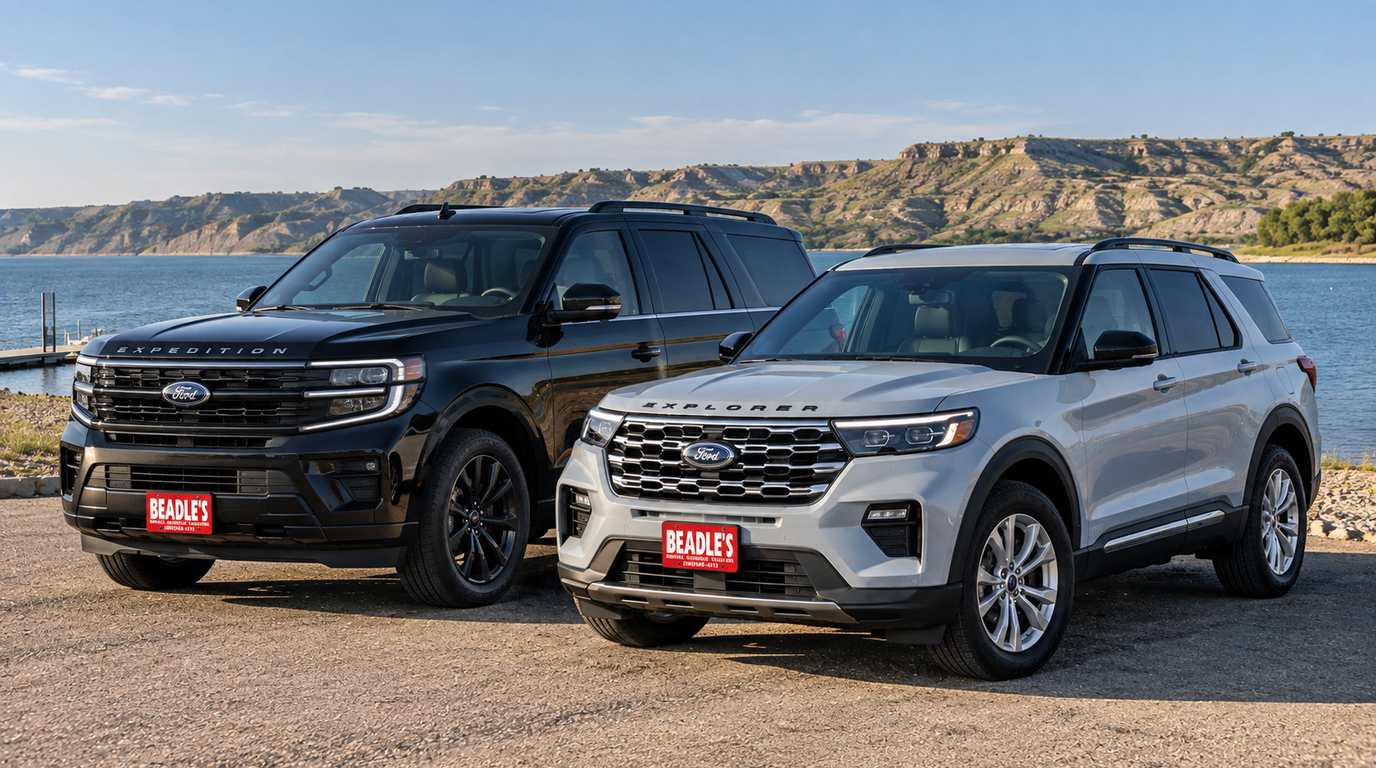
2027 Ford Explorer next to a 2027 Ford Expedition at Lake Oahe, comparing Ford three-row SUVs at Beadle Ford

Ford Explorer vs. Expedition: Which Ford Three-Row Should You Buy?

Home› Ford Explorer› 2027 Ford Explorer› Explorer vs. Expedition Quick Answer Buy the Explorer unless you specifically need what the Expedition adds. The Expedition is much longer, seats eight with an adult-sized third row, and tows 9,600 lbs against the Explorer’s 5,000. The Explorer is easier to park, cheaper to buy and fuel, and enough SUV for most families — step up only if you tow a big camper or regularly carry eight people. We sell both, so this one is not a sales pitch for either. The Explorer and the Expedition are both three-row Fords, both on the lot in Bowdle in 2026 and 2027 model years, and they are built for different jobs. Buying the Expedition when an Explorer would do costs you money every month at the pump and every time you park. Buying the Explorer when you needed the Expedition costs you the trailer you cannot pull and the third row the adults will not sit in. This guide puts the two side by side on size, seating and third-row room, towing, engines, fuel, and price, then tells you which families end up in which one. Full guides for each: the 2027 Ford Explorer Buyers Guide and the 2027 Ford Expedition Buyers Guide. Get Pre-Approved Shop Explorer Inventory On This Page The short answer Size: what a foot of length means The third row and cargo Towing: 5,000 vs. 9,600 lbs Engines and fuel Price and which families end up where The short answer Buy the Explorer if your trailer is under 5,000 lbs (a fishing boat, a small camper, a snowmobile trailer), the third row is for kids most of the time, and you want the vehicle that is easier to park, cheaper to buy, and lighter on fuel. It is the right three-row for most families. Buy the Expedition if you tow more than 5,000 lbs (a stock trailer, a tandem-axle camper, a bigger boat), you regularly put adults in the third row, or you need the cargo room of a full-size body-on-frame SUV. It tows up to 9,600 lbs and seats up to eight. Size: what a foot of length means 2027 Ford Explorer 2027 Ford Expedition Construction Unibody, rear-drive based Body-on-frame (F-150 platform), rear-drive based Length 198.7 in About 210 in (Expedition MAX is longer) Wheelbase 119.1 in About 122.5 in (MAX longer) Width (no mirrors) 78.9 in Wider Seating Up to 7 (6 on Tremor) Up to 8 Cargo behind 3rd row 16.3 cu ft Considerably more; see the Expedition guide Explorer figures are Ford’s 2027 specifications. Expedition dimensions are approximate; confirm on the 2027 Expedition guide. Roughly a foot of length and a body-on-frame construction is the whole story of the Expedition. It is what makes the third row adult-sized, the cargo area big enough for a family’s luggage with all three rows up, and the tow rating nearly double. It is also what you feel in a school pickup line, a parking ramp in Sioux Falls, and a two-car garage that was built in 1975. The Explorer fits places the Expedition does not, and for a lot of families that is the deciding factor. The third row and cargo The Explorer’s third row is a kids’ row and an occasional-adult row. With it up there are 16.3 cubic feet behind it, which handles the hockey bags and the groceries; with rows two and three down there are 85.3 cubic feet. The Expedition’s third row is an adult row, and its cargo area with all three rows up is large enough for a week’s luggage. If your regular load is three teenagers plus a friend plus their gear, or grandparents in the third row on the drive to Rapid City, the Expedition is the one that does it without complaint. If your regular load is two car seats in the second row, kids in the back a few times a month, and a dog, the Explorer’s space is right-sized and the extra room in the Expedition is room you pay to carry around empty. Towing: 5,000 vs. 9,600 lbs This is the cleanest dividing line. The 2027 Explorer tows up to 5,000 lbs on every trim with either engine, Class III hitch standard. The 2027 Expedition tows up to 9,600 lbs on 4x4 models with the Heavy-Duty Trailer Tow Package, and 6,000 to 6,300 lbs on 4x2 models, all when properly equipped. Under 5,000 lbs (most aluminum fishing boats on a single-axle trailer, a two-place snowmobile trailer, a small travel trailer, a utility trailer): Explorer. 5,000 to 9,600 lbs (a tandem-axle camper, a bigger fiberglass boat, a stock or flatbed trailer): Expedition. Weigh what you actually pull, loaded, including the trailer. A lot of families guess low. If the honest number is close to 5,000, go Expedition; towing at the limit every weekend is hard on a vehicle and on the driver. Explorer towing details are in the Explorer Buyers Guide towing section. Not sure which Ford three-row? Tell us what you tow and who rides in the third row. We will put you in the right one, and both are on the lot. Shop Explorers in Stock Ask About a Custom Order Engines and fuel 2027 Ford Explorer 2027 Ford Expedition Standard engine 2.3L EcoBoost I-4, 300 hp / 310 lb-ft 3.5L EcoBoost V6, 400 hp / 480 lb-ft Available engine 3.0L EcoBoost V6, up to 400 hp / 415 lb-ft 3.5L EcoBoost V6 High Output, 440 hp / 510 lb-ft (Tremor and Platinum performance builds) Transmission 10-speed automatic 10-speed automatic Fuel economy 2.3L 4WD: 20 / 27 / 23 mpg (EPA) See the window sticker on each unit Fuel tank 17.9 gal (2.3L) / 20.2 gal (3.0L) Larger Ford published figures. Towing requires proper equipment. The Expedition starts where the Explorer tops out: its base engine makes 400 horsepower and 480 lb-ft, and the High Output version makes 440 and 510. That is what moves a 9,600-lb trailer. The cost is fuel. The Explorer 2.3L 4WD is EPA-rated at 23 mpg combined, and a full-size body-on-frame SUV with a twin-turbo V6 is not going to match it; check the sticker on the specific Expedition, but plan on a meaningful difference at 15,000 miles a year. If you do not need the towing, the Explorer’s 300-hp four is plenty and the savings are real. Price and which families end up where The 2027 Explorer starts at $38,465 (Active 100A RWD) and tops out at $56,460 (Tremor 801A) before options and $1,795 destination. The Expedition starts well above the Explorer’s base and a loaded Platinum runs well into the upper range of the Ford SUV lineup; the current numbers are in the 2027 Expedition Buyers Guide and on the window stickers on our lot. As a rule, an Explorer trim costs roughly what the Expedition trim one step below it costs. Who ends up in what, from our lot: growing families with kids under twelve, a boat, and a gravel road go Explorer, usually an Active 200A 4WD or an ST-Line, and the Tremor if they hunt. Families with teenagers and a camper, ranch families with a stock trailer, and anyone who regularly fills all three rows with adults go Expedition. Empty nesters trading down from an Expedition go Explorer Platinum, and for 2027 the V6 makes that trade-down easy: Platinum 2.3L or 3.0L V6. Both are on the lot in Bowdle in both model years, parked close enough to walk between. Shop the Explorers in stock, shop the Expeditions, and get pre-approved so the payment on each is a known number before you decide. Key Takeaways Explorer: up to 5,000 lbs towing, up to 7 seats, 198.7 inches long, from $38,465. Expedition: up to 9,600 lbs, up to 8 seats, about a foot longer, priced well above. The trailer decides it. Under 5,000 lbs loaded, Explorer. Over, Expedition. The Explorer’s third row is for kids and occasional adults; the Expedition’s is adult-sized with real cargo room behind it. Expedition starts at 400 hp / 480 lb-ft; Explorer at 300 hp / 310 lb-ft with a 400-hp V6 available. The Explorer is the fuel-economy choice. Both are on the Beadle Ford lot in 2026 and 2027 model years; drive both before you decide. Frequently Asked Questions What is the difference between the Ford Explorer and the Ford Expedition? The Explorer is a unibody midsize three-row SUV, 198.7 inches long, seating up to seven and towing up to 5,000 lbs. The Expedition is a body-on-frame full-size SUV built on the F-150 platform, roughly a foot longer, seating up to eight and towing up to 9,600 lbs when properly equipped. How much more can the Expedition tow than the Explorer? Up to 4,600 lbs more. The 2027 Explorer tows up to 5,000 lbs on every trim. The 2027 Expedition tows up to 9,600 lbs on 4x4 models with the Heavy-Duty Trailer Tow Package, and 6,000 to 6,300 lbs on 4x2 models. Is the Explorer’s third row big enough for adults? For short trips, yes. For regular adult use or long drives, the Expedition’s third row is the adult-sized one. The Explorer’s third row is best for kids and teenagers, with 16.3 cubic feet of cargo behind it. Which gets better fuel economy, the Explorer or the Expedition? The Explorer. Its 2.3L 4WD is EPA-rated 20 city / 27 highway / 23 combined. The Expedition’s 3.5L twin-turbo V6 in a full-size body-on-frame SUV uses noticeably more fuel; check the window sticker on a specific unit. Which is cheaper, the Explorer or the Expedition? The Explorer. The 2027 Explorer starts at $38,465 (plus $1,795 destination) and tops out at $56,460 before options. The Expedition starts well above the Explorer’s base and a loaded Expedition Platinum is priced well above the top Explorer; see the 2027 Expedition Buyers Guide for current figures. Are the Explorer and Expedition both on the lot at Beadle Ford? Yes. Beadle Ford in Bowdle, SD, has both 2026 and 2027 Explorers and Expeditions in stock. Shop Explorer and Expedition inventory online or contact us to compare specific units. My Take Because we sell both, I get to be honest here. About two out of three families who come in asking about an Expedition leave in an Explorer, because when we weigh their actual trailer and count who actually rides in the third row, the Explorer does the job and saves them real money every month. The other third genuinely needs the Expedition, and I would never put them in something smaller. Tell us what you pull and who rides where. That conversation takes ten minutes and it is the whole decision. Shop Explorer Inventory Get Pre-Approved Contact Beadle Ford About the Author Lexy Tabbert — Beadle Ford, Bowdle, SD Lexy Tabbert is the Director of Sales and Marketing at Beadle Ford in Bowdle, South Dakota. She covers Ford vehicles, trim comparisons, and buyer guidance — helping families, ranchers, and ag operators across the region find the right truck and configuration for their needs. Learn more about Lexy.
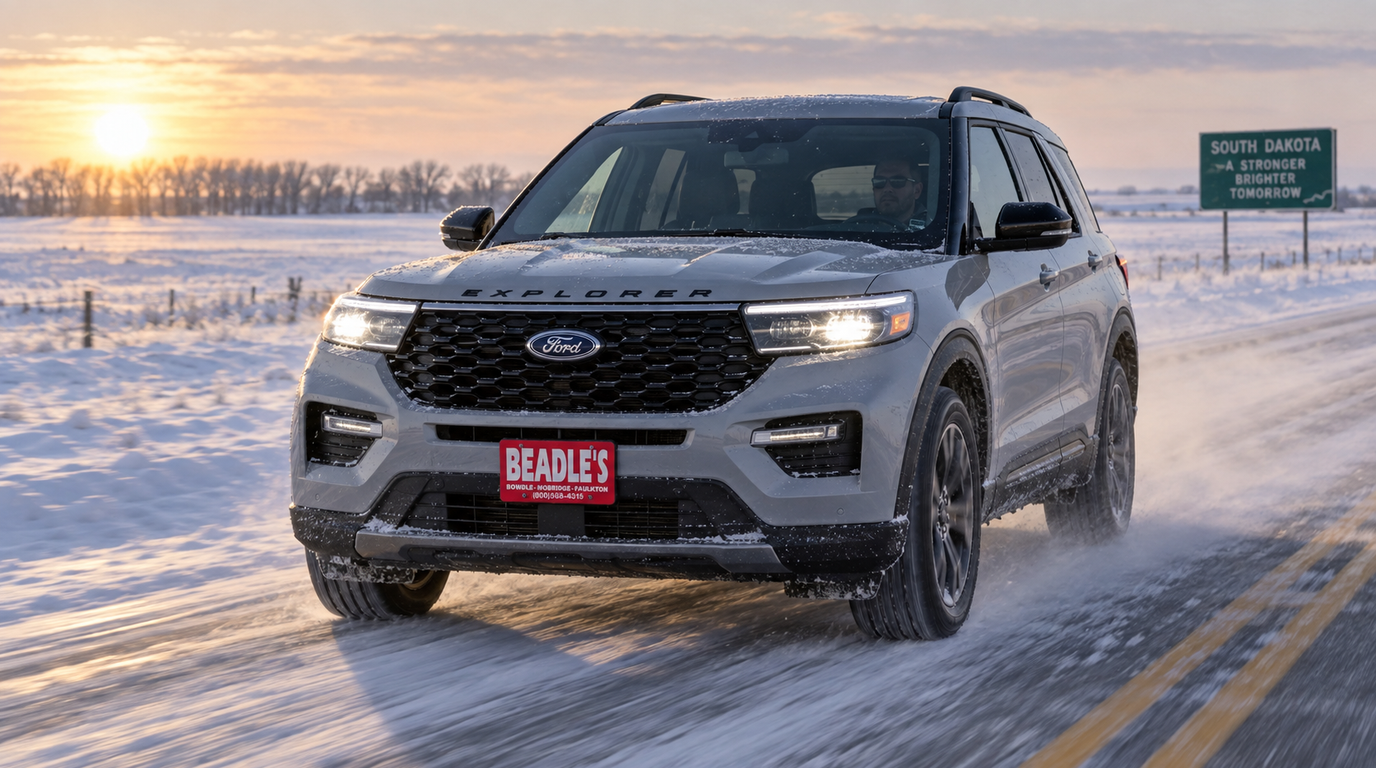
2027 Ford Explorer 4WD on a snowy South Dakota highway in January, winter-ready at Beadle Ford in Bowdle

2027 Ford Explorer vs. Jeep Grand Cherokee L: Three Rows, Towing, and Winter Compared

Home› Ford Explorer› 2027 Ford Explorer› vs. Grand Cherokee L Quick Answer The Grand Cherokee L tows more — 6,200 lbs against the Explorer’s 5,000 — and offers the Hurricane inline-six. The Explorer counters with slightly more maximum cargo room (85.3 vs. 84.6 cubic feet), the Tremor and ST trims, and a simpler Intelligent 4WD system. If towing is the priority, take the Jeep; for family hauling and winter confidence at a lower starting price, take the Explorer. The Jeep Grand Cherokee L is the three-row that our Tremor shoppers and our ranch families cross-shop, because Jeep’s reputation for 4x4 is earned. The comparison is closer than the Toyota or Honda one: both are rear-drive-based, both offer real four-wheel-drive systems, and both have an available turbo engine with more than 320 horsepower. The differences are in towing, the off-road trims, interior space, and price. This guide compares the 2027 Explorer and the 2026 Grand Cherokee L on engines, towing, 4WD systems, off-road trims, space, tech, and price. Jeep figures are from Jeep’s published 2026 Grand Cherokee L specifications; Explorer figures are Ford’s 2027 numbers from the 2027 Ford Explorer Buyers Guide. Get Pre-Approved Shop Explorer Inventory On This Page The short answer Engines and towing 4WD systems and winter Tremor vs. the Jeep lineup Three-row space and interior Tech and price The short answer The Grand Cherokee L tows more (up to 6,200 lbs with the V6 against the Explorer’s 5,000), offers an air suspension on upper trims, and carries the Jeep badge. If your trailer is between 5,000 and 6,200 lbs, that settles it. The Explorer has more standard power (300 hp vs. 293), more available power (up to 400 hp vs. 324), a factory off-road trim with all-terrain tires and a limited-slip rear on a three-row body (Jeep’s Trailhawk is two-row only), BlueCruise hands-free driving, a lower starting price, and it is on the lot in Bowdle in two model years. For most families who tow a boat or a small camper and drive gravel, the Explorer does the job for less. Engines and towing 2027 Ford Explorer 2026 Jeep Grand Cherokee L Standard engine 2.3L EcoBoost I-4, 300 hp / 310 lb-ft 3.6L Pentastar V6, 293 hp / 260 lb-ft Available engine 3.0L EcoBoost V6, up to 400 hp / 415 lb-ft 2.0L Hurricane turbo I-4, 324 hp / 332 lb-ft Transmission 10-speed automatic 8-speed automatic Max towing 5,000 lbs, every trim Up to 6,200 lbs, properly equipped Fuel tank 17.9 gal (2.3L) / 20.2 gal (3.0L) Per Jeep specifications Explorer figures are Ford’s published 2027 specifications; towing requires proper equipment. Jeep figures per Jeep’s 2026 published specifications. Torque is the number to look at. The Explorer’s base turbo four makes 50 lb-ft more than Jeep’s base V6, and it makes it low in the rev range, which is what you feel with a loaded trailer. Jeep’s Hurricane four is a strong engine at 324 hp and 332 lb-ft; the Explorer’s 3.0L V6 answers it with up to 400 hp and 415 lb-ft on the ST, the Tremor 801A, and the Platinum. Where Jeep wins outright is the tow rating: 6,200 lbs is 1,200 more than any Explorer. If you are towing a tandem-axle camper near that number, buy the Jeep, or come look at an Expedition. 4WD systems and winter Both are rear-drive-based, which is the right starting point for towing and for ice. The Explorer’s Intelligent 4WD has seven drive modes including Slippery and Deep Snow/Sand, Hill Descent Control, and on the Tremor a TORSEN limited-slip rear axle that puts torque to the wheel with grip mechanically. Jeep offers its Quadra-Trac 4x4 systems on the Grand Cherokee L, with Quadra-Drive II and an electronic limited-slip rear on upper trims, plus the Selec-Terrain modes. On a snow-packed highway or an icy intersection in Mobridge, both are excellent, and I would not pick one over the other for that alone. Ground clearance is similar in standard form (the Explorer runs 7.6 to 8.7 inches depending on trim); Jeep’s Quadra-Lift air suspension on upper trims can raise it further, which is a genuine Jeep advantage on a deeply rutted two-track, at a price. Tremor vs. the Jeep lineup Here is the detail that surprises Jeep shoppers: the Trailhawk trim, Jeep’s off-road package with all-terrain tires and skid plates, is offered only on the two-row Grand Cherokee. There is no Grand Cherokee L Trailhawk. If you need three rows and want factory off-road hardware from Jeep, the answer is an Overland or Summit with the air suspension, which is a luxury build at a luxury price. The Explorer Tremor is that missing vehicle: a three-row with P265/65R18 all-terrain tires, front and rear underbody deflector plates, front tow hooks, auxiliary grille lights, a TORSEN limited-slip rear, 8.7 inches of clearance, and 4WD only, from $49,200 with the 2.3L or $56,460 with the V6 (plus $1,795 destination). It is not a Wrangler or a Bronco, and it is not trying to be. It is the three-row that handles the section road, the two-track to the stand, and the boat ramp without asking you to give up the third row. The full Tremor guide. Three rows and gravel roads? Drive an Explorer Tremor on the section road behind the dealership. That is the comparison Jeep cannot offer on a three-row. Shop Tremors in Stock Ask About a Custom Order Three-row space and interior The Grand Cherokee L seats six or seven and Jeep lists up to 84.6 cubic feet of cargo with the rear rows folded. The 2027 Explorer seats up to seven (six on the Tremor) with 16.3 cubic feet behind the third row and up to 85.3 cubic feet folded. These two are effectively the same size inside; neither has the Grand Highlander’s or Pilot’s extra room, and neither needs it for a family of five with hockey gear. Interior character is where they differ. The Grand Cherokee L leans luxurious even on lower trims and can be optioned into Lincoln territory on a Summit Reserve. The Explorer spends its money differently: standard tri-zone climate, standard second-row captain’s chairs, a power-fold third row on ST, Platinum, and Tremor 801A, and on the Platinum multicontour seats, a 14-speaker B&O system, and BlueCruise included for a year plus 90 days. Tech and price Both have big screens and full driver-assist suites. The Explorer’s 13.2-inch touchscreen runs Google built in with wireless CarPlay and Android Auto, 5G, and over-the-air updates; Jeep’s Uconnect is a good system with its own strengths, including an available passenger screen. The Explorer’s advantage is BlueCruise, which Jeep does not offer on the Grand Cherokee L. BlueCruise vs. the other hands-free systems. Price: the 2027 Explorer Active 100A starts at $38,465 in RWD and $40,465 in 4WD, plus $1,795 destination. Jeep lists the 2026 Grand Cherokee L Laredo from $41,990 before destination, and 4x4 is extra. Trim for trim the Explorer starts a few thousand dollars lower and the gap widens at the top, where a loaded Summit Reserve sits well above a V6 Platinum. Every Explorer trim and price: 2027 Explorer trim levels. Both model years are on the lot: see what is in stock and get pre-approved before you come in. Key Takeaways Grand Cherokee L tows more: up to 6,200 lbs vs. the Explorer’s 5,000. If your trailer is in that range, that decides it. Explorer has more standard power (300 vs. 293 hp) and more available power (400 vs. 324 hp). Jeep’s Trailhawk is two-row only. The Explorer Tremor is the factory off-road three-row, with all-terrain tires, plates, hooks, and a TORSEN rear. Both are rear-drive-based with capable 4WD; Jeep offers an air suspension on upper trims, Ford offers BlueCruise. Explorer starts a few thousand lower ($38,465 vs. $41,990 before destination), and both model years are on the lot in Bowdle. Frequently Asked Questions Does the Grand Cherokee L tow more than the Explorer? Yes. Jeep rates the 2026 Grand Cherokee L at up to 6,200 lbs when properly equipped. The 2027 Explorer is rated at up to 5,000 lbs on every trim. If you tow between 5,000 and 6,200 lbs, the Jeep or a Ford Expedition is the right answer. Which has more horsepower, the Explorer or the Grand Cherokee L? The Explorer. Its 2.3L EcoBoost makes 300 hp and 310 lb-ft standard against the Jeep’s 293-hp, 260-lb-ft 3.6L V6, and the Explorer’s available 3.0L V6 makes up to 400 hp against the Jeep’s 324-hp 2.0L Hurricane. Is there a Grand Cherokee L Trailhawk? No. Jeep offers the Trailhawk off-road trim only on the two-row Grand Cherokee. The three-row Grand Cherokee L is offered in trims such as Laredo, Limited, Overland, and Summit. The Explorer Tremor is the factory off-road three-row in this comparison. Which is better in snow, the Explorer or the Grand Cherokee L? Both are rear-drive-based with capable four-wheel-drive systems and are excellent in winter. The Explorer adds Deep Snow/Sand and Slippery drive modes and, on the Tremor, a TORSEN limited-slip rear and all-terrain tires; Jeep’s upper trims offer Quadra-Drive II and an air suspension. Which is bigger inside? They are close. The Grand Cherokee L seats six or seven with up to 84.6 cubic feet of cargo folded; the Explorer seats up to seven with 16.3 cubic feet behind the third row and up to 85.3 cubic feet folded. Which costs less, the Explorer or the Grand Cherokee L? The 2027 Explorer Active starts at $38,465 before $1,795 destination. Jeep lists the 2026 Grand Cherokee L Laredo from $41,990 before destination, with 4x4 extra. My Take This is the comparison I respect most, because the Grand Cherokee L is a good truck and the Jeep buyer usually knows exactly what they want. My honest read: if the tow rating matters, Jeep wins and I will say so. If three rows plus real gravel capability is the job, the Explorer Tremor is the only one of the two that offers it, and it costs less than the Jeep you would have to build to get close. Drive the Tremor on the section road behind the store. Then go drive the Jeep. I am comfortable with where that ends up. Shop Explorer Inventory Get Pre-Approved Contact Beadle Ford About the Author Lexy Tabbert — Beadle Ford, Bowdle, SD Lexy Tabbert is the Director of Sales and Marketing at Beadle Ford in Bowdle, South Dakota. She covers Ford vehicles, trim comparisons, and buyer guidance — helping families, ranchers, and ag operators across the region find the right truck and configuration for their needs. Learn more about Lexy.
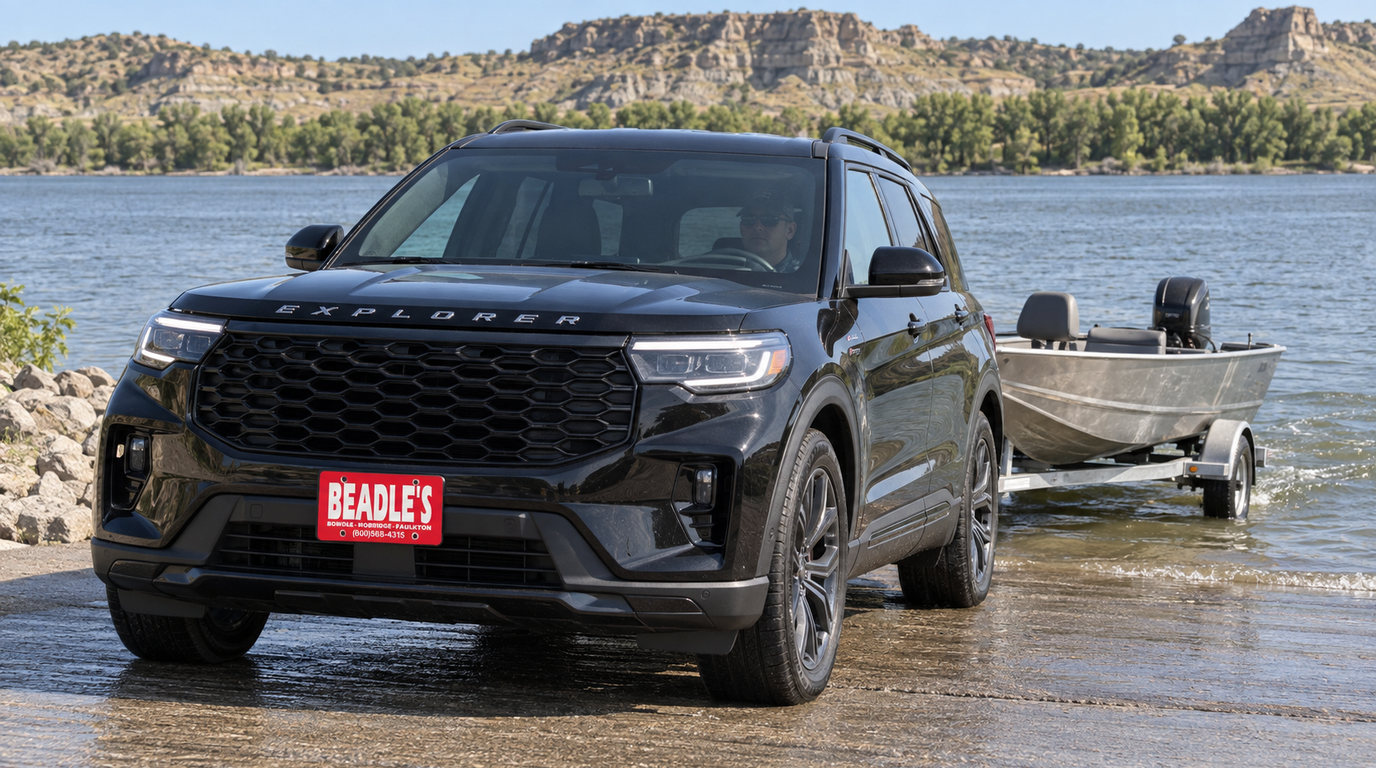
2027 Ford Explorer towing a fishing boat at a Lake Oahe boat ramp, 5,000-lb towing at Beadle Ford in Bowdle SD

2027 Ford Explorer vs. Honda Pilot: Turbo Four, V6, 4WD, and Towing Compared

Home› Ford Explorer› 2027 Ford Explorer› vs. Honda Pilot Quick Answer The Explorer’s 300-hp 2.3L EcoBoost outmuscles the Pilot’s 285-hp V6, and every Explorer tows 5,000 lbs where a Pilot needs AWD to get there (3,500 lbs with front-wheel drive). The Explorer also offers true 4WD plus the Tremor and ST; the Pilot answers with a roomier, squarer cabin and the TrailSport. For South Dakota winters and towing, the Explorer is the stronger pick. The Honda Pilot is the other three-row that shows up in our trade lane most often, usually a 2018 to 2023 that has been a good vehicle. Pilot owners who come to look at an Explorer tend to ask the same three things: is the turbo four as good as the V6 they have, does the Explorer tow more, and is Ford’s 4WD better than Honda’s AWD in the winter. Fair questions, with clear answers. This guide compares the 2027 Explorer and the 2026 Pilot on engines, towing, all-weather capability, the off-road trims, space, tech, and price. Honda figures are from Honda’s published 2026 Pilot specifications; Explorer figures are Ford’s 2027 numbers from the 2027 Ford Explorer Buyers Guide. Get Pre-Approved Shop Explorer Inventory On This Page The short answer Engines: 300-hp turbo four vs. 285-hp V6 Winter: Ford Intelligent 4WD vs. Honda i-VTM4 AWD Seating, cargo, and the third row Technology and driver assistance Price The short answer The Pilot is the roomier vehicle, with up to eight seats and more total cargo volume, and its naturally aspirated V6 is a known quantity. If you want maximum interior space and you do not tow, it is a fine choice. The Explorer has more power from its base engine than the Pilot has from its only engine, tows 5,000 lbs on every trim (the Pilot needs AWD to get there; front-drive Pilots are rated at 3,500), runs a rear-drive-based 4WD system, offers a V6 with up to 400 hp and a true off-road Tremor trim, and starts lower. For a family that tows a boat or a camper and drives gravel, the Explorer is the better fit. Engines: 300-hp turbo four vs. 285-hp V6 2027 Ford Explorer 2026 Honda Pilot Standard engine 2.3L EcoBoost I-4, 300 hp / 310 lb-ft 3.5L V6, 285 hp / 262 lb-ft Available engine 3.0L EcoBoost V6, up to 400 hp / 415 lb-ft None; one engine across the lineup Transmission 10-speed automatic 10-speed automatic Drive RWD or Intelligent 4WD (rear-drive based) FWD or i-VTM4 AWD (front-drive based) Max towing 5,000 lbs, every trim and both engines 5,000 lbs AWD; 3,500 lbs FWD Explorer figures are Ford’s published 2027 specifications; towing requires proper equipment. Honda figures per Honda’s 2026 published specifications. The Pilot’s 3.5L V6 is smooth and durable, and Pilot owners like it. But 262 lb-ft of torque arriving high in the rev range is the reason a loaded Pilot on a grade with a trailer behind it feels busy. The Explorer’s 2.3L EcoBoost makes 310 lb-ft at low rpm, which is what you feel pulling out of a boat ramp or passing on US-12. And the Explorer has a second answer the Pilot does not: the 3.0L V6 at up to 400 hp on the ST, the Tremor 801A, and now the Platinum. Winter: Ford Intelligent 4WD vs. Honda i-VTM4 AWD Honda’s i-VTM4 is a good torque-vectoring AWD system on a front-drive platform. The Explorer is built the other way around: rear-drive based, with Intelligent 4WD that sends power forward as needed, seven drive modes including Slippery and Deep Snow/Sand, and Hill Descent Control on every 4WD model. In everyday snow both are capable. Where the difference shows is towing on a slick ramp, starting on an icy hill with a load, and driving rutted gravel, where a rear-biased layout keeps the front tires steering instead of pulling. Both brands have an off-road trim. The Pilot TrailSport adds all-terrain tires, a lifted suspension, and skid plates to the AWD Pilot. The Explorer Tremor adds all-terrain tires, front and rear underbody plates, front tow hooks, auxiliary grille lights, 8.7 inches of ground clearance, and a TORSEN limited-slip rear axle, on a 4WD-only build, with the 300-hp 2.3L or the 400-hp V6. The Tremor guide has the full hardware list. Trading a Pilot? Bring it to Bowdle. We will appraise it, and you can drive the Explorer 4WD on gravel the same afternoon. Shop Explorers in Stock Ask About a Custom Order Seating, cargo, and the third row The Pilot is the bigger box. It seats up to eight, Honda lists 18.6 cubic feet behind the third row, and its total cargo volume with the rear rows folded is greater than the Explorer’s. The 2027 Explorer seats up to seven, with 16.3 cubic feet behind the third row and up to 85.3 cubic feet folded. If cargo volume is the one number you are buying on, Honda has it. In use, the differences are smaller than the table suggests. Both fit hockey bags behind the third row. Both have second-row captain’s chairs available (standard on the Explorer, which is the layout car-seat families want). The Explorer’s third row is power-folding on ST, Platinum, and Tremor 801A, and tri-zone climate control is standard on every trim. Bring your gear to the lot and load it; that is how our customers actually decide. Technology and driver assistance The Explorer runs a 13.2-inch touchscreen with Google built in, a 12.3-inch digital cluster, wireless Apple CarPlay and Android Auto, a 5G modem, and over-the-air updates on every trim, with Ford Co-Pilot360™ Assist+ standard and the 360-degree camera from ST-Line up. The Pilot’s screens are smaller, Honda Sensing is standard, and wireless CarPlay depends on trim. The bigger gap is hands-free driving. BlueCruise is included on the Explorer Platinum for a year plus 90 days, trial-included on ST and Tremor 801A, and optional on ST-Line and Tremor 800A. Honda does not offer a hands-free highway system on the Pilot. On the long drives that define living out here, that matters. How BlueCruise compares with GM and Nissan. Price The 2027 Explorer Active 100A starts at $38,465 in RWD and $40,465 in 4WD, plus $1,795 destination, with the Class III tow package already on it. Honda lists the 2026 Pilot Sport from $42,395 in front-wheel drive, before destination, and AWD is required for the 5,000-lb tow rating. So the Explorer that tows 5,000 lbs starts roughly $2,000 below the Pilot that tows 3,500. Every Explorer trim and price: 2027 Explorer trim levels. And both the 2026 and 2027 Explorer are on the lot at Beadle Ford. See the Explorers in stock, bring the Pilot for an appraisal, and get pre-approved first if you want the numbers settled before you drive out. Key Takeaways Explorer: 300 hp standard, up to 400 hp available, 310 to 415 lb-ft. Pilot: one 285-hp V6 with 262 lb-ft. Every Explorer tows 5,000 lbs; the Pilot tows 5,000 only with AWD (3,500 in FWD). Explorer is rear-drive-based 4WD with Deep Snow and Slippery modes; the Tremor adds a TORSEN axle, plates, and hooks the TrailSport does not have. Pilot is roomier: up to 8 seats and more total cargo. Explorer: up to 7, 16.3 / 85.3 cu ft. Explorer starts around $2,000 lower, offers BlueCruise, and both model years are on the lot in Bowdle. Frequently Asked Questions Which has more horsepower, the Explorer or the Pilot? The Explorer. Its standard 2.3L EcoBoost makes 300 hp and 310 lb-ft against the Pilot’s 285-hp, 262-lb-ft V6, and the Explorer’s available 3.0L V6 makes up to 400 hp. The Pilot offers one engine. Does the Explorer or the Pilot tow more? Both max out at 5,000 lbs, but every 2027 Explorer trim is rated for 5,000 lbs with a Class III package standard. The Pilot is rated at 5,000 lbs only with AWD; front-wheel-drive Pilots are rated at 3,500 lbs. Is the Pilot bigger inside than the Explorer? Yes. The Pilot seats up to eight with 18.6 cubic feet behind the third row and more total cargo volume. The Explorer seats up to seven with 16.3 cubic feet behind the third row and up to 85.3 cubic feet folded. Explorer Tremor vs. Pilot TrailSport: which is more capable? The Tremor. Both add all-terrain tires and skid plates, but the Tremor also has a TORSEN limited-slip rear axle, front tow hooks, 8.7 inches of ground clearance, a rear-drive-based 4WD system, and up to 400 hp with the 801A V6. Does the Honda Pilot have hands-free driving like BlueCruise? No. Honda Sensing includes adaptive cruise and lane keeping but not a hands-free highway system. BlueCruise is included on the Explorer Platinum and trial-included on ST and Tremor 801A. Which is cheaper, the Explorer or the Pilot? The 2027 Explorer Active starts at $38,465 before $1,795 destination. Honda lists the 2026 Pilot Sport from $42,395 in FWD before destination. Trim for trim the Explorer starts lower. My Take Pilot owners are usually happy Pilot owners, and I do not try to talk them out of that. What I show them is the tow rating on a front-drive Pilot, the torque number on the Explorer’s base engine, and then I hand them the keys to a 4WD Explorer and point at the gravel road behind the dealership. Most of them come back with the decision made. If your Pilot has been good to you and you never tow, keep shopping both. If a boat or a camper is in your future, the Explorer is the one built for it, and it costs less to start. Shop Explorer Inventory Get Pre-Approved Contact Beadle Ford About the Author Lexy Tabbert — Beadle Ford, Bowdle, SD Lexy Tabbert is the Director of Sales and Marketing at Beadle Ford in Bowdle, South Dakota. She covers Ford vehicles, trim comparisons, and buyer guidance — helping families, ranchers, and ag operators across the region find the right truck and configuration for their needs. Learn more about Lexy.
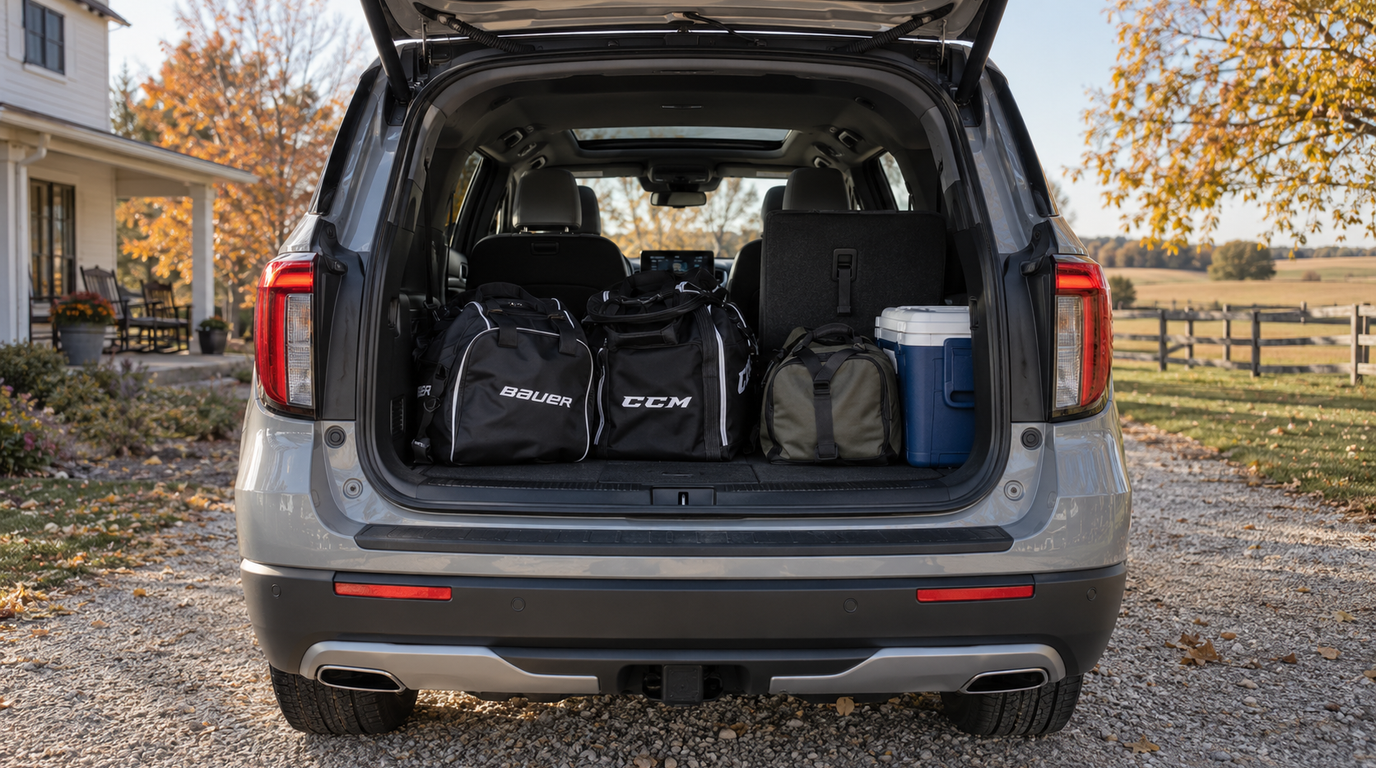
2027 Ford Explorer cargo area with the third row folded and hockey bags loaded, family room at Beadle Ford Bowdle SD

2027 Ford Explorer vs. Toyota Grand Highlander: Which Three-Row Fits Your Family?

Home› Ford Explorer› 2027 Ford Explorer› vs. Grand Highlander Quick Answer The Grand Highlander is the roomier box with hybrid powertrains and a genuine eight-seat layout; the Explorer is rear-drive-based with available 4WD and far more power at the top of the range. Both tow 5,000 lbs properly equipped. Choose the Grand Highlander for third-row space and fuel economy, and the Explorer for winter traction, how it drives, and the Tremor and ST versions Toyota has no answer for. The Toyota Grand Highlander is the three-row most of our Explorer shoppers cross-shop, and it deserves the comparison: it is roomy, it is well built, and the hybrid options are real. The 2027 Explorer answers with more power at every price, a 4WD system built on a rear-drive layout, an off-road trim Toyota does not offer, and a lower starting price. Which one is right depends on what your family actually does with it. This is a straight comparison on the things that matter here: engines, towing, third-row and cargo space, winter capability, tech, and price. Toyota figures are from Toyota’s published 2026 Grand Highlander specifications and should be confirmed on a specific unit. Explorer figures are Ford’s 2027 numbers from the 2027 Ford Explorer Buyers Guide. Get Pre-Approved Shop Explorer Inventory On This Page The short answer Engines: EcoBoost vs. turbo four and hybrids Third row, cargo, and seating Winter and gravel: 4WD vs. AWD Technology and driver assistance Price The short answer Pick the Grand Highlander if you want a hybrid, if you regularly carry adults in the third row, or if maximum cargo volume is the deciding factor. It is a larger vehicle inside, with up to eight seats and more cargo space than the Explorer. Pick the Explorer if you want more power for the money (300 hp standard, up to 400 hp available, against Toyota’s 265-hp turbo four), a rear-drive-based 4WD system with real drive modes and an off-road Tremor trim, a lower starting price, or the ability to walk onto the lot in Bowdle and drive one home today. Both tow 5,000 lbs when properly equipped, so the boat is not the tiebreaker. Engines: EcoBoost vs. turbo four and hybrids 2027 Ford Explorer 2026 Toyota Grand Highlander Standard engine 2.3L EcoBoost I-4, 300 hp / 310 lb-ft, 10-speed automatic 2.4L turbo I-4, 265 hp / 310 lb-ft, 8-speed automatic Available engine 3.0L EcoBoost V6, up to 400 hp / 415 lb-ft (ST, Tremor 801A, Platinum) 2.5L Hybrid, 245 hp combined; Hybrid MAX 2.4L turbo hybrid, 362 hp Drive RWD or Intelligent 4WD (rear-drive based) FWD or AWD (front-drive based); Hybrid MAX is AWD Max towing 5,000 lbs, every trim 5,000 lbs, properly equipped Fuel economy 2.3L 4WD: 20 / 27 / 23 mpg (EPA); other combinations not yet posted Varies by powertrain; the 2.5L Hybrid is the efficiency leader Explorer figures are Ford’s published 2027 specifications; towing requires proper equipment. Toyota figures per Toyota’s 2026 published specifications. The gap at the base is the headline: an Explorer Active 100A has 35 more horsepower than a Grand Highlander LE and costs less. At the top, Toyota’s Hybrid MAX is a strong engine at 362 hp, and the Explorer ST and V6 Platinum answer it with up to 400 hp. Where Toyota clearly wins is the 2.5L Hybrid: if your priority is fuel economy over power, the Explorer does not offer a hybrid, and I am not going to pretend otherwise. Explorer details by engine: Platinum 2.3L or 3.0L. Third row, cargo, and seating The Grand Highlander was designed around the third row, and it shows. It seats up to eight and Toyota lists up to 97.5 cubic feet of cargo with the rear rows folded. The Explorer seats up to seven and lists 16.3 cubic feet behind the third row and up to 85.3 cubic feet folded. If you regularly haul three teenagers plus their friends, or you need the third row to be adult-comfortable on a three-hour drive, the Toyota has the edge on room. Where the Explorer’s space works: the second-row captain’s chairs are standard, which is the configuration most families with car seats prefer; the third row folds flat and is power-folding on ST, Platinum, and Tremor 801A; and 16.3 cubic feet behind the third row is enough for the hockey bags with the seats up. Come put your actual gear in the back of one on our lot. That settles this faster than any table. Bring the hockey bags Load your real gear into an Explorer on the lot in Bowdle. It settles the space question faster than any spec sheet. Shop Explorers in Stock Ask About a Custom Order Winter and gravel: 4WD vs. AWD This is where the layouts matter. The Explorer is rear-drive based with Intelligent 4WD, seven selectable drive modes including Slippery and Deep Snow/Sand, and Hill Descent Control. The Grand Highlander is front-drive based with an on-demand AWD system. On a snow-packed highway both will get you there. On a rutted section road, a soft boat ramp, or a hill in an ice storm, a rear-drive-based 4WD with a true Deep Snow mode is more composed and more predictable, and the Explorer’s 7.6 to 8.7 inches of ground clearance depending on trim helps. Toyota does not offer a Grand Highlander with all-terrain tires, skid plates, or a limited-slip rear. The Explorer Tremor has all three, plus front tow hooks, on a three-row family vehicle. If any part of your driving leaves pavement on purpose, that is a category Toyota is not in. The 2027 Explorer Tremor guide covers it. Technology and driver assistance Both have the modern basics: a large center screen, wireless Apple CarPlay and Android Auto, a digital cluster, and a full driver-assist suite standard. The Explorer’s 13.2-inch touchscreen runs the Ford Digital Experience with Google built in (Google Maps, Google Assistant, Google Play) and takes over-the-air updates through a 5G modem. Ford Co-Pilot360™ Assist+ is standard on every Explorer, with the 360-degree camera from ST-Line up. Toyota Safety Sense is standard on every Grand Highlander. The Explorer’s tech edge is BlueCruise: hands-free highway driving that is included on Platinum for a year plus 90 days and trial-included on ST and Tremor 801A. Toyota does not offer a hands-free system on the Grand Highlander. If your drives are I-90 or I-29 to Sioux Falls or Rapid City, that is a real difference; here is how BlueCruise compares with the other systems. Price The 2027 Explorer Active 100A starts at $38,465 in RWD and $40,465 in 4WD, plus $1,795 destination. The Active 200A, the trim most families buy, is $40,400 / $42,400. Toyota lists the 2026 Grand Highlander LE from about $42,855 before destination, with AWD and the hybrids above that. Trim for trim, the Explorer starts a few thousand dollars lower and gives you more horsepower at each step. Full Explorer pricing: 2027 Explorer trim levels. The other price factor is availability. Both the 2026 and 2027 Explorer are on the lot at Beadle Ford; see what is in stock and get pre-approved before you come in. Key Takeaways Explorer wins on power at every price: 300 hp standard vs. 265, up to 400 hp available vs. 362. Grand Highlander wins on interior room (up to 8 seats, up to 97.5 cu ft) and offers hybrids; the Explorer does not have a hybrid. Both tow 5,000 lbs. The Explorer’s rear-drive-based 4WD and the Tremor trim give it the edge off pavement and in deep snow. Explorer offers BlueCruise hands-free driving; the Grand Highlander does not offer a hands-free system. Explorer starts a few thousand dollars lower trim for trim, and both model years are on the lot in Bowdle. Frequently Asked Questions Is the Ford Explorer or the Toyota Grand Highlander bigger? The Grand Highlander is larger inside. It seats up to eight and Toyota lists up to 97.5 cubic feet of cargo. The 2027 Explorer seats up to seven with 16.3 cubic feet behind the third row and up to 85.3 cubic feet folded. Which has more power, the Explorer or the Grand Highlander? The Explorer. Its standard 2.3L EcoBoost makes 300 hp against the Grand Highlander’s 265-hp turbo four, and the Explorer’s available 3.0L V6 makes up to 400 hp against Toyota’s 362-hp Hybrid MAX. Can the Explorer and the Grand Highlander both tow 5,000 pounds? Yes. The 2027 Explorer is rated to tow up to 5,000 lbs on every trim with a Class III package standard. Toyota rates the Grand Highlander at up to 5,000 lbs when properly equipped. Does the Ford Explorer come as a hybrid? No. The 2027 Explorer is offered with the 2.3L EcoBoost I-4 or the 3.0L EcoBoost V6. The Grand Highlander offers a 2.5L Hybrid and a Hybrid MAX. Which is better in South Dakota winters? Both handle snow-packed highways with AWD or 4WD. The Explorer’s rear-drive-based Intelligent 4WD with Deep Snow/Sand and Slippery modes, plus the all-terrain Tremor trim, gives it the advantage on gravel, ice, and unplowed roads. Which is cheaper, the Explorer or the Grand Highlander? The 2027 Explorer Active starts at $38,465 before $1,795 destination. Toyota lists the 2026 Grand Highlander LE from about $42,855 before destination. Trim for trim the Explorer starts lower. My Take I will give Toyota its due: if a family tells me the third row is for adults every week and they want a hybrid, the Grand Highlander is the right vehicle and I would rather say so than sell them the wrong one. Most families I talk to are not that family. They put car seats in the second row, kids in the third a few times a month, a boat behind it in summer, and they drive gravel to get home. For that, the Explorer is more vehicle for less money, and the 4WD is the kind you can trust in February. Come load your gear into one. The space question answers itself in about five minutes. Shop Explorer Inventory Get Pre-Approved Contact Beadle Ford About the Author Lexy Tabbert — Beadle Ford, Bowdle, SD Lexy Tabbert is the Director of Sales and Marketing at Beadle Ford in Bowdle, South Dakota. She covers Ford vehicles, trim comparisons, and buyer guidance — helping families, ranchers, and ag operators across the region find the right truck and configuration for their needs. Learn more about Lexy.
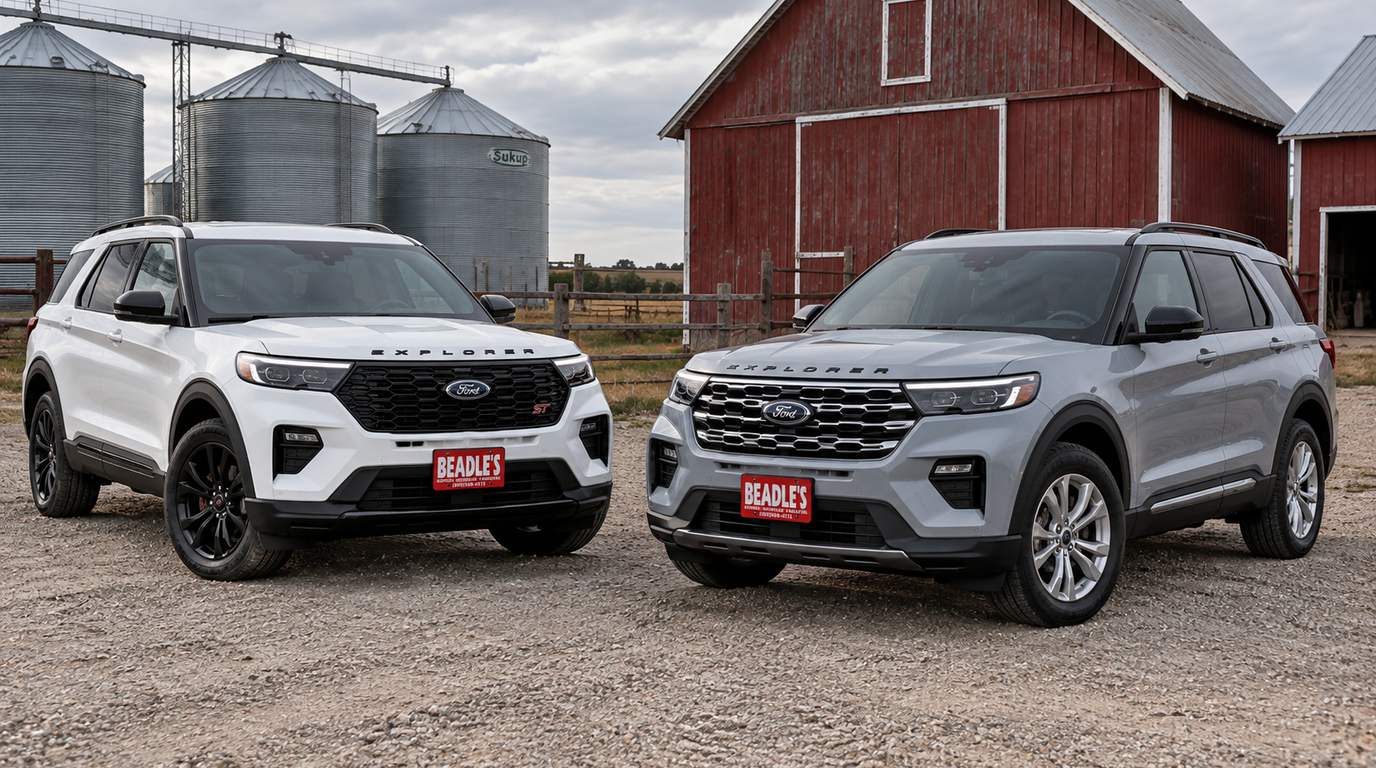
2026 and 2027 Ford Explorer side by side on a South Dakota farmyard, both on the lot at Beadle Ford in Bowdle

Buy a 2026 Ford Explorer Now or a 2027? Both Are on the Lot

Home› Ford Explorer› 2027 Ford Explorer› 2026 or 2027? Quick Answer Both are on the lot at Beadle Ford, and the 2027 is a model-year update rather than a redesign — same engines, same 5,000-lb tow rating, same 16.3 / 85.3 cubic feet of cargo. Buy the 2027 if you want the Tremor with the V6, a V6 Platinum, the ST Sinister Package, or one of the new colors. Otherwise a remaining 2026 is the same vehicle for less money. This is the question I get most often right now, and it is a good one to have: the 2026 Explorers on our lot are the same generation as the 2027 parked beside them, and for most trims they are nearly the same vehicle. So the decision is not old versus new. It is a short list of 2027-only items against whatever the 2026 pricing looks like on the day you come in. This guide lays out exactly what changed, which buyers should take a 2026 and which should hold out for or order a 2027, how your trade fits either way, and a checklist to walk through on the lot. The complete 2027 change list is in What’s New for 2027, and both model years have a full guide: 2026 Explorer Buyers Guide and 2027 Explorer Buyers Guide. Get Pre-Approved Shop Explorer Inventory On This Page What actually changed from 2026 to 2027? Where the 2026 is the better buy Where the 2027 is worth it What is on the lot at Beadle Ford right now How your trade-in fits either way The lot checklist What actually changed from 2026 to 2027? Three real changes and a handful of small ones. The Tremor 801A makes the 3.0L V6 its own equipment group with BlueCruise hardware, a PowerFold third row, and an open-on-approach liftgate bundled in. The 3.0L V6 returns to the Platinum, and ordering it includes the Ultimate content (Lux Leather, quad chrome tips, 21-inch dark alloy wheels). The ST gets the $1,695 Sinister Package with gloss black wheels, amber daytime running lamps, and a red ST badge. The small ones: two new paints (Avalanche Gray, Ruby Red Metallic Tinted Clearcoat) and one dropped (Space White); a Panoramic Vista Roof that opens, replacing the fixed glass roof; a $295 Slick Roof Conversion; a universal garage door opener on Tremor, ST, and Platinum; and a year of the Ford Security Package on every unit. What did not change: the body, the interior, the 13.2-inch screen with Google built in, the safety suite, the 2.3L and 3.0L EcoBoost engines and their 300 and 400 horsepower ratings, the 5,000-lb tow rating, the three rows, and the 16.3 / 85.3 cubic feet of cargo. A 2026 Explorer is not last generation. It is last year’s version of this one. Where the 2026 is the better buy If you are shopping an Active, an ST-Line, a 2.3L Platinum, or a Tremor 800A, the 2026 and 2027 versions are functionally identical, and the 2026 has three things going for it. It is here. We have 2026 Explorers on the lot in several trims, including Tremor, ST-Line, Active, and Platinum. You can drive the exact unit today and take it home this week. Pricing. As the 2027s arrive, Ford’s incentives and our own pricing tend to favor the outgoing model year. I will not quote a number here because it changes monthly; ask us for the current 2026 offers on the unit you like and compare them to the 2027 window sticker side by side. Choice. The 2027 selection on the lot is just getting started. The 2026 selection is several units in several colors and trims. If the vehicle you want is already sitting here in the right color, waiting for a 2027 version of it gains you nothing. One specific case: the 2026 Tremor. Every piece of Tremor hardware (TORSEN axle, all-terrain tires, plates, hooks, 8.7 inches of clearance) is identical for 2027, and a 2026 Tremor could be ordered with the 3.0L V6 as an engine option. If a 2026 Tremor on the lot has the engine you want, it is the same vehicle as a 2027 Tremor at a better number. Where the 2027 is worth it Hold out for, or order, a 2027 if any of these is on your list: A V6 Platinum. The 2026 Platinum was 2.3L only. If you want the 3.0L with the Lux Leather, quad tips, and 21-inch wheels, that is a 2027. Platinum 2.3L or 3.0L V6. The ST Sinister Package. Gloss black 21s, amber DRLs, and the red badge exist only on the 2027 ST. The Sinister Package explained. A Tremor 801A ordered clean. The V6 Tremor with BlueCruise hardware, the PowerFold third row, and Sun and Sound availability is a cleaner, better-equipped order on the 2027. 2027 Explorer Tremor guide. An opening roof. The 2026 panoramic roof was fixed glass; the 2027 Vista Roof opens. Avalanche Gray or Ruby Red. Neither exists on a 2026. A newer model year on the title, which matters to some buyers for resale even when the vehicle is the same. I understand that; just know what you are paying for. If your list is none of those and your trim is Active or ST-Line, the 2027 is the same Explorer with a newer number on the sticker. That is a fine reason to buy one if the price is right, and the first 2027 on our lot is an Active 4WD in Avalanche Gray, so you can judge that in person. Both years, one lot Drive a 2026 and the 2027 back to back in Bowdle. We will price both against your trade. Shop 2026 and 2027 Explorers Ask About a Custom Order What is on the lot at Beadle Ford right now Both model years, parked together. On the 2026 side we have ST-Line, Active, Tremor, and Platinum units. On the 2027 side, the first Active 4WD with the Active Comfort Package is here and more are arriving; Tremor 801A, V6 Platinum, and Sinister ST builds are order-to-spec for now, and we will place and track those with you. Inventory changes weekly, so the live list is the one to trust: shop every Explorer in stock. Every listing links the window sticker, which is where the EPA rating for that engine and drive combination lives. (The 2.3L 4WD is rated 20 city / 27 highway / 23 combined; Ford has not yet posted the other combinations.) How your trade-in fits either way Most Explorer buyers here are trading a 2016 to 2020 Explorer, an Edge, an Escape, or a competitor’s three-row. Two things to know. First, the jump from any of those into this generation of Explorer is bigger than the difference between a 2026 and a 2027, so the trade matters more to your payment than the model year does. Second, the trade is worth the same on either purchase; what changes is how quickly we can close. A 2026 on the lot means we appraise the trade, agree on numbers, and you drive home. A 2027 order means we appraise now and re-confirm at delivery, and you keep driving your current vehicle in the meantime. The best way to walk in is with a pre-approval already done. It takes a few minutes online, it does not affect your credit to start, and it turns the conversation into which vehicle instead of whether. Get pre-approved here. If you would rather talk it through first, contact us and we will pull your trade value and current 2026 and 2027 numbers before you make the drive. The lot checklist Pick your trim first (Active, ST-Line, Tremor, ST, or Platinum), using the trim guide. If it is Active, ST-Line, 2.3L Platinum, or Tremor 800A: find the 2026 on the lot closest to your spec and get its current price with incentives. Compare that to the 2027 window sticker on the same trim. Note what the 2027 adds that you would actually use. If it is a V6 Platinum, a Sinister ST, or a Tremor 801A: it is a 2027, and it is probably an order. Build it with us and we will price it line by line. Drive both. They are parked next to each other for exactly this reason. Have the trade appraised and the pre-approval done before you decide, so the decision is about the vehicle. Key Takeaways The 2026 and 2027 Explorer share the body, interior, engines, tech, and safety suite. A 2026 is last year’s version of this generation, not the old one. For Active, ST-Line, 2.3L Platinum, and Tremor 800A buyers, a 2026 on the lot is usually the better buy: available now, more choice, model-year pricing. The 2027 is worth it for a V6 Platinum, the ST Sinister Package, a Tremor 801A, the opening Vista Roof, or the two new colors. Both years are on the Beadle Ford lot now; 2027 Tremor 801A, V6 Platinum, and Sinister ST builds are order-to-spec. Your trade is worth the same either way. Get pre-approved first so the decision is about the vehicle. Frequently Asked Questions Should I buy a 2026 Ford Explorer or wait for the 2027? If you want an Active, ST-Line, 2.3L Platinum, or Tremor 800A, the 2026 and 2027 are nearly identical and a 2026 on the lot is usually the faster and better-priced choice. If you want the 3.0L V6 on a Platinum, the ST Sinister Package, a Tremor 801A, the opening Vista Roof, or Avalanche Gray or Ruby Red paint, those are 2027-only. Is the 2027 Ford Explorer a new generation? No. The 2027 Explorer is a model-year update of the same generation as the 2025 and 2026. The body, interior, 13.2-inch screen, safety suite, and both EcoBoost engines carry over. Is the 2027 Explorer on the lot at Beadle Ford? Yes. The first 2027 Explorer, an Active 4WD, is on the lot in Bowdle next to our 2026 Explorers, with more 2027 units arriving. Tremor 801A, V6 Platinum, and Sinister ST configurations are currently order-to-spec. Does the 2027 Explorer get better fuel economy than the 2026? The engines are unchanged. The 2027 2.3L 4WD is EPA-rated 20 city / 27 highway / 23 combined. Ford has not yet posted ratings for the other 2027 engine and drive combinations; check the window sticker on each unit. Will Beadle Ford take my current Explorer in trade? Yes. We appraise trades on both 2026 and 2027 purchases. On a 2026 on the lot the deal closes the same day; on a 2027 order we appraise now and re-confirm at delivery while you keep driving your current vehicle. Are there incentives on the 2026 Explorer? Ford incentives and our pricing change monthly and usually favor the outgoing model year as the 2027s arrive. Ask Beadle Ford for the current 2026 offers on a specific unit rather than relying on a published number. My Take I will be direct: unless one of the 2027-only items is on your list, I would rather sell you a 2026 off the lot than have you wait. You get the same Explorer, you get it now, and the numbers on the 2026 are usually better. The families I see paying for a 2027 they did not need are the ones who never walked over to the 2026 parked next to it. The exceptions are real, though. If you have been waiting for a V6 Platinum or a Sinister ST, or you want the Tremor with everything bundled, order the 2027 and let us track it. Either way, come drive both. Shop Explorer Inventory Get Pre-Approved Contact Beadle Ford About the Author Lexy Tabbert — Beadle Ford, Bowdle, SD Lexy Tabbert is the Director of Sales and Marketing at Beadle Ford in Bowdle, South Dakota. She covers Ford vehicles, trim comparisons, and buyer guidance — helping families, ranchers, and ag operators across the region find the right truck and configuration for their needs. Learn more about Lexy.
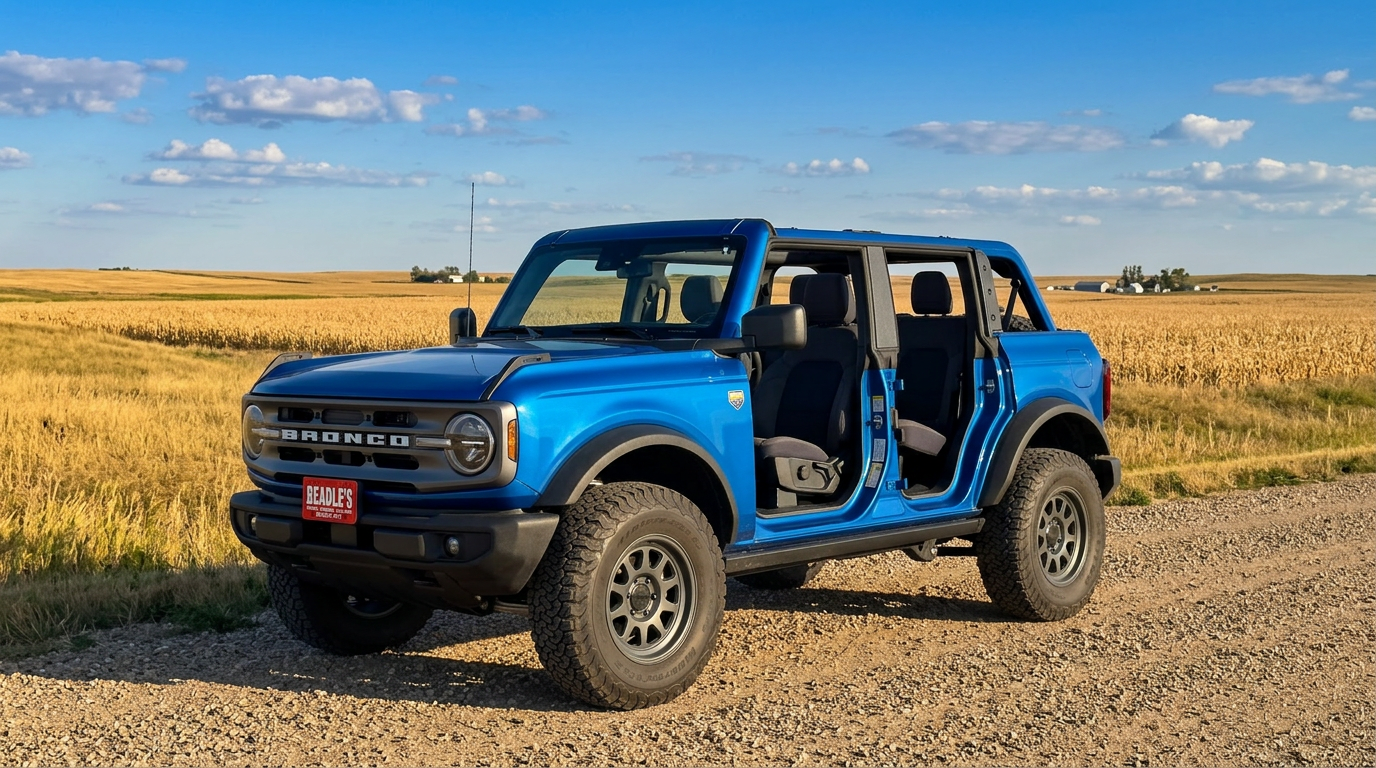
2026 Ford Bronco Big Bend with the doors removed and front roof panels off, parked on a South Dakota gravel road through CRP grassland on a summer afternoon

2026 Ford Bronco Removable Doors and Roof: A Practical Owner's Guide

The removable doors and roof are the single feature most buyers ask about — and the feature most owners use less than they expect. Done right, taking the doors off a Bronco for a summer evening drive across the central South Dakota plains is one of the real pleasures of ownership. Done wrong, it's a Saturday spent fighting with panels in your garage and a winter spent regretting the soft-top order you made in July. This is a practical owner's guide for a 2026 Bronco buyer in Bowdle and the central SD region. We'll cover what comes off and what doesn't, how the removal actually works, where to store doors and panels at home, soft top versus hardtop in a cold climate, theft and security when the doors are off, and when you'll really want the doors off in central SD. The honest take is in here, not just the sales sheet version. Shop Broncos in Stock Get Pre-Approved On This Page What Comes Off and What Stays On When You Remove the Bronco's Doors and Roof? How Does the Step-by-Step Doors and Roof Removal Actually Work? Where Should I Store the Doors and Roof Panels at Home? Soft Top or Hardtop: Which Is the Right Choice in a Cold Climate? Are the Doors Off a Theft or Security Concern Around Town? When Will I Actually Want the Doors Off in Central South Dakota? What Comes Off and What Stays On When You Remove the Bronco's Doors and Roof? All four doors come off — they're frameless, lift straight up off the hinges, and the wiring connector unplugs cleanly. The roof is modular: on a hardtop, the two front panels above the driver and front passenger lift off independently for a sunroof-style opening, and the rear section over the back seats and cargo area can come off as a third piece. On a soft top, the entire fabric assembly folds back and stays attached to the vehicle. What stays on regardless of the configuration: the windshield, the body-mounted sideview mirrors, the cowl, and the roll cage that's integrated into the body structure. The mirrors staying with the vehicle is the practical detail that separates the Bronco from a Wrangler — Wrangler mirrors are door-mounted, so when doors come off, mirrors come off too, and aftermarket frame-mounted mirrors are required for legal on-road driving without doors. On the Bronco you can take the doors off, hop in, and drive without thinking about the mirror situation. The Tool Kit for removable doors and tops is standard equipment on the Base trim, which means every Bronco above Base inherits it as well. Tube doors are an available accessory at $850 for 2-Door and $1,250 for 4-Door if you want a doors-off look with side-rail protection — useful for buyers who want the open-air feel without leaving doors at home. For the full Bronco vs Wrangler comparison see our 2026 Bronco vs Jeep Wrangler honest comparison. How Does the Step-by-Step Doors and Roof Removal Actually Work? For a single door: roll the window down, unplug the wiring connector inside the door jamb, pull the strap loose from the body, remove the two hinge bolts with the supplied Torx tool, and lift the door straight up off the hinge pins. The first time you do this, plan on twenty minutes per door because you'll be looking up the steps. After the third or fourth time, it's about five minutes per door. For the front roof panels on a hardtop: from inside the cabin, release the two over-center latches on each panel, lift the panel free, and store it. Each front panel takes well under a minute. The rear section is heavier and is a two-person job — bolts and clips along the rear pillar release the section, and you'll want a partner to handle weight and avoid scratching the body. Most owners pull the front panels far more often than the rear section, which is by design. Practical tip: the doors are heavier than they look. A 4-Door Bronco's rear doors are manageable solo if you have decent grip and back, but the larger 2-Door front doors are easier with two people. If you're working alone, a folding moving blanket on a workbench gives you a soft place to set the door without scuffing the paint or the wiring connector. Where Should I Store the Doors and Roof Panels at Home? Plan on roughly the floor area of a closet for four 4-Door doors set vertically against a wall, plus a flat space the size of a standard countertop for stacked roof panels. The Ford-supplied storage bags are worth using — they protect the painted body color, the wiring connectors, and the latches from dust and incidental contact in a working garage. Wall-mount door hangers are an aftermarket accessory worth the money if you're going to remove doors more than once a season. A summer evening on a ranch property is the use case the doors-off configuration was built for. The four-to-six month window in central SD is the realistic season. The most common mistake we see at trade-in is doors and panels stored on a concrete floor without protection — by year three, the bottom edges of the doors show wear that cosmetic detail won't hide. Store them off the ground, ideally on a wall hanger or a foam-padded shelf. Roof panels lay flat with the painted side up. If you don't have garage space — common for ranch-area owners whose garages are full of hay, equipment, or another vehicle — that's a strong signal to skip the soft-top configuration entirely and run the hardtop year-round. There's no shame in admitting a feature won't get used. Storage logistics derail the doors-off lifestyle for more owners than the doors-off lifestyle delivers value to. Soft Top or Hardtop: Which Is the Right Choice in a Cold Climate? For a year-round daily driver in central South Dakota, a hardtop is the right answer for almost every buyer. The soft top is functional through SD winters, but it loses cabin heat faster, lets in more highway noise at speed, and shows wear faster on a vehicle that lives outdoors through a Bowdle winter. Most experienced Bronco owners in the area run a hardtop year-round and use the front roof panels for occasional sunroof-style summer driving. Hardtop attached, year-round. The Heritage Edition's standard Oxford White-painted hardtop is one example; every other trim has its own hardtop options at various price points. The Dual Tops add-in (order code 66J) at $1,995 is the splurge option — it bundles a soft top with the hardtop so you can swap by season. We see this ordered most often by buyers who actually live the doors-off summer lifestyle and have garage space to store the second top. For most central SD buyers it's not worth the money; the front roof panels of the modular hardtop already deliver most of the open-air experience without the storage headache. Painted hardtops are a separate decision. Body-color and contrast painted hardtops are available at upcharges across most trims; the Heritage Edition gets its standard Oxford White-painted hardtop at no extra charge. The painted top is a styling decision more than a functional one — every hardtop seals and insulates the same way regardless of the paint. For the SD winter side of this equation see our South Dakota winter driving guide. Get Pre-Approved Contact Beadle Ford Are the Doors Off a Theft or Security Concern Around Town? In Bowdle and small-town central SD generally, doors-off vehicle theft is rare to the point of irrelevance. The bigger practical concern is theft from inside the cabin — anything visible in the interior is reachable in seconds when there are no doors. That means stowing a wallet, phone, firearm, or rifle case before you walk away from the vehicle, even for a quick stop at the post office or coffee shop. The center console locks on most Bronco trims, which gives you a small secure spot for keys, a wallet, or a phone. A hardtop with the rear section attached lets you lock items in the cargo area behind the rear seats. With the doors off and the front roof panels removed, treat the cabin like an open boat — no valuables visible, no firearms visible, period. Insurance generally treats doors-off driving the same as doors-on driving in terms of comprehensive coverage, but if you're storing doors at a property other than your residence (a cabin, a hunting camp, a parents' garage), check that they're covered there too. We've never had a customer report a theft of removed doors, but we've heard of damage from a falling shelf in a garage where the doors weren't properly stored. When Will I Actually Want the Doors Off in Central South Dakota? The realistic doors-off window in central SD is roughly May through early October — a four-to-six month season. Within that window, the use cases that earn the configuration are summer evening drives across the plains, slow scouting runs through CRP and harvested fields, ranch-property loop drives at golden hour, lake-access trips on warm afternoons, and the occasional Black Hills weekend where the temperature stays above sixty. By the time pheasant season opens in late October, almost every Bronco in the area has its doors and front panels back on. November through April is hardtop weather across central SD — and the front panels usually stay on too, since spring is unpredictable enough that "above sixty" days are exceptions before May. The doors-off lifestyle in central SD is real, but it's a summer privilege, not a year-round one. We get into the seasonal hunting-rig context in detail in our South Dakota hunting guide. What this means for the buying decision is simple. The removable doors and roof are real features that add real value during the summer months — they're not marketing fluff. They're also features most owners use a few dozen times a year, not a few hundred. Pricing the soft-top and dual-tops options against that realistic usage is part of getting the build right. The full lineup and configuration choices come together in the 2026 Ford Bronco overview, which lays out trims, top options, and pricing side by side. Key Takeaways All four doors and the front roof panels come off; the rear roof section is a heavier two-person job. Bronco mirrors are body-mounted, so they stay attached when doors come off — no aftermarket mirror required for legal on-road driving. For year-round SD use, spec a hardtop. The Dual Tops add-in (66J, $1,995) is for buyers with garage space who actually live the summer doors-off lifestyle. Plan on closet-floor space for stored doors and a countertop-sized flat area for roof panels. Wall-mount door hangers are worth the money if you remove doors more than once a season. The realistic doors-off window in central SD is May through early October — a four-to-six month season, not a year-round feature. Frequently Asked Questions How long does it take to remove the doors and roof on a 2026 Ford Bronco? First time, plan on roughly twenty minutes per door because you'll be referring to the manual. Once you've done it three or four times, it drops to about five minutes per door. The two front roof panels on a hardtop release in well under a minute each. The rear roof section is heavier and is a two-person job that takes longer. Do the sideview mirrors stay attached when the Bronco's doors come off? Yes. The Bronco's sideview mirrors are mounted to the body, not the doors, so they stay attached when the doors are removed. This is different from the Jeep Wrangler, where the mirrors are door-mounted and aftermarket frame-mounted mirrors are required for legal on-road driving without doors. Should I order a soft top or a hardtop on a 2026 Bronco for South Dakota? For a year-round daily driver in central South Dakota, a hardtop is the right call for almost every buyer. The soft top is functional through SD winters, but it loses cabin heat faster, lets in more highway noise at speed, and shows wear faster on a vehicle that lives outdoors. The Dual Tops add-in ($1,995) bundles both for buyers with garage space and a genuine summer doors-off use case. How much storage space do the doors and roof panels take in a garage? Roughly the floor area of a closet for four 4-Door doors set vertically against a wall, plus a countertop-sized flat space for stacked roof panels. The Ford-supplied storage bags are worth using to protect the paint and connectors. Aftermarket wall-mount door hangers are a worthwhile add if you remove doors more than once a season. Are tube doors a good substitute for the standard frameless doors? Tube doors are an available accessory at $850 for 2-Door and $1,250 for 4-Door, and they're a smart option for owners who want the doors-off open-air feel with side-rail protection. They don't replace the standard frameless doors for highway driving — there's no glass, no insulation, and no weather sealing — but for ranch-property summer use or short slow drives they work well. How many months a year will I actually drive doors-off in central South Dakota? A realistic central SD doors-off window is May through early October — four to six months, depending on spring and fall temperatures. By the late-October pheasant opener almost every Bronco in the area has its doors and front roof panels back on. For winter, the doors stay on every time. My Take on the Bronco's Removable Doors and Roof I've watched plenty of customers walk in convinced they need the soft-top configuration because they want the open-air feel — and most of them, after a few months of ownership, end up running the hardtop year-round and pulling the front panels for the warm Saturdays they actually want them. That's not a failure of the soft top; it's just the realistic central SD use case. The doors-off summer evening drive is one of the moments that earns the Bronco its reputation. It's also a moment that happens twenty or thirty times a year, not two hundred. If you're weighing the top configuration on a build, come in and let's talk through the actual storage you have at home and how you'll really use the vehicle. We'd rather steer a customer toward the right top up front than answer a regret call in February. The doors-off feature is real and worth talking about — it's also worth being honest about how it fits into a Bowdle-area life. Shop Broncos in Stock Get Pre-Approved About the Author Lexy Tabbert — Beadle Ford, Bowdle, SD Lexy Tabbert is the Director of Sales and Marketing at Beadle Ford in Bowdle, South Dakota. She covers Ford vehicles, trim comparisons, and buyer guidance — helping families, ranchers, and ag operators across the region find the right truck and configuration for their needs. Learn more about Lexy.
2026 Ford F-150 4x4 & Winter Driving Guide

Winter driving in South Dakota places unique demands on a full-size truck, including traction control, drivetrain configuration, and cold-weather comfort features. The 2026 Ford F-150 offers multiple systems designed to handle these conditions confidently. The 2026 Ford F-150 offers multiple drivetrain configurations, selectable drive modes, and available off-road packages designed to handle these conditions confidently. This guide explains how 4x4 systems work, which trims support winter-ready features, and what drivers should consider before ordering. For full trim and engine availability, see the complete 2026 Ford F-150 overview. Contact Beadle Ford Table of Contents Is 4x4 Necessary in South Dakota? 4x4 vs 4x2: What’s the Difference? What Drive Modes Are Available? What Is the FX4 Off-Road Package? What Winter Comfort Features Are Available? How Does Winter Affect Towing? How to Choose the Right Winter Setup Is 4x4 Necessary in South Dakota? For many rural drivers, yes. While 4x2 models can perform well with proper tires, 4x4 provides improved traction when accelerating on snow-packed roads, climbing icy inclines, and navigating unplowed surfaces. Drivers regularly traveling county highways, farm access roads, or open prairie areas during winter typically benefit from 4x4 capability. What’s the Difference Between 4x4 and 4x2? 4x2 (two-wheel drive) sends power to the rear wheels only. 4x4 systems distribute power to all four wheels when engaged, improving traction in low-grip conditions. For highway commuters staying on cleared roads, 4x2 may be sufficient. For mixed rural and winter use, 4x4 adds confidence and control. What Drive Modes Are Available on the 2026 F-150? The 2026 F-150 offers selectable drive modes that adjust throttle response, traction control behavior, and transmission logic. Normal Eco Sport Tow/Haul Slippery Deep Snow/Sand (on applicable trims) Deep Snow/Sand mode can improve throttle mapping and traction control behavior in low-traction environments. What Is the FX4 Off-Road Package? The FX4 Off-Road Package adds features such as off-road tuned shocks, skid plates, and terrain management enhancements. While designed for trail use, these features can also benefit drivers navigating uneven rural terrain. FX4 is not required for winter driving, but it may add confidence for those frequently off pavement. What Winter Comfort Features Are Available? Depending on trim, the 2026 F-150 can include: Heated front seats Heated steering wheel Remote start capability Dual-zone climate control These features improve comfort during extended winter commutes and early morning starts. How Does Winter Affect Towing? Towing in winter introduces additional traction considerations. 4x4 systems improve launch stability on icy boat ramps or snow-covered job sites. For maximum towing ratings and equipment requirements, see our detailed 2026 F-150 Towing Guide. How to Choose the Right Winter Configuration Determine whether you regularly drive unplowed or gravel roads. Evaluate trailer use during winter months. Consider available heated and remote start features. Confirm drivetrain availability within your preferred trim. Key Takeaways 4x4 improves traction and stability in snow and rural conditions. Selectable drive modes enhance low-traction performance. FX4 adds off-road durability but is not mandatory for winter use. Heated features improve daily winter comfort. Proper tires remain essential regardless of drivetrain. Frequently Asked Questions Is 4x4 required for South Dakota winters? While not legally required, 4x4 is strongly recommended for drivers navigating rural roads and heavy snow conditions. Does 4x4 improve towing in winter? Yes. It improves traction during launch and low-speed maneuvering on slippery surfaces. Is FX4 necessary for winter driving? No. FX4 enhances off-road durability but is not required for snow performance. Conclusion In my experience, winter capability decisions are less about extreme off-road features and more about honest assessment of daily driving conditions. For many South Dakota drivers, 4x4 paired with proper tires provides the balance of confidence and practicality that winter demands. Explore winter-ready 2026 F-150 configurations at Beadle Ford or contact us to discuss 4x4 availability. About the Author Lexy Tabbert provides research-driven truck configuration guidance and in-depth vehicle insights for drivers across South Dakota and the surrounding region.

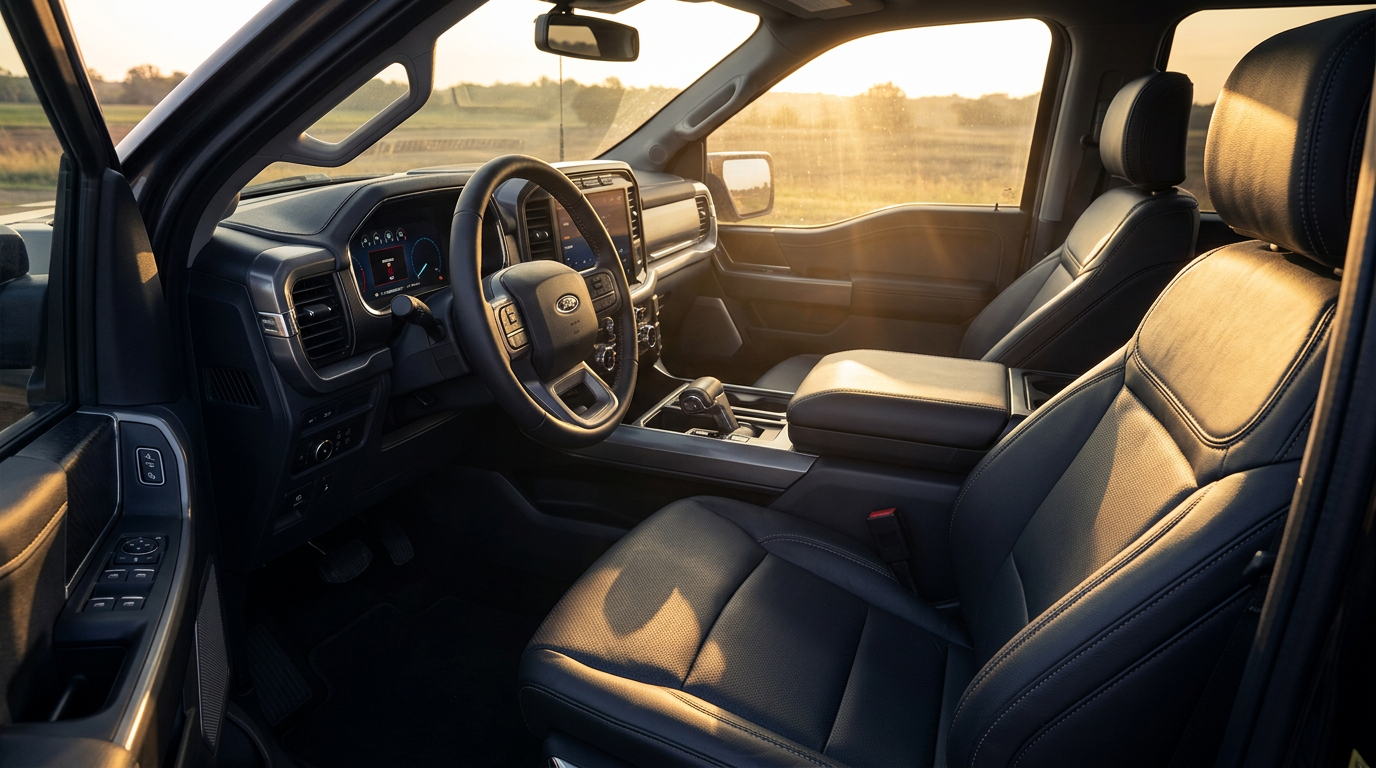
2027 Ford F-250 Lariat interior with the 12-inch touchscreen

2027 Ford F-250 Trims for the Everyday Buyer

Quick Answer The 2027 Ford F-250 comes in five trims: XL, XLT, Lariat, King Ranch, and Platinum. For most everyday buyers, the XLT is the value sweet spot and the Lariat is the comfort sweet spot — both with the standard 7.3L gas V8 and available 4x4. King Ranch and Platinum add Western and modern luxury. Every 2027 F-250 has the same Super Duty capability under it, so picking a trim is really about how much comfort and tech you want for the money. The good news for 2027 is that the 7.3L gas V8 is standard across the board, so you're not trading capability for a lower trim. Here's what each trim gets you, where the everyday-buyer value lands, and when the King Ranch or Platinum is worth the step up — framed for how people actually use a Super Duty around Bowdle and Aberdeen. Shop F-250s in Stock Reserve a 2027 F-250 Get Pre-Approved On This Page What trims does the 2027 F-250 come in? What do you get on XL and XLT? Why Lariat is the comfort sweet spot King Ranch and Platinum: worth the step up? What trims does the 2027 F-250 come in? Five, from work truck to luxury: XL, XLT, Lariat, King Ranch, and Platinum. The 7.3L gas V8 is standard on all of them, and the 6.7L High-Output diesel is optional across the line, so capability doesn't change with trim — only comfort, tech, and styling do. A couple of equipment notes worth knowing: Pro Power Onboard is standard from the XLT up, and 4x4 is standard beginning on the King Ranch (it's available on XL, XLT, and Lariat). The new Super Duty Carhartt Package brings work-grade style to single-rear-wheel trucks. Trim Character Right for you if XL Straightforward work truck You want the best price and a no-frills tool XLT Work plus everyday comfort You want value — capability without luxury cost Lariat Leather and the big screen You live in the truck on long drives King Ranch Western-styled luxury (4x4 standard) You want premium that still works for a living Platinum Top tech-forward luxury You want the most modern, loaded F-250 What do you get on XL and XLT? The XL is the tool: durable, hose-out-friendly, and built to work, now with the 7.3L gas V8 standard and Tremor Off-Road newly available with the STX Appearance Package. It's the lowest price of entry and exactly enough truck for a jobsite or a fleet. The XLT is where most everyday buyers land. It keeps the work capability but adds the comfort and convenience that make a truck pleasant to live with — chrome exterior trim, more interior features, available LED lighting, and standard Pro Power Onboard for running tools and gear off the truck. For value, the XLT is hard to beat. Why Lariat is the comfort sweet spot The Lariat is the trim we point most long-haul and daily-driver buyers toward. It adds leather seating, the 12-inch SYNC 4 touchscreen and 12-inch digital cluster, dual-zone automatic climate control, heated and ventilated front seats, and standard LED lighting — the features that make long Dakota highway miles genuinely comfortable. It's the step where an F-250 stops feeling like a work truck and starts feeling like a nice truck you'd happily drive every day, without climbing into King Ranch or Platinum money. If you want one truck that tows, works, and serves as the family highway vehicle, the Lariat is the sweet spot. King Ranch and Platinum: worth the step up? They're worth it if you want a luxury truck that still has full Super Duty capability. The King Ranch brings Western-themed Kingsville leather, distinctive styling, two-tone Marsh Gray lower cladding, and standard 4x4. The Platinum goes the modern-luxury route with Multicontour leather seats and the most tech-forward cabin in the lineup. Neither gives up any towing or hauling to the work trims — you're paying purely for comfort, materials, and style. If you spend serious time in the truck and want it to feel special, the step up makes sense; if you mainly want capability and value, the XLT or Lariat already covers it. Our Recommendation For most everyday F-250 buyers around Bowdle and Aberdeen, the XLT is the value pick and the Lariat is the comfort pick — both with the standard 7.3L gas V8 and 4x4. Step up to King Ranch or Platinum only if you want luxury materials and styling, since none of it changes what the truck can tow or haul. From the Beadle Ford Lot The trim conversation usually settles itself once people sit in a Lariat. They came in pricing an XLT to save money, then they feel the leather and the big screen on a test drive and realize the Lariat is the truck they'll actually want to spend time in. Both are great buys — it just comes down to how many highway miles you're putting on it. Key Takeaways The 2027 F-250 offers five trims: XL, XLT, Lariat, King Ranch, and Platinum. The 7.3L gas V8 is standard on every trim — capability doesn't change, only comfort and tech. Pro Power Onboard is standard from the XLT; 4x4 is standard beginning on the King Ranch. The XLT is the value sweet spot; the Lariat adds leather and the 12-inch SYNC 4 screen for daily comfort. King Ranch and Platinum add luxury and styling without changing what the truck can tow or haul. Frequently Asked Questions What trims does the 2027 Ford F-250 come in? Five: XL, XLT, Lariat, King Ranch, and Platinum. The 7.3L gas V8 is standard on all of them and the 6.7L High-Output diesel is optional across the line, so trim changes comfort, tech, and styling rather than capability. Which 2027 F-250 trim is the best value? The XLT. It keeps the work capability and the standard 7.3L gas V8 but adds everyday comfort, chrome trim, available LED lighting, and standard Pro Power Onboard — the value sweet spot for most buyers. The Lariat is the next step up for leather and the big touchscreen. Is 4x4 standard on the 2027 F-250? 4x4 is standard beginning on the King Ranch. On the XL, XLT, and Lariat it's available, with 4x2 as the standard drivetrain. For South Dakota winters and gravel, most buyers add 4x4 regardless of trim. Does the Lariat have leather and a touchscreen? Yes. The Lariat adds leather seating, the 12-inch SYNC 4 touchscreen, a 12-inch digital cluster, dual-zone automatic climate, heated and ventilated front seats, and standard LED lighting — the comfort sweet spot for daily driving and long highway miles. Quick Answers: 2027 F-250 Trims One-line answers to the follow-up questions buyers ask next. How many trims? Five — XL, XLT, Lariat, King Ranch, Platinum. Best value? The XLT. Comfort sweet spot? The Lariat. Which has the most luxury? The Platinum. Standard engine on all trims? The 7.3L gas V8. Where does Pro Power Onboard start? Standard on the XLT and up. Where is 4x4 standard? Beginning on the King Ranch. Which trim gets the 12-inch screen? The Lariat and up. Is there a work-style package? Yes — the new Super Duty Carhartt Package (single-rear-wheel). Where can I compare trims in person? Beadle Ford in Bowdle, SD. Keep Researching The complete 2027 Ford F-250 Super Duty overview — trims, towing, specs, and inventory 2027 F-250 colors & appearance — packages, wheels, and styling by trim Is an F-250 enough truck? — capability across the lineup Buy a 2026 now or order a 2027? — timing your purchase My Take on Picking a 2027 F-250 Trim Because the 7.3L gas is standard everywhere now, I tell people not to overthink capability and just buy the comfort level they'll appreciate. For a work-first truck, the XLT is all most folks need and a genuinely good value. For someone putting on real highway miles, the Lariat is the one I'd own — it's the point where the truck feels as nice as it is capable. The King Ranch and Platinum are wonderful, but they're about wanting them, not needing them. Come sit in an XLT and a Lariat back to back at Beadle Ford in Bowdle — that comparison usually makes the decision for you. Shop F-250s in Stock Reserve a 2027 F-250 Get Pre-Approved About the Author Lexy Tabbert — Beadle Ford, Bowdle, SD Lexy Tabbert is the Director of Sales and Marketing at Beadle Ford in Bowdle, South Dakota. She covers Ford vehicles, trim comparisons, and buyer guidance — helping families, ranchers, and ag operators across the region find the right truck and configuration for their needs. Learn more about Lexy.
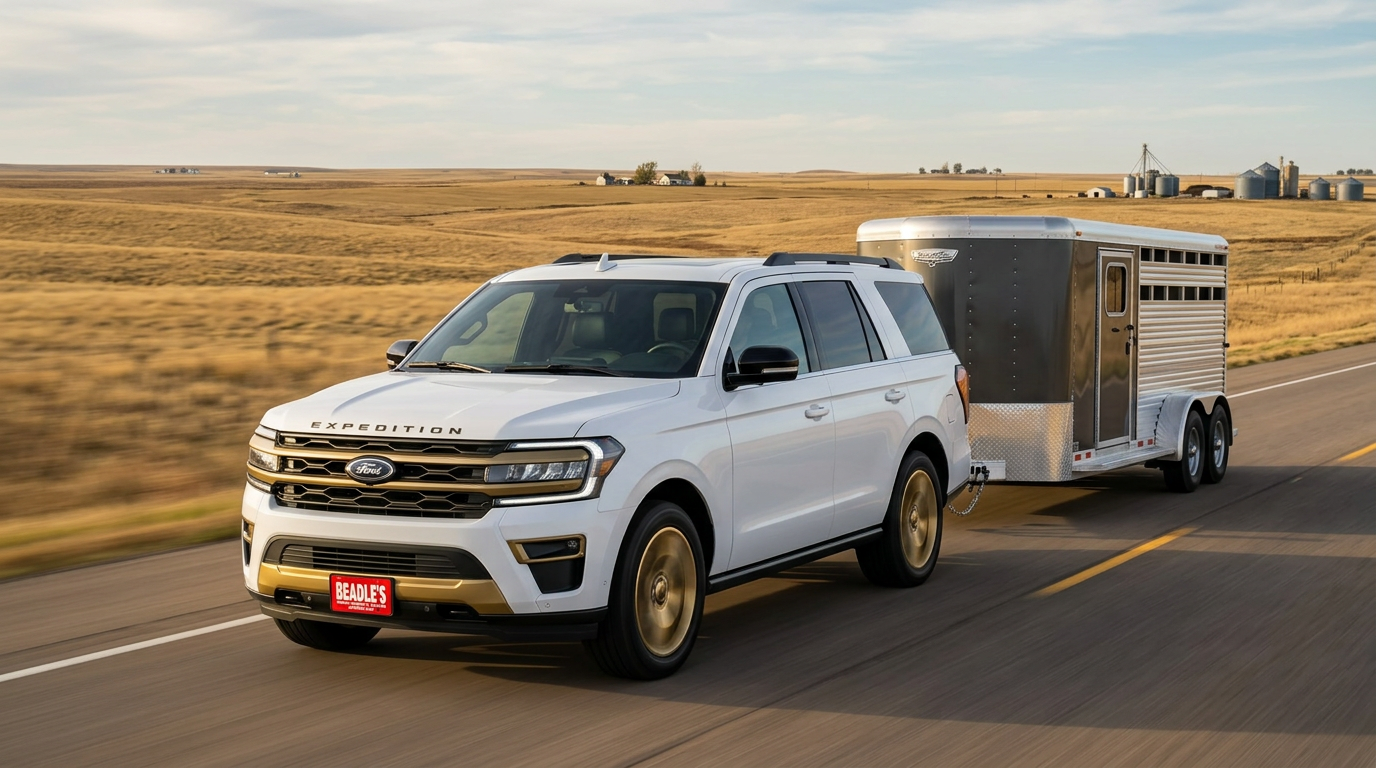
2026 Ford Expedition towing a trailer near Bowdle South Dakota

2026 Ford Expedition Towing Guide: Capacity, Configurations & What You Need to Know

The 2026 Ford Expedition can tow up to 9,600 lbs — but that number only applies to one specific configuration. The actual rating for your build depends on drivetrain, axle ratio, wheelbase, and whether the Heavy-Duty Trailer Tow package is installed. Get one of those wrong and you may be operating beyond your rated limit without knowing it. This guide breaks down every towing figure from Ford's official 2026 Expedition Towing Guide, explains the equipment required to reach the higher ratings, and connects those numbers to the trailers South Dakota buyers actually pull — horse trailers, bumper-pull campers, hay equipment, and boats on the Missouri River system. Shop Expeditions in Stock Get Pre-Approved On This Page What are the actual 2026 Expedition tow ratings by configuration? What does the Heavy-Duty Trailer Tow package include? Why does the axle ratio matter so much? When is a weight-distributing hitch required? Real-world towing scenarios: what can the Expedition actually pull? Does elevation affect towing capacity in South Dakota? Does the Expedition MAX tow less than the standard Expedition? What towing technology comes with the Expedition? Key Takeaways FAQ What are the actual 2026 Expedition tow ratings — by configuration? The 9,600 lb headline figure applies to the Expedition SWB 4x4 with the 3.73 axle ratio and the Heavy-Duty Trailer Tow package installed. Every other configuration is rated lower. The table below reflects Ford's official 2026 Expedition Towing Guide, calculated using the SAE J2807® method. Configuration Axle GCWR (lbs.) Max Tow (lbs.) Expedition SWB 4x4 3.73 15,900 9,600 Expedition SWB 4x2 — Tremor® High Output 3.73 15,600 9,300 Expedition SWB 4x2 — standard (24" wheels) 3.73 15,600 9,200 Expedition MAX 4x4 3.73 15,900 9,000 Expedition SWB 4x2 — standard 3.31 12,000 6,000 Expedition MAX 4x2 — standard 3.31 12,500 6,300 Source All figures from Ford's official 2026 Expedition Towing Guide, calculated using the SAE J2807® method. Maximum towing varies based on cargo, vehicle configuration, accessories, and number of passengers. Ratings assume a 150-lb. driver and passenger. The difference between the 6,000 lb and 9,600 lb rating comes down to two things: the 3.73 rear axle ratio and the Heavy-Duty Trailer Tow package. Without both, you're operating at the lower end of the range. On the Active 4x2, neither is included as standard — both are required additions. What does the Heavy-Duty Trailer Tow package include — and which trims get it standard? The HDTT package is the single most important option for any Expedition buyer who plans to tow above 6,000 lbs. It bundles the upgraded axle, integrated brake controller, trailer camera, and Pro Trailer Backup Assist™ 2.0 in one package — and it's standard on every trim except the Active. Trim HDTT Status Note Active Optional Requires 4x4. Not available on 4x2. Tremor® Standard 28MM radiator (vs. 26MM on other trims) King Ranch® Standard 26MM radiator Platinum Standard 26MM radiator What the Heavy-Duty Trailer Tow package includes on all 2026 Expedition configurations: ✓ 4-pin and 7-pin trailer connector ✓ Class IV hitch receiver ✓ Upgraded 3.73 rear axle ratio ✓ Upgraded radiator (26MM / 28MM Tremor®) ✓ Tow/Haul mode ✓ 2-speed automatic 4WD with neutral towing ✓ Integrated trailer brake controller ✓ Trailer sway control ✓ Pro Trailer Hitch Assist™ ✓ Pro Trailer Backup Assist™ 2.0 ✓ 360-degree camera ✓ Lane Keeping Alert Warranty Note Per Ford's 2026 Expedition Towing Guide: your New Vehicle Limited Warranty may be voided if you tow above the rating for your configuration without the required equipment. Confirm your specific build's tow rating on the window sticker before purchase. Why does the axle ratio matter so much for towing? The axle ratio is one of the two biggest factors separating the 6,000 lb rating from the 9,600 lb rating. The 3.31 axle ratio is standard on Active 4x2 configurations — and with it, towing is capped at 6,000 lbs (SWB) or 6,300 lbs (MAX). Moving to the 3.73 ratio — which comes with the HDTT package — unlocks the full rating for your drivetrain. What the axle ratio codes mean on your window sticker Check the Safety Compliance Certification Label on the left front door lock facing. Below the bar code, you'll see "AXLE" followed by a two-digit code: Code 15 = 3.31 ratio (Non-Limited Slip) — base towing rating Code 2L = 3.73 ratio (Non-Limited Slip) — required for maximum tow ratings A numerically higher axle ratio multiplies torque at the wheels more aggressively, which is what allows the Expedition to pull heavier loads from a stop and maintain controlled speed on grades. For buyers towing loaded livestock trailers or heavy campers on the grades around the Missouri River breaks, the 3.73 isn't just a preference — it's required for the job. When is a weight-distributing hitch required — and what does that mean in practice? Per Ford's official towing guide: any trailer over 7,000 lbs requires a weight-distributing hitch on both the Expedition SWB and the Expedition MAX. This is not optional — it's a requirement to tow safely within the rated limit, and Ford's warranty language references it directly. Hitch Receiver Weight Capacity — Per Ford's Official Towing Guide Vehicle Weight-Carrying Max Max Tongue (WC) Weight-Distributing Max Max Tongue (WD) Expedition SWB 4x4 7,000 lbs 700 lbs 9,600 lbs 960 lbs Expedition MAX 4x4 7,000 lbs 700 lbs 9,000 lbs 900 lbs What this means practically: if you're pulling a bumper-pull horse trailer or loaded camper above 7,000 lbs, you need a weight-distributing hitch setup — not just the ball mount that comes with the receiver. The hitch receiver is standard on the vehicle; the ball mount, hitch ball, and weight-distributing head are the buyer's responsibility. Tongue weight should be approximately 10% of the total loaded trailer weight. A 9,000 lb trailer requires roughly 900 lbs of tongue weight — which must be within your vehicle's available payload after accounting for passengers and cargo. What can the 2026 Expedition actually tow — real-world scenarios for South Dakota buyers? The numbers on the tow chart only matter when matched to the trailers buyers here actually pull. Here's how the Expedition's ratings map to common loads in this part of South Dakota and the upper plains. Two-horse bumper-pull trailer (loaded) A two-horse straight-load bumper-pull trailer with horses typically weighs 5,000–7,000 lbs loaded depending on trailer weight and horse size. This falls within the Expedition's rating on any 4x4 configuration with HDTT — including the Active 4x4. A weight-distributing hitch is required at the upper end of this range (above 7,000 lbs). ✓ Within rating on: Active 4x4 w/HDTT, Tremor®, King Ranch®, Platinum (SWB or MAX) Four-horse slant-load with living quarters A four-horse LQ trailer can weigh 8,000–9,500 lbs loaded. An Expedition SWB 4x4 properly equipped is rated at 9,600 lbs — which covers most configurations at the lower end. At 9,000+ lbs, you're near or above maximum. A weight-distributing hitch is mandatory, and tongue weight must be carefully managed. At this weight, many buyers consider a truck instead — but the Expedition SWB 4x4 is in the conversation up to 9,600 lbs when properly equipped. ⚠ Approaching limit: SWB 4x4 only, weight-distributing hitch required, verify loaded weight before towing Bumper-pull travel trailer or fifth-wheel camper Most bumper-pull travel trailers in the 24–30 ft range weigh 5,000–8,500 lbs loaded. The Expedition handles this range comfortably on any 4x4 configuration with HDTT. Fifth-wheel trailers require a different hitch setup and are generally better suited for a pickup — the Expedition is not recommended for fifth-wheel use given hitch type and bed requirements. ✓ Within rating on: Active 4x4 w/HDTT, Tremor®, King Ranch®, Platinum — bumper-pull only Boat and trailer (Lake Oahe, Sharpe, or Francis Case) A 20–24 ft fiberglass fishing or pontoon boat with a loaded trailer typically runs 4,500–7,500 lbs. The Expedition handles this range on 4x4 with HDTT without issue. Tongue weight management matters on boat trailers — ensure the trailer is loaded with roughly 60% of weight in the front half. ✓ Comfortably within rating on all 4x4 configurations with HDTT Utility / hay / livestock trailer Gooseneck livestock trailers with hay or cattle typically exceed 10,000–15,000 lbs loaded — well beyond the Expedition's 9,600 lb maximum. For regular heavy livestock or gooseneck use, a pickup truck is the correct tool. The Expedition is not rated for gooseneck or fifth-wheel hitch configurations. ✗ Exceeds Expedition's max rating — a truck is the right tool for gooseneck/heavy livestock loads Does elevation affect towing capacity in South Dakota and the western plains? Yes — and this matters for buyers in western South Dakota more than most people realize. Ford's official towing guide states: reduce Gross Vehicle Weight (GVW) and Gross Combination Weight (GCW) by 2% per 1,000 ft. of elevation when towing at altitude. Elevation context — western South Dakota Bowdle, SD: approximately 1,800 ft — about a 3.6% reduction (~346 lbs off 9,600 lb max) Rapid City, SD: approximately 3,200 ft — about a 6.4% reduction (~614 lbs off 9,600 lb max) Black Hills region: 4,000–7,200 ft — 8–14% reduction in effective GCW Western routes into Wyoming/Montana: 4,500–7,000 ft — significant reduction applies If you're hauling a loaded trailer from Bowdle to Rapid City and up into the Hills, the effective towing capacity at elevation is meaningfully lower than what the sticker says at sea level. Build in a margin — don't tow at the absolute maximum if your route includes significant elevation gain. Does the Expedition MAX tow less than the standard Expedition? Yes — by 600 lbs on the 4x4 configuration. The Expedition MAX 4x4 is rated at 9,000 lbs vs. 9,600 lbs for the SWB 4x4, both properly equipped. The difference comes from the additional body weight of the extended wheelbase. The engine, axle, and HDTT package are identical — the body is heavier. Expedition SWB Expedition MAX Max tow — 4x4 w/HDTT 9,600 lbs 9,000 lbs Max tow — 4x2, no HDTT 6,000 lbs 6,300 lbs GCWR — 4x4 w/HDTT 15,900 lbs 15,900 lbs Tremor® available Yes No For most buyers pulling trailers in the 5,000–8,500 lb range, the 600 lb difference between SWB and MAX is irrelevant — both configurations are within rating. The decision between them is really about cargo space and third-row legroom, not towing. The full comparison is covered in the 2026 Expedition vs. Expedition MAX guide. What towing technology comes with the 2026 Expedition? The HDTT package bundles a set of active and passive towing technologies that make a real difference for buyers who tow regularly. These aren't marketing features — they're the systems that prevent trailer sway incidents and take the stress out of backing a trailer in a crowded boat launch. Pro Trailer Backup Assist™ 2.0 Steer the trailer using a knob on the dash — the system translates your input into counter-intuitive steering corrections automatically. Particularly useful on narrow boat ramps, tight ranch lanes, and unfamiliar campsites. Pro Trailer Hitch Assist™ Uses the 360-degree camera system to guide the hitch ball directly under the trailer coupler. Eliminates the guesswork of lining up solo — a practical tool when you're hooking up alone in the dark or in tight quarters. Integrated Trailer Brake Controller Provides proportional braking output to the trailer's electric brakes based on the Expedition's brake pressure. Built into the vehicle — no external controller to purchase or calibrate. Required for trailers with electric brakes. Trailer Sway Control Detects trailer sway and automatically applies selective braking or reduces engine torque to bring the combination back under control. Standard on all 2026 Expedition configurations — not just HDTT-equipped vehicles. Tow/Haul Mode Adjusts the 10-speed automatic's shift points for towing — holds gears longer on grades, uses engine braking on descents, and reduces hunting between gears on hilly terrain. Engage it anytime you're pulling a loaded trailer. 360-Degree Camera with BLIS® Trailer Coverage The camera system gives a top-down view during hitching and maneuvering. BLIS® with Trailer Coverage extends blind spot monitoring to account for the trailer's length — useful on highway passes when the trailer obscures your rear sightlines. Key Takeaways 9,600 lbs = SWB 4x4 only, with 3.73 axle and HDTT — not every Expedition configuration Without HDTT, the Active 4x2 is limited to 6,000 lbs (SWB) or 6,300 lbs (MAX) HDTT is optional on Active (requires 4x4), standard on Tremor®, King Ranch®, and Platinum Any trailer over 7,000 lbs requires a weight-distributing hitch — per Ford's official towing guide The Expedition MAX tows up to 9,000 lbs (4x4 w/HDTT) — 600 lbs less than SWB Tongue weight should be approximately 10% of total loaded trailer weight Reduce GVW and GCW by 2% per 1,000 ft. of elevation — relevant for western SD routes The Expedition is not rated for gooseneck or fifth-wheel hitch configurations Tow ratings are calculated with a 150-lb driver and passenger — real-world payload reduces effective capacity Confirm your build's specific tow rating on the window sticker before purchase Frequently Asked Questions What is the maximum towing capacity of the 2026 Ford Expedition? 9,600 lbs — but only on the Expedition SWB 4x4, properly equipped with the 3.73 rear axle and Heavy-Duty Trailer Tow package. Trailers above 7,000 lbs also require a weight-distributing hitch. The Active 4x2 without HDTT is limited to 6,000 lbs (SWB) or 6,300 lbs (MAX). All figures are from Ford's official 2026 Expedition Towing Guide, calculated using the SAE J2807® method. Can the 2026 Expedition tow a horse trailer? Yes — a two-horse bumper-pull loaded at 5,000–7,000 lbs is well within rating on any Expedition 4x4 with HDTT. A four-horse LQ trailer at 8,000–9,500 lbs loaded approaches or exceeds the SWB 4x4 maximum of 9,600 lbs and requires careful weight management, a weight-distributing hitch, and verified loaded weights before towing. Heavy gooseneck livestock trailers exceeding 10,000 lbs require a pickup truck — the Expedition is not rated for gooseneck hitch use. Does the Expedition MAX tow less than the standard Expedition? Yes — by 600 lbs. The MAX 4x4 with HDTT is rated at 9,000 lbs vs. 9,600 lbs for the SWB 4x4. The longer wheelbase adds body weight, which reduces available tow capacity. For most trailer loads in the 5,000–8,500 lb range, both configurations are comfortably within rating — the difference only matters if you're regularly near the upper limit. Do I need the Heavy-Duty Trailer Tow package to tow with the Expedition? Not for loads under 6,000 lbs on the Active 4x2 — but you cannot add it to a 4x2 configuration. For any load above 6,000 lbs, the HDTT package is required to reach the higher ratings, and it requires 4x4 on the Active trim. On Tremor®, King Ranch®, and Platinum, HDTT is standard. The package also includes the integrated trailer brake controller, Pro Trailer Backup Assist™ 2.0, and 360-degree camera — features most towing buyers want regardless of trailer weight. Is a weight-distributing hitch included with the Expedition? No. The hitch receiver is factory-installed and standard on the Expedition. The ball mount, hitch ball, and weight-distributing head are the buyer's responsibility. Per Ford's towing guide, a weight-distributing hitch is required for any trailer over 7,000 lbs on both SWB and MAX configurations. Does elevation affect how much the Expedition can tow? Yes. Ford's official guidance calls for reducing Gross Vehicle Weight and Gross Combination Weight by 2% per 1,000 ft. of elevation. Buyers in western South Dakota or those routing through the Black Hills should account for this when loading near maximum — especially on routes that climb from 1,800 ft near Bowdle to 4,000+ ft in the Hills region. My Take on Towing with the 2026 Expedition The towing conversation I have most often at Beadle Ford goes like this: a buyer comes in saying they need to tow a horse trailer or a camper, they've seen the 9,600 lb headline, and they assume any Expedition will get them there. The first thing I do is ask what configuration they're looking at — because that number only belongs to one specific build. For most buyers around here pulling a two- or three-horse trailer or a mid-size camper in the 6,000–8,500 lb range, the Active 4x4 with HDTT gets the job done and is the most affordable path to the full tow package. If you're pushing above 8,500 lbs regularly, you're looking at the Tremor® or Platinum — where HDTT is already standard — or you're having a different conversation about whether a truck is a better fit for your use case. The elevation piece matters more than most buyers realize. If your route takes you through Rapid City or up into the Hills, you're losing real effective capacity at altitude. Build in a margin — don't configure at the absolute maximum if your route climbs. For the full picture on how trim and configuration choices interact with towing, the 2026 Ford Expedition overview covers it all in one place. If you want to talk through a specific trailer and build, come see us at Beadle Ford in Bowdle or reach out anytime. Shop Expeditions in Stock Get Pre-Approved Contact Beadle Ford About the Author Lexy Tabbert — Beadle Ford, Bowdle, SD Lexy Tabbert covers Ford vehicles, trim comparisons, and buyer guidance for Beadle Ford in Bowdle, South Dakota. Her content is grounded in real buyer conversations with families, ranchers, and ag operators across the region. Learn more about Lexy.

2026 Ford Maverick front three-quarter exterior

2026 Ford Maverick Towing Guide (What to Buy, What to Avoid)

Maverick towing success isn’t about hype—it’s about buying the right towing hardware for the trailer you actually pull. This guide breaks down the two towing equipment levels (basic hitch vs 4K Tow Package), what each includes, and the questions you should answer before you commit. If you’re still deciding AWD vs FWD and overall configuration, start here first: 2026 Maverick Specs & Configurations. For inventory and shopping support in one place, visit the Ford Maverick model page. Shop Mavericks in Stock Ask a Towing Question Table of Contents Step 1: Identify which towing “level” you need 2K Trailer Hitch (4-pin): what it’s for 4K Tow Package: what it includes (and why it matters) What to confirm on the exact truck before you buy How to choose the right Maverick for your trailer FAQ Step 1: Identify which towing “level” you need For 2026, the order guide makes it clear that Maverick towing equipment generally lands in one of two setups: a basic hitch for light trailers, or the full 4K Tow Package hardware for higher towing needs. The right choice depends on your trailer’s loaded weight, not the empty brochure number. Quick decision rule (real-world) Light utility trailer, occasional use: basic 2K hitch can be appropriate (depending on your actual load). Brake-equipped trailers or frequent towing: look for the 4K Tow Package because it adds a brake controller and higher-grade hitch/wiring. If you’re uncertain: it’s usually better to buy the right hardware now than “try to upgrade later.” 2K Trailer Hitch (4-pin): what it’s for The 2K hitch setup is a light-duty tow solution. In the order guide, it’s shown as a 2K Trailer Hitch Receiver with a 4-pin connector on various configurations. This setup is best for simpler trailers where you don’t need a brake controller integrated into the truck. Wiring: 4-pin connector (typical for trailer lights on lighter trailers). Best for: small utility trailers and light loads. Important restriction: the order guide notes the 2K hitch is not available with the 4K Tow Package —they’re different equipment paths. 4K Tow Package: what it includes (and why it matters) The 4K Tow Package is the towing setup most serious Maverick towers should focus on because it includes the critical hardware buyers try to add later. In the 2026 order guide, the 4K Tow Package includes: Trailer Brake Controller Trailer Hitch (Class III) 2” receiver with 4-pin and 7-pin connector Upgraded cooling components (engine-dependent): higher capacity radiator for 2.0L gas; transmission oil cooler for 2.5L Hybrid; upgraded cooling fan Conventional 17” spare tire (215/70R17) There’s also a practical ordering detail: on XL and XLT, the 4K Tow Package requires Ford Co-Pilot360. That matters if you’re trying to build a value trim with towing hardware. What to confirm on the exact truck before you buy If you want a specific answer (not “it depends”), this is the checklist that prevents towing regret. Confirm these on the actual truck you’re buying—window sticker + physical walkaround: Do you have the trailer brake controller? If your trailer has brakes, you generally want this integrated. Do you have a 7-pin connector? The 4K package includes 4-pin + 7-pin; the basic hitch is typically 4-pin only. Hitch class and receiver size: confirm Class III 2” receiver if you’re planning heavier towing. Payload sticker: towing isn’t only tow rating—payload limits tongue weight + people + gear. Trailer type reality: loaded trailer weight (not empty) and how often you tow in wind/winter. Quick Overview Best for 2K hitch Light towing, simpler trailers, occasional use Best for 4K Tow Package Frequent towing, brake-equipped trailers, higher confidence setup Most important check Brake controller + 7-pin connector + payload sticker on the exact truck How to choose the right Maverick for your trailer Write down your trailer type (utility, small camper, equipment, etc.). Estimate loaded trailer weight (cargo + fuel + water + tools + everything you actually carry). Decide if you need brakes (many trailers do—if yes, prioritize a truck with the brake controller). Choose towing hardware level: 2K hitch vs 4K Tow Package. Confirm payload sticker so tongue weight + passengers + bed cargo stays realistic. Shop Mavericks in Stock Get Help Matching a Trailer to a Maverick FAQ What’s the fastest way to tell if a Maverick has the 4K Tow Package? Check the window sticker/build sheet for “4K Tow Package,” then confirm you have a trailer brake controller and a 7-pin connector. The 4K package also uses a Class III 2” receiver. Can I order the 2K hitch and the 4K Tow Package together? No—these are different towing equipment paths. The order guide notes the 2K hitch is not available when the 4K Tow Package is selected. Does towing depend on trim (XL vs XLT vs Lariat)? Trim affects feature access, but towing readiness depends on the towing hardware on that specific build. For example, the 4K Tow Package on XL/XLT requires Ford Co-Pilot360—so equipment availability can vary by how the truck is configured. Why do payload and towing feel connected? Payload is what you can carry in the truck (people + cargo + accessories). Towing adds tongue weight and gear, which can eat into payload quickly. That’s why the payload sticker matters for towing confidence—especially with passengers in the cab. Conclusion In my experience, Maverick towing goes well when buyers shop the hardware first: brake controller, 7-pin, hitch class, and the right cooling support. If you buy the correct towing equipment up front, the truck feels calmer and more predictable—especially in South Dakota wind and winter conditions. About the Author: Lexy Tabbert works with South Dakota and North Dakota buyers who need practical answers on towing setups, winter capability, and long-term ownership. Her process is simple: match the towing hardware and payload reality to the trailer you actually use, then choose trim and features with confidence.

2027 Ford F-350 Lariat in Agate Black Metallic on a Missouri River bluff at golden hour

What's New for the 2027 Ford F-350 Super Duty

Quick Answer The biggest 2027 Ford F-350 change is the engine lineup: it drops from four to two. The 7.3L gas V8 is now standard on every trim, and the 6.7L High-Output Power Stroke is the only diesel. 2027 also adds the Super Duty Carhartt Package, Tremor on XL, and a new 8-foot bed with the High-Output diesel — while towing and payload carry over unchanged. The 2027 Ford F-350 Super Duty isn't a redesign — the body, grille, and silhouette carry over — but under the hood and in the order guide, it's the most changed Super Duty in years. Ford simplified the lineup instead of restyling it. Here's everything that's new for 2027, what it means for the way trucks get used around Bowdle and Aberdeen, and how to think about ordering one — including whether a 2026 still on the lot might be the smarter buy. Shop F-350s in Stock Get Pre-Approved On This Page What changed on the 2027 F-350? Why did Ford cut the engines from four to two? Does the 2027 F-350 lose any capability? What new packages and features arrive for 2027? Should you buy a 2026 now or order a 2027? What changed on the 2027 F-350? The 2027 F-350 keeps the current Super Duty body but reworks what's available underneath. The headline: the engine lineup goes from four to two. Alongside that, Ford added a Super Duty Carhartt Package, opened the Tremor Off-Road Package to the XL trim, and introduced a new 8-foot bed / 176-inch wheelbase with the High-Output diesel. In short: 2027 is a simplification, not a redesign. Same proven truck, a cleaner set of choices — and, importantly, no loss of towing or payload capability. Why did Ford cut the engines from four to two? For 2027, the 7.3L gas V8 becomes standard on every trim and the 6.7L High-Output Power Stroke is the only diesel. The 6.8L gas V8 and the standard-output 6.7L Power Stroke diesel are both discontinued. The move trims overlap: the 7.3L gas already covered most of what the 6.8L did, and the High-Output diesel covers everything the standard-output diesel did and more. Both engines pair with the 10-speed TorqShift automatic. One honest note: Ford hasn't published final 2027 horsepower and torque figures yet, so we're not quoting output numbers until they're official — but the lineup itself is locked, and the capability numbers below are confirmed. The full gas-vs-diesel breakdown is in our 2027 F-350 engine comparison. Does the 2027 F-350 lose any capability? No. Despite the simpler lineup, the 2027 F-350's ratings carry over: up to 40,000 lbs gooseneck (High-Output diesel, dual-rear-wheel, 40K Gooseneck Tow Package), up to 35,000 lbs fifth-wheel, up to 28,000 lbs conventional on the dually, and up to roughly 7,900 lbs of payload with the 7.3L gas and the heavy-duty payload package. The new 8-foot bed / 176-inch wheelbase with the High-Output diesel actually adds a longer-deck option for haulers. From the Beadle Ford Lot The first worry we heard about 2027 was that losing the standard-output diesel meant losing capability. It doesn't — the ratings are the same as 2026. Most buyers who tow on the lighter end are realizing the now-standard 7.3L gas covers far more than they expected, and the diesel decision comes down to how often they run heavy. What new packages and features arrive for 2027? Beyond the engines, 2027 brings real additions: Super Duty Carhartt Package — a new work-grade styling package, available on single-rear-wheel trucks. Tremor Off-Road on XL — the off-road package is now available on the base work trim, not just higher up the line. New 8-foot bed / 176-inch wheelbase — available with the High-Output diesel, for haulers who want the longer deck. New exterior colors added, with a few 2026 shades retired. Trim equipment shuffle — for example, memory power-adjustable pedals are no longer standard on Platinum. Our Recommendation For most ranch and farm buyers around Bowdle and Aberdeen, the 2027 simplification is good news: order the now-standard 7.3L gas for daily work and most towing, and step to the High-Output diesel only if you pull heavy and often. If you want the new Carhartt look or Tremor on an XL work truck, 2027 is the year to order it. We'll match the build to how you actually use the truck. Should you buy a 2026 now or order a 2027? It comes down to the engine you want. If you specifically want the 6.8L gas V8 or the standard-output 6.7L diesel, a 2026 still on the lot is your last chance — those are gone for 2027. If you want the simplified lineup, the new Carhartt Package, or Tremor on XL, ordering a 2027 makes sense. There's also a value angle worth weighing, since the now-standard 7.3L was an extra-cost option in 2026. We walk through the full trade-off — including pricing and timing — in our buy a 2026 now or order a 2027 guide. Key Takeaways 2027 cuts the engine lineup from four to two: 7.3L gas standard on all trims, 6.7L High-Output diesel optional. The 6.8L gas and standard-output 6.7L diesel are discontinued. Capability carries over: up to 40,000 lbs gooseneck and ~7,900 lbs payload, properly equipped. New for 2027: Super Duty Carhartt Package, Tremor on XL, and an 8-ft bed with the HO diesel. Want a dropped engine? A 2026 is the last chance. Want the new lineup? Order a 2027. Frequently Asked Questions What's the biggest change on the 2027 Ford F-350? The engine lineup drops from four to two. The 7.3L gas V8 is now standard on every trim, and the 6.7L High-Output Power Stroke is the only diesel. The 6.8L gas V8 and the standard-output 6.7L diesel are discontinued. Did the 2027 F-350 get a redesign? No. The body, grille, and silhouette carry over from the current Super Duty generation. 2027 is a powertrain and equipment update, not a styling redesign — the next full redesign is expected later. Does the 2027 F-350 tow less with fewer engines? No — ratings carry over. Properly equipped, the 2027 F-350 still tows up to 40,000 lbs gooseneck (High-Output diesel, DRW), 35,000 lbs fifth-wheel, and 28,000 lbs conventional on the dually, with payload up to about 7,900 lbs on the 7.3L gas. What is the Super Duty Carhartt Package? It's a new-for-2027 work-grade styling package, available on single-rear-wheel F-350s, that brings Carhartt-branded design cues inside and out. We cover it in the 2027 F-350 Carhartt Edition guide. Are the 2027 F-350 horsepower and torque numbers out yet? Not yet — Ford lists 2027 output figures as not-yet-published. The two-engine lineup is confirmed, and we'll update with official horsepower and torque once Ford releases them. Quick Answers: 2027 F-350 Changes One-line answers to the follow-up questions buyers ask next. How many engines for 2027? Two — 7.3L gas standard, 6.7L HO diesel optional. Which engines were dropped? The 6.8L gas and the standard-output 6.7L diesel. Is the 7.3L gas standard now? Yes, on every trim. Did towing drop? No — up to 40,000 lbs gooseneck, same as 2026. Is there a new bed option? Yes — an 8-ft bed / 176-in wheelbase with the HO diesel. Is Tremor on XL now? Yes, new for 2027. What's the Carhartt Package? A new SRW-only work-grade styling package. Are hp/torque published? Not yet — Ford lists them as TBD. Is the 2027 on the lot? Yes — the first 2027 F-350s are here, and we can still build one to your spec. 2026 or 2027? Want a dropped engine, buy a 2026; want the new lineup, order a 2027. Keep Researching The complete 2027 Ford F-350 Super Duty overview — specs, towing, trims, and how to order. 2027 F-350 engine comparison — 7.3L gas vs. the High-Output diesel, now that it's a two-engine choice. Buy a 2026 now or order a 2027? — the decision the engine change drives. 2027 F-350 Carhartt Edition — the new work-grade package in detail. My Take on the 2027 Changes In my experience, simpler usually means easier to buy right. Cutting the F-350 to two engines takes the guesswork out — gas for daily work and most towing, the High-Output diesel when you genuinely run heavy — without giving up any of the capability that makes a Super Duty worth owning around here. If you're deciding between grabbing a 2026 on the lot or ordering a 2027 to your spec, tell me how you use the truck and I'll help you land it. Stop in at Beadle Ford in Bowdle or reach out anytime. Shop F-350s in Stock Get Pre-Approved About the Author Lexy Tabbert — Beadle Ford, Bowdle, SD Lexy Tabbert is the Director of Sales and Marketing at Beadle Ford in Bowdle, South Dakota. She covers Ford vehicles, trim comparisons, and buyer guidance — helping families, ranchers, and ag operators across the region find the right truck and configuration for their needs. Learn more about Lexy.
2027 Ford F-250 in the new Neptune Blue in South Dakota

2027 Ford F-250 Colors & Appearance: New Colors, Tremor on XL

Quick Answer For 2027, the Ford F-250 adds two new colors — Neptune Blue and Iconic Silver Metallic — while dropping Argon Blue Metallic and Avalanche. The big appearance news is Tremor Off-Road now available on the XL, a new XL Off-Road 35-inch Tire Package, and the new Super Duty Carhartt Package. Color is the headline most buyers want, but 2027 also opens up real styling and off-road appearance options that weren't on the F-250 before. If you want your Super Duty to look a certain way — clean and chrome, blacked-out, off-road rugged, or work-ready — there's now a package for it. Here's what's new and dropped in the palette, the off-road and appearance packages worth knowing, and how wheels and styling break down by trim. To see every color on the same truck, use our interactive 2027 Super Duty color picker. Shop F-250s in Stock Reserve a 2027 F-250 Get Pre-Approved On This Page What new colors did the 2027 F-250 add? Which 2026 colors were dropped? Tremor on XL and the 35-inch tire package Wheels and appearance options by trim What new colors did the 2027 F-250 add? Two: Neptune Blue, a deep marine blue, and Iconic Silver Metallic, a bright silver. Both are available across the trims (Iconic Silver on every trim except King Ranch), giving the 2027 F-250 a fresh blue and a clean, low-maintenance silver in the lineup. They join carryover favorites like Oxford White, Agate Black Metallic, Carbonized Gray Metallic, and the premium tri-coats. For the full retail palette — ten colors shown on the same truck in the same light, with trim-exclusive ones labeled — the interactive Super Duty color picker is the fastest way to compare. Which 2026 colors were dropped? Argon Blue Metallic and Avalanche are discontinued for 2027. If either was on your shortlist, a 2026 F-250 still on the lot is the last way to get it — once that inventory sells down, those colors are gone. For blue buyers, the new Neptune Blue is the natural successor and is available across every trim. If you were set on Avalanche specifically, talk to us before our remaining 2026 inventory moves. Tremor on XL and the 35-inch tire package The biggest appearance change for 2027 is off-road. The Tremor Off-Road Package is now available on the XL (with the STX Appearance Package), bringing the lifted, aggressive Tremor look and capability to the work trim for the first time. There's also a new XL Off-Road 35-inch Tire Package for buyers who want the rugged stance without the full Tremor. The XL Off-Road 35-inch Tire Package adds 35-inch tires, a taller ride height, an electronic locking rear differential, a limited-slip front differential, upgraded suspension dampers, Rock Crawl mode, Trail Control, Trail Turn Assist, and heavy-duty skid plates — serious gravel-and-trail hardware on an affordable trim. Also new: the Super Duty Carhartt Package brings work-grade, Carhartt-branded styling inside and out to single-rear-wheel trucks — a distinctive work-truck look for 2027. Wheels and appearance options by trim Styling scales with trim. XL and XLT start with 18-inch wheels and add appearance flavor through packages — the STX Appearance Package for a sportier look or the Black Appearance Package to black out the chrome. The XLT and Lariat can step up to 20-inch wheels, including a 20-inch Dark Carbonized Gray High-Gloss option and a 20-inch Chrome PVD wheel on the Lariat. Up top, the King Ranch wears its signature Western styling with two-tone Marsh Gray lower cladding (and an available Chrome Package), while the Platinum gets the most modern, monochromatic premium look. So whether you want blacked-out, chromed-out, off-road, or refined, there's a 2027 F-250 configuration for it. Our Recommendation For a sharp, value-minded look around Bowdle and Aberdeen, we like an XLT in one of the new colors with the STX Appearance Package — or, if you want real gravel-and-trail capability on a budget, the new XL Off-Road 35-inch Tire Package. Both deliver standout style without stepping into King Ranch or Platinum money. From the Beadle Ford Lot The appearance change people are most excited about is Tremor finally landing on the XL. Buyers who wanted that lifted, 35-inch-tire look used to have to climb into a higher trim to get it — now they can build a work-priced XL that looks the part. We expect to order a lot of those. Key Takeaways New 2027 colors: Neptune Blue and Iconic Silver Metallic; dropped: Argon Blue Metallic and Avalanche. Tremor Off-Road is now available on the F-250 XL (with the STX Appearance Package). The new XL Off-Road 35-inch Tire Package adds 35-inch tires, a locking rear diff, Rock Crawl, and skid plates. The new Super Duty Carhartt Package brings work-grade styling to single-rear-wheel trucks. Appearance options scale by trim: STX and Black Appearance on the work trims, chrome and Western styling up top. Frequently Asked Questions What are the new 2027 F-250 colors? Neptune Blue, a deep marine blue, and Iconic Silver Metallic, a bright silver. Both are new for 2027. You can see all ten retail colors on the same truck in our interactive Super Duty color picker. Which 2027 F-250 colors were discontinued? Argon Blue Metallic and Avalanche are discontinued for 2027. A 2026 F-250 still on the lot is the last way to get either of those colors. Is the Tremor package available on the 2027 F-250 XL? Yes — new for 2027, the Tremor Off-Road Package is available on the XL with the STX Appearance Package. There's also a new XL Off-Road 35-inch Tire Package for the rugged look and capability without the full Tremor. What is the Super Duty Carhartt Package? It's a new-for-2027 work-grade appearance package with Carhartt-branded styling inside and out, available on single-rear-wheel F-250s. It gives a distinctive, rugged work-truck look. Quick Answers: 2027 F-250 Colors & Appearance One-line answers to the follow-up questions buyers ask next. New colors? Neptune Blue and Iconic Silver Metallic. Dropped colors? Argon Blue Metallic and Avalanche. How many retail colors total? Ten. Where can I see them all? The interactive Super Duty color picker. Tremor on the XL? Yes — new for 2027, with the STX Appearance Package. What's the 35-inch tire package? 35-inch tires, locking rear diff, Rock Crawl, skid plates on the XL. Is there a Carhartt edition? Yes — the Super Duty Carhartt Package, single-rear-wheel. Blacked-out look? The Black Appearance Package. Chrome look? Standard chrome on mid trims; a Chrome Package on King Ranch. Where can I build one? Beadle Ford in Bowdle, SD. Keep Researching The complete 2027 Ford F-250 Super Duty overview — trims, towing, specs, and inventory See every 2027 Super Duty color — the interactive color picker 2027 F-250 trims for the everyday buyer — how styling scales by trim What's new for the 2027 F-250 — every change for the model year My Take on the 2027 F-250 Look The color choices are great, but the change I'm most excited to show people is Tremor on the XL. For years, the buyers who wanted that lifted, aggressive look had to spend up for it — now we can build a work-priced XL that turns heads on the gravel. Pair it with Neptune Blue or Iconic Silver and it's a genuinely good-looking truck for the money. Use the color picker to settle on your paint, then come tell me how you want the truck to look — we'll spec the packages and wheels to match. We're at Beadle Ford in Bowdle whenever you're ready. Shop F-250s in Stock Reserve a 2027 F-250 Get Pre-Approved About the Author Lexy Tabbert — Beadle Ford, Bowdle, SD Lexy Tabbert is the Director of Sales and Marketing at Beadle Ford in Bowdle, South Dakota. She covers Ford vehicles, trim comparisons, and buyer guidance — helping families, ranchers, and ag operators across the region find the right truck and configuration for their needs. Learn more about Lexy.
Contact Us

Fill out this form below and we'll contact you shortly
*Required Fields