
Quick Answer The 2026 Ford F-350 comes in five trims — XL, XLT, Lariat, King Ranch, and Platinum — but towing and payload come from configuration (engine, axle, SRW/DRW), not trim. Packages like Snow Plow Prep and the 40K Gooseneck Tow Package refine capability; trims set comfort and technology. Choosing a 2026 Ford F-350 Super Duty isn't just about picking a trim badge — it's about building a truck that matches your workload, towing reality, and long-term ownership plans. Trims set your comfort level and available features; packages refine capability, appearance, and towing support. But configuration — cab, bed, drivetrain, engine, and single- vs. dual-rear-wheel — often decides what you can even select. This guide walks the trim ladder, the packages that actually change how the truck works, and the order to make those decisions in. Shop F-350s in Stock Get Pre-Approved On This Page What are the 2026 F-350 trims, and which fits you? Work-focused vs. premium trims: what changes? Which packages matter most for real-world use? Why does configuration affect package availability? How do you build the right trim & package setup? What are the 2026 F-350 trims, and which fits you? The 2026 F-350 comes in five trims: XL, XLT, Lariat, King Ranch, and Platinum. They climb from work-truck durability to full luxury — but here's the key point: a higher trim does not add towing capacity. Capability comes from configuration; trim sets comfort, technology, and styling. XL is right for you if the truck is a tool — fleet, jobsite, vinyl floors you can hose out. XLT is right for you if you want work capability plus everyday comfort at the value sweet spot. Lariat is right for you if you spend long hours in the cab and want the 12-inch touchscreen and leather. King Ranch is right for you if you want Western-styled luxury that still works for a living. Platinum is right for you if you want the most modern, tech-forward luxury Super Duty. Work-focused vs. premium trims: what actually changes? Moving up the ladder changes the cab, not the capability. What you're really buying with each step is materials, display size, driver-assist tech, and appearance. Work-focused (XL, XLT): built for durability, upfit readiness, and straightforward operation; a 4.2-inch cluster display on base. Mid-level (Lariat): the volume step — 12-inch center touchscreen with SYNC 4, leather-trimmed seating, and more towing tech. Premium (King Ranch, Platinum): refined materials, a 12-inch digital cluster, and appearance upgrades, all while keeping full heavy-duty capability. If cabin materials and technology are a major factor, that's covered in our 2026 F-350 interior & comfort guide. Which packages matter most for real-world use? Packages are where a working F-350 is really built. The ones that change what the truck can do fall into four buckets: Towing-focused: the 40K Gooseneck Tow Package that unlocks the 40,000-lb maximum, 5th-wheel/gooseneck hitch prep, and trailer camera and brake-control support. Work equipment: Snow Plow Prep Package (computer-selected springs for plow duty) and the Snowplow/Camper Package — frequent adds in our market. Off-road: the Tremor Off-Road Package and traction/underbody hardware for gravel and field work. Appearance: chrome, blacked-out styling, and wheel upgrades through XLT and Lariat premium appearance groups. From the Beadle Ford Lot The package buyers around Bowdle skip most often and regret is Snow Plow Prep — it's a small line item next to the truck, but adding it after the fact is far harder than checking the box up front when you're plowing a ranch yard all winter. Color and finish options are easier to compare in our 2026 F-350 exterior colors & styling guide, and how towing packages interact with configuration is in the 2026 F-350 towing guide. Why does configuration affect package availability? Cab style, bed length, drivetrain, axle ratio, single- or dual-rear-wheel, and engine all influence which trims and packages you can order. The 40,000-lb gooseneck rating, for instance, requires the High-Output diesel in dual-rear-wheel form — so the package depends on the configuration. That's why experienced buyers choose configuration first, then layer trim and packages on top. Our Recommendation For most ranch, farm, and contractor buyers around Bowdle and Aberdeen, we recommend building capability first — engine, SRW vs. DRW, axle, and tow package to match your trailer — then choosing XLT for a work-first value truck or Lariat for the comfort step with the 12-inch screen and leather. King Ranch and Platinum are worth it when the cab is your office; they don't change what you can pull. Compare builds in the 2026 F-350 overview. How do you build the right trim & package setup? Build in this order so capability drives the decision: Define your towing and payload requirements. Choose single- or dual-rear-wheel based on stability needs. Pick the engine that matches your towing frequency. Pick a trim that aligns with your comfort expectations. Add only the packages that directly support how you use the truck — then confirm the exact build before finalizing. Key Takeaways Five trims: XL, XLT, Lariat, King Ranch, Platinum — they set comfort and tech, not towing capacity. Configuration (engine, axle, SRW/DRW) determines capability; the 40,000-lb rating needs the HO diesel DRW. The packages that matter most: 40K Gooseneck Tow, Snow Plow Prep, Tremor Off-Road, and appearance groups. Build capability first, then trim, then packages — around real use, not badge level. Confirm the exact build before finalizing; availability varies by configuration. Frequently Asked Questions What trims does the 2026 Ford F-350 come in? Five: XL, XLT, Lariat, King Ranch, and Platinum. XL and XLT are work-focused; Lariat adds the 12-inch touchscreen and leather; King Ranch and Platinum are luxury trucks that keep full Super Duty capability. Does a higher trim increase towing capacity? Not by itself. Towing capability depends on configuration — engine, axle ratio, drivetrain, and single- or dual-rear-wheel setup — rather than the trim badge. A well-configured XL can out-tow a Platinum that wasn't built for it. Are towing packages available on lower trims? Many towing features can be added on XL and XLT depending on configuration — that's part of why they make strong work trucks. Availability varies by build, so reviewing real inventory or a build sheet confirms exact equipment. Is there a snow plow package on the 2026 F-350? Yes — the Snow Plow Prep Package, which includes computer-selected springs sized for plow duty, plus a Snowplow/Camper Package option. Both are common adds in our market and easier to order up front than to retrofit. What package do I need for maximum towing? The 40K Gooseneck Tow Package, paired with the 6.7L High-Output Power Stroke diesel in dual-rear-wheel form, is what unlocks the F-350's 40,000-lb gooseneck maximum. Without it, gooseneck ratings are lower. Quick Answers: F-350 Trims & Packages One-line answers to the follow-up questions buyers ask next. How many trims are there? Five — XL, XLT, Lariat, King Ranch, and Platinum. Which trim is the value pick? XLT, for work capability plus everyday comfort. Which trim adds the 12-inch screen and leather? Lariat. Do higher trims tow more? No — configuration sets towing, not trim. What unlocks 40,000-lb towing? The 40K Gooseneck Tow Package on the HO diesel DRW. Is there a plow package? Yes — Snow Plow Prep, with springs sized for plowing. Is there an off-road package? Yes — the Tremor Off-Road Package. Can I get appearance upgrades on XLT? Yes — chrome and blacked-out groups are available. What should I choose first? Configuration (engine, axle, SRW/DRW), then trim, then packages. How do I confirm a build's equipment? We verify it against the build sheet before you order. Keep Researching The complete 2026 Ford F-350 Super Duty overview — trims, specs, towing, and inventory in one place. 2026 F-350 towing guide — how tow packages and configuration set your real ratings. 2026 F-350 engine comparison — the gas-vs-diesel decision that drives the rest of the build. 2026 F-350 interior & comfort — what the trim step actually buys you in the cab. My Take on Building a 2026 F-350 In my experience, the best F-350 builds start with capability decisions first and trim decisions second. When configuration, packages, and comfort level are chosen intentionally, the truck feels purpose-built instead of over-equipped — and you're not paying for a badge that doesn't change what you can pull. Tell me how you'll use the truck and I'll help you build it in the right order. Stop in at Beadle Ford in Bowdle or reach out anytime. Shop F-350s in Stock Get Pre-Approved About the Author Lexy Tabbert — Beadle Ford, Bowdle, SD Lexy Tabbert is the Director of Sales and Marketing at Beadle Ford in Bowdle, South Dakota. She covers Ford vehicles, trim comparisons, and buyer guidance — helping families, ranchers, and ag operators across the region find the right truck and configuration for their needs. Learn more about Lexy.
The 2026 Ford Ranger Got Some Upgrades — Here's Everything That Changed (and What Didn't)
Every year when a new model rolls out, the first question is the same: did anything actually change? For the 2026 Ford Ranger, the honest answer is yes — and a couple of those changes are more significant than the typical annual refresh. There's a new exterior color, a first-ever option for this Ranger generation, an expanded off-road package, and a handful of refinements across packages, technology, and interior materials. This guide covers every confirmed change from 2025 to 2026 — new color, new options, package updates, seating changes, and tech upgrades. It also covers the one big topic that didn't change: towing. Shop Rangers in Stock Get Pre-Approved On This Page What actually changed on the 2026 Ford Ranger? Did the 2026 Ranger get a new exterior color? Is there finally a moonroof option on the Ranger? Is the FX4 Off-Road Package available on more trims? What changed on the 2026 Ranger Lariat? What other updates came with the 2026 model year? Did the 2026 Ranger's towing capacity change? What actually changed on the 2026 Ford Ranger? The 2026 Ranger updates fall into four categories: color, options, packages, and interior. No powertrain changes, no towing changes, no new body style. Here's the full picture at a glance. What Changed 2025 2026 Exterior color Azure Gray available Avalanche added; Azure Gray removed Moonroof Not available Optional on XLT and Lariat FX4 availability XLT and Lariat only XL, XLT, and Lariat Lariat seating Leather ActiveX (leather-alternative) SiriusXM tier Standard satellite 360L on-demand + satellite Chrome Accent Package Available on XLT Lariat only 18" Chrome PVD wheels (XLT) Part of a package Available standalone Black Appearance Graphics Not available New package option Towing capacity Up to 7,500 lbs when properly equipped Unchanged Everything in the table above is confirmed for 2026. These changes apply across the lineup as noted — some are trim-specific, some are package-level. Full details on each are in the sections below. Did the 2026 Ranger get a new exterior color? Yes. Avalanche is a new color for 2026, and Azure Gray has been removed from the palette. If you were considering the Ranger in Azure Gray, that option is no longer available — Avalanche is the new addition in its place. The rest of the color lineup carries over from 2025. Confirm current color availability on the window sticker or with Beadle Ford directly, as dealer allocation can vary by model year and region. Is there finally a moonroof option on the Ranger? Yes — and this is a legitimate first. An optional power moonroof is available on XLT and Lariat trims for 2026. This is the first time Ford has offered a moonroof option on this generation of the Ranger. It is not available on the base XL or the Ranger Raptor. For buyers who've been waiting on a Ranger with a sunroof, 2026 is the year it arrived. Out here in central South Dakota where the sky is the best thing about the drive, it's an option that actually makes sense. Is the FX4 Off-Road Package available on more trims for 2026? Yes — FX4 is now available on the XL trim for 2026. In 2025, the FX4 Off-Road Package was limited to XLT and Lariat. That changes with 2026, making FX4 accessible across all three non-Raptor trim levels: XL, XLT, and Lariat. This matters for buyers who want the FX4 hardware — electronic-locking rear differential, skid plates, Trail Control™, and off-road-tuned shocks — without moving up to XLT pricing. The FX4 package itself is unchanged; it's just now available one rung lower. To see how these changes play out across each trim level, the 2026 Ranger trim breakdown has the full picture. What changed on the 2026 Ranger Lariat? Two changes are specific to the Lariat for 2026. First, seating material switches from leather to ActiveX upholstery. ActiveX is Ford's leather-alternative material — it offers a similar appearance and is designed to be easier to clean and more consistent in temperature extremes, which matters in South Dakota winters and summers alike. This is a direct material substitution, not a feature addition or removal. Second, the Chrome Accent Package is no longer available on XLT for 2026 — it's now a Lariat-only option. If you were planning to add chrome accent trim to an XLT, that configuration is not available on the 2026 model year. What other updates came with the 2026 model year? A few additional changes round out the 2026 update: SiriusXM upgraded to 360L. The 2026 Ranger upgrades SiriusXM from the standard satellite tier to the 360L on-demand service, which combines traditional satellite broadcasting with on-demand streaming. A 3-year 360L subscription plan is now an optionable add-on. 18" Chrome PVD wheels available standalone on XLT. The 18-inch Chrome PVD aluminum wheel is now available as a standalone option on XLT, rather than requiring it as part of a larger package. This gives XLT buyers more flexibility when configuring the truck. New Black Appearance Graphics package. A Black Appearance Graphics add-on is a new option for 2026, providing a blacked-out exterior accent treatment for buyers who prefer that look. New dealer-installed options are also available for 2026, including an Illuminated Ford Oval, Jump Starter, Tool Kit, Windshield Sunscreen, and roll-up tonneau cover options — practical add-ons that can be configured before delivery. Did the 2026 Ranger's towing capacity change? No. Towing capacity on the 2026 Ford Ranger is identical to 2025. Non-Raptor trims with the Trailer Tow Package are rated at up to 7,500 lbs when properly equipped. The Ranger Raptor is rated at up to 5,510 lbs when properly equipped. Bumper-only towing without the Tow Package remains 3,500 lbs. Package requirements are unchanged. This is worth stating clearly because it's a common assumption that spec sheets change annually. For towing, the 2026 Ranger is spec-for-spec identical to 2025. If you're making a towing decision, the full breakdown of capacity by engine configuration, package requirements, and GCWR is covered in the 2026 Ranger towing guide. Key Takeaways Avalanche is a new exterior color for 2026; Azure Gray has been removed A power moonroof is available for the first time on this Ranger generation — XLT and Lariat only FX4 Off-Road Package is now available on the XL trim, expanding availability to XL, XLT, and Lariat Lariat switches from leather to ActiveX seating for 2026 — same category, different material SiriusXM upgraded to the 360L on-demand tier; 3-year subscription plan now optionable Chrome Accent Package moved from XLT to Lariat-only for 2026 18" Chrome PVD wheels are now available as a standalone option on XLT Black Appearance Graphics is a new 2026 package option Towing capacity is completely unchanged from 2025 — up to 7,500 lbs when properly equipped on non-Raptor trims Frequently Asked Questions Did Ford change the Ranger's engines for 2026? No. All three engine options carry over unchanged from 2025: the 2.3L EcoBoost® I4 (270 hp, 310 lb-ft), the available 2.7L EcoBoost® V6 (315 hp, 400 lb-ft), and the Raptor-exclusive 3.0L EcoBoost® V6 (405 hp, 430 lb-ft). All pair with a 10-speed automatic transmission. Drivetrain availability by trim is also unchanged. Is Azure Gray still available on the 2026 Ranger? No. Azure Gray has been removed from the 2026 Ranger color lineup and replaced by Avalanche. If Azure Gray was your planned color, you would need to find a remaining 2025 model or choose a different 2026 color. What exactly is ActiveX upholstery on the 2026 Lariat? ActiveX is Ford's leather-alternative seating material. It is designed to approximate the appearance and feel of leather while offering easier cleaning and more consistent performance across temperature extremes — a practical consideration in a climate like South Dakota's. It replaces genuine leather on the 2026 Lariat but retains the same heated and ventilated seat functionality. Can I get the moonroof on the 2026 Ranger Raptor? No. The optional power moonroof is available on XLT and Lariat trims only. It is not available on the base XL or the Ranger Raptor. Did any of the 2026 changes affect towing or payload ratings? No. Towing ratings, payload ratings, GCWR values, and package requirements are all identical to the 2025 Ranger. None of the 2026 updates — color, moonroof, FX4 availability, seating material, or SiriusXM tier — affect the truck's rated capabilities. My Take on the 2026 Ranger Updates The question I hear at Beadle Ford in Bowdle more than almost any other is: "Is the new model year worth waiting for, or should I just buy the one on the lot?" For the 2026 Ranger, my honest answer is: it depends on what matters to you. If you've been holding out for a moonroof on a Ranger — that's a real upgrade, and it's the first time it's been available on this generation. If you've been eyeing an XL and wanted FX4 capability without jumping to XLT pricing, that's also a meaningful change. For buyers focused primarily on towing — pulling a camper out to the Badlands for a long weekend, or hauling livestock equipment — there's no functional reason to wait. The 2026 Ranger tows the same as 2025. The package setup is the same. The numbers haven't moved. These updates are best understood alongside the full picture of what this truck offers year-round — the 2026 Ford Ranger overview covers trims, engines, towing, and features in one place. If you want to talk through which configuration fits your situation, stop by or give Beadle Ford a call — we're here to help you find the right truck, not just sell you the newest one. Shop Rangers in Stock Get Pre-Approved Contact Beadle Ford About the Author Lexy Tabbert — Beadle Ford, Bowdle, SD Lexy Tabbert covers Ford vehicles, trim comparisons, and buyer guidance for Beadle Ford in Bowdle, South Dakota. Her content is grounded in real buyer conversations with families, ranchers, and ag operators across the Bowdle region and central South Dakota. Learn more about Lexy.
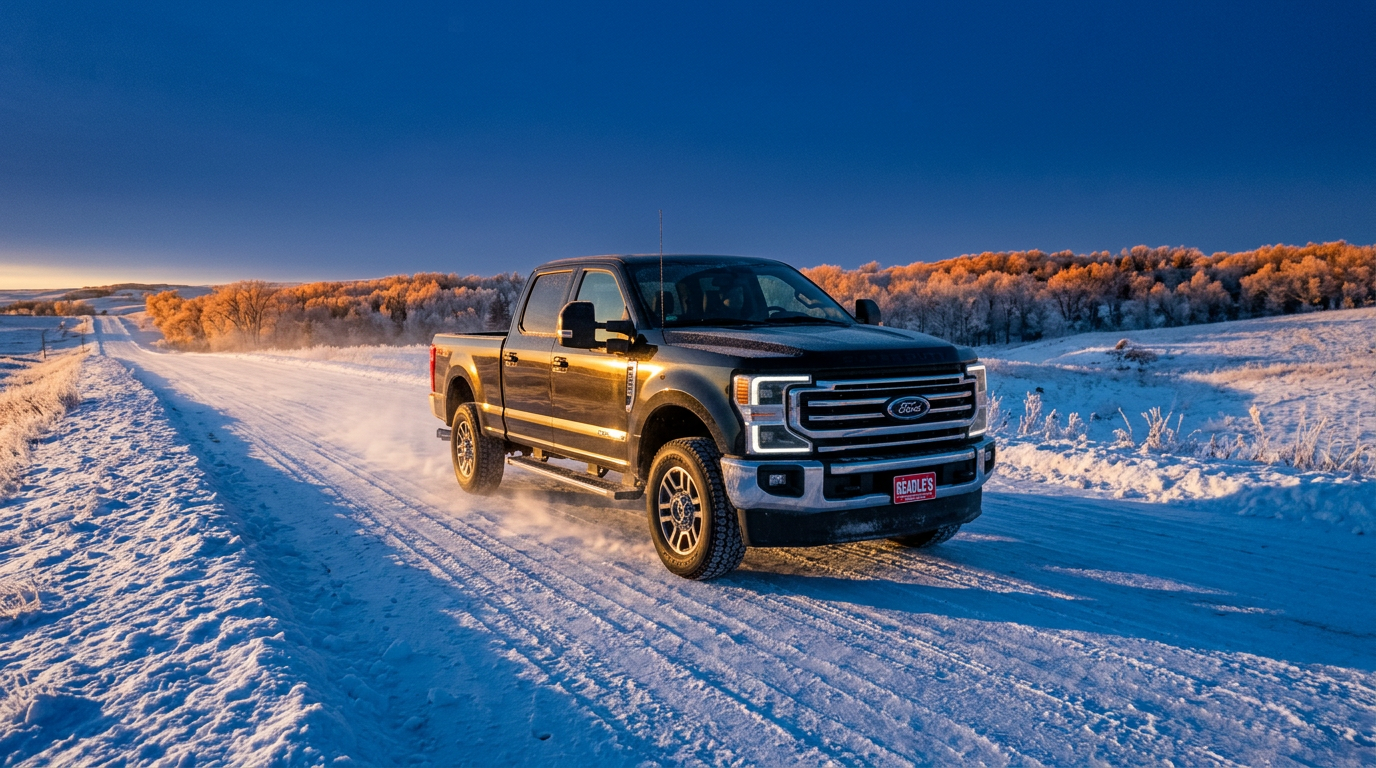
2027 Ford F-250 Winter & Gravel Capability in South Dakota
Quick Answer The 2027 Ford F-250 is excellent in South Dakota winters and on gravel with 4x4, selectable drive modes including Slippery Roads, real ground clearance, and the right tires. Add the Snow Plow Prep Package for plowing, or the XL Off-Road 35-inch Tire Package for serious traction. Around here, a truck has to earn its keep in February and on washboard gravel just as much as it does towing in July. The good news is that the same heavy-duty build that makes the F-250 a strong tow truck also makes it one of the most confident winter and gravel daily drivers you can buy — as long as you spec it right. Here's how the 2027 F-250 handles a Dakota winter, what 4x4, drive modes, and snow-plow prep actually do for you, the tires that matter most, and the off-road traction tech worth ordering. Shop F-250s in Stock Reserve a 2027 F-250 Get Pre-Approved On This Page How does the 2027 F-250 handle SD winters? 4x4, drive modes, and snow-plow prep Best tires for snow and gravel Off-road and traction tech worth having How does the 2027 F-250 handle SD winters? Very well, and for the same reasons it's a good tow truck: 4x4 traction, real ground clearance to clear drifts, weight to stay planted, and traction tech tuned for slick roads. On a snow-packed county road or a drifted-in driveway, the F-250 with 4x4 and good tires is hard to stop. The ground clearance is the underrated part. Where a low car high-centers on a plow ridge, the Super Duty drives over it. Combine that with the Electronic Shift-on-the-Fly 4x4 and the Slippery Roads drive mode, and getting to work in a Dakota February stops being a question. 4x4, drive modes, and snow-plow prep The F-250's Electronic Shift-on-the-Fly 4x4 lets you move between two-wheel and four-wheel drive on the move, and the selectable drive modes — including Slippery Roads — retune throttle response and traction control for snow and ice. 4x4 is standard beginning on the King Ranch and available on the XL, XLT, and Lariat; for South Dakota, most buyers add it on any trim. If you plow, order the Snow Plow Prep Package. It readies the truck to mount a plow within Ford's front-axle weight limits, with the upgraded components a plow setup needs. Spec it from the factory rather than adding it later — it's a cleaner, better-integrated setup. Best tires for snow and gravel Tires matter more than almost anything else for winter and gravel traction. A good set of all-terrain tires is the practical all-rounder for South Dakota — they handle gravel, mud, and packed snow well and last. If you drive a lot of ice and deep snow, a dedicated winter tire is the safest choice for those months. The point is to match the tire to your roads. A truck that's perfect on the highway can feel sketchy on glare ice with the wrong rubber, and the right tire transforms how a heavy 4x4 puts power down. We'll help you pick a tire that fits how and where you actually drive. Off-road and traction tech worth having For buyers who run rough gravel, mud, and trails, the new XL Off-Road 35-inch Tire Package is the standout for 2027. It adds 35-inch tires, a taller ride height, an electronic locking rear differential, a limited-slip front differential, Rock Crawl mode, Trail Control, Trail Turn Assist, and heavy-duty skid plates — serious capability on an affordable trim. Stepping up, the Tremor Off-Road Package — now available on the XL for 2027 — brings a lifted suspension and the full off-road treatment. For most winter-and-gravel daily drivers, though, plain 4x4 with the right tires does the job; the off-road packages are for buyers who genuinely leave the maintained roads. Our Recommendation For a South Dakota winter-and-gravel daily driver, we recommend a 4x4 F-250 with a good set of all-terrain tires and the Snow Plow Prep Package if you push snow. That combination handles our roads in any season. Add the XL Off-Road 35-inch Tire Package only if you regularly run rough trails and mud beyond the gravel. From the Beadle Ford Lot The single biggest winter upgrade I steer people toward isn't a package — it's tires. A 4x4 F-250 on worn highway tires will still struggle on glare ice, and the same truck on a good all-terrain set is a different machine. We sort out the tire before we talk about anything else for a winter driver. Key Takeaways With 4x4, drive modes, ground clearance, and the right tires, the 2027 F-250 is excellent in winter and on gravel. Electronic Shift-on-the-Fly 4x4 and the Slippery Roads drive mode tune the truck for snow and ice. 4x4 is standard from the King Ranch and available on XL, XLT, and Lariat — most SD buyers add it. Order the Snow Plow Prep Package from the factory if you plow. Tires are the biggest winter upgrade; the XL Off-Road 35-inch Tire Package adds serious off-road traction. Frequently Asked Questions Is the 2027 F-250 good in the snow? Yes. With 4x4, the Slippery Roads drive mode, real ground clearance, and good tires, the F-250 handles snow-packed roads and drifts confidently. The weight and traction tech help it stay planted, and the clearance lets it drive over plow ridges that stop lower vehicles. Does the 2027 F-250 have a snow plow prep package? Yes. The Snow Plow Prep Package readies the F-250 to mount a plow within Ford's front-axle weight limits, with the upgraded components a plow setup needs. It's best ordered from the factory for a cleaner, better-integrated installation. What tires are best for an F-250 in South Dakota? A good set of all-terrain tires is the practical all-rounder for gravel, mud, and packed snow. If you drive a lot of ice and deep snow, dedicated winter tires are the safest choice for those months. Tires make the biggest difference in winter and gravel traction. Do I need an off-road package for gravel roads? No. For maintained gravel and winter roads, plain 4x4 with good all-terrain tires is plenty. The XL Off-Road 35-inch Tire Package or Tremor are for buyers who regularly run rough trails and mud beyond the gravel. Quick Answers: F-250 Winter & Gravel One-line answers to the follow-up questions buyers ask next. Good in snow? Yes — excellent with 4x4 and good tires. Does it have a winter drive mode? Yes — the Slippery Roads mode. What kind of 4x4? Electronic Shift-on-the-Fly. Is 4x4 standard? Standard from the King Ranch; available on XL, XLT, Lariat. Can it plow? Yes — order the Snow Plow Prep Package. Best tires? All-terrain for the all-around, winter tires for heavy ice and snow. Biggest winter upgrade? Tires, before any package. Off-road package for trails? The XL Off-Road 35-inch Tire Package or Tremor. Does ground clearance help in snow? Yes — it clears drifts and plow ridges. Where can I spec one for winter? Beadle Ford in Bowdle, SD. Keep Researching The complete 2027 Ford F-250 Super Duty overview — trims, towing, specs, and inventory 2027 F-250 as a daily driver in South Dakota — winter, fuel, and livability 2027 F-250 for recreational towing — getting to the lake in any season 2027 F-150 vs. F-250 — how much truck you need My Take on Winter and Gravel With the F-250 Living and working out here, I'm a believer that the F-250 is one of the most weather-proof daily drivers a person can own — but only if it's set up right. I'd take a properly spec'd 4x4 with good all-terrain tires over almost anything when the roads turn to glass. What I steer people away from is buying the truck and skimping on the tire, because that's where a capable machine gets let down. Tell me how rough your roads get and whether you push snow, and we'll build an F-250 that gets you through a Dakota winter without drama. We're at Beadle Ford in Bowdle whenever you're ready to spec one. Shop F-250s in Stock Reserve a 2027 F-250 Get Pre-Approved About the Author Lexy Tabbert — Beadle Ford, Bowdle, SD Lexy Tabbert is the Director of Sales and Marketing at Beadle Ford in Bowdle, South Dakota. She covers Ford vehicles, trim comparisons, and buyer guidance — helping families, ranchers, and ag operators across the region find the right truck and configuration for their needs. Learn more about Lexy.
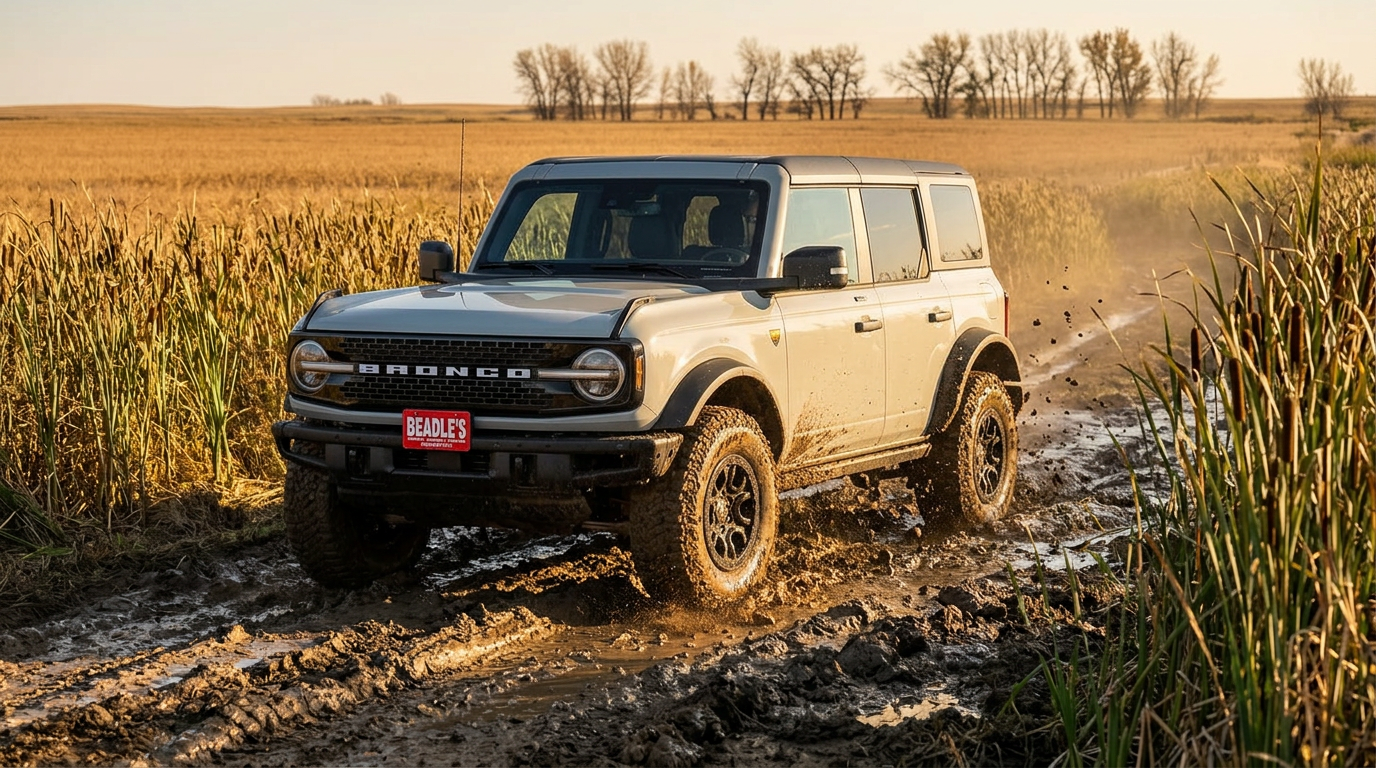
2026 Ford Bronco G.O.A.T. Modes Explained: When to Use Each One
G.O.A.T. stands for Goes Over Any Type of Terrain — it's Ford's terrain management system that adjusts throttle response, transmission shift points, traction control behavior, and torque distribution depending on what's under the tires. The marketing version makes every mode sound essential. The honest version, after years of selling Broncos to ranchers, hunters, and lake-bound buyers in central South Dakota, is that you'll use two or three of the modes regularly and the others maybe once a season. This guide walks through every G.O.A.T. mode on the 2026 Ford Bronco, names which trims get which modes, and pairs each one with a real central SD use case. We'll also cover Trail Control, Trail Turn Assist, and One-Pedal Trail Driving — three off-road tech features that don't get marketed as G.O.A.T. modes but matter as much as some that do. Shop Broncos in Stock Get Pre-Approved On This Page What's the Full G.O.A.T. Mode List for the 2026 Bronco? What Are the Five Modes Every Bronco Has — Normal, ECO, Sport, Slippery, and Sand? Which Modes Do Badlands and Raptor Add — Off-Road, Rock-Crawl, and Baja? When Would I Actually Use Each Mode in Central South Dakota? How Do G.O.A.T. Modes Compare to Jeep's Selec-Terrain System? What Do Trail Control, Trail Turn Assist, and One-Pedal Trail Driving Do? What's the Full G.O.A.T. Mode List for the 2026 Bronco? Every 2026 Bronco gets five G.O.A.T. modes as standard equipment: Normal, ECO, Sport, Slippery, and Sand. Badlands and Raptor get a different seven-mode set: Normal, ECO, Slippery, Off-Road, Sport, Rock-Crawl, and Baja. The Badlands setup drops Sand from the standard list and adds three off-road-specific modes — it's not just five-plus-two, it's a different mix tuned for harder use. The mode dial sits on the center console where the standard transmission shifter would be on a non-G.O.A.T. vehicle, and you select modes by rotating the dial. The current mode is shown both on the dial itself and in the digital instrument cluster. The Heritage Edition and Stroppe Edition use the standard five-mode set; the Big Bend and Outer Banks also get five. If the seven-mode set matters to your use case, Badlands or Raptor is the trim. For full trim breakdowns see our 2026 Bronco trim levels guide. What Are the Five Modes Every Bronco Has — Normal, ECO, Sport, Slippery, and Sand? Normal is the default mode for everyday driving — paved roads, dry gravel, light loads. The system runs balanced throttle response, normal shift mapping, and standard traction control. It's where the Bronco sits 80 percent of the time for most owners. ECO mode dials throttle response back, holds gears longer, and biases shift points for fuel economy. It's the mode for the Bowdle-to-Black-Hills highway run when you'd rather have an extra mile or two per gallon than instant pedal response. Highway only — there's no off-road benefit to ECO. Sport sharpens throttle response, holds gears longer for higher-RPM operation, and tightens steering feel slightly. It's the mode for the rare moments you actually want to drive a Bronco hard on pavement — a fun back-road run, a quick highway pass. Most Bronco owners try Sport once and never return to it. Slippery is the workhorse of the standard five-mode set in central South Dakota. It dials throttle response back so you don't break traction at takeoff, smooths shift points, and recalibrates traction control for soft or slick surfaces. Slippery covers wet gravel, packed snow, glare ice on a section line, a soft CRP access road, and frozen ruts in early winter. If you live outside Bowdle on a gravel road, this mode earns its money every week of the cold months. Sand is the mode for a Lake Oahe shoreline access lane, a soft beach approach to a boat ramp, and any deep dry-loose surface where you need wheel speed to maintain forward momentum. It defeats traction control more aggressively than Slippery does, on the principle that wheel slip is part of how you make progress through deep sand. Sand is missing from the Badlands and Raptor mode set, since those trims expect their drivers to use Off-Road or 4-Low for that work instead. Which Modes Do Badlands and Raptor Add — Off-Road, Rock-Crawl, and Baja? Off-Road is the everyday off-pavement mode for Badlands and Raptor. It engages the front axle, biases torque toward the wheels with grip, calibrates throttle for low-speed control, and prepares the system for use of the front and rear lockers if needed. This is the mode for a cattail-slough access road in late October, a river-bottom timber two-track in November, or a section line that hasn't been graded since spring thaw. The G.O.A.T. mode dial sits on the center console; the current mode reads on both the dial and the digital instrument cluster. Rock-Crawl is the slowest, most deliberate mode — designed for picking through rocky terrain with maximum control. It holds low gears, sharpens brake response, and integrates with Trail Control for hands-off-the-throttle crawling speed. In central SD, Rock-Crawl is overkill for almost everything. You'd reach for it on a Black Hills weekend or a serious hunting access trail with embedded rocks. It's a Wyoming or Colorado feature more than a Bowdle one. Baja is the high-speed off-road mode — sharp throttle, aggressive shift mapping, traction control retuned for desert-style driving. Like Rock-Crawl, it's geographically misaligned with central SD. There aren't many places within an hour of Bowdle where Baja mode is the right tool. Most Badlands owners around here never use it. It's part of the package because the Badlands trim is sold nationwide, and there are buyers in the Southwest and West Coast who do use it. Both lockers — front and rear, electronic — are standard on Badlands, Heritage Edition, Raptor, and any Bronco with the Sasquatch Package. The lockers are what get you out of a stuck situation when an open differential is just spinning one wheel; they're a separate system from the mode dial, but Off-Road and Rock-Crawl prepare the vehicle to use them. Sasquatch deep-dive in our 2026 Bronco Sasquatch Package guide. Get Pre-Approved Contact Beadle Ford When Would I Actually Use Each Mode in Central South Dakota? Here's the honest central SD use map for each mode: For 80 percent of the miles a Bronco logs on central SD section roads, Normal mode handles it. Slippery is the wet-gravel and snow-cover answer. Normal: Paved roads anywhere — Bowdle in town, US-12, US-83, the trip to Aberdeen or Pierre. Dry gravel section roads in summer. Light errand-running on packed snow with no ice. This is where the Bronco lives most of the time. ECO: Long highway runs, particularly to the Black Hills (~four hours) when you'd rather take the small fuel-economy improvement. Skip ECO in town or on gravel — there's no benefit. Sport: Almost never. The Bronco isn't a sport-tuned vehicle, and the mode is more relevant for highway passing maneuvers than for daily driving. Slippery: Wet gravel section roads, snow-covered county roads, glare ice, frozen ruts in early winter, soft CRP access roads after rain, the muddy approach to a Lake Oahe boat ramp in spring. This is the everyday cold-weather setting for a Bronco that lives outside Bowdle. Sand: Lake Oahe shoreline access at unimproved boat ramps in summer. Some sandy two-tracks across CRP. Used a few times a season at most. Off-Road (Badlands/Raptor): Cattail-slough access roads, river-bottom timber two-tracks, ranch-property loops with deep ruts, harvested-cornfield approaches in wet conditions. This is the SD-relevant mode that actually gets used in the field. Rock-Crawl and Baja (Badlands/Raptor): Black Hills weekend trips for Rock-Crawl. Baja is mostly geographically misaligned with central SD — an interesting feature on the spec sheet that most local owners never use. How Do G.O.A.T. Modes Compare to Jeep's Selec-Terrain System? Both systems do the same job — adjust traction control, throttle response, transmission behavior, and torque distribution for different surfaces. The differences are in mode count, mode names, and how the systems integrate with other off-road tech. Jeep's Selec-Terrain typically runs four to five primary modes (Auto, Snow, Sand/Mud, Rock) depending on the trim, paired with the brand's Command-Trac, Selec-Trac, or Rock-Trac 4WD systems. G.O.A.T. tends to be more discrete in mode count — five on most Broncos, seven on Badlands and Raptor — and more electronic in feel. Selec-Terrain leans more analog, with a tighter integration with Rock-Trac's mechanical 4:1 low-range gearing on Wrangler Rubicons. Neither system has a clear edge over the other; they're tuned for the different brand philosophies. For the full Bronco vs Wrangler picture see our 2026 Bronco vs Jeep Wrangler honest comparison. For a central SD buyer, the comparison usually doesn't come down to mode count — it comes down to other factors (engine choice, towing, doors-off design, dealer relationship). The G.O.A.T. system covers everything a Bronco buyer needs in this region. The Selec-Terrain system covers everything a Wrangler buyer needs. Both work. What Do Trail Control, Trail Turn Assist, and One-Pedal Trail Driving Do? These three features get less attention than G.O.A.T. modes but matter as much in real off-road work. Trail Control is low-speed off-road cruise control — set a speed between roughly 1 and 20 mph, and the vehicle maintains it while you focus on steering. It's available on Bronco trims with the 10-Speed Automatic and is the right tool for crawling through deep ruts, soft mud, or a cattail-slough access road where you'd rather not modulate the throttle by foot. Trail Turn Assist uses individual brake application to tighten the turning radius dramatically when you're navigating a tight off-road switchback or a narrow section-line corner. It's a niche feature in central SD because most of our terrain doesn't require it, but for a Black Hills trail or a wooded ranch-property loop with tight turns it does what no amount of steering-wheel input can match. One-Pedal Trail Driving is available on Outer Banks and Badlands with the 10-Speed Automatic. It lets you control acceleration and braking with just the throttle pedal — lift off the throttle and the vehicle slows aggressively without you needing to swap to the brake pedal. For tricky off-road work where your right foot is doing more thinking than driving, it's a useful feature. All three of these tools become clearer within the full 2026 Ford Bronco overview, where capability and tech features lay out by trim. Key Takeaways Every 2026 Bronco has five G.O.A.T. modes: Normal, ECO, Sport, Slippery, and Sand. Badlands and Raptor get a different seven-mode set: Normal, ECO, Slippery, Off-Road, Sport, Rock-Crawl, and Baja (drops Sand, adds three off-road modes). For central SD buyers, Slippery is the everyday cold-weather mode — earns its money every week of the cold months on a gravel-road commute. Off-Road is the SD-relevant Badlands mode that gets real use; Rock-Crawl and Baja are tuned for terrain we don't have around Bowdle. Trail Control (low-speed off-road cruise) is the sleeper feature — pair it with Off-Road mode and a Bronco walks through ruts you'd struggle through manually. Frequently Asked Questions How many G.O.A.T. modes does a 2026 Ford Bronco have? Most 2026 Bronco trims (Base, Big Bend, Outer Banks, Heritage Edition, Stroppe) have five G.O.A.T. modes: Normal, ECO, Sport, Slippery, and Sand. The Badlands and Raptor get a different seven-mode set: Normal, ECO, Slippery, Off-Road, Sport, Rock-Crawl, and Baja. Sand is dropped from the Badlands set and replaced by the three off-road-specific modes. What does Slippery mode do on a 2026 Bronco? Slippery dials throttle response back so you don't break traction at takeoff, smooths shift points, and recalibrates traction control for soft or slick surfaces. It's the right setting for wet gravel, packed snow, glare ice, soft CRP access roads, and frozen ruts in early winter — the everyday cold-weather mode for a central SD Bronco. Does the 2026 Bronco have a Mud/Ruts mode? No. Earlier Bronco model years included a "Mud/Ruts" mode in marketing materials, but the 2026 Badlands order guide lists Off-Road in its place. The Badlands seven-mode set for 2026 is Normal, ECO, Slippery, Off-Road, Sport, Rock-Crawl, and Baja. Off-Road covers the muddy and rutted use cases that Mud/Ruts used to handle. Which G.O.A.T. mode should I use on a snow-packed South Dakota section road? Slippery mode is the right setting on every Bronco trim for snow-packed county roads. If you're in a Badlands or Raptor and the road is deep or rutted, switch to Off-Road and engage 4-High or 4-Low as conditions warrant. Trail Control is helpful when ruts get deep enough that throttle modulation by foot becomes tedious. Is Trail Control available on Bronco trims with the manual transmission? No. Trail Control and Trail Turn Assist are tied to the 10-Speed Automatic transmission. The 7-Speed Manual (paired with the 2.3L EcoBoost) does not offer them. If those features matter to your off-road use case, spec a 10-Speed Automatic configuration. Do I need Badlands or Raptor to get capable G.O.A.T. modes for South Dakota? For most central SD use cases — wet gravel, packed snow, soft CRP access roads, light off-pavement — the standard five-mode set with Slippery and Sand handles it. Badlands and Raptor add Off-Road, Rock-Crawl, and Baja, which earn their value if you regularly cross deep ruts, cattail-slough access roads, or river-bottom timber two-tracks. For a Big Bend or Outer Banks buyer in this region, the standard mode set is plenty. My Take on G.O.A.T. Modes for Central SD Buyers The marketing version of G.O.A.T. modes makes every setting sound essential. The reality, after years of selling Broncos to ranchers, hunters, and ag operators in this region, is that most owners use Normal and Slippery for ninety-five percent of their miles, reach for Sand a couple times a summer, and never touch Sport. On a Badlands, Off-Road gets actual use; Rock-Crawl and Baja stay on the dial as features the spec sheet wanted but the geography doesn't ask for. What I'd tell a customer is this: the seven-mode set on Badlands isn't worth paying for if you're not going to use Off-Road regularly. The five-mode set with a Big Bend's Black Diamond Package or an Outer Banks gets you 95 percent of the central SD Bronco experience for less money. If you actually do hunt sloughs and river bottoms, the Badlands Off-Road mode plus the standard front and rear lockers earn the upcharge. Come in and we'll figure out which math fits your week. Shop Broncos in Stock Get Pre-Approved About the Author Lexy Tabbert — Beadle Ford, Bowdle, SD Lexy Tabbert is the Director of Sales and Marketing at Beadle Ford in Bowdle, South Dakota. She covers Ford vehicles, trim comparisons, and buyer guidance — helping families, ranchers, and ag operators across the region find the right truck and configuration for their needs. Learn more about Lexy.
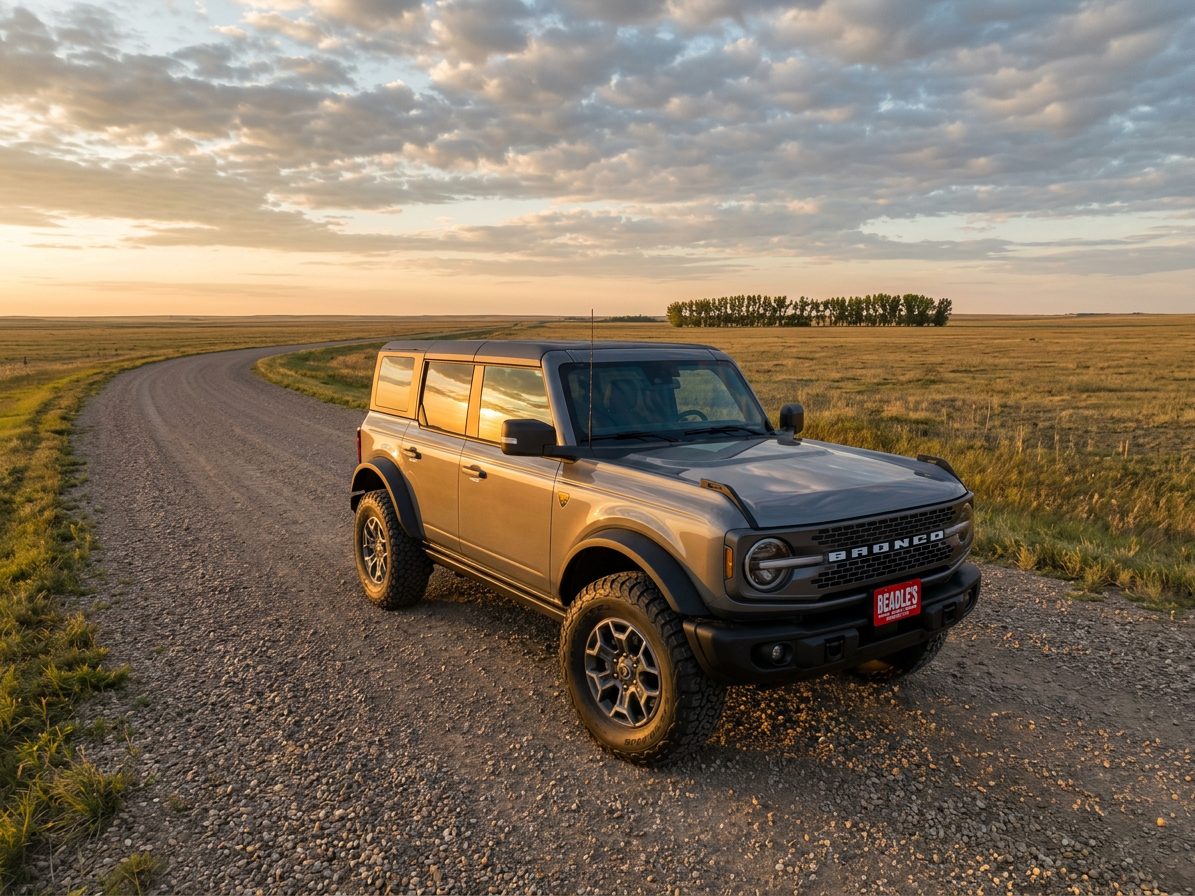
Big Bend, Badlands, or Raptor? The 2026 Ford Bronco Trim Levels, Decoded
The 2026 Ford Bronco lineup runs from a $40,495 stripped-down Base 2-Door all the way up to a $79,995 Raptor — and there are six retail trims, two body styles, and a small pile of packages to sort through before you land on the right one. For most Beadle-area buyers, the answer is somewhere in the middle, and the difference between Big Bend, Outer Banks, and Badlands matters more than the brochure makes it look. This guide walks through every 2026 Bronco trim — what's standard, what's optional, what each one is actually for, and which one tends to fit a Plains Outdoorsman, a Ranch-Country Daily, or a Wrangler cross-shopper. Pricing is MSRP before the $1,995 destination charge. Shop Broncos in Stock Get Pre-Approved On This Page The 2026 Bronco Lineup at a Glance: Base Through Raptor Big Bend, Outer Banks, and Badlands: The Mainstream Choices Heritage Edition: Plaid Cloth, Sasquatch Standard, and a Different Buyer Black Diamond and Wildtrak: Packages, Not Trims (and Why That Matters) The Raptor: When the Top of the Lineup Makes Sense Which 2026 Bronco Trim Is Right for You? What Are All the 2026 Ford Bronco Trim Levels? The 2026 Bronco is sold in six retail trims — Base, Big Bend, Outer Banks, Badlands, Heritage Edition, and Raptor — plus a Stroppe Edition that is fleet and military only and not part of regular retail ordering. Black Diamond and Wildtrak are no longer standalone trims; they are now packages that bolt onto Big Bend and Badlands respectively. All 2026 Broncos are 4x4. Base and Badlands can be ordered as either a 2-Door or 4-Door; Big Bend, Outer Banks, Heritage, and Raptor are 4-Door only. Pricing starts at $40,495 for either Base body style and tops out at $79,995 for the Raptor, with the bulk of real-world Beadle-area orders landing between $45,000 and $60,000. Engine choice is also tied to trim. The 2.3L EcoBoost (300 hp / 325 lb-ft on premium fuel) is the default across most trims and is the only engine that pairs with the 7-speed manual transmission. The 2.7L EcoBoost V6 (330 hp / 415 lb-ft) is optional or standard on Outer Banks, Badlands 4-Door, and Heritage, and is the only engine offered on the Stroppe. The Raptor gets its own 3.0L EcoBoost V6 with the 10-speed automatic. Towing is uniform across the non-Raptor lineup at 3,500 lbs, regardless of engine or trim. The Raptor moves up to 4,500 lbs. If you've heard a higher number from a friend's Bronco or an older brochure, that's not 2026 — Ford caps the standard hitch receiver at 3,500 lbs, period. Which Bronco Trim Is Best for Most Buyers — Big Bend, Outer Banks, or Badlands? For most Beadle-area buyers, the answer is one of three trims: Big Bend if you want capable and simple, Outer Banks if you want creature comforts, or Badlands if you actually plan to use the off-road hardware. These three together account for the bulk of retail Bronco demand. Big Bend — $40,995 (4-Door 4x4) Big Bend is what most people think of as the "real" entry point — Base is more of an order-code starting point than a trim most retail buyers actually take home. For $500 more than Base, you get cloth seats with better material, painted wheels instead of bare steel, body-color flares, the upgraded grille, and a more livable interior package. The 12-inch SYNC 4 screen with wireless Apple CarPlay and Android Auto is standard, as it is on every 2026 Bronco. Co-Pilot360 driver-assist features (BLIS, lane-keeping, automatic emergency braking) come standard from Big Bend up. The 2.3L EcoBoost with the 7-speed manual is standard. Big Bend fits the Ranch-Country Daily — a buyer who wants real 4x4 capability and a comfortable enough cabin without paying for hardware they won't use. 2026 Ford Bronco 4-Door Outer Banks in Velocity Blue Metallic with body-color painted hardtop, on a Lake Oahe shoreline access lane. Outer Banks — $48,090 (4-Door 4x4) Outer Banks is where the Bronco gets comfortable. Standard equipment includes leather-trimmed seats, an automatic transmission (the 7-speed manual isn't offered here), 18-inch machined-aluminum wheels with 32-inch all-terrains, painted wheel arches, and Pro Power Onboard with the 400W outlet at the back of the console. The black soft top with hard-top prep kit is standard, and a body-color painted modular hardtop is available as an option ($2,695). The 2.7L EcoBoost V6 is optional ($2,995 upcharge). It is also the trim that gets the new 60th Anniversary Package for 2026 — a $4,995 add-on that requires Sasquatch and either Ruby Red or Wimbledon White paint. Outer Banks fits the Plains Outdoorsman who wants creature comforts on the long Bowdle-to-Black-Hills run, or a Ranch-Country Daily upgrading from a base truck and wanting the leather and the V6. Badlands — $48,890 (2-Door or 4-Door 4x4) Badlands is the trim built around off-road hardware that actually works. It comes standard with HOSS 2.0 suspension (rear Bilstein position-sensitive dampers), 33-inch R/T tires, electronic-locking front and rear differentials, the Advanced 4x4 system with 4-Auto mode, and the full 7-mode G.O.A.T. terrain system (Normal, ECO, Slippery, Off-Road, Sport, Rock-Crawl, and Baja — note that the historical "Mud/Ruts" mode is now Off-Road on the 2026 Badlands). For 2026, Ford also made the Front Stabilizer Bar Disconnect available as a standalone $1,305 option on Badlands — previously it only came packaged inside Sasquatch. The Sasquatch Package itself is $4,350 with the auto, $6,345 with the manual, and adds the 35-inch tires, 4.70 axle, and Bilstein high-clearance suspension. Badlands fits the Plains Outdoorsman who runs cattail sloughs, two-track section roads, and pasture access lanes — the buyer who is actually going to use the lockers. For the engine side of this decision — manual versus automatic, 2.3L versus 2.7L — see our 2.3L vs 2.7L EcoBoost engine comparison. For the Sasquatch Package math, see our honest take on whether Sasquatch is worth it in central South Dakota. Get Pre-Approved Contact Beadle Ford Who Is the 2026 Bronco Heritage Edition Actually For? Heritage Edition is for the buyer who wants a Bronco that looks like a Bronco — and is willing to pay $51,625 to get it without optioning piece by piece. It comes with the Sasquatch Package included as standard equipment, an Oxford White-painted hardtop, 17-inch Unique White wheels, navy plaid cloth seats, a white grille with red "FORD" lettering, and Heritage bodyside graphics that nod to the original first-generation Bronco. 2026 Ford Bronco 4-Door Heritage Edition in Marsh Gray with the standard Oxford White-painted hardtop and 17-inch Unique White wheels. Mechanically, Heritage is most similar to a Sasquatch-equipped Outer Banks or Badlands — the 35-inch R/T tires, 4.70 axle, electronic-locking front and rear differentials, and high-clearance suspension all come with it. New for 2026, the 10-speed automatic is now offered with the 2.3L EcoBoost on Heritage; previously the auto was only available with the 2.7L V6. The 2.7L V6 is still available as an upgrade. One late-build note worth knowing: Oxford White is no longer orderable as a body color on Heritage for 2026, even though the hardtop is still Oxford White. Heritage Edition fits the Wrangler cross-shopper who wants a vehicle with a personality — and the Plains Outdoorsman who values that the Sasquatch hardware is bundled in rather than line-itemed. It's not the cheapest way to get to Sasquatch capability, but it's the most distinctive. Are Black Diamond and Wildtrak Still Trim Levels for 2026? No — for 2026 both Black Diamond and Wildtrak are packages, not standalone trims. This trips up returning Bronco shoppers who remember the 2021–2024 lineup, where each had its own trim line and pricing. The Black Diamond Package ($4,495) bolts onto Big Bend and brings rock-rail-style steel bumpers, a heavy-duty bash plate, marine-grade vinyl seats, and an electronic-locking rear differential. It's also a prerequisite if you want to add Sasquatch to a Big Bend. Practically, this is what makes a Big Bend buildable into something close to a Badlands without paying full Badlands money — though without the front locker or HOSS 2.0 suspension. The Wildtrak Package ($11,945) is new for 2026's late build cycle and is exclusive to the Badlands 4-Door. It bundles the 2.7L EcoBoost V6, the 10-speed auto, the full Sasquatch package, the upgraded HOSS 3.0 suspension with FOX Internal Bypass dampers, and the Black Appearance Package. There is no way to option a Badlands to match what the Wildtrak Package gives you for less money — the FOX dampers are the part that drives the price. Two practical notes: Wildtrak is not available with painted hardtops, and the Black Diamond and Wildtrak packages are not interchangeable across trims — Black Diamond is Big Bend only, Wildtrak is Badlands 4-Door only. If you came in wanting a "2026 Wildtrak" or "2026 Black Diamond," the answer is to pick the underlying trim first, then add the package. When Does the 2026 Bronco Raptor Make Sense? The Raptor makes sense when you actually run high-speed off-road terrain — the kind of desert running it was engineered for — or when you want the most capable Bronco built without compromise on price. At $79,995 before destination, it's nearly twice the cost of a Big Bend, and for the average central-South Dakota buyer, that's harder to justify than it is in Phoenix or Las Vegas. Hardware-wise, the Raptor sits in its own tier: a twin-turbo 3.0L EcoBoost V6 producing 418 horsepower and 440 lb-ft of torque, 37-inch tires on 17-inch wheels, a Raptor-specific HOSS 4.0 suspension with FOX Live Valve dampers, body-color high-coverage fender flares, and the only Bronco hitch receiver rated to 4,500 lbs. Front Stabilizer Bar Disconnect and Lux Package content (360-degree camera, adaptive cruise, Bang & Olufsen audio) are standard. 2026 Ford Bronco 4-Door Raptor in Shelter Green Metallic with 37-inch tires, body-color high-coverage flares, and the Raptor-specific grille. Raptor interior with the Code Orange Appearance Package — Code Orange stitching, orange G.O.A.T. dial ring, carbon-fiber accents, and the standard 12-inch SYNC 4 display. Raptors do show up in Beadle-area orders, but they're a minority of retail demand. For a buyer who wants Raptor-level looks without the Raptor-level invoice, the Wildtrak Package on Badlands gets you the FOX suspension and the Sasquatch hardware for substantially less — though without the 37s, the wider track, and the Raptor-specific 3.0L V6. The Raptor fits the buyer who genuinely wants the most extreme version of the Bronco — and is willing to live with the fuel economy and tire-replacement bills that come with it. If you also cross-shop Wrangler at this level, our 2026 Bronco vs Jeep Wrangler comparison covers the Raptor-versus-Wrangler 392 question directly. Which 2026 Bronco Trim Is Right for You? For most Beadle-area buyers, the practical answer is one of three: Big Bend if you want a capable, comfortable Bronco at the lowest sensible entry point and don't need the lockers, Outer Banks if leather, the V6, and a painted hardtop matter more than Sasquatch hardware, or Badlands if you actually plan to use the front locker, HOSS 2.0, and 33-inch R/Ts on pasture roads, river-bottom access lanes, and lake shorelines. Heritage Edition is for the buyer who wants Sasquatch hardware bundled in and a vehicle that doesn't blend in at the elevator. Wildtrak Package on Badlands 4-Door is for the buyer who wants the FOX suspension and Sasquatch in one box without stepping up to a Raptor. Raptor itself is for the buyer who wants the Bronco at its absolute top spec — and accepts the price and operating costs that come with it. Either body style — 2-Door or 4-Door — works in Bowdle. The 4-Door dominates retail demand for kids, dogs, gear, and long highway runs. The 2-Door is a niche but real choice; for the trade-off discussion, see our 2-Door vs 4-Door Bronco breakdown. And to put any single trim in the context of the whole 2026 model year, the full 2026 Ford Bronco overview lays the engines, capability, and what's-new content side by side. Key Takeaways The 2026 Bronco lineup is six retail trims: Base, Big Bend, Outer Banks, Badlands, Heritage Edition, and Raptor — plus Stroppe (fleet/military only). Black Diamond and Wildtrak are no longer trims — they are packages on Big Bend and Badlands 4-Door, respectively. All non-Raptor 2026 Broncos tow 3,500 lbs. The Raptor tows 4,500 lbs. There is no in-between. SYNC 4 with the 12-inch screen is standard on every trim, including Base. BlueCruise is not offered on the 2026 Bronco. For most Beadle-area buyers, Big Bend, Outer Banks, or Badlands is the right answer — Heritage and Raptor serve specific buyers, not the average shopper. Frequently Asked Questions How many trim levels does the 2026 Ford Bronco have? There are six retail trims for 2026: Base, Big Bend, Outer Banks, Badlands, Heritage Edition, and Raptor. A Stroppe Edition exists but is fleet and military only and is not part of normal retail ordering. Black Diamond and Wildtrak are packages, not separate trims, on Big Bend and Badlands 4-Door respectively. Which 2026 Bronco trims come with electronic-locking differentials? Badlands, Heritage Edition, and Raptor come with electronic-locking front and rear differentials standard. Any trim equipped with the Sasquatch Package also gets front and rear lockers. Big Bend with the Black Diamond Package gets a rear locker only. Base, standard Big Bend, and standard Outer Banks come with open differentials. Can you still get a manual transmission on the 2026 Bronco? Yes. The 7-speed manual transmission is offered on Base, Big Bend, Badlands, and Heritage Edition — all paired with the 2.3L EcoBoost engine. It is not offered on Outer Banks, Stroppe, or Raptor. The 2.7L EcoBoost V6 and the Raptor's 3.0L EcoBoost V6 are automatic-only. How much does a fully loaded 2026 Ford Bronco cost? A fully loaded 2026 Bronco Raptor with appearance and convenience options can exceed $90,000 before destination. The retail starting prices range from $40,495 (Base) to $79,995 (Raptor), and the destination charge is $1,995 on every trim. Most Beadle-area orders land between $45,000 and $60,000 once trim, package, and color choices are added. What is the difference between Black Diamond and Sasquatch? Black Diamond is a value-focused capability package on Big Bend that adds a rear locker, steel bumpers, bash plates, and marine-grade vinyl seats for $4,495. Sasquatch is the high-clearance off-road package that adds 35-inch tires, the 4.70 axle, front and rear lockers, and Bilstein high-clearance suspension. They are not the same — and on Big Bend, Black Diamond is a prerequisite to add Sasquatch. My Take on the 2026 Ford Bronco Lineup In my time at Beadle Ford, I've seen the same trim conversation play out a hundred different ways — and the buyers who land happiest tend to be the ones who picked based on what they actually do, not on what the brochure cover looks like. The Big Bend with the Black Diamond Package quietly outperforms its price, the Outer Banks is the trim I steer comfort-first families toward, and the Badlands is the one our pheasant and ranch-country buyers usually keep coming back to. If you're trying to decide between two trims and the math feels close, come walk both of them. We can talk through the order guide, the package logic, and what each trim actually does on a section road outside Bowdle — and you'll know in twenty minutes which one is yours. Shop Broncos in Stock Get Pre-Approved About the Author Lexy Tabbert — Beadle Ford, Bowdle, SD Lexy Tabbert is the Director of Sales and Marketing at Beadle Ford in Bowdle, South Dakota. She covers Ford vehicles, trim comparisons, and buyer guidance — helping families, ranchers, and ag operators across the region find the right truck and configuration for their needs. Learn more about Lexy.
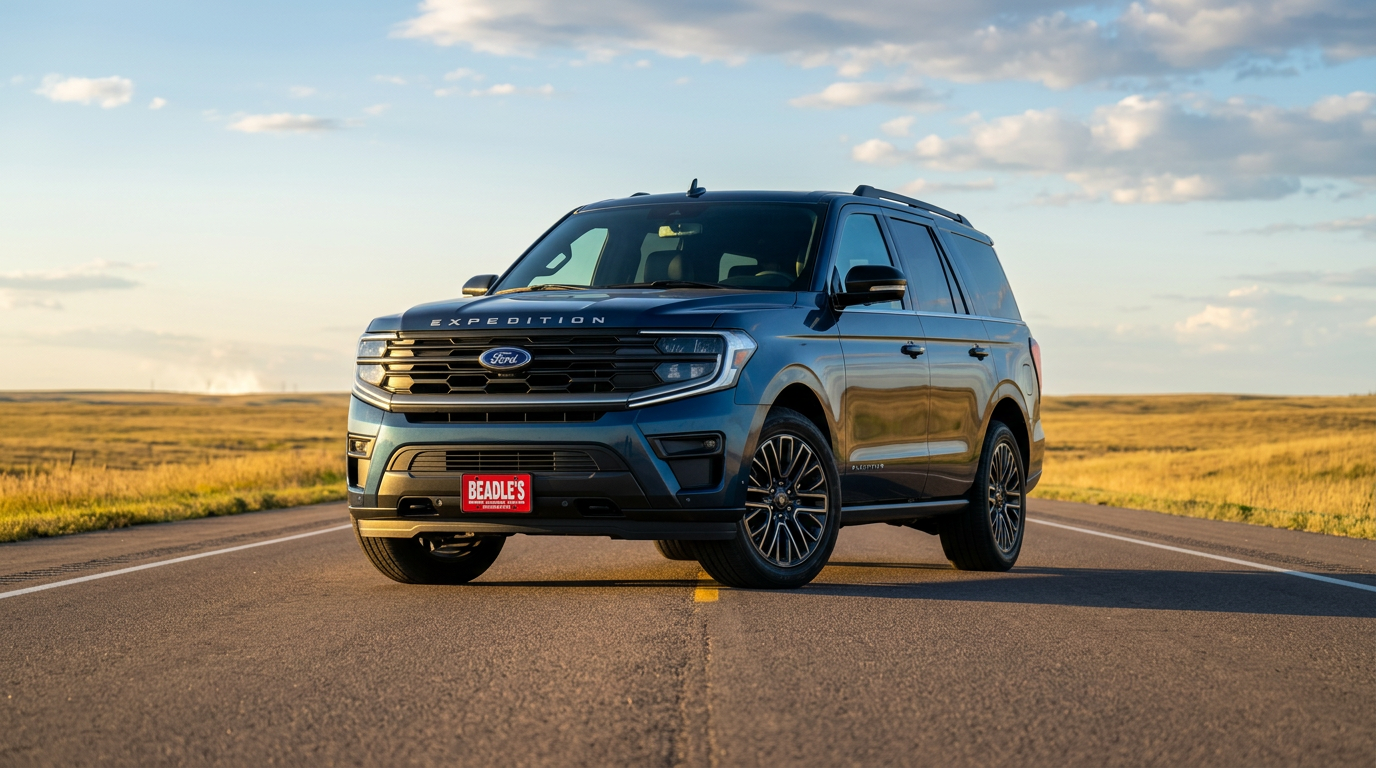
2027 Ford Expedition vs. 2026 Chevy Tahoe and Suburban: An Honest Cross-Shop for Ag Country Buyers
Home› Ford Expedition› 2027 Ford Expedition› Expedition vs. Tahoe & Suburban If you’re cross-shopping a 2027 Ford Expedition against a 2026 Chevy Tahoe or Suburban, you’re asking one of the most practical full-size-SUV questions in this part of the country. Both trucks do the same jobs — haul a family, pull a livestock or gooseneck trailer, cover long highway stretches to Sioux Falls or Fargo — but they get there with different powertrains, different tech, and different body-style philosophies. This guide is an honest cross-shop written for the buyers we actually see at Beadle Ford: ranchers and ag operators who’ve run GM full-size SUVs for decades, families who want the MAX-length option, and highway commuters deciding between EcoBoost V6 and V8 power. We’ll compare powertrains, towing, interior and tech (including BlueCruise vs. Super Cruise), and the MAX-vs.-Suburban body-style decision — then close with who should pick which truck and why. Browse Expedition Inventory Ask About a Custom Order On This Page Ford EcoBoost V6 vs. GM V8 — which powertrain wins? How does the 2027 Expedition’s towing compare to Tahoe and Suburban? Ford Digital Experience vs. GM tech — what’s different? Expedition MAX vs. Suburban — which is the right long-haul SUV? Which buyers should pick Ford and who should stay with GM? Ford EcoBoost V6 vs. GM V8 — which powertrain wins? It depends on what you’re measuring. The 2027 Ford Expedition runs the 3.5L EcoBoost V6 — a twin-turbocharged V6 — with a 440 hp / 510 lb-ft High Output variant available on the Tremor, Platinum Stealth Performance, and Platinum Ultimate configurations. The 2026 Chevy Tahoe and Suburban use naturally aspirated V8s: a 5.3L as the standard engine, a 6.2L V8 as the upgrade. Both brands mate their engines to 10-speed automatic transmissions. Where the V6 turbo wins: cruise fuel economy on flat interstate (the EcoBoost is off-boost at 70 mph and behaves like a smaller engine), altitude tolerance (a turbocharged V6 doesn’t lose power at elevation the way a naturally aspirated V8 does — relevant if you tow into Wyoming or the Black Hills), and peak torque delivered lower in the rev range. The Ford’s 510 lb-ft High Output figure outpaces the Tahoe’s 6.2L V8 on peak torque, and both High Output and the Tahoe’s 6.2L use the same 10-speed auto. Where the GM V8 wins: throttle feel at cold starts, a mechanical simplicity that some long-time owners value, and the sound. Buyers who have run GM V8s for a decade or more often describe the EcoBoost as “different” — not worse, but different. Under load with a trailer, the EcoBoost spools up and delivers; a 6.2L V8 just digs in. Both work. For the full 2027 Expedition lineup and engine-by-trim availability, see the complete 2027 Ford Expedition overview. How does the 2027 Expedition’s towing compare to Tahoe and Suburban? The Expedition has a few hundred pounds of headroom over comparable Tahoe and Suburban configurations. Official 2027 tow ratings will be confirmed when Ford releases the 2027 Towing Guide. Public reporting on the current-generation Expedition Tremor cites a maximum tow rating of approximately 9,600 lbs when properly equipped. Chevrolet’s published figures for the 2026 Tahoe cite a maximum tow rating in the 8,400 lb range when properly equipped, with the Suburban rated slightly lower due to its longer wheelbase and additional mass. For most buyers in our service area, the real-world question isn’t peak rating — it’s whether the truck handles your specific trailer comfortably. A 24-foot gooseneck loaded with a pair of quarter horses, a 20-foot enclosed trailer with a side-by-side and gear, or a tandem-axle boat trailer for Lake Oahe all sit well inside both trucks’ capabilities when properly equipped. Configuration, payload, and weight distribution matter more than peak figures. Where the Expedition adds practical value: Pro Trailer Hitch Assist and Pro Trailer Backup Assist are standard across every retail Expedition trim via Ford Co-Pilot360 Assist 2.0 — they’re not package-dependent. BLIS with Trailer Coverage extends blind-spot monitoring around whatever you’re pulling. The Tremor’s 3.73 Electronic Locking Rear Differential and seven drive modes give you a recovery option that a Tahoe or Suburban simply doesn’t offer from the factory. If you’re sizing an Expedition to a specific trailer, contact Beadle Ford and we’ll run the configuration against your actual load before you buy. Ready to explore the Ford side? Get Pre-Approved Browse Current Expedition Inventory Ford Digital Experience vs. GM tech — what’s different? Both brands now run Google-integrated infotainment. The 2027 Expedition’s Ford Digital Experience pairs a 24" panoramic driver display with a 13.2" center display, with Google Maps, Google Assistant, and Google Play Store embedded natively. Wireless Apple CarPlay and Android Auto are standard from Active (200A) and up. The 2026 Tahoe and Suburban use GM’s Google Built-In system across a 17.7" center touchscreen on upper trims, with a similar Google Maps and Assistant integration. The driver-monitoring hands-free systems are the bigger differentiator. Ford’s BlueCruise works on approximately 97% of controlled-access U.S. and Canada highways, includes Lane Change Assist and In-Lane Repositioning, and uses a driver-facing camera for attention monitoring. A 90-Day Trial is included on Active Touring (202A) retail orders, and the 1-Year + 90-Day plan is standard on Platinum Ultimate (17A) and King Ranch (400A). GM’s Super Cruise is the mature competing system — it’s hands-free on a different set of mapped roads and uses its own driver-monitoring approach. For South Dakota buyers, the coverage question matters most on two routes: I-90 east-west across the state and the US-12 / US-281 highway system north-south. Both systems cover I-90 well; coverage on the two-lane and semi-divided highway stretches that most of us actually drive is narrower for both. The BlueCruise vs. Super Cruise vs. ProPilot comparison walks through which system covers which roads — it’s the right resource if hands-free driving is a real decision factor for you. Ford Co-Pilot360 Assist 2.0 is standard on every retail Expedition. Features include a 360-degree camera with off-road overlays and a Rock Crawl view (the camera hardware that enables the Tremor’s trail-running), adaptive cruise with lane centering and Predictive Speed Assist, Pre-Collision Assist with automatic emergency braking, and BLIS with cross-traffic and trailer coverage. GM offers comparable tiers on the Tahoe and Suburban depending on trim. Expedition MAX vs. Suburban — which is the right long-haul SUV? Both are the extended-length full-size SUV answer from their respective brands. The Expedition MAX is the stretched version of the standard Expedition — available for 2027 on XL, Active Select, Active Touring, Platinum (including the 30th Anniversary Appearance Package), and King Ranch. Tremor is standard-length only. New for 2027: MAX Platinum is offered in 4x2 configuration as well as 4x4. The Suburban is GM’s always-extended full-size — there is no “standard Suburban” body style; the name itself denotes the extended platform. The body-style decision usually comes down to powertrain and tech preference rather than size. Both offer meaningful third-row legroom and cargo volume behind the third row — enough for a family of five or six with luggage for a week. If you want extended length plus V8 power, Suburban is the answer. If you want extended length plus EcoBoost V6 plus Ford Digital Experience plus the option of the 30th Anniversary Appearance Package on a MAX Platinum, the MAX is the answer. For a full Expedition vs. MAX decision framework — standard-length vs. extended, trim availability by body style, and when the extra length is genuinely worth it — see the 2027 Ford Expedition vs. Expedition MAX guide. Which buyers should pick Ford and who should stay with GM? Both trucks are legitimate. The right call depends on what you actually value in a full-size SUV, how you drive, and what your history with both brands has taught you. Pick the 2027 Ford Expedition if: You want EcoBoost V6 turbocharged power and the cruise-fuel and altitude benefits that come with it You’re considering a factory off-road trim — the Tremor has no direct GM equivalent (GM’s Z71 is a package, not a standalone trim) You want the 30th Anniversary Appearance Package on a Platinum — the only Expedition configuration offering Blue Ember Metallic You want Pro Trailer Hitch Assist and Pro Trailer Backup Assist standard on every retail trim, not as an upsell You want BlueCruise coverage and the 97% controlled-access highway figure matches how you drive You want the 24" panoramic driver display and the Ford Digital Experience’s pano mode Stay with the 2026 Chevy Tahoe or Suburban if: You’ve run GM V8s for decades and the sound, feel, and mechanical character of a naturally aspirated V8 matter to you You want a 6.2L V8 specifically and don’t want a turbocharged V6 alternative You want the 3.0L Duramax diesel inline-six option (Ford doesn’t offer a diesel in the Expedition) Super Cruise’s mapped-road footprint covers your specific highway routes better than BlueCruise does You’re deeply loyal to the Chevrolet brand and have a service relationship you want to keep For the ag buyer who has run GM full-size forever and is considering the switch because of a specific feature — whether that’s BlueCruise, the EcoBoost V6’s altitude behavior, Pro Trailer Hitch Assist, or the Tremor — come drive both and see which one you get out of at the end of a 200-mile day. That usually decides it. Key Takeaways Ford: 3.5L EcoBoost V6 (standard) and 3.5L EcoBoost V6 High Output at 440 hp / 510 lb-ft (confirmed). GM: 5.3L V8 standard, 6.2L V8 optional, 3.0L Duramax diesel I6 optional. Both brands use 10-speed automatic transmissions. Expedition max tow is reported at approximately 9,600 lbs (Tremor) pending the 2027 Ford Towing Guide; Tahoe tops out near 8,400 lbs per Chevrolet’s published figures. Pro Trailer Hitch Assist and Pro Trailer Backup Assist are standard on every retail 2027 Expedition trim via Ford Co-Pilot360 Assist 2.0. BlueCruise covers approximately 97% of controlled-access U.S. and Canada highways; Super Cruise covers a different mapped footprint. Compare by the routes you actually drive. No direct GM equivalent to the Expedition Tremor as a factory off-road trim. No Ford Expedition diesel option. Frequently Asked Questions How does the 2027 Ford Expedition compare to the Chevy Tahoe and Suburban? The 2027 Expedition uses a 3.5L EcoBoost V6 (twin-turbo, with a 440 hp / 510 lb-ft High Output variant) while the 2026 Tahoe and Suburban run naturally aspirated V8s (5.3L standard, 6.2L optional) plus an available 3.0L Duramax diesel I6 on the GM side. Both brands use 10-speed autos. Expedition tops in max tow capability and offers BlueCruise; GM counters with V8 heritage, Super Cruise, and the diesel option. Can the 2027 Expedition tow more than a Chevy Tahoe? In maximum trailer rating, yes — reporting on the current-generation Expedition Tremor cites approximately 9,600 lbs when properly equipped, versus Chevrolet’s published figures for the 2026 Tahoe in the 8,400 lb range. Official 2027 Expedition tow ratings will be confirmed when Ford releases the 2027 Towing Guide. Configuration and weight distribution matter more than peak figures for most real trailers. Does the Ford Expedition have a V8? No. The 2027 Ford Expedition is offered only with the 3.5L EcoBoost V6 family — standard, or the 440 hp / 510 lb-ft High Output variant on Tremor, Platinum Stealth Performance, and Platinum Ultimate. There is no V8 Expedition and no diesel Expedition. Is the Expedition MAX the same size as the Suburban? Both are extended-length full-size SUVs and offer similar third-row legroom and cargo volume. The Expedition MAX is the stretched version of the standard Expedition; the Suburban is always the extended platform (there is no standard-length Suburban). Exact overall length differs slightly between the two; the real comparison for most buyers is powertrain and tech preference rather than inches. Does the Tahoe have a factory off-road trim like the Tremor? Not as a standalone trim. Chevrolet offers the Z71 off-road package on the Tahoe, which adds off-road-oriented equipment to a trim, but the Expedition Tremor is a full trim with its own engine spec (the 440 hp High Output V6), its own suspension tuning, its own 3.73 Electronic Locking Rear Differential, and its own off-road-specific equipment standard — not a package layered onto an existing trim. Which is better on fuel — the Expedition or the Tahoe? EPA ratings for the 2027 Ford Expedition are listed on each in-stock unit’s window sticker. Turbocharged V6 engines typically return better fuel economy than naturally aspirated V8s at cruise, especially at altitude, but full-throttle towing and payload scenarios narrow that gap. If fuel economy is a primary decision factor, compare the window-sticker numbers against your specific driving pattern. Where can I drive both before I decide? Beadle Ford in Bowdle has the 2026 Expedition lineup on the lot — we’d be happy to set up a test drive and compare configurations against what you’re seeing on the Chevy side. Call (866) 561-2636 or reach out through our contact page to schedule. My Take on the Expedition vs. Tahoe & Suburban Cross-Shop Both trucks are legitimate. I won’t pretend otherwise. What I tell buyers who walk into Beadle Ford cross-shopping from a GM full-size is this: drive the EcoBoost V6 before you decide. It’s different from a 5.3L or 6.2L V8, and whether that difference registers as “better” or just “different” depends on what you’re used to. The Expedition’s advantages — peak tow headroom, standard Pro Trailer assists, Tremor capability, BlueCruise coverage, the 24" panoramic display — are real, but they matter more to some buyers than others. If you’ve been running GM for decades and everything works for you, there’s no shame in sticking with GM. If you’re curious about what the sixth-generation Expedition does better, come drive one. I’ll walk you through the configuration and we’ll figure out honestly whether switching makes sense for your week. No pressure, no scripts. Shop 2027 Expeditions in Stock Contact Beadle Ford About the Author Lexy Tabbert — Beadle Ford, Bowdle, SD Lexy Tabbert is the Director of Sales and Marketing at Beadle Ford in Bowdle, South Dakota. She covers Ford vehicles, trim comparisons, and buyer guidance — helping families, ranchers, and ag operators across the region find the right truck and configuration for their needs. Learn more about Lexy.
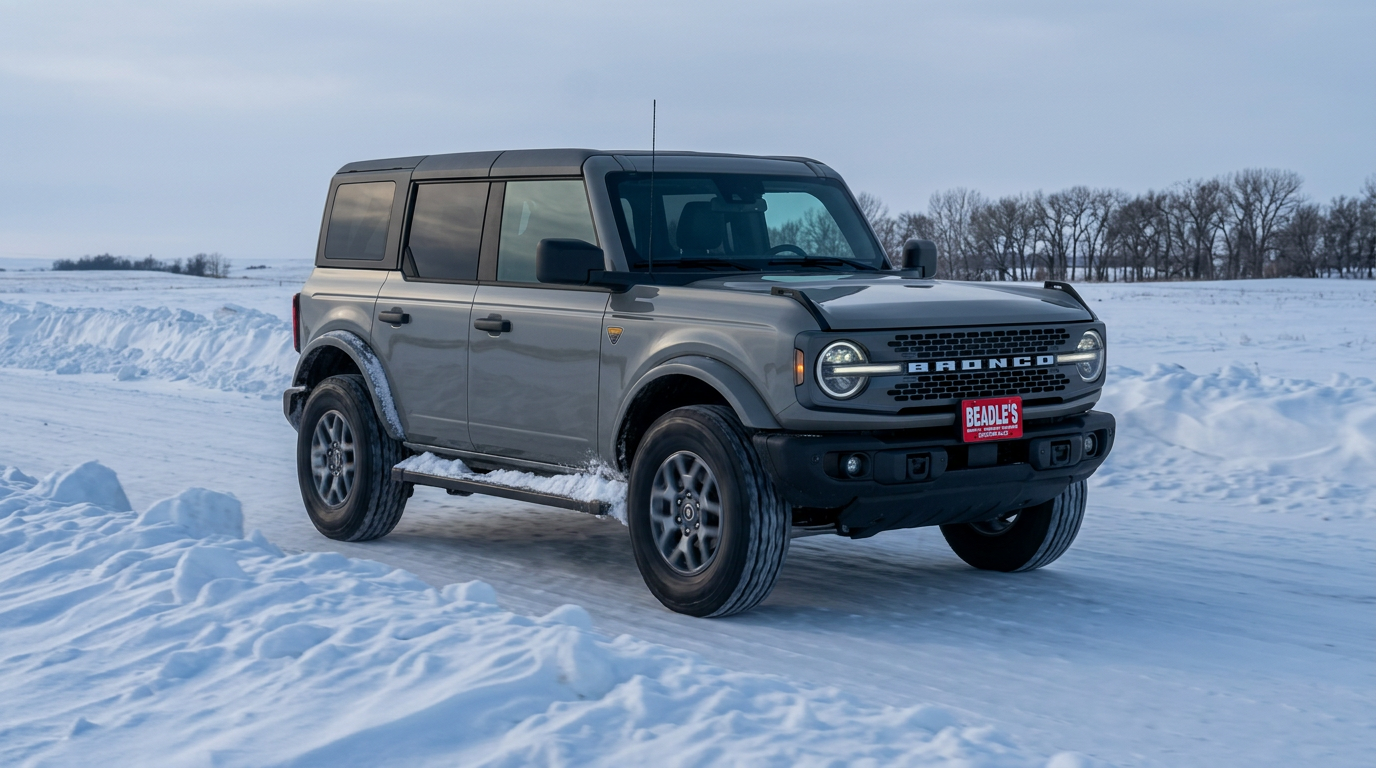
The 2026 Ford Bronco in South Dakota Winter: An Honest Look
Most reviews of the 2026 Ford Bronco are written by people who tested it in California or on a closed Michigan track. That's not the test that matters in central South Dakota. The real test is whether it starts at minus-twenty without a block heater, whether it tracks straight on a section line that drifts shut twice a week, and whether the soft top is anything other than a liability when the wind chill hits forty below. We sell Broncos to ranchers, hunters, and ag operators who hear the same questions every winter — so this is an honest take on how the 2026 Bronco actually performs through a real central SD winter. This guide covers the 4WD systems and what each setting is for, the soft-top trade-off in deep cold, heated seats and steering by trim, ground clearance against drifted snow and plowed banks, cold-weather practicality (block heater, battery, storage), and what the Bronco actually handles versus what it doesn't. There's no glossing over the rough edges — and there are a few. Shop Broncos in Stock Get Pre-Approved On This Page How Do 4-Auto, 4H, and 4L Work on Icy SD Section Roads? Can the Soft Top and Removable Doors Handle 30-Below Weather? Which Bronco Trims Get Heated Seats, Heated Steering, and Strong Defrost? Is the Bronco's Ground Clearance Enough for Drifted Snow and Plowed Banks? What Cold-Weather Practicality Should I Plan For — Block Heater, Battery, Storage? What Does the Bronco Handle on Plowed County Roads vs Unplowed Section Lines? How Do 4-Auto, 4H, and 4L Work on Icy SD Section Roads? On Broncos with the Advanced 4x4 system — Badlands, Heritage Edition, Raptor, and any trim equipped with the Sasquatch Package — 4-Auto is the setting you want for almost every central SD winter drive. It engages the front axle automatically when the rears slip, then disengages when grip returns, so you can leave it on for a 90-mile run that mixes plowed pavement, drifted gravel, and ice patches without thinking about transfer-case position. 4H is the manual-engagement setting for sustained low-traction surfaces — a packed snow section line, a long stretch of glare ice, the drive into a CRP gate that hasn't been plowed since November. It locks 50/50 torque split front to rear, which is exactly what you want when both axles need power but not what you want on dry pavement (parking-lot binding will let you know). The Base Bronco's standard 4x4 is part-time selectable engagement only — no 4-Auto, manual transfer-case shifts only — so 4H is the everyday winter setting on that trim. 4L is the deep-stuck setting. Wheel speed slows dramatically while torque goes up — the right combination for crawling out of a drift, climbing a snow-packed approach to a tree stand, or breaking through a wind-piled section-line drift you couldn't see coming. You won't use it on the highway. You'll use it three or four times a winter at most, but when you need it, nothing else does the job. For the full transmission and engine context see our 2.3L vs 2.7L EcoBoost engine comparison. Can the Soft Top and Removable Doors Handle 30-Below Weather? The honest answer most reviewers won't give: the soft top is functional in central SD winter, but for most of our customers it isn't the right call. A soft top loses cabin heat faster, lets road noise in at highway speed, and shows wear faster on a vehicle that lives outdoors through a Bowdle winter. If you're buying a Bronco that will be a year-round daily driver in SD, spec a hardtop and don't look back. Heritage Edition with the standard Oxford White-painted hardtop. For SD year-round use, a hardtop is the right answer. On the door side, the frameless removable doors do seal — there's no daylight visible at the seam — and the door-frame heater channels behave well at sub-zero temperatures. Where the design shows up is in noise: at 70 mph in a cross-wind on US-12 west of Bowdle, you hear more wind than you would in a comparable hardtop SUV from a unibody platform. Most owners get used to it within a month. A few never do. Door-removal in winter isn't really an option to plan around — by the time you'd want the doors off again, it's spring. The four to six months from May through early October is the realistic window for that, and we cover the full picture in our removable doors and roof guide. For winter, leave them on. Lock them on. Maybe forget you can take them off. Which Bronco Trims Get Heated Seats, Heated Steering, and Strong Defrost? Heated front seats and a heated steering wheel are available via the Mid Package on Big Bend (222A), Outer Banks (312A), and Badlands (332A), and they're typically included on Heritage Edition, Stroppe, and Raptor. If you're buying for SD winter use, the Mid Package is non-negotiable on Big Bend, Outer Banks, or Badlands — confirm it's on the build sheet before you sign. A heated steering wheel and heated front seats kill the cold while the cabin catches up. Confirm the trim and package before you sign — they're standard on some, optional on others. Defrost performance is where the Bronco surprises people. The HVAC system warms up faster than you'd expect from a body-on-frame SUV with a soft-top option in the lineup, and the windshield clears in a couple of minutes from a cold start. The rear defrost grid on the hardtop's swing-gate window works well; it's worth confirming you have it on whichever top you spec, since soft-top configurations have a different rear-glass setup. The 12-inch SYNC 4 display is standard on every trim including Base, which means remote start and climate pre-conditioning through the FordPass app are available across the lineup. On a January morning when it's minus-fifteen and the wind is picking up, walking out to a cabin that's already warming is the kind of small advantage that earns its money back fast. Trim-by-trim breakdowns are in our 2026 Bronco trim levels guide. Get Pre-Approved Contact Beadle Ford Is the Bronco's Ground Clearance Enough for Drifted Snow and Plowed Banks? A Badlands with the standard 33-inch Rugged-Terrain tires has approximately 8.8 to 9.0 inches of ground clearance — enough for the every-week winter scenarios in central SD: county-road drifts, plow-bank crossings into a driveway, an inch or two of fresh on top of packed gravel. A Bronco with the Sasquatch Package and 35-inch tires moves up to about 11.6 inches. The Raptor sits at roughly 13.1 inches on its 37-inch all-terrains. Where ground clearance starts to matter is the section-line scenario most central SD owners face: a road that hasn't been plowed in three days, with cross-drifts that rise to running-board height. A standard Badlands handles those drifts; a Sasquatch handles them more easily; an Outer Banks on 18-inch street-biased tires struggles. If you live ten miles outside Bowdle on a road that gets plowed once a week, the math points toward Badlands as the floor and Sasquatch as the upgrade if you can swing it. A practical note: plow banks at the end of a driveway are different from drifted snow on a section road. A plow bank is dense, often icy, and it'll grab a bumper if you hit it at speed. A drifted section road is loose powder until it isn't. Slippery mode handles both, but the actual ground clearance — not the tire size alone — is what carries you over. What Cold-Weather Practicality Should I Plan For — Block Heater, Battery, Storage? The 2.3L EcoBoost and 2.7L EcoBoost both start cold reliably without a block heater above zero, and most owners around Bowdle don't bother with one. Below zero — and especially below minus-twenty, which we hit several times most winters — a block heater shortens the warm-up cycle and puts less stress on the battery. It's a worthwhile add for a vehicle that lives outdoors all winter, and any service department can install one. The OEM battery has been reliable in our experience, but a Bronco that sits unstarted for a week in deep cold — common for a hunting rig that's parked between pheasant trips — benefits from a battery tender or a dual-battery setup if you run aftermarket lighting. The Bronco's available auxiliary upfitter switches (where equipped) make wiring a tender or a winter-only accessory cleaner than splicing into the main harness. Storage of the doors and panels is the other practical question if you've kept the soft-top option open for summer. Doors take up roughly the floor area of a closet; panels stack flat in a garage corner with the Ford-supplied storage bag. If you don't have garage space, plan to leave the hardtop on year-round and skip the soft-top configuration entirely. We've watched plenty of customers regret a soft-top order they made in July when February rolls around. What Does the Bronco Handle on Plowed County Roads vs Unplowed Section Lines? On a plowed county road in 4-Auto with 33-inch tires, the Bronco tracks straight at 60 mph with no drama. The body-on-frame chassis is heavier than a unibody crossover, which works in its favor on packed snow — the weight helps the tires bite. Cross-wind handling on US-83 or US-12 is on par with an F-150 SuperCrew of similar height, which is to say it's manageable but not invisible. On an unplowed section line with 6 to 12 inches of fresh, the Badlands or any Sasquatch-equipped Bronco walks through it without complaint in 4H or 4-Auto. Slippery mode dials throttle response back so you don't break traction on the gas pedal, and Trail Control (on automatic-transmission trims) is genuinely useful for a long deliberate crawl through deep stuff — set the speed, focus on steering. A standard Big Bend without the Black Diamond Package is more limited; it'll do most of what you ask, but it's not the right trim for an everyday section-line winter commute. Where the Bronco honestly doesn't shine: deep, heavy, wet snow at the end of a long driveway in a March melt. The vehicle is heavy enough that it can sink in slush rather than float over it the way a lifted side-by-side might. Approach speed and Slippery mode help; momentum is your friend. If you regularly cross 18-plus inches of heavy March slush, that's the use case where Sasquatch's 35-inch tires earn their upcharge — narrower contact patch, more bite, less flotation needed. All of this is clearer within the full 2026 Ford Bronco overview, where every trim's drivetrain, tire size, and package availability lays out side by side. Winter is the season that separates the right Bronco spec from the wrong one — looking at the lineup as a whole helps make the call. Key Takeaways 4-Auto is the everyday winter setting on Badlands, Heritage, Raptor, and any Sasquatch-equipped trim — set it and leave it. For year-round SD use, spec a hardtop. The soft top is functional but loses heat and shows wear faster outdoors. Heated front seats and a heated steering wheel come via the Mid Package on Big Bend, Outer Banks, and Badlands — don't skip it on a winter rig. 33-inch R/T tires (Badlands) clear the every-week winter scenarios in central SD; 35-inch tires (Sasquatch) earn their money on weekly unplowed section-line drifts. A block heater is worth installing on any Bronco that lives outdoors below zero. Battery tenders are smart for a vehicle that sits between hunting trips. Frequently Asked Questions Should I buy a soft-top Bronco for South Dakota winter use? For year-round SD use, no — spec a hardtop. The soft top is functional, but it loses cabin heat faster, lets in more highway noise at speed, and shows wear faster on a vehicle that lives outdoors through a Bowdle winter. If you're after a doors-off summer rig, the dual-tops option (soft top plus hardtop) lets you switch by season, but most owners just run the hardtop year-round. Does the 2026 Ford Bronco come with a block heater for cold starts? A block heater is not standard equipment, and it's an add we recommend for any Bronco that lives outdoors through a central SD winter. The 2.3L EcoBoost and 2.7L EcoBoost both start reliably above zero without one, but a block heater shortens the warm-up cycle and reduces battery stress in true cold. Any service department can install one as a dealer accessory. Is 4-Auto safe to leave on for the entire winter? Yes — 4-Auto on the Advanced 4x4 system is designed for exactly this use case. It engages the front axle automatically when traction is needed and disengages when it isn't, so it's safe on dry pavement, plowed roads, and mixed surfaces. 4-Auto is available on Badlands, Heritage Edition, Raptor, and any Bronco equipped with the Sasquatch Package; the Base Bronco's part-time 4x4 system doesn't include 4-Auto. Are heated seats standard on the 2026 Bronco? Heated front seats and a heated steering wheel are available via the Mid Package on Big Bend (222A), Outer Banks (312A), and Badlands (332A), and they're typically included on Heritage Edition, Stroppe Edition, and Raptor. Availability on the Base Bronco is more limited. For a winter daily driver, confirm the package is on the build sheet before you sign. Will a 2026 Bronco Badlands clear a typical SD plow bank at the end of a driveway? In most cases, yes — a Badlands on 33-inch Rugged-Terrain tires has approximately 8.8 to 9.0 inches of ground clearance, which handles typical end-of-driveway plow banks at a reasonable approach speed. A Sasquatch-equipped Bronco on 35-inch tires has about 11.6 inches and clears denser, taller banks more easily. The Raptor on 37-inch tires has roughly 13.1 inches. For all configurations, dense icy banks should be approached with momentum and Slippery mode engaged. Does the Bronco handle better than a lifted F-150 in heavy SD snow? Different strengths. A 4WD F-150 SuperCrew has a longer wheelbase that tracks well at highway speeds and a heavier curb weight that bites packed snow well. A Badlands or Sasquatch-equipped Bronco has a shorter wheelbase that maneuvers better in tight spots — section-line corners, narrow ranch gates — and tire options up to 35 or 37 inches. For long highway runs in heavy weather, the F-150 has the edge. For shorter drives that mix pavement and unplowed terrain, the Bronco usually wins. My Take on the 2026 Bronco as a South Dakota Winter Vehicle I'll say what most reviews won't: the Bronco is a real winter vehicle in central SD, but only if you spec it right. A Big Bend with the Mid Package and a hardtop will handle 95 percent of what a Bowdle-area owner faces in a winter. A Badlands with the Mid Package adds the front locker, the seven-mode terrain system, and 33-inch R/T tires that quietly do their job through a January cold snap. A Sasquatch-equipped build is for the buyer whose driveway is on the wrong side of a section line that doesn't get plowed for days at a time. None of those are the wrong call — they're three different answers to three different winter realities. What I'd steer customers away from is an Outer Banks on 18-inch street-biased tires as a year-round SD vehicle. It's a capable rig in three seasons; in February it asks for more than it should. If you're shopping a Bronco for winter use, come in and let's walk through trims, tops, and tire packages with the actual roads and driveway you drive in mind. That conversation usually saves a customer money and gets them the right rig the first time. Shop Broncos in Stock Get Pre-Approved About the Author Lexy Tabbert — Beadle Ford, Bowdle, SD Lexy Tabbert is the Director of Sales and Marketing at Beadle Ford in Bowdle, South Dakota. She covers Ford vehicles, trim comparisons, and buyer guidance — helping families, ranchers, and ag operators across the region find the right truck and configuration for their needs. Learn more about Lexy.
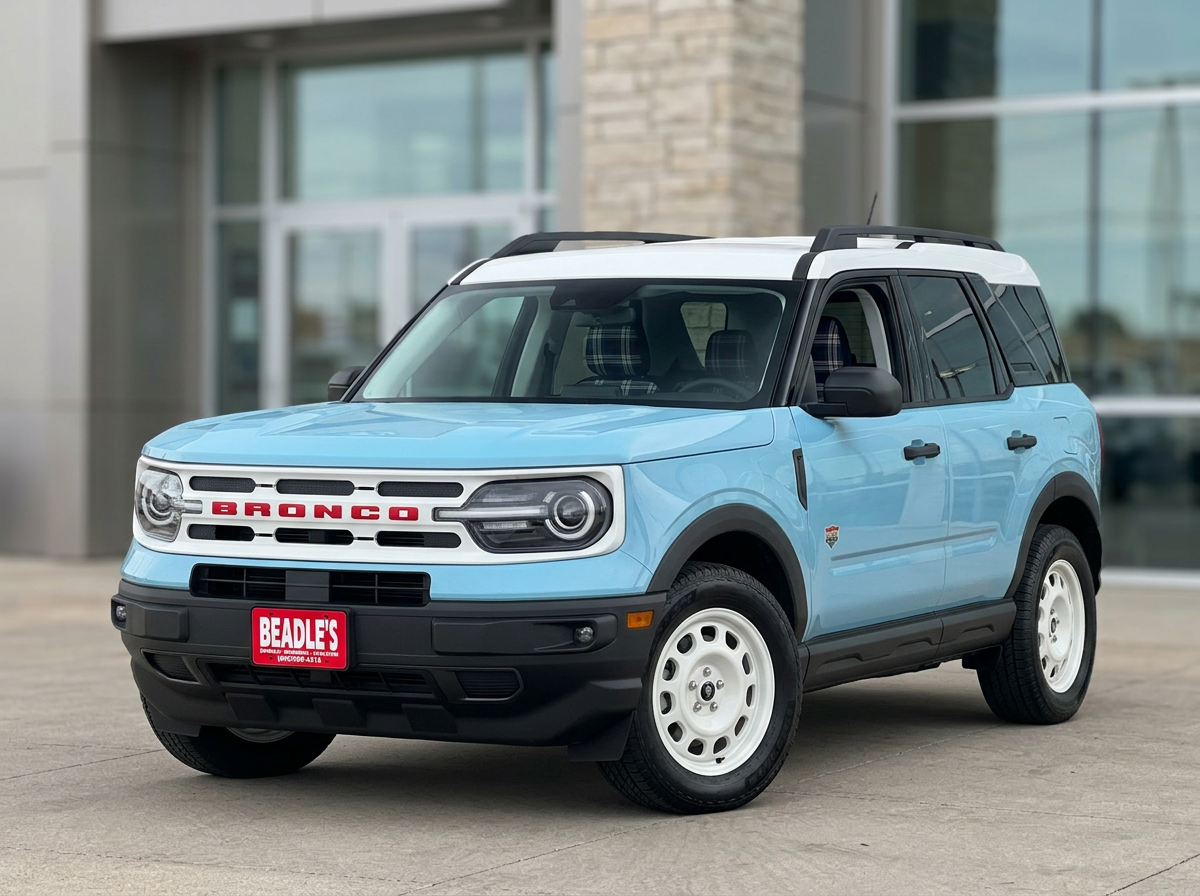
The 2026 Ford Bronco Sport Heritage: White Roof, Plaid Seats, A/T Tires Standard — Who This Trim Is Actually Built For
The 2026 Ford Bronco Sport Heritage is the most visually distinctive trim in the lineup — and the most misunderstood. Buyers see the Oxford White contrasting roof and the plaid seats and assume it's a fashion trim built for looks and nothing more. But the Heritage also comes standard with all-terrain tires, retro-inspired exterior cues drawn from the original 1966 Bronco, and unique color combinations you can't get on any other trim. Here's what actually sets the Heritage apart, who it's built for, and whether it belongs on your short list. Shop Bronco Sports in Stock Get Pre-Approved In This Guide What Makes the 2026 Bronco Sport Heritage Different From Every Other Trim? Is the Oxford White Roof Standard or an Option? Are the Heritage's A/T Tires Enough for Off-Road Use? Heritage vs. Heritage Limited: What Do You Actually Get for the Upgrade? Heritage vs. Outer Banks: Same Price Range, Very Different Character Who Is the 2026 Bronco Sport Heritage Actually Built For? What Makes the 2026 Bronco Sport Heritage Different From Every Other Trim? The Heritage trim occupies a unique spot in the Bronco Sport lineup. It's positioned above Big Bend but below Outer Banks in terms of features, yet it stands out from both because of its deliberate throwback styling — drawing direct visual cues from the first-generation Ford Bronco that debuted in 1966. What makes the Heritage distinctly its own: Heritage-Exclusive Feature What Makes It Unique Oxford White Contrasting Hardtop Roof Standard on every Heritage — not an option, not an upgrade; the white roof is built into the trim identity Plaid Cloth Seat Inserts Tartan plaid pattern referencing the original Bronco's interior; not available on any other Bronco Sport trim Heritage Badging Distinctive "Bronco" script fender badges and retro-styled exterior badging Unique Exterior Color Combinations Heritage-exclusive two-tone body colors not offered on other trims, including Robin's Egg Blue and Yellowstone Metallic All-Terrain Tires Standard A/T tires included at the base Heritage trim level — Big Bend uses highway-terrain tires Body-Color Front Fender Flares Matched to body paint rather than black; contributes to the Heritage's distinct two-tone look No other Bronco Sport trim gets the plaid seats or the white roof as a standard feature. They aren't options you can add to a Big Bend or Outer Banks — they exist only on the Heritage and Heritage Limited trims. If this look appeals to you, these are the only two ways to get it. Is the Oxford White Roof Standard or an Option? The Oxford White contrasting roof is standard on the Heritage. It's not an option you select, and it's not something you can delete from the build. Every 2026 Bronco Sport Heritage leaves the factory with the white hardtop, regardless of which body color you choose. This is an important detail for buyers who see the Heritage at a dealer and wonder whether they can order one in a single solid color without the white roof — the answer is no. The two-tone look is fundamental to the trim's identity, not an add-on. The body-color exterior combined with the Oxford White roof is what creates the Heritage's visual personality, and it's styled to echo the early Broncos that came in two-tone white-over-body-color schemes. In practice, this works well with most of the Heritage's available body colors. Ford specifically curated the Heritage's color palette to complement the white roof, so combinations like Eruption Green with white, Robin's Egg Blue with white, and Yellowstone Metallic with white all look intentional rather than mismatched. If you want a Bronco Sport without the white roof, the Big Bend, Outer Banks, or Badlands trims give you standard solid or monochromatic roof options. Are the Heritage's A/T Tires Enough for Off-Road Use? The Heritage comes with P225/60R18 all-terrain tires as standard equipment — the same A/T compound found on several of the higher trims. This is a meaningful upgrade over the Big Bend's highway-terrain tires, which prioritize ride comfort and fuel economy over grip on loose or slick surfaces. What the Heritage's A/T tires help with versus what they don't: A/T Tires Help With... Gravel roads and two-track pasture lanes Light trail use and forest roads Snow and ice traction in South Dakota winters Wet grass and soft ground near water or fields Muddy access roads after spring rain A/T Tires Won't Replace... Advanced 4x4 with twin-clutch torque vectoring (requires Sasquatch or Badlands) HOSS 2.0 off-road suspension for technical terrain Trail Control for low-speed technical obstacles Rock Crawl mode calibration (Badlands exclusive) The Heritage's 4x4 system is the standard configuration — capable and reliable for the vast majority of off-pavement use in South Dakota, but not the same as the Advanced 4x4 twin-clutch system on the Outer Banks Sasquatch or Badlands. For buyers who need a capable crossover that handles gravel lanes and winter roads between Bowdle and the next town over, the Heritage's standard 4x4 and A/T tires are genuinely well-suited. For buyers planning serious rock-crawling or technical trail runs, the Badlands is the more appropriate tool. The key point: the Heritage is more capable in real-world South Dakota conditions than its retro styling might suggest — the A/T tires are a functional upgrade, not just an aesthetic detail. Heritage vs. Heritage Limited: What Do You Actually Get for the Upgrade? The Heritage Limited is the premium version of the retro-themed lineup. Both share the signature Oxford White roof and plaid seat identity, but the Limited adds a meaningful set of interior and technology upgrades. Feature Heritage Heritage Limited Oxford White Contrasting Roof Standard Standard Plaid Seat Inserts Cloth plaid Plaid with premium trim A/T Tires Standard Yes Yes Heated Front Seats Not standard Available Remote Start Not standard Available Upgraded Wheels Standard alloys Premium finish alloys 12.3" Digital Cluster Display Not standard Available Exclusive Color Options Heritage palette Heritage + Limited-exclusive colors The Heritage Limited is the better fit if you're buying the Heritage primarily for the retro look but want the comfort features — especially heated seats and remote start — that make a Bowdle winter more bearable. If the base Heritage's price point is the draw and you don't need the cold-weather comfort features, the standard Heritage delivers the same visual personality at a lower entry price. Heritage vs. Outer Banks: Same Price Range, Very Different Character The Heritage Limited and the Outer Banks land in a similar price bracket, which means buyers often find themselves choosing between them. They're very different vehicles in terms of personality and feature priorities. Priority Heritage / Heritage Limited Outer Banks Retro / throwback styling Designed for it Modern styling Premium audio (B&O) Not available Available Panoramic fixed glass roof Not available Available Unique plaid seats + white roof Standard Not available Upgrade path to Sasquatch Package Not available Available (with Tech Package) Heritage-exclusive color palette Yes No The Heritage wins on personality and uniqueness. The Outer Banks wins on upgrade flexibility and premium interior options. If you're drawn to the Heritage because of the way it looks, that's a completely valid reason — there's no other Bronco Sport that gives you that aesthetic. If you're drawn to it for practical capability, just be aware that the Outer Banks with the Sasquatch Package can go significantly further off-road when properly equipped. Who Is the 2026 Bronco Sport Heritage Actually Built For? The Heritage is a confident choice for a specific kind of buyer. It's not trying to be the most capable off-road vehicle in the lineup, and it's not trying to be the most loaded-up comfort cruiser. It's built for buyers who care about how their vehicle looks, value individuality, and want a capable daily driver that handles South Dakota's roads without being a cookie-cutter crossover. The Heritage Is the Right Pick If You... Love the original Bronco's look and want that lineage reflected in your vehicle Want a Bronco Sport that looks genuinely different from every other one on the road Drive gravel or dirt roads regularly and want A/T tires without paying for full off-road hardware Want a two-tone color combination that works out of the factory — no custom paint needed Are buying for yourself, not for what someone else thinks is the most "capable" trim Want the Heritage Limited's cold-weather features (heated seats, remote start) at a mid-range price The Heritage is not the right fit if your primary goal is maximum off-road performance — the Badlands does that more effectively. It's also not the right fit if premium audio or a panoramic roof are top priorities — those belong to the Outer Banks. But for buyers who want something that turns heads at the trailhead and at the grocery store equally, the Heritage delivers that in a way none of the other trims can match. For more detail on where every trim sits in terms of standard features, pricing, and drivetrain options, our full 2026 Bronco Sport trim comparison guide breaks it all down side-by-side. Key Takeaways The Oxford White contrasting roof is standard on every 2026 Bronco Sport Heritage — it's not an option and cannot be deleted from the build. Plaid cloth seat inserts are Heritage and Heritage Limited exclusive — they are not available on any other Bronco Sport trim. The Heritage comes standard with all-terrain tires, which is a functional upgrade over Big Bend's highway-terrain tires for gravel roads and South Dakota winters. The Heritage uses the standard 4x4 system — the Advanced 4x4 with twin-clutch torque vectoring requires the Sasquatch Package (Outer Banks only) or Badlands trim. Heritage Limited adds heated seats, remote start, upgraded wheels, and additional technology features — worth the step-up for buyers who need cold-weather comfort in South Dakota. The Heritage is built for buyers who value retro character and visual uniqueness — not for those optimizing for maximum off-road performance or premium interior luxury. Frequently Asked Questions Can I get a Bronco Sport Heritage without the white roof? No. The Oxford White contrasting hardtop is standard on every 2026 Bronco Sport Heritage and Heritage Limited. It's a defining feature of these trims and cannot be removed or replaced with a body-color roof. If you want a Bronco Sport without the white roof, the Big Bend, Outer Banks, and Badlands are your options. Are the plaid seats available on other trims? No. The tartan plaid seat inserts are exclusive to the Heritage and Heritage Limited trims. They cannot be added to the Big Bend, Outer Banks, or Badlands through any package or option. If the plaid seats are part of your decision, these two trims are the only way to get them. Is the Heritage more capable off-road than Big Bend? The Heritage comes with all-terrain tires as standard, while the Big Bend uses highway-terrain tires. That A/T tire difference gives the Heritage a meaningful advantage on gravel, loose terrain, and snow. However, both trims share the same standard 4x4 system — neither has the Advanced 4x4 with twin-clutch torque vectoring found on the Outer Banks Sasquatch and Badlands. For light to moderate off-road use, the Heritage is better equipped than Big Bend. For technical trail work, the Badlands is a more capable platform. What colors are available on the Heritage? The Heritage is available in a curated palette that includes Heritage-exclusive colors such as Robin's Egg Blue, Yellowstone Metallic, and Eruption Green, in addition to some colors shared across the lineup. All Heritage colors are paired with the Oxford White hardtop roof. Confirm specific color availability for the current model year with our team, as production cuts can affect availability on lot versus order. Does the Heritage come with heated seats? Heated seats are not standard on the base Heritage trim. They are available on the Heritage Limited through its available packages. If heated seats are a priority for South Dakota winters, the Heritage Limited or the step up to Outer Banks are the paths to get them configured into your build. My Take on the Heritage for Bowdle Buyers The Heritage is the Bronco Sport I'd point you toward if you've been staring at the same five gray crossovers in every parking lot and want something that looks like it has a point of view. The white roof is polarizing — some buyers love it immediately, others aren't sure what to make of it. But once you see it in Robin's Egg Blue with the white top, you either get it or you don't. What I appreciate from a practical standpoint is that the A/T tires are standard — so you're not sacrificing capability to get the retro look. On the gravel roads between here and the next county line, that matters. The Heritage Limited adds enough cold-weather features to make it a comfortable year-round daily driver in South Dakota without a lot of package stacking. For a full breakdown of how the Heritage stacks up against every other Bronco Sport trim in the 2026 lineup, our 2026 Ford Bronco Sport guide at Beadle Ford has the full comparison with pricing and standard features for each trim level. Shop Bronco Sports in Stock Get Pre-Approved Contact Us About the Author Lexy Tabbert Lexy Tabbert is an automotive content writer and researcher at Beadle Ford in Bowdle, SD. She covers Ford lineup updates, trim comparisons, package guides, and regional buying content to help South Dakota shoppers make confident decisions. She has strong opinions about two-tone roof color combinations and is not sorry about it.
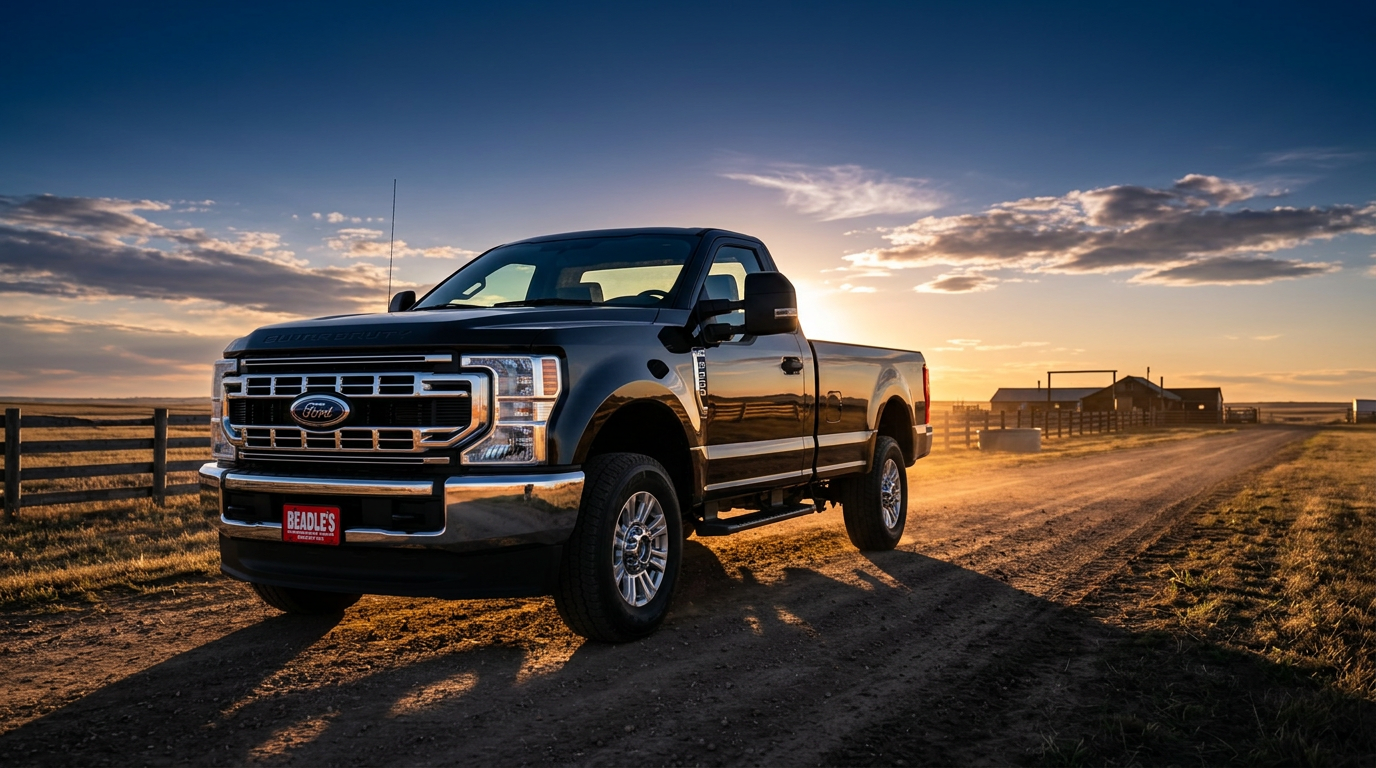
Is an F-250 Enough Truck? (2027 Ford F-250)
Quick Answer For most buyers, the 2027 Ford F-250 is enough truck. As a single-rear-wheel three-quarter-ton it tows up to 23,000 lbs gooseneck (diesel) and carries up to about 3,700 lbs of payload, properly equipped — plenty for daily driving, recreational towing, and ranch work. Step up to the F-350 mainly for a dually or maximum payload. "Do I need an F-350, or is the F-250 enough?" is the question we hear most from heavy-duty shoppers. The honest answer for the large majority of buyers around here is that the F-250 is plenty — and stepping up to a one-ton usually solves a problem you don't actually have. This guide lays out what a 2027 F-250 handles day to day, exactly how much it tows and hauls, the specific cases where an F-350 earns the upgrade, and whether a three-quarter-ton is too much truck for a daily driver. Shop F-250s in Stock Reserve a 2027 F-250 Get Pre-Approved On This Page What can a 2027 F-250 handle day to day? How much can it tow and haul? When would you actually need an F-350? Is the F-250 too much truck for a daily driver? What can a 2027 F-250 handle day to day? Just about everything a non-commercial owner throws at a truck: hauling in the bed, plowing snow, running gravel roads, and towing campers, boats, stock trailers, and the occasional gooseneck. With the now-standard 7.3L gas V8 and available 4x4, it's a genuine heavy-duty truck without the bulk of a one-ton dually. Around Bowdle and Aberdeen, that covers the way most people actually use a Super Duty: a capable work-and-family truck during the week, a tow vehicle on the weekend, and a snow-and-gravel machine all winter. The single-rear-wheel setup keeps it easy to drive and park while still carrying serious payload. How much can it tow and haul? Properly equipped, a 2027 F-250 tows up to about 19,500 lbs on a fifth-wheel or gooseneck with the 7.3L gas, and up to 23,000 lbs gooseneck with the 6.7L High-Output diesel and the High-Capacity Axle Upgrade. Payload reaches up to about 3,700 lbs. Put that in real terms: a typical fifth-wheel camper, a loaded tandem stock trailer, or a skid steer on a deckover all sit comfortably within an F-250's range. You'd have to be pulling a genuinely heavy gooseneck — the kind that's near the top of the rating every trip — before the F-250 runs out of truck. 2027 F-250 capability Properly equipped Max gooseneck towing Up to 23,000 lbs (HO diesel) Max fifth-wheel towing Up to 22,100 lbs (HO diesel); ~19,500 lbs (gas) Max conventional towing Up to 22,000 lbs (HO diesel); 18,200 lbs (gas) Max payload Up to about 3,700 lbs Maximums require proper equipment and vary by cab, bed, axle, engine, and configuration. When would you actually need an F-350? Step up to the F-350 when you need a dual-rear-wheel (dually) setup, the highest payload, or you routinely run heavy gooseneck and fifth-wheel loads near the top of the range. The F-350 adds DRW stability, more payload headroom, and a higher tow ceiling — up to 40,000 lbs gooseneck when properly equipped. If that's not you, the extra capability is capability you'll pay for and rarely use. The dually is wider, harder to park, and less convenient as a daily driver. Most buyers who think they need a one-ton are buying for the heaviest day they can imagine rather than the load they actually pull. Stay with the F-250 if you tow campers, boats, stock trailers, or an occasional gooseneck, and you want an easy daily driver. Step up to the F-350 if you need a dually, run heavy goosenecks weekly, carry maximum payload, or want the 40,000-lb tow ceiling. Is the F-250 too much truck for a daily driver? No. A single-rear-wheel F-250 drives, parks, and lives like a normal full-size truck — it's the dually F-350 that gets cumbersome as a daily. With the comfort of a Lariat or Platinum cab and the 7.3L gas, plenty of owners run an F-250 as their everyday vehicle. The trade-off versus a half-ton F-150 is ride and fuel: the heavier-duty suspension rides a little firmer unloaded, and a big gas V8 isn't sipping fuel. For buyers who tow with any regularity, that's a fair trade for the capability and the smoother manners when there's a trailer behind you. Our Recommendation For the large majority of buyers around Bowdle and Aberdeen, the 2027 F-250 is the right truck — it tows up to 23,000 lbs gooseneck and carries up to about 3,700 lbs, which covers daily driving, recreational towing, and ranch work. Only move up to the F-350 if you genuinely need a dually, maximum payload, or routinely tow heavy goosenecks. From the Beadle Ford Lot A lot of folks come in convinced they need a one-ton, and once we walk through what they actually pull, most of them land on an F-250 and are happier for it — easier to drive every day, less money out the door, and still more capability than they use. The buyers we send to the F-350 are the ones who already know they need a dually. Key Takeaways The 2027 F-250 tows up to 23,000 lbs gooseneck (diesel) and carries up to about 3,700 lbs of payload. That covers daily driving, recreational towing, and ranch work for the large majority of buyers. Step up to the F-350 only for a dually, maximum payload, or routine heavy gooseneck towing. A single-rear-wheel F-250 drives and parks like a normal full-size truck — not too much for a daily driver. Frequently Asked Questions Is the 2027 F-250 enough truck for ranch work? For most operations, yes. The F-250 tows up to 23,000 lbs gooseneck and carries up to about 3,700 lbs of payload, which handles stock trailers, hay, feed, and equipment. You'd step up to an F-350 mainly for a dually or to routinely pull the heaviest goosenecks. What's the difference between the F-250 and F-350? The F-250 is a single-rear-wheel three-quarter-ton; the F-350 is a one-ton offered in single- and dual-rear-wheel (dually) form. The F-350 adds payload headroom, dually stability, and a higher tow ceiling (up to 40,000 lbs gooseneck). The F-250 is easier to drive daily. Can an F-250 tow a fifth-wheel camper? Yes. The F-250 tows up to about 19,500 lbs fifth-wheel with the 7.3L gas and up to 22,100 lbs with the High-Output diesel, properly equipped — enough for the large majority of recreational fifth-wheel campers. Is an F-250 hard to drive every day? Not really. A single-rear-wheel F-250 drives and parks like a normal full-size truck. The ride is a touch firmer than a half-ton when unloaded, but it's an easy daily driver — it's the dually F-350 that gets cumbersome in town. Quick Answers: Is an F-250 Enough? One-line answers to the follow-up questions buyers ask next. Max gooseneck tow? Up to 23,000 lbs with the High-Output diesel. Max payload? Up to about 3,700 lbs. Does the F-250 come as a dually? No — for a dually, step up to the F-350. Can it pull a fifth-wheel camper? Yes — up to about 19,500 lbs on the gas V8. Is it good for ranch work? Yes — stock trailers, hay, feed, and equipment. When do I need an F-350? Dually, max payload, or routine heavy goosenecks. Is it too big for daily driving? No — the SRW F-250 drives like a normal full-size truck. Gas or diesel for an F-250? Gas for occasional towing; diesel for heavy, frequent hauling. How does it compare to an F-150? More capability and a smoother tow, with a firmer unloaded ride. Where can I see one? Beadle Ford in Bowdle, SD. Keep Researching The complete 2027 Ford F-250 Super Duty overview — trims, towing, specs, and inventory 2027 F-150 vs. F-250 — do you even need a Super Duty? 7.3L gas vs. HO diesel — which engine fits how you tow 2027 F-250 trims for the everyday buyer — where the value lands My Take on Whether the F-250 Is Enough I'd rather sell someone the truck they'll actually use than the biggest one on the lot. When a buyer walks me through their real loads, the F-250 is the answer far more often than not — it does the work, it's easier to live with every day, and it leaves money on the table that a one-ton would have taken. The people I point to an F-350 already know they need a dually before they walk in. If you're not sure which side of that line you're on, tell me your heaviest trailer and how often you pull it. We'll figure it out together at Beadle Ford in Bowdle. Shop F-250s in Stock Reserve a 2027 F-250 Get Pre-Approved About the Author Lexy Tabbert — Beadle Ford, Bowdle, SD Lexy Tabbert is the Director of Sales and Marketing at Beadle Ford in Bowdle, South Dakota. She covers Ford vehicles, trim comparisons, and buyer guidance — helping families, ranchers, and ag operators across the region find the right truck and configuration for their needs. Learn more about Lexy.
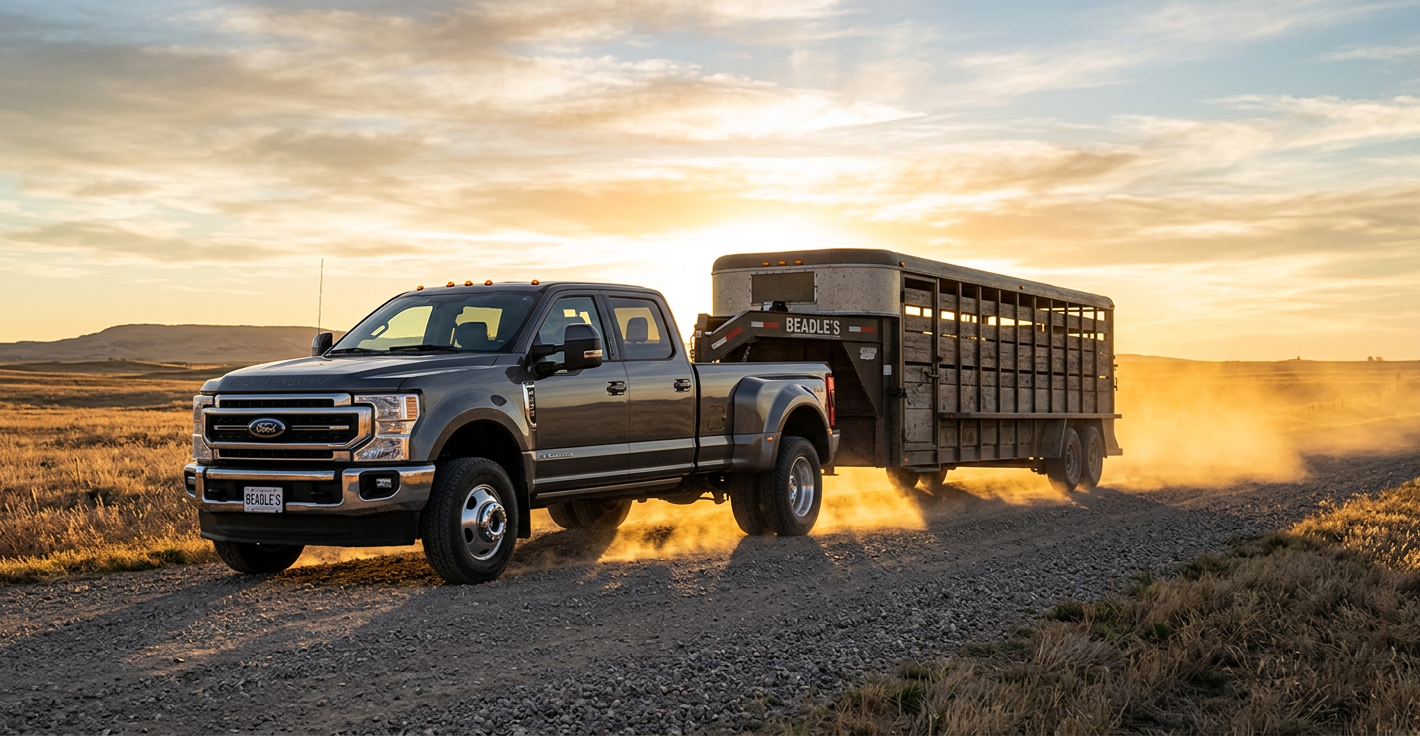
2027 Ford F-350 Towing Guide: Real Numbers by Configuration
Quick Answer Properly equipped, the 2027 Ford F-350 tows up to 40,000 lbs gooseneck (6.7L High-Output diesel, dual-rear-wheel, 40K Gooseneck Tow Package), up to 35,000 lbs fifth-wheel, and up to 28,000 lbs conventional on the dually (25,000 lbs single-rear-wheel). Those ratings carry over unchanged from 2026. The 2027 F-350 simplified to two engines, but it didn't give up an ounce of towing capability — the ratings are identical to 2026. What changed is the path to them: the High-Output diesel is now the only diesel, and it's what anchors the big numbers. This guide breaks down what the 2027 F-350 tows by hitch type, how the engine and single- vs. dual-rear-wheel choice affect it, and how to build a towing setup with real margin for the way you haul around Bowdle and Aberdeen. Shop F-350s in Stock Get Pre-Approved On This Page How much can the 2027 F-350 tow? Gooseneck vs. fifth-wheel vs. conventional Does engine choice change what it tows? How does SRW vs. DRW affect towing? How do you choose a towing setup? How much can the 2027 F-350 tow? Properly equipped, up to 40,000 lbs gooseneck, up to 35,000 lbs fifth-wheel, and up to 28,000 lbs conventional on the dually. A single-rear-wheel F-350 handles up to 25,000 lbs conventional. Here's the breakdown by hitch type: Hitch Type Max (properly equipped) Best For Gooseneck Up to 40,000 lbs (HO diesel, DRW, 40K package) Loaded livestock and equipment trailers, max capability Fifth-wheel Up to 35,000 lbs (diesel, DRW) Large fifth-wheel campers and toy haulers Conventional (bumper-pull) Up to 28,000 lbs DRW / 25,000 lbs SRW Utility, flatbed, and many travel trailers Maximums require proper equipment and vary with cab, bed, axle ratio, and configuration. The 40,000-lb gooseneck rating requires the High-Output diesel DRW with the 40K Gooseneck Tow Package. Gooseneck vs. fifth-wheel vs. conventional The hitch type sets both the ceiling and how the load behaves. Gooseneck and fifth-wheel hitches mount over the rear axle for a more stable, higher-capacity tow; a conventional bumper-pull is simpler but tops out lower. Gooseneck: the livestock and equipment standard — controlled feel, tight maneuvering, and the highest rating at up to 40,000 lbs. Fifth-wheel: popular for large RVs; the over-axle connection feels stable on the highway, up to about 35,000 lbs. Conventional: common for utility and travel trailers; up to 28,000 lbs DRW or 25,000 lbs SRW, with weight distribution and brake control mattering more as loads climb. Does engine choice change what it tows? Yes — the 6.7L High-Output Power Stroke diesel is what reaches the 40,000-lb gooseneck maximum, and it feels most composed on grades and in wind. The now-standard 7.3L gas V8 covers a wide range of lighter and moderate trailers and carries the highest payload. With only two engines for 2027, the towing decision is really "how heavy, how often." Our Recommendation For most ranch and farm buyers around Bowdle and Aberdeen, a 7.3L gas F-350 with the right hitch and axle covers the goosenecks they actually pull. Step up to the High-Output diesel and a dually when you run heavy near the top of the range or want the 40,000-lb ceiling. Compare the engines in our 2027 F-350 engine comparison. How does SRW vs. DRW affect towing? Dual-rear-wheel (DRW) trucks reach the highest ratings and feel most planted under a heavy gooseneck or fifth-wheel; single-rear-wheel (SRW) trucks still tow well beyond any half-ton (up to 25,000 lbs conventional) and are easier to live with day to day. It's the decision that most affects both capability and how the truck drives — covered in depth in our 2027 F-350 SRW vs. DRW guide. From the Beadle Ford Lot The most common towing mistake we see isn't buying too little truck — it's buying for the heaviest trailer someone pulls twice a year. We size the F-350 to the load you actually haul most weeks, then leave honest margin on top. More often than not that lands a buyer on a single-rear-wheel truck with room to spare. How do you choose a towing setup? Work from the trailer to the truck, in five steps: Start with the trailer: type (gooseneck, fifth-wheel, conventional) and realistic loaded weight. Decide SRW vs. DRW based on how heavy you run and how the truck will drive day to day. Pick the engine for your towing frequency — gas for most, High-Output diesel for heavy and often. Match the hitch, axle ratio, and tow package to your trailer (the 40K package for the gooseneck maximum). Confirm the exact build — ratings vary by configuration. Key Takeaways 2027 F-350 towing carries over: up to 40,000 lbs gooseneck, 35,000 lbs fifth-wheel, 28,000 lbs conventional DRW. The High-Output diesel + DRW + 40K package reach the 40,000-lb maximum. SRW still tows up to 25,000 lbs conventional — well beyond any half-ton. Hitch type sets both the ceiling and the feel; gooseneck is highest. Build to the trailer you pull most, with honest margin — not your once-a-year heaviest. Frequently Asked Questions How much can the 2027 Ford F-350 tow? Properly equipped, up to 40,000 lbs gooseneck (6.7L High-Output diesel, DRW, 40K Gooseneck Tow Package), up to 35,000 lbs fifth-wheel, and up to 28,000 lbs conventional on the dually (25,000 lbs single-rear-wheel). Ratings carry over unchanged from 2026. Did the 2027 F-350 lose towing capacity with fewer engines? No. The High-Output diesel still anchors the 40,000-lb gooseneck maximum, and all ratings match 2026 — the simplified two-engine lineup didn't cost the F-350 any capability. What package do I need for the 40,000-lb gooseneck rating? The 40K Gooseneck Tow Package, paired with the 6.7L High-Output Power Stroke diesel in dual-rear-wheel form. Without it, gooseneck ratings are lower. We confirm the exact axle and package on any truck before you order. Can the 7.3L gas F-350 tow a gooseneck? Yes. The now-standard 7.3L gas V8 handles a wide range of gooseneck and conventional trailers and carries the highest payload. For the heaviest loads near the top of the range, the High-Output diesel is the better fit. Do I need a dually to tow heavy with the 2027 F-350? Not for most trailers. A single-rear-wheel F-350 tows up to 25,000 lbs conventional and covers many goosenecks with margin. A dually is for maximum stability and the highest ratings, including the 40,000-lb gooseneck maximum. Quick Answers: 2027 F-350 Towing One-line answers to the follow-up questions buyers ask next. Max gooseneck? Up to 40,000 lbs (HO diesel, DRW, 40K package). Max fifth-wheel? Up to 35,000 lbs, properly equipped. Max conventional? Up to 28,000 lbs DRW, 25,000 lbs SRW. Did 2027 towing drop? No — same as 2026. Which engine for max towing? The 6.7L High-Output diesel. Can the gas tow a gooseneck? Yes — a wide range of them. Do I need a dually? Only for the heaviest loads and the 40,000-lb max. What's the 40K package? The option group required for the 40,000-lb gooseneck rating. Is a trailer brake controller included? An integrated controller is available and recommended for heavy trailers. How do I confirm a truck's rating? We verify cab, axle, and package against the build before you order. Keep Researching The complete 2027 Ford F-350 Super Duty overview — specs, towing, trims, and how to order. 2027 F-350 engine comparison — gas vs. the High-Output diesel behind the ratings. 2027 F-350 SRW vs. DRW — the stance decision that shapes your towing. 2027 F-350 payload & upfit — when payload, not towing, is the limit. My Take on Towing the 2027 F-350 In my experience, the best towing setup is the one built with margin — the truck feels composed, the trailer feels predictable, and you're not managing the load. The good news for 2027 is that the simpler engine lineup didn't change any of that; the F-350 still pulls everything it did before, you just have a cleaner decision to make. Bring me your trailer type and a realistic loaded weight and we'll size the right 2027 F-350. Stop in at Beadle Ford in Bowdle or reach out anytime. Shop F-350s in Stock Get Pre-Approved About the Author Lexy Tabbert — Beadle Ford, Bowdle, SD Lexy Tabbert is the Director of Sales and Marketing at Beadle Ford in Bowdle, South Dakota. She covers Ford vehicles, trim comparisons, and buyer guidance — helping families, ranchers, and ag operators across the region find the right truck and configuration for their needs. Learn more about Lexy.
2026 Ford F-350 Interior Comfort
Quick Answer The 2026 Ford F-350 interior ranges from hose-out-durable to genuinely luxurious. XL and XLT use work-ready materials and a 4.2-inch cluster; Lariat adds a 12-inch SYNC 4 touchscreen and leather; King Ranch and Platinum add premium leather, heated and ventilated front seats, and memory adjustable pedals. A heavy-duty truck is built around capability, but the cabin still has to work for real life — long miles, cold mornings, jobsite dust, and full days behind the wheel. The 2026 F-350 can be straightforward and durable or genuinely comfortable, depending on how it's equipped. This guide focuses on what matters most: work-ready materials, the comfort features that cut fatigue on long South Dakota highway days, storage that supports tools and gear, and how the interior actually changes as you move up the trim ladder. Shop F-350s in Stock Get Pre-Approved On This Page What makes an F-350 interior "work-ready"? Which comfort features matter most for long days? How should you think about storage and usability? How does the interior change by trim? How do you choose the right interior setup? What makes an F-350 interior "work-ready"? Work-ready means surfaces that hold up, materials that clean easily, and controls you can operate quickly — sometimes with gloves on, sometimes in a hurry. On the XL and XLT, that's vinyl or hard-wearing cloth, a straightforward 4.2-inch cluster, and a layout built to take abuse. If your truck is a daily tool, that durability matters as much as towing and payload. The good news is you don't trade away capability for comfort — every F-350 cab, from XL to Platinum, sits on the same heavy-duty truck. Which comfort features matter most for long days? On the long, straight highway runs between towns out here, the features that cut fatigue are supportive seating, a quiet settled cabin, and clear displays. The bigger comfort steps come from the trim: leather-trimmed seats on Lariat, and heated-and-ventilated front seats plus memory adjustable pedals on Platinum. Supportive seating: matters more the longer you drive and the more you tow; leather and heated/ventilated options arrive on the upper trims. Cabin comfort: how quiet and settled the truck feels varies with trim and equipment. Controls and displays: the 12-inch SYNC 4 touchscreen on Lariat and up puts trailer and drive info front-and-center, which reduces fatigue when towing. For a deeper look at the displays, camera views, and driver-assist systems, see our 2026 F-350 technology guide. How should you think about storage and usability? Storage layout is something you notice every single day. If you carry straps, tools, paperwork, chargers, or jobsite gear, a usable center console and smart cabin storage make the truck feel more efficient — especially when it pulls double duty for work and family. A Crew Cab opens up the most rear-seat storage and passenger room; SuperCab and Regular Cab trade cabin space for a shorter footprint or longer bed. Match the cab to how you actually use the back seat before you think about materials. How does the interior change by trim? Materials, screen sizes, and comfort equipment vary significantly by trim — so the smart way to shop the interior is to compare real equipment lists, not assume every F-350 is the same inside. XL: durable vinyl/cloth, 4.2-inch cluster — built to be cleaned, not pampered. XLT: upgraded cloth and more comfort and tech, still work-first. Lariat: 12-inch SYNC 4 touchscreen and leather-trimmed seating — the comfort sweet spot. King Ranch: unique Kingsville leather and Western-styled trim. Platinum: the most refined cabin — heated and ventilated front seats and memory adjustable pedals. Our Recommendation For buyers who spend real hours in the cab — long hauls, daily ranch and jobsite use — we recommend Lariat as the comfort sweet spot: the 12-inch SYNC 4 screen and leather make the long days easier without luxury-trim pricing. If the truck is a pure work tool, XLT cloth is the value play; step to King Ranch or Platinum when the cab is your office. See how it pairs with capability in our packages & trims guide. How do you choose the right interior setup? Work from how you'll live with the truck, in four steps: Decide whether the truck is primarily a work tool or a dual-purpose daily driver. Choose cab size based on passengers, gear, and how often you use the back seat. Prioritize materials that fit your environment — farm, construction, winter. Confirm the comfort and tech features on the exact trim and package combination. From the Beadle Ford Lot Buyers around Bowdle almost always underestimate how many hours they'll actually sit in the truck. The ones who come back happiest tend to be the ones who stepped from XLT cloth up to Lariat leather and the 12-inch screen — once you're putting on highway miles between towns, that's the upgrade that earns its keep. Key Takeaways Work-ready interiors (XL, XLT) prioritize durability, easy cleanup, and a simple 4.2-inch cluster. Lariat is the comfort sweet spot: 12-inch SYNC 4 touchscreen and leather-trimmed seats. King Ranch adds Kingsville leather; Platinum adds heated/ventilated front seats and memory pedals. Crew Cab gives the most rear-seat room and storage; match the cab to your back-seat use. Interior equipment varies by trim and package — confirm on the exact truck. Frequently Asked Questions Are all 2026 F-350 interiors the same? No. Materials, screens, and comfort features vary by trim and package — from durable cloth and a 4.2-inch cluster on XL to leather and a 12-inch SYNC 4 touchscreen on Lariat and up. Compare the equipment list for the specific truck you're considering. Which cab is best for families and crews? A Crew Cab is the popular choice for passenger space and rear-seat comfort. SuperCab and Regular Cab trade cabin room for a shorter overall footprint or a longer bed. The right cab depends on how many people you carry and how often you need the back seat. Which 2026 F-350 trim has heated and ventilated seats? Platinum adds heated and ventilated front seats along with memory power-adjustable pedals. Heated seating and leather appear earlier on Lariat and King Ranch; XL and XLT focus on durable, work-ready materials. What screen and infotainment does the 2026 F-350 have? Higher trims run a 12-inch center touchscreen with SYNC 4 and a 12-inch digital cluster; base trims use a 4.2-inch productivity cluster. SYNC 4 supports wireless smartphone connectivity and the trailering displays that help on long tows. What's the best interior for farm and ranch use? For dusty, muddy, hard-use environments, XL or XLT with durable cloth or vinyl is the practical pick — easy to clean and built to take it. If you also log long highway miles, an XLT with the comfort upgrades, or a Lariat, balances durability with a more livable cab. Quick Answers: F-350 Interior One-line answers to the follow-up questions buyers ask next. Does the F-350 have leather seats? Yes — leather-trimmed seating starts on Lariat. Which trim has the 12-inch screen? Lariat and up, with SYNC 4. What's standard on XL? Durable materials and a 4.2-inch productivity cluster. Which trim has heated and ventilated seats? Platinum. Does it have memory adjustable pedals? Yes, on Platinum. Best cab for families? Crew Cab, for the most rear-seat room. Is there wireless phone connectivity? Yes — SYNC 4 supports it on equipped trims. Best interior for dusty work? XL or XLT cloth/vinyl for easy cleanup. Is the cab quiet on the highway? Quieter on upper trims; all share the heavy-duty platform. How do I confirm a truck's interior? We check the build sheet against the exact unit before you buy. Keep Researching The complete 2026 Ford F-350 Super Duty overview — trims, specs, towing, and inventory in one place. 2026 F-350 packages & trims — which trim and packages get you the interior you want. 2026 F-350 technology — the SYNC 4 screen, cameras, and driver-assist features in detail. 2026 F-350 colors & styling — pair your cabin choice with the right exterior. My Take on the 2026 F-350 Interior In my experience, interior decisions go from "nice" to "important" once you live with the truck every day. When the seating, storage, and controls match your routine, the F-350 feels less like a compromise and more like the right tool for the long haul — and around here, that usually means at least the XLT comfort step, often Lariat. Tell me how you'll use the cab and I'll help you land the right trim and cab. Stop in at Beadle Ford in Bowdle or reach out anytime. Shop F-350s in Stock Get Pre-Approved About the Author Lexy Tabbert — Beadle Ford, Bowdle, SD Lexy Tabbert is the Director of Sales and Marketing at Beadle Ford in Bowdle, South Dakota. She covers Ford vehicles, trim comparisons, and buyer guidance — helping families, ranchers, and ag operators across the region find the right truck and configuration for their needs. Learn more about Lexy.
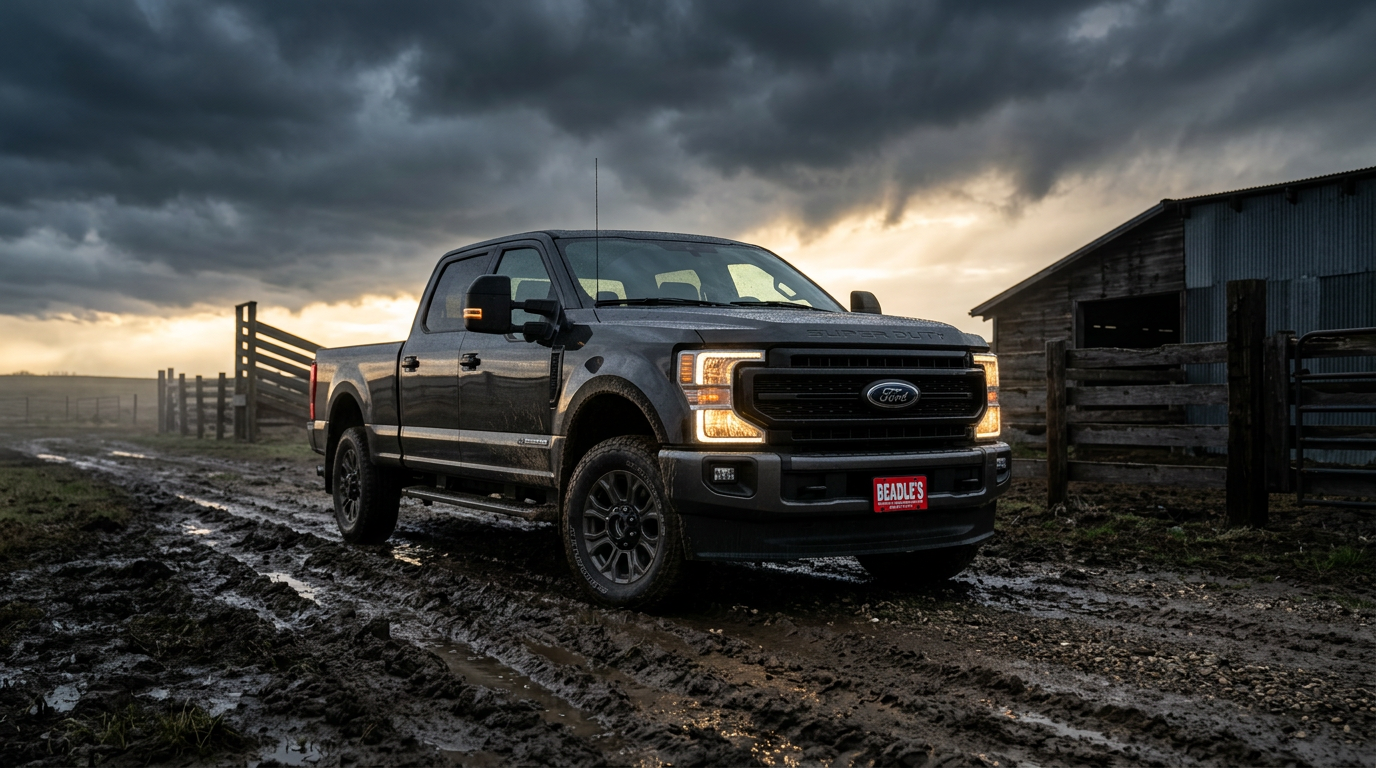
2027 Ford F-350 Carhartt Edition: Work-Ready Style
Quick Answer The Super Duty Carhartt Package is new for 2027 — a work-grade Carhartt-branded styling package for the F-350, offered on single-rear-wheel (SRW) trucks only. It pairs the toughness of the Carhartt name with the F-350's full capability, aimed squarely at the daily-driven work-truck buyer rather than the max-tow dually crowd. One of the standout 2027 additions is the Super Duty Carhartt Package — a tie-up with the workwear brand that's as recognizable on a South Dakota jobsite as the Ford oval. It brings Carhartt's work-grade look to the F-350 without touching the truck's capability. Here's what's confirmed about the package, who it's built for, and why its single-rear-wheel-only availability tells you exactly which buyer Ford had in mind. Shop F-350s in Stock Get Pre-Approved On This Page What is the 2027 Super Duty Carhartt Package? Who is the Carhartt Edition F-350 for? Why is it single-rear-wheel only? How does it fit the rest of the lineup? How do you order one? What is the 2027 Super Duty Carhartt Package? It's a new-for-2027 styling package that brings Carhartt's work-grade design to the F-350 Super Duty. Ford has confirmed the package and that it's available on single-rear-wheel trucks; the full equipment list is still being finalized, so we'll confirm exact contents — interior materials, exterior cues, and pricing — as Ford releases them. What matters most is the positioning: it's a look, not a capability change. A Carhartt-package F-350 tows and hauls exactly like any other F-350 in the same configuration — you're adding rugged, brand-right style to a truck that already works for a living. Who is the Carhartt Edition F-350 for? This one's for the buyer who lives in their truck the way they live in their Carhartts — ranchers, contractors, and tradespeople who want a work-first F-350 that looks the part. It's a hard-use, daily-driven truck with styling that matches the job, not a show piece. Why is it single-rear-wheel only? The Carhartt Package is offered on single-rear-wheel F-350s only — and that tells you the buyer Ford is targeting. It's a work-truck and daily-driver play, not a dually max-hauler statement. If you want the Carhartt look, it steers your build toward SRW; you can't pair it with a dual-rear-wheel truck. That fits the way most F-350s actually get used around here: a single-rear-wheel truck still tows up to 25,000 lbs conventional and covers most goosenecks with margin, while staying easy to park and run on gravel. More on that choice in our 2027 F-350 SRW vs. DRW guide. Our Recommendation If you want the Carhartt Edition, build it as a working single-rear-wheel F-350 — XLT or Lariat with the 7.3L gas covers daily ranch and jobsite duty perfectly, and you add the Carhartt style on top. If your hauling truly needs a dually, the Carhartt look isn't available there, so we'd point you to a standard appearance package instead. How does it fit the rest of the lineup? The Carhartt Package sits alongside the F-350's other 2027 appearance and capability options — it's about style, so you still choose your trim, the 7.3L gas or High-Output diesel, and your cab and bed as usual. Pair it with the trims and packages that match your work in our 2027 F-350 colors & appearance guide. From the Beadle Ford Lot The Carhartt name carries real weight with our customers — it's what half of them are already wearing when they walk onto the lot. We expect this package to land most with the work-first buyer who wants a single-rear-wheel F-350 that looks as tough as it works, and we're happy to spec one as soon as Ford finalizes the details. How do you order one? Because the Carhartt Edition is a 2027 build, it's an order — here's the path: Confirm you want a single-rear-wheel F-350 (the Carhartt Package requires it). Pick your trim and engine — 7.3L gas for most work, High-Output diesel if you tow heavy. Choose cab, bed, and the rest of your configuration. Add the Carhartt Package and any other appearance or work options. Place the order with us and we'll track it to delivery once Ford opens Carhartt allocation. Key Takeaways The Super Duty Carhartt Package is new for 2027 — work-grade Carhartt styling for the F-350. It's available on single-rear-wheel trucks only, pointing it at the work-truck buyer. It changes the look, not the capability — same towing and payload as any like-configured F-350. Full package contents and pricing are being finalized; we'll confirm as Ford releases them. It's a 2027 order — build it to spec with us. Frequently Asked Questions What is the 2027 Ford F-350 Carhartt Package? A new-for-2027 Super Duty styling package that brings Carhartt's work-grade design to the F-350. Ford has confirmed the package and that it's available on single-rear-wheel trucks; full equipment details and pricing are being finalized. Can I get the Carhartt Package on a dually F-350? No — it's available on single-rear-wheel (SRW) trucks only. If you want the Carhartt look, your build will be an SRW F-350. Dually buyers can choose a standard appearance package instead. Does the Carhartt Package change the F-350's capability? No. It's a styling package, so a Carhartt-equipped F-350 tows and hauls the same as any other F-350 in the same configuration. You still choose your engine, cab, bed, and trim for the capability you need. What trim and engine should I pair with the Carhartt Package? For a work-first build, XLT or Lariat with the now-standard 7.3L gas covers daily ranch and jobsite duty well. Step to the High-Output diesel if you tow heavy. The Carhartt look layers on top of your configuration. How do I get a 2027 F-350 Carhartt Edition? It's a 2027 order. Build a single-rear-wheel F-350 to your spec, add the Carhartt Package, and place the order with Beadle Ford — we'll track it to delivery once Ford opens Carhartt allocation. Call 866-561-2636 or contact us to start. Quick Answers: F-350 Carhartt Edition One-line answers to the follow-up questions buyers ask next. Is the Carhartt Package new? Yes — new for the 2027 Super Duty. SRW or DRW? Single-rear-wheel only. Does it change towing? No — it's styling, capability is unchanged. Who's it for? The work-first, daily-driven F-350 buyer. Best trim to pair it with? XLT or Lariat for a work build. Best engine? 7.3L gas for most; HO diesel if you tow heavy. Is it available now? It's a 2027 order; allocation opens with the model year. Full contents confirmed? Being finalized — we'll confirm as Ford releases them. Can a dually get the look? No — choose a standard appearance package instead. How do I order? Build an SRW F-350 with us and add the package. Keep Researching The complete 2027 Ford F-350 Super Duty overview — specs, towing, trims, and how to order. 2027 F-350 colors & appearance — where the Carhartt look fits among the appearance options. 2027 F-350 SRW vs. DRW — why the SRW-only Carhartt build makes sense for most. What's new for 2027 — the Carhartt Package in the context of all the changes. My Take on the Carhartt Edition In my experience, the Carhartt name resonates with our customers more than almost any badge Ford could put on a truck — it's the brand they already trust on their backs. Making it a single-rear-wheel package is the right call: this is a working truck for working people, dressed to match. I think it'll be a popular order once it's available. If the Carhartt Edition is on your radar, let's spec one out so you're ready to order the moment allocation opens. Stop in at Beadle Ford in Bowdle or reach out anytime. Shop F-350s in Stock Get Pre-Approved About the Author Lexy Tabbert — Beadle Ford, Bowdle, SD Lexy Tabbert is the Director of Sales and Marketing at Beadle Ford in Bowdle, South Dakota. She covers Ford vehicles, trim comparisons, and buyer guidance — helping families, ranchers, and ag operators across the region find the right truck and configuration for their needs. Learn more about Lexy.