

Blog / New Vehicles

The 2026 Ford Bronco in South Dakota Winter: An Honest Look

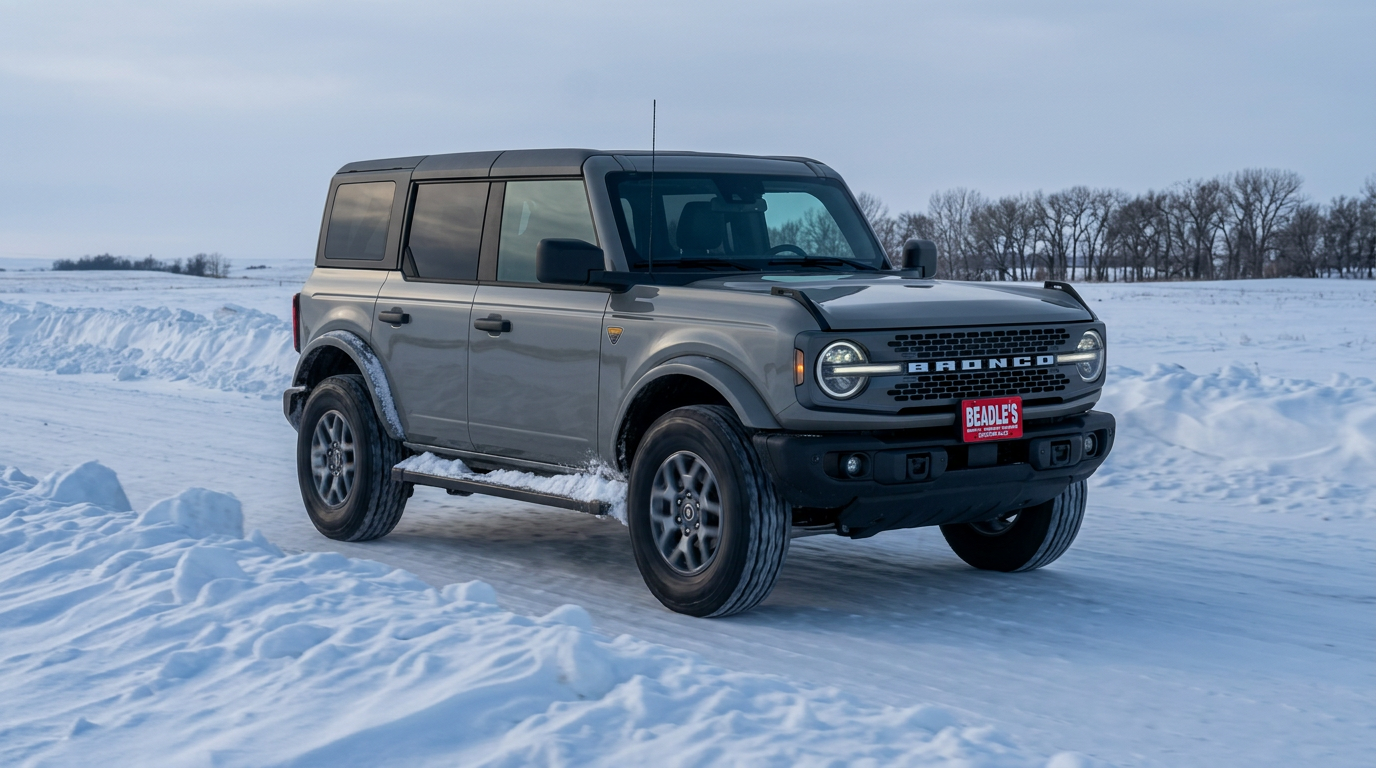
2026 Ford Bronco Badlands on a snow-packed central South Dakota section road in deep winter, drifted snow banks rising to the running boards

Most reviews of the 2026 Ford Bronco are written by people who tested it in California or on a closed Michigan track. That's not the test that matters in central South Dakota. The real test is whether it starts at minus-twenty without a block heater, whether it tracks straight on a section line that drifts shut twice a week, and whether the soft top is anything other than a liability when the wind chill hits forty below. We sell Broncos to ranchers, hunters, and ag operators who hear the same questions every winter — so this is an honest take on how the 2026 Bronco actually performs through a real central SD winter.

This guide covers the 4WD systems and what each setting is for, the soft-top trade-off in deep cold, heated seats and steering by trim, ground clearance against drifted snow and plowed banks, cold-weather practicality (block heater, battery, storage), and what the Bronco actually handles versus what it doesn't. There's no glossing over the rough edges — and there are a few.

How Do 4-Auto, 4H, and 4L Work on Icy SD Section Roads?

On Broncos with the Advanced 4x4 system — Badlands, Heritage Edition, Raptor, and any trim equipped with the Sasquatch Package — 4-Auto is the setting you want for almost every central SD winter drive. It engages the front axle automatically when the rears slip, then disengages when grip returns, so you can leave it on for a 90-mile run that mixes plowed pavement, drifted gravel, and ice patches without thinking about transfer-case position.

4H is the manual-engagement setting for sustained low-traction surfaces — a packed snow section line, a long stretch of glare ice, the drive into a CRP gate that hasn't been plowed since November. It locks 50/50 torque split front to rear, which is exactly what you want when both axles need power but not what you want on dry pavement (parking-lot binding will let you know). The Base Bronco's standard 4x4 is part-time selectable engagement only — no 4-Auto, manual transfer-case shifts only — so 4H is the everyday winter setting on that trim.

4L is the deep-stuck setting. Wheel speed slows dramatically while torque goes up — the right combination for crawling out of a drift, climbing a snow-packed approach to a tree stand, or breaking through a wind-piled section-line drift you couldn't see coming. You won't use it on the highway. You'll use it three or four times a winter at most, but when you need it, nothing else does the job. For the full transmission and engine context see our 2.3L vs 2.7L EcoBoost engine comparison.

Can the Soft Top and Removable Doors Handle 30-Below Weather?

The honest answer most reviewers won't give: the soft top is functional in central SD winter, but for most of our customers it isn't the right call. A soft top loses cabin heat faster, lets road noise in at highway speed, and shows wear faster on a vehicle that lives outdoors through a Bowdle winter. If you're buying a Bronco that will be a year-round daily driver in SD, spec a hardtop and don't look back.
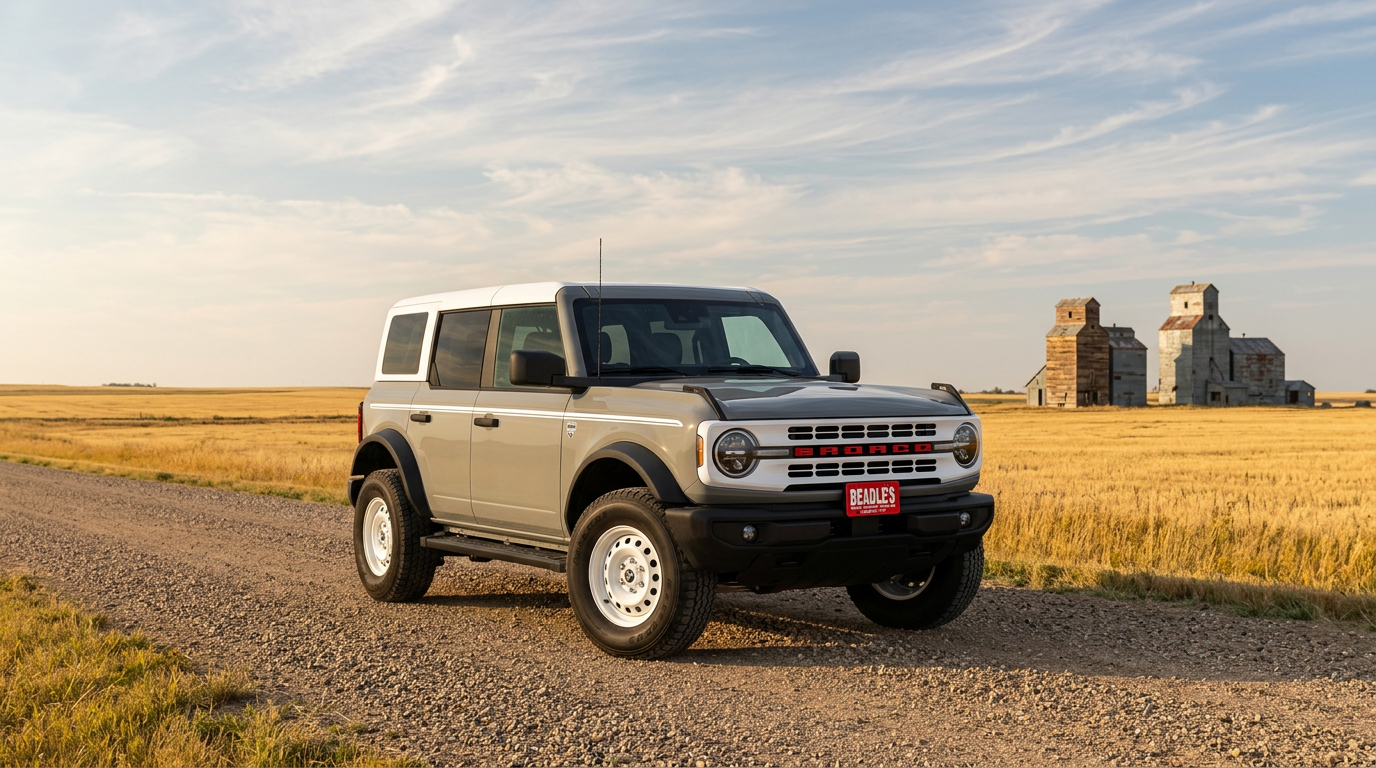
2026 Ford Bronco Heritage Edition with Oxford White-painted hardtop attached, parked near a South Dakota grain elevator in late winter light
Heritage Edition with the standard Oxford White-painted hardtop. For SD year-round use, a hardtop is the right answer.

On the door side, the frameless removable doors do seal — there's no daylight visible at the seam — and the door-frame heater channels behave well at sub-zero temperatures. Where the design shows up is in noise: at 70 mph in a cross-wind on US-12 west of Bowdle, you hear more wind than you would in a comparable hardtop SUV from a unibody platform. Most owners get used to it within a month. A few never do.

Door-removal in winter isn't really an option to plan around — by the time you'd want the doors off again, it's spring. The four to six months from May through early October is the realistic window for that, and we cover the full picture in our removable doors and roof guide. For winter, leave them on. Lock them on. Maybe forget you can take them off.

Which Bronco Trims Get Heated Seats, Heated Steering, and Strong Defrost?

Heated front seats and a heated steering wheel are available via the Mid Package on Big Bend (222A), Outer Banks (312A), and Badlands (332A), and they're typically included on Heritage Edition, Stroppe, and Raptor. If you're buying for SD winter use, the Mid Package is non-negotiable on Big Bend, Outer Banks, or Badlands — confirm it's on the build sheet before you sign.
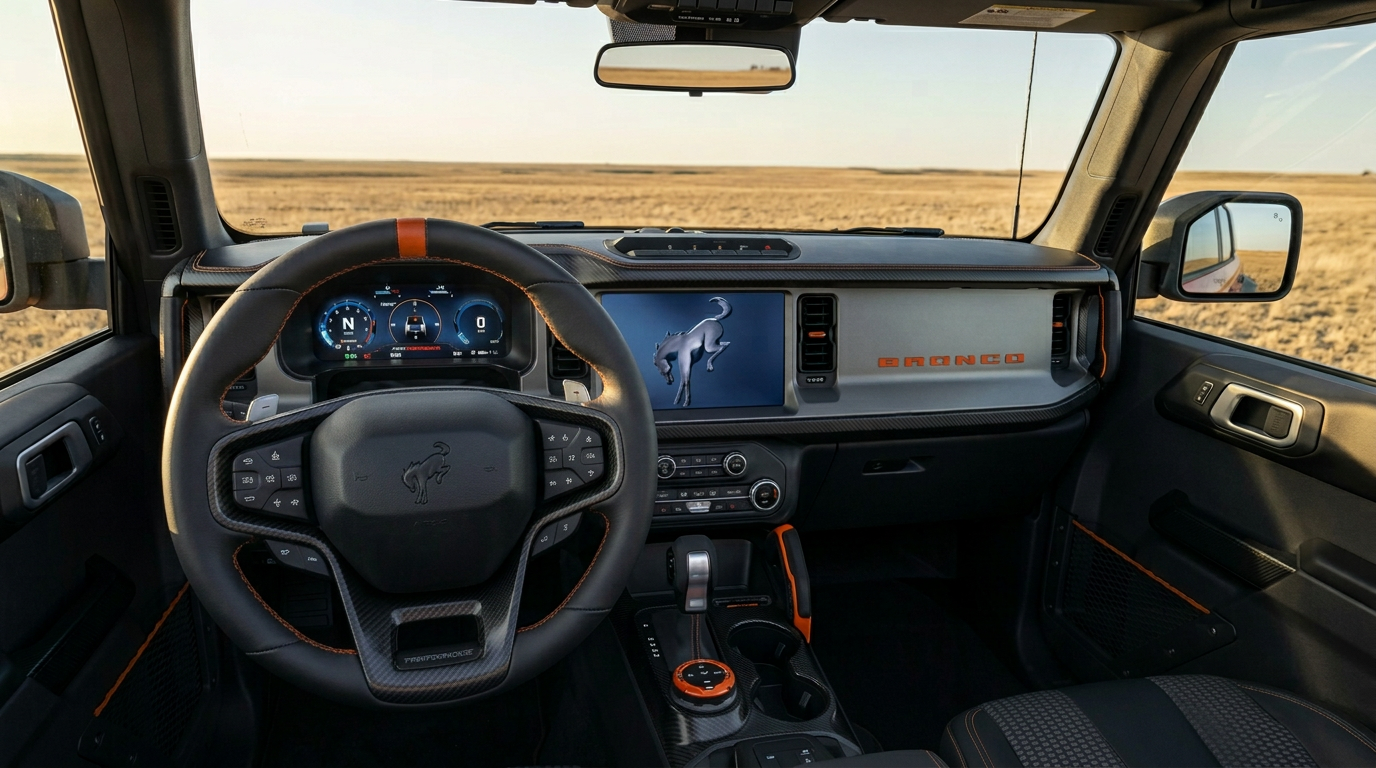
Dashboard view of the 2026 Ford Bronco showing the heated steering wheel, 12-inch SYNC 4 display, and digital cluster — Beadle Ford in Bowdle, SD
A heated steering wheel and heated front seats kill the cold while the cabin catches up. Confirm the trim and package before you sign — they're standard on some, optional on others.

Defrost performance is where the Bronco surprises people. The HVAC system warms up faster than you'd expect from a body-on-frame SUV with a soft-top option in the lineup, and the windshield clears in a couple of minutes from a cold start. The rear defrost grid on the hardtop's swing-gate window works well; it's worth confirming you have it on whichever top you spec, since soft-top configurations have a different rear-glass setup.

The 12-inch SYNC 4 display is standard on every trim including Base, which means remote start and climate pre-conditioning through the FordPass app are available across the lineup. On a January morning when it's minus-fifteen and the wind is picking up, walking out to a cabin that's already warming is the kind of small advantage that earns its money back fast. Trim-by-trim breakdowns are in our 2026 Bronco trim levels guide.

Is the Bronco's Ground Clearance Enough for Drifted Snow and Plowed Banks?

A Badlands with the standard 33-inch Rugged-Terrain tires has approximately 8.8 to 9.0 inches of ground clearance — enough for the every-week winter scenarios in central SD: county-road drifts, plow-bank crossings into a driveway, an inch or two of fresh on top of packed gravel. A Bronco with the Sasquatch Package and 35-inch tires moves up to about 11.6 inches. The Raptor sits at roughly 13.1 inches on its 37-inch all-terrains.

Where ground clearance starts to matter is the section-line scenario most central SD owners face: a road that hasn't been plowed in three days, with cross-drifts that rise to running-board height. A standard Badlands handles those drifts; a Sasquatch handles them more easily; an Outer Banks on 18-inch street-biased tires struggles. If you live ten miles outside Bowdle on a road that gets plowed once a week, the math points toward Badlands as the floor and Sasquatch as the upgrade if you can swing it.

A practical note: plow banks at the end of a driveway are different from drifted snow on a section road. A plow bank is dense, often icy, and it'll grab a bumper if you hit it at speed. A drifted section road is loose powder until it isn't. Slippery mode handles both, but the actual ground clearance — not the tire size alone — is what carries you over.

What Cold-Weather Practicality Should I Plan For — Block Heater, Battery, Storage?

The 2.3L EcoBoost and 2.7L EcoBoost both start cold reliably without a block heater above zero, and most owners around Bowdle don't bother with one. Below zero — and especially below minus-twenty, which we hit several times most winters — a block heater shortens the warm-up cycle and puts less stress on the battery. It's a worthwhile add for a vehicle that lives outdoors all winter, and any service department can install one.

The OEM battery has been reliable in our experience, but a Bronco that sits unstarted for a week in deep cold — common for a hunting rig that's parked between pheasant trips — benefits from a battery tender or a dual-battery setup if you run aftermarket lighting. The Bronco's available auxiliary upfitter switches (where equipped) make wiring a tender or a winter-only accessory cleaner than splicing into the main harness.

Storage of the doors and panels is the other practical question if you've kept the soft-top option open for summer. Doors take up roughly the floor area of a closet; panels stack flat in a garage corner with the Ford-supplied storage bag. If you don't have garage space, plan to leave the hardtop on year-round and skip the soft-top configuration entirely. We've watched plenty of customers regret a soft-top order they made in July when February rolls around.

What Does the Bronco Handle on Plowed County Roads vs Unplowed Section Lines?

On a plowed county road in 4-Auto with 33-inch tires, the Bronco tracks straight at 60 mph with no drama. The body-on-frame chassis is heavier than a unibody crossover, which works in its favor on packed snow — the weight helps the tires bite. Cross-wind handling on US-83 or US-12 is on par with an F-150 SuperCrew of similar height, which is to say it's manageable but not invisible.

On an unplowed section line with 6 to 12 inches of fresh, the Badlands or any Sasquatch-equipped Bronco walks through it without complaint in 4H or 4-Auto. Slippery mode dials throttle response back so you don't break traction on the gas pedal, and Trail Control (on automatic-transmission trims) is genuinely useful for a long deliberate crawl through deep stuff — set the speed, focus on steering. A standard Big Bend without the Black Diamond Package is more limited; it'll do most of what you ask, but it's not the right trim for an everyday section-line winter commute.

Where the Bronco honestly doesn't shine: deep, heavy, wet snow at the end of a long driveway in a March melt. The vehicle is heavy enough that it can sink in slush rather than float over it the way a lifted side-by-side might. Approach speed and Slippery mode help; momentum is your friend. If you regularly cross 18-plus inches of heavy March slush, that's the use case where Sasquatch's 35-inch tires earn their upcharge — narrower contact patch, more bite, less flotation needed.

All of this is clearer within the full 2026 Ford Bronco overview, where every trim's drivetrain, tire size, and package availability lays out side by side. Winter is the season that separates the right Bronco spec from the wrong one — looking at the lineup as a whole helps make the call.

Key Takeaways

  • 4-Auto is the everyday winter setting on Badlands, Heritage, Raptor, and any Sasquatch-equipped trim — set it and leave it.
  • For year-round SD use, spec a hardtop. The soft top is functional but loses heat and shows wear faster outdoors.
  • Heated front seats and a heated steering wheel come via the Mid Package on Big Bend, Outer Banks, and Badlands — don't skip it on a winter rig.
  • 33-inch R/T tires (Badlands) clear the every-week winter scenarios in central SD; 35-inch tires (Sasquatch) earn their money on weekly unplowed section-line drifts.
  • A block heater is worth installing on any Bronco that lives outdoors below zero. Battery tenders are smart for a vehicle that sits between hunting trips.

Frequently Asked Questions

Should I buy a soft-top Bronco for South Dakota winter use?

For year-round SD use, no — spec a hardtop. The soft top is functional, but it loses cabin heat faster, lets in more highway noise at speed, and shows wear faster on a vehicle that lives outdoors through a Bowdle winter. If you're after a doors-off summer rig, the dual-tops option (soft top plus hardtop) lets you switch by season, but most owners just run the hardtop year-round.

Does the 2026 Ford Bronco come with a block heater for cold starts?

A block heater is not standard equipment, and it's an add we recommend for any Bronco that lives outdoors through a central SD winter. The 2.3L EcoBoost and 2.7L EcoBoost both start reliably above zero without one, but a block heater shortens the warm-up cycle and reduces battery stress in true cold. Any service department can install one as a dealer accessory.

Is 4-Auto safe to leave on for the entire winter?

Yes — 4-Auto on the Advanced 4x4 system is designed for exactly this use case. It engages the front axle automatically when traction is needed and disengages when it isn't, so it's safe on dry pavement, plowed roads, and mixed surfaces. 4-Auto is available on Badlands, Heritage Edition, Raptor, and any Bronco equipped with the Sasquatch Package; the Base Bronco's part-time 4x4 system doesn't include 4-Auto.

Are heated seats standard on the 2026 Bronco?

Heated front seats and a heated steering wheel are available via the Mid Package on Big Bend (222A), Outer Banks (312A), and Badlands (332A), and they're typically included on Heritage Edition, Stroppe Edition, and Raptor. Availability on the Base Bronco is more limited. For a winter daily driver, confirm the package is on the build sheet before you sign.

Will a 2026 Bronco Badlands clear a typical SD plow bank at the end of a driveway?

In most cases, yes — a Badlands on 33-inch Rugged-Terrain tires has approximately 8.8 to 9.0 inches of ground clearance, which handles typical end-of-driveway plow banks at a reasonable approach speed. A Sasquatch-equipped Bronco on 35-inch tires has about 11.6 inches and clears denser, taller banks more easily. The Raptor on 37-inch tires has roughly 13.1 inches. For all configurations, dense icy banks should be approached with momentum and Slippery mode engaged.

Does the Bronco handle better than a lifted F-150 in heavy SD snow?

Different strengths. A 4WD F-150 SuperCrew has a longer wheelbase that tracks well at highway speeds and a heavier curb weight that bites packed snow well. A Badlands or Sasquatch-equipped Bronco has a shorter wheelbase that maneuvers better in tight spots — section-line corners, narrow ranch gates — and tire options up to 35 or 37 inches. For long highway runs in heavy weather, the F-150 has the edge. For shorter drives that mix pavement and unplowed terrain, the Bronco usually wins.

My Take on the 2026 Bronco as a South Dakota Winter Vehicle

I'll say what most reviews won't: the Bronco is a real winter vehicle in central SD, but only if you spec it right. A Big Bend with the Mid Package and a hardtop will handle 95 percent of what a Bowdle-area owner faces in a winter. A Badlands with the Mid Package adds the front locker, the seven-mode terrain system, and 33-inch R/T tires that quietly do their job through a January cold snap. A Sasquatch-equipped build is for the buyer whose driveway is on the wrong side of a section line that doesn't get plowed for days at a time. None of those are the wrong call — they're three different answers to three different winter realities.

What I'd steer customers away from is an Outer Banks on 18-inch street-biased tires as a year-round SD vehicle. It's a capable rig in three seasons; in February it asks for more than it should. If you're shopping a Bronco for winter use, come in and let's walk through trims, tops, and tire packages with the actual roads and driveway you drive in mind. That conversation usually saves a customer money and gets them the right rig the first time.

About the Author

Lexy Tabbert — Beadle Ford, Bowdle, SD

Lexy Tabbert is the Director of Sales and Marketing at Beadle Ford in Bowdle, South Dakota. She covers Ford vehicles, trim comparisons, and buyer guidance — helping families, ranchers, and ag operators across the region find the right truck and configuration for their needs.

Posted in:

Related Posts

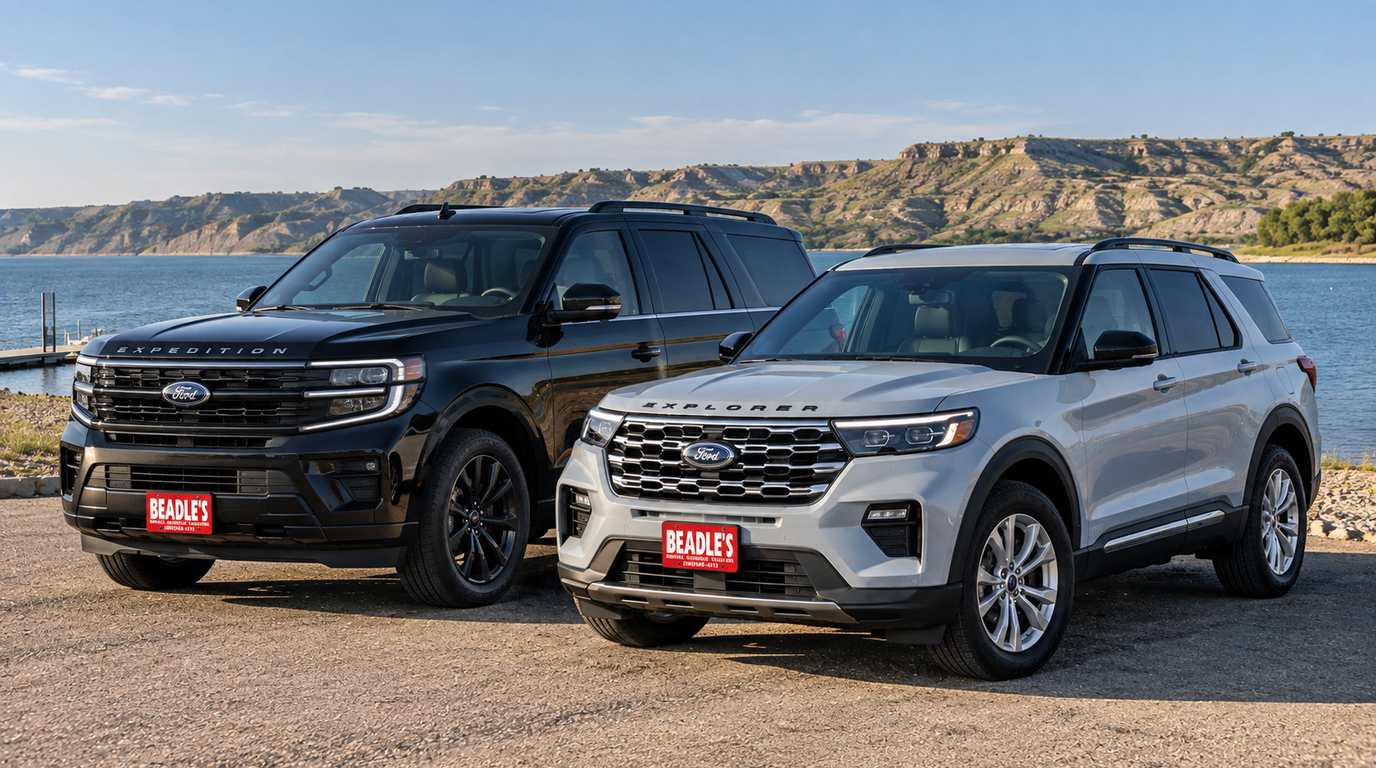
2027 Ford Explorer next to a 2027 Ford Expedition at Lake Oahe, comparing Ford three-row SUVs at Beadle Ford

Ford Explorer vs. Expedition: Which Ford Three-Row Should You Buy?

Home› Ford Explorer› 2027 Ford Explorer› Explorer vs. Expedition Quick Answer Buy the Explorer unless you specifically need what the Expedition adds. The Expedition is much longer, seats eight with an adult-sized third row, and tows 9,600 lbs against the Explorer’s 5,000. The Explorer is easier to park, cheaper to buy and fuel, and enough SUV for most families — step up only if you tow a big camper or regularly carry eight people. We sell both, so this one is not a sales pitch for either. The Explorer and the Expedition are both three-row Fords, both on the lot in Bowdle in 2026 and 2027 model years, and they are built for different jobs. Buying the Expedition when an Explorer would do costs you money every month at the pump and every time you park. Buying the Explorer when you needed the Expedition costs you the trailer you cannot pull and the third row the adults will not sit in. This guide puts the two side by side on size, seating and third-row room, towing, engines, fuel, and price, then tells you which families end up in which one. Full guides for each: the 2027 Ford Explorer Buyers Guide and the 2027 Ford Expedition Buyers Guide. Get Pre-Approved Shop Explorer Inventory On This Page The short answer Size: what a foot of length means The third row and cargo Towing: 5,000 vs. 9,600 lbs Engines and fuel Price and which families end up where The short answer Buy the Explorer if your trailer is under 5,000 lbs (a fishing boat, a small camper, a snowmobile trailer), the third row is for kids most of the time, and you want the vehicle that is easier to park, cheaper to buy, and lighter on fuel. It is the right three-row for most families. Buy the Expedition if you tow more than 5,000 lbs (a stock trailer, a tandem-axle camper, a bigger boat), you regularly put adults in the third row, or you need the cargo room of a full-size body-on-frame SUV. It tows up to 9,600 lbs and seats up to eight. Size: what a foot of length means 2027 Ford Explorer 2027 Ford Expedition Construction Unibody, rear-drive based Body-on-frame (F-150 platform), rear-drive based Length 198.7 in About 210 in (Expedition MAX is longer) Wheelbase 119.1 in About 122.5 in (MAX longer) Width (no mirrors) 78.9 in Wider Seating Up to 7 (6 on Tremor) Up to 8 Cargo behind 3rd row 16.3 cu ft Considerably more; see the Expedition guide Explorer figures are Ford’s 2027 specifications. Expedition dimensions are approximate; confirm on the 2027 Expedition guide. Roughly a foot of length and a body-on-frame construction is the whole story of the Expedition. It is what makes the third row adult-sized, the cargo area big enough for a family’s luggage with all three rows up, and the tow rating nearly double. It is also what you feel in a school pickup line, a parking ramp in Sioux Falls, and a two-car garage that was built in 1975. The Explorer fits places the Expedition does not, and for a lot of families that is the deciding factor. The third row and cargo The Explorer’s third row is a kids’ row and an occasional-adult row. With it up there are 16.3 cubic feet behind it, which handles the hockey bags and the groceries; with rows two and three down there are 85.3 cubic feet. The Expedition’s third row is an adult row, and its cargo area with all three rows up is large enough for a week’s luggage. If your regular load is three teenagers plus a friend plus their gear, or grandparents in the third row on the drive to Rapid City, the Expedition is the one that does it without complaint. If your regular load is two car seats in the second row, kids in the back a few times a month, and a dog, the Explorer’s space is right-sized and the extra room in the Expedition is room you pay to carry around empty. Towing: 5,000 vs. 9,600 lbs This is the cleanest dividing line. The 2027 Explorer tows up to 5,000 lbs on every trim with either engine, Class III hitch standard. The 2027 Expedition tows up to 9,600 lbs on 4x4 models with the Heavy-Duty Trailer Tow Package, and 6,000 to 6,300 lbs on 4x2 models, all when properly equipped. Under 5,000 lbs (most aluminum fishing boats on a single-axle trailer, a two-place snowmobile trailer, a small travel trailer, a utility trailer): Explorer. 5,000 to 9,600 lbs (a tandem-axle camper, a bigger fiberglass boat, a stock or flatbed trailer): Expedition. Weigh what you actually pull, loaded, including the trailer. A lot of families guess low. If the honest number is close to 5,000, go Expedition; towing at the limit every weekend is hard on a vehicle and on the driver. Explorer towing details are in the Explorer Buyers Guide towing section. Not sure which Ford three-row? Tell us what you tow and who rides in the third row. We will put you in the right one, and both are on the lot. Shop Explorers in Stock Ask About a Custom Order Engines and fuel 2027 Ford Explorer 2027 Ford Expedition Standard engine 2.3L EcoBoost I-4, 300 hp / 310 lb-ft 3.5L EcoBoost V6, 400 hp / 480 lb-ft Available engine 3.0L EcoBoost V6, up to 400 hp / 415 lb-ft 3.5L EcoBoost V6 High Output, 440 hp / 510 lb-ft (Tremor and Platinum performance builds) Transmission 10-speed automatic 10-speed automatic Fuel economy 2.3L 4WD: 20 / 27 / 23 mpg (EPA) See the window sticker on each unit Fuel tank 17.9 gal (2.3L) / 20.2 gal (3.0L) Larger Ford published figures. Towing requires proper equipment. The Expedition starts where the Explorer tops out: its base engine makes 400 horsepower and 480 lb-ft, and the High Output version makes 440 and 510. That is what moves a 9,600-lb trailer. The cost is fuel. The Explorer 2.3L 4WD is EPA-rated at 23 mpg combined, and a full-size body-on-frame SUV with a twin-turbo V6 is not going to match it; check the sticker on the specific Expedition, but plan on a meaningful difference at 15,000 miles a year. If you do not need the towing, the Explorer’s 300-hp four is plenty and the savings are real. Price and which families end up where The 2027 Explorer starts at $38,465 (Active 100A RWD) and tops out at $56,460 (Tremor 801A) before options and $1,795 destination. The Expedition starts well above the Explorer’s base and a loaded Platinum runs well into the upper range of the Ford SUV lineup; the current numbers are in the 2027 Expedition Buyers Guide and on the window stickers on our lot. As a rule, an Explorer trim costs roughly what the Expedition trim one step below it costs. Who ends up in what, from our lot: growing families with kids under twelve, a boat, and a gravel road go Explorer, usually an Active 200A 4WD or an ST-Line, and the Tremor if they hunt. Families with teenagers and a camper, ranch families with a stock trailer, and anyone who regularly fills all three rows with adults go Expedition. Empty nesters trading down from an Expedition go Explorer Platinum, and for 2027 the V6 makes that trade-down easy: Platinum 2.3L or 3.0L V6. Both are on the lot in Bowdle in both model years, parked close enough to walk between. Shop the Explorers in stock, shop the Expeditions, and get pre-approved so the payment on each is a known number before you decide. Key Takeaways Explorer: up to 5,000 lbs towing, up to 7 seats, 198.7 inches long, from $38,465. Expedition: up to 9,600 lbs, up to 8 seats, about a foot longer, priced well above. The trailer decides it. Under 5,000 lbs loaded, Explorer. Over, Expedition. The Explorer’s third row is for kids and occasional adults; the Expedition’s is adult-sized with real cargo room behind it. Expedition starts at 400 hp / 480 lb-ft; Explorer at 300 hp / 310 lb-ft with a 400-hp V6 available. The Explorer is the fuel-economy choice. Both are on the Beadle Ford lot in 2026 and 2027 model years; drive both before you decide. Frequently Asked Questions What is the difference between the Ford Explorer and the Ford Expedition? The Explorer is a unibody midsize three-row SUV, 198.7 inches long, seating up to seven and towing up to 5,000 lbs. The Expedition is a body-on-frame full-size SUV built on the F-150 platform, roughly a foot longer, seating up to eight and towing up to 9,600 lbs when properly equipped. How much more can the Expedition tow than the Explorer? Up to 4,600 lbs more. The 2027 Explorer tows up to 5,000 lbs on every trim. The 2027 Expedition tows up to 9,600 lbs on 4x4 models with the Heavy-Duty Trailer Tow Package, and 6,000 to 6,300 lbs on 4x2 models. Is the Explorer’s third row big enough for adults? For short trips, yes. For regular adult use or long drives, the Expedition’s third row is the adult-sized one. The Explorer’s third row is best for kids and teenagers, with 16.3 cubic feet of cargo behind it. Which gets better fuel economy, the Explorer or the Expedition? The Explorer. Its 2.3L 4WD is EPA-rated 20 city / 27 highway / 23 combined. The Expedition’s 3.5L twin-turbo V6 in a full-size body-on-frame SUV uses noticeably more fuel; check the window sticker on a specific unit. Which is cheaper, the Explorer or the Expedition? The Explorer. The 2027 Explorer starts at $38,465 (plus $1,795 destination) and tops out at $56,460 before options. The Expedition starts well above the Explorer’s base and a loaded Expedition Platinum is priced well above the top Explorer; see the 2027 Expedition Buyers Guide for current figures. Are the Explorer and Expedition both on the lot at Beadle Ford? Yes. Beadle Ford in Bowdle, SD, has both 2026 and 2027 Explorers and Expeditions in stock. Shop Explorer and Expedition inventory online or contact us to compare specific units. My Take Because we sell both, I get to be honest here. About two out of three families who come in asking about an Expedition leave in an Explorer, because when we weigh their actual trailer and count who actually rides in the third row, the Explorer does the job and saves them real money every month. The other third genuinely needs the Expedition, and I would never put them in something smaller. Tell us what you pull and who rides where. That conversation takes ten minutes and it is the whole decision. Shop Explorer Inventory Get Pre-Approved Contact Beadle Ford About the Author Lexy Tabbert — Beadle Ford, Bowdle, SD Lexy Tabbert is the Director of Sales and Marketing at Beadle Ford in Bowdle, South Dakota. She covers Ford vehicles, trim comparisons, and buyer guidance — helping families, ranchers, and ag operators across the region find the right truck and configuration for their needs. Learn more about Lexy.
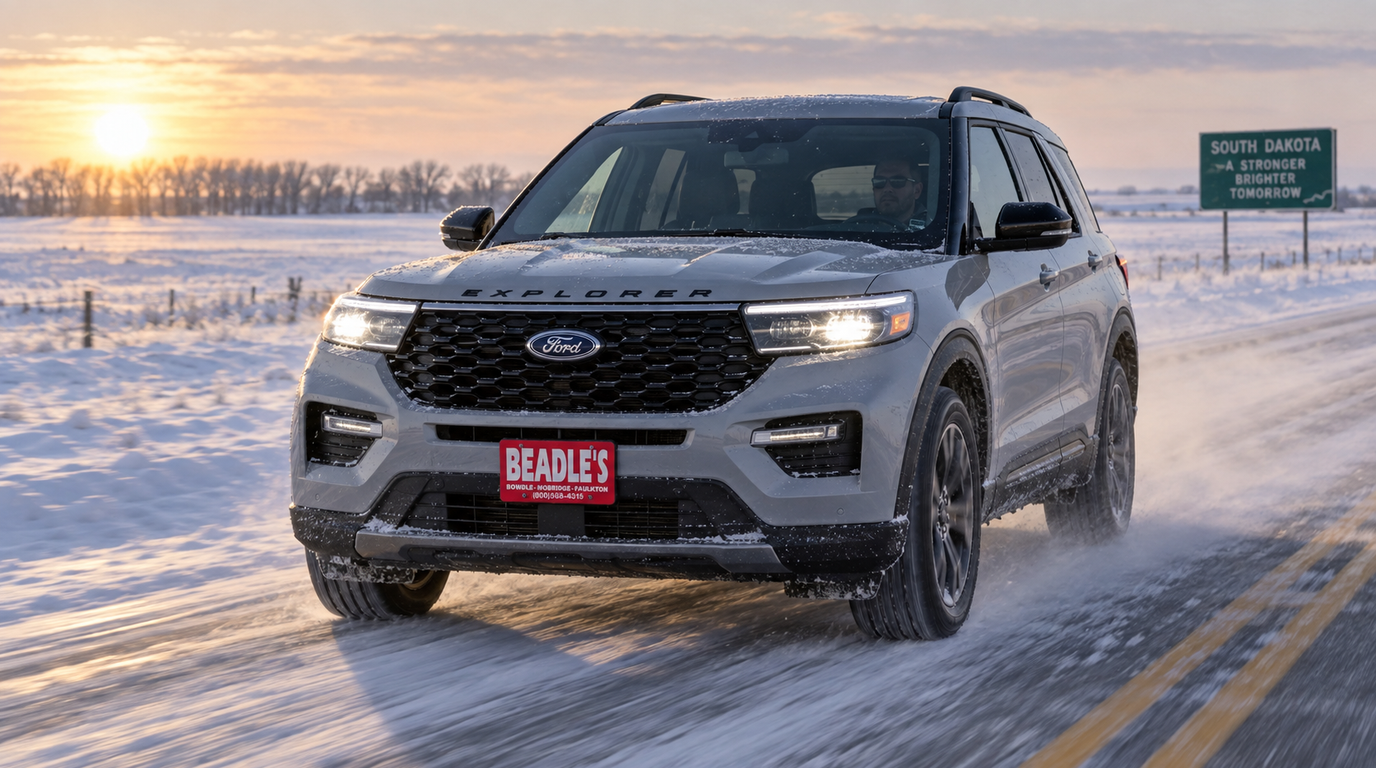
2027 Ford Explorer 4WD on a snowy South Dakota highway in January, winter-ready at Beadle Ford in Bowdle

2027 Ford Explorer vs. Jeep Grand Cherokee L: Three Rows, Towing, and Winter Compared

Home› Ford Explorer› 2027 Ford Explorer› vs. Grand Cherokee L Quick Answer The Grand Cherokee L tows more — 6,200 lbs against the Explorer’s 5,000 — and offers the Hurricane inline-six. The Explorer counters with slightly more maximum cargo room (85.3 vs. 84.6 cubic feet), the Tremor and ST trims, and a simpler Intelligent 4WD system. If towing is the priority, take the Jeep; for family hauling and winter confidence at a lower starting price, take the Explorer. The Jeep Grand Cherokee L is the three-row that our Tremor shoppers and our ranch families cross-shop, because Jeep’s reputation for 4x4 is earned. The comparison is closer than the Toyota or Honda one: both are rear-drive-based, both offer real four-wheel-drive systems, and both have an available turbo engine with more than 320 horsepower. The differences are in towing, the off-road trims, interior space, and price. This guide compares the 2027 Explorer and the 2026 Grand Cherokee L on engines, towing, 4WD systems, off-road trims, space, tech, and price. Jeep figures are from Jeep’s published 2026 Grand Cherokee L specifications; Explorer figures are Ford’s 2027 numbers from the 2027 Ford Explorer Buyers Guide. Get Pre-Approved Shop Explorer Inventory On This Page The short answer Engines and towing 4WD systems and winter Tremor vs. the Jeep lineup Three-row space and interior Tech and price The short answer The Grand Cherokee L tows more (up to 6,200 lbs with the V6 against the Explorer’s 5,000), offers an air suspension on upper trims, and carries the Jeep badge. If your trailer is between 5,000 and 6,200 lbs, that settles it. The Explorer has more standard power (300 hp vs. 293), more available power (up to 400 hp vs. 324), a factory off-road trim with all-terrain tires and a limited-slip rear on a three-row body (Jeep’s Trailhawk is two-row only), BlueCruise hands-free driving, a lower starting price, and it is on the lot in Bowdle in two model years. For most families who tow a boat or a small camper and drive gravel, the Explorer does the job for less. Engines and towing 2027 Ford Explorer 2026 Jeep Grand Cherokee L Standard engine 2.3L EcoBoost I-4, 300 hp / 310 lb-ft 3.6L Pentastar V6, 293 hp / 260 lb-ft Available engine 3.0L EcoBoost V6, up to 400 hp / 415 lb-ft 2.0L Hurricane turbo I-4, 324 hp / 332 lb-ft Transmission 10-speed automatic 8-speed automatic Max towing 5,000 lbs, every trim Up to 6,200 lbs, properly equipped Fuel tank 17.9 gal (2.3L) / 20.2 gal (3.0L) Per Jeep specifications Explorer figures are Ford’s published 2027 specifications; towing requires proper equipment. Jeep figures per Jeep’s 2026 published specifications. Torque is the number to look at. The Explorer’s base turbo four makes 50 lb-ft more than Jeep’s base V6, and it makes it low in the rev range, which is what you feel with a loaded trailer. Jeep’s Hurricane four is a strong engine at 324 hp and 332 lb-ft; the Explorer’s 3.0L V6 answers it with up to 400 hp and 415 lb-ft on the ST, the Tremor 801A, and the Platinum. Where Jeep wins outright is the tow rating: 6,200 lbs is 1,200 more than any Explorer. If you are towing a tandem-axle camper near that number, buy the Jeep, or come look at an Expedition. 4WD systems and winter Both are rear-drive-based, which is the right starting point for towing and for ice. The Explorer’s Intelligent 4WD has seven drive modes including Slippery and Deep Snow/Sand, Hill Descent Control, and on the Tremor a TORSEN limited-slip rear axle that puts torque to the wheel with grip mechanically. Jeep offers its Quadra-Trac 4x4 systems on the Grand Cherokee L, with Quadra-Drive II and an electronic limited-slip rear on upper trims, plus the Selec-Terrain modes. On a snow-packed highway or an icy intersection in Mobridge, both are excellent, and I would not pick one over the other for that alone. Ground clearance is similar in standard form (the Explorer runs 7.6 to 8.7 inches depending on trim); Jeep’s Quadra-Lift air suspension on upper trims can raise it further, which is a genuine Jeep advantage on a deeply rutted two-track, at a price. Tremor vs. the Jeep lineup Here is the detail that surprises Jeep shoppers: the Trailhawk trim, Jeep’s off-road package with all-terrain tires and skid plates, is offered only on the two-row Grand Cherokee. There is no Grand Cherokee L Trailhawk. If you need three rows and want factory off-road hardware from Jeep, the answer is an Overland or Summit with the air suspension, which is a luxury build at a luxury price. The Explorer Tremor is that missing vehicle: a three-row with P265/65R18 all-terrain tires, front and rear underbody deflector plates, front tow hooks, auxiliary grille lights, a TORSEN limited-slip rear, 8.7 inches of clearance, and 4WD only, from $49,200 with the 2.3L or $56,460 with the V6 (plus $1,795 destination). It is not a Wrangler or a Bronco, and it is not trying to be. It is the three-row that handles the section road, the two-track to the stand, and the boat ramp without asking you to give up the third row. The full Tremor guide. Three rows and gravel roads? Drive an Explorer Tremor on the section road behind the dealership. That is the comparison Jeep cannot offer on a three-row. Shop Tremors in Stock Ask About a Custom Order Three-row space and interior The Grand Cherokee L seats six or seven and Jeep lists up to 84.6 cubic feet of cargo with the rear rows folded. The 2027 Explorer seats up to seven (six on the Tremor) with 16.3 cubic feet behind the third row and up to 85.3 cubic feet folded. These two are effectively the same size inside; neither has the Grand Highlander’s or Pilot’s extra room, and neither needs it for a family of five with hockey gear. Interior character is where they differ. The Grand Cherokee L leans luxurious even on lower trims and can be optioned into Lincoln territory on a Summit Reserve. The Explorer spends its money differently: standard tri-zone climate, standard second-row captain’s chairs, a power-fold third row on ST, Platinum, and Tremor 801A, and on the Platinum multicontour seats, a 14-speaker B&O system, and BlueCruise included for a year plus 90 days. Tech and price Both have big screens and full driver-assist suites. The Explorer’s 13.2-inch touchscreen runs Google built in with wireless CarPlay and Android Auto, 5G, and over-the-air updates; Jeep’s Uconnect is a good system with its own strengths, including an available passenger screen. The Explorer’s advantage is BlueCruise, which Jeep does not offer on the Grand Cherokee L. BlueCruise vs. the other hands-free systems. Price: the 2027 Explorer Active 100A starts at $38,465 in RWD and $40,465 in 4WD, plus $1,795 destination. Jeep lists the 2026 Grand Cherokee L Laredo from $41,990 before destination, and 4x4 is extra. Trim for trim the Explorer starts a few thousand dollars lower and the gap widens at the top, where a loaded Summit Reserve sits well above a V6 Platinum. Every Explorer trim and price: 2027 Explorer trim levels. Both model years are on the lot: see what is in stock and get pre-approved before you come in. Key Takeaways Grand Cherokee L tows more: up to 6,200 lbs vs. the Explorer’s 5,000. If your trailer is in that range, that decides it. Explorer has more standard power (300 vs. 293 hp) and more available power (400 vs. 324 hp). Jeep’s Trailhawk is two-row only. The Explorer Tremor is the factory off-road three-row, with all-terrain tires, plates, hooks, and a TORSEN rear. Both are rear-drive-based with capable 4WD; Jeep offers an air suspension on upper trims, Ford offers BlueCruise. Explorer starts a few thousand lower ($38,465 vs. $41,990 before destination), and both model years are on the lot in Bowdle. Frequently Asked Questions Does the Grand Cherokee L tow more than the Explorer? Yes. Jeep rates the 2026 Grand Cherokee L at up to 6,200 lbs when properly equipped. The 2027 Explorer is rated at up to 5,000 lbs on every trim. If you tow between 5,000 and 6,200 lbs, the Jeep or a Ford Expedition is the right answer. Which has more horsepower, the Explorer or the Grand Cherokee L? The Explorer. Its 2.3L EcoBoost makes 300 hp and 310 lb-ft standard against the Jeep’s 293-hp, 260-lb-ft 3.6L V6, and the Explorer’s available 3.0L V6 makes up to 400 hp against the Jeep’s 324-hp 2.0L Hurricane. Is there a Grand Cherokee L Trailhawk? No. Jeep offers the Trailhawk off-road trim only on the two-row Grand Cherokee. The three-row Grand Cherokee L is offered in trims such as Laredo, Limited, Overland, and Summit. The Explorer Tremor is the factory off-road three-row in this comparison. Which is better in snow, the Explorer or the Grand Cherokee L? Both are rear-drive-based with capable four-wheel-drive systems and are excellent in winter. The Explorer adds Deep Snow/Sand and Slippery drive modes and, on the Tremor, a TORSEN limited-slip rear and all-terrain tires; Jeep’s upper trims offer Quadra-Drive II and an air suspension. Which is bigger inside? They are close. The Grand Cherokee L seats six or seven with up to 84.6 cubic feet of cargo folded; the Explorer seats up to seven with 16.3 cubic feet behind the third row and up to 85.3 cubic feet folded. Which costs less, the Explorer or the Grand Cherokee L? The 2027 Explorer Active starts at $38,465 before $1,795 destination. Jeep lists the 2026 Grand Cherokee L Laredo from $41,990 before destination, with 4x4 extra. My Take This is the comparison I respect most, because the Grand Cherokee L is a good truck and the Jeep buyer usually knows exactly what they want. My honest read: if the tow rating matters, Jeep wins and I will say so. If three rows plus real gravel capability is the job, the Explorer Tremor is the only one of the two that offers it, and it costs less than the Jeep you would have to build to get close. Drive the Tremor on the section road behind the store. Then go drive the Jeep. I am comfortable with where that ends up. Shop Explorer Inventory Get Pre-Approved Contact Beadle Ford About the Author Lexy Tabbert — Beadle Ford, Bowdle, SD Lexy Tabbert is the Director of Sales and Marketing at Beadle Ford in Bowdle, South Dakota. She covers Ford vehicles, trim comparisons, and buyer guidance — helping families, ranchers, and ag operators across the region find the right truck and configuration for their needs. Learn more about Lexy.
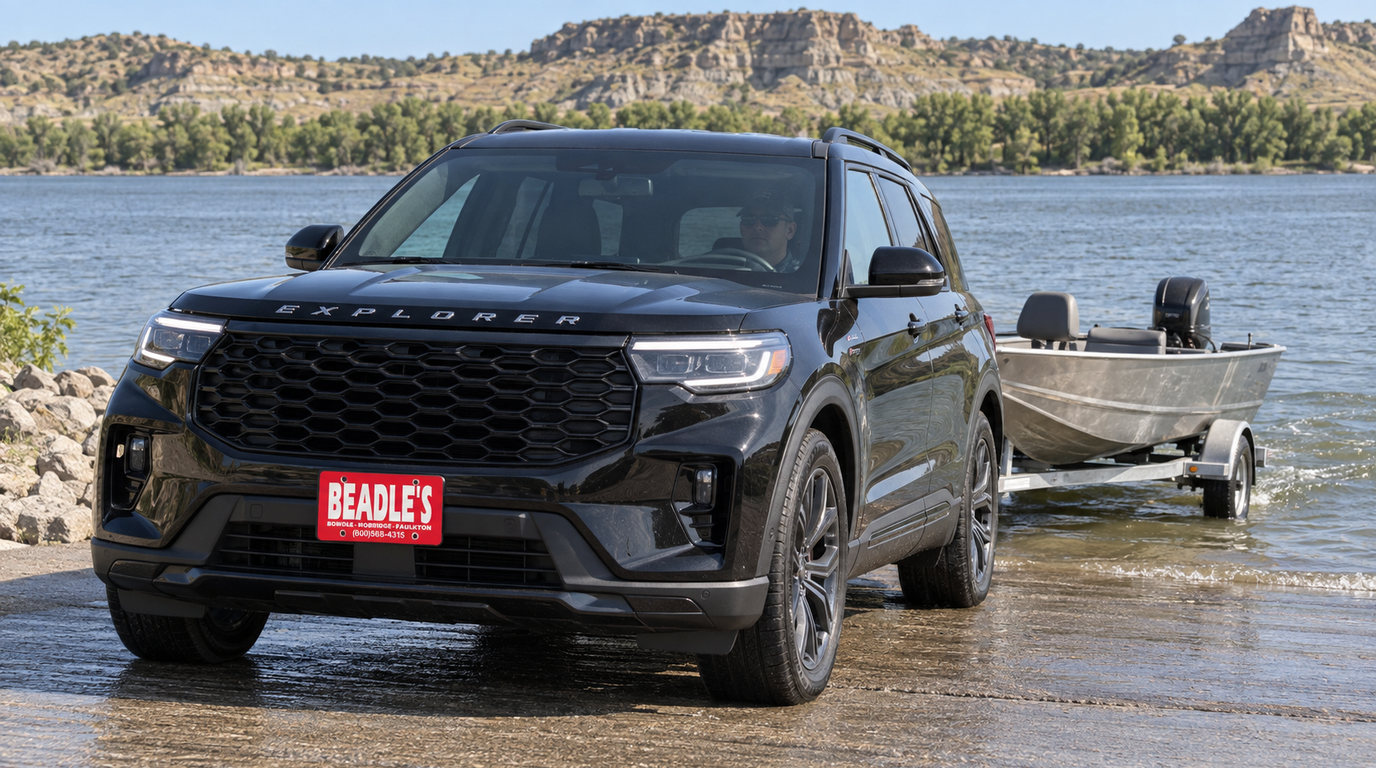
2027 Ford Explorer towing a fishing boat at a Lake Oahe boat ramp, 5,000-lb towing at Beadle Ford in Bowdle SD

2027 Ford Explorer vs. Honda Pilot: Turbo Four, V6, 4WD, and Towing Compared

Home› Ford Explorer› 2027 Ford Explorer› vs. Honda Pilot Quick Answer The Explorer’s 300-hp 2.3L EcoBoost outmuscles the Pilot’s 285-hp V6, and every Explorer tows 5,000 lbs where a Pilot needs AWD to get there (3,500 lbs with front-wheel drive). The Explorer also offers true 4WD plus the Tremor and ST; the Pilot answers with a roomier, squarer cabin and the TrailSport. For South Dakota winters and towing, the Explorer is the stronger pick. The Honda Pilot is the other three-row that shows up in our trade lane most often, usually a 2018 to 2023 that has been a good vehicle. Pilot owners who come to look at an Explorer tend to ask the same three things: is the turbo four as good as the V6 they have, does the Explorer tow more, and is Ford’s 4WD better than Honda’s AWD in the winter. Fair questions, with clear answers. This guide compares the 2027 Explorer and the 2026 Pilot on engines, towing, all-weather capability, the off-road trims, space, tech, and price. Honda figures are from Honda’s published 2026 Pilot specifications; Explorer figures are Ford’s 2027 numbers from the 2027 Ford Explorer Buyers Guide. Get Pre-Approved Shop Explorer Inventory On This Page The short answer Engines: 300-hp turbo four vs. 285-hp V6 Winter: Ford Intelligent 4WD vs. Honda i-VTM4 AWD Seating, cargo, and the third row Technology and driver assistance Price The short answer The Pilot is the roomier vehicle, with up to eight seats and more total cargo volume, and its naturally aspirated V6 is a known quantity. If you want maximum interior space and you do not tow, it is a fine choice. The Explorer has more power from its base engine than the Pilot has from its only engine, tows 5,000 lbs on every trim (the Pilot needs AWD to get there; front-drive Pilots are rated at 3,500), runs a rear-drive-based 4WD system, offers a V6 with up to 400 hp and a true off-road Tremor trim, and starts lower. For a family that tows a boat or a camper and drives gravel, the Explorer is the better fit. Engines: 300-hp turbo four vs. 285-hp V6 2027 Ford Explorer 2026 Honda Pilot Standard engine 2.3L EcoBoost I-4, 300 hp / 310 lb-ft 3.5L V6, 285 hp / 262 lb-ft Available engine 3.0L EcoBoost V6, up to 400 hp / 415 lb-ft None; one engine across the lineup Transmission 10-speed automatic 10-speed automatic Drive RWD or Intelligent 4WD (rear-drive based) FWD or i-VTM4 AWD (front-drive based) Max towing 5,000 lbs, every trim and both engines 5,000 lbs AWD; 3,500 lbs FWD Explorer figures are Ford’s published 2027 specifications; towing requires proper equipment. Honda figures per Honda’s 2026 published specifications. The Pilot’s 3.5L V6 is smooth and durable, and Pilot owners like it. But 262 lb-ft of torque arriving high in the rev range is the reason a loaded Pilot on a grade with a trailer behind it feels busy. The Explorer’s 2.3L EcoBoost makes 310 lb-ft at low rpm, which is what you feel pulling out of a boat ramp or passing on US-12. And the Explorer has a second answer the Pilot does not: the 3.0L V6 at up to 400 hp on the ST, the Tremor 801A, and now the Platinum. Winter: Ford Intelligent 4WD vs. Honda i-VTM4 AWD Honda’s i-VTM4 is a good torque-vectoring AWD system on a front-drive platform. The Explorer is built the other way around: rear-drive based, with Intelligent 4WD that sends power forward as needed, seven drive modes including Slippery and Deep Snow/Sand, and Hill Descent Control on every 4WD model. In everyday snow both are capable. Where the difference shows is towing on a slick ramp, starting on an icy hill with a load, and driving rutted gravel, where a rear-biased layout keeps the front tires steering instead of pulling. Both brands have an off-road trim. The Pilot TrailSport adds all-terrain tires, a lifted suspension, and skid plates to the AWD Pilot. The Explorer Tremor adds all-terrain tires, front and rear underbody plates, front tow hooks, auxiliary grille lights, 8.7 inches of ground clearance, and a TORSEN limited-slip rear axle, on a 4WD-only build, with the 300-hp 2.3L or the 400-hp V6. The Tremor guide has the full hardware list. Trading a Pilot? Bring it to Bowdle. We will appraise it, and you can drive the Explorer 4WD on gravel the same afternoon. Shop Explorers in Stock Ask About a Custom Order Seating, cargo, and the third row The Pilot is the bigger box. It seats up to eight, Honda lists 18.6 cubic feet behind the third row, and its total cargo volume with the rear rows folded is greater than the Explorer’s. The 2027 Explorer seats up to seven, with 16.3 cubic feet behind the third row and up to 85.3 cubic feet folded. If cargo volume is the one number you are buying on, Honda has it. In use, the differences are smaller than the table suggests. Both fit hockey bags behind the third row. Both have second-row captain’s chairs available (standard on the Explorer, which is the layout car-seat families want). The Explorer’s third row is power-folding on ST, Platinum, and Tremor 801A, and tri-zone climate control is standard on every trim. Bring your gear to the lot and load it; that is how our customers actually decide. Technology and driver assistance The Explorer runs a 13.2-inch touchscreen with Google built in, a 12.3-inch digital cluster, wireless Apple CarPlay and Android Auto, a 5G modem, and over-the-air updates on every trim, with Ford Co-Pilot360™ Assist+ standard and the 360-degree camera from ST-Line up. The Pilot’s screens are smaller, Honda Sensing is standard, and wireless CarPlay depends on trim. The bigger gap is hands-free driving. BlueCruise is included on the Explorer Platinum for a year plus 90 days, trial-included on ST and Tremor 801A, and optional on ST-Line and Tremor 800A. Honda does not offer a hands-free highway system on the Pilot. On the long drives that define living out here, that matters. How BlueCruise compares with GM and Nissan. Price The 2027 Explorer Active 100A starts at $38,465 in RWD and $40,465 in 4WD, plus $1,795 destination, with the Class III tow package already on it. Honda lists the 2026 Pilot Sport from $42,395 in front-wheel drive, before destination, and AWD is required for the 5,000-lb tow rating. So the Explorer that tows 5,000 lbs starts roughly $2,000 below the Pilot that tows 3,500. Every Explorer trim and price: 2027 Explorer trim levels. And both the 2026 and 2027 Explorer are on the lot at Beadle Ford. See the Explorers in stock, bring the Pilot for an appraisal, and get pre-approved first if you want the numbers settled before you drive out. Key Takeaways Explorer: 300 hp standard, up to 400 hp available, 310 to 415 lb-ft. Pilot: one 285-hp V6 with 262 lb-ft. Every Explorer tows 5,000 lbs; the Pilot tows 5,000 only with AWD (3,500 in FWD). Explorer is rear-drive-based 4WD with Deep Snow and Slippery modes; the Tremor adds a TORSEN axle, plates, and hooks the TrailSport does not have. Pilot is roomier: up to 8 seats and more total cargo. Explorer: up to 7, 16.3 / 85.3 cu ft. Explorer starts around $2,000 lower, offers BlueCruise, and both model years are on the lot in Bowdle. Frequently Asked Questions Which has more horsepower, the Explorer or the Pilot? The Explorer. Its standard 2.3L EcoBoost makes 300 hp and 310 lb-ft against the Pilot’s 285-hp, 262-lb-ft V6, and the Explorer’s available 3.0L V6 makes up to 400 hp. The Pilot offers one engine. Does the Explorer or the Pilot tow more? Both max out at 5,000 lbs, but every 2027 Explorer trim is rated for 5,000 lbs with a Class III package standard. The Pilot is rated at 5,000 lbs only with AWD; front-wheel-drive Pilots are rated at 3,500 lbs. Is the Pilot bigger inside than the Explorer? Yes. The Pilot seats up to eight with 18.6 cubic feet behind the third row and more total cargo volume. The Explorer seats up to seven with 16.3 cubic feet behind the third row and up to 85.3 cubic feet folded. Explorer Tremor vs. Pilot TrailSport: which is more capable? The Tremor. Both add all-terrain tires and skid plates, but the Tremor also has a TORSEN limited-slip rear axle, front tow hooks, 8.7 inches of ground clearance, a rear-drive-based 4WD system, and up to 400 hp with the 801A V6. Does the Honda Pilot have hands-free driving like BlueCruise? No. Honda Sensing includes adaptive cruise and lane keeping but not a hands-free highway system. BlueCruise is included on the Explorer Platinum and trial-included on ST and Tremor 801A. Which is cheaper, the Explorer or the Pilot? The 2027 Explorer Active starts at $38,465 before $1,795 destination. Honda lists the 2026 Pilot Sport from $42,395 in FWD before destination. Trim for trim the Explorer starts lower. My Take Pilot owners are usually happy Pilot owners, and I do not try to talk them out of that. What I show them is the tow rating on a front-drive Pilot, the torque number on the Explorer’s base engine, and then I hand them the keys to a 4WD Explorer and point at the gravel road behind the dealership. Most of them come back with the decision made. If your Pilot has been good to you and you never tow, keep shopping both. If a boat or a camper is in your future, the Explorer is the one built for it, and it costs less to start. Shop Explorer Inventory Get Pre-Approved Contact Beadle Ford About the Author Lexy Tabbert — Beadle Ford, Bowdle, SD Lexy Tabbert is the Director of Sales and Marketing at Beadle Ford in Bowdle, South Dakota. She covers Ford vehicles, trim comparisons, and buyer guidance — helping families, ranchers, and ag operators across the region find the right truck and configuration for their needs. Learn more about Lexy.