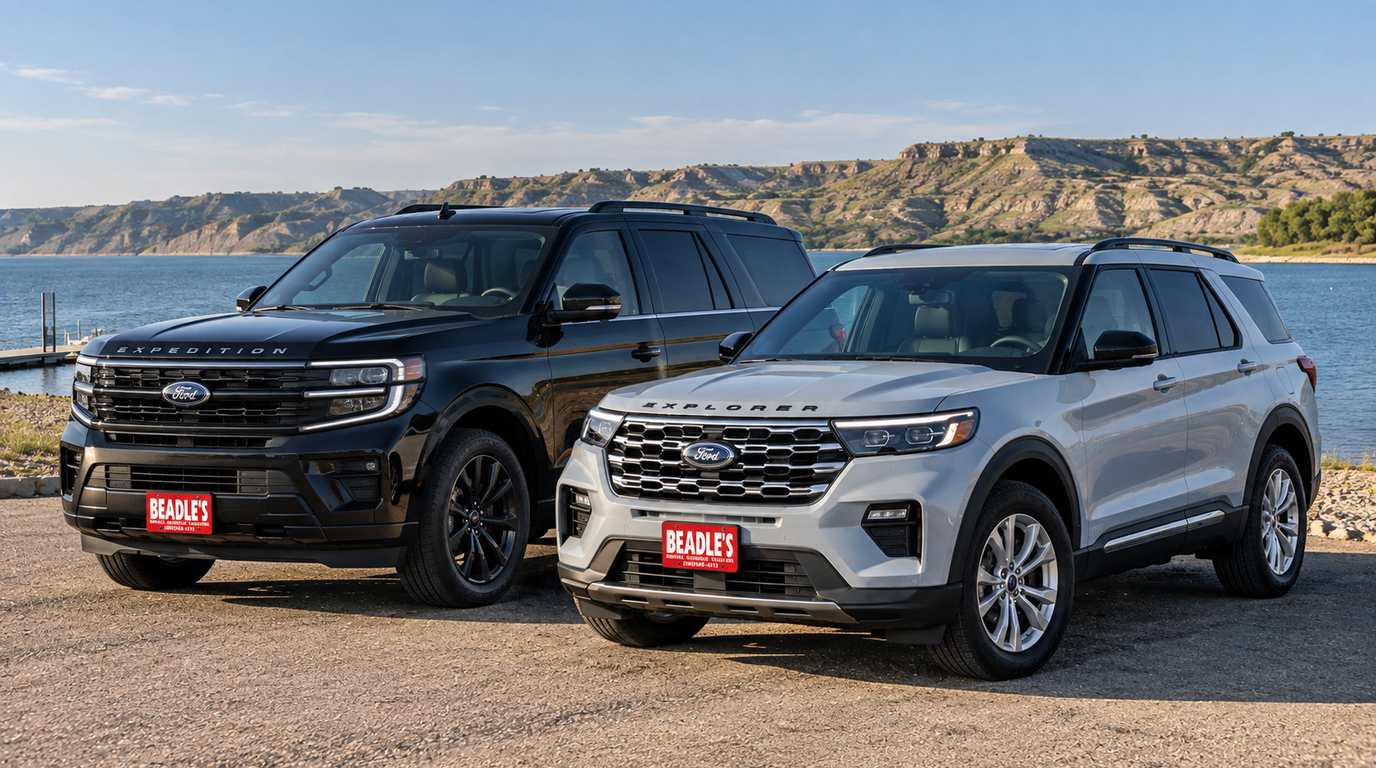

Quick Answer
The Grand Cherokee L tows more — 6,200 lbs against the Explorer’s 5,000 — and offers the Hurricane inline-six. The Explorer counters with slightly more maximum cargo room (85.3 vs. 84.6 cubic feet), the Tremor and ST trims, and a simpler Intelligent 4WD system. If towing is the priority, take the Jeep; for family hauling and winter confidence at a lower starting price, take the Explorer.
The Jeep Grand Cherokee L is the three-row that our Tremor shoppers and our ranch families cross-shop, because Jeep’s reputation for 4x4 is earned. The comparison is closer than the Toyota or Honda one: both are rear-drive-based, both offer real four-wheel-drive systems, and both have an available turbo engine with more than 320 horsepower. The differences are in towing, the off-road trims, interior space, and price.
This guide compares the 2027 Explorer and the 2026 Grand Cherokee L on engines, towing, 4WD systems, off-road trims, space, tech, and price. Jeep figures are from Jeep’s published 2026 Grand Cherokee L specifications; Explorer figures are Ford’s 2027 numbers from the 2027 Ford Explorer Buyers Guide.
The short answer
The Grand Cherokee L tows more (up to 6,200 lbs with the V6 against the Explorer’s 5,000), offers an air suspension on upper trims, and carries the Jeep badge. If your trailer is between 5,000 and 6,200 lbs, that settles it.
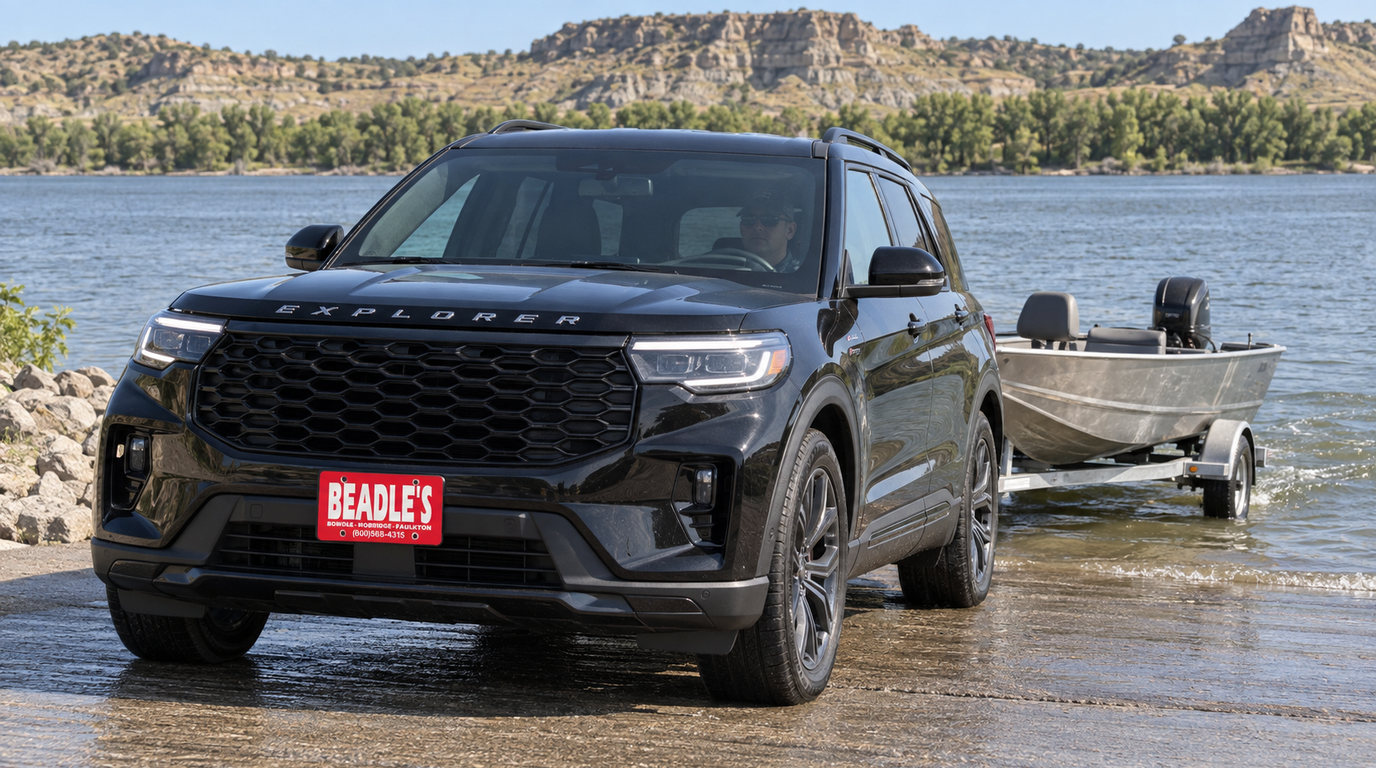
The Explorer has more standard power (300 hp vs. 293), more available power (up to 400 hp vs. 324), a factory off-road trim with all-terrain tires and a limited-slip rear on a three-row body (Jeep’s Trailhawk is two-row only), BlueCruise hands-free driving, a lower starting price, and it is on the lot in Bowdle in two model years. For most families who tow a boat or a small camper and drive gravel, the Explorer does the job for less.
Engines and towing
| 2027 Ford Explorer | 2026 Jeep Grand Cherokee L | |
|---|---|---|
| Standard engine | 2.3L EcoBoost I-4, 300 hp / 310 lb-ft | 3.6L Pentastar V6, 293 hp / 260 lb-ft |
| Available engine | 3.0L EcoBoost V6, up to 400 hp / 415 lb-ft | 2.0L Hurricane turbo I-4, 324 hp / 332 lb-ft |
| Transmission | 10-speed automatic | 8-speed automatic |
| Max towing | 5,000 lbs, every trim | Up to 6,200 lbs, properly equipped |
| Fuel tank | 17.9 gal (2.3L) / 20.2 gal (3.0L) | Per Jeep specifications |
Explorer figures are Ford’s published 2027 specifications; towing requires proper equipment. Jeep figures per Jeep’s 2026 published specifications.
Torque is the number to look at. The Explorer’s base turbo four makes 50 lb-ft more than Jeep’s base V6, and it makes it low in the rev range, which is what you feel with a loaded trailer. Jeep’s Hurricane four is a strong engine at 324 hp and 332 lb-ft; the Explorer’s 3.0L V6 answers it with up to 400 hp and 415 lb-ft on the ST, the Tremor 801A, and the Platinum. Where Jeep wins outright is the tow rating: 6,200 lbs is 1,200 more than any Explorer. If you are towing a tandem-axle camper near that number, buy the Jeep, or come look at an Expedition.
4WD systems and winter
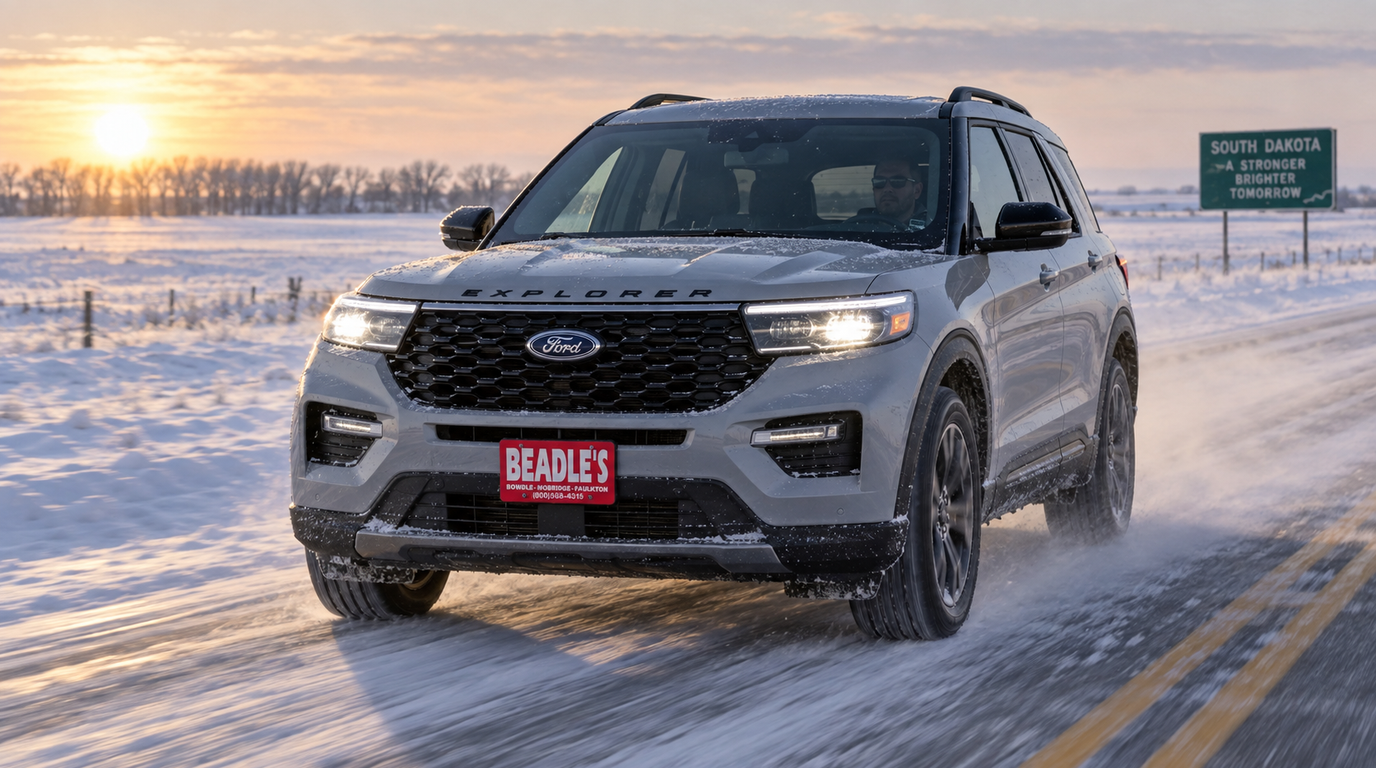
Both are rear-drive-based, which is the right starting point for towing and for ice. The Explorer’s Intelligent 4WD has seven drive modes including Slippery and Deep Snow/Sand, Hill Descent Control, and on the Tremor a TORSEN limited-slip rear axle that puts torque to the wheel with grip mechanically. Jeep offers its Quadra-Trac 4x4 systems on the Grand Cherokee L, with Quadra-Drive II and an electronic limited-slip rear on upper trims, plus the Selec-Terrain modes.
On a snow-packed highway or an icy intersection in Mobridge, both are excellent, and I would not pick one over the other for that alone. Ground clearance is similar in standard form (the Explorer runs 7.6 to 8.7 inches depending on trim); Jeep’s Quadra-Lift air suspension on upper trims can raise it further, which is a genuine Jeep advantage on a deeply rutted two-track, at a price.
Tremor vs. the Jeep lineup
Here is the detail that surprises Jeep shoppers: the Trailhawk trim, Jeep’s off-road package with all-terrain tires and skid plates, is offered only on the two-row Grand Cherokee. There is no Grand Cherokee L Trailhawk. If you need three rows and want factory off-road hardware from Jeep, the answer is an Overland or Summit with the air suspension, which is a luxury build at a luxury price.
The Explorer Tremor is that missing vehicle: a three-row with P265/65R18 all-terrain tires, front and rear underbody deflector plates, front tow hooks, auxiliary grille lights, a TORSEN limited-slip rear, 8.7 inches of clearance, and 4WD only, from $49,200 with the 2.3L or $56,460 with the V6 (plus $1,795 destination). It is not a Wrangler or a Bronco, and it is not trying to be. It is the three-row that handles the section road, the two-track to the stand, and the boat ramp without asking you to give up the third row. The full Tremor guide.
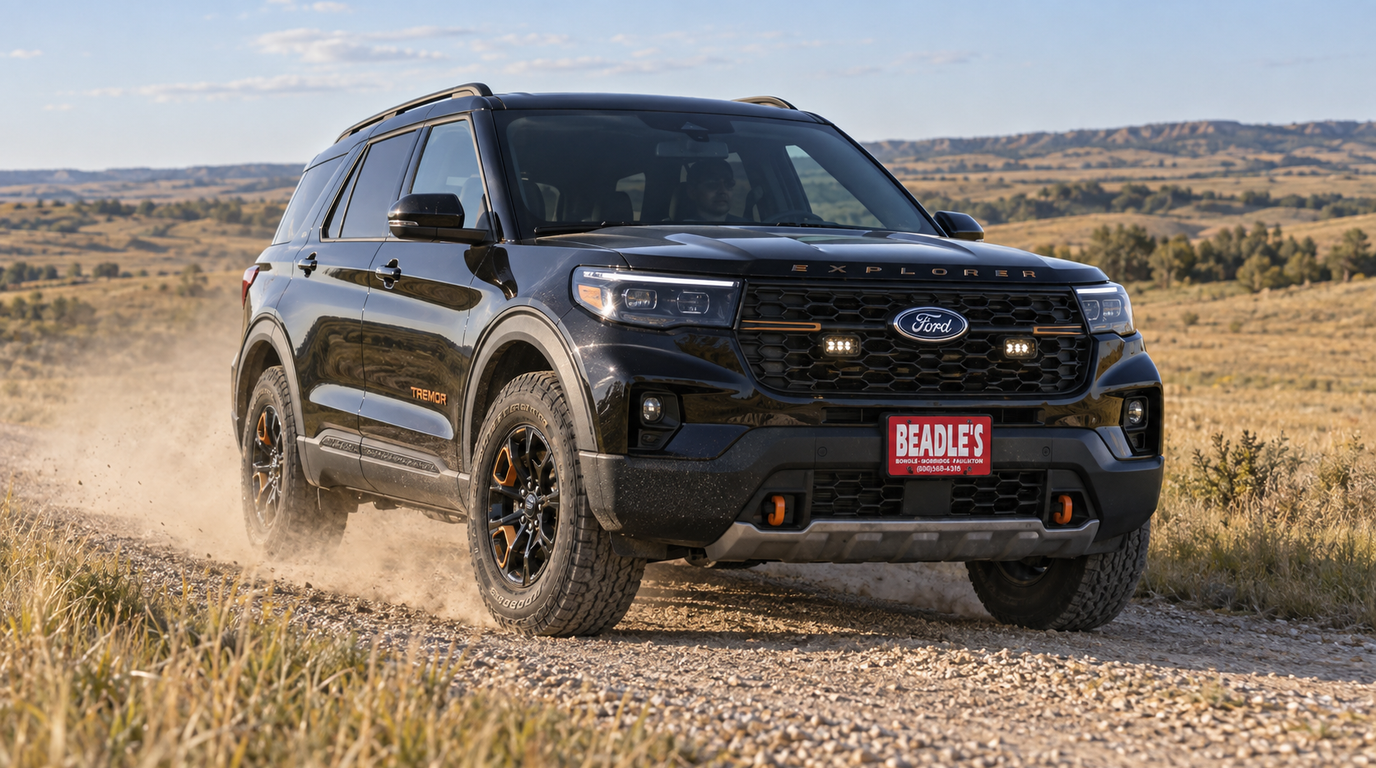
Three rows and gravel roads?
Drive an Explorer Tremor on the section road behind the dealership. That is the comparison Jeep cannot offer on a three-row.
Three-row space and interior
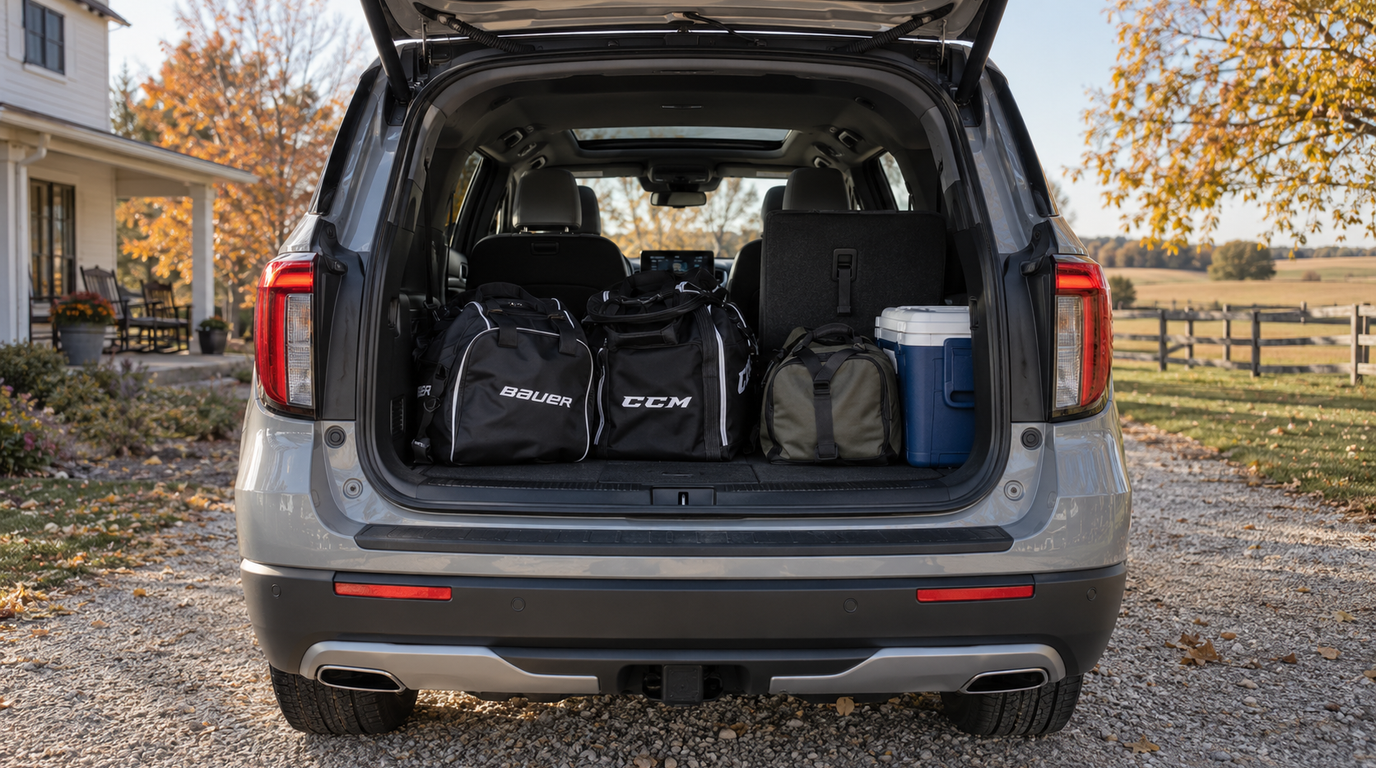
The Grand Cherokee L seats six or seven and Jeep lists up to 84.6 cubic feet of cargo with the rear rows folded. The 2027 Explorer seats up to seven (six on the Tremor) with 16.3 cubic feet behind the third row and up to 85.3 cubic feet folded. These two are effectively the same size inside; neither has the Grand Highlander’s or Pilot’s extra room, and neither needs it for a family of five with hockey gear.
Interior character is where they differ. The Grand Cherokee L leans luxurious even on lower trims and can be optioned into Lincoln territory on a Summit Reserve. The Explorer spends its money differently: standard tri-zone climate, standard second-row captain’s chairs, a power-fold third row on ST, Platinum, and Tremor 801A, and on the Platinum multicontour seats, a 14-speaker B&O system, and BlueCruise included for a year plus 90 days.
Tech and price
Both have big screens and full driver-assist suites. The Explorer’s 13.2-inch touchscreen runs Google built in with wireless CarPlay and Android Auto, 5G, and over-the-air updates; Jeep’s Uconnect is a good system with its own strengths, including an available passenger screen. The Explorer’s advantage is BlueCruise, which Jeep does not offer on the Grand Cherokee L. BlueCruise vs. the other hands-free systems.
Price: the 2027 Explorer Active 100A starts at $38,465 in RWD and $40,465 in 4WD, plus $1,795 destination. Jeep lists the 2026 Grand Cherokee L Laredo from $41,990 before destination, and 4x4 is extra. Trim for trim the Explorer starts a few thousand dollars lower and the gap widens at the top, where a loaded Summit Reserve sits well above a V6 Platinum. Every Explorer trim and price: 2027 Explorer trim levels. Both model years are on the lot: see what is in stock and get pre-approved before you come in.
Key Takeaways
- Grand Cherokee L tows more: up to 6,200 lbs vs. the Explorer’s 5,000. If your trailer is in that range, that decides it.
- Explorer has more standard power (300 vs. 293 hp) and more available power (400 vs. 324 hp).
- Jeep’s Trailhawk is two-row only. The Explorer Tremor is the factory off-road three-row, with all-terrain tires, plates, hooks, and a TORSEN rear.
- Both are rear-drive-based with capable 4WD; Jeep offers an air suspension on upper trims, Ford offers BlueCruise.
- Explorer starts a few thousand lower ($38,465 vs. $41,990 before destination), and both model years are on the lot in Bowdle.
Frequently Asked Questions
My Take
This is the comparison I respect most, because the Grand Cherokee L is a good truck and the Jeep buyer usually knows exactly what they want. My honest read: if the tow rating matters, Jeep wins and I will say so. If three rows plus real gravel capability is the job, the Explorer Tremor is the only one of the two that offers it, and it costs less than the Jeep you would have to build to get close.
Drive the Tremor on the section road behind the store. Then go drive the Jeep. I am comfortable with where that ends up.
About the Author
Lexy Tabbert — Beadle Ford, Bowdle, SD
Lexy Tabbert is the Director of Sales and Marketing at Beadle Ford in Bowdle, South Dakota. She covers Ford vehicles, trim comparisons, and buyer guidance — helping families, ranchers, and ag operators across the region find the right truck and configuration for their needs. Learn more about Lexy.