
Picking a 2026 Ford Maverick trim is only “step two.” The buyers who end up happiest usually decide drivetrain (AWD vs FWD), payload reality, and towing hardware first—then use trims and packages to fine-tune comfort, convenience, and appearance. If you haven’t locked in your must-haves yet, start with: 2026 Maverick Specs & Configurations. For inventory, model guidance, and local help in one place, visit the Ford Maverick model page. Shop Mavericks in Stock Contact Us Table of Contents Which 2026 Maverick trims are offered? What trims change (and what they don’t) Packages that actually change ownership Why AWD-first shopping changes the best trim choice How to choose a trim/package setup (step-by-step) FAQ Which 2026 Maverick trims are offered? The 2026 Maverick lineup is commonly shown with these model lines: XL, XLT, Lobo, Lariat, and Tremor. The biggest mistake buyers make is assuming the trim name automatically equals capability. On Maverick, capability is driven by drivetrain, payload, and towing equipment. What trims change (and what they don’t) Trims primarily change comfort, interior materials, feature access, and appearance. They can also influence which options are easier to add, because packages and required equipment can be tied to certain trims. What trims usually change: cabin feel, tech convenience, appearance details, and option availability. What trims do not automatically change: your real towing readiness if the truck doesn’t have the right towing hardware. What to do instead: verify the exact truck’s equipment list before assuming it’s “the towing one” or “the winter one.” If towing is part of your decision, pair this with: 2026 Maverick Towing Guide. Packages that actually change ownership Most packages fall into a few real-world categories. The “best” packages aren’t the fanciest—they’re the ones that solve problems you actually have. Towing-focused packages: aim at real towing hardware (brake controller, 7-pin, hitch class). Confirm on the window sticker. Winter/traction-minded equipment: AWD helps, but tires and visibility features often matter just as much. Comfort/commute packages: worthwhile if you drive long miles and want the truck to feel “easy” every day. Appearance packages: great when they don’t interfere with capability priorities or budget. Why AWD-first shopping changes the best trim choice In South Dakota, many Maverick buyers shop AWD first because winter traction is a non-negotiable. That changes how you should evaluate trims: you want the trim that lets you get the drivetrain you want without forcing unwanted extras. Quick Overview Best approach Choose drivetrain + towing needs first, then pick trim for comfort/features Most common mistake Buying a trim for the badge and missing the equipment you actually need Smart confirmation Verify the window sticker for towing hardware, AWD, and required option bundles How to choose a trim/package setup (step-by-step) Decide AWD vs FWD based on winter routes and confidence needs. Decide towing level (light hitch vs full towing hardware) based on your trailer’s loaded weight. Confirm payload reality (people + gear + bed cargo) so the build actually fits your routine. Pick your trim to match comfort/feature expectations without forcing extras you don’t want. Add packages intentionally —choose only what solves a real need. Shop Mavericks in Stock Ask About a Specific Trim FAQ Does a higher trim automatically tow more? Not automatically. Towing readiness depends on the towing hardware on that exact build (hitch class, wiring, brake controller), plus drivetrain and configuration. Always confirm the window sticker. What’s the best way to avoid overpaying for packages? Start with your non-negotiables (AWD, towing equipment, payload needs), then choose the lowest trim that supports those needs. Add only packages that solve real problems for your driving routine. Where can I compare trims and real inventory together? The fastest method is browsing the Ford Maverick model page, then checking each truck’s equipment list. If you want help comparing two specific builds, contact us. Conclusion In my experience, the best Maverick purchases happen when buyers choose capability first and trim second. When AWD, towing hardware, and payload reality are locked in up front, trims and packages become a simple “fit and finish” decision—not a gamble. About the Author: Lexy Tabbert helps South Dakota and North Dakota shoppers choose truck configurations that fit real driving—winter roads, weekend projects, towing needs, and long-term ownership. Her approach is straightforward: confirm the capability requirements first, then choose the trim and packages that support how you actually use the truck.
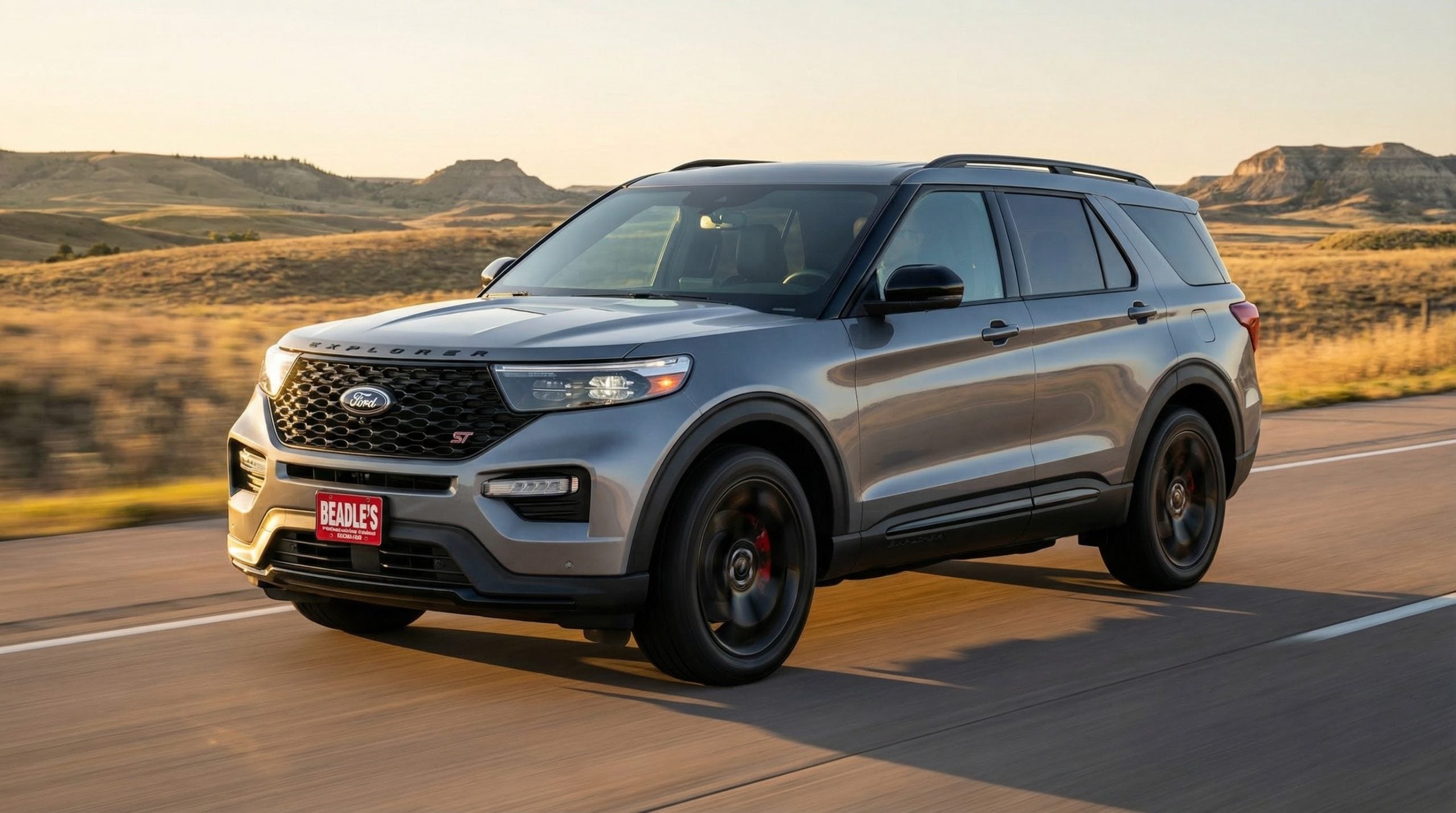
2026 Ford Explorer ST Performance Guide
The 2026 Ford Explorer ST is built for drivers who want their three-row SUV to feel fast, responsive, and confident — not just practical. While the Explorer lineup is family-focused at its core, the ST trim shifts the personality toward performance. This guide explains what makes the Explorer ST different from other trims, how it feels in real-world driving, and who it’s truly built for. For full lineup context, including how ST fits alongside Active, Platinum, and Tremor, start with the 2026 Ford Explorer overview. Shop Explorers in Stock Table of Contents What is the Explorer ST? What engine does the ST use? How does the ST feel different to drive? Does the ST handle differently? ST vs Tremor: Performance vs Adventure Who should buy the Explorer ST? Is the ST still practical for families? How to properly test drive an Explorer ST What is the 2026 Ford Explorer ST? The Explorer ST is the performance-focused trim of the Explorer lineup. It combines three-row seating with a stronger engine and sport-tuned driving characteristics. It’s not just about horsepower — it’s about how the SUV responds when you press the accelerator, change lanes at highway speed, or drive through curves. What engine does the Explorer ST use? The 2026 Explorer ST is powered by a 3.0L EcoBoost® V6 engine. In simple terms: it produces more power and torque than the standard 2.3L engine used in other trims. What that means in everyday life: Quicker acceleration when merging Stronger passing power at highway speeds Less “working hard” feeling when loaded with passengers More confident towing feel when properly equipped If you want a full comparison between the 2.3L and 3.0L engines, see our Explorer Engine Deep Dive. How does the ST feel different to drive? This is where the difference becomes noticeable. Compared to an Active or ST-Line trim: The accelerator feels more immediate. The SUV reaches highway speed more quickly. Passing slower vehicles requires less planning. The engine feels stronger under heavy load. For drivers who spend significant time on highways — especially in areas with strong wind or long-distance travel — the ST’s power can feel more relaxed and effortless. Does the Explorer ST handle differently? Yes. The ST features sport-oriented tuning designed to provide a more controlled feel through curves and during quick lane changes. It’s still a three-row SUV — but it feels tighter and more responsive compared to family-focused trims. This makes it appealing to drivers who want practicality without sacrificing driving enjoyment. Explorer ST vs Explorer Tremor: What’s the difference? This is one of the most common questions. Explorer ST: Performance-focused Strong acceleration Sport-tuned handling On-road emphasis Explorer Tremor: Adventure-focused Designed for gravel and uneven terrain Distinct styling and capability orientation Off-road confidence priority If your driving is primarily paved roads and highways, ST is the performance path. If you regularly travel beyond pavement, Tremor may be the better fit. The full trim breakdown is available in our Explorer Trim Levels Guide. Who should buy the 2026 Explorer ST? The Explorer ST is best for drivers who: Enjoy strong acceleration Drive long highway distances regularly Want their SUV to feel athletic Carry passengers but still want performance Prefer a sport-inspired driving experience It’s especially appealing to families where at least one driver values performance feel as much as practicality. Is the ST still practical for families? Yes. The Explorer ST retains three-row seating and family functionality. Seating configurations and interior layout may vary by equipment selection, so it’s important to confirm your preferred layout. Interior space details are covered in our Interior & Cargo Guide. How should you test drive an Explorer ST? Start with a normal city drive to feel throttle response. Merge onto a highway and notice acceleration difference. Perform a controlled highway pass. Drive through a few curves to feel steering control. Compare directly with a 2.3L-equipped trim if possible. The difference becomes most obvious during highway acceleration and passing. Quick ST Overview Category Explorer ST Engine 3.0L EcoBoost V6 Driving Feel Performance-focused Personality Sporty, responsive, confident Seating Three rows (configuration varies) Key Takeaways The ST is the performance-focused Explorer trim. It uses the 3.0L EcoBoost engine. Acceleration and passing feel stronger and more effortless. It remains practical for family use. Best suited for drivers who enjoy athletic driving feel. Frequently Asked Questions Is the Explorer ST fast? The Explorer ST offers significantly stronger acceleration compared to standard trims, especially during highway merging and passing. Does the ST tow more than other Explorers? Maximum towing capacity depends on configuration, but engine strength can influence how confident towing feels. Is the Explorer ST good in winter? With available AWD and proper tires, the ST can perform confidently in winter conditions. Is the ST worth the upgrade? For drivers who value performance feel and acceleration, many find the upgrade worthwhile. For purely practical use, other trims may meet daily needs just as well. Conclusion In my experience, the Explorer ST appeals most to drivers who want their SUV to feel powerful and responsive — not just functional. When buyers test drive it back-to-back with a standard trim, the difference in acceleration and highway confidence becomes clear very quickly. For families who want practicality without sacrificing driving enjoyment, the ST often feels like the perfect balance. About the Author Lexy Tabbert provides research-driven SUV configuration guidance and performance insights for drivers across South Dakota and beyond.
How Much Can a Ford Edge Tow? Capacity, Cargo Space, and Real-World Capability
Ford Edge Capability Guide How Much Can a Ford Edge Tow? Capacity, Cargo Space, and Real-World Capability Definitive towing specs, Class II package details, and practical guidance for South Dakota buyers. The Ford Edge is a three-row crossover SUV built for families, outdoor enthusiasts, and SD ranchers who need a daily driver that can handle a boat, utility trailer, or camping setup. But what’s the real towing capacity? What cargo space do you actually get? And how do you know if an Edge you’re considering at a dealer lot is equipped to tow? We’ve pulled the OEM spec sheets and real-world owner feedback to give you the complete picture — exact towing limits by engine and package, GCWR numbers, tongue weight, and honest talk about what Edge owners pull across South Dakota’s lakes and back roads. Shop Edges in Stock Get Pre-Approved On This Page Ford Edge Towing Capacity: OEM Specs Class II Tow Package (53G) Explained Cargo Space & Interior Dimensions Real-World SD Use Cases What to Look for When Buying Used Frequently Asked Questions Key Takeaways Ford Edge Towing Capacity: OEM Specs The Ford Edge comes in three main powertrain configurations, and towing capacity differs significantly by engine choice and whether you add the optional Class II Tow Package (53G). Here’s the breakdown from Ford’s official 2023–2024 towing guides: Configuration Max Trailer Weight GCWR Tongue Load 2.0L EcoBoost I4 AWD (no tow package) 1,500 lbs 6,300 lbs N/A* 2.0L EcoBoost I4 AWD + Class II Package (53G) 3,500 lbs 8,300 lbs 350 lbs 2.7L EcoBoost V6 AWD ST (tow package standard) 3,500 lbs 8,500 lbs 350 lbs *The base 2.0L without tow package does NOT offer a factory Class II receiver; dealer accessory installation required. Max tongue load is 350 lbs on configurations with Class II package or factory tow prep. GCWR explained: Gross Combined Weight Rating is the total weight of your Edge plus the loaded trailer. Ford’s system stops you from overloading — if your Edge weighs 4,500 lbs, you can’t add more than 3,800 lbs of trailer and cargo in the 8,300 lbs GCWR configuration. Key takeaway: If you plan to tow more than 1,500 lbs, you need either the Class II Package on the 2.0L or the 2.7L V6 ST. The 2.7L offers a higher GCWR (8,500 vs. 8,300) and slightly more confidence for heavier loads, but both cap out at 3,500 lbs trailer weight. Expert Tip: All configurations are SAE J2807 certified, meaning they’ve been independently tested for towing safety. You can tow up to spec with confidence, but don’t exceed it. Class II Tow Package (53G): What You’re Really Getting The optional Class II Tow Package (Ford code 53G) is standard on the 2.7L V6 ST trim and optional on SE, SEL, ST-Line, and Titanium trims. Here’s exactly what Ford includes: Class II Tow Package (53G) Contents Trailer Wiring Harness (4-Pin): Powers brake lights and turn signals on your trailer. Essential for legal towing. Hitch Receiver (Class II): 1¼” square, rated for 3,500 lbs. Accepts standard hitch balls and adjustable ball mounts. Trailer Sway Control: Uses the Edge’s stability control to detect and dampen trailer oscillation at highway speeds. Activates automatically. SelectShift Automatic Transmission + Steering Wheel Paddle Shifters: Manual gear selection for engine braking on grades and towing. Better heat management than full auto. The SelectShift and paddle shifters are particularly valuable when towing. Lake Oahe and the Missouri River run through central South Dakota with plenty of hills — having the ability to lock the transmission in a lower gear means your transmission fluid stays cooler and you get better braking on the descent. That alone can add transmission lifespan by thousands of miles on a towing vehicle. Frontal area: Edges with the tow package have a larger frontal area (30 sq ft vs. 20 sq ft), which relates to air density and cooling calculations. More relevant for heat-heavy conditions like summer towing in the Black Hills. Class II hitch receiver detail: 1.25" square rated for 3,500 lbs WC (weight-carrying). Standard on ST, optional on other trims. Do You Need the Class II Package? Yes, if you plan to tow anything regularly. Even if your boat or utility trailer is only 2,500 lbs, the factory receiver, wiring, and SelectShift give you: Professional-grade towing harness (no aftermarket adapters to fail) Integrated sway control (proven to reduce accident risk by ~40% per NHTSA) Transmission management tools for safer braking on grades Better resale value (noted by used car buyers) Skip it if: You only tow every few years or plan to tow under 1,500 lbs. You can add a dealer-installed receiver later, but integrated factory towing always outperforms bolt-on kits. Cargo Space & Interior Dimensions Towing is part of the Edge story, but cargo space is equally important for SD buyers who haul feed, tools, camping gear, and equipment. Configuration Cargo Volume (Cu. Ft.) Behind 2nd row (typical) 39.2 cu. ft. 2nd row folded (max) 73.4 cu. ft. What fits in 39 cubic feet? Two large suitcases, a folded baby stroller, groceries for two weeks, camping gear for a family of four, or a side-by-side ATV frame. It’s the sweet spot for daily family hauling. What fits in 73 cubic feet? Everything above plus a second ATV, a small snowblower, pallets of feed sacks, or enough camping equipment for a week-long trip with toys and sports gear. Fold that second row and you’re in truck-like territory for volume. Second row folds flat for max cargo. Real-world: you can fit a pallet of 50-lb feed sacks in the cargo area with room to spare. Practical Cargo Scenarios for South Dakota Weekend at Lake Oahe: Beach towels, cooler, life jackets, snorkel gear, folding chairs, camping tent. Uses ~20 cu. ft. with 2nd row up. Plenty of room. Feed run to the co-op: 1,200 lbs of bagged feed (12 × 50-lb bags). Cargo area holds the volume easily; weight is within GVWR limits for all Edge configurations. Tool run + small equipment: Chainsaw, tool chest, extension ladder, tarps, fuel cans. Organize with cargo netting on the sides; 2nd row down gives you 6+ feet of length. ATV transport + camping: Fold 2nd row. Secure one ATV on a cargo dolly, load tent, sleeping bags, cooler in remaining space. This is a working Edge. Load Safety Note: Keep weight in the cargo area, not on the roof. High roof loads reduce stability at highway speeds and increase rollover risk, especially when cornering or crossing wind-exposed terrain. Real-World SD Use Cases: What Edge Owners Actually Tow Boat Trailers (Lake Oahe & Missouri River) Lake Oahe is the crown jewel of SD recreation, and Edge owners across the region use them to tow pontoon and fishing boat trailers. Here’s what works: Small fishing boat (17–19 ft): Typical dry weight 1,800–2,200 lbs, fuel + gear adds another 400–600 lbs. Total 2,200–2,800 lbs. Edge can handle with Class II package. Pontoon (20–22 ft): Dry weight 3,000–3,500 lbs, fully loaded 3,500–4,200 lbs. This exceeds Edge capacity. You need an Explorer or truck. Jet ski trailer (dual jet skis): Dry weight 800–1,200 lbs, loaded 1,500–1,800 lbs. Edge with Class II package is ideal. Tongue weight on boat trailers typically runs 10–12% of loaded trailer weight. On a 2,500 lb loaded boat, expect 250–300 lbs tongue load — right in the Edge’s 350 lbs sweet spot. Utility & Equipment Trailers Ranch work and hobby projects call for open utility trailers. Edge owners frequently tow: Single-axle enclosed trailer (6×10 ft): Empty weight 1,200 lbs. Loaded with fencing, posts, and tools: 2,500–3,000 lbs. Class II package handles this routinely. Tandem-axle utility trailer: Dry weight 2,000+ lbs before loading. Exceeds Edge capacity. Truck territory. ATV/quad trailer (single or dual): Empty 600–900 lbs, loaded with two ATVs 2,500–3,200 lbs. Edge with Class II package works. Camping & Recreational Trailers Travel trailers under 2,500 lbs: Lightweight teardrop and vintage Airstream models are increasingly popular with SD families. Edge with Class II package can tow these comfortably. Tongue load is typically 200–300 lbs. Horse trailers: A 2-horse steel trailer runs 1,500–1,800 lbs empty. With hay and equipment, 2,200–2,600 lbs. Edge can manage, but monitor fluid temps on longer hauls. Real Owner Feedback: “I tow a 2,200-lb fishing boat to Oahe on weekends with my Class II Edge. The sway control is rock-solid, and the paddle shifters let me brake downhill without riding the brakes. Transmission stays cool. Only regret is not getting the V6 for the extra GCWR headroom if we ever upgrade boats.” — James K., Pierre, SD What to Look for When Buying a Used Edge for Towing Not every used Edge you find at a dealer lot is equipped the same way. Here’s your checklist when shopping for a tow-capable Edge: 1. Confirm the Tow Package Look underneath the rear bumper: If there’s a Class II hitch receiver (1.25” square tube), the tow package is installed. If the bumper is smooth plastic, no package. Check the Monroney label (window sticker) or Carfax: Search for option code “53G” in the vehicle history. If the dealer says “we can add one,” verify the cost. Factory receivers run $600–$1,200; aftermarket adds another $300–$500. 2. Check Engine & GCWR History Ask the dealer: “Was this Edge used for towing?” Signs of heavy towing use: Transmission fluid darker than normal (should be bright red) Higher mileage on the odometer than expected for the year Wear marks on the hitch receiver Cooler hoses showing signs of stress If the Edge was towed a lot, it’s not a dealbreaker, but budget for earlier transmission service (fluid and filter every 50k miles instead of 150k). 3. Verify the Engine 2.0L EcoBoost I4: Adequate for most uses but requires the Class II package for 3,500 lbs. Single turbo, reliable engine. Check boost line clamps for leaks. 2.7L EcoBoost V6: Superior towing confidence. Dual turbo, more power, comes with tow package standard. Higher fuel consumption. Good choice if you plan heavy seasonal towing. 4. Test the Transmission (SelectShift) If the Edge has SelectShift, test the paddle shifters: Upshift and downshift using steering wheel paddles. Should respond instantly. No hesitation, grinding, or slipping. Manual mode disengages automatically above 6,500 rpm (safety feature). SelectShift adds confidence and longevity on towing-heavy vehicles. If the paddles are broken or unresponsive, factor in a transmission diagnostic (usually $100–$200). 5. Inspect Brake & Cooling Systems Brakes: Towing puts extra demand on brakes. Check pad thickness (should be >0.25”) and rotor condition. If pads are thin, budget $600–$1,000 for replacement. Transmission cooler: Open the hood and look for a secondary cooler mounted in front of the main radiator. On high-mileage Edges with heavy towing history, a failing cooler is common. Replacement runs $800–$1,500. 6. Ask the Right Questions Question What It Tells You “Was this towed, or used for towing?” Whether it endured heavy use. Transmission wear patterns differ. “Has the transmission fluid been serviced?” Maintenance history. Towed Edges need fluid changes sooner. “Any transmission issues or hesitations?” Early warning. Hesitation = internal wear. Costly repair. “Do the paddle shifters work?” Whether you have manual control for towing. Broken = electronics repair. Key Takeaways Max towing is 3,500 lbs (Class II package required on 2.0L; standard on 2.7L V6 ST). Any trailer exceeding this needs a different vehicle. Class II package is worth the cost if you tow regularly. Factory integration, sway control, and SelectShift add safety and resale value. Tongue weight maxes at 350 lbs across all Edge configurations. Most boat and utility trailers fall under this; verify before purchase. Cargo space is generous: 39.2 cu. ft. with the 2nd row up, 73.4 cu. ft. folded. Perfect for gear + weekend trips without a trailer. Real-world SD use: Fishing boats (under 2,800 lbs), jet skis, ATV trailers, light utility trailers, and small travel trailers are all safe bets. Pontoons and tandem-utility trailers exceed capacity. When buying used: Confirm the tow package, check brake and transmission cooler condition, and ask about towing history. Heavy use requires closer inspection. If your needs exceed 3,500 lbs, consider the Ford Explorer, which tows up to 5,600 lbs, or a truck like the F-150. Frequently Asked Questions Can I tow 3,500 lbs with a Ford Edge that doesn’t have the Class II package? No. Without the Class II Tow Package (53G), the 2.0L EcoBoost is rated for a maximum of 1,500 lbs. The 2.7L V6 ST comes with the package standard and can tow 3,500 lbs. If you have a 2.0L without the package and need higher capacity, you must either upgrade to the V6 or have a dealer install a Class II receiver (though Ford does not recommend towing the full 3,500 lbs without the integrated package components like trailer sway control and SelectShift). What does GCWR mean, and why does it matter? GCWR (Gross Combined Weight Rating) is the maximum total weight your Edge plus the loaded trailer can weigh. For example, a 2.0L with Class II has an 8,300 lbs GCWR. If your Edge weighs 4,500 lbs, you can add no more than 3,800 lbs of trailer and cargo. Exceeding GCWR overloads the chassis, transmission, and brakes, creating serious safety and reliability issues. You can check your Edge’s curb weight on the driver’s door jamb label. Is the Ford Edge better for towing than the Honda Pilot or Chevy Traverse? All three are competitive in the 3,500-lbs class. The Pilot maxes at 3,500 lbs, the Traverse at 5,600 lbs (with V8), and the Edge at 3,500 lbs. For towing capacity alone, the Traverse wins if you need a full-size three-row. For a mid-size vehicle, Edge, Pilot, and Traverse are equivalent. Choose based on features, interior layout, and local dealer support (we recommend Beadle Ford for Edge owners in South Dakota). Will towing an Edge void the warranty? No, as long as you stay within GCWR and tow weight limits, and follow Ford’s recommended maintenance schedule. Towing within spec is a normal use case. However, if you exceed GCWR or tow beyond the rated 3,500 lbs, Ford can deny warranty claims on related components (transmission, cooling system, brakes). Stick to the specs and service on schedule, and you’re covered. Do I need a separate brake controller for the trailer? The Class II package includes a 4-pin trailer wiring harness (12V connector). This powers trailer lights but not trailer brakes. For trailers under 3,000 lbs with surge or electric brakes, most states do not require a separate controller (South Dakota allows this). For heavier trailers or if you prefer integrated braking, a $150–$300 proportional brake controller can be added by a dealer or RV shop. Check your trailer’s manual and local regulations. Can I tow in the rain, snow, or high wind conditions common in South Dakota? Yes, with caution. The Edge’s Trailer Sway Control (included in the Class II package) helps stabilize the trailer in crosswinds and adverse conditions. However, reduce speed and increase following distance in rain, snow, and high-wind zones (common near Oahe and the Missouri River breaks). Avoid towing in whiteout conditions. The paddle shifters and SelectShift give you manual braking control on slippery descents — use it to prevent jackknifing. My Take on the Ford Edge as a Towing Vehicle From a marketing research perspective, the Edge occupies a genuinely useful position in the market: it’s a mid-size crossover that tows at the same ceiling as many buyers actually need. The 3,500-lb limit covers the most common South Dakota use cases — fishing boats at Lake Oahe, jet ski trailers, small utility trailers, and ATV setups. Buyers who regularly pull anything heavier should be looking at the Explorer or F-150 instead, and the Edge doesn’t pretend otherwise. The Class II package distinction is the most important purchasing detail in this guide. Without it, buyers on the 2.0L are limited to 1,500 lbs and don’t get trailer sway control — that’s a meaningful gap, not just a spec sheet difference. When evaluating a used Edge for towing, confirming the presence of that package should be the first question. For the complete model overview including trim and year comparisons, the Ford Edge buyer guide has the full context. Questions about a specific vehicle or tow package configuration? Beadle Ford in Bowdle can help. Shop Edges in Stock Get Pre-Approved Contact Beadle Ford Related Edge Resources Shop Edges in Stock Ford Edge Best Years & Model History Need More Towing Capacity? The Ford Explorer tows up to 5,600 lbs and offers three rows with more room. View Explorer inventory. About the Author Lexy Tabbert — Beadle Ford, Bowdle, SD Lexy Tabbert is the Director of Sales and Marketing at Beadle Ford in Bowdle, South Dakota. She covers Ford vehicles, trim comparisons, and buyer guidance — helping families, ranchers, and ag operators across the region find the right truck and configuration for their needs. Learn more about Lexy.
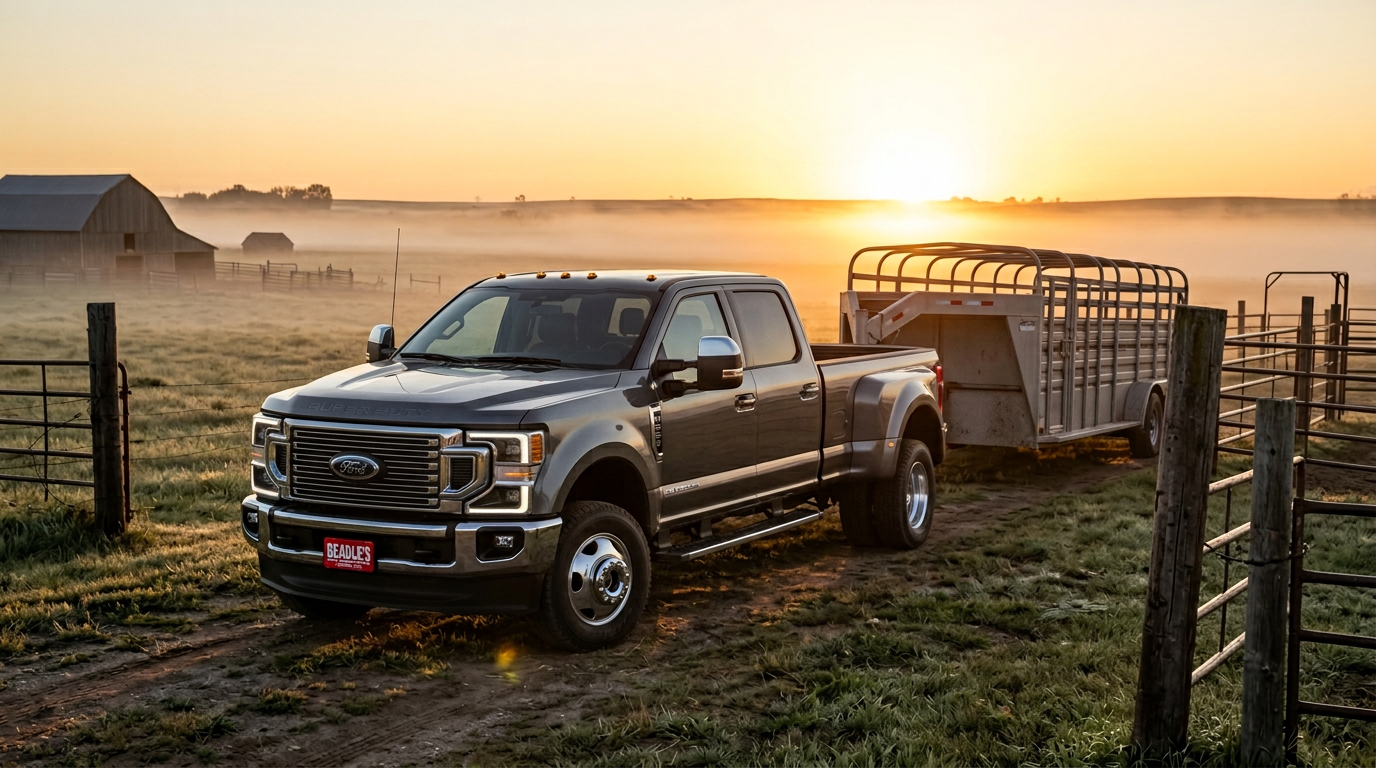
2027 Ford F-350 for Ag & Ranch in South Dakota
Quick Answer For South Dakota ag and ranch work, the 2027 Ford F-350 pulls loaded livestock goosenecks up to 40,000 lbs, carries up to about 7,900 lbs of payload, and comes standard with the 7.3L gas V8 — with available 4x4 and snow plow prep for gravel roads and hard winters. The High-Output diesel is there for the heaviest, most frequent hauling. Out here, a truck isn't a luxury — it's equipment. Between long gravel miles, cattle to move, hay and equipment to haul, and five months of winter, the F-350 has to earn its keep every day around Bowdle, Aberdeen, and the ranch country in between. Here's how the 2027 F-350 fits real ag and ranch work, which engine and configuration make sense, and how to build one for the conditions we actually drive in. Shop F-350s in Stock Get Pre-Approved On This Page Why the 2027 F-350 fits SD ag and ranch work What can it haul for ag? Which engine and configuration for ranch work? How does it handle winter, gravel, and plowing? How do you build a ranch F-350? Why the 2027 F-350 fits SD ag and ranch work The F-350 hits the sweet spot for most operations here: enough capability to pull a loaded gooseneck and carry a heavy load, without the cost and bulk of stepping up to an F-450. For 2027, the now-standard 7.3L gas V8 makes that capable baseline the value baseline too — and the truck's heavy-duty frame, available 4x4, and winter prep are built for our roads and seasons. It's also a truck you can live with: a single-rear-wheel F-350 runs gravel and ranch yards easily while still towing well past any half-ton. What can it haul for ag? Properly equipped, the 2027 F-350 pulls up to 40,000 lbs gooseneck — enough for a loaded triple-axle stock trailer of cow-calf pairs, a loaded equipment trailer, or hay racks — and carries up to about 7,900 lbs of payload for feed, fuel, fencing, and gear. Livestock: loaded gooseneck stock trailers, hauled to auction or pasture. Equipment: skid steers, implements, and flatbed loads within the F-350's ratings. Hay & feed: bale racks behind the truck and feed/fuel in the bed. Which engine and configuration for ranch work? For most ranches, the now-standard 7.3L gas V8 with 4x4 covers daily hauling and the goosenecks you actually pull, at the lowest cost. Step to the High-Output diesel if you tow heavy stock or equipment frequently and want maximum torque. Single-rear-wheel suits most operations; a dually is for the heaviest, most regular gooseneck loads. Our Recommendation For the typical Bowdle/Aberdeen ranch, we recommend a single-rear-wheel 7.3L gas F-350 with 4x4 and snow plow prep — it pulls the goosenecks most folks run, carries a heavy bed, handles gravel and winter, and keeps cost and upkeep down. Go diesel and/or dually only when you haul heavy stock daily. Match it to your loads with our 2027 F-350 towing guide. How does it handle winter, gravel, and plowing? Available 4x4 is the foundation for gravel roads, muddy lots, and snow, and available snow plow prep — with computer-selected springs sized for a plow — lets you clear your own yard and driveways all winter. Tow mirrors, trailer cameras, and trailer-aware blind-spot monitoring help on long two-lane hauls in crosswinds and changing weather. From the Beadle Ford Lot The add our ranch buyers most often skip and then wish they hadn't is snow plow prep — it's a small line item next to the truck, but adding it after the fact is a headache when you're plowing the yard in February. We bring it up on every ranch build for exactly that reason. How do you build a ranch F-350? Build for the work and the weather, in five steps: Start with your heaviest loaded gooseneck and your daily bed load. Pick the 7.3L gas for most ranches; the High-Output diesel if you haul heavy stock daily. Choose 4x4 for gravel, mud, and snow. Add snow plow prep, the right hitch and axle, and tow-camera/mirror options. Decide SRW vs. DRW, then confirm the exact ratings on the build sheet. Key Takeaways The 2027 F-350 pulls up to 40,000 lbs gooseneck and carries up to ~7,900 lbs of payload, properly equipped. The now-standard 7.3L gas covers most ranch hauling at the lowest cost; HO diesel for heavy daily work. Available 4x4 and snow plow prep handle gravel, mud, and SD winters. A single-rear-wheel F-350 fits most operations; dually for the heaviest stock loads. Spec snow plow prep up front — it's hard to add later. Frequently Asked Questions Is the 2027 F-350 good for hauling cattle and ag work in South Dakota? Yes — it's a core use case at Beadle Ford. Properly equipped, it pulls loaded gooseneck stock and equipment trailers up to 40,000 lbs, carries up to about 7,900 lbs of payload, and offers available 4x4 and snow plow prep for gravel and winter. Gas or diesel for ranch work? For most ranches, the now-standard 7.3L gas covers daily hauling and the goosenecks you actually pull, at the lowest cost. Choose the High-Output diesel if you tow heavy stock or equipment frequently and want maximum torque on long pulls. Do I need 4x4 on a ranch F-350 in South Dakota? For most ranch and farm buyers, yes. Available 4x4 handles gravel, mud, and snow, and adds confidence and resale value in our region — especially if you tow off paved roads or drive outside town in winter. Can the 2027 F-350 be set up for plowing? Yes — available snow plow prep includes computer-selected springs sized for plow duty, and most buyers pair it with 4x4. It's far easier to order up front than to add later, so we recommend speccing it on any truck that'll plow. SRW or DRW for a ranch truck? A single-rear-wheel F-350 fits most operations — it pulls most goosenecks with margin and is easier on gravel and in the yard. Choose a dually only if you regularly haul heavy stock near the top of the range. See our SRW vs. DRW guide for the details. Quick Answers: 2027 F-350 for Ag & Ranch One-line answers to the follow-up questions buyers ask next. Max gooseneck for stock trailers? Up to 40,000 lbs, properly equipped. Payload for feed and gear? Up to ~7,900 lbs. Best engine for most ranches? The now-standard 7.3L gas V8. When go diesel? Heavy stock or equipment hauled frequently. Do I need 4x4? For most ag/ranch use here, yes. Can it plow? Yes — available snow plow prep. SRW or DRW? SRW for most; dually for the heaviest loads. Good on gravel? Yes — especially an SRW 4x4. Did 2027 lose capability? No — same towing and payload as 2026. How do I build one? Start with your heaviest gooseneck; we'll spec it. Keep Researching The complete 2027 Ford F-350 Super Duty overview — specs, towing, trims, and how to order. 2027 F-350 towing guide — match the truck to your loaded gooseneck. 2027 F-350 engine comparison — gas vs. diesel for ranch hauling. 2027 F-350 SRW vs. DRW — the rear-wheel choice for ranch work. My Take on the F-350 for Ag & Ranch In my experience, the best ranch truck is the one built around your real loads and our real weather — not the biggest one on the lot. For most operations around here, a single-rear-wheel 7.3L gas F-350 with 4x4 and plow prep does everything that's actually asked of it, and the 2027 standard gas makes that the value pick too. Tell me your heaviest gooseneck and how you run through winter, and I'll build the right 2027 F-350 for the operation. Stop in at Beadle Ford in Bowdle or reach out anytime. Shop F-350s in Stock Get Pre-Approved About the Author Lexy Tabbert — Beadle Ford, Bowdle, SD Lexy Tabbert is the Director of Sales and Marketing at Beadle Ford in Bowdle, South Dakota. She covers Ford vehicles, trim comparisons, and buyer guidance — helping families, ranchers, and ag operators across the region find the right truck and configuration for their needs. Learn more about Lexy.
2026 Ford F-350 Packages & Trims
Quick Answer The 2026 Ford F-350 comes in five trims — XL, XLT, Lariat, King Ranch, and Platinum — but towing and payload come from configuration (engine, axle, SRW/DRW), not trim. Packages like Snow Plow Prep and the 40K Gooseneck Tow Package refine capability; trims set comfort and technology. Choosing a 2026 Ford F-350 Super Duty isn't just about picking a trim badge — it's about building a truck that matches your workload, towing reality, and long-term ownership plans. Trims set your comfort level and available features; packages refine capability, appearance, and towing support. But configuration — cab, bed, drivetrain, engine, and single- vs. dual-rear-wheel — often decides what you can even select. This guide walks the trim ladder, the packages that actually change how the truck works, and the order to make those decisions in. Shop F-350s in Stock Get Pre-Approved On This Page What are the 2026 F-350 trims, and which fits you? Work-focused vs. premium trims: what changes? Which packages matter most for real-world use? Why does configuration affect package availability? How do you build the right trim & package setup? What are the 2026 F-350 trims, and which fits you? The 2026 F-350 comes in five trims: XL, XLT, Lariat, King Ranch, and Platinum. They climb from work-truck durability to full luxury — but here's the key point: a higher trim does not add towing capacity. Capability comes from configuration; trim sets comfort, technology, and styling. XL is right for you if the truck is a tool — fleet, jobsite, vinyl floors you can hose out. XLT is right for you if you want work capability plus everyday comfort at the value sweet spot. Lariat is right for you if you spend long hours in the cab and want the 12-inch touchscreen and leather. King Ranch is right for you if you want Western-styled luxury that still works for a living. Platinum is right for you if you want the most modern, tech-forward luxury Super Duty. Work-focused vs. premium trims: what actually changes? Moving up the ladder changes the cab, not the capability. What you're really buying with each step is materials, display size, driver-assist tech, and appearance. Work-focused (XL, XLT): built for durability, upfit readiness, and straightforward operation; a 4.2-inch cluster display on base. Mid-level (Lariat): the volume step — 12-inch center touchscreen with SYNC 4, leather-trimmed seating, and more towing tech. Premium (King Ranch, Platinum): refined materials, a 12-inch digital cluster, and appearance upgrades, all while keeping full heavy-duty capability. If cabin materials and technology are a major factor, that's covered in our 2026 F-350 interior & comfort guide. Which packages matter most for real-world use? Packages are where a working F-350 is really built. The ones that change what the truck can do fall into four buckets: Towing-focused: the 40K Gooseneck Tow Package that unlocks the 40,000-lb maximum, 5th-wheel/gooseneck hitch prep, and trailer camera and brake-control support. Work equipment: Snow Plow Prep Package (computer-selected springs for plow duty) and the Snowplow/Camper Package — frequent adds in our market. Off-road: the Tremor Off-Road Package and traction/underbody hardware for gravel and field work. Appearance: chrome, blacked-out styling, and wheel upgrades through XLT and Lariat premium appearance groups. From the Beadle Ford Lot The package buyers around Bowdle skip most often and regret is Snow Plow Prep — it's a small line item next to the truck, but adding it after the fact is far harder than checking the box up front when you're plowing a ranch yard all winter. Color and finish options are easier to compare in our 2026 F-350 exterior colors & styling guide, and how towing packages interact with configuration is in the 2026 F-350 towing guide. Why does configuration affect package availability? Cab style, bed length, drivetrain, axle ratio, single- or dual-rear-wheel, and engine all influence which trims and packages you can order. The 40,000-lb gooseneck rating, for instance, requires the High-Output diesel in dual-rear-wheel form — so the package depends on the configuration. That's why experienced buyers choose configuration first, then layer trim and packages on top. Our Recommendation For most ranch, farm, and contractor buyers around Bowdle and Aberdeen, we recommend building capability first — engine, SRW vs. DRW, axle, and tow package to match your trailer — then choosing XLT for a work-first value truck or Lariat for the comfort step with the 12-inch screen and leather. King Ranch and Platinum are worth it when the cab is your office; they don't change what you can pull. Compare builds in the 2026 F-350 overview. How do you build the right trim & package setup? Build in this order so capability drives the decision: Define your towing and payload requirements. Choose single- or dual-rear-wheel based on stability needs. Pick the engine that matches your towing frequency. Pick a trim that aligns with your comfort expectations. Add only the packages that directly support how you use the truck — then confirm the exact build before finalizing. Key Takeaways Five trims: XL, XLT, Lariat, King Ranch, Platinum — they set comfort and tech, not towing capacity. Configuration (engine, axle, SRW/DRW) determines capability; the 40,000-lb rating needs the HO diesel DRW. The packages that matter most: 40K Gooseneck Tow, Snow Plow Prep, Tremor Off-Road, and appearance groups. Build capability first, then trim, then packages — around real use, not badge level. Confirm the exact build before finalizing; availability varies by configuration. Frequently Asked Questions What trims does the 2026 Ford F-350 come in? Five: XL, XLT, Lariat, King Ranch, and Platinum. XL and XLT are work-focused; Lariat adds the 12-inch touchscreen and leather; King Ranch and Platinum are luxury trucks that keep full Super Duty capability. Does a higher trim increase towing capacity? Not by itself. Towing capability depends on configuration — engine, axle ratio, drivetrain, and single- or dual-rear-wheel setup — rather than the trim badge. A well-configured XL can out-tow a Platinum that wasn't built for it. Are towing packages available on lower trims? Many towing features can be added on XL and XLT depending on configuration — that's part of why they make strong work trucks. Availability varies by build, so reviewing real inventory or a build sheet confirms exact equipment. Is there a snow plow package on the 2026 F-350? Yes — the Snow Plow Prep Package, which includes computer-selected springs sized for plow duty, plus a Snowplow/Camper Package option. Both are common adds in our market and easier to order up front than to retrofit. What package do I need for maximum towing? The 40K Gooseneck Tow Package, paired with the 6.7L High-Output Power Stroke diesel in dual-rear-wheel form, is what unlocks the F-350's 40,000-lb gooseneck maximum. Without it, gooseneck ratings are lower. Quick Answers: F-350 Trims & Packages One-line answers to the follow-up questions buyers ask next. How many trims are there? Five — XL, XLT, Lariat, King Ranch, and Platinum. Which trim is the value pick? XLT, for work capability plus everyday comfort. Which trim adds the 12-inch screen and leather? Lariat. Do higher trims tow more? No — configuration sets towing, not trim. What unlocks 40,000-lb towing? The 40K Gooseneck Tow Package on the HO diesel DRW. Is there a plow package? Yes — Snow Plow Prep, with springs sized for plowing. Is there an off-road package? Yes — the Tremor Off-Road Package. Can I get appearance upgrades on XLT? Yes — chrome and blacked-out groups are available. What should I choose first? Configuration (engine, axle, SRW/DRW), then trim, then packages. How do I confirm a build's equipment? We verify it against the build sheet before you order. Keep Researching The complete 2026 Ford F-350 Super Duty overview — trims, specs, towing, and inventory in one place. 2026 F-350 towing guide — how tow packages and configuration set your real ratings. 2026 F-350 engine comparison — the gas-vs-diesel decision that drives the rest of the build. 2026 F-350 interior & comfort — what the trim step actually buys you in the cab. My Take on Building a 2026 F-350 In my experience, the best F-350 builds start with capability decisions first and trim decisions second. When configuration, packages, and comfort level are chosen intentionally, the truck feels purpose-built instead of over-equipped — and you're not paying for a badge that doesn't change what you can pull. Tell me how you'll use the truck and I'll help you build it in the right order. Stop in at Beadle Ford in Bowdle or reach out anytime. Shop F-350s in Stock Get Pre-Approved About the Author Lexy Tabbert — Beadle Ford, Bowdle, SD Lexy Tabbert is the Director of Sales and Marketing at Beadle Ford in Bowdle, South Dakota. She covers Ford vehicles, trim comparisons, and buyer guidance — helping families, ranchers, and ag operators across the region find the right truck and configuration for their needs. Learn more about Lexy.
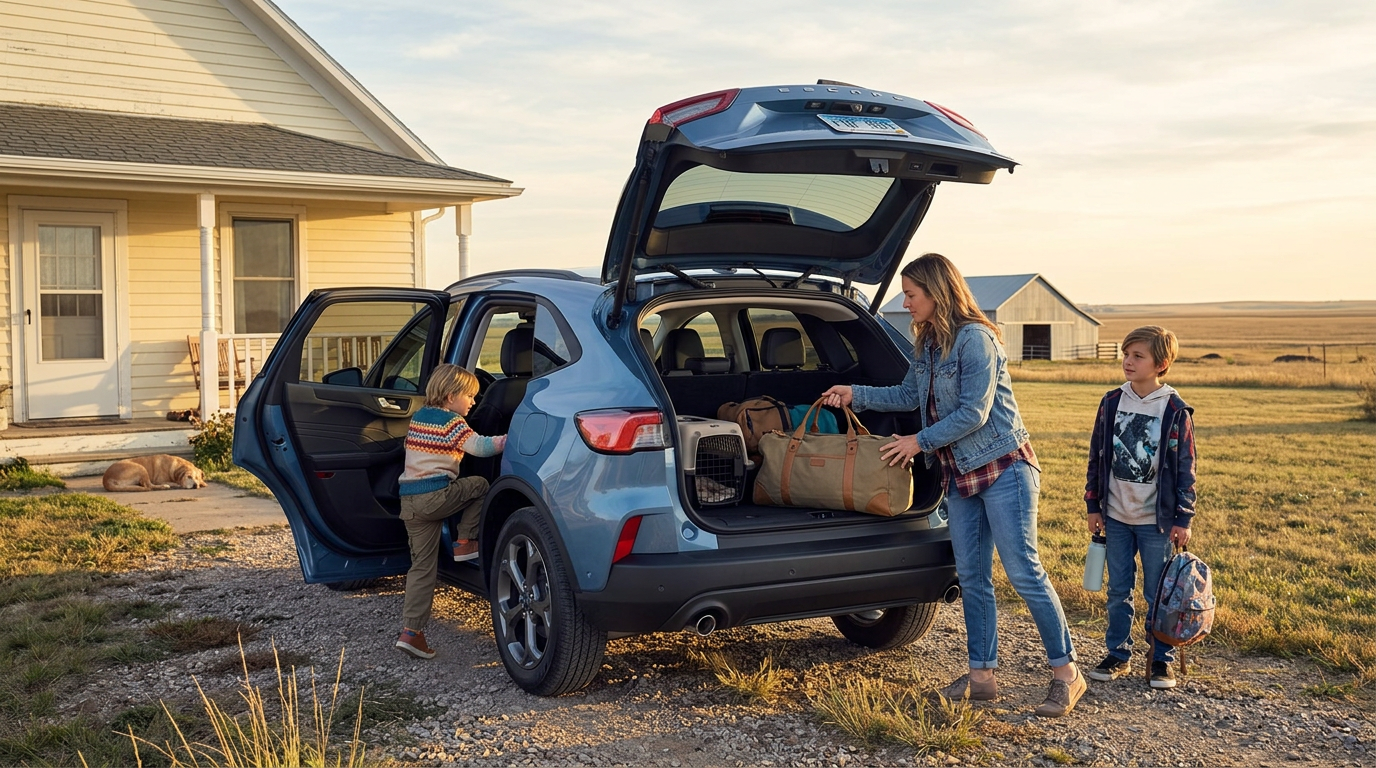
Is the 2026 Ford Escape a Good Family SUV? A Practical Look for South Dakota Buyers
The 2026 Ford Escape seats five, offers available AWD, delivers among the better fuel economy in its class through the hybrid powertrain, and includes Ford's full Co-Pilot360 safety suite as standard equipment across every trim. For South Dakota families — school runs in Bowdle, sports travel to Huron or Mitchell, longer highway trips to Aberdeen or Sioux Falls — it covers most of what a family vehicle needs to do without moving up to a larger SUV. This guide breaks down the Escape's family-specific specs and features honestly: interior room, safety systems, AWD availability for winter driving, and fuel economy for a family that logs real miles across central South Dakota. It also covers when the Escape genuinely isn't enough and the Explorer makes more sense. Shop Escapes in Stock Get Pre-Approved On This Page What Is the 2026 Ford Escape Like Inside for a Family of Five? What Kid-Friendly Features Does the 2026 Ford Escape Have? What Safety Features Come Standard on the 2026 Ford Escape? Does the 2026 Ford Escape Have AWD for Year-Round Family Driving in South Dakota? How Does the Escape's Fuel Economy Affect a Family's Monthly Driving Budget? When Should a South Dakota Family Consider the Explorer Instead of the Escape? What Is the 2026 Ford Escape Like Inside for a Family of Five? The Escape fits five passengers across two rows. It is a compact crossover, so the rear seat is sized for kids and average-build adults comfortably, but it is not a large SUV — tall adults sitting behind tall adults will feel the compact footprint on long trips. Cargo is the practical question for families. Behind the rear seats, the Escape offers approximately 37.5 cubic feet of cargo space — enough for a week of grocery runs or a weekend's worth of luggage for four. With the rear seats folded flat (60/40 split configuration), cargo capacity expands to approximately 60.8 cubic feet. Verify current figures at Ford.com, as cargo numbers are not listed in the order guide. The 60/40 split-fold rear seats are sliding as well as folding — the sliding feature lets you push the rear seats back for more legroom when cargo isn't the priority, or forward when you need the extra cargo depth. Where the Escape works well for SD families: daily driving, school pickup, commutes, and trips where you're packing light. Where it starts to feel tight: sports weekends with equipment, camping trips with gear, or anything that would fill a typical pickup bed. For most Bowdle-area families using the Escape as a daily driver and second vehicle, the cargo room is adequate. For families who routinely haul gear for multiple kids plus parents, the complete 2026 Ford Escape overview covers all configurations, and the Explorer section below covers when stepping up makes sense. What Kid-Friendly Features Does the 2026 Ford Escape Have? LATCH anchors are standard on the rear outboard seating positions across all 2026 Escape trims. For families with car seats, the sliding rear bench is genuinely useful — you can slide the second row forward to give the front passenger more room, or push it back to make car seat installation and kid loading easier. That flexibility is a practical difference from fixed-rear-seat competitors in this class. Features that matter for SD family winters — and when they become standard: heated front seats, a heated steering wheel, and remote start are all standard on ST-Line Select and up. On Active and ST-Line, they are not standard — they require either an option package or moving to a higher trim. If you're pre-warming a vehicle for school pickup in January at -10°F in Bowdle, that feature set matters, and the ST-Line Select is where it becomes baked in. A power liftgate (genuinely useful with your hands full of groceries or a kid) is also standard on ST-Line Select and up. Dual-zone electronic automatic climate control is standard across all trims — both front and rear passengers can reach their preferred temperature. The 13.2" SYNC 4 screen is standard on ST-Line Elite, PHEV, and Platinum; it's optional via tech packages on Select and lower trims. Wireless Apple CarPlay and Android Auto are included on all trims with the 8" standard screen and up. There is no factory-installed rear seat entertainment system on the 2026 Escape — families who want screen time for rear passengers will need a tablet or aftermarket solution. One honest note: the Escape trim levels guide covers which trims include the winter-ready feature set and which require option packages. What Safety Features Come Standard on the 2026 Ford Escape? Ford Co-Pilot360 is standard on every 2026 Ford Escape trim — from the entry-level Active through Platinum. This means automatic emergency braking (AEB) with pedestrian detection, forward collision warning, BLIS blind spot monitoring with rear cross-traffic braking, lane-keeping assist with driver alert, road departure warning, rear view camera, auto high-beam headlamps, and post-collision braking are included regardless of which configuration you purchase. Also standard on all trims: AdvanceTrac with Roll Stability Control (RSC), Electronic Traction Control, SOS Post-Crash Alert System, SecuriLock passive anti-theft, and a full airbag system including a Safety Canopy with rollover sensor. For highway driving on SD's open interstates where deer crossings and sudden weather changes are real risks, having AEB with pedestrian detection and road departure warning on every single trim matters. For families who want the next level of driver assistance — adaptive cruise control with stop-and-go, lane centering assist, rear parking sensors, and intersection assist — that's Co-Pilot360 Assist+. It comes standard on ST-Line Elite, PHEV, and Platinum. On Active, ST-Line, and ST-Line Select, Co-Pilot360 Assist+ requires a tech package upgrade. If highway-capable adaptive cruise is important for your family's longer South Dakota drives, the ST-Line Elite is where it becomes standard without package math. Other Ford Models to Consider Need more room? These models are also available at Beadle Ford. Ford Explorer More cargo room, available 3-row seating, more towing capacity. Shop Escapes in Stock Ford Bronco Sport Standard AWD, GOAT modes, staying in Ford's lineup. Shop Escapes in Stock Ford Maverick Compact truck with hybrid option, bed utility, and family-friendly price. Shop Escapes in Stock Does the 2026 Ford Escape Have AWD for Year-Round Family Driving in South Dakota? Yes — and the answer matters more depending on which trim you order. AWD is standard and the only drivetrain option on ST-Line Select, ST-Line Elite, and Platinum. On Active and ST-Line, FWD comes standard and AWD must be added at order — it does not come on the vehicle automatically. The PHEV trim is front-wheel drive only with no AWD option. For a family in Bowdle that's doing school pickup on packed gravel in November and running kids to Saturday morning sports in Huron in February, the AWD configuration is the practical choice. The Escape's AWD system distributes torque to the rear axle when slip is detected — it handles packed snow and gravel county roads competently. What it doesn't have is a dedicated Snow/Slippery driving mode — it's a reactive AWD system rather than a mode-switching one. The ST-Line Select is the natural starting point for South Dakota family buyers: AWD becomes non-negotiable here (you can't order FWD even if you wanted to), and it adds the full winter-ready package — heated front seats, heated steering wheel, and remote start — as standard equipment. That combination in a single trim is a clean deal for a central SD family vehicle. For more detail on how AWD availability lines up across all trims, the complete 2026 Ford Escape lineup overview covers all six configurations. How Does the Escape's Fuel Economy Affect a Family's Monthly Driving Budget? The 2026 Ford Escape's fuel economy advantage is most meaningful in the Hybrid AWD configuration. The 2.5L Hybrid AWD (available on ST-Line Select, Elite, and Platinum) delivers approximately 39 mpg combined — verify current EPA figures at fueleconomy.gov. For a family logging 15,000 miles per year, that's roughly 385 gallons of fuel annually. On the 1.5L EcoBoost FWD at approximately 30 mpg combined, the same 15,000 miles requires closer to 500 gallons. That difference — roughly 115 gallons per year — is real money on a farm family's budget where every dollar matters. The SD-specific efficiency argument is the highway leg. South Dakota families don't just drive city blocks — they're driving 30-mile county road hauls to get to a highway, then 60 to 80 miles into a larger city for errands or appointments. The Escape Hybrid's EPA highway figure (approximately 36 mpg — verify at fueleconomy.gov) holds up well on those stretches. For a Bowdle family making regular trips to Aberdeen or Huron, the Hybrid AWD pays back in fuel savings in a way that suburban buyers who drive shorter loops don't experience as directly. The PHEV is worth mentioning for context: it delivers higher MPGe when running on electricity (~101 MPGe, verify at fueleconomy.gov) and good hybrid-mode efficiency once the battery depletes (~40 mpg, verify). The practical challenge for central SD families is that reliable Level 2 charging infrastructure near Bowdle is limited — the PHEV's efficiency advantage is smaller if you're charging on a standard Level 1 outlet or not charging consistently. And the PHEV is FWD-only, which is a significant trade-off for SD winter driving. For most SD families, the non-plug-in Hybrid AWD on ST-Line Select is the stronger combination of efficiency, AWD, and real-world practicality. When Should a South Dakota Family Consider the Ford Explorer Instead of the Escape? The Explorer is the right call when the Escape's two-row, five-passenger limit is genuinely a constraint for your family's actual use. The Explorer offers available three-row seating — a real third row for a family of six or seven, not a jump seat. It also offers more cargo volume behind the second row than the Escape, more towing capacity depending on configuration, and a longer wheelbase that translates to more rear-passenger legroom on multi-hour drives. The trade-offs are straightforward: the Explorer is larger, costs more, and burns more fuel. For a family that genuinely needs three rows a few times a year (church trips, extended family hauling, carpool groups), paying the Explorer premium makes sense. For a family that's primarily two parents and two kids — the Escape's five-passenger cabin covers everyone, the cargo room handles the gear, and you're spending and fueling less for the same trip. One practical note on timing: the 2026 Escape is the final model year — Ford is not producing an Escape beyond 2026. The Explorer is continuing in Ford's lineup. If long-term model continuity and parts availability over a 10+ year ownership horizon matters to your family's decision, the Explorer's ongoing production is a real difference. For a 5–7 year ownership window, that consideration is lower — the Escape carries full Ford warranty coverage and parts support for any recently discontinued model is strong for many years post-production. Both the Escape and Explorer are available at Beadle Ford in Bowdle. Key Takeaways for South Dakota Families The Escape seats five with a sliding, 60/40 split-fold rear seat; cargo room is approximately 37.5 cu ft behind the rear seats (verify at Ford.com). It is not a three-row SUV. Ford Co-Pilot360 with AEB, pedestrian detection, BLIS, lane-keeping, and road departure warning is standard on every trim — no trim is without it. LATCH anchors are standard on rear outboard positions; heated seats, heated steering wheel, remote start, and power liftgate become standard starting at ST-Line Select. For SD family winter driving, ST-Line Select is the practical starting point: AWD is standard (no FWD option), and the full cold-weather feature set is included. The 2.5L Hybrid AWD delivers approximately 39 mpg combined — roughly 115 gallons per year less than the 1.5L gas on 15,000 annual miles, a meaningful difference for a farm family's budget. If your family regularly needs three rows or significantly more cargo capacity, step up to the Explorer — the Escape is a compact two-row vehicle and that limit is real on big gear days. Frequently Asked Questions Does the 2026 Ford Escape have LATCH anchors for car seats? Yes — LATCH anchors are standard on the rear outboard seating positions on all 2026 Ford Escape trims. The rear seat also features 60/40 split-fold and sliding functionality. The sliding capability is useful for car seat installation, as you can position the second row forward or rearward depending on car seat size and how much front-passenger legroom you want. There is no LATCH anchor on the rear center position. Which 2026 Ford Escape trim is best for a South Dakota family? For most South Dakota families, the ST-Line Select is the practical starting point. It is the first trim where AWD is standard (no FWD option), and it adds heated front seats, a heated steering wheel, remote start, and a power liftgate as standard equipment — the full winter-ready package for central SD conditions. The ST-Line Elite steps up to a 10-way power driver's seat, the 13.2" SYNC 4 screen, wireless charging, and Co-Pilot360 Assist+ as standard equipment for families who want the full tech suite without package math. Both are available with the 2.5L Hybrid AWD for families prioritizing fuel economy on long South Dakota drives. Does the 2026 Ford Escape have a third row? No — the 2026 Ford Escape is a two-row, five-passenger vehicle. There is no three-row option at any trim or configuration. If your family regularly needs seating for six or seven, or needs the cargo room that comes with a longer three-row platform, the Ford Explorer is the appropriate step up. The Explorer is available at Beadle Ford in Bowdle and offers available three-row seating with more interior volume than the Escape. Is the 2026 Ford Escape safe enough for family use? The 2026 Ford Escape includes Ford Co-Pilot360 as standard equipment on every trim — this means automatic emergency braking with pedestrian detection, BLIS blind spot monitoring with rear cross-traffic braking, lane-keeping assist, road departure warning, pre-collision warning with dynamic brake support, and a rear view camera come on every Escape regardless of price point. AdvanceTrac with Roll Stability Control and a full airbag system including a Safety Canopy with rollover sensor are also standard across all trims. Verify current NHTSA and IIHS safety ratings at their respective websites for the most recent test results. Is the Ford Escape or Explorer better for a South Dakota family? For a family of five using the vehicle primarily for daily driving, school runs, and regional highway trips, the Escape handles the job with better fuel economy and a lower price point than the Explorer. For families who need three rows, routinely haul significant equipment, or plan to use the vehicle for towing beyond the Escape's capacity (the 2.0L Escape maxes at 3,500 lbs with the Class II package; the Explorer can tow more depending on configuration), the Explorer is the right step up. If you're on the fence, both are available at Beadle Ford in Bowdle — a back-to-back comparison is the best way to make the call for your specific family use case. My Take on the 2026 Ford Escape as a South Dakota Family Vehicle The buyers I talk to who are considering the Escape for family use usually come in with one of two scenarios: they're using it as a second vehicle on the farm — mom's daily driver for town runs and kid hauling while the truck handles the heavier work — or they're a smaller family that doesn't need a full-size SUV and is trying to keep fuel costs reasonable on South Dakota highway miles. The Escape fits both of those use cases well. The ST-Line Select in Hybrid AWD hits a real sweet spot: AWD locked in, heated seats and remote start included, and approximately 39 mpg on the highway. I do tell families honestly when the Escape is going to come up short. If you've got three kids who need their own row, or you're the household that hauls ATV gear and sports equipment for multiple kids on the same trip — you're going to load the Escape to its limit and probably wish you'd gone to the Explorer. The five-passenger, two-row limit is real. It's not a knock on the vehicle; it's just what it is. The Explorer is right down the lot. If you want to walk through which trim makes the most sense for your family's actual routine, stop by Beadle Ford in Bowdle. I'm happy to go through it with you. Shop Escapes in Stock Get Pre-Approved About the Author Lexy Tabbert — Beadle Ford, Bowdle, SD Lexy Tabbert is the Director of Sales and Marketing at Beadle Ford in Bowdle, South Dakota. She covers Ford vehicles, trim comparisons, and buyer guidance — helping families, ranchers, and ag operators across the region find the right truck and configuration for their needs. Learn more about Lexy.
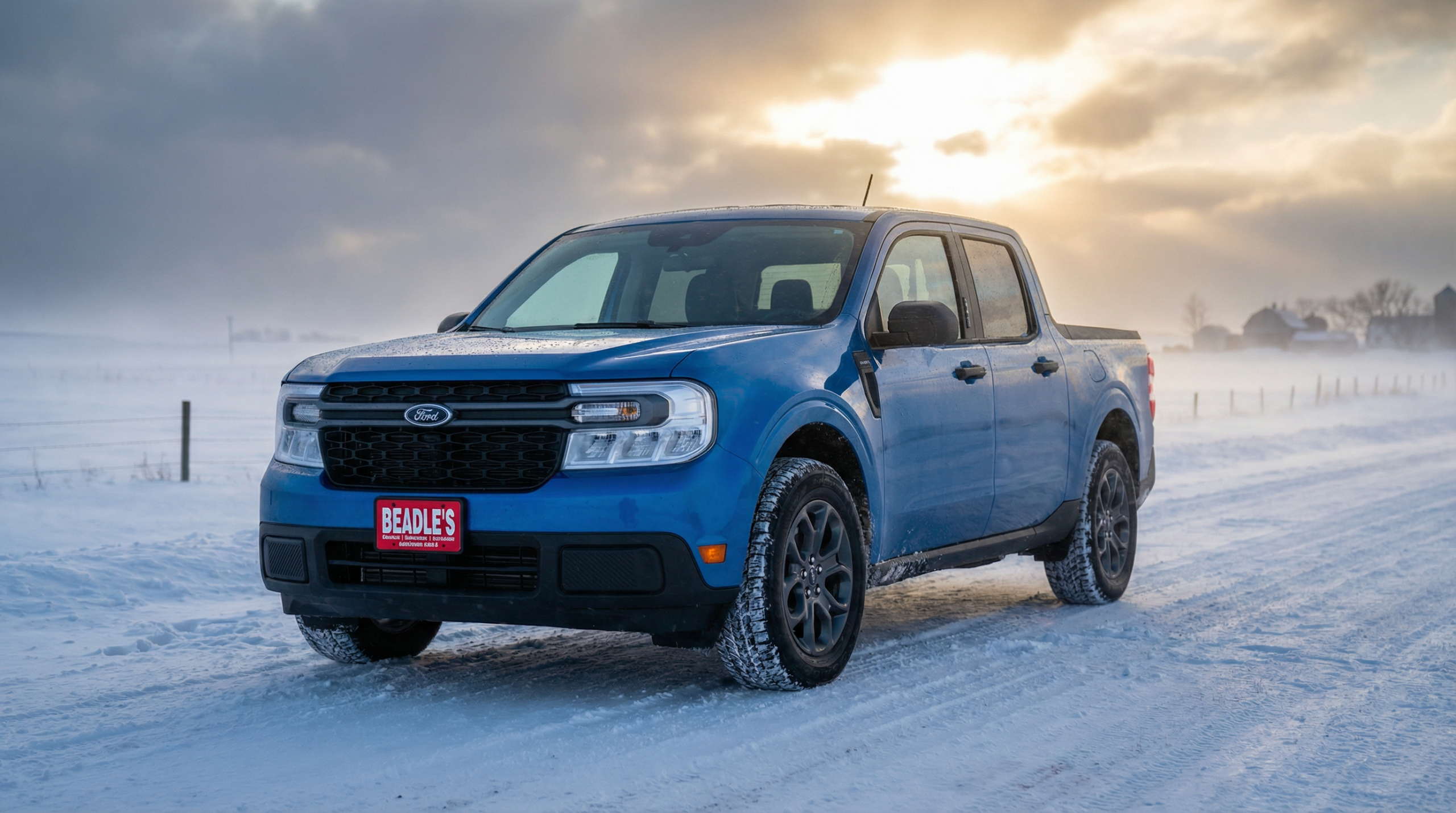
2026 Ford Maverick Winter Driving Guide (AWD Confidence in South Dakota)
If you’re buying a Maverick in South Dakota, winter confidence is the real test. AWD helps—but the best winter setups come from AWD + the right tires + realistic expectations. This guide focuses on what actually makes a Maverick feel stable and predictable when roads are slick, windy, or snow-packed. Winter performance makes the most sense after you’ve decided drivetrain and configuration. If you haven’t done that step yet, start with: 2026 Maverick Specs & Configurations. For inventory and shopping help, visit the Ford Maverick model page. Shop Mavericks in Stock Contact Us Table of Contents AWD vs tires: what matters more? Traction basics for compact trucks Highway wind and stability: what to expect How to set up a Maverick for winter (practical checklist) How to choose an AWD Maverick build for SD winters FAQ AWD vs tires: what matters more? For winter driving, tires usually make the biggest difference first. AWD helps you get moving and maintain traction, but stopping and cornering confidence comes heavily from tire grip. The best winter Maverick setup is usually AWD plus tires that match your routes and snow/ice exposure. Traction basics for compact trucks Maverick is a compact truck, which is a good thing in winter: it’s easier to maneuver and less fatiguing in town. The tradeoff is that traction can change quickly when roads go from plowed to drifted, or when you transition from pavement to gravel. That’s why tires, visibility, and a stable driving rhythm matter just as much as drivetrain. If you’re balancing winter needs with ownership costs, this is explored further in: 2026 Maverick MPG & Ownership Costs. Highway wind and stability: what to expect South Dakota winter driving isn’t just snow—it’s wind. On open highways, the combination of gusts, passing semis, and uneven road surfaces can make vehicles feel “busy.” The best way to reduce stress is good tires, proper pressure, and a build that matches your real route needs. How to set up a Maverick for winter (practical checklist) Choose tires intentionally: winter tires if you drive in snow/ice daily; quality all-seasons if you’re mostly on plowed roads. Confirm AWD if it’s a non-negotiable: verify on the equipment list—not assumptions. Check wipers/visibility: winter visibility is often the “make or break” comfort factor. Keep weight realistic: don’t overload—payload still matters in winter handling. Plan for driving style: smooth inputs beat aggressive driving every time in slick conditions. Quick Overview Best winter upgrade Tires that match your routes and snow/ice exposure Best confidence combo AWD + good tires + clear visibility setup Smart shopping move Choose drivetrain first, then trim; confirm equipment list on the exact truck How to choose an AWD Maverick build for SD winters Decide where you drive: in-town, highway commute, or rural gravel routes. Choose AWD if you need traction margin for winter and variable surfaces. Budget for tires that match your winter exposure (this matters more than many packages). Keep towing/payload realistic so winter handling stays predictable. Compare two real builds on the Maverick hub to confirm equipment and value. Shop Mavericks in Stock Ask About Winter Setup FAQ Is AWD enough for South Dakota winters? AWD helps traction, but tires are usually the bigger difference-maker for winter confidence—especially for stopping and cornering. For the best setup, prioritize tires first and AWD second. Do I need winter tires if I have AWD? Not always, but many drivers prefer them if they regularly drive in snow/ice or on unplowed rural roads. AWD helps you move, but tire grip helps you stop and steer. What’s the biggest winter-driving mistake Maverick buyers make? Assuming AWD replaces the need for tires and careful driving. The best winter outcomes come from traction + visibility + smooth inputs, not drivetrain alone. Conclusion In my experience, the Maverick winter setup that feels best is simple: AWD for traction margin, tires that match your routes, and a build that stays realistic on payload and towing. When buyers plan for visibility and traction first, the Maverick feels calm and predictable even when South Dakota weather doesn’t cooperate. About the Author: Lexy Tabbert helps South Dakota and North Dakota shoppers choose winter-capable truck setups for real routes—highway commutes, rural roads, and changing weather. Her guidance focuses on practical confidence: the right drivetrain, the right tires, and a configuration that matches how you actually drive.
The 2026 Ford Ranger Got Some Upgrades — Here's Everything That Changed (and What Didn't)
Every year when a new model rolls out, the first question is the same: did anything actually change? For the 2026 Ford Ranger, the honest answer is yes — and a couple of those changes are more significant than the typical annual refresh. There's a new exterior color, a first-ever option for this Ranger generation, an expanded off-road package, and a handful of refinements across packages, technology, and interior materials. This guide covers every confirmed change from 2025 to 2026 — new color, new options, package updates, seating changes, and tech upgrades. It also covers the one big topic that didn't change: towing. Shop Rangers in Stock Get Pre-Approved On This Page What actually changed on the 2026 Ford Ranger? Did the 2026 Ranger get a new exterior color? Is there finally a moonroof option on the Ranger? Is the FX4 Off-Road Package available on more trims? What changed on the 2026 Ranger Lariat? What other updates came with the 2026 model year? Did the 2026 Ranger's towing capacity change? What actually changed on the 2026 Ford Ranger? The 2026 Ranger updates fall into four categories: color, options, packages, and interior. No powertrain changes, no towing changes, no new body style. Here's the full picture at a glance. What Changed 2025 2026 Exterior color Azure Gray available Avalanche added; Azure Gray removed Moonroof Not available Optional on XLT and Lariat FX4 availability XLT and Lariat only XL, XLT, and Lariat Lariat seating Leather ActiveX (leather-alternative) SiriusXM tier Standard satellite 360L on-demand + satellite Chrome Accent Package Available on XLT Lariat only 18" Chrome PVD wheels (XLT) Part of a package Available standalone Black Appearance Graphics Not available New package option Towing capacity Up to 7,500 lbs when properly equipped Unchanged Everything in the table above is confirmed for 2026. These changes apply across the lineup as noted — some are trim-specific, some are package-level. Full details on each are in the sections below. Did the 2026 Ranger get a new exterior color? Yes. Avalanche is a new color for 2026, and Azure Gray has been removed from the palette. If you were considering the Ranger in Azure Gray, that option is no longer available — Avalanche is the new addition in its place. The rest of the color lineup carries over from 2025. Confirm current color availability on the window sticker or with Beadle Ford directly, as dealer allocation can vary by model year and region. Is there finally a moonroof option on the Ranger? Yes — and this is a legitimate first. An optional power moonroof is available on XLT and Lariat trims for 2026. This is the first time Ford has offered a moonroof option on this generation of the Ranger. It is not available on the base XL or the Ranger Raptor. For buyers who've been waiting on a Ranger with a sunroof, 2026 is the year it arrived. Out here in central South Dakota where the sky is the best thing about the drive, it's an option that actually makes sense. Is the FX4 Off-Road Package available on more trims for 2026? Yes — FX4 is now available on the XL trim for 2026. In 2025, the FX4 Off-Road Package was limited to XLT and Lariat. That changes with 2026, making FX4 accessible across all three non-Raptor trim levels: XL, XLT, and Lariat. This matters for buyers who want the FX4 hardware — electronic-locking rear differential, skid plates, Trail Control™, and off-road-tuned shocks — without moving up to XLT pricing. The FX4 package itself is unchanged; it's just now available one rung lower. To see how these changes play out across each trim level, the 2026 Ranger trim breakdown has the full picture. What changed on the 2026 Ranger Lariat? Two changes are specific to the Lariat for 2026. First, seating material switches from leather to ActiveX upholstery. ActiveX is Ford's leather-alternative material — it offers a similar appearance and is designed to be easier to clean and more consistent in temperature extremes, which matters in South Dakota winters and summers alike. This is a direct material substitution, not a feature addition or removal. Second, the Chrome Accent Package is no longer available on XLT for 2026 — it's now a Lariat-only option. If you were planning to add chrome accent trim to an XLT, that configuration is not available on the 2026 model year. What other updates came with the 2026 model year? A few additional changes round out the 2026 update: SiriusXM upgraded to 360L. The 2026 Ranger upgrades SiriusXM from the standard satellite tier to the 360L on-demand service, which combines traditional satellite broadcasting with on-demand streaming. A 3-year 360L subscription plan is now an optionable add-on. 18" Chrome PVD wheels available standalone on XLT. The 18-inch Chrome PVD aluminum wheel is now available as a standalone option on XLT, rather than requiring it as part of a larger package. This gives XLT buyers more flexibility when configuring the truck. New Black Appearance Graphics package. A Black Appearance Graphics add-on is a new option for 2026, providing a blacked-out exterior accent treatment for buyers who prefer that look. New dealer-installed options are also available for 2026, including an Illuminated Ford Oval, Jump Starter, Tool Kit, Windshield Sunscreen, and roll-up tonneau cover options — practical add-ons that can be configured before delivery. Did the 2026 Ranger's towing capacity change? No. Towing capacity on the 2026 Ford Ranger is identical to 2025. Non-Raptor trims with the Trailer Tow Package are rated at up to 7,500 lbs when properly equipped. The Ranger Raptor is rated at up to 5,510 lbs when properly equipped. Bumper-only towing without the Tow Package remains 3,500 lbs. Package requirements are unchanged. This is worth stating clearly because it's a common assumption that spec sheets change annually. For towing, the 2026 Ranger is spec-for-spec identical to 2025. If you're making a towing decision, the full breakdown of capacity by engine configuration, package requirements, and GCWR is covered in the 2026 Ranger towing guide. Key Takeaways Avalanche is a new exterior color for 2026; Azure Gray has been removed A power moonroof is available for the first time on this Ranger generation — XLT and Lariat only FX4 Off-Road Package is now available on the XL trim, expanding availability to XL, XLT, and Lariat Lariat switches from leather to ActiveX seating for 2026 — same category, different material SiriusXM upgraded to the 360L on-demand tier; 3-year subscription plan now optionable Chrome Accent Package moved from XLT to Lariat-only for 2026 18" Chrome PVD wheels are now available as a standalone option on XLT Black Appearance Graphics is a new 2026 package option Towing capacity is completely unchanged from 2025 — up to 7,500 lbs when properly equipped on non-Raptor trims Frequently Asked Questions Did Ford change the Ranger's engines for 2026? No. All three engine options carry over unchanged from 2025: the 2.3L EcoBoost® I4 (270 hp, 310 lb-ft), the available 2.7L EcoBoost® V6 (315 hp, 400 lb-ft), and the Raptor-exclusive 3.0L EcoBoost® V6 (405 hp, 430 lb-ft). All pair with a 10-speed automatic transmission. Drivetrain availability by trim is also unchanged. Is Azure Gray still available on the 2026 Ranger? No. Azure Gray has been removed from the 2026 Ranger color lineup and replaced by Avalanche. If Azure Gray was your planned color, you would need to find a remaining 2025 model or choose a different 2026 color. What exactly is ActiveX upholstery on the 2026 Lariat? ActiveX is Ford's leather-alternative seating material. It is designed to approximate the appearance and feel of leather while offering easier cleaning and more consistent performance across temperature extremes — a practical consideration in a climate like South Dakota's. It replaces genuine leather on the 2026 Lariat but retains the same heated and ventilated seat functionality. Can I get the moonroof on the 2026 Ranger Raptor? No. The optional power moonroof is available on XLT and Lariat trims only. It is not available on the base XL or the Ranger Raptor. Did any of the 2026 changes affect towing or payload ratings? No. Towing ratings, payload ratings, GCWR values, and package requirements are all identical to the 2025 Ranger. None of the 2026 updates — color, moonroof, FX4 availability, seating material, or SiriusXM tier — affect the truck's rated capabilities. My Take on the 2026 Ranger Updates The question I hear at Beadle Ford in Bowdle more than almost any other is: "Is the new model year worth waiting for, or should I just buy the one on the lot?" For the 2026 Ranger, my honest answer is: it depends on what matters to you. If you've been holding out for a moonroof on a Ranger — that's a real upgrade, and it's the first time it's been available on this generation. If you've been eyeing an XL and wanted FX4 capability without jumping to XLT pricing, that's also a meaningful change. For buyers focused primarily on towing — pulling a camper out to the Badlands for a long weekend, or hauling livestock equipment — there's no functional reason to wait. The 2026 Ranger tows the same as 2025. The package setup is the same. The numbers haven't moved. These updates are best understood alongside the full picture of what this truck offers year-round — the 2026 Ford Ranger overview covers trims, engines, towing, and features in one place. If you want to talk through which configuration fits your situation, stop by or give Beadle Ford a call — we're here to help you find the right truck, not just sell you the newest one. Shop Rangers in Stock Get Pre-Approved Contact Beadle Ford About the Author Lexy Tabbert — Beadle Ford, Bowdle, SD Lexy Tabbert covers Ford vehicles, trim comparisons, and buyer guidance for Beadle Ford in Bowdle, South Dakota. Her content is grounded in real buyer conversations with families, ranchers, and ag operators across the Bowdle region and central South Dakota. Learn more about Lexy.
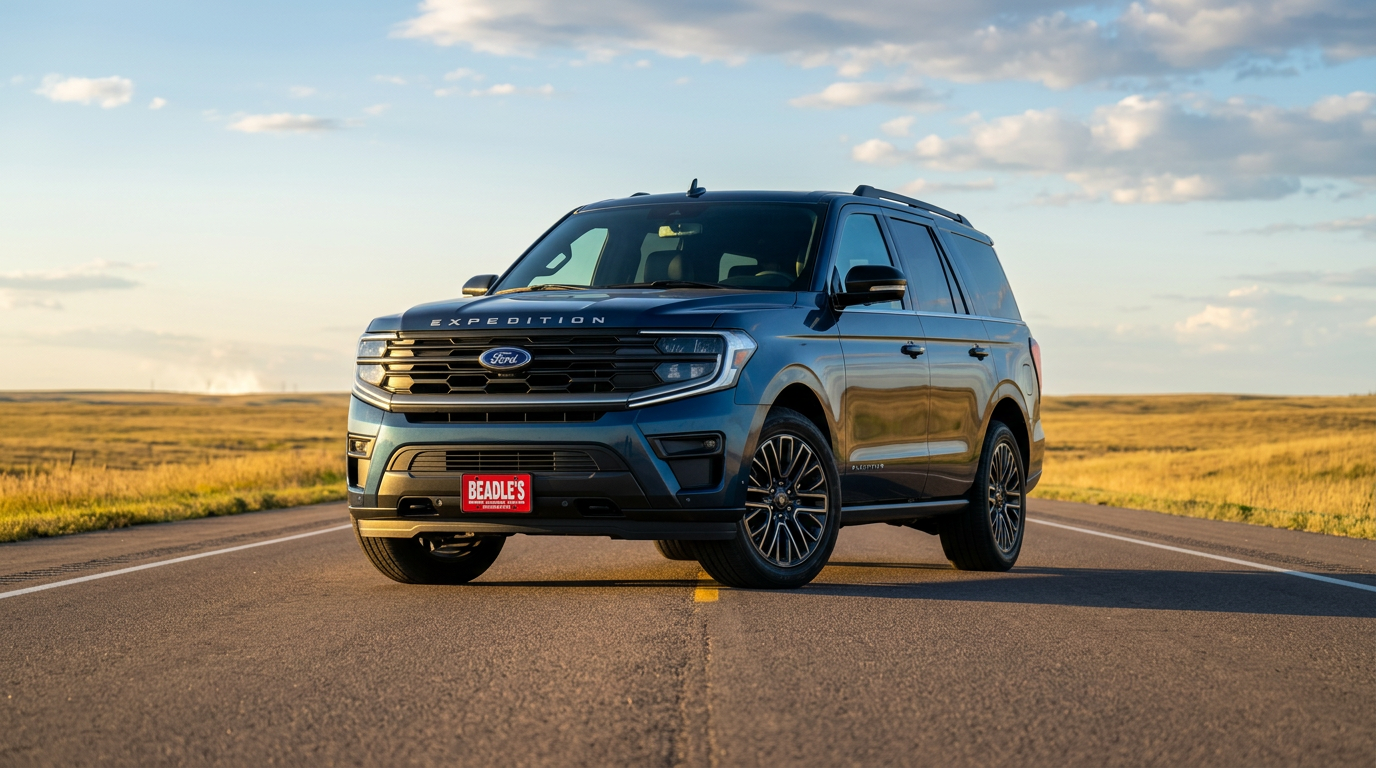
2027 Ford Expedition vs. 2026 Chevy Tahoe and Suburban: An Honest Cross-Shop for Ag Country Buyers
Home› Ford Expedition› 2027 Ford Expedition› Expedition vs. Tahoe & Suburban If you’re cross-shopping a 2027 Ford Expedition against a 2026 Chevy Tahoe or Suburban, you’re asking one of the most practical full-size-SUV questions in this part of the country. Both trucks do the same jobs — haul a family, pull a livestock or gooseneck trailer, cover long highway stretches to Sioux Falls or Fargo — but they get there with different powertrains, different tech, and different body-style philosophies. This guide is an honest cross-shop written for the buyers we actually see at Beadle Ford: ranchers and ag operators who’ve run GM full-size SUVs for decades, families who want the MAX-length option, and highway commuters deciding between EcoBoost V6 and V8 power. We’ll compare powertrains, towing, interior and tech (including BlueCruise vs. Super Cruise), and the MAX-vs.-Suburban body-style decision — then close with who should pick which truck and why. Browse Expedition Inventory Ask About a Custom Order On This Page Ford EcoBoost V6 vs. GM V8 — which powertrain wins? How does the 2027 Expedition’s towing compare to Tahoe and Suburban? Ford Digital Experience vs. GM tech — what’s different? Expedition MAX vs. Suburban — which is the right long-haul SUV? Which buyers should pick Ford and who should stay with GM? Ford EcoBoost V6 vs. GM V8 — which powertrain wins? It depends on what you’re measuring. The 2027 Ford Expedition runs the 3.5L EcoBoost V6 — a twin-turbocharged V6 — with a 440 hp / 510 lb-ft High Output variant available on the Tremor, Platinum Stealth Performance, and Platinum Ultimate configurations. The 2026 Chevy Tahoe and Suburban use naturally aspirated V8s: a 5.3L as the standard engine, a 6.2L V8 as the upgrade. Both brands mate their engines to 10-speed automatic transmissions. Where the V6 turbo wins: cruise fuel economy on flat interstate (the EcoBoost is off-boost at 70 mph and behaves like a smaller engine), altitude tolerance (a turbocharged V6 doesn’t lose power at elevation the way a naturally aspirated V8 does — relevant if you tow into Wyoming or the Black Hills), and peak torque delivered lower in the rev range. The Ford’s 510 lb-ft High Output figure outpaces the Tahoe’s 6.2L V8 on peak torque, and both High Output and the Tahoe’s 6.2L use the same 10-speed auto. Where the GM V8 wins: throttle feel at cold starts, a mechanical simplicity that some long-time owners value, and the sound. Buyers who have run GM V8s for a decade or more often describe the EcoBoost as “different” — not worse, but different. Under load with a trailer, the EcoBoost spools up and delivers; a 6.2L V8 just digs in. Both work. For the full 2027 Expedition lineup and engine-by-trim availability, see the complete 2027 Ford Expedition overview. How does the 2027 Expedition’s towing compare to Tahoe and Suburban? The Expedition has a few hundred pounds of headroom over comparable Tahoe and Suburban configurations. Official 2027 tow ratings will be confirmed when Ford releases the 2027 Towing Guide. Public reporting on the current-generation Expedition Tremor cites a maximum tow rating of approximately 9,600 lbs when properly equipped. Chevrolet’s published figures for the 2026 Tahoe cite a maximum tow rating in the 8,400 lb range when properly equipped, with the Suburban rated slightly lower due to its longer wheelbase and additional mass. For most buyers in our service area, the real-world question isn’t peak rating — it’s whether the truck handles your specific trailer comfortably. A 24-foot gooseneck loaded with a pair of quarter horses, a 20-foot enclosed trailer with a side-by-side and gear, or a tandem-axle boat trailer for Lake Oahe all sit well inside both trucks’ capabilities when properly equipped. Configuration, payload, and weight distribution matter more than peak figures. Where the Expedition adds practical value: Pro Trailer Hitch Assist and Pro Trailer Backup Assist are standard across every retail Expedition trim via Ford Co-Pilot360 Assist 2.0 — they’re not package-dependent. BLIS with Trailer Coverage extends blind-spot monitoring around whatever you’re pulling. The Tremor’s 3.73 Electronic Locking Rear Differential and seven drive modes give you a recovery option that a Tahoe or Suburban simply doesn’t offer from the factory. If you’re sizing an Expedition to a specific trailer, contact Beadle Ford and we’ll run the configuration against your actual load before you buy. Ready to explore the Ford side? Get Pre-Approved Browse Current Expedition Inventory Ford Digital Experience vs. GM tech — what’s different? Both brands now run Google-integrated infotainment. The 2027 Expedition’s Ford Digital Experience pairs a 24" panoramic driver display with a 13.2" center display, with Google Maps, Google Assistant, and Google Play Store embedded natively. Wireless Apple CarPlay and Android Auto are standard from Active (200A) and up. The 2026 Tahoe and Suburban use GM’s Google Built-In system across a 17.7" center touchscreen on upper trims, with a similar Google Maps and Assistant integration. The driver-monitoring hands-free systems are the bigger differentiator. Ford’s BlueCruise works on approximately 97% of controlled-access U.S. and Canada highways, includes Lane Change Assist and In-Lane Repositioning, and uses a driver-facing camera for attention monitoring. A 90-Day Trial is included on Active Touring (202A) retail orders, and the 1-Year + 90-Day plan is standard on Platinum Ultimate (17A) and King Ranch (400A). GM’s Super Cruise is the mature competing system — it’s hands-free on a different set of mapped roads and uses its own driver-monitoring approach. For South Dakota buyers, the coverage question matters most on two routes: I-90 east-west across the state and the US-12 / US-281 highway system north-south. Both systems cover I-90 well; coverage on the two-lane and semi-divided highway stretches that most of us actually drive is narrower for both. The BlueCruise vs. Super Cruise vs. ProPilot comparison walks through which system covers which roads — it’s the right resource if hands-free driving is a real decision factor for you. Ford Co-Pilot360 Assist 2.0 is standard on every retail Expedition. Features include a 360-degree camera with off-road overlays and a Rock Crawl view (the camera hardware that enables the Tremor’s trail-running), adaptive cruise with lane centering and Predictive Speed Assist, Pre-Collision Assist with automatic emergency braking, and BLIS with cross-traffic and trailer coverage. GM offers comparable tiers on the Tahoe and Suburban depending on trim. Expedition MAX vs. Suburban — which is the right long-haul SUV? Both are the extended-length full-size SUV answer from their respective brands. The Expedition MAX is the stretched version of the standard Expedition — available for 2027 on XL, Active Select, Active Touring, Platinum (including the 30th Anniversary Appearance Package), and King Ranch. Tremor is standard-length only. New for 2027: MAX Platinum is offered in 4x2 configuration as well as 4x4. The Suburban is GM’s always-extended full-size — there is no “standard Suburban” body style; the name itself denotes the extended platform. The body-style decision usually comes down to powertrain and tech preference rather than size. Both offer meaningful third-row legroom and cargo volume behind the third row — enough for a family of five or six with luggage for a week. If you want extended length plus V8 power, Suburban is the answer. If you want extended length plus EcoBoost V6 plus Ford Digital Experience plus the option of the 30th Anniversary Appearance Package on a MAX Platinum, the MAX is the answer. For a full Expedition vs. MAX decision framework — standard-length vs. extended, trim availability by body style, and when the extra length is genuinely worth it — see the 2027 Ford Expedition vs. Expedition MAX guide. Which buyers should pick Ford and who should stay with GM? Both trucks are legitimate. The right call depends on what you actually value in a full-size SUV, how you drive, and what your history with both brands has taught you. Pick the 2027 Ford Expedition if: You want EcoBoost V6 turbocharged power and the cruise-fuel and altitude benefits that come with it You’re considering a factory off-road trim — the Tremor has no direct GM equivalent (GM’s Z71 is a package, not a standalone trim) You want the 30th Anniversary Appearance Package on a Platinum — the only Expedition configuration offering Blue Ember Metallic You want Pro Trailer Hitch Assist and Pro Trailer Backup Assist standard on every retail trim, not as an upsell You want BlueCruise coverage and the 97% controlled-access highway figure matches how you drive You want the 24" panoramic driver display and the Ford Digital Experience’s pano mode Stay with the 2026 Chevy Tahoe or Suburban if: You’ve run GM V8s for decades and the sound, feel, and mechanical character of a naturally aspirated V8 matter to you You want a 6.2L V8 specifically and don’t want a turbocharged V6 alternative You want the 3.0L Duramax diesel inline-six option (Ford doesn’t offer a diesel in the Expedition) Super Cruise’s mapped-road footprint covers your specific highway routes better than BlueCruise does You’re deeply loyal to the Chevrolet brand and have a service relationship you want to keep For the ag buyer who has run GM full-size forever and is considering the switch because of a specific feature — whether that’s BlueCruise, the EcoBoost V6’s altitude behavior, Pro Trailer Hitch Assist, or the Tremor — come drive both and see which one you get out of at the end of a 200-mile day. That usually decides it. Key Takeaways Ford: 3.5L EcoBoost V6 (standard) and 3.5L EcoBoost V6 High Output at 440 hp / 510 lb-ft (confirmed). GM: 5.3L V8 standard, 6.2L V8 optional, 3.0L Duramax diesel I6 optional. Both brands use 10-speed automatic transmissions. Expedition max tow is reported at approximately 9,600 lbs (Tremor) pending the 2027 Ford Towing Guide; Tahoe tops out near 8,400 lbs per Chevrolet’s published figures. Pro Trailer Hitch Assist and Pro Trailer Backup Assist are standard on every retail 2027 Expedition trim via Ford Co-Pilot360 Assist 2.0. BlueCruise covers approximately 97% of controlled-access U.S. and Canada highways; Super Cruise covers a different mapped footprint. Compare by the routes you actually drive. No direct GM equivalent to the Expedition Tremor as a factory off-road trim. No Ford Expedition diesel option. Frequently Asked Questions How does the 2027 Ford Expedition compare to the Chevy Tahoe and Suburban? The 2027 Expedition uses a 3.5L EcoBoost V6 (twin-turbo, with a 440 hp / 510 lb-ft High Output variant) while the 2026 Tahoe and Suburban run naturally aspirated V8s (5.3L standard, 6.2L optional) plus an available 3.0L Duramax diesel I6 on the GM side. Both brands use 10-speed autos. Expedition tops in max tow capability and offers BlueCruise; GM counters with V8 heritage, Super Cruise, and the diesel option. Can the 2027 Expedition tow more than a Chevy Tahoe? In maximum trailer rating, yes — reporting on the current-generation Expedition Tremor cites approximately 9,600 lbs when properly equipped, versus Chevrolet’s published figures for the 2026 Tahoe in the 8,400 lb range. Official 2027 Expedition tow ratings will be confirmed when Ford releases the 2027 Towing Guide. Configuration and weight distribution matter more than peak figures for most real trailers. Does the Ford Expedition have a V8? No. The 2027 Ford Expedition is offered only with the 3.5L EcoBoost V6 family — standard, or the 440 hp / 510 lb-ft High Output variant on Tremor, Platinum Stealth Performance, and Platinum Ultimate. There is no V8 Expedition and no diesel Expedition. Is the Expedition MAX the same size as the Suburban? Both are extended-length full-size SUVs and offer similar third-row legroom and cargo volume. The Expedition MAX is the stretched version of the standard Expedition; the Suburban is always the extended platform (there is no standard-length Suburban). Exact overall length differs slightly between the two; the real comparison for most buyers is powertrain and tech preference rather than inches. Does the Tahoe have a factory off-road trim like the Tremor? Not as a standalone trim. Chevrolet offers the Z71 off-road package on the Tahoe, which adds off-road-oriented equipment to a trim, but the Expedition Tremor is a full trim with its own engine spec (the 440 hp High Output V6), its own suspension tuning, its own 3.73 Electronic Locking Rear Differential, and its own off-road-specific equipment standard — not a package layered onto an existing trim. Which is better on fuel — the Expedition or the Tahoe? EPA ratings for the 2027 Ford Expedition are listed on each in-stock unit’s window sticker. Turbocharged V6 engines typically return better fuel economy than naturally aspirated V8s at cruise, especially at altitude, but full-throttle towing and payload scenarios narrow that gap. If fuel economy is a primary decision factor, compare the window-sticker numbers against your specific driving pattern. Where can I drive both before I decide? Beadle Ford in Bowdle has the 2026 Expedition lineup on the lot — we’d be happy to set up a test drive and compare configurations against what you’re seeing on the Chevy side. Call (866) 561-2636 or reach out through our contact page to schedule. My Take on the Expedition vs. Tahoe & Suburban Cross-Shop Both trucks are legitimate. I won’t pretend otherwise. What I tell buyers who walk into Beadle Ford cross-shopping from a GM full-size is this: drive the EcoBoost V6 before you decide. It’s different from a 5.3L or 6.2L V8, and whether that difference registers as “better” or just “different” depends on what you’re used to. The Expedition’s advantages — peak tow headroom, standard Pro Trailer assists, Tremor capability, BlueCruise coverage, the 24" panoramic display — are real, but they matter more to some buyers than others. If you’ve been running GM for decades and everything works for you, there’s no shame in sticking with GM. If you’re curious about what the sixth-generation Expedition does better, come drive one. I’ll walk you through the configuration and we’ll figure out honestly whether switching makes sense for your week. No pressure, no scripts. Shop 2027 Expeditions in Stock Contact Beadle Ford About the Author Lexy Tabbert — Beadle Ford, Bowdle, SD Lexy Tabbert is the Director of Sales and Marketing at Beadle Ford in Bowdle, South Dakota. She covers Ford vehicles, trim comparisons, and buyer guidance — helping families, ranchers, and ag operators across the region find the right truck and configuration for their needs. Learn more about Lexy.
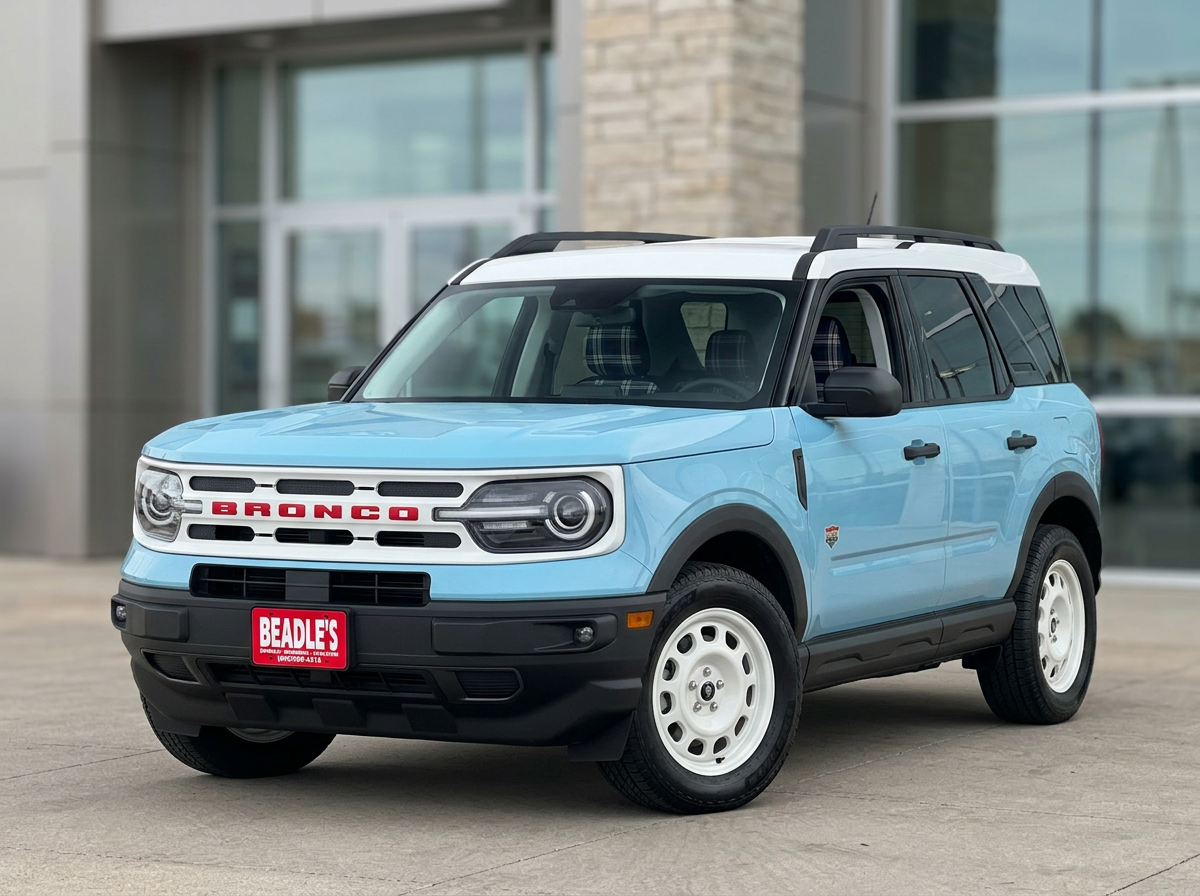
The 2026 Ford Bronco Sport Heritage: White Roof, Plaid Seats, A/T Tires Standard — Who This Trim Is Actually Built For
The 2026 Ford Bronco Sport Heritage is the most visually distinctive trim in the lineup — and the most misunderstood. Buyers see the Oxford White contrasting roof and the plaid seats and assume it's a fashion trim built for looks and nothing more. But the Heritage also comes standard with all-terrain tires, retro-inspired exterior cues drawn from the original 1966 Bronco, and unique color combinations you can't get on any other trim. Here's what actually sets the Heritage apart, who it's built for, and whether it belongs on your short list. Shop Bronco Sports in Stock Get Pre-Approved In This Guide What Makes the 2026 Bronco Sport Heritage Different From Every Other Trim? Is the Oxford White Roof Standard or an Option? Are the Heritage's A/T Tires Enough for Off-Road Use? Heritage vs. Heritage Limited: What Do You Actually Get for the Upgrade? Heritage vs. Outer Banks: Same Price Range, Very Different Character Who Is the 2026 Bronco Sport Heritage Actually Built For? What Makes the 2026 Bronco Sport Heritage Different From Every Other Trim? The Heritage trim occupies a unique spot in the Bronco Sport lineup. It's positioned above Big Bend but below Outer Banks in terms of features, yet it stands out from both because of its deliberate throwback styling — drawing direct visual cues from the first-generation Ford Bronco that debuted in 1966. What makes the Heritage distinctly its own: Heritage-Exclusive Feature What Makes It Unique Oxford White Contrasting Hardtop Roof Standard on every Heritage — not an option, not an upgrade; the white roof is built into the trim identity Plaid Cloth Seat Inserts Tartan plaid pattern referencing the original Bronco's interior; not available on any other Bronco Sport trim Heritage Badging Distinctive "Bronco" script fender badges and retro-styled exterior badging Unique Exterior Color Combinations Heritage-exclusive two-tone body colors not offered on other trims, including Robin's Egg Blue and Yellowstone Metallic All-Terrain Tires Standard A/T tires included at the base Heritage trim level — Big Bend uses highway-terrain tires Body-Color Front Fender Flares Matched to body paint rather than black; contributes to the Heritage's distinct two-tone look No other Bronco Sport trim gets the plaid seats or the white roof as a standard feature. They aren't options you can add to a Big Bend or Outer Banks — they exist only on the Heritage and Heritage Limited trims. If this look appeals to you, these are the only two ways to get it. Is the Oxford White Roof Standard or an Option? The Oxford White contrasting roof is standard on the Heritage. It's not an option you select, and it's not something you can delete from the build. Every 2026 Bronco Sport Heritage leaves the factory with the white hardtop, regardless of which body color you choose. This is an important detail for buyers who see the Heritage at a dealer and wonder whether they can order one in a single solid color without the white roof — the answer is no. The two-tone look is fundamental to the trim's identity, not an add-on. The body-color exterior combined with the Oxford White roof is what creates the Heritage's visual personality, and it's styled to echo the early Broncos that came in two-tone white-over-body-color schemes. In practice, this works well with most of the Heritage's available body colors. Ford specifically curated the Heritage's color palette to complement the white roof, so combinations like Eruption Green with white, Robin's Egg Blue with white, and Yellowstone Metallic with white all look intentional rather than mismatched. If you want a Bronco Sport without the white roof, the Big Bend, Outer Banks, or Badlands trims give you standard solid or monochromatic roof options. Are the Heritage's A/T Tires Enough for Off-Road Use? The Heritage comes with P225/60R18 all-terrain tires as standard equipment — the same A/T compound found on several of the higher trims. This is a meaningful upgrade over the Big Bend's highway-terrain tires, which prioritize ride comfort and fuel economy over grip on loose or slick surfaces. What the Heritage's A/T tires help with versus what they don't: A/T Tires Help With... Gravel roads and two-track pasture lanes Light trail use and forest roads Snow and ice traction in South Dakota winters Wet grass and soft ground near water or fields Muddy access roads after spring rain A/T Tires Won't Replace... Advanced 4x4 with twin-clutch torque vectoring (requires Sasquatch or Badlands) HOSS 2.0 off-road suspension for technical terrain Trail Control for low-speed technical obstacles Rock Crawl mode calibration (Badlands exclusive) The Heritage's 4x4 system is the standard configuration — capable and reliable for the vast majority of off-pavement use in South Dakota, but not the same as the Advanced 4x4 twin-clutch system on the Outer Banks Sasquatch or Badlands. For buyers who need a capable crossover that handles gravel lanes and winter roads between Bowdle and the next town over, the Heritage's standard 4x4 and A/T tires are genuinely well-suited. For buyers planning serious rock-crawling or technical trail runs, the Badlands is the more appropriate tool. The key point: the Heritage is more capable in real-world South Dakota conditions than its retro styling might suggest — the A/T tires are a functional upgrade, not just an aesthetic detail. Heritage vs. Heritage Limited: What Do You Actually Get for the Upgrade? The Heritage Limited is the premium version of the retro-themed lineup. Both share the signature Oxford White roof and plaid seat identity, but the Limited adds a meaningful set of interior and technology upgrades. Feature Heritage Heritage Limited Oxford White Contrasting Roof Standard Standard Plaid Seat Inserts Cloth plaid Plaid with premium trim A/T Tires Standard Yes Yes Heated Front Seats Not standard Available Remote Start Not standard Available Upgraded Wheels Standard alloys Premium finish alloys 12.3" Digital Cluster Display Not standard Available Exclusive Color Options Heritage palette Heritage + Limited-exclusive colors The Heritage Limited is the better fit if you're buying the Heritage primarily for the retro look but want the comfort features — especially heated seats and remote start — that make a Bowdle winter more bearable. If the base Heritage's price point is the draw and you don't need the cold-weather comfort features, the standard Heritage delivers the same visual personality at a lower entry price. Heritage vs. Outer Banks: Same Price Range, Very Different Character The Heritage Limited and the Outer Banks land in a similar price bracket, which means buyers often find themselves choosing between them. They're very different vehicles in terms of personality and feature priorities. Priority Heritage / Heritage Limited Outer Banks Retro / throwback styling Designed for it Modern styling Premium audio (B&O) Not available Available Panoramic fixed glass roof Not available Available Unique plaid seats + white roof Standard Not available Upgrade path to Sasquatch Package Not available Available (with Tech Package) Heritage-exclusive color palette Yes No The Heritage wins on personality and uniqueness. The Outer Banks wins on upgrade flexibility and premium interior options. If you're drawn to the Heritage because of the way it looks, that's a completely valid reason — there's no other Bronco Sport that gives you that aesthetic. If you're drawn to it for practical capability, just be aware that the Outer Banks with the Sasquatch Package can go significantly further off-road when properly equipped. Who Is the 2026 Bronco Sport Heritage Actually Built For? The Heritage is a confident choice for a specific kind of buyer. It's not trying to be the most capable off-road vehicle in the lineup, and it's not trying to be the most loaded-up comfort cruiser. It's built for buyers who care about how their vehicle looks, value individuality, and want a capable daily driver that handles South Dakota's roads without being a cookie-cutter crossover. The Heritage Is the Right Pick If You... Love the original Bronco's look and want that lineage reflected in your vehicle Want a Bronco Sport that looks genuinely different from every other one on the road Drive gravel or dirt roads regularly and want A/T tires without paying for full off-road hardware Want a two-tone color combination that works out of the factory — no custom paint needed Are buying for yourself, not for what someone else thinks is the most "capable" trim Want the Heritage Limited's cold-weather features (heated seats, remote start) at a mid-range price The Heritage is not the right fit if your primary goal is maximum off-road performance — the Badlands does that more effectively. It's also not the right fit if premium audio or a panoramic roof are top priorities — those belong to the Outer Banks. But for buyers who want something that turns heads at the trailhead and at the grocery store equally, the Heritage delivers that in a way none of the other trims can match. For more detail on where every trim sits in terms of standard features, pricing, and drivetrain options, our full 2026 Bronco Sport trim comparison guide breaks it all down side-by-side. Key Takeaways The Oxford White contrasting roof is standard on every 2026 Bronco Sport Heritage — it's not an option and cannot be deleted from the build. Plaid cloth seat inserts are Heritage and Heritage Limited exclusive — they are not available on any other Bronco Sport trim. The Heritage comes standard with all-terrain tires, which is a functional upgrade over Big Bend's highway-terrain tires for gravel roads and South Dakota winters. The Heritage uses the standard 4x4 system — the Advanced 4x4 with twin-clutch torque vectoring requires the Sasquatch Package (Outer Banks only) or Badlands trim. Heritage Limited adds heated seats, remote start, upgraded wheels, and additional technology features — worth the step-up for buyers who need cold-weather comfort in South Dakota. The Heritage is built for buyers who value retro character and visual uniqueness — not for those optimizing for maximum off-road performance or premium interior luxury. Frequently Asked Questions Can I get a Bronco Sport Heritage without the white roof? No. The Oxford White contrasting hardtop is standard on every 2026 Bronco Sport Heritage and Heritage Limited. It's a defining feature of these trims and cannot be removed or replaced with a body-color roof. If you want a Bronco Sport without the white roof, the Big Bend, Outer Banks, and Badlands are your options. Are the plaid seats available on other trims? No. The tartan plaid seat inserts are exclusive to the Heritage and Heritage Limited trims. They cannot be added to the Big Bend, Outer Banks, or Badlands through any package or option. If the plaid seats are part of your decision, these two trims are the only way to get them. Is the Heritage more capable off-road than Big Bend? The Heritage comes with all-terrain tires as standard, while the Big Bend uses highway-terrain tires. That A/T tire difference gives the Heritage a meaningful advantage on gravel, loose terrain, and snow. However, both trims share the same standard 4x4 system — neither has the Advanced 4x4 with twin-clutch torque vectoring found on the Outer Banks Sasquatch and Badlands. For light to moderate off-road use, the Heritage is better equipped than Big Bend. For technical trail work, the Badlands is a more capable platform. What colors are available on the Heritage? The Heritage is available in a curated palette that includes Heritage-exclusive colors such as Robin's Egg Blue, Yellowstone Metallic, and Eruption Green, in addition to some colors shared across the lineup. All Heritage colors are paired with the Oxford White hardtop roof. Confirm specific color availability for the current model year with our team, as production cuts can affect availability on lot versus order. Does the Heritage come with heated seats? Heated seats are not standard on the base Heritage trim. They are available on the Heritage Limited through its available packages. If heated seats are a priority for South Dakota winters, the Heritage Limited or the step up to Outer Banks are the paths to get them configured into your build. My Take on the Heritage for Bowdle Buyers The Heritage is the Bronco Sport I'd point you toward if you've been staring at the same five gray crossovers in every parking lot and want something that looks like it has a point of view. The white roof is polarizing — some buyers love it immediately, others aren't sure what to make of it. But once you see it in Robin's Egg Blue with the white top, you either get it or you don't. What I appreciate from a practical standpoint is that the A/T tires are standard — so you're not sacrificing capability to get the retro look. On the gravel roads between here and the next county line, that matters. The Heritage Limited adds enough cold-weather features to make it a comfortable year-round daily driver in South Dakota without a lot of package stacking. For a full breakdown of how the Heritage stacks up against every other Bronco Sport trim in the 2026 lineup, our 2026 Ford Bronco Sport guide at Beadle Ford has the full comparison with pricing and standard features for each trim level. Shop Bronco Sports in Stock Get Pre-Approved Contact Us About the Author Lexy Tabbert Lexy Tabbert is an automotive content writer and researcher at Beadle Ford in Bowdle, SD. She covers Ford lineup updates, trim comparisons, package guides, and regional buying content to help South Dakota shoppers make confident decisions. She has strong opinions about two-tone roof color combinations and is not sorry about it.
2026 Ford F-350 Interior Comfort
Quick Answer The 2026 Ford F-350 interior ranges from hose-out-durable to genuinely luxurious. XL and XLT use work-ready materials and a 4.2-inch cluster; Lariat adds a 12-inch SYNC 4 touchscreen and leather; King Ranch and Platinum add premium leather, heated and ventilated front seats, and memory adjustable pedals. A heavy-duty truck is built around capability, but the cabin still has to work for real life — long miles, cold mornings, jobsite dust, and full days behind the wheel. The 2026 F-350 can be straightforward and durable or genuinely comfortable, depending on how it's equipped. This guide focuses on what matters most: work-ready materials, the comfort features that cut fatigue on long South Dakota highway days, storage that supports tools and gear, and how the interior actually changes as you move up the trim ladder. Shop F-350s in Stock Get Pre-Approved On This Page What makes an F-350 interior "work-ready"? Which comfort features matter most for long days? How should you think about storage and usability? How does the interior change by trim? How do you choose the right interior setup? What makes an F-350 interior "work-ready"? Work-ready means surfaces that hold up, materials that clean easily, and controls you can operate quickly — sometimes with gloves on, sometimes in a hurry. On the XL and XLT, that's vinyl or hard-wearing cloth, a straightforward 4.2-inch cluster, and a layout built to take abuse. If your truck is a daily tool, that durability matters as much as towing and payload. The good news is you don't trade away capability for comfort — every F-350 cab, from XL to Platinum, sits on the same heavy-duty truck. Which comfort features matter most for long days? On the long, straight highway runs between towns out here, the features that cut fatigue are supportive seating, a quiet settled cabin, and clear displays. The bigger comfort steps come from the trim: leather-trimmed seats on Lariat, and heated-and-ventilated front seats plus memory adjustable pedals on Platinum. Supportive seating: matters more the longer you drive and the more you tow; leather and heated/ventilated options arrive on the upper trims. Cabin comfort: how quiet and settled the truck feels varies with trim and equipment. Controls and displays: the 12-inch SYNC 4 touchscreen on Lariat and up puts trailer and drive info front-and-center, which reduces fatigue when towing. For a deeper look at the displays, camera views, and driver-assist systems, see our 2026 F-350 technology guide. How should you think about storage and usability? Storage layout is something you notice every single day. If you carry straps, tools, paperwork, chargers, or jobsite gear, a usable center console and smart cabin storage make the truck feel more efficient — especially when it pulls double duty for work and family. A Crew Cab opens up the most rear-seat storage and passenger room; SuperCab and Regular Cab trade cabin space for a shorter footprint or longer bed. Match the cab to how you actually use the back seat before you think about materials. How does the interior change by trim? Materials, screen sizes, and comfort equipment vary significantly by trim — so the smart way to shop the interior is to compare real equipment lists, not assume every F-350 is the same inside. XL: durable vinyl/cloth, 4.2-inch cluster — built to be cleaned, not pampered. XLT: upgraded cloth and more comfort and tech, still work-first. Lariat: 12-inch SYNC 4 touchscreen and leather-trimmed seating — the comfort sweet spot. King Ranch: unique Kingsville leather and Western-styled trim. Platinum: the most refined cabin — heated and ventilated front seats and memory adjustable pedals. Our Recommendation For buyers who spend real hours in the cab — long hauls, daily ranch and jobsite use — we recommend Lariat as the comfort sweet spot: the 12-inch SYNC 4 screen and leather make the long days easier without luxury-trim pricing. If the truck is a pure work tool, XLT cloth is the value play; step to King Ranch or Platinum when the cab is your office. See how it pairs with capability in our packages & trims guide. How do you choose the right interior setup? Work from how you'll live with the truck, in four steps: Decide whether the truck is primarily a work tool or a dual-purpose daily driver. Choose cab size based on passengers, gear, and how often you use the back seat. Prioritize materials that fit your environment — farm, construction, winter. Confirm the comfort and tech features on the exact trim and package combination. From the Beadle Ford Lot Buyers around Bowdle almost always underestimate how many hours they'll actually sit in the truck. The ones who come back happiest tend to be the ones who stepped from XLT cloth up to Lariat leather and the 12-inch screen — once you're putting on highway miles between towns, that's the upgrade that earns its keep. Key Takeaways Work-ready interiors (XL, XLT) prioritize durability, easy cleanup, and a simple 4.2-inch cluster. Lariat is the comfort sweet spot: 12-inch SYNC 4 touchscreen and leather-trimmed seats. King Ranch adds Kingsville leather; Platinum adds heated/ventilated front seats and memory pedals. Crew Cab gives the most rear-seat room and storage; match the cab to your back-seat use. Interior equipment varies by trim and package — confirm on the exact truck. Frequently Asked Questions Are all 2026 F-350 interiors the same? No. Materials, screens, and comfort features vary by trim and package — from durable cloth and a 4.2-inch cluster on XL to leather and a 12-inch SYNC 4 touchscreen on Lariat and up. Compare the equipment list for the specific truck you're considering. Which cab is best for families and crews? A Crew Cab is the popular choice for passenger space and rear-seat comfort. SuperCab and Regular Cab trade cabin room for a shorter overall footprint or a longer bed. The right cab depends on how many people you carry and how often you need the back seat. Which 2026 F-350 trim has heated and ventilated seats? Platinum adds heated and ventilated front seats along with memory power-adjustable pedals. Heated seating and leather appear earlier on Lariat and King Ranch; XL and XLT focus on durable, work-ready materials. What screen and infotainment does the 2026 F-350 have? Higher trims run a 12-inch center touchscreen with SYNC 4 and a 12-inch digital cluster; base trims use a 4.2-inch productivity cluster. SYNC 4 supports wireless smartphone connectivity and the trailering displays that help on long tows. What's the best interior for farm and ranch use? For dusty, muddy, hard-use environments, XL or XLT with durable cloth or vinyl is the practical pick — easy to clean and built to take it. If you also log long highway miles, an XLT with the comfort upgrades, or a Lariat, balances durability with a more livable cab. Quick Answers: F-350 Interior One-line answers to the follow-up questions buyers ask next. Does the F-350 have leather seats? Yes — leather-trimmed seating starts on Lariat. Which trim has the 12-inch screen? Lariat and up, with SYNC 4. What's standard on XL? Durable materials and a 4.2-inch productivity cluster. Which trim has heated and ventilated seats? Platinum. Does it have memory adjustable pedals? Yes, on Platinum. Best cab for families? Crew Cab, for the most rear-seat room. Is there wireless phone connectivity? Yes — SYNC 4 supports it on equipped trims. Best interior for dusty work? XL or XLT cloth/vinyl for easy cleanup. Is the cab quiet on the highway? Quieter on upper trims; all share the heavy-duty platform. How do I confirm a truck's interior? We check the build sheet against the exact unit before you buy. Keep Researching The complete 2026 Ford F-350 Super Duty overview — trims, specs, towing, and inventory in one place. 2026 F-350 packages & trims — which trim and packages get you the interior you want. 2026 F-350 technology — the SYNC 4 screen, cameras, and driver-assist features in detail. 2026 F-350 colors & styling — pair your cabin choice with the right exterior. My Take on the 2026 F-350 Interior In my experience, interior decisions go from "nice" to "important" once you live with the truck every day. When the seating, storage, and controls match your routine, the F-350 feels less like a compromise and more like the right tool for the long haul — and around here, that usually means at least the XLT comfort step, often Lariat. Tell me how you'll use the cab and I'll help you land the right trim and cab. Stop in at Beadle Ford in Bowdle or reach out anytime. Shop F-350s in Stock Get Pre-Approved About the Author Lexy Tabbert — Beadle Ford, Bowdle, SD Lexy Tabbert is the Director of Sales and Marketing at Beadle Ford in Bowdle, South Dakota. She covers Ford vehicles, trim comparisons, and buyer guidance — helping families, ranchers, and ag operators across the region find the right truck and configuration for their needs. Learn more about Lexy.
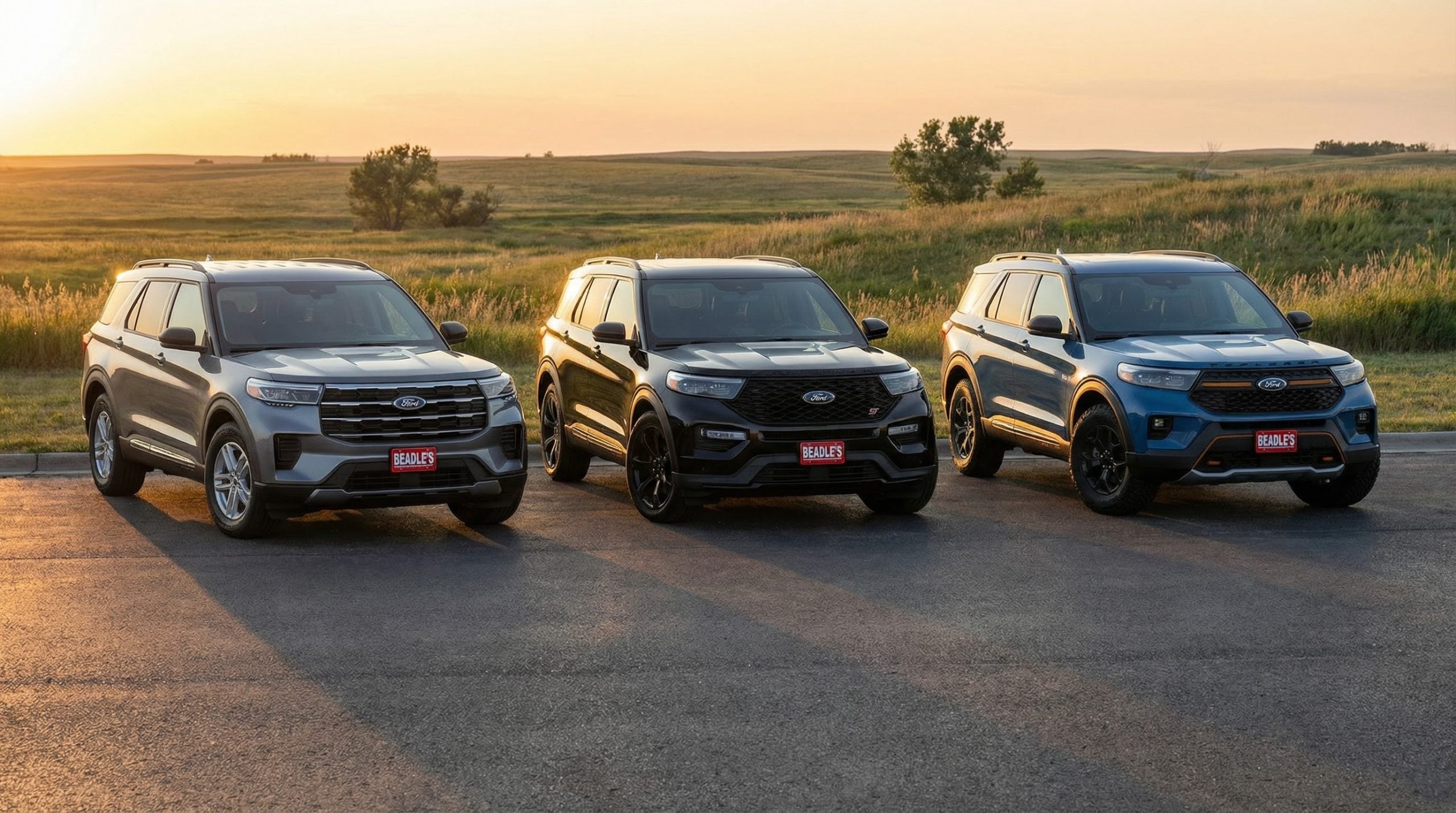
2026 Ford Explorer Trim Levels Guide
The 2026 Ford Explorer lineup includes five primary trims, each designed around a different driving priority: everyday family flexibility, sport-inspired styling, performance acceleration, premium comfort, or off-road confidence. This guide explains how Active, ST-Line, ST, Platinum, and Tremor differ — and how equipment groups within each trim affect seating, technology availability, and capability. Before narrowing trims, it helps to understand how the full 2026 lineup is structured. That broader context is outlined in our 2026 Ford Explorer overview. Shop Explorers in Stock Table of Contents What trims are available? How do the trims compare side by side? What is the Explorer Active? What is the Explorer ST-Line? What is the Explorer ST? What is the Explorer Tremor? What is the Explorer Platinum? ST vs Tremor: Which is better? Best trim for families? How to choose the right trim What trims are available on the 2026 Ford Explorer? The 2026 Explorer is available in: Active (100A and 200A equipment groups) ST-Line ST Platinum Tremor Equipment groups within each trim can alter seating configuration, technology availability, and certain features. Availability can vary by configuration. How do the 2026 Explorer trims compare? Trim Primary Focus Engine Type Personality Active Family practicality 2.3L EcoBoost Balanced, everyday flexibility ST-Line Sport styling 2.3L EcoBoost Athletic appearance without full performance tuning ST Performance 3.0L EcoBoost Stronger acceleration, sport-tuned feel Platinum Premium comfort Varies by configuration Upscale interior and technology focus Tremor Off-road confidence 2.3L standard, 3.0L available Adventure-oriented capability What is the 2026 Explorer Active? Explorer Active is built around everyday family use. It prioritizes flexible seating, practical technology, and a balanced driving experience. It is often the trim families choose when upgrading from a smaller SUV because it delivers three-row seating without emphasizing performance or luxury over usability. What is the 2026 Explorer ST-Line? ST-Line emphasizes sporty design elements while maintaining the standard 2.3L EcoBoost powertrain. It is for buyers who prefer an athletic appearance but do not require the full performance tuning of the ST model. What is the 2026 Explorer ST? Explorer ST is performance-focused. It features the 3.0L EcoBoost engine and sport-tuned characteristics designed for stronger acceleration and a more responsive driving feel. Seating configurations may vary by equipment group. For families balancing performance and practicality, ST can provide both — depending on layout selection. Performance differences are explored more deeply in our Explorer ST Performance Guide. What is the 2026 Explorer Tremor? Explorer Tremor is designed for drivers who travel gravel roads, uneven terrain, and outdoor destinations more frequently. It adds a distinct visual identity and adventure-oriented configuration. Engine availability depends on equipment selection. Tremor can be configured differently than standard trims. What is the 2026 Explorer Platinum? Explorer Platinum focuses on interior refinement, advanced technology availability, and upscale finishes. It appeals to drivers who prioritize comfort and premium design elements. ST vs Tremor: Which is better? ST is better for performance-focused drivers who value acceleration and sport handling. Tremor is better for drivers who prioritize confidence beyond pavement and travel versatility. The decision depends on driving environment more than horsepower alone. Which Explorer trim is best for families? Active and ST-Line are commonly selected by families because they balance space, usability, and technology without shifting into full performance or premium positioning. Interior layout differences are explained further in our Interior & Cargo Guide. How do you choose the right 2026 Explorer trim? Identify your primary use (family commuting, towing, performance, adventure). Confirm seating configuration needs. Review engine preferences. Compare technology availability. View inventory within that trim. Key Takeaways Active focuses on family practicality. ST-Line adds sport-inspired styling. ST prioritizes performance. Tremor emphasizes adventure capability. Platinum delivers premium comfort. Frequently Asked Questions Does Explorer ST always have captain’s chairs? Seating configuration availability can vary by equipment group and configuration. Is Tremor more powerful than ST? ST is performance-oriented, while Tremor is capability-oriented. Engine availability varies by configuration. Which trim includes BlueCruise? Driver-assist technology availability varies by trim and equipment group selection. Conclusion In my experience, the right Explorer trim becomes clear once buyers identify whether their daily driving leans more toward family logistics, performance enjoyment, or outdoor travel. When you match the trim to how you actually use your SUV, the 2026 Explorer lineup makes a lot more sense. About the Author Lexy Tabbert provides research-driven SUV configuration guidance for drivers throughout South Dakota and beyond.