
Blog / New Vehicles

Blog

All New Vehicles Bowdle Ford Dealer Bowdle Ford Service
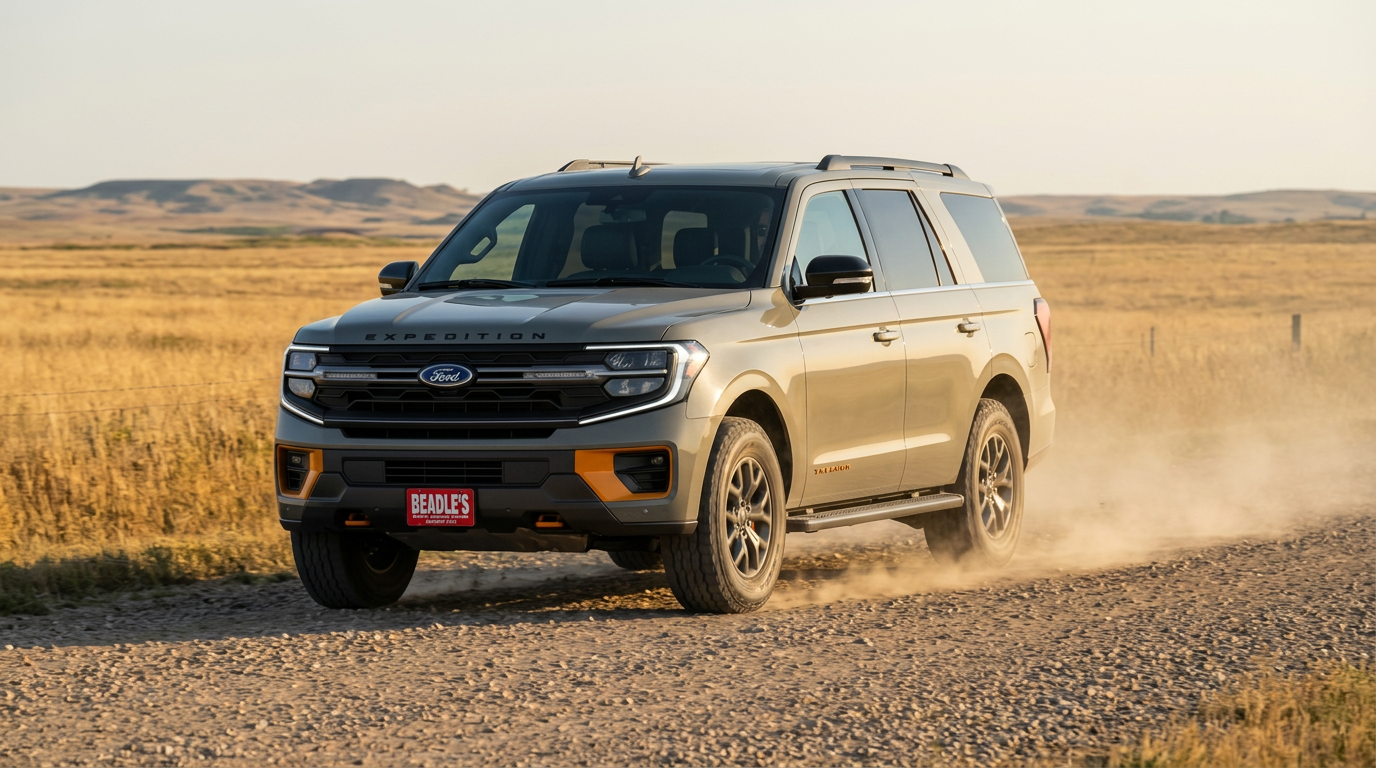
2027 Ford Expedition Tremor in Marsh Gray on a South Dakota gravel section road near Bowdle

The 2027 Ford Expedition Tremor: More Than a Platinum With Off-Road Stickers

Home› Ford Expedition› 2027 Ford Expedition› Expedition Tremor The 2027 Ford Expedition Tremor is the Expedition’s factory off-road trim — a 4x4-only, 440-horsepower, electronic-locking-differential configuration that sits between the Platinum and an aftermarket project. It’s the first factory off-road Expedition, and it continues in the 2027 lineup unchanged from its 2025 launch. If you’ve been hearing about the Tremor but weren’t sure whether it’s a legitimate capability trim or a Platinum with stickers and steel-look wheels, this guide answers it honestly. We’ll walk through what the Tremor actually is mechanically, what the 440 hp and 510 lb-ft High Output EcoBoost really gets you, how it handles gravel and section-line roads in the kind of terrain we drive around Bowdle, why Ford only offers the Tremor in 4x4 and not in Expedition MAX, whether it’s worth the jump over a Platinum for a rural South Dakota buyer, and what you give up to get it. If you’re cross-shopping the Tremor against anything from a Wagoneer to a Tahoe Z71, the trade-offs section at the end matters as much as the specs at the top. Get Pre-Approved Browse Expedition Inventory On This Page What is the Expedition Tremor, really? What does 440 hp and 510 lb-ft actually get you? How does the Tremor handle gravel and off-pavement? Why is the Tremor 4x4 only and not offered in MAX? Is the Tremor worth it over a Platinum for rural South Dakota? What do you give up by choosing the Tremor? What is the Expedition Tremor, really? The Expedition Tremor is the factory off-road trim of the sixth-generation Expedition — a standalone retail trim, not a package. It’s not a Platinum with different wheels or a skid-plate cosmetic; it’s a different mechanical specification of the Expedition with its own engine, suspension, tires, differential, and drive-mode software. What that mechanical difference includes: a 3.5L EcoBoost V6 High Output engine, a 3.73 Electronic Locking Rear Differential, a modified higher-ride suspension with premium passive shocks, modified Raptor-style front and transmission skid plates, an underbody fuel tank shield, P275/70R18 all-terrain tires on unique 18" Dark Carbonized Gray wheels, a unique off-road grille with Carbonized Gray bars and signature lighting, amber Active front tow hooks, a platform running board with angular step bars, a standard off-road underbody shield, and a drive-mode system that adds Rock Crawl on top of the standard six modes. None of that equipment is optional on another Expedition trim — it’s Tremor-specific. The Platinum trim, by contrast, is the Expedition’s luxury spec — 22" Ebony Bright Machined wheels, painted body-color bumpers, a chrome-trimmed grille, and an interior that leans plush over purposeful. You can order a Platinum with the Stealth Performance Package (19B) or the Platinum Ultimate Package (17A) and get the same 440 hp / 510 lb-ft High Output V6 as the Tremor, but you won’t get the Tremor’s locking differential, its Rock Crawl drive mode, its all-terrain tire setup, or its off-road-specific skid plates. Those are structural choices the Tremor trim makes that a Platinum cannot match. If you’re comparing the Tremor to the rest of the lineup, the complete 2027 Ford Expedition overview has the side-by-side trim framing. What does 440 hp and 510 lb-ft actually get you? The Tremor runs the 3.5L EcoBoost V6 High Output — a twin-turbocharged V6 that produces 440 horsepower and 510 lb-ft of torque, confirmed in the 2027 Ford Expedition Order Guide. It’s mated to a 10-speed automatic transmission with SelectShift capability and Ford’s intelligent 4WD system with Torque on Demand and a two-speed transfer case. Practically, the 440 hp and 510 lb-ft figures matter in two scenarios. First, towing — the Tremor’s Heavy-Duty Trailer Tow Package is standard, and current-generation Tremor reporting cites a max tow capacity of approximately 9,600 lbs when properly equipped. Ford will confirm the official 2027 figure when the 2027 Ford Towing Guide is released. That’s enough tow for most livestock trailers, most flat-deck trailers in the 24- to 30-foot range, a two-place enclosed snowmobile trailer, and any boat that fits on a single-axle or tandem trailer for Lake Oahe. Second, altitude and load — turbocharged engines don’t lose power at elevation the way naturally aspirated engines do, which matters if you tow to the Black Hills or into Wyoming from Bowdle. The High Output engine gives you usable torque across the whole tach range, not just at the top. The engine also includes a High Flow Exhaust System and an Engine Sound Enhancer with Active Noise Cancellation — which means the cabin stays conversational at highway speed while the exhaust has more presence when you’re on the throttle. It’s a deliberate calibration choice, not a defect. How does the Tremor handle gravel and off-pavement? Better than any Expedition before it. The Tremor’s modified higher-ride suspension, P275/70R18 all-terrain tires, 3.73 Electronic Locking Rear Differential, and seven drive modes (Normal, Sport, Tow/Haul, Eco, Slippery, Off-Road, and Rock Crawl) are all aimed at the same use case: rural, unpaved, variable-grip driving. Independent reviews of the current-generation Tremor from outlets like Gear Patrol and JD Power cite approximately 10.6 inches of ground clearance; the 2027 figure should be verified against final Ford documentation but the hardware is unchanged. The practical difference on gravel is twofold. The suspension and tires together let the Tremor absorb washboard gravel at reasonable speed without the harshness of a Platinum on 22" low-profile tires — which matters if your weekly commute involves 10 or 15 miles of county gravel before you hit US-12 or US-83. And Trail Control — which includes Trail One Pedal Drive for steep grade management and Trail Turn Assist for tight-radius maneuvering — plus the off-road underbody shield and modified Raptor skid plates, let you drive into places a Platinum shouldn’t go. Pasture two-tracks after a wet week, unmaintained CRP access roads, Lake Oahe shoreline when the grade gets soft — that’s the terrain the Tremor was engineered for. Standard on the Tremor: off-road auxiliary grille lights, amber Active front tow hooks, front and rear parking sensors, a 360-degree camera with off-road overlays and a Rock Crawl view, and the BLIS trailer coverage that extends blind-spot monitoring around whatever you’re pulling. None of it is optional. None of it is a bundled package. It’s baseline Tremor equipment. Why is the Tremor 4x4 only and not offered in MAX? Both answers come back to the same idea: Ford engineered the Tremor for a specific use case, and they didn’t water it down for configurations that compromise that use case. A 4x2 Tremor would be contradictory — the whole point of the trim is off-pavement capability, and you can’t get that without four-wheel drive. So there’s only one Tremor configuration: 4x4, with the two-speed transfer case, Torque on Demand, and the 3.73 Electronic Locking Rear Differential standard. The no-MAX decision is more about geometry. The Expedition MAX adds roughly a foot of wheelbase and overall length. That length, in an off-road context, hurts the rear departure angle, increases the risk of high-centering over ruts and crests, and makes tight-radius off-road maneuvering (which Trail Turn Assist is designed to help with) meaningfully harder. Ford chose not to offer a compromised off-road Expedition — if you want MAX length, the Expedition MAX is available in XL, Active, Platinum, and King Ranch for 2027. That does create a buyer decision: if your use case is hauling three kids, dog crates, and a week of gear between Bowdle and Fargo, the Tremor’s standard length may feel short behind the third row. In that case the 2027 Expedition MAX Platinum (now offered in 4x2 as well as 4x4) is probably the better fit. The Expedition vs. Expedition MAX comparison walks through that decision in detail. Thinking about a Tremor? See what is on the lot, or ask us about a custom order before you commit. Shop 2027 Expeditions in Stock Ask About a Custom Order Is the Tremor worth it over a Platinum for rural South Dakota? For a lot of buyers in our service area — Bowdle, Selby, Ipswich, Eureka, and out across north-central South Dakota to the Missouri River — yes, but only if your actual weekly driving includes unpaved terrain. If your driving is 90% paved highway, a Platinum does the exact same job with a more refined ride on the 22" wheels and a plusher interior. If your driving is 60% paved and 40% county gravel, pasture, or shoreline access, the Tremor earns its spot. Pick the Tremor if: you run gravel daily and want a suspension and tire setup built for it; you want a locking rear differential for mud, snow, or steep approach angles; you want Rock Crawl mode for lake access or trailer launches on unimproved ramps; you want Amber Active tow hooks rated for recovery, not decoration; or you want the standard 22-speaker B&O Play Unleashed audio and the Power Panoramic Vista Roof without stepping up to a Platinum Ultimate. Pick a Platinum instead if: you live on pavement, you prefer the 22" Ebony Bright Machined wheel look over the 18" Dark Carbonized Gray Tremor wheel, you want the 30th Anniversary Appearance Package (which is Platinum-only and not compatible with the Tremor), or you’re leaning toward the Platinum Ultimate’s combination of High Output engine, Driver’s Package, and standard BlueCruise 1-Year + 90-Day plan. For a broader framing of the whole lineup — Active, Tremor, Platinum with its four packages, and King Ranch — the 2027 Ford Expedition trim levels guide walks through who each trim is really built for. What do you give up by choosing the Tremor? Three real trade-offs. The first is fuel economy. EPA ratings for the 2027 Expedition are listed on each in-stock unit’s window sticker, but as a rule the Tremor — with all-terrain tires, the modified suspension, and the High Output V6 — uses more fuel than a standard Expedition with the base 3.5L EcoBoost V6 and highway-biased tires. If most of your miles are interstate commuting, the Tremor will cost you at the pump versus an Active Touring or a Platinum 4x2. The second is the no-MAX constraint covered above. The Tremor’s third-row and cargo-behind-third-row space is the standard-length Expedition’s space. If you’re hauling big family gear regularly, that may not be enough. The third is price. Pricing is on the window sticker of each in-stock unit; the Tremor lands in the mid-$80,000s, which places it above a standard Expedition Platinum and roughly in range with a Platinum Stealth Performance. What you’re paying for is the Tremor-unique mechanical content, not cosmetic upgrades. That’s a different value proposition than most trim walks. Parking and daily usability are not really trade-offs. The Tremor is the same overall length as a standard Expedition — you’re not navigating a longer truck. The 18" wheels with taller all-terrain sidewalls actually handle curbs and potholes more forgivingly than 22" low-profile wheels do. If daily-driver livability is a concern, the Tremor is not the trim that compromises it — MAX is. Key Takeaways The Tremor is a standalone factory off-road trim — not a Platinum package. It carries over from its 2025 launch. 3.5L EcoBoost V6 High Output at 440 hp / 510 lb-ft, 10-speed automatic, 3.73 Electronic Locking Rear Differential standard. Seven drive modes including Rock Crawl, Trail Control with One Pedal Drive and Trail Turn Assist, P275/70R18 all-terrain tires. 4x4 only. No 4x2. No Expedition Tremor MAX — Ford didn’t compromise off-road geometry for extended length. Worth it over a Platinum if unpaved terrain is part of your weekly driving; Platinum is the better pick if you’re primarily on pavement. Frequently Asked Questions Is the Expedition Tremor new for 2027? No. The Expedition Tremor launched with the sixth-generation Expedition for the 2025 model year and continues in the 2027 lineup. It’s not marked as a new trim in the 2027 Order Guide. How much horsepower does the 2027 Ford Expedition Tremor have? The Tremor runs the 3.5L EcoBoost V6 High Output at 440 horsepower and 510 lb-ft of torque, confirmed by the 2027 Ford Expedition Order Guide. It’s paired with a 10-speed automatic transmission and a two-speed transfer case. Can you get an Expedition Tremor MAX? No — the Expedition Tremor is only offered in the standard (non-MAX) body style and only in 4x4 configuration. The MAX body style is available on XL, Active, Platinum, and King Ranch for 2027. How much can the 2027 Expedition Tremor tow? Official 2027 tow ratings will be confirmed when Ford releases the 2027 Ford Towing Guide. Public reporting on the current-generation Tremor cites a maximum tow rating of approximately 9,600 lbs when properly equipped. Contact Beadle Ford to confirm the exact figure against your trailer and payload. Does the Tremor have a locking differential? Yes — a 3.73 Electronic Locking Rear Differential is standard on the Tremor. It’s paired with the Heavy-Duty Trailer Tow Package and Ford’s intelligent 4WD with Torque on Demand and a two-speed transfer case. What tires does the Tremor come with? P275/70R18 all-terrain BSW tires on unique 18" × 8.5" Dark Carbonized Gray Painted Aluminum wheels with Electric Spice Pocket accents. The all-terrain tire and taller sidewall (versus 22" low-profile wheels on Platinum and King Ranch) is one of the Tremor’s defining equipment differences. How is the Tremor different from a Platinum with off-road packages? A Platinum can be ordered with the Stealth Performance Package (19B) or Platinum Ultimate Package (17A), which get the same 440 hp / 510 lb-ft High Output V6 as the Tremor. But only the Tremor has the 3.73 Electronic Locking Rear Differential, Rock Crawl drive mode, modified Raptor-style skid plates, all-terrain tires, unique off-road grille, and amber Active tow hooks. Those are trim-specific, not package options. My Take on the 2027 Ford Expedition Tremor I talk to a lot of Expedition buyers in north-central South Dakota, and the Tremor is the trim I’m happiest to explain honestly. For the ranch-and-hunt buyers who actually use the capability — gravel-road commutes, stock-trailer towing, pasture access, boat launches that go below the waterline at Lake Oahe — the Tremor earns every dollar. For the buyer who wants it because it looks rugged but drives exclusively on US-12 and US-83, a Platinum is honestly the better truck, and the Platinum Ultimate gets you the same engine and BlueCruise at a different emphasis. If you’re trying to decide, let’s talk through your actual week — where you drive, what you tow, and what you need from the third row. I’ll point you at the right trim for you, even if it isn’t the one you walked in thinking about. Shop 2027 Expeditions in Stock Contact Beadle Ford About the Author Lexy Tabbert — Beadle Ford, Bowdle, SD Lexy Tabbert is the Director of Sales and Marketing at Beadle Ford in Bowdle, South Dakota. She covers Ford vehicles, trim comparisons, and buyer guidance — helping families, ranchers, and ag operators across the region find the right truck and configuration for their needs. Learn more about Lexy.
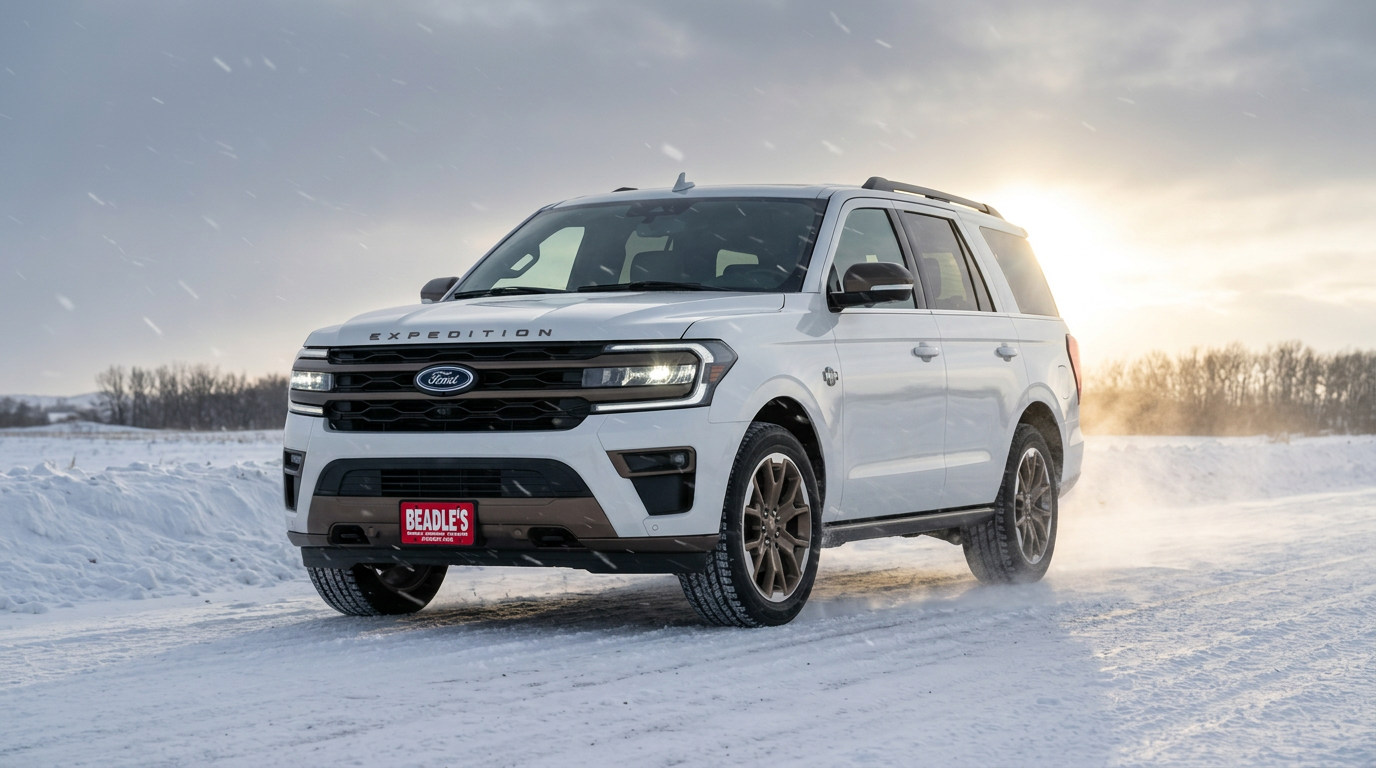
2027 Ford Expedition in Star White Metallic on a snowy South Dakota highway near Bowdle

2027 Ford Expedition vs. 2026 Toyota Sequoia: EcoBoost V6 vs. i-FORCE MAX Hybrid — and the Service Question Most Reviews Skip

Home› Ford Expedition› 2027 Ford Expedition› Expedition vs. Toyota Sequoia If you’re cross-shopping a 2027 Ford Expedition against a 2026 Toyota Sequoia, you’re choosing between two very different takes on the full-size three-row SUV. Ford brings a 3.5L EcoBoost V6 — with a 440 hp / 510 lb-ft High Output variant available — paired with BlueCruise hands-free highway driving. Toyota counters with a single powertrain: the i-FORCE MAX hybrid, a 3.5L twin-turbo V6 paired with an electric motor producing a combined 437 hp and 583 lb-ft of torque. Both are legitimate; they’re just optimized differently. This guide covers the decisions that actually matter for a Dakota buyer: how each powertrain behaves in real winter conditions, cargo and third-row usability, towing in cold weather with a hybrid (a real consideration north of I-90), the hands-free driving comparison, and dealer network accessibility — an honest look at what happens when your Sequoia needs service and your closest Toyota dealer is 60-plus miles away. Browse Expedition Inventory Ask About a Custom Order On This Page EcoBoost V6 vs. i-FORCE MAX hybrid — which works better in Dakota winters? Which SUV gives you more usable space? Can the Sequoia’s hybrid handle heavy trailers in cold weather? BlueCruise vs. Toyota Safety Sense — which hands-free system wins? Dealer network, resale, and cost of ownership — does Toyota reliability win here? EcoBoost V6 vs. i-FORCE MAX hybrid — which works better in Dakota winters? Both trucks use twin-turbocharged V6 engines; the difference is what Toyota adds on top. The 2027 Ford Expedition runs the 3.5L EcoBoost V6 as the standard engine with a 3.5L EcoBoost V6 High Output at 440 hp / 510 lb-ft optional on Tremor, Platinum Stealth Performance, and Platinum Ultimate. Toyota’s 2026 Sequoia offers one powertrain only — the i-FORCE MAX hybrid, pairing a 3.5L twin-turbo V6 with an electric motor and a nickel-metal hydride battery pack for a combined 437 hp and 583 lb-ft of torque. Both use 10-speed automatic transmissions. For hot climates and stop-and-go driving, hybrids shine. For our climate, the calculus shifts. Nickel-metal hydride batteries — the chemistry Toyota uses in the Sequoia’s hybrid system — perform meaningfully worse in sustained cold. At -10°F or colder (which we see several weeks a winter), a hybrid’s regenerative braking is less effective, battery efficiency drops, and the electric motor contributes less. You’re running on the gas engine more and the hybrid advantage narrows. The EcoBoost V6, by contrast, behaves consistently regardless of temperature — it’s the same engine at 80°F as it is at -20°F. The practical takeaway: if most of your driving is interstate cruising in reasonable weather, the Sequoia’s hybrid gets stronger fuel economy, especially at lower speeds. If you drive through a Dakota winter every year, the EcoBoost V6’s consistency matters. And if you want the 440 hp High Output engine and the factory off-road Tremor trim, those simply aren’t options Toyota offers. The full 2027 Expedition trim and engine breakdown is in the complete 2027 Ford Expedition overview. Which SUV gives you more usable space? The Expedition wins most of the practical space comparisons, and independent reviews from Edmunds and others have consistently called this out. The Ford’s third row is genuinely adult-usable, with leg and headroom that supports taller passengers on longer trips — Bowdle to Fargo with three kids across the back row works without complaints. The Sequoia’s third row is narrower and has less legroom; it’s better described as kid-friendly rather than adult-friendly. Cargo behind the third row is where the Sequoia has a specific geometry quirk. Because of how Toyota packaged the hybrid battery pack, the Sequoia’s load floor is higher and the third-row seatbacks don’t fold flat — you end up with a raised, uneven surface when the third row is folded down. The Expedition’s third row folds flat and the cargo floor is at a consistent height, which matters when you’re loading a generator, a cooler, or long gear. Inside, the Expedition brings the 24" panoramic driver display and 13.2" center display as the Ford Digital Experience standard from Active (200A) and up, with Google Maps, Google Assistant, and Google Play Store embedded natively plus wireless Apple CarPlay and Android Auto. The Sequoia runs Toyota’s 14" multimedia touchscreen with wireless CarPlay/Android Auto on most trims — a capable system, but the visual experience is different. If you need the MAX-length body style for even more cargo and third-row space, the Expedition MAX is available on Active, Platinum, and King Ranch (the Tremor is standard-length only). The Expedition vs. Expedition MAX guide walks through that body-style decision. Toyota does not offer an extended-length Sequoia. Can the Sequoia’s hybrid handle heavy trailers in cold weather? On paper, the Sequoia tows well. Toyota publishes a maximum trailer rating of approximately 9,520 lbs when properly equipped — functionally in the same ballpark as the Expedition Tremor’s reported 9,600 lbs. For a standard gooseneck loaded with livestock or a 24-foot enclosed trailer with a side-by-side, either truck handles it. The question isn’t peak capacity; it’s how each truck delivers that capability in adverse conditions. Cold-weather towing is a real consideration with a hybrid. Hybrid batteries lose efficiency in sustained cold, and when you’re towing heavy — 7,000 or 8,000 lbs behind you — the electric motor is contributing less of the torque and the gas engine is working harder. On long cold-weather hauls, Sequoia owners have reported lower-than-advertised fuel economy and more frequent engine loading. A turbocharged V6 like the EcoBoost maintains consistent power delivery regardless of temperature, which is why long-range towing consistency is one place the Expedition has an advantage. Pro Trailer Hitch Assist and Pro Trailer Backup Assist are standard on every retail Expedition trim via Ford Co-Pilot360 Assist 2.0. The 360-degree camera includes a trailer view specifically designed for hitching and navigating narrow hauling situations. BLIS with Trailer Coverage extends the blind-spot monitoring around the length of whatever you’re pulling. Toyota offers comparable features on upper Sequoia trims, but they’re more package-dependent on the Toyota side than on the Ford side. Official 2027 Expedition tow ratings will be confirmed when Ford releases the 2027 Towing Guide. If you’re sizing an Expedition to a specific trailer, contact Beadle Ford and we’ll run the configuration against your actual load. Ready to explore the Ford side? Get Pre-Approved Browse Current Expedition Inventory BlueCruise vs. Toyota Safety Sense — which hands-free system wins? Ford has the more mature hands-free highway driving system. BlueCruise works on approximately 97% of controlled-access U.S. and Canada highways with driver-facing camera monitoring, Lane Change Assist, and In-Lane Repositioning. Active Touring (202A) includes a 90-Day BlueCruise trial on retail orders; Platinum Ultimate (17A) and King Ranch (400A) come with a 1-Year + 90-Day plan standard. Toyota’s 2026 Sequoia comes standard with Toyota Safety Sense 3.0 — Dynamic Radar Cruise Control, Lane Departure Alert with Steering Assist, Pre-Collision System with Pedestrian Detection, Road Sign Assist, and Blind Spot Monitor. It’s comparable to Ford Co-Pilot360 Assist 2.0 for the core driver-assist tier. What Toyota doesn’t offer at the Sequoia price point is a direct BlueCruise competitor — true hands-free highway driving with driver monitoring across a mapped road network. Nissan offers ProPilot 2.0 on its Ariya and some other models; GM offers Super Cruise on Tahoe and Suburban. Toyota’s hands-free capability on the Sequoia is narrower in scope. If hands-free highway driving matters to you — especially on the long I-90 or US-281 hauls most Dakota drivers know well — BlueCruise is the clearer answer on this cross-shop. The BlueCruise vs. Super Cruise vs. ProPilot 2.0 guide walks through which system covers which roads and which buyer fits which system. Dealer network, resale, and cost of ownership — does Toyota reliability win here? Toyota’s reputation for reliability is real. It shows up in resale data, in long-term ownership studies, and in the fact that you’ll see 15-year-old Tundras and Sequoias still in daily service. But reliability is only part of the cost-of-ownership equation, and in rural South Dakota, the dealer network side of that equation often matters more. If you live in Bowdle or anywhere in north-central South Dakota and you buy a Sequoia, your closest Toyota dealer for service, warranty work, or hybrid-system diagnostics is roughly 60-plus miles away. That’s a real consideration. Recall work, a 30,000-mile service interval, a brake job, a hybrid inverter warning on the dashboard — every one of those becomes a day trip. If something goes wrong under warranty that requires multiple visits, it’s multiple day trips. Beadle Ford is in Bowdle. Service is local. The techs working on your Expedition know the truck because they’ve been working on Expeditions for years. Ford parts are nationally available. Neither is a “Toyota is worse” argument — both brands build reliable trucks. But when you factor in the accessibility of routine service, warranty work, and emergency repairs over a five or seven-year ownership period, the dealer network question meaningfully narrows Toyota’s reliability advantage. Hybrid-specific maintenance is worth naming too. The i-FORCE MAX system is well-engineered, but it adds components — battery pack, inverter, electric motor — that a naturally aspirated V8 or a turbo V6 like the EcoBoost doesn’t have. Long-term battery replacement at 10+ years is a real out-of-warranty cost to plan for on any hybrid. The Expedition’s EcoBoost V6 is a conventional powertrain with well-understood long-term service costs. Key Takeaways Ford offers two engines (standard 3.5L EcoBoost V6 and the 440 hp / 510 lb-ft High Output); Toyota offers one (i-FORCE MAX hybrid at 437 hp / 583 lb-ft combined). Hybrid powertrains lose efficiency in sustained cold. EcoBoost V6 performance is consistent regardless of temperature. Expedition’s third row and cargo behind the third row are more usable than the Sequoia’s, largely because of hybrid battery packaging. BlueCruise offers more mature hands-free highway coverage than Toyota Safety Sense 3.0 provides on the Sequoia. Service network matters in rural SD. Beadle Ford is in Bowdle; the nearest Toyota dealer is 60-plus miles away. No factory off-road Sequoia trim comparable to the Expedition Tremor; no Sequoia MAX-length option. Frequently Asked Questions How does the 2027 Ford Expedition compare to the 2026 Toyota Sequoia? Ford uses the 3.5L EcoBoost V6 (with a 440 hp / 510 lb-ft High Output variant) and offers BlueCruise hands-free driving, five trims including the off-road Tremor, and a MAX body style. Toyota offers one i-FORCE MAX hybrid powertrain at a combined 437 hp / 583 lb-ft, no off-road trim, and no extended-length Sequoia. Expedition wins on third-row space and cargo-floor flatness; Sequoia wins on hybrid fuel economy in non-winter conditions. Is the Toyota Sequoia’s hybrid better in the cold than the Ford EcoBoost V6? No. Hybrid batteries lose efficiency in sustained cold, and the Sequoia’s i-FORCE MAX relies on its electric motor for part of its power delivery. In a Dakota winter, you’re running on the gas engine more and the hybrid advantage narrows. The EcoBoost V6 behaves consistently regardless of temperature. Which has more third-row room, the Expedition or the Sequoia? The Expedition has meaningfully more usable third-row space for adult passengers, as reviewed by Edmunds and other independent outlets. The Sequoia’s third row is narrower with less legroom due to hybrid battery packaging, and the cargo floor behind the third row is raised and uneven when folded. How much can the Expedition tow vs. the Sequoia? The 2026 Toyota Sequoia publishes a maximum trailer rating of approximately 9,520 lbs when properly equipped. Public reporting on the current-generation Expedition Tremor cites approximately 9,600 lbs when properly equipped. Official 2027 Expedition tow ratings will be confirmed when Ford releases the 2027 Towing Guide. Both are in the same functional range for most real trailers. Does the Sequoia have a hands-free driving system like BlueCruise? Not directly. The 2026 Toyota Sequoia includes Toyota Safety Sense 3.0 as standard — Dynamic Radar Cruise Control, Lane Departure Alert with Steering Assist, Pre-Collision System, and Blind Spot Monitor — but it doesn’t offer true hands-free highway driving at the Expedition’s BlueCruise tier. Ford’s BlueCruise works on approximately 97% of controlled-access U.S. and Canada highways. Where’s the nearest Toyota dealer to Bowdle? The nearest Toyota dealership to Bowdle is roughly 60-plus miles away. Routine service, hybrid-system diagnostics, recalls, and warranty work require a round trip. Beadle Ford is in Bowdle — service for an Expedition is local and same-day possible for most issues. Does the Expedition have a direct competitor to the Sequoia’s hybrid powertrain? No. The 2027 Ford Expedition is offered only with the 3.5L EcoBoost V6 family — standard, or the 440 hp / 510 lb-ft High Output variant on Tremor, Platinum Stealth Performance, and Platinum Ultimate. There is no hybrid or electric Expedition variant. If a hybrid powertrain is a non-negotiable, the Sequoia is the direct pick in this class. My Take on the Expedition vs. Sequoia Cross-Shop The Sequoia is a well-built truck, and if you’re committed to a hybrid powertrain, it’s the cleanest answer in this class. I won’t pretend otherwise. But for the buyers we see at Beadle Ford — families commuting between Bowdle and Sioux Falls, ranchers hauling stock trailers through Dakota winters, or anyone who’s thinking about hands-free highway driving on their regular routes — the Expedition typically wins on the practical details. Third-row usability, cargo-floor flatness, BlueCruise coverage, and local service accessibility all stack in Ford’s favor for how most of our customers actually drive. The real test is a side-by-side drive with a cold-weather trailer in mind. If you’re serious about this decision, come drive an Expedition and we’ll talk through your specific use case against the Sequoia honestly. The right answer depends on your week, not on a spec sheet. Shop 2027 Expeditions in Stock Contact Beadle Ford About the Author Lexy Tabbert — Beadle Ford, Bowdle, SD Lexy Tabbert is the Director of Sales and Marketing at Beadle Ford in Bowdle, South Dakota. She covers Ford vehicles, trim comparisons, and buyer guidance — helping families, ranchers, and ag operators across the region find the right truck and configuration for their needs. Learn more about Lexy.
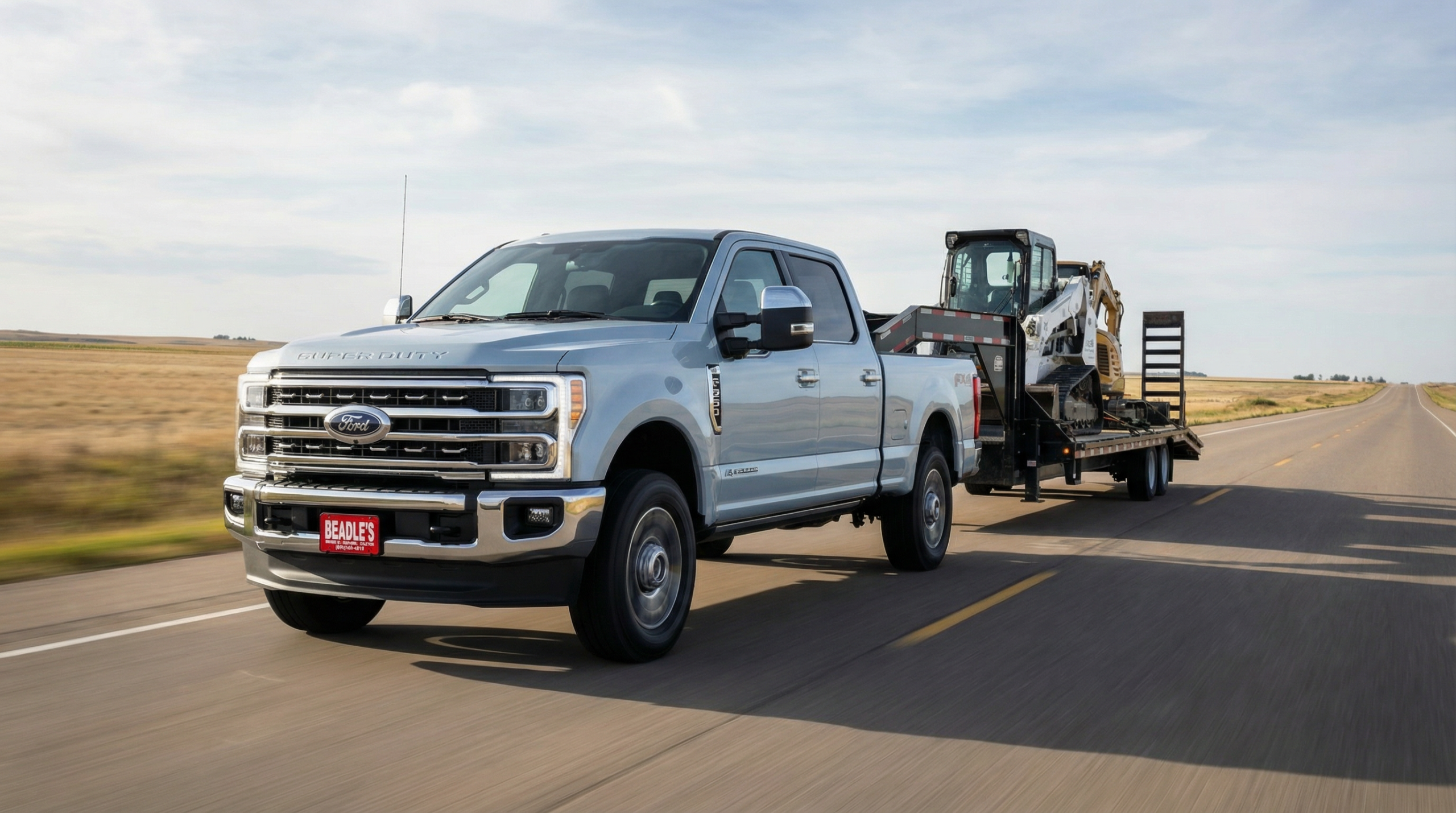
2026 Ford F-350 Super Duty towing on a rural South Dakota highway

2026 Ford F-350 Towing Guide

Quick Answer Properly equipped, the 2026 Ford F-350 Super Duty tows up to 40,000 lbs gooseneck with the 6.7L High-Output Power Stroke diesel and 40K Gooseneck Tow Package, up to about 35,000 lbs fifth-wheel, and up to 28,000 lbs conventional in dual-rear-wheel form. The 2026 Ford F-350 Super Duty is built for drivers who tow heavy on purpose — fifth-wheels, goosenecks, livestock, and equipment loads that don't leave much room for guesswork. If your towing days include long highway miles, wind, grades, or soft gravel lots, the right F-350 configuration feels noticeably more planted and in control. This guide focuses on the decisions that actually change towing confidence: the real numbers by hitch type and engine, the single-rear-wheel versus dual-rear-wheel choice, and the towing visibility features that matter once the trailer is hooked up. Because capability depends on how the truck is built, compare your options within the full lineup before you finalize a plan. Shop F-350s in Stock Get Pre-Approved On This Page What actually changes how much an F-350 can tow? How much can the 2026 F-350 tow by hitch type and engine? SRW vs. DRW: which one fits your trailer? Gooseneck vs. fifth-wheel vs. bumper pull: what's the difference? Which engine should you tow with? What towing tech is worth prioritizing? How do you choose an F-350 towing setup? What actually changes how much an F-350 can tow? Towing capacity isn't one number — on the F-350 it shifts with cab and bed choice, drivetrain, axle ratio, single- or dual-rear-wheel setup, hitch type, and packages. The headline 40,000-lb figure is a specific build, not every truck on the lot. The right way to shop is backward from your trailer: start with your real loaded weight and hitch type, then choose the configuration that gives you stability and margin instead of a close call. Around Bowdle and Aberdeen, that usually means matching the engine to how often you pull heavy and deciding honestly whether you need a dually — the two choices that move the numbers most. How much can the 2026 F-350 tow by hitch type and engine? Properly equipped, the 2026 F-350 tows up to 40,000 lbs gooseneck, up to about 35,000 lbs fifth-wheel, and up to 28,000 lbs on a conventional (bumper-pull) hitch in dual-rear-wheel form. A single-rear-wheel F-350 handles up to 25,000 lbs conventional — still well beyond any half-ton. Maximum gooseneck capability by engine breaks down like this: Engine Max Gooseneck Best For 6.8L gas V8 Up to 18,900 lbs Lighter goosenecks, occasional towing, top payload 7.3L gas V8 Up to 22,500 lbs Frequent gas towing without diesel upkeep 6.7L Power Stroke diesel Up to 38,600 lbs Regular heavy goosenecks, livestock, large fifth-wheels 6.7L High-Output Power Stroke Up to 40,000 lbs Maximum capability (DRW + 40K Gooseneck Tow Package) Maximums require proper equipment and vary with cab, bed, axle ratio, and configuration. The 40,000-lb gooseneck rating requires the dual-rear-wheel HO diesel with the 40K Gooseneck Tow Package (535). SRW vs. DRW: which one fits your trailer? Single-rear-wheel (SRW) is the better all-around choice for most heavy towing while staying easy to live with day to day; dual-rear-wheel (DRW, or dually) is for maximum stability and the heaviest goosenecks and fifth-wheels. This is the most important F-350 decision most buyers make. Single-rear-wheel (SRW) is right for you if you tow goosenecks and fifth-wheels well under the top of the range, run gravel and tight yards often, and want a truck that's easier to park and daily-drive. Dual-rear-wheel (DRW) is right for you if you regularly pull a large fifth-wheel or gooseneck near the F-350's ceiling, want the calmest feel in crosswinds and on long highway runs, or need the 40,000-lb maximum. From the Beadle Ford Lot The most common F-350 conversation we have in Bowdle is SRW vs. DRW — and plenty of buyers who assume they need a dually don't. A single-rear-wheel F-350 covers most goosenecks around here with margin to spare and is far easier to live with on gravel and in the yard. Gooseneck vs. fifth-wheel vs. bumper pull: what's the difference? The hitch type changes how the load behaves and how the truck should be equipped. Gooseneck and fifth-wheel hitches mount over the rear axle for a more stable, higher-capacity tow; a conventional bumper pull is simpler but tops out lower. Bumper pull (conventional): common for utility and many travel trailers; weight distribution and brake control matter more as loads climb. Up to 25,000 lbs SRW, 28,000 lbs DRW. Fifth-wheel: popular for larger RVs; the over-axle connection feels more stable on the highway. Up to about 35,000 lbs. Gooseneck: the livestock and equipment standard; controlled feel and tight maneuvering, and the highest ratings — up to 40,000 lbs. Which engine should you tow with? Match the engine to towing frequency and weight. Gas (6.8L or 7.3L) fits mixed driving and periodic towing; the 6.7L Power Stroke diesels are the choice when you tow heavy and often and want torque-forward control on long pulls. All four engines pair with the 10-speed TorqShift automatic. The standard diesel makes 1,050 lb-ft and pulls up to 38,600 lbs gooseneck; the High-Output diesel adds 150 lb-ft and unlocks the 40,000-lb maximum in DRW form. Our Recommendation For most ranch and farm buyers around Bowdle and Aberdeen running gooseneck stock and equipment trailers, we recommend the standard-output 6.7L Power Stroke. Its 1,050 lb-ft and up-to-38,600-lb gooseneck rating cover nearly every trailer in this part of South Dakota — the High-Output engine and a dually only pay off if you're routinely near the top of the range. The full breakdown is in our 2026 F-350 engine comparison guide. What towing tech is worth prioritizing? Prioritize the features you use every time you hook up: trailer brake control, camera visibility, trailer-aware monitoring, and proper tow mirrors. On a heavy gooseneck or a dually-and-long-trailer combo, visibility is a safety feature, not a convenience. Trailer brake control: increasingly important as trailer weight rises. Camera visibility: helps with hitch alignment, backing, and tight maneuvers. Trailer-aware monitoring: when equipped, eases lane changes and long highway runs. Tow mirrors and lighting: clear sightlines down a long trailer in a crosswind. How do you choose an F-350 towing setup? Work from the trailer to the truck, in five steps: Start with the trailer: type (bumper pull, fifth-wheel, gooseneck) and realistic loaded weight. Decide SRW vs. DRW: choose your stability margin based on how heavy and how often you tow. Pick an engine for your frequency: occasional gas vs. frequent heavy diesel pulling. Prioritize visibility and control: brake control, camera support, and tow mirrors. Confirm the exact build: ratings and equipment vary with configuration — verify before you order. Key Takeaways The 2026 F-350 tows up to 40,000 lbs gooseneck, ~35,000 lbs fifth-wheel, and up to 28,000 lbs conventional — properly equipped. SRW fits most heavy towing and daily use; DRW is the stability choice for the largest fifth-wheels and goosenecks. Hitch type changes both the rating and how the truck should be equipped. The standard 6.7L Power Stroke (38,600 lbs gooseneck) covers nearly every trailer in this region. Towing visibility tech can matter as much as horsepower in real conditions. Frequently Asked Questions How much can the 2026 Ford F-350 tow? Properly equipped, up to 40,000 lbs gooseneck with the 6.7L High-Output Power Stroke diesel in dual-rear-wheel form with the 40K Gooseneck Tow Package, up to about 35,000 lbs fifth-wheel, and up to 28,000 lbs conventional on the DRW. A single-rear-wheel F-350 tows up to 25,000 lbs conventional. Exact ratings depend on cab, bed, axle ratio, and configuration. When should I choose an F-350 instead of an F-250 for towing? Step up to an F-350 when you want more stability margin for heavy trailers, tow more frequently, or need a configuration built for large fifth-wheel or gooseneck use. The F-350's 40,000-lb gooseneck maximum is nearly double the F-250's 23,000 lbs, so if your loaded trailer is anywhere near an F-250's ceiling, the F-350 gives you headroom instead of a truck at its limit. Is DRW worth it for fifth-wheel or gooseneck towing? DRW is worth it for maximum stability and the heaviest loads — large fifth-wheels and goosenecks near the top of the range — and it's required for the 40,000-lb maximum. SRW still handles most trailers in this region with margin, so the dually pays off mainly when you're routinely running heavy or want the calmest feel in crosswinds. What is the 40K Gooseneck Tow Package? It's the factory option group (order code 535) required to reach the F-350's 40,000-lb gooseneck maximum, available with the 6.7L High-Output Power Stroke diesel in dual-rear-wheel form. Without it, gooseneck ratings are lower. We confirm the exact package and axle combination on any truck before you order. Does an F-350 ride differently when it's unloaded? Yes — a heavy-duty truck is designed around carrying and towing, so the unloaded ride is firmer, and a dually is firmer still than a single-rear-wheel. Many buyers accept that trade for a more controlled, planted feel once the trailer is connected. Quick Answers: F-350 Towing One-line answers to the follow-up questions buyers ask next. What's the max gooseneck rating? Up to 40,000 lbs with the HO diesel DRW and 40K Gooseneck Tow Package. What's the max fifth-wheel rating? Up to about 35,000 lbs, properly equipped. What's the max conventional rating? Up to 28,000 lbs DRW, 25,000 lbs SRW. How much can the gas 7.3L tow? Up to 22,500 lbs gooseneck. How much can the standard diesel tow? Up to 38,600 lbs gooseneck. Do I need a dually to tow heavy? No — SRW covers most trailers here; DRW is for the heaviest loads. What transmission handles the towing? A 10-speed TorqShift automatic, standard on all engines. Is a trailer brake controller included? Yes — an integrated trailer brake controller is available and recommended for heavy trailers. Can it tow a large livestock gooseneck? Yes — that's a core use case for the F-350 in our market. How do I confirm a specific truck's rating? We verify cab, axle, and package against the build before you order. Keep Researching The complete 2026 Ford F-350 Super Duty overview — trims, specs, towing, and inventory in one place. 2026 F-350 engine comparison — gas vs. diesel and the ownership-cost math behind the tow ratings. 2026 F-350 packages & trims — where DRW becomes available and which towing packages to order. 2026 F-350 technology — the trailer cameras and driver-assist features that matter when towing. My Take on Towing with the 2026 Ford F-350 In my experience, the best towing setups are the ones built with margin — where the truck feels composed, the trailer feels predictable, and you're not constantly managing the load. The F-350 shines when buyers choose SRW vs. DRW intentionally, match the hitch to the job, and pick the engine for how they actually tow rather than for the biggest number on the window sticker. If you bring me your trailer type and a realistic loaded weight, we can size the right F-350 in a few minutes. Stop in at Beadle Ford in Bowdle or reach out and we'll walk through it together. Shop F-350s in Stock Get Pre-Approved About the Author Lexy Tabbert — Beadle Ford, Bowdle, SD Lexy Tabbert is the Director of Sales and Marketing at Beadle Ford in Bowdle, South Dakota. She covers Ford vehicles, trim comparisons, and buyer guidance — helping families, ranchers, and ag operators across the region find the right truck and configuration for their needs. Learn more about Lexy.
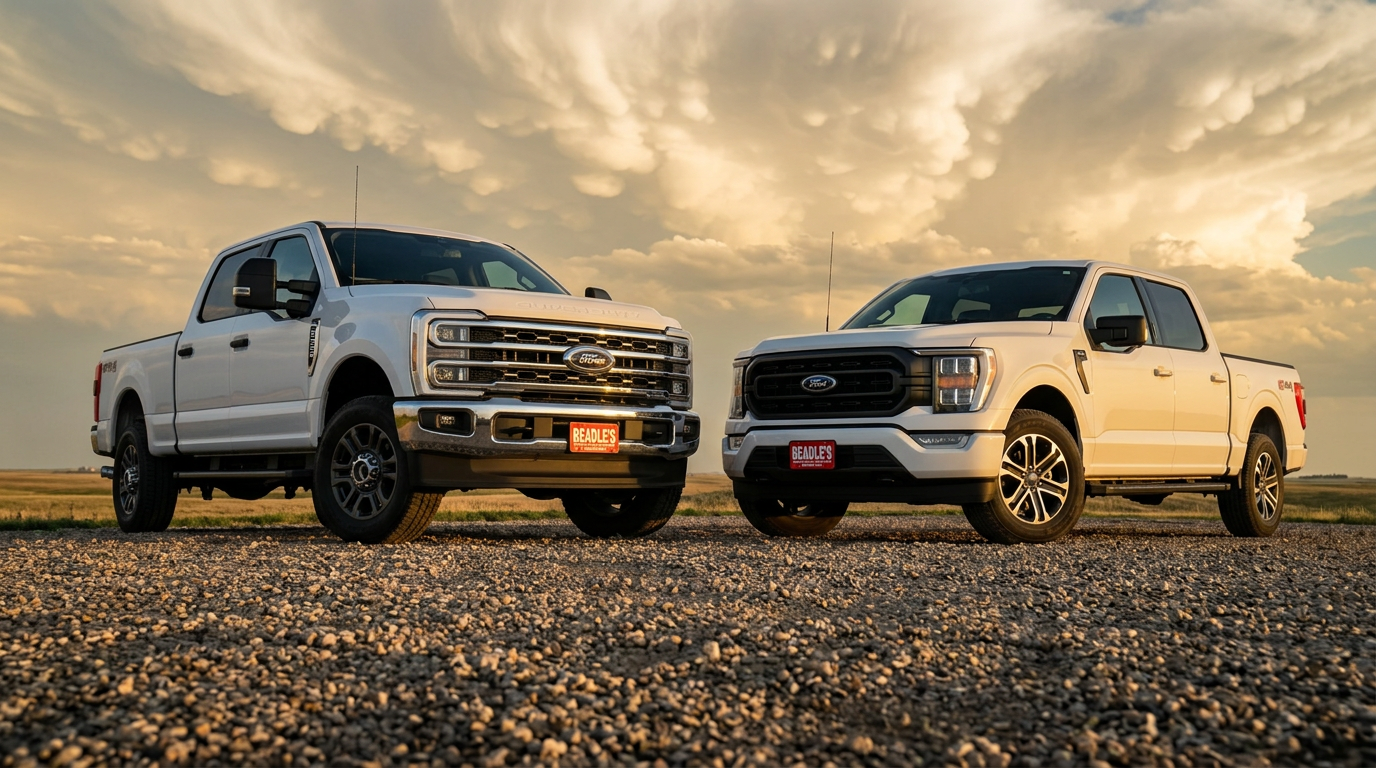
2027 Ford F-250 beside a Ford F-150 in South Dakota

2027 Ford F-150 vs. F-250: Do You Need a Super Duty?

Quick Answer Choose the 2027 Ford F-150 for light, occasional towing and the best daily ride and fuel economy. Step up to the F-250 Super Duty when you tow a fifth-wheel or gooseneck, haul heavy regularly, or want capability well beyond the F-150's roughly 13,500-lb maximum. The 2027 Ford F-150 and F-250 look like cousins, but they're built for different jobs. The F-150 is a half-ton tuned for everyday driving and lighter loads; the F-250 Super Duty is a three-quarter-ton built to tow and haul heavy. The real question isn't which is "better" — it's whether you actually need Super Duty capability. This guide compares the two on towing and payload, ride and fuel, and daily livability, then helps you match the truck to how often and how heavy you tow around central South Dakota. Shop F-250s in Stock Reserve a 2027 F-250 Get Pre-Approved On This Page How do the 2027 F-150 and F-250 differ? Towing and payload: where's the real gap? Ride, fuel, and daily livability compared Which truck fits your towing frequency? How do the 2027 F-150 and F-250 differ? The F-150 is a half-ton; the F-250 is a three-quarter-ton Super Duty. That means heavier frames and axles, beefier brakes and suspension, and a fifth-wheel/gooseneck-ready bed on the F-250 — built for towing and hauling at weights a half-ton isn't rated for. The F-150 counters with a lighter, more refined platform: a smoother unloaded ride, better fuel economy, more engine and trim variety, and easier maneuvering. Think of the F-150 as the do-everything daily truck and the F-250 as the dedicated tow-and-haul truck that's still comfortable to live with. Towing and payload: where's the real gap? On conventional towing, the F-150 tops out around 13,500 lbs, while the 2027 F-250 reaches up to 18,200 lbs with the gas V8 and up to 22,000 lbs with the High-Output diesel. The bigger difference is fifth-wheel and gooseneck capability: the F-250 adds up to 23,000 lbs gooseneck, a job the F-150 isn't built for. Payload tells the same story — the F-250 carries up to about 3,700 lbs versus the F-150's lighter-duty rating. If you're hauling a fifth-wheel camper, a loaded gooseneck, or heavy material in the bed, that's Super Duty territory. If your trailer is a boat, a small utility trailer, or a bumper-pull under the F-150's limit, the half-ton has it covered. Capability (properly equipped) 2027 F-150 2027 F-250 Max conventional towing Around 13,500 lbs Up to 22,000 lbs Fifth-wheel / gooseneck Not its strength Up to 23,000 lbs gooseneck Class Half-ton Three-quarter-ton (Super Duty) Best at Daily driving, light towing Heavy and frequent towing F-250 figures verified for 2027; F-150 maximum is its top conventional rating with the appropriate engine and tow package and varies by configuration. Ride, fuel, and daily livability compared Unloaded, the F-150 rides smoother and uses less fuel — its lighter-duty suspension and lineup of efficient engines make it the easier everyday truck. The F-250's heavy-duty suspension is firmer when the bed is empty, and a big gas V8 or diesel isn't sipping fuel. Flip a heavy trailer onto the back, though, and the picture changes: the F-250 stays planted and composed where a half-ton starts to feel the load. So the "better daily driver" depends entirely on whether you're usually empty or usually towing. For a truck that mostly runs errands and tows light, the F-150 wins comfort and fuel; for a truck that earns its keep with a trailer, the F-250's manners under load matter more. Which truck fits your towing frequency? Match the truck to how often and how heavy you tow. If you tow light loads occasionally and want the best ride and fuel economy, the F-150 is the smarter half-ton. If you tow a fifth-wheel or gooseneck, haul heavy in the bed, or tow with any regularity, the F-250 is built for it. Our Recommendation For buyers towing under about 13,000 lbs occasionally — a boat, a small camper, a utility trailer — the 2027 F-150 is the better daily truck. The moment a fifth-wheel, a gooseneck, or regular heavy towing enters the picture, the 2027 F-250 is the right call — it tows up to 22,000 lbs conventional and 23,000 lbs gooseneck, well past anything a half-ton should attempt. Choose the F-150 if you tow light and occasionally and want the best ride, fuel economy, and price. Choose the F-250 if you tow a fifth-wheel or gooseneck, haul heavy, or tow regularly enough to want the capability. From the Beadle Ford Lot The cleanest way we help people decide is the trailer question: if it's a gooseneck or a fifth-wheel, the conversation is over — that's a Super Duty. If it's a bumper-pull under the F-150's rating and the truck mostly runs empty, the half-ton usually makes them happier day to day. The trailer almost always answers it. Key Takeaways The F-150 is a half-ton; the F-250 is a three-quarter-ton Super Duty built for heavier towing and hauling. The F-150 tops out around 13,500 lbs conventional; the 2027 F-250 reaches up to 22,000 lbs conventional and 23,000 lbs gooseneck. Fifth-wheel and gooseneck towing is Super Duty territory — not a half-ton job. The F-150 rides smoother and uses less fuel unloaded; the F-250 is more composed under a heavy trailer. Let the trailer decide: light bumper-pull and mostly empty means F-150; gooseneck, fifth-wheel, or frequent heavy towing means F-250. Frequently Asked Questions Do I need an F-250, or is an F-150 enough? If you tow light loads occasionally, the F-150 is enough and the better daily driver. If you tow a fifth-wheel or gooseneck, haul heavy in the bed, or tow regularly, you need the F-250's capability — up to 22,000 lbs conventional and 23,000 lbs gooseneck. How much more can the F-250 tow than the F-150? On conventional towing, the 2027 F-250 reaches up to 22,000 lbs versus around 13,500 lbs for the F-150 — roughly 8,500 lbs more. The F-250 also adds fifth-wheel and gooseneck towing up to 23,000 lbs, which the F-150 isn't designed for. Can an F-150 tow a fifth-wheel or gooseneck? Fifth-wheel and gooseneck towing is a Super Duty job, not a half-ton strength. For that kind of trailer you want the F-250, which is built with the frame, axles, and bed rating to handle it — up to 23,000 lbs gooseneck, properly equipped. Is the F-150 a better daily driver than the F-250? Unloaded, yes — the F-150 rides smoother and uses less fuel. But under a heavy trailer the F-250 is more composed. The better daily driver depends on whether your truck spends most of its time empty or towing. Quick Answers: F-150 vs. F-250 One-line answers to the follow-up questions buyers ask next. Which is the half-ton? The F-150; the F-250 is a three-quarter-ton. F-150 max towing? Around 13,500 lbs conventional, properly equipped. F-250 max towing? Up to 22,000 lbs conventional, 23,000 lbs gooseneck. Which rides better empty? The F-150. Which uses less fuel? The F-150. Which tows a fifth-wheel? The F-250 — that's Super Duty territory. Which is the better daily driver? The F-150 if you're mostly empty; the F-250 if you tow heavy. Which has more payload? The F-250, up to about 3,700 lbs. Gas or diesel in the F-250? Gas for occasional towing; diesel for heavy, frequent hauling. Where can I compare them? Beadle Ford in Bowdle, SD. Keep Researching The complete 2027 Ford F-250 Super Duty overview — trims, towing, specs, and inventory Is an F-250 enough truck? — or do you need to step up to an F-350 2027 F-250 for recreational towing — campers and fifth-wheels on the F-250 2027 F-250 trims for the everyday buyer — where the value lands My Take on F-150 vs. F-250 I don't push people up to a Super Duty they don't need — if a buyer tows a boat or a small camper a few times a summer and the truck is otherwise empty, the F-150 is the one I'd put my own family in. But I also don't want anyone underbuying. The minute someone mentions a gooseneck or a fifth-wheel, the F-250 is the honest answer, and trying to make a half-ton do that job is how people end up unhappy and unsafe. Tell me your heaviest trailer and how often you pull it and I'll tell you straight which truck you need. We've got both at Beadle Ford in Bowdle and you're welcome to drive them back to back. Shop F-250s in Stock Reserve a 2027 F-250 Get Pre-Approved About the Author Lexy Tabbert — Beadle Ford, Bowdle, SD Lexy Tabbert is the Director of Sales and Marketing at Beadle Ford in Bowdle, South Dakota. She covers Ford vehicles, trim comparisons, and buyer guidance — helping families, ranchers, and ag operators across the region find the right truck and configuration for their needs. Learn more about Lexy.
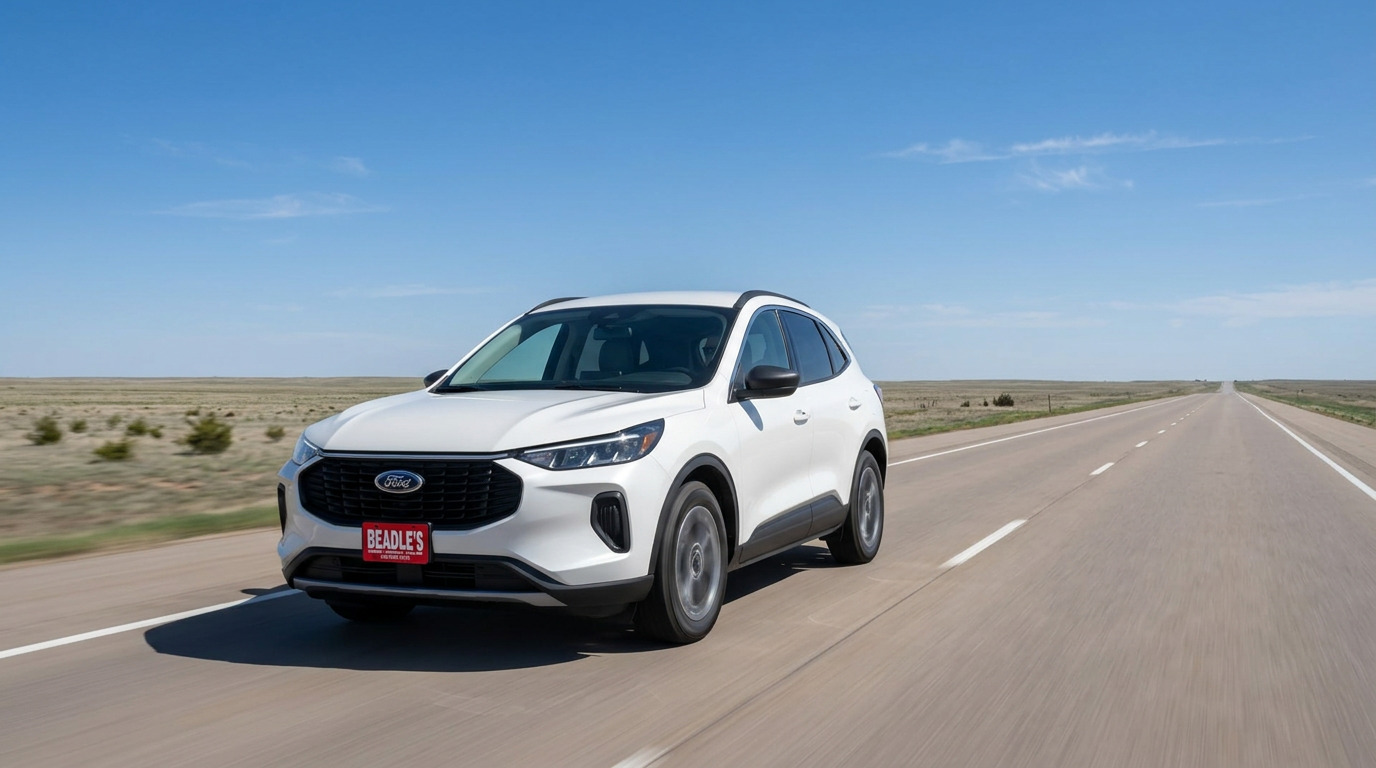
2026 Ford Escape Hybrid on South Dakota highway, powertrain comparison

2026 Ford Escape Hybrid vs. Gas vs. Plug-In Hybrid: Which Powertrain Makes Sense for Rural South Dakota?

The 2026 Ford Escape comes with four distinct powertrain options: a 1.5L EcoBoost gas engine, a 2.0L EcoBoost gas engine, a 2.5L hybrid (non-plug-in), and a 2.5L plug-in hybrid (PHEV). The choice isn't just about fuel economy — each powertrain comes with different AWD availability, different trim access, and different real-world implications for buyers driving central South Dakota roads year-round. This guide breaks down what each powertrain actually delivers, who it makes sense for, and where the trade-offs land — specifically for the long-distance, all-season, rural driving conditions common to buyers in the Bowdle area. Shop Escapes in Stock Get Pre-Approved On This Page What Powertrain Options Does the 2026 Ford Escape Offer? When Does the 1.5L EcoBoost Make Sense for South Dakota Buyers? What Does the 2.0L EcoBoost Bring Over the 1.5L — and Is It Worth It? Why Do Many South Dakota Buyers Choose the 2.5L Hybrid AWD? What's the Honest Case for — and Against — the Escape PHEV Near Bowdle? Which Escape Powertrain Is the Right Choice for Rural South Dakota Driving? What Powertrain Options Does the 2026 Ford Escape Offer? The 2026 Escape offers four powertrain options across six trims. Which powertrains are available depends entirely on which trim you're looking at — and AWD availability is not consistent across all of them. Powertrain Drivetrain Available Trims 1.5L EcoBoost FWD std / AWD optional Active, ST-Line 2.0L EcoBoost AWD Only ST-Line Select, ST-Line Elite, Platinum 2.5L Hybrid AWD Only ST-Line Select, ST-Line Elite, Platinum 2.5L PHEV FWD Only — no AWD PHEV trim only The central point: if AWD matters to you — and for most South Dakota buyers it should — the 2.5L PHEV is off the table immediately. The 1.5L EcoBoost is viable only if AWD is added at the order stage on Active or ST-Line. The 2.0L EcoBoost and 2.5L Hybrid are AWD by default on Select and above, with no FWD option available. The full 2026 Ford Escape overview at Beadle Ford covers how each powertrain fits within the broader trim lineup. When Does the 1.5L EcoBoost Make Sense for South Dakota Buyers? The 1.5L EcoBoost makes the most sense when price is the primary driver and AWD is explicitly selected at the order stage. It's capable on pavement and gravel, and delivers reasonable efficiency — approximately 30 mpg combined in FWD configuration (verify at fueleconomy.gov for current EPA figures). AWD-equipped 1.5L fuel economy has not been officially published; check fueleconomy.gov for updated ratings. The limitation for SD buyers is what comes with those trims. Active and ST-Line — the only trims offering the 1.5L — don't include heated seats, a heated steering wheel, remote start, or a power liftgate as standard equipment. Adding AWD doesn't change that. On a February morning in Spink County, those features aren't luxuries. The 1.5L is paired with an 8-speed conventional automatic — not an eCVT. Towing is capped at 2,000 lbs regardless of drivetrain, and the Class II factory tow package is not available on Active or ST-Line, only through a dealer accessory. If cost is the main consideration and cold-weather standard features are less important, the 1.5L with AWD added is workable. If the goal is winter readiness as a complete package, the comparison against ST-Line Select usually goes against the 1.5L once all-in cost is factored. What Does the 2.0L EcoBoost Bring Over the 1.5L — and Is It Worth It? The 2.0L EcoBoost delivers more power and a meaningful towing capacity advantage. It's AWD only — available on ST-Line Select, ST-Line Elite, and Platinum — so AWD is always included at no additional option cost. The key practical upgrade over the 1.5L is towing: with the Class II factory tow package (code 536), the 2.0L EcoBoost AWD is rated at 3,500 lbs, compared to 2,000 lbs on the 1.5L with no factory package available. For buyers who need to move a small boat to Lake Oahe, a utility trailer, or similar light-duty loads common in central South Dakota, 3,500 lbs is the right number. A small fishing boat and trailer, a loaded single-axle utility trailer — the 2.0L covers those tasks where the 1.5L falls short. The 1.5L tops out at 2,000 lbs without a factory package option — that gap matters for buyers with regular, even occasional, towing needs. The trade-off against the 2.5L Hybrid is fuel economy. The Hybrid delivers approximately 39 mpg combined (verify at fueleconomy.gov), which compounds over significant highway miles between Bowdle and Aberdeen or Pierre. The 2.0L EcoBoost AWD fuel economy has not been officially published — check fueleconomy.gov for current EPA figures. The 2.0L also uses an 8-speed conventional automatic rather than an eCVT, which some buyers prefer for its familiar feel. If towing matters more than fuel savings, the 2.0L EcoBoost is the right call. Looking for Something in Stock? Check out these models available now at Beadle Ford. Ford Bronco Sport Standard 4x4, GOAT modes, staying in Ford's lineup. Shop Escapes in Stock Ford Explorer More room, available 3-row seating, ready for the plains. Shop Escapes in Stock Ford Maverick Compact truck versatility at an Escape-comparable price. Shop Escapes in Stock Why Do Many South Dakota Buyers Choose the 2.5L Hybrid AWD? Because it delivers AWD and significantly better fuel efficiency than either gas option, with no charging requirement. The 2.5L Hybrid AWD is available on ST-Line Select, ST-Line Elite, and Platinum — all trims that include heated seats, remote start, and a power liftgate as standard. The efficiency gain doesn't come at the expense of cold-weather preparedness. The hybrid system delivers approximately 39 mpg combined (verify at fueleconomy.gov for current EPA ratings). On a 200-mile round trip to Aberdeen or Sioux Falls, that's a tangible fuel savings compared to either gas option. The eCVT transmission behaves differently from a conventional automatic — it maintains a steady engine rpm during acceleration rather than stepping through gears. Most buyers adapt quickly; many appreciate the smooth, consistent pull on long open-road stretches common in central South Dakota. The trade-off is towing. With the Class II tow package, the 2.5L Hybrid AWD is rated for 1,500 lbs — significantly less than the 2.0L EcoBoost's 3,500 lbs with the same package. For buyers who only need to move a small utility trailer or a jon boat, 1,500 lbs is workable. For anything heavier, the 2.0L EcoBoost is the right call. The AWD winter performance guide covers how the Hybrid AWD system handles South Dakota winter and gravel conditions in detail. What's the Honest Case for — and Against — the Escape PHEV Near Bowdle? The PHEV is front-wheel drive only — that's the immediate limitation for most central South Dakota buyers. But for buyers who have Level 2 charging at home and can accept FWD for their use case, the PHEV is the most feature-complete single Escape configuration available. The plug-in hybrid system offers approximately 37 miles of EV-only range on a full charge (verify at fueleconomy.gov). Combined with a rated approximately 101 MPGe when operating on electricity and approximately 40 mpg fuel economy after the battery depletes, total range in hybrid mode extends to approximately 520 miles. The PHEV trim itself is well-equipped: Co-Pilot360 Assist+, 13.2" SYNC 4, heated front seats, heated steering wheel, remote start, power liftgate, and roof-rack side rails are all standard. A Mobile Power Cord for Level 1 home charging comes included; Level 2 charging requires a separate 240V charger installation. The realistic limitation for rural South Dakota buyers: Level 2 charging infrastructure is sparse around Bowdle and most of central SD. Without regular Level 2 access, the EV range advantage disappears — the PHEV effectively operates as a front-wheel-drive hybrid, and the non-plug-in 2.5L Hybrid AWD on Select, Elite, or Platinum delivers comparable gas-mode fuel economy without the charging dependency and without giving up all-wheel drive. The PHEV makes the most sense for a buyer who commutes to a larger town with Level 2 access, drives predictable daily distances within the EV range, and genuinely doesn't need AWD. Which Escape Powertrain Is the Right Choice for Rural South Dakota Driving? For most central South Dakota buyers, the 2.5L Hybrid AWD on ST-Line Select is where the decision lands. AWD is standard, efficiency is strong, and the trim's cold-weather features are included without adding packages. That combination — traction in winter, manageable fuel costs on long highway miles, and a vehicle that starts reliably in January — covers the majority of what SD buyers prioritize. The 2.0L EcoBoost AWD is the right move if towing up to 3,500 lbs with the Class II package is part of your regular use case. It's also AWD only at Select and above, so the cold-weather feature set stays intact. The trade-off is fuel economy — it won't reach the Hybrid's approximately 39 mpg combined. If you're running Lake Oahe trips with a boat in tow regularly, the 2.0L makes that trade-off worthwhile. The 1.5L EcoBoost is viable if budget is the driver and AWD is specified at order — but the buyer accepts the cold-weather feature gaps that come with Active and ST-Line. The PHEV is a niche fit for this market: strong configuration, but FWD-only and rural charging realities limit its relevance for most buyers in the area. The complete trim levels guide maps each powertrain option to the specific trim configurations available. Key Takeaways The 2.5L PHEV is front-wheel drive only with no AWD option — a meaningful limitation for most central South Dakota buyers. The 2.5L Hybrid AWD on ST-Line Select delivers the best combination of AWD, efficiency (approximately 39 mpg combined), and cold-weather standard features for rural SD use. The 2.0L EcoBoost AWD is the right call when towing up to 3,500 lbs matters — the Class II factory tow package is available on Select, Elite, and Platinum only, not on 1.5L trims. The 1.5L EcoBoost with AWD is a viable lower-cost entry, but AWD must be explicitly specified at order on Active or ST-Line, and heated seats, remote start, and power liftgate are not included. PHEV buyers near Bowdle need reliable Level 2 charging access to realize the plug-in value proposition; without it, the non-plug-in Hybrid AWD delivers comparable efficiency with AWD included. Frequently Asked Questions What engines are available in the 2026 Ford Escape? The 2026 Ford Escape offers four powertrain options: a 1.5L EcoBoost three-cylinder with 8-speed automatic (Active, ST-Line — FWD standard/AWD optional), a 2.0L EcoBoost four-cylinder with 8-speed automatic (ST-Line Select, Elite, Platinum — AWD only), a 2.5L hybrid with eCVT (ST-Line Select, Elite, Platinum — AWD only), and a 2.5L plug-in hybrid with eCVT (PHEV trim — FWD only, no AWD). The choice of powertrain determines which trims are available and whether AWD comes standard. Is the 2026 Ford Escape hybrid available with AWD? Yes — the 2.5L non-plug-in Hybrid is AWD only, available on ST-Line Select, ST-Line Elite, and Platinum. There is no FWD option on the non-plug-in Hybrid. The 2.5L PHEV (plug-in hybrid) is the opposite — it is front-wheel drive only with no AWD available at any trim or price point. How much can the 2026 Ford Escape tow? Towing capacity varies by powertrain. The 2.0L EcoBoost AWD with the Class II factory tow package (code 536) is rated at 3,500 lbs. The 2.5L Hybrid AWD and 2.5L PHEV each rate at 1,500 lbs with the Class II package. The 1.5L EcoBoost (FWD or AWD) is rated at 2,000 lbs — but the Class II factory tow package is not available on Active or ST-Line trims; only a dealer-installed accessory is available for those configurations. All figures are SAE J2807 method. How far can the 2026 Ford Escape PHEV go on electricity alone? The 2026 Ford Escape PHEV offers approximately 37 miles of EV-only range on a full charge (verify current figures at fueleconomy.gov). Once the battery is depleted, the vehicle operates as a conventional gas hybrid with approximately 40 mpg fuel economy and a total range of approximately 520 miles. A Mobile Power Cord for Level 1 home charging is included; Level 2 charging requires a separate 240V charger installation. Which 2026 Ford Escape powertrain gets the best fuel economy? On a pure fuel economy basis, the PHEV delivers the highest MPGe rating (approximately 101 MPGe) when operating on electricity. Once the battery depletes, it continues as a gas hybrid at approximately 40 mpg. The 2.5L non-plug-in Hybrid AWD delivers approximately 39 mpg combined without any charging requirement. The 1.5L EcoBoost FWD delivers approximately 30 mpg combined. The 2.0L EcoBoost AWD combined fuel economy has not been officially published — check fueleconomy.gov for current EPA figures. For most South Dakota buyers without reliable Level 2 charging access, the 2.5L Hybrid AWD is the practical efficiency leader for real-world use. My Take on the 2026 Escape Powertrain Decision for South Dakota Buyers When I'm talking through powertrain options with a buyer, the conversation usually reaches the same two questions: do you need to tow anything, and do you have Level 2 charging access at home? Those two questions separate most of the field. If neither applies — no regular towing, no home charger — the 2.5L Hybrid AWD on Select is almost always where it lands. AWD is locked in, efficiency is real on the highway miles between towns, and the cold-weather features come with the trim. That combination is hard to argue with for central South Dakota use. The PHEV comes up a fair amount, and I try to be direct about the charging situation near Bowdle. Without Level 2 access at home, the EV range advantage effectively disappears, and you end up with a front-wheel-drive hybrid. The non-plug-in Hybrid AWD covers that use case more practically for most buyers in this area. For buyers who do have that home charging setup and aren't dependent on AWD — and there are some — the PHEV is genuinely strong. If you want to work through the specifics for your situation — towing weight, typical drive distance, whether a Level 2 charger makes sense to add — I'm happy to run through that comparison with you directly. Stop by Beadle Ford in Bowdle or give us a call. Shop Escapes in Stock Get Pre-Approved About the Author Lexy Tabbert — Beadle Ford, Bowdle, SD Lexy Tabbert is the Director of Sales and Marketing at Beadle Ford in Bowdle, South Dakota. She covers Ford vehicles, trim comparisons, and buyer guidance — helping families, ranchers, and ag operators across the region find the right truck and configuration for their needs. Learn more about Lexy.
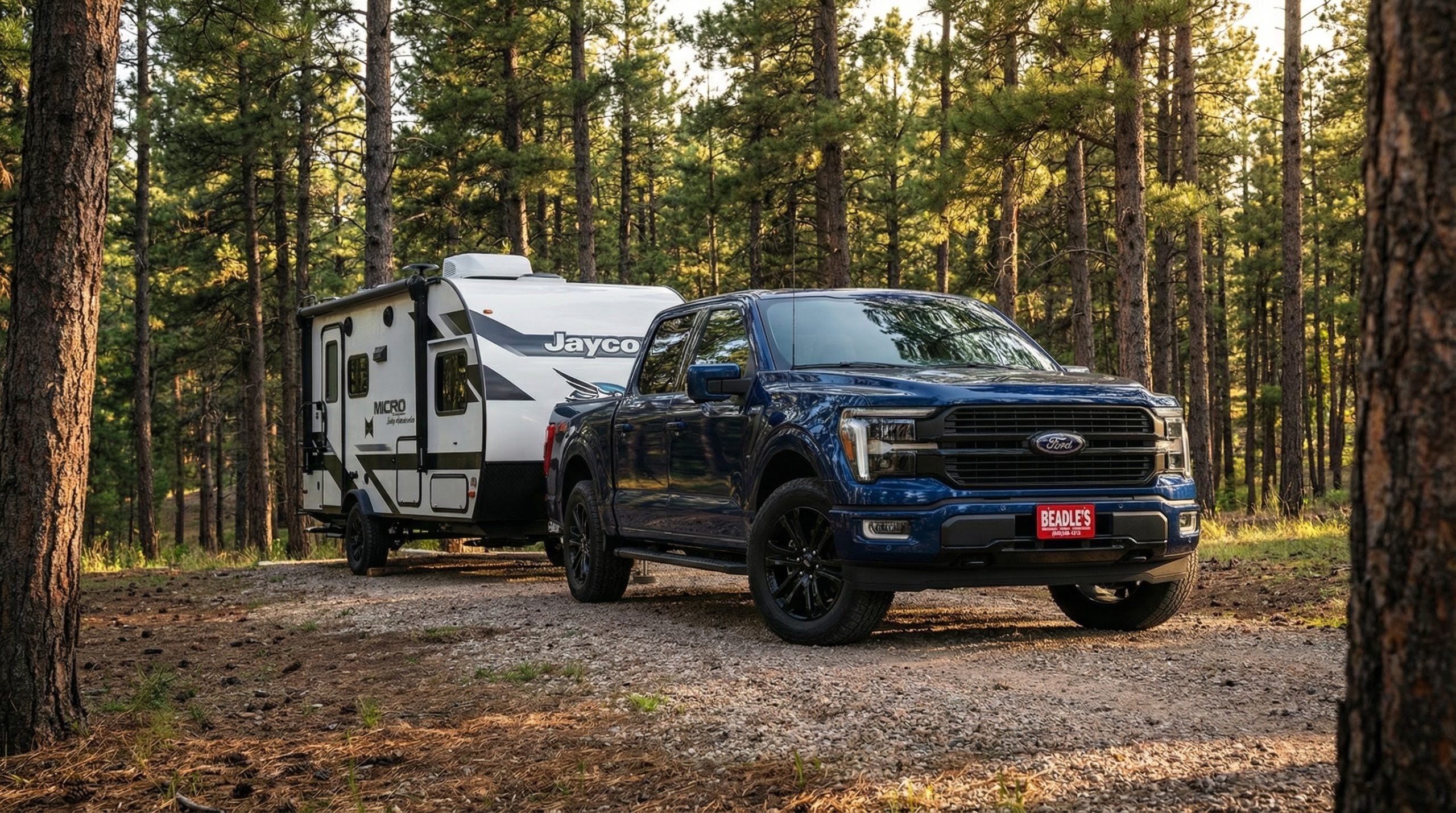
XL, XLT, Lariat, or Raptor: Which 2026 Ford Ranger Is Actually Right for You?

Four trim levels. Three engines. Multiple drivetrain configurations. Choosing the right 2026 Ford Ranger isn't complicated once you know what each level actually includes — but the overlap between XLT and Lariat trips up a lot of buyers, and the Raptor is its own category entirely. This guide breaks down every trim from XL through Raptor: what's standard, what's available, how the drivetrain options compare, and which configuration makes the most sense for buyers in central South Dakota. Shop Rangers in Stock Get Pre-Approved On This Page What are the 2026 Ford Ranger trim levels? What does the 2026 Ranger XL include? What does the 2026 Ranger XLT include? What does the 2026 Ranger Lariat include? What makes the 2026 Ranger Raptor different from every other trim? Which Ranger trims come in 4x2 vs. 4x4? Which 2026 Ranger trim is the best value for South Dakota buyers? What are the 2026 Ford Ranger trim levels? The 2026 Ranger comes in four trim levels: XL, XLT, Lariat, and Ranger Raptor. They are not equally spaced in what they offer. XL is the work-truck baseline. XLT is where most buyers land and where the biggest value jump happens. Lariat adds comfort, technology, and the V6 option. The Ranger Raptor is a purpose-built off-road variant that doesn't compete with the other three — it's a different vehicle for a different buyer. Every Ranger is a SuperCrew: four full-size doors, a 128-inch wheelbase, and a 5-foot bed. There is no SuperCab option for this generation. What does the 2026 Ranger XL include? The XL is the work-first configuration. It comes with the 2.3L EcoBoost® I4 (270 hp, 310 lb-ft torque), cloth seating, a 10-inch SYNC 4A touchscreen, an 8-inch digital instrument cluster, steel wheels with hub covers, and a reverse camera. It is available in both 4x2 and 4x4. What the XL doesn't include at the base level: Ford Co-Pilot360™ driver assist (available as an option), heated seats, power-adjustable driver's seat, or a 12-inch touchscreen. It gets the job done without extras — which is exactly what a lot of ranch and work-truck buyers want. New for 2026: FX4 Off-Road Package is now available on the XL. That means buyers can get a base-trim Ranger with an electronic-locking rear differential, skid plates, and Trail Control™ without paying for XLT features they don't need. The 2.3L is the only engine on XL — no V6 option at this trim. What does the 2026 Ranger XLT include? XLT is the high-volume trim for good reason. The high-series XLT build (301A) adds a significant amount over XL at a reasonable price step: Ford Co-Pilot360™ driver assist as standard equipment, heated front seats, a power-adjustable driver's seat, a 12-inch SYNC 4A touchscreen, and dual-zone electronic automatic temperature control (DEATC). It also adds a power-sliding rear window. The 2.7L EcoBoost® V6 (315 hp, 400 lb-ft torque) becomes available on XLT — but only in 4x4 configuration. If you want the V6, you're going 4x4. That's not a downside in South Dakota, but it's worth knowing before you spec the truck. FX4 Off-Road Package is available on XLT in both 2.3L and 2.7L configurations. The optional new power moonroof is also available on XLT for 2026 — the first time it's been offered on this Ranger generation. For a deeper look at what the FX4 package actually includes, the FX4 Off-Road Package guide covers every component. What does the 2026 Ranger Lariat include? The Lariat is the comfort-and-capability tier. It adds ActiveX upholstered seating (Ford's leather-alternative — new for 2026, replacing leather), a 12-inch digital instrument cluster, zone lighting, ambient interior lighting, a Bang & Olufsen Premium Sound System, and standard Adaptive Cruise Control with Speed Sign Recognition. Technology features that are packaged options on XLT — including the 360-degree camera — are standard on Lariat. The Lariat carries both the 2.3L EcoBoost® I4 and the 2.7L EcoBoost® V6 as options. The V6 is available in 4x4 only at this trim. FX4 and the optional power moonroof are both available on Lariat. If you're comparing XLT and Lariat, the Lariat is primarily an interior upgrade — better sound, better instrumentation, leather-alternative seating, and standard technology features. If those comfort and tech differences matter to you in daily use, Lariat is worth the step up. If you're mostly using this as a work or tow truck, XLT gets you almost everything that matters at a lower price. What makes the 2026 Ranger Raptor different from every other trim? The Ranger Raptor is not a trim upgrade — it's a different truck. It uses a purpose-built 3.0L EcoBoost® V6 producing 405 horsepower and 430 lb-ft of torque. It rides on Fox Live Valve position-sensitive shock absorbers with a Watts-link rear suspension. It has Baja and Rock Crawl drive modes that don't exist on any other Ranger trim. It comes standard with everything the FX4 package adds to other trims — and then well beyond. It is also 4x4 only, and it tows less than a standard Ranger — up to 5,510 lbs when properly equipped, compared to 7,500 lbs on non-Raptor trims. That lower tow rating reflects its off-road-optimized axle ratio (4.27 vs. 3.73 on other trims) and heavier suspension hardware. It is not a tow truck. It is not a daily hauler. It is a performance off-road vehicle that happens to have a 5-foot bed. The Raptor also gets Raptor-specific interior features: performance seats, Raptor badging, unique instrument cluster graphics, and the 3.0L-exclusive powertrain display. If dedicated off-road performance is the priority and towing isn't, this is the trim. For everyone else, the right comparison is XL, XLT, or Lariat. Which Ranger trims come in 4x2 vs. 4x4? The 2026 Ranger's drivetrain availability depends on trim and engine. Here's the full picture: Trim Engine 4x2 4x4 XL 2.3L I4 only Yes Yes XLT 2.3L I4 Yes Yes XLT 2.7L V6 No Yes (only) Lariat 2.3L I4 Yes Yes Lariat 2.7L V6 No Yes (only) Raptor 3.0L V6 only No Yes (only) If getting the 2.7L V6 is a priority, you are committing to 4x4 — it is not available any other way. For most South Dakota buyers, that's not a concern. For the handful who want the V6 purely for towing on flat terrain and would prefer to save the 4x4 premium, the 2.3L in 4x2 is the only path. For the full breakdown of towing capacity by engine and configuration, see the 2026 Ranger towing guide. Which 2026 Ranger trim is the best value for South Dakota buyers? For buyers in the Bowdle area — where the truck sees a mix of gravel roads, highway miles, ranch work, and seasonal weather — the XLT with the 2.7L V6 and FX4 Off-Road Package is the configuration that keeps coming up as the right answer. You get the safety and comfort step-up from Co-Pilot360 and heated seats, the torque advantage of the V6 for towing, and the e-locker and skid plates for the county section roads and spring mud conditions that are part of regular driving here. Quick Buyer Guide XL — Best for: work trucks, fleet buyers, buyers who want FX4 at entry-level pricing. No V6, no Co-Pilot360 standard. XLT — Best for: most buyers. Big comfort and safety step-up from XL; V6 available; FX4 available; new moonroof option available. Lariat — Best for: buyers who want a more premium interior, better audio, and standard tech without stepping into the Raptor tier. V6 and FX4 available. Raptor — Best for: buyers whose primary use case is off-road performance. Not for towing-first buyers — tow rating is lower than all other trims. Key Takeaways Four trim levels: XL (work-first), XLT (best all-rounder), Lariat (comfort + tech), Raptor (off-road performance) The 2.7L V6 is available on XLT and Lariat in 4x4 only — choosing the V6 means choosing 4x4 The 3.0L V6 is exclusive to the Ranger Raptor and is not available on any other trim FX4 is available on XL, XLT, and Lariat for 2026 — new on XL this year The Raptor tows less (up to 5,510 lbs when properly equipped) than all other trims (up to 7,500 lbs when properly equipped) The power moonroof is a new 2026 option available on XLT and Lariat only Lariat switches from leather to ActiveX seating for 2026 For most Bowdle-area buyers, XLT with the 2.7L V6 and FX4 is the practical sweet spot Frequently Asked Questions What's the difference between XLT Standard and XLT High? XLT is offered in two build packages. The standard XLT (300A) is the lower build, which includes the base XLT content. The high-series XLT (301A) adds Ford Co-Pilot360™, heated front seats, a power-adjustable driver's seat, a 12-inch SYNC 4A touchscreen, dual-zone climate control, and a power-sliding rear window. Most buyers shopping XLT are comparing against the high-series build — that's where the significant comfort and safety upgrades live. Can I get the 2.7L V6 on the XL trim? No. The 2.7L EcoBoost® V6 is available on XLT and Lariat only. The XL is 2.3L I4 exclusively. If the V6 is a priority, the starting point is XLT. Is Ford Co-Pilot360 standard on all Ranger trims? Ford Co-Pilot360™ is standard on XLT (high-series build) and above. On the base XL, it is available as an optional package. It is not standard on the base XL. Co-Pilot360 includes Pre-Collision Assist with Automatic Emergency Braking, BLIS with Cross-Traffic Alert and Trailer Coverage, Lane-Keeping System, Auto High-Beam Headlamps, Rear Parking Sensors, and Reverse Brake Assist. Does the Lariat come with the 360-degree camera standard? Yes. The 360-degree camera is standard on the Lariat. On XLT, it is available through an advanced tow or technology package. On XL, it is not available. If a 360-degree camera is important for trailer positioning or tight-space maneuvering, that's one reason to consider Lariat over XLT. What wheels does each Ranger trim come with? XL comes standard with steel wheels. XLT with the Sport Package gets 17-inch gray-painted aluminum wheels; the optional 18-inch Chrome PVD aluminum wheel is now available standalone on XLT for 2026. Lariat comes with 18-inch machined aluminum wheels with dark-painted pockets. The Raptor uses 17-inch gray-painted aluminum Raptor-specific wheels with LT285/70R17 all-terrain tires. My Take on the 2026 Ranger Trim Lineup When buyers come into Beadle Ford in Bowdle and ask where to start with the Ranger, I usually ask two questions: do you need to tow regularly, and how much of your driving is on gravel or off-pavement? Those two answers narrow it down fast. If the answer to both is yes — and for most folks in this region, it is — the XLT with the 2.7L V6 and FX4 is where the conversation ends up. It covers the towing, it covers the terrain, and it does it without paying Lariat prices for interior upgrades you might not need on a work truck. The Lariat makes a lot of sense for buyers who split time between hauling and highway driving — the B&O sound, ambient lighting, and ActiveX seating matter more if this is also your daily driver. The XL with FX4 is the right spec for anyone who wants a capable ranch truck without the price of the XLT feature set. And the Raptor is for a specific buyer who prioritizes off-road performance above everything else, including towing capacity. The complete picture of what each trim includes — including engine and drivetrain availability — is on the 2026 Ford Ranger overview. If you want to talk through which trim fits your situation before you drive, give us a call or stop by Beadle Ford in Bowdle. Shop Rangers in Stock Get Pre-Approved Contact Beadle Ford About the Author Lexy Tabbert — Beadle Ford, Bowdle, SD Lexy Tabbert covers Ford vehicles, trim comparisons, and buyer guidance for Beadle Ford in Bowdle, South Dakota. Her content is grounded in real buyer conversations with families, ranchers, and ag operators across the Bowdle region and central South Dakota. Learn more about Lexy.

Can the 2026 Ford Ranger Tow That? A No-Nonsense Guide to Capacity, Packages, and Real Trailers

If you're hauling a boat to Lake Oahe, pulling a livestock trailer across gravel roads, or packing a travel trailer for a Black Hills trip, the number that matters most is towing capacity — and the 2026 Ford Ranger has a story worth knowing. Not just one number. A few of them, depending on which engine you pick, whether you tow with a hitch or the bumper, and whether the Raptor is even on your radar. This guide breaks all of it down in plain terms so you can answer the real question: can the Ranger tow what you need to tow? Quick note before we get into it: towing is one area where nothing changed for 2026 — same figures as 2025, same packages, same ratings. So if you've been researching the Ranger for a while, this data is current and confirmed. The Numbers: Towing Capacity by Engine and Drivetrain The 2026 Ford Ranger offers three engine options across its trim lineup. Two of them — the 2.3L EcoBoost® I4 and the 2.7L EcoBoost® V6 — deliver the same maximum towing rating. The third is the Raptor-exclusive 3.0L, which is tuned for off-road performance and tows a different number entirely. All figures are SAE J2807 certified and require proper equipment. Configuration Max Towing GCWR 2.3L EcoBoost® I4 — 4x2 up to 7,500 lbs 12,370 lbs 2.3L EcoBoost® I4 — 4x4 up to 7,500 lbs 12,590 lbs 2.7L EcoBoost® V6 — 4x4 up to 7,500 lbs 12,745 lbs 3.0L EcoBoost® V6 — Raptor 4x4 up to 5,510 lbs 11,465 lbs All max towing figures require the Trailer Tow Package and proper setup per Ford's towing guidelines. Figures rated to SAE J2807. What Is GCWR — and Why Does It Matter? GCWR stands for Gross Combined Weight Rating — the maximum allowable weight of your fully loaded truck plus your fully loaded trailer combined. It's the number that protects your drivetrain, brakes, and frame from being overloaded even when your trailer alone is within the max towing limit. Here's a practical example: say you're towing a 6,800 lb loaded horse trailer with a 2.3L 4x4 Ranger. That's within the 7,500 lb tow limit. But if your truck is fully loaded with gear, fuel, passengers, and payload, you'll want to add those weights together and confirm the total stays under 12,590 lbs. Most drivers never get close — but on a long haul with a packed cab and a loaded trailer, it's worth checking. The Raptor's GCWR of 11,465 lbs is lower than the other configurations, which is one reason its max trailer rating sits at 5,510 lbs rather than 7,500 lbs. More on that below. The Trailer Tow Package: You Need It to Reach 7,500 lbs Without the Trailer Tow Package, the Ranger's maximum towing capacity drops to 3,500 lbs — bumper-pull only. That's enough for a small utility trailer, a personal watercraft, or a light single-horse trailer, but it won't get you to the 7,500 lb figure most people are asking about. The Trailer Tow Package adds a Class IV trailer hitch receiver and wiring harness, which enables the full 7,500 lb rating and increases the allowed frontal trailer area from 30 sq ft to 55 sq ft. Frontal area matters because a tall, wide trailer creates more aerodynamic drag — the package accounts for that additional load on the powertrain and cooling system. Tongue Load Limits — Know These Before You Hitch Up Tongue load is the downward force the trailer puts on your hitch ball. Too little and the trailer sways. Too much and you stress the rear suspension. Hitch receiver (with Trailer Tow Package): up to 750 lbs The rule of thumb is to keep tongue weight between 10–15% of total trailer weight. On a 6,000 lb trailer, that's 600–900 lbs — so you'd want to load toward the lighter end for the Ranger. Real Trailers, Real Numbers: What Can You Actually Pull? Spec sheets are one thing. Knowing whether your actual trailer fits those specs is another. Here's a look at common trailers around Bowdle and the surrounding area and where they land against the Ranger's ratings. Trailer Type Typical Loaded Weight Ranger (w/ Tow Pkg) 16–18 ft pontoon boat + trailer 3,500–5,500 lbs ✓ Handles it Single-horse or 2-horse bumper-pull trailer 3,000–5,000 lbs loaded ✓ Handles it Livestock trailer (2–3 head cattle) 4,500–6,500 lbs loaded ✓ Within range Mid-size travel trailer 4,000–6,500 lbs ✓ Within range Larger travel trailer / toy hauler 7,000–10,000+ lbs ⚠ Exceeds rating Enclosed car/equipment trailer varies widely Confirm loaded weight For the trip from Bowdle down to the Badlands or out to the Black Hills with a loaded travel trailer, the Ranger's 7,500 lb ceiling comfortably handles most smaller-to-mid travel trailers. Once you're looking at larger trailers in the 8,000–10,000 lb range, you'll want to be looking at a full-size truck like the F-150 instead. What About the Raptor? Why It Tows Less The Raptor's towing capacity of up to 5,510 lbs when properly equipped is lower than the other Ranger configurations — and that's by design, not a weakness. The Raptor is built around a different mission: high-speed off-road capability. It runs on a long-travel suspension setup with live-valve Fox Racing Shox that's tuned for absorbing rough terrain at speed, not for maximum towing geometry. The 3.0L EcoBoost® V6 in the Raptor makes 405 hp and 430 lb-ft of torque — more output than the other two engines — but that power is optimized for rock crawling and Baja-style driving, not fifth-wheel pulling. The shorter GCWR (11,465 lbs) reflects the overall system's tow-optimized limits relative to its suspension and frame tuning. Bottom line: if towing is your primary use case, the XLT or Lariat with the Trailer Tow Package is the smarter configuration. The Raptor's 5,510 lb limit handles a pontoon boat or a horse trailer just fine — it's just not the right tool if you're regularly running at or near the 7,500 lb ceiling. 2026 vs. 2025: Towing Didn't Change If you've been cross-referencing 2025 and 2026 Ranger specs trying to find a difference in towing — there isn't one. The 7,500 lb max, the GCWR figures, the bumper-pull limit, the tongue load specs — all identical to 2025. Ford updated a number of other things for 2026 (new color, FX4 availability changes, SiriusXM tier upgrade, Power Moonroof added), but towing capacity was not touched. That's actually a good thing — 7,500 lbs is near the top of the midsize truck segment, and there's no structural reason Ford would need to change it. The platform has plenty of capability left for most real-world towing jobs. Towing on Soft Ground: Where the FX4 Package Helps Getting a trailer out of a muddy boat ramp or pulling up a loose gravel access road to a hunting spot is a different kind of challenge than highway towing. That's where the FX4 Off-Road Package earns its place in a towing conversation. The FX4 Package adds an electronic rear locking differential, which locks both rear wheels to the same rotational speed when you need maximum traction. At a boat ramp where one rear tire is in loose sand and the other is on wet concrete, the e-locker prevents the truck from spinning the easy wheel and losing momentum. It makes a meaningful difference in low-traction departure situations — the kind that happen all the time around Lake Oahe. For a deeper look at everything the FX4 adds, the FX4 Off-Road Package guide covers every component and who actually needs it. Towing FAQ Does the 2026 Ford Ranger need the Trailer Tow Package to tow 7,500 lbs? Yes. Without the Trailer Tow Package, the Ranger's maximum towing capacity is 3,500 lbs — bumper-pull only. The Trailer Tow Package adds the Class IV hitch receiver and wiring needed to reach the 7,500 lb rating. Is the 2.7L V6 significantly better for towing than the 2.3L four-cylinder? Both engines cap at the same 7,500 lb max towing rating, so on paper they're equal. The 2.7L makes 315 hp and 400 lb-ft of torque vs. 270 hp and 310 lb-ft for the 2.3L — so you'll feel more effortless power at highway speeds and on grades with the V6. If you're regularly towing near the top of the range, the 2.7L is the more comfortable choice. What is the payload capacity of the 2026 Ranger? The 2026 Ford Ranger has a payload capacity of up to 1,788 lbs on 4x2 models and up to 1,711 lbs on 4x4 models. Payload includes passengers, cargo in the bed, and gear in the cab — everything the truck carries, not what it pulls. Your specific truck's payload limit is on the sticker inside the driver's door. Can the Raptor tow a boat or horse trailer? Yes — the Raptor can tow up to 5,510 lbs when properly equipped, which covers a pontoon boat, a 2-horse trailer, or a mid-size travel trailer. It won't reach the 7,500 lb figure of the other configurations due to its off-road-tuned suspension and frame setup, but it's not a no-tow vehicle by any stretch. Did towing capacity change from 2025 to 2026? No. Towing capacity is identical between the 2025 and 2026 Ford Ranger across all configurations. The 7,500 lb max for non-Raptor models with the Trailer Tow Package, the 5,510 lb Raptor rating, the GCWR figures, and the tongue load limits are all unchanged. Key Takeaways The 2026 Ford Ranger tows up to 7,500 lbs when properly equipped — same on the 2.3L I4 and 2.7L V6 The Raptor tows up to 5,510 lbs — intentionally lower due to its off-road suspension tuning Without the Trailer Tow Package, maximum towing drops to 3,500 lbs bumper-pull only GCWR accounts for the combined weight of truck and trailer — always check it, not just the tow limit Max tongue load is 750 lbs (hitch) — stay in the 10–15% range of your total trailer weight The FX4 e-locker improves traction on boat ramps, muddy fields, and loose-surface departure situations Towing figures are identical to 2025 — no change for 2026 All figures rated to SAE J2807 — the industry standard for consistent towing measurement For most of what people around Bowdle are actually pulling — boats, horse trailers, livestock loads, a travel trailer to Custer or Wall Drug — the 2026 Ranger with the Trailer Tow Package sits comfortably in range. The 7,500 lb ceiling is one of the highest ratings in the midsize segment, and the 2.7L V6 makes that capacity feel effortless rather than strained. At Beadle Ford in Bowdle, I can walk you through the trim and package combination that makes the most sense for what you're hauling. If you want to see how trim choice affects your towing setup options, the 2026 Ford Ranger overview breaks down the complete lineup. — Lexy Tabbert, Beadle Ford Continue Reading → Everything that's new on the 2026 Ranger — and what towing specs stayed the same → How the FX4 e-locker helps in soft-surface towing situations

2026 Ford F-150 towing a camping trailer in South Dakota

2026 Ford F-150 Ownership, Fuel Economy & Long-Term Costs Guide

Long-term ownership costs for the 2026 Ford F-150 depend heavily on engine selection, driving habits, towing frequency, and trim configuration. This guide explains what to expect from gas and hybrid configurations, how usage patterns affect costs, and what rural drivers should consider before ordering. For full trim, engine, and towing details, see the complete 2026 Ford F-150 overview. Contact Beadle Ford Table of Contents What Is the Fuel Economy Like? Hybrid vs Gas: Which Costs Less Long-Term? What Maintenance Should Owners Expect? How Long Does the Hybrid Battery Last? Does Engine Choice Affect Fuel Tank Size? How Does the F-150 Hold Its Value? How to Choose the Most Cost-Effective Setup What Is the Fuel Economy Like on the 2026 F-150? Fuel economy varies depending on engine, drivetrain, axle ratio, and driving conditions. Smaller EcoBoost engines generally prioritize efficiency, while larger engines and performance variants prioritize capability. The PowerBoost hybrid is engineered to improve efficiency compared to traditional gas-only configurations, particularly in city and mixed driving conditions. Exact EPA ratings vary by configuration and should be reviewed alongside trim and drivetrain selection. Hybrid vs Gas: Which Costs Less Over Time? The answer depends largely on driving habits. Frequent short trips and city driving: Hybrid efficiency gains may offset higher initial cost. Heavy towing and highway use: Gas engines may offer comparable long-term operating costs. Jobsite or recreational power needs: Hybrid Pro Power capability may reduce generator costs. Buyers who rarely tow at maximum capacity but drive daily may benefit more from hybrid efficiency than those consistently hauling heavy trailers. Engine performance and towing differences are detailed in our F-150 Engine Options Guide. What Maintenance Should Owners Expect? Like all full-size trucks, maintenance includes routine oil changes, brake service, tire rotations, and fluid inspections. EcoBoost engines use turbocharging systems that require proper maintenance intervals. Hybrid models include additional electrical components but are engineered for long-term durability. Maintenance costs are more influenced by usage intensity than engine type alone. How Long Does the PowerBoost Hybrid Battery Last? Hybrid battery systems are designed for long-term operation under normal use conditions. Warranty coverage details should be reviewed at time of purchase. Battery longevity depends on driving habits, climate conditions, and regular servicing. Does Engine Choice Affect Fuel Tank Size? Yes. Certain engine configurations may impact available fuel tank sizes and range characteristics. Drivers planning long-distance towing or rural travel should verify fuel tank specifications when selecting engine and trim combinations. How Does the F-150 Hold Its Value? The Ford F-150 has historically maintained strong resale value compared to many competitors in the full-size segment. Factors influencing resale include: Engine choice Trim level Condition and mileage Regional demand Maintenance history Work-ready trims and balanced configurations often perform well in rural resale markets. How to Choose the Most Cost-Effective 2026 F-150 Estimate your realistic annual mileage. Evaluate how often you tow heavy loads. Consider whether onboard power replaces separate equipment. Balance upfront cost with projected long-term fuel savings. Choose a trim that fits both daily use and resale goals. Key Takeaways Fuel economy varies significantly by configuration. Hybrid models may benefit daily drivers more than heavy haulers. Maintenance costs depend more on usage than engine type. Fuel tank size and axle ratios affect long-distance practicality. Balanced configurations often support strong resale value. Frequently Asked Questions Is the hybrid more expensive to maintain? Maintenance costs vary by usage pattern. Hybrid systems are engineered for durability and include warranty coverage. Does towing reduce fuel economy significantly? Yes. Fuel economy decreases when towing, especially at higher weights and highway speeds. Is the F-150 a good long-term truck investment? When properly maintained and configured appropriately, the F-150 has historically demonstrated strong long-term durability and resale value. Conclusion In my experience, long-term ownership decisions are less about chasing the highest fuel economy number and more about honestly evaluating how the truck will be used. A well-matched configuration tends to deliver better satisfaction and value over time than selecting features based solely on headline statistics. Review available 2026 Ford F-150 models at Beadle Ford or contact us to discuss long-term ownership considerations. About the Author Lexy Tabbert provides research-driven truck ownership guidance and vehicle configuration insights for drivers across South Dakota and the surrounding region.

2026 Ford Explorer second-row captain’s chairs

2026 Ford Explorer Interior & 3-Row Space Guide

The 2026 Ford Explorer is designed around three-row flexibility. For many families, interior layout matters more than horsepower or trim names. Seating configuration, third-row usability, and cargo space behind the rear seats often determine whether Explorer is the right fit. This guide explains how the 2026 Explorer’s seating and cargo space are structured, and how trim and equipment choices can affect layout. For a broader overview of trim positioning and feature availability, see the 2026 Ford Explorer overview. Shop Explorers in Stock Table of Contents How many people does the Explorer seat? Captain’s chairs vs bench: what’s the difference? Is the third row usable for adults? How much cargo space is behind the third row? Is the Explorer good for road trips? How to choose the right seating layout How many people can the 2026 Ford Explorer seat? The 2026 Explorer can seat up to seven passengers, depending on second-row configuration. Second-row captain’s chairs reduce seating to six but improve passenger comfort and ease of access to the third row. A second-row bench increases capacity to seven. Captain’s chairs vs bench: what’s the difference? Captain’s chairs provide individual seating positions in the second row and a center aisle for easier third-row access. Many families prefer this layout for daily school drop-offs and passenger comfort. Bench seating increases total seating capacity and can be useful for larger families who regularly transport more than six passengers. Seating availability can vary by trim and equipment group, so it’s important to confirm configuration when selecting a vehicle. Is the Explorer third row comfortable for adults? The third row in the 2026 Explorer is generally best suited for children and shorter trips for adults. For extended travel with adult passengers, seating comfort may depend on passenger height and overall cabin configuration. Families who regularly use the third row for teenagers or adults may want to evaluate overall cabin layout during a test drive. How much cargo space is behind the third row? With all three rows upright, the Explorer provides usable cargo space suitable for groceries, sports bags, and carry-on luggage. Folding the third row significantly increases cargo capacity, allowing for larger items such as coolers, strollers, and travel gear. Real-world cargo practicality depends on how frequently all three rows are occupied. Is the 2026 Explorer good for road trips? The Explorer’s three-row layout, available infotainment features, and flexible cargo configurations make it well-suited for family road trips. For longer drives, interior materials, seating configuration, and available technology features can influence comfort more than raw cabin dimensions. Technology availability is explained further in our Technology & Safety Guide. How do you choose the right seating layout? Determine how many passengers you regularly transport. Decide whether third-row access convenience is important. Consider how often all seats will be occupied. Balance seating needs with cargo needs. Confirm trim availability of desired configuration. Quick Interior Overview Feature 2026 Explorer Maximum Seating Up to 7 passengers Second Row Options Bench or captain’s chairs (varies by configuration) Third Row Standard on all trims Cargo Flexibility Expandable with fold-flat rear seats Key Takeaways Explorer seats up to seven passengers. Captain’s chairs improve access and comfort. Bench seating increases total capacity. Cargo space expands significantly when rear seats are folded. Seating availability can vary by trim. Frequently Asked Questions Does the 2026 Explorer come standard with three rows? Yes, three-row seating is standard across the Explorer lineup. Which Explorer trims offer captain’s chairs? Captain’s chairs are available on many configurations. Availability can vary by trim and equipment group. Is the Explorer bigger than the Edge? Yes, the Explorer offers three rows, while the Edge is a two-row SUV. Is the third row suitable for adults? The third row is generally best suited for children or shorter adult trips. Conclusion In my experience, most Explorer buyers make their final decision based on seating layout rather than trim name. Once families clarify whether they need six or seven seats — and how often the third row will be used — the right configuration usually becomes clear within the 2026 lineup. About the Author Lexy Tabbert provides research-driven SUV configuration guidance for drivers throughout South Dakota and beyond.

2026 Ford Maverick interior technology and displays

2026 Ford Maverick Technology Guide (What Actually Helps Day-to-Day)

In a compact truck, technology should solve problems—not add complexity. For most Maverick owners, the best tech improves visibility, daily convenience, and winter confidence. This guide focuses on the tech questions people actually ask when they’re comparing trims and trying to avoid paying for features they’ll never use. Technology choices are easiest after you know your drivetrain and use-case. If you haven’t done that step yet, start here: 2026 Maverick Specs & Configurations. For shopping and inventory support, visit the Ford Maverick model page. Shop Mavericks in Stock Contact Us Table of Contents What technology matters most in a Maverick? Visibility tech: the real quality-of-life upgrade Tech that helps in winter and bad weather Why tech varies by trim and package How to shop Maverick tech without guessing FAQ What technology matters most in a Maverick? The most valuable Maverick technology is the kind that makes the truck easier to live with: clear displays, simple controls, and driver-assist features that reduce stress in traffic and on long rural drives. Start by thinking about your biggest friction points: backing, visibility in bad weather, long commutes, or managing a small trailer. Visibility tech: the real quality-of-life upgrade Camera views: reduce backing stress and help in tight driveways and parking lots. Clear displays: matter more than “biggest screen” if you want quick, readable information. Practical layout: the best tech is easy to access while wearing gloves or managing winter gear. Tech that helps in winter and bad weather For South Dakota winters, the most helpful tech usually isn’t flashy—it’s what helps you see better and stay calm when roads change fast. AWD helps with traction, but visibility and confidence features help you avoid mistakes. If your main goal is winter confidence, pair this with: 2026 Maverick Winter Driving Guide. Why tech varies by trim and package Maverick technology isn’t “all or nothing.” Availability can change by trim, package, and build timing—so it’s smart to confirm the exact equipment list instead of assuming every Maverick has the same screens or driver assistance features. If you’re choosing between trims primarily for features, use: 2026 Maverick Trims & Packages Guide. Quick Overview Best tech focus Visibility, simple usability, and confidence in daily driving Most important shopping habit Confirm equipment by window sticker/build list Related decisions Trims & packages, winter driving, light towing How to shop Maverick tech without guessing List your pain points: backing, long commutes, winter visibility, or towing a small trailer. Decide must-have vs nice-to-have: keep the list short so you don’t overpay. Compare two real builds: use the window sticker/equipment list, not assumptions. Confirm usability: readable screens, straightforward controls, and camera views where you’ll actually use them. Shop Mavericks in Stock Ask About a Specific Feature FAQ Do all 2026 Mavericks have the same screens and tech features? Not necessarily. Tech equipment can vary by trim and package. The safest approach is confirming the exact truck’s equipment list or window sticker. What tech helps the most for winter driving? Visibility and confidence features usually matter most: camera views, clear displays, and practical controls. AWD helps traction, but winter tires and visibility are still the biggest difference-makers. How should I compare tech between two trims? Compare the specific equipment lists on the window stickers (or build sheets), then decide if the features you gain match the price difference for your daily driving. Conclusion In my experience, the best Maverick tech choices are the ones that reduce daily friction—visibility, easy controls, and confidence in bad weather. When buyers focus on real-life usability instead of feature bragging rights, they end up with a truck that feels easier to own every day. About the Author: Lexy Tabbert works with South Dakota and North Dakota buyers who want practical truck guidance—winter driving confidence, feature decisions that matter, and long-term ownership value. Her focus is straightforward: confirm the essentials first, then choose the technology that makes daily life easier.

2026 Ford Bronco Wildtrak with Sasquatch Package on a muddy two-track through a central South Dakota cattail slough during late-October pheasant season

The 2026 Ford Bronco for South Dakota Hunting: Pheasants, Deer, and Waterfowl

A hunting rig in central South Dakota is asked to do four different jobs in four different seasons. It hauls a Lab and a kennel out to a CRP field at dawn for the pheasant opener, picks its way down a muddy ranch two-track to a cattail slough for late-October waterfowl, parks at the edge of river-bottom timber for a November whitetail sit, and breaks through drifted snow on a section line in late January for the closing weekend of the season. Most trucks can do one or two of those well. The 2026 Ford Bronco is built to do all four. This guide is for upland, big-game, and waterfowl hunters around Bowdle and the central South Dakota plains who are weighing whether the Bronco fits the way they actually hunt. We'll cover cargo, the removable top, the G.O.A.T. modes that matter for SD terrain, how a Bronco compares to an F-150 or a side-by-side as a hunting rig, which trim suits the job best, and what each season really demands. There's no marketing spin here — just what works. Shop Broncos in Stock Get Pre-Approved On This Page What Cargo and Gear Can the 2026 Bronco Actually Haul for a Hunt? How Does the Removable Top Help With Upland Hunting? Which G.O.A.T. Modes Handle Muddy CRP, Cattail Sloughs, and River-Bottom Timber? Bronco vs F-150 vs Side-by-Side: Which Is the Right Hunting Rig? Which 2026 Bronco Trim Is Best for the South Dakota Hunter? What Are the Real SD Use Cases, From the October Pheasant Opener Through Late Whitetail? What Cargo and Gear Can the 2026 Bronco Actually Haul for a Hunt? A 4-Door 2026 Bronco swallows a Lab-sized kennel, a full decoy spread for a small-water hunt, two coolers, a couple of shotgun cases, and a duffel of blaze orange — with the rear seats up — and still leaves room behind the seats for a wet bird dog and a muddy bird bag. Fold the rear seat down and it opens up enough room to lay down a 200-decoy mallard spread or a layout blind. This is the practical cargo case for the 4-Door, and it's the body style we recommend for almost every hunter. The 2-Door is a different conversation. It's a smaller cargo box behind the rear seats, and the rear seat itself is tight enough that a kennel of any meaningful size has to ride up front or the rear seats fold down and you lose the seats entirely. For a single hunter with a single dog and a tight gear footprint, the 2-Door works. For most hunting parties — multiple dogs, a partner, decoys, blinds, and a cooler that can hold a day's worth of birds — the 4-Door is the right call. A few details that matter on the lot. The Badlands trim ships with marine-grade vinyl seats — the right material when wet dogs, mud, blood, and bird residue are part of the routine. They wipe down with a damp rag and don't soak. Outer Banks gets leather-trimmed seats, which look sharp on the lot but require more care in a hunting context. The Bronco's swing-gate tailgate (versus a drop gate) means you load from the side rather than tailgating off the back — a small adjustment if you're used to an F-150 bed, but it works fine for cargo and for sitting on while you change boots. On the trailer side, every non-Raptor 2026 Bronco is rated for a 3,500-lb maximum loaded trailer weight. The Raptor is rated to 4,500 lbs. That's enough for a small aluminum boat for waterfowl on Lake Oahe, a single-axle utility trailer for layout blinds and a bigger decoy spread, or a small enclosed trailer for hauling dogs and gear long distance. It's not enough to tow a heavy stock trailer or a tandem-axle camper — that's an F-150 conversation, not a Bronco one. We cover the engine and towing details in our 2.3L vs 2.7L EcoBoost engine comparison. How Does the Removable Top Help With Upland Hunting? For early-season grouse, summer scouting, and warm October days when you're driving slow along section lines glassing for sign, doors-off and front-roof-panels-off is genuinely useful — you can see, hear, and load dogs without ducking through a doorframe. For cold-weather hunting, which is most of the SD season, the doors and top stay on. Doors-off and front roof panels off — the configuration that earns the Bronco its reputation, mostly useful here from May through early October. Two practical things to know. First, the Bronco's sideview mirrors are mounted to the body, not the doors, so they stay attached when the doors come off — you don't need aftermarket mirrors to drive legally without doors. That's a real engineering edge if you take the doors off often. Second, the modular hardtop comes apart in panels: the front two panels lift off easily for a sunroof effect, and the rear section can come off as a separate piece. Most days when hunters say they want "doors-off" what they really want is the front roof panels off — easier to do, easier to put back, and you keep the cabin enclosed if weather changes. The honest take: the doors-off lifestyle is a four- to six-month window in central SD, roughly May through early October. By the time the pheasant opener rolls around in mid-October, most hunters want the doors and roof on. Where the removable hardware actually helps a hunter is in the soft season — scouting trails, running dogs, checking food plots, summer grouse — not in the November cold. The full deep-dive on storage, removal time, and cold-weather trade-offs lives in our removable doors and roof guide. Which G.O.A.T. Modes Handle Muddy CRP, Cattail Sloughs, and River-Bottom Timber? Slippery mode handles most muddy CRP access roads on every Bronco trim. Off-Road and Rock-Crawl modes — available on Badlands, Heritage Edition, and Raptor — are what you reach for when a cattail slough or a river-bottom two-track gets serious. Sand mode is the one to use along Lake Oahe shorelines and at unimproved boat ramps. Every 2026 Bronco has five G.O.A.T. modes standard: Normal, ECO, Sport, Slippery, and Sand. Slippery is the workhorse for SD hunters — it dials back throttle response, reins in shift points, and biases torque distribution for a slick or soft surface. That's the right setting for a CRP access road after rain, a frozen ruts in a section line in early November, or a wet ranch two-track at first light. Badlands and Raptor add Off-Road, Rock-Crawl, and Baja modes — seven total. Off-Road is what you want for a muddy two-track to a cattail slough or a river-bottom timber stand, where ruts are deep and you need slow, deliberate progress. Pair it with Trail Control (low-speed off-road cruise control, available on the 10-speed automatic) and the Bronco crawls through at a set speed while you focus on steering. Rock-Crawl is overkill for almost everything in the central SD region — you'd reach for it on a Black Hills weekend, not at home. The lockers matter as much as the modes. Badlands, Heritage Edition, Raptor, and any Bronco equipped with the Sasquatch Package get electronic-locking front and rear differentials. When you're sitting in mud or ice and the open differentials are spinning one wheel, the lockers are what get you out. For full mode-by-mode use cases see our 2026 Bronco G.O.A.T. Modes guide. Get Pre-Approved Contact Beadle Ford Bronco vs F-150 vs Side-by-Side: Which Is the Right Hunting Rig? The Bronco isn't trying to replace an F-150 or a side-by-side — it's the rig that fills the gap between them. The F-150 is the long-haul truck and the towing king. The side-by-side is the back-pasture access tool. The Bronco is the road-legal, weather-sealed, dog-haulable middle ground that can do most of what each does without compromising on either highway manners or off-road capability. Where the F-150 still wins: open-bed cargo for elk quarters or whole deer, towing big enclosed trailers, and seating five-plus full-size adults in comfort. If you're hauling a tandem-axle stock trailer or a heavy gooseneck, that's an F-150 question. Where the F-150 loses to the Bronco: tight CRP corners, narrow ranch gates, and back-pasture two-tracks where wheelbase and overhangs start to matter. A 4-Door Bronco's wheelbase is roughly 116 inches; a 4-Door F-150 SuperCrew's is 145+. That difference shows up the second you try to thread between cottonwoods on a section line. Where a side-by-side wins: pure terrain access, low operating cost, the ability to leave it on the property full-time. Where it loses: it's not road-legal in most of the state for the long drive to a Cow Creek WMA, it has no enclosed cargo for a kennel and gear in cold rain, and it has no real cabin for a January late-season hunt when the wind chill is below zero. For most of our customers in the Bowdle area, the Bronco doesn't displace either one. It joins the F-150 in the driveway as the second vehicle — the access vehicle for the 90-mile drive to public land where the F-150 is too big for the gates and the side-by-side can't legally make the trip. That role is what the Bronco was built for. Which 2026 Bronco Trim Is Best for the South Dakota Hunter? The Badlands 4-Door is the sweet spot for most central SD hunters. It comes standard with marine-grade vinyl seats that wipe down clean, 33-inch Rugged-Terrain tires, the seven-mode G.O.A.T. system with Off-Road and Rock-Crawl, electronic-locking front and rear differentials, and the Advanced 4x4 system with 4-Auto. That's the spec sheet of a serious hunting rig at a trim that doesn't require a Sasquatch upcharge. Badlands 4-Door at a harvested cornfield on opening morning — vinyl seats, swing gate open, Lab in a blaze vest. The trim and the use case were built for each other. Big Bend with the Black Diamond Package is the budget option. Black Diamond adds an electronic-locking rear differential plus additional off-road hardware — enough capability for most hunters who don't need the Badlands' front locker or the seven-mode terrain system. It's a real working trim at a lower entry price. Outer Banks is more comfort-oriented (leather-trimmed seats, painted hardtop, body-color flares); it's a capable rig but not the one you want if dogs and decoys ride in the back every weekend. Heritage Edition is Badlands hardware in a different aesthetic — Sasquatch is standard (35-inch tires, lockers, 4.7 axle), white wheels and Oxford White hardtop give it a distinctive look, and plaid cloth seats nod to the original 1960s Bronco. It works as a hunting rig, but you're paying a premium for the styling. Raptor is overkill for SD hunting unless you're also doing Black Hills high-clearance trails on weekends — its 37-inch tires, Live Valve dampers, and 4,500-lb tow rating are built for terrain you don't have in central SD. The new-for-2026 Wildtrak Package on Badlands 4-Door (a $11,945 option) bundles the 2.7L V6, the 10-speed automatic, the Sasquatch Package, HOSS 3.0 with FOX Internal Bypass dampers, and the Black Appearance Package. For a hunter who genuinely uses the rig in deep mud, river-bottom ruts, or cattail slough access — and who wants the V6's torque for towing a small boat — Wildtrak earns its money. Full trim breakdowns are in our 2026 Bronco trim levels guide. What Are the Real SD Use Cases, From the October Pheasant Opener Through Late Whitetail? The third Saturday of October is opening day for pheasants. A Badlands 4-Door pulls up to the edge of a CRP field at dawn, swing gate opens, the Lab jumps out, the cooler and gun case come out behind. The drive in might have been a wet section road — Slippery mode for the gravel, 4-Auto for the change from pavement to dirt, no manual shifting needed. Available heated front seats and a heated steering wheel kill the cold while you wait for legal shooting time. That's the everyday pheasant scenario, and the Bronco was built for it. Late October through November shifts to waterfowl in the cattail sloughs north and west of Bowdle, and toward whitetail along the Whitlock and Cow Creek arms of Lake Oahe. The slough access roads are where Off-Road mode and electronic lockers earn their keep — soft mud, deep ruts, sometimes ice forming on the shaded side. A standard Badlands handles most of it; Wildtrak with Sasquatch handles all of it. The whitetail sit means parking at the edge of river-bottom timber and not getting stuck on the way out three hours after dark. Late season — January for resident pheasant hunters and the closing weekend of waterfowl — is where the Bronco really separates from a side-by-side. The cabin is heated and weather-sealed. The 33-inch or 35-inch tires push through drifted snow on a county section line where a stock-suspension SUV would high-center on the running boards. Slippery mode plus 4-Auto lets the rig sort traction without you needing to think about it. We cover the full winter picture in our South Dakota winter driving guide. All of this becomes clearer within the full 2026 Ford Bronco overview, which lays out trims, engines, capability, and what's new for the year side by side. The hunting use case is one of the cleanest applications of the Bronco's design — and seeing it next to the rest of the lineup helps make the trim choice obvious. Key Takeaways 4-Door is the right body style for almost every hunter — the 2-Door is too tight for kennels, decoys, and a hunting partner. Badlands 4-Door is the sweet spot: marine-grade vinyl seats, 33" R/T tires, front and rear lockers, seven G.O.A.T. modes, and Advanced 4x4 with 4-Auto. Slippery mode covers most muddy CRP access roads; Off-Road and Rock-Crawl on Badlands and up handle cattail-slough and river-bottom two-tracks. Maximum towing on every non-Raptor 2026 Bronco is 3,500 lbs — enough for a small boat or a single-axle utility trailer, not for heavy stock or gooseneck trailers. The Bronco doesn't replace an F-150 or a side-by-side — it's the road-legal, weather-sealed access vehicle that fits between them. Frequently Asked Questions Will a Lab-sized kennel fit in the back of a 2026 Ford Bronco? In a 4-Door Bronco, yes — a standard intermediate or large dog kennel fits behind the rear seats with the seats up, and slides forward easily with the rear seat folded down for a longer drive. In a 2-Door, kennel fitment is much tighter and usually requires the rear seats folded, which limits passenger space. The 4-Door is the better hunting body style for owners who travel with a dog crate. Are the Bronco's seats waterproof for wet dogs and muddy gear? The Badlands and Raptor trims come standard with marine-grade vinyl seats — the right material when wet dogs, mud, and bird residue are part of the routine, and they wipe down with a damp rag. Big Bend offers Marine Grade Vinyl as an option. Outer Banks gets leather-trimmed seats, which require more care in a hunting context. For pure utility, the Badlands' marine vinyl is the answer. Do I need the Sasquatch Package for South Dakota hunting? For most central SD hunting — CRP access roads, muddy ranch two-tracks, drifted county lines — a standard Badlands with 33-inch Rugged-Terrain tires is plenty. Sasquatch (35-inch tires, lockers, 4.7 axle) earns its keep if you regularly hunt cattail-slough access roads in real spring mud, river-bottom timber two-tracks, or unimproved Lake Oahe shoreline. It's worth it for some hunters and overkill for most. Can the 2026 Bronco tow a small fishing boat for waterfowl or summer scouting? Yes. Every non-Raptor 2026 Bronco is rated for a 3,500-lb maximum loaded trailer weight, which covers a small aluminum bass or duck boat on a single-axle trailer with room to spare. The Raptor is rated for 4,500 lbs. A dealer-installed OEM trailer hitch receiver is required for any towing over 2,000 lbs, regardless of trim. Is a Bronco better than my F-150 for hunting in central South Dakota? Different jobs. The F-150 wins on open-bed cargo, heavy towing, and full-size passenger comfort. The Bronco wins on tight CRP corners, narrow ranch gates, and back-pasture two-tracks where the F-150's longer wheelbase becomes a problem. For most hunters around Bowdle, the Bronco doesn't replace the F-150 — it's a second vehicle that goes where the F-150 can't. Which G.O.A.T. mode should I use for a CRP access road after rain? Slippery mode is the right setting on most trims — it dials back throttle response, smooths shift points, and biases torque distribution for a soft or slick surface. If you're on a Badlands or Raptor and the road is genuinely deep or rutted, switch to Off-Road mode and engage 4-High or 4-Low as conditions warrant. Trail Control (low-speed off-road cruise control on the 10-speed automatic) is a real help when ruts get deep. My Take on the 2026 Bronco as a South Dakota Hunting Rig I've watched plenty of customers come in thinking they need a Raptor or a fully loaded Sasquatch build, then walk out an hour later with a Badlands 4-Door because the spec list lined up exactly with how they actually hunt. The Badlands has been our recommendation for the central SD hunter for as long as we've been selling the new Bronco — marine vinyl seats that handle a wet Lab, 33-inch Rugged-Terrain tires that work in mud and snow, electronic lockers when you actually need them, and seven G.O.A.T. modes that cover everything from a CRP access road to a river-bottom two-track. It doesn't try to be a Black Hills rock-crawler, because most of us aren't asking it to be one. If you're weighing one as a second vehicle alongside an F-150 — which is how most of my hunting customers buy a Bronco — bring your kennel and your gear bag in for the test drive. We'll fold the seats, load the cargo bay, and you can see for yourself whether the 4-Door's footprint actually works for the way you hunt. That's the kind of conversation we'd rather have face to face than over a spec sheet. Shop Broncos in Stock Get Pre-Approved About the Author Lexy Tabbert — Beadle Ford, Bowdle, SD Lexy Tabbert is the Director of Sales and Marketing at Beadle Ford in Bowdle, South Dakota. She covers Ford vehicles, trim comparisons, and buyer guidance — helping families, ranchers, and ag operators across the region find the right truck and configuration for their needs. Learn more about Lexy.
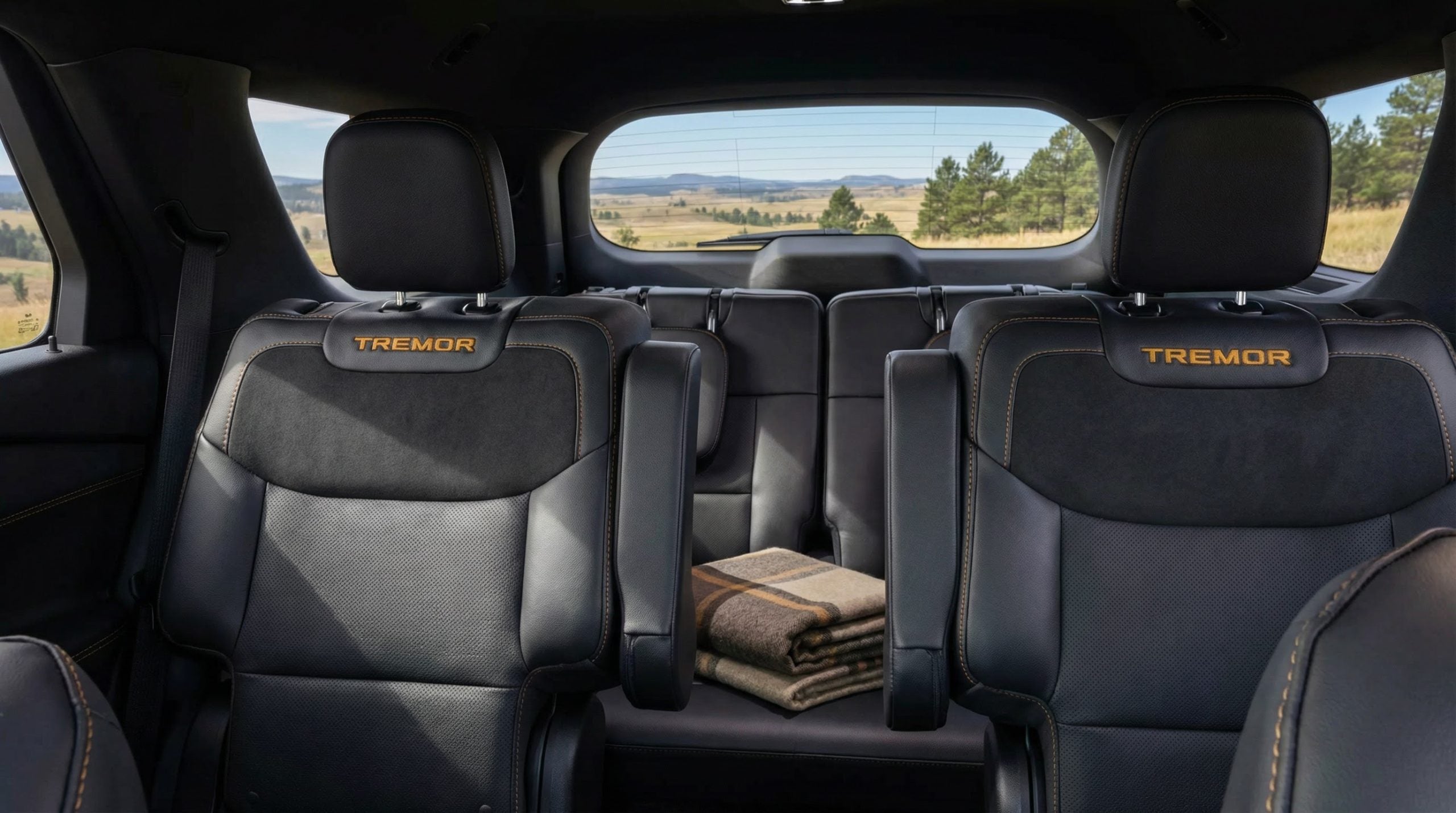
2026 Ford F-150 towing equipment trailer

2026 Ford F-150 Towing & Payload Guide

The 2026 Ford F-150 delivers serious towing capability across multiple engine configurations. When properly equipped, it can tow up to 13,500 pounds — but reaching that number depends on engine choice, axle ratio, and required equipment. This guide breaks down maximum towing ratings, required packages, 5th-wheel limits, axle considerations, altitude adjustments, and what South Dakota buyers should verify before ordering. For full trim and engine availability details, reference the complete 2026 Ford F-150 overview. Contact Beadle Ford Table of Contents What Is the Maximum Towing Capacity? Towing Capacity by Engine What Equipment Is Required? 5th-Wheel & Gooseneck Limits Frontal Area Limits Does Altitude Affect Towing? What About Raptor Models? How to Choose the Right Setup What Is the Maximum Towing Capacity of the 2026 F-150? The highest conventional towing capacity available on the 2026 Ford F-150 is 13,500 pounds when properly equipped with the 3.5L EcoBoost engine and required towing packages. Not all trims and configurations qualify for maximum towing, which is why engine and equipment selection matters. 2026 F-150 Towing Capacity by Engine Engine Max Conventional Tow (lbs.) 2.7L EcoBoost V6 8,400 5.0L V8 12,800 3.5L EcoBoost V6 13,500 3.5L PowerBoost Hybrid 11,600 3.5L EcoBoost High Output (Raptor) 8,200 5.2L Supercharged V8 (Raptor R) 8,700 Maximum ratings require proper configuration. Engine selection is explained further in our F-150 Engine Options Guide. What Equipment Is Required to Reach Maximum Tow Ratings? For gas engines towing above 11,600 pounds — and hybrids above 10,800 pounds — the Tow/Haul Package and Max Tow Axle configuration are required. Tow/Haul Package Integrated Trailer Brake Controller Max Tow Axle Ratio (varies by engine) Proper hitch setup Without these components, your truck will not reach published maximum ratings. What Are the 5th-Wheel and Gooseneck Limits? The 2026 F-150 can tow up to 7,200 pounds via 5th-wheel or gooseneck when properly equipped with the appropriate hitch kit. Note that Raptor models are not recommended for 5th-wheel towing. Do Trailer Frontal Area Limits Matter? Yes. Trailer frontal area affects safe towing limits. Under 7,700 lbs: 55 sq ft frontal area Over 7,701 lbs: 65 sq ft frontal area 5th-wheel/gooseneck: 75 sq ft frontal area Enclosed trailers and campers can exceed frontal area limits even if weight appears within range. This is commonly overlooked. Does Altitude Affect Towing Capacity? Yes. Ford recommends reducing Gross Combined Weight by 2% per 1,000 feet above sea level. This matters for drivers traveling through higher elevations in western South Dakota and neighboring states. How Do Raptor and Raptor R Compare for Towing? Raptor models prioritize suspension travel and off-road performance over maximum conventional towing numbers. While capable, they are not designed to compete with the 3.5L EcoBoost’s 13,500-pound maximum rating. How to Choose the Right Towing Configuration Confirm the exact loaded weight of your trailer. Verify required Tow/Haul and axle configurations. Check frontal area limits if towing enclosed trailers. Consider elevation if towing long distance. Match engine and trim to your real usage pattern. Key Takeaways Maximum towing reaches 13,500 lbs with the 3.5L EcoBoost. Proper equipment is required to achieve published ratings. Hybrid models offer strong capability but lower max ratings. Frontal area and altitude adjustments are often overlooked. Raptor models prioritize performance over max towing. For fuel economy and long-term operating considerations while towing, see our Ownership & Fuel Economy Guide. Frequently Asked Questions Which 2026 F-150 engine tows the most? The 3.5L EcoBoost delivers the highest conventional towing capacity at up to 13,500 pounds when properly equipped. Do I need the Tow/Haul Package for maximum towing? Yes. Maximum ratings require specific packages and axle ratios. Can the hybrid tow over 11,000 pounds? Yes. The PowerBoost hybrid can tow up to 11,600 pounds when properly equipped. Conclusion In my experience, towing decisions become much clearer once buyers move beyond advertised maximum numbers and focus on equipment requirements and real trailer weight. The strongest configuration is the one that matches your actual towing habits — not just the biggest headline figure. See how current 2026 F-150 models are configured at Beadle Ford or contact us to verify towing equipment availability. About the Author Lexy Tabbert provides in-depth truck research and configuration guidance for drivers across South Dakota and the surrounding region.

Contact Us

Fill out this form below and we'll contact you shortly
*Required Fields