

Blog / New Vehicles

The 2026 Ford Bronco for South Dakota Hunting: Pheasants, Deer, and Waterfowl

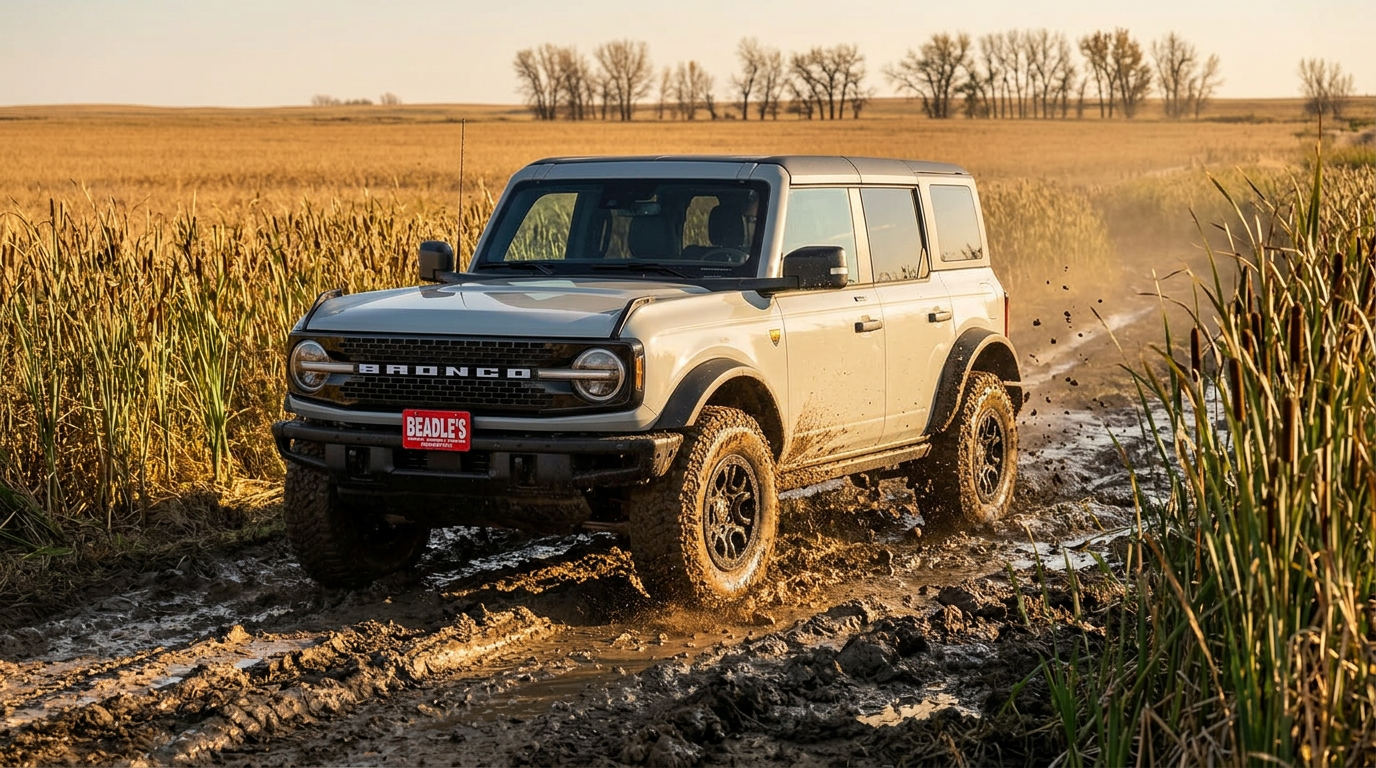
2026 Ford Bronco Wildtrak with Sasquatch Package on a muddy two-track through a central South Dakota cattail slough during late-October pheasant season

A hunting rig in central South Dakota is asked to do four different jobs in four different seasons. It hauls a Lab and a kennel out to a CRP field at dawn for the pheasant opener, picks its way down a muddy ranch two-track to a cattail slough for late-October waterfowl, parks at the edge of river-bottom timber for a November whitetail sit, and breaks through drifted snow on a section line in late January for the closing weekend of the season. Most trucks can do one or two of those well. The 2026 Ford Bronco is built to do all four.

This guide is for upland, big-game, and waterfowl hunters around Bowdle and the central South Dakota plains who are weighing whether the Bronco fits the way they actually hunt. We'll cover cargo, the removable top, the G.O.A.T. modes that matter for SD terrain, how a Bronco compares to an F-150 or a side-by-side as a hunting rig, which trim suits the job best, and what each season really demands. There's no marketing spin here — just what works.

What Cargo and Gear Can the 2026 Bronco Actually Haul for a Hunt?

A 4-Door 2026 Bronco swallows a Lab-sized kennel, a full decoy spread for a small-water hunt, two coolers, a couple of shotgun cases, and a duffel of blaze orange — with the rear seats up — and still leaves room behind the seats for a wet bird dog and a muddy bird bag. Fold the rear seat down and it opens up enough room to lay down a 200-decoy mallard spread or a layout blind. This is the practical cargo case for the 4-Door, and it's the body style we recommend for almost every hunter.

The 2-Door is a different conversation. It's a smaller cargo box behind the rear seats, and the rear seat itself is tight enough that a kennel of any meaningful size has to ride up front or the rear seats fold down and you lose the seats entirely. For a single hunter with a single dog and a tight gear footprint, the 2-Door works. For most hunting parties — multiple dogs, a partner, decoys, blinds, and a cooler that can hold a day's worth of birds — the 4-Door is the right call.

A few details that matter on the lot. The Badlands trim ships with marine-grade vinyl seats — the right material when wet dogs, mud, blood, and bird residue are part of the routine. They wipe down with a damp rag and don't soak. Outer Banks gets leather-trimmed seats, which look sharp on the lot but require more care in a hunting context. The Bronco's swing-gate tailgate (versus a drop gate) means you load from the side rather than tailgating off the back — a small adjustment if you're used to an F-150 bed, but it works fine for cargo and for sitting on while you change boots.

On the trailer side, every non-Raptor 2026 Bronco is rated for a 3,500-lb maximum loaded trailer weight. The Raptor is rated to 4,500 lbs. That's enough for a small aluminum boat for waterfowl on Lake Oahe, a single-axle utility trailer for layout blinds and a bigger decoy spread, or a small enclosed trailer for hauling dogs and gear long distance. It's not enough to tow a heavy stock trailer or a tandem-axle camper — that's an F-150 conversation, not a Bronco one. We cover the engine and towing details in our 2.3L vs 2.7L EcoBoost engine comparison.

How Does the Removable Top Help With Upland Hunting?

For early-season grouse, summer scouting, and warm October days when you're driving slow along section lines glassing for sign, doors-off and front-roof-panels-off is genuinely useful — you can see, hear, and load dogs without ducking through a doorframe. For cold-weather hunting, which is most of the SD season, the doors and top stay on.
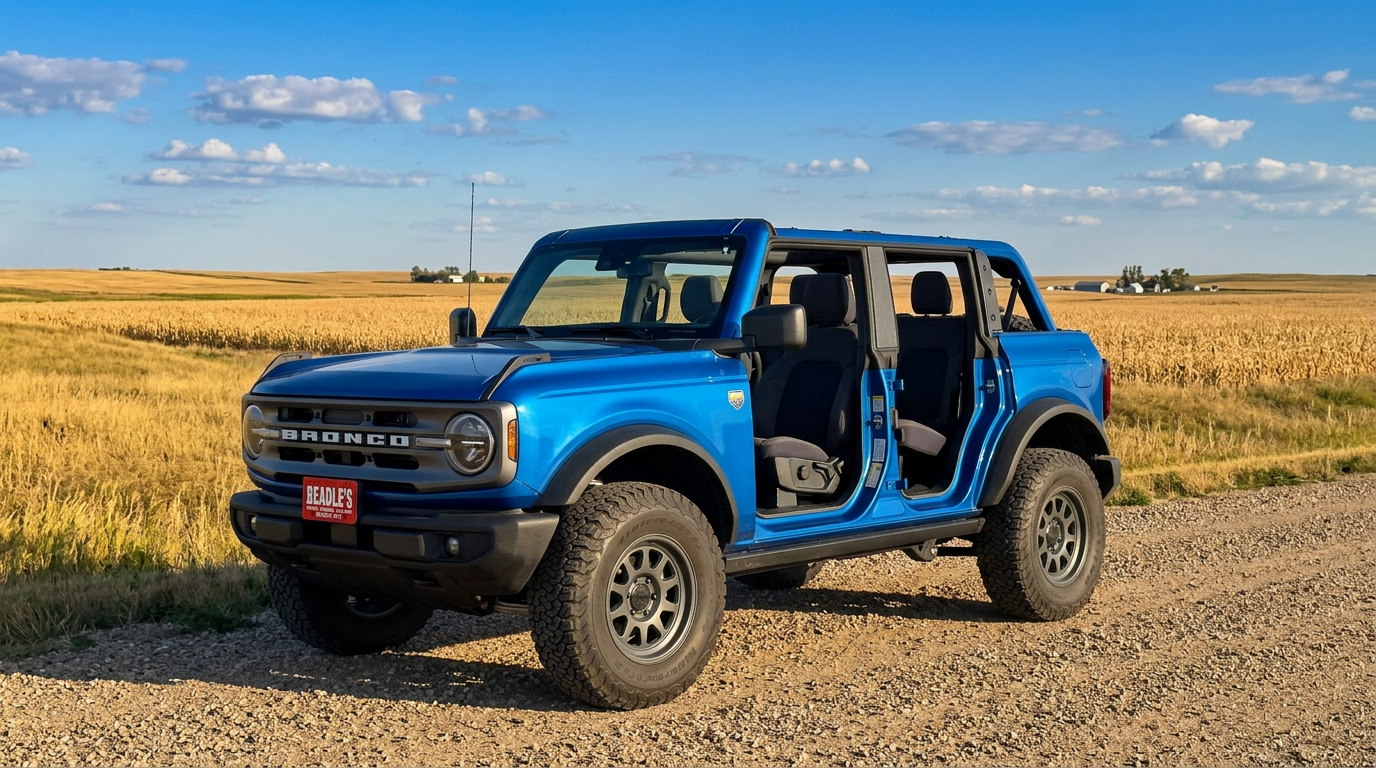
2026 Ford Bronco set up for an open-air drive across the central South Dakota plains
Doors-off and front roof panels off — the configuration that earns the Bronco its reputation, mostly useful here from May through early October.

Two practical things to know. First, the Bronco's sideview mirrors are mounted to the body, not the doors, so they stay attached when the doors come off — you don't need aftermarket mirrors to drive legally without doors. That's a real engineering edge if you take the doors off often. Second, the modular hardtop comes apart in panels: the front two panels lift off easily for a sunroof effect, and the rear section can come off as a separate piece. Most days when hunters say they want "doors-off" what they really want is the front roof panels off — easier to do, easier to put back, and you keep the cabin enclosed if weather changes.

The honest take: the doors-off lifestyle is a four- to six-month window in central SD, roughly May through early October. By the time the pheasant opener rolls around in mid-October, most hunters want the doors and roof on. Where the removable hardware actually helps a hunter is in the soft season — scouting trails, running dogs, checking food plots, summer grouse — not in the November cold. The full deep-dive on storage, removal time, and cold-weather trade-offs lives in our removable doors and roof guide.

Which G.O.A.T. Modes Handle Muddy CRP, Cattail Sloughs, and River-Bottom Timber?

Slippery mode handles most muddy CRP access roads on every Bronco trim. Off-Road and Rock-Crawl modes — available on Badlands, Heritage Edition, and Raptor — are what you reach for when a cattail slough or a river-bottom two-track gets serious. Sand mode is the one to use along Lake Oahe shorelines and at unimproved boat ramps.

Every 2026 Bronco has five G.O.A.T. modes standard: Normal, ECO, Sport, Slippery, and Sand. Slippery is the workhorse for SD hunters — it dials back throttle response, reins in shift points, and biases torque distribution for a slick or soft surface. That's the right setting for a CRP access road after rain, a frozen ruts in a section line in early November, or a wet ranch two-track at first light.

Badlands and Raptor add Off-Road, Rock-Crawl, and Baja modes — seven total. Off-Road is what you want for a muddy two-track to a cattail slough or a river-bottom timber stand, where ruts are deep and you need slow, deliberate progress. Pair it with Trail Control (low-speed off-road cruise control, available on the 10-speed automatic) and the Bronco crawls through at a set speed while you focus on steering. Rock-Crawl is overkill for almost everything in the central SD region — you'd reach for it on a Black Hills weekend, not at home.

The lockers matter as much as the modes. Badlands, Heritage Edition, Raptor, and any Bronco equipped with the Sasquatch Package get electronic-locking front and rear differentials. When you're sitting in mud or ice and the open differentials are spinning one wheel, the lockers are what get you out. For full mode-by-mode use cases see our 2026 Bronco G.O.A.T. Modes guide.

Bronco vs F-150 vs Side-by-Side: Which Is the Right Hunting Rig?

The Bronco isn't trying to replace an F-150 or a side-by-side — it's the rig that fills the gap between them. The F-150 is the long-haul truck and the towing king. The side-by-side is the back-pasture access tool. The Bronco is the road-legal, weather-sealed, dog-haulable middle ground that can do most of what each does without compromising on either highway manners or off-road capability.

Where the F-150 still wins: open-bed cargo for elk quarters or whole deer, towing big enclosed trailers, and seating five-plus full-size adults in comfort. If you're hauling a tandem-axle stock trailer or a heavy gooseneck, that's an F-150 question. Where the F-150 loses to the Bronco: tight CRP corners, narrow ranch gates, and back-pasture two-tracks where wheelbase and overhangs start to matter. A 4-Door Bronco's wheelbase is roughly 116 inches; a 4-Door F-150 SuperCrew's is 145+. That difference shows up the second you try to thread between cottonwoods on a section line.

Where a side-by-side wins: pure terrain access, low operating cost, the ability to leave it on the property full-time. Where it loses: it's not road-legal in most of the state for the long drive to a Cow Creek WMA, it has no enclosed cargo for a kennel and gear in cold rain, and it has no real cabin for a January late-season hunt when the wind chill is below zero.

For most of our customers in the Bowdle area, the Bronco doesn't displace either one. It joins the F-150 in the driveway as the second vehicle — the access vehicle for the 90-mile drive to public land where the F-150 is too big for the gates and the side-by-side can't legally make the trip. That role is what the Bronco was built for.

Which 2026 Bronco Trim Is Best for the South Dakota Hunter?

The Badlands 4-Door is the sweet spot for most central SD hunters. It comes standard with marine-grade vinyl seats that wipe down clean, 33-inch Rugged-Terrain tires, the seven-mode G.O.A.T. system with Off-Road and Rock-Crawl, electronic-locking front and rear differentials, and the Advanced 4x4 system with 4-Auto. That's the spec sheet of a serious hunting rig at a trim that doesn't require a Sasquatch upcharge.
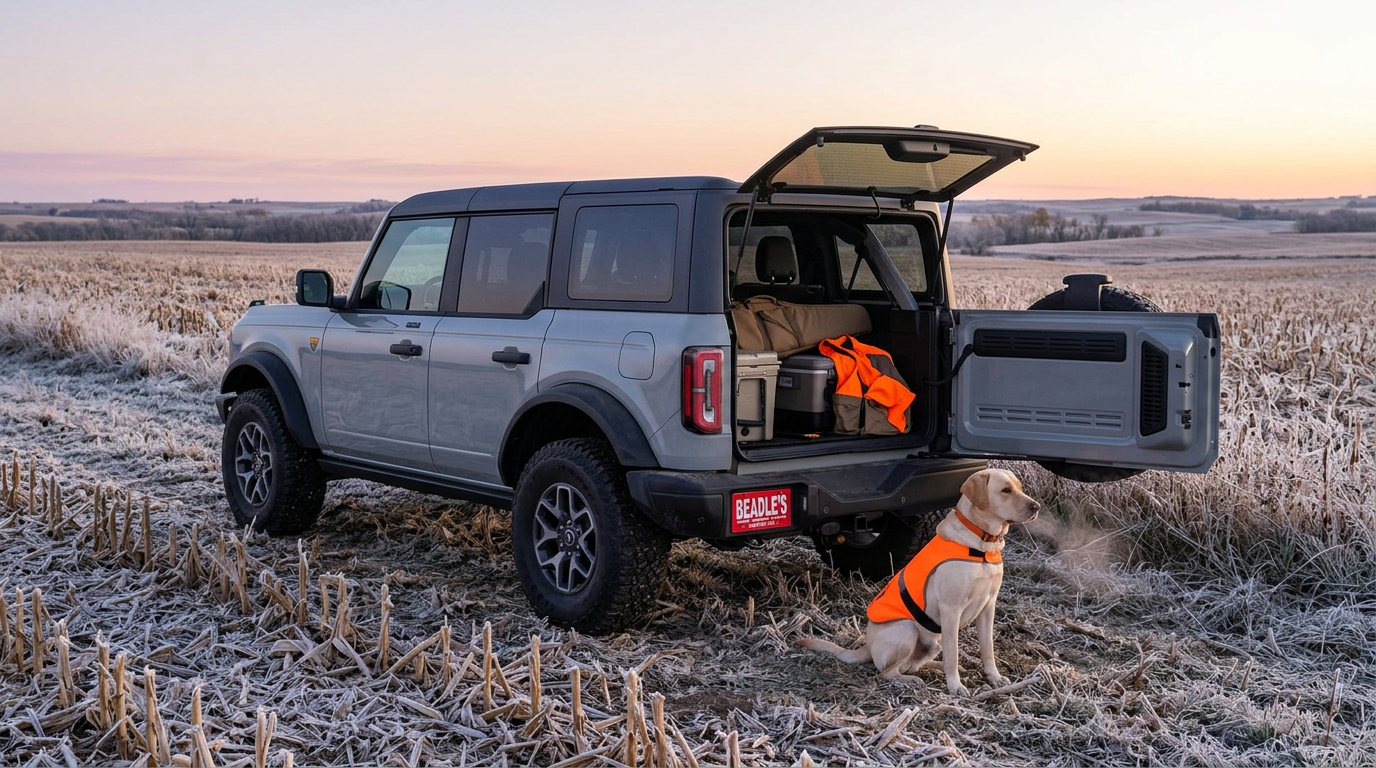
2026 Ford Bronco Badlands parked at a harvested South Dakota cornfield at dawn during pheasant season, rear swing gate open with a yellow Labrador in a blaze orange vest beside the bumper
Badlands 4-Door at a harvested cornfield on opening morning — vinyl seats, swing gate open, Lab in a blaze vest. The trim and the use case were built for each other.

Big Bend with the Black Diamond Package is the budget option. Black Diamond adds an electronic-locking rear differential plus additional off-road hardware — enough capability for most hunters who don't need the Badlands' front locker or the seven-mode terrain system. It's a real working trim at a lower entry price. Outer Banks is more comfort-oriented (leather-trimmed seats, painted hardtop, body-color flares); it's a capable rig but not the one you want if dogs and decoys ride in the back every weekend.

Heritage Edition is Badlands hardware in a different aesthetic — Sasquatch is standard (35-inch tires, lockers, 4.7 axle), white wheels and Oxford White hardtop give it a distinctive look, and plaid cloth seats nod to the original 1960s Bronco. It works as a hunting rig, but you're paying a premium for the styling. Raptor is overkill for SD hunting unless you're also doing Black Hills high-clearance trails on weekends — its 37-inch tires, Live Valve dampers, and 4,500-lb tow rating are built for terrain you don't have in central SD.

The new-for-2026 Wildtrak Package on Badlands 4-Door (a $11,945 option) bundles the 2.7L V6, the 10-speed automatic, the Sasquatch Package, HOSS 3.0 with FOX Internal Bypass dampers, and the Black Appearance Package. For a hunter who genuinely uses the rig in deep mud, river-bottom ruts, or cattail slough access — and who wants the V6's torque for towing a small boat — Wildtrak earns its money. Full trim breakdowns are in our 2026 Bronco trim levels guide.

What Are the Real SD Use Cases, From the October Pheasant Opener Through Late Whitetail?

The third Saturday of October is opening day for pheasants. A Badlands 4-Door pulls up to the edge of a CRP field at dawn, swing gate opens, the Lab jumps out, the cooler and gun case come out behind. The drive in might have been a wet section road — Slippery mode for the gravel, 4-Auto for the change from pavement to dirt, no manual shifting needed. Available heated front seats and a heated steering wheel kill the cold while you wait for legal shooting time. That's the everyday pheasant scenario, and the Bronco was built for it.

Late October through November shifts to waterfowl in the cattail sloughs north and west of Bowdle, and toward whitetail along the Whitlock and Cow Creek arms of Lake Oahe. The slough access roads are where Off-Road mode and electronic lockers earn their keep — soft mud, deep ruts, sometimes ice forming on the shaded side. A standard Badlands handles most of it; Wildtrak with Sasquatch handles all of it. The whitetail sit means parking at the edge of river-bottom timber and not getting stuck on the way out three hours after dark.

Late season — January for resident pheasant hunters and the closing weekend of waterfowl — is where the Bronco really separates from a side-by-side. The cabin is heated and weather-sealed. The 33-inch or 35-inch tires push through drifted snow on a county section line where a stock-suspension SUV would high-center on the running boards. Slippery mode plus 4-Auto lets the rig sort traction without you needing to think about it. We cover the full winter picture in our South Dakota winter driving guide.

All of this becomes clearer within the full 2026 Ford Bronco overview, which lays out trims, engines, capability, and what's new for the year side by side. The hunting use case is one of the cleanest applications of the Bronco's design — and seeing it next to the rest of the lineup helps make the trim choice obvious.

Key Takeaways

  • 4-Door is the right body style for almost every hunter — the 2-Door is too tight for kennels, decoys, and a hunting partner.
  • Badlands 4-Door is the sweet spot: marine-grade vinyl seats, 33" R/T tires, front and rear lockers, seven G.O.A.T. modes, and Advanced 4x4 with 4-Auto.
  • Slippery mode covers most muddy CRP access roads; Off-Road and Rock-Crawl on Badlands and up handle cattail-slough and river-bottom two-tracks.
  • Maximum towing on every non-Raptor 2026 Bronco is 3,500 lbs — enough for a small boat or a single-axle utility trailer, not for heavy stock or gooseneck trailers.
  • The Bronco doesn't replace an F-150 or a side-by-side — it's the road-legal, weather-sealed access vehicle that fits between them.

Frequently Asked Questions

Will a Lab-sized kennel fit in the back of a 2026 Ford Bronco?

In a 4-Door Bronco, yes — a standard intermediate or large dog kennel fits behind the rear seats with the seats up, and slides forward easily with the rear seat folded down for a longer drive. In a 2-Door, kennel fitment is much tighter and usually requires the rear seats folded, which limits passenger space. The 4-Door is the better hunting body style for owners who travel with a dog crate.

Are the Bronco's seats waterproof for wet dogs and muddy gear?

The Badlands and Raptor trims come standard with marine-grade vinyl seats — the right material when wet dogs, mud, and bird residue are part of the routine, and they wipe down with a damp rag. Big Bend offers Marine Grade Vinyl as an option. Outer Banks gets leather-trimmed seats, which require more care in a hunting context. For pure utility, the Badlands' marine vinyl is the answer.

Do I need the Sasquatch Package for South Dakota hunting?

For most central SD hunting — CRP access roads, muddy ranch two-tracks, drifted county lines — a standard Badlands with 33-inch Rugged-Terrain tires is plenty. Sasquatch (35-inch tires, lockers, 4.7 axle) earns its keep if you regularly hunt cattail-slough access roads in real spring mud, river-bottom timber two-tracks, or unimproved Lake Oahe shoreline. It's worth it for some hunters and overkill for most.

Can the 2026 Bronco tow a small fishing boat for waterfowl or summer scouting?

Yes. Every non-Raptor 2026 Bronco is rated for a 3,500-lb maximum loaded trailer weight, which covers a small aluminum bass or duck boat on a single-axle trailer with room to spare. The Raptor is rated for 4,500 lbs. A dealer-installed OEM trailer hitch receiver is required for any towing over 2,000 lbs, regardless of trim.

Is a Bronco better than my F-150 for hunting in central South Dakota?

Different jobs. The F-150 wins on open-bed cargo, heavy towing, and full-size passenger comfort. The Bronco wins on tight CRP corners, narrow ranch gates, and back-pasture two-tracks where the F-150's longer wheelbase becomes a problem. For most hunters around Bowdle, the Bronco doesn't replace the F-150 — it's a second vehicle that goes where the F-150 can't.

Which G.O.A.T. mode should I use for a CRP access road after rain?

Slippery mode is the right setting on most trims — it dials back throttle response, smooths shift points, and biases torque distribution for a soft or slick surface. If you're on a Badlands or Raptor and the road is genuinely deep or rutted, switch to Off-Road mode and engage 4-High or 4-Low as conditions warrant. Trail Control (low-speed off-road cruise control on the 10-speed automatic) is a real help when ruts get deep.

My Take on the 2026 Bronco as a South Dakota Hunting Rig

I've watched plenty of customers come in thinking they need a Raptor or a fully loaded Sasquatch build, then walk out an hour later with a Badlands 4-Door because the spec list lined up exactly with how they actually hunt. The Badlands has been our recommendation for the central SD hunter for as long as we've been selling the new Bronco — marine vinyl seats that handle a wet Lab, 33-inch Rugged-Terrain tires that work in mud and snow, electronic lockers when you actually need them, and seven G.O.A.T. modes that cover everything from a CRP access road to a river-bottom two-track. It doesn't try to be a Black Hills rock-crawler, because most of us aren't asking it to be one.

If you're weighing one as a second vehicle alongside an F-150 — which is how most of my hunting customers buy a Bronco — bring your kennel and your gear bag in for the test drive. We'll fold the seats, load the cargo bay, and you can see for yourself whether the 4-Door's footprint actually works for the way you hunt. That's the kind of conversation we'd rather have face to face than over a spec sheet.

About the Author

Lexy Tabbert — Beadle Ford, Bowdle, SD

Lexy Tabbert is the Director of Sales and Marketing at Beadle Ford in Bowdle, South Dakota. She covers Ford vehicles, trim comparisons, and buyer guidance — helping families, ranchers, and ag operators across the region find the right truck and configuration for their needs.

Posted in:

Related Posts

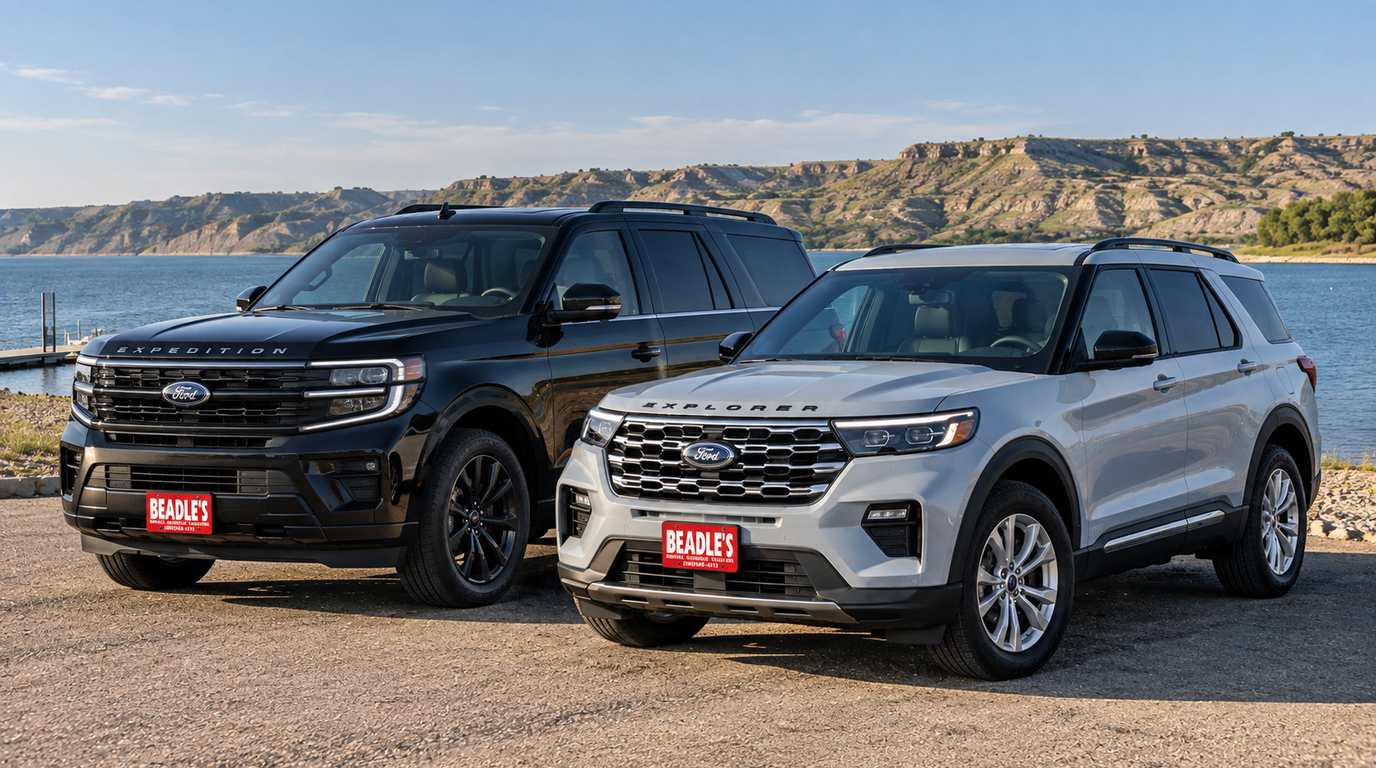
2027 Ford Explorer next to a 2027 Ford Expedition at Lake Oahe, comparing Ford three-row SUVs at Beadle Ford

Ford Explorer vs. Expedition: Which Ford Three-Row Should You Buy?

Home› Ford Explorer› 2027 Ford Explorer› Explorer vs. Expedition Quick Answer Buy the Explorer unless you specifically need what the Expedition adds. The Expedition is much longer, seats eight with an adult-sized third row, and tows 9,600 lbs against the Explorer’s 5,000. The Explorer is easier to park, cheaper to buy and fuel, and enough SUV for most families — step up only if you tow a big camper or regularly carry eight people. We sell both, so this one is not a sales pitch for either. The Explorer and the Expedition are both three-row Fords, both on the lot in Bowdle in 2026 and 2027 model years, and they are built for different jobs. Buying the Expedition when an Explorer would do costs you money every month at the pump and every time you park. Buying the Explorer when you needed the Expedition costs you the trailer you cannot pull and the third row the adults will not sit in. This guide puts the two side by side on size, seating and third-row room, towing, engines, fuel, and price, then tells you which families end up in which one. Full guides for each: the 2027 Ford Explorer Buyers Guide and the 2027 Ford Expedition Buyers Guide. Get Pre-Approved Shop Explorer Inventory On This Page The short answer Size: what a foot of length means The third row and cargo Towing: 5,000 vs. 9,600 lbs Engines and fuel Price and which families end up where The short answer Buy the Explorer if your trailer is under 5,000 lbs (a fishing boat, a small camper, a snowmobile trailer), the third row is for kids most of the time, and you want the vehicle that is easier to park, cheaper to buy, and lighter on fuel. It is the right three-row for most families. Buy the Expedition if you tow more than 5,000 lbs (a stock trailer, a tandem-axle camper, a bigger boat), you regularly put adults in the third row, or you need the cargo room of a full-size body-on-frame SUV. It tows up to 9,600 lbs and seats up to eight. Size: what a foot of length means 2027 Ford Explorer 2027 Ford Expedition Construction Unibody, rear-drive based Body-on-frame (F-150 platform), rear-drive based Length 198.7 in About 210 in (Expedition MAX is longer) Wheelbase 119.1 in About 122.5 in (MAX longer) Width (no mirrors) 78.9 in Wider Seating Up to 7 (6 on Tremor) Up to 8 Cargo behind 3rd row 16.3 cu ft Considerably more; see the Expedition guide Explorer figures are Ford’s 2027 specifications. Expedition dimensions are approximate; confirm on the 2027 Expedition guide. Roughly a foot of length and a body-on-frame construction is the whole story of the Expedition. It is what makes the third row adult-sized, the cargo area big enough for a family’s luggage with all three rows up, and the tow rating nearly double. It is also what you feel in a school pickup line, a parking ramp in Sioux Falls, and a two-car garage that was built in 1975. The Explorer fits places the Expedition does not, and for a lot of families that is the deciding factor. The third row and cargo The Explorer’s third row is a kids’ row and an occasional-adult row. With it up there are 16.3 cubic feet behind it, which handles the hockey bags and the groceries; with rows two and three down there are 85.3 cubic feet. The Expedition’s third row is an adult row, and its cargo area with all three rows up is large enough for a week’s luggage. If your regular load is three teenagers plus a friend plus their gear, or grandparents in the third row on the drive to Rapid City, the Expedition is the one that does it without complaint. If your regular load is two car seats in the second row, kids in the back a few times a month, and a dog, the Explorer’s space is right-sized and the extra room in the Expedition is room you pay to carry around empty. Towing: 5,000 vs. 9,600 lbs This is the cleanest dividing line. The 2027 Explorer tows up to 5,000 lbs on every trim with either engine, Class III hitch standard. The 2027 Expedition tows up to 9,600 lbs on 4x4 models with the Heavy-Duty Trailer Tow Package, and 6,000 to 6,300 lbs on 4x2 models, all when properly equipped. Under 5,000 lbs (most aluminum fishing boats on a single-axle trailer, a two-place snowmobile trailer, a small travel trailer, a utility trailer): Explorer. 5,000 to 9,600 lbs (a tandem-axle camper, a bigger fiberglass boat, a stock or flatbed trailer): Expedition. Weigh what you actually pull, loaded, including the trailer. A lot of families guess low. If the honest number is close to 5,000, go Expedition; towing at the limit every weekend is hard on a vehicle and on the driver. Explorer towing details are in the Explorer Buyers Guide towing section. Not sure which Ford three-row? Tell us what you tow and who rides in the third row. We will put you in the right one, and both are on the lot. Shop Explorers in Stock Ask About a Custom Order Engines and fuel 2027 Ford Explorer 2027 Ford Expedition Standard engine 2.3L EcoBoost I-4, 300 hp / 310 lb-ft 3.5L EcoBoost V6, 400 hp / 480 lb-ft Available engine 3.0L EcoBoost V6, up to 400 hp / 415 lb-ft 3.5L EcoBoost V6 High Output, 440 hp / 510 lb-ft (Tremor and Platinum performance builds) Transmission 10-speed automatic 10-speed automatic Fuel economy 2.3L 4WD: 20 / 27 / 23 mpg (EPA) See the window sticker on each unit Fuel tank 17.9 gal (2.3L) / 20.2 gal (3.0L) Larger Ford published figures. Towing requires proper equipment. The Expedition starts where the Explorer tops out: its base engine makes 400 horsepower and 480 lb-ft, and the High Output version makes 440 and 510. That is what moves a 9,600-lb trailer. The cost is fuel. The Explorer 2.3L 4WD is EPA-rated at 23 mpg combined, and a full-size body-on-frame SUV with a twin-turbo V6 is not going to match it; check the sticker on the specific Expedition, but plan on a meaningful difference at 15,000 miles a year. If you do not need the towing, the Explorer’s 300-hp four is plenty and the savings are real. Price and which families end up where The 2027 Explorer starts at $38,465 (Active 100A RWD) and tops out at $56,460 (Tremor 801A) before options and $1,795 destination. The Expedition starts well above the Explorer’s base and a loaded Platinum runs well into the upper range of the Ford SUV lineup; the current numbers are in the 2027 Expedition Buyers Guide and on the window stickers on our lot. As a rule, an Explorer trim costs roughly what the Expedition trim one step below it costs. Who ends up in what, from our lot: growing families with kids under twelve, a boat, and a gravel road go Explorer, usually an Active 200A 4WD or an ST-Line, and the Tremor if they hunt. Families with teenagers and a camper, ranch families with a stock trailer, and anyone who regularly fills all three rows with adults go Expedition. Empty nesters trading down from an Expedition go Explorer Platinum, and for 2027 the V6 makes that trade-down easy: Platinum 2.3L or 3.0L V6. Both are on the lot in Bowdle in both model years, parked close enough to walk between. Shop the Explorers in stock, shop the Expeditions, and get pre-approved so the payment on each is a known number before you decide. Key Takeaways Explorer: up to 5,000 lbs towing, up to 7 seats, 198.7 inches long, from $38,465. Expedition: up to 9,600 lbs, up to 8 seats, about a foot longer, priced well above. The trailer decides it. Under 5,000 lbs loaded, Explorer. Over, Expedition. The Explorer’s third row is for kids and occasional adults; the Expedition’s is adult-sized with real cargo room behind it. Expedition starts at 400 hp / 480 lb-ft; Explorer at 300 hp / 310 lb-ft with a 400-hp V6 available. The Explorer is the fuel-economy choice. Both are on the Beadle Ford lot in 2026 and 2027 model years; drive both before you decide. Frequently Asked Questions What is the difference between the Ford Explorer and the Ford Expedition? The Explorer is a unibody midsize three-row SUV, 198.7 inches long, seating up to seven and towing up to 5,000 lbs. The Expedition is a body-on-frame full-size SUV built on the F-150 platform, roughly a foot longer, seating up to eight and towing up to 9,600 lbs when properly equipped. How much more can the Expedition tow than the Explorer? Up to 4,600 lbs more. The 2027 Explorer tows up to 5,000 lbs on every trim. The 2027 Expedition tows up to 9,600 lbs on 4x4 models with the Heavy-Duty Trailer Tow Package, and 6,000 to 6,300 lbs on 4x2 models. Is the Explorer’s third row big enough for adults? For short trips, yes. For regular adult use or long drives, the Expedition’s third row is the adult-sized one. The Explorer’s third row is best for kids and teenagers, with 16.3 cubic feet of cargo behind it. Which gets better fuel economy, the Explorer or the Expedition? The Explorer. Its 2.3L 4WD is EPA-rated 20 city / 27 highway / 23 combined. The Expedition’s 3.5L twin-turbo V6 in a full-size body-on-frame SUV uses noticeably more fuel; check the window sticker on a specific unit. Which is cheaper, the Explorer or the Expedition? The Explorer. The 2027 Explorer starts at $38,465 (plus $1,795 destination) and tops out at $56,460 before options. The Expedition starts well above the Explorer’s base and a loaded Expedition Platinum is priced well above the top Explorer; see the 2027 Expedition Buyers Guide for current figures. Are the Explorer and Expedition both on the lot at Beadle Ford? Yes. Beadle Ford in Bowdle, SD, has both 2026 and 2027 Explorers and Expeditions in stock. Shop Explorer and Expedition inventory online or contact us to compare specific units. My Take Because we sell both, I get to be honest here. About two out of three families who come in asking about an Expedition leave in an Explorer, because when we weigh their actual trailer and count who actually rides in the third row, the Explorer does the job and saves them real money every month. The other third genuinely needs the Expedition, and I would never put them in something smaller. Tell us what you pull and who rides where. That conversation takes ten minutes and it is the whole decision. Shop Explorer Inventory Get Pre-Approved Contact Beadle Ford About the Author Lexy Tabbert — Beadle Ford, Bowdle, SD Lexy Tabbert is the Director of Sales and Marketing at Beadle Ford in Bowdle, South Dakota. She covers Ford vehicles, trim comparisons, and buyer guidance — helping families, ranchers, and ag operators across the region find the right truck and configuration for their needs. Learn more about Lexy.
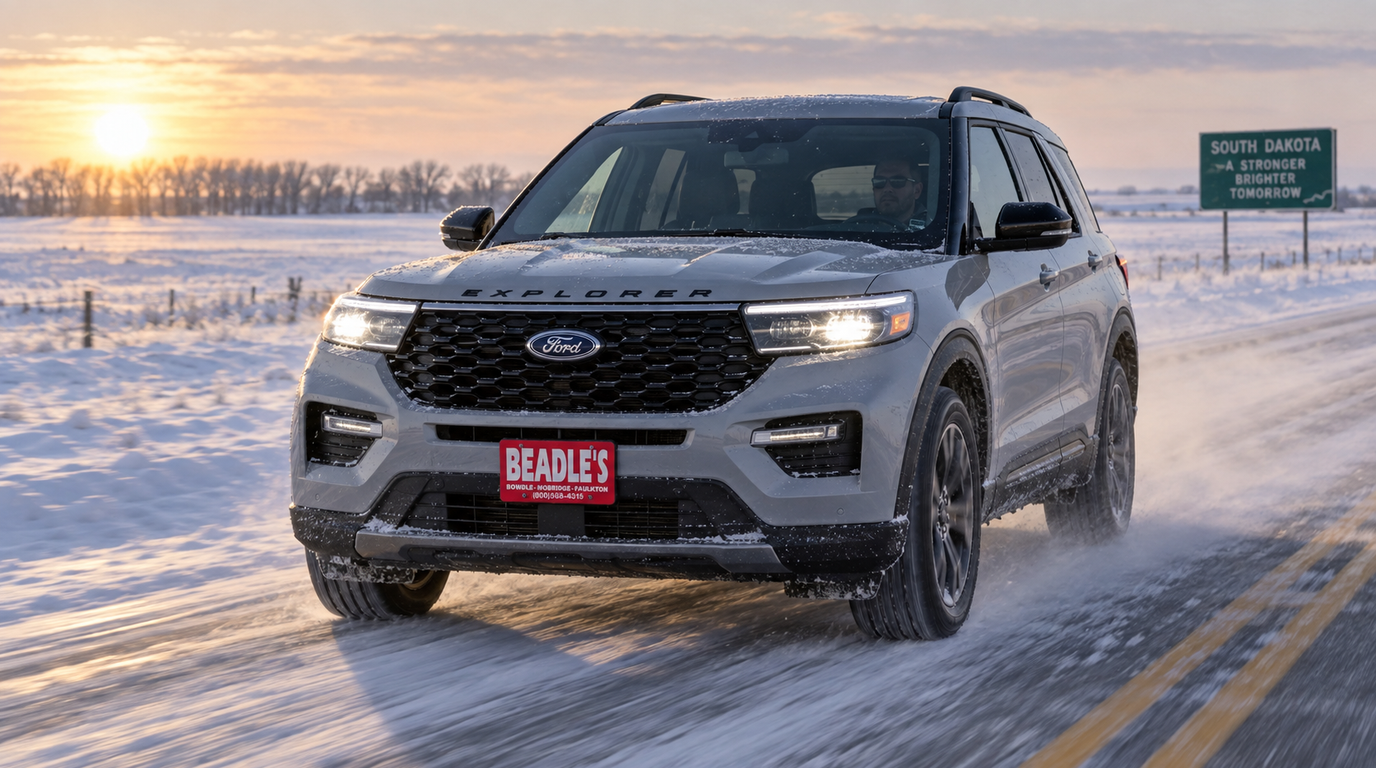
2027 Ford Explorer 4WD on a snowy South Dakota highway in January, winter-ready at Beadle Ford in Bowdle

2027 Ford Explorer vs. Jeep Grand Cherokee L: Three Rows, Towing, and Winter Compared

Home› Ford Explorer› 2027 Ford Explorer› vs. Grand Cherokee L Quick Answer The Grand Cherokee L tows more — 6,200 lbs against the Explorer’s 5,000 — and offers the Hurricane inline-six. The Explorer counters with slightly more maximum cargo room (85.3 vs. 84.6 cubic feet), the Tremor and ST trims, and a simpler Intelligent 4WD system. If towing is the priority, take the Jeep; for family hauling and winter confidence at a lower starting price, take the Explorer. The Jeep Grand Cherokee L is the three-row that our Tremor shoppers and our ranch families cross-shop, because Jeep’s reputation for 4x4 is earned. The comparison is closer than the Toyota or Honda one: both are rear-drive-based, both offer real four-wheel-drive systems, and both have an available turbo engine with more than 320 horsepower. The differences are in towing, the off-road trims, interior space, and price. This guide compares the 2027 Explorer and the 2026 Grand Cherokee L on engines, towing, 4WD systems, off-road trims, space, tech, and price. Jeep figures are from Jeep’s published 2026 Grand Cherokee L specifications; Explorer figures are Ford’s 2027 numbers from the 2027 Ford Explorer Buyers Guide. Get Pre-Approved Shop Explorer Inventory On This Page The short answer Engines and towing 4WD systems and winter Tremor vs. the Jeep lineup Three-row space and interior Tech and price The short answer The Grand Cherokee L tows more (up to 6,200 lbs with the V6 against the Explorer’s 5,000), offers an air suspension on upper trims, and carries the Jeep badge. If your trailer is between 5,000 and 6,200 lbs, that settles it. The Explorer has more standard power (300 hp vs. 293), more available power (up to 400 hp vs. 324), a factory off-road trim with all-terrain tires and a limited-slip rear on a three-row body (Jeep’s Trailhawk is two-row only), BlueCruise hands-free driving, a lower starting price, and it is on the lot in Bowdle in two model years. For most families who tow a boat or a small camper and drive gravel, the Explorer does the job for less. Engines and towing 2027 Ford Explorer 2026 Jeep Grand Cherokee L Standard engine 2.3L EcoBoost I-4, 300 hp / 310 lb-ft 3.6L Pentastar V6, 293 hp / 260 lb-ft Available engine 3.0L EcoBoost V6, up to 400 hp / 415 lb-ft 2.0L Hurricane turbo I-4, 324 hp / 332 lb-ft Transmission 10-speed automatic 8-speed automatic Max towing 5,000 lbs, every trim Up to 6,200 lbs, properly equipped Fuel tank 17.9 gal (2.3L) / 20.2 gal (3.0L) Per Jeep specifications Explorer figures are Ford’s published 2027 specifications; towing requires proper equipment. Jeep figures per Jeep’s 2026 published specifications. Torque is the number to look at. The Explorer’s base turbo four makes 50 lb-ft more than Jeep’s base V6, and it makes it low in the rev range, which is what you feel with a loaded trailer. Jeep’s Hurricane four is a strong engine at 324 hp and 332 lb-ft; the Explorer’s 3.0L V6 answers it with up to 400 hp and 415 lb-ft on the ST, the Tremor 801A, and the Platinum. Where Jeep wins outright is the tow rating: 6,200 lbs is 1,200 more than any Explorer. If you are towing a tandem-axle camper near that number, buy the Jeep, or come look at an Expedition. 4WD systems and winter Both are rear-drive-based, which is the right starting point for towing and for ice. The Explorer’s Intelligent 4WD has seven drive modes including Slippery and Deep Snow/Sand, Hill Descent Control, and on the Tremor a TORSEN limited-slip rear axle that puts torque to the wheel with grip mechanically. Jeep offers its Quadra-Trac 4x4 systems on the Grand Cherokee L, with Quadra-Drive II and an electronic limited-slip rear on upper trims, plus the Selec-Terrain modes. On a snow-packed highway or an icy intersection in Mobridge, both are excellent, and I would not pick one over the other for that alone. Ground clearance is similar in standard form (the Explorer runs 7.6 to 8.7 inches depending on trim); Jeep’s Quadra-Lift air suspension on upper trims can raise it further, which is a genuine Jeep advantage on a deeply rutted two-track, at a price. Tremor vs. the Jeep lineup Here is the detail that surprises Jeep shoppers: the Trailhawk trim, Jeep’s off-road package with all-terrain tires and skid plates, is offered only on the two-row Grand Cherokee. There is no Grand Cherokee L Trailhawk. If you need three rows and want factory off-road hardware from Jeep, the answer is an Overland or Summit with the air suspension, which is a luxury build at a luxury price. The Explorer Tremor is that missing vehicle: a three-row with P265/65R18 all-terrain tires, front and rear underbody deflector plates, front tow hooks, auxiliary grille lights, a TORSEN limited-slip rear, 8.7 inches of clearance, and 4WD only, from $49,200 with the 2.3L or $56,460 with the V6 (plus $1,795 destination). It is not a Wrangler or a Bronco, and it is not trying to be. It is the three-row that handles the section road, the two-track to the stand, and the boat ramp without asking you to give up the third row. The full Tremor guide. Three rows and gravel roads? Drive an Explorer Tremor on the section road behind the dealership. That is the comparison Jeep cannot offer on a three-row. Shop Tremors in Stock Ask About a Custom Order Three-row space and interior The Grand Cherokee L seats six or seven and Jeep lists up to 84.6 cubic feet of cargo with the rear rows folded. The 2027 Explorer seats up to seven (six on the Tremor) with 16.3 cubic feet behind the third row and up to 85.3 cubic feet folded. These two are effectively the same size inside; neither has the Grand Highlander’s or Pilot’s extra room, and neither needs it for a family of five with hockey gear. Interior character is where they differ. The Grand Cherokee L leans luxurious even on lower trims and can be optioned into Lincoln territory on a Summit Reserve. The Explorer spends its money differently: standard tri-zone climate, standard second-row captain’s chairs, a power-fold third row on ST, Platinum, and Tremor 801A, and on the Platinum multicontour seats, a 14-speaker B&O system, and BlueCruise included for a year plus 90 days. Tech and price Both have big screens and full driver-assist suites. The Explorer’s 13.2-inch touchscreen runs Google built in with wireless CarPlay and Android Auto, 5G, and over-the-air updates; Jeep’s Uconnect is a good system with its own strengths, including an available passenger screen. The Explorer’s advantage is BlueCruise, which Jeep does not offer on the Grand Cherokee L. BlueCruise vs. the other hands-free systems. Price: the 2027 Explorer Active 100A starts at $38,465 in RWD and $40,465 in 4WD, plus $1,795 destination. Jeep lists the 2026 Grand Cherokee L Laredo from $41,990 before destination, and 4x4 is extra. Trim for trim the Explorer starts a few thousand dollars lower and the gap widens at the top, where a loaded Summit Reserve sits well above a V6 Platinum. Every Explorer trim and price: 2027 Explorer trim levels. Both model years are on the lot: see what is in stock and get pre-approved before you come in. Key Takeaways Grand Cherokee L tows more: up to 6,200 lbs vs. the Explorer’s 5,000. If your trailer is in that range, that decides it. Explorer has more standard power (300 vs. 293 hp) and more available power (400 vs. 324 hp). Jeep’s Trailhawk is two-row only. The Explorer Tremor is the factory off-road three-row, with all-terrain tires, plates, hooks, and a TORSEN rear. Both are rear-drive-based with capable 4WD; Jeep offers an air suspension on upper trims, Ford offers BlueCruise. Explorer starts a few thousand lower ($38,465 vs. $41,990 before destination), and both model years are on the lot in Bowdle. Frequently Asked Questions Does the Grand Cherokee L tow more than the Explorer? Yes. Jeep rates the 2026 Grand Cherokee L at up to 6,200 lbs when properly equipped. The 2027 Explorer is rated at up to 5,000 lbs on every trim. If you tow between 5,000 and 6,200 lbs, the Jeep or a Ford Expedition is the right answer. Which has more horsepower, the Explorer or the Grand Cherokee L? The Explorer. Its 2.3L EcoBoost makes 300 hp and 310 lb-ft standard against the Jeep’s 293-hp, 260-lb-ft 3.6L V6, and the Explorer’s available 3.0L V6 makes up to 400 hp against the Jeep’s 324-hp 2.0L Hurricane. Is there a Grand Cherokee L Trailhawk? No. Jeep offers the Trailhawk off-road trim only on the two-row Grand Cherokee. The three-row Grand Cherokee L is offered in trims such as Laredo, Limited, Overland, and Summit. The Explorer Tremor is the factory off-road three-row in this comparison. Which is better in snow, the Explorer or the Grand Cherokee L? Both are rear-drive-based with capable four-wheel-drive systems and are excellent in winter. The Explorer adds Deep Snow/Sand and Slippery drive modes and, on the Tremor, a TORSEN limited-slip rear and all-terrain tires; Jeep’s upper trims offer Quadra-Drive II and an air suspension. Which is bigger inside? They are close. The Grand Cherokee L seats six or seven with up to 84.6 cubic feet of cargo folded; the Explorer seats up to seven with 16.3 cubic feet behind the third row and up to 85.3 cubic feet folded. Which costs less, the Explorer or the Grand Cherokee L? The 2027 Explorer Active starts at $38,465 before $1,795 destination. Jeep lists the 2026 Grand Cherokee L Laredo from $41,990 before destination, with 4x4 extra. My Take This is the comparison I respect most, because the Grand Cherokee L is a good truck and the Jeep buyer usually knows exactly what they want. My honest read: if the tow rating matters, Jeep wins and I will say so. If three rows plus real gravel capability is the job, the Explorer Tremor is the only one of the two that offers it, and it costs less than the Jeep you would have to build to get close. Drive the Tremor on the section road behind the store. Then go drive the Jeep. I am comfortable with where that ends up. Shop Explorer Inventory Get Pre-Approved Contact Beadle Ford About the Author Lexy Tabbert — Beadle Ford, Bowdle, SD Lexy Tabbert is the Director of Sales and Marketing at Beadle Ford in Bowdle, South Dakota. She covers Ford vehicles, trim comparisons, and buyer guidance — helping families, ranchers, and ag operators across the region find the right truck and configuration for their needs. Learn more about Lexy.
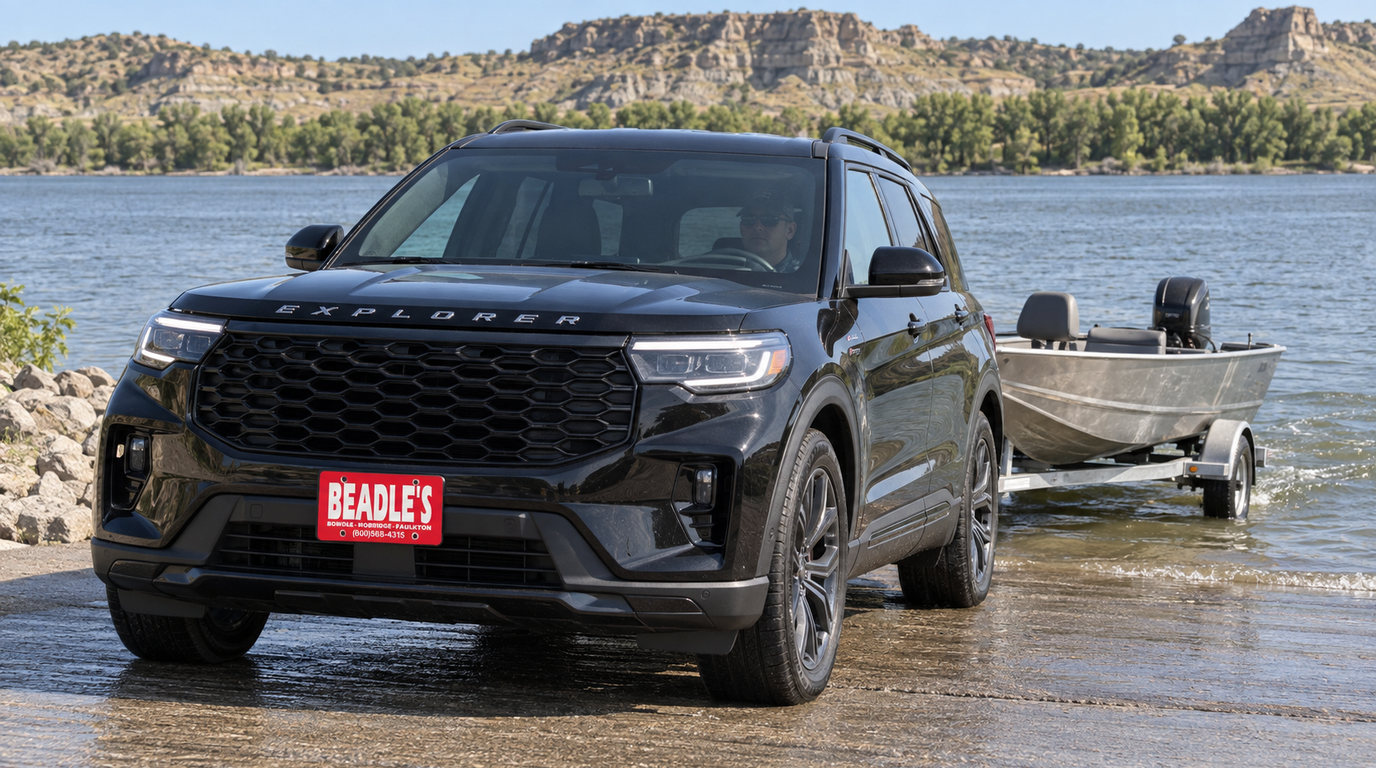
2027 Ford Explorer towing a fishing boat at a Lake Oahe boat ramp, 5,000-lb towing at Beadle Ford in Bowdle SD

2027 Ford Explorer vs. Honda Pilot: Turbo Four, V6, 4WD, and Towing Compared

Home› Ford Explorer› 2027 Ford Explorer› vs. Honda Pilot Quick Answer The Explorer’s 300-hp 2.3L EcoBoost outmuscles the Pilot’s 285-hp V6, and every Explorer tows 5,000 lbs where a Pilot needs AWD to get there (3,500 lbs with front-wheel drive). The Explorer also offers true 4WD plus the Tremor and ST; the Pilot answers with a roomier, squarer cabin and the TrailSport. For South Dakota winters and towing, the Explorer is the stronger pick. The Honda Pilot is the other three-row that shows up in our trade lane most often, usually a 2018 to 2023 that has been a good vehicle. Pilot owners who come to look at an Explorer tend to ask the same three things: is the turbo four as good as the V6 they have, does the Explorer tow more, and is Ford’s 4WD better than Honda’s AWD in the winter. Fair questions, with clear answers. This guide compares the 2027 Explorer and the 2026 Pilot on engines, towing, all-weather capability, the off-road trims, space, tech, and price. Honda figures are from Honda’s published 2026 Pilot specifications; Explorer figures are Ford’s 2027 numbers from the 2027 Ford Explorer Buyers Guide. Get Pre-Approved Shop Explorer Inventory On This Page The short answer Engines: 300-hp turbo four vs. 285-hp V6 Winter: Ford Intelligent 4WD vs. Honda i-VTM4 AWD Seating, cargo, and the third row Technology and driver assistance Price The short answer The Pilot is the roomier vehicle, with up to eight seats and more total cargo volume, and its naturally aspirated V6 is a known quantity. If you want maximum interior space and you do not tow, it is a fine choice. The Explorer has more power from its base engine than the Pilot has from its only engine, tows 5,000 lbs on every trim (the Pilot needs AWD to get there; front-drive Pilots are rated at 3,500), runs a rear-drive-based 4WD system, offers a V6 with up to 400 hp and a true off-road Tremor trim, and starts lower. For a family that tows a boat or a camper and drives gravel, the Explorer is the better fit. Engines: 300-hp turbo four vs. 285-hp V6 2027 Ford Explorer 2026 Honda Pilot Standard engine 2.3L EcoBoost I-4, 300 hp / 310 lb-ft 3.5L V6, 285 hp / 262 lb-ft Available engine 3.0L EcoBoost V6, up to 400 hp / 415 lb-ft None; one engine across the lineup Transmission 10-speed automatic 10-speed automatic Drive RWD or Intelligent 4WD (rear-drive based) FWD or i-VTM4 AWD (front-drive based) Max towing 5,000 lbs, every trim and both engines 5,000 lbs AWD; 3,500 lbs FWD Explorer figures are Ford’s published 2027 specifications; towing requires proper equipment. Honda figures per Honda’s 2026 published specifications. The Pilot’s 3.5L V6 is smooth and durable, and Pilot owners like it. But 262 lb-ft of torque arriving high in the rev range is the reason a loaded Pilot on a grade with a trailer behind it feels busy. The Explorer’s 2.3L EcoBoost makes 310 lb-ft at low rpm, which is what you feel pulling out of a boat ramp or passing on US-12. And the Explorer has a second answer the Pilot does not: the 3.0L V6 at up to 400 hp on the ST, the Tremor 801A, and now the Platinum. Winter: Ford Intelligent 4WD vs. Honda i-VTM4 AWD Honda’s i-VTM4 is a good torque-vectoring AWD system on a front-drive platform. The Explorer is built the other way around: rear-drive based, with Intelligent 4WD that sends power forward as needed, seven drive modes including Slippery and Deep Snow/Sand, and Hill Descent Control on every 4WD model. In everyday snow both are capable. Where the difference shows is towing on a slick ramp, starting on an icy hill with a load, and driving rutted gravel, where a rear-biased layout keeps the front tires steering instead of pulling. Both brands have an off-road trim. The Pilot TrailSport adds all-terrain tires, a lifted suspension, and skid plates to the AWD Pilot. The Explorer Tremor adds all-terrain tires, front and rear underbody plates, front tow hooks, auxiliary grille lights, 8.7 inches of ground clearance, and a TORSEN limited-slip rear axle, on a 4WD-only build, with the 300-hp 2.3L or the 400-hp V6. The Tremor guide has the full hardware list. Trading a Pilot? Bring it to Bowdle. We will appraise it, and you can drive the Explorer 4WD on gravel the same afternoon. Shop Explorers in Stock Ask About a Custom Order Seating, cargo, and the third row The Pilot is the bigger box. It seats up to eight, Honda lists 18.6 cubic feet behind the third row, and its total cargo volume with the rear rows folded is greater than the Explorer’s. The 2027 Explorer seats up to seven, with 16.3 cubic feet behind the third row and up to 85.3 cubic feet folded. If cargo volume is the one number you are buying on, Honda has it. In use, the differences are smaller than the table suggests. Both fit hockey bags behind the third row. Both have second-row captain’s chairs available (standard on the Explorer, which is the layout car-seat families want). The Explorer’s third row is power-folding on ST, Platinum, and Tremor 801A, and tri-zone climate control is standard on every trim. Bring your gear to the lot and load it; that is how our customers actually decide. Technology and driver assistance The Explorer runs a 13.2-inch touchscreen with Google built in, a 12.3-inch digital cluster, wireless Apple CarPlay and Android Auto, a 5G modem, and over-the-air updates on every trim, with Ford Co-Pilot360™ Assist+ standard and the 360-degree camera from ST-Line up. The Pilot’s screens are smaller, Honda Sensing is standard, and wireless CarPlay depends on trim. The bigger gap is hands-free driving. BlueCruise is included on the Explorer Platinum for a year plus 90 days, trial-included on ST and Tremor 801A, and optional on ST-Line and Tremor 800A. Honda does not offer a hands-free highway system on the Pilot. On the long drives that define living out here, that matters. How BlueCruise compares with GM and Nissan. Price The 2027 Explorer Active 100A starts at $38,465 in RWD and $40,465 in 4WD, plus $1,795 destination, with the Class III tow package already on it. Honda lists the 2026 Pilot Sport from $42,395 in front-wheel drive, before destination, and AWD is required for the 5,000-lb tow rating. So the Explorer that tows 5,000 lbs starts roughly $2,000 below the Pilot that tows 3,500. Every Explorer trim and price: 2027 Explorer trim levels. And both the 2026 and 2027 Explorer are on the lot at Beadle Ford. See the Explorers in stock, bring the Pilot for an appraisal, and get pre-approved first if you want the numbers settled before you drive out. Key Takeaways Explorer: 300 hp standard, up to 400 hp available, 310 to 415 lb-ft. Pilot: one 285-hp V6 with 262 lb-ft. Every Explorer tows 5,000 lbs; the Pilot tows 5,000 only with AWD (3,500 in FWD). Explorer is rear-drive-based 4WD with Deep Snow and Slippery modes; the Tremor adds a TORSEN axle, plates, and hooks the TrailSport does not have. Pilot is roomier: up to 8 seats and more total cargo. Explorer: up to 7, 16.3 / 85.3 cu ft. Explorer starts around $2,000 lower, offers BlueCruise, and both model years are on the lot in Bowdle. Frequently Asked Questions Which has more horsepower, the Explorer or the Pilot? The Explorer. Its standard 2.3L EcoBoost makes 300 hp and 310 lb-ft against the Pilot’s 285-hp, 262-lb-ft V6, and the Explorer’s available 3.0L V6 makes up to 400 hp. The Pilot offers one engine. Does the Explorer or the Pilot tow more? Both max out at 5,000 lbs, but every 2027 Explorer trim is rated for 5,000 lbs with a Class III package standard. The Pilot is rated at 5,000 lbs only with AWD; front-wheel-drive Pilots are rated at 3,500 lbs. Is the Pilot bigger inside than the Explorer? Yes. The Pilot seats up to eight with 18.6 cubic feet behind the third row and more total cargo volume. The Explorer seats up to seven with 16.3 cubic feet behind the third row and up to 85.3 cubic feet folded. Explorer Tremor vs. Pilot TrailSport: which is more capable? The Tremor. Both add all-terrain tires and skid plates, but the Tremor also has a TORSEN limited-slip rear axle, front tow hooks, 8.7 inches of ground clearance, a rear-drive-based 4WD system, and up to 400 hp with the 801A V6. Does the Honda Pilot have hands-free driving like BlueCruise? No. Honda Sensing includes adaptive cruise and lane keeping but not a hands-free highway system. BlueCruise is included on the Explorer Platinum and trial-included on ST and Tremor 801A. Which is cheaper, the Explorer or the Pilot? The 2027 Explorer Active starts at $38,465 before $1,795 destination. Honda lists the 2026 Pilot Sport from $42,395 in FWD before destination. Trim for trim the Explorer starts lower. My Take Pilot owners are usually happy Pilot owners, and I do not try to talk them out of that. What I show them is the tow rating on a front-drive Pilot, the torque number on the Explorer’s base engine, and then I hand them the keys to a 4WD Explorer and point at the gravel road behind the dealership. Most of them come back with the decision made. If your Pilot has been good to you and you never tow, keep shopping both. If a boat or a camper is in your future, the Explorer is the one built for it, and it costs less to start. Shop Explorer Inventory Get Pre-Approved Contact Beadle Ford About the Author Lexy Tabbert — Beadle Ford, Bowdle, SD Lexy Tabbert is the Director of Sales and Marketing at Beadle Ford in Bowdle, South Dakota. She covers Ford vehicles, trim comparisons, and buyer guidance — helping families, ranchers, and ag operators across the region find the right truck and configuration for their needs. Learn more about Lexy.