
Blog

All New Vehicles Bowdle Ford Dealer Bowdle Ford Service
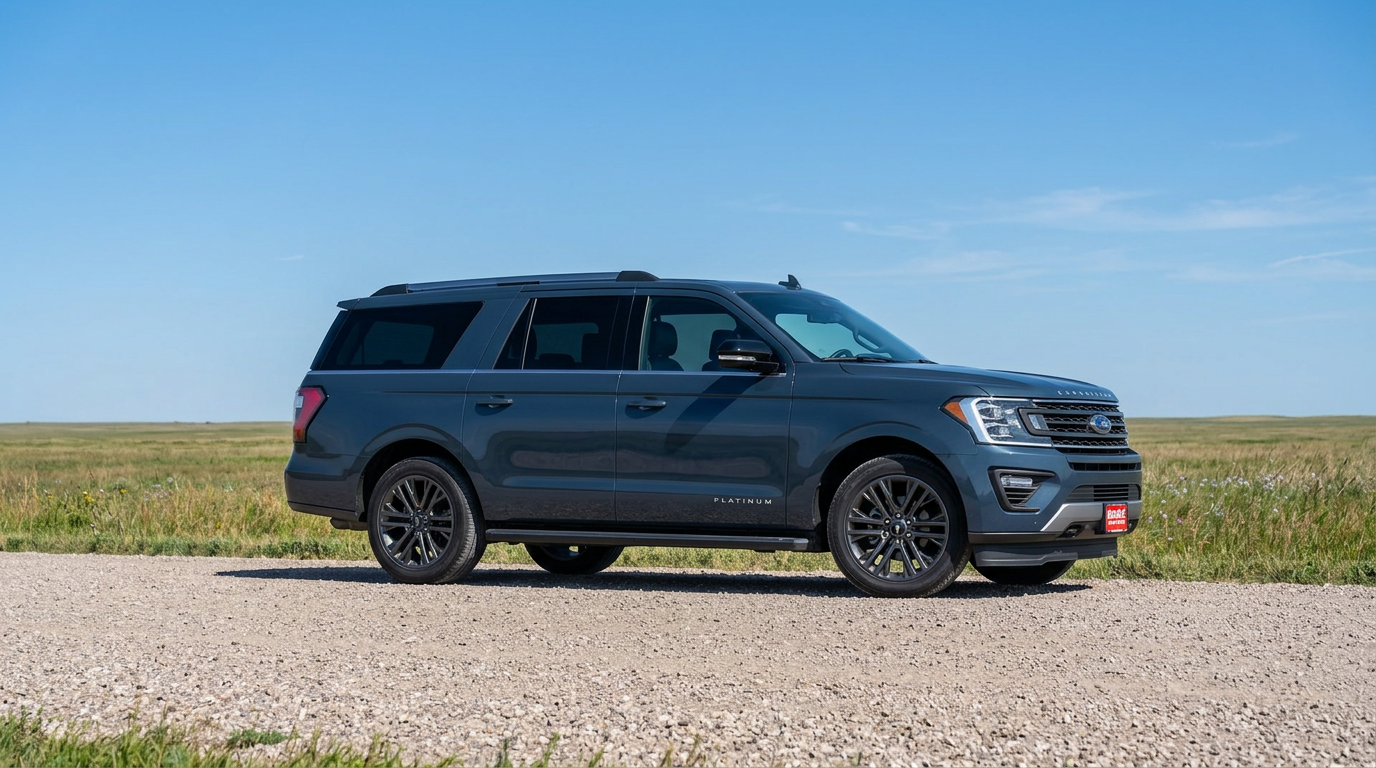
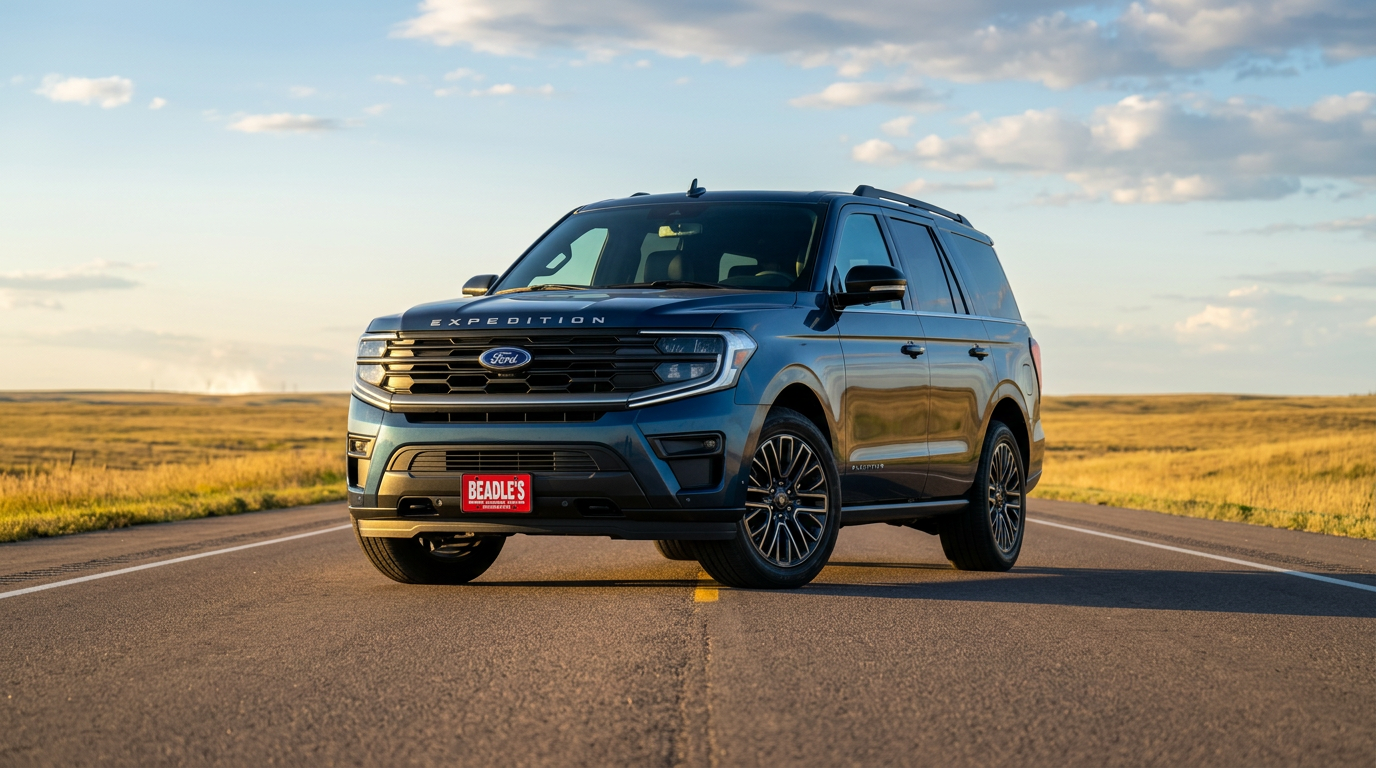
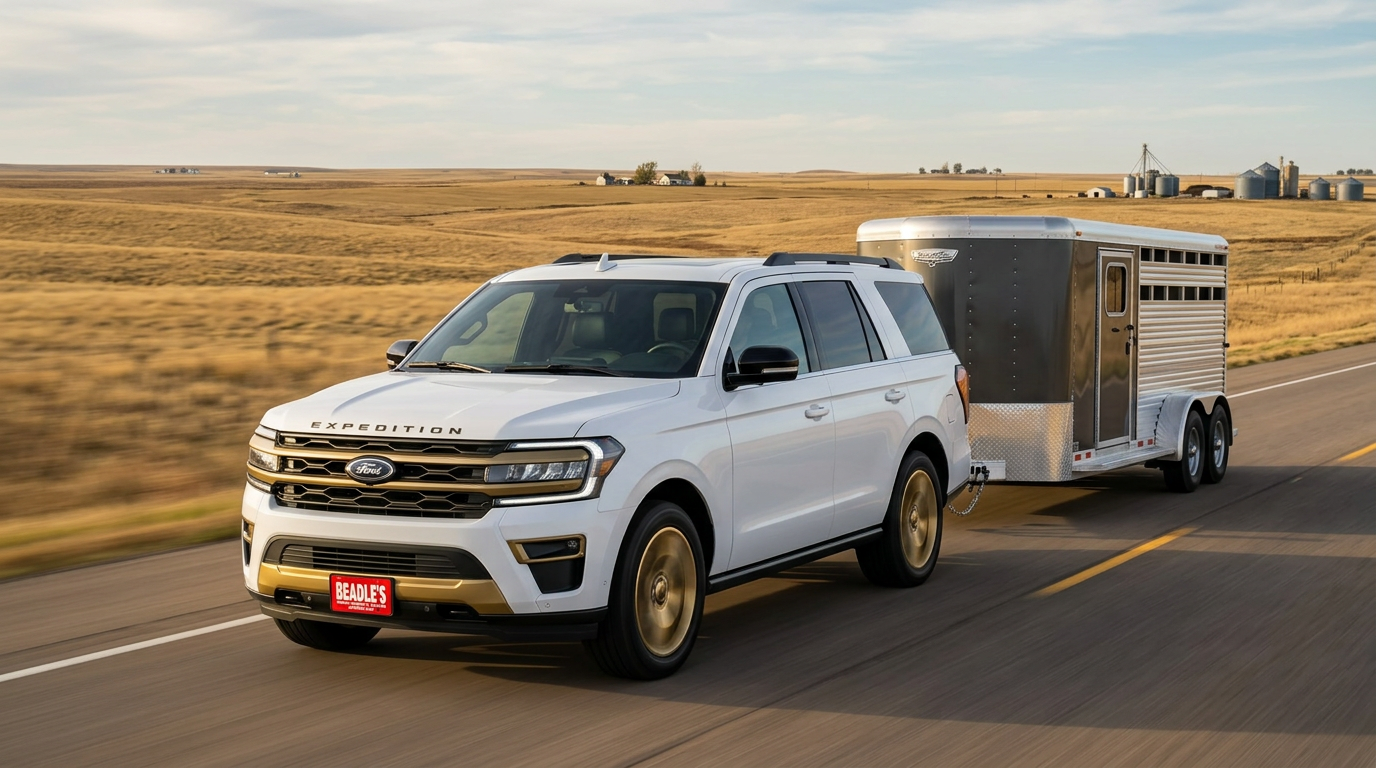
2026 Ford Expedition towing a trailer near Bowdle South Dakota

2026 Ford Expedition Towing Guide: Capacity, Configurations & What You Need to Know

The 2026 Ford Expedition can tow up to 9,600 lbs — but that number only applies to one specific configuration. The actual rating for your build depends on drivetrain, axle ratio, wheelbase, and whether the Heavy-Duty Trailer Tow package is installed. Get one of those wrong and you may be operating beyond your rated limit without knowing it. This guide breaks down every towing figure from Ford's official 2026 Expedition Towing Guide, explains the equipment required to reach the higher ratings, and connects those numbers to the trailers South Dakota buyers actually pull — horse trailers, bumper-pull campers, hay equipment, and boats on the Missouri River system. Shop Expeditions in Stock Get Pre-Approved On This Page What are the actual 2026 Expedition tow ratings by configuration? What does the Heavy-Duty Trailer Tow package include? Why does the axle ratio matter so much? When is a weight-distributing hitch required? Real-world towing scenarios: what can the Expedition actually pull? Does elevation affect towing capacity in South Dakota? Does the Expedition MAX tow less than the standard Expedition? What towing technology comes with the Expedition? Key Takeaways FAQ What are the actual 2026 Expedition tow ratings — by configuration? The 9,600 lb headline figure applies to the Expedition SWB 4x4 with the 3.73 axle ratio and the Heavy-Duty Trailer Tow package installed. Every other configuration is rated lower. The table below reflects Ford's official 2026 Expedition Towing Guide, calculated using the SAE J2807® method. Configuration Axle GCWR (lbs.) Max Tow (lbs.) Expedition SWB 4x4 3.73 15,900 9,600 Expedition SWB 4x2 — Tremor® High Output 3.73 15,600 9,300 Expedition SWB 4x2 — standard (24" wheels) 3.73 15,600 9,200 Expedition MAX 4x4 3.73 15,900 9,000 Expedition SWB 4x2 — standard 3.31 12,000 6,000 Expedition MAX 4x2 — standard 3.31 12,500 6,300 Source All figures from Ford's official 2026 Expedition Towing Guide, calculated using the SAE J2807® method. Maximum towing varies based on cargo, vehicle configuration, accessories, and number of passengers. Ratings assume a 150-lb. driver and passenger. The difference between the 6,000 lb and 9,600 lb rating comes down to two things: the 3.73 rear axle ratio and the Heavy-Duty Trailer Tow package. Without both, you're operating at the lower end of the range. On the Active 4x2, neither is included as standard — both are required additions. What does the Heavy-Duty Trailer Tow package include — and which trims get it standard? The HDTT package is the single most important option for any Expedition buyer who plans to tow above 6,000 lbs. It bundles the upgraded axle, integrated brake controller, trailer camera, and Pro Trailer Backup Assist™ 2.0 in one package — and it's standard on every trim except the Active. Trim HDTT Status Note Active Optional Requires 4x4. Not available on 4x2. Tremor® Standard 28MM radiator (vs. 26MM on other trims) King Ranch® Standard 26MM radiator Platinum Standard 26MM radiator What the Heavy-Duty Trailer Tow package includes on all 2026 Expedition configurations: ✓ 4-pin and 7-pin trailer connector ✓ Class IV hitch receiver ✓ Upgraded 3.73 rear axle ratio ✓ Upgraded radiator (26MM / 28MM Tremor®) ✓ Tow/Haul mode ✓ 2-speed automatic 4WD with neutral towing ✓ Integrated trailer brake controller ✓ Trailer sway control ✓ Pro Trailer Hitch Assist™ ✓ Pro Trailer Backup Assist™ 2.0 ✓ 360-degree camera ✓ Lane Keeping Alert Warranty Note Per Ford's 2026 Expedition Towing Guide: your New Vehicle Limited Warranty may be voided if you tow above the rating for your configuration without the required equipment. Confirm your specific build's tow rating on the window sticker before purchase. Why does the axle ratio matter so much for towing? The axle ratio is one of the two biggest factors separating the 6,000 lb rating from the 9,600 lb rating. The 3.31 axle ratio is standard on Active 4x2 configurations — and with it, towing is capped at 6,000 lbs (SWB) or 6,300 lbs (MAX). Moving to the 3.73 ratio — which comes with the HDTT package — unlocks the full rating for your drivetrain. What the axle ratio codes mean on your window sticker Check the Safety Compliance Certification Label on the left front door lock facing. Below the bar code, you'll see "AXLE" followed by a two-digit code: Code 15 = 3.31 ratio (Non-Limited Slip) — base towing rating Code 2L = 3.73 ratio (Non-Limited Slip) — required for maximum tow ratings A numerically higher axle ratio multiplies torque at the wheels more aggressively, which is what allows the Expedition to pull heavier loads from a stop and maintain controlled speed on grades. For buyers towing loaded livestock trailers or heavy campers on the grades around the Missouri River breaks, the 3.73 isn't just a preference — it's required for the job. When is a weight-distributing hitch required — and what does that mean in practice? Per Ford's official towing guide: any trailer over 7,000 lbs requires a weight-distributing hitch on both the Expedition SWB and the Expedition MAX. This is not optional — it's a requirement to tow safely within the rated limit, and Ford's warranty language references it directly. Hitch Receiver Weight Capacity — Per Ford's Official Towing Guide Vehicle Weight-Carrying Max Max Tongue (WC) Weight-Distributing Max Max Tongue (WD) Expedition SWB 4x4 7,000 lbs 700 lbs 9,600 lbs 960 lbs Expedition MAX 4x4 7,000 lbs 700 lbs 9,000 lbs 900 lbs What this means practically: if you're pulling a bumper-pull horse trailer or loaded camper above 7,000 lbs, you need a weight-distributing hitch setup — not just the ball mount that comes with the receiver. The hitch receiver is standard on the vehicle; the ball mount, hitch ball, and weight-distributing head are the buyer's responsibility. Tongue weight should be approximately 10% of the total loaded trailer weight. A 9,000 lb trailer requires roughly 900 lbs of tongue weight — which must be within your vehicle's available payload after accounting for passengers and cargo. What can the 2026 Expedition actually tow — real-world scenarios for South Dakota buyers? The numbers on the tow chart only matter when matched to the trailers buyers here actually pull. Here's how the Expedition's ratings map to common loads in this part of South Dakota and the upper plains. Two-horse bumper-pull trailer (loaded) A two-horse straight-load bumper-pull trailer with horses typically weighs 5,000–7,000 lbs loaded depending on trailer weight and horse size. This falls within the Expedition's rating on any 4x4 configuration with HDTT — including the Active 4x4. A weight-distributing hitch is required at the upper end of this range (above 7,000 lbs). ✓ Within rating on: Active 4x4 w/HDTT, Tremor®, King Ranch®, Platinum (SWB or MAX) Four-horse slant-load with living quarters A four-horse LQ trailer can weigh 8,000–9,500 lbs loaded. An Expedition SWB 4x4 properly equipped is rated at 9,600 lbs — which covers most configurations at the lower end. At 9,000+ lbs, you're near or above maximum. A weight-distributing hitch is mandatory, and tongue weight must be carefully managed. At this weight, many buyers consider a truck instead — but the Expedition SWB 4x4 is in the conversation up to 9,600 lbs when properly equipped. ⚠ Approaching limit: SWB 4x4 only, weight-distributing hitch required, verify loaded weight before towing Bumper-pull travel trailer or fifth-wheel camper Most bumper-pull travel trailers in the 24–30 ft range weigh 5,000–8,500 lbs loaded. The Expedition handles this range comfortably on any 4x4 configuration with HDTT. Fifth-wheel trailers require a different hitch setup and are generally better suited for a pickup — the Expedition is not recommended for fifth-wheel use given hitch type and bed requirements. ✓ Within rating on: Active 4x4 w/HDTT, Tremor®, King Ranch®, Platinum — bumper-pull only Boat and trailer (Lake Oahe, Sharpe, or Francis Case) A 20–24 ft fiberglass fishing or pontoon boat with a loaded trailer typically runs 4,500–7,500 lbs. The Expedition handles this range on 4x4 with HDTT without issue. Tongue weight management matters on boat trailers — ensure the trailer is loaded with roughly 60% of weight in the front half. ✓ Comfortably within rating on all 4x4 configurations with HDTT Utility / hay / livestock trailer Gooseneck livestock trailers with hay or cattle typically exceed 10,000–15,000 lbs loaded — well beyond the Expedition's 9,600 lb maximum. For regular heavy livestock or gooseneck use, a pickup truck is the correct tool. The Expedition is not rated for gooseneck or fifth-wheel hitch configurations. ✗ Exceeds Expedition's max rating — a truck is the right tool for gooseneck/heavy livestock loads Does elevation affect towing capacity in South Dakota and the western plains? Yes — and this matters for buyers in western South Dakota more than most people realize. Ford's official towing guide states: reduce Gross Vehicle Weight (GVW) and Gross Combination Weight (GCW) by 2% per 1,000 ft. of elevation when towing at altitude. Elevation context — western South Dakota Bowdle, SD: approximately 1,800 ft — about a 3.6% reduction (~346 lbs off 9,600 lb max) Rapid City, SD: approximately 3,200 ft — about a 6.4% reduction (~614 lbs off 9,600 lb max) Black Hills region: 4,000–7,200 ft — 8–14% reduction in effective GCW Western routes into Wyoming/Montana: 4,500–7,000 ft — significant reduction applies If you're hauling a loaded trailer from Bowdle to Rapid City and up into the Hills, the effective towing capacity at elevation is meaningfully lower than what the sticker says at sea level. Build in a margin — don't tow at the absolute maximum if your route includes significant elevation gain. Does the Expedition MAX tow less than the standard Expedition? Yes — by 600 lbs on the 4x4 configuration. The Expedition MAX 4x4 is rated at 9,000 lbs vs. 9,600 lbs for the SWB 4x4, both properly equipped. The difference comes from the additional body weight of the extended wheelbase. The engine, axle, and HDTT package are identical — the body is heavier. Expedition SWB Expedition MAX Max tow — 4x4 w/HDTT 9,600 lbs 9,000 lbs Max tow — 4x2, no HDTT 6,000 lbs 6,300 lbs GCWR — 4x4 w/HDTT 15,900 lbs 15,900 lbs Tremor® available Yes No For most buyers pulling trailers in the 5,000–8,500 lb range, the 600 lb difference between SWB and MAX is irrelevant — both configurations are within rating. The decision between them is really about cargo space and third-row legroom, not towing. The full comparison is covered in the 2026 Expedition vs. Expedition MAX guide. What towing technology comes with the 2026 Expedition? The HDTT package bundles a set of active and passive towing technologies that make a real difference for buyers who tow regularly. These aren't marketing features — they're the systems that prevent trailer sway incidents and take the stress out of backing a trailer in a crowded boat launch. Pro Trailer Backup Assist™ 2.0 Steer the trailer using a knob on the dash — the system translates your input into counter-intuitive steering corrections automatically. Particularly useful on narrow boat ramps, tight ranch lanes, and unfamiliar campsites. Pro Trailer Hitch Assist™ Uses the 360-degree camera system to guide the hitch ball directly under the trailer coupler. Eliminates the guesswork of lining up solo — a practical tool when you're hooking up alone in the dark or in tight quarters. Integrated Trailer Brake Controller Provides proportional braking output to the trailer's electric brakes based on the Expedition's brake pressure. Built into the vehicle — no external controller to purchase or calibrate. Required for trailers with electric brakes. Trailer Sway Control Detects trailer sway and automatically applies selective braking or reduces engine torque to bring the combination back under control. Standard on all 2026 Expedition configurations — not just HDTT-equipped vehicles. Tow/Haul Mode Adjusts the 10-speed automatic's shift points for towing — holds gears longer on grades, uses engine braking on descents, and reduces hunting between gears on hilly terrain. Engage it anytime you're pulling a loaded trailer. 360-Degree Camera with BLIS® Trailer Coverage The camera system gives a top-down view during hitching and maneuvering. BLIS® with Trailer Coverage extends blind spot monitoring to account for the trailer's length — useful on highway passes when the trailer obscures your rear sightlines. Key Takeaways 9,600 lbs = SWB 4x4 only, with 3.73 axle and HDTT — not every Expedition configuration Without HDTT, the Active 4x2 is limited to 6,000 lbs (SWB) or 6,300 lbs (MAX) HDTT is optional on Active (requires 4x4), standard on Tremor®, King Ranch®, and Platinum Any trailer over 7,000 lbs requires a weight-distributing hitch — per Ford's official towing guide The Expedition MAX tows up to 9,000 lbs (4x4 w/HDTT) — 600 lbs less than SWB Tongue weight should be approximately 10% of total loaded trailer weight Reduce GVW and GCW by 2% per 1,000 ft. of elevation — relevant for western SD routes The Expedition is not rated for gooseneck or fifth-wheel hitch configurations Tow ratings are calculated with a 150-lb driver and passenger — real-world payload reduces effective capacity Confirm your build's specific tow rating on the window sticker before purchase Frequently Asked Questions What is the maximum towing capacity of the 2026 Ford Expedition? 9,600 lbs — but only on the Expedition SWB 4x4, properly equipped with the 3.73 rear axle and Heavy-Duty Trailer Tow package. Trailers above 7,000 lbs also require a weight-distributing hitch. The Active 4x2 without HDTT is limited to 6,000 lbs (SWB) or 6,300 lbs (MAX). All figures are from Ford's official 2026 Expedition Towing Guide, calculated using the SAE J2807® method. Can the 2026 Expedition tow a horse trailer? Yes — a two-horse bumper-pull loaded at 5,000–7,000 lbs is well within rating on any Expedition 4x4 with HDTT. A four-horse LQ trailer at 8,000–9,500 lbs loaded approaches or exceeds the SWB 4x4 maximum of 9,600 lbs and requires careful weight management, a weight-distributing hitch, and verified loaded weights before towing. Heavy gooseneck livestock trailers exceeding 10,000 lbs require a pickup truck — the Expedition is not rated for gooseneck hitch use. Does the Expedition MAX tow less than the standard Expedition? Yes — by 600 lbs. The MAX 4x4 with HDTT is rated at 9,000 lbs vs. 9,600 lbs for the SWB 4x4. The longer wheelbase adds body weight, which reduces available tow capacity. For most trailer loads in the 5,000–8,500 lb range, both configurations are comfortably within rating — the difference only matters if you're regularly near the upper limit. Do I need the Heavy-Duty Trailer Tow package to tow with the Expedition? Not for loads under 6,000 lbs on the Active 4x2 — but you cannot add it to a 4x2 configuration. For any load above 6,000 lbs, the HDTT package is required to reach the higher ratings, and it requires 4x4 on the Active trim. On Tremor®, King Ranch®, and Platinum, HDTT is standard. The package also includes the integrated trailer brake controller, Pro Trailer Backup Assist™ 2.0, and 360-degree camera — features most towing buyers want regardless of trailer weight. Is a weight-distributing hitch included with the Expedition? No. The hitch receiver is factory-installed and standard on the Expedition. The ball mount, hitch ball, and weight-distributing head are the buyer's responsibility. Per Ford's towing guide, a weight-distributing hitch is required for any trailer over 7,000 lbs on both SWB and MAX configurations. Does elevation affect how much the Expedition can tow? Yes. Ford's official guidance calls for reducing Gross Vehicle Weight and Gross Combination Weight by 2% per 1,000 ft. of elevation. Buyers in western South Dakota or those routing through the Black Hills should account for this when loading near maximum — especially on routes that climb from 1,800 ft near Bowdle to 4,000+ ft in the Hills region. My Take on Towing with the 2026 Expedition The towing conversation I have most often at Beadle Ford goes like this: a buyer comes in saying they need to tow a horse trailer or a camper, they've seen the 9,600 lb headline, and they assume any Expedition will get them there. The first thing I do is ask what configuration they're looking at — because that number only belongs to one specific build. For most buyers around here pulling a two- or three-horse trailer or a mid-size camper in the 6,000–8,500 lb range, the Active 4x4 with HDTT gets the job done and is the most affordable path to the full tow package. If you're pushing above 8,500 lbs regularly, you're looking at the Tremor® or Platinum — where HDTT is already standard — or you're having a different conversation about whether a truck is a better fit for your use case. The elevation piece matters more than most buyers realize. If your route takes you through Rapid City or up into the Hills, you're losing real effective capacity at altitude. Build in a margin — don't configure at the absolute maximum if your route climbs. For the full picture on how trim and configuration choices interact with towing, the 2026 Ford Expedition overview covers it all in one place. If you want to talk through a specific trailer and build, come see us at Beadle Ford in Bowdle or reach out anytime. Shop Expeditions in Stock Get Pre-Approved Contact Beadle Ford About the Author Lexy Tabbert — Beadle Ford, Bowdle, SD Lexy Tabbert covers Ford vehicles, trim comparisons, and buyer guidance for Beadle Ford in Bowdle, South Dakota. Her content is grounded in real buyer conversations with families, ranchers, and ag operators across the region. Learn more about Lexy.
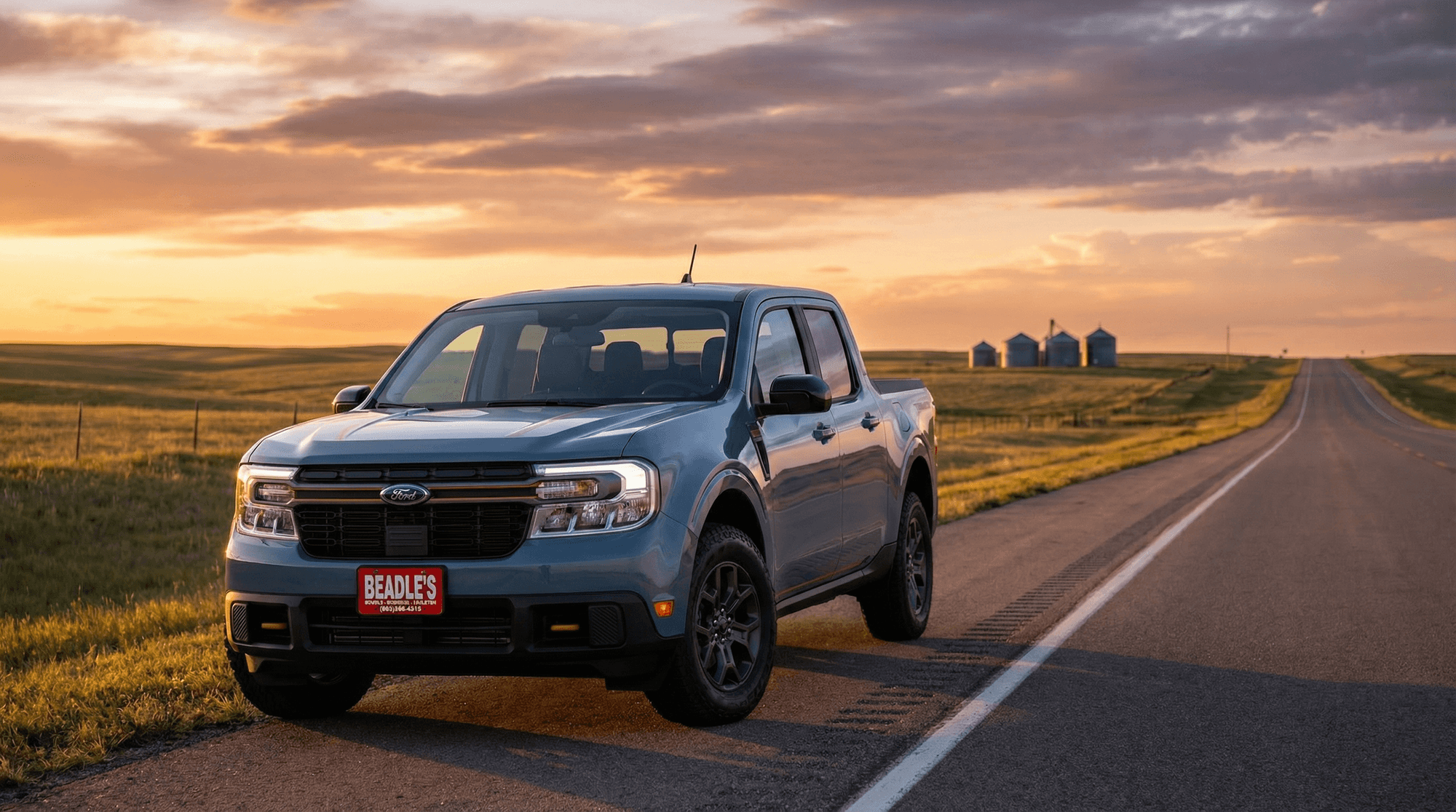
2026 Ford Maverick front three-quarter exterior

2026 Ford Maverick Towing Guide (What to Buy, What to Avoid)

Maverick towing success isn’t about hype—it’s about buying the right towing hardware for the trailer you actually pull. This guide breaks down the two towing equipment levels (basic hitch vs 4K Tow Package), what each includes, and the questions you should answer before you commit. If you’re still deciding AWD vs FWD and overall configuration, start here first: 2026 Maverick Specs & Configurations. For inventory and shopping support in one place, visit the Ford Maverick model page. Shop Mavericks in Stock Ask a Towing Question Table of Contents Step 1: Identify which towing “level” you need 2K Trailer Hitch (4-pin): what it’s for 4K Tow Package: what it includes (and why it matters) What to confirm on the exact truck before you buy How to choose the right Maverick for your trailer FAQ Step 1: Identify which towing “level” you need For 2026, the order guide makes it clear that Maverick towing equipment generally lands in one of two setups: a basic hitch for light trailers, or the full 4K Tow Package hardware for higher towing needs. The right choice depends on your trailer’s loaded weight, not the empty brochure number. Quick decision rule (real-world) Light utility trailer, occasional use: basic 2K hitch can be appropriate (depending on your actual load). Brake-equipped trailers or frequent towing: look for the 4K Tow Package because it adds a brake controller and higher-grade hitch/wiring. If you’re uncertain: it’s usually better to buy the right hardware now than “try to upgrade later.” 2K Trailer Hitch (4-pin): what it’s for The 2K hitch setup is a light-duty tow solution. In the order guide, it’s shown as a 2K Trailer Hitch Receiver with a 4-pin connector on various configurations. This setup is best for simpler trailers where you don’t need a brake controller integrated into the truck. Wiring: 4-pin connector (typical for trailer lights on lighter trailers). Best for: small utility trailers and light loads. Important restriction: the order guide notes the 2K hitch is not available with the 4K Tow Package —they’re different equipment paths. 4K Tow Package: what it includes (and why it matters) The 4K Tow Package is the towing setup most serious Maverick towers should focus on because it includes the critical hardware buyers try to add later. In the 2026 order guide, the 4K Tow Package includes: Trailer Brake Controller Trailer Hitch (Class III) 2” receiver with 4-pin and 7-pin connector Upgraded cooling components (engine-dependent): higher capacity radiator for 2.0L gas; transmission oil cooler for 2.5L Hybrid; upgraded cooling fan Conventional 17” spare tire (215/70R17) There’s also a practical ordering detail: on XL and XLT, the 4K Tow Package requires Ford Co-Pilot360. That matters if you’re trying to build a value trim with towing hardware. What to confirm on the exact truck before you buy If you want a specific answer (not “it depends”), this is the checklist that prevents towing regret. Confirm these on the actual truck you’re buying—window sticker + physical walkaround: Do you have the trailer brake controller? If your trailer has brakes, you generally want this integrated. Do you have a 7-pin connector? The 4K package includes 4-pin + 7-pin; the basic hitch is typically 4-pin only. Hitch class and receiver size: confirm Class III 2” receiver if you’re planning heavier towing. Payload sticker: towing isn’t only tow rating—payload limits tongue weight + people + gear. Trailer type reality: loaded trailer weight (not empty) and how often you tow in wind/winter. Quick Overview Best for 2K hitch Light towing, simpler trailers, occasional use Best for 4K Tow Package Frequent towing, brake-equipped trailers, higher confidence setup Most important check Brake controller + 7-pin connector + payload sticker on the exact truck How to choose the right Maverick for your trailer Write down your trailer type (utility, small camper, equipment, etc.). Estimate loaded trailer weight (cargo + fuel + water + tools + everything you actually carry). Decide if you need brakes (many trailers do—if yes, prioritize a truck with the brake controller). Choose towing hardware level: 2K hitch vs 4K Tow Package. Confirm payload sticker so tongue weight + passengers + bed cargo stays realistic. Shop Mavericks in Stock Get Help Matching a Trailer to a Maverick FAQ What’s the fastest way to tell if a Maverick has the 4K Tow Package? Check the window sticker/build sheet for “4K Tow Package,” then confirm you have a trailer brake controller and a 7-pin connector. The 4K package also uses a Class III 2” receiver. Can I order the 2K hitch and the 4K Tow Package together? No—these are different towing equipment paths. The order guide notes the 2K hitch is not available when the 4K Tow Package is selected. Does towing depend on trim (XL vs XLT vs Lariat)? Trim affects feature access, but towing readiness depends on the towing hardware on that specific build. For example, the 4K Tow Package on XL/XLT requires Ford Co-Pilot360—so equipment availability can vary by how the truck is configured. Why do payload and towing feel connected? Payload is what you can carry in the truck (people + cargo + accessories). Towing adds tongue weight and gear, which can eat into payload quickly. That’s why the payload sticker matters for towing confidence—especially with passengers in the cab. Conclusion In my experience, Maverick towing goes well when buyers shop the hardware first: brake controller, 7-pin, hitch class, and the right cooling support. If you buy the correct towing equipment up front, the truck feels calmer and more predictable—especially in South Dakota wind and winter conditions. About the Author: Lexy Tabbert works with South Dakota and North Dakota buyers who need practical answers on towing setups, winter capability, and long-term ownership. Her process is simple: match the towing hardware and payload reality to the trailer you actually use, then choose trim and features with confidence.

Close-up of the dual rear wheels on a 2027 Ford F-350 dually at blue hour

2027 Ford F-350 SRW vs. DRW: Which Rear-Wheel Setup Fits Your Trailer

Quick Answer On the 2027 Ford F-350, single-rear-wheel (SRW) tows up to 25,000 lbs conventional and is easier to drive and park daily; dual-rear-wheel (DRW, or dually) raises conventional towing to 28,000 lbs, adds stability under heavy loads, and is required to reach the 40,000-lb gooseneck maximum. Most buyers who don't run near the top of the range are well served by SRW. Single- versus dual-rear-wheel is the most important decision most 2027 F-350 buyers make — it shapes both how much the truck can safely handle and how it drives every day. And it's a decision plenty of buyers get backward, assuming they need a dually when they don't. Here's how SRW and DRW differ on the 2027 F-350, what each one fits, and how to decide based on the trailers you actually pull around Bowdle and Aberdeen. Shop F-350s in Stock Get Pre-Approved On This Page What's the difference between SRW and DRW? Which one fits your trailer? Does DRW change the towing and payload numbers? How does each drive day to day? How do you decide? What's the difference between SRW and DRW? Single-rear-wheel (SRW) has one tire on each side of the rear axle; dual-rear-wheel (DRW, or "dually") has two, for a wider rear footprint. That extra rubber spreads heavy loads over more contact area, which is why the dually carries higher ratings and feels more planted under a big gooseneck or fifth-wheel. The trade is everyday livability: a dually is wider, harder to park, and a bit more truck to run on gravel and in the yard. Neither is "better" — they fit different loads and different daily routines. Which one fits your trailer? Match the rear-wheel choice to the loads you pull most, not the heaviest you'll ever pull: Single-rear-wheel (SRW) is right for you if you tow goosenecks and fifth-wheels comfortably under the top of the range, run gravel and tight yards often, and want a truck that's easier to park and daily-drive — it still tows up to 25,000 lbs conventional. Dual-rear-wheel (DRW) is right for you if you regularly run a large gooseneck or fifth-wheel near the F-350's ceiling, want the calmest feel in crosswinds and on long hauls, or need the 40,000-lb gooseneck maximum. Does DRW change the towing and payload numbers? Yes. On the 2027 F-350, SRW tows up to 25,000 lbs conventional; DRW raises that to 28,000 lbs and, with the High-Output diesel and the 40K Gooseneck Tow Package, reaches the 40,000-lb gooseneck maximum (about 35,000 lbs fifth-wheel). The dually also typically carries higher payload for the heaviest hauling. Exact figures depend on cab, bed, axle, and engine. Our Recommendation For most ranch and farm buyers around Bowdle and Aberdeen, a single-rear-wheel 2027 F-350 covers the goosenecks they actually pull with margin to spare — and it's far easier to live with. Go dually when you routinely run heavy near the top of the range or need the 40,000-lb ceiling. Build the right one with our 2027 F-350 towing guide. How does each drive day to day? An SRW F-350 parks easier, fits a standard lane and most spots without a second thought, and is more forgiving on gravel and in the yard. A dually is wider at the rear, takes more room to maneuver, and rides a touch firmer unloaded — trades many heavy-haulers gladly make for the stability it adds under load. If the truck is also your daily driver, that everyday difference is worth weighing honestly. From the Beadle Ford Lot The most common F-350 question on our lot is still SRW vs. DRW — and plenty of buyers who walk in set on a dually leave in a single-rear-wheel truck once we look at their real trailer weight. A dually is the right call for the heaviest goosenecks, but it's more truck than most loads around here actually need. How do you decide? Four questions settle it: What's your heaviest trailer, loaded — and how often do you actually pull it? Is the truck a daily driver, or mostly a work and tow rig? Do you need the 40,000-lb gooseneck ceiling, or is comfortable margin enough? How important is easy parking and gravel/yard maneuvering to you? If the heaviest loads are occasional and daily ease matters, SRW usually wins. If you live near the top of the range, the dually earns it. Key Takeaways SRW tows up to 25,000 lbs conventional; DRW up to 28,000 lbs and the 40,000-lb gooseneck maximum. DRW adds stability and the highest ratings; SRW is easier to park, drive, and run on gravel. Match the choice to the trailer you pull most, with honest margin — not your once-a-year heaviest. Many F-350 buyers around here are well served by SRW. Go dually when you routinely run heavy or need the 40,000-lb ceiling. Frequently Asked Questions What does SRW vs. DRW mean on the 2027 F-350? SRW (single-rear-wheel) has one tire per side at the rear; DRW (dual-rear-wheel, or "dually") has two per side for a wider footprint. The dually spreads heavy loads over more contact area, carrying higher ratings and feeling more planted under big trailers. Do I need a dually F-350? Not for most trailers. A single-rear-wheel F-350 tows up to 25,000 lbs conventional and covers many goosenecks with margin. Choose a dually if you regularly run a large gooseneck or fifth-wheel near the top of the range, want the calmest feel under load, or need the 40,000-lb gooseneck maximum. How much more can a DRW F-350 tow than SRW? Conventional towing goes from up to 25,000 lbs (SRW) to up to 28,000 lbs (DRW). And only the dually, with the High-Output diesel and the 40K Gooseneck Tow Package, reaches the 40,000-lb gooseneck maximum. Is a dually harder to drive every day? A bit. A dually is wider at the rear, takes more room to park and maneuver, and rides slightly firmer unloaded. Many heavy-haulers accept that for the added stability; if the truck is also your daily driver, an SRW is easier to live with. Can I get the Carhartt Package on a dually? No — the new 2027 Super Duty Carhartt Package is available on single-rear-wheel trucks only. If you want the Carhartt look, that points you toward an SRW build. See our Carhartt Edition guide. Quick Answers: F-350 SRW vs. DRW One-line answers to the follow-up questions buyers ask next. What's a dually? A dual-rear-wheel truck — two tires per side at the rear. SRW conventional tow? Up to 25,000 lbs. DRW conventional tow? Up to 28,000 lbs. Which reaches 40,000 lbs gooseneck? DRW with the HO diesel and 40K package. Which is easier to park? SRW. Which is more stable under heavy loads? DRW. Do most buyers need DRW? No — SRW covers most trailers here. Is the ride different? A dually is slightly firmer unloaded. Carhartt Package on a dually? No — SRW only. How do I decide? Match it to the trailer you pull most, with honest margin. Keep Researching The complete 2027 Ford F-350 Super Duty overview — specs, towing, trims, and how to order. 2027 F-350 towing guide — full ratings by hitch type, engine, and rear-wheel setup. 2027 F-350 payload & upfit — where the dually's extra capacity matters most. 2027 F-350 engine comparison — pairing the right engine with your rear-wheel choice. My Take on SRW vs. DRW In my experience, the dually is the right truck far less often than people expect walking in. It's the call for the heaviest goosenecks and the most stability under load — but for the trailers most folks around here actually pull, a single-rear-wheel F-350 does the job with margin and is a lot easier to live with the other 360 days a year. Tell me your heaviest trailer and how often you pull it, and I'll help you land on SRW or DRW with confidence. Stop in at Beadle Ford in Bowdle or reach out anytime. Shop F-350s in Stock Get Pre-Approved About the Author Lexy Tabbert — Beadle Ford, Bowdle, SD Lexy Tabbert is the Director of Sales and Marketing at Beadle Ford in Bowdle, South Dakota. She covers Ford vehicles, trim comparisons, and buyer guidance — helping families, ranchers, and ag operators across the region find the right truck and configuration for their needs. Learn more about Lexy.

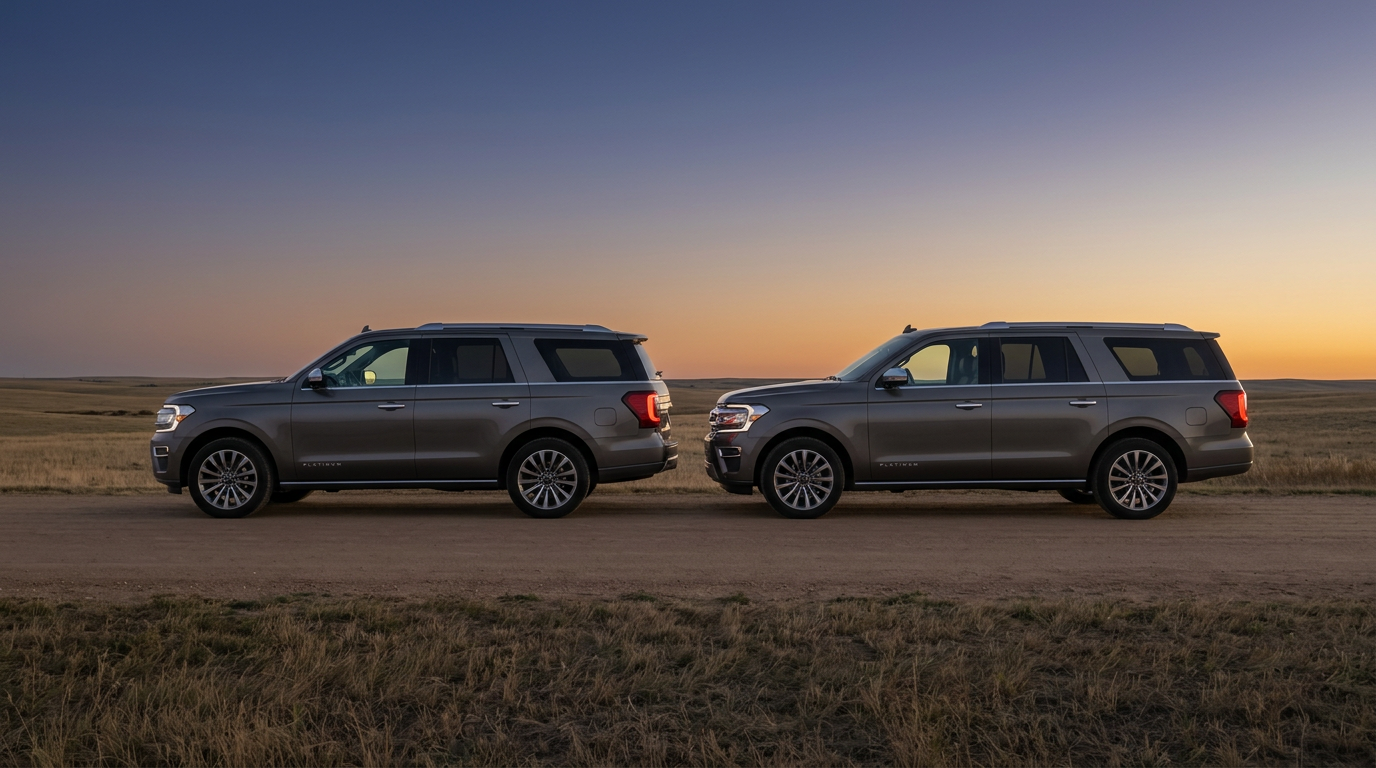
2027 Ford Expedition and Expedition MAX side by side at dusk showing the length difference, Beadle Ford Bowdle SD

2027 Ford Expedition vs. 2027 Expedition MAX: Which Body Style Fits Your Week (and Your Garage)?

Home› Ford Expedition› 2027 Ford Expedition› Expedition vs. Expedition MAX The 2027 Ford Expedition comes in two body styles: standard Expedition and Expedition MAX. Same sixth-generation platform, same engines, same technology, same Ford Co-Pilot360 Assist 2.0, same Ford Digital Experience. The MAX adds roughly a foot of wheelbase and overall length, and the difference ends up concentrated in one place — the cargo area behind the third row. For some buyers, that’s the whole decision. For others, it’s a meaningful trade-off against everyday parking and garage fit. This guide walks through what actually differs between the two body styles, which trims are available in MAX (and which are standard-length only), what’s new for Expedition MAX in 2027, how MAX changes everyday driving and parking, and which body style fits which buyer. The SD framing is direct: if your longest haul is Bowdle to Fargo with three kids and a week of gear, you might want MAX. If it’s Bowdle to Selby every Tuesday and one car seat, you probably don’t. Get Pre-Approved Browse Expedition Inventory On This Page What are the length, cargo, and seating differences? Which Expedition trims come in MAX — and why is Tremor standard-length only? What’s new for Expedition MAX in 2027? Will MAX fit your garage and everyday driving? Who should order MAX and who should stick with standard-length? What are the length, cargo, and seating differences? The MAX body style extends the Expedition by approximately 12 inches of wheelbase, with most of the added length going to the cargo area behind the third row. Both body styles share the same engine lineup (3.5L EcoBoost V6 standard, 3.5L EcoBoost V6 High Output at 440 hp / 510 lb-ft on select configurations), the same 10-speed automatic transmission, the same Ford Digital Experience with 24" panoramic and 13.2" center displays, and the same Ford Co-Pilot360 Assist 2.0 driver-assist stack. Cargo space. This is where MAX pays off. The cargo area behind the third row is meaningfully larger on MAX — the difference you notice when you’re packing a family of six for a week in the Black Hills or loading a full hockey-gear set of bags behind three rows of passengers. On the standard Expedition, behind-the-third-row cargo is more limited; on MAX, you can run the truck with the third row in place and still have real cargo room. With the third row folded, both body styles give you substantial cargo volume — MAX just gives you more of it. Seating. Both body styles preserve 7-passenger or 8-passenger configurations depending on trim and options. MAX doesn’t add a fourth row or different seating count — the extra length benefits cargo, not passenger count. Third-row legroom is similar between the two body styles; Ford designed both to support adult passengers in the third row. Dimensions. Overall length on the standard 2027 Expedition is close to an F-150 SuperCrew with a 6.5-foot bed; Expedition MAX is closer to an F-150 SuperCrew with an 8-foot bed. If your current vehicle is an F-150 SuperCrew, you have a useful reference point for what each Expedition body style will feel like in your driveway and on the road. For the complete 2027 Expedition lineup including engines, technology, and feature content, see the complete 2027 Ford Expedition overview. Which Expedition trims come in MAX — and why is Tremor standard-length only? MAX is available on XL (fleet-only), Active Select (200A), Active Touring (202A), Platinum (600A, including the 30th Anniversary Appearance Package), and King Ranch (400A). The Expedition Tremor is the only retail trim not offered in MAX — it’s standard-length only, 4x4 only. Ford’s engineering decision on Tremor makes sense once you look at the off-road geometry. The Tremor is the Expedition’s factory off-road trim — 3.73 Electronic Locking Rear Differential, seven drive modes including Rock Crawl, Trail Control with Trail One Pedal Drive and Trail Turn Assist, modified Raptor-style skid plates, and off-road-specific suspension. An extended wheelbase would compromise the departure angle, increase the risk of high-centering over ruts and crests, and make Trail Turn Assist’s tight-radius off-road maneuvering noticeably harder. Ford chose not to offer a length-compromised off-road Expedition — the Tremor stays standard-length to protect the capability. Practically, this creates a clear decision fork. If you need extended length, the Tremor is off the table — you’re picking from XL (fleet only), Active, Platinum, or King Ranch in MAX. If you need Tremor-level off-road capability, you’re in standard length. There’s no way to get both in a single truck, and no Expedition package or option fills that gap. For the full buyer’s guide on the Tremor — what it offers, who it’s built for, and how it compares to a Platinum Stealth Performance — see the 2027 Ford Expedition Tremor guide. For a trim-by-trim framework across the entire lineup, see the 2027 Ford Expedition Trim Levels guide. Ready to decide on MAX vs. standard length? See which body style is on the lot, or ask us to order the other one. Get Pre-Approved What’s new for Expedition MAX in 2027? The biggest MAX-specific change for 2027 is 4x2 configuration availability on MAX Platinum. Previously, MAX Platinum was 4x4 only. For 2027, Ford added 4x2 as an option — meaningful for buyers who want the MAX body style but don’t need four-wheel drive (a family hauler driven primarily on pavement for Fargo, Sioux Falls, or interstate commutes). The standard-length Platinum also became available in 4x2 for 2027 after previously being 4x4 only, but the MAX 4x2 configuration is the newer availability. The 30th Anniversary Appearance Package (91A) — new for 2027, Platinum-only — is available on both standard-length Expedition Platinum and Expedition MAX Platinum. When ordered on MAX, the “MAX” liftgate badge is finished in black to match the rest of the package styling. The three paint colors offered with the Anniversary Package (Agate Black Metallic, Star White Metallic Tri-Coat, Blue Ember Metallic) are available regardless of standard vs. MAX. Blue Ember Metallic is the exclusive-to-91A finish. Other 2027 changes apply across both body styles: the Ford Security Package newly optional on every trim, a laminated windshield standard across the lineup, three new paint colors (Bronze Fire Metallic Tri-coat, Nocturnal Blue Metallic, and Blue Ember Metallic for the Anniversary Package), and the Family Travel Package newly optional on Active Touring. For the complete list of 2027 model-year changes, see What’s New for the 2027 Ford Expedition. For the 30th Anniversary Appearance Package specifically, see 2027 Ford Expedition 30th Anniversary Appearance Package Explained. Will MAX fit your garage and everyday driving? Garage. Standard-length Expedition fits in most residential garages that accommodate a full-size pickup. Expedition MAX is roughly the length of an F-150 SuperCrew with an 8-foot bed — close to the edge of what a standard 22-foot residential garage can hold comfortably. If your garage is 24 feet deep, MAX fits without issue. If it’s shorter, bring your measurements when you come to Beadle Ford and we’ll confirm against the exact 2027 dimensions. Parking in town. A MAX takes up more of a parking stall than the standard Expedition does. For angled parking on a Main Street or in a tight lot, the extra length is real. In typical suburban or small-town parking, both body styles work without difficulty. If your daily driving involves frequent tight parking (a hospital lot, a school pickup line), the standard Expedition is easier to live with. Turning radius. MAX has a slightly wider turning radius than standard-length, reflecting the longer wheelbase. For most driving — rural roads, interstate, suburban streets — the difference is minor. For tight three-point turns in narrow farmyards or tight cul-de-sacs, the standard Expedition is more nimble. Highway drive quality. This is where MAX has a subtle advantage. The longer wheelbase generally delivers a slightly smoother ride on long interstate stretches because the body spans more of the pavement’s wavelength. For a family spending 6-8 hours on a road trip, that subtle smoothness adds up. Fuel economy. EPA ratings for both body styles are listed on each in-stock unit’s window sticker. In general, MAX’s additional mass and length result in slightly lower fuel economy than standard-length Expedition. The difference is small compared to the engine-choice variance within the lineup. Who should order MAX and who should stick with standard-length? The honest framing comes back to what you’re doing with the cargo area behind the third row. If you regularly run with the third row in use AND need substantial cargo behind it, MAX is the body style for you. If you either fold the third row most of the time (opening up both body styles’ full cargo volume) or travel lighter, standard-length works. Order Expedition MAX if: You regularly carry 6 or more passengers with their gear — family road trips, sports team runs, extended-family travel Your longest routine haul is Bowdle to Fargo (or equivalent) with kids and a full set of gear for a week You tow recreational gear (camper, boat) that fills a substantial trunk area and you want third-row passenger capacity at the same time Your garage is 24 feet deep or larger and tight parking is rare in your daily driving You want a MAX Platinum with the 30th Anniversary Appearance Package or the newly available 4x2 configuration Stick with standard-length Expedition if: Your third row gets used occasionally rather than weekly, and you typically fold it for cargo Your longest regular haul is Bowdle to Selby, Ipswich, or Aberdeen — shorter runs where standard-length cargo is enough You want the Tremor trim — MAX is not offered Your garage is tighter than 24 feet or you frequently park in narrow spaces You want the slightly more nimble turning radius for farmyard maneuvering or tight small-town driving Most Dakota buyers we see at Beadle Ford fall into the standard-length camp. That said, the growing-family and extended-travel case for MAX is real — if that’s your life, MAX is the right answer. Come see both body styles in person if you’re on the fence; the difference in cargo space is easier to feel in person than to describe. We’ll walk through your configuration against your actual week. Key Takeaways Expedition MAX adds about a foot of wheelbase and length, with most of the additional space going to cargo behind the third row. MAX is available on XL (fleet-only), Active Select, Active Touring, Platinum (including the 30th Anniversary Appearance Package), and King Ranch. The Tremor is standard-length only. Both body styles share the same platform, engines, transmission, technology, and driver-assist stack. Differences are physical dimensions and behind-third-row cargo. New for 2027 MAX: 4x2 Platinum availability (previously 4x4 only); the 30th Anniversary Appearance Package is available on MAX Platinum. MAX fits most residential garages 24 feet deep or larger; tight in 22-foot garages. Standard-length is more nimble in tight parking and small-town driving. Order MAX if you regularly run third row + gear; stick with standard-length if the third row is occasional and you value easier parking and garage fit. Frequently Asked Questions What’s the difference between the 2027 Ford Expedition and Expedition MAX? Expedition MAX adds approximately 12 inches of wheelbase and overall length to the standard Expedition, with the extra length going primarily to cargo volume behind the third row. Both body styles share the same platform, engines (3.5L EcoBoost V6 with a 440 hp / 510 lb-ft High Output option), 10-speed automatic, Ford Digital Experience, and Ford Co-Pilot360 Assist 2.0. Passenger count and third-row legroom are similar between the two. Which trims are available in Expedition MAX? For retail buyers: Active Select (200A), Active Touring (202A), Platinum (600A, including the 30th Anniversary Appearance Package), and King Ranch (400A). XL is fleet-only. The Tremor is the only retail trim not offered in MAX — it’s standard-length only. Why isn’t the Expedition Tremor available in MAX? Off-road geometry. The Tremor’s factory off-road capability relies on a tight departure angle, good break-over behavior, and Trail Turn Assist for tight-radius maneuvering — all of which would be compromised by an extended wheelbase. Ford chose to keep the Tremor standard-length so the off-road capability isn’t diluted. No Expedition Tremor MAX exists or is planned in the 2027 lineup. Can I order an Expedition MAX in 4x2 for 2027? Yes, newly for 2027. The 4x2 Platinum configuration on Expedition MAX is new for the 2027 model year (previously MAX Platinum was 4x4 only). This opens the MAX body style to buyers who want the extended cargo area without requiring four-wheel drive, which can lower purchase price and improve fuel economy. Does MAX have more seating than standard Expedition? No — both body styles offer the same 7-passenger or 8-passenger configurations depending on trim and options. MAX’s additional length benefits cargo volume behind the third row, not passenger count. Third-row legroom is similar between the two. Will Expedition MAX fit in my garage? Expedition MAX is roughly the length of an F-150 SuperCrew with an 8-foot bed — close to the edge of what a standard 22-foot residential garage can hold. In a 24-foot or deeper garage, MAX fits without issue. Bring your garage measurements to Beadle Ford and we’ll confirm against the exact 2027 Expedition and Expedition MAX dimensions. Is the 30th Anniversary Appearance Package available on MAX? Yes. The 30th Anniversary Appearance Package (91A) is available on both standard-length Expedition Platinum and Expedition MAX Platinum. When ordered on MAX, the liftgate “MAX” badge is finished in black to match the rest of the package styling. Available paint colors: Agate Black Metallic, Star White Metallic Tri-Coat, or Blue Ember Metallic (the exclusive-to-91A finish). My Take on the MAX Decision Most of the Expedition buyers I see at Beadle Ford go with standard length. It fits the Dakota driving pattern well — county gravel, interstate stretches, farmyard maneuvering, tight Main Street parking. The standard body style covers those use cases with no compromise. But for the families who are really running at the edge of what a three-row SUV can hold — six passengers with gear, teenage sports seasons, long weekends at the lake with everything loaded — MAX earns its keep. Those buyers know who they are. If you’re genuinely on the fence, stop in and we’ll put the two side-by-side on the lot. The cargo-area difference is easier to understand when you’re standing in it than when you’re reading about it. I’ll help you figure out which one actually fits your week. Shop 2027 Expeditions in Stock Contact Beadle Ford About the Author Lexy Tabbert — Beadle Ford, Bowdle, SD Lexy Tabbert is the Director of Sales and Marketing at Beadle Ford in Bowdle, South Dakota. She covers Ford vehicles, trim comparisons, and buyer guidance — helping families, ranchers, and ag operators across the region find the right truck and configuration for their needs. Learn more about Lexy.

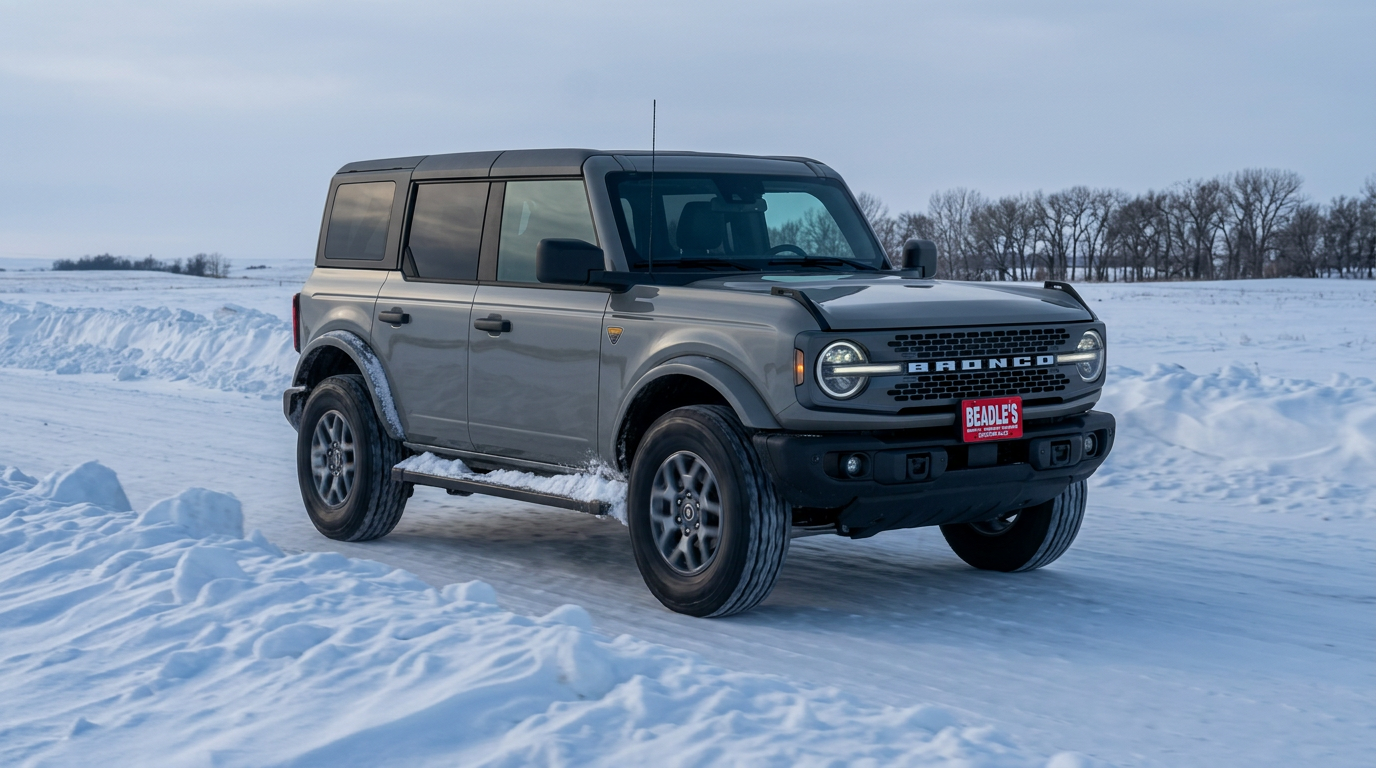
2026 Ford Bronco Badlands on a snow-packed central South Dakota section road in deep winter, drifted snow banks rising to the running boards

The 2026 Ford Bronco in South Dakota Winter: An Honest Look

Most reviews of the 2026 Ford Bronco are written by people who tested it in California or on a closed Michigan track. That's not the test that matters in central South Dakota. The real test is whether it starts at minus-twenty without a block heater, whether it tracks straight on a section line that drifts shut twice a week, and whether the soft top is anything other than a liability when the wind chill hits forty below. We sell Broncos to ranchers, hunters, and ag operators who hear the same questions every winter — so this is an honest take on how the 2026 Bronco actually performs through a real central SD winter. This guide covers the 4WD systems and what each setting is for, the soft-top trade-off in deep cold, heated seats and steering by trim, ground clearance against drifted snow and plowed banks, cold-weather practicality (block heater, battery, storage), and what the Bronco actually handles versus what it doesn't. There's no glossing over the rough edges — and there are a few. Shop Broncos in Stock Get Pre-Approved On This Page How Do 4-Auto, 4H, and 4L Work on Icy SD Section Roads? Can the Soft Top and Removable Doors Handle 30-Below Weather? Which Bronco Trims Get Heated Seats, Heated Steering, and Strong Defrost? Is the Bronco's Ground Clearance Enough for Drifted Snow and Plowed Banks? What Cold-Weather Practicality Should I Plan For — Block Heater, Battery, Storage? What Does the Bronco Handle on Plowed County Roads vs Unplowed Section Lines? How Do 4-Auto, 4H, and 4L Work on Icy SD Section Roads? On Broncos with the Advanced 4x4 system — Badlands, Heritage Edition, Raptor, and any trim equipped with the Sasquatch Package — 4-Auto is the setting you want for almost every central SD winter drive. It engages the front axle automatically when the rears slip, then disengages when grip returns, so you can leave it on for a 90-mile run that mixes plowed pavement, drifted gravel, and ice patches without thinking about transfer-case position. 4H is the manual-engagement setting for sustained low-traction surfaces — a packed snow section line, a long stretch of glare ice, the drive into a CRP gate that hasn't been plowed since November. It locks 50/50 torque split front to rear, which is exactly what you want when both axles need power but not what you want on dry pavement (parking-lot binding will let you know). The Base Bronco's standard 4x4 is part-time selectable engagement only — no 4-Auto, manual transfer-case shifts only — so 4H is the everyday winter setting on that trim. 4L is the deep-stuck setting. Wheel speed slows dramatically while torque goes up — the right combination for crawling out of a drift, climbing a snow-packed approach to a tree stand, or breaking through a wind-piled section-line drift you couldn't see coming. You won't use it on the highway. You'll use it three or four times a winter at most, but when you need it, nothing else does the job. For the full transmission and engine context see our 2.3L vs 2.7L EcoBoost engine comparison. Can the Soft Top and Removable Doors Handle 30-Below Weather? The honest answer most reviewers won't give: the soft top is functional in central SD winter, but for most of our customers it isn't the right call. A soft top loses cabin heat faster, lets road noise in at highway speed, and shows wear faster on a vehicle that lives outdoors through a Bowdle winter. If you're buying a Bronco that will be a year-round daily driver in SD, spec a hardtop and don't look back. Heritage Edition with the standard Oxford White-painted hardtop. For SD year-round use, a hardtop is the right answer. On the door side, the frameless removable doors do seal — there's no daylight visible at the seam — and the door-frame heater channels behave well at sub-zero temperatures. Where the design shows up is in noise: at 70 mph in a cross-wind on US-12 west of Bowdle, you hear more wind than you would in a comparable hardtop SUV from a unibody platform. Most owners get used to it within a month. A few never do. Door-removal in winter isn't really an option to plan around — by the time you'd want the doors off again, it's spring. The four to six months from May through early October is the realistic window for that, and we cover the full picture in our removable doors and roof guide. For winter, leave them on. Lock them on. Maybe forget you can take them off. Which Bronco Trims Get Heated Seats, Heated Steering, and Strong Defrost? Heated front seats and a heated steering wheel are available via the Mid Package on Big Bend (222A), Outer Banks (312A), and Badlands (332A), and they're typically included on Heritage Edition, Stroppe, and Raptor. If you're buying for SD winter use, the Mid Package is non-negotiable on Big Bend, Outer Banks, or Badlands — confirm it's on the build sheet before you sign. A heated steering wheel and heated front seats kill the cold while the cabin catches up. Confirm the trim and package before you sign — they're standard on some, optional on others. Defrost performance is where the Bronco surprises people. The HVAC system warms up faster than you'd expect from a body-on-frame SUV with a soft-top option in the lineup, and the windshield clears in a couple of minutes from a cold start. The rear defrost grid on the hardtop's swing-gate window works well; it's worth confirming you have it on whichever top you spec, since soft-top configurations have a different rear-glass setup. The 12-inch SYNC 4 display is standard on every trim including Base, which means remote start and climate pre-conditioning through the FordPass app are available across the lineup. On a January morning when it's minus-fifteen and the wind is picking up, walking out to a cabin that's already warming is the kind of small advantage that earns its money back fast. Trim-by-trim breakdowns are in our 2026 Bronco trim levels guide. Get Pre-Approved Contact Beadle Ford Is the Bronco's Ground Clearance Enough for Drifted Snow and Plowed Banks? A Badlands with the standard 33-inch Rugged-Terrain tires has approximately 8.8 to 9.0 inches of ground clearance — enough for the every-week winter scenarios in central SD: county-road drifts, plow-bank crossings into a driveway, an inch or two of fresh on top of packed gravel. A Bronco with the Sasquatch Package and 35-inch tires moves up to about 11.6 inches. The Raptor sits at roughly 13.1 inches on its 37-inch all-terrains. Where ground clearance starts to matter is the section-line scenario most central SD owners face: a road that hasn't been plowed in three days, with cross-drifts that rise to running-board height. A standard Badlands handles those drifts; a Sasquatch handles them more easily; an Outer Banks on 18-inch street-biased tires struggles. If you live ten miles outside Bowdle on a road that gets plowed once a week, the math points toward Badlands as the floor and Sasquatch as the upgrade if you can swing it. A practical note: plow banks at the end of a driveway are different from drifted snow on a section road. A plow bank is dense, often icy, and it'll grab a bumper if you hit it at speed. A drifted section road is loose powder until it isn't. Slippery mode handles both, but the actual ground clearance — not the tire size alone — is what carries you over. What Cold-Weather Practicality Should I Plan For — Block Heater, Battery, Storage? The 2.3L EcoBoost and 2.7L EcoBoost both start cold reliably without a block heater above zero, and most owners around Bowdle don't bother with one. Below zero — and especially below minus-twenty, which we hit several times most winters — a block heater shortens the warm-up cycle and puts less stress on the battery. It's a worthwhile add for a vehicle that lives outdoors all winter, and any service department can install one. The OEM battery has been reliable in our experience, but a Bronco that sits unstarted for a week in deep cold — common for a hunting rig that's parked between pheasant trips — benefits from a battery tender or a dual-battery setup if you run aftermarket lighting. The Bronco's available auxiliary upfitter switches (where equipped) make wiring a tender or a winter-only accessory cleaner than splicing into the main harness. Storage of the doors and panels is the other practical question if you've kept the soft-top option open for summer. Doors take up roughly the floor area of a closet; panels stack flat in a garage corner with the Ford-supplied storage bag. If you don't have garage space, plan to leave the hardtop on year-round and skip the soft-top configuration entirely. We've watched plenty of customers regret a soft-top order they made in July when February rolls around. What Does the Bronco Handle on Plowed County Roads vs Unplowed Section Lines? On a plowed county road in 4-Auto with 33-inch tires, the Bronco tracks straight at 60 mph with no drama. The body-on-frame chassis is heavier than a unibody crossover, which works in its favor on packed snow — the weight helps the tires bite. Cross-wind handling on US-83 or US-12 is on par with an F-150 SuperCrew of similar height, which is to say it's manageable but not invisible. On an unplowed section line with 6 to 12 inches of fresh, the Badlands or any Sasquatch-equipped Bronco walks through it without complaint in 4H or 4-Auto. Slippery mode dials throttle response back so you don't break traction on the gas pedal, and Trail Control (on automatic-transmission trims) is genuinely useful for a long deliberate crawl through deep stuff — set the speed, focus on steering. A standard Big Bend without the Black Diamond Package is more limited; it'll do most of what you ask, but it's not the right trim for an everyday section-line winter commute. Where the Bronco honestly doesn't shine: deep, heavy, wet snow at the end of a long driveway in a March melt. The vehicle is heavy enough that it can sink in slush rather than float over it the way a lifted side-by-side might. Approach speed and Slippery mode help; momentum is your friend. If you regularly cross 18-plus inches of heavy March slush, that's the use case where Sasquatch's 35-inch tires earn their upcharge — narrower contact patch, more bite, less flotation needed. All of this is clearer within the full 2026 Ford Bronco overview, where every trim's drivetrain, tire size, and package availability lays out side by side. Winter is the season that separates the right Bronco spec from the wrong one — looking at the lineup as a whole helps make the call. Key Takeaways 4-Auto is the everyday winter setting on Badlands, Heritage, Raptor, and any Sasquatch-equipped trim — set it and leave it. For year-round SD use, spec a hardtop. The soft top is functional but loses heat and shows wear faster outdoors. Heated front seats and a heated steering wheel come via the Mid Package on Big Bend, Outer Banks, and Badlands — don't skip it on a winter rig. 33-inch R/T tires (Badlands) clear the every-week winter scenarios in central SD; 35-inch tires (Sasquatch) earn their money on weekly unplowed section-line drifts. A block heater is worth installing on any Bronco that lives outdoors below zero. Battery tenders are smart for a vehicle that sits between hunting trips. Frequently Asked Questions Should I buy a soft-top Bronco for South Dakota winter use? For year-round SD use, no — spec a hardtop. The soft top is functional, but it loses cabin heat faster, lets in more highway noise at speed, and shows wear faster on a vehicle that lives outdoors through a Bowdle winter. If you're after a doors-off summer rig, the dual-tops option (soft top plus hardtop) lets you switch by season, but most owners just run the hardtop year-round. Does the 2026 Ford Bronco come with a block heater for cold starts? A block heater is not standard equipment, and it's an add we recommend for any Bronco that lives outdoors through a central SD winter. The 2.3L EcoBoost and 2.7L EcoBoost both start reliably above zero without one, but a block heater shortens the warm-up cycle and reduces battery stress in true cold. Any service department can install one as a dealer accessory. Is 4-Auto safe to leave on for the entire winter? Yes — 4-Auto on the Advanced 4x4 system is designed for exactly this use case. It engages the front axle automatically when traction is needed and disengages when it isn't, so it's safe on dry pavement, plowed roads, and mixed surfaces. 4-Auto is available on Badlands, Heritage Edition, Raptor, and any Bronco equipped with the Sasquatch Package; the Base Bronco's part-time 4x4 system doesn't include 4-Auto. Are heated seats standard on the 2026 Bronco? Heated front seats and a heated steering wheel are available via the Mid Package on Big Bend (222A), Outer Banks (312A), and Badlands (332A), and they're typically included on Heritage Edition, Stroppe Edition, and Raptor. Availability on the Base Bronco is more limited. For a winter daily driver, confirm the package is on the build sheet before you sign. Will a 2026 Bronco Badlands clear a typical SD plow bank at the end of a driveway? In most cases, yes — a Badlands on 33-inch Rugged-Terrain tires has approximately 8.8 to 9.0 inches of ground clearance, which handles typical end-of-driveway plow banks at a reasonable approach speed. A Sasquatch-equipped Bronco on 35-inch tires has about 11.6 inches and clears denser, taller banks more easily. The Raptor on 37-inch tires has roughly 13.1 inches. For all configurations, dense icy banks should be approached with momentum and Slippery mode engaged. Does the Bronco handle better than a lifted F-150 in heavy SD snow? Different strengths. A 4WD F-150 SuperCrew has a longer wheelbase that tracks well at highway speeds and a heavier curb weight that bites packed snow well. A Badlands or Sasquatch-equipped Bronco has a shorter wheelbase that maneuvers better in tight spots — section-line corners, narrow ranch gates — and tire options up to 35 or 37 inches. For long highway runs in heavy weather, the F-150 has the edge. For shorter drives that mix pavement and unplowed terrain, the Bronco usually wins. My Take on the 2026 Bronco as a South Dakota Winter Vehicle I'll say what most reviews won't: the Bronco is a real winter vehicle in central SD, but only if you spec it right. A Big Bend with the Mid Package and a hardtop will handle 95 percent of what a Bowdle-area owner faces in a winter. A Badlands with the Mid Package adds the front locker, the seven-mode terrain system, and 33-inch R/T tires that quietly do their job through a January cold snap. A Sasquatch-equipped build is for the buyer whose driveway is on the wrong side of a section line that doesn't get plowed for days at a time. None of those are the wrong call — they're three different answers to three different winter realities. What I'd steer customers away from is an Outer Banks on 18-inch street-biased tires as a year-round SD vehicle. It's a capable rig in three seasons; in February it asks for more than it should. If you're shopping a Bronco for winter use, come in and let's walk through trims, tops, and tire packages with the actual roads and driveway you drive in mind. That conversation usually saves a customer money and gets them the right rig the first time. Shop Broncos in Stock Get Pre-Approved About the Author Lexy Tabbert — Beadle Ford, Bowdle, SD Lexy Tabbert is the Director of Sales and Marketing at Beadle Ford in Bowdle, South Dakota. She covers Ford vehicles, trim comparisons, and buyer guidance — helping families, ranchers, and ag operators across the region find the right truck and configuration for their needs. Learn more about Lexy.

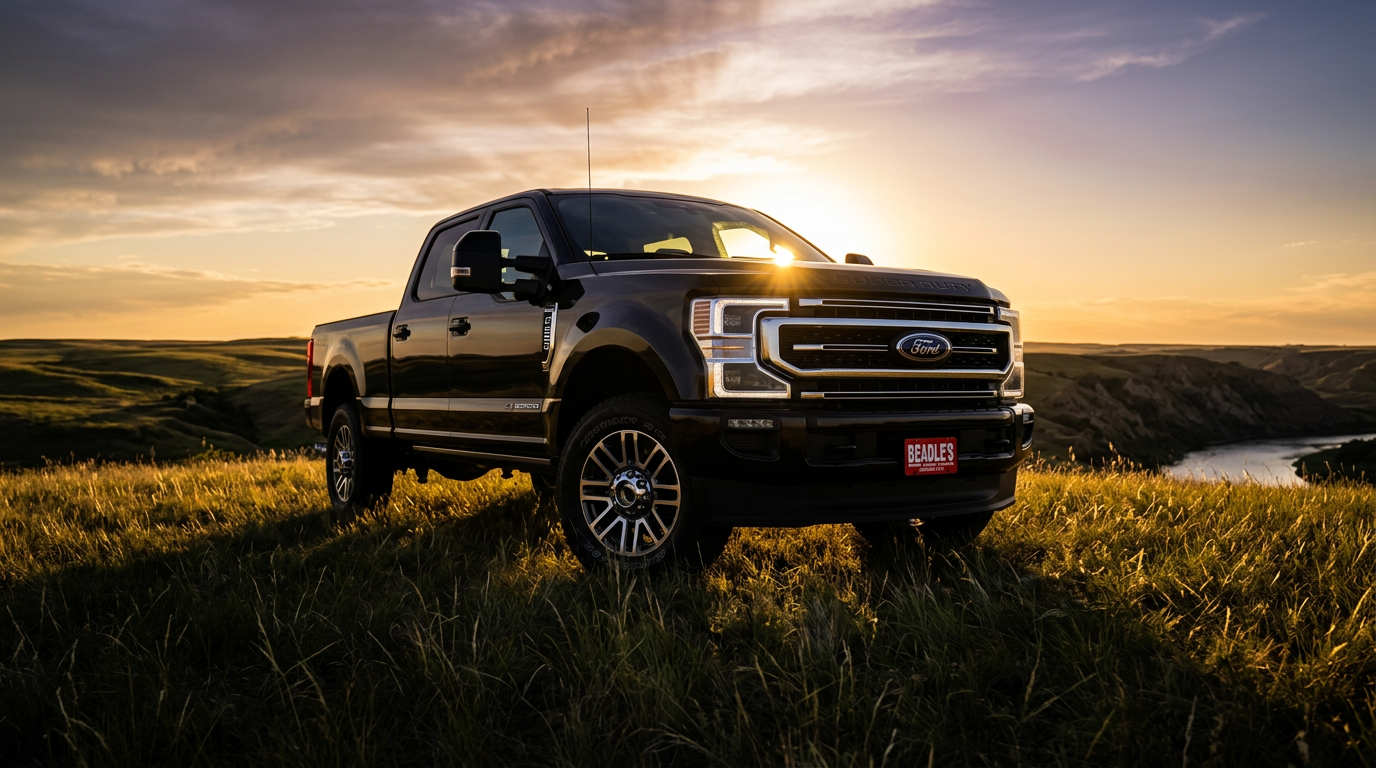
2027 Ford F-350 Lariat in Agate Black Metallic on a Missouri River bluff at golden hour

Buy a 2026 Ford F-350 Now or Order a 2027?

Quick Answer Buy a 2026 F-350 on the lot if you specifically want the 6.8L gas V8 or the standard-output 6.7L diesel — both are discontinued for 2027. Order a 2027 if you want the simplified two-engine lineup, the new Super Duty Carhartt Package, or Tremor on XL. Towing and payload are identical between the two years. With the 2027 F-350 changing more than any Super Duty in years, a lot of buyers are asking the same thing: grab a 2026 or 2027 that’s on the lot now, or order a 2027 to spec? The good news is the capability is the same either way — so the decision comes down to engine, timing, features, and price. Here's how to think it through for the way trucks get used around Bowdle and Aberdeen. Shop F-350s in Stock Get Pre-Approved On This Page The short answer What a 2026 still offers that 2027 doesn't What's better about ordering a 2027 Does the price change between years? How do you decide? The short answer It comes down to the engine you want and how soon you need the truck. The F-350's towing and payload are identical across 2026 and 2027, so neither year wins on capability — both tow up to 40,000 lbs gooseneck, properly equipped. What differs is which engines you can get, whether you buy off the lot or order, and the new-for-2027 features. Buy a 2026 now if you want the 6.8L gas or the standard-output 6.7L diesel, or you need a truck on the lot today. Order a 2027 if you want the simplified lineup, the Carhartt Package, Tremor on XL, the new 8-ft/176" HO bed, or a build configured exactly your way. What a 2026 still offers that 2027 doesn't The 2026 F-350 is the last model year for two engines: the 6.8L gas V8 and the standard-output 6.7L Power Stroke diesel. If you want either one — maybe the lower-cost gas base, or the standard-output diesel's balance of torque and price — a 2026 still on the lot is your last chance. A 2026 is also available now: no ordering and waiting. Browse what's in stock on the 2026 F-350 overview. What's better about ordering a 2027 The 2027 simplifies the lineup to the 7.3L gas (now standard on every trim) and the 6.7L High-Output diesel, and adds the new Super Duty Carhartt Package, Tremor availability on XL, and a new 8-foot bed / 176-inch wheelbase with the High-Output diesel. Ordering also means building the truck exactly to your spec — cab, bed, axle, SRW or DRW, trim, and packages. Our Recommendation If your heart's set on a specific 2026 engine, don't wait — those builds won't come back. Otherwise, ordering a 2027 to your exact spec is usually the better long-term buy, especially if you want the Carhartt look or Tremor on a work trim. Not sure which engine you'd even pick? Start with our 2027 engine comparison. Does the price change between years? It can — and the engine change is why. The 7.3L gas was an extra-cost upgrade over the base engine in 2026; for 2027 it's standard. That means a 2027's base price reflects the bigger gas engine that some 2026 buyers paid extra for. Pricing for the 2027s on our lot is on each window sticker — and it’s a real factor in the buy-now-vs-order math, alongside any incentives on remaining 2026 stock. From the Beadle Ford Lot The buyers happiest with their decision are the ones who got specific about the engine first. If someone wants the standard-output diesel, we point them at a 2026 today; if they're open to the new lineup, ordering a 2027 to spec almost always beats settling for whatever's on a lot. We'll run both numbers with you side by side. How do you decide? Four questions get you there: Do you specifically want an engine that's dropped for 2027 (6.8L gas or standard-output diesel)? If yes, buy a 2026. Do you need a truck now, or can you order and wait a few weeks for an exact build? Do you want any 2027-only features — Carhartt Package, Tremor on XL, the new HO bed config? How do the numbers compare — a configured 2027 vs. an in-stock 2026 with current incentives? Key Takeaways Capability is identical: 2026 and 2027 both tow up to 40,000 lbs gooseneck, properly equipped. A 2026 is the last chance for the 6.8L gas and the standard-output 6.7L diesel. A 2027 brings the simplified lineup, the Carhartt Package, Tremor on XL, and a build-to-order truck. Pricing can shift because the 7.3L gas went from an option to standard; exact 2027 prices TBD. Decide on the engine first — that usually settles which year to buy. Frequently Asked Questions Should I buy a 2026 F-350 now or order a 2027? Buy a 2026 if you want the 6.8L gas or the standard-output 6.7L diesel — both are gone for 2027 — or you need a truck now. Order a 2027 if you want the simplified lineup, the Carhartt Package, Tremor on XL, or a build configured exactly your way. Towing and payload are the same either year. Which engines are gone for 2027? The 6.8L gas V8 and the standard-output 6.7L Power Stroke diesel. For 2027, the 7.3L gas is standard on every trim and the 6.7L High-Output diesel is the only diesel. A 2026 on the lot is the last chance for the dropped engines. Does a 2026 F-350 tow less than a 2027? No — towing and payload are identical between the two years. Both tow up to 40,000 lbs gooseneck and carry up to about 7,900 lbs of payload, properly equipped. Capability isn't the deciding factor; engine, timing, features, and price are. Will a 2027 F-350 cost more than a 2026? Possibly. The 7.3L gas was an extra-cost option in 2026 and is standard for 2027, so a 2027's base price reflects the larger engine. Ford hasn't published final 2027 pricing yet — we'll compare a configured 2027 against an in-stock 2026 with current incentives when you're ready. How long does it take to order a 2027 F-350? Build-and-order timing varies with allocation and the configuration. Ordering gets you the exact spec if what you want is not on the lot; if you need a truck immediately, an in-stock 2026 or 2027 is the faster route. We'll give you a realistic timeline for your build. Quick Answers: 2026 vs. 2027 F-350 One-line answers to the follow-up questions buyers ask next. Same towing both years? Yes — up to 40,000 lbs gooseneck either way. What's only on a 2026? The 6.8L gas and the standard-output 6.7L diesel. What's new for 2027? Two-engine lineup, Carhartt Package, Tremor on XL, new HO bed. Is the 7.3L gas standard for 2027? Yes, on every trim. Want the standard-output diesel? Buy a 2026 — it's discontinued. Need a truck today? An in-stock 2026 is the fast route. Want an exact build? Order a 2027 to spec. Will 2027 cost more? Possibly — pricing TBD; the gas is now standard. Are there 2026 incentives? Often — we'll check current offers on remaining stock. How do I compare them? We'll run a configured 2027 vs. an in-stock 2026 side by side. Keep Researching The 2027 Ford F-350 Super Duty overview — what's new and how to order. The 2026 Ford F-350 overview — what's on the lot now, including the dropped engines. What's new for 2027 — every change, in detail. 2027 engine comparison — pick the engine that settles the decision. My Take on 2026 vs. 2027 In my experience, this decision gets easy the moment you name the engine. If it's one of the two the 2027 drops, a 2026 on the lot is the move and there's no reason to wait. If you're open to the new lineup, ordering a 2027 to your exact spec almost always beats settling — and you get the new features on top. Tell me how you use the truck and what you want under the hood, and I'll lay a 2026 and a 2027 side by side. Stop in at Beadle Ford in Bowdle or reach out anytime. Shop F-350s in Stock Get Pre-Approved About the Author Lexy Tabbert — Beadle Ford, Bowdle, SD Lexy Tabbert is the Director of Sales and Marketing at Beadle Ford in Bowdle, South Dakota. She covers Ford vehicles, trim comparisons, and buyer guidance — helping families, ranchers, and ag operators across the region find the right truck and configuration for their needs. Learn more about Lexy.

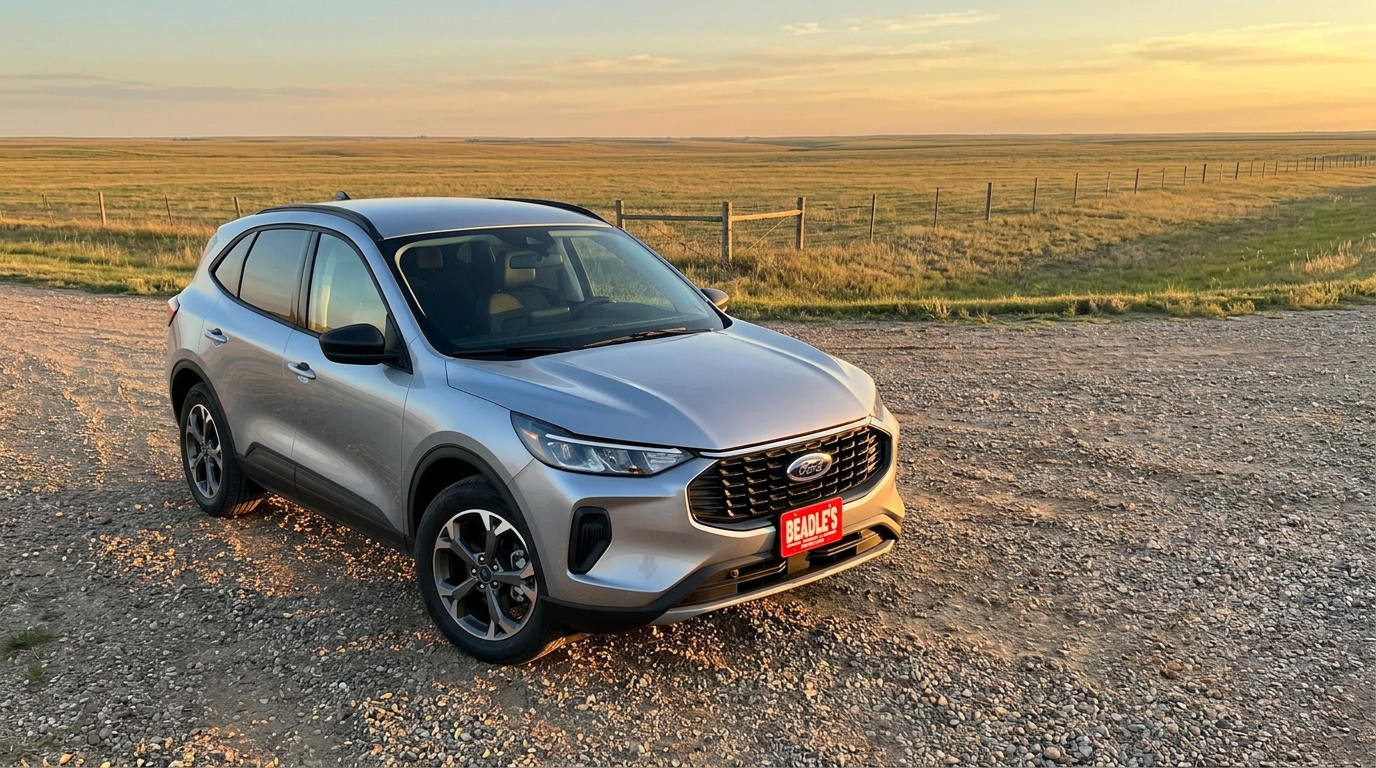
2026 Ford Escape and Ford Bronco Sport side by side in South Dakota

2026 Ford Escape vs. Ford Bronco Sport: Which One Should a South Dakota Buyer Choose?

Two Ford crossovers, similar footprint, very different orientation. The 2026 Ford Escape is a highway-capable crossover with hybrid powertrain options and a refined ride — built for efficiency and daily comfort. The 2026 Ford Bronco Sport is built around standard AWD and GOAT modes (Goes Over Any Type of Terrain), with more ground clearance and trail-specific capability across its lineup. For South Dakota buyers, the comparison usually comes down to three things: fuel economy, AWD standard vs. optional, and what your roads actually look like. This guide compares both vehicles directly across the factors that matter most for central South Dakota use: winter traction, daily practicality, long-distance efficiency, and real-world capability on gravel and county roads. Shop Escapes in Stock On This Page How Do the Escape and Bronco Sport Compare at a Glance? Which Has Better AWD and Winter Traction for South Dakota Roads? Is the Escape's Hybrid Option Worth Choosing Over the Bronco Sport's Gas Engine? How Do the Escape and Bronco Sport Compare for Day-to-Day South Dakota Use? Does It Matter That the 2026 Escape Is the Last Model Year? Which Vehicle Is the Right Choice for a South Dakota Buyer? How Do the Escape and Bronco Sport Compare at a Glance? Both are compact Ford crossovers, but they're built for different use cases. The Escape prioritizes efficiency and road comfort; the Bronco Sport prioritizes go-anywhere capability and standard AWD across the lineup. Category 2026 Ford Escape 2026 Ford Bronco Sport AWD Optional (lower trims) / Standard (Select, Elite, Platinum) Standard across lineup Powertrains Gas, Hybrid, PHEV Gas only Off-road modes None GOAT modes (5 modes) Ground clearance Lower (road-oriented profile) Higher (trail-capable profile) Fuel economy Up to ~39 mpg (Hybrid AWD) ~26–28 mpg combined (gas) (verify at fueleconomy.gov) Lineup future Discontinued after 2026 Continuing in Ford lineup The Escape is the more highway-oriented, efficiency-focused option. The Bronco Sport is the more capable choice for buyers who want AWD guaranteed regardless of trim and some off-road margin for gravel roads and field access. Both are available now at Beadle Ford in Bowdle. The complete 2026 Ford Escape overview covers all six Escape trims and configurations in detail. Which Has Better AWD and Winter Traction for South Dakota Roads? The Bronco Sport has the structural advantage here: AWD is standard across the entire lineup, and the Bronco Sport is built around GOAT modes — including a dedicated Slippery mode for low-traction surfaces — across its configuration. You can't accidentally take delivery of a Bronco Sport without AWD. The Escape's situation is more nuanced. On Active and ST-Line, AWD is optional — it has to be specified at the order stage or you'll receive an FWD unit. On ST-Line Select, Elite, and Platinum, AWD is standard and mandatory. The 2026 Escape's AWD system distributes torque to the rear axle when slip is detected, similar to how most modern crossover AWD systems work. What it doesn't have is the GOAT mode framework — there's no dedicated Slippery or Off-Road setting. For packed snow and gravel county roads, Escape AWD is competent. For soft shoulder work or field access, the Bronco Sport has more hardware working in its favor. The Bronco Sport also carries more ground clearance than the Escape, which is relevant on unimproved rural approaches and during spring breakup when road surfaces are unpredictable. For winter highway and gravel driving — which is the majority of central South Dakota use — both vehicles handle it. The Bronco Sport has the edge if you routinely drive on marginal surfaces or need that off-road margin. The full Escape AWD winter guide covers how the Escape system performs in South Dakota conditions specifically. Is the Escape's Hybrid Option Worth Choosing Over the Bronco Sport's Gas Engine? For buyers who log significant highway miles between Bowdle and larger cities, the Escape's 2.5L Hybrid AWD is a meaningful advantage. The Hybrid delivers approximately 39 mpg combined (verify at fueleconomy.gov), compared to approximately 26–28 mpg combined for the Bronco Sport's gas engine depending on trim. Over 15,000 miles per year, that gap adds up in a tangible way at the pump. The Bronco Sport doesn't offer a hybrid option — it's gas-only across the entire lineup in 2026. For buyers who want the Bronco Sport's AWD standard and off-road capability but also want improved efficiency, there's no hybrid path. The Escape offers that combination — 2.5L Hybrid AWD on Select, Elite, or Platinum gives you AWD standard, approximately 39 mpg combined, and the cold-weather feature set (heated seats, heated steering wheel, remote start) in one package. The trade-off: the Escape's eCVT transmission has a different feel from the Bronco Sport's 8-speed automatic. Neither is objectively better — it's a preference. The Bronco Sport's powertrain is tuned for confident low-end torque delivery on challenging terrain. The Escape Hybrid's eCVT is tuned for smooth, efficient highway operation. The right answer depends on which use case dominates your actual driving. Other Ford Models to Consider Not sure if Escape or Bronco Sport is right? These models are also available at Beadle Ford. Ford Explorer More interior room, 3-row option, AWD available. Shop Escapes in Stock Ford Maverick Compact truck with hybrid option and bed utility. Shop Escapes in Stock Ford Bronco Sport Standard AWD, GOAT modes, staying in Ford's lineup. Shop Escapes in Stock How Do the Escape and Bronco Sport Compare for Day-to-Day South Dakota Use? For typical daily use — highway driving, trips to Pierre or Aberdeen, grocery runs, school pickups — the Escape is the smoother, quieter daily driver. Its lower hood line gives better forward sightlines on highways, and the refined suspension tuning makes long South Dakota interstate stretches more comfortable. On-road ride quality is noticeably better than the Bronco Sport's more rugged setup. The Bronco Sport's more upright stance and rugged suspension tuning are an asset off pavement, but the stiffer ride is a real trade-off on long highway stretches. Cabin road noise is generally higher in the Bronco Sport compared to the Escape. The Bronco Sport's taller body also catches more wind on open prairie highway driving, which can affect both feel and fuel consumption in windy SD conditions. Both offer comparable interior space and cargo room for most family use cases. Technology features at comparable price points are similar — both offer SYNC 4, Co-Pilot360, and available heated seats at mid-trim levels. The Bronco Sport's standard roof rails and available auxiliary switches cater to buyers who outfit their vehicle with outdoor gear. The Escape's available 12.3" SYNC 4 screen at Elite and Platinum trims and the B&O audio option offer a more premium interior experience at the top of its lineup. Interior cargo room is close enough between the two that neither vehicle will feel like a compromise for grocery runs, school pickups, or weekend trips — both are two-row crossovers with similar footprints and neither is cramped for daily South Dakota use. Does It Matter That the 2026 Escape Is the Last Model Year? It matters for some things and not others. The 2026 Ford Escape is the final model year — Ford is not producing an Escape in 2027 or beyond. The Bronco Sport is continuing in Ford's lineup. If future parts availability or continued dealer familiarity with the model is important to your decision, that's a legitimate reason to weight the Bronco Sport. What doesn't change: warranty coverage and service support. A new 2026 Escape purchased from Beadle Ford comes with Ford's standard 3-year/36,000-mile bumper-to-bumper and 5-year/60,000-mile powertrain warranty exactly like any other new Ford vehicle. Parts supply for a recently discontinued model is typically strong for many years post-production — Ford produces large volumes of Escapes, and the parts ecosystem doesn't disappear the day production ends. Where it could matter practically: if you plan to keep the vehicle 10–15 years, the Bronco Sport's continuing production means ongoing OEM parts availability that a discontinued model eventually loses. If you're planning a 5–7 year ownership cycle and staying within the warranty and common parts window, the Escape's discontinuation is a lower concern. For buyers who want to buy a Ford crossover at this price point and keep their options open for future service familiarity, the Bronco Sport has the cleaner long-term story. Which Vehicle Is the Right Choice for a South Dakota Buyer? Choose the Escape if: you want hybrid fuel efficiency, you're doing primarily highway and gravel road driving, you're comfortable specifying AWD at order (or starting at ST-Line Select where it's standard), and you want the most comfortable long-distance ride. The 2.5L Hybrid AWD on ST-Line Select is one of the better combinations of AWD, efficiency, and cold-weather readiness available at this price point — and the 2026 is the last year you can buy it new. Choose the Bronco Sport if: AWD guaranteed without having to think about it matters more than fuel economy, you occasionally need more ground clearance or off-road margin for field access and unimproved roads, you want a vehicle that stays in Ford's active lineup, or the rugged exterior aesthetic fits your preference. The Bronco Sport's standard AWD removes the order-time AWD question entirely — every unit off the lot is equipped for South Dakota conditions. The decision usually comes down to how much you value fuel economy versus guaranteed off-road margin, and whether the Escape's final model year status changes your calculus. The Escape trim levels guide covers which Escape configurations deliver AWD standard if that's the direction you're leaning. Key Takeaways The Bronco Sport has AWD standard across its entire lineup; the Escape has AWD optional on lower trims and standard only on ST-Line Select, Elite, and Platinum. The Escape's 2.5L Hybrid AWD delivers approximately 39 mpg combined — significantly better than the Bronco Sport's gas-only powertrain at approximately 26–28 mpg combined. The Bronco Sport offers GOAT modes and more ground clearance, making it more capable on marginal surfaces, unimproved roads, and field approaches common in rural SD. The Escape is the smoother, quieter highway vehicle — the Bronco Sport's rugged suspension is an asset off-road and a trade-off on long interstate stretches. The 2026 Escape is the final model year; the Bronco Sport is continuing in Ford's lineup — relevant for buyers with long ownership horizons or concerns about long-term parts availability. Frequently Asked Questions Is the Ford Bronco Sport AWD standard on every trim? Yes — AWD is standard across the Ford Bronco Sport lineup in 2026. The Bronco Sport is built around GOAT modes (Goes Over Any Type of Terrain) including a Slippery mode for low-traction surfaces across its configuration (verify current trim-level availability at ford.com). This is in contrast to the Escape, where AWD is optional on Active and ST-Line trims and must be specified at order, and standard only on ST-Line Select, Elite, and Platinum. Does the Ford Bronco Sport have a hybrid option? No — the 2026 Ford Bronco Sport is gas-only. It is available with a 1.5L EcoBoost three-cylinder on most trims and a 2.0L EcoBoost four-cylinder on the Badlands. There is no hybrid or plug-in hybrid option. The 2026 Ford Escape offers a 2.5L non-plug-in Hybrid AWD and a 2.5L PHEV, making the Escape the efficiency-focused option for buyers comparing the two. Is the 2026 Ford Escape being discontinued? Yes — the 2026 Ford Escape is the final model year. Ford has discontinued the Escape nameplate; there will be no 2027 Escape. A new 2026 Escape purchased from Beadle Ford carries Ford's standard 3-year/36,000-mile bumper-to-bumper and 5-year/60,000-mile powertrain warranty, the same as any other new Ford vehicle. The Bronco Sport is continuing in Ford's lineup beyond 2026. Which is better for South Dakota winters — the Escape or the Bronco Sport? Both handle South Dakota winters well when properly equipped. The Bronco Sport has the structural advantage — AWD is standard on every unit and GOAT modes include a Slippery setting for low-traction surfaces. The Escape's AWD system is capable on packed snow and gravel, but requires specifically ordering AWD on Active and ST-Line trims to avoid taking delivery of an FWD unit. Starting at ST-Line Select, the Escape's AWD is standard. The Bronco Sport also carries more ground clearance, which is useful on unimproved roads during spring breakup. What is the towing capacity of the Ford Bronco Sport? The Ford Bronco Sport is rated at approximately 2,000 lbs towing capacity on most trims with a trailer tow package. The Badlands trim with its 2.0L EcoBoost engine and available tow package steps up to approximately 2,200 lbs. For comparison, the 2026 Ford Escape with the 2.0L EcoBoost AWD and Class II factory tow package is rated at 3,500 lbs. Verify current figures for both vehicles at ford.com or with a Beadle Ford sales associate, as tow ratings can vary by configuration. My Take on the Escape vs. Bronco Sport Decision for South Dakota Buyers I've had this conversation quite a bit lately, and it tends to split pretty clearly. Buyers who do most of their driving on paved highways and gravel roads and want the best fuel economy usually end up with the Escape Hybrid AWD — the efficiency advantage on long SD drives is real, and ST-Line Select packages the winter-ready features together cleanly. Buyers who want AWD without having to think about it, or who occasionally need that extra ground clearance for field access and rough approaches, usually land on the Bronco Sport. The Escape being the final model year is worth taking seriously if you're a long-term keeper. For a five-year ownership window, it matters less — the warranty coverage is identical and parts are widely available for recently discontinued models. But if you plan to drive it for 12 years, the Bronco Sport's continuing lineup is a reasonable tie-breaker. If you want to drive both back to back and see which one fits your actual use — that's honestly the best way to make this call. Stop by Beadle Ford in Bowdle and we'll pull both out for you. Shop Escapes in Stock About the Author Lexy Tabbert — Beadle Ford, Bowdle, SD Lexy Tabbert is the Director of Sales and Marketing at Beadle Ford in Bowdle, South Dakota. She covers Ford vehicles, trim comparisons, and buyer guidance — helping families, ranchers, and ag operators across the region find the right truck and configuration for their needs. Learn more about Lexy.

2026 Ford F-150 SYNC 4 touchscreen display

2026 Ford F-150 Technology & Interior Guide

The 2026 Ford F-150 integrates advanced infotainment, driver assistance systems, and interior refinement features that elevate it beyond traditional work-truck expectations. This guide explains available technology, interior materials, connectivity features, and comfort upgrades. For trim-by-trim availability and engine pairing, see the full 2026 Ford F-150 overview. Contact Beadle Ford Table of Contents What Is SYNC 4? Does the F-150 Have a Digital Instrument Cluster? Is BlueCruise Available? What Is the Ford Connectivity Package? What Is Pro Power Onboard? Interior Materials by Trim Does the F-150 Offer a Mobile Office Setup? How to Choose the Right Technology Package What Is SYNC 4 on the 2026 F-150? SYNC 4 is Ford’s advanced infotainment system. It supports touchscreen functionality, smartphone integration, voice recognition, and over-the-air update capability. Depending on trim, the F-150 may feature a large center touchscreen display with split-screen capability for navigation, media, and vehicle settings. Feature availability varies by trim and equipment group, which is outlined in our F-150 Trim Levels Guide. Does the 2026 F-150 Have a Digital Instrument Cluster? Yes. Select trims offer a fully digital instrument cluster that replaces traditional analog gauges. This display can present navigation prompts, towing information, off-road data, and customizable vehicle information. Cluster availability varies by trim and equipment group. Is BlueCruise Available on the 2026 F-150? Available on select trims, BlueCruise is a hands-free highway driving assistance feature designed for compatible divided highways. It uses camera and radar systems to help maintain lane position and adaptive speed control. Feature availability and subscription requirements depend on trim and package selection. What Is the Ford Connectivity Package? The available Ford Connectivity Package enhances data-based services, navigation functionality, and connected features through Ford’s digital ecosystem. Buyers considering advanced connected features should review package requirements alongside their selected trim. What Is Pro Power Onboard? Pro Power Onboard provides integrated electrical outlets in the truck bed, allowing drivers to power tools, appliances, and jobsite equipment directly from the vehicle. This feature is especially valuable for contractors, outdoor recreation users, and rural property owners. Engine pairing and output levels may vary depending on configuration. How Do Interior Materials Differ by Trim? Interior finishes vary significantly across the lineup. XL / STX: Durable cloth-focused interiors XLT: Upgraded materials with expanded tech availability Lariat: Premium seating surfaces and refined finishes King Ranch / Platinum: High-end materials and distinctive trim accents Raptor: Performance-focused interior styling For a full breakdown of trim positioning, see our F-150 Trim Levels Guide. Does the 2026 F-150 Offer a Mobile Office Setup? Yes. Select configurations offer a fold-flat work surface in the center console, creating a stable workspace for laptops, paperwork, and tablets. Combined with available connectivity features and Pro Power Onboard, this setup allows the truck to function as a mobile workspace. How to Choose the Right Technology Setup Determine whether advanced driver assistance is a priority. Identify if onboard power is needed for work or recreation. Consider how much time is spent commuting or traveling long distance. Match desired features to trim and equipment groups. Key Takeaways SYNC 4 supports modern infotainment and connectivity features. Digital clusters are available on select trims. BlueCruise availability varies by configuration. Pro Power Onboard enhances jobsite and recreational flexibility. Interior refinement increases significantly at higher trims. Frequently Asked Questions Does every 2026 F-150 include a large touchscreen? Screen size and feature availability vary by trim and equipment group. Is BlueCruise standard? No. It is available on select trims and may require specific packages or subscription activation. Can Pro Power Onboard run power tools? Yes. Output capability depends on configuration and engine pairing. Conclusion In my experience, technology decisions should support how the truck will actually be used. For some buyers, advanced driver assistance features are essential for long highway drives. For others, onboard power and mobile workspace functionality provide more real-world value. Choosing the right setup means aligning features with daily routines rather than simply selecting the highest trim. View current 2026 F-150 technology-equipped models at Beadle Ford or contact us to compare trim features. About the Author Lexy Tabbert provides research-driven vehicle guidance and truck configuration insights for drivers across South Dakota and the surrounding region.

2026 Ford Expedition MAX extended wheelbase side profile

2026 Ford Expedition vs. Expedition MAX: Which One Is Right for You?

The 2026 Ford Expedition and Expedition MAX share the same engine, the same trim lineup, and the same core technology. The difference between them comes down to one thing: the MAX is about a foot longer, and that extra length changes what the vehicle can do for you day to day. This guide walks through every meaningful difference — cargo space, towing, trim availability, seating, garage fit, and the one thing buyers often overlook — so you can decide which configuration actually fits your life. Shop Expeditions in Stock Get Pre-Approved On This Page Side-by-side specs: what actually changes? How much more cargo space does the MAX actually add? Does the MAX tow less than the standard Expedition? Which trims are available on each wheelbase? Is the passenger experience different in the MAX? Will the MAX fit in my garage? Which one should you choose? FAQ Side-by-side specs: what actually changes between Expedition and Expedition MAX? Most specs are identical — same engine, same horsepower, same axle options, same technology. The differences are limited to body dimensions, towing capacity, and one trim exclusion. Here's everything in one table. Expedition (SWB) Expedition MAX Overall length ~210 in. ~221.9 in. Engine 3.5L EcoBoost® V6 — identical on both Standard horsepower 400 HP (standard) / 440 HP (High Output — Tremor® or optional Platinum packages) Transmission 10-speed automatic with SelectShift® — identical on both Max tow — 4x4 w/HDTT 9,600 lbs 9,000 lbs Max tow — 4x2, no HDTT 6,000 lbs 6,300 lbs Cargo — behind 3rd row 22.9 cu. ft. 37.4 cu. ft. Cargo — all rows folded 108.5 cu. ft. 123.1 cu. ft. Passenger seating 7 or 8 passengers — same on both Tremor® available Yes — SWB only No Active, Platinum, King Ranch® SWB and MAX SWB and MAX Drivetrain options 4x2 or 4x4 (Active); 4x4 only (Tremor®, Platinum, King Ranch®) Source note: Towing figures from Ford's official 2026 Expedition Towing Guide (SAE J2807® method). Trim availability confirmed from the 2026 Expedition Order Guide. Exterior dimensions and cargo volumes are manufacturer-published specifications; fuel economy figures are TBD per the order guide and will be updated when EPA ratings are released. How much more cargo space does the MAX actually add? The ~12-inch longer body translates to approximately 15 additional cubic feet behind the third row — the space that matters most when all three rows are occupied and you still need to carry gear. With rows folded, the MAX adds roughly 15 cubic feet over the standard Expedition. Expedition (SWB) 22.9 cu. ft. behind 3rd row (all seats up) 108.5 cu. ft. all rows folded flat Expedition MAX 37.4 cu. ft. behind 3rd row (all seats up) 123.1 cu. ft. all rows folded flat The difference behind the third row is significant. The standard Expedition offers around 23 cubic feet with all seats up — enough for a few bags and a cooler. The MAX jumps to 37.4 cubic feet, which means a full row of luggage, a large stroller, sporting equipment, or a week's worth of gear without folding any seats. What ~15 extra cubic feet behind row 3 actually holds A full-size double stroller without folding 3–4 large checked-bag-size rolling suitcases upright Two large sporting equipment bags (hockey, lacrosse, wrestling) A loaded dog crate (large breed) without encroaching on the third row A week of groceries for a family of 7 — without Tetris If your third row is occupied most of the time and you regularly carry cargo behind it — sports gear, strollers, hunting equipment, travel luggage — the MAX pays for itself in daily convenience. If your third row is folded more often than not, the additional cargo space is largely redundant because both vehicles provide an enormous flat floor when the seats are down. Does the Expedition MAX tow less — and does it matter? Yes — the MAX tows 600 lbs less than the SWB on the 4x4 configuration. Per Ford's official 2026 Expedition Towing Guide, the SWB 4x4 with HDTT is rated at 9,600 lbs and the MAX 4x4 with HDTT is rated at 9,000 lbs. Both require the 3.73 rear axle and HDTT package to reach their respective maximums. Configuration Max Tow GCWR SWB 4x4 — 3.73 axle w/HDTT 9,600 lbs 15,900 lbs MAX 4x4 — 3.73 axle w/HDTT 9,000 lbs 15,900 lbs SWB 4x2 — 3.31 axle, no HDTT 6,000 lbs 12,000 lbs MAX 4x2 — 3.31 axle, no HDTT 6,300 lbs 12,500 lbs For most buyers in this region pulling a two-horse trailer, a bumper-pull camper, or a boat in the 5,000–8,500 lb range, both configurations are comfortably within their rated limits. The 600 lb difference only matters if you're regularly towing near the absolute ceiling — say, a fully loaded four-horse LQ trailer pushing 9,000+ lbs. For a full breakdown of all towing configurations, requirements, and real-world trailer scenarios, see the 2026 Expedition Towing Guide. Which trims are available on each wheelbase? The most important trim-availability difference: the Tremor® is only available on the standard wheelbase (SWB). If you want the Tremor®, you're getting the standard Expedition — the MAX body is not available on that trim. All other trims offer both wheelbases. Trim SWB Available MAX Available Notes Active ✓ Yes ✓ Yes 4x2 or 4x4 Tremor® ✓ Yes ✗ Not available 4x4 only Platinum ✓ Yes ✓ Yes 4x4 only King Ranch® ✓ Yes ✓ Yes 4x4 only The Tremor® exclusivity to the SWB is a meaningful constraint for buyers who want both off-road capability and maximum cargo space. That combination isn't available in a single vehicle — a Tremor® buyer is getting the standard wheelbase, period. For full trim details, see the 2026 Expedition Trims & Packages guide. Is the passenger experience different in the MAX? Passenger seating capacity is identical — both wheelbases seat 7 or 8 depending on second-row configuration. The extra length in the MAX goes to cargo space behind the third row, not to the passenger cabin itself. Third-row legroom and second-row space are the same in both. Seating configurations — identical on SWB and MAX Active Select (200A): 8-passenger bench standard, captain's chairs optional Active Touring (202A): 7-passenger captain's chairs standard, 8-passenger bench optional Tremor® (501A): 7-passenger captain's chairs standard, 8-passenger bench optional — SWB only Platinum (600A): 7-passenger captain's chairs standard, 8-passenger bench optional (not available with Stealth packages) King Ranch® (400A): 7-passenger captain's chairs only — bench not available on either wheelbase The key distinction: if you frequently carry 7 passengers and need cargo space behind the third row at the same time, the MAX is the vehicle for that use case. If you have 7 passengers occasionally and fold the third row most of the time, the standard Expedition's 108 cubic feet of flat floor is more than adequate. For car-seat families: both wheelbases offer the same LATCH anchor and tether coverage. The Expedition leads its class in lower anchor and top tether availability across all three rows — and that's not changed by wheelbase selection. Will the Expedition MAX fit in my garage? This is the question that decides it for more buyers than they'd expect. The MAX at approximately 221.9 inches long is just over 18.5 feet. Many standard two-car garages are 20–22 feet deep, but clearance matters — you need room to walk around the vehicle and open the Split Gate liftgate fully. Vehicle Length Min. Recommended Garage Depth Expedition SWB ~210 in. (17.5 ft.) ~20 ft. with clearance Expedition MAX ~221.9 in. (18.5 ft.) ~21–22 ft. recommended Before you order a MAX Measure your garage depth from the closed door to the back wall. Standard garage doors open overhead and reclaim 12–18 inches of that depth. If your actual usable depth is under 21 feet, the MAX may not give you comfortable clearance to fully open the liftgate. Measure first — don't assume. Parking lot and drive-through clearance is the same consideration. The MAX is noticeably longer in tight turns, multi-level parking structures, and ranch or farm lane situations. Most buyers adapt quickly, but if you regularly park in constrained environments, the SWB is the easier daily driver. Which one should you choose? The decision usually comes down to how you use the third row. Here's a straightforward decision framework based on the real differences between these two vehicles. Choose the Expedition MAX if: Your third row is occupied regularly and you still need to carry cargo behind it You have a large family (4+ kids) and routinely pack sports gear, strollers, or luggage You take long road trips with all seats full and need space for a week of bags You want Platinum or King Ranch® and the extra cargo is valuable to you Your garage comfortably accommodates 22 feet or longer Choose the standard Expedition (SWB) if: You want the Tremor® — it's only available on the SWB Your third row is folded more often than occupied You want maximum towing capacity (9,600 lbs vs. 9,000 lbs) Your garage, parking, or daily route rewards a shorter footprint You're towing near the upper limit and need every pound of rated capacity The honest summary For most families in this part of South Dakota, the standard Expedition handles the daily load — including towing and cargo — without the added length. The MAX earns its premium when your third row is regularly occupied and cargo behind it matters. If you're ever torn, come to Beadle Ford and spend 15 minutes actually loading your real gear into both. The right answer usually becomes obvious fast. Frequently Asked Questions What is the difference between the Expedition and Expedition MAX? The Expedition MAX is the extended-wheelbase version of the standard Expedition — approximately 12 inches longer overall. That extra length adds roughly 15 cubic feet of cargo space behind the third row. Everything else — engine, transmission, seating capacity, trim options, and most dimensions — is shared between the two. The Tremor® off-road trim is the one exception: it's available on the SWB only, not the MAX. Does the Expedition MAX seat more passengers than the standard? No — both wheelbases seat 7 or 8 passengers depending on second-row configuration. The extra length in the MAX goes to cargo space behind the third row, not to passenger room. Third-row and second-row space are the same in both vehicles. Can I get the Tremor® in an Expedition MAX? No. Per the 2026 Expedition Order Guide, the Tremor® is only offered on the standard wheelbase (SWB). There is no Expedition MAX Tremor®. Active, Platinum, and King Ranch® are all available on both wheelbases. Is the MAX harder to drive and park than the standard Expedition? The MAX is 12 inches longer, which is noticeable in tight turns, parking structures, and narrow lanes. Both vehicles come with a 360-degree camera and Pro Trailer Hitch Assist™ (with HDTT), which help significantly. Most buyers adapt to the size quickly. The practical concern is garage fit — if your garage is under about 21 feet deep, the MAX may be tight for liftgate clearance. Which gets better fuel economy — the Expedition or Expedition MAX? The 2026 Expedition's official EPA fuel economy figures are listed as TBD in the Ford order guide at the time of this writing and will be updated when EPA ratings are released. Historically the standard SWB has rated slightly higher in city driving due to the lighter body; highway numbers have been essentially equivalent between the two. Check the window sticker for final EPA estimates on any specific vehicle. How much more does the Expedition MAX cost than the standard? Pricing varies by trim, configuration, and market. Contact Beadle Ford directly for current MSRP on specific configurations — we'll pull the exact numbers on any build you're considering. You can also browse current inventory at the link below. My Take: SWB vs. MAX When buyers ask me which one they should get, my first question is always: do you use that third row as actual seating, or as a shelf? If the answer is "mostly a shelf," the standard Expedition is a cleaner choice — easier to park, rated for 600 more pounds of towing, and available in the Tremor® if off-road matters to you. If you have four kids and at least two of them regularly ride in the third row, the MAX starts making real sense. Not because the third row is bigger — it isn't — but because the cargo you need to carry with everyone aboard actually fits without a game of Tetris every time you leave the house. Garage fit is the thing I remind buyers to check before they leave. I've had more than a few people order the MAX, fall in love with it, and then spend a weekend reorganizing their garage. Measure your depth, account for the door track overhead, and make sure you can open the liftgate all the way without hitting the back wall. For the full picture on trim options, available packages, and what comes standard at each level, the 2026 Ford Expedition overview at Beadle Ford covers it all. Come see us in Bowdle or reach out — we're happy to spec out both wheelbases side by side for you. Shop Expeditions in Stock Get Pre-Approved Contact Beadle Ford About the Author Lexy Tabbert — Beadle Ford, Bowdle, SD Lexy Tabbert covers Ford vehicles, trim comparisons, and buyer guidance for Beadle Ford in Bowdle, South Dakota. Her content is grounded in real buyer conversations with families, ranchers, and ag operators across the region. Learn more about Lexy.
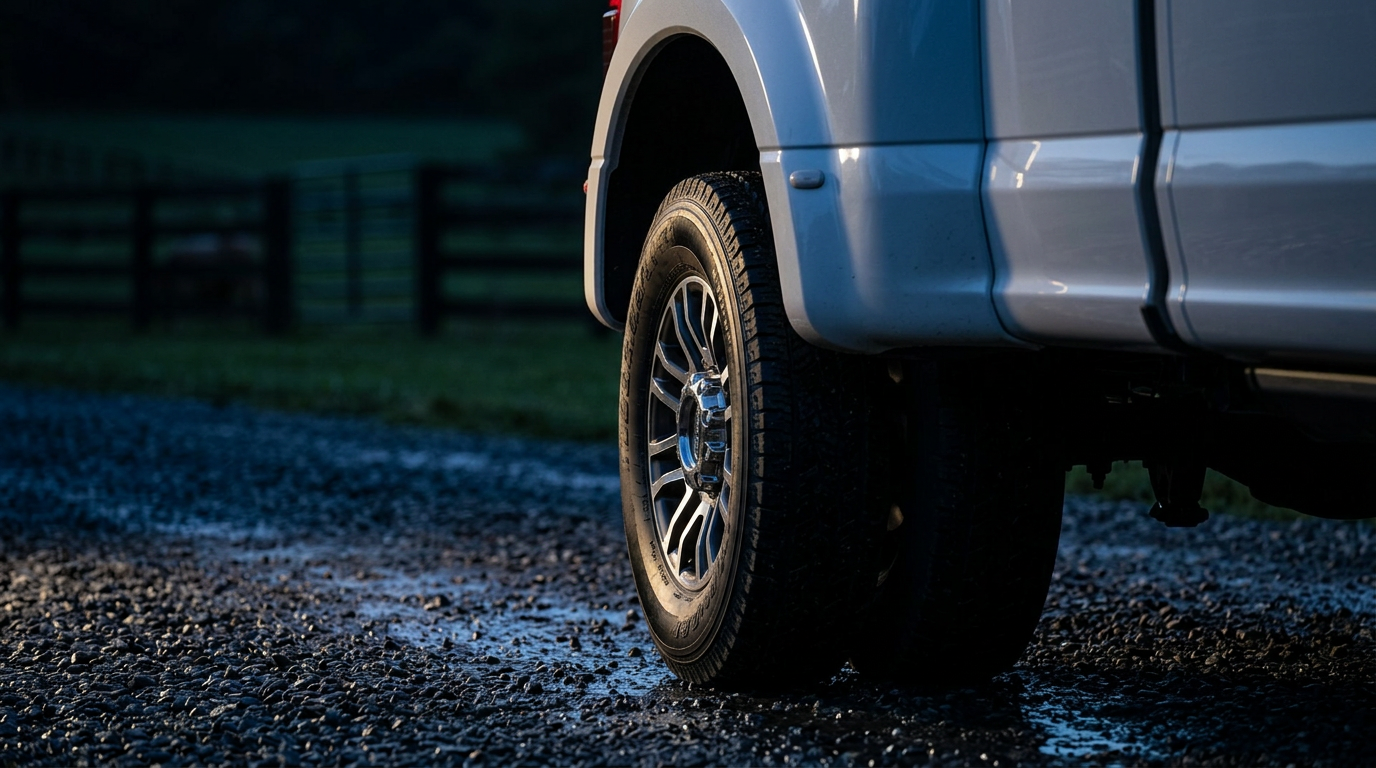
2026 Ford Bronco Sport Heritage with Oxford White roof and retro styling in South Dakota

The 2026 Ford Bronco Sport Heritage: White Roof, Plaid Seats, A/T Tires Standard — Who This Trim Is Actually Built For

The 2026 Ford Bronco Sport Heritage is the most visually distinctive trim in the lineup — and the most misunderstood. Buyers see the Oxford White contrasting roof and the plaid seats and assume it's a fashion trim built for looks and nothing more. But the Heritage also comes standard with all-terrain tires, retro-inspired exterior cues drawn from the original 1966 Bronco, and unique color combinations you can't get on any other trim. Here's what actually sets the Heritage apart, who it's built for, and whether it belongs on your short list. Shop Bronco Sports in Stock Get Pre-Approved In This Guide What Makes the 2026 Bronco Sport Heritage Different From Every Other Trim? Is the Oxford White Roof Standard or an Option? Are the Heritage's A/T Tires Enough for Off-Road Use? Heritage vs. Heritage Limited: What Do You Actually Get for the Upgrade? Heritage vs. Outer Banks: Same Price Range, Very Different Character Who Is the 2026 Bronco Sport Heritage Actually Built For? What Makes the 2026 Bronco Sport Heritage Different From Every Other Trim? The Heritage trim occupies a unique spot in the Bronco Sport lineup. It's positioned above Big Bend but below Outer Banks in terms of features, yet it stands out from both because of its deliberate throwback styling — drawing direct visual cues from the first-generation Ford Bronco that debuted in 1966. What makes the Heritage distinctly its own: Heritage-Exclusive Feature What Makes It Unique Oxford White Contrasting Hardtop Roof Standard on every Heritage — not an option, not an upgrade; the white roof is built into the trim identity Plaid Cloth Seat Inserts Tartan plaid pattern referencing the original Bronco's interior; not available on any other Bronco Sport trim Heritage Badging Distinctive "Bronco" script fender badges and retro-styled exterior badging Unique Exterior Color Combinations Heritage-exclusive two-tone body colors not offered on other trims, including Robin's Egg Blue and Yellowstone Metallic All-Terrain Tires Standard A/T tires included at the base Heritage trim level — Big Bend uses highway-terrain tires Body-Color Front Fender Flares Matched to body paint rather than black; contributes to the Heritage's distinct two-tone look No other Bronco Sport trim gets the plaid seats or the white roof as a standard feature. They aren't options you can add to a Big Bend or Outer Banks — they exist only on the Heritage and Heritage Limited trims. If this look appeals to you, these are the only two ways to get it. Is the Oxford White Roof Standard or an Option? The Oxford White contrasting roof is standard on the Heritage. It's not an option you select, and it's not something you can delete from the build. Every 2026 Bronco Sport Heritage leaves the factory with the white hardtop, regardless of which body color you choose. This is an important detail for buyers who see the Heritage at a dealer and wonder whether they can order one in a single solid color without the white roof — the answer is no. The two-tone look is fundamental to the trim's identity, not an add-on. The body-color exterior combined with the Oxford White roof is what creates the Heritage's visual personality, and it's styled to echo the early Broncos that came in two-tone white-over-body-color schemes. In practice, this works well with most of the Heritage's available body colors. Ford specifically curated the Heritage's color palette to complement the white roof, so combinations like Eruption Green with white, Robin's Egg Blue with white, and Yellowstone Metallic with white all look intentional rather than mismatched. If you want a Bronco Sport without the white roof, the Big Bend, Outer Banks, or Badlands trims give you standard solid or monochromatic roof options. Are the Heritage's A/T Tires Enough for Off-Road Use? The Heritage comes with P225/60R18 all-terrain tires as standard equipment — the same A/T compound found on several of the higher trims. This is a meaningful upgrade over the Big Bend's highway-terrain tires, which prioritize ride comfort and fuel economy over grip on loose or slick surfaces. What the Heritage's A/T tires help with versus what they don't: A/T Tires Help With... Gravel roads and two-track pasture lanes Light trail use and forest roads Snow and ice traction in South Dakota winters Wet grass and soft ground near water or fields Muddy access roads after spring rain A/T Tires Won't Replace... Advanced 4x4 with twin-clutch torque vectoring (requires Sasquatch or Badlands) HOSS 2.0 off-road suspension for technical terrain Trail Control for low-speed technical obstacles Rock Crawl mode calibration (Badlands exclusive) The Heritage's 4x4 system is the standard configuration — capable and reliable for the vast majority of off-pavement use in South Dakota, but not the same as the Advanced 4x4 twin-clutch system on the Outer Banks Sasquatch or Badlands. For buyers who need a capable crossover that handles gravel lanes and winter roads between Bowdle and the next town over, the Heritage's standard 4x4 and A/T tires are genuinely well-suited. For buyers planning serious rock-crawling or technical trail runs, the Badlands is the more appropriate tool. The key point: the Heritage is more capable in real-world South Dakota conditions than its retro styling might suggest — the A/T tires are a functional upgrade, not just an aesthetic detail. Heritage vs. Heritage Limited: What Do You Actually Get for the Upgrade? The Heritage Limited is the premium version of the retro-themed lineup. Both share the signature Oxford White roof and plaid seat identity, but the Limited adds a meaningful set of interior and technology upgrades. Feature Heritage Heritage Limited Oxford White Contrasting Roof Standard Standard Plaid Seat Inserts Cloth plaid Plaid with premium trim A/T Tires Standard Yes Yes Heated Front Seats Not standard Available Remote Start Not standard Available Upgraded Wheels Standard alloys Premium finish alloys 12.3" Digital Cluster Display Not standard Available Exclusive Color Options Heritage palette Heritage + Limited-exclusive colors The Heritage Limited is the better fit if you're buying the Heritage primarily for the retro look but want the comfort features — especially heated seats and remote start — that make a Bowdle winter more bearable. If the base Heritage's price point is the draw and you don't need the cold-weather comfort features, the standard Heritage delivers the same visual personality at a lower entry price. Heritage vs. Outer Banks: Same Price Range, Very Different Character The Heritage Limited and the Outer Banks land in a similar price bracket, which means buyers often find themselves choosing between them. They're very different vehicles in terms of personality and feature priorities. Priority Heritage / Heritage Limited Outer Banks Retro / throwback styling Designed for it Modern styling Premium audio (B&O) Not available Available Panoramic fixed glass roof Not available Available Unique plaid seats + white roof Standard Not available Upgrade path to Sasquatch Package Not available Available (with Tech Package) Heritage-exclusive color palette Yes No The Heritage wins on personality and uniqueness. The Outer Banks wins on upgrade flexibility and premium interior options. If you're drawn to the Heritage because of the way it looks, that's a completely valid reason — there's no other Bronco Sport that gives you that aesthetic. If you're drawn to it for practical capability, just be aware that the Outer Banks with the Sasquatch Package can go significantly further off-road when properly equipped. Who Is the 2026 Bronco Sport Heritage Actually Built For? The Heritage is a confident choice for a specific kind of buyer. It's not trying to be the most capable off-road vehicle in the lineup, and it's not trying to be the most loaded-up comfort cruiser. It's built for buyers who care about how their vehicle looks, value individuality, and want a capable daily driver that handles South Dakota's roads without being a cookie-cutter crossover. The Heritage Is the Right Pick If You... Love the original Bronco's look and want that lineage reflected in your vehicle Want a Bronco Sport that looks genuinely different from every other one on the road Drive gravel or dirt roads regularly and want A/T tires without paying for full off-road hardware Want a two-tone color combination that works out of the factory — no custom paint needed Are buying for yourself, not for what someone else thinks is the most "capable" trim Want the Heritage Limited's cold-weather features (heated seats, remote start) at a mid-range price The Heritage is not the right fit if your primary goal is maximum off-road performance — the Badlands does that more effectively. It's also not the right fit if premium audio or a panoramic roof are top priorities — those belong to the Outer Banks. But for buyers who want something that turns heads at the trailhead and at the grocery store equally, the Heritage delivers that in a way none of the other trims can match. For more detail on where every trim sits in terms of standard features, pricing, and drivetrain options, our full 2026 Bronco Sport trim comparison guide breaks it all down side-by-side. Key Takeaways The Oxford White contrasting roof is standard on every 2026 Bronco Sport Heritage — it's not an option and cannot be deleted from the build. Plaid cloth seat inserts are Heritage and Heritage Limited exclusive — they are not available on any other Bronco Sport trim. The Heritage comes standard with all-terrain tires, which is a functional upgrade over Big Bend's highway-terrain tires for gravel roads and South Dakota winters. The Heritage uses the standard 4x4 system — the Advanced 4x4 with twin-clutch torque vectoring requires the Sasquatch Package (Outer Banks only) or Badlands trim. Heritage Limited adds heated seats, remote start, upgraded wheels, and additional technology features — worth the step-up for buyers who need cold-weather comfort in South Dakota. The Heritage is built for buyers who value retro character and visual uniqueness — not for those optimizing for maximum off-road performance or premium interior luxury. Frequently Asked Questions Can I get a Bronco Sport Heritage without the white roof? No. The Oxford White contrasting hardtop is standard on every 2026 Bronco Sport Heritage and Heritage Limited. It's a defining feature of these trims and cannot be removed or replaced with a body-color roof. If you want a Bronco Sport without the white roof, the Big Bend, Outer Banks, and Badlands are your options. Are the plaid seats available on other trims? No. The tartan plaid seat inserts are exclusive to the Heritage and Heritage Limited trims. They cannot be added to the Big Bend, Outer Banks, or Badlands through any package or option. If the plaid seats are part of your decision, these two trims are the only way to get them. Is the Heritage more capable off-road than Big Bend? The Heritage comes with all-terrain tires as standard, while the Big Bend uses highway-terrain tires. That A/T tire difference gives the Heritage a meaningful advantage on gravel, loose terrain, and snow. However, both trims share the same standard 4x4 system — neither has the Advanced 4x4 with twin-clutch torque vectoring found on the Outer Banks Sasquatch and Badlands. For light to moderate off-road use, the Heritage is better equipped than Big Bend. For technical trail work, the Badlands is a more capable platform. What colors are available on the Heritage? The Heritage is available in a curated palette that includes Heritage-exclusive colors such as Robin's Egg Blue, Yellowstone Metallic, and Eruption Green, in addition to some colors shared across the lineup. All Heritage colors are paired with the Oxford White hardtop roof. Confirm specific color availability for the current model year with our team, as production cuts can affect availability on lot versus order. Does the Heritage come with heated seats? Heated seats are not standard on the base Heritage trim. They are available on the Heritage Limited through its available packages. If heated seats are a priority for South Dakota winters, the Heritage Limited or the step up to Outer Banks are the paths to get them configured into your build. My Take on the Heritage for Bowdle Buyers The Heritage is the Bronco Sport I'd point you toward if you've been staring at the same five gray crossovers in every parking lot and want something that looks like it has a point of view. The white roof is polarizing — some buyers love it immediately, others aren't sure what to make of it. But once you see it in Robin's Egg Blue with the white top, you either get it or you don't. What I appreciate from a practical standpoint is that the A/T tires are standard — so you're not sacrificing capability to get the retro look. On the gravel roads between here and the next county line, that matters. The Heritage Limited adds enough cold-weather features to make it a comfortable year-round daily driver in South Dakota without a lot of package stacking. For a full breakdown of how the Heritage stacks up against every other Bronco Sport trim in the 2026 lineup, our 2026 Ford Bronco Sport guide at Beadle Ford has the full comparison with pricing and standard features for each trim level. Shop Bronco Sports in Stock Get Pre-Approved Contact Us About the Author Lexy Tabbert Lexy Tabbert is an automotive content writer and researcher at Beadle Ford in Bowdle, SD. She covers Ford lineup updates, trim comparisons, package guides, and regional buying content to help South Dakota shoppers make confident decisions. She has strong opinions about two-tone roof color combinations and is not sorry about it.

2027 Ford F-250 on a working ranch in South Dakota

Is an F-250 Enough Truck? (2027 Ford F-250)

Quick Answer For most buyers, the 2027 Ford F-250 is enough truck. As a single-rear-wheel three-quarter-ton it tows up to 23,000 lbs gooseneck (diesel) and carries up to about 3,700 lbs of payload, properly equipped — plenty for daily driving, recreational towing, and ranch work. Step up to the F-350 mainly for a dually or maximum payload. "Do I need an F-350, or is the F-250 enough?" is the question we hear most from heavy-duty shoppers. The honest answer for the large majority of buyers around here is that the F-250 is plenty — and stepping up to a one-ton usually solves a problem you don't actually have. This guide lays out what a 2027 F-250 handles day to day, exactly how much it tows and hauls, the specific cases where an F-350 earns the upgrade, and whether a three-quarter-ton is too much truck for a daily driver. Shop F-250s in Stock Reserve a 2027 F-250 Get Pre-Approved On This Page What can a 2027 F-250 handle day to day? How much can it tow and haul? When would you actually need an F-350? Is the F-250 too much truck for a daily driver? What can a 2027 F-250 handle day to day? Just about everything a non-commercial owner throws at a truck: hauling in the bed, plowing snow, running gravel roads, and towing campers, boats, stock trailers, and the occasional gooseneck. With the now-standard 7.3L gas V8 and available 4x4, it's a genuine heavy-duty truck without the bulk of a one-ton dually. Around Bowdle and Aberdeen, that covers the way most people actually use a Super Duty: a capable work-and-family truck during the week, a tow vehicle on the weekend, and a snow-and-gravel machine all winter. The single-rear-wheel setup keeps it easy to drive and park while still carrying serious payload. How much can it tow and haul? Properly equipped, a 2027 F-250 tows up to about 19,500 lbs on a fifth-wheel or gooseneck with the 7.3L gas, and up to 23,000 lbs gooseneck with the 6.7L High-Output diesel and the High-Capacity Axle Upgrade. Payload reaches up to about 3,700 lbs. Put that in real terms: a typical fifth-wheel camper, a loaded tandem stock trailer, or a skid steer on a deckover all sit comfortably within an F-250's range. You'd have to be pulling a genuinely heavy gooseneck — the kind that's near the top of the rating every trip — before the F-250 runs out of truck. 2027 F-250 capability Properly equipped Max gooseneck towing Up to 23,000 lbs (HO diesel) Max fifth-wheel towing Up to 22,100 lbs (HO diesel); ~19,500 lbs (gas) Max conventional towing Up to 22,000 lbs (HO diesel); 18,200 lbs (gas) Max payload Up to about 3,700 lbs Maximums require proper equipment and vary by cab, bed, axle, engine, and configuration. When would you actually need an F-350? Step up to the F-350 when you need a dual-rear-wheel (dually) setup, the highest payload, or you routinely run heavy gooseneck and fifth-wheel loads near the top of the range. The F-350 adds DRW stability, more payload headroom, and a higher tow ceiling — up to 40,000 lbs gooseneck when properly equipped. If that's not you, the extra capability is capability you'll pay for and rarely use. The dually is wider, harder to park, and less convenient as a daily driver. Most buyers who think they need a one-ton are buying for the heaviest day they can imagine rather than the load they actually pull. Stay with the F-250 if you tow campers, boats, stock trailers, or an occasional gooseneck, and you want an easy daily driver. Step up to the F-350 if you need a dually, run heavy goosenecks weekly, carry maximum payload, or want the 40,000-lb tow ceiling. Is the F-250 too much truck for a daily driver? No. A single-rear-wheel F-250 drives, parks, and lives like a normal full-size truck — it's the dually F-350 that gets cumbersome as a daily. With the comfort of a Lariat or Platinum cab and the 7.3L gas, plenty of owners run an F-250 as their everyday vehicle. The trade-off versus a half-ton F-150 is ride and fuel: the heavier-duty suspension rides a little firmer unloaded, and a big gas V8 isn't sipping fuel. For buyers who tow with any regularity, that's a fair trade for the capability and the smoother manners when there's a trailer behind you. Our Recommendation For the large majority of buyers around Bowdle and Aberdeen, the 2027 F-250 is the right truck — it tows up to 23,000 lbs gooseneck and carries up to about 3,700 lbs, which covers daily driving, recreational towing, and ranch work. Only move up to the F-350 if you genuinely need a dually, maximum payload, or routinely tow heavy goosenecks. From the Beadle Ford Lot A lot of folks come in convinced they need a one-ton, and once we walk through what they actually pull, most of them land on an F-250 and are happier for it — easier to drive every day, less money out the door, and still more capability than they use. The buyers we send to the F-350 are the ones who already know they need a dually. Key Takeaways The 2027 F-250 tows up to 23,000 lbs gooseneck (diesel) and carries up to about 3,700 lbs of payload. That covers daily driving, recreational towing, and ranch work for the large majority of buyers. Step up to the F-350 only for a dually, maximum payload, or routine heavy gooseneck towing. A single-rear-wheel F-250 drives and parks like a normal full-size truck — not too much for a daily driver. Frequently Asked Questions Is the 2027 F-250 enough truck for ranch work? For most operations, yes. The F-250 tows up to 23,000 lbs gooseneck and carries up to about 3,700 lbs of payload, which handles stock trailers, hay, feed, and equipment. You'd step up to an F-350 mainly for a dually or to routinely pull the heaviest goosenecks. What's the difference between the F-250 and F-350? The F-250 is a single-rear-wheel three-quarter-ton; the F-350 is a one-ton offered in single- and dual-rear-wheel (dually) form. The F-350 adds payload headroom, dually stability, and a higher tow ceiling (up to 40,000 lbs gooseneck). The F-250 is easier to drive daily. Can an F-250 tow a fifth-wheel camper? Yes. The F-250 tows up to about 19,500 lbs fifth-wheel with the 7.3L gas and up to 22,100 lbs with the High-Output diesel, properly equipped — enough for the large majority of recreational fifth-wheel campers. Is an F-250 hard to drive every day? Not really. A single-rear-wheel F-250 drives and parks like a normal full-size truck. The ride is a touch firmer than a half-ton when unloaded, but it's an easy daily driver — it's the dually F-350 that gets cumbersome in town. Quick Answers: Is an F-250 Enough? One-line answers to the follow-up questions buyers ask next. Max gooseneck tow? Up to 23,000 lbs with the High-Output diesel. Max payload? Up to about 3,700 lbs. Does the F-250 come as a dually? No — for a dually, step up to the F-350. Can it pull a fifth-wheel camper? Yes — up to about 19,500 lbs on the gas V8. Is it good for ranch work? Yes — stock trailers, hay, feed, and equipment. When do I need an F-350? Dually, max payload, or routine heavy goosenecks. Is it too big for daily driving? No — the SRW F-250 drives like a normal full-size truck. Gas or diesel for an F-250? Gas for occasional towing; diesel for heavy, frequent hauling. How does it compare to an F-150? More capability and a smoother tow, with a firmer unloaded ride. Where can I see one? Beadle Ford in Bowdle, SD. Keep Researching The complete 2027 Ford F-250 Super Duty overview — trims, towing, specs, and inventory 2027 F-150 vs. F-250 — do you even need a Super Duty? 7.3L gas vs. HO diesel — which engine fits how you tow 2027 F-250 trims for the everyday buyer — where the value lands My Take on Whether the F-250 Is Enough I'd rather sell someone the truck they'll actually use than the biggest one on the lot. When a buyer walks me through their real loads, the F-250 is the answer far more often than not — it does the work, it's easier to live with every day, and it leaves money on the table that a one-ton would have taken. The people I point to an F-350 already know they need a dually before they walk in. If you're not sure which side of that line you're on, tell me your heaviest trailer and how often you pull it. We'll figure it out together at Beadle Ford in Bowdle. Shop F-250s in Stock Reserve a 2027 F-250 Get Pre-Approved About the Author Lexy Tabbert — Beadle Ford, Bowdle, SD Lexy Tabbert is the Director of Sales and Marketing at Beadle Ford in Bowdle, South Dakota. She covers Ford vehicles, trim comparisons, and buyer guidance — helping families, ranchers, and ag operators across the region find the right truck and configuration for their needs. Learn more about Lexy.

2027 Ford Expedition Platinum in Nocturnal Blue Metallic on a South Dakota highway at golden hour, Beadle Ford Bowdle SD

2027 Ford Expedition: What's New, What's Gone, and the Tremor Myth Worth Busting

Home› Ford Expedition› 2027 Ford Expedition› What’s New for 2027 If you drive an Expedition today, or you’re thinking about your first one, 2027 is the biggest model-year refresh since the sixth-generation Expedition arrived in 2025. The 2027 is on the lot at Beadle Ford now alongside the 2026, and there are six real changes worth knowing about before you decide which model year to take home. This guide walks through every change that matters for retail buyers — the 30th Anniversary Appearance Package that debuts on Platinum, three new paint colors, the Ford Security Package that’s newly optional across every trim, a laminated windshield that’s now standard, the new Family Travel Package on Active Touring, and the expanded 4x2 availability for MAX Platinum. It also tackles the question most current Expedition owners are asking me: is the 2027 worth waiting for, or is the right 2026 the smarter move? Get Pre-Approved Browse Expedition Inventory On This Page What’s actually new on the 2027 Expedition vs. the 2026? Is the Expedition Tremor new for 2027? What is the 30th Anniversary Appearance Package? What paints are new, deleted, or fleet-only for 2027? Should you wait for the 2027 or buy a 2026 today? What’s actually new on the 2027 Expedition vs. the 2026? Six meaningful changes. The 30th Anniversary Appearance Package debuts on Platinum, three new paints join the catalog, the Ford Security Package is newly optional across every trim, a laminated windshield is standard across the lineup, Active Touring adds a new Family Travel Package, and MAX-length Platinum is newly available in 4x2 configuration for the first time. The sixth-generation platform, the Ford Digital Experience with the 24" panoramic display, Ford Co-Pilot360 Assist 2.0, and the Tremor trim all carry over from 2025–2026. So do the engine choices — the 3.5L EcoBoost V6 and the 3.5L EcoBoost V6 High Output. Horsepower and torque for the standard engine are listed on each in-stock unit’s window sticker; the High Output engine remains at 440 hp and 510 lb-ft per the 2027 Order Guide. What that means practically: this is a refresh year, not a redesign year. If you drive 15,000 miles a year on US-12 and US-83, none of the 2027 changes fundamentally alter the truck — but the 30th Anniversary Package gives Expedition buyers something visually distinct, the Ford Security Package addresses a real owner concern, and the 4x2 MAX Platinum availability opens a configuration that wasn’t possible in 2026. The full change list — including trim-by-trim equipment shifts, package availability changes, and every bullet point from the Order Guide — lives in the complete 2027 Ford Expedition overview. This guide focuses on the changes most buyers ask about. Is the Expedition Tremor new for 2027? No. The Expedition Tremor launched with the sixth-generation platform for the 2025 model year, and it continues in the 2027 lineup essentially unchanged. It’s one of the most talked-about Expedition trims, which is probably why people assume it’s new — but the 2027 Order Guide does not mark the Tremor trim as new for this model year. What the Tremor is, for anyone who hasn’t looked yet: the first factory off-road Expedition. It’s 4x4 only, it’s not offered in MAX, and it runs the 3.5L EcoBoost V6 High Output at 440 hp and 510 lb-ft of torque. A 3.73 Electronic Locking Rear Differential is standard, Trail Control with Trail One Pedal Drive handles steep descents, and the drive-mode system adds a Rock Crawl mode on top of the standard Normal, Sport, Tow/Haul, Eco, Slippery, and Off-Road modes. Modified Raptor-style front and transmission skid plates plus an underbody fuel tank shield protect the important hardware, and it rides on P275/70R18 all-terrain tires on 18" Dark Carbonized Gray wheels. For buyers whose driving includes gravel roads, pasture two-tracks, or Lake Oahe shoreline terrain, the Tremor is the Expedition trim that handles it without compromise — and you don’t give up three-row family usability to get there. If the Tremor is on your list, the full buyer’s guide is here: 2027 Ford Expedition Tremor: Everything You Need to Know. What is the 30th Anniversary Appearance Package? The 30th Anniversary Appearance Package is a new-for-2027, Platinum-only option that commemorates three decades of the Ford Expedition nameplate. It layers a cohesive set of visual upgrades over the Platinum trim and introduces a paint color you can’t get anywhere else in the Expedition lineup. On the outside, the package adds 22" × 9" Ebony Bright Machined aluminum wheels, a Carbon Black front bumper and fascia, an Ebony painted grille, Black Bezel headlamps with an Ebony trim applique, black beltline moldings, and liftgate badging that reads “30th ANNIVERSARY” in black. Inside, Salt Crystal Gray leather is required, and the package includes a Cargo Organizer, front and second-row tray-style floor liners, and scuff plates with satin-aluminum “30th” lettering in a racetrack motif. The paint palette is where the package gets unique. It’s offered in Agate Black Metallic, Star White Metallic Tri-coat, or Blue Ember Metallic — and Blue Ember is only available on the 30th Anniversary Package. If that finish sounds familiar, it previously lived exclusively on the Mustang Dark Horse. This is its first appearance on an Expedition. The Anniversary Package can be ordered on either standard-length Platinum or Expedition MAX Platinum, but it is not compatible with the Platinum Ultimate, Stealth Appearance, or Stealth Performance packages. The full walkthrough — every inclusion, every paint and interior combination, and whether to pick it over a standard Platinum — is here: 2027 Ford Expedition 30th Anniversary Appearance Package Explained. Ready to lock in your 2027 Expedition configuration? The 2027 is on the ground. Shop what is in stock, or ask us about a custom order for a configuration we do not have. Get Pre-Approved What paints are new, deleted, or fleet-only for 2027? Three new paints join the 2027 Expedition catalog, two are discontinued, and one is now restricted to fleet orders. The net effect is a slightly smaller retail palette, but with three genuinely distinctive additions. New for 2027: Bronze Fire Metallic Tri-coat — an extra-cost tri-coat finish available on most retail trims Nocturnal Blue Metallic — an extra-cost finish available on most retail trims Blue Ember Metallic — only available on Platinum with the 30th Anniversary Appearance Package Discontinued: Space Silver Metallic Stone Blue Metallic Now fleet-only: Oxford White — retail buyers can no longer order the base white on a 2027 Expedition Agate Black Metallic, Dark Matter Gray Metallic, Glacier Gray Metallic Tri-Coat, Marsh Gray (Tremor-focused availability), and Star White Metallic Tri-Coat continue from 2026. If a specific color is driving your decision, availability per trim is worth confirming before you buy — contact Beadle Ford and we’ll pull the specifics against your trim choice. Should you wait for the 2027 or buy a 2026 today? It depends on which 2027 changes matter to you. The core platform, engines, technology, and safety suite are the same on both model years — so a 2026 Expedition isn’t a lesser truck, it’s last year’s version of this generation. Wait for the 2027 if: you want the 30th Anniversary Appearance Package, you specifically want Blue Ember Metallic, Bronze Fire Metallic Tri-coat, or Nocturnal Blue Metallic paint, the new Family Travel Package on Active Touring is non-negotiable, you want the Ford Security Package included from day one, or you’re set on a 4x2 MAX Platinum (which wasn’t offered in 2026). Consider a 2026 instead if: the 2027 color additions aren’t deal-makers for you, or you find a 2026 configuration in our current inventory that matches what you’d order anyway. A 2026 Expedition is the same generation with the same Ford Digital Experience, same Co-Pilot360 Assist 2.0, and same core powertrain — it just doesn’t have the 2027 cosmetic and packaging updates. If you’re trading an older Expedition: the 6th-gen platform itself is the bigger jump from a 2021–2024 Expedition than any year-to-year change within the 6th gen. If your current Expedition is a 2021, 2022, 2023, or 2024, the decision between a 2026 and a 2027 matters less than the decision to move into the new generation at all. That trade-in math, and how we time the deal around your purchase, is walked through here: Should You Trade Your Current Ford Expedition for a 2027?. Whichever way you lean, the decision gets easier when you can see a current Expedition in person. Browse our current Ford Expedition inventory and compare against the full 2027 Ford Expedition overview. Key Takeaways The 2027 Expedition is a refresh, not a redesign — same sixth-generation platform as 2025 and 2026. Six real changes for 2027: 30th Anniversary Package, three new paints, Ford Security Package, standard laminated windshield, Family Travel Package (Active Touring), and 4x2 MAX Platinum. The Expedition Tremor is NOT new for 2027 — it launched with the 2025 MY and carries over. Blue Ember Metallic paint is exclusive to the 30th Anniversary Appearance Package, which is Platinum-only. If you’re driving a 2021–2024 Expedition, moving into the 6th-gen platform is a bigger jump than choosing 2027 over 2026. Frequently Asked Questions What’s the biggest difference between the 2026 and 2027 Ford Expedition? For most buyers, the 30th Anniversary Appearance Package on Platinum is the single biggest change — it introduces a new paint (Blue Ember Metallic) and a cohesive blacked-out exterior treatment. The three new paints across the broader lineup and the newly available 4x2 MAX Platinum are the next most noticeable changes. Is the 2027 Expedition faster or more powerful than the 2026? No — the engine lineup carries over. The 3.5L EcoBoost V6 High Output remains at 440 hp and 510 lb-ft of torque on the Tremor and the Platinum Stealth Performance and Platinum Ultimate configurations. Horsepower and torque for the standard 3.5L EcoBoost V6 are listed on each in-stock unit’s window sticker. Is the Tremor new for 2027? No. The Expedition Tremor launched with the sixth-generation platform for the 2025 model year. It continues in the 2027 lineup but is not a new-for-2027 trim. Can I get Blue Ember Metallic on any 2027 Expedition trim? No — Blue Ember Metallic is exclusive to the 30th Anniversary Appearance Package, which is only available on Platinum. If you want that finish, you’re ordering a Platinum with the 91A Anniversary Package. Does the 2027 Expedition have a hybrid or electric option? No. The 2027 Ford Expedition is offered only with the 3.5L EcoBoost V6 family — there is no hybrid and no electric Expedition variant. How do I buy a 2027 Expedition at Beadle Ford? Shop the 2027 Expeditions in stock on our inventory page, get pre-approved online, or call Beadle Ford at (866) 561-2636. If the trim, body style, or package you want is not on the lot, we can custom order it and confirm pricing and build timing before you commit. Is the 2027 Expedition on the lot at Beadle Ford now? Yes. The first 2027 Expeditions are on the lot in Bowdle and more are arriving. Inventory changes week to week, so check our live Expedition inventory or contact Beadle Ford and we’ll tell you what is on the ground and what is in transit. My Take on the 2027 Ford Expedition Most of the Expedition drivers I talk to in Bowdle and the surrounding ranch and farm country have had their current Expedition for five years or more. For that group, the 2026 vs. 2027 decision is smaller than people think — either truck is a generational step up from what’s in the driveway today. The 30th Anniversary Package is genuinely distinctive, and if Blue Ember Metallic is on your wish list, ask us about a custom order. But if you’re just looking for the 6th-gen Expedition, a current 2026 — inventory permitting — will do exactly that. If you’d like to talk through which way makes sense for your situation — trade-in timing, configuration, and whether the 2027 changes are worth the wait — stop in or call us. I’m happy to walk through it. Get Pre-Approved Browse Expedition Inventory About the Author Lexy Tabbert — Beadle Ford, Bowdle, SD Lexy Tabbert is the Director of Sales and Marketing at Beadle Ford in Bowdle, South Dakota. She covers Ford vehicles, trim comparisons, and buyer guidance — helping families, ranchers, and ag operators across the region find the right truck and configuration for their needs. Learn more about Lexy.

Contact Us

Fill out this form below and we'll contact you shortly
*Required Fields