
Blog

All New Vehicles Bowdle Ford Dealer Bowdle Ford Service
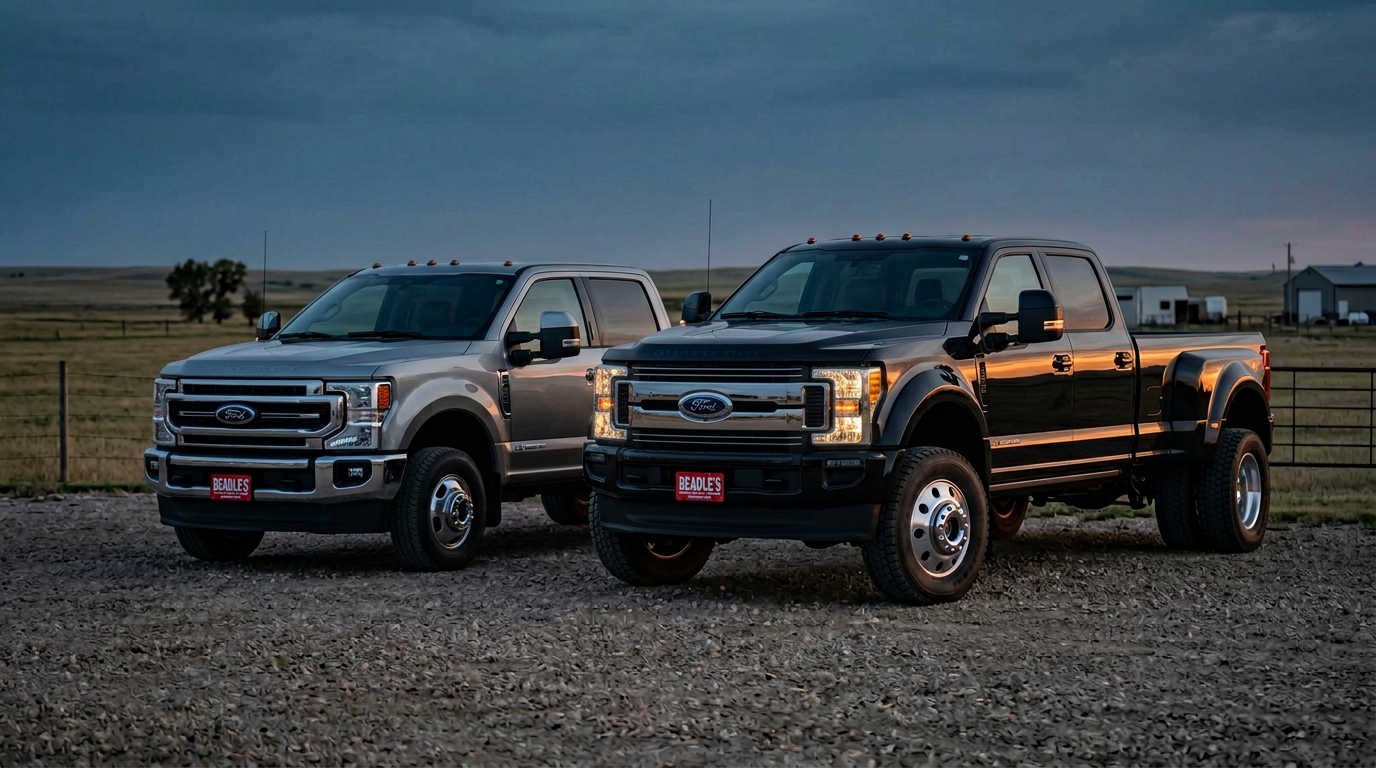
2027 Ford F-350 dually beside a 2027 Ford F-450 dually on a ranch lot at dusk

2027 Ford F-350 vs. F-450: When to Step Up

Quick Answer The 2027 F-350 and F-450 both tow up to 40,000 lbs gooseneck. The F-450 steps up with higher conventional and fifth-wheel ratings (up to 30,000 lbs vs. 28,000), a higher GVWR and payload, 19.5-inch commercial wheels, and the 6.7L High-Output diesel as standard. The F-350 starts with the 7.3L gas, so it's the lower-cost, easier-to-live-with truck that covers most needs. The F-450 is the top of Ford's Super Duty pickup line — but more truck isn't automatically the right truck. For most heavy-haulers around Bowdle and Aberdeen, a dually F-350 is plenty; the F-450 earns its keep in a narrower set of cases. Here's exactly what the F-450 adds over the F-350 for 2027, the trade-offs that come with it, and how to know when stepping up is the right call. Shop F-350s in Stock Get Pre-Approved On This Page What's the difference between the F-350 and F-450? What does the F-450 give you that the F-350 doesn't? What are the trade-offs of stepping up? When should you step up to an F-450? How do you decide? What's the difference between the F-350 and F-450? Both are 1-ton-class Super Dutys that share the same body and the same 40,000-lb gooseneck ceiling. The F-450 is the heavier-duty pickup: higher conventional and fifth-wheel ratings, a higher GVWR and payload, commercial-grade 19.5-inch wheels, and the High-Output diesel as standard equipment. Here's the head-to-head: 2027 F-350 2027 F-450 Standard engine 7.3L gas V8 6.7L High-Output diesel Max gooseneck Up to 40,000 lbs Up to 40,000 lbs Max conventional / 5th-wheel Up to 28,000 lbs (DRW) Up to 30,000 lbs Wheels 17"–20" (SRW or DRW) 19.5" forged commercial (DRW only) Best for Most heavy-haul, daily use, lower cost Maxing conventional/GVWR, commercial running gear Ratings require proper equipment and vary by configuration. 2027 horsepower/torque not yet published by Ford. What does the F-450 give you that the F-350 doesn't? Higher conventional and fifth-wheel ratings — up to 30,000 lbs vs. the F-350 DRW's 28,000. Higher GVWR and payload for the heaviest carrying and upfit work. 19.5-inch forged commercial wheels and traction tires built for sustained heavy loads. The 6.7L High-Output diesel as standard — no need to option up to the heavy-tow engine. Heavier-duty running gear for maximum stability when you're routinely at the top of the range. In short, the F-450 is the truck for buyers who consistently operate where the F-350 leaves little margin. What are the trade-offs of stepping up? The F-450's strengths come with costs: a higher purchase price, the diesel as your only standard engine, pricier 19.5-inch commercial tires to replace, a firmer ride, and a wider turning circle that's less convenient in tight yards and lots. For a truck that spends most days well under its limits, that's a lot to pay for headroom you rarely use. Our Recommendation For most heavy-haulers around Bowdle and Aberdeen, a dually F-350 with the High-Output diesel is the right truck — it reaches the same 40,000-lb gooseneck ceiling for less money and lives easier day to day. Step up to the F-450 only if you routinely max the F-350's conventional or GVWR limits, or you specifically want the commercial 19.5-inch running gear. Size it honestly with our 2027 F-350 towing guide. When should you step up to an F-450? Step up when you're genuinely operating at the edge of an F-350: regularly running conventional or fifth-wheel loads near 28,000 lbs, needing the highest GVWR for a heavy upfit, or wanting commercial-grade wheels and tires for sustained heavy-duty use. If that's not you, the F-350 is the smarter buy. From the Beadle Ford Lot We sell far more F-350s than F-450s, and that's the right ratio. The F-450 buyers who are happiest knew exactly why they needed it — a specific commercial load or upfit that maxed an F-350. When someone's stepping up just for bragging rights, we usually steer them back to a dually F-350 that does the job for thousands less. How do you decide? Four questions settle it: Do your loaded conventional or fifth-wheel trailers regularly approach the F-350's 28,000-lb limit? Do you need a higher GVWR than the F-350 offers for a heavy upfit or payload? Do you want commercial 19.5-inch wheels and tires for sustained heavy use? Are you willing to trade ride comfort, turning ease, and tire cost for that capability? Mostly "no"? A dually F-350 is your truck. Mostly "yes"? The F-450 is worth it. Key Takeaways F-350 and F-450 share the same body and the same 40,000-lb gooseneck ceiling. F-450 adds higher conventional/5th-wheel ratings (30,000 lbs), higher GVWR, and 19.5" commercial wheels. F-450 comes standard with the HO diesel; F-350 starts with the 7.3L gas (lower cost of entry). F-450 trade-offs: price, diesel-only standard, pricier tires, firmer ride, wider turning. Most heavy-haulers are well served by a dually F-350; step up only when you truly max it out. Frequently Asked Questions What's the difference between the 2027 F-350 and F-450? Both share the same body and a 40,000-lb gooseneck ceiling. The F-450 is the heavier-duty pickup: higher conventional/fifth-wheel ratings (up to 30,000 lbs vs. 28,000), higher GVWR and payload, 19.5-inch commercial wheels, and the 6.7L High-Output diesel as standard. The F-350 starts with the 7.3L gas and is the lower-cost, easier-to-live-with truck. Does the F-450 tow more than the F-350? On gooseneck, both reach up to 40,000 lbs. The F-450's advantage is on conventional and fifth-wheel hitches (up to 30,000 lbs vs. the F-350 DRW's 28,000) and in GVWR — so it matters most if you max those ratings. Does the 2027 F-450 come standard with the diesel? Yes — the 6.7L High-Output Power Stroke diesel is standard on the 2027 F-450, where it's optional on the F-350 (which starts with the 7.3L gas). That's part of why the F-450 carries a higher cost of entry. Is an F-450 harder to live with than an F-350? Generally yes. The F-450 rides firmer, turns wider, and runs 19.5-inch commercial tires that cost more to replace. Those are reasonable trades for buyers who need the capability, but real downsides if you don't. Do most buyers need an F-450 or is an F-350 enough? For most heavy-haulers, a dually F-350 is enough — it reaches the same 40,000-lb gooseneck ceiling for less money. The F-450 is for those who routinely max the F-350's conventional or GVWR limits, or specifically need the commercial running gear. Quick Answers: F-350 vs. F-450 One-line answers to the follow-up questions buyers ask next. Same gooseneck max? Yes — both up to 40,000 lbs. F-450 conventional max? Up to 30,000 lbs (vs. F-350's 28,000 DRW). F-450 standard engine? The 6.7L High-Output diesel. F-350 standard engine? The 7.3L gas V8. F-450 wheels? 19.5" forged commercial (DRW only). Which costs less? The F-350. Which rides better? The F-350. Which carries more? The F-450 (higher GVWR/payload). Do most buyers need an F-450? No — a dually F-350 covers most needs. How do I decide? Step up only if you max the F-350's conventional/GVWR limits. Keep Researching The complete 2027 Ford F-350 Super Duty overview — specs, towing, trims, and how to order. 2027 F-350 towing guide — confirm whether an F-350 covers your loads first. 2027 F-350 SRW vs. DRW — a dually F-350 reaches the 40,000-lb ceiling too. 2027 F-350 payload & upfit — when GVWR is the real reason to step up. My Take on F-350 vs. F-450 In my experience, the F-450 is the right truck less often than people assume — but exactly right for the few who need it. Because a dually F-350 already reaches 40,000 lbs gooseneck, the step up is really about higher conventional ratings, GVWR, and commercial running gear. If you're not maxing those, the F-350 saves you money and drives easier. Tell me your heaviest loads and how you run them, and I'll tell you honestly whether you need the F-450. Stop in at Beadle Ford in Bowdle or reach out anytime. Shop F-350s in Stock Get Pre-Approved About the Author Lexy Tabbert — Beadle Ford, Bowdle, SD Lexy Tabbert is the Director of Sales and Marketing at Beadle Ford in Bowdle, South Dakota. She covers Ford vehicles, trim comparisons, and buyer guidance — helping families, ranchers, and ag operators across the region find the right truck and configuration for their needs. Learn more about Lexy.
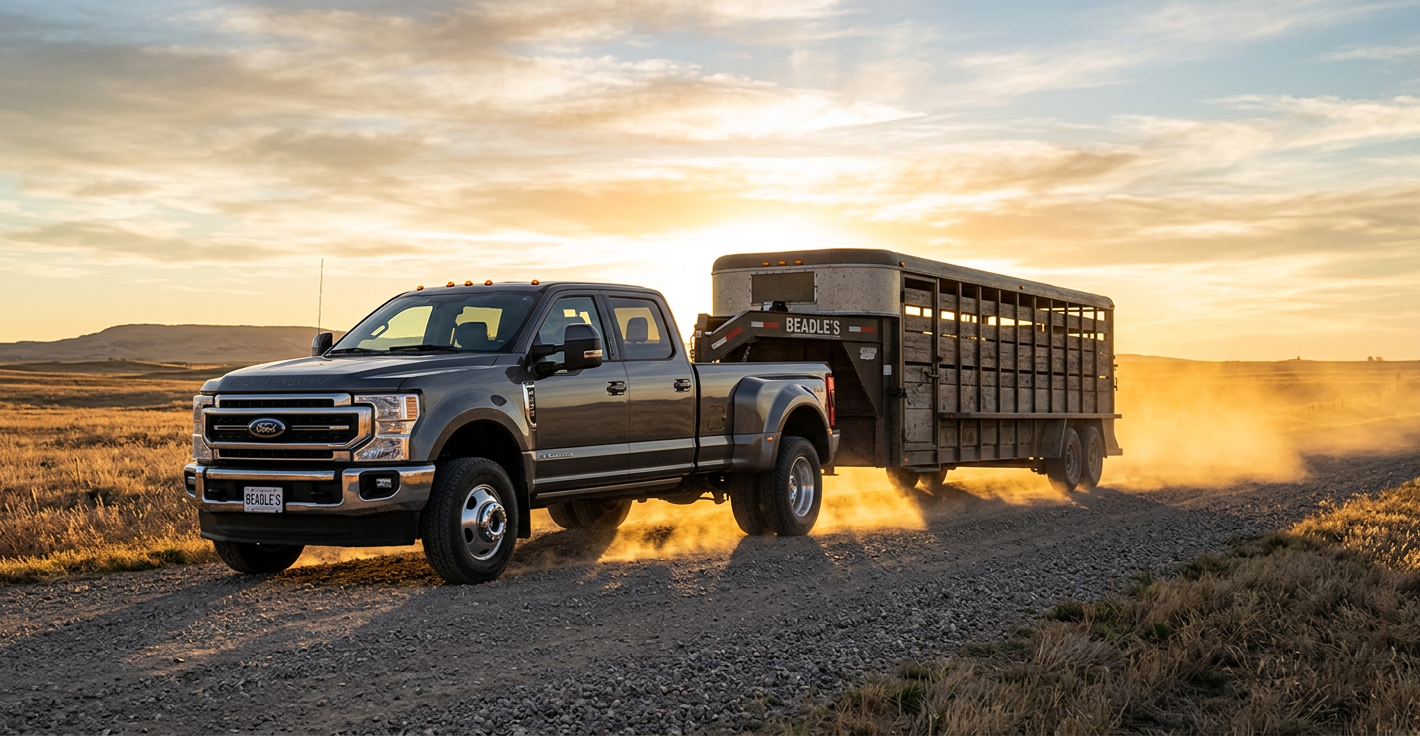
2027 Ford F-350 dually in Carbonized Gray towing a loaded gooseneck stock trailer on a gravel ranch road

2027 Ford F-350 Towing Guide: Real Numbers by Configuration

Quick Answer Properly equipped, the 2027 Ford F-350 tows up to 40,000 lbs gooseneck (6.7L High-Output diesel, dual-rear-wheel, 40K Gooseneck Tow Package), up to 35,000 lbs fifth-wheel, and up to 28,000 lbs conventional on the dually (25,000 lbs single-rear-wheel). Those ratings carry over unchanged from 2026. The 2027 F-350 simplified to two engines, but it didn't give up an ounce of towing capability — the ratings are identical to 2026. What changed is the path to them: the High-Output diesel is now the only diesel, and it's what anchors the big numbers. This guide breaks down what the 2027 F-350 tows by hitch type, how the engine and single- vs. dual-rear-wheel choice affect it, and how to build a towing setup with real margin for the way you haul around Bowdle and Aberdeen. Shop F-350s in Stock Get Pre-Approved On This Page How much can the 2027 F-350 tow? Gooseneck vs. fifth-wheel vs. conventional Does engine choice change what it tows? How does SRW vs. DRW affect towing? How do you choose a towing setup? How much can the 2027 F-350 tow? Properly equipped, up to 40,000 lbs gooseneck, up to 35,000 lbs fifth-wheel, and up to 28,000 lbs conventional on the dually. A single-rear-wheel F-350 handles up to 25,000 lbs conventional. Here's the breakdown by hitch type: Hitch Type Max (properly equipped) Best For Gooseneck Up to 40,000 lbs (HO diesel, DRW, 40K package) Loaded livestock and equipment trailers, max capability Fifth-wheel Up to 35,000 lbs (diesel, DRW) Large fifth-wheel campers and toy haulers Conventional (bumper-pull) Up to 28,000 lbs DRW / 25,000 lbs SRW Utility, flatbed, and many travel trailers Maximums require proper equipment and vary with cab, bed, axle ratio, and configuration. The 40,000-lb gooseneck rating requires the High-Output diesel DRW with the 40K Gooseneck Tow Package. Gooseneck vs. fifth-wheel vs. conventional The hitch type sets both the ceiling and how the load behaves. Gooseneck and fifth-wheel hitches mount over the rear axle for a more stable, higher-capacity tow; a conventional bumper-pull is simpler but tops out lower. Gooseneck: the livestock and equipment standard — controlled feel, tight maneuvering, and the highest rating at up to 40,000 lbs. Fifth-wheel: popular for large RVs; the over-axle connection feels stable on the highway, up to about 35,000 lbs. Conventional: common for utility and travel trailers; up to 28,000 lbs DRW or 25,000 lbs SRW, with weight distribution and brake control mattering more as loads climb. Does engine choice change what it tows? Yes — the 6.7L High-Output Power Stroke diesel is what reaches the 40,000-lb gooseneck maximum, and it feels most composed on grades and in wind. The now-standard 7.3L gas V8 covers a wide range of lighter and moderate trailers and carries the highest payload. With only two engines for 2027, the towing decision is really "how heavy, how often." Our Recommendation For most ranch and farm buyers around Bowdle and Aberdeen, a 7.3L gas F-350 with the right hitch and axle covers the goosenecks they actually pull. Step up to the High-Output diesel and a dually when you run heavy near the top of the range or want the 40,000-lb ceiling. Compare the engines in our 2027 F-350 engine comparison. How does SRW vs. DRW affect towing? Dual-rear-wheel (DRW) trucks reach the highest ratings and feel most planted under a heavy gooseneck or fifth-wheel; single-rear-wheel (SRW) trucks still tow well beyond any half-ton (up to 25,000 lbs conventional) and are easier to live with day to day. It's the decision that most affects both capability and how the truck drives — covered in depth in our 2027 F-350 SRW vs. DRW guide. From the Beadle Ford Lot The most common towing mistake we see isn't buying too little truck — it's buying for the heaviest trailer someone pulls twice a year. We size the F-350 to the load you actually haul most weeks, then leave honest margin on top. More often than not that lands a buyer on a single-rear-wheel truck with room to spare. How do you choose a towing setup? Work from the trailer to the truck, in five steps: Start with the trailer: type (gooseneck, fifth-wheel, conventional) and realistic loaded weight. Decide SRW vs. DRW based on how heavy you run and how the truck will drive day to day. Pick the engine for your towing frequency — gas for most, High-Output diesel for heavy and often. Match the hitch, axle ratio, and tow package to your trailer (the 40K package for the gooseneck maximum). Confirm the exact build — ratings vary by configuration. Key Takeaways 2027 F-350 towing carries over: up to 40,000 lbs gooseneck, 35,000 lbs fifth-wheel, 28,000 lbs conventional DRW. The High-Output diesel + DRW + 40K package reach the 40,000-lb maximum. SRW still tows up to 25,000 lbs conventional — well beyond any half-ton. Hitch type sets both the ceiling and the feel; gooseneck is highest. Build to the trailer you pull most, with honest margin — not your once-a-year heaviest. Frequently Asked Questions How much can the 2027 Ford F-350 tow? Properly equipped, up to 40,000 lbs gooseneck (6.7L High-Output diesel, DRW, 40K Gooseneck Tow Package), up to 35,000 lbs fifth-wheel, and up to 28,000 lbs conventional on the dually (25,000 lbs single-rear-wheel). Ratings carry over unchanged from 2026. Did the 2027 F-350 lose towing capacity with fewer engines? No. The High-Output diesel still anchors the 40,000-lb gooseneck maximum, and all ratings match 2026 — the simplified two-engine lineup didn't cost the F-350 any capability. What package do I need for the 40,000-lb gooseneck rating? The 40K Gooseneck Tow Package, paired with the 6.7L High-Output Power Stroke diesel in dual-rear-wheel form. Without it, gooseneck ratings are lower. We confirm the exact axle and package on any truck before you order. Can the 7.3L gas F-350 tow a gooseneck? Yes. The now-standard 7.3L gas V8 handles a wide range of gooseneck and conventional trailers and carries the highest payload. For the heaviest loads near the top of the range, the High-Output diesel is the better fit. Do I need a dually to tow heavy with the 2027 F-350? Not for most trailers. A single-rear-wheel F-350 tows up to 25,000 lbs conventional and covers many goosenecks with margin. A dually is for maximum stability and the highest ratings, including the 40,000-lb gooseneck maximum. Quick Answers: 2027 F-350 Towing One-line answers to the follow-up questions buyers ask next. Max gooseneck? Up to 40,000 lbs (HO diesel, DRW, 40K package). Max fifth-wheel? Up to 35,000 lbs, properly equipped. Max conventional? Up to 28,000 lbs DRW, 25,000 lbs SRW. Did 2027 towing drop? No — same as 2026. Which engine for max towing? The 6.7L High-Output diesel. Can the gas tow a gooseneck? Yes — a wide range of them. Do I need a dually? Only for the heaviest loads and the 40,000-lb max. What's the 40K package? The option group required for the 40,000-lb gooseneck rating. Is a trailer brake controller included? An integrated controller is available and recommended for heavy trailers. How do I confirm a truck's rating? We verify cab, axle, and package against the build before you order. Keep Researching The complete 2027 Ford F-350 Super Duty overview — specs, towing, trims, and how to order. 2027 F-350 engine comparison — gas vs. the High-Output diesel behind the ratings. 2027 F-350 SRW vs. DRW — the stance decision that shapes your towing. 2027 F-350 payload & upfit — when payload, not towing, is the limit. My Take on Towing the 2027 F-350 In my experience, the best towing setup is the one built with margin — the truck feels composed, the trailer feels predictable, and you're not managing the load. The good news for 2027 is that the simpler engine lineup didn't change any of that; the F-350 still pulls everything it did before, you just have a cleaner decision to make. Bring me your trailer type and a realistic loaded weight and we'll size the right 2027 F-350. Stop in at Beadle Ford in Bowdle or reach out anytime. Shop F-350s in Stock Get Pre-Approved About the Author Lexy Tabbert — Beadle Ford, Bowdle, SD Lexy Tabbert is the Director of Sales and Marketing at Beadle Ford in Bowdle, South Dakota. She covers Ford vehicles, trim comparisons, and buyer guidance — helping families, ranchers, and ag operators across the region find the right truck and configuration for their needs. Learn more about Lexy.
XL, XLT, Lariat, or Raptor: Which 2026 Ford Ranger Is Actually Right for You?

Four trim levels. Three engines. Multiple drivetrain configurations. Choosing the right 2026 Ford Ranger isn't complicated once you know what each level actually includes — but the overlap between XLT and Lariat trips up a lot of buyers, and the Raptor is its own category entirely. This guide breaks down every trim from XL through Raptor: what's standard, what's available, how the drivetrain options compare, and which configuration makes the most sense for buyers in central South Dakota. Shop Rangers in Stock Get Pre-Approved On This Page What are the 2026 Ford Ranger trim levels? What does the 2026 Ranger XL include? What does the 2026 Ranger XLT include? What does the 2026 Ranger Lariat include? What makes the 2026 Ranger Raptor different from every other trim? Which Ranger trims come in 4x2 vs. 4x4? Which 2026 Ranger trim is the best value for South Dakota buyers? What are the 2026 Ford Ranger trim levels? The 2026 Ranger comes in four trim levels: XL, XLT, Lariat, and Ranger Raptor. They are not equally spaced in what they offer. XL is the work-truck baseline. XLT is where most buyers land and where the biggest value jump happens. Lariat adds comfort, technology, and the V6 option. The Ranger Raptor is a purpose-built off-road variant that doesn't compete with the other three — it's a different vehicle for a different buyer. Every Ranger is a SuperCrew: four full-size doors, a 128-inch wheelbase, and a 5-foot bed. There is no SuperCab option for this generation. What does the 2026 Ranger XL include? The XL is the work-first configuration. It comes with the 2.3L EcoBoost® I4 (270 hp, 310 lb-ft torque), cloth seating, a 10-inch SYNC 4A touchscreen, an 8-inch digital instrument cluster, steel wheels with hub covers, and a reverse camera. It is available in both 4x2 and 4x4. What the XL doesn't include at the base level: Ford Co-Pilot360™ driver assist (available as an option), heated seats, power-adjustable driver's seat, or a 12-inch touchscreen. It gets the job done without extras — which is exactly what a lot of ranch and work-truck buyers want. New for 2026: FX4 Off-Road Package is now available on the XL. That means buyers can get a base-trim Ranger with an electronic-locking rear differential, skid plates, and Trail Control™ without paying for XLT features they don't need. The 2.3L is the only engine on XL — no V6 option at this trim. What does the 2026 Ranger XLT include? XLT is the high-volume trim for good reason. The high-series XLT build (301A) adds a significant amount over XL at a reasonable price step: Ford Co-Pilot360™ driver assist as standard equipment, heated front seats, a power-adjustable driver's seat, a 12-inch SYNC 4A touchscreen, and dual-zone electronic automatic temperature control (DEATC). It also adds a power-sliding rear window. The 2.7L EcoBoost® V6 (315 hp, 400 lb-ft torque) becomes available on XLT — but only in 4x4 configuration. If you want the V6, you're going 4x4. That's not a downside in South Dakota, but it's worth knowing before you spec the truck. FX4 Off-Road Package is available on XLT in both 2.3L and 2.7L configurations. The optional new power moonroof is also available on XLT for 2026 — the first time it's been offered on this Ranger generation. For a deeper look at what the FX4 package actually includes, the FX4 Off-Road Package guide covers every component. What does the 2026 Ranger Lariat include? The Lariat is the comfort-and-capability tier. It adds ActiveX upholstered seating (Ford's leather-alternative — new for 2026, replacing leather), a 12-inch digital instrument cluster, zone lighting, ambient interior lighting, a Bang & Olufsen Premium Sound System, and standard Adaptive Cruise Control with Speed Sign Recognition. Technology features that are packaged options on XLT — including the 360-degree camera — are standard on Lariat. The Lariat carries both the 2.3L EcoBoost® I4 and the 2.7L EcoBoost® V6 as options. The V6 is available in 4x4 only at this trim. FX4 and the optional power moonroof are both available on Lariat. If you're comparing XLT and Lariat, the Lariat is primarily an interior upgrade — better sound, better instrumentation, leather-alternative seating, and standard technology features. If those comfort and tech differences matter to you in daily use, Lariat is worth the step up. If you're mostly using this as a work or tow truck, XLT gets you almost everything that matters at a lower price. What makes the 2026 Ranger Raptor different from every other trim? The Ranger Raptor is not a trim upgrade — it's a different truck. It uses a purpose-built 3.0L EcoBoost® V6 producing 405 horsepower and 430 lb-ft of torque. It rides on Fox Live Valve position-sensitive shock absorbers with a Watts-link rear suspension. It has Baja and Rock Crawl drive modes that don't exist on any other Ranger trim. It comes standard with everything the FX4 package adds to other trims — and then well beyond. It is also 4x4 only, and it tows less than a standard Ranger — up to 5,510 lbs when properly equipped, compared to 7,500 lbs on non-Raptor trims. That lower tow rating reflects its off-road-optimized axle ratio (4.27 vs. 3.73 on other trims) and heavier suspension hardware. It is not a tow truck. It is not a daily hauler. It is a performance off-road vehicle that happens to have a 5-foot bed. The Raptor also gets Raptor-specific interior features: performance seats, Raptor badging, unique instrument cluster graphics, and the 3.0L-exclusive powertrain display. If dedicated off-road performance is the priority and towing isn't, this is the trim. For everyone else, the right comparison is XL, XLT, or Lariat. Which Ranger trims come in 4x2 vs. 4x4? The 2026 Ranger's drivetrain availability depends on trim and engine. Here's the full picture: Trim Engine 4x2 4x4 XL 2.3L I4 only Yes Yes XLT 2.3L I4 Yes Yes XLT 2.7L V6 No Yes (only) Lariat 2.3L I4 Yes Yes Lariat 2.7L V6 No Yes (only) Raptor 3.0L V6 only No Yes (only) If getting the 2.7L V6 is a priority, you are committing to 4x4 — it is not available any other way. For most South Dakota buyers, that's not a concern. For the handful who want the V6 purely for towing on flat terrain and would prefer to save the 4x4 premium, the 2.3L in 4x2 is the only path. For the full breakdown of towing capacity by engine and configuration, see the 2026 Ranger towing guide. Which 2026 Ranger trim is the best value for South Dakota buyers? For buyers in the Bowdle area — where the truck sees a mix of gravel roads, highway miles, ranch work, and seasonal weather — the XLT with the 2.7L V6 and FX4 Off-Road Package is the configuration that keeps coming up as the right answer. You get the safety and comfort step-up from Co-Pilot360 and heated seats, the torque advantage of the V6 for towing, and the e-locker and skid plates for the county section roads and spring mud conditions that are part of regular driving here. Quick Buyer Guide XL — Best for: work trucks, fleet buyers, buyers who want FX4 at entry-level pricing. No V6, no Co-Pilot360 standard. XLT — Best for: most buyers. Big comfort and safety step-up from XL; V6 available; FX4 available; new moonroof option available. Lariat — Best for: buyers who want a more premium interior, better audio, and standard tech without stepping into the Raptor tier. V6 and FX4 available. Raptor — Best for: buyers whose primary use case is off-road performance. Not for towing-first buyers — tow rating is lower than all other trims. Key Takeaways Four trim levels: XL (work-first), XLT (best all-rounder), Lariat (comfort + tech), Raptor (off-road performance) The 2.7L V6 is available on XLT and Lariat in 4x4 only — choosing the V6 means choosing 4x4 The 3.0L V6 is exclusive to the Ranger Raptor and is not available on any other trim FX4 is available on XL, XLT, and Lariat for 2026 — new on XL this year The Raptor tows less (up to 5,510 lbs when properly equipped) than all other trims (up to 7,500 lbs when properly equipped) The power moonroof is a new 2026 option available on XLT and Lariat only Lariat switches from leather to ActiveX seating for 2026 For most Bowdle-area buyers, XLT with the 2.7L V6 and FX4 is the practical sweet spot Frequently Asked Questions What's the difference between XLT Standard and XLT High? XLT is offered in two build packages. The standard XLT (300A) is the lower build, which includes the base XLT content. The high-series XLT (301A) adds Ford Co-Pilot360™, heated front seats, a power-adjustable driver's seat, a 12-inch SYNC 4A touchscreen, dual-zone climate control, and a power-sliding rear window. Most buyers shopping XLT are comparing against the high-series build — that's where the significant comfort and safety upgrades live. Can I get the 2.7L V6 on the XL trim? No. The 2.7L EcoBoost® V6 is available on XLT and Lariat only. The XL is 2.3L I4 exclusively. If the V6 is a priority, the starting point is XLT. Is Ford Co-Pilot360 standard on all Ranger trims? Ford Co-Pilot360™ is standard on XLT (high-series build) and above. On the base XL, it is available as an optional package. It is not standard on the base XL. Co-Pilot360 includes Pre-Collision Assist with Automatic Emergency Braking, BLIS with Cross-Traffic Alert and Trailer Coverage, Lane-Keeping System, Auto High-Beam Headlamps, Rear Parking Sensors, and Reverse Brake Assist. Does the Lariat come with the 360-degree camera standard? Yes. The 360-degree camera is standard on the Lariat. On XLT, it is available through an advanced tow or technology package. On XL, it is not available. If a 360-degree camera is important for trailer positioning or tight-space maneuvering, that's one reason to consider Lariat over XLT. What wheels does each Ranger trim come with? XL comes standard with steel wheels. XLT with the Sport Package gets 17-inch gray-painted aluminum wheels; the optional 18-inch Chrome PVD aluminum wheel is now available standalone on XLT for 2026. Lariat comes with 18-inch machined aluminum wheels with dark-painted pockets. The Raptor uses 17-inch gray-painted aluminum Raptor-specific wheels with LT285/70R17 all-terrain tires. My Take on the 2026 Ranger Trim Lineup When buyers come into Beadle Ford in Bowdle and ask where to start with the Ranger, I usually ask two questions: do you need to tow regularly, and how much of your driving is on gravel or off-pavement? Those two answers narrow it down fast. If the answer to both is yes — and for most folks in this region, it is — the XLT with the 2.7L V6 and FX4 is where the conversation ends up. It covers the towing, it covers the terrain, and it does it without paying Lariat prices for interior upgrades you might not need on a work truck. The Lariat makes a lot of sense for buyers who split time between hauling and highway driving — the B&O sound, ambient lighting, and ActiveX seating matter more if this is also your daily driver. The XL with FX4 is the right spec for anyone who wants a capable ranch truck without the price of the XLT feature set. And the Raptor is for a specific buyer who prioritizes off-road performance above everything else, including towing capacity. The complete picture of what each trim includes — including engine and drivetrain availability — is on the 2026 Ford Ranger overview. If you want to talk through which trim fits your situation before you drive, give us a call or stop by Beadle Ford in Bowdle. Shop Rangers in Stock Get Pre-Approved Contact Beadle Ford About the Author Lexy Tabbert — Beadle Ford, Bowdle, SD Lexy Tabbert covers Ford vehicles, trim comparisons, and buyer guidance for Beadle Ford in Bowdle, South Dakota. Her content is grounded in real buyer conversations with families, ranchers, and ag operators across the Bowdle region and central South Dakota. Learn more about Lexy.

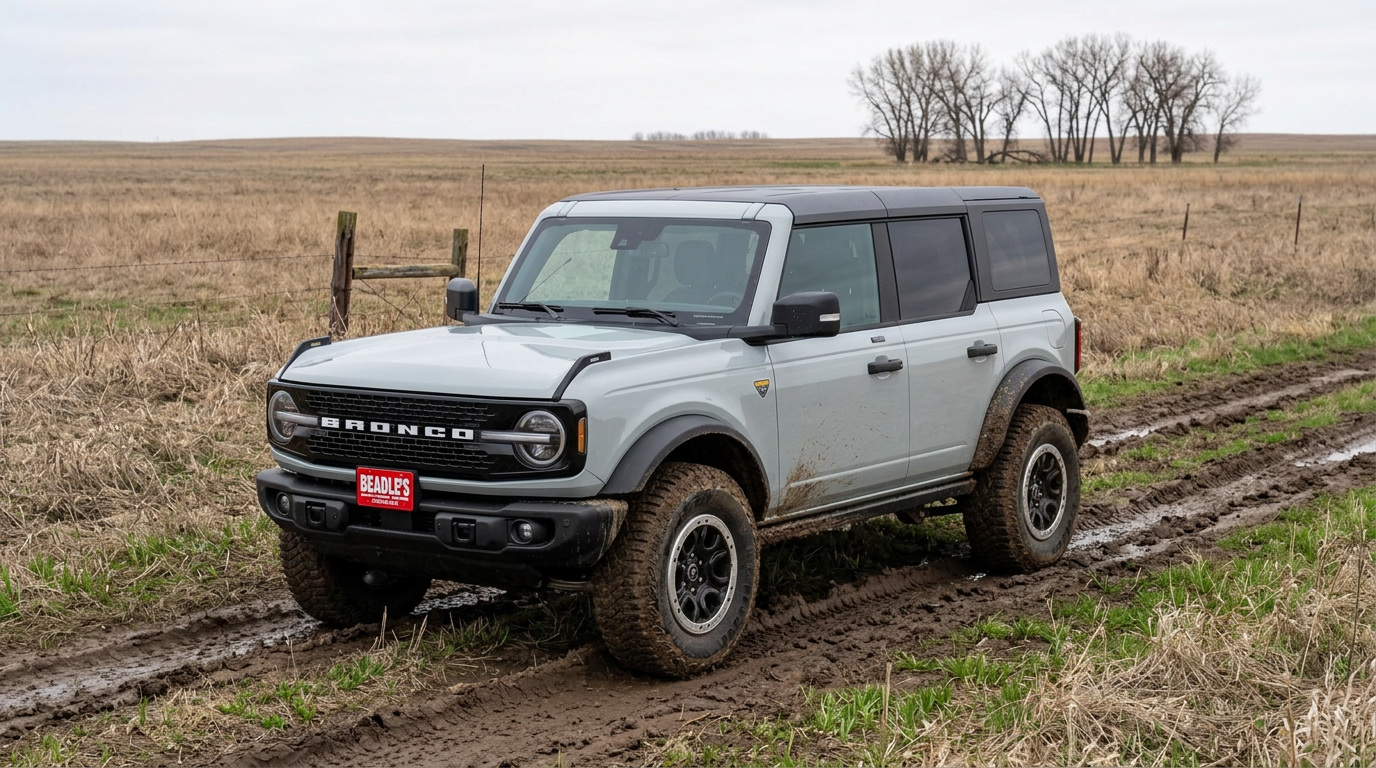
2026 Ford Bronco Badlands with Sasquatch Package on a muddy CRP two-track in central South Dakota

Is the 2026 Ford Bronco Sasquatch Package Worth It in South Dakota? An Honest Take

The Sasquatch Package is the single most-asked-about option on the 2026 Ford Bronco — and for most central-South Dakota buyers, it's also the option that's hardest to justify on paper. The 35-inch tires, the electronic-locking front and rear differentials, and the Bilstein high-clearance suspension are real upgrades, but they're built for terrain most Bowdle-area drivers don't actually run. This is an honest decision guide. We'll cover what's actually in the package, what the 35-inch R/T tires cost you on highway and gravel, when the front locker matters and when it doesn't, the price by trim, and the buyer who genuinely benefits from Sasquatch versus the one who'd be just as happy with a standard Badlands. Shop Broncos in Stock Get Pre-Approved On This Page What Does the Sasquatch Package Include? Are the 35-Inch Tires Worth the Trade-Offs on Highway and Gravel? What Do Electronic-Locking Front and Rear Axles Actually Do? How Much Does the Sasquatch Package Cost by Trim? Is the Sasquatch Package Worth It for Central South Dakota Drivers? What Does the Sasquatch Package Include? The Sasquatch Package (Ford order code 765) bundles seven hardware upgrades that move a Bronco from capable to seriously off-road ready. The standard contents are the same on every trim that can take it. Standard Sasquatch contents include the Advanced 4x4 system with Automatic On-Demand Engagement (which adds 4-Auto mode), 17-inch matte-black alloy wheels, a 4.70 final-drive axle ratio with electronic-locking front and rear differentials, high-clearance suspension, high-clearance fender flares, LT315/70R17 Rugged-Terrain (R/T) tires (the 35s), and position-sensitive Bilstein shocks. That's the package. Everything else listed in marketing — the 4-Auto, the lockers, the suspension — is a re-statement of those seven items. Two trims add a little more on top of the base Sasquatch contents. Outer Banks with Sasquatch adds a passenger-side interior grab handle. Badlands with Sasquatch adds the Front Stabilizer Bar Disconnect — a feature that's also available standalone for $1,305 on the 2026 Badlands. The Stroppe Edition (fleet/military only) also adds HOSS 3.0 with FOX Internal Bypass Dampers when Sasquatch is equipped. The Sasquatch wheel — 17-inch matte-black, beadlock capable when ordered with the 64X wheel option, mounted with LT315/70R17 R/T tires. For full context on which trim is the right starting point before adding Sasquatch, see our 2026 Ford Bronco trim levels guide. Heritage Edition is the one trim that includes Sasquatch in the base price — for everyone else, it's an option. Are the 35-Inch Tires Worth the Trade-Offs on Highway and Gravel? For genuine off-road use the 35s are an upgrade you can feel. For long stretches of South Dakota highway and gravel section roads, the standard 33-inch R/T tire on a non-Sasquatch Badlands handles the same job with less compromise on ride, noise, and fuel economy. The Sasquatch tire is an LT315/70R17 Rugged-Terrain — load-rated, aggressive tread, 35-inch overall diameter. On a moderate trail, in spring mud, on a steep loose-rock approach, or anywhere a sidewall might meet a rock face, that tire is exactly what you'd want. The trade-offs show up the rest of the time. On Bowdle-to-Black-Hills runs, you'll feel a small but real fuel-economy penalty from the heavier rotating mass and the more aggressive tread. Highway noise is more present at 70+ mph than the 33-inch R/T or the 32-inch all-terrain on lower trims. On washboard gravel, the longer sidewall actually rides slightly softer than a smaller-diameter tire — that's a small win for Sasquatch. Tire replacement is more expensive at this size, and rotation intervals matter more because LT-rated tires don't tolerate uneven wear well. If you do go Sasquatch and want something better than the matte-black standard wheel, you have four upgrade options: 17-inch Black High Gloss-Painted Aluminum with a Warm Alloy Beauty Ring, beadlock capable (64X) at $995; 17-inch Dark Carbonized Gray Alloy Painted, beadlock-capable forged (64T) at $1,995 on Raptor and Lux trims; 17-inch Magnetic Gray Mid-Gloss-Painted Alloy with Machined Flange (DIO) at $1,960; or the 17-inch Gravity Gray-Painted Alloy that's included with the 60th Anniversary Package on Outer Banks. The honest summary: if you live on gravel and highway and your "off-roading" is gravel two-tracks and lake access, the 33s do the job. If you actually run rocks, drift mud, or want the lifted look enough to pay for it, the 35s earn their keep. Get Pre-Approved Contact Beadle Ford What Do Electronic-Locking Front and Rear Axles Actually Do? A locking differential forces both wheels on an axle to spin at the same speed, regardless of which one has grip. Without it, a wheel hanging in the air or sitting on ice can spin freely while the wheel on solid ground gets nothing — that's an open differential at work. With a locker engaged, both wheels turn together, so even one wheel with traction can pull the vehicle through. Electronic-locking front and rear differentials are standard with every Sasquatch Package, on every Badlands and Heritage Edition trim, and on the Raptor. A standard Big Bend (without the Black Diamond Package) has open differentials front and rear. Big Bend with Black Diamond gets a rear locker only — no front locker — which still meaningfully improves traction on slippery, rutted, or off-camber surfaces but doesn't match a full Sasquatch or Badlands setup. When you actually use the lockers in central South Dakota: deep mud in spring thaw on a section line; loose, off-camber climbs in the Black Hills; rocky two-track approaches to a Lake Oahe boat ramp where one tire is up on a step and another is dropped into a rut. When you don't need them: every gravel road, snow on a county road (4-Auto and the standard 4WD system handle that), pasture work, and most of what a Bronco does day-to-day. The lockers are insurance, not a daily driver. The 4.70 axle ratio that Sasquatch brings — versus the standard 3.73 or 4.46 ratios — also gives the Bronco shorter overall gearing. That helps in low range when you actually need crawl-speed torque, but it slightly raises engine RPM at highway speeds. The 10-speed automatic compensates well; the 7-speed manual will feel busier on long highway runs than a non-Sasquatch 2.3L manual would. For more on what the 4-Auto and the full GOAT mode system do alongside the lockers, see our 2026 Bronco G.O.A.T. Modes guide. How Much Does the Sasquatch Package Cost by Trim? Sasquatch pricing ranges from $4,180 on a Big Bend with the 10-speed automatic (when Black Diamond is already added) up to $8,460 on a Base trim with the 7-speed manual. On the Heritage Edition the package is included in the base price at no upcharge. Here's how the math works out by trim, before destination: Trim With 7-Spd Manual With 10-Spd Auto Base $8,460 $6,465 Big Bend (requires Black Diamond +$4,495) $6,175 $4,180 Outer Banks n/a (auto only) $6,465 Badlands $6,345 $4,350 Heritage Edition included included Two pricing realities are worth flagging. First, Big Bend's lower Sasquatch sticker is misleading — Black Diamond is a prerequisite, so the true added cost over a standard Big Bend is Black Diamond ($4,495) plus Sasquatch ($4,180 with auto) for $8,675 total. That is more than ordering Sasquatch on a Badlands, where the off-road hardware that Black Diamond duplicates is already standard. Second, Heritage Edition is the cleanest path to Sasquatch capability — it bundles the package with the trim's distinct styling at $51,625, which works out very close to a Badlands 4-Door with Sasquatch added once you account for the auto transmission and standard equipment. Outer Banks pricing is automatic-only because Outer Banks doesn't offer the 7-speed manual. On Base, the cost is highest because there's no overlap with hardware already on the trim — every Sasquatch piece is genuinely new. Is the Sasquatch Package Worth It for Central South Dakota Drivers? Sasquatch in the kind of mud-season cattail slough access where the 35-inch R/Ts and lockers actually earn their keep. For most central-South Dakota drivers, the standard Badlands 33-inch R/T setup with electronic-locking front and rear differentials is enough. Sasquatch is worth it for the buyer who actually rock-crawls in the Black Hills, regularly runs deep mud or sand, or specifically wants the lifted look — which is a real and valid reason on its own. The contrarian truth most national Bronco content won't tell you: gravel section roads, harvested-cornfield two-tracks, Lake Oahe boat-ramp access, ranch pasture work, and a few weekend trips per year to the Hills are well within what a non-Sasquatch Badlands handles. The Badlands already comes with both lockers, HOSS 2.0 suspension, and the 33-inch R/T tires. The Sasquatch upgrade buys you taller tires, a numerically lower (deeper) axle ratio, Bilstein high-clearance shocks, and the high-clearance fender flares to clear the bigger tires. Useful upgrades — but not a leap from "couldn't do it" to "now I can." The Badlands could already do it. Sasquatch is worth it if you actually rock-crawl two or more weekends a year in the Hills, run timber or river-bottom approaches that scrape rocker panels, regularly cross deep mud or sand the standard Badlands setup wouldn't clear, want the look enough to pay for it (and there's nothing wrong with that), or are buying Heritage Edition or Wildtrak Package — both of which include it bundled at a price that's hard to argue with on its own. Sasquatch is not worth it if your "off-roading" is gravel-road commutes, lake-access two-tracks, light snow, light pasture work, or one annual trip to a campground — the standard Badlands or even a Big Bend with Black Diamond will do all of that on the 32- or 33-inch tires they ship with, and you'll keep the better ride, the better fuel economy, and several thousand dollars on a different option. For the engine side of this decision — whether the 2.3L or the 2.7L makes more sense once you're already at this spec level — see our 2.3L vs 2.7L EcoBoost engine comparison. And for the broader 2026 model-year context, the full 2026 Ford Bronco overview walks through everything new for the year. Key Takeaways The Sasquatch Package adds 35-inch R/T tires, a 4.70 axle, electronic-locking front and rear differentials, high-clearance Bilstein suspension, and high-clearance fender flares. Sasquatch pricing ranges from $4,180 (Big Bend auto, after Black Diamond) to $8,460 (Base manual). Heritage Edition includes it standard. For most central-SD drivers — gravel, lake access, light Hills trips — a non-Sasquatch Badlands with 33-inch tires does the same work without the highway and fuel-economy trade-offs. Sasquatch earns its keep for buyers who actually rock-crawl, run deep mud or sand, or want the lifted look enough to pay for it. Big Bend's Sasquatch sticker looks low, but Black Diamond is a prerequisite — true added cost is closer to a Badlands with Sasquatch when you tally both. Frequently Asked Questions Does the Sasquatch Package come with front and rear lockers? Yes. Every Sasquatch Package includes electronic-locking front and rear differentials, regardless of which trim it's added to. The package also brings the 4.70 final-drive axle ratio that pairs with the lockers for low-range crawling. What size are the tires on the 2026 Bronco Sasquatch Package? The Sasquatch Package mounts LT315/70R17 Rugged-Terrain (R/T) tires — 35 inches in overall diameter — on 17-inch matte-black alloy wheels. Beadlock-capable wheel options are available as additional upgrades ranging from $995 to $1,995. Is the Sasquatch Package standard on the Heritage Edition? Yes. The 2026 Heritage Edition includes the Sasquatch Package as standard equipment at no upcharge, alongside the Oxford White-painted hardtop and 17-inch Unique White wheels. It's the only retail Bronco trim where Sasquatch is bundled in the base price. Can you add Sasquatch to a 2026 Big Bend? Yes, but only if Black Diamond Package ($4,495) is added first. Black Diamond is a prerequisite for Sasquatch on Big Bend. Once Black Diamond is on the order, Sasquatch is $6,175 with the manual or $4,180 with the automatic. Does the Sasquatch Package hurt the Bronco's fuel economy? Yes, modestly. The 35-inch R/T tires add rotating mass and rolling resistance, and the 4.70 axle ratio raises highway-cruise RPM compared to the 3.73 or 4.46 axles on non-Sasquatch trims. On long highway runs you'll see a small but real MPG penalty versus the same trim with the 33-inch or 32-inch tire setup. My Take on the 2026 Bronco Sasquatch Package I see two kinds of Sasquatch buyers walk through the door at Beadle Ford. One actually uses the hardware — they rock-crawl, they run deep mud in spring, they're the buyer the package was engineered for. The other wants the look, knows it, and is paying for it on purpose — which is a perfectly valid reason if the truck is going to be parked in their driveway for the next eight years. The buyer I quietly steer away from Sasquatch is the one who's halfway between, who has been told by a friend or a forum that they "need" it for South Dakota, and who would actually be happier with a standard Badlands. If you're not sure which of those buyers you are, come walk a Badlands and a Sasquatch-equipped trim back to back on the gravel just outside Bowdle. The difference is real, but it's not the difference Ford's marketing tells you to expect — and twenty minutes of side-by-side time will save you $4,000–$8,000 either direction. Shop Broncos in Stock Get Pre-Approved About the Author Lexy Tabbert — Beadle Ford, Bowdle, SD Lexy Tabbert is the Director of Sales and Marketing at Beadle Ford in Bowdle, South Dakota. She covers Ford vehicles, trim comparisons, and buyer guidance — helping families, ranchers, and ag operators across the region find the right truck and configuration for their needs. Learn more about Lexy.
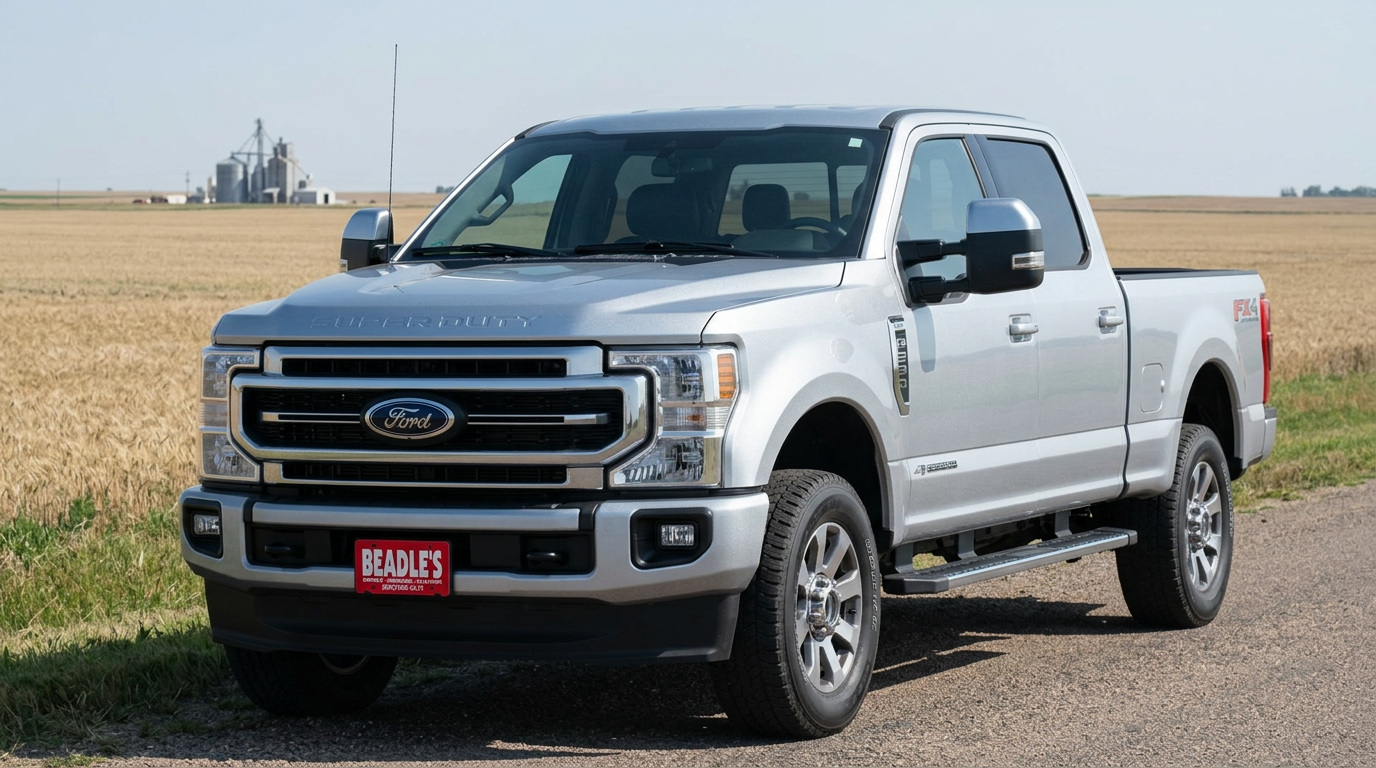
2027 Ford F-250 in Iconic Silver Metallic in South Dakota

What's New for the 2027 Ford F-250 Super Duty

Quick Answer For 2027, the Ford F-250 Super Duty drops from four engines to two: the 7.3L gas V8 is now standard on every trim, and the 6.7L High-Output Power Stroke diesel is the only diesel. New for 2027 are Tremor on the XL, the Carhartt Package, and two new colors. If you're shopping the 2027 Ford F-250, the headline is the engine lineup. Ford cut it from four engines to two, and making the 7.3L gas V8 standard changes the math for most buyers — in a good way if you tow occasionally rather than every day. Here's every meaningful change for 2027 — engines, packages, colors, and what to expect on price — and what it all means for a daily-capable three-quarter-ton around Bowdle and Aberdeen. Shop F-250s in Stock Reserve a 2027 F-250 Get Pre-Approved On This Page What are the biggest changes for the 2027 F-250? Why did Ford drop two engines for 2027? Is the 7.3L gas V8 really standard now? What new packages and colors arrived for 2027? Will the 2027 F-250 cost more than the 2026? What are the biggest changes for the 2027 F-250? The biggest change is the engine lineup dropping from four engines to two: the 7.3L gas V8 is now standard on every trim, and the 6.7L High-Output Power Stroke diesel is the only diesel. Everything else builds on that. Here's the full list of what's new for 2027: Two engines, not four — 7.3L gas V8 standard on all trims; 6.7L High-Output Power Stroke diesel optional across the line. Tremor Off-Road now available on the XL (with the STX Appearance Package), opening the off-road package to the work trim. New XL Off-Road 35-inch Tire Package — 35-inch tires, a locking rear differential, a taller ride height, Rock Crawl mode, Trail Control, and heavy-duty skid plates. New Super Duty Carhartt Package — work-grade styling on single-rear-wheel trucks. Two new colors — Neptune Blue and Iconic Silver Metallic, replacing Argon Blue Metallic and Avalanche. For a North Dakota and South Dakota buyer, the takeaway is simple: the 2027 F-250 keeps all of its capability while making the decision easier and the standard truck more capable. Why did Ford drop two engines for 2027? Ford simplified the lineup. The 6.8L gas V8 and the standard-output 6.7L Power Stroke diesel are both discontinued for 2027, leaving the 7.3L gas V8 and the 6.7L High-Output Power Stroke diesel. In practice, the two remaining engines cover the full range of how F-250 owners actually use the truck. The 7.3L gas handles daily driving and the large majority of recreational and ranch towing; the High-Output diesel is there for the buyer who tows heavy and often. Cutting the two middle engines mostly removes decision paralysis — you're choosing between a capable standard gas V8 and the heavy-haul diesel, not sorting through four overlapping options. Is the 7.3L gas V8 really standard now? Yes. The 7.3L gas V8 is standard on every 2027 F-250 trim, from XL to Platinum. In 2026 it was roughly a $1,500 option over the base engine — so for 2027 you get more standard engine for your money. Properly equipped, the 7.3L gas pulls up to about 19,500 lbs on a fifth-wheel or gooseneck and 18,200 lbs conventional. For most people towing a camper, a stock trailer, or an occasional gooseneck, that's plenty of margin without the upfront cost or added maintenance of a diesel. Our Recommendation For most daily drivers and weekend haulers around Bowdle and Aberdeen, the now-standard 7.3L gas V8 is the right call — it covers daily miles and up to about 19,500 lbs of towing without diesel cost. Step up to the High-Output diesel only if you tow heavy and often or want the truck's maximum ratings. Want the full gas-versus-diesel breakdown? That decision gets its own deep dive within the complete 2027 F-250 overview. What new packages and colors arrived for 2027? Three package additions and two new colors. Tremor Off-Road is now available on the XL (with the STX Appearance Package), there's a new XL Off-Road 35-inch Tire Package, and the Super Duty Carhartt Package debuts on single-rear-wheel trucks. On color, Neptune Blue (a deep marine blue) and Iconic Silver Metallic (a bright silver) are new for 2027, while Argon Blue Metallic and Avalanche are discontinued. If you had your eye on either dropped color, a 2026 F-250 still on the lot is your last chance to get it. You can see all ten 2027 colors on the same truck with our interactive Super Duty color picker, or dig into appearance packages and wheels in the 2027 F-250 colors & appearance guide. Will the 2027 F-250 cost more than the 2026? Expect a modest increase. The 7.3L gas V8 was about a $1,500 option in 2026 and is now standard equipment, so the entry price likely reflects that. Ford has not yet published final 2027 pricing. That makes the timing question real: order a 2027 to get the simplified lineup and the new packages, or buy a 2026 on the lot to lock in an engine the 2027 drops. There's no wrong answer — it comes down to what you want under the hood and how soon you need the truck. Order a 2027 if you want the standard 7.3L gas, Tremor on the XL, the new Carhartt Package, or one of the new colors — and you can wait for a build. Buy a 2026 now if you want the 6.8L gas or the standard-output diesel (both dropped for 2027), or you need a truck on the lot today. From the Beadle Ford Lot Most F-250 shoppers who hear about the engine changes walk in worried they've lost an option they wanted. Once we show them the 7.3L gas is now standard on every trim — and walk through what it actually tows — the simpler lineup usually fits them better than the engine they came in asking about. Key Takeaways The 2027 F-250 cuts its engine lineup from four to two: 7.3L gas V8 standard, 6.7L High-Output diesel optional. The 6.8L gas V8 and the standard-output 6.7L diesel are discontinued for 2027. Tremor is now available on the XL, plus a new XL Off-Road 35-inch Tire Package and the Super Duty Carhartt Package. Neptune Blue and Iconic Silver Metallic are new colors; Argon Blue Metallic and Avalanche are gone. Expect a modest price increase since the 7.3L gas (a ~$1,500 option in 2026) is now standard; final pricing is not yet announced. Frequently Asked Questions What's new on the 2027 Ford F-250? The engine lineup drops from four to two: the 7.3L gas V8 is now standard on every trim and the 6.7L High-Output Power Stroke diesel is the only diesel. 2027 also adds Tremor on the XL, a new XL Off-Road 35-inch Tire Package, the Super Duty Carhartt Package, and two new colors (Neptune Blue and Iconic Silver Metallic). What engines does the 2027 F-250 have? Two: the 7.3L gas V8, now standard on all trims, and the available 6.7L High-Output Power Stroke V8 turbo diesel. Both pair with a 10-speed TorqShift automatic. The 6.8L gas V8 and the standard-output 6.7L diesel were discontinued for 2027. Is the 7.3L gas V8 standard on the 2027 F-250? Yes, on every trim from XL to Platinum. It was roughly a $1,500 option in 2026. Properly equipped, the 7.3L gas tows up to about 19,500 lbs on a fifth-wheel or gooseneck and 18,200 lbs conventional. What new packages does the 2027 F-250 offer? Tremor Off-Road is now available on the XL with the STX Appearance Package, there's a new XL Off-Road 35-inch Tire Package, and the Super Duty Carhartt Package debuts on single-rear-wheel trucks. Will the 2027 F-250 cost more than the 2026? Likely a modest increase, since the 7.3L gas V8 (about a $1,500 option in 2026) is now standard equipment. Ford has not yet published final 2027 F-250 pricing — contact us for current figures as they're released. Quick Answers: 2027 F-250 Changes One-line answers to the follow-up questions buyers ask next. How many engines for 2027? Two — 7.3L gas standard, 6.7L High-Output diesel optional. Which engines were dropped? The 6.8L gas V8 and the standard-output 6.7L diesel. Is the 7.3L gas standard now? Yes, on every trim. What does the 7.3L gas tow? Up to about 19,500 lbs fifth-wheel/gooseneck, properly equipped. Is Tremor on the XL now? Yes — new for 2027, with the STX Appearance Package. New colors? Neptune Blue and Iconic Silver Metallic. Dropped colors? Argon Blue Metallic and Avalanche. Is there a Carhartt edition? Yes — the new Super Duty Carhartt Package, single-rear-wheel. Will it cost more? Likely a modest increase; final pricing not yet announced. Can I order one now? Yes — 2027 order banks are open; build yours to spec. Keep Researching The complete 2027 Ford F-250 Super Duty overview — trims, towing, specs, and inventory 2027 F-250: 7.3L gas vs. HO diesel — which engine fits how you tow Buy a 2026 F-250 now or order a 2027? — the timing and engine trade-off 2027 F-250 colors & appearance — the new colors, packages, and wheels My Take on the 2027 F-250 Changes I think the simplified lineup is a win for the kind of F-250 buyer we see most around here. A lot of folks came in over the years talking themselves into a diesel they didn't really need for a camper and the occasional gooseneck. Making the 7.3L gas standard takes the pressure off that decision — you get a genuinely capable truck without paying the diesel premium, and the diesel is still right there when you actually run heavy. If you're weighing a 2026 on our lot against ordering a 2027, I'm happy to walk through both with you and figure out which one matches how you'll actually use the truck. Stop by Beadle Ford in Bowdle or give us a call. Shop F-250s in Stock Reserve a 2027 F-250 Get Pre-Approved About the Author Lexy Tabbert — Beadle Ford, Bowdle, SD Lexy Tabbert is the Director of Sales and Marketing at Beadle Ford in Bowdle, South Dakota. She covers Ford vehicles, trim comparisons, and buyer guidance — helping families, ranchers, and ag operators across the region find the right truck and configuration for their needs. Learn more about Lexy.
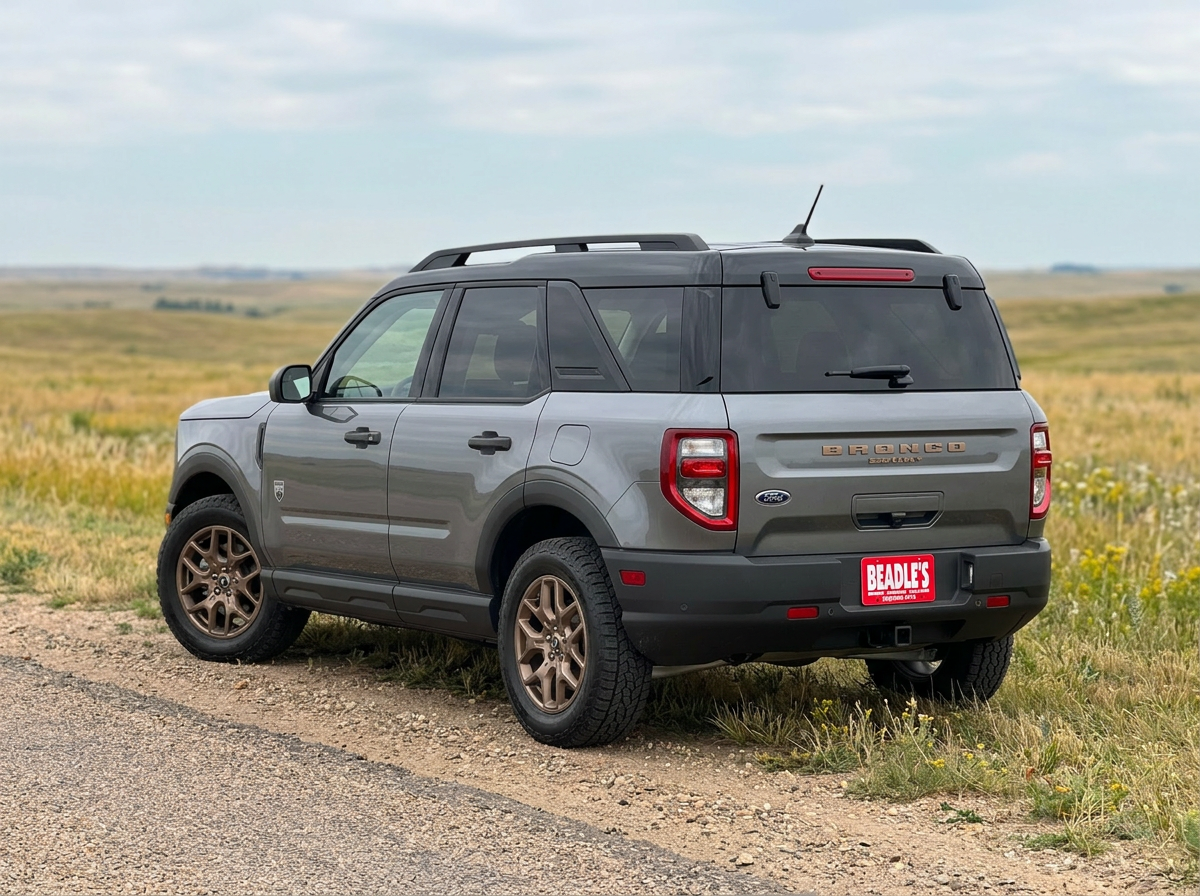
2026 Bronco Sport Bronze Package Sinister Bronze wheels Shadow Black roof SD

Is the 2026 Bronco Sport Bronze Appearance Package Worth It? What It Includes and Who Should Add It

The Bronze Package is new for 2026 and exclusive to the Big Bend trim. It's an appearance package with a specific aesthetic: Sinister Bronze wheels, bronze badge and grille lettering, a Shadow Black roof, and bronze-stitched sport seats. For buyers who want a distinctive look at a lower price point than stepping up to Outer Banks or Badlands, it's a worthwhile option to understand. This guide covers exactly what the Bronze Package includes in both configurations, what it costs in terms of capability trade-offs, and who it actually makes sense for. Shop Bronco Sports in Stock Get Pre-Approved On This Page What is the Bronze Package on the 2026 Bronco Sport? What does the Bronze Package (60F) include? What does the Bronze + Black Diamond Package (60H) include? How do 60F and 60H compare? Is the Bronze Package worth adding? Who is the Bronze Package actually for? What is the Bronze Package on the 2026 Bronco Sport? The Bronze Package is a new option for 2026, available only on the Big Bend trim. It comes in two versions: the Bronze Package (order code 60F) and the Bronze + Black Diamond Off-Road Package (order code 60H). Both are appearance-focused additions that build a visual identity around a bronze color theme applied to exterior and interior details. The 60H variant also adds off-road and towing capability hardware. Key Facts About the Bronze Package Available only on Big Bend — not offered on Heritage, Outer Banks, or Badlands New for 2026 — not carried over from 2025 Two configurations: 60F (appearance only) and 60H (appearance + off-road hardware) Exterior theme: Sinister Bronze wheels, bronze badge and grille lettering, Shadow Black roof Interior theme: Sport contour seats with bronze stitching, all-weather floor liners with bronze accents What does the Bronze Package (60F) include? The base Bronze Package (60F) is a pure appearance package. It changes how the vehicle looks — inside and out — without modifying the drivetrain, tires, or off-road capability from the standard Big Bend. Component What's Included Wheels 17” Sinister Bronze painted aluminum wheels Tires All-season (A/S) tires Roof Shadow Black painted roof Badges and grille Bronze badge lettering, bronze grille lettering, body-color door handles Seats Sport contour premium seats with bronze stitching Floor liners All-weather floor liners with bronze accent The 60F package does not include the Class II Trailer Tow Package, A/T tires, or any suspension upgrades. The Big Bend's standard 4x4, HOSS 1.0 suspension, and all-season tires remain unchanged. What does the Bronze + Black Diamond Package (60H) include? The Bronze + Black Diamond Package (60H) is the 60F appearance package combined with the Black Diamond Off-Road Package. This combination adds meaningful capability hardware on top of the visual upgrades: A/T tires replace the A/S tires, and the Class II Trailer Tow Package is included, raising the tow rating to 2,200 lbs. Component What's Included Everything in 60F All Bronze Package appearance items listed above Tires A/T tires — replaces A/S tires in the 60F base package Towing Class II Trailer Tow Package included — max tow rating 2,200 lbs (SAE J2807) The 60H combination is the version that makes functional sense for buyers who also need towing capability or who want A/T tires without moving to a higher trim. It delivers the Bronze Package's look alongside Big Bend's highest available tow rating. How do the Bronze Package (60F) and Bronze + Black Diamond (60H) compare? The decision between 60F and 60H comes down to whether you need A/T tires and towing capacity above 1,500 lbs. Both carry the same appearance changes — the functional difference is entirely in the tire and tow package. Feature 60F Bronze Package 60H Bronze + Black Diamond Bronze appearance items Included Included Tires All-season (A/S) All-terrain (A/T) Class II Tow Package Not included Included Max tow rating 1,500 lbs 2,200 lbs Is the Bronze Package worth adding to a Big Bend? The Bronze Package is an honest appearance upgrade. It doesn't inflate the truck's mechanical capability — it changes the way it looks, and it does so with a coherent visual theme rather than a scattered set of trim additions. The Sinister Bronze wheels against the Shadow Black roof give a Big Bend a significantly more distinctive appearance than the base configuration. Worth It If You want a visually distinctive Bronco Sport at a Big Bend price point You prefer the bronze/black exterior theme over the standard Big Bend look For 60H: you need A/T tires and occasional towing up to 2,200 lbs without stepping to a higher trim Skip It If You need heated seats, dual-zone climate, or remote start — those are Outer Banks features the Bronze Package doesn't add. If cold-weather comfort is a priority, consider the Outer Banks rather than a Bronze Package Big Bend. The 60F package is purely cosmetic. The 60H package adds real capability alongside the look. If towing or off-road tires matter, go with 60H over 60F — the A/T tires alone make it a more complete package for buyers who drive rural SD roads regularly. Who is the Bronze Package actually for? The Bronze Package makes the most sense for buyers who want a visually individualized compact SUV without the price of the Outer Banks or Badlands. It positions the Big Bend as something distinct — not a base-model look, but a specific visual package that stands apart from both the standard Big Bend and the higher trims' aesthetic. For buyers in north-central SD who need both the appearance and functional capability — A/T tires for gravel roads and occasional towing — the 60H combination delivers that at a lower total price than Heritage + A/T tires through dealer add-ons. The Heritage gets A/T tires standard on its own, but in a different visual direction (retro white roof and plaid) without a tow package. If towing is part of your need, 60H Big Bend is the only way to get that combination at the Big Bend price level. The full trim comparison — where the Bronze Package fits alongside Heritage, Outer Banks, and Badlands — is covered in the 2026 Bronco Sport trim guide, and the complete 2026 model year overview is at the 2026 Bronco Sport overview page. Key Takeaways The Bronze Package is new for 2026 and exclusive to the Big Bend trim. 60F is a pure appearance package: bronze wheels, bronze accents, Shadow Black roof, sport seats with bronze stitching — no capability upgrades. 60H (Bronze + Black Diamond) adds A/T tires and the Class II Trailer Tow Package, raising max tow to 2,200 lbs. Neither Bronze Package configuration adds heated seats, dual-zone climate, or remote start — those are Outer Banks features. 60H is the better choice for buyers who drive gravel roads regularly or need occasional towing above 1,500 lbs. The Bronze Package does not change the engine, 4x4 system, or HOSS 1.0 suspension. Frequently Asked Questions Can I get the Bronze Package on a Heritage, Outer Banks, or Badlands? No. The Bronze Package (60F and 60H) is only available on the Big Bend trim. It is not offered on any other 2026 Bronco Sport trim. If you want bronze accent styling on a higher trim, that's not currently an available configuration. Does the Bronze Package work with all exterior colors? The Bronze Package is designed to be applied to available Big Bend exterior colors, with the Shadow Black painted roof as part of the package itself. Confirm color pairing availability when configuring your order — not all exterior colors may be available with the Bronze Package depending on production scheduling. Check with Beadle Ford in Bowdle for current availability. Is the Bronze + Black Diamond (60H) worth it over just ordering the Heritage? They serve different priorities. The Heritage gives you A/T tires standard and the retro-white aesthetic — but no tow package path. The 60H Bronze + Black Diamond Big Bend gives you A/T tires and the Class II tow package at potentially a lower price point than the Heritage, with a different visual theme (bronze/black vs white/retro). If towing above 1,500 lbs matters, 60H is the only Big Bend path to that capability. Confirm current pricing at Beadle Ford. Was the Bronze Package available on the 2025 Bronco Sport? No. The Bronze Package is a new addition for the 2026 model year. It was not available on 2025 Bronco Sports in any configuration. My Take on the 2026 Bronze Package The Bronze Package is a straightforward option — Ford added it to give Big Bend buyers a distinctive appearance path without pushing them up to the Outer Banks price point. For some buyers that's exactly what they want: a Bronco Sport that looks different from the standard Big Bend without paying for features they don't need. When buyers come into Beadle Ford in Bowdle asking about it, my typical advice is: if you're going to add the Bronze Package, go with 60H over 60F. The A/T tires and tow package make it a more functional vehicle for the kinds of driving people do around here — gravel roads, occasional trailer hauls, boat launches. The appearance upgrade is there either way. If you want to see where the Bronze Package fits in the full 2026 lineup, the 2026 Ford Bronco Sport overview covers all trims and packages in one place. Come into Beadle Ford and we can build out the right configuration for what you need. Shop Bronco Sports in Stock Get Pre-Approved Contact Beadle Ford About the Author Lexy Tabbert — Beadle Ford, Bowdle, SD Lexy Tabbert covers Ford vehicles, trim comparisons, and buyer guidance for Beadle Ford in Bowdle, South Dakota. Her content is grounded in real buyer conversations with farmers, ranchers, and outdoor enthusiasts across north-central South Dakota and beyond. Learn more about Lexy.

Can the 2026 Ford Ranger Tow That? A No-Nonsense Guide to Capacity, Packages, and Real Trailers

If you're hauling a boat to Lake Oahe, pulling a livestock trailer across gravel roads, or packing a travel trailer for a Black Hills trip, the number that matters most is towing capacity — and the 2026 Ford Ranger has a story worth knowing. Not just one number. A few of them, depending on which engine you pick, whether you tow with a hitch or the bumper, and whether the Raptor is even on your radar. This guide breaks all of it down in plain terms so you can answer the real question: can the Ranger tow what you need to tow? Quick note before we get into it: towing is one area where nothing changed for 2026 — same figures as 2025, same packages, same ratings. So if you've been researching the Ranger for a while, this data is current and confirmed. The Numbers: Towing Capacity by Engine and Drivetrain The 2026 Ford Ranger offers three engine options across its trim lineup. Two of them — the 2.3L EcoBoost® I4 and the 2.7L EcoBoost® V6 — deliver the same maximum towing rating. The third is the Raptor-exclusive 3.0L, which is tuned for off-road performance and tows a different number entirely. All figures are SAE J2807 certified and require proper equipment. Configuration Max Towing GCWR 2.3L EcoBoost® I4 — 4x2 up to 7,500 lbs 12,370 lbs 2.3L EcoBoost® I4 — 4x4 up to 7,500 lbs 12,590 lbs 2.7L EcoBoost® V6 — 4x4 up to 7,500 lbs 12,745 lbs 3.0L EcoBoost® V6 — Raptor 4x4 up to 5,510 lbs 11,465 lbs All max towing figures require the Trailer Tow Package and proper setup per Ford's towing guidelines. Figures rated to SAE J2807. What Is GCWR — and Why Does It Matter? GCWR stands for Gross Combined Weight Rating — the maximum allowable weight of your fully loaded truck plus your fully loaded trailer combined. It's the number that protects your drivetrain, brakes, and frame from being overloaded even when your trailer alone is within the max towing limit. Here's a practical example: say you're towing a 6,800 lb loaded horse trailer with a 2.3L 4x4 Ranger. That's within the 7,500 lb tow limit. But if your truck is fully loaded with gear, fuel, passengers, and payload, you'll want to add those weights together and confirm the total stays under 12,590 lbs. Most drivers never get close — but on a long haul with a packed cab and a loaded trailer, it's worth checking. The Raptor's GCWR of 11,465 lbs is lower than the other configurations, which is one reason its max trailer rating sits at 5,510 lbs rather than 7,500 lbs. More on that below. The Trailer Tow Package: You Need It to Reach 7,500 lbs Without the Trailer Tow Package, the Ranger's maximum towing capacity drops to 3,500 lbs — bumper-pull only. That's enough for a small utility trailer, a personal watercraft, or a light single-horse trailer, but it won't get you to the 7,500 lb figure most people are asking about. The Trailer Tow Package adds a Class IV trailer hitch receiver and wiring harness, which enables the full 7,500 lb rating and increases the allowed frontal trailer area from 30 sq ft to 55 sq ft. Frontal area matters because a tall, wide trailer creates more aerodynamic drag — the package accounts for that additional load on the powertrain and cooling system. Tongue Load Limits — Know These Before You Hitch Up Tongue load is the downward force the trailer puts on your hitch ball. Too little and the trailer sways. Too much and you stress the rear suspension. Hitch receiver (with Trailer Tow Package): up to 750 lbs The rule of thumb is to keep tongue weight between 10–15% of total trailer weight. On a 6,000 lb trailer, that's 600–900 lbs — so you'd want to load toward the lighter end for the Ranger. Real Trailers, Real Numbers: What Can You Actually Pull? Spec sheets are one thing. Knowing whether your actual trailer fits those specs is another. Here's a look at common trailers around Bowdle and the surrounding area and where they land against the Ranger's ratings. Trailer Type Typical Loaded Weight Ranger (w/ Tow Pkg) 16–18 ft pontoon boat + trailer 3,500–5,500 lbs ✓ Handles it Single-horse or 2-horse bumper-pull trailer 3,000–5,000 lbs loaded ✓ Handles it Livestock trailer (2–3 head cattle) 4,500–6,500 lbs loaded ✓ Within range Mid-size travel trailer 4,000–6,500 lbs ✓ Within range Larger travel trailer / toy hauler 7,000–10,000+ lbs ⚠ Exceeds rating Enclosed car/equipment trailer varies widely Confirm loaded weight For the trip from Bowdle down to the Badlands or out to the Black Hills with a loaded travel trailer, the Ranger's 7,500 lb ceiling comfortably handles most smaller-to-mid travel trailers. Once you're looking at larger trailers in the 8,000–10,000 lb range, you'll want to be looking at a full-size truck like the F-150 instead. What About the Raptor? Why It Tows Less The Raptor's towing capacity of up to 5,510 lbs when properly equipped is lower than the other Ranger configurations — and that's by design, not a weakness. The Raptor is built around a different mission: high-speed off-road capability. It runs on a long-travel suspension setup with live-valve Fox Racing Shox that's tuned for absorbing rough terrain at speed, not for maximum towing geometry. The 3.0L EcoBoost® V6 in the Raptor makes 405 hp and 430 lb-ft of torque — more output than the other two engines — but that power is optimized for rock crawling and Baja-style driving, not fifth-wheel pulling. The shorter GCWR (11,465 lbs) reflects the overall system's tow-optimized limits relative to its suspension and frame tuning. Bottom line: if towing is your primary use case, the XLT or Lariat with the Trailer Tow Package is the smarter configuration. The Raptor's 5,510 lb limit handles a pontoon boat or a horse trailer just fine — it's just not the right tool if you're regularly running at or near the 7,500 lb ceiling. 2026 vs. 2025: Towing Didn't Change If you've been cross-referencing 2025 and 2026 Ranger specs trying to find a difference in towing — there isn't one. The 7,500 lb max, the GCWR figures, the bumper-pull limit, the tongue load specs — all identical to 2025. Ford updated a number of other things for 2026 (new color, FX4 availability changes, SiriusXM tier upgrade, Power Moonroof added), but towing capacity was not touched. That's actually a good thing — 7,500 lbs is near the top of the midsize truck segment, and there's no structural reason Ford would need to change it. The platform has plenty of capability left for most real-world towing jobs. Towing on Soft Ground: Where the FX4 Package Helps Getting a trailer out of a muddy boat ramp or pulling up a loose gravel access road to a hunting spot is a different kind of challenge than highway towing. That's where the FX4 Off-Road Package earns its place in a towing conversation. The FX4 Package adds an electronic rear locking differential, which locks both rear wheels to the same rotational speed when you need maximum traction. At a boat ramp where one rear tire is in loose sand and the other is on wet concrete, the e-locker prevents the truck from spinning the easy wheel and losing momentum. It makes a meaningful difference in low-traction departure situations — the kind that happen all the time around Lake Oahe. For a deeper look at everything the FX4 adds, the FX4 Off-Road Package guide covers every component and who actually needs it. Towing FAQ Does the 2026 Ford Ranger need the Trailer Tow Package to tow 7,500 lbs? Yes. Without the Trailer Tow Package, the Ranger's maximum towing capacity is 3,500 lbs — bumper-pull only. The Trailer Tow Package adds the Class IV hitch receiver and wiring needed to reach the 7,500 lb rating. Is the 2.7L V6 significantly better for towing than the 2.3L four-cylinder? Both engines cap at the same 7,500 lb max towing rating, so on paper they're equal. The 2.7L makes 315 hp and 400 lb-ft of torque vs. 270 hp and 310 lb-ft for the 2.3L — so you'll feel more effortless power at highway speeds and on grades with the V6. If you're regularly towing near the top of the range, the 2.7L is the more comfortable choice. What is the payload capacity of the 2026 Ranger? The 2026 Ford Ranger has a payload capacity of up to 1,788 lbs on 4x2 models and up to 1,711 lbs on 4x4 models. Payload includes passengers, cargo in the bed, and gear in the cab — everything the truck carries, not what it pulls. Your specific truck's payload limit is on the sticker inside the driver's door. Can the Raptor tow a boat or horse trailer? Yes — the Raptor can tow up to 5,510 lbs when properly equipped, which covers a pontoon boat, a 2-horse trailer, or a mid-size travel trailer. It won't reach the 7,500 lb figure of the other configurations due to its off-road-tuned suspension and frame setup, but it's not a no-tow vehicle by any stretch. Did towing capacity change from 2025 to 2026? No. Towing capacity is identical between the 2025 and 2026 Ford Ranger across all configurations. The 7,500 lb max for non-Raptor models with the Trailer Tow Package, the 5,510 lb Raptor rating, the GCWR figures, and the tongue load limits are all unchanged. Key Takeaways The 2026 Ford Ranger tows up to 7,500 lbs when properly equipped — same on the 2.3L I4 and 2.7L V6 The Raptor tows up to 5,510 lbs — intentionally lower due to its off-road suspension tuning Without the Trailer Tow Package, maximum towing drops to 3,500 lbs bumper-pull only GCWR accounts for the combined weight of truck and trailer — always check it, not just the tow limit Max tongue load is 750 lbs (hitch) — stay in the 10–15% range of your total trailer weight The FX4 e-locker improves traction on boat ramps, muddy fields, and loose-surface departure situations Towing figures are identical to 2025 — no change for 2026 All figures rated to SAE J2807 — the industry standard for consistent towing measurement For most of what people around Bowdle are actually pulling — boats, horse trailers, livestock loads, a travel trailer to Custer or Wall Drug — the 2026 Ranger with the Trailer Tow Package sits comfortably in range. The 7,500 lb ceiling is one of the highest ratings in the midsize segment, and the 2.7L V6 makes that capacity feel effortless rather than strained. At Beadle Ford in Bowdle, I can walk you through the trim and package combination that makes the most sense for what you're hauling. If you want to see how trim choice affects your towing setup options, the 2026 Ford Ranger overview breaks down the complete lineup. — Lexy Tabbert, Beadle Ford Continue Reading → Everything that's new on the 2026 Ranger — and what towing specs stayed the same → How the FX4 e-locker helps in soft-surface towing situations

2027 Ford F-350 Super Duty engine bay with the available 6.7L High-Output Power Stroke diesel

2027 Ford F-350 Engine Comparison: 7.3L Gas vs. High-Output Diesel

Quick Answer For 2027 the F-350 offers just two engines: the 7.3L gas V8 (now standard on every trim) and the available 6.7L High-Output Power Stroke diesel. The gas carries the highest payload (up to ~7,900 lbs) and covers most towing; the High-Output diesel is the choice for heavy, frequent towing and the 40,000-lb gooseneck maximum. The 2027 F-350 makes the engine decision simpler than it's ever been. Gone are the 6.8L gas and the standard-output diesel — leaving a clean choice between the now-standard 7.3L gas V8 and the available 6.7L High-Output Power Stroke diesel. This guide covers what each engine is built for, how they compare on the numbers that are confirmed for 2027, and how to match one to the way you actually tow and haul around Bowdle and Aberdeen. Shop F-350s in Stock Get Pre-Approved On This Page What engines does the 2027 F-350 offer? Is the 7.3L gas enough without the standard diesel? When is the High-Output diesel worth it? Gas vs. diesel: ownership beyond the spec sheet How do you choose for your workload? What engines does the 2027 F-350 offer? Two, both paired with the 10-speed TorqShift automatic: the 7.3L gas V8, now standard on every trim, and the available 6.7L High-Output Power Stroke diesel — the only diesel for 2027. Ford hasn't published final 2027 horsepower and torque figures, so the comparison below is built on the capability numbers that are confirmed. Engine Best For Confirmed Capability 7.3L gas V8 (standard) Daily work, occasional-to-moderate towing, max payload, lower cost of ownership Highest payload — up to ~7,900 lbs 6.7L High-Output Power Stroke (available) Heavy, frequent towing; large goosenecks and fifth-wheels; max capability Up to 40,000 lbs gooseneck (DRW, 40K package) Maximums require proper equipment and vary by cab, bed, axle, and single- or dual-rear-wheel configuration. 2027 hp/torque not yet published by Ford. Is the 7.3L gas enough without the standard diesel? For most F-350 buyers, yes. The 7.3L gas V8 is now standard on every trim, and it carries the F-350's highest payload — up to about 7,900 lbs — because it's lighter than the diesel. It handles daily ranch and jobsite work and a wide range of gooseneck and trailer loads without the diesel's upfront cost or maintenance. If your towing stays in the range a gas Super Duty comfortably covers, the standard 7.3L may be all the truck you need — and the money saved goes a long way toward the rest of the build. When is the High-Output diesel worth it? The 6.7L High-Output Power Stroke is the heavy-towing engine — it's what unlocks the 40,000-lb gooseneck maximum and feels most composed on grades, in wind, and on long highway pulls. If you tow heavy and often, run a large gooseneck or fifth-wheel, or want maximum capability headroom, it earns its premium. Our Recommendation For most ranch and farm buyers around Bowdle and Aberdeen, start with the now-standard 7.3L gas — it covers daily work, the highest payload, and most of the towing people actually do. Choose the High-Output diesel when you regularly run heavy goosenecks or want the 40,000-lb ceiling. Size it to your real loaded trailer with our 2027 F-350 towing guide. Gas vs. diesel: ownership beyond the spec sheet The engine is an ownership decision, not just a capability one. Weigh these against how hard you'll actually work the truck: Upfront cost: the diesel carries a higher purchase price than the gas. Payload need: if you haul heavy in the bed more than you tow, the 7.3L gas and its ~7,900-lb payload may matter more than diesel torque. Use pattern: frequent heavy towing justifies diesel; mixed driving favors gas. Long-term plans: how long you keep the truck and your annual miles change the math. From the Beadle Ford Lot With the standard-output diesel gone, the conversation has flipped. Buyers used to default to "get the diesel"; now, once we walk through their real trailer weight, more are landing on the standard 7.3L gas and putting the savings toward trim or the build they actually want. How do you choose for your workload? Work from how you use the truck, in four steps: Identify your heaviest trailer and how often you tow it. Decide whether maximum capability headroom matters, or whether comfortable margin is enough. Factor in payload needs, annual miles, and how long you keep trucks. Confirm the build — engine choice can affect available packages and SRW vs. DRW. Key Takeaways 2027 simplifies to two engines: 7.3L gas standard, 6.7L High-Output diesel optional. The 7.3L gas carries the highest payload — up to ~7,900 lbs — and covers most towing. The High-Output diesel is the heavy-towing choice and unlocks the 40,000-lb gooseneck maximum. Pick by use pattern and payload need, not by habit — many buyers now fit the gas. Ford hasn't published 2027 hp/torque yet; the lineup and capability figures are confirmed. Frequently Asked Questions What engines does the 2027 Ford F-350 have? Two: the 7.3L gas V8, standard on every trim, and the available 6.7L High-Output Power Stroke diesel. Both use a 10-speed TorqShift automatic. The 6.8L gas and standard-output 6.7L diesel from 2026 are discontinued. Ford hasn't published final 2027 horsepower and torque figures. Is the 7.3L gas enough for an F-350 without the diesel? For most buyers, yes. The 7.3L gas is now standard, carries the highest payload (up to ~7,900 lbs), and handles daily work and a wide range of towing. The diesel is for those who tow heavy and often or want the 40,000-lb gooseneck maximum. Which 2027 F-350 engine tows the most? The 6.7L High-Output Power Stroke diesel — it anchors the F-350's 40,000-lb gooseneck maximum in dual-rear-wheel form with the 40K Gooseneck Tow Package. The 7.3L gas covers most lighter and moderate towing. Which engine has the most payload? The 7.3L gas V8, at up to approximately 7,900 lbs with the heavy-duty payload package — more than the diesel, because the lighter engine frees up weight for the bed. Do the 2027 engines change towing or payload vs. 2026? No — the F-350's tow and payload maximums carry over. Even with two engines instead of four, the High-Output diesel still tows up to 40,000 lbs gooseneck and the gas still leads on payload at ~7,900 lbs, properly equipped. Quick Answers: 2027 F-350 Engines One-line answers to the follow-up questions buyers ask next. How many engines for 2027? Two — 7.3L gas standard, 6.7L HO diesel optional. What's the standard engine? The 7.3L gas V8, on every trim. Most towing? The HO diesel — up to 40,000 lbs gooseneck. Most payload? The 7.3L gas — up to ~7,900 lbs. Is the standard-output diesel gone? Yes — only the High-Output diesel remains. Is the 6.8L gas gone? Yes — discontinued for 2027. What transmission? 10-speed TorqShift on both engines. Are hp/torque published? Not yet — Ford lists 2027 outputs as TBD. Gas or diesel for occasional towing? Gas — lower cost, plenty of capability. How do I confirm the right engine? We size it to your real loaded trailer before you order. Keep Researching The complete 2027 Ford F-350 Super Duty overview — specs, towing, trims, and how to order. 2027 F-350 towing guide — the ratings behind each engine, by configuration. What's new for 2027 — why the lineup dropped to two engines. Buy a 2026 now or order a 2027? — if you want a dropped engine, time matters. My Take on the 2027 Engine Choice In my experience, the two-engine lineup makes this easier, not harder. Most buyers around here are better served starting with the now-standard 7.3L gas and only stepping to the High-Output diesel when their trailer math truly calls for it — and now that the gas is standard, that's a real money decision, not just a power one. Tell me your heaviest trailer and your typical week, and I'll point you to the right engine and build. Stop in at Beadle Ford in Bowdle or reach out anytime. Shop F-350s in Stock Get Pre-Approved About the Author Lexy Tabbert — Beadle Ford, Bowdle, SD Lexy Tabbert is the Director of Sales and Marketing at Beadle Ford in Bowdle, South Dakota. She covers Ford vehicles, trim comparisons, and buyer guidance — helping families, ranchers, and ag operators across the region find the right truck and configuration for their needs. Learn more about Lexy.
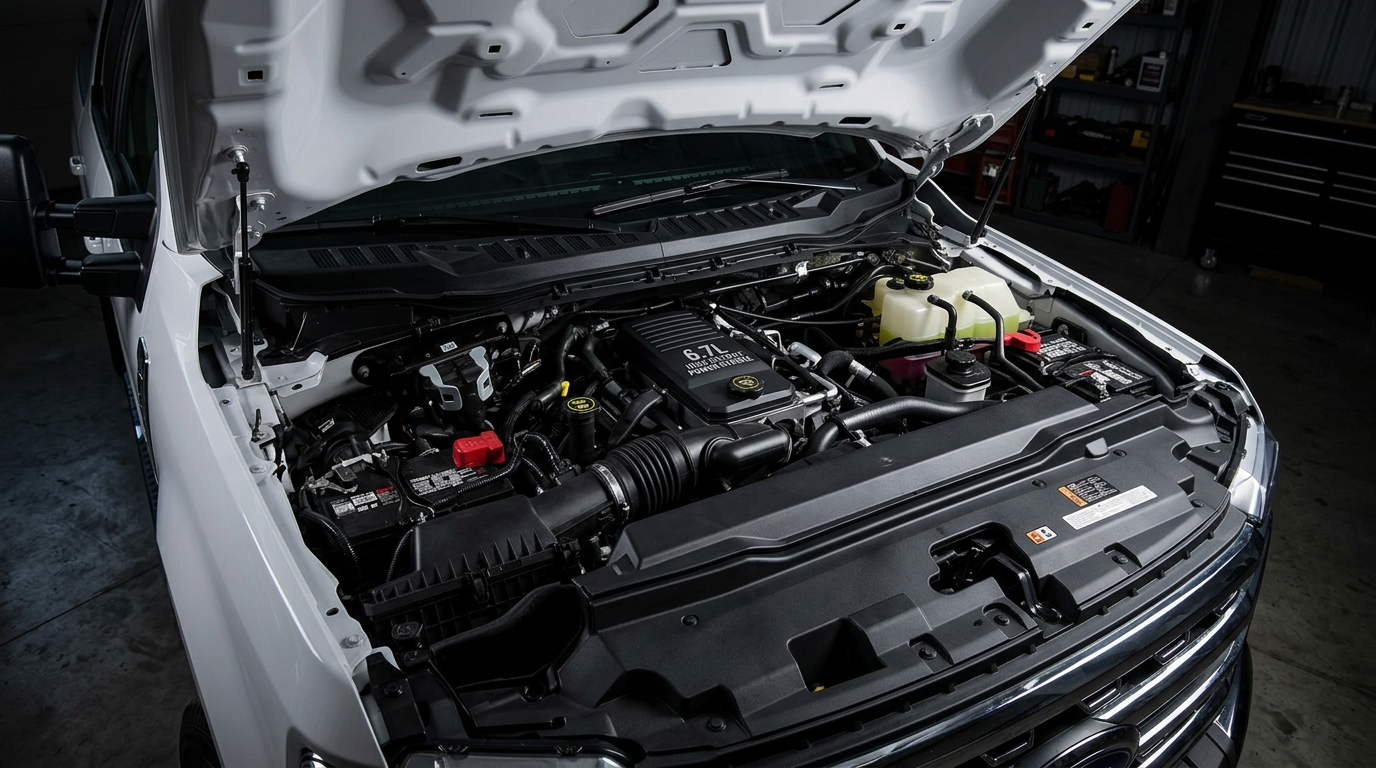
2026 Ford Maverick Specs & Configurations (AWD-Forward Guide)

/* Beadle blog image fix: prevents skew/stretch from theme styles */ img.beadle-img { width: 100% !important; max-width: 980px; height: auto !important; display: block; margin: 0 auto 12px; border-radius: 10px; } If you’re shopping the 2026 Ford Maverick and you care about AWD for South Dakota winters, the smartest move is to start with the non-negotiables: drivetrain, towing needs, payload reality, and the equipment that actually shows up on the window sticker. This guide lays out the specs buyers ask for most—without assuming every Maverick is built the same way. Want the full “which one should I buy?” overview first? Use the 2026 Ford Maverick overview. If you’re browsing the full lineup and model guidance (including what’s typically available locally), start at the 2026 Ford Maverick overview. Shop Mavericks in Stock Contact Us Table of Contents What powertrains are offered for 2026? Which Maverick builds can you get with AWD? Towing specs: what changes the rating? Payload: what buyers misunderstand most What to confirm on the window sticker How to spec the right Maverick (step-by-step) FAQ What powertrains are offered for 2026? The 2026 Maverick lineup is built around two buyer profiles: people who want a compact truck that’s easy to live with every day, and people who want compact size but still prioritize winter traction and capability. Powertrain availability can vary by build and timing, so the best approach is to treat published specs as a starting point—then confirm what’s on the specific unit or order. If you’re comparing trims at the same time, the 2026 Ford Maverick overview shows how different trims are positioned and which types of buyers they typically fit. Which Maverick builds can you get with AWD? For South Dakota buyers, AWD isn’t a “nice to have”—it’s often the deciding filter. The key is that AWD availability is tied to configuration, and that configuration can also influence towing equipment, wheel/tire setup, and how the truck feels under load. AWD is a configuration decision: choose it early, because it can narrow what’s available. Don’t ignore tires: the right tire choice matters as much as drivetrain for winter confidence. Confirm the exact build: window sticker and equipment list matter more than assumptions. If winter traction is your main concern, we break down what actually matters (tires, clearance, visibility, and driving patterns) in the upcoming 2026 Maverick winter driving guide. Towing specs: what changes the rating? Maverick towing capability is heavily dependent on towing equipment and configuration. The most common mistake is shopping by a single towing number without checking whether the truck has the right package hardware to match your trailer. Trailer type matters: utility trailers and small campers are common Maverick use cases. Equipment matters: hitches, cooling/support hardware, and package content can change what’s realistic. Real loaded weight beats brochure weight: always plan around what you actually tow. For a detailed towing breakdown (including how to think about trailer weight, stability, and what to check on the equipment list), see the upcoming 2026 Maverick towing guide. Payload: what buyers misunderstand most Payload is the limit that sneaks up on people—especially if you carry passengers, tools, or bed loads at the same time. The practical way to think about payload is “everything you add to the truck” (people + gear + accessories) and whether the truck is still comfortably within spec. Passengers count toward payload. Bed loads + accessories add up faster than most people expect. When towing, tongue weight (or hitch load) also affects payload. What to confirm on the window sticker before you commit If you want a specific answer, don’t guess—verify the truck’s equipment list. Here’s what serious buyers confirm every time: Drivetrain: AWD vs FWD (and how it’s listed on the build) Towing equipment: hitch / package content that supports your trailer Wheel/tire setup: impacts winter confidence and ride feel Cab/bed configuration: affects daily usability and what you can carry Quick Overview Best for Buyers who want AWD confidence and practical truck capability Smartest move Choose drivetrain + towing needs first, then pick trim Confirm before purchase Window sticker equipment list (don’t assume) How to spec the right Maverick (step-by-step) Decide AWD vs FWD first based on your winter routes and where you drive. Write down your trailer type (if any) and realistic loaded weight. Estimate payload needs (people + gear + bed load) for your normal week. Pick trim based on comfort/tech needs after capability is locked. Verify equipment on the exact unit using the window sticker or build sheet. Shop Mavericks in Stock Ask a Maverick Question FAQ Is AWD worth it for South Dakota winters? For many drivers, yes—especially if you drive rural roads, commute early before plows, or deal with drifting snow. That said, winter tires can make a major difference too. The best setup is AWD plus a tire choice that fits how and where you drive. What’s the fastest way to avoid buying the “wrong” Maverick? Decide drivetrain and towing needs first, then confirm the equipment list on the exact truck you’re considering. Most regrets come from assuming the truck has a package or hardware that isn’t actually on that build. Should I pick trim first or capability first? Capability first. Get AWD/FWD, towing needs, and payload reality sorted—then pick trim for comfort and tech. The 2026 Ford Maverick overview helps compare trims once your configuration is clear. Conclusion In my experience, buyers feel best about a Maverick when they spec it like a tool first and a trim badge second. When AWD, towing equipment, and payload expectations line up with real life, the Maverick becomes the kind of truck that’s easy to live with year-round. About the Author: Lexy Tabbert helps South Dakota and North Dakota drivers choose the right Ford vehicle configuration for real-world use. Her Maverick guidance focuses on AWD confidence for winter driving, practical towing/payload decision-making, and verifying equipment on the exact build—so buyers get a truck that fits long-term.

2027 Ford F-250 on a Bowdle, South Dakota main street

2027 Ford F-250 as a Daily Driver in South Dakota

Quick Answer Yes, the 2027 Ford F-250 works well as a daily driver in South Dakota. A single-rear-wheel F-250 drives and parks like a normal full-size truck, upper trims are highway-comfortable, and 4x4 makes it excellent in snow and gravel. The trade-off is a firmer unloaded ride and a thirsty gas V8. Plenty of people around here drive an F-250 every day, not just on tow days. The question isn't whether a three-quarter-ton can be a daily driver — it's whether the comfort, fuel, and winter manners line up with how you live. For most rural South Dakota owners, they do. Here's an honest look at the F-250 as an everyday vehicle: practicality, highway comfort and tech, what to really expect at the pump, and how it handles a Dakota winter and a season of gravel roads. Shop F-250s in Stock Reserve a 2027 F-250 Get Pre-Approved On This Page Is an F-250 practical as an everyday vehicle? Comfort and tech for long highway miles Real-world fuel expectations on the 7.3L Winter and gravel-road livability Is an F-250 practical as an everyday vehicle? Yes. A single-rear-wheel F-250 drives, parks, and lives like a normal full-size truck — it's the dually F-350 that gets awkward in a parking lot. For school runs, the co-op, the lumber yard, and the highway between towns, the F-250 is entirely livable as a daily. The honest trade-offs versus a half-ton are size and ride: it's a taller, heavier truck, and the heavy-duty suspension rides firmer when the bed is empty. Around here, where driveways are long, distances are real, and a truck earns its keep, those trade-offs are easy ones for most buyers to make. Comfort and tech for long highway miles On the long, straight highway miles between Dakota towns, the F-250 is a comfortable place to spend time — especially in Lariat trim and up, which add leather, the 12-inch SYNC 4 touchscreen, heated and ventilated seats, and a quieter, more settled cabin. Even the work-focused XLT is a pleasant long-haul truck. The upper trims also bring the driver-assist and connectivity tech that makes a daily truck easier: a big digital cluster, wireless phone integration, and available 360-degree cameras. If your F-250 is going to double as the family highway vehicle, the Lariat is the comfort sweet spot. Best daily-driver pick: an XLT for value or a Lariat for comfort, with the standard 7.3L gas V8 and 4x4 — capable enough for any chore, comfortable enough to live in. Real-world fuel expectations on the 7.3L Set expectations honestly: Super Duty trucks are above the 8,500-lb weight class the EPA rates, so there's no window-sticker MPG figure. In real-world driving, the 7.3L gas V8 generally returns low-to-mid teens unloaded, and less when you're towing. The 6.7L High-Output diesel does noticeably better on the highway and especially under load, which is part of why heavy, high-mileage tow buyers lean diesel. But for a daily driver that mostly runs empty, the gas V8's lower purchase and maintenance cost usually outweighs the diesel's fuel savings. A big V8 in a heavy-duty truck is never going to sip — that's the deal you make for the capability. Winter and gravel-road livability This is where the F-250 shines as a Dakota daily. With 4x4, selectable drive modes, real ground clearance, and the weight to stay planted, it handles snow-packed roads and washboard gravel about as well as anything on the lot. Add a good set of all-terrain or winter tires and it's hard to stop. The same toughness that makes it a capable tow truck makes it a confident winter commuter: heavy-duty everything, ground clearance to clear drifts, and the traction tech to put the power down. For getting to work in February or down a muddy spring two-track, it's exactly the truck you want. The full breakdown lives in our 2027 F-250 winter & gravel capability guide. Our Recommendation For an F-250 that pulls daily-driver duty around Bowdle and Aberdeen, we recommend an XLT or Lariat with the standard 7.3L gas V8 and 4x4. You get genuine heavy-duty capability, a comfortable highway cabin, excellent winter and gravel manners, and a lower cost of ownership than the diesel for a truck that mostly drives unloaded. From the Beadle Ford Lot A fair number of our F-250 buyers barely tow at all — they want one truck that handles the gravel, the winter, and the occasional heavy chore, and doubles as the everyday driver. When someone tells me they want capability they can live in daily, I point them at a Lariat with the gas V8 and 4x4, and they rarely look back. Key Takeaways A single-rear-wheel F-250 drives and parks like a normal full-size truck — livable as a daily driver. Lariat and up add leather, the 12-inch SYNC 4 touchscreen, and heated/ventilated seats for long highway miles. Super Duty trucks aren't EPA-rated; expect low-to-mid teens unloaded from the 7.3L gas, less when towing. With 4x4 and good tires, the F-250 is excellent on Dakota snow and gravel. For a daily driver, an XLT or Lariat with the 7.3L gas and 4x4 is the value-and-comfort sweet spot. Frequently Asked Questions Is a 2027 F-250 good as a daily driver? Yes. A single-rear-wheel F-250 drives and parks like a normal full-size truck and is comfortable for long highway miles, especially in Lariat trim and up. The trade-offs are a firmer unloaded ride and a thirsty gas V8 — reasonable for a capable truck you can use every day. What fuel economy does the 7.3L gas F-250 get? Super Duty trucks are above the EPA's rated weight class, so there's no official window-sticker MPG. In real-world driving, the 7.3L gas V8 typically returns low-to-mid teens unloaded and less when towing. The diesel does better, especially on the highway and under load. Is the F-250 hard to drive in winter? No — it's one of the better winter daily drivers around. With 4x4, selectable drive modes, real ground clearance, and good tires, the F-250 handles snow-packed roads and gravel confidently. The weight and traction tech help it stay planted. Which F-250 trim is best for daily driving? An XLT for value or a Lariat for comfort, with the standard 7.3L gas V8 and 4x4. The Lariat adds leather, the 12-inch SYNC 4 touchscreen, and heated/ventilated seats that make long highway miles easy, while the gas V8 keeps the cost of ownership down for a truck that mostly drives unloaded. Quick Answers: F-250 as a Daily Driver One-line answers to the follow-up questions buyers ask next. Is it too big for daily use? No — the SRW F-250 drives like a normal full-size truck. Fuel economy on the gas V8? Low-to-mid teens unloaded; not EPA-rated. Is there an MPG window sticker? No — Super Duty is above the EPA-rated weight class. Best daily trim? XLT for value, Lariat for comfort. Best daily engine? The standard 7.3L gas V8. Good in winter? Yes — excellent with 4x4 and good tires. Comfortable on the highway? Yes, especially Lariat and up. Does it have wireless phone connectivity? Yes, on upper trims with SYNC 4. Gas or diesel for a daily? Gas, unless you tow heavy and often. Where can I test drive one? Beadle Ford in Bowdle, SD. Keep Researching The complete 2027 Ford F-250 Super Duty overview — trims, towing, specs, and inventory 2027 F-250 winter & gravel capability — 4x4, drive modes, and the right tires 2027 F-250 trims for the everyday buyer — where the value lands Is an F-250 enough truck? — capability for daily and weekend use My Take on Daily-Driving an F-250 I'm upfront with daily-driver buyers about the fuel — a big gas V8 in a heavy-duty truck is going to drink more than a half-ton, and I'd rather someone know that going in than be surprised at the first fill-up. What I find, though, is that the people who want one truck to do everything around here almost never regret the F-250. It's comfortable on the highway, unstoppable in the winter, and ready the day they finally do need to tow something heavy. If you're thinking about an F-250 as your everyday truck, come drive a Lariat and see how it feels on our roads. We're at Beadle Ford in Bowdle whenever you're ready. Shop F-250s in Stock Reserve a 2027 F-250 Get Pre-Approved About the Author Lexy Tabbert — Beadle Ford, Bowdle, SD Lexy Tabbert is the Director of Sales and Marketing at Beadle Ford in Bowdle, South Dakota. She covers Ford vehicles, trim comparisons, and buyer guidance — helping families, ranchers, and ag operators across the region find the right truck and configuration for their needs. Learn more about Lexy.
2026 Ford F-150 towing a camping trailer in South Dakota

2026 Ford F-150 Ownership, Fuel Economy & Long-Term Costs Guide

Long-term ownership costs for the 2026 Ford F-150 depend heavily on engine selection, driving habits, towing frequency, and trim configuration. This guide explains what to expect from gas and hybrid configurations, how usage patterns affect costs, and what rural drivers should consider before ordering. For full trim, engine, and towing details, see the complete 2026 Ford F-150 overview. Contact Beadle Ford Table of Contents What Is the Fuel Economy Like? Hybrid vs Gas: Which Costs Less Long-Term? What Maintenance Should Owners Expect? How Long Does the Hybrid Battery Last? Does Engine Choice Affect Fuel Tank Size? How Does the F-150 Hold Its Value? How to Choose the Most Cost-Effective Setup What Is the Fuel Economy Like on the 2026 F-150? Fuel economy varies depending on engine, drivetrain, axle ratio, and driving conditions. Smaller EcoBoost engines generally prioritize efficiency, while larger engines and performance variants prioritize capability. The PowerBoost hybrid is engineered to improve efficiency compared to traditional gas-only configurations, particularly in city and mixed driving conditions. Exact EPA ratings vary by configuration and should be reviewed alongside trim and drivetrain selection. Hybrid vs Gas: Which Costs Less Over Time? The answer depends largely on driving habits. Frequent short trips and city driving: Hybrid efficiency gains may offset higher initial cost. Heavy towing and highway use: Gas engines may offer comparable long-term operating costs. Jobsite or recreational power needs: Hybrid Pro Power capability may reduce generator costs. Buyers who rarely tow at maximum capacity but drive daily may benefit more from hybrid efficiency than those consistently hauling heavy trailers. Engine performance and towing differences are detailed in our F-150 Engine Options Guide. What Maintenance Should Owners Expect? Like all full-size trucks, maintenance includes routine oil changes, brake service, tire rotations, and fluid inspections. EcoBoost engines use turbocharging systems that require proper maintenance intervals. Hybrid models include additional electrical components but are engineered for long-term durability. Maintenance costs are more influenced by usage intensity than engine type alone. How Long Does the PowerBoost Hybrid Battery Last? Hybrid battery systems are designed for long-term operation under normal use conditions. Warranty coverage details should be reviewed at time of purchase. Battery longevity depends on driving habits, climate conditions, and regular servicing. Does Engine Choice Affect Fuel Tank Size? Yes. Certain engine configurations may impact available fuel tank sizes and range characteristics. Drivers planning long-distance towing or rural travel should verify fuel tank specifications when selecting engine and trim combinations. How Does the F-150 Hold Its Value? The Ford F-150 has historically maintained strong resale value compared to many competitors in the full-size segment. Factors influencing resale include: Engine choice Trim level Condition and mileage Regional demand Maintenance history Work-ready trims and balanced configurations often perform well in rural resale markets. How to Choose the Most Cost-Effective 2026 F-150 Estimate your realistic annual mileage. Evaluate how often you tow heavy loads. Consider whether onboard power replaces separate equipment. Balance upfront cost with projected long-term fuel savings. Choose a trim that fits both daily use and resale goals. Key Takeaways Fuel economy varies significantly by configuration. Hybrid models may benefit daily drivers more than heavy haulers. Maintenance costs depend more on usage than engine type. Fuel tank size and axle ratios affect long-distance practicality. Balanced configurations often support strong resale value. Frequently Asked Questions Is the hybrid more expensive to maintain? Maintenance costs vary by usage pattern. Hybrid systems are engineered for durability and include warranty coverage. Does towing reduce fuel economy significantly? Yes. Fuel economy decreases when towing, especially at higher weights and highway speeds. Is the F-150 a good long-term truck investment? When properly maintained and configured appropriately, the F-150 has historically demonstrated strong long-term durability and resale value. Conclusion In my experience, long-term ownership decisions are less about chasing the highest fuel economy number and more about honestly evaluating how the truck will be used. A well-matched configuration tends to deliver better satisfaction and value over time than selecting features based solely on headline statistics. Review available 2026 Ford F-150 models at Beadle Ford or contact us to discuss long-term ownership considerations. About the Author Lexy Tabbert provides research-driven truck ownership guidance and vehicle configuration insights for drivers across South Dakota and the surrounding region.

2026 Ford Explorer second-row captain’s chairs

2026 Ford Explorer Interior & 3-Row Space Guide

The 2026 Ford Explorer is designed around three-row flexibility. For many families, interior layout matters more than horsepower or trim names. Seating configuration, third-row usability, and cargo space behind the rear seats often determine whether Explorer is the right fit. This guide explains how the 2026 Explorer’s seating and cargo space are structured, and how trim and equipment choices can affect layout. For a broader overview of trim positioning and feature availability, see the 2026 Ford Explorer overview. Shop Explorers in Stock Table of Contents How many people does the Explorer seat? Captain’s chairs vs bench: what’s the difference? Is the third row usable for adults? How much cargo space is behind the third row? Is the Explorer good for road trips? How to choose the right seating layout How many people can the 2026 Ford Explorer seat? The 2026 Explorer can seat up to seven passengers, depending on second-row configuration. Second-row captain’s chairs reduce seating to six but improve passenger comfort and ease of access to the third row. A second-row bench increases capacity to seven. Captain’s chairs vs bench: what’s the difference? Captain’s chairs provide individual seating positions in the second row and a center aisle for easier third-row access. Many families prefer this layout for daily school drop-offs and passenger comfort. Bench seating increases total seating capacity and can be useful for larger families who regularly transport more than six passengers. Seating availability can vary by trim and equipment group, so it’s important to confirm configuration when selecting a vehicle. Is the Explorer third row comfortable for adults? The third row in the 2026 Explorer is generally best suited for children and shorter trips for adults. For extended travel with adult passengers, seating comfort may depend on passenger height and overall cabin configuration. Families who regularly use the third row for teenagers or adults may want to evaluate overall cabin layout during a test drive. How much cargo space is behind the third row? With all three rows upright, the Explorer provides usable cargo space suitable for groceries, sports bags, and carry-on luggage. Folding the third row significantly increases cargo capacity, allowing for larger items such as coolers, strollers, and travel gear. Real-world cargo practicality depends on how frequently all three rows are occupied. Is the 2026 Explorer good for road trips? The Explorer’s three-row layout, available infotainment features, and flexible cargo configurations make it well-suited for family road trips. For longer drives, interior materials, seating configuration, and available technology features can influence comfort more than raw cabin dimensions. Technology availability is explained further in our Technology & Safety Guide. How do you choose the right seating layout? Determine how many passengers you regularly transport. Decide whether third-row access convenience is important. Consider how often all seats will be occupied. Balance seating needs with cargo needs. Confirm trim availability of desired configuration. Quick Interior Overview Feature 2026 Explorer Maximum Seating Up to 7 passengers Second Row Options Bench or captain’s chairs (varies by configuration) Third Row Standard on all trims Cargo Flexibility Expandable with fold-flat rear seats Key Takeaways Explorer seats up to seven passengers. Captain’s chairs improve access and comfort. Bench seating increases total capacity. Cargo space expands significantly when rear seats are folded. Seating availability can vary by trim. Frequently Asked Questions Does the 2026 Explorer come standard with three rows? Yes, three-row seating is standard across the Explorer lineup. Which Explorer trims offer captain’s chairs? Captain’s chairs are available on many configurations. Availability can vary by trim and equipment group. Is the Explorer bigger than the Edge? Yes, the Explorer offers three rows, while the Edge is a two-row SUV. Is the third row suitable for adults? The third row is generally best suited for children or shorter adult trips. Conclusion In my experience, most Explorer buyers make their final decision based on seating layout rather than trim name. Once families clarify whether they need six or seven seats — and how often the third row will be used — the right configuration usually becomes clear within the 2026 lineup. About the Author Lexy Tabbert provides research-driven SUV configuration guidance for drivers throughout South Dakota and beyond.

Contact Us

Fill out this form below and we'll contact you shortly
*Required Fields