
Blog

All New Vehicles Bowdle Ford Dealer Bowdle Ford Service
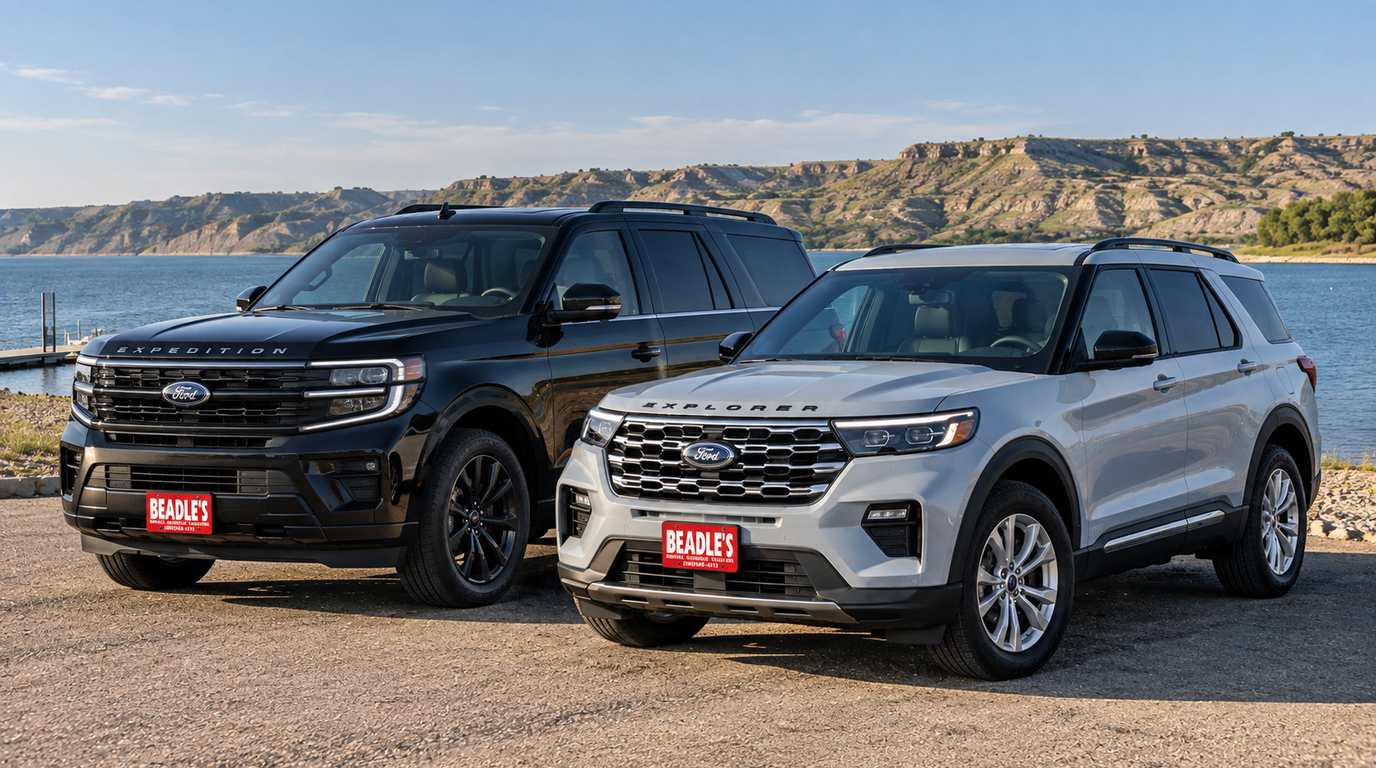
2027 Ford Explorer next to a 2027 Ford Expedition at Lake Oahe, comparing Ford three-row SUVs at Beadle Ford

Ford Explorer vs. Expedition: Which Ford Three-Row Should You Buy?

Home› Ford Explorer› 2027 Ford Explorer› Explorer vs. Expedition Quick Answer Buy the Explorer unless you specifically need what the Expedition adds. The Expedition is much longer, seats eight with an adult-sized third row, and tows 9,600 lbs against the Explorer’s 5,000. The Explorer is easier to park, cheaper to buy and fuel, and enough SUV for most families — step up only if you tow a big camper or regularly carry eight people. We sell both, so this one is not a sales pitch for either. The Explorer and the Expedition are both three-row Fords, both on the lot in Bowdle in 2026 and 2027 model years, and they are built for different jobs. Buying the Expedition when an Explorer would do costs you money every month at the pump and every time you park. Buying the Explorer when you needed the Expedition costs you the trailer you cannot pull and the third row the adults will not sit in. This guide puts the two side by side on size, seating and third-row room, towing, engines, fuel, and price, then tells you which families end up in which one. Full guides for each: the 2027 Ford Explorer Buyers Guide and the 2027 Ford Expedition Buyers Guide. Get Pre-Approved Shop Explorer Inventory On This Page The short answer Size: what a foot of length means The third row and cargo Towing: 5,000 vs. 9,600 lbs Engines and fuel Price and which families end up where The short answer Buy the Explorer if your trailer is under 5,000 lbs (a fishing boat, a small camper, a snowmobile trailer), the third row is for kids most of the time, and you want the vehicle that is easier to park, cheaper to buy, and lighter on fuel. It is the right three-row for most families. Buy the Expedition if you tow more than 5,000 lbs (a stock trailer, a tandem-axle camper, a bigger boat), you regularly put adults in the third row, or you need the cargo room of a full-size body-on-frame SUV. It tows up to 9,600 lbs and seats up to eight. Size: what a foot of length means 2027 Ford Explorer 2027 Ford Expedition Construction Unibody, rear-drive based Body-on-frame (F-150 platform), rear-drive based Length 198.7 in About 210 in (Expedition MAX is longer) Wheelbase 119.1 in About 122.5 in (MAX longer) Width (no mirrors) 78.9 in Wider Seating Up to 7 (6 on Tremor) Up to 8 Cargo behind 3rd row 16.3 cu ft Considerably more; see the Expedition guide Explorer figures are Ford’s 2027 specifications. Expedition dimensions are approximate; confirm on the 2027 Expedition guide. Roughly a foot of length and a body-on-frame construction is the whole story of the Expedition. It is what makes the third row adult-sized, the cargo area big enough for a family’s luggage with all three rows up, and the tow rating nearly double. It is also what you feel in a school pickup line, a parking ramp in Sioux Falls, and a two-car garage that was built in 1975. The Explorer fits places the Expedition does not, and for a lot of families that is the deciding factor. The third row and cargo The Explorer’s third row is a kids’ row and an occasional-adult row. With it up there are 16.3 cubic feet behind it, which handles the hockey bags and the groceries; with rows two and three down there are 85.3 cubic feet. The Expedition’s third row is an adult row, and its cargo area with all three rows up is large enough for a week’s luggage. If your regular load is three teenagers plus a friend plus their gear, or grandparents in the third row on the drive to Rapid City, the Expedition is the one that does it without complaint. If your regular load is two car seats in the second row, kids in the back a few times a month, and a dog, the Explorer’s space is right-sized and the extra room in the Expedition is room you pay to carry around empty. Towing: 5,000 vs. 9,600 lbs This is the cleanest dividing line. The 2027 Explorer tows up to 5,000 lbs on every trim with either engine, Class III hitch standard. The 2027 Expedition tows up to 9,600 lbs on 4x4 models with the Heavy-Duty Trailer Tow Package, and 6,000 to 6,300 lbs on 4x2 models, all when properly equipped. Under 5,000 lbs (most aluminum fishing boats on a single-axle trailer, a two-place snowmobile trailer, a small travel trailer, a utility trailer): Explorer. 5,000 to 9,600 lbs (a tandem-axle camper, a bigger fiberglass boat, a stock or flatbed trailer): Expedition. Weigh what you actually pull, loaded, including the trailer. A lot of families guess low. If the honest number is close to 5,000, go Expedition; towing at the limit every weekend is hard on a vehicle and on the driver. Explorer towing details are in the Explorer Buyers Guide towing section. Not sure which Ford three-row? Tell us what you tow and who rides in the third row. We will put you in the right one, and both are on the lot. Shop Explorers in Stock Ask About a Custom Order Engines and fuel 2027 Ford Explorer 2027 Ford Expedition Standard engine 2.3L EcoBoost I-4, 300 hp / 310 lb-ft 3.5L EcoBoost V6, 400 hp / 480 lb-ft Available engine 3.0L EcoBoost V6, up to 400 hp / 415 lb-ft 3.5L EcoBoost V6 High Output, 440 hp / 510 lb-ft (Tremor and Platinum performance builds) Transmission 10-speed automatic 10-speed automatic Fuel economy 2.3L 4WD: 20 / 27 / 23 mpg (EPA) See the window sticker on each unit Fuel tank 17.9 gal (2.3L) / 20.2 gal (3.0L) Larger Ford published figures. Towing requires proper equipment. The Expedition starts where the Explorer tops out: its base engine makes 400 horsepower and 480 lb-ft, and the High Output version makes 440 and 510. That is what moves a 9,600-lb trailer. The cost is fuel. The Explorer 2.3L 4WD is EPA-rated at 23 mpg combined, and a full-size body-on-frame SUV with a twin-turbo V6 is not going to match it; check the sticker on the specific Expedition, but plan on a meaningful difference at 15,000 miles a year. If you do not need the towing, the Explorer’s 300-hp four is plenty and the savings are real. Price and which families end up where The 2027 Explorer starts at $38,465 (Active 100A RWD) and tops out at $56,460 (Tremor 801A) before options and $1,795 destination. The Expedition starts well above the Explorer’s base and a loaded Platinum runs well into the upper range of the Ford SUV lineup; the current numbers are in the 2027 Expedition Buyers Guide and on the window stickers on our lot. As a rule, an Explorer trim costs roughly what the Expedition trim one step below it costs. Who ends up in what, from our lot: growing families with kids under twelve, a boat, and a gravel road go Explorer, usually an Active 200A 4WD or an ST-Line, and the Tremor if they hunt. Families with teenagers and a camper, ranch families with a stock trailer, and anyone who regularly fills all three rows with adults go Expedition. Empty nesters trading down from an Expedition go Explorer Platinum, and for 2027 the V6 makes that trade-down easy: Platinum 2.3L or 3.0L V6. Both are on the lot in Bowdle in both model years, parked close enough to walk between. Shop the Explorers in stock, shop the Expeditions, and get pre-approved so the payment on each is a known number before you decide. Key Takeaways Explorer: up to 5,000 lbs towing, up to 7 seats, 198.7 inches long, from $38,465. Expedition: up to 9,600 lbs, up to 8 seats, about a foot longer, priced well above. The trailer decides it. Under 5,000 lbs loaded, Explorer. Over, Expedition. The Explorer’s third row is for kids and occasional adults; the Expedition’s is adult-sized with real cargo room behind it. Expedition starts at 400 hp / 480 lb-ft; Explorer at 300 hp / 310 lb-ft with a 400-hp V6 available. The Explorer is the fuel-economy choice. Both are on the Beadle Ford lot in 2026 and 2027 model years; drive both before you decide. Frequently Asked Questions What is the difference between the Ford Explorer and the Ford Expedition? The Explorer is a unibody midsize three-row SUV, 198.7 inches long, seating up to seven and towing up to 5,000 lbs. The Expedition is a body-on-frame full-size SUV built on the F-150 platform, roughly a foot longer, seating up to eight and towing up to 9,600 lbs when properly equipped. How much more can the Expedition tow than the Explorer? Up to 4,600 lbs more. The 2027 Explorer tows up to 5,000 lbs on every trim. The 2027 Expedition tows up to 9,600 lbs on 4x4 models with the Heavy-Duty Trailer Tow Package, and 6,000 to 6,300 lbs on 4x2 models. Is the Explorer’s third row big enough for adults? For short trips, yes. For regular adult use or long drives, the Expedition’s third row is the adult-sized one. The Explorer’s third row is best for kids and teenagers, with 16.3 cubic feet of cargo behind it. Which gets better fuel economy, the Explorer or the Expedition? The Explorer. Its 2.3L 4WD is EPA-rated 20 city / 27 highway / 23 combined. The Expedition’s 3.5L twin-turbo V6 in a full-size body-on-frame SUV uses noticeably more fuel; check the window sticker on a specific unit. Which is cheaper, the Explorer or the Expedition? The Explorer. The 2027 Explorer starts at $38,465 (plus $1,795 destination) and tops out at $56,460 before options. The Expedition starts well above the Explorer’s base and a loaded Expedition Platinum is priced well above the top Explorer; see the 2027 Expedition Buyers Guide for current figures. Are the Explorer and Expedition both on the lot at Beadle Ford? Yes. Beadle Ford in Bowdle, SD, has both 2026 and 2027 Explorers and Expeditions in stock. Shop Explorer and Expedition inventory online or contact us to compare specific units. My Take Because we sell both, I get to be honest here. About two out of three families who come in asking about an Expedition leave in an Explorer, because when we weigh their actual trailer and count who actually rides in the third row, the Explorer does the job and saves them real money every month. The other third genuinely needs the Expedition, and I would never put them in something smaller. Tell us what you pull and who rides where. That conversation takes ten minutes and it is the whole decision. Shop Explorer Inventory Get Pre-Approved Contact Beadle Ford About the Author Lexy Tabbert — Beadle Ford, Bowdle, SD Lexy Tabbert is the Director of Sales and Marketing at Beadle Ford in Bowdle, South Dakota. She covers Ford vehicles, trim comparisons, and buyer guidance — helping families, ranchers, and ag operators across the region find the right truck and configuration for their needs. Learn more about Lexy.
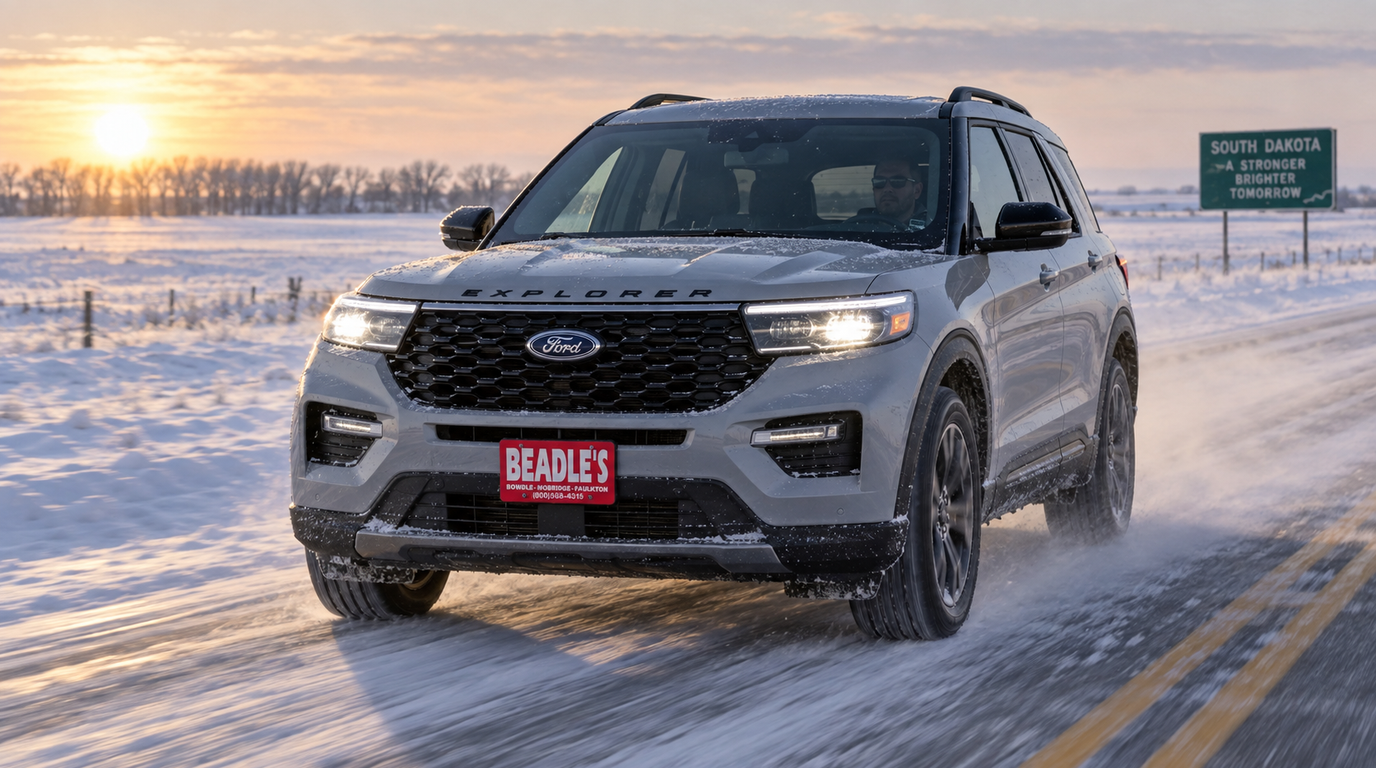
2027 Ford Explorer 4WD on a snowy South Dakota highway in January, winter-ready at Beadle Ford in Bowdle

2027 Ford Explorer vs. Jeep Grand Cherokee L: Three Rows, Towing, and Winter Compared

Home› Ford Explorer› 2027 Ford Explorer› vs. Grand Cherokee L Quick Answer The Grand Cherokee L tows more — 6,200 lbs against the Explorer’s 5,000 — and offers the Hurricane inline-six. The Explorer counters with slightly more maximum cargo room (85.3 vs. 84.6 cubic feet), the Tremor and ST trims, and a simpler Intelligent 4WD system. If towing is the priority, take the Jeep; for family hauling and winter confidence at a lower starting price, take the Explorer. The Jeep Grand Cherokee L is the three-row that our Tremor shoppers and our ranch families cross-shop, because Jeep’s reputation for 4x4 is earned. The comparison is closer than the Toyota or Honda one: both are rear-drive-based, both offer real four-wheel-drive systems, and both have an available turbo engine with more than 320 horsepower. The differences are in towing, the off-road trims, interior space, and price. This guide compares the 2027 Explorer and the 2026 Grand Cherokee L on engines, towing, 4WD systems, off-road trims, space, tech, and price. Jeep figures are from Jeep’s published 2026 Grand Cherokee L specifications; Explorer figures are Ford’s 2027 numbers from the 2027 Ford Explorer Buyers Guide. Get Pre-Approved Shop Explorer Inventory On This Page The short answer Engines and towing 4WD systems and winter Tremor vs. the Jeep lineup Three-row space and interior Tech and price The short answer The Grand Cherokee L tows more (up to 6,200 lbs with the V6 against the Explorer’s 5,000), offers an air suspension on upper trims, and carries the Jeep badge. If your trailer is between 5,000 and 6,200 lbs, that settles it. The Explorer has more standard power (300 hp vs. 293), more available power (up to 400 hp vs. 324), a factory off-road trim with all-terrain tires and a limited-slip rear on a three-row body (Jeep’s Trailhawk is two-row only), BlueCruise hands-free driving, a lower starting price, and it is on the lot in Bowdle in two model years. For most families who tow a boat or a small camper and drive gravel, the Explorer does the job for less. Engines and towing 2027 Ford Explorer 2026 Jeep Grand Cherokee L Standard engine 2.3L EcoBoost I-4, 300 hp / 310 lb-ft 3.6L Pentastar V6, 293 hp / 260 lb-ft Available engine 3.0L EcoBoost V6, up to 400 hp / 415 lb-ft 2.0L Hurricane turbo I-4, 324 hp / 332 lb-ft Transmission 10-speed automatic 8-speed automatic Max towing 5,000 lbs, every trim Up to 6,200 lbs, properly equipped Fuel tank 17.9 gal (2.3L) / 20.2 gal (3.0L) Per Jeep specifications Explorer figures are Ford’s published 2027 specifications; towing requires proper equipment. Jeep figures per Jeep’s 2026 published specifications. Torque is the number to look at. The Explorer’s base turbo four makes 50 lb-ft more than Jeep’s base V6, and it makes it low in the rev range, which is what you feel with a loaded trailer. Jeep’s Hurricane four is a strong engine at 324 hp and 332 lb-ft; the Explorer’s 3.0L V6 answers it with up to 400 hp and 415 lb-ft on the ST, the Tremor 801A, and the Platinum. Where Jeep wins outright is the tow rating: 6,200 lbs is 1,200 more than any Explorer. If you are towing a tandem-axle camper near that number, buy the Jeep, or come look at an Expedition. 4WD systems and winter Both are rear-drive-based, which is the right starting point for towing and for ice. The Explorer’s Intelligent 4WD has seven drive modes including Slippery and Deep Snow/Sand, Hill Descent Control, and on the Tremor a TORSEN limited-slip rear axle that puts torque to the wheel with grip mechanically. Jeep offers its Quadra-Trac 4x4 systems on the Grand Cherokee L, with Quadra-Drive II and an electronic limited-slip rear on upper trims, plus the Selec-Terrain modes. On a snow-packed highway or an icy intersection in Mobridge, both are excellent, and I would not pick one over the other for that alone. Ground clearance is similar in standard form (the Explorer runs 7.6 to 8.7 inches depending on trim); Jeep’s Quadra-Lift air suspension on upper trims can raise it further, which is a genuine Jeep advantage on a deeply rutted two-track, at a price. Tremor vs. the Jeep lineup Here is the detail that surprises Jeep shoppers: the Trailhawk trim, Jeep’s off-road package with all-terrain tires and skid plates, is offered only on the two-row Grand Cherokee. There is no Grand Cherokee L Trailhawk. If you need three rows and want factory off-road hardware from Jeep, the answer is an Overland or Summit with the air suspension, which is a luxury build at a luxury price. The Explorer Tremor is that missing vehicle: a three-row with P265/65R18 all-terrain tires, front and rear underbody deflector plates, front tow hooks, auxiliary grille lights, a TORSEN limited-slip rear, 8.7 inches of clearance, and 4WD only, from $49,200 with the 2.3L or $56,460 with the V6 (plus $1,795 destination). It is not a Wrangler or a Bronco, and it is not trying to be. It is the three-row that handles the section road, the two-track to the stand, and the boat ramp without asking you to give up the third row. The full Tremor guide. Three rows and gravel roads? Drive an Explorer Tremor on the section road behind the dealership. That is the comparison Jeep cannot offer on a three-row. Shop Tremors in Stock Ask About a Custom Order Three-row space and interior The Grand Cherokee L seats six or seven and Jeep lists up to 84.6 cubic feet of cargo with the rear rows folded. The 2027 Explorer seats up to seven (six on the Tremor) with 16.3 cubic feet behind the third row and up to 85.3 cubic feet folded. These two are effectively the same size inside; neither has the Grand Highlander’s or Pilot’s extra room, and neither needs it for a family of five with hockey gear. Interior character is where they differ. The Grand Cherokee L leans luxurious even on lower trims and can be optioned into Lincoln territory on a Summit Reserve. The Explorer spends its money differently: standard tri-zone climate, standard second-row captain’s chairs, a power-fold third row on ST, Platinum, and Tremor 801A, and on the Platinum multicontour seats, a 14-speaker B&O system, and BlueCruise included for a year plus 90 days. Tech and price Both have big screens and full driver-assist suites. The Explorer’s 13.2-inch touchscreen runs Google built in with wireless CarPlay and Android Auto, 5G, and over-the-air updates; Jeep’s Uconnect is a good system with its own strengths, including an available passenger screen. The Explorer’s advantage is BlueCruise, which Jeep does not offer on the Grand Cherokee L. BlueCruise vs. the other hands-free systems. Price: the 2027 Explorer Active 100A starts at $38,465 in RWD and $40,465 in 4WD, plus $1,795 destination. Jeep lists the 2026 Grand Cherokee L Laredo from $41,990 before destination, and 4x4 is extra. Trim for trim the Explorer starts a few thousand dollars lower and the gap widens at the top, where a loaded Summit Reserve sits well above a V6 Platinum. Every Explorer trim and price: 2027 Explorer trim levels. Both model years are on the lot: see what is in stock and get pre-approved before you come in. Key Takeaways Grand Cherokee L tows more: up to 6,200 lbs vs. the Explorer’s 5,000. If your trailer is in that range, that decides it. Explorer has more standard power (300 vs. 293 hp) and more available power (400 vs. 324 hp). Jeep’s Trailhawk is two-row only. The Explorer Tremor is the factory off-road three-row, with all-terrain tires, plates, hooks, and a TORSEN rear. Both are rear-drive-based with capable 4WD; Jeep offers an air suspension on upper trims, Ford offers BlueCruise. Explorer starts a few thousand lower ($38,465 vs. $41,990 before destination), and both model years are on the lot in Bowdle. Frequently Asked Questions Does the Grand Cherokee L tow more than the Explorer? Yes. Jeep rates the 2026 Grand Cherokee L at up to 6,200 lbs when properly equipped. The 2027 Explorer is rated at up to 5,000 lbs on every trim. If you tow between 5,000 and 6,200 lbs, the Jeep or a Ford Expedition is the right answer. Which has more horsepower, the Explorer or the Grand Cherokee L? The Explorer. Its 2.3L EcoBoost makes 300 hp and 310 lb-ft standard against the Jeep’s 293-hp, 260-lb-ft 3.6L V6, and the Explorer’s available 3.0L V6 makes up to 400 hp against the Jeep’s 324-hp 2.0L Hurricane. Is there a Grand Cherokee L Trailhawk? No. Jeep offers the Trailhawk off-road trim only on the two-row Grand Cherokee. The three-row Grand Cherokee L is offered in trims such as Laredo, Limited, Overland, and Summit. The Explorer Tremor is the factory off-road three-row in this comparison. Which is better in snow, the Explorer or the Grand Cherokee L? Both are rear-drive-based with capable four-wheel-drive systems and are excellent in winter. The Explorer adds Deep Snow/Sand and Slippery drive modes and, on the Tremor, a TORSEN limited-slip rear and all-terrain tires; Jeep’s upper trims offer Quadra-Drive II and an air suspension. Which is bigger inside? They are close. The Grand Cherokee L seats six or seven with up to 84.6 cubic feet of cargo folded; the Explorer seats up to seven with 16.3 cubic feet behind the third row and up to 85.3 cubic feet folded. Which costs less, the Explorer or the Grand Cherokee L? The 2027 Explorer Active starts at $38,465 before $1,795 destination. Jeep lists the 2026 Grand Cherokee L Laredo from $41,990 before destination, with 4x4 extra. My Take This is the comparison I respect most, because the Grand Cherokee L is a good truck and the Jeep buyer usually knows exactly what they want. My honest read: if the tow rating matters, Jeep wins and I will say so. If three rows plus real gravel capability is the job, the Explorer Tremor is the only one of the two that offers it, and it costs less than the Jeep you would have to build to get close. Drive the Tremor on the section road behind the store. Then go drive the Jeep. I am comfortable with where that ends up. Shop Explorer Inventory Get Pre-Approved Contact Beadle Ford About the Author Lexy Tabbert — Beadle Ford, Bowdle, SD Lexy Tabbert is the Director of Sales and Marketing at Beadle Ford in Bowdle, South Dakota. She covers Ford vehicles, trim comparisons, and buyer guidance — helping families, ranchers, and ag operators across the region find the right truck and configuration for their needs. Learn more about Lexy.
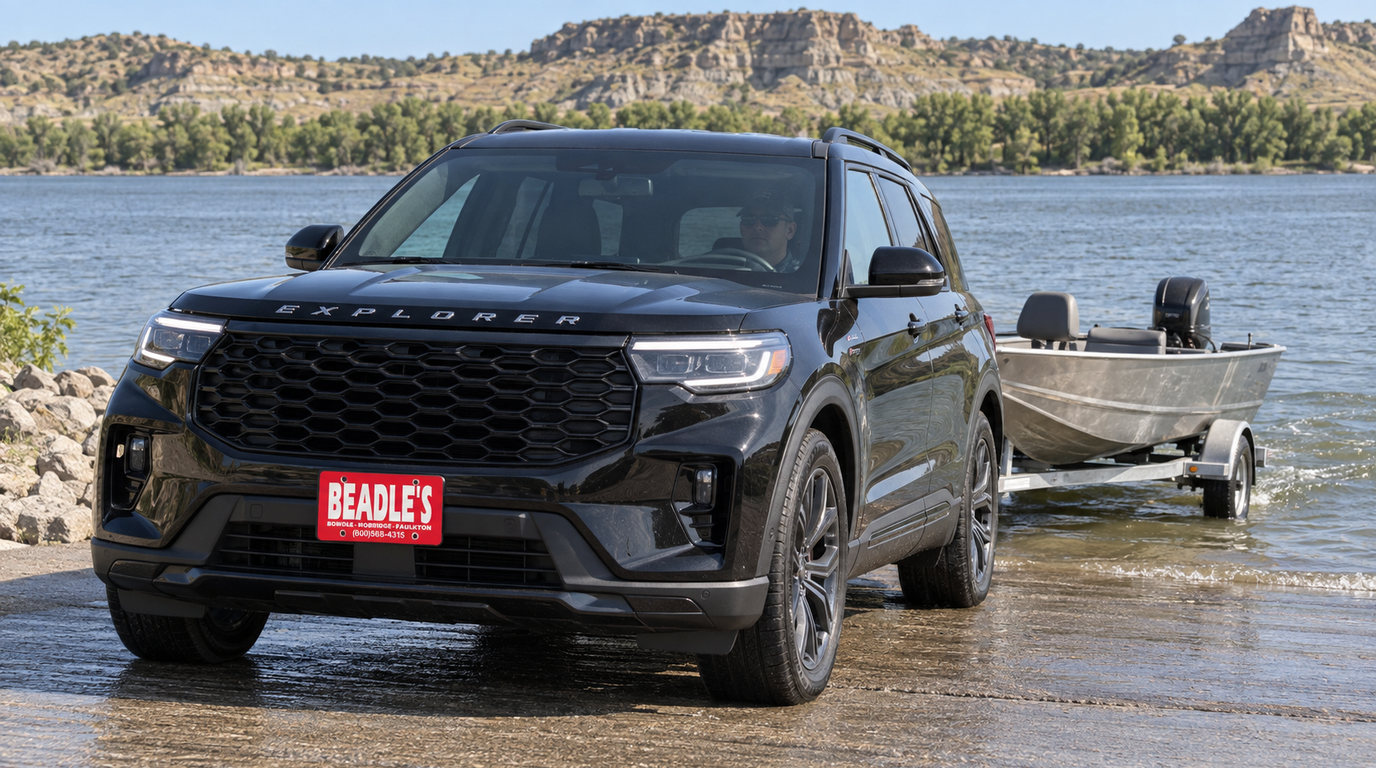
2027 Ford Explorer towing a fishing boat at a Lake Oahe boat ramp, 5,000-lb towing at Beadle Ford in Bowdle SD

2027 Ford Explorer vs. Honda Pilot: Turbo Four, V6, 4WD, and Towing Compared

Home› Ford Explorer› 2027 Ford Explorer› vs. Honda Pilot Quick Answer The Explorer’s 300-hp 2.3L EcoBoost outmuscles the Pilot’s 285-hp V6, and every Explorer tows 5,000 lbs where a Pilot needs AWD to get there (3,500 lbs with front-wheel drive). The Explorer also offers true 4WD plus the Tremor and ST; the Pilot answers with a roomier, squarer cabin and the TrailSport. For South Dakota winters and towing, the Explorer is the stronger pick. The Honda Pilot is the other three-row that shows up in our trade lane most often, usually a 2018 to 2023 that has been a good vehicle. Pilot owners who come to look at an Explorer tend to ask the same three things: is the turbo four as good as the V6 they have, does the Explorer tow more, and is Ford’s 4WD better than Honda’s AWD in the winter. Fair questions, with clear answers. This guide compares the 2027 Explorer and the 2026 Pilot on engines, towing, all-weather capability, the off-road trims, space, tech, and price. Honda figures are from Honda’s published 2026 Pilot specifications; Explorer figures are Ford’s 2027 numbers from the 2027 Ford Explorer Buyers Guide. Get Pre-Approved Shop Explorer Inventory On This Page The short answer Engines: 300-hp turbo four vs. 285-hp V6 Winter: Ford Intelligent 4WD vs. Honda i-VTM4 AWD Seating, cargo, and the third row Technology and driver assistance Price The short answer The Pilot is the roomier vehicle, with up to eight seats and more total cargo volume, and its naturally aspirated V6 is a known quantity. If you want maximum interior space and you do not tow, it is a fine choice. The Explorer has more power from its base engine than the Pilot has from its only engine, tows 5,000 lbs on every trim (the Pilot needs AWD to get there; front-drive Pilots are rated at 3,500), runs a rear-drive-based 4WD system, offers a V6 with up to 400 hp and a true off-road Tremor trim, and starts lower. For a family that tows a boat or a camper and drives gravel, the Explorer is the better fit. Engines: 300-hp turbo four vs. 285-hp V6 2027 Ford Explorer 2026 Honda Pilot Standard engine 2.3L EcoBoost I-4, 300 hp / 310 lb-ft 3.5L V6, 285 hp / 262 lb-ft Available engine 3.0L EcoBoost V6, up to 400 hp / 415 lb-ft None; one engine across the lineup Transmission 10-speed automatic 10-speed automatic Drive RWD or Intelligent 4WD (rear-drive based) FWD or i-VTM4 AWD (front-drive based) Max towing 5,000 lbs, every trim and both engines 5,000 lbs AWD; 3,500 lbs FWD Explorer figures are Ford’s published 2027 specifications; towing requires proper equipment. Honda figures per Honda’s 2026 published specifications. The Pilot’s 3.5L V6 is smooth and durable, and Pilot owners like it. But 262 lb-ft of torque arriving high in the rev range is the reason a loaded Pilot on a grade with a trailer behind it feels busy. The Explorer’s 2.3L EcoBoost makes 310 lb-ft at low rpm, which is what you feel pulling out of a boat ramp or passing on US-12. And the Explorer has a second answer the Pilot does not: the 3.0L V6 at up to 400 hp on the ST, the Tremor 801A, and now the Platinum. Winter: Ford Intelligent 4WD vs. Honda i-VTM4 AWD Honda’s i-VTM4 is a good torque-vectoring AWD system on a front-drive platform. The Explorer is built the other way around: rear-drive based, with Intelligent 4WD that sends power forward as needed, seven drive modes including Slippery and Deep Snow/Sand, and Hill Descent Control on every 4WD model. In everyday snow both are capable. Where the difference shows is towing on a slick ramp, starting on an icy hill with a load, and driving rutted gravel, where a rear-biased layout keeps the front tires steering instead of pulling. Both brands have an off-road trim. The Pilot TrailSport adds all-terrain tires, a lifted suspension, and skid plates to the AWD Pilot. The Explorer Tremor adds all-terrain tires, front and rear underbody plates, front tow hooks, auxiliary grille lights, 8.7 inches of ground clearance, and a TORSEN limited-slip rear axle, on a 4WD-only build, with the 300-hp 2.3L or the 400-hp V6. The Tremor guide has the full hardware list. Trading a Pilot? Bring it to Bowdle. We will appraise it, and you can drive the Explorer 4WD on gravel the same afternoon. Shop Explorers in Stock Ask About a Custom Order Seating, cargo, and the third row The Pilot is the bigger box. It seats up to eight, Honda lists 18.6 cubic feet behind the third row, and its total cargo volume with the rear rows folded is greater than the Explorer’s. The 2027 Explorer seats up to seven, with 16.3 cubic feet behind the third row and up to 85.3 cubic feet folded. If cargo volume is the one number you are buying on, Honda has it. In use, the differences are smaller than the table suggests. Both fit hockey bags behind the third row. Both have second-row captain’s chairs available (standard on the Explorer, which is the layout car-seat families want). The Explorer’s third row is power-folding on ST, Platinum, and Tremor 801A, and tri-zone climate control is standard on every trim. Bring your gear to the lot and load it; that is how our customers actually decide. Technology and driver assistance The Explorer runs a 13.2-inch touchscreen with Google built in, a 12.3-inch digital cluster, wireless Apple CarPlay and Android Auto, a 5G modem, and over-the-air updates on every trim, with Ford Co-Pilot360™ Assist+ standard and the 360-degree camera from ST-Line up. The Pilot’s screens are smaller, Honda Sensing is standard, and wireless CarPlay depends on trim. The bigger gap is hands-free driving. BlueCruise is included on the Explorer Platinum for a year plus 90 days, trial-included on ST and Tremor 801A, and optional on ST-Line and Tremor 800A. Honda does not offer a hands-free highway system on the Pilot. On the long drives that define living out here, that matters. How BlueCruise compares with GM and Nissan. Price The 2027 Explorer Active 100A starts at $38,465 in RWD and $40,465 in 4WD, plus $1,795 destination, with the Class III tow package already on it. Honda lists the 2026 Pilot Sport from $42,395 in front-wheel drive, before destination, and AWD is required for the 5,000-lb tow rating. So the Explorer that tows 5,000 lbs starts roughly $2,000 below the Pilot that tows 3,500. Every Explorer trim and price: 2027 Explorer trim levels. And both the 2026 and 2027 Explorer are on the lot at Beadle Ford. See the Explorers in stock, bring the Pilot for an appraisal, and get pre-approved first if you want the numbers settled before you drive out. Key Takeaways Explorer: 300 hp standard, up to 400 hp available, 310 to 415 lb-ft. Pilot: one 285-hp V6 with 262 lb-ft. Every Explorer tows 5,000 lbs; the Pilot tows 5,000 only with AWD (3,500 in FWD). Explorer is rear-drive-based 4WD with Deep Snow and Slippery modes; the Tremor adds a TORSEN axle, plates, and hooks the TrailSport does not have. Pilot is roomier: up to 8 seats and more total cargo. Explorer: up to 7, 16.3 / 85.3 cu ft. Explorer starts around $2,000 lower, offers BlueCruise, and both model years are on the lot in Bowdle. Frequently Asked Questions Which has more horsepower, the Explorer or the Pilot? The Explorer. Its standard 2.3L EcoBoost makes 300 hp and 310 lb-ft against the Pilot’s 285-hp, 262-lb-ft V6, and the Explorer’s available 3.0L V6 makes up to 400 hp. The Pilot offers one engine. Does the Explorer or the Pilot tow more? Both max out at 5,000 lbs, but every 2027 Explorer trim is rated for 5,000 lbs with a Class III package standard. The Pilot is rated at 5,000 lbs only with AWD; front-wheel-drive Pilots are rated at 3,500 lbs. Is the Pilot bigger inside than the Explorer? Yes. The Pilot seats up to eight with 18.6 cubic feet behind the third row and more total cargo volume. The Explorer seats up to seven with 16.3 cubic feet behind the third row and up to 85.3 cubic feet folded. Explorer Tremor vs. Pilot TrailSport: which is more capable? The Tremor. Both add all-terrain tires and skid plates, but the Tremor also has a TORSEN limited-slip rear axle, front tow hooks, 8.7 inches of ground clearance, a rear-drive-based 4WD system, and up to 400 hp with the 801A V6. Does the Honda Pilot have hands-free driving like BlueCruise? No. Honda Sensing includes adaptive cruise and lane keeping but not a hands-free highway system. BlueCruise is included on the Explorer Platinum and trial-included on ST and Tremor 801A. Which is cheaper, the Explorer or the Pilot? The 2027 Explorer Active starts at $38,465 before $1,795 destination. Honda lists the 2026 Pilot Sport from $42,395 in FWD before destination. Trim for trim the Explorer starts lower. My Take Pilot owners are usually happy Pilot owners, and I do not try to talk them out of that. What I show them is the tow rating on a front-drive Pilot, the torque number on the Explorer’s base engine, and then I hand them the keys to a 4WD Explorer and point at the gravel road behind the dealership. Most of them come back with the decision made. If your Pilot has been good to you and you never tow, keep shopping both. If a boat or a camper is in your future, the Explorer is the one built for it, and it costs less to start. Shop Explorer Inventory Get Pre-Approved Contact Beadle Ford About the Author Lexy Tabbert — Beadle Ford, Bowdle, SD Lexy Tabbert is the Director of Sales and Marketing at Beadle Ford in Bowdle, South Dakota. She covers Ford vehicles, trim comparisons, and buyer guidance — helping families, ranchers, and ag operators across the region find the right truck and configuration for their needs. Learn more about Lexy.
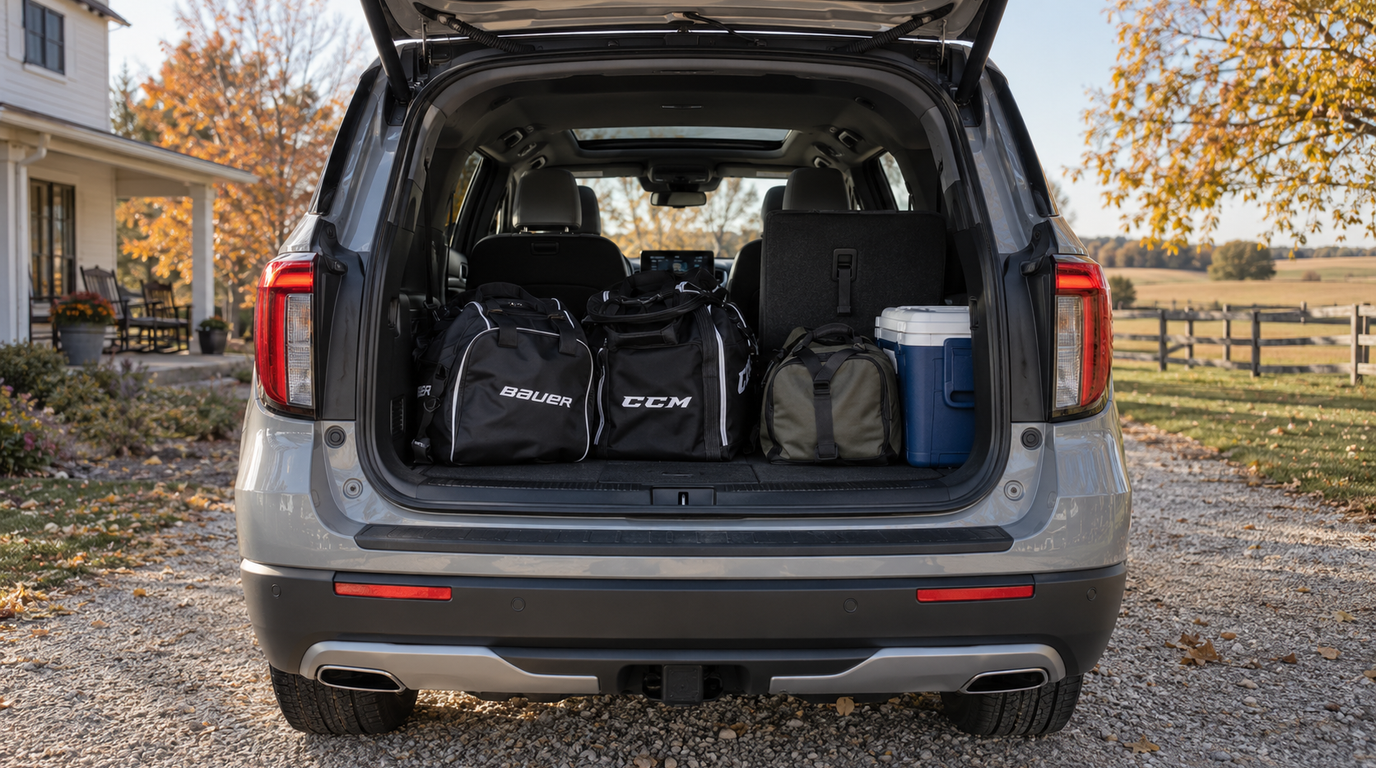
2027 Ford Explorer cargo area with the third row folded and hockey bags loaded, family room at Beadle Ford Bowdle SD

2027 Ford Explorer vs. Toyota Grand Highlander: Which Three-Row Fits Your Family?

Home› Ford Explorer› 2027 Ford Explorer› vs. Grand Highlander Quick Answer The Grand Highlander is the roomier box with hybrid powertrains and a genuine eight-seat layout; the Explorer is rear-drive-based with available 4WD and far more power at the top of the range. Both tow 5,000 lbs properly equipped. Choose the Grand Highlander for third-row space and fuel economy, and the Explorer for winter traction, how it drives, and the Tremor and ST versions Toyota has no answer for. The Toyota Grand Highlander is the three-row most of our Explorer shoppers cross-shop, and it deserves the comparison: it is roomy, it is well built, and the hybrid options are real. The 2027 Explorer answers with more power at every price, a 4WD system built on a rear-drive layout, an off-road trim Toyota does not offer, and a lower starting price. Which one is right depends on what your family actually does with it. This is a straight comparison on the things that matter here: engines, towing, third-row and cargo space, winter capability, tech, and price. Toyota figures are from Toyota’s published 2026 Grand Highlander specifications and should be confirmed on a specific unit. Explorer figures are Ford’s 2027 numbers from the 2027 Ford Explorer Buyers Guide. Get Pre-Approved Shop Explorer Inventory On This Page The short answer Engines: EcoBoost vs. turbo four and hybrids Third row, cargo, and seating Winter and gravel: 4WD vs. AWD Technology and driver assistance Price The short answer Pick the Grand Highlander if you want a hybrid, if you regularly carry adults in the third row, or if maximum cargo volume is the deciding factor. It is a larger vehicle inside, with up to eight seats and more cargo space than the Explorer. Pick the Explorer if you want more power for the money (300 hp standard, up to 400 hp available, against Toyota’s 265-hp turbo four), a rear-drive-based 4WD system with real drive modes and an off-road Tremor trim, a lower starting price, or the ability to walk onto the lot in Bowdle and drive one home today. Both tow 5,000 lbs when properly equipped, so the boat is not the tiebreaker. Engines: EcoBoost vs. turbo four and hybrids 2027 Ford Explorer 2026 Toyota Grand Highlander Standard engine 2.3L EcoBoost I-4, 300 hp / 310 lb-ft, 10-speed automatic 2.4L turbo I-4, 265 hp / 310 lb-ft, 8-speed automatic Available engine 3.0L EcoBoost V6, up to 400 hp / 415 lb-ft (ST, Tremor 801A, Platinum) 2.5L Hybrid, 245 hp combined; Hybrid MAX 2.4L turbo hybrid, 362 hp Drive RWD or Intelligent 4WD (rear-drive based) FWD or AWD (front-drive based); Hybrid MAX is AWD Max towing 5,000 lbs, every trim 5,000 lbs, properly equipped Fuel economy 2.3L 4WD: 20 / 27 / 23 mpg (EPA); other combinations not yet posted Varies by powertrain; the 2.5L Hybrid is the efficiency leader Explorer figures are Ford’s published 2027 specifications; towing requires proper equipment. Toyota figures per Toyota’s 2026 published specifications. The gap at the base is the headline: an Explorer Active 100A has 35 more horsepower than a Grand Highlander LE and costs less. At the top, Toyota’s Hybrid MAX is a strong engine at 362 hp, and the Explorer ST and V6 Platinum answer it with up to 400 hp. Where Toyota clearly wins is the 2.5L Hybrid: if your priority is fuel economy over power, the Explorer does not offer a hybrid, and I am not going to pretend otherwise. Explorer details by engine: Platinum 2.3L or 3.0L. Third row, cargo, and seating The Grand Highlander was designed around the third row, and it shows. It seats up to eight and Toyota lists up to 97.5 cubic feet of cargo with the rear rows folded. The Explorer seats up to seven and lists 16.3 cubic feet behind the third row and up to 85.3 cubic feet folded. If you regularly haul three teenagers plus their friends, or you need the third row to be adult-comfortable on a three-hour drive, the Toyota has the edge on room. Where the Explorer’s space works: the second-row captain’s chairs are standard, which is the configuration most families with car seats prefer; the third row folds flat and is power-folding on ST, Platinum, and Tremor 801A; and 16.3 cubic feet behind the third row is enough for the hockey bags with the seats up. Come put your actual gear in the back of one on our lot. That settles this faster than any table. Bring the hockey bags Load your real gear into an Explorer on the lot in Bowdle. It settles the space question faster than any spec sheet. Shop Explorers in Stock Ask About a Custom Order Winter and gravel: 4WD vs. AWD This is where the layouts matter. The Explorer is rear-drive based with Intelligent 4WD, seven selectable drive modes including Slippery and Deep Snow/Sand, and Hill Descent Control. The Grand Highlander is front-drive based with an on-demand AWD system. On a snow-packed highway both will get you there. On a rutted section road, a soft boat ramp, or a hill in an ice storm, a rear-drive-based 4WD with a true Deep Snow mode is more composed and more predictable, and the Explorer’s 7.6 to 8.7 inches of ground clearance depending on trim helps. Toyota does not offer a Grand Highlander with all-terrain tires, skid plates, or a limited-slip rear. The Explorer Tremor has all three, plus front tow hooks, on a three-row family vehicle. If any part of your driving leaves pavement on purpose, that is a category Toyota is not in. The 2027 Explorer Tremor guide covers it. Technology and driver assistance Both have the modern basics: a large center screen, wireless Apple CarPlay and Android Auto, a digital cluster, and a full driver-assist suite standard. The Explorer’s 13.2-inch touchscreen runs the Ford Digital Experience with Google built in (Google Maps, Google Assistant, Google Play) and takes over-the-air updates through a 5G modem. Ford Co-Pilot360™ Assist+ is standard on every Explorer, with the 360-degree camera from ST-Line up. Toyota Safety Sense is standard on every Grand Highlander. The Explorer’s tech edge is BlueCruise: hands-free highway driving that is included on Platinum for a year plus 90 days and trial-included on ST and Tremor 801A. Toyota does not offer a hands-free system on the Grand Highlander. If your drives are I-90 or I-29 to Sioux Falls or Rapid City, that is a real difference; here is how BlueCruise compares with the other systems. Price The 2027 Explorer Active 100A starts at $38,465 in RWD and $40,465 in 4WD, plus $1,795 destination. The Active 200A, the trim most families buy, is $40,400 / $42,400. Toyota lists the 2026 Grand Highlander LE from about $42,855 before destination, with AWD and the hybrids above that. Trim for trim, the Explorer starts a few thousand dollars lower and gives you more horsepower at each step. Full Explorer pricing: 2027 Explorer trim levels. The other price factor is availability. Both the 2026 and 2027 Explorer are on the lot at Beadle Ford; see what is in stock and get pre-approved before you come in. Key Takeaways Explorer wins on power at every price: 300 hp standard vs. 265, up to 400 hp available vs. 362. Grand Highlander wins on interior room (up to 8 seats, up to 97.5 cu ft) and offers hybrids; the Explorer does not have a hybrid. Both tow 5,000 lbs. The Explorer’s rear-drive-based 4WD and the Tremor trim give it the edge off pavement and in deep snow. Explorer offers BlueCruise hands-free driving; the Grand Highlander does not offer a hands-free system. Explorer starts a few thousand dollars lower trim for trim, and both model years are on the lot in Bowdle. Frequently Asked Questions Is the Ford Explorer or the Toyota Grand Highlander bigger? The Grand Highlander is larger inside. It seats up to eight and Toyota lists up to 97.5 cubic feet of cargo. The 2027 Explorer seats up to seven with 16.3 cubic feet behind the third row and up to 85.3 cubic feet folded. Which has more power, the Explorer or the Grand Highlander? The Explorer. Its standard 2.3L EcoBoost makes 300 hp against the Grand Highlander’s 265-hp turbo four, and the Explorer’s available 3.0L V6 makes up to 400 hp against Toyota’s 362-hp Hybrid MAX. Can the Explorer and the Grand Highlander both tow 5,000 pounds? Yes. The 2027 Explorer is rated to tow up to 5,000 lbs on every trim with a Class III package standard. Toyota rates the Grand Highlander at up to 5,000 lbs when properly equipped. Does the Ford Explorer come as a hybrid? No. The 2027 Explorer is offered with the 2.3L EcoBoost I-4 or the 3.0L EcoBoost V6. The Grand Highlander offers a 2.5L Hybrid and a Hybrid MAX. Which is better in South Dakota winters? Both handle snow-packed highways with AWD or 4WD. The Explorer’s rear-drive-based Intelligent 4WD with Deep Snow/Sand and Slippery modes, plus the all-terrain Tremor trim, gives it the advantage on gravel, ice, and unplowed roads. Which is cheaper, the Explorer or the Grand Highlander? The 2027 Explorer Active starts at $38,465 before $1,795 destination. Toyota lists the 2026 Grand Highlander LE from about $42,855 before destination. Trim for trim the Explorer starts lower. My Take I will give Toyota its due: if a family tells me the third row is for adults every week and they want a hybrid, the Grand Highlander is the right vehicle and I would rather say so than sell them the wrong one. Most families I talk to are not that family. They put car seats in the second row, kids in the third a few times a month, a boat behind it in summer, and they drive gravel to get home. For that, the Explorer is more vehicle for less money, and the 4WD is the kind you can trust in February. Come load your gear into one. The space question answers itself in about five minutes. Shop Explorer Inventory Get Pre-Approved Contact Beadle Ford About the Author Lexy Tabbert — Beadle Ford, Bowdle, SD Lexy Tabbert is the Director of Sales and Marketing at Beadle Ford in Bowdle, South Dakota. She covers Ford vehicles, trim comparisons, and buyer guidance — helping families, ranchers, and ag operators across the region find the right truck and configuration for their needs. Learn more about Lexy.
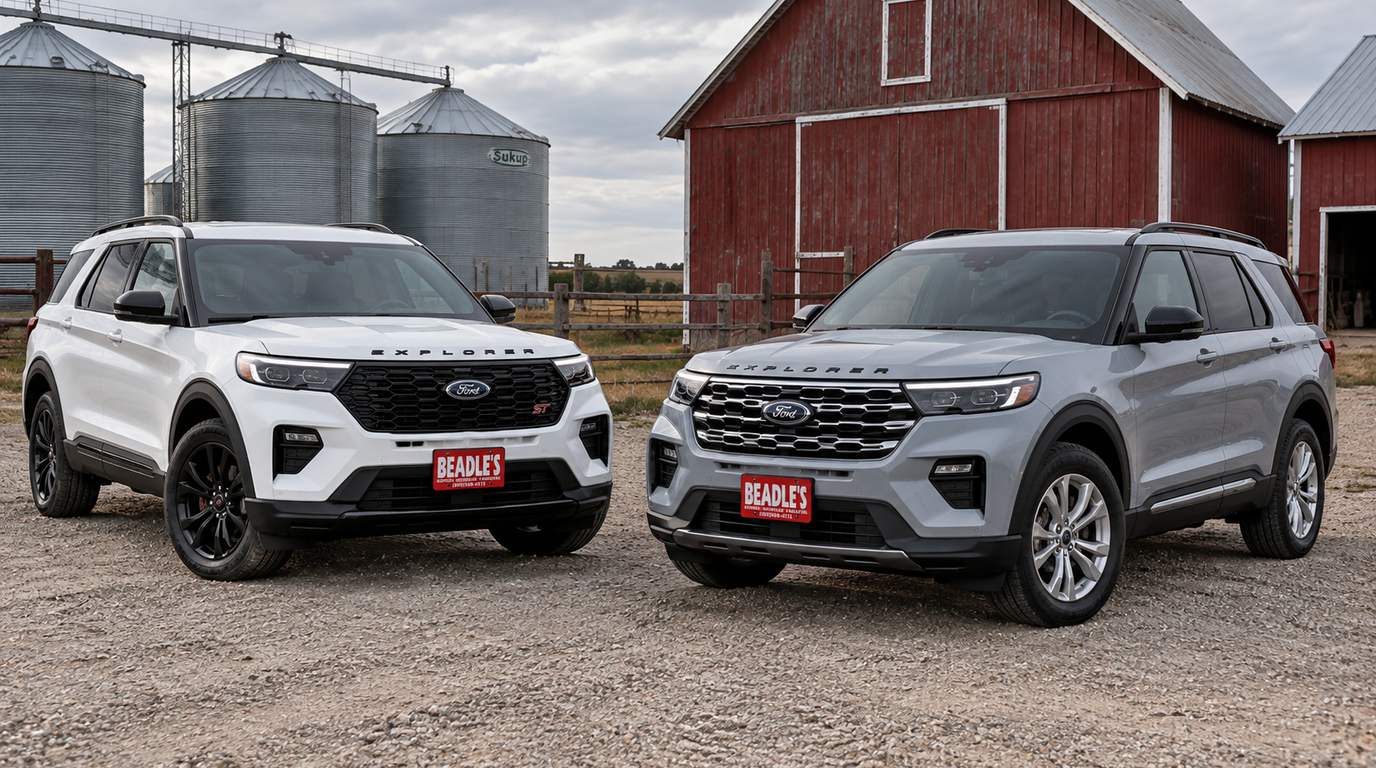
2026 and 2027 Ford Explorer side by side on a South Dakota farmyard, both on the lot at Beadle Ford in Bowdle

Buy a 2026 Ford Explorer Now or a 2027? Both Are on the Lot

Home› Ford Explorer› 2027 Ford Explorer› 2026 or 2027? Quick Answer Both are on the lot at Beadle Ford, and the 2027 is a model-year update rather than a redesign — same engines, same 5,000-lb tow rating, same 16.3 / 85.3 cubic feet of cargo. Buy the 2027 if you want the Tremor with the V6, a V6 Platinum, the ST Sinister Package, or one of the new colors. Otherwise a remaining 2026 is the same vehicle for less money. This is the question I get most often right now, and it is a good one to have: the 2026 Explorers on our lot are the same generation as the 2027 parked beside them, and for most trims they are nearly the same vehicle. So the decision is not old versus new. It is a short list of 2027-only items against whatever the 2026 pricing looks like on the day you come in. This guide lays out exactly what changed, which buyers should take a 2026 and which should hold out for or order a 2027, how your trade fits either way, and a checklist to walk through on the lot. The complete 2027 change list is in What’s New for 2027, and both model years have a full guide: 2026 Explorer Buyers Guide and 2027 Explorer Buyers Guide. Get Pre-Approved Shop Explorer Inventory On This Page What actually changed from 2026 to 2027? Where the 2026 is the better buy Where the 2027 is worth it What is on the lot at Beadle Ford right now How your trade-in fits either way The lot checklist What actually changed from 2026 to 2027? Three real changes and a handful of small ones. The Tremor 801A makes the 3.0L V6 its own equipment group with BlueCruise hardware, a PowerFold third row, and an open-on-approach liftgate bundled in. The 3.0L V6 returns to the Platinum, and ordering it includes the Ultimate content (Lux Leather, quad chrome tips, 21-inch dark alloy wheels). The ST gets the $1,695 Sinister Package with gloss black wheels, amber daytime running lamps, and a red ST badge. The small ones: two new paints (Avalanche Gray, Ruby Red Metallic Tinted Clearcoat) and one dropped (Space White); a Panoramic Vista Roof that opens, replacing the fixed glass roof; a $295 Slick Roof Conversion; a universal garage door opener on Tremor, ST, and Platinum; and a year of the Ford Security Package on every unit. What did not change: the body, the interior, the 13.2-inch screen with Google built in, the safety suite, the 2.3L and 3.0L EcoBoost engines and their 300 and 400 horsepower ratings, the 5,000-lb tow rating, the three rows, and the 16.3 / 85.3 cubic feet of cargo. A 2026 Explorer is not last generation. It is last year’s version of this one. Where the 2026 is the better buy If you are shopping an Active, an ST-Line, a 2.3L Platinum, or a Tremor 800A, the 2026 and 2027 versions are functionally identical, and the 2026 has three things going for it. It is here. We have 2026 Explorers on the lot in several trims, including Tremor, ST-Line, Active, and Platinum. You can drive the exact unit today and take it home this week. Pricing. As the 2027s arrive, Ford’s incentives and our own pricing tend to favor the outgoing model year. I will not quote a number here because it changes monthly; ask us for the current 2026 offers on the unit you like and compare them to the 2027 window sticker side by side. Choice. The 2027 selection on the lot is just getting started. The 2026 selection is several units in several colors and trims. If the vehicle you want is already sitting here in the right color, waiting for a 2027 version of it gains you nothing. One specific case: the 2026 Tremor. Every piece of Tremor hardware (TORSEN axle, all-terrain tires, plates, hooks, 8.7 inches of clearance) is identical for 2027, and a 2026 Tremor could be ordered with the 3.0L V6 as an engine option. If a 2026 Tremor on the lot has the engine you want, it is the same vehicle as a 2027 Tremor at a better number. Where the 2027 is worth it Hold out for, or order, a 2027 if any of these is on your list: A V6 Platinum. The 2026 Platinum was 2.3L only. If you want the 3.0L with the Lux Leather, quad tips, and 21-inch wheels, that is a 2027. Platinum 2.3L or 3.0L V6. The ST Sinister Package. Gloss black 21s, amber DRLs, and the red badge exist only on the 2027 ST. The Sinister Package explained. A Tremor 801A ordered clean. The V6 Tremor with BlueCruise hardware, the PowerFold third row, and Sun and Sound availability is a cleaner, better-equipped order on the 2027. 2027 Explorer Tremor guide. An opening roof. The 2026 panoramic roof was fixed glass; the 2027 Vista Roof opens. Avalanche Gray or Ruby Red. Neither exists on a 2026. A newer model year on the title, which matters to some buyers for resale even when the vehicle is the same. I understand that; just know what you are paying for. If your list is none of those and your trim is Active or ST-Line, the 2027 is the same Explorer with a newer number on the sticker. That is a fine reason to buy one if the price is right, and the first 2027 on our lot is an Active 4WD in Avalanche Gray, so you can judge that in person. Both years, one lot Drive a 2026 and the 2027 back to back in Bowdle. We will price both against your trade. Shop 2026 and 2027 Explorers Ask About a Custom Order What is on the lot at Beadle Ford right now Both model years, parked together. On the 2026 side we have ST-Line, Active, Tremor, and Platinum units. On the 2027 side, the first Active 4WD with the Active Comfort Package is here and more are arriving; Tremor 801A, V6 Platinum, and Sinister ST builds are order-to-spec for now, and we will place and track those with you. Inventory changes weekly, so the live list is the one to trust: shop every Explorer in stock. Every listing links the window sticker, which is where the EPA rating for that engine and drive combination lives. (The 2.3L 4WD is rated 20 city / 27 highway / 23 combined; Ford has not yet posted the other combinations.) How your trade-in fits either way Most Explorer buyers here are trading a 2016 to 2020 Explorer, an Edge, an Escape, or a competitor’s three-row. Two things to know. First, the jump from any of those into this generation of Explorer is bigger than the difference between a 2026 and a 2027, so the trade matters more to your payment than the model year does. Second, the trade is worth the same on either purchase; what changes is how quickly we can close. A 2026 on the lot means we appraise the trade, agree on numbers, and you drive home. A 2027 order means we appraise now and re-confirm at delivery, and you keep driving your current vehicle in the meantime. The best way to walk in is with a pre-approval already done. It takes a few minutes online, it does not affect your credit to start, and it turns the conversation into which vehicle instead of whether. Get pre-approved here. If you would rather talk it through first, contact us and we will pull your trade value and current 2026 and 2027 numbers before you make the drive. The lot checklist Pick your trim first (Active, ST-Line, Tremor, ST, or Platinum), using the trim guide. If it is Active, ST-Line, 2.3L Platinum, or Tremor 800A: find the 2026 on the lot closest to your spec and get its current price with incentives. Compare that to the 2027 window sticker on the same trim. Note what the 2027 adds that you would actually use. If it is a V6 Platinum, a Sinister ST, or a Tremor 801A: it is a 2027, and it is probably an order. Build it with us and we will price it line by line. Drive both. They are parked next to each other for exactly this reason. Have the trade appraised and the pre-approval done before you decide, so the decision is about the vehicle. Key Takeaways The 2026 and 2027 Explorer share the body, interior, engines, tech, and safety suite. A 2026 is last year’s version of this generation, not the old one. For Active, ST-Line, 2.3L Platinum, and Tremor 800A buyers, a 2026 on the lot is usually the better buy: available now, more choice, model-year pricing. The 2027 is worth it for a V6 Platinum, the ST Sinister Package, a Tremor 801A, the opening Vista Roof, or the two new colors. Both years are on the Beadle Ford lot now; 2027 Tremor 801A, V6 Platinum, and Sinister ST builds are order-to-spec. Your trade is worth the same either way. Get pre-approved first so the decision is about the vehicle. Frequently Asked Questions Should I buy a 2026 Ford Explorer or wait for the 2027? If you want an Active, ST-Line, 2.3L Platinum, or Tremor 800A, the 2026 and 2027 are nearly identical and a 2026 on the lot is usually the faster and better-priced choice. If you want the 3.0L V6 on a Platinum, the ST Sinister Package, a Tremor 801A, the opening Vista Roof, or Avalanche Gray or Ruby Red paint, those are 2027-only. Is the 2027 Ford Explorer a new generation? No. The 2027 Explorer is a model-year update of the same generation as the 2025 and 2026. The body, interior, 13.2-inch screen, safety suite, and both EcoBoost engines carry over. Is the 2027 Explorer on the lot at Beadle Ford? Yes. The first 2027 Explorer, an Active 4WD, is on the lot in Bowdle next to our 2026 Explorers, with more 2027 units arriving. Tremor 801A, V6 Platinum, and Sinister ST configurations are currently order-to-spec. Does the 2027 Explorer get better fuel economy than the 2026? The engines are unchanged. The 2027 2.3L 4WD is EPA-rated 20 city / 27 highway / 23 combined. Ford has not yet posted ratings for the other 2027 engine and drive combinations; check the window sticker on each unit. Will Beadle Ford take my current Explorer in trade? Yes. We appraise trades on both 2026 and 2027 purchases. On a 2026 on the lot the deal closes the same day; on a 2027 order we appraise now and re-confirm at delivery while you keep driving your current vehicle. Are there incentives on the 2026 Explorer? Ford incentives and our pricing change monthly and usually favor the outgoing model year as the 2027s arrive. Ask Beadle Ford for the current 2026 offers on a specific unit rather than relying on a published number. My Take I will be direct: unless one of the 2027-only items is on your list, I would rather sell you a 2026 off the lot than have you wait. You get the same Explorer, you get it now, and the numbers on the 2026 are usually better. The families I see paying for a 2027 they did not need are the ones who never walked over to the 2026 parked next to it. The exceptions are real, though. If you have been waiting for a V6 Platinum or a Sinister ST, or you want the Tremor with everything bundled, order the 2027 and let us track it. Either way, come drive both. Shop Explorer Inventory Get Pre-Approved Contact Beadle Ford About the Author Lexy Tabbert — Beadle Ford, Bowdle, SD Lexy Tabbert is the Director of Sales and Marketing at Beadle Ford in Bowdle, South Dakota. She covers Ford vehicles, trim comparisons, and buyer guidance — helping families, ranchers, and ag operators across the region find the right truck and configuration for their needs. Learn more about Lexy.
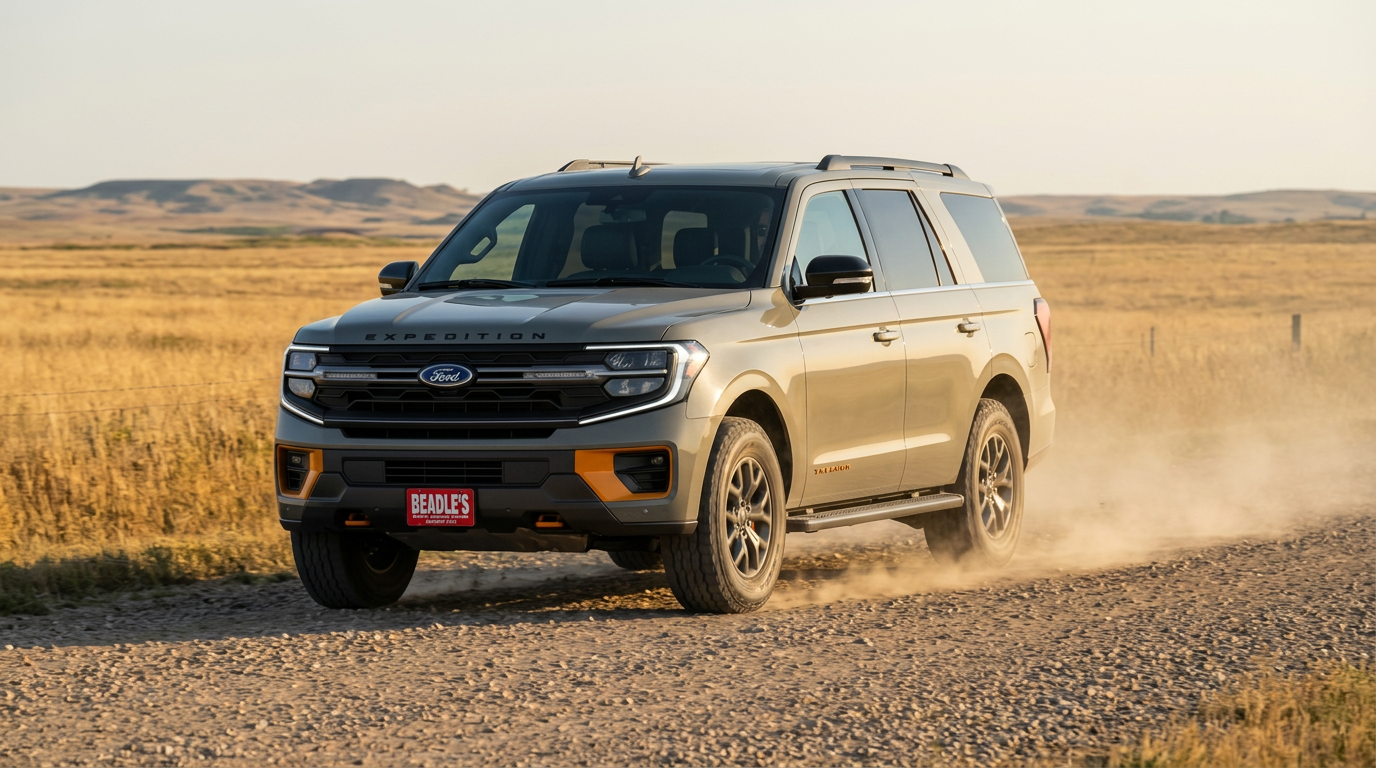
2027 Ford Expedition Tremor in Marsh Gray on a South Dakota gravel section road near Bowdle

The 2027 Ford Expedition Tremor: More Than a Platinum With Off-Road Stickers

Home› Ford Expedition› 2027 Ford Expedition› Expedition Tremor The 2027 Ford Expedition Tremor is the Expedition’s factory off-road trim — a 4x4-only, 440-horsepower, electronic-locking-differential configuration that sits between the Platinum and an aftermarket project. It’s the first factory off-road Expedition, and it continues in the 2027 lineup unchanged from its 2025 launch. If you’ve been hearing about the Tremor but weren’t sure whether it’s a legitimate capability trim or a Platinum with stickers and steel-look wheels, this guide answers it honestly. We’ll walk through what the Tremor actually is mechanically, what the 440 hp and 510 lb-ft High Output EcoBoost really gets you, how it handles gravel and section-line roads in the kind of terrain we drive around Bowdle, why Ford only offers the Tremor in 4x4 and not in Expedition MAX, whether it’s worth the jump over a Platinum for a rural South Dakota buyer, and what you give up to get it. If you’re cross-shopping the Tremor against anything from a Wagoneer to a Tahoe Z71, the trade-offs section at the end matters as much as the specs at the top. Get Pre-Approved Browse Expedition Inventory On This Page What is the Expedition Tremor, really? What does 440 hp and 510 lb-ft actually get you? How does the Tremor handle gravel and off-pavement? Why is the Tremor 4x4 only and not offered in MAX? Is the Tremor worth it over a Platinum for rural South Dakota? What do you give up by choosing the Tremor? What is the Expedition Tremor, really? The Expedition Tremor is the factory off-road trim of the sixth-generation Expedition — a standalone retail trim, not a package. It’s not a Platinum with different wheels or a skid-plate cosmetic; it’s a different mechanical specification of the Expedition with its own engine, suspension, tires, differential, and drive-mode software. What that mechanical difference includes: a 3.5L EcoBoost V6 High Output engine, a 3.73 Electronic Locking Rear Differential, a modified higher-ride suspension with premium passive shocks, modified Raptor-style front and transmission skid plates, an underbody fuel tank shield, P275/70R18 all-terrain tires on unique 18" Dark Carbonized Gray wheels, a unique off-road grille with Carbonized Gray bars and signature lighting, amber Active front tow hooks, a platform running board with angular step bars, a standard off-road underbody shield, and a drive-mode system that adds Rock Crawl on top of the standard six modes. None of that equipment is optional on another Expedition trim — it’s Tremor-specific. The Platinum trim, by contrast, is the Expedition’s luxury spec — 22" Ebony Bright Machined wheels, painted body-color bumpers, a chrome-trimmed grille, and an interior that leans plush over purposeful. You can order a Platinum with the Stealth Performance Package (19B) or the Platinum Ultimate Package (17A) and get the same 440 hp / 510 lb-ft High Output V6 as the Tremor, but you won’t get the Tremor’s locking differential, its Rock Crawl drive mode, its all-terrain tire setup, or its off-road-specific skid plates. Those are structural choices the Tremor trim makes that a Platinum cannot match. If you’re comparing the Tremor to the rest of the lineup, the complete 2027 Ford Expedition overview has the side-by-side trim framing. What does 440 hp and 510 lb-ft actually get you? The Tremor runs the 3.5L EcoBoost V6 High Output — a twin-turbocharged V6 that produces 440 horsepower and 510 lb-ft of torque, confirmed in the 2027 Ford Expedition Order Guide. It’s mated to a 10-speed automatic transmission with SelectShift capability and Ford’s intelligent 4WD system with Torque on Demand and a two-speed transfer case. Practically, the 440 hp and 510 lb-ft figures matter in two scenarios. First, towing — the Tremor’s Heavy-Duty Trailer Tow Package is standard, and current-generation Tremor reporting cites a max tow capacity of approximately 9,600 lbs when properly equipped. Ford will confirm the official 2027 figure when the 2027 Ford Towing Guide is released. That’s enough tow for most livestock trailers, most flat-deck trailers in the 24- to 30-foot range, a two-place enclosed snowmobile trailer, and any boat that fits on a single-axle or tandem trailer for Lake Oahe. Second, altitude and load — turbocharged engines don’t lose power at elevation the way naturally aspirated engines do, which matters if you tow to the Black Hills or into Wyoming from Bowdle. The High Output engine gives you usable torque across the whole tach range, not just at the top. The engine also includes a High Flow Exhaust System and an Engine Sound Enhancer with Active Noise Cancellation — which means the cabin stays conversational at highway speed while the exhaust has more presence when you’re on the throttle. It’s a deliberate calibration choice, not a defect. How does the Tremor handle gravel and off-pavement? Better than any Expedition before it. The Tremor’s modified higher-ride suspension, P275/70R18 all-terrain tires, 3.73 Electronic Locking Rear Differential, and seven drive modes (Normal, Sport, Tow/Haul, Eco, Slippery, Off-Road, and Rock Crawl) are all aimed at the same use case: rural, unpaved, variable-grip driving. Independent reviews of the current-generation Tremor from outlets like Gear Patrol and JD Power cite approximately 10.6 inches of ground clearance; the 2027 figure should be verified against final Ford documentation but the hardware is unchanged. The practical difference on gravel is twofold. The suspension and tires together let the Tremor absorb washboard gravel at reasonable speed without the harshness of a Platinum on 22" low-profile tires — which matters if your weekly commute involves 10 or 15 miles of county gravel before you hit US-12 or US-83. And Trail Control — which includes Trail One Pedal Drive for steep grade management and Trail Turn Assist for tight-radius maneuvering — plus the off-road underbody shield and modified Raptor skid plates, let you drive into places a Platinum shouldn’t go. Pasture two-tracks after a wet week, unmaintained CRP access roads, Lake Oahe shoreline when the grade gets soft — that’s the terrain the Tremor was engineered for. Standard on the Tremor: off-road auxiliary grille lights, amber Active front tow hooks, front and rear parking sensors, a 360-degree camera with off-road overlays and a Rock Crawl view, and the BLIS trailer coverage that extends blind-spot monitoring around whatever you’re pulling. None of it is optional. None of it is a bundled package. It’s baseline Tremor equipment. Why is the Tremor 4x4 only and not offered in MAX? Both answers come back to the same idea: Ford engineered the Tremor for a specific use case, and they didn’t water it down for configurations that compromise that use case. A 4x2 Tremor would be contradictory — the whole point of the trim is off-pavement capability, and you can’t get that without four-wheel drive. So there’s only one Tremor configuration: 4x4, with the two-speed transfer case, Torque on Demand, and the 3.73 Electronic Locking Rear Differential standard. The no-MAX decision is more about geometry. The Expedition MAX adds roughly a foot of wheelbase and overall length. That length, in an off-road context, hurts the rear departure angle, increases the risk of high-centering over ruts and crests, and makes tight-radius off-road maneuvering (which Trail Turn Assist is designed to help with) meaningfully harder. Ford chose not to offer a compromised off-road Expedition — if you want MAX length, the Expedition MAX is available in XL, Active, Platinum, and King Ranch for 2027. That does create a buyer decision: if your use case is hauling three kids, dog crates, and a week of gear between Bowdle and Fargo, the Tremor’s standard length may feel short behind the third row. In that case the 2027 Expedition MAX Platinum (now offered in 4x2 as well as 4x4) is probably the better fit. The Expedition vs. Expedition MAX comparison walks through that decision in detail. Thinking about a Tremor? See what is on the lot, or ask us about a custom order before you commit. Shop 2027 Expeditions in Stock Ask About a Custom Order Is the Tremor worth it over a Platinum for rural South Dakota? For a lot of buyers in our service area — Bowdle, Selby, Ipswich, Eureka, and out across north-central South Dakota to the Missouri River — yes, but only if your actual weekly driving includes unpaved terrain. If your driving is 90% paved highway, a Platinum does the exact same job with a more refined ride on the 22" wheels and a plusher interior. If your driving is 60% paved and 40% county gravel, pasture, or shoreline access, the Tremor earns its spot. Pick the Tremor if: you run gravel daily and want a suspension and tire setup built for it; you want a locking rear differential for mud, snow, or steep approach angles; you want Rock Crawl mode for lake access or trailer launches on unimproved ramps; you want Amber Active tow hooks rated for recovery, not decoration; or you want the standard 22-speaker B&O Play Unleashed audio and the Power Panoramic Vista Roof without stepping up to a Platinum Ultimate. Pick a Platinum instead if: you live on pavement, you prefer the 22" Ebony Bright Machined wheel look over the 18" Dark Carbonized Gray Tremor wheel, you want the 30th Anniversary Appearance Package (which is Platinum-only and not compatible with the Tremor), or you’re leaning toward the Platinum Ultimate’s combination of High Output engine, Driver’s Package, and standard BlueCruise 1-Year + 90-Day plan. For a broader framing of the whole lineup — Active, Tremor, Platinum with its four packages, and King Ranch — the 2027 Ford Expedition trim levels guide walks through who each trim is really built for. What do you give up by choosing the Tremor? Three real trade-offs. The first is fuel economy. EPA ratings for the 2027 Expedition are listed on each in-stock unit’s window sticker, but as a rule the Tremor — with all-terrain tires, the modified suspension, and the High Output V6 — uses more fuel than a standard Expedition with the base 3.5L EcoBoost V6 and highway-biased tires. If most of your miles are interstate commuting, the Tremor will cost you at the pump versus an Active Touring or a Platinum 4x2. The second is the no-MAX constraint covered above. The Tremor’s third-row and cargo-behind-third-row space is the standard-length Expedition’s space. If you’re hauling big family gear regularly, that may not be enough. The third is price. Pricing is on the window sticker of each in-stock unit; the Tremor lands in the mid-$80,000s, which places it above a standard Expedition Platinum and roughly in range with a Platinum Stealth Performance. What you’re paying for is the Tremor-unique mechanical content, not cosmetic upgrades. That’s a different value proposition than most trim walks. Parking and daily usability are not really trade-offs. The Tremor is the same overall length as a standard Expedition — you’re not navigating a longer truck. The 18" wheels with taller all-terrain sidewalls actually handle curbs and potholes more forgivingly than 22" low-profile wheels do. If daily-driver livability is a concern, the Tremor is not the trim that compromises it — MAX is. Key Takeaways The Tremor is a standalone factory off-road trim — not a Platinum package. It carries over from its 2025 launch. 3.5L EcoBoost V6 High Output at 440 hp / 510 lb-ft, 10-speed automatic, 3.73 Electronic Locking Rear Differential standard. Seven drive modes including Rock Crawl, Trail Control with One Pedal Drive and Trail Turn Assist, P275/70R18 all-terrain tires. 4x4 only. No 4x2. No Expedition Tremor MAX — Ford didn’t compromise off-road geometry for extended length. Worth it over a Platinum if unpaved terrain is part of your weekly driving; Platinum is the better pick if you’re primarily on pavement. Frequently Asked Questions Is the Expedition Tremor new for 2027? No. The Expedition Tremor launched with the sixth-generation Expedition for the 2025 model year and continues in the 2027 lineup. It’s not marked as a new trim in the 2027 Order Guide. How much horsepower does the 2027 Ford Expedition Tremor have? The Tremor runs the 3.5L EcoBoost V6 High Output at 440 horsepower and 510 lb-ft of torque, confirmed by the 2027 Ford Expedition Order Guide. It’s paired with a 10-speed automatic transmission and a two-speed transfer case. Can you get an Expedition Tremor MAX? No — the Expedition Tremor is only offered in the standard (non-MAX) body style and only in 4x4 configuration. The MAX body style is available on XL, Active, Platinum, and King Ranch for 2027. How much can the 2027 Expedition Tremor tow? Official 2027 tow ratings will be confirmed when Ford releases the 2027 Ford Towing Guide. Public reporting on the current-generation Tremor cites a maximum tow rating of approximately 9,600 lbs when properly equipped. Contact Beadle Ford to confirm the exact figure against your trailer and payload. Does the Tremor have a locking differential? Yes — a 3.73 Electronic Locking Rear Differential is standard on the Tremor. It’s paired with the Heavy-Duty Trailer Tow Package and Ford’s intelligent 4WD with Torque on Demand and a two-speed transfer case. What tires does the Tremor come with? P275/70R18 all-terrain BSW tires on unique 18" × 8.5" Dark Carbonized Gray Painted Aluminum wheels with Electric Spice Pocket accents. The all-terrain tire and taller sidewall (versus 22" low-profile wheels on Platinum and King Ranch) is one of the Tremor’s defining equipment differences. How is the Tremor different from a Platinum with off-road packages? A Platinum can be ordered with the Stealth Performance Package (19B) or Platinum Ultimate Package (17A), which get the same 440 hp / 510 lb-ft High Output V6 as the Tremor. But only the Tremor has the 3.73 Electronic Locking Rear Differential, Rock Crawl drive mode, modified Raptor-style skid plates, all-terrain tires, unique off-road grille, and amber Active tow hooks. Those are trim-specific, not package options. My Take on the 2027 Ford Expedition Tremor I talk to a lot of Expedition buyers in north-central South Dakota, and the Tremor is the trim I’m happiest to explain honestly. For the ranch-and-hunt buyers who actually use the capability — gravel-road commutes, stock-trailer towing, pasture access, boat launches that go below the waterline at Lake Oahe — the Tremor earns every dollar. For the buyer who wants it because it looks rugged but drives exclusively on US-12 and US-83, a Platinum is honestly the better truck, and the Platinum Ultimate gets you the same engine and BlueCruise at a different emphasis. If you’re trying to decide, let’s talk through your actual week — where you drive, what you tow, and what you need from the third row. I’ll point you at the right trim for you, even if it isn’t the one you walked in thinking about. Shop 2027 Expeditions in Stock Contact Beadle Ford About the Author Lexy Tabbert — Beadle Ford, Bowdle, SD Lexy Tabbert is the Director of Sales and Marketing at Beadle Ford in Bowdle, South Dakota. She covers Ford vehicles, trim comparisons, and buyer guidance — helping families, ranchers, and ag operators across the region find the right truck and configuration for their needs. Learn more about Lexy.
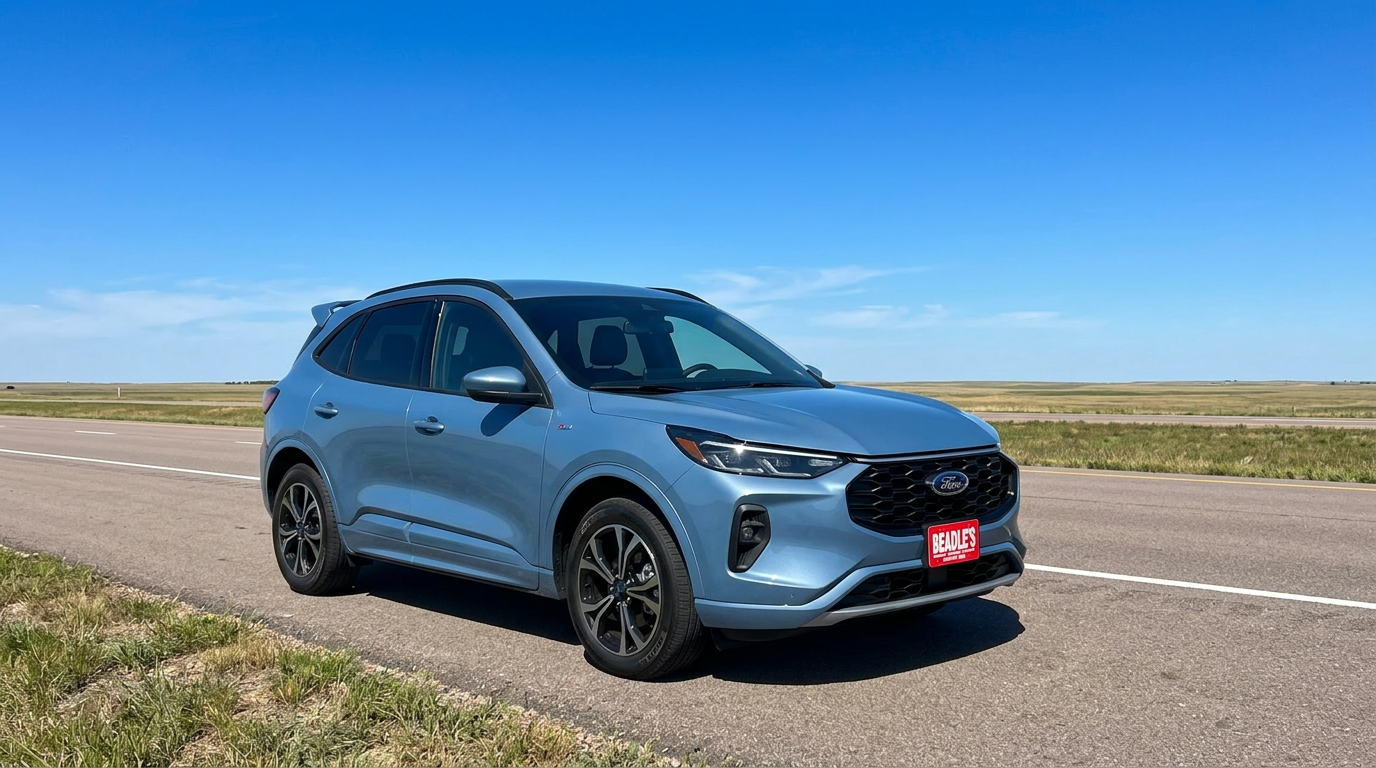
2026 Ford Escape ST-Line Select on South Dakota plains, clean sky background

2026 Ford Escape Trim Levels Explained: Which One Is Right for You?

The 2026 Ford Escape comes in six trim levels: Active, PHEV, ST-Line, ST-Line Select, ST-Line Elite, and Platinum. For buyers in central South Dakota, one variable shapes that decision more than any other: AWD. The AWD picture changes dramatically depending on which trim you're looking at — some include it standard, some require you to add it, and one trim can't get it at all. This guide breaks down what changes at each trim level, what you're actually paying for, and which configuration makes the most practical sense for buyers driving county roads and South Dakota winters. The focus is on the decisions that matter here — AWD, cold-weather features, and real-world usability for rural SD driving. Shop Escapes in Stock Get Pre-Approved On This Page Which Trims Include AWD — and Why Does It Shape Every Decision? Is the Escape Active the Right Starting Point for South Dakota Buyers? What Does the Escape ST-Line Add Over the Active? Why Is the ST-Line Select the Natural Starting Point for South Dakota Buyers? What Does the Escape ST-Line Elite Add Over the Select? Should South Dakota Buyers Consider the Escape PHEV? What Makes the Escape Platinum Worth the Step Up? Which Trims Include AWD — and Why Does It Shape Every Decision? AWD is optional on Active and ST-Line, standard (and mandatory) on ST-Line Select, ST-Line Elite, and Platinum, and unavailable on the PHEV. That single variable changes the practical suitability of each trim for central South Dakota winters more than any other spec on the sheet. Here's how the lineup splits on drivetrain: Trim Drivetrain Engine Options Active FWD standard / AWD optional 1.5L EcoBoost ST-Line FWD standard / AWD optional 1.5L EcoBoost ST-Line Select AWD Only 2.5L Hybrid or 2.0L EcoBoost ST-Line Elite AWD Only 2.5L Hybrid or 2.0L EcoBoost Platinum AWD Only 2.5L Hybrid or 2.0L EcoBoost PHEV FWD Only — no AWD 2.5L Plug-In Hybrid The dividing line is ST-Line Select. Below it, AWD must be added explicitly at the order stage and you'll still be on the 1.5L EcoBoost. At Select and above, AWD is locked in and the engine steps up to a 2.0L EcoBoost or 2.5L Hybrid. The full AWD breakdown covers how Ford's Intelligent AWD performs in South Dakota winter conditions. The complete 2026 Escape overview at Beadle Ford covers all six trims and powertrains in full. Is the 2026 Escape Active the Right Starting Point for South Dakota Buyers? The Active is the value entry point of the Escape lineup — capable vehicle, lower price point, and Co-Pilot360 standard. But in South Dakota, what matters is that AWD is optional, not included. Buyers who skip it end up with an FWD crossover on packed county roads in January. What the Active includes standard: 1.5L EcoBoost with 8-speed automatic, 17" Shadow Silver-painted aluminum wheels, cloth seating with 6-way manual driver and 4-way manual passenger adjustment, 8" SYNC 4 touchscreen, dual-zone electronic automatic climate, and the full Ford Co-Pilot360 suite. What it does not include: heated seats, a heated steering wheel, remote start, or a power liftgate. On a -15°F morning outside Bowdle, those absences are noticeable. The Active is a reasonable choice if AWD is added at order and you're comparing total cost to what the ST-Line Select offers. If the all-in price with AWD added comes within range of ST-Line Select territory, the Select is usually the better use of that money — you'd be getting AWD standard plus heated seats, remote start, and a power liftgate without needing to option everything separately. What Does the Escape ST-Line Add Over the Active? The ST-Line adds sport exterior styling and a more supportive seat. The powertrain and AWD situation are identical to the Active — 1.5L EcoBoost, FWD standard, AWD optional — and the cold-weather feature gaps remain the same. What changes over Active: 18" Rock Metallic painted aluminum wheels (with a slightly lower-profile tire), a black mesh grille, large rear spoiler, rear skid plate, and ST-Line exterior badging that give the Escape a more aggressive profile. Inside, ST-Line replaces the standard cloth with Sport Contour bucket seats in partial vinyl and cloth with red accent stitching, and steps the driver's seat up to an 8-way power adjustment versus the Active's 6-way manual. That's a meaningful seat upgrade for long highway drives. What doesn't change: still no heated seats, still no heated steering wheel, still no remote start, still no power liftgate. For South Dakota buyers, the ST-Line is worth considering if styling and seat comfort matter to you — but AWD still has to be added specifically if you want it, and the same cost comparison against ST-Line Select applies. Looking for Something in Stock? Check out these models available now at Beadle Ford. Ford Bronco Sport Standard 4x4, GOAT modes, staying in Ford's lineup. Built for South Dakota. Shop Escapes in Stock Ford Explorer More room, available 3-row seating, ready for the plains. Shop Escapes in Stock Ford Maverick Compact truck versatility at an Escape-comparable price. Shop Escapes in Stock Why Is the ST-Line Select the Natural Starting Point for South Dakota Buyers? Because AWD is standard on every unit — there's no FWD version to accidentally end up with — and it brings heated front seats, a heated steering wheel, remote start, and a power liftgate in the same configuration. The Select is the first trim that addresses a central South Dakota winter in a complete way, in one package. The engine also steps up significantly at Select. Unlike Active and ST-Line which use the 1.5L EcoBoost, the Select runs either the 2.5L Hybrid AWD or the 2.0L EcoBoost AWD — both AWD only, no FWD version available. Additional standard equipment over ST-Line: body-color heated mirrors, LED fog lamps, illuminated vanity mirrors, and one-touch-up/down front and rear windows. Optional packages on Select include Tech Pack 1 (adds Co-Pilot360 Assist+ with adaptive cruise and lane centering, plus the 13.2" SYNC 4 screen) and Tech Pack 2 (adds 360° camera, B&O premium audio, 12.3" digital cluster, power passenger seat, and wireless charging). For buyers who want a fully equipped Select without stepping up to Elite, Tech Pack 2 covers most of what changes between the two trims. Choosing between the 2.5L Hybrid and 2.0L EcoBoost at this trim level is its own decision — the powertrain comparison guide covers that in detail. What Does the Escape ST-Line Elite Add Over the Select? The Elite is a substantial comfort and technology step. The 12.3" Digital Productivity Screen, Co-Pilot360 Assist+, and wireless charging all become standard equipment — no optional packages needed. Seating upgrades to a 10-way heated power driver seat and 6-way heated power passenger seat, and a memory package for driver seat and mirrors is added. AWD remains standard, same as Select. Exterior: 19" Machined-face Ebony-painted aluminum wheels (up from 18" on Select). Interior: the 13.2" SYNC 4 touchscreen is standard here without requiring Tech Pack 1, and the LED light bar headlamps, auto-dimming rearview mirror, and perimeter alarm all come built in. For South Dakota buyers logging significant highway miles between towns, Co-Pilot360 Assist+'s adaptive cruise with stop-and-go and lane centering adds real-world value on long straight stretches. The memory package matters less in a personal vehicle but is useful if multiple drivers share the car regularly. The Elite makes the strongest case for buyers who want the full technology experience without moving to the top trim. Should South Dakota Buyers Consider the Escape PHEV? Probably not as their first choice. The PHEV is front-wheel drive only — no AWD option exists at any price point — which is a significant limitation for buyers in central South Dakota facing winter driving on county roads and gravel. On paper, the PHEV is well-equipped: Co-Pilot360 Assist+ standard, 13.2" SYNC 4 standard, heated front seats, heated steering wheel, remote start, power liftgate, and roof-rack side rails — all built in. The plug-in hybrid system offers approximately 37 miles of EV-only range (verify at fueleconomy.gov) on a full charge, with a Mobile Power Cord for Level 1 home charging included. Total range in hybrid mode extends well beyond that once the battery depletes. The practical reality for rural South Dakota buyers: Level 2 charging infrastructure is limited around Bowdle and much of central SD, which means most PHEV owners in this area end up relying on the gas hybrid mode for the majority of their miles. That undercuts the primary value proposition of plug-in ownership. If fuel efficiency without a charging requirement is the goal, the 2.5L Hybrid AWD on Select, Elite, or Platinum delivers strong economy without the AWD trade-off. If charging access isn't a concern, the PHEV's feature content is strong. The powertrain comparison guide covers this decision in detail. What Makes the Escape Platinum Worth the Step Up? The Platinum is the top trim, and its primary differentiator over Elite is interior material quality and the Space Gray interior option. Seats step up to ActiveX trimmed material with mini-perforation — the only Escape trim available in the Space Gray interior environment. AWD is standard, same as Elite. Standard equipment over Elite: Universal Garage Door Opener and roof-rack side rails join the list, and the 10-way heated power driver seat and 6-way heated power passenger seat carry forward with the premium ActiveX seating material. Memory package, wireless charging, power liftgate, and the full 13.2" SYNC 4 with 12.3" digital cluster — all standard, same as Elite. Engine options remain 2.5L Hybrid AWD or 2.0L EcoBoost AWD. The Platinum is the right choice if the interior material and the Space Gray color combination matter to you, or if you want the full-feature vehicle without building it through optional packages. Buyers comparing Elite with Tech Pack 2 added to the Platinum should run the specific price difference — in some configurations the gap is narrower than expected. Key Takeaways AWD is standard and mandatory on ST-Line Select, Elite, and Platinum — on Active and ST-Line it must be added specifically, and the PHEV has no AWD option at any price. The ST-Line Select is where most central South Dakota buyers should start — AWD is locked in and heated seats, heated steering wheel, and remote start all come with it. The 1.5L EcoBoost is only available on Active and ST-Line; Select and above use the 2.0L EcoBoost or 2.5L Hybrid, both AWD only. The PHEV's FWD-only configuration is a real limitation for winter driving in SD — the 2.5L Hybrid AWD on Select, Elite, or Platinum is the better efficiency option for most buyers in this area. The Elite is the natural choice when technology and seat comfort on highway miles matter — Co-Pilot360 Assist+, the 12.3" cluster, and wireless charging are all standard without option packages. Frequently Asked Questions What are the trim levels of the 2026 Ford Escape? The 2026 Ford Escape comes in six trim levels: Active, PHEV, ST-Line, ST-Line Select, ST-Line Elite, and Platinum. Each trim has different drivetrain availability, engine options, and standard features. Active and ST-Line use the 1.5L EcoBoost with optional AWD. Select, Elite, and Platinum use the 2.5L Hybrid or 2.0L EcoBoost with AWD standard. The PHEV is a front-wheel-drive-only plug-in hybrid trim. Which 2026 Ford Escape trims come with AWD standard? AWD is standard — and the only drivetrain option — on the ST-Line Select, ST-Line Elite, and Platinum trims. On the Active and ST-Line, FWD comes standard and AWD must be added as an option at order. The PHEV trim is front-wheel drive only with no AWD available at any configuration. What is the difference between the Escape ST-Line and ST-Line Select? The ST-Line Select is a significant step up from the ST-Line. AWD becomes standard on the Select (no FWD option), the engine steps up from the 1.5L EcoBoost to either the 2.5L Hybrid or 2.0L EcoBoost, and the Select adds heated front seats, a heated steering wheel, remote start, a power liftgate, and body-color heated mirrors as standard equipment. The ST-Line has sport styling over the Active but shares the same powertrain and cold-weather feature gaps. Is the Escape PHEV AWD or FWD? The 2026 Ford Escape PHEV is front-wheel drive only. There is no AWD option available on the PHEV trim at any price point. Buyers who want both plug-in capability and all-wheel drive will need to look at a different vehicle. The 2.5L non-plug-in Hybrid on the ST-Line Select, Elite, and Platinum is AWD only and delivers strong fuel economy without requiring a charger. Which 2026 Ford Escape trim is best for winter driving in South Dakota? The ST-Line Select is the natural starting point for South Dakota buyers. AWD is standard with no FWD option, and it includes heated front seats, a heated steering wheel, remote start, and a power liftgate — the full winter preparedness package in one trim. ST-Line Elite and Platinum offer more technology and comfort upgrades while keeping AWD standard. Active and ST-Line with AWD added are viable but require specifically requesting AWD at order to avoid an FWD unit. My Take on the 2026 Escape Trim Lineup for South Dakota Buyers When I'm working through trim options with a buyer, the conversation almost always lands on ST-Line Select as the starting point — not because it's the cheapest or the most expensive, but because it's where the math makes sense for someone who needs to drive in January. AWD is already in, heated seats and remote start are in, and you're not piecing together options to get there. That combination at one trim level is hard to argue against for central South Dakota use. From there it usually comes down to whether adaptive cruise and the larger technology suite matter enough to step to Elite, or whether the buyer is looking for the full-feature experience and the Platinum makes sense. The PHEV is worth a look if you have a charging setup at home and AWD isn't a requirement — but for most buyers around here, the gas hybrid AWD is the configuration that holds up best year-round. If you want to talk through which trim fits your situation, I'm happy to run the comparison with you directly. Stop by Beadle Ford in Bowdle or give us a call. Shop Escapes in Stock Get Pre-Approved About the Author Lexy Tabbert — Beadle Ford, Bowdle, SD Lexy Tabbert is the Director of Sales and Marketing at Beadle Ford in Bowdle, South Dakota. She covers Ford vehicles, trim comparisons, and buyer guidance — helping families, ranchers, and ag operators across the region find the right truck and configuration for their needs. Learn more about Lexy.
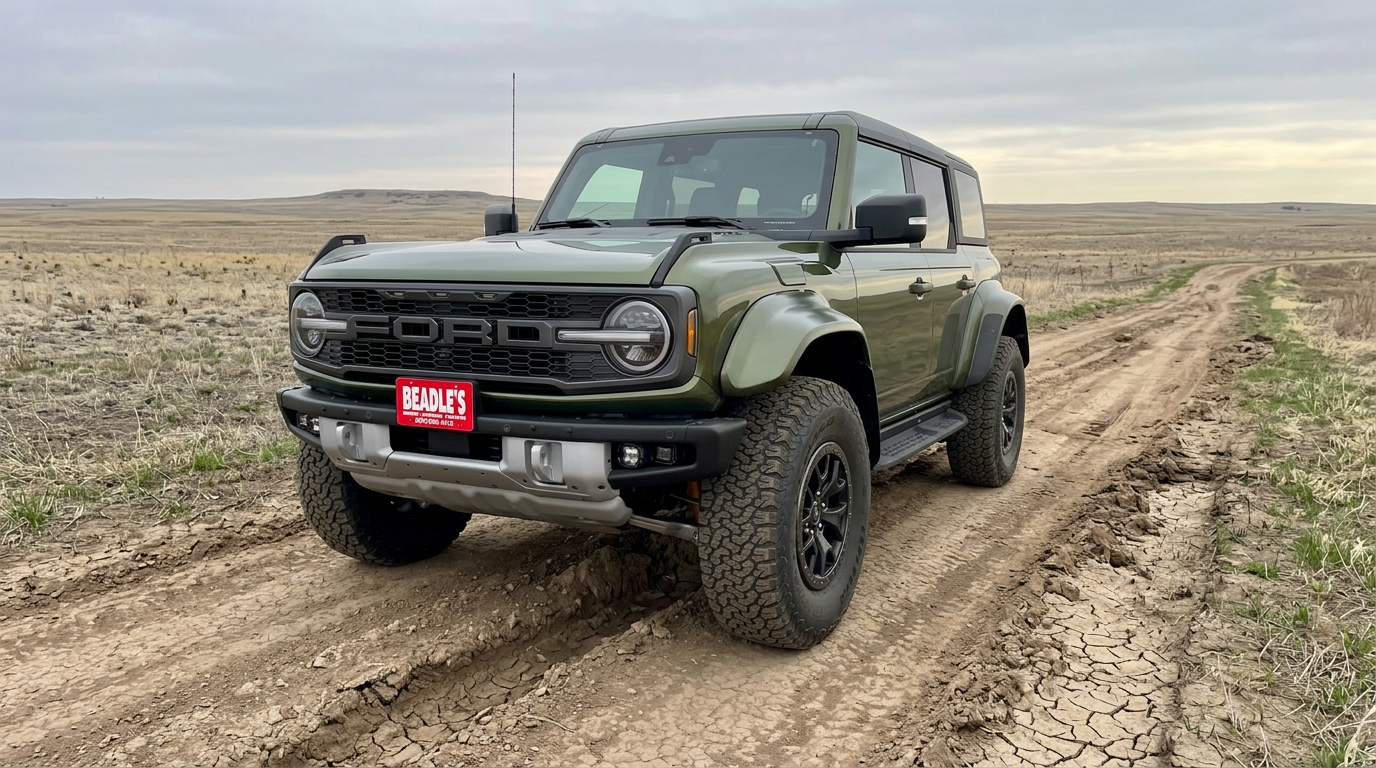
2026 Ford Bronco 4-Door Raptor in Shelter Green Metallic on a rutted section-line dirt road in central South Dakota

2026 Ford Bronco vs 2026 Jeep Wrangler: An Honest Comparison From a Ford Store

The 2026 Ford Bronco and the 2026 Jeep Wrangler are the two body-on-frame, four-wheel-drive, removable-top SUVs in the segment. They share a buyer profile and a use case — both are bought as second vehicles, weekend rigs, and lifestyle expressions as much as transportation. Cross-shopping is real, and most Bronco buyers in central South Dakota have driven a Wrangler at least once before signing. This is an honest comparison from a Ford store, played even-handedly. We'll cover engines and transmissions, off-road hardware, the doors-off and roof-off designs, on-road comfort, what the money actually buys, and where the Wrangler still wins versus where the Bronco is the right call for most Beadle-area buyers. There are real differences in both directions. Shop Broncos in Stock Get Pre-Approved On This Page How Do the 2026 Bronco and Wrangler Compare on Engines and Transmissions? How Does the Off-Road Hardware Stack Up? Removable Doors and Roof: How Do the Two Designs Differ? Which One Drives Better on Long Highway Hauls? What Do You Actually Get for the Money With Each One? Where Does the Wrangler Still Win — and Where Does the Bronco Win? How Do the 2026 Bronco and Wrangler Compare on Engines and Transmissions? The two lineups are organized differently. The Bronco offers three EcoBoost engines (2.3L I-4, 2.7L V6, 3.0L V6 Raptor) and the only manual transmission in the segment — a 7-speed paired with the 2.3L. The Wrangler runs a 2.0L turbo I-4 and a 3.6L Pentastar V6 across most of its lineup, with the 6.4L HEMI V8 reserved for the new-for-2026 Moab 392 and the limited-edition Willys 392. The Wrangler offers a 6-speed manual on the 3.6L V6, and an 8-speed automatic across the lineup. On peak horsepower, Wrangler wins at the top — the 6.4L HEMI V8 in the Moab 392 makes 470 horsepower and 470 lb-ft of torque versus the Bronco Raptor's 418 horsepower and 440 lb-ft from its 3.0L EcoBoost V6. The HEMI also makes a sound the Raptor doesn't try to make. For buyers cross-shopping at the very top of each lineup — Bronco Raptor versus Wrangler 392 — the Wrangler is the more powerful vehicle on paper. In the meaningful middle of the lineup, the Bronco's 2.7L EcoBoost V6 (330 hp / 415 lb-ft) outpunches the Wrangler 3.6L Pentastar (285 hp / 260 lb-ft) on torque by a wide margin — 415 versus 260 lb-ft is the difference between an engine that pulls effortlessly from low RPM and one that needs to rev to make work. The Bronco's base 2.3L (300 hp / 325 lb-ft) similarly outpunches the Wrangler 2.0L turbo (270 hp / 295 lb-ft). The transmission story is more even. Bronco's 10-speed automatic has more ratios than Wrangler's 8-speed, which gives the Bronco a smoother shift cadence at highway speed and more precise gearing for off-road crawl. But Wrangler still offers a manual with the V6 — Bronco's manual is 2.3L-only. For buyers who want a V6 with a stick shift, the Wrangler is the only option. For full Bronco engine context see our 2.3L vs 2.7L EcoBoost engine comparison. How Does the Off-Road Hardware Stack Up? Both vehicles are genuinely capable. The differences are in how each is engineered to be capable, not in whether they are. At the top spec, the numbers are within a half-degree of each other on most published metrics. On terrain management systems, the Bronco uses G.O.A.T. Modes (Goes Over Any Type of Terrain) — five modes on most trims, seven on Badlands and Raptor, including Off-Road, Rock-Crawl, and Baja. Wrangler uses Selec-Terrain with four primary modes (Auto, Snow, Sand/Mud, Rock) plus the brand's familiar 4WD systems (Command-Trac, Selec-Trac, or Rock-Trac depending on trim). Both work well; G.O.A.T. tends to be more discrete in mode count, while Selec-Terrain is broader by default. See our 2026 Bronco G.O.A.T. Modes guide for the full mode-by-mode breakdown. On locking differentials, both vehicles offer electronic-locking front and rear lockers at their off-road-focused trims. Bronco standardizes them on Badlands, Heritage Edition, Raptor, and any trim equipped with the Sasquatch Package. Wrangler standardizes them on Rubicon trims (and the new Moab 392 / Willys 392). Big Bend with the Black Diamond Package gets a rear locker only — Wrangler's Sport S and Sahara are similar. On front sway-bar disconnect, both vehicles offer it. Wrangler's electronic disconnect (on Rubicon and up) has been the segment benchmark for years. Bronco offers Front Stabilizer Bar Disconnect standard on Raptor and Stroppe, and new for 2026 Ford made it a standalone $1,305 option on Badlands (previously only via Sasquatch). Bronco Wildtrak with Sasquatch in the kind of cattail-slough mud that Wrangler buyers also cross-shop for — both vehicles handle it; the question is which one fits how you live with it the rest of the week. On geometry numbers at the most-capable spec: the Bronco Raptor (37" tires) lists approximately 13.1 inches of ground clearance, 47.2° approach, 30.8° breakover, and 40.5° departure. The Wrangler Moab 392 lists approximately 12.9 inches of ground clearance, 47.4° approach, and 40.4° departure (Jeep doesn't always publish breakover the same way). The Bronco Sasquatch (35" tires) lists approximately 11.6 inches of ground clearance with similar angle values. Wrangler Rubicon with the Xtreme 35 Package is in roughly the same neighborhood. These numbers are within rounding error of each other at the top spec — neither vehicle has a meaningful geometry advantage. For Sasquatch context specifically, see our 2026 Bronco Sasquatch Package guide. On 4WD systems, Wrangler's Rock-Trac (Rubicon-only) gets a 4:1 low-range gear that's sharper than what the Bronco uses, and the Bronco compensates with the GOAT Off-Road and Rock-Crawl modes plus Trail Control (low-speed off-road cruise control). Both are capable; Wrangler is slightly more analog, Bronco is slightly more electronic. Get Pre-Approved Contact Beadle Ford Removable Doors and Roof: How Do the Two Designs Differ? Both vehicles have removable doors and removable tops. The differences are in how the engineering is executed — and in how often you'd actually take advantage of it. 2026 Ford Bronco 4-Door Big Bend in doors-off configuration with front roof panels removed — what most buyers picture when they imagine the doors-off lifestyle. Bronco's frameless doors are designed to be removed without specialty tools — the Tool Kit is standard on Base and inherited up the trim ladder. The mirrors stay attached to the body (not the door), which means you keep your sideview mirrors when the doors are off. Wrangler's mirrors are mounted to the doors, so when those come off, the mirrors come with them — and Jeep sells aftermarket frame-mounted mirrors as an accessory if you want to drive doors-off legally on the highway. On the roof, Bronco offers a Modular Hardtop with separate front panels (driver and passenger T-tops) that can come off independently of the rear, plus a soft-top option. Wrangler offers either a one-piece hardtop, a two-piece hardtop (Freedom Top), or the soft top. Both designs work; Wrangler's Freedom Top is generally faster to take off than Bronco's modular setup, while Bronco's lets you go partial — front panels off, rear panels on — which is a useful in-between for a sunny day with cooler weather behind you. Honest take for central South Dakota: the doors-off and roof-off lifestyle is mostly a 4–6 month window. From mid-October through early April, the doors stay on and the hardtop earns its keep. Both vehicles handle the cold months equivalently — but if you're bought either of them for the doors-off feature, plan around the calendar. Our 2026 Bronco removable doors and roof guide covers this in more detail. Which One Drives Better on Long Highway Hauls? This is one of the clearer differences. The Bronco generally rides quieter, tracks straighter at highway speeds, and feels less truck-like over expansion joints than the Wrangler does — particularly on Outer Banks and on any non-Sasquatch configuration. The Wrangler's solid front axle (a feature for off-road purists) is also why it tends to wander more at 75 mph and follow road crowns more aggressively than the Bronco's independent front suspension does. For long-distance drivers — anyone making the four-hour Bowdle-to-Black-Hills run a few times a year — the Bronco's on-road manners are a real, daily-felt advantage. Wind noise is lower, steering feel is closer to a modern crossover, and the cabin doesn't ask the driver to actively manage the wheel the way a Wrangler can on a windy day. Both vehicles offer modern infotainment. Bronco runs SYNC 4 with a 12-inch standard touchscreen on every trim — including Base — and wireless Apple CarPlay and Android Auto. Wrangler runs Uconnect 5 with an 8.4-inch standard screen (12.3-inch optional). Both interfaces are good. Bronco's standard screen is bigger; Wrangler's tactile controls are arguably better for off-road glove use. Worth flagging: the 2026 Bronco does not offer Ford's BlueCruise hands-free highway driving. Wrangler doesn't offer a competing hands-free system either. So while BlueCruise is a Ford brand strength elsewhere in the lineup, it's not a differentiator here. What Do You Actually Get for the Money With Each One? At MSRP, the two lineups overlap heavily. The 2026 Bronco starts at $40,495 (Base, before destination) and tops out at $79,995 (Raptor). The 2026 Wrangler starts comparably (depending on trim and body style) and tops out near $90,000+ for the Moab 392 and the limited-edition Willys 392. For mainstream comparison, a Bronco Big Bend, Outer Banks, or Badlands sits roughly in line with a Wrangler Sport S, Sahara, or Rubicon respectively. Where the math diverges is in standard equipment per dollar. The Bronco runs SYNC 4 with the 12-inch screen, wireless CarPlay and Android Auto, and Co-Pilot360 driver-assist (BLIS, lane-keeping, AEB) standard from Big Bend up. Wrangler delivers similar tech but more of it lands in optional packages or higher trims. A Bronco Big Bend at MSRP usually has more standard tech than a Wrangler Sport S at the same price. For trim-by-trim Bronco context, see our 2026 Bronco trim levels guide. On towing, Wrangler wins on paper: the 4-door Wrangler Rubicon with the 4.10 axle (and the Moab 392 / Willys 392) is rated to tow up to 5,000 lbs. Every non-Raptor 2026 Bronco caps at 3,500 lbs; the Bronco Raptor caps at 4,500 lbs. If you're regularly towing a trailer that puts you above 3,500 lbs, that pushes you to a Bronco Raptor or to the Wrangler. For most buyers towing a fishing boat, an ATV trailer, or a small camper, both are well within capacity. Resale value is roughly comparable. Wrangler has historically held value extremely well — that hasn't completely changed — but the Bronco's resale has been strong since launch and continues to track close to Wrangler's at three- and five-year points. Both vehicles depreciate less than the average mainstream SUV. Where Does the Wrangler Still Win — and Where Does the Bronco Win? The Wrangler still wins if you want the highest-output engine in the segment (the 470-hp HEMI V8 Moab 392 / Willys 392 — the Bronco Raptor doesn't try to chase it), if you want a manual transmission paired with a V6 (Bronco's manual is 2.3L-only), if your tow load lives between 3,500 and 5,000 lbs (Bronco caps at 3,500 lb non-Raptor / 4,500 lb Raptor), or if you place a strong premium on the Wrangler's brand identity and aftermarket community — both are real and longstanding strengths. The Bronco wins if you do a lot of long-distance highway miles, if you want the segment's best standard-tech-per-dollar (SYNC 4, 12-inch screen, Co-Pilot360 from Big Bend up), if you want creature comforts in your off-road SUV without stepping all the way up to a top-trim Wrangler, if you appreciate that the Bronco's mirrors stay on when the doors come off, or if you want the GOAT mode terrain system rather than Selec-Terrain. The third factor — the one that doesn't show up on a spec sheet — is the dealer relationship. The nearest Jeep dealership to Bowdle is enough miles away that warranty service, recall work, and trade-in conversations all become a half-day commitment. Beadle Ford is twenty minutes from most of our buyers, and we've been here for decades. For a vehicle that's going to need an oil change four times in the first year and a service item or two over its life, that proximity matters more than most buyers think when they're shopping on paper. Either vehicle is a good choice. We recommend driving both — and we'll tell you straight up which one fits your specific use case, even if that answer isn't the Bronco. For the broader 2026 Bronco context, the full 2026 Ford Bronco overview covers engines, capability, and what's new for the year. Key Takeaways Top engines: Wrangler 6.4L HEMI V8 (470 hp / 470 lb-ft) outpowers Bronco Raptor 3.0L V6 (418 hp / 440 lb-ft). In the meaningful middle, Bronco's 2.7L EcoBoost V6 outpunches Wrangler's 3.6L V6 on torque (415 vs 260 lb-ft). Off-road geometry at top spec is within rounding error: Bronco Raptor ~13.1" GC, 47.2° approach, 40.5° departure; Wrangler Moab 392 ~12.9" GC, 47.4° approach, 40.4° departure. Towing: Wrangler tops out at 5,000 lbs (4-Dr Rubicon w/ 4.10 axle); Bronco caps at 3,500 lbs non-Raptor, 4,500 lbs Raptor. Doors-off design: Bronco's mirrors are body-mounted (stay on); Wrangler's mirrors come off with the doors and require aftermarket frame mirrors for legal road use. Bronco wins on long-highway comfort, standard tech per dollar (SYNC 4 + 12-inch screen + Co-Pilot360), and dealer proximity for central-SD buyers. Wrangler wins on top-spec horsepower, V6+manual availability, max towing, and aftermarket community. Frequently Asked Questions Is the 2026 Ford Bronco better off-road than the 2026 Jeep Wrangler? Neither has a meaningful geometry advantage at top spec — published approach, departure, and ground-clearance numbers are within a half-degree or half-inch of each other. Both have front and rear lockers and front sway-bar disconnect at their off-road trims. The vehicles are differently engineered to the same end: Bronco leans more electronic (GOAT modes, Trail Control), Wrangler more analog (Rock-Trac 4:1 low range, solid front axle). Does the 2026 Bronco tow more than the 2026 Wrangler? No. Wrangler wins on max towing. The 4-Door Wrangler Rubicon with the 4.10 axle and the Moab 392 / Willys 392 are rated up to 5,000 lbs. The 2026 Ford Bronco tops out at 4,500 lbs (Raptor only); every other Bronco trim caps at 3,500 lbs. Can you get a manual transmission on either the 2026 Bronco or Wrangler? Both vehicles offer a manual transmission. The Bronco's 7-speed manual is paired exclusively with the 2.3L EcoBoost. The Wrangler's 6-speed manual is offered with the 3.6L Pentastar V6. If you want a V6 with a stick shift, only the Wrangler offers that combination. Which is more comfortable on the highway: 2026 Bronco or Wrangler? The Bronco is generally quieter, tracks straighter, and handles wind and road crowns better at 70+ mph than the Wrangler does. The Wrangler's solid front axle is a feature for off-road purists but trades on-road manners for it. If long highway miles are a regular part of how you'll use the vehicle, the Bronco is the more comfortable highway companion. Do you keep the sideview mirrors when you take the doors off the 2026 Bronco? Yes. The Bronco's sideview mirrors are mounted to the body, not the doors, so they stay attached when the doors are removed. On the Wrangler, the mirrors are door-mounted — when the doors come off, the mirrors come off with them, and aftermarket frame-mounted mirrors are required for legal on-road use without doors. My Take on the 2026 Bronco vs Wrangler Decision I'll be honest — I've sold a few customers a Bronco who would have been better off with a Wrangler, and I've sent a couple of long-time Wrangler owners home in a Bronco who didn't expect to like it. The decision usually comes down to two questions: how many highway miles will you put on it, and how committed are you to the brand identity and the community that comes with each one. If long highway runs are a big part of your year and you don't have strong loyalty either way, the Bronco's on-road manners and standard-tech-per-dollar usually carry the day. If you've owned three Wranglers and you know what you love about them, no amount of EcoBoost torque is going to change that — and that's a perfectly valid reason to stay with what you know. The thing the spec sheet doesn't capture is the dealer side of the deal. We've been at Beadle Ford in Bowdle long enough to remember a lot of our customers' previous trucks — and the closest Jeep store is far enough away that the relationship is harder to build. If you're cross-shopping and the trucks land at a near-tie on paper, the dealer math is worth weighing. Either way, come drive both. We'll be square with you about which one fits. Shop Broncos in Stock Get Pre-Approved About the Author Lexy Tabbert — Beadle Ford, Bowdle, SD Lexy Tabbert is the Director of Sales and Marketing at Beadle Ford in Bowdle, South Dakota. She covers Ford vehicles, trim comparisons, and buyer guidance — helping families, ranchers, and ag operators across the region find the right truck and configuration for their needs. Learn more about Lexy.
2026 Ford Bronco Sport Outer Banks with Sasquatch Package in South Dakota

Outer Banks Sasquatch vs Badlands: What the 2026 Bronco Sport Sasquatch Package Adds and Who It's Actually For

The 2026 Ford Bronco Sport Sasquatch Package turns the Outer Banks trim into a legitimate off-road machine — but it's not the same thing as buying a Badlands. If you're deciding between adding the Sasquatch Package to an Outer Banks or stepping up to the Badlands outright, the answer depends on what you're actually planning to do with the vehicle and how much the Outer Banks' interior upgrades matter to you. Here's what the Sasquatch Package adds, what it can't change, and which buyer each option is really built for. Shop Bronco Sports in Stock Get Pre-Approved In This Guide What Is the Sasquatch Package on the 2026 Bronco Sport? What Does the Sasquatch Package Actually Include? Outer Banks Sasquatch vs. Badlands: Full Comparison Does the Outer Banks Sasquatch Get Rock Crawl and Rally Modes? Is the Sasquatch Package Worth It on the Outer Banks? Who Should Buy the Outer Banks Sasquatch vs. the Badlands? What Is the Sasquatch Package on the 2026 Bronco Sport? The Sasquatch Package (option code 67A) is a factory off-road upgrade available exclusively on the 2026 Bronco Sport Outer Banks trim. It cannot be added to Big Bend, Heritage, or Heritage Limited — and it has no place on the Badlands, because the Badlands already includes most of its hardware as standard equipment. The package was built to give Outer Banks buyers access to Badlands-tier off-road hardware without giving up the Outer Banks' comfort and luxury features. You get the Advanced 4x4 system with twin-clutch rear axle, HOSS 2.0 off-road suspension, aggressive A/T tires, Trail Control, recovery hooks, and underbody protection — all on a trim that also offers available B&O audio, a panoramic fixed glass roof, and leather-trimmed seating. One important note: the Sasquatch Package requires the Outer Banks Tech Package (option code 96T) to be ordered first. For Bowdle buyers who want a capable trail rig that can also serve as a comfortable vehicle for longer South Dakota road trips, the Outer Banks Sasquatch is worth a serious look — as long as you understand exactly what it does and doesn't give you. What Does the Sasquatch Package Actually Include? The Sasquatch Package is one of the most content-rich factory option packages on the Bronco Sport lineup. Here's what's bundled in: Feature What It Means Advanced 4x4 with Twin-Clutch DRSC Active torque-vectoring rear axle — the same system standard on Badlands HOSS 2.0 Off-Road Suspension High-performance Off-Road Stabilization & Suspension with Bilstein position-sensitive dampers Trail Control Low-speed cruise control that manages throttle and braking over technical terrain Trail One-Pedal Drive Regenerative deceleration for precise throttle control at slow off-road speeds Pro Power Onboard 400W 110V outlet with up to 400 watts for power tools, camp gear, or electronics 17" Ebony Black Aluminum Wheels Larger-diameter wheels replacing Outer Banks' standard alloys P235/65R17 All-Terrain Tires All-terrain compound for improved grip on gravel, dirt, snow, and soft ground High Clearance Front Fender Flares Wider clearance to accommodate bigger tires and improve approach angles Front Brush Guard with Recovery Hooks Black MIC (Molded-In Color) construction; integrated front recovery points Black MIC Front & Rear Bumpers Replaces body-color bumpers with a more rugged, trail-ready look Rear Recovery Hooks — 2 D-rings Frame-mounted rear anchor points for recovery straps or tow lines Class II Trailer Tow Package Required for towing above 1,500 lbs; adds hitch receiver and wiring harness 12.3" Digital Instrument Cluster Full-color reconfigurable display replacing analog gauges Rubberized Floor Covering Easier cleanup after muddy or wet adventures Underbody Protection Front and rear skid plates to guard against rocks and trail debris That's a significant list. The Sasquatch Package essentially bolts Badlands-level off-road hardware onto the Outer Banks platform — giving you access to two capability sets that normally live on separate trim lines. The remaining question is what it leaves out, which is covered in the next section. Outer Banks Sasquatch vs. Badlands: Full Comparison On the surface, the Outer Banks Sasquatch and the Badlands look nearly identical once the package is installed. But there are meaningful differences — primarily in the engine room and the G.O.A.T. mode system — that matter to serious off-road buyers. Feature Outer Banks + Sasquatch Badlands Base Engine 1.5L EcoBoost (180 hp / 190 lb-ft) 2.0L EcoBoost (250 hp / 280 lb-ft) 2.0L Engine Available? Yes — optional add-on Standard, included Advanced 4x4 with Twin Clutch Yes (via Sasquatch Package) Standard HOSS 2.0 Suspension Yes (via Sasquatch Package) Standard Trail Control + Trail One-Pedal Yes (via Sasquatch Package) Standard P235/65R17 A/T Tires Yes (via Sasquatch Package) Standard Total G.O.A.T. Modes 5 modes 7 modes Rock Crawl Mode No Yes Rally Mode No Yes Leather-Trimmed Seating Available Available (heated) B&O Sound System Available Not available Panoramic Fixed Glass Roof Available Not available Pro Power Onboard 400W Yes (via Sasquatch Package) Standard The short version: the Outer Banks Sasquatch gives you Badlands hardware while keeping the Outer Banks' luxury features, but starts with the 1.5L engine and lacks Rock Crawl and Rally modes. The Badlands comes with the 2.0L, Rock Crawl, and Rally as standard — but trades away the panoramic roof and B&O audio options. Does the Outer Banks Sasquatch Get Rock Crawl and Rally Modes? No. Rock Crawl and Rally are exclusive to the Badlands trim and cannot be unlocked by any package or option on the Outer Banks. This is one of the most important differences between the two configurations — and the one buyers most often overlook when spec-shopping. The Outer Banks Sasquatch gets the five standard G.O.A.T. (Goes Over Any Type of Terrain) modes: Normal, Eco, Sport, Slippery, and Sand. These are genuinely capable across a wide range of conditions. But Rock Crawl and Rally require the Badlands' powertrain calibration and the 2.0L engine's specific torque curve — neither of which transfers to the Outer Banks through a package alone. G.O.A.T. Mode Availability by Configuration Mode Outer Banks Sasquatch Badlands Normal Yes Yes Eco Yes Yes Sport Yes Yes Slippery Yes Yes Sand Yes Yes Rock Crawl No Yes Rally No Yes If you're regularly running rocky terrain in the Badlands (the geographic region, not the trim) or want Rock Crawl's precise throttle management for technical obstacles, the Badlands trim is the right call. If your off-roading consists of trail riding, forest roads, pasture tracks, or winter traction across western South Dakota, the Outer Banks Sasquatch's five modes are fully up to the task. Is the Sasquatch Package Worth It on the Outer Banks? For the right buyer, yes. The Sasquatch Package bundles gear that would cost substantially more to source aftermarket — an upgraded 4x4 system, skid plates, recovery hooks front and rear, A/T tires, upgraded suspension, Pro Power Onboard, Trail Control, and the Class II tow package. Buying those components separately would run well past the package price, and they wouldn't be factory-integrated or covered under your Ford warranty. The value question is different depending on your use case: Worth It If You... Want the Outer Banks' interior upgrades and off-road hardware in a single build Plan to tow a jon boat, ATV trailer, or utility load (up to 2,200 lbs with the 2.0L) Drive gravel, pasture, or forest roads regularly but don't need Rock Crawl mode Want A/T tires and capable 4x4 for South Dakota winters without buying aftermarket Want the 400W outlet for worksites, hunting camp, or charging gear on the road Skip It If You... Primarily drive pavement and rarely go off-road Need Rock Crawl or Rally modes for technical terrain Want the 2.0L engine as standard without a separate upgrade Are comparing total cost to a Badlands without factoring in the required Tech Package One important consideration: the Sasquatch Package requires the Outer Banks Tech Package (96T) to be ordered first, which means the actual entry cost includes both packages stacked. Build your full configuration before comparing it to Badlands pricing — the sticker difference is often smaller than buyers expect. Who Should Buy the Outer Banks Sasquatch vs. the Badlands? This decision usually comes down to one core question: what matters more to you — the interior experience or the maximum off-road performance ceiling? Here's how to map your use case to the right build: Use Case Outer Banks Sasquatch Badlands Weekend trail riding + comfortable daily commute Better fit Also capable Serious rock crawling or technical off-road routes Limited — no Rock Crawl mode Better fit Long road trips, premium audio, comfort features Better fit Fewer luxury options Towing a boat to Lake Oahe or a small utility trailer Better fit (Class II included) Also capable Maximum horsepower and torque without upgrades Requires separate 2.0L add-on Better fit — 2.0L standard South Dakota winter driving and gravel roads year-round Strong Strong Our full 2026 Bronco Sport trim comparison guide breaks down all five trims side-by-side — including base prices, standard features, and which engine each gets — so you can see exactly where the Outer Banks Sasquatch and the Badlands land against each other before you make a decision. Key Takeaways The Sasquatch Package (67A) is available only on the Outer Banks trim and requires the Tech Package (96T) first — it cannot be added to other trims. It includes Advanced 4x4 with twin clutch, HOSS 2.0 suspension, A/T tires, Trail Control, Trail One-Pedal Drive, Pro Power 400W, front brush guard, front and rear recovery hooks, underbody protection, and the Class II Tow Package. The Outer Banks Sasquatch does NOT include Rock Crawl or Rally modes — those remain exclusive to the Badlands trim regardless of packages ordered. The Outer Banks base engine is the 1.5L EcoBoost (180 hp); the 2.0L is available as a separate upgrade but is not included with the Sasquatch Package. The Badlands includes the 2.0L EcoBoost, Rock Crawl, and Rally as standard — but the panoramic roof and B&O audio are not available on Badlands. Factor in both the Tech Package and Sasquatch Package when budgeting — the combined cost may put you close to Badlands pricing, so run both configurations before committing. Frequently Asked Questions Can I add the Sasquatch Package to any Bronco Sport trim? No. The Sasquatch Package (67A) is only available on the Outer Banks for the 2026 model year. It cannot be added to Big Bend, Heritage, Heritage Limited, or Badlands. It also requires the Outer Banks Tech Package (96T) as a prerequisite order. Does the Sasquatch Package include Rock Crawl mode? No. Rock Crawl is a Badlands-exclusive G.O.A.T. mode and is not available on the Outer Banks regardless of which packages are added. The Outer Banks Sasquatch receives five G.O.A.T. modes: Normal, Eco, Sport, Slippery, and Sand. Does the Outer Banks Sasquatch automatically come with the 2.0L engine? No. The Outer Banks base engine is the 1.5L EcoBoost three-cylinder (180 hp, 190 lb-ft). The 2.0L EcoBoost is available as a separate option on the Outer Banks but is not bundled with the Sasquatch Package. If you want the 2.0L, you need to add it separately when you configure your order. Is the Outer Banks Sasquatch more expensive than the Badlands? It depends on how you configure both. The Outer Banks requires the Tech Package before the Sasquatch Package can be added, meaning your real starting point is Outer Banks base + Tech Package + Sasquatch Package. When stacked, the total is often close to a similarly equipped Badlands. Compare both full builds before committing — the gap is usually smaller than buyers expect. Can the Outer Banks Sasquatch tow a boat to Lake Oahe? Yes. With the Class II Trailer Tow Package included in the Sasquatch bundle, the 2026 Bronco Sport Outer Banks Sasquatch is capable of towing up to 2,200 lbs when properly equipped with the 2.0L EcoBoost. A jon boat, small aluminum fishing boat, or personal watercraft trailer is well within that range. Confirm your loaded boat-and-trailer weight before you head to the ramp. Bottom Line for Bowdle Buyers I've walked a lot of buyers through the Outer Banks Sasquatch vs. Badlands decision, and it almost always comes down to one question: how often are you on technical rocky terrain versus gravel roads, dirt trails, and slick winter conditions? For most buyers in this area — running fence lines, heading out to hunting ground, pulling a boat to Lake Oahe, or managing winter roads between towns — the Outer Banks Sasquatch is genuinely well-equipped. The hardware is serious, and the Outer Banks interior makes those longer trips a lot more comfortable. But if Rock Crawl matters to you, or you want the 2.0L as a given rather than an add-on, the Badlands is the cleaner answer. Either way, you're looking at one of the most capable compact SUVs in this price class for the way South Dakotans actually use their vehicles. For a full side-by-side of all five trims — including standard features, engine options, and package breakdowns — our 2026 Ford Bronco Sport guide at Beadle Ford has everything you need to finalize your configuration. Shop Bronco Sports in Stock Get Pre-Approved Contact Us About the Author Lexy Tabbert Lexy Tabbert is an automotive content writer and researcher at Beadle Ford in Bowdle, SD. She covers Ford lineup updates, trim comparisons, package breakdowns, and regional buying guides to help South Dakota shoppers make confident vehicle decisions. When she's not comparing option codes, she's watching the roads between here and the Badlands — the geographic ones, not the trim.

2027 Ford F-350 Lariat in Ruby Red Metallic in a South Dakota sunflower field

2027 Ford F-350 Colors & Appearance

Quick Answer The 2027 Ford F-350 palette runs from work-ready Oxford White, Agate Black, and Carbonized Gray to bold Ruby Red and Argon Blue, with premium tri-coat options available. New for 2027: Tremor Off-Road on the XL work trim and the Super Duty Carhartt Package, plus new colors added and a few 2026 shades retired. Availability varies by trim and build. Styling on a heavy-duty truck is rarely "just cosmetic." Color affects how the truck represents a business, how well it hides gravel dust and road salt, and how easy it is to match later if you add another truck to the fleet — and 2027 brings a few real appearance changes worth knowing. Here's the 2027 F-350's colors, what's new in appearance, and how to choose a look that fits the work for buyers around Bowdle and Aberdeen. Shop F-350s in Stock Get Pre-Approved On This Page What colors does the 2027 F-350 come in? Neutral vs. bold for a work truck What changed in appearance for 2027? Chrome vs. blacked-out, and wheels How do you choose styling for your use? What colors does the 2027 F-350 come in? The 2027 palette spans work-truck neutrals to bold and premium finishes. Confirmed colors include: Work-friendly neutrals: Oxford White, Agate Black Metallic, Carbonized Gray Metallic, Iconic Silver Metallic, Marsh Gray, and Avalanche. Bold: Ruby Red Metallic Tinted Clearcoat and Argon Blue Metallic. Premium: available tri-coat finishes (extra cost). 2027 adds new colors and retires a few 2026 shades, and availability varies by trim and build — confirm the exact 2027 palette and your color's availability when you order. Neutral vs. bold for a work truck For a truck that works and gets traded, neutrals are usually the safe long-term play: they hide dust and salt, match a fleet, and hold the broadest resale appeal. Bold colors look sharp but can narrow the buyer pool later and may be more limited by trim and package. From the Beadle Ford Lot The F-350s that move fastest at trade-in around here are white, black, and gray — they hide the gravel dust and winter salt that coat everything by February, and a fleet buyer can match them without a second thought. Bold colors look great in the yard; just go in knowing they can narrow your resale pool down the road. What changed in appearance for 2027? Two additions stand out. The Tremor Off-Road Package is now available on the XL work trim — bringing the rugged off-road look to the base truck for the first time — and the new Super Duty Carhartt Package adds work-grade styling on single-rear-wheel trucks. The color palette also shifted, with new shades in and a few 2026 colors out. If the Carhartt look is what you're after, it points your build toward single-rear-wheel — full detail in our 2027 F-350 Carhartt Edition guide. Chrome vs. blacked-out, and wheels Appearance packages change the truck's personality fast — grille, bumpers, and trim shift from bright chrome to blacked-out. Wheels vary by trim and configuration too, from 18-inch painted and machined aluminum on work trims to 20-inch finishes higher up, plus the 17-inch forged wheels on dual-rear-wheel trucks. Choose your finish direction and trim together so you don't back into a look after the fact. Our Recommendation For work, fleet, and resale buyers around Bowdle and Aberdeen, a neutral — Oxford White, Agate Black, or Carbonized Gray — hides dust and salt and trades easiest. Save a premium tri-coat or a bold Ruby Red for a personal truck you plan to keep, and pick chrome or blacked-out to match how you want it to read. Match the look to a trim in our what's-new for 2027 guide. How do you choose styling for your use? Work from how the truck will be used, in four steps: Decide if the truck represents a business or fleet, or is personal. Choose a finish direction — chrome, blacked-out, Tremor, or Carhartt — before locking the trim. Confirm your color is available on your preferred 2027 build (premium tri-coats are limited and extra-cost). Check wheel and tire practicality for winter, gravel, and towing. Key Takeaways The 2027 palette spans Oxford White, Agate Black, and Carbonized Gray to Ruby Red and Argon Blue, plus premium tri-coats. New for 2027: Tremor Off-Road now on XL, and the Super Duty Carhartt Package (SRW). New colors added and a few 2026 shades retired — confirm the final palette at order. Neutrals hide dust and salt, match fleets, and trade easiest in this region. Appearance packages and wheels vary by trim — choose finish and trim together. Frequently Asked Questions What colors does the 2027 Ford F-350 come in? Confirmed colors include Oxford White, Agate Black Metallic, Carbonized Gray Metallic, Iconic Silver Metallic, Marsh Gray, Avalanche, Argon Blue Metallic, and Ruby Red Metallic Tinted Clearcoat, plus available premium tri-coat finishes. 2027 adds new colors and retires a few 2026 shades; availability varies by trim and build. Which F-350 colors are best for resale? Neutrals — Oxford White, Agate Black, and Carbonized Gray — tend to hold the broadest resale appeal and are easiest to match in a fleet. They also hide gravel dust and winter road salt better, which matters in South Dakota. Bold colors look great but can narrow the resale pool. Is the Tremor Off-Road Package new for 2027? It's newly available on the XL work trim for 2027 — bringing the rugged off-road look and hardware to the base truck for the first time. The package adds traction and appearance elements that change the truck's stance and styling. Do appearance packages change the wheels and grille? Often, yes. Many appearance packages adjust exterior finishes — grille, bumpers, and wheel designs — shifting between bright chrome and blacked-out looks. Wheels also vary by trim and configuration, so confirm the exact content by build. Are premium tri-coat colors extra on the 2027 F-350? Yes — tri-coat finishes are premium, extra-cost paints and can be limited by trim. Standard and no-cost metallics cover most of the lineup. We'll confirm which colors are available on your build and at what cost when you order. Quick Answers: 2027 F-350 Colors & Appearance One-line answers to the follow-up questions buyers ask next. Most popular work colors? Oxford White, Agate Black, and Carbonized Gray. Boldest options? Ruby Red Tinted Clearcoat and Argon Blue Metallic. Premium paints? Available tri-coat finishes, extra cost. Best color for resale? Neutral white, black, or gray. New appearance for 2027? Tremor on XL and the Carhartt Package (SRW). Did colors change? Yes — new shades added, a few 2026 colors dropped. Blacked-out look? Yes — via appearance packages on equipped trims. Do wheels change by trim? Yes — 18" work wheels up to 20"; 17" forged on DRW. Best to hide dust and salt? White and gray shades. How do I confirm a color? We verify the 2027 palette and your color at order. Keep Researching The complete 2027 Ford F-350 Super Duty overview — specs, towing, trims, and how to order. 2027 F-350 Carhartt Edition — the new work-grade styling package. What's new for 2027 — Tremor-on-XL and the rest of the changes. 2027 F-350 SRW vs. DRW — wheels and stance by rear-wheel choice. My Take on F-350 Colors & Styling In my experience, styling feels right when it matches the job. The 2027 additions — Tremor on XL and the Carhartt look — give work-truck buyers more personality than ever, but for a truck that earns its keep and gets traded, a neutral color still wins on resale and on hiding the dust. Pick the look you'll be happy with for years, not just on the lot. Tell me how you'll use the truck and the look you're after, and I'll help you land a color and finish that holds up. Stop in at Beadle Ford in Bowdle or reach out anytime. Shop F-350s in Stock Get Pre-Approved About the Author Lexy Tabbert — Beadle Ford, Bowdle, SD Lexy Tabbert is the Director of Sales and Marketing at Beadle Ford in Bowdle, South Dakota. She covers Ford vehicles, trim comparisons, and buyer guidance — helping families, ranchers, and ag operators across the region find the right truck and configuration for their needs. Learn more about Lexy.
2026 Ford F-350 Super Duty driving on a rural South Dakota road

2026 Ford F-350 Engine Comparison

Quick Answer The 2026 Ford F-350 offers four engines: a 6.8L gas V8 (405 hp), a 7.3L gas V8 (430 hp), a 6.7L Power Stroke diesel (1,050 lb-ft), and a 6.7L High-Output Power Stroke (1,200 lb-ft, up to 40,000 lbs gooseneck). Gas suits mixed driving and top payload; diesel wins for frequent heavy towing. The "best" engine on a 2026 Ford F-350 Super Duty is the one that matches how you actually use the truck. If you tow heavy frequently, drive long distances, or want an effortless feel under load, your priorities look different than someone doing mixed driving with occasional towing. This guide lays out the four engines with their real numbers, how gas and diesel actually feel when towing, the ownership considerations beyond fuel, and how to match the engine to your workload here in South Dakota and North Dakota. Shop F-350s in Stock Get Pre-Approved On This Page What are the 2026 F-350 engine options and specs? Gas vs. diesel: what changes in real use? Which engine feels best for towing? Ownership considerations beyond fuel How do you match an engine to your workload? What are the 2026 F-350 engine options and specs? The 2026 F-350 offers four engines, all paired with a 10-speed TorqShift automatic: two gas V8s and two 6.7L Power Stroke diesels. The 6.8L gas is standard on XL, XLT, and Lariat; the 7.3L gas becomes standard on King Ranch and up; both diesels are optional across the line. Engine Output Max Tow / Payload 6.8L gas V8 405 hp / 445 lb-ft 18,900 lbs / up to 8,000 lbs payload 7.3L gas V8 430 hp / 485 lb-ft 22,500 lbs / 7,635 lbs payload 6.7L Power Stroke diesel 475 hp / 1,050 lb-ft 38,600 lbs / 6,952 lbs payload 6.7L High-Output Power Stroke 500 hp / 1,200 lb-ft 40,000 lbs / 6,935 lbs payload Tow figures are maximum gooseneck, properly equipped; the 40,000-lb rating requires the dual-rear-wheel HO diesel with the 40K Gooseneck Tow Package. Payload and towing vary with cab, bed, axle, and configuration. Gas vs. diesel: what changes in real use? Both can be strong choices — for different patterns. Gas is the simpler, lower-cost-of-entry option for mixed driving and occasional towing, and the 6.8L gas actually carries the highest payload of any F-350 at up to 8,000 lbs. Diesel earns its premium when towing is frequent and heavy, trading purchase price for torque and a composed feel under load. Engine availability ties to trim and packages, so it helps to compare powertrains alongside equipment. That framework is in our 2026 F-350 packages & trims guide. Which engine feels best for towing? For heavy, frequent towing, the diesels feel best — stable and unstrained on grades, in wind, and on long highway runs — which is why they're the common pick above roughly 20,000 lbs. The standard 6.7L Power Stroke (1,050 lb-ft, up to 38,600 lbs) covers nearly every gooseneck around here; the High-Output (1,200 lb-ft, up to 40,000 lbs) is for the heaviest loads. If your towing is occasional and mixed, the 7.3L gas is capable to 22,500 lbs without diesel upkeep. Our Recommendation For most ranch and farm buyers around Bowdle and Aberdeen who tow gooseneck trailers regularly, we recommend the standard 6.7L Power Stroke — its 1,050 lb-ft and 38,600-lb rating cover nearly every trailer here without paying for the High-Output engine. If you tow only occasionally and want maximum payload and the lowest cost of ownership, the 7.3L gas V8 is the smarter buy. Match it to a build with our 2026 F-350 towing guide. Ownership considerations beyond fuel The right engine is an ownership decision, not just a spec-sheet one. Weigh the purchase premium against how hard and how often you'll actually work the truck. Upfront cost: diesel configurations carry a higher purchase price than gas. Use pattern: frequent heavy towing justifies diesel; mixed driving favors gas. Payload need: if you haul heavy in the bed more than you tow, the 6.8L gas and its 8,000-lb payload may matter more than diesel torque. Long-term plans: how long you keep the truck changes the value equation. Work reality: in wind, winter, and long distances, "effortless under load" can matter more than mileage. How do you match an engine to your workload? Work from how you use the truck, in four steps: Identify your heaviest trailer and how often you tow it. Decide whether "effortless under load" on grades and in wind is a priority. Factor in payload needs, annual miles, and how long you keep trucks. Compare real builds — engine choice can affect available equipment, packages, and SRW vs. DRW. From the Beadle Ford Lot Most F-350 shoppers come in asking about the High-Output diesel, but once we walk through their real trailer weight, more leave with the standard 6.7L Power Stroke or the 7.3L gas — the High-Output engine and a dually mostly earn their premium once you're routinely past what those two cover. Key Takeaways Four engines, all 10-speed TorqShift: 6.8L gas (405 hp), 7.3L gas (430 hp), 6.7L diesel (1,050 lb-ft), 6.7L HO diesel (1,200 lb-ft). The 6.8L gas carries the highest payload of any F-350 — up to 8,000 lbs. Diesel tows farthest: 38,600 lbs standard, 40,000 lbs High-Output (DRW). Pick by workload pattern, not headline torque — gas for mixed/occasional, diesel for frequent heavy towing. Engine choice can affect equipment and packages, so confirm on a real build. Frequently Asked Questions What are the 2026 Ford F-350 engine specs? Four engines, all with a 10-speed TorqShift automatic: the 6.8L gas V8 (405 hp / 445 lb-ft), the 7.3L gas V8 (430 hp / 485 lb-ft), the 6.7L Power Stroke diesel (475 hp / 1,050 lb-ft), and the 6.7L High-Output Power Stroke (500 hp / 1,200 lb-ft). Is diesel always the best choice for an F-350? Not always. Diesel shines for frequent heavy towing — up to 38,600 lbs standard or 40,000 lbs High-Output — but gas can be a strong fit for mixed driving and occasional towing. The best choice depends on your trailer weight, towing frequency, payload needs, and ownership priorities. Which 2026 F-350 engine has the most payload? The 6.8L gas V8, at up to 8,000 lbs properly equipped — more than either diesel — because the lighter engine leaves more weight available for the bed. The 7.3L gas follows at 7,635 lbs, with the diesels near 6,950 lbs. Does engine choice affect towing features and packages? It can. Some towing equipment and packages vary by trim, engine, and configuration — the 40,000-lb gooseneck rating, for example, requires the High-Output diesel in dual-rear-wheel form with the 40K Gooseneck Tow Package. Confirm the equipment list on the exact truck you're considering. Which engine should I get if I tow heavy every week? For regular heavy gooseneck towing in this region, the standard 6.7L Power Stroke is the value pick — 1,050 lb-ft and up to 38,600 lbs covers nearly every trailer. Step up to the High-Output diesel only if you routinely run near 40,000 lbs, where the dually and 40K package pay off. Quick Answers: F-350 Engines One-line answers to the follow-up questions buyers ask next. How many engines does the 2026 F-350 offer? Four — two gas V8s and two 6.7L Power Stroke diesels. What transmission do they use? A 10-speed TorqShift automatic, standard on all four. Most powerful engine? The 6.7L High-Output Power Stroke — 500 hp and 1,200 lb-ft. Most payload? The 6.8L gas V8 — up to 8,000 lbs. Most towing? The High-Output diesel — up to 40,000 lbs gooseneck (DRW). Best value diesel? The standard 6.7L Power Stroke — 1,050 lb-ft, up to 38,600 lbs. Which gas engine is standard? The 6.8L on XL/XLT/Lariat; the 7.3L on King Ranch and up. Is gas good enough to tow? Yes — the 7.3L gas tows up to 22,500 lbs gooseneck. Does diesel cost more upfront? Yes, but frequent heavy towing can justify it. How do I confirm an engine on a build? We verify engine, axle, and packages before you order. Keep Researching The complete 2026 Ford F-350 Super Duty overview — trims, specs, towing, and inventory in one place. 2026 F-350 towing guide — the gooseneck, fifth-wheel, and conventional ratings behind each engine. 2026 F-350 packages & trims — which engine is standard on which trim, and where DRW becomes available. 2026 F-350 technology — the trailering tech that pairs with your powertrain choice. My Take on the 2026 F-350 Engines In my experience, engine decisions are easiest when you stop thinking in headlines and start thinking in workload. When the engine matches how often — and how heavy — you tow, the truck feels more confident to drive and simpler to live with over time. Around here, that lands more buyers on the standard diesel or the 7.3L gas than on the High-Output engine they came in asking about. Tell me your heaviest trailer and your typical week, and we'll match the engine to it. Stop in at Beadle Ford in Bowdle or reach out anytime. Shop F-350s in Stock Get Pre-Approved About the Author Lexy Tabbert — Beadle Ford, Bowdle, SD Lexy Tabbert is the Director of Sales and Marketing at Beadle Ford in Bowdle, South Dakota. She covers Ford vehicles, trim comparisons, and buyer guidance — helping families, ranchers, and ag operators across the region find the right truck and configuration for their needs. Learn more about Lexy.
2026 Ford Maverick Trims & Packages

Picking a 2026 Ford Maverick trim is only “step two.” The buyers who end up happiest usually decide drivetrain (AWD vs FWD), payload reality, and towing hardware first—then use trims and packages to fine-tune comfort, convenience, and appearance. If you haven’t locked in your must-haves yet, start with: 2026 Maverick Specs & Configurations. For inventory, model guidance, and local help in one place, visit the Ford Maverick model page. Shop Mavericks in Stock Contact Us Table of Contents Which 2026 Maverick trims are offered? What trims change (and what they don’t) Packages that actually change ownership Why AWD-first shopping changes the best trim choice How to choose a trim/package setup (step-by-step) FAQ Which 2026 Maverick trims are offered? The 2026 Maverick lineup is commonly shown with these model lines: XL, XLT, Lobo, Lariat, and Tremor. The biggest mistake buyers make is assuming the trim name automatically equals capability. On Maverick, capability is driven by drivetrain, payload, and towing equipment. What trims change (and what they don’t) Trims primarily change comfort, interior materials, feature access, and appearance. They can also influence which options are easier to add, because packages and required equipment can be tied to certain trims. What trims usually change: cabin feel, tech convenience, appearance details, and option availability. What trims do not automatically change: your real towing readiness if the truck doesn’t have the right towing hardware. What to do instead: verify the exact truck’s equipment list before assuming it’s “the towing one” or “the winter one.” If towing is part of your decision, pair this with: 2026 Maverick Towing Guide. Packages that actually change ownership Most packages fall into a few real-world categories. The “best” packages aren’t the fanciest—they’re the ones that solve problems you actually have. Towing-focused packages: aim at real towing hardware (brake controller, 7-pin, hitch class). Confirm on the window sticker. Winter/traction-minded equipment: AWD helps, but tires and visibility features often matter just as much. Comfort/commute packages: worthwhile if you drive long miles and want the truck to feel “easy” every day. Appearance packages: great when they don’t interfere with capability priorities or budget. Why AWD-first shopping changes the best trim choice In South Dakota, many Maverick buyers shop AWD first because winter traction is a non-negotiable. That changes how you should evaluate trims: you want the trim that lets you get the drivetrain you want without forcing unwanted extras. Quick Overview Best approach Choose drivetrain + towing needs first, then pick trim for comfort/features Most common mistake Buying a trim for the badge and missing the equipment you actually need Smart confirmation Verify the window sticker for towing hardware, AWD, and required option bundles How to choose a trim/package setup (step-by-step) Decide AWD vs FWD based on winter routes and confidence needs. Decide towing level (light hitch vs full towing hardware) based on your trailer’s loaded weight. Confirm payload reality (people + gear + bed cargo) so the build actually fits your routine. Pick your trim to match comfort/feature expectations without forcing extras you don’t want. Add packages intentionally —choose only what solves a real need. Shop Mavericks in Stock Ask About a Specific Trim FAQ Does a higher trim automatically tow more? Not automatically. Towing readiness depends on the towing hardware on that exact build (hitch class, wiring, brake controller), plus drivetrain and configuration. Always confirm the window sticker. What’s the best way to avoid overpaying for packages? Start with your non-negotiables (AWD, towing equipment, payload needs), then choose the lowest trim that supports those needs. Add only packages that solve real problems for your driving routine. Where can I compare trims and real inventory together? The fastest method is browsing the Ford Maverick model page, then checking each truck’s equipment list. If you want help comparing two specific builds, contact us. Conclusion In my experience, the best Maverick purchases happen when buyers choose capability first and trim second. When AWD, towing hardware, and payload reality are locked in up front, trims and packages become a simple “fit and finish” decision—not a gamble. About the Author: Lexy Tabbert helps South Dakota and North Dakota shoppers choose truck configurations that fit real driving—winter roads, weekend projects, towing needs, and long-term ownership. Her approach is straightforward: confirm the capability requirements first, then choose the trim and packages that support how you actually use the truck.

Contact Us

Fill out this form below and we'll contact you shortly
*Required Fields