
Maverick buyers are usually trying to hit the same goal: practical truck utility without taking on “full-size truck” operating costs. This guide focuses on real-world MPG expectations (especially for AWD EcoBoost shoppers), what changes in winter, and the cost factors that matter just as much as fuel. If you’re still deciding drivetrain and towing equipment (which can change how the truck is used and what it costs to run), start with: 2026 Maverick Specs & Configurations. For inventory and shopping support, visit the Ford Maverick model page. Shop Mavericks in Stock Contact Us Table of Contents What affects MPG the most on a Maverick? AWD + South Dakota winter: what changes? Ownership costs beyond fuel (the stuff buyers miss) Hybrid note: when it makes sense (without making it the focus) How to estimate your real cost to own FAQ What affects MPG the most on a Maverick? MPG isn’t a single number you “get.” It’s the result of how you drive, where you drive, and how the truck is set up. For Maverick owners in SD/ND, the biggest swing factors are highway speed, wind, winter temperatures, tire choice, and whether you spend a lot of time carrying gear or towing. Speed + wind: open highways and headwinds can reduce efficiency more than most people expect. Cold starts: short trips in winter usually lower MPG the most. Load and towing: carrying heavy gear or towing changes the truck’s workload and fuel use quickly. AWD + South Dakota winter: what changes? AWD is worth it for many buyers because traction and confidence matter more than chasing the best possible MPG. The trade-off is that winter driving usually reduces efficiency—cold air, warm-up time, snow-covered roads, and winter tires all play a role. If your priority is winter confidence and choosing the right setup (including tires), use: 2026 Maverick Winter Driving Guide. Ownership costs beyond fuel (the stuff buyers miss) Fuel matters, but most ownership cost surprises come from build choices. A truck that’s “over-optioned” for your use can cost more up front and not make your daily life any better. Option creep: adding packages that don’t solve real needs inflates payment and ownership cost. Tires: great winter tires improve safety and confidence—often more than another tech package. Usage pattern: heavy hauling/towing changes wear and operating costs more than most people budget for. Hybrid note: when it makes sense (without making it the focus) Some buyers prioritize hybrid for efficiency, especially for city-heavy driving. In our local shopping reality, many buyers still prioritize AWD for winter confidence. The right answer depends on your commute style, winter route demands, and what you value most day-to-day. Quick Overview Best for Budget-minded buyers balancing truck utility and daily efficiency Biggest swing factors Winter temperature, highway speed/wind, load/towing, tires Smart shopping move Build for your real use—don’t pay for packages you won’t feel How to estimate your real cost to own List your driving: city vs highway, daily miles, and winter usage. Decide your priority: winter traction (AWD) vs maximum efficiency (often hybrid). Account for tires: budget for winter tires if you drive in snow regularly. Be honest about towing: even light towing can change fuel use and wear. Compare two real builds: choose the one you’ll actually benefit from. Shop Mavericks in Stock Ask About AWD vs Hybrid FAQ Will winter driving reduce Maverick MPG? Typically, yes. Cold starts, warming up, snow-covered roads, and winter tires can all reduce efficiency. The biggest drops usually happen with short trips in very cold weather. Does AWD always mean worse MPG? AWD can add some efficiency trade-off depending on conditions and driving pattern, but many buyers consider it worth it for winter confidence. Tires and driving style often matter just as much as drivetrain when it comes to real-world MPG. What’s the biggest ownership-cost mistake buyers make? Paying for packages that don’t improve daily life. The best Maverick builds are usually the ones that match the use-case first, then add only the features you’ll actually notice. Conclusion In my experience, Maverick ownership feels “cheap in a good way” when the build matches the real routine—AWD for winter confidence, towing hardware only if you need it, and packages that you’ll actually feel every day. When buyers build intentionally, Maverick delivers the practicality people want without the operating cost shock. About the Author: Lexy Tabbert helps South Dakota and North Dakota buyers choose efficient, practical truck setups for real life—winter driving, commuting, weekend projects, and long-term ownership value. Her approach is straightforward: build for your real use-case first, then add features and packages that you’ll actually notice.
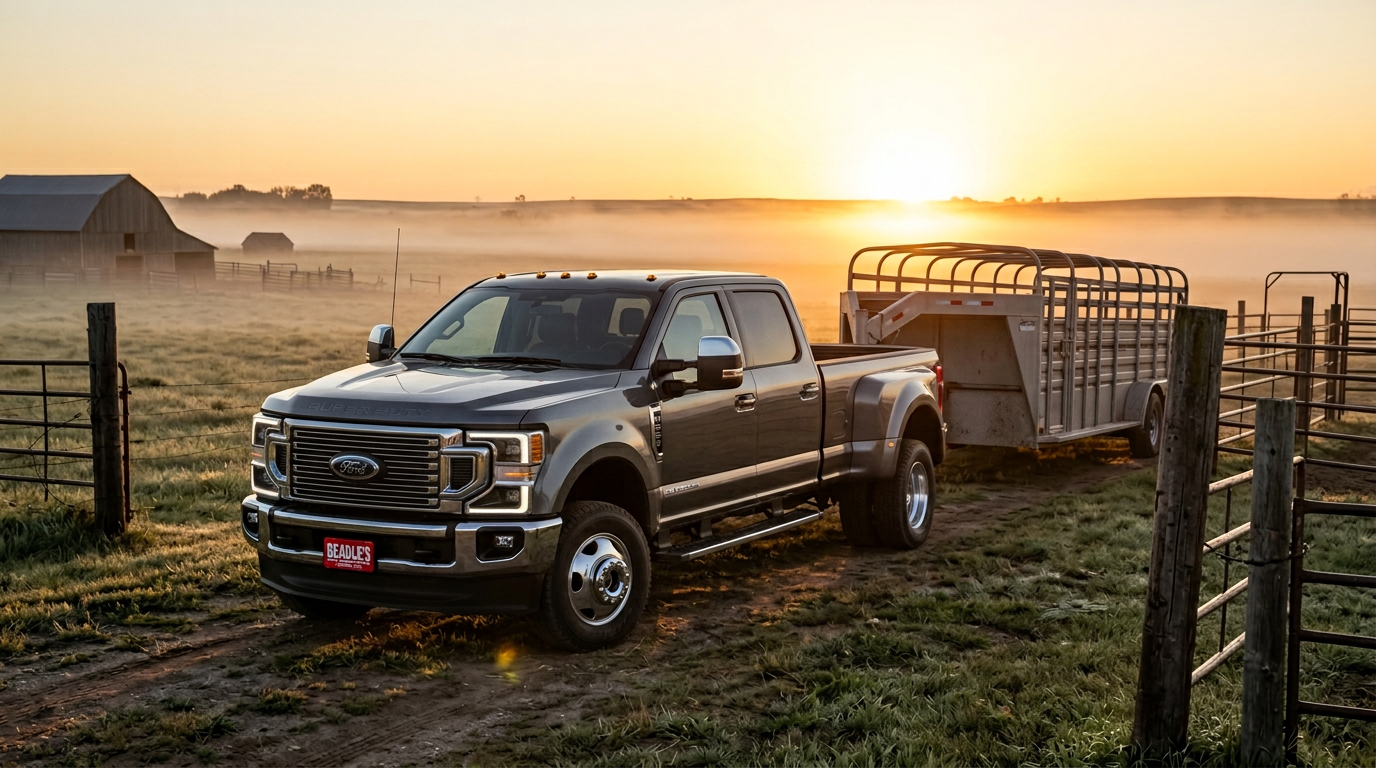
2027 Ford F-350 for Ag & Ranch in South Dakota
Quick Answer For South Dakota ag and ranch work, the 2027 Ford F-350 pulls loaded livestock goosenecks up to 40,000 lbs, carries up to about 7,900 lbs of payload, and comes standard with the 7.3L gas V8 — with available 4x4 and snow plow prep for gravel roads and hard winters. The High-Output diesel is there for the heaviest, most frequent hauling. Out here, a truck isn't a luxury — it's equipment. Between long gravel miles, cattle to move, hay and equipment to haul, and five months of winter, the F-350 has to earn its keep every day around Bowdle, Aberdeen, and the ranch country in between. Here's how the 2027 F-350 fits real ag and ranch work, which engine and configuration make sense, and how to build one for the conditions we actually drive in. Shop F-350s in Stock Get Pre-Approved On This Page Why the 2027 F-350 fits SD ag and ranch work What can it haul for ag? Which engine and configuration for ranch work? How does it handle winter, gravel, and plowing? How do you build a ranch F-350? Why the 2027 F-350 fits SD ag and ranch work The F-350 hits the sweet spot for most operations here: enough capability to pull a loaded gooseneck and carry a heavy load, without the cost and bulk of stepping up to an F-450. For 2027, the now-standard 7.3L gas V8 makes that capable baseline the value baseline too — and the truck's heavy-duty frame, available 4x4, and winter prep are built for our roads and seasons. It's also a truck you can live with: a single-rear-wheel F-350 runs gravel and ranch yards easily while still towing well past any half-ton. What can it haul for ag? Properly equipped, the 2027 F-350 pulls up to 40,000 lbs gooseneck — enough for a loaded triple-axle stock trailer of cow-calf pairs, a loaded equipment trailer, or hay racks — and carries up to about 7,900 lbs of payload for feed, fuel, fencing, and gear. Livestock: loaded gooseneck stock trailers, hauled to auction or pasture. Equipment: skid steers, implements, and flatbed loads within the F-350's ratings. Hay & feed: bale racks behind the truck and feed/fuel in the bed. Which engine and configuration for ranch work? For most ranches, the now-standard 7.3L gas V8 with 4x4 covers daily hauling and the goosenecks you actually pull, at the lowest cost. Step to the High-Output diesel if you tow heavy stock or equipment frequently and want maximum torque. Single-rear-wheel suits most operations; a dually is for the heaviest, most regular gooseneck loads. Our Recommendation For the typical Bowdle/Aberdeen ranch, we recommend a single-rear-wheel 7.3L gas F-350 with 4x4 and snow plow prep — it pulls the goosenecks most folks run, carries a heavy bed, handles gravel and winter, and keeps cost and upkeep down. Go diesel and/or dually only when you haul heavy stock daily. Match it to your loads with our 2027 F-350 towing guide. How does it handle winter, gravel, and plowing? Available 4x4 is the foundation for gravel roads, muddy lots, and snow, and available snow plow prep — with computer-selected springs sized for a plow — lets you clear your own yard and driveways all winter. Tow mirrors, trailer cameras, and trailer-aware blind-spot monitoring help on long two-lane hauls in crosswinds and changing weather. From the Beadle Ford Lot The add our ranch buyers most often skip and then wish they hadn't is snow plow prep — it's a small line item next to the truck, but adding it after the fact is a headache when you're plowing the yard in February. We bring it up on every ranch build for exactly that reason. How do you build a ranch F-350? Build for the work and the weather, in five steps: Start with your heaviest loaded gooseneck and your daily bed load. Pick the 7.3L gas for most ranches; the High-Output diesel if you haul heavy stock daily. Choose 4x4 for gravel, mud, and snow. Add snow plow prep, the right hitch and axle, and tow-camera/mirror options. Decide SRW vs. DRW, then confirm the exact ratings on the build sheet. Key Takeaways The 2027 F-350 pulls up to 40,000 lbs gooseneck and carries up to ~7,900 lbs of payload, properly equipped. The now-standard 7.3L gas covers most ranch hauling at the lowest cost; HO diesel for heavy daily work. Available 4x4 and snow plow prep handle gravel, mud, and SD winters. A single-rear-wheel F-350 fits most operations; dually for the heaviest stock loads. Spec snow plow prep up front — it's hard to add later. Frequently Asked Questions Is the 2027 F-350 good for hauling cattle and ag work in South Dakota? Yes — it's a core use case at Beadle Ford. Properly equipped, it pulls loaded gooseneck stock and equipment trailers up to 40,000 lbs, carries up to about 7,900 lbs of payload, and offers available 4x4 and snow plow prep for gravel and winter. Gas or diesel for ranch work? For most ranches, the now-standard 7.3L gas covers daily hauling and the goosenecks you actually pull, at the lowest cost. Choose the High-Output diesel if you tow heavy stock or equipment frequently and want maximum torque on long pulls. Do I need 4x4 on a ranch F-350 in South Dakota? For most ranch and farm buyers, yes. Available 4x4 handles gravel, mud, and snow, and adds confidence and resale value in our region — especially if you tow off paved roads or drive outside town in winter. Can the 2027 F-350 be set up for plowing? Yes — available snow plow prep includes computer-selected springs sized for plow duty, and most buyers pair it with 4x4. It's far easier to order up front than to add later, so we recommend speccing it on any truck that'll plow. SRW or DRW for a ranch truck? A single-rear-wheel F-350 fits most operations — it pulls most goosenecks with margin and is easier on gravel and in the yard. Choose a dually only if you regularly haul heavy stock near the top of the range. See our SRW vs. DRW guide for the details. Quick Answers: 2027 F-350 for Ag & Ranch One-line answers to the follow-up questions buyers ask next. Max gooseneck for stock trailers? Up to 40,000 lbs, properly equipped. Payload for feed and gear? Up to ~7,900 lbs. Best engine for most ranches? The now-standard 7.3L gas V8. When go diesel? Heavy stock or equipment hauled frequently. Do I need 4x4? For most ag/ranch use here, yes. Can it plow? Yes — available snow plow prep. SRW or DRW? SRW for most; dually for the heaviest loads. Good on gravel? Yes — especially an SRW 4x4. Did 2027 lose capability? No — same towing and payload as 2026. How do I build one? Start with your heaviest gooseneck; we'll spec it. Keep Researching The complete 2027 Ford F-350 Super Duty overview — specs, towing, trims, and how to order. 2027 F-350 towing guide — match the truck to your loaded gooseneck. 2027 F-350 engine comparison — gas vs. diesel for ranch hauling. 2027 F-350 SRW vs. DRW — the rear-wheel choice for ranch work. My Take on the F-350 for Ag & Ranch In my experience, the best ranch truck is the one built around your real loads and our real weather — not the biggest one on the lot. For most operations around here, a single-rear-wheel 7.3L gas F-350 with 4x4 and plow prep does everything that's actually asked of it, and the 2027 standard gas makes that the value pick too. Tell me your heaviest gooseneck and how you run through winter, and I'll build the right 2027 F-350 for the operation. Stop in at Beadle Ford in Bowdle or reach out anytime. Shop F-350s in Stock Get Pre-Approved About the Author Lexy Tabbert — Beadle Ford, Bowdle, SD Lexy Tabbert is the Director of Sales and Marketing at Beadle Ford in Bowdle, South Dakota. She covers Ford vehicles, trim comparisons, and buyer guidance — helping families, ranchers, and ag operators across the region find the right truck and configuration for their needs. Learn more about Lexy.
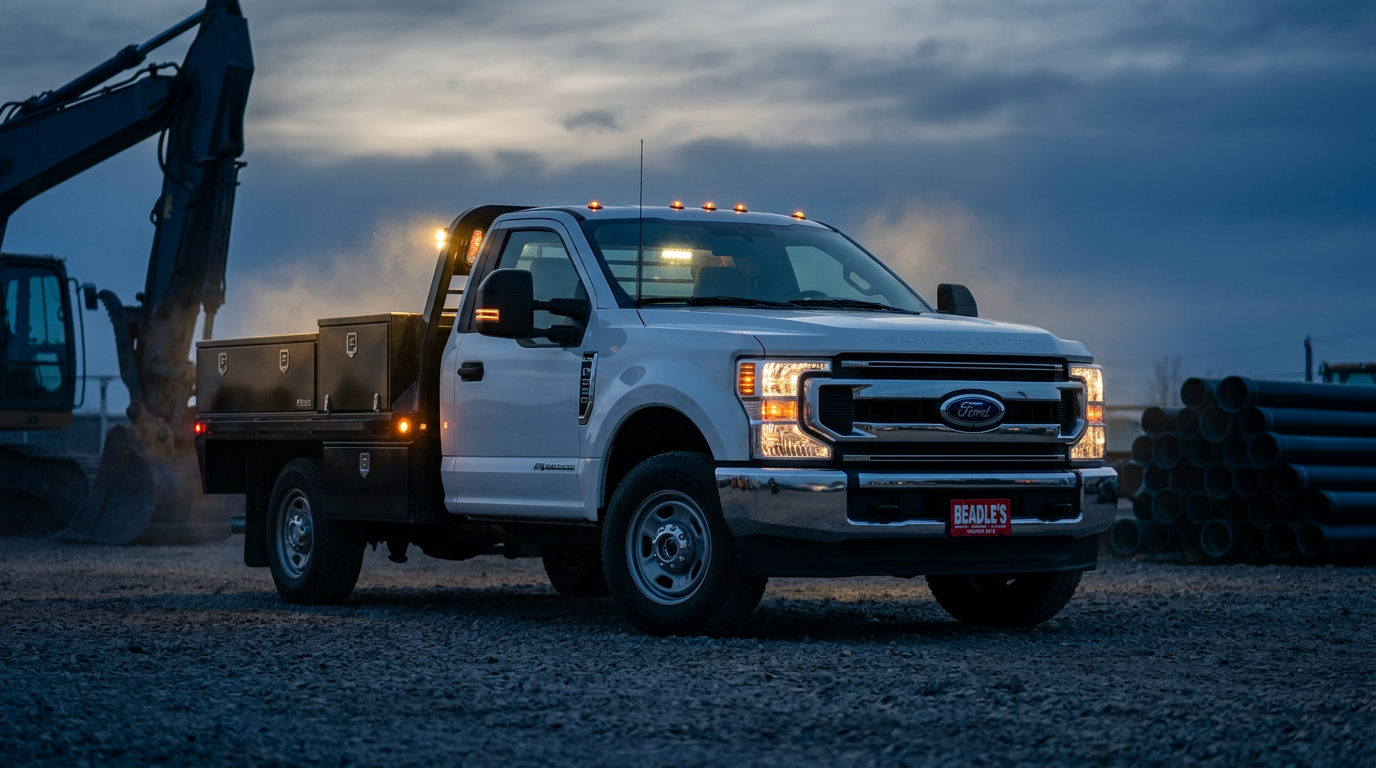
2027 Ford F-350 Payload & Upfit Guide
Quick Answer The 2027 Ford F-350 carries up to about 7,900 lbs of payload, properly equipped — and the now-standard 7.3L gas V8 is the payload leader because it's lighter than the diesel. A new 8-foot bed / 176-inch wheelbase is available with the High-Output diesel, and available Pro Power Onboard and Smart Hitch add real work capability. Towing gets the headlines, but for a lot of F-350 buyers around Bowdle and Aberdeen, payload is the number that actually matters — what you can carry in the bed or on a work body, day in and day out. This guide covers the 2027 F-350's payload, how cab and bed choices change it, what makes the truck upfit-friendly, and which engine to pick when carrying — not towing — is the priority. Shop F-350s in Stock Get Pre-Approved On This Page What's the 2027 F-350 max payload? How do cab and bed choices change payload? What makes the F-350 upfit-friendly? Which engine is best for payload? How do you build a payload setup? What's the 2027 F-350 max payload? Up to about 7,900 lbs, properly equipped with the 7.3L gas V8 and the heavy-duty payload package. That figure carries over from 2026 — the engine simplification didn't cost the F-350 any carrying capacity. Payload always varies with cab, bed, drivetrain, and single- or dual-rear-wheel setup, so the right way to confirm a specific truck's number is the door-jamb label or the build sheet. One thing worth saying plainly: heavy hauling in the bed eats into towing tongue weight, and vice versa. If you carry and tow at the same time, we'll work the full math so you stay inside the ratings. How do cab and bed choices change payload? Configuration drives payload as much as the engine. A lighter cab and a longer bed generally free up more carrying capacity, while loading up on options adds weight that comes out of payload. Cab: Regular Cab, SuperCab, and Crew Cab — more cab generally means more weight and less payload margin. Bed: longer beds carry more; new for 2027 is an 8-foot bed / 176-inch wheelbase available with the High-Output diesel. Packages: the heavy-duty payload package is what unlocks the ~7,900-lb maximum on the gas V8. SRW vs. DRW: dual-rear-wheel trucks generally carry more for the heaviest work; SRW stays easier to live with. What makes the F-350 upfit-friendly? The F-350's heavy-duty frame and payload make it a natural base for work bodies — flatbeds, utility/service bodies, and other upfits added through a body company. On the truck itself, available Pro Power Onboard turns it into a jobsite generator with onboard outlets, and available Smart Hitch helps you load to the correct tongue weight. From the Beadle Ford Lot For our farm and contractor buyers, payload is the spec they should be checking first and often don't. We've seen folks size up for towing they rarely do, then run out of payload carrying tools, fuel, and a slide-in load every day. We build the truck around what's actually in the bed. Which engine is best for payload? The 7.3L gas V8 — it carries the F-350's highest payload because it's lighter than the diesel, and for 2027 it's standard on every trim. If carrying is your priority and you tow only occasionally, the gas is both the higher-payload and lower-cost choice. The High-Output diesel is about torque for heavy, frequent towing, not maximum payload. Our Recommendation If you carry heavy more than you tow heavy, build a 7.3L gas F-350 with the heavy-duty payload package and the cab/bed that fits your load — that's the highest-payload, best-value path for 2027. Add a work body or Pro Power Onboard as the job needs. Weigh it against the towing side in our 2027 engine comparison. How do you build a payload setup? Work from the load, in five steps: Add up what you carry daily — tools, fuel, materials, a slide-in or service body, and passengers. Pick the 7.3L gas for maximum payload (or the diesel if heavy towing also matters). Choose cab and bed to balance payload margin with the space you need. Add the heavy-duty payload package and any upfit-supporting options (Pro Power Onboard, prep packages). Confirm the exact payload on the build sheet before you order, and account for any work body's weight. Key Takeaways 2027 F-350 payload: up to ~7,900 lbs with the 7.3L gas and heavy-duty payload package. The gas V8 is the payload leader — lighter than the diesel — and it's now standard. New 8-ft bed / 176-in wheelbase is available with the High-Output diesel. Available Pro Power Onboard and Smart Hitch add jobsite power and load guidance. Build around the load in the bed; confirm exact payload on the door-jamb label or build sheet. Frequently Asked Questions What is the max payload of the 2027 Ford F-350? Up to about 7,900 lbs, properly equipped with the 7.3L gas V8 and the heavy-duty payload package. It carries over from 2026 and varies with cab, bed, drivetrain, and single- or dual-rear-wheel configuration — confirm a specific truck on the door-jamb label or build sheet. Which engine has the most payload? The 7.3L gas V8 — it's lighter than the diesel, so more weight is available for the bed. For 2027 it's standard on every trim, making it both the payload leader and the lower-cost choice. Can I put a flatbed or service body on a 2027 F-350? Yes — the F-350's heavy-duty frame and payload make it a common base for flatbed, utility, and service-body upfits done through a body company. We can help you spec a truck that supports the upfit you have in mind and account for the body's weight in your payload. What is Pro Power Onboard? An available onboard generator system that provides power outlets to run tools and equipment directly from the truck — handy on a jobsite or a remote ranch task. Available Smart Hitch also helps you load a trailer to the correct tongue weight. Does the 2027 F-350 have a longer bed option? Yes — new for 2027 is an 8-foot bed / 176-inch wheelbase available with the 6.7L High-Output diesel, adding deck length for haulers who need it. Bed and cab options affect both payload and overall length, so we'll match them to your use. Quick Answers: 2027 F-350 Payload & Upfit One-line answers to the follow-up questions buyers ask next. Max payload? Up to ~7,900 lbs, properly equipped. Which engine for payload? The 7.3L gas V8 (lighter = more payload). Is the gas standard now? Yes, on every trim. Longest bed? New 8-ft bed / 176-in wheelbase with the HO diesel. Can I upfit a work body? Yes — flatbed, utility, and service bodies via a body company. Onboard generator? Yes — available Pro Power Onboard. Load-assist feature? Available Smart Hitch for correct tongue weight. SRW or DRW for payload? DRW carries more for the heaviest work; SRW is easier daily. How do I confirm a truck's payload? Door-jamb label or the build sheet. Carry and tow at once? We'll work the full math to keep you in the ratings. Keep Researching The complete 2027 Ford F-350 Super Duty overview — specs, towing, trims, and how to order. 2027 F-350 for commercial & fleet — work-trim ordering and upfit-ready options. 2027 F-350 SRW vs. DRW — the rear-wheel choice that affects carrying capacity. 2027 F-350 towing guide — when towing tongue weight and payload interact. My Take on Payload & Upfit In my experience, payload is the spec that quietly makes or breaks a work truck. Plenty of buyers spec for towing and then run tight on what they can actually carry every day. For 2027, the now-standard 7.3L gas makes the highest-payload build the value build too — which is a nice change. Tell me what you haul and whether you're adding a work body, and I'll build the right 2027 F-350 around the load. Stop in at Beadle Ford in Bowdle or reach out anytime. Shop F-350s in Stock Get Pre-Approved About the Author Lexy Tabbert — Beadle Ford, Bowdle, SD Lexy Tabbert is the Director of Sales and Marketing at Beadle Ford in Bowdle, South Dakota. She covers Ford vehicles, trim comparisons, and buyer guidance — helping families, ranchers, and ag operators across the region find the right truck and configuration for their needs. Learn more about Lexy.
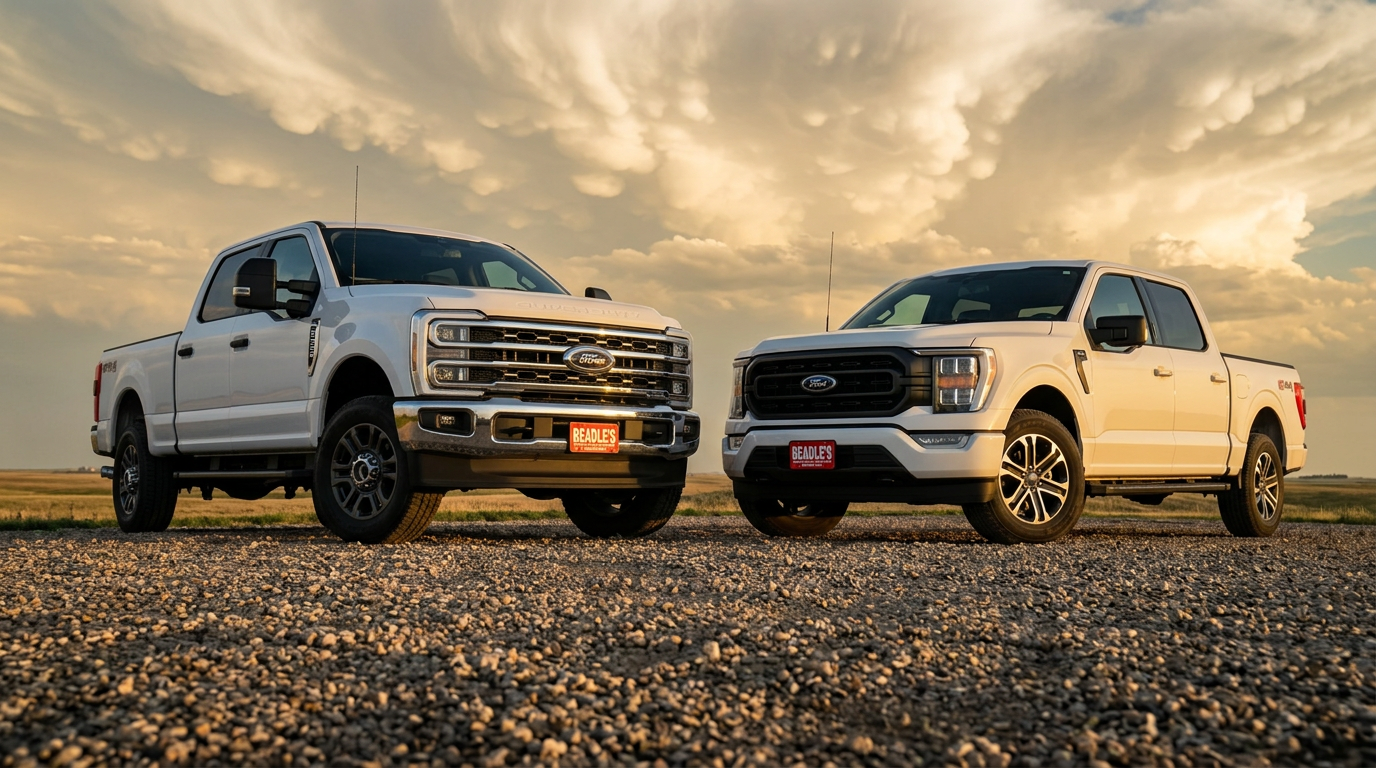
2027 Ford F-150 vs. F-250: Do You Need a Super Duty?
Quick Answer Choose the 2027 Ford F-150 for light, occasional towing and the best daily ride and fuel economy. Step up to the F-250 Super Duty when you tow a fifth-wheel or gooseneck, haul heavy regularly, or want capability well beyond the F-150's roughly 13,500-lb maximum. The 2027 Ford F-150 and F-250 look like cousins, but they're built for different jobs. The F-150 is a half-ton tuned for everyday driving and lighter loads; the F-250 Super Duty is a three-quarter-ton built to tow and haul heavy. The real question isn't which is "better" — it's whether you actually need Super Duty capability. This guide compares the two on towing and payload, ride and fuel, and daily livability, then helps you match the truck to how often and how heavy you tow around central South Dakota. Shop F-250s in Stock Reserve a 2027 F-250 Get Pre-Approved On This Page How do the 2027 F-150 and F-250 differ? Towing and payload: where's the real gap? Ride, fuel, and daily livability compared Which truck fits your towing frequency? How do the 2027 F-150 and F-250 differ? The F-150 is a half-ton; the F-250 is a three-quarter-ton Super Duty. That means heavier frames and axles, beefier brakes and suspension, and a fifth-wheel/gooseneck-ready bed on the F-250 — built for towing and hauling at weights a half-ton isn't rated for. The F-150 counters with a lighter, more refined platform: a smoother unloaded ride, better fuel economy, more engine and trim variety, and easier maneuvering. Think of the F-150 as the do-everything daily truck and the F-250 as the dedicated tow-and-haul truck that's still comfortable to live with. Towing and payload: where's the real gap? On conventional towing, the F-150 tops out around 13,500 lbs, while the 2027 F-250 reaches up to 18,200 lbs with the gas V8 and up to 22,000 lbs with the High-Output diesel. The bigger difference is fifth-wheel and gooseneck capability: the F-250 adds up to 23,000 lbs gooseneck, a job the F-150 isn't built for. Payload tells the same story — the F-250 carries up to about 3,700 lbs versus the F-150's lighter-duty rating. If you're hauling a fifth-wheel camper, a loaded gooseneck, or heavy material in the bed, that's Super Duty territory. If your trailer is a boat, a small utility trailer, or a bumper-pull under the F-150's limit, the half-ton has it covered. Capability (properly equipped) 2027 F-150 2027 F-250 Max conventional towing Around 13,500 lbs Up to 22,000 lbs Fifth-wheel / gooseneck Not its strength Up to 23,000 lbs gooseneck Class Half-ton Three-quarter-ton (Super Duty) Best at Daily driving, light towing Heavy and frequent towing F-250 figures verified for 2027; F-150 maximum is its top conventional rating with the appropriate engine and tow package and varies by configuration. Ride, fuel, and daily livability compared Unloaded, the F-150 rides smoother and uses less fuel — its lighter-duty suspension and lineup of efficient engines make it the easier everyday truck. The F-250's heavy-duty suspension is firmer when the bed is empty, and a big gas V8 or diesel isn't sipping fuel. Flip a heavy trailer onto the back, though, and the picture changes: the F-250 stays planted and composed where a half-ton starts to feel the load. So the "better daily driver" depends entirely on whether you're usually empty or usually towing. For a truck that mostly runs errands and tows light, the F-150 wins comfort and fuel; for a truck that earns its keep with a trailer, the F-250's manners under load matter more. Which truck fits your towing frequency? Match the truck to how often and how heavy you tow. If you tow light loads occasionally and want the best ride and fuel economy, the F-150 is the smarter half-ton. If you tow a fifth-wheel or gooseneck, haul heavy in the bed, or tow with any regularity, the F-250 is built for it. Our Recommendation For buyers towing under about 13,000 lbs occasionally — a boat, a small camper, a utility trailer — the 2027 F-150 is the better daily truck. The moment a fifth-wheel, a gooseneck, or regular heavy towing enters the picture, the 2027 F-250 is the right call — it tows up to 22,000 lbs conventional and 23,000 lbs gooseneck, well past anything a half-ton should attempt. Choose the F-150 if you tow light and occasionally and want the best ride, fuel economy, and price. Choose the F-250 if you tow a fifth-wheel or gooseneck, haul heavy, or tow regularly enough to want the capability. From the Beadle Ford Lot The cleanest way we help people decide is the trailer question: if it's a gooseneck or a fifth-wheel, the conversation is over — that's a Super Duty. If it's a bumper-pull under the F-150's rating and the truck mostly runs empty, the half-ton usually makes them happier day to day. The trailer almost always answers it. Key Takeaways The F-150 is a half-ton; the F-250 is a three-quarter-ton Super Duty built for heavier towing and hauling. The F-150 tops out around 13,500 lbs conventional; the 2027 F-250 reaches up to 22,000 lbs conventional and 23,000 lbs gooseneck. Fifth-wheel and gooseneck towing is Super Duty territory — not a half-ton job. The F-150 rides smoother and uses less fuel unloaded; the F-250 is more composed under a heavy trailer. Let the trailer decide: light bumper-pull and mostly empty means F-150; gooseneck, fifth-wheel, or frequent heavy towing means F-250. Frequently Asked Questions Do I need an F-250, or is an F-150 enough? If you tow light loads occasionally, the F-150 is enough and the better daily driver. If you tow a fifth-wheel or gooseneck, haul heavy in the bed, or tow regularly, you need the F-250's capability — up to 22,000 lbs conventional and 23,000 lbs gooseneck. How much more can the F-250 tow than the F-150? On conventional towing, the 2027 F-250 reaches up to 22,000 lbs versus around 13,500 lbs for the F-150 — roughly 8,500 lbs more. The F-250 also adds fifth-wheel and gooseneck towing up to 23,000 lbs, which the F-150 isn't designed for. Can an F-150 tow a fifth-wheel or gooseneck? Fifth-wheel and gooseneck towing is a Super Duty job, not a half-ton strength. For that kind of trailer you want the F-250, which is built with the frame, axles, and bed rating to handle it — up to 23,000 lbs gooseneck, properly equipped. Is the F-150 a better daily driver than the F-250? Unloaded, yes — the F-150 rides smoother and uses less fuel. But under a heavy trailer the F-250 is more composed. The better daily driver depends on whether your truck spends most of its time empty or towing. Quick Answers: F-150 vs. F-250 One-line answers to the follow-up questions buyers ask next. Which is the half-ton? The F-150; the F-250 is a three-quarter-ton. F-150 max towing? Around 13,500 lbs conventional, properly equipped. F-250 max towing? Up to 22,000 lbs conventional, 23,000 lbs gooseneck. Which rides better empty? The F-150. Which uses less fuel? The F-150. Which tows a fifth-wheel? The F-250 — that's Super Duty territory. Which is the better daily driver? The F-150 if you're mostly empty; the F-250 if you tow heavy. Which has more payload? The F-250, up to about 3,700 lbs. Gas or diesel in the F-250? Gas for occasional towing; diesel for heavy, frequent hauling. Where can I compare them? Beadle Ford in Bowdle, SD. Keep Researching The complete 2027 Ford F-250 Super Duty overview — trims, towing, specs, and inventory Is an F-250 enough truck? — or do you need to step up to an F-350 2027 F-250 for recreational towing — campers and fifth-wheels on the F-250 2027 F-250 trims for the everyday buyer — where the value lands My Take on F-150 vs. F-250 I don't push people up to a Super Duty they don't need — if a buyer tows a boat or a small camper a few times a summer and the truck is otherwise empty, the F-150 is the one I'd put my own family in. But I also don't want anyone underbuying. The minute someone mentions a gooseneck or a fifth-wheel, the F-250 is the honest answer, and trying to make a half-ton do that job is how people end up unhappy and unsafe. Tell me your heaviest trailer and how often you pull it and I'll tell you straight which truck you need. We've got both at Beadle Ford in Bowdle and you're welcome to drive them back to back. Shop F-250s in Stock Reserve a 2027 F-250 Get Pre-Approved About the Author Lexy Tabbert — Beadle Ford, Bowdle, SD Lexy Tabbert is the Director of Sales and Marketing at Beadle Ford in Bowdle, South Dakota. She covers Ford vehicles, trim comparisons, and buyer guidance — helping families, ranchers, and ag operators across the region find the right truck and configuration for their needs. Learn more about Lexy.
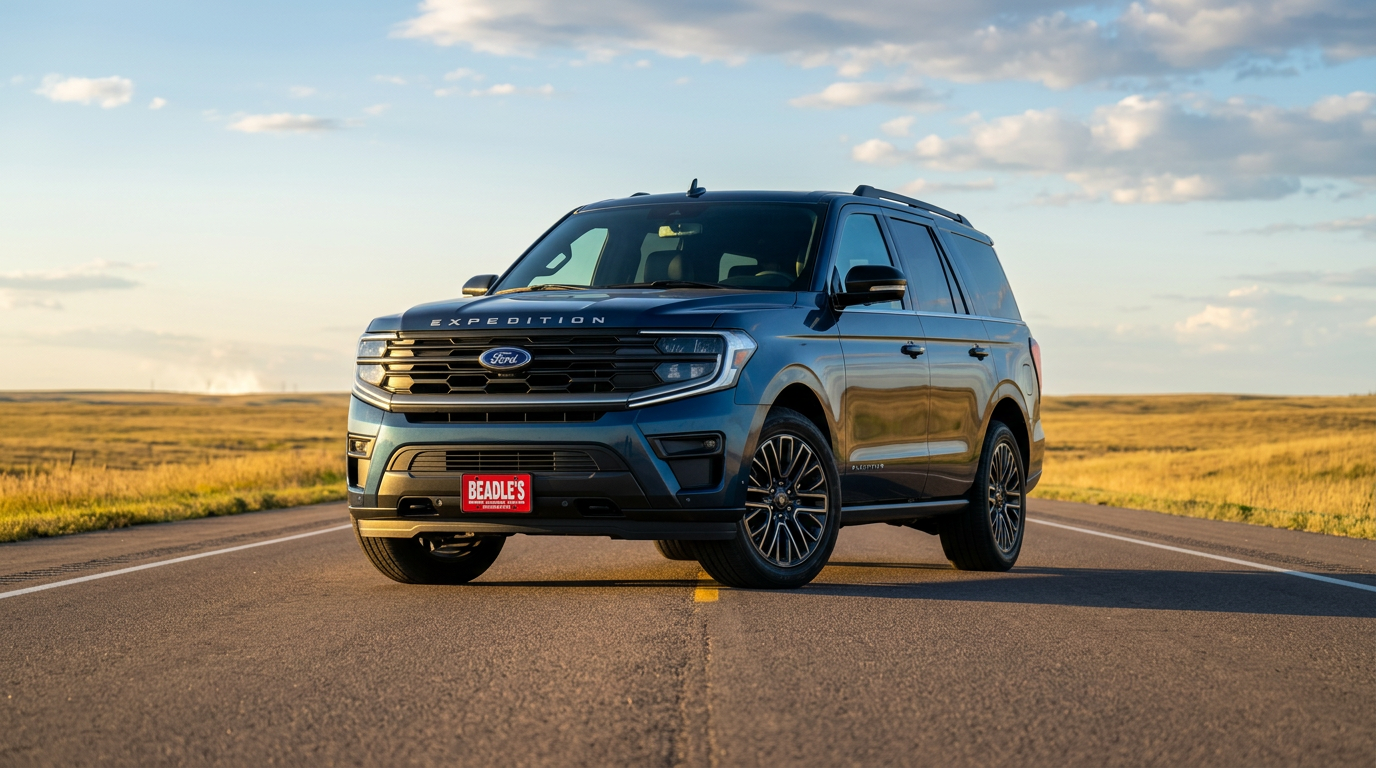
2027 Ford Expedition Trims Explained: How to Pick From Five Trims and Four Platinum Packages
Quick Answer The 2027 Ford Expedition offers four retail trims — Active, Tremor, Platinum, and King Ranch — plus four Platinum packages and the new 30th Anniversary Appearance Package. Tremor is the only trim with the 440-hp High Output V6 standard; Active Touring is the value sweet spot for most families. Picking a 2027 Expedition trim is really two decisions, not one. First you choose the trim — Active, Tremor, Platinum, or King Ranch. Then, if you land on Platinum, you choose again: base Platinum or one of four packages that change the engine, the look, and the tech in meaningful ways. This guide walks through both decisions the way we walk through them with buyers at Beadle Ford in Bowdle — who each trim is actually built for, how the Platinum packages differ, which colors pair with which trims, and where the trade-offs genuinely matter for driving in north-central South Dakota. Search Available Expedition Inventory Get Pre-Approved On This Page What trims does the 2027 Ford Expedition come in? Is the Active trim enough Expedition for most buyers? Who is the Expedition Tremor actually built for? How do the four Platinum packages differ? When does King Ranch make more sense than Platinum? Which colors can you get on each 2027 trim? Which 2027 Expedition trim should you buy? What trims does the 2027 Ford Expedition come in? Retail buyers choose from four trims: Active (in Select or Touring form), Tremor, Platinum, and King Ranch. A fifth trim, XL, exists only for fleet orders, so it won’t appear on a retail order sheet. Every 2027 Expedition runs a twin-turbo 3.5L EcoBoost V6 with a 10-speed automatic. The standard engine is rated at 400 horsepower and 480 lb-ft of torque; the High Output version raises that to 440 horsepower and 510 lb-ft, and comes standard on Tremor or with two of the Platinum packages. Both standard-length Expedition and extended-length Expedition MAX are offered on every retail trim except Tremor, which is standard-length only. Trim Engine MAX Available Best For Active (Select / Touring) 400 hp standard V6 Yes Families who want the full-size space and tech without the luxury price Tremor 440 hp High Output (standard) No — standard length, 4x4 only Gravel, pasture, snow, and trail driving with three rows intact Platinum 400 hp standard; 440 hp with Stealth Performance or Ultimate Yes — 4x2 MAX new for 2027 Luxury buyers who want to tailor the build with packages King Ranch 400 hp standard V6 Yes Western luxury — Del Rio leather, bronze accents, everything standard XL 400 hp standard V6 Yes Fleet orders only — not available at retail Maximum towing across the lineup is up to 9,600 lbs on 4x4 models with the Heavy-Duty Trailer Tow Package, properly equipped, per Ford’s official 2027 figures. Is the Active trim enough Expedition for most buyers? For most families, yes — and Active Touring in particular is where the equipment-per-dollar math peaks in the 2027 lineup. Active Select is the retail entry point, and it already includes the equipment that defines this Expedition generation: the Ford Digital Experience with a 24" panoramic display and 13.2" center screen, embedded Google Maps and Assistant, wireless Apple CarPlay and Android Auto, Ford Co-Pilot360 Assist 2.0 with adaptive cruise and Pro Trailer Backup Assist, and true 8-passenger seating with a second-row bench. Cloth seats and fewer comfort features are the trade-off. Active Touring layers on the comfort items South Dakota buyers actually use: heated front seats and heated steering wheel, ActiveX seat trim, power-folding second-row captain’s chairs, Pro Power Onboard 400W, rain-sensing wipers, a power tilt/telescoping column with memory, and a 90-day BlueCruise hands-free driving trial on retail orders. New for 2027, Touring can also add the Family Travel Package — a bundle built around road trips, with the power panoramic vista roof, 360-Degree Zone Lighting, a flex powered console, third-row power-folding flexible seating, a digital device holder with USB ports in the front seatbacks, and remote start. The honest trade-off: Active cannot be optioned to the 440-hp High Output engine, and the 22-speaker B&O Play Unleashed audio stays exclusive to higher trims. If those two things don’t matter to you, it’s hard to out-argue a Family Travel Package Touring as the family pick. Who is the Expedition Tremor actually built for? The Tremor is for the buyer whose “driveway” is a gravel section road — it’s the only 2027 Expedition trim with the 440-hp High Output V6, a two-speed transfer case, and an electronic locking rear differential all standard. Beyond the drivetrain, Tremor gets a raised off-road suspension, modified Raptor-style front and transmission skid plates with fuel tank underbody protection, all-terrain tires on 18" wheels, amber front tow hooks, seven drive modes including Rock Crawl, and Trail Control with Trail One Pedal Drive and Trail Turn Assist. It is 4x4 only and standard-length only — there is no Tremor MAX. What surprises people is how little you give up inside: leather-trimmed heated and ventilated front seats, the 22-speaker B&O Play Unleashed system, a power panoramic vista roof, and Pro Power Onboard 400W are all standard. The real limitations are the two body-style constraints — no MAX cargo length, no 4x2 price break — and a firmer ride on pavement than a Platinum on all-season tires. How do the four Platinum packages differ? Base Platinum is the luxury anchor of the lineup; the four packages then push it in different directions — more audio and convenience, a blacked-out look, more power, or all of it at once. Every Platinum starts with leather-trimmed heated and ventilated front seats, heated second-row captain’s chairs, 20" Ebony Bright Machined wheels, 360-Degree Zone Lighting, a 10-speaker B&O sound system, and the full Digital Experience. From there: Driver’s Package — upgrades audio to the 22-speaker B&O Play Unleashed with Beosonic sound spaces and adds a wireless charging pad. The pick if sound quality is your luxury. Stealth Appearance Package — the blacked-out treatment: dark exterior trim and wheels with a required Black Onyx interior. Appearance only — the standard 400-hp engine stays. Stealth Performance Package — the Stealth look plus the 440-hp High Output V6, 4x4 only, with the Heavy-Duty Trailer Tow Package standard. The driver’s pick of the Platinum family. Platinum Ultimate Package — the everything build: High Output V6, BlueCruise 1-Year + 90-Day plan, the Driver’s Package content, and 4x4 — and for 2027 it’s the only Platinum that keeps the chrome roof rails, lit grille bar, and lit tailgate applique (base Platinum goes black-trimmed this year). A fifth option, the new 30th Anniversary Appearance Package, sits apart from these four: a commemorative blacked-out spec on Platinum with exclusive Blue Ember Metallic paint and a required Salt Crystal Gray interior. It cannot be combined with Stealth Appearance, Stealth Performance, or Platinum Ultimate — and it keeps the standard 400-hp engine. The full breakdown lives in the 30th Anniversary Package guide. Our Recommendation If you’re going Platinum and you tow, order the Stealth Performance Package: it’s the least expensive route to the 440-hp / 510 lb-ft High Output V6 with Heavy-Duty Trailer Tow standard. If you want hands-free highway driving too, step up to Platinum Ultimate and the BlueCruise year is included. When does King Ranch make more sense than Platinum? Choose King Ranch when you want the flagship spec without building it from packages — and when the western character is the point. King Ranch comes one way: loaded. Del Rio leather on all three rows with the Mesa Antique armrest, 22" Sinister Bronze Diamond Cut wheels, Sinister Bronze grille bars with signature lighting, power-deployable running boards, a lit tailgate applique, the 22-speaker B&O Unleashed system, a wireless charging pad, and the BlueCruise 1-Year + 90-Day plan — all standard. There are no decision points beyond body length and drive wheels. The honest catch for 2027: King Ranch keeps the 400-hp standard V6 — the High Output engine is not offered on it. A Platinum Ultimate out-powers a King Ranch while matching most of its equipment. If the 440-hp engine matters more to you than Del Rio leather, that’s your answer; if it’s the other way around, King Ranch is the better one-decision buy. Which colors can you get on each 2027 Expedition trim? Not every 2027 color is available on every trim — and the three new paints each come with rules. Blue Ember Metallic is locked to the 30th Anniversary Package, Marsh Gray is reserved for Tremor and the Stealth packages, and the rest of the palette spreads across the retail lineup. 2027 Color Availability Agate Black Metallic All retail trims (standard, no-cost) Bronze Fire Metallic Tri-coat NEW Most retail trims — not offered with the 30th Anniversary Package Nocturnal Blue Metallic NEW Most retail trims — not offered with the 30th Anniversary Package Blue Ember Metallic NEW 30th Anniversary Package only — no other configuration Star White Metallic Tri-Coat Active, Tremor, Platinum, King Ranch Dark Matter Gray Metallic Most retail trims Glacier Gray Metallic Tri-Coat Most retail trims — not offered with the 30th Anniversary Package Marsh Gray Tremor, plus Platinum with Stealth Appearance or Stealth Performance Oxford White Fleet orders only for 2027 Two familiar colors are gone for 2027 — Space Silver Metallic and Stone Blue Metallic are discontinued. To see every color on the vehicle, the complete 2027 Ford Expedition overview has the full photo gallery of the 2027 palette. Which 2027 Expedition trim should you buy? Match the trim to the job, not the badge. Here’s the short version we give buyers on the lot: Active Touring is right for you if you want the most family equipment per dollar — add the Family Travel Package for road-trip duty. Tremor is right for you if gravel, pasture, snow, or Lake Oahe shoreline is part of your normal week and you want the 440-hp engine standard. Platinum with Stealth Performance is right for you if you want luxury and the High Output engine for serious towing. Platinum Ultimate is right for you if you want everything — power, BlueCruise included, premium audio — in one package. King Ranch is right for you if you want the flagship western spec with zero option-sheet homework. The 30th Anniversary Package is right for you if Blue Ember Metallic and the commemorative spec are the draw — and you can live without the High Output engine. From the Beadle Ford Lot The most common trim conversation we have is Platinum versus Platinum Ultimate — and it almost always comes down to one question: do you tow enough to want the 440-hp engine? Buyers who answer yes rarely regret the step up; buyers who answer no are usually happier putting that money toward the Family Travel Package on an Active Touring instead. Key Takeaways Four retail trims for 2027: Active (Select/Touring), Tremor, Platinum, and King Ranch — XL is fleet-only. The 2027 Expedition Tremor is the only trim with the 440-hp High Output V6 standard; Platinum can add it via the Stealth Performance or Platinum Ultimate package. Blue Ember Metallic is available on exactly one 2027 Expedition configuration: the Platinum 30th Anniversary Package. MAX extended length is offered on every retail trim except Tremor, and MAX Platinum adds a 4x2 option for the first time in 2027. Properly equipped 4x4 models with Heavy-Duty Trailer Tow are rated to tow up to 9,600 lbs per Ford’s official 2027 figures. Frequently Asked Questions How many trims does the 2027 Ford Expedition have? Five total, four of them retail: Active (offered as Select or Touring), Tremor, Platinum, and King Ranch. The fifth, XL, is a fleet-only configuration not sold to retail buyers. Which 2027 Expedition trims get the 440-hp High Output engine? The Tremor includes the 440-hp / 510 lb-ft High Output 3.5L EcoBoost V6 standard. On Platinum, it comes with the Stealth Performance Package or the Platinum Ultimate Package, both 4x4 only. Active and King Ranch use the 400-hp standard engine. What is the difference between Active Select and Active Touring? Select is the entry version with cloth seats and 8-passenger seating. Touring adds heated front seats and steering wheel, ActiveX trim with power-folding second-row captain's chairs, Pro Power Onboard 400W, a 90-day BlueCruise trial on retail orders, and the option of the new Family Travel Package. Can you get the 2027 Expedition Tremor in the MAX body style? No. The 2027 Expedition Tremor is standard-length and 4x4 only. Every other retail trim — Active, Platinum, and King Ranch — can be ordered as an extended-length Expedition MAX. What colors changed for the 2027 Ford Expedition? Three paints are new: Bronze Fire Metallic Tri-coat, Nocturnal Blue Metallic, and Blue Ember Metallic (30th Anniversary Package only). Space Silver Metallic and Stone Blue Metallic are discontinued, and Oxford White moves to fleet orders only. Does the King Ranch come with BlueCruise? Yes — King Ranch includes the BlueCruise 1-Year + 90-Day plan standard, as does the Platinum Ultimate Package. Active Touring includes a 90-day trial on retail orders, and other trims can add BlueCruise plans at order time. Quick Answers: 2027 Expedition Trims One-line answers to the follow-up questions buyers ask next. What's the cheapest 2027 Expedition trim? Active Select is the retail entry point. What's the top 2027 Expedition trim? King Ranch is the flagship; Platinum Ultimate is the most powerful luxury build. Is the Tremor 4x2 or 4x4? 4x4 only, with a two-speed transfer case and locking rear differential. Which trims seat 8? Active Select seats 8 standard; Touring, Tremor, and Platinum can seat 8 with the optional second-row bench. Which trim has the best audio? The 22-speaker B&O Play Unleashed is standard on Tremor and King Ranch, and comes to Platinum with the Driver's, Stealth Performance, or Ultimate package. Can the Platinum be 4x2? Yes — and for 2027, MAX-length Platinum is available in 4x2 for the first time. Does every trim tow 9,600 lbs? No — the 9,600-lb max requires a 4x4 with the Heavy-Duty Trailer Tow Package, properly equipped; 4x2 models are rated up to 6,000–6,300 lbs. What interior does the 30th Anniversary Package require? Salt Crystal Gray leather — no other interior is offered with it. Is there a hybrid 2027 Expedition? No — the 3.5L EcoBoost V6 family is the only powertrain. Can fleet buyers get the XL at retail? No — XL is fleet-only for 2027. Keep Researching The complete 2027 Ford Expedition overview — every trim, color photo, spec, and how to buy 2027 Ford Expedition: What’s New — every change from 2026, in one place The 30th Anniversary Appearance Package — every included item, plus the Blue Ember paint story The 2027 Expedition Tremor, explained — the off-road hardware in detail My Take on the 2027 Expedition Lineup In my experience, the buyers who end up happiest with their Expedition are the ones who started with the job and worked backward to the trim. Around Bowdle that usually sorts people fast: the family running kids to Aberdeen and back lands on an Active Touring, the ranch family that lives on gravel gravitates to the Tremor, and the buyer replacing a loaded 2022 or 2023 Expedition is usually deciding between Platinum Ultimate and King Ranch — which is really the engine-versus-leather question. If you’re not sure which side of those lines you fall on, stop in or call with your best guess — we’ll walk the window sticker of what is on the lot together before anything is decided. Search Available Expedition Inventory Get Pre-Approved About the Author Lexy Tabbert — Beadle Ford, Bowdle, SD Lexy Tabbert is the Director of Sales and Marketing at Beadle Ford in Bowdle, South Dakota. She covers Ford vehicles, trim comparisons, and buyer guidance — helping families, ranchers, and ag operators across the region find the right truck and configuration for their needs. Learn more about Lexy.
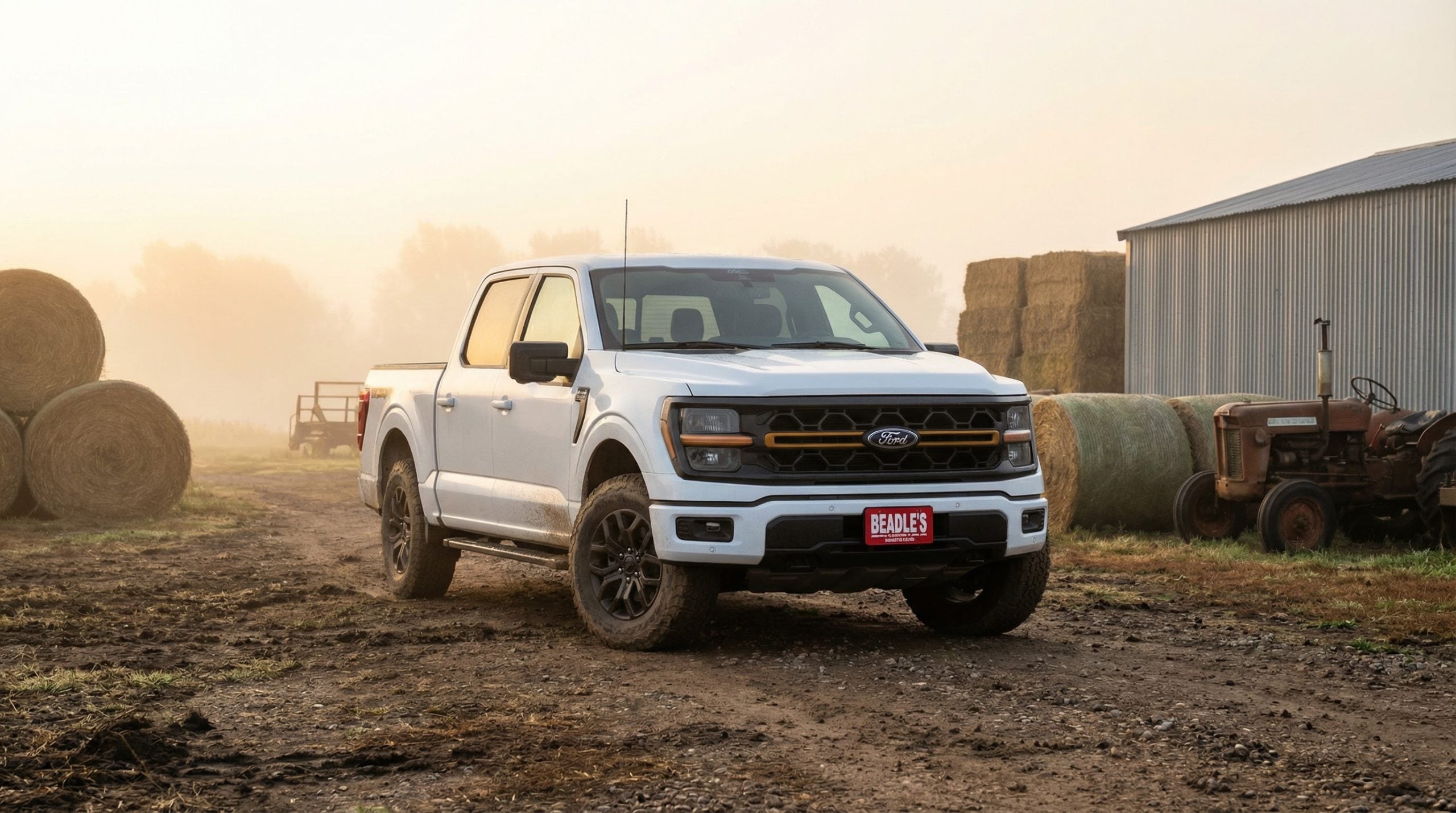
2026 Ford F-150 Engine Options Guide
The 2026 Ford F-150 offers six distinct engine options, ranging from efficient EcoBoost configurations to a full hybrid system and high-performance Raptor variants. Each powertrain is engineered for a different balance of towing strength, daily drivability, and long-term ownership priorities. This guide breaks down each available powertrain and explains who it makes the most sense for. For full trim availability, drivetrain pairings, and feature differences, reference the complete 2026 Ford F-150 overview. Contact Beadle Ford Table of Contents How Many Engines Are Available? Is the 2.7L EcoBoost Enough? Does the 5.0L V8 Still Make Sense? Why Choose the 3.5L EcoBoost? Is the PowerBoost Hybrid Worth It? What About Raptor Engines? Which Engine Is Best for South Dakota? How to Choose the Right Engine How Many Engine Options Are Available on the 2026 F-150? The 2026 F-150 offers six distinct powertrains, including five gas engines and one full hybrid system. All are paired with a 10-speed automatic transmission and differ in torque delivery, towing capability, and overall driving character. 2.7L EcoBoost V6 5.0L V8 3.5L EcoBoost V6 3.5L PowerBoost Full Hybrid 3.5L EcoBoost High Output (Raptor) 5.2L Supercharged V8 (Raptor R) Is the 2.7L EcoBoost Enough for Most Drivers? Yes — for many drivers, the 2.7L EcoBoost provides more than enough capability. When properly equipped, it can tow up to 8,400 pounds while delivering strong low-end torque for everyday driving. This engine works well for commuting, moderate trailer use, and rural driving without stepping into maximum towing configurations. Does the 5.0L V8 Still Make Sense in 2026? The 5.0L V8 remains a popular option for buyers who prefer naturally aspirated power delivery and traditional V8 sound and feel. When properly equipped, it can tow up to 12,800 pounds. For many drivers, the V8 represents straightforward performance and proven durability. Why Choose the 3.5L EcoBoost? The 3.5L EcoBoost delivers the highest conventional towing rating in the 2026 lineup — up to 13,500 pounds when properly equipped with the Tow/Haul Package and Max Tow Axle. It balances heavy-duty capability with strong highway performance, making it ideal for long-distance towing. For axle ratios, required packages, and configuration specifics, see the detailed 2026 F-150 Towing Guide. Is the 3.5L PowerBoost Hybrid Worth It? The PowerBoost hybrid combines twin-turbo power with electric motor assistance. When properly equipped, it can tow up to 11,600 pounds. It also enables available Pro Power Onboard functionality, supplying electricity for job sites or camping setups. Long-term cost considerations between hybrid and gas configurations are explored further in our F-150 Ownership & Long-Term Costs Guide. What About Raptor and Raptor R Engines? The Raptor’s 3.5L High Output EcoBoost focuses on high-speed off-road performance, offering up to 8,200 pounds of towing capability. The Raptor R’s supercharged 5.2L V8 emphasizes extreme performance and can tow up to 8,700 pounds. Which Engine Is Best for South Dakota Driving? The right engine depends on how the truck will actually be used. Daily driving + moderate towing: 2.7L EcoBoost Traditional V8 preference: 5.0L V8 Maximum conventional towing: 3.5L EcoBoost Efficiency + onboard power: PowerBoost Hybrid Off-road performance focus: Raptor or Raptor R Engine choice becomes clearer when considered within the full 2026 Ford F-150 overview, including trim and drivetrain pairings. How to Choose the Right F-150 Engine Determine the heaviest trailer you realistically plan to tow. Confirm required equipment for maximum ratings. Consider how often you drive long highway distances. Evaluate winter traction needs. Balance capability with daily comfort. Conclusion In my experience, the right engine choice becomes much clearer once buyers focus on how often they truly need maximum towing versus how often they’ll use the truck for everyday driving. The strongest number on paper isn’t always the best fit — the best configuration is the one that matches how the truck will actually be used. Review current 2026 Ford F-150 availability at Beadle Ford or contact us to compare engine configurations in person. About the Author Lexy Tabbert provides research-driven vehicle guides and in-depth truck insights for drivers across South Dakota and the surrounding region.
2026 Ford F-350 Packages & Trims
Quick Answer The 2026 Ford F-350 comes in five trims — XL, XLT, Lariat, King Ranch, and Platinum — but towing and payload come from configuration (engine, axle, SRW/DRW), not trim. Packages like Snow Plow Prep and the 40K Gooseneck Tow Package refine capability; trims set comfort and technology. Choosing a 2026 Ford F-350 Super Duty isn't just about picking a trim badge — it's about building a truck that matches your workload, towing reality, and long-term ownership plans. Trims set your comfort level and available features; packages refine capability, appearance, and towing support. But configuration — cab, bed, drivetrain, engine, and single- vs. dual-rear-wheel — often decides what you can even select. This guide walks the trim ladder, the packages that actually change how the truck works, and the order to make those decisions in. Shop F-350s in Stock Get Pre-Approved On This Page What are the 2026 F-350 trims, and which fits you? Work-focused vs. premium trims: what changes? Which packages matter most for real-world use? Why does configuration affect package availability? How do you build the right trim & package setup? What are the 2026 F-350 trims, and which fits you? The 2026 F-350 comes in five trims: XL, XLT, Lariat, King Ranch, and Platinum. They climb from work-truck durability to full luxury — but here's the key point: a higher trim does not add towing capacity. Capability comes from configuration; trim sets comfort, technology, and styling. XL is right for you if the truck is a tool — fleet, jobsite, vinyl floors you can hose out. XLT is right for you if you want work capability plus everyday comfort at the value sweet spot. Lariat is right for you if you spend long hours in the cab and want the 12-inch touchscreen and leather. King Ranch is right for you if you want Western-styled luxury that still works for a living. Platinum is right for you if you want the most modern, tech-forward luxury Super Duty. Work-focused vs. premium trims: what actually changes? Moving up the ladder changes the cab, not the capability. What you're really buying with each step is materials, display size, driver-assist tech, and appearance. Work-focused (XL, XLT): built for durability, upfit readiness, and straightforward operation; a 4.2-inch cluster display on base. Mid-level (Lariat): the volume step — 12-inch center touchscreen with SYNC 4, leather-trimmed seating, and more towing tech. Premium (King Ranch, Platinum): refined materials, a 12-inch digital cluster, and appearance upgrades, all while keeping full heavy-duty capability. If cabin materials and technology are a major factor, that's covered in our 2026 F-350 interior & comfort guide. Which packages matter most for real-world use? Packages are where a working F-350 is really built. The ones that change what the truck can do fall into four buckets: Towing-focused: the 40K Gooseneck Tow Package that unlocks the 40,000-lb maximum, 5th-wheel/gooseneck hitch prep, and trailer camera and brake-control support. Work equipment: Snow Plow Prep Package (computer-selected springs for plow duty) and the Snowplow/Camper Package — frequent adds in our market. Off-road: the Tremor Off-Road Package and traction/underbody hardware for gravel and field work. Appearance: chrome, blacked-out styling, and wheel upgrades through XLT and Lariat premium appearance groups. From the Beadle Ford Lot The package buyers around Bowdle skip most often and regret is Snow Plow Prep — it's a small line item next to the truck, but adding it after the fact is far harder than checking the box up front when you're plowing a ranch yard all winter. Color and finish options are easier to compare in our 2026 F-350 exterior colors & styling guide, and how towing packages interact with configuration is in the 2026 F-350 towing guide. Why does configuration affect package availability? Cab style, bed length, drivetrain, axle ratio, single- or dual-rear-wheel, and engine all influence which trims and packages you can order. The 40,000-lb gooseneck rating, for instance, requires the High-Output diesel in dual-rear-wheel form — so the package depends on the configuration. That's why experienced buyers choose configuration first, then layer trim and packages on top. Our Recommendation For most ranch, farm, and contractor buyers around Bowdle and Aberdeen, we recommend building capability first — engine, SRW vs. DRW, axle, and tow package to match your trailer — then choosing XLT for a work-first value truck or Lariat for the comfort step with the 12-inch screen and leather. King Ranch and Platinum are worth it when the cab is your office; they don't change what you can pull. Compare builds in the 2026 F-350 overview. How do you build the right trim & package setup? Build in this order so capability drives the decision: Define your towing and payload requirements. Choose single- or dual-rear-wheel based on stability needs. Pick the engine that matches your towing frequency. Pick a trim that aligns with your comfort expectations. Add only the packages that directly support how you use the truck — then confirm the exact build before finalizing. Key Takeaways Five trims: XL, XLT, Lariat, King Ranch, Platinum — they set comfort and tech, not towing capacity. Configuration (engine, axle, SRW/DRW) determines capability; the 40,000-lb rating needs the HO diesel DRW. The packages that matter most: 40K Gooseneck Tow, Snow Plow Prep, Tremor Off-Road, and appearance groups. Build capability first, then trim, then packages — around real use, not badge level. Confirm the exact build before finalizing; availability varies by configuration. Frequently Asked Questions What trims does the 2026 Ford F-350 come in? Five: XL, XLT, Lariat, King Ranch, and Platinum. XL and XLT are work-focused; Lariat adds the 12-inch touchscreen and leather; King Ranch and Platinum are luxury trucks that keep full Super Duty capability. Does a higher trim increase towing capacity? Not by itself. Towing capability depends on configuration — engine, axle ratio, drivetrain, and single- or dual-rear-wheel setup — rather than the trim badge. A well-configured XL can out-tow a Platinum that wasn't built for it. Are towing packages available on lower trims? Many towing features can be added on XL and XLT depending on configuration — that's part of why they make strong work trucks. Availability varies by build, so reviewing real inventory or a build sheet confirms exact equipment. Is there a snow plow package on the 2026 F-350? Yes — the Snow Plow Prep Package, which includes computer-selected springs sized for plow duty, plus a Snowplow/Camper Package option. Both are common adds in our market and easier to order up front than to retrofit. What package do I need for maximum towing? The 40K Gooseneck Tow Package, paired with the 6.7L High-Output Power Stroke diesel in dual-rear-wheel form, is what unlocks the F-350's 40,000-lb gooseneck maximum. Without it, gooseneck ratings are lower. Quick Answers: F-350 Trims & Packages One-line answers to the follow-up questions buyers ask next. How many trims are there? Five — XL, XLT, Lariat, King Ranch, and Platinum. Which trim is the value pick? XLT, for work capability plus everyday comfort. Which trim adds the 12-inch screen and leather? Lariat. Do higher trims tow more? No — configuration sets towing, not trim. What unlocks 40,000-lb towing? The 40K Gooseneck Tow Package on the HO diesel DRW. Is there a plow package? Yes — Snow Plow Prep, with springs sized for plowing. Is there an off-road package? Yes — the Tremor Off-Road Package. Can I get appearance upgrades on XLT? Yes — chrome and blacked-out groups are available. What should I choose first? Configuration (engine, axle, SRW/DRW), then trim, then packages. How do I confirm a build's equipment? We verify it against the build sheet before you order. Keep Researching The complete 2026 Ford F-350 Super Duty overview — trims, specs, towing, and inventory in one place. 2026 F-350 towing guide — how tow packages and configuration set your real ratings. 2026 F-350 engine comparison — the gas-vs-diesel decision that drives the rest of the build. 2026 F-350 interior & comfort — what the trim step actually buys you in the cab. My Take on Building a 2026 F-350 In my experience, the best F-350 builds start with capability decisions first and trim decisions second. When configuration, packages, and comfort level are chosen intentionally, the truck feels purpose-built instead of over-equipped — and you're not paying for a badge that doesn't change what you can pull. Tell me how you'll use the truck and I'll help you build it in the right order. Stop in at Beadle Ford in Bowdle or reach out anytime. Shop F-350s in Stock Get Pre-Approved About the Author Lexy Tabbert — Beadle Ford, Bowdle, SD Lexy Tabbert is the Director of Sales and Marketing at Beadle Ford in Bowdle, South Dakota. She covers Ford vehicles, trim comparisons, and buyer guidance — helping families, ranchers, and ag operators across the region find the right truck and configuration for their needs. Learn more about Lexy.
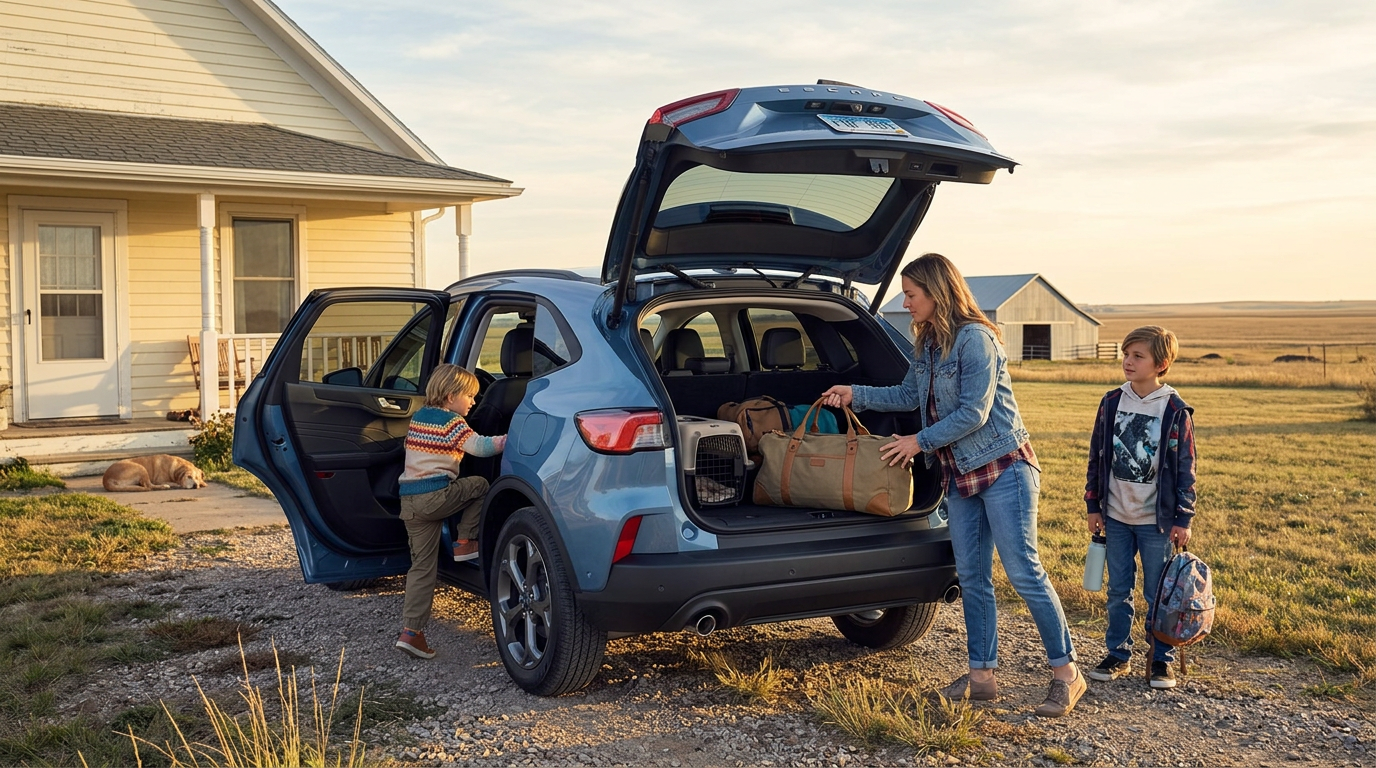
Is the 2026 Ford Escape a Good Family SUV? A Practical Look for South Dakota Buyers
The 2026 Ford Escape seats five, offers available AWD, delivers among the better fuel economy in its class through the hybrid powertrain, and includes Ford's full Co-Pilot360 safety suite as standard equipment across every trim. For South Dakota families — school runs in Bowdle, sports travel to Huron or Mitchell, longer highway trips to Aberdeen or Sioux Falls — it covers most of what a family vehicle needs to do without moving up to a larger SUV. This guide breaks down the Escape's family-specific specs and features honestly: interior room, safety systems, AWD availability for winter driving, and fuel economy for a family that logs real miles across central South Dakota. It also covers when the Escape genuinely isn't enough and the Explorer makes more sense. Shop Escapes in Stock Get Pre-Approved On This Page What Is the 2026 Ford Escape Like Inside for a Family of Five? What Kid-Friendly Features Does the 2026 Ford Escape Have? What Safety Features Come Standard on the 2026 Ford Escape? Does the 2026 Ford Escape Have AWD for Year-Round Family Driving in South Dakota? How Does the Escape's Fuel Economy Affect a Family's Monthly Driving Budget? When Should a South Dakota Family Consider the Explorer Instead of the Escape? What Is the 2026 Ford Escape Like Inside for a Family of Five? The Escape fits five passengers across two rows. It is a compact crossover, so the rear seat is sized for kids and average-build adults comfortably, but it is not a large SUV — tall adults sitting behind tall adults will feel the compact footprint on long trips. Cargo is the practical question for families. Behind the rear seats, the Escape offers approximately 37.5 cubic feet of cargo space — enough for a week of grocery runs or a weekend's worth of luggage for four. With the rear seats folded flat (60/40 split configuration), cargo capacity expands to approximately 60.8 cubic feet. Verify current figures at Ford.com, as cargo numbers are not listed in the order guide. The 60/40 split-fold rear seats are sliding as well as folding — the sliding feature lets you push the rear seats back for more legroom when cargo isn't the priority, or forward when you need the extra cargo depth. Where the Escape works well for SD families: daily driving, school pickup, commutes, and trips where you're packing light. Where it starts to feel tight: sports weekends with equipment, camping trips with gear, or anything that would fill a typical pickup bed. For most Bowdle-area families using the Escape as a daily driver and second vehicle, the cargo room is adequate. For families who routinely haul gear for multiple kids plus parents, the complete 2026 Ford Escape overview covers all configurations, and the Explorer section below covers when stepping up makes sense. What Kid-Friendly Features Does the 2026 Ford Escape Have? LATCH anchors are standard on the rear outboard seating positions across all 2026 Escape trims. For families with car seats, the sliding rear bench is genuinely useful — you can slide the second row forward to give the front passenger more room, or push it back to make car seat installation and kid loading easier. That flexibility is a practical difference from fixed-rear-seat competitors in this class. Features that matter for SD family winters — and when they become standard: heated front seats, a heated steering wheel, and remote start are all standard on ST-Line Select and up. On Active and ST-Line, they are not standard — they require either an option package or moving to a higher trim. If you're pre-warming a vehicle for school pickup in January at -10°F in Bowdle, that feature set matters, and the ST-Line Select is where it becomes baked in. A power liftgate (genuinely useful with your hands full of groceries or a kid) is also standard on ST-Line Select and up. Dual-zone electronic automatic climate control is standard across all trims — both front and rear passengers can reach their preferred temperature. The 13.2" SYNC 4 screen is standard on ST-Line Elite, PHEV, and Platinum; it's optional via tech packages on Select and lower trims. Wireless Apple CarPlay and Android Auto are included on all trims with the 8" standard screen and up. There is no factory-installed rear seat entertainment system on the 2026 Escape — families who want screen time for rear passengers will need a tablet or aftermarket solution. One honest note: the Escape trim levels guide covers which trims include the winter-ready feature set and which require option packages. What Safety Features Come Standard on the 2026 Ford Escape? Ford Co-Pilot360 is standard on every 2026 Ford Escape trim — from the entry-level Active through Platinum. This means automatic emergency braking (AEB) with pedestrian detection, forward collision warning, BLIS blind spot monitoring with rear cross-traffic braking, lane-keeping assist with driver alert, road departure warning, rear view camera, auto high-beam headlamps, and post-collision braking are included regardless of which configuration you purchase. Also standard on all trims: AdvanceTrac with Roll Stability Control (RSC), Electronic Traction Control, SOS Post-Crash Alert System, SecuriLock passive anti-theft, and a full airbag system including a Safety Canopy with rollover sensor. For highway driving on SD's open interstates where deer crossings and sudden weather changes are real risks, having AEB with pedestrian detection and road departure warning on every single trim matters. For families who want the next level of driver assistance — adaptive cruise control with stop-and-go, lane centering assist, rear parking sensors, and intersection assist — that's Co-Pilot360 Assist+. It comes standard on ST-Line Elite, PHEV, and Platinum. On Active, ST-Line, and ST-Line Select, Co-Pilot360 Assist+ requires a tech package upgrade. If highway-capable adaptive cruise is important for your family's longer South Dakota drives, the ST-Line Elite is where it becomes standard without package math. Other Ford Models to Consider Need more room? These models are also available at Beadle Ford. Ford Explorer More cargo room, available 3-row seating, more towing capacity. Shop Escapes in Stock Ford Bronco Sport Standard AWD, GOAT modes, staying in Ford's lineup. Shop Escapes in Stock Ford Maverick Compact truck with hybrid option, bed utility, and family-friendly price. Shop Escapes in Stock Does the 2026 Ford Escape Have AWD for Year-Round Family Driving in South Dakota? Yes — and the answer matters more depending on which trim you order. AWD is standard and the only drivetrain option on ST-Line Select, ST-Line Elite, and Platinum. On Active and ST-Line, FWD comes standard and AWD must be added at order — it does not come on the vehicle automatically. The PHEV trim is front-wheel drive only with no AWD option. For a family in Bowdle that's doing school pickup on packed gravel in November and running kids to Saturday morning sports in Huron in February, the AWD configuration is the practical choice. The Escape's AWD system distributes torque to the rear axle when slip is detected — it handles packed snow and gravel county roads competently. What it doesn't have is a dedicated Snow/Slippery driving mode — it's a reactive AWD system rather than a mode-switching one. The ST-Line Select is the natural starting point for South Dakota family buyers: AWD becomes non-negotiable here (you can't order FWD even if you wanted to), and it adds the full winter-ready package — heated front seats, heated steering wheel, and remote start — as standard equipment. That combination in a single trim is a clean deal for a central SD family vehicle. For more detail on how AWD availability lines up across all trims, the complete 2026 Ford Escape lineup overview covers all six configurations. How Does the Escape's Fuel Economy Affect a Family's Monthly Driving Budget? The 2026 Ford Escape's fuel economy advantage is most meaningful in the Hybrid AWD configuration. The 2.5L Hybrid AWD (available on ST-Line Select, Elite, and Platinum) delivers approximately 39 mpg combined — verify current EPA figures at fueleconomy.gov. For a family logging 15,000 miles per year, that's roughly 385 gallons of fuel annually. On the 1.5L EcoBoost FWD at approximately 30 mpg combined, the same 15,000 miles requires closer to 500 gallons. That difference — roughly 115 gallons per year — is real money on a farm family's budget where every dollar matters. The SD-specific efficiency argument is the highway leg. South Dakota families don't just drive city blocks — they're driving 30-mile county road hauls to get to a highway, then 60 to 80 miles into a larger city for errands or appointments. The Escape Hybrid's EPA highway figure (approximately 36 mpg — verify at fueleconomy.gov) holds up well on those stretches. For a Bowdle family making regular trips to Aberdeen or Huron, the Hybrid AWD pays back in fuel savings in a way that suburban buyers who drive shorter loops don't experience as directly. The PHEV is worth mentioning for context: it delivers higher MPGe when running on electricity (~101 MPGe, verify at fueleconomy.gov) and good hybrid-mode efficiency once the battery depletes (~40 mpg, verify). The practical challenge for central SD families is that reliable Level 2 charging infrastructure near Bowdle is limited — the PHEV's efficiency advantage is smaller if you're charging on a standard Level 1 outlet or not charging consistently. And the PHEV is FWD-only, which is a significant trade-off for SD winter driving. For most SD families, the non-plug-in Hybrid AWD on ST-Line Select is the stronger combination of efficiency, AWD, and real-world practicality. When Should a South Dakota Family Consider the Ford Explorer Instead of the Escape? The Explorer is the right call when the Escape's two-row, five-passenger limit is genuinely a constraint for your family's actual use. The Explorer offers available three-row seating — a real third row for a family of six or seven, not a jump seat. It also offers more cargo volume behind the second row than the Escape, more towing capacity depending on configuration, and a longer wheelbase that translates to more rear-passenger legroom on multi-hour drives. The trade-offs are straightforward: the Explorer is larger, costs more, and burns more fuel. For a family that genuinely needs three rows a few times a year (church trips, extended family hauling, carpool groups), paying the Explorer premium makes sense. For a family that's primarily two parents and two kids — the Escape's five-passenger cabin covers everyone, the cargo room handles the gear, and you're spending and fueling less for the same trip. One practical note on timing: the 2026 Escape is the final model year — Ford is not producing an Escape beyond 2026. The Explorer is continuing in Ford's lineup. If long-term model continuity and parts availability over a 10+ year ownership horizon matters to your family's decision, the Explorer's ongoing production is a real difference. For a 5–7 year ownership window, that consideration is lower — the Escape carries full Ford warranty coverage and parts support for any recently discontinued model is strong for many years post-production. Both the Escape and Explorer are available at Beadle Ford in Bowdle. Key Takeaways for South Dakota Families The Escape seats five with a sliding, 60/40 split-fold rear seat; cargo room is approximately 37.5 cu ft behind the rear seats (verify at Ford.com). It is not a three-row SUV. Ford Co-Pilot360 with AEB, pedestrian detection, BLIS, lane-keeping, and road departure warning is standard on every trim — no trim is without it. LATCH anchors are standard on rear outboard positions; heated seats, heated steering wheel, remote start, and power liftgate become standard starting at ST-Line Select. For SD family winter driving, ST-Line Select is the practical starting point: AWD is standard (no FWD option), and the full cold-weather feature set is included. The 2.5L Hybrid AWD delivers approximately 39 mpg combined — roughly 115 gallons per year less than the 1.5L gas on 15,000 annual miles, a meaningful difference for a farm family's budget. If your family regularly needs three rows or significantly more cargo capacity, step up to the Explorer — the Escape is a compact two-row vehicle and that limit is real on big gear days. Frequently Asked Questions Does the 2026 Ford Escape have LATCH anchors for car seats? Yes — LATCH anchors are standard on the rear outboard seating positions on all 2026 Ford Escape trims. The rear seat also features 60/40 split-fold and sliding functionality. The sliding capability is useful for car seat installation, as you can position the second row forward or rearward depending on car seat size and how much front-passenger legroom you want. There is no LATCH anchor on the rear center position. Which 2026 Ford Escape trim is best for a South Dakota family? For most South Dakota families, the ST-Line Select is the practical starting point. It is the first trim where AWD is standard (no FWD option), and it adds heated front seats, a heated steering wheel, remote start, and a power liftgate as standard equipment — the full winter-ready package for central SD conditions. The ST-Line Elite steps up to a 10-way power driver's seat, the 13.2" SYNC 4 screen, wireless charging, and Co-Pilot360 Assist+ as standard equipment for families who want the full tech suite without package math. Both are available with the 2.5L Hybrid AWD for families prioritizing fuel economy on long South Dakota drives. Does the 2026 Ford Escape have a third row? No — the 2026 Ford Escape is a two-row, five-passenger vehicle. There is no three-row option at any trim or configuration. If your family regularly needs seating for six or seven, or needs the cargo room that comes with a longer three-row platform, the Ford Explorer is the appropriate step up. The Explorer is available at Beadle Ford in Bowdle and offers available three-row seating with more interior volume than the Escape. Is the 2026 Ford Escape safe enough for family use? The 2026 Ford Escape includes Ford Co-Pilot360 as standard equipment on every trim — this means automatic emergency braking with pedestrian detection, BLIS blind spot monitoring with rear cross-traffic braking, lane-keeping assist, road departure warning, pre-collision warning with dynamic brake support, and a rear view camera come on every Escape regardless of price point. AdvanceTrac with Roll Stability Control and a full airbag system including a Safety Canopy with rollover sensor are also standard across all trims. Verify current NHTSA and IIHS safety ratings at their respective websites for the most recent test results. Is the Ford Escape or Explorer better for a South Dakota family? For a family of five using the vehicle primarily for daily driving, school runs, and regional highway trips, the Escape handles the job with better fuel economy and a lower price point than the Explorer. For families who need three rows, routinely haul significant equipment, or plan to use the vehicle for towing beyond the Escape's capacity (the 2.0L Escape maxes at 3,500 lbs with the Class II package; the Explorer can tow more depending on configuration), the Explorer is the right step up. If you're on the fence, both are available at Beadle Ford in Bowdle — a back-to-back comparison is the best way to make the call for your specific family use case. My Take on the 2026 Ford Escape as a South Dakota Family Vehicle The buyers I talk to who are considering the Escape for family use usually come in with one of two scenarios: they're using it as a second vehicle on the farm — mom's daily driver for town runs and kid hauling while the truck handles the heavier work — or they're a smaller family that doesn't need a full-size SUV and is trying to keep fuel costs reasonable on South Dakota highway miles. The Escape fits both of those use cases well. The ST-Line Select in Hybrid AWD hits a real sweet spot: AWD locked in, heated seats and remote start included, and approximately 39 mpg on the highway. I do tell families honestly when the Escape is going to come up short. If you've got three kids who need their own row, or you're the household that hauls ATV gear and sports equipment for multiple kids on the same trip — you're going to load the Escape to its limit and probably wish you'd gone to the Explorer. The five-passenger, two-row limit is real. It's not a knock on the vehicle; it's just what it is. The Explorer is right down the lot. If you want to walk through which trim makes the most sense for your family's actual routine, stop by Beadle Ford in Bowdle. I'm happy to go through it with you. Shop Escapes in Stock Get Pre-Approved About the Author Lexy Tabbert — Beadle Ford, Bowdle, SD Lexy Tabbert is the Director of Sales and Marketing at Beadle Ford in Bowdle, South Dakota. She covers Ford vehicles, trim comparisons, and buyer guidance — helping families, ranchers, and ag operators across the region find the right truck and configuration for their needs. Learn more about Lexy.
Owning a Ford Edge After Discontinuation: Maintenance, Parts, and What to Expect
Owning a Ford Edge After Discontinuation: Maintenance, Parts, and What to Expect Ford stopped building the Edge in April 2024—but that doesn’t mean your SUV is left behind. Here’s what owners need to know about parts, service, costs, and long-term ownership. Published March 31, 2026 — Lexy Tabbert, Beadle Ford, Bowdle, SD Shop Edges in Stock Get Pre-Approved Quick Navigation What “Discontinued” Actually Means Parts Availability & Where to Source Them Ford Edge Maintenance Schedule & Intervals Estimated Annual Ownership Costs Warranty & CPO Options SYNC 4A Software Updates & Support Resale Value & Depreciation Outlook South Dakota Winter Maintenance Frequently Asked Questions When Ford announced the Edge’s discontinuation in 2024, many owners wondered what it meant for the future of their vehicles. Would parts become impossible to find? Would service dry up? Would resale value plummet? The reality is much more reassuring than the headlines suggest. “Discontinued” does not mean “abandoned.” Ford dealerships maintain legal obligations to stock and order parts for discontinued models for years after production ends. The Edges on the road today—with their proven EcoBoost engines, SYNC 4A infotainment, and all-wheel-drive standard configuration—remain fully supported, maintainable, and valuable. If you own a pre-owned Edge or are considering buying one, understanding the true cost of ownership, parts availability, and maintenance expectations will help you make a confident decision. At Beadle Ford in Bowdle, SD, we service hundreds of Edge owners in the region and stay current with the latest guidance from Ford. Let’s break down what ownership really looks like. What “Discontinued” Actually Means for Owners Production has ended, but support continues. Ford stopped manufacturing the Edge in April 2024. That’s it. The factory line closed, and no new 2025 or 2026 models will be built. But discontinuation does NOT automatically trigger the end of service, parts availability, or dealer support. Automakers in the United States are legally required to make parts available for vehicles for a minimum of 10 years after the final production year. In practice, Ford maintains relationships with parts suppliers and distributors for far longer—often 15, 20, or even 30+ years for popular models. The Edge was in production for over two decades (2006–2024), which means an enormous installed base and continued demand for replacement parts. When you discontinue a vehicle, you don’t discontinue warranty coverage for owners, recall compliance, or TSB (Technical Service Bulletin) support. Ford service departments are equipped to handle the entire library of Edge maintenance and repair needs—from routine oil changes to transmission rebuilds. Why does this matter? It means the pre-owned Edge you buy today will not become a "car nobody can fix." It means resale value is not immediately crushed. And it means you are not betting on a dying vehicle platform when you choose a used Edge for your family or business. Parts Availability & Where to Source Them Ford dealerships continue to stock and order Edge parts. Your Beadle Ford service department has access to Ford’s full parts catalog for the Edge. Common wear items like brake pads, air filters, spark plugs, serpentine belts, and battery replacements are in stock or can be ordered within 1–3 business days. Larger components—transmission assemblies, engine gaskets, suspension arms, and cooling system parts—are also available through Ford’s parts network. Aftermarket suppliers fill the gap. Major retailers including RockAuto, CarParts.com, AutoAccessoriesGarage.com, PartsGeek, and Advance Auto Parts maintain extensive catalogs of Edge parts and accessories. These aftermarket sources often price below OEM (original equipment manufacturer) parts and ship nationwide. Warranty and return policies vary, but reputable aftermarket suppliers typically offer 30-day returns and satisfaction guarantees. Salvage yards and used parts. For owners on a budget, salvage yards across the Great Plains stock used Edge components. Websites like Car-Part.com let you search inventory across multiple yards and compare pricing. Used parts can reduce repair costs significantly, especially for body panels, interior trim, and mechanical assemblies from lower-mileage vehicles. What to expect pricing-wise: OEM parts from Ford dealers run 15–40% higher than equivalent aftermarket parts, depending on the component. For routine maintenance, aftermarket brake pads, filters, and fluids offer the best value. For critical systems (transmission, engine, suspension), many owners balance cost by sourcing used OEM components through salvage suppliers or choosing reputable aftermarket brands with strong warranties. Ford Edge Maintenance Schedule & Recommended Intervals The Ford Edge follows the manufacturer’s recommended preventive maintenance schedule found in your owner’s manual. Below is a summary of critical service intervals for Edge models (2020–2024, applicable to earlier years with minor adjustments): Service Interval Estimated Cost* Oil & Filter Change (5W-20) Every 10,000 miles or 12 months $45–$85 Tire Rotation & Rebalance Every 7,500–10,000 miles $40–$80 Brake Pads (front & rear) Every 50,000–70,000 miles $200–$400 Engine Air Filter Replacement Every 30,000 miles or annually $30–$60 Cabin Air Filter Replacement Every 15,000–30,000 miles $25–$50 Transmission Fluid Drain & Fill (8-spd) Every 100,000 miles or 10 years $150–$250 Coolant System Flush Every 100,000 miles or 10 years $120–$200 Spark Plugs (replacement) Every 100,000 miles $100–$180 All-Wheel-Drive Fluid Service Every 100,000 miles $150–$250 Battery Replacement (hybrid) Every 8–10 years or as needed $100–$250 *Costs are estimates for dealer service in South Dakota. Aftermarket parts and independent shops may offer lower rates. EcoBoost-specific care: The 2.0L and 2.7L EcoBoost engines in the Edge benefit from synthetic 5W-20 oil and quality fuel with detergent additives. Some owners report carbon buildup in direct-injection engines; regular use of top-tier gasoline (Shell, Chevron, Mobil) or fuel system cleaners every 10,000–15,000 miles can minimize this. Always refer to your vehicle’s maintenance manual for model-specific intervals. When in doubt, contact Beadle Ford—our service advisors can build a custom maintenance plan for your Edge based on driving habits, climate, and mileage. Estimated Annual Ownership Costs Understanding the true cost of owning a used Edge helps you budget realistically. Below is a breakdown of typical annual expenses for a 4–6 year-old Edge with 50,000–80,000 miles: Routine Maintenance (Oil changes, filters, tire rotation) $350–$500/year Tire Replacement (averaged over 4-year life) $200–$350/year Brake Service (pads, rotors, averaged) $150–$250/year Insurance (comprehensive/collision, varies by age, ZIP) $800–$1,400/year Fuel (EPA combined 22–27 MPG, 12,000 miles/year @ $3.20/gal) $1,400–$1,745/year Unexpected Repairs (averaged) $300–$600/year Total Estimated Annual Cost $3,200–$4,845/year How does this compare? The Ford Edge costs roughly 10–15% less annually to own than comparable SUVs like the Chevy Traverse or Toyota Highlander, primarily due to lower insurance costs and fuel economy. The EcoBoost engines deliver strong efficiency for their size, and parts remain affordable as the model ages. Factors that impact your costs: Annual mileage, driving conditions (city vs. highway), local fuel prices, insurance rates, and maintenance habits all play a role. Owners in South Dakota who tackle winter maintenance proactively (undercoating, rust prevention) often avoid expensive rust-related repairs later. Warranty & Certified Pre-Owned (CPO) Options Factory warranty for used Edges. If you purchase a pre-owned Edge from a Ford dealership, the original factory warranty coverage transfers to you. Most Edge models from 2020 onward still carry: Basic Warranty: 3 years or 36,000 miles (whichever comes first) Powertrain Warranty: 5 years or 60,000 miles (engine, transmission, drivetrain) Corrosion/Rust Warranty: 5 years, unlimited miles Ford Certified Pre-Owned (CPO) Warranty. Edges purchased through the Ford CPO program receive an additional layer of protection. A standard CPO warranty covers major components for up to 7 years or 100,000 miles from the original in-service date. Each CPO vehicle passes a comprehensive 200-point inspection, includes a vehicle history report, and qualifies for roadside assistance. Extended warranties. For used Edges outside factory warranty, third-party extended warranties or maintenance plans are available. Prices typically range from $1,200–$3,500 for 5–7 year coverage, depending on deductibles and coverage limits. Compare plans carefully; some exclude certain components or impose mileage caps. At Beadle Ford, we help customers navigate warranty options and provide transparent pricing. Ask us about extended warranty programs when you browse our Edge inventory or discuss pre-purchase inspections. SYNC 4A Software Updates & Long-Term Support SYNC 4A is receiving ongoing over-the-air updates. The Edge’s standard SYNC 4A infotainment system is integrated with Ford’s “Power-Up” over-the-air (OTA) update program. This means your Edge can receive software updates wirelessly—no trip to the dealer necessary (though updates can also be installed at a Ford service center if you prefer). What updates include: Security patches, performance improvements, new features (when available), and compatibility enhancements. Ford has committed to providing OTA updates for vehicles across its lineup, including discontinued models, as long as the vehicles are on the road and owners subscribe to the connected services feature. Connectivity requirements. Your Edge must have an active FordPass account and internet connectivity (via the vehicle’s cellular modem) to receive automatic updates. Over-the-air updates download silently and install at convenient times (typically overnight or when the vehicle is parked and plugged in, if equipped with wireless charging). You can also manually check for and install updates via the SYNC settings menu. Discontinuation and software support. Ford has not announced plans to discontinue SYNC 4A updates for discontinued vehicle models. In fact, discontinuing a model does not typically trigger the end of software support—Ford maintains liability and functionality obligations for the vehicles already on the road. For peace of mind, check your SYNC system’s settings regularly to confirm automatic updates are enabled. If you encounter issues with updates or connectivity, our service team at Beadle Ford can diagnose the problem and ensure your Edge stays current. Resale Value & Depreciation Outlook Discontinuation does NOT crush resale value. The Edge benefits from strong brand recognition, a loyal owner base, and a 19-year production run (2006–2024). These factors support stable used-market pricing. Unlike obscure or poorly-selling models, the Edge commands consistent demand from buyers seeking mid-size AWD SUVs. Depreciation trends: A typical pre-owned Edge depreciates about 10–15% annually in its first few years after purchase. A 2022 Edge purchased used in 2026 (4 years old) typically loses 40–50% of its original sticker price. By year 7–8, depreciation rates stabilize as older Edges become classic daily drivers rather than luxury purchases. What supports Edge resale value: Strong fuel economy for the class (AWD standard improves appeal in snow regions) Reliable EcoBoost engine and automatic transmission with proven track records SYNC 4A and Co-Pilot360 standard—modern tech that matches newer SUVs Large installed base means strong secondary market and parts availability Broad appeal to families, ranch operators, and fleet buyers across the Midwest Buy with confidence: A well-maintained 2020–2024 Edge is not a depreciating asset you should avoid. It’s a practical, supported SUV that will retain reasonable value if you maintain it properly. When you’re ready to sell or trade it in, Beadle Ford is here to help with fair valuations and seamless transactions. South Dakota Winter Maintenance & Year-Round Care South Dakota is in the “Salt Belt.” Our region uses road salt to manage winter snow and ice, which means your Edge faces unique corrosion challenges that owners in milder climates don’t encounter. Proactive winter maintenance can add years of service life and prevent costly rust repairs. Tire and traction management: The Edge’s all-wheel-drive system is excellent for snow and ice, but traction depends on quality winter tires. Many South Dakota owners swap to winter tires (rated 3PMSF) from November through April. All-season radials lose grip below 45°F; winter tires maintain traction and reduce stopping distances in snow. Tire swapping also extends your summer tire life and improves safety. Undercarriage and rust prevention: Road salt accumulates on your vehicle’s undercarriage, brake lines, suspension components, and wheel wells without you seeing it. To prevent rust: Wash your Edge regularly after snowstorms and every 2–3 weeks during winter. Use a pressure washer or car wash with an undercarriage spray to blast salt away from hidden areas. Professional undercoating applied before winter (September–October) creates a protective barrier. Cost is typically $150–$300 and can save thousands in rust repairs over a vehicle’s life. Touch up paint chips immediately. Exposed metal rust rapidly when salt is present. Keep a paint pen or touch-up bottle on hand during winter. Inspect suspension and brake components annually. Rusted brake lines or suspension links can fail unexpectedly. Our service team checks these systems during routine maintenance. Cold-weather engine and battery care: South Dakota winters can dip to –20°F or colder. Maintain your Edge with: Engine block heater (if equipped) to warm the engine overnight and improve cold starts. Ford Edge models can accommodate aftermarket block heaters for $100–$200. Synthetic 5W-20 oil (standard for Edge) flows better in cold temperatures than conventional oil. Use it year-round to support cold startups. Battery health check twice yearly (fall and spring). Cold temperatures reduce battery output by 30–50%; if your Edge struggles to start on cold mornings, a battery test takes 10 minutes and costs nothing at Beadle Ford. Coolant system maintenance prevents freeze-up and corrosion. Ford recommends a coolant flush every 100,000 miles or 10 years; in harsh South Dakota winters, consider flushing every 5 years or 50,000 miles. All-wheel-drive fluid service: The Edge’s AWD system requires periodic fluid changes. Snow and cold put extra stress on the transfer case and rear differential. Service them every 100,000 miles or, in extreme climates, every 50,000 miles. Neglecting AWD service can lead to binding, noise, and drivetrain failure. Schedule a seasonal check-up: Before winter (September–October) and before spring (March–April), bring your Edge to Beadle Ford for a comprehensive inspection. We check battery health, coolant condition, brake system integrity, tire tread and pressure, and suspension for salt damage. Small repairs prevent big problems. Call 605-285-6202 to book your seasonal appointment. Key Takeaways Discontinuation does NOT mean lack of support. Ford dealerships and aftermarket suppliers maintain parts inventory and service capability for years after production ends. Parts are readily available through Ford dealerships, major aftermarket retailers (RockAuto, CarParts.com, PartsGeek), and salvage yards. Expect OEM parts to cost 15–40% more than aftermarket alternatives. Annual ownership costs for a used Edge range $3,200–$4,845 (maintenance, insurance, fuel, repairs), making it 10–15% cheaper than comparable mid-size AWD SUVs. SYNC 4A continues to receive over-the-air updates. Discontinued models are NOT cut off from software support; Ford maintains update services for vehicles on the road. Resale value remains stable. The Edge’s strong brand reputation, large owner base, and reliable engines support consistent used-market demand. South Dakota winter ownership requires proactive rust prevention: regular washing, professional undercoating, tire swaps, coolant service, and battery maintenance. Certified Pre-Owned (CPO) Edges offer extended warranties (up to 7 years/100,000 miles) and thorough inspections. Factory warranty coverage carries over to second owners. Frequently Asked Questions About Ford Edge Ownership Is a discontinued Ford Edge still supported by Ford dealerships? Yes, absolutely. Ford dealerships are legally required to support discontinued models for a minimum of 10 years after the final production year. In practice, support typically extends far longer for popular models like the Edge. Ford service departments maintain access to parts catalogs, technical service bulletins (TSBs), recall information, and warranty coverage for all Edge model years still on the road. You can bring your Edge to any Ford dealership, including Beadle Ford in Bowdle, SD, for maintenance and repair. Where can I find replacement parts for my Edge if Ford dealership parts are too expensive? Aftermarket parts suppliers are your best option for cost savings. Major retailers including RockAuto, CarParts.com, AutoAccessoriesGarage.com, PartsGeek, and Advance Auto Parts stock extensive Edge catalogs and typically price 15–40% below OEM parts. For used components, salvage yards across the Great Plains offer lower-cost alternatives; search Car-Part.com to compare inventory and pricing nationwide. Most aftermarket suppliers offer 30-day returns and warranties on parts. For critical systems (engine, transmission), balance cost with warranty coverage to avoid future headaches. Will my Ford Edge continue to receive SYNC 4A software updates after discontinuation? Yes, the Edge will continue to receive over-the-air (OTA) updates through Ford’s Power-Up program. Discontinuation of a model does not automatically terminate software support. Your Edge can receive security patches, performance improvements, and compatibility enhancements wirelessly as long as your vehicle is equipped with a cellular modem and you maintain an active FordPass account with connected services. Updates install automatically or can be manually triggered via the SYNC settings menu. Ford has committed to supporting OTA updates across its lineup, including discontinued models, for as long as vehicles remain on the road. How much does it cost to own a used Ford Edge annually? Annual ownership costs for a typical 4–6 year-old Edge range from $3,200 to $4,845, depending on mileage, driving habits, and local repair rates. This includes routine maintenance ($350–$500), tire replacement amortized over a 4-year lifespan ($200–$350), brake service ($150–$250), insurance ($800–$1,400), fuel ($1,400–$1,745 based on 12,000 miles/year), and unexpected repairs ($300–$600). The Edge typically costs 10–15% less to own annually than comparable AWD SUVs like the Chevy Traverse or Toyota Highlander, thanks to lower insurance costs and strong fuel economy. Will a discontinued Ford Edge lose value quickly compared to models still in production? No. The Edge’s discontinuation will not significantly accelerate depreciation. The model enjoyed 19 years of continuous production (2006–2024), building a large installed base and strong owner loyalty. Resale values remain stable, supported by consistent market demand from buyers seeking reliable mid-size AWD SUVs. A well-maintained Edge from 2020–2024 will depreciate at typical rates (10–15% annually for the first few years), no worse than comparable models still in production. The Edge’s fuel efficiency, modern SYNC 4A tech, and proven EcoBoost engines maintain its appeal to buyers. Discontinuation actually strengthens the resale value of remaining inventory by reducing future supply and competitive pressure from new models. What warranty coverage applies to a used Ford Edge purchased today? Factory warranty coverage transfers to subsequent owners. A used Edge from a Ford dealer typically carries basic warranty (3 years/36,000 miles) and powertrain warranty (5 years/60,000 miles) coverage. Corrosion/rust warranty extends for 5 years, unlimited mileage. If the Edge is purchased through the Ford Certified Pre-Owned (CPO) program, coverage extends to 7 years or 100,000 miles from the original in-service date, plus roadside assistance. Extended warranties from third-party providers ($1,200–$3,500 for 5–7 years) are also available for out-of-warranty vehicles. Beadle Ford can help you review warranty options and find the right coverage for your situation. My Take on Owning a Ford Edge After Discontinuation I talk to Edge owners here in Bowdle and across the region regularly, and the concern I hear most often is some version of: “Is this thing going to become impossible to fix?” My honest answer is no—not for a long time, and probably not in your ownership window at all. The Edge was built for nearly two decades. That kind of production run creates a parts ecosystem that doesn’t just evaporate overnight. From a cost standpoint, used Edges are genuinely solid value right now. The discontinuation has taken new inventory off the table, which means less competition for used examples and more stable resale prices. If you keep up with the maintenance intervals—especially the AWD fluid and coolant service that South Dakota winters demand—you’ll get reliable miles out of this platform. The EcoBoost engines are proven, the SYNC 4A is still current enough to feel modern, and AWD standard across trims makes it practical for our climate. If you’re weighing a used Edge purchase or want a maintenance plan built for South Dakota driving, I’d encourage you to review the complete Ford Edge buyer guide for the full picture on trims, years, and what to look for. And if you have questions or want to talk through your specific situation, come see us at Beadle Ford in Bowdle—we’re here to help you make a confident decision. Shop Edges in Stock Get Pre-Approved Contact Beadle Ford Related Ford Edge Content Shop Edges in Stock Common Ford Edge Problems & How to Fix Them Best Ford Edge Years — Model Year Comparison About the Author Lexy Tabbert — Beadle Ford, Bowdle, SD Lexy Tabbert is the Director of Sales and Marketing at Beadle Ford in Bowdle, South Dakota. She covers Ford vehicles, trim comparisons, and buyer guidance — helping families, ranchers, and ag operators across the region find the right truck and configuration for their needs. Learn more about Lexy.
Ford Edge Trims Explained: SE, SEL, ST-Line, Titanium, and ST
Ford Edge Buyer’s Guide Ford Edge Trims Explained: SE, SEL, ST-Line, Titanium, and ST The Ford Edge comes in five distinct trims — SE, SEL, ST-Line, Titanium, and ST — each designed for different buyer priorities and budgets. Whether you’re seeking maximum value, premium comfort, or performance-tuned capability, this guide walks you through every option so you can choose with confidence. Shop Edges in Stock On This Page What Does the Ford Edge SE Include? What’s New in the Ford Edge SEL? What Is the Ford Edge ST-Line? Why Choose the Ford Edge Titanium? What Makes the Ford Edge ST Performance-Ready? Ford Edge Trim Comparison Table Which Ford Edge Trim Is Right for You? Frequently Asked Questions What Does the Ford Edge SE Include? The Ford Edge SE (100A) is the entry-level trim and the best choice for budget-conscious families seeking a spacious, reliable SUV. Every SE arrives with all-wheel drive standard — no front-wheel drive option — making it ready for South Dakota winters. Powertrain: The SE houses a 2.0L EcoBoost I-4 engine producing 250 horsepower and 280 lb-ft of torque, paired with an 8-speed automatic transmission. Fuel economy is solid for the class, and the EcoBoost platform has proven reliability across Ford’s lineup. Interior & Comfort: Cloth seats with a 4-way manual driver adjustment keep costs down without sacrificing comfort. Dual-zone automatic climate control, a leather-wrapped steering wheel, and SYNC 4A with a 12-inch touchscreen and wireless CarPlay/Android Auto come standard across all trims. The SE includes six speakers and a manual liftgate. Wheels & Styling: The SE rolls on 18-inch Sparkle Silver wheels with all-season tires (245/60R18). The Iconic Silver Honeycomb grille gives the SE a refined, distinct appearance. Towing & Cargo: Without the Class II Tow Package, the SE can tow 1,500 lbs. Cargo capacity sits at 39.2 cu ft behind the rear seats, expanding to 73.4 cu ft with seats folded — more than enough for a farm run or family road trip across the Prairie. Best for: Young families, first-time SUV buyers, rural operators who prioritize reliability and all-wheel drive capability without premium features. What’s New in the Ford Edge SEL? The SEL (201A) is where comfort upgrades begin. Stepping up to this trim unlocks power seat adjustments, heated front seats, and rear parking sensors — features that make daily driving more convenient and safer, especially during South Dakota winters. Seating: ActiveX seats with improved bolstering replace cloth on the SE. The driver seat moves with 8-way power adjustment, while the front passenger gets 4-way power adjustability. Both front seats are heated, a welcome feature on cold Prairie mornings. Lighting & Visibility: LED Signature Lighting enhances nighttime visibility and gives the SEL a more upscale exterior presence. Heated side mirrors and an auto-dimming rearview mirror round out the comfort package, reducing glare during sunrise and sunset drives across rural South Dakota. Wheels: The SEL steps up to 18-inch Split-Spoke Sparkle Silver wheels, a more refined design than the SE’s base pattern. Best for: Buyers who want the SE’s value foundation plus comfort conveniences; ranchers and ag professionals who appreciate heated seats for early-morning work. What Is the Ford Edge ST-Line? The ST-Line (250A) bridges comfort and sporty styling, appealing to buyers who want a bolder look without the V6 engine of the ST. It builds on the SEL foundation and adds distinctive design cues that make a statement on the road. Wheels & Suspension: Twenty-inch Premium Gloss Black wheels (245/50R20) replace the SEL’s 18-inchers, delivering a more aggressive stance. These larger wheels improve handling feedback without compromising ride quality over South Dakota’s gravel roads and highway stretches. Interior Design: ActiveX seating gets Miko insert accents, and red accent stitching throughout the cabin signals the ST-Line’s sportier personality. A wireless charging pad for mobile devices (increasingly essential) and remote start via smartphone round out the tech upgrades. Power Liftgate & Styling: The power liftgate is a genuine convenience, especially when your hands are full or you’re loading cargo. The Pillar Black Mesh grille and overall sharper styling differentiate the ST-Line visually from lower trims. 110V Outlet: A 110V outlet in the cargo area lets you power tools, coolers, or other equipment during ranch work or tailgating. Best for: Style-conscious buyers, outdoors enthusiasts, those who want SUV presence without sacrificing fuel efficiency of the 2.0L engine. Why Choose the Ford Edge Titanium? The Titanium (300A & 301A Lux) is Ford’s luxury play in the Edge lineup. This trim delivers premium materials, advanced driver-assistance systems, and premium audio that rival vehicles costing thousands more. Choose 300A for core luxury, or 301A Lux for the ultimate Titanium experience. Seating & Materials: Ten-way power driver seat with memory function, 6-way power passenger seat, and premium leather upholstery set the Titanium apart. Both front seats are heated as standard, and the 301A Lux adds cooled front and heated rear seats — luxury touches perfect for South Dakota’s temperature extremes. Wheels & Exterior: Nineteen-inch Luster Nickel wheels (245/55R19) provide a refined, upscale presence. The Chrome bars grille signals Titanium’s premium positioning. A hands-free foot-activated liftgate adds genuine convenience when carrying groceries or ranch supplies. Audio & Ambiance: A 12-speaker B&O system with subwoofer transforms your commute into a concert venue. Ambient lighting throughout the cabin creates a refined atmosphere during night drives. The heated steering wheel (standard on Titanium) is a game-changer during Bowdle winters. 301A Lux Upgrades: The premium package adds adaptive cruise control with stop-and-go functionality — excellent for highway drives across Nebraska and South Dakota. A panoramic roof opens the cabin visually, and a 180-degree camera system enhances parking confidence in tight farm or downtown spaces. Best for: Luxury-minded families, executives making long commutes, buyers who value premium audio and comfort technology; those shopping the used market seeking the most feature-rich, lowest-mileage Edge available. What Makes the Ford Edge ST Performance-Ready? The Ford Edge ST (400A & 401A High) is the performance flagship — a true enthusiast’s SUV powered by a 2.7L EcoBoost V6 engine. It delivers the muscle to tow trailers, haul equipment, and corner with authority, all while maintaining SUV practicality. Engine & Powertrain: The 2.7L twin-turbocharged EcoBoost V6 produces 335 horsepower and 380 lb-ft of torque — a meaningful step up from the 2.0L I-4’s 250 hp. A 7-speed automatic transmission is tuned by Ford Performance engineers for responsive acceleration and dynamic handling. Towing capacity jumps to 3,500 lbs standard, with the Class II Tow Package included. Suspension & Handling: The ST gets Ford Performance-tuned suspension geometry and dampers, delivering noticeably sharper turn-in and flatter cornering than lower trims. Yet it remains comfortable on highway stretches across the Great Plains. This is the Edge you choose when you want an SUV that feels alive behind the wheel. Interior & Seating: ST bolstered bucket seats with Miko inserts and leather trim hug you during spirited driving. Ten-way power driver seat with memory, B&O 12-speaker premium audio, and heated steering wheel come standard. The 401A High adds adaptive cruise control, panoramic roof, cooled front seats, and heated rear seats for maximum comfort and convenience. Wheels & Exterior: Twenty-inch Bright-Machined wheels (with performance tires) and ST-exclusive styling cues — including unique badging and aggressive grille treatment — make the ST unmistakable on the road. Best for: Performance enthusiasts, those who tow trailers regularly, buyers seeking an SUV with genuine dynamic personality; ranchers and operators who need both capability and confidence. Ford Edge Trim Comparison Table Use this table to compare specifications, features, and pricing across all five Ford Edge trims: Feature SE SEL ST-Line Titanium ST Engine 2.0L I-4 EcoBoost 2.0L I-4 EcoBoost 2.0L I-4 EcoBoost 2.0L I-4 EcoBoost 2.7L V6 EcoBoost Horsepower / Torque 250 hp/280 lb-ft 250 hp/280 lb-ft 250 hp/280 lb-ft 250 hp/280 lb-ft 335 hp/380 lb-ft Transmission 8-Speed Auto 8-Speed Auto 8-Speed Auto 8-Speed Auto 7-Speed Auto Drivetrain All AWD All AWD All AWD All AWD All AWD Towing (with Class II) 3,500 lbs 3,500 lbs 3,500 lbs 3,500 lbs 3,500 lbs (std) Driver Seat 4-way Manual 8-way Power 8-way Power 10-way Power + Memory 10-way Power + Memory Heated Front Seats No Yes Yes Yes Yes Audio System 6 speakers 6 speakers 6 speakers B&O 12 + Sub B&O 12 + Sub Wheels 18” Sparkle Silver 18” Split-Spoke 20” Gloss Black 19” Luster Nickel 20” Bright-Machined Liftgate Manual Manual Power Hands-free Foot TBD Adaptive Cruise No No No 301A only 401A High only SYNC 4A & Co-Pilot360 Standard Standard Standard Standard Standard All Edge trims include standard all-wheel drive, SYNC 4A 12” touchscreen, wireless CarPlay/Android Auto, and Co-Pilot360 driver-assistance suite. Which Ford Edge Trim Is Right for You? Choose SE if: You’re a budget-conscious family or first-time SUV buyer. The SE delivers all the essential tech — SYNC 4A, wireless CarPlay, Co-Pilot360 — in a proven, reliable package. Perfect for commuting and family hauling in South Dakota. Choose SEL if: You want the SE’s value but appreciate power seating, heated seats for winter, rear parking sensors, and a cleaner interior look via ActiveX trim. Ideal for ranchers and ag operators making regular long drives across the region. Choose ST-Line if: You seek style, sportier wheels, and practical upgrades (power liftgate, wireless charging, remote start) without the V6 engine premium. The ST-Line is the sweet spot for outdoors enthusiasts and those who want Edge presence without premium fuel costs. Choose Titanium if: You value luxury materials, premium audio (B&O 12-speaker + subwoofer), cooled/heated seats, and the latest driver-tech (301A Lux adds adaptive cruise, panoramic roof, 180-degree camera). Best for executives, long-distance commuters, and buyers shopping the used market for maximum feature density. Choose ST if: You tow regularly or demand SUV performance and handling. The 2.7L V6 EcoBoost (335 hp/380 lb-ft) and Ford Performance suspension deliver genuine driving excitement. The 401A High variant includes adaptive cruise, panoramic roof, and cooled/heated seating. Ranchers, equipment haulers, and performance enthusiasts will find the ST indispensable. Key Takeaways All five Edge trims come with all-wheel drive standard, SYNC 4A, wireless CarPlay/Android Auto, and Ford Co-Pilot360 driver-assistance suite. SE ($) — Best value; cloth interior, manual seats, 6 speakers. Tow 1,500 lbs base, 3,500 with Class II package. SEL ($ $) — Add power seats, heated seats, rear sensors, LED lighting, and a more refined interior. ST-Line ($ $ $) — 20-inch wheels, power liftgate, wireless charging, and sportier styling; fuel-efficient 2.0L I-4. Titanium ($ $ $ $) — Premium audio (B&O 12 + sub), leather, cooled/heated seats, hands-free liftgate. 301A adds adaptive cruise and panoramic roof. ST ($$$$ $) — 2.7L V6 EcoBoost (335 hp), Class II tow standard, Ford Performance suspension, bolstered buckets. 401A adds adaptive cruise, panoramic roof, cooled/heated seating. In the used market, Titanium 301A Lux and ST 401A High models hold strong value due to their comprehensive feature sets. Frequently Asked Questions Can I get front-wheel drive on any Ford Edge trim? No. All five Ford Edge trims — SE, SEL, ST-Line, Titanium, and ST — come exclusively with all-wheel drive. There is no front-wheel drive option. AWD is standard equipment across the entire lineup, which is ideal for South Dakota winters and unpaved rural roads. What is the difference between the Titanium and ST? The Titanium prioritizes luxury, comfort, and refinement with premium audio, cooled/heated seats, and a hands-free liftgate. The ST prioritizes performance with a 2.7L V6 EcoBoost (335 hp vs. Titanium’s 250 hp 2.0L), Ford Performance suspension tuning, and standard Class II towing. Choose Titanium for luxury; choose ST for performance and capability. How much can the Ford Edge tow? Base towing without a package is 1,500 lbs on all trims. With the Class II Tow Package (53G), 2.0L I-4 trims tow 3,500 lbs. The ST includes the Class II package standard, also rated at 3,500 lbs. Perfect for trailers, equipment, and ATV hauling across South Dakota ranches. Is SYNC 4A and CarPlay standard on all Edge trims? Yes. SYNC 4A with 12-inch touchscreen, wireless CarPlay/Android Auto, and Co-Pilot360 driver-assistance tech come standard on every Edge trim — SE through ST. No surprises; everyone gets the latest connectivity and safety tech. Which Edge trim has the best resale value? Titanium 301A Lux and ST 401A High trims typically hold value strongest on the used market because they offer comprehensive, desirable features — adaptive cruise, panoramic roof, premium audio, cooled/heated seating, and advanced cameras. Buyers seeking low-mileage, feature-rich used Edges seek these versions specifically. Do I need the Class II Tow Package, or can I tow with the base Edge? You can tow 1,500 lbs base on any Edge. If you plan to tow trailers, ATVs, or equipment regularly — common on South Dakota ranches — the Class II package (which upgrades capacity to 3,500 lbs) is recommended. The ST includes Class II standard. Related Resources Ford Edge Best Years — Which Model Year Should You Buy? Shop Edges in Stock Shop Edges in Stock My Take on the Ford Edge Trim Lineup In researching the Edge for this guide, the trim structure is one of the clearest in Ford’s lineup — each step up adds meaningful, specific features rather than just cosmetic changes. The SE and SEL represent genuine value for buyers who don’t need heated seats or premium audio; the Titanium and ST represent real capability upgrades for buyers who do. For buyers in the Bowdle area, the one trim detail worth emphasizing is that AWD is standard across every Edge — that’s not something you have to seek out or pay extra for. And for anyone towing regularly, the Class II package distinction matters: only the SE and SEL require it as an add-on, while the ST includes it outright. For context on which model years these trims appeared in and which to target used, the Ford Edge buyer guide covers the full picture. Questions about a specific vehicle? Beadle Ford in Bowdle can help. Shop Edges in Stock Contact Beadle Ford About the Author Lexy Tabbert — Beadle Ford, Bowdle, SD Lexy Tabbert is the Director of Sales and Marketing at Beadle Ford in Bowdle, South Dakota. She covers Ford vehicles, trim comparisons, and buyer guidance — helping families, ranchers, and ag operators across the region find the right truck and configuration for their needs. Learn more about Lexy.
2026 Ford Escape Final Model Year: What South Dakota Buyers Need to Know
The 2026 Ford Escape is the last one Ford will ever build. If you're researching an Escape right now, that matters — not because it makes the vehicle worse, but because it changes the conversation around availability, long-term support, and what comes next on our lot. This guide covers what South Dakota buyers in and around Bowdle actually need to know: why Ford is ending Escape production, what that means for parts and service down the road, whether now is the right time to buy, and what options we have in stock if you decide a different direction makes more sense for you. Shop Escapes in Stock Get Pre-Approved On This Page Why Is Ford Discontinuing the Escape After 2026? What Does the Final Model Year Mean for Pricing and Availability? Will Ford Still Support the Escape After Production Ends? Should You Buy a 2026 Escape Now — or Wait? What's Coming After the Escape at Beadle Ford? Why Is Ford Discontinuing the Escape After 2026? Ford is ending Escape production after the 2026 model year as part of a deliberate shift in its SUV lineup — moving away from car-based crossovers and toward truck-based platforms and models with stronger long-term demand. This isn't a quality problem or a recall situation. The Escape has been a reliable, well-regarded vehicle through its run. But Ford has made a strategic decision that its compact crossover slot is better served by vehicles like the Bronco Sport, which shares a similar footprint but is built on a more capable platform and stays in the lineup going forward. The car-based Escape, by contrast, has been competing in a segment that's gotten crowded, and Ford isn't planning a successor. For buyers in central South Dakota, the practical meaning is simple: the 2026 is the last new Escape you can buy. There's no 2027 version coming to wait for. If you're on the fence about an Escape, the clock on new-vehicle availability is running. What Does the Final Model Year Mean for Pricing and Availability? Final model year vehicles can go either direction on pricing — some carry incentives as the year winds down, others tighten up on allocation and become harder to find in specific trims or colors. The honest answer is that it depends on how the rest of the year plays out. What we do know: production isn't increasing. Ford isn't building more 2026 Escapes to meet late-year demand. If you have a specific trim level, powertrain, or color in mind — the ST-Line Select in hybrid AWD, for example — the chance of finding exactly what you want decreases as inventory moves. Waiting for a better deal later in the year is a reasonable strategy if you're flexible on configuration; it's a riskier strategy if you're particular about what you want. For the full picture on what trim levels and powertrains are available and how they compare for South Dakota buyers, the 2026 Ford Escape overview breaks down every configuration in detail. Will Ford Still Support the Escape After Production Ends? Yes. Ford maintains parts availability well beyond production end, and your new-vehicle warranty applies fully regardless of whether the model continues. Buying a 2026 Escape doesn't leave you stranded on parts. This is a common and reasonable concern for rural buyers — if a model disappears, does support disappear with it? Not in any meaningful way for the first decade. The Escape shares a significant number of mechanical components with other Ford vehicles still in production, including powertrains used across multiple platforms. Common wear items like brakes, filters, belts, and sensors will remain stocked through Ford's parts network and available through Beadle Ford's service department. Where you might eventually see impact — many years down the road — is on body panels and trim pieces specific to the Escape's final generation. That's a long-term consideration, not an immediate one, and not different from what happens with any discontinued vehicle over time. Didn't find what you were looking for? The Escape is Ford's final model year compact SUV — but we have three strong alternatives in the same size class and price range in stock now. Ford Bronco Sport Standard 4x4, GOAT modes, and it's staying in Ford's lineup. Built for South Dakota. Shop Escapes in Stock Ford Explorer More room, available 3-row seating, and ready for whatever the plains throw at it. Shop Escapes in Stock Ford Maverick Compact truck versatility at an Escape-comparable price. Great fuel economy too. Shop Escapes in Stock Should You Buy a 2026 Escape Now — or Wait? If the Escape fits your needs today, the 2026 is the best version Ford built — and waiting doesn't get you a newer one, because there isn't one. The case for buying now is straightforward. The 2026 Escape comes standard with Ford's Co-Pilot360 suite on every trim — automatic emergency braking, blind-spot monitoring, lane-keeping assist, and more. The hybrid AWD option (available on ST-Line Select and above) makes it one of the more capable all-weather compact crossovers in its class. If you've been considering an Escape and already know it fits your life, the argument for acting now rather than later is real. The case for waiting is narrower but valid: if you're flexible on trim, color, and powertrain, watching how incentive programs develop over the rest of the model year is reasonable. Final model year vehicles sometimes see factory-to-dealer incentive programs in the back half of the year as Ford moves remaining units. What we'd caution against is waiting with a specific configuration in mind. Central South Dakota isn't a high-volume Escape market. The trims most suited to your climate — hybrid AWD on ST-Line Select or above — aren't sitting in large numbers at regional dealers. What's Coming After the Escape at Beadle Ford? Beadle Ford will continue carrying the Bronco Sport, Explorer, and Maverick — all three of which overlap meaningfully with what Escape buyers value, depending on what mattered most to you about the Escape. The Bronco Sport is the most natural follow-on for buyers who wanted compact size and capable AWD. Where the Escape offered AWD as an optional upgrade on most trims, the Bronco Sport starts with standard 4x4 across its entire lineup — no upgrade required. For Bowdle-area buyers who know what a South Dakota winter looks like, that distinction matters. If you're weighing the two, take a look at our Escape vs. Bronco Sport comparison for a direct breakdown. The Explorer makes sense if you need more space than the Escape offered — more second-row legroom, available three-row seating, and a larger cargo area. It's a step up in size and in tow rating. The Maverick is the option to consider if part of the Escape's appeal was its price point and efficiency. The Maverick's standard hybrid (included at no charge, not an upgrade) delivers fuel economy in the same range as the Escape Hybrid, and it adds a small truck bed for buyers who occasionally need to haul something but don't want a full-size pickup. Key Takeaways The 2026 Ford Escape is the final model year — Ford is not building a 2027 Escape or any successor under that name. Parts and warranty support continue after production ends; Ford is required to supply parts for at least 10 years from the last model year. The 2026 Escape includes Ford Co-Pilot360 standard on every trim — automatic emergency braking, blind-spot monitoring, and lane-keeping assist with no upgrade required. If you need a specific trim or color — especially hybrid AWD — availability will only tighten as the year progresses. The Bronco Sport, Explorer, and Maverick are all in stock at Beadle Ford and cover most of what Escape buyers are looking for. Frequently Asked Questions Is the 2026 Ford Escape really the last model year? Yes. Ford has confirmed that the 2026 model year is the final production year for the Escape. There is no 2027 Escape planned, and Ford has not announced a successor vehicle under a different name to fill the same segment. The Bronco Sport, which is staying in Ford's lineup, is the closest in size and use case. Does buying a discontinued vehicle affect resale value? It can, but the effect varies. Some discontinued vehicles hold value well because they become the last clean example of a popular model. Others depreciate faster if demand for used examples drops. The Escape has a large existing ownership base, which tends to support the used parts and service ecosystem. For buyers in central South Dakota keeping a vehicle 8–10 years, resale is usually a secondary concern compared to reliability and running costs. What happens to my Ford warranty if the Escape is discontinued? Your warranty is not affected by the model's discontinuation. A new 2026 Escape purchased from Beadle Ford comes with Ford's standard 3-year/36,000-mile bumper-to-bumper warranty and 5-year/60,000-mile powertrain warranty, just like any other new Ford vehicle. Warranty obligations are tied to the vehicle purchase, not to whether Ford continues producing that model. Is the Bronco Sport a good replacement for the Ford Escape? For most South Dakota buyers, the Bronco Sport is the closest direct alternative. It's built on a capable platform with standard 4x4 across all trims, which the Escape only offered as an optional upgrade. The trade-off is fuel economy — the Escape's hybrid AWD is more efficient than the Bronco Sport's gas-only lineup. If AWD reliability in winter is the priority, the Bronco Sport has an argument. If fuel cost over 100,000+ rural miles matters most, the Escape's hybrid makes the stronger case. Can I still order a 2026 Ford Escape from Beadle Ford? Factory orders depend on whether Ford still has production allocation available for the 2026 model year. Contact Beadle Ford directly to find out what's available to order or locate from dealer inventory. As the year progresses, ordering windows close and the inventory that exists is the inventory that exists — so the sooner you reach out, the more options you're likely to have. My Take on the 2026 Ford Escape I've talked to a lot of buyers around Bowdle who are genuinely torn on the Escape situation. They've driven Escapes, they like Escapes, and now they're being told the model is going away — and they're not sure if that means they should rush in or step back. My honest take: the 2026 is a well-built, well-equipped vehicle, and the hybrid AWD in particular is one of the better real-world winter setups I've seen in this class. If it fits your life, the final model year shouldn't scare you off — it should make you more decisive, not less. If you're not sure whether the Escape is the right fit, I'm happy to walk you through the Bronco Sport, Explorer, or Maverick options we have on the lot and help you find what makes the most sense for how you actually drive out here. Stop by or give us a call. Shop Escapes in Stock Get Pre-Approved About the Author Lexy Tabbert — Beadle Ford, Bowdle, SD Lexy Tabbert is the Director of Sales and Marketing at Beadle Ford in Bowdle, South Dakota. She covers Ford vehicles, trim comparisons, and buyer guidance — helping families, ranchers, and ag operators across the region find the right truck and configuration for their needs. Learn more about Lexy.
2026 Ford F-150 4x4 & Winter Driving Guide
Winter driving in South Dakota places unique demands on a full-size truck, including traction control, drivetrain configuration, and cold-weather comfort features. The 2026 Ford F-150 offers multiple systems designed to handle these conditions confidently. The 2026 Ford F-150 offers multiple drivetrain configurations, selectable drive modes, and available off-road packages designed to handle these conditions confidently. This guide explains how 4x4 systems work, which trims support winter-ready features, and what drivers should consider before ordering. For full trim and engine availability, see the complete 2026 Ford F-150 overview. Contact Beadle Ford Table of Contents Is 4x4 Necessary in South Dakota? 4x4 vs 4x2: What’s the Difference? What Drive Modes Are Available? What Is the FX4 Off-Road Package? What Winter Comfort Features Are Available? How Does Winter Affect Towing? How to Choose the Right Winter Setup Is 4x4 Necessary in South Dakota? For many rural drivers, yes. While 4x2 models can perform well with proper tires, 4x4 provides improved traction when accelerating on snow-packed roads, climbing icy inclines, and navigating unplowed surfaces. Drivers regularly traveling county highways, farm access roads, or open prairie areas during winter typically benefit from 4x4 capability. What’s the Difference Between 4x4 and 4x2? 4x2 (two-wheel drive) sends power to the rear wheels only. 4x4 systems distribute power to all four wheels when engaged, improving traction in low-grip conditions. For highway commuters staying on cleared roads, 4x2 may be sufficient. For mixed rural and winter use, 4x4 adds confidence and control. What Drive Modes Are Available on the 2026 F-150? The 2026 F-150 offers selectable drive modes that adjust throttle response, traction control behavior, and transmission logic. Normal Eco Sport Tow/Haul Slippery Deep Snow/Sand (on applicable trims) Deep Snow/Sand mode can improve throttle mapping and traction control behavior in low-traction environments. What Is the FX4 Off-Road Package? The FX4 Off-Road Package adds features such as off-road tuned shocks, skid plates, and terrain management enhancements. While designed for trail use, these features can also benefit drivers navigating uneven rural terrain. FX4 is not required for winter driving, but it may add confidence for those frequently off pavement. What Winter Comfort Features Are Available? Depending on trim, the 2026 F-150 can include: Heated front seats Heated steering wheel Remote start capability Dual-zone climate control These features improve comfort during extended winter commutes and early morning starts. How Does Winter Affect Towing? Towing in winter introduces additional traction considerations. 4x4 systems improve launch stability on icy boat ramps or snow-covered job sites. For maximum towing ratings and equipment requirements, see our detailed 2026 F-150 Towing Guide. How to Choose the Right Winter Configuration Determine whether you regularly drive unplowed or gravel roads. Evaluate trailer use during winter months. Consider available heated and remote start features. Confirm drivetrain availability within your preferred trim. Key Takeaways 4x4 improves traction and stability in snow and rural conditions. Selectable drive modes enhance low-traction performance. FX4 adds off-road durability but is not mandatory for winter use. Heated features improve daily winter comfort. Proper tires remain essential regardless of drivetrain. Frequently Asked Questions Is 4x4 required for South Dakota winters? While not legally required, 4x4 is strongly recommended for drivers navigating rural roads and heavy snow conditions. Does 4x4 improve towing in winter? Yes. It improves traction during launch and low-speed maneuvering on slippery surfaces. Is FX4 necessary for winter driving? No. FX4 enhances off-road durability but is not required for snow performance. Conclusion In my experience, winter capability decisions are less about extreme off-road features and more about honest assessment of daily driving conditions. For many South Dakota drivers, 4x4 paired with proper tires provides the balance of confidence and practicality that winter demands. Explore winter-ready 2026 F-150 configurations at Beadle Ford or contact us to discuss 4x4 availability. About the Author Lexy Tabbert provides research-driven truck configuration guidance and in-depth vehicle insights for drivers across South Dakota and the surrounding region.