
Blog

All New Vehicles Bowdle Ford Dealer Bowdle Ford Service
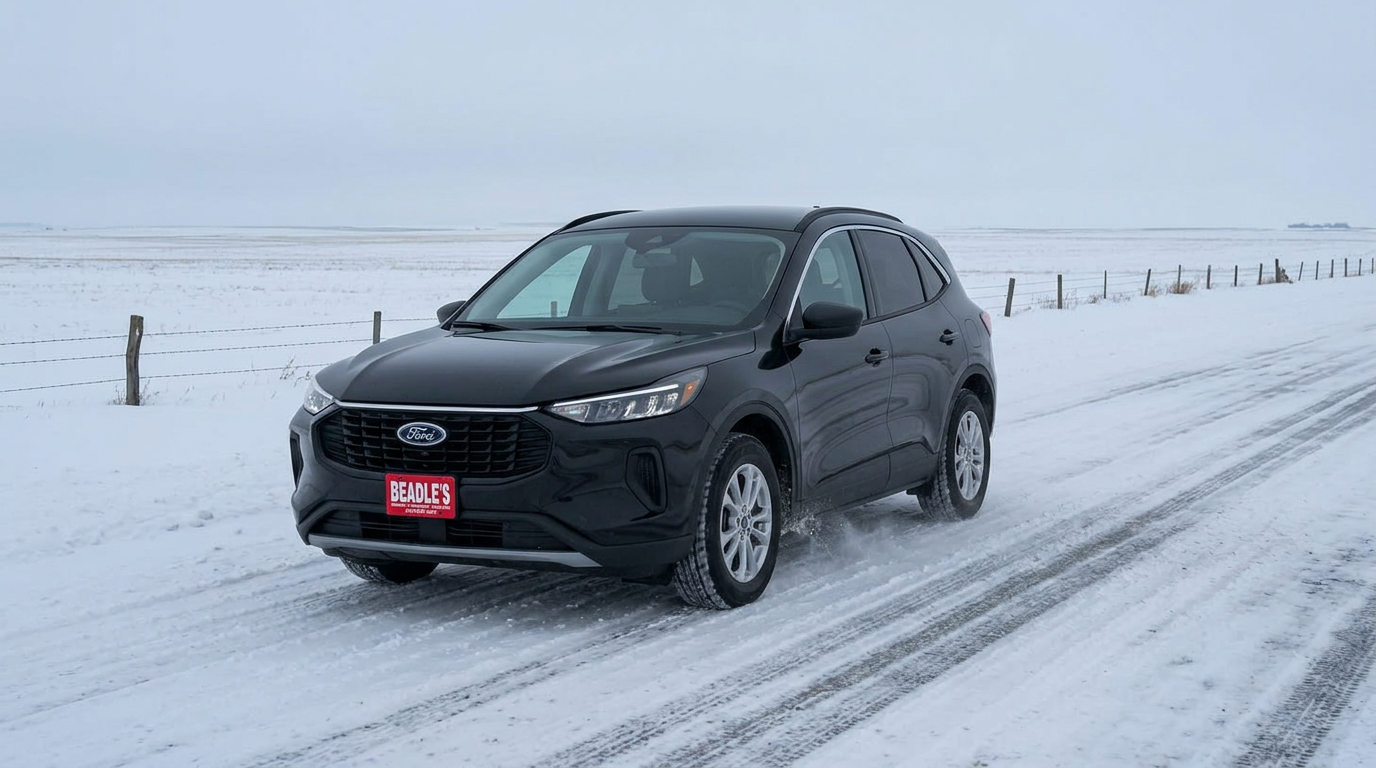
2026 Ford Escape AWD on snow-covered South Dakota highway in winter

2026 Ford Escape AWD in South Dakota Winters: What You Actually Need to Know

If you're shopping for a 2026 Ford Escape in South Dakota, AWD is probably on your checklist — and for good reason. But the answer to "does it come with AWD?" isn't a simple yes or no. Some trims include it standard. Some have it as an option you must add at the order stage. And one trim can't get it at all. Getting this wrong at purchase is costly — in most cases, drivetrain can't be changed after the vehicle is built. This guide covers what central South Dakota buyers specifically need to know: which 2026 Escape trims come with AWD, how the system performs on packed snow and gravel county roads, whether the optional AWD upgrade on entry trims is worth the cost, and why the PHEV has a limitation most buyers don't discover until it's too late. Shop Escapes in Stock Get Pre-Approved On This Page Which 2026 Ford Escape Trims Come with AWD? What Does Ford's Intelligent AWD Actually Do in Snow and Ice? Active and ST-Line AWD: Is the Optional Upgrade Worth It? Why PHEV Buyers Should Think Twice (It's FWD Only) How Does the Escape AWD Hold Up on Gravel Roads and Through South Dakota's Mud Season? Which 2026 Ford Escape Trims Come with AWD? AWD is standard — and the only drivetrain option — on the ST-Line Select, ST-Line Elite, and Platinum trims. On the Active and ST-Line, FWD comes standard and AWD is an option you must specifically select at order. The PHEV trim is front-wheel drive only with no AWD available at any configuration. Here's the full breakdown: Trim AWD Status Engine Active Optional (FWD standard — must add) 1.5L EcoBoost ST-Line Optional (FWD standard — must add) 1.5L EcoBoost ST-Line Select AWD Only — standard, no FWD 2.0L EcoBoost or 2.5L Hybrid ST-Line Elite AWD Only — standard, no FWD 2.0L EcoBoost or 2.5L Hybrid Platinum AWD Only — standard, no FWD 2.0L EcoBoost or 2.5L Hybrid PHEV FWD Only — no AWD available 2.5L Plug-In Hybrid The practical takeaway for buyers in this area: if you want AWD without having to think about it at the order stage, start at ST-Line Select. At that trim and above, every unit built is AWD — there is no FWD version to accidentally end up with. For buyers considering Active or ST-Line, AWD must be explicitly specified when the vehicle is ordered. You cannot add it to a finished vehicle later. What Does Ford's Intelligent AWD Actually Do in Snow and Ice? Ford's Intelligent All-Wheel Drive monitors wheel slip continuously and transfers torque between the front and rear axles as conditions change — without any driver input required. In normal driving, the system defaults toward front-wheel drive to preserve fuel economy. When it detects wheel slip on snow, ice, or slippery surfaces, it engages the rear axle and redistributes power to where traction is available. This is on-demand AWD, not a locked four-wheel-drive system. That distinction matters for South Dakota buyers. The Escape's Intelligent AWD is designed to handle the conditions most drivers in this area encounter most often: packed snow on county roads, ice-covered intersections, slippery highway on-ramps in January, and the slow grip loss that starts on a gravel road in early October. For those conditions, it performs well. Where it starts to show limits is in deeper unpacked snow, significant off-camber terrain, or situations where a driver wants to manually lock in four-wheel drive. That's where the Bronco Sport's standard 4x4 system with GOAT (Goes Over Any Type of Terrain) modes has a genuine edge. For most Escape buyers — highway commuters, school-run vehicles, buyers who see gravel roads but not serious off-road terrain — the Intelligent AWD is well-suited to what a central South Dakota winter actually looks like. The full 2026 Ford Escape overview at Beadle Ford covers the complete powertrain and AWD picture if you want to compare everything at once. Looking for Something in Stock? Check out these models available now at Beadle Ford. Ford Bronco Sport Standard 4x4, GOAT modes, staying in Ford's lineup. Built for South Dakota. Shop Escapes in Stock Ford Explorer More room, available 3-row seating, ready for the plains. Shop Escapes in Stock Ford Maverick Compact truck versatility at an Escape-comparable price. Shop Escapes in Stock Active and ST-Line AWD: Is the Optional Upgrade Worth It? For most South Dakota buyers, yes. Winter driving in Spink or Walworth County is not the same as winter driving in a warm-climate suburb, and the optional AWD on Active and ST-Line trims is one of those decisions where the cost of skipping it tends to show up in February. The critical point is that it's a factory-order decision — it must be selected when the vehicle is built. Once an FWD Escape leaves the assembly line, it stays FWD. Before committing to the AWD add on an Active or ST-Line, it's worth looking at the ST-Line Select as a comparison. The Select starts at AWD as its only configuration — no option needed, no risk of an FWD unit being delivered — and it also brings heated front seats, a heated steering wheel, remote start, a power liftgate, and body-color heated mirrors as standard equipment. At -15°F outside Bowdle on a January morning, those aren't comfort upgrades — they're practical ones. For many buyers, the total picture at ST-Line Select represents better value per dollar than adding only AWD to a base trim and still missing those features. That comparison gets clearer when you see all six trims laid out with specific feature detail. The 2026 Ford Escape trim levels guide walks through every trim with a South Dakota buyer's lens — including which features matter most in this climate and at this price point. Why PHEV Buyers Should Think Twice (It's FWD Only) The 2026 Escape PHEV is front-wheel drive only. There is no AWD option, no upgrade path, no workaround. That's confirmed in the 2026 order guide. If you purchase a 2026 Escape PHEV, it will be FWD — regardless of trim package or added options. The PHEV's approximately 37-mile EV-only range sounds appealing on paper, but that figure comes with a significant infrastructure assumption: regular access to Level 2 charging. In practice, the Level 2 charging network that makes plug-in hybrids most cost-effective is concentrated in larger cities. If you're primarily driving around Bowdle, Gettysburg, or Redfield, the realistic scenario involves Level 1 home charging — slower, and in many cases insufficient to keep the battery consistently topped for daily use. Many rural PHEV owners end up running in hybrid gas mode the majority of the time anyway, which means they've paid for plug-in capability they can't fully use, in a vehicle that can't get AWD. For central South Dakota buyers, the 2.5L Hybrid AWD — available on ST-Line Select, ST-Line Elite, and Platinum — is typically the more practical choice. It delivers strong fuel economy without requiring a charger, and AWD is standard on every unit. The PHEV has its place in the right situation; that situation is more easily found closer to a city with established charging infrastructure than it is in rural central South Dakota. How Does the Escape AWD Hold Up on Gravel Roads and Through South Dakota's Mud Season? AWD earns its value in central South Dakota well beyond December through February. The seasonal picture for a vehicle driven in this area breaks into four distinct challenges: deep-winter cold and packed snow from December through March, spring mud season on gravel roads through April and May, dry-season gravel and dust from June through September, and early freeze and frost conditions in October and November. Ford's Intelligent AWD handles the winter and fall scenarios well for a vehicle in the Escape's class — the on-demand torque transfer responds quickly to the kind of gradual slip that packed county roads and icy intersections produce. Spring mud adds a different kind of AWD value: gravel township roads that soften and rut through May are manageable with AWD in a way that FWD crossovers often aren't. The Escape isn't a dedicated mud vehicle — all-season tires and moderate ground clearance define its limits clearly — but it handles the general surface variability of rural South Dakota driving better than FWD alternatives in the same class. One honest caveat worth stating clearly: if your driving regularly involves unimproved ranch access roads, significant off-camber terrain, or anything approaching serious off-road conditions, the Escape AWD will reach its limits before the Bronco Sport does. The Bronco Sport's standard 4x4, higher ground clearance, and GOAT mode settings are built for more demanding use. For the majority of South Dakota Escape buyers — county road commuters, farm families using the vehicle as a daily driver, buyers who encounter gravel roads but not livestock trails — the Escape AWD handles the year-round reality of this area well. Key Takeaways AWD is standard on ST-Line Select, ST-Line Elite, and Platinum — on Active and ST-Line, it's an option that must be explicitly added at the order stage. The PHEV trim is front-wheel drive only — there is no AWD available on the 2026 Escape PHEV at any price point. Ford's Intelligent AWD handles packed snow, ice, and gravel roads well — it's well-matched to typical central South Dakota winter and spring driving conditions. ST-Line Select is where AWD becomes mandatory, and it also brings heated seats, heated steering wheel, and remote start — making it a single-decision answer to winter preparedness for most buyers. For buyers who need deeper off-road capability or want standard 4x4 engagement, the Bronco Sport is the stronger option in Ford's current lineup. Frequently Asked Questions Does the 2026 Ford Escape come with AWD standard? AWD is standard — and the only drivetrain option — on the ST-Line Select, ST-Line Elite, and Platinum trims. On the Active and ST-Line, FWD comes standard and AWD is an optional add that must be specified at order. The PHEV trim is front-wheel drive only with no AWD available at any configuration or price point. Is the 2026 Ford Escape hybrid AWD or FWD? It depends on which hybrid. The 2.5L Hybrid (gas-electric, non-plug-in) is AWD only — available on the ST-Line Select, ST-Line Elite, and Platinum trims. The 2.5L Plug-In Hybrid (PHEV trim) is front-wheel drive only, with no AWD option available on that trim. Can you get the 2026 Ford Escape PHEV with AWD? No. The 2026 Ford Escape PHEV is front-wheel drive only. There is no AWD configuration available for the PHEV trim at any price point. Buyers who want both plug-in hybrid capability and all-wheel drive will need to consider a different vehicle. Which 2026 Ford Escape trim is best for South Dakota winter driving? The ST-Line Select is the natural starting point for South Dakota buyers. AWD is standard on that trim with no FWD option, and it also includes heated front seats, a heated steering wheel, remote start, and a power liftgate — all of which matter in sub-zero temperatures. ST-Line Elite and Platinum add more comfort and technology upgrades. Active and ST-Line with the optional AWD add are viable, but require explicitly specifying AWD at order to avoid receiving an FWD unit. How does the Escape's AWD compare to the Bronco Sport's 4x4? The Escape uses Ford's Intelligent AWD, an on-demand system that monitors slip and engages the rear axle as conditions require. The Bronco Sport uses a standard 4x4 system with GOAT modes and higher ground clearance, designed for more demanding off-road and rough-terrain use. For typical South Dakota winter driving — packed snow, ice, gravel roads, spring mud — both are capable. The Bronco Sport has an advantage in deeper snow, off-camber terrain, and situations calling for engaged four-wheel drive. The Escape Hybrid AWD has an advantage in fuel economy on highway miles. My Take on AWD and the 2026 Ford Escape The AWD question comes up in almost every Escape conversation I have, and the answer that surprises most buyers is that it isn't guaranteed by the model — it depends on which trim they're actually ordering. My default starting point in those conversations is usually ST-Line Select, because AWD is already locked in, and so are the heated seats and remote start that make the first start of a February morning significantly less unpleasant. Getting all three in a single trim decision takes a lot of the complexity out of it. If you're trying to decide between adding AWD to an Active or ST-Line versus stepping up to Select, or if you're weighing the Escape against the Bronco Sport on traction grounds, I'm happy to walk through the specifics. Those are real trade-offs worth talking through before you commit. Stop by or give us a call. Shop Escapes in Stock Get Pre-Approved About the Author Lexy Tabbert — Beadle Ford, Bowdle, SD Lexy Tabbert is the Director of Sales and Marketing at Beadle Ford in Bowdle, South Dakota. She covers Ford vehicles, trim comparisons, and buyer guidance — helping families, ranchers, and ag operators across the region find the right truck and configuration for their needs. Learn more about Lexy.
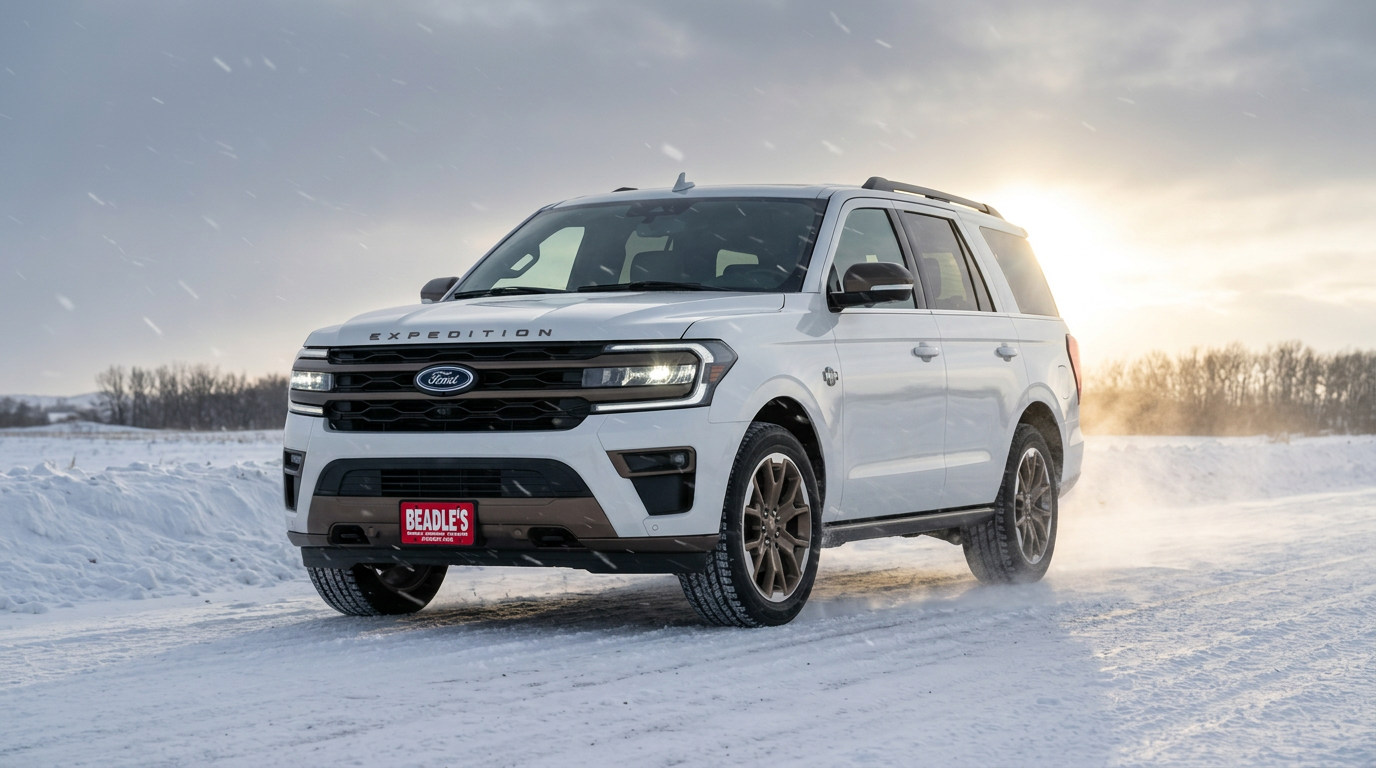
2027 Ford Expedition in Star White Metallic on a snowy South Dakota highway near Bowdle

2027 Ford Expedition vs. 2026 Toyota Sequoia: EcoBoost V6 vs. i-FORCE MAX Hybrid — and the Service Question Most Reviews Skip

Home› Ford Expedition› 2027 Ford Expedition› Expedition vs. Toyota Sequoia If you’re cross-shopping a 2027 Ford Expedition against a 2026 Toyota Sequoia, you’re choosing between two very different takes on the full-size three-row SUV. Ford brings a 3.5L EcoBoost V6 — with a 440 hp / 510 lb-ft High Output variant available — paired with BlueCruise hands-free highway driving. Toyota counters with a single powertrain: the i-FORCE MAX hybrid, a 3.5L twin-turbo V6 paired with an electric motor producing a combined 437 hp and 583 lb-ft of torque. Both are legitimate; they’re just optimized differently. This guide covers the decisions that actually matter for a Dakota buyer: how each powertrain behaves in real winter conditions, cargo and third-row usability, towing in cold weather with a hybrid (a real consideration north of I-90), the hands-free driving comparison, and dealer network accessibility — an honest look at what happens when your Sequoia needs service and your closest Toyota dealer is 60-plus miles away. Browse Expedition Inventory Ask About a Custom Order On This Page EcoBoost V6 vs. i-FORCE MAX hybrid — which works better in Dakota winters? Which SUV gives you more usable space? Can the Sequoia’s hybrid handle heavy trailers in cold weather? BlueCruise vs. Toyota Safety Sense — which hands-free system wins? Dealer network, resale, and cost of ownership — does Toyota reliability win here? EcoBoost V6 vs. i-FORCE MAX hybrid — which works better in Dakota winters? Both trucks use twin-turbocharged V6 engines; the difference is what Toyota adds on top. The 2027 Ford Expedition runs the 3.5L EcoBoost V6 as the standard engine with a 3.5L EcoBoost V6 High Output at 440 hp / 510 lb-ft optional on Tremor, Platinum Stealth Performance, and Platinum Ultimate. Toyota’s 2026 Sequoia offers one powertrain only — the i-FORCE MAX hybrid, pairing a 3.5L twin-turbo V6 with an electric motor and a nickel-metal hydride battery pack for a combined 437 hp and 583 lb-ft of torque. Both use 10-speed automatic transmissions. For hot climates and stop-and-go driving, hybrids shine. For our climate, the calculus shifts. Nickel-metal hydride batteries — the chemistry Toyota uses in the Sequoia’s hybrid system — perform meaningfully worse in sustained cold. At -10°F or colder (which we see several weeks a winter), a hybrid’s regenerative braking is less effective, battery efficiency drops, and the electric motor contributes less. You’re running on the gas engine more and the hybrid advantage narrows. The EcoBoost V6, by contrast, behaves consistently regardless of temperature — it’s the same engine at 80°F as it is at -20°F. The practical takeaway: if most of your driving is interstate cruising in reasonable weather, the Sequoia’s hybrid gets stronger fuel economy, especially at lower speeds. If you drive through a Dakota winter every year, the EcoBoost V6’s consistency matters. And if you want the 440 hp High Output engine and the factory off-road Tremor trim, those simply aren’t options Toyota offers. The full 2027 Expedition trim and engine breakdown is in the complete 2027 Ford Expedition overview. Which SUV gives you more usable space? The Expedition wins most of the practical space comparisons, and independent reviews from Edmunds and others have consistently called this out. The Ford’s third row is genuinely adult-usable, with leg and headroom that supports taller passengers on longer trips — Bowdle to Fargo with three kids across the back row works without complaints. The Sequoia’s third row is narrower and has less legroom; it’s better described as kid-friendly rather than adult-friendly. Cargo behind the third row is where the Sequoia has a specific geometry quirk. Because of how Toyota packaged the hybrid battery pack, the Sequoia’s load floor is higher and the third-row seatbacks don’t fold flat — you end up with a raised, uneven surface when the third row is folded down. The Expedition’s third row folds flat and the cargo floor is at a consistent height, which matters when you’re loading a generator, a cooler, or long gear. Inside, the Expedition brings the 24" panoramic driver display and 13.2" center display as the Ford Digital Experience standard from Active (200A) and up, with Google Maps, Google Assistant, and Google Play Store embedded natively plus wireless Apple CarPlay and Android Auto. The Sequoia runs Toyota’s 14" multimedia touchscreen with wireless CarPlay/Android Auto on most trims — a capable system, but the visual experience is different. If you need the MAX-length body style for even more cargo and third-row space, the Expedition MAX is available on Active, Platinum, and King Ranch (the Tremor is standard-length only). The Expedition vs. Expedition MAX guide walks through that body-style decision. Toyota does not offer an extended-length Sequoia. Can the Sequoia’s hybrid handle heavy trailers in cold weather? On paper, the Sequoia tows well. Toyota publishes a maximum trailer rating of approximately 9,520 lbs when properly equipped — functionally in the same ballpark as the Expedition Tremor’s reported 9,600 lbs. For a standard gooseneck loaded with livestock or a 24-foot enclosed trailer with a side-by-side, either truck handles it. The question isn’t peak capacity; it’s how each truck delivers that capability in adverse conditions. Cold-weather towing is a real consideration with a hybrid. Hybrid batteries lose efficiency in sustained cold, and when you’re towing heavy — 7,000 or 8,000 lbs behind you — the electric motor is contributing less of the torque and the gas engine is working harder. On long cold-weather hauls, Sequoia owners have reported lower-than-advertised fuel economy and more frequent engine loading. A turbocharged V6 like the EcoBoost maintains consistent power delivery regardless of temperature, which is why long-range towing consistency is one place the Expedition has an advantage. Pro Trailer Hitch Assist and Pro Trailer Backup Assist are standard on every retail Expedition trim via Ford Co-Pilot360 Assist 2.0. The 360-degree camera includes a trailer view specifically designed for hitching and navigating narrow hauling situations. BLIS with Trailer Coverage extends the blind-spot monitoring around the length of whatever you’re pulling. Toyota offers comparable features on upper Sequoia trims, but they’re more package-dependent on the Toyota side than on the Ford side. Official 2027 Expedition tow ratings will be confirmed when Ford releases the 2027 Towing Guide. If you’re sizing an Expedition to a specific trailer, contact Beadle Ford and we’ll run the configuration against your actual load. Ready to explore the Ford side? Get Pre-Approved Browse Current Expedition Inventory BlueCruise vs. Toyota Safety Sense — which hands-free system wins? Ford has the more mature hands-free highway driving system. BlueCruise works on approximately 97% of controlled-access U.S. and Canada highways with driver-facing camera monitoring, Lane Change Assist, and In-Lane Repositioning. Active Touring (202A) includes a 90-Day BlueCruise trial on retail orders; Platinum Ultimate (17A) and King Ranch (400A) come with a 1-Year + 90-Day plan standard. Toyota’s 2026 Sequoia comes standard with Toyota Safety Sense 3.0 — Dynamic Radar Cruise Control, Lane Departure Alert with Steering Assist, Pre-Collision System with Pedestrian Detection, Road Sign Assist, and Blind Spot Monitor. It’s comparable to Ford Co-Pilot360 Assist 2.0 for the core driver-assist tier. What Toyota doesn’t offer at the Sequoia price point is a direct BlueCruise competitor — true hands-free highway driving with driver monitoring across a mapped road network. Nissan offers ProPilot 2.0 on its Ariya and some other models; GM offers Super Cruise on Tahoe and Suburban. Toyota’s hands-free capability on the Sequoia is narrower in scope. If hands-free highway driving matters to you — especially on the long I-90 or US-281 hauls most Dakota drivers know well — BlueCruise is the clearer answer on this cross-shop. The BlueCruise vs. Super Cruise vs. ProPilot 2.0 guide walks through which system covers which roads and which buyer fits which system. Dealer network, resale, and cost of ownership — does Toyota reliability win here? Toyota’s reputation for reliability is real. It shows up in resale data, in long-term ownership studies, and in the fact that you’ll see 15-year-old Tundras and Sequoias still in daily service. But reliability is only part of the cost-of-ownership equation, and in rural South Dakota, the dealer network side of that equation often matters more. If you live in Bowdle or anywhere in north-central South Dakota and you buy a Sequoia, your closest Toyota dealer for service, warranty work, or hybrid-system diagnostics is roughly 60-plus miles away. That’s a real consideration. Recall work, a 30,000-mile service interval, a brake job, a hybrid inverter warning on the dashboard — every one of those becomes a day trip. If something goes wrong under warranty that requires multiple visits, it’s multiple day trips. Beadle Ford is in Bowdle. Service is local. The techs working on your Expedition know the truck because they’ve been working on Expeditions for years. Ford parts are nationally available. Neither is a “Toyota is worse” argument — both brands build reliable trucks. But when you factor in the accessibility of routine service, warranty work, and emergency repairs over a five or seven-year ownership period, the dealer network question meaningfully narrows Toyota’s reliability advantage. Hybrid-specific maintenance is worth naming too. The i-FORCE MAX system is well-engineered, but it adds components — battery pack, inverter, electric motor — that a naturally aspirated V8 or a turbo V6 like the EcoBoost doesn’t have. Long-term battery replacement at 10+ years is a real out-of-warranty cost to plan for on any hybrid. The Expedition’s EcoBoost V6 is a conventional powertrain with well-understood long-term service costs. Key Takeaways Ford offers two engines (standard 3.5L EcoBoost V6 and the 440 hp / 510 lb-ft High Output); Toyota offers one (i-FORCE MAX hybrid at 437 hp / 583 lb-ft combined). Hybrid powertrains lose efficiency in sustained cold. EcoBoost V6 performance is consistent regardless of temperature. Expedition’s third row and cargo behind the third row are more usable than the Sequoia’s, largely because of hybrid battery packaging. BlueCruise offers more mature hands-free highway coverage than Toyota Safety Sense 3.0 provides on the Sequoia. Service network matters in rural SD. Beadle Ford is in Bowdle; the nearest Toyota dealer is 60-plus miles away. No factory off-road Sequoia trim comparable to the Expedition Tremor; no Sequoia MAX-length option. Frequently Asked Questions How does the 2027 Ford Expedition compare to the 2026 Toyota Sequoia? Ford uses the 3.5L EcoBoost V6 (with a 440 hp / 510 lb-ft High Output variant) and offers BlueCruise hands-free driving, five trims including the off-road Tremor, and a MAX body style. Toyota offers one i-FORCE MAX hybrid powertrain at a combined 437 hp / 583 lb-ft, no off-road trim, and no extended-length Sequoia. Expedition wins on third-row space and cargo-floor flatness; Sequoia wins on hybrid fuel economy in non-winter conditions. Is the Toyota Sequoia’s hybrid better in the cold than the Ford EcoBoost V6? No. Hybrid batteries lose efficiency in sustained cold, and the Sequoia’s i-FORCE MAX relies on its electric motor for part of its power delivery. In a Dakota winter, you’re running on the gas engine more and the hybrid advantage narrows. The EcoBoost V6 behaves consistently regardless of temperature. Which has more third-row room, the Expedition or the Sequoia? The Expedition has meaningfully more usable third-row space for adult passengers, as reviewed by Edmunds and other independent outlets. The Sequoia’s third row is narrower with less legroom due to hybrid battery packaging, and the cargo floor behind the third row is raised and uneven when folded. How much can the Expedition tow vs. the Sequoia? The 2026 Toyota Sequoia publishes a maximum trailer rating of approximately 9,520 lbs when properly equipped. Public reporting on the current-generation Expedition Tremor cites approximately 9,600 lbs when properly equipped. Official 2027 Expedition tow ratings will be confirmed when Ford releases the 2027 Towing Guide. Both are in the same functional range for most real trailers. Does the Sequoia have a hands-free driving system like BlueCruise? Not directly. The 2026 Toyota Sequoia includes Toyota Safety Sense 3.0 as standard — Dynamic Radar Cruise Control, Lane Departure Alert with Steering Assist, Pre-Collision System, and Blind Spot Monitor — but it doesn’t offer true hands-free highway driving at the Expedition’s BlueCruise tier. Ford’s BlueCruise works on approximately 97% of controlled-access U.S. and Canada highways. Where’s the nearest Toyota dealer to Bowdle? The nearest Toyota dealership to Bowdle is roughly 60-plus miles away. Routine service, hybrid-system diagnostics, recalls, and warranty work require a round trip. Beadle Ford is in Bowdle — service for an Expedition is local and same-day possible for most issues. Does the Expedition have a direct competitor to the Sequoia’s hybrid powertrain? No. The 2027 Ford Expedition is offered only with the 3.5L EcoBoost V6 family — standard, or the 440 hp / 510 lb-ft High Output variant on Tremor, Platinum Stealth Performance, and Platinum Ultimate. There is no hybrid or electric Expedition variant. If a hybrid powertrain is a non-negotiable, the Sequoia is the direct pick in this class. My Take on the Expedition vs. Sequoia Cross-Shop The Sequoia is a well-built truck, and if you’re committed to a hybrid powertrain, it’s the cleanest answer in this class. I won’t pretend otherwise. But for the buyers we see at Beadle Ford — families commuting between Bowdle and Sioux Falls, ranchers hauling stock trailers through Dakota winters, or anyone who’s thinking about hands-free highway driving on their regular routes — the Expedition typically wins on the practical details. Third-row usability, cargo-floor flatness, BlueCruise coverage, and local service accessibility all stack in Ford’s favor for how most of our customers actually drive. The real test is a side-by-side drive with a cold-weather trailer in mind. If you’re serious about this decision, come drive an Expedition and we’ll talk through your specific use case against the Sequoia honestly. The right answer depends on your week, not on a spec sheet. Shop 2027 Expeditions in Stock Contact Beadle Ford About the Author Lexy Tabbert — Beadle Ford, Bowdle, SD Lexy Tabbert is the Director of Sales and Marketing at Beadle Ford in Bowdle, South Dakota. She covers Ford vehicles, trim comparisons, and buyer guidance — helping families, ranchers, and ag operators across the region find the right truck and configuration for their needs. Learn more about Lexy.
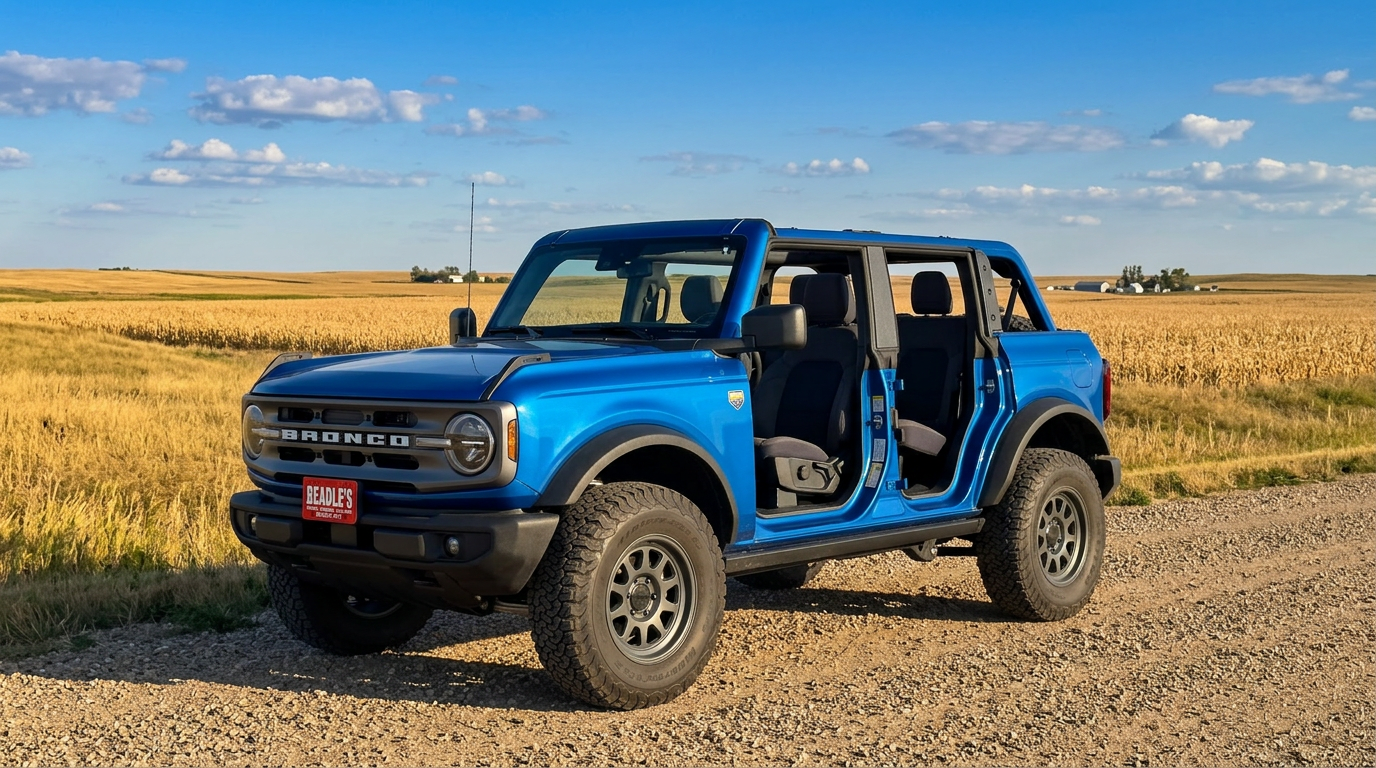
2026 Ford Bronco Big Bend with the doors removed and front roof panels off, parked on a South Dakota gravel road through CRP grassland on a summer afternoon

2026 Ford Bronco Removable Doors and Roof: A Practical Owner's Guide

The removable doors and roof are the single feature most buyers ask about — and the feature most owners use less than they expect. Done right, taking the doors off a Bronco for a summer evening drive across the central South Dakota plains is one of the real pleasures of ownership. Done wrong, it's a Saturday spent fighting with panels in your garage and a winter spent regretting the soft-top order you made in July. This is a practical owner's guide for a 2026 Bronco buyer in Bowdle and the central SD region. We'll cover what comes off and what doesn't, how the removal actually works, where to store doors and panels at home, soft top versus hardtop in a cold climate, theft and security when the doors are off, and when you'll really want the doors off in central SD. The honest take is in here, not just the sales sheet version. Shop Broncos in Stock Get Pre-Approved On This Page What Comes Off and What Stays On When You Remove the Bronco's Doors and Roof? How Does the Step-by-Step Doors and Roof Removal Actually Work? Where Should I Store the Doors and Roof Panels at Home? Soft Top or Hardtop: Which Is the Right Choice in a Cold Climate? Are the Doors Off a Theft or Security Concern Around Town? When Will I Actually Want the Doors Off in Central South Dakota? What Comes Off and What Stays On When You Remove the Bronco's Doors and Roof? All four doors come off — they're frameless, lift straight up off the hinges, and the wiring connector unplugs cleanly. The roof is modular: on a hardtop, the two front panels above the driver and front passenger lift off independently for a sunroof-style opening, and the rear section over the back seats and cargo area can come off as a third piece. On a soft top, the entire fabric assembly folds back and stays attached to the vehicle. What stays on regardless of the configuration: the windshield, the body-mounted sideview mirrors, the cowl, and the roll cage that's integrated into the body structure. The mirrors staying with the vehicle is the practical detail that separates the Bronco from a Wrangler — Wrangler mirrors are door-mounted, so when doors come off, mirrors come off too, and aftermarket frame-mounted mirrors are required for legal on-road driving without doors. On the Bronco you can take the doors off, hop in, and drive without thinking about the mirror situation. The Tool Kit for removable doors and tops is standard equipment on the Base trim, which means every Bronco above Base inherits it as well. Tube doors are an available accessory at $850 for 2-Door and $1,250 for 4-Door if you want a doors-off look with side-rail protection — useful for buyers who want the open-air feel without leaving doors at home. For the full Bronco vs Wrangler comparison see our 2026 Bronco vs Jeep Wrangler honest comparison. How Does the Step-by-Step Doors and Roof Removal Actually Work? For a single door: roll the window down, unplug the wiring connector inside the door jamb, pull the strap loose from the body, remove the two hinge bolts with the supplied Torx tool, and lift the door straight up off the hinge pins. The first time you do this, plan on twenty minutes per door because you'll be looking up the steps. After the third or fourth time, it's about five minutes per door. For the front roof panels on a hardtop: from inside the cabin, release the two over-center latches on each panel, lift the panel free, and store it. Each front panel takes well under a minute. The rear section is heavier and is a two-person job — bolts and clips along the rear pillar release the section, and you'll want a partner to handle weight and avoid scratching the body. Most owners pull the front panels far more often than the rear section, which is by design. Practical tip: the doors are heavier than they look. A 4-Door Bronco's rear doors are manageable solo if you have decent grip and back, but the larger 2-Door front doors are easier with two people. If you're working alone, a folding moving blanket on a workbench gives you a soft place to set the door without scuffing the paint or the wiring connector. Where Should I Store the Doors and Roof Panels at Home? Plan on roughly the floor area of a closet for four 4-Door doors set vertically against a wall, plus a flat space the size of a standard countertop for stacked roof panels. The Ford-supplied storage bags are worth using — they protect the painted body color, the wiring connectors, and the latches from dust and incidental contact in a working garage. Wall-mount door hangers are an aftermarket accessory worth the money if you're going to remove doors more than once a season. A summer evening on a ranch property is the use case the doors-off configuration was built for. The four-to-six month window in central SD is the realistic season. The most common mistake we see at trade-in is doors and panels stored on a concrete floor without protection — by year three, the bottom edges of the doors show wear that cosmetic detail won't hide. Store them off the ground, ideally on a wall hanger or a foam-padded shelf. Roof panels lay flat with the painted side up. If you don't have garage space — common for ranch-area owners whose garages are full of hay, equipment, or another vehicle — that's a strong signal to skip the soft-top configuration entirely and run the hardtop year-round. There's no shame in admitting a feature won't get used. Storage logistics derail the doors-off lifestyle for more owners than the doors-off lifestyle delivers value to. Soft Top or Hardtop: Which Is the Right Choice in a Cold Climate? For a year-round daily driver in central South Dakota, a hardtop is the right answer for almost every buyer. The soft top is functional through SD winters, but it loses cabin heat faster, lets in more highway noise at speed, and shows wear faster on a vehicle that lives outdoors through a Bowdle winter. Most experienced Bronco owners in the area run a hardtop year-round and use the front roof panels for occasional sunroof-style summer driving. Hardtop attached, year-round. The Heritage Edition's standard Oxford White-painted hardtop is one example; every other trim has its own hardtop options at various price points. The Dual Tops add-in (order code 66J) at $1,995 is the splurge option — it bundles a soft top with the hardtop so you can swap by season. We see this ordered most often by buyers who actually live the doors-off summer lifestyle and have garage space to store the second top. For most central SD buyers it's not worth the money; the front roof panels of the modular hardtop already deliver most of the open-air experience without the storage headache. Painted hardtops are a separate decision. Body-color and contrast painted hardtops are available at upcharges across most trims; the Heritage Edition gets its standard Oxford White-painted hardtop at no extra charge. The painted top is a styling decision more than a functional one — every hardtop seals and insulates the same way regardless of the paint. For the SD winter side of this equation see our South Dakota winter driving guide. Get Pre-Approved Contact Beadle Ford Are the Doors Off a Theft or Security Concern Around Town? In Bowdle and small-town central SD generally, doors-off vehicle theft is rare to the point of irrelevance. The bigger practical concern is theft from inside the cabin — anything visible in the interior is reachable in seconds when there are no doors. That means stowing a wallet, phone, firearm, or rifle case before you walk away from the vehicle, even for a quick stop at the post office or coffee shop. The center console locks on most Bronco trims, which gives you a small secure spot for keys, a wallet, or a phone. A hardtop with the rear section attached lets you lock items in the cargo area behind the rear seats. With the doors off and the front roof panels removed, treat the cabin like an open boat — no valuables visible, no firearms visible, period. Insurance generally treats doors-off driving the same as doors-on driving in terms of comprehensive coverage, but if you're storing doors at a property other than your residence (a cabin, a hunting camp, a parents' garage), check that they're covered there too. We've never had a customer report a theft of removed doors, but we've heard of damage from a falling shelf in a garage where the doors weren't properly stored. When Will I Actually Want the Doors Off in Central South Dakota? The realistic doors-off window in central SD is roughly May through early October — a four-to-six month season. Within that window, the use cases that earn the configuration are summer evening drives across the plains, slow scouting runs through CRP and harvested fields, ranch-property loop drives at golden hour, lake-access trips on warm afternoons, and the occasional Black Hills weekend where the temperature stays above sixty. By the time pheasant season opens in late October, almost every Bronco in the area has its doors and front panels back on. November through April is hardtop weather across central SD — and the front panels usually stay on too, since spring is unpredictable enough that "above sixty" days are exceptions before May. The doors-off lifestyle in central SD is real, but it's a summer privilege, not a year-round one. We get into the seasonal hunting-rig context in detail in our South Dakota hunting guide. What this means for the buying decision is simple. The removable doors and roof are real features that add real value during the summer months — they're not marketing fluff. They're also features most owners use a few dozen times a year, not a few hundred. Pricing the soft-top and dual-tops options against that realistic usage is part of getting the build right. The full lineup and configuration choices come together in the 2026 Ford Bronco overview, which lays out trims, top options, and pricing side by side. Key Takeaways All four doors and the front roof panels come off; the rear roof section is a heavier two-person job. Bronco mirrors are body-mounted, so they stay attached when doors come off — no aftermarket mirror required for legal on-road driving. For year-round SD use, spec a hardtop. The Dual Tops add-in (66J, $1,995) is for buyers with garage space who actually live the summer doors-off lifestyle. Plan on closet-floor space for stored doors and a countertop-sized flat area for roof panels. Wall-mount door hangers are worth the money if you remove doors more than once a season. The realistic doors-off window in central SD is May through early October — a four-to-six month season, not a year-round feature. Frequently Asked Questions How long does it take to remove the doors and roof on a 2026 Ford Bronco? First time, plan on roughly twenty minutes per door because you'll be referring to the manual. Once you've done it three or four times, it drops to about five minutes per door. The two front roof panels on a hardtop release in well under a minute each. The rear roof section is heavier and is a two-person job that takes longer. Do the sideview mirrors stay attached when the Bronco's doors come off? Yes. The Bronco's sideview mirrors are mounted to the body, not the doors, so they stay attached when the doors are removed. This is different from the Jeep Wrangler, where the mirrors are door-mounted and aftermarket frame-mounted mirrors are required for legal on-road driving without doors. Should I order a soft top or a hardtop on a 2026 Bronco for South Dakota? For a year-round daily driver in central South Dakota, a hardtop is the right call for almost every buyer. The soft top is functional through SD winters, but it loses cabin heat faster, lets in more highway noise at speed, and shows wear faster on a vehicle that lives outdoors. The Dual Tops add-in ($1,995) bundles both for buyers with garage space and a genuine summer doors-off use case. How much storage space do the doors and roof panels take in a garage? Roughly the floor area of a closet for four 4-Door doors set vertically against a wall, plus a countertop-sized flat space for stacked roof panels. The Ford-supplied storage bags are worth using to protect the paint and connectors. Aftermarket wall-mount door hangers are a worthwhile add if you remove doors more than once a season. Are tube doors a good substitute for the standard frameless doors? Tube doors are an available accessory at $850 for 2-Door and $1,250 for 4-Door, and they're a smart option for owners who want the doors-off open-air feel with side-rail protection. They don't replace the standard frameless doors for highway driving — there's no glass, no insulation, and no weather sealing — but for ranch-property summer use or short slow drives they work well. How many months a year will I actually drive doors-off in central South Dakota? A realistic central SD doors-off window is May through early October — four to six months, depending on spring and fall temperatures. By the late-October pheasant opener almost every Bronco in the area has its doors and front roof panels back on. For winter, the doors stay on every time. My Take on the Bronco's Removable Doors and Roof I've watched plenty of customers walk in convinced they need the soft-top configuration because they want the open-air feel — and most of them, after a few months of ownership, end up running the hardtop year-round and pulling the front panels for the warm Saturdays they actually want them. That's not a failure of the soft top; it's just the realistic central SD use case. The doors-off summer evening drive is one of the moments that earns the Bronco its reputation. It's also a moment that happens twenty or thirty times a year, not two hundred. If you're weighing the top configuration on a build, come in and let's talk through the actual storage you have at home and how you'll really use the vehicle. We'd rather steer a customer toward the right top up front than answer a regret call in February. The doors-off feature is real and worth talking about — it's also worth being honest about how it fits into a Bowdle-area life. Shop Broncos in Stock Get Pre-Approved About the Author Lexy Tabbert — Beadle Ford, Bowdle, SD Lexy Tabbert is the Director of Sales and Marketing at Beadle Ford in Bowdle, South Dakota. She covers Ford vehicles, trim comparisons, and buyer guidance — helping families, ranchers, and ag operators across the region find the right truck and configuration for their needs. Learn more about Lexy.
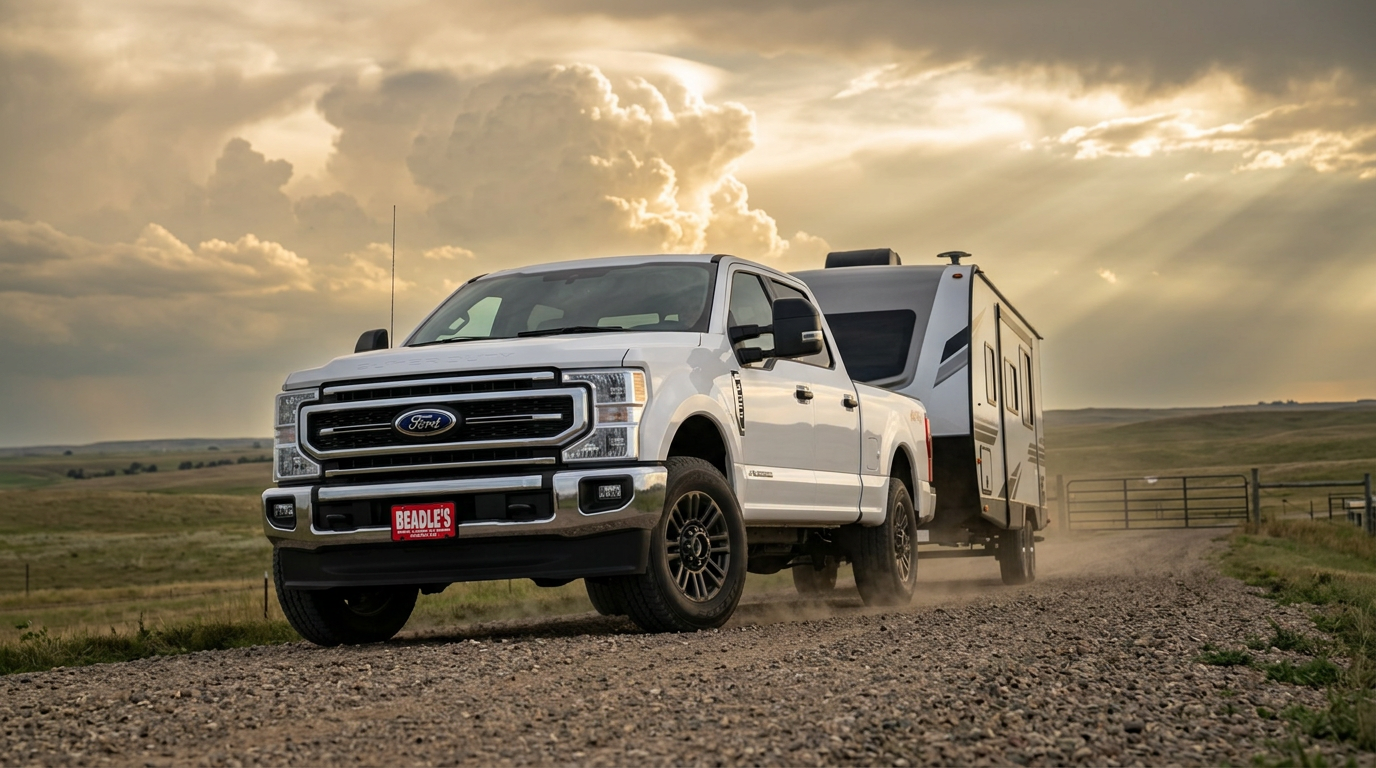
2027 Ford F-250 towing a travel trailer in South Dakota

2027 Ford F-250: 7.3L Gas vs. 6.7L HO Diesel

Quick Answer The 2027 F-250 offers a standard 7.3L gas V8 and an optional 6.7L High-Output Power Stroke diesel. The gas V8 tows up to about 19,500 lbs and suits daily driving and occasional towing; the diesel raises the maximum to 23,000 lbs gooseneck for heavy, frequent hauling. With the 2027 F-250 down to two engines, the choice is cleaner than it used to be: the now-standard 7.3L gas V8, or the available 6.7L High-Output Power Stroke diesel. For most buyers around here, the real question isn't which engine is "better" — it's how often and how heavy you actually tow. This guide breaks down what each engine tows, when the gas V8 is the smarter buy, when the diesel earns its premium, and what each costs to own over time — framed for the occasional-to-regular tower in central South Dakota. Shop F-250s in Stock Reserve a 2027 F-250 Get Pre-Approved On This Page What engines does the 2027 F-250 offer? How much can the gas V8 tow vs. the HO diesel? When is the 7.3L gas the smarter buy? When does the HO diesel pay off? What does each engine cost to own? What engines does the 2027 F-250 offer? Two. The 7.3L gas V8 is standard on every trim, and the 6.7L High-Output Power Stroke V8 turbo diesel is optional across the line. Both use a 10-speed TorqShift automatic. The 7.3L gas is a big, simple, naturally aspirated V8 — strong, easy to live with, and inexpensive to maintain. The High-Output diesel trades that simplicity for far more low-end torque and the highest tow ratings in the F-250 lineup. There's no longer a "middle" engine to overthink; you're choosing between a capable standard gas V8 and the heavy-haul diesel. How much can the gas V8 tow vs. the HO diesel? Properly equipped, the 7.3L gas tows up to about 19,500 lbs on a fifth-wheel or gooseneck and 18,200 lbs conventional. The 6.7L High-Output diesel raises that to up to 23,000 lbs gooseneck, 22,100 lbs fifth-wheel, and 22,000 lbs conventional with the F-250 High-Capacity Axle Upgrade. That gap matters only if your trailer lives in it. A loaded tandem-axle stock trailer or a typical fifth-wheel camper sits comfortably inside the gas truck's range. It's the heavy gooseneck — equipment, big livestock loads, the trailer that's near the top of the range every week — where the diesel's extra ceiling and torque pull ahead. Max towing (properly equipped) 7.3L Gas V8 6.7L HO Diesel Conventional Up to 18,200 lbs Up to 22,000 lbs Fifth-wheel About 19,500 lbs Up to 22,100 lbs Gooseneck About 19,500 lbs Up to 23,000 lbs Maximums require proper equipment and vary by cab, bed, axle, and configuration. The highest diesel ratings require the F-250 High-Capacity Axle Upgrade. When is the 7.3L gas the smarter buy? When you tow occasionally rather than constantly, and your loads stay under roughly 19,500 lbs. For a camper on weekends, a stock trailer to the sale barn, or an occasional gooseneck, the gas V8 has the room without the diesel's upfront cost or added upkeep. It also wins on the unglamorous stuff: a lower purchase price, cheaper oil changes, no diesel exhaust fluid to manage, and easier cold-weather starting in a Dakota January. For a truck that spends most of its life unloaded and tows on weekends, that adds up. Our Recommendation For most F-250 buyers around Bowdle and Aberdeen — daily drivers who tow a camper or a gooseneck occasionally — the standard 7.3L gas V8 is the smarter buy. It covers up to about 19,500 lbs of towing and saves you several thousand dollars up front plus the diesel's ongoing maintenance. When does the HO diesel pay off? When you tow heavy and often. The High-Output diesel's extra torque, higher tow ceiling, and better fuel economy under load make it worth the premium for buyers who run near the top of the range regularly — loaded goosenecks, equipment hauling, or long highway miles with a fifth-wheel. The diesel also tends to hold its value well and is built for high-mileage, hard-working duty cycles. If towing is your truck's main job rather than an occasional weekend, the diesel usually earns back its upfront cost in capability, comfort under load, and resale. Pair it with the High-Capacity Axle Upgrade to unlock the 23,000-lb gooseneck maximum. What does each engine cost to own? The gas V8 is cheaper to buy and cheaper to maintain; the diesel costs several thousand dollars more up front and more per service, but returns better towing fuel economy and stronger resale. Ford has not yet published final 2027 pricing, so the exact diesel premium is to be confirmed. The honest math comes down to use. If you tow occasionally, the gas truck's lower cost of ownership is hard to beat. If you tow heavy and rack up loaded miles, the diesel's efficiency and durability under load close the gap and often come out ahead over a long ownership period. Factor 7.3L Gas V8 6.7L HO Diesel Best for Daily driving, occasional towing Heavy, frequent towing Upfront cost Lower (standard) Several thousand more Maintenance Lower; no DEF Higher; DEF, larger oil capacity Towing fuel economy Good for the class Better under heavy load Resale Solid Strong, especially high-mileage From the Beadle Ford Lot The question we ask every gas-versus-diesel shopper is the same: what's your heaviest trailer, and how often do you pull it? When we weigh a buyer's actual loaded trailer against the now-standard 7.3L gas, most realize the gas truck covers it with room to spare — and the diesel decision turns out to be about frequency, not whether it'll handle the job. Key Takeaways The 7.3L gas V8 is standard and tows up to about 19,500 lbs on a fifth-wheel or gooseneck. The 6.7L High-Output diesel raises the max to 23,000 lbs gooseneck with the High-Capacity Axle Upgrade. Choose the gas V8 for daily driving and occasional towing; choose the diesel for heavy, frequent hauling. The gas V8 costs less to buy and maintain; the diesel returns better towing economy and stronger resale. The deciding factor is frequency and trailer weight, not whether the gas truck can do the job. Frequently Asked Questions Is the 7.3L gas enough for towing a fifth-wheel? For most fifth-wheel campers, yes. The 7.3L gas V8 tows up to about 19,500 lbs on a fifth-wheel or gooseneck, properly equipped, which covers the large majority of recreational fifth-wheels. Step up to the diesel if your loaded trailer runs higher or you tow heavy every week. How much more can the diesel tow than the gas V8? The 6.7L High-Output diesel tows up to 23,000 lbs gooseneck and 22,000 lbs conventional with the High-Capacity Axle Upgrade, versus about 19,500 lbs gooseneck and 18,200 lbs conventional for the 7.3L gas. That's roughly 3,500 to 4,000 lbs more capability at the top. Does the diesel cost more to own? Up front and per service, yes — the diesel is a several-thousand-dollar option and costs more to maintain, including diesel exhaust fluid and larger oil changes. It returns better fuel economy under heavy load and stronger resale, so over a long ownership period of frequent towing it can come out ahead. Which engine is better for South Dakota winters? The 7.3L gas V8 is the simpler cold-weather choice — easy starting in deep cold and no diesel-specific cold-start considerations. Diesels run fine in Dakota winters with proper fuel and plug-in use, but for a truck that mostly drives unloaded, the gas V8 is lower-hassle. Do I need the High-Capacity Axle Upgrade? Only if you want the diesel's maximum tow ratings. The F-250 High-Capacity Axle Upgrade is what unlocks the 23,000-lb gooseneck and 22,000-lb conventional figures on the High-Output diesel. If your loads sit well below those numbers, you may not need it — we can match the axle to your trailer. Quick Answers: 2027 F-250 Gas vs. Diesel One-line answers to the follow-up questions buyers ask next. Which engine is standard? The 7.3L gas V8. Gas towing max? About 19,500 lbs fifth-wheel/gooseneck, 18,200 lbs conventional. Diesel towing max? Up to 23,000 lbs gooseneck with the High-Capacity Axle Upgrade. Which is cheaper to buy? The gas V8 — it's standard. Which is cheaper to maintain? The gas V8 — no DEF, smaller oil changes. Which has better towing fuel economy? The diesel, under heavy load. Which holds value better? The diesel, especially at high mileage. Best for occasional towing? The 7.3L gas V8. Best for daily heavy hauling? The 6.7L High-Output diesel. Do both use the same transmission? Yes — a 10-speed TorqShift automatic. Keep Researching The complete 2027 Ford F-250 Super Duty overview — trims, towing, specs, and inventory 2027 F-250 for recreational towing — campers and fifth-wheels on the gas V8 What's new for the 2027 F-250 — the four-to-two engine change explained Is an F-250 enough truck? — when to consider stepping up to an F-350 My Take on Gas vs. Diesel in the 2027 F-250 I steer a lot of people toward the gas V8, and not because it's the cheaper sale — it's because most of the folks who ask me are towing a camper or a stock trailer a handful of times a year, not running a loaded gooseneck every week. For that buyer, the now-standard 7.3L is genuinely the right truck, and it keeps several thousand dollars in their pocket. When someone really does pull heavy and often, the diesel is the obvious call and I'll say so. The best way to settle it is to tell me your heaviest trailer and how often you pull it. Bring those numbers to Beadle Ford in Bowdle and we'll match the engine to how you actually use the truck. Shop F-250s in Stock Reserve a 2027 F-250 Get Pre-Approved About the Author Lexy Tabbert — Beadle Ford, Bowdle, SD Lexy Tabbert is the Director of Sales and Marketing at Beadle Ford in Bowdle, South Dakota. She covers Ford vehicles, trim comparisons, and buyer guidance — helping families, ranchers, and ag operators across the region find the right truck and configuration for their needs. Learn more about Lexy.
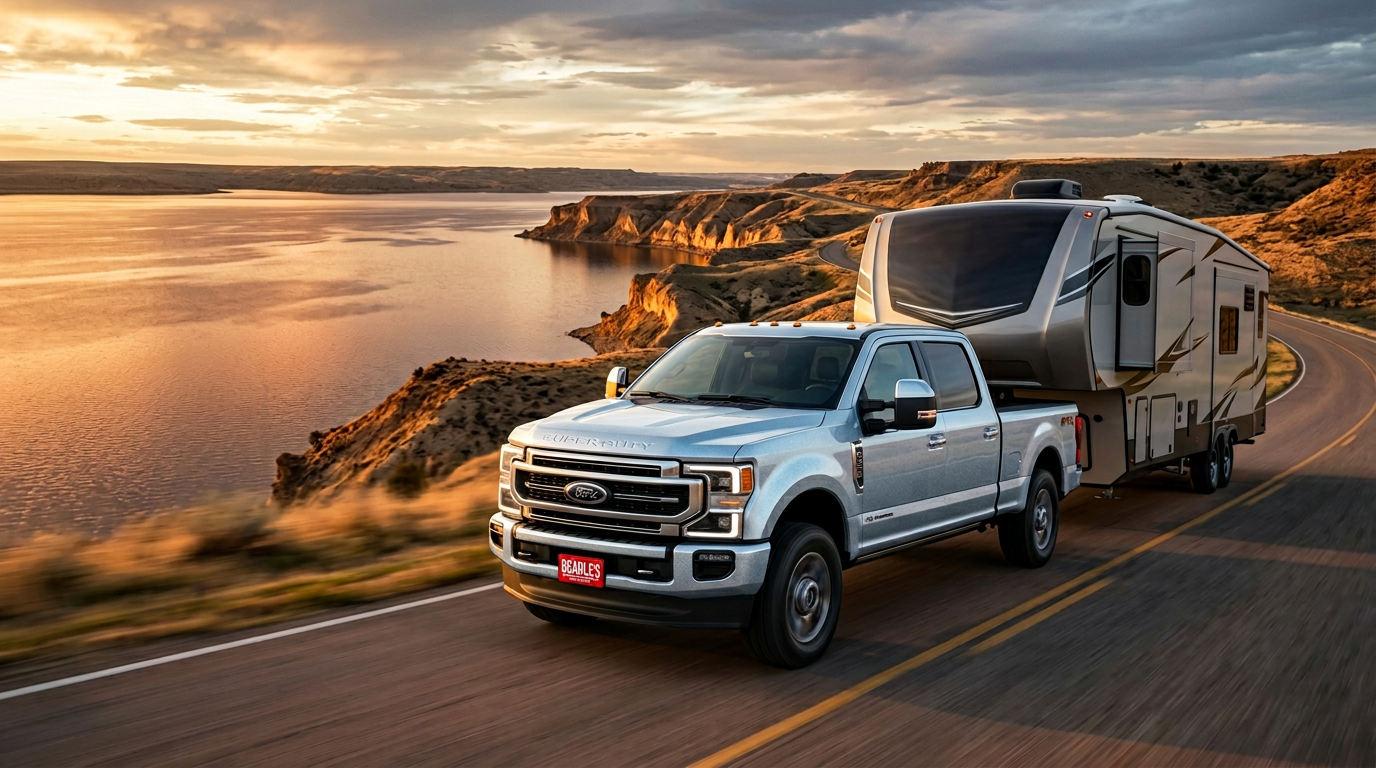
2027 Ford F-250 towing a fifth-wheel camper near Lake Oahe, SD

2027 Ford F-250 for Recreational Towing: Campers & Fifth-Wheels

Quick Answer Properly equipped, the 2027 Ford F-250 tows travel trailers and fifth-wheel campers up to about 19,500 lbs on the standard 7.3L gas V8 and up to 22,100 lbs fifth-wheel with the High-Output diesel. For most RV buyers, the gas V8 has the room without the diesel premium. If your idea of a good weekend is a camper behind the truck headed for Lake Oahe or the Black Hills, the 2027 F-250 is built for it. With the now-standard 7.3L gas V8 and the right tow setup, it pulls big travel trailers and most fifth-wheels comfortably — no diesel required for the majority of recreational towing. Here's what the F-250 tows for RVs, whether the gas V8 is enough for a big fifth-wheel, the tow equipment worth ordering, and how to match a trailer to your exact configuration. Shop F-250s in Stock Reserve a 2027 F-250 Get Pre-Approved On This Page How much can the 2027 F-250 tow for RVs? Can the 7.3L gas pull a big fifth-wheel? What tow package, hitch, and mirrors do you want? How to match a trailer to your F-250 config How much can the 2027 F-250 tow for RVs? Properly equipped, the 7.3L gas F-250 tows up to about 19,500 lbs on a fifth-wheel or gooseneck and 18,200 lbs conventional. The 6.7L High-Output diesel raises that to up to 22,100 lbs fifth-wheel and 22,000 lbs conventional. That covers the full range of travel trailers and the large majority of recreational fifth-wheels. For perspective, a typical family fifth-wheel runs roughly 12,000 to 16,000 lbs loaded, and most bumper-pull travel trailers come in well under that. Both sit comfortably inside the F-250's range with margin to spare for gear, water, and the climb out of a river valley. RV towing (properly equipped) 7.3L Gas V8 6.7L HO Diesel Travel trailer (conventional) Up to 18,200 lbs Up to 22,000 lbs Fifth-wheel camper About 19,500 lbs Up to 22,100 lbs Maximums require proper equipment and vary by cab, bed, axle, and configuration. Always tow to your specific truck's door-jamb ratings. Can the 7.3L gas pull a big fifth-wheel? Yes — the now-standard 7.3L gas V8 tows a fifth-wheel up to about 19,500 lbs, which covers the large majority of recreational fifth-wheel campers. Unless your rig is a heavy toy hauler or a full-time-living fifth-wheel near the top of the range, the gas truck has the capability. The number that trips people up isn't the tow rating — it's king pin weight. A fifth-wheel puts roughly 15% of its loaded weight down on the truck, so a 16,000-lb fifth-wheel adds around 2,400 lbs to the bed. That has to fit within the F-250's payload along with your passengers and gear, which is exactly why the payload number matters as much as the tow rating. Our Recommendation For most RV buyers around Bowdle and Aberdeen, the standard 7.3L gas V8 is the right engine — it pulls a fifth-wheel up to about 19,500 lbs and saves the diesel premium. Step up to the High-Output diesel if you run a heavy toy hauler, climb mountain grades often, or want the extra fuel economy on long hauls. What tow package, hitch, and mirrors do you want? For recreational towing, order the trailer tow equipment that makes the trip easy and safe: the factory trailer tow package with the 7-wire harness, the integrated trailer brake controller, PowerScope telescoping tow mirrors, and the fifth-wheel/gooseneck prep package if you're pulling either. The F-250's 2.5-inch receiver is rated to 22,000 lbs and 2,200 lbs of tongue weight. Trailer Tow Package — 7-wire harness and connector, the backbone of any RV setup. Integrated trailer brake controller — smooth, factory-tuned trailer braking. PowerScope telescoping trailer tow mirrors — the visibility you'll want behind a wide fifth-wheel. Fifth-wheel / gooseneck prep package — factory bed prep so the hitch installs clean. 360-degree camera and Pro Trailer features where available — a big help backing into a tight campsite. How to match a trailer to your F-250 config Match three numbers, not one: your trailer's loaded weight against the truck's tow rating, your trailer's tongue or king pin weight against the truck's payload, and your total combined weight against the GCWR on the door jamb. The tow rating alone doesn't tell you if the truck can carry the hitch weight. Cab, bed, axle ratio, and engine all shift those numbers, so the smartest move is to spec the truck around your actual trailer. Tell us your camper's loaded weight and we'll build an F-250 with the right axle and options to tow it with margin — or check it against a truck already on the lot before you buy. From the Beadle Ford Lot The mistake we catch most with camper buyers is shopping the tow rating and forgetting the payload. A big fifth-wheel's king pin weight eats into payload fast, and a beautifully spec'd truck can run out of payload before it runs out of tow rating. We always check both against the actual trailer before anyone signs. Key Takeaways The 7.3L gas F-250 tows fifth-wheels up to about 19,500 lbs and travel trailers up to 18,200 lbs. The High-Output diesel raises that to up to 22,100 lbs fifth-wheel and 22,000 lbs conventional. For most recreational towing, the standard gas V8 is plenty — no diesel premium needed. Watch king pin weight (about 15% of a fifth-wheel) against payload, not just the tow rating. Order the trailer tow package, brake controller, PowerScope mirrors, and fifth-wheel prep for an easy setup. Frequently Asked Questions Can a 2027 F-250 tow a fifth-wheel camper? Yes. The 7.3L gas F-250 tows a fifth-wheel up to about 19,500 lbs and the High-Output diesel up to 22,100 lbs, properly equipped — covering the large majority of recreational fifth-wheel campers. Just confirm the king pin weight fits within the truck's payload. Do I need the diesel to tow an RV? Not for most campers. The standard 7.3L gas V8 tows fifth-wheels up to about 19,500 lbs, which handles the majority of travel trailers and fifth-wheels. The diesel makes sense for heavy toy haulers, frequent mountain grades, or buyers who want better long-haul fuel economy. What tow equipment should I order for camping? The trailer tow package with the 7-wire harness, the integrated trailer brake controller, PowerScope telescoping tow mirrors, and the fifth-wheel/gooseneck prep package if you pull either. A 360-degree camera helps a lot when backing into a campsite. Why does payload matter for towing a camper? Because a fifth-wheel or gooseneck puts roughly 15% of its loaded weight on the truck as king pin weight. That hitch weight, plus passengers and cargo, has to fit within payload — so a truck can hit its payload limit before its tow rating. Always check both. Quick Answers: F-250 Recreational Towing One-line answers to the follow-up questions buyers ask next. Fifth-wheel max on gas? About 19,500 lbs, properly equipped. Fifth-wheel max on diesel? Up to 22,100 lbs. Travel trailer max on gas? Up to 18,200 lbs conventional. Do I need a diesel for a camper? Not for most — the gas V8 covers it. What's king pin weight? Roughly 15% of a fifth-wheel's loaded weight, carried by the truck. What hitch receiver does it have? A 2.5-inch receiver rated to 22,000 lbs. Best mirrors for towing? PowerScope telescoping trailer tow mirrors. Does it have a trailer brake controller? Yes — an integrated, factory-tuned controller. Will it back into a campsite easily? Yes, especially with the 360-degree camera. Where can I match my camper to a truck? Beadle Ford in Bowdle, SD. Keep Researching The complete 2027 Ford F-250 Super Duty overview — trims, towing, specs, and inventory 7.3L gas vs. HO diesel — which engine for how you tow 2027 F-150 vs. F-250 — do you need a Super Duty for your camper? 2027 F-250 winter & gravel capability — getting to the lake in any season My Take on Towing a Camper With the F-250 The thing I most want camper buyers to walk away knowing is to bring me the trailer's real loaded weight, not the brochure dry weight. People load a fifth-wheel up with water, gear, and a generator and suddenly the king pin weight is a different number than they planned for. When we spec the truck around the trailer you actually own, the F-250 tows it beautifully — and most folks are pleasantly surprised the standard gas V8 is all they need. Headed to Oahe or the Hills this summer? Bring me your camper's numbers and we'll build or find the right F-250 to pull it. Stop by Beadle Ford in Bowdle anytime. Shop F-250s in Stock Reserve a 2027 F-250 Get Pre-Approved About the Author Lexy Tabbert — Beadle Ford, Bowdle, SD Lexy Tabbert is the Director of Sales and Marketing at Beadle Ford in Bowdle, South Dakota. She covers Ford vehicles, trim comparisons, and buyer guidance — helping families, ranchers, and ag operators across the region find the right truck and configuration for their needs. Learn more about Lexy.
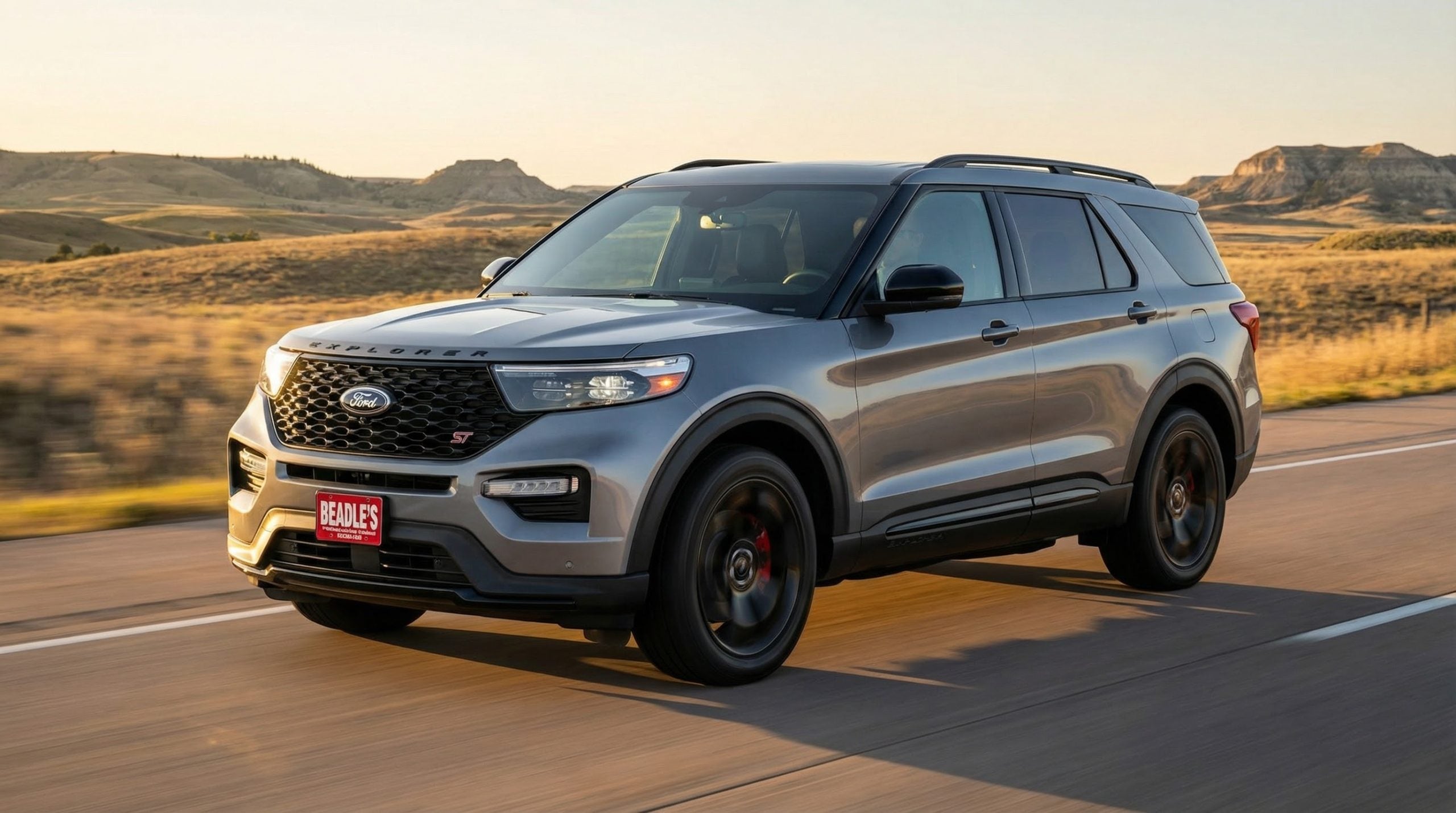
2026 Ford Explorer ST on open highway

2026 Ford Explorer Engine Options Deep Dive (2.3L vs 3.0L)

If you’re shopping for a 2026 Ford Explorer, the engine choice matters because it changes how the SUV feels every day — how easily it merges onto the highway, how confident it feels when loaded with people and gear, and how relaxed it is when towing or driving into headwinds. This guide explains the two main engine paths in plain language: what the 2.3L EcoBoost is best at, what the 3.0L EcoBoost does differently, and how to choose based on real life (not confusing specs). For the full lineup context (trims, seating layouts, towing structure, and how it all fits together), start with the 2026 Ford Explorer overview. Shop Explorers in Stock Table of Contents What engines are available on the 2026 Explorer? What does “turbocharged” actually mean? Who is the 2.3L EcoBoost best for? Who is the 3.0L EcoBoost best for? Real-world examples: when the engine choice matters ST vs Tremor: how engine choice changes the vibe Does the engine affect fuel and day-to-day costs? How to choose the right engine in 5 steps What engines are available on the 2026 Ford Explorer? The 2026 Ford Explorer is generally built around two EcoBoost options: 2.3L EcoBoost® I-4 (commonly found on Explorer Active and ST-Line, and used across much of the lineup depending on configuration) 3.0L EcoBoost® V6 (the performance-focused option, standard on Explorer ST and available on some Tremor configurations depending on equipment selection) Simple takeaway: The 2.3L is the “everyday balanced” engine. The 3.0L is the “effortless power” engine. Trim-level structure and availability changes are best understood inside the full lineup guide: 2026 Ford Explorer overview. What does “turbocharged” actually mean? A turbo is like a “power helper.” Instead of making the engine bigger, it pushes more air into the engine so it can make more power when you need it — like when you accelerate, merge, or climb a hill. What that means in real life: You can have a smaller engine that still feels strong when you press the gas. Power can come in quickly when you need it (great for merging and passing). How smooth it feels depends on the engine size and tuning (which is where 2.3 vs 3.0 starts to matter). Who is the 2.3L EcoBoost best for? The 2.3L EcoBoost is usually the best fit for drivers who want a three-row SUV that feels confident and modern without paying extra for performance they won’t use every day. Best match if your life looks like: School drop-offs, errands, commuting, and weekend travel Mostly highway driving at steady speeds Occasional towing (with the right tow equipment) You want capability, but you don’t need “sports SUV” acceleration How it feels: responsive, balanced, and easy to live with — especially in Active and ST-Line trims. If your priority is family layout and space, this pairs well with what we cover in the Interior & Cargo Guide. Who is the 3.0L EcoBoost V6 best for? The 3.0L EcoBoost is for drivers who want the Explorer to feel effortless — especially when the SUV is loaded with people, gear, and long-distance highway miles. Best match if: You routinely drive with 5–7 passengers plus cargo You live on the highway and want strong passing power You tow more often (or want towing to feel less strained) You simply enjoy the feeling of confident acceleration How it feels: smoother power delivery, less “working hard” sensation on hills and passing, and a more performance-oriented personality — especially in Explorer ST. If you’re considering ST specifically, the deeper performance angle is covered in the Explorer ST Performance Guide. Real-world examples: when the engine choice matters Most people don’t notice engine differences in a calm test drive. They notice it during the moments that actually matter in real life. Here are the most common situations where your engine choice will feel different: 1) Merging onto the highway with kids in the back 2.3L: capable and responsive, but you may press the gas more to get the same “go now” feeling. 3.0L: feels more immediate and relaxed — less effort, more confidence. 2) Passing a semi on a two-lane highway 2.3L: does the job, but you’ll plan your pass a little more. 3.0L: passing power feels easier and quicker, especially at speed. 3) Driving into strong South Dakota wind 2.3L: steady, but you may notice more downshifts or effort in gusty conditions. 3.0L: maintains speed more effortlessly with less “strain” sensation. 4) Towing a small camper or boat The 2026 Explorer can tow up to 5,000 pounds when properly equipped, but engine choice impacts how confident it feels while towing — especially on hills, in wind, or when the SUV is loaded. For the full towing breakdown (including tongue weight, trailer frontal area, and setup tips), see the 2026 Explorer Towing & AWD Guide. ST vs Tremor: how engine choice changes the vibe This is a very common question: “If I want something special, should I choose ST or Tremor?” ST: performance personality — the engine and tuning are meant to feel fast and responsive on pavement. Tremor: adventure personality — designed for confidence on rougher roads and travel routes beyond pavement, with engine availability depending on how it’s equipped. If you want a trim-level decision guide that compares these clearly, the best reference is the 2026 Explorer Trim Levels Guide (it frames the “who each trim is for” question). Does the engine affect fuel and day-to-day costs? In plain terms: the more performance you choose, the more you should expect the vehicle to use fuel when you drive it like a performance vehicle. But driving habits matter just as much as engine choice. If you drive calmly, fuel use may be closer than you’d expect. If you accelerate aggressively or drive at high speeds often, the difference becomes more noticeable. Simple way to think about it: 2.3L: optimized for everyday efficiency and balance 3.0L: optimized for effortless power and performance feel How to choose the right Explorer engine in 5 steps This is voice-search friendly on purpose — it’s the simplest way to decide without getting lost. List your “most common” week. Commute, school, errands, highway miles. Think about your “most demanding” day. Full family load + gear + winter driving + highway passing. Decide how you want it to feel. “Fine and capable” vs “effortless and confident.” If you tow, decide how often. Occasional towing vs frequent towing. Use the trim structure as your shortcut. ST = performance path, Active/ST-Line = balanced path, Tremor = adventure path depending on configuration. Quick Specs / Overview (Plain Language) Engine What it’s best at Who it fits best 2.3L EcoBoost I-4 Everyday balance and confident daily driving Most families, commuters, general travel 3.0L EcoBoost V6 Effortless power, highway passing, performance feel ST shoppers, frequent highway drivers, heavy loads Key Takeaways The 2.3L EcoBoost is the “balanced everyday” engine for most families. The 3.0L EcoBoost is the “effortless power” option that feels stronger under load. Engine choice matters most in merging, passing, wind, hills, and towing feel. Trim choice is often the easiest way to narrow engine options. For full lineup context, the pillar page ties everything together. FAQ Is the 2.3L engine enough for a family SUV? For most families, yes. It’s designed to provide confident everyday performance for commuting, errands, highway travel, and family trips. The difference is less about “enough” and more about whether you want power to feel effortless under heavy loads. When does the 3.0L engine make the biggest difference? Most drivers notice the difference during highway merging and passing, when the vehicle is fully loaded with passengers, when driving into strong wind, and when towing or climbing hills. Does the engine change towing capacity? The Explorer can tow up to 5,000 pounds when properly equipped, but engine choice can change how confident and relaxed towing feels. Equipment configuration also matters, which is why towing should be evaluated as a full setup. Do I need the ST to get the stronger engine? Explorer ST is the most direct performance path, and the 3.0L EcoBoost is standard there. Other trims may have different availability depending on configuration, so the trim guide is the best starting point. What should I test drive to compare engines? If possible, drive an Explorer Active (2.3L) and an Explorer ST (3.0L). Use the same roads: a highway merge, a passing situation, and a rougher road section. The “feel” difference becomes clear quickly. Conclusion In my experience, engine decisions get much easier when shoppers stop thinking in “car specs” and instead focus on real moments: merging with kids in the back, passing on a two-lane highway, driving into wind, or towing on a weekend trip. When you match the engine to the life you actually live, the right Explorer configuration usually becomes obvious. About the Author Lexy Tabbert provides research-driven SUV configuration guidance and ownership insights for drivers across South Dakota and beyond.

2026 Ford Bronco Outer Banks in Velocity Blue Metallic in motion on a two-lane South Dakota highway, prairie horizon

2.3L vs 2.7L EcoBoost: Which 2026 Ford Bronco Engine Is Right for You?

Two engines power most 2026 Ford Bronco orders: a 2.3L EcoBoost I-4 making 300 horsepower and 325 lb-ft of torque, and a 2.7L EcoBoost V6 making 330 horsepower and 415 lb-ft. The Raptor's 3.0L V6 sits in its own tier (418 hp / 440 lb-ft) and isn't part of this comparison. For everyone else, the choice is between the four-cylinder and the V6 — and it's a closer call than most buyers expect. This is an honest decision tool. We'll cover what each engine actually feels like behind the wheel, what towing looks like (spoiler: nearly identical), what to expect at the pump on a Bowdle-to-Black-Hills run, whether the 7-speed manual still earns its place, and which engine matches which buyer in central South Dakota. Shop Broncos in Stock Get Pre-Approved On This Page Why Is the 2.3L EcoBoost the Default Engine on the 2026 Bronco? What Does the 2.7L EcoBoost V6 Actually Buy You Over the 2.3L? How Different Is Towing Between the 2.3L and 2.7L? What's the EPA Fuel Economy for Each 2026 Bronco Engine? Should You Pick the 7-Speed Manual or the 10-Speed Automatic? Which 2026 Bronco Engine Is Right for You? Why Is the 2.3L EcoBoost the Default Engine on the 2026 Bronco? The 2.3L EcoBoost is the default because it's the broadest-fit engine in the lineup — the only one offered with the 7-speed manual transmission, standard on every trim from Base through Heritage Edition (other than Outer Banks, where it pairs with the auto only), and capable of the same 3,500-pound tow rating as the V6. For most buyers it's enough engine. Output is 300 horsepower at 5,700 RPM and 325 lb-ft of torque at 3,400 RPM on premium fuel (275 hp / 315 lb-ft on regular). It's a turbocharged inline-four with direct injection, and in a body-on-frame Bronco it pulls cleanly from low RPM and turns the four-cylinder displacement gap into a non-issue most of the time. On a county-road merge or a Black Hills two-track, the four cylinder doesn't feel undersized. Where the 2.3L gives ground is at sustained high-load output: a long uphill grade with a trailer, or the upper third of the rev range when you want immediate punch from 50 to 75. The four cylinder works harder there than the V6 does — you'll hear it through the firewall, and you'll feel the turbo spooling rather than the V6's broader torque shelf. For most central-SD use cases, that distinction doesn't show up in everyday driving. Trim availability: standard on Base, Big Bend, Outer Banks, Badlands, and Heritage Edition. New for 2026, the 10-speed automatic is now available with the 2.3L on Heritage (was 2.7L-only before). Stroppe and Raptor don't offer the 2.3L. For full trim-by-trim context, see our 2026 Ford Bronco trim levels guide. A 2.3L EcoBoost Badlands in its natural habitat — gravel county road, prairie horizon, the Bowdle-to-Hills run that 80% of central-SD Bronco miles look like. What Does the 2.7L EcoBoost V6 Actually Buy You Over the 2.3L? The 2.7L EcoBoost V6 buys you 30 more horsepower (330 vs 300) and — much more meaningfully — 90 more lb-ft of torque (415 vs 325) on premium fuel. The torque is what you actually feel: stronger pull from a stop, easier passing at highway speed, and a smoother delivery profile that doesn't ask the engine to work as hard. The upcharge is $2,995. The 2.7L is a turbocharged V6 with direct injection. It's automatic-only — there's no manual-transmission option with the V6. It's available on Outer Banks, Badlands 4-Door, and Heritage Edition, and it's the only engine offered on the Stroppe Edition (fleet/military only). It is not offered on Base, Big Bend, Badlands 2-Door, or Raptor. Day-to-day, the V6 is most noticeable at the moments the 2.3L works hardest — uphill grades with weight, on-ramp acceleration, sustained 70+ highway speeds with a headwind, and the kind of pull-from-2,500-RPM situations where a V6's torque shelf flattens out before a four cylinder's turbo fully spools. For drivers who do a lot of long highway miles or pull a small trailer regularly, the V6 reduces the engine's working effort. For drivers who mostly do town errands and gravel section roads, that effort difference is real but often not worth the upcharge. There's also a refinement gap. The V6 is quieter at cruise and smoother at idle — small things, but the kind of thing you notice on a four-hour run to the Hills. If long highway distance is a big part of your annual miles, that refinement adds up. Get Pre-Approved Contact Beadle Ford How Different Is Towing Between the 2.3L and 2.7L? On paper, almost not at all. Both the 2.3L and 2.7L EcoBoost are rated to tow 3,500 lbs on every non-Raptor 2026 Bronco — regardless of trim, axle ratio, body style, or transmission. The Raptor is the only 2026 Bronco rated higher, at 4,500 lbs. The standard hitch receiver on every non-Raptor caps at 3,500 / 350 lbs (trailer / tongue), so the engine choice doesn't change the ceiling. Outer Banks 2.7L EcoBoost towing a small bass-fishing rig to a Lake Oahe boat ramp — well within the Bronco's 3,500-pound non-Raptor cap. Where the engines actually differ is in how they pull that 3,500 lbs, not how much. The 2.7L V6's extra torque means the engine works less hard at the same load — fewer downshifts on grade, less turbo build-up before getting underway, lower thermal load on long pulls. If you're pulling a single-axle aluminum bass boat to Lake Oahe a few times a summer, the 2.3L handles it with no issue. If you're pulling a 3,400-pound enclosed trailer with sled or ATV to the Hills regularly, the V6 will feel measurably less stressed at the end of a long day. A 2026 footnote worth knowing: the Badlands 4-Door with the 2.7L V6 and 4.46 axle has a slightly lower published rating of 3,460 lbs (versus 3,500 on every other configuration). It's a 40-pound spread — not relevant to most buyers, but if you've got a trailer that's right at the line, that's the one config to flag. The Trailer Tow Prep Package is included on every non-Raptor Bronco, but the dealer-installed OEM trailer hitch receiver is required for any towing over 2,000 lbs. The frontal-area limit is 30 sq ft (non-Raptor), which rules out tall enclosed trailers regardless of weight rating. What's the EPA Fuel Economy for Each 2026 Bronco Engine? EPA-estimated fuel economy varies by door count, transmission, axle ratio, and tire size — there isn't one single number that applies. As a baseline, the 2.3L EcoBoost rates roughly 18 city / 20 highway / 19 combined on a 4-Door automatic, and the 2.7L EcoBoost V6 rates roughly 17 / 17 / 17 on the same body. The 2-Door 2.3L generally rates a touch higher (around 20 / 21 / 20). Verify your specific configuration on fueleconomy.gov before purchase — Sasquatch's 35-inch tires and 4.70 axle, in particular, drop EPA combined by a noticeable margin on either engine. For a Bowdle-to-Black-Hills round trip (about 720 miles total at mostly highway speeds), the math comes out roughly like this on each engine, before fuel-cost variations. A 2.3L 4-Door averaging 20 mpg highway burns about 36 gallons. A 2.7L V6 4-Door averaging 17 mpg burns about 42 gallons — a six-gallon difference per round trip, which adds up over a year of regular Hills runs but doesn't move the needle on a single weekend. What changes more than the engine choice is what's hung off the Bronco. Sasquatch's bigger tires and steeper axle ratio are the single biggest fuel-economy variable in the lineup — a non-Sasquatch 2.3L Badlands and a Sasquatch-equipped 2.3L Badlands aren't really the same vehicle for MPG purposes. If saving fuel on long highway hauls is a priority, lean toward the smaller-tire trim and the 4-Door 2.3L auto. If you're already at Sasquatch spec, the 2.7L's torque advantage often offsets the V6's combined-MPG penalty for the way most buyers actually use the truck. Both engines run on regular 87-octane fuel; premium is recommended for peak rated horsepower and torque but not required. Real-world MPG from owner forums tends to track within 1–2 mpg of EPA combined under mixed driving, with bigger gaps when towing or running deep snow. Should You Pick the 7-Speed Manual or the 10-Speed Automatic? For most buyers in central South Dakota, the 10-speed automatic is the practical pick. The 7-speed manual is a real driver's-engagement choice, and it earns its keep for buyers who want it — but the auto wins on towing, on long-distance highway comfort, and on every winter morning where the manual's clutch and Crank-in-Gear function become extra effort instead of fun. The 7-speed manual (Ford code 44Q) is offered with the 2.3L EcoBoost only — never with the V6. It's standard on Base, Big Bend, Badlands, and Heritage Edition. It includes a Granny Gear (an ultra-low first), Crank-in-Gear functionality (lets you start the engine while in gear with the clutch pressed), and Hill Descent Control. For genuine off-road work — slow, technical climbs in the Black Hills or precise low-speed crawl situations — the manual gives the driver more direct control than even a well-tuned automatic. The 10-speed automatic (Ford code 44T) is available with the 2.3L on most trims (NEW for 2026 on Heritage Edition with the 2.3L) and standard with the 2.7L V6 and 3.0L Raptor V6. With the auto you also get Trail Control (low-speed cruise control for off-road), Trail Turn Assist (tightens the turning radius by braking the inside rear wheel), and on Outer Banks and Badlands, Trail One-Pedal Driving. Those features pair tightly with the GOAT modes — see our 2026 Bronco G.O.A.T. Modes guide for how those interact in practice. The honest take: if you're choosing between a 2.3L manual and a 2.3L auto, and you're not specifically excited about driving a manual, take the auto. It's better for towing, better in stop-and-go, better for resale value, and better in winter clutch-leg fatigue. If you genuinely want the manual — and a meaningful number of Bronco buyers do — get it. It's one of the few capable off-road SUVs that still offers a true row-your-own option. Which 2026 Bronco Engine Is Right for You? The 2.3L EcoBoost fits the buyer who wants the broadest-fit engine and is doing mostly daily driving, gravel section roads, light recreational towing, and weekend trips to the Hills. It's the right call for the Plains Outdoorsman who already owns an F-150 for heavy work and uses the Bronco as a secondary vehicle, the buyer who wants the manual transmission, and anyone primarily driving in town or on county roads where the V6's extra torque doesn't get used. The 2.7L EcoBoost V6 fits the buyer who runs long highway miles regularly, regularly tows close to the 3,500-pound limit, wants the smoother and quieter cruise feel, and doesn't want the manual transmission anyway. The Ranch-Country Daily who's pulling a small trailer to and from a property weekly, or the buyer who makes the Hills run six or eight times a year, will appreciate the V6's torque shelf. The $2,995 upcharge is real money, but for the right use case, it's well-spent. For SD winter driving — a topic worth its own treatment — both engines handle cold starts and traction well. See our 2026 Bronco in South Dakota winter guide for the cold-weather details that matter at 30 below. For the broader 2026 Bronco context — engines, capability, what's new for the year — the full 2026 Ford Bronco overview walks through the lineup side by side. And if Sasquatch is on your build sheet, our honest take on whether Sasquatch is worth it in central South Dakota covers that decision in detail — Sasquatch is the single biggest variable on either engine's fuel economy. Key Takeaways 2.3L EcoBoost: 300 hp / 325 lb-ft, available with 7-speed manual, the broadest-fit engine for most buyers. 2.7L EcoBoost V6: 330 hp / 415 lb-ft, automatic-only, $2,995 upcharge — buys torque, refinement, and easier highway and towing duty. Both engines tow 3,500 lbs (non-Raptor cap). The Raptor's 3.0L V6 is in its own tier at 4,500 lbs. EPA estimates: 2.3L 4-Door auto ~18/20/19; 2.7L V6 4-Door ~17/17/17. Verify your specific configuration on fueleconomy.gov before purchase. The 7-speed manual is 2.3L-only and rewards engaged drivers; the 10-speed auto is the practical pick for most central-SD buyers. Frequently Asked Questions How much horsepower does each 2026 Bronco engine make? On premium fuel, the 2.3L EcoBoost makes 300 horsepower and 325 lb-ft of torque, the 2.7L EcoBoost V6 makes 330 horsepower and 415 lb-ft, and the Raptor's 3.0L EcoBoost V6 makes 418 horsepower and 440 lb-ft. Output drops slightly on regular 87-octane fuel. Can both engines tow the same amount? Yes. Every non-Raptor 2026 Bronco — 2.3L or 2.7L, manual or automatic, any trim — is rated to tow 3,500 lbs. The hitch receiver on non-Raptor models caps there. Only the Raptor (3.0L V6) is rated higher at 4,500 lbs. One small footnote: the Badlands 4-Door with the 2.7L V6 and 4.46 axle is rated at 3,460 lbs. Which trims offer the 2.7L EcoBoost V6? The 2.7L EcoBoost V6 is offered on Outer Banks, Badlands 4-Door, and Heritage Edition, and is the only engine on the Stroppe Edition (fleet/military only). The upcharge is $2,995. It is not offered on Base, Big Bend, Badlands 2-Door, or Raptor. Is the 7-speed manual transmission available with the 2.7L V6? No. The 7-speed manual is offered exclusively with the 2.3L EcoBoost. The 2.7L EcoBoost V6 and the Raptor's 3.0L EcoBoost V6 are 10-speed automatic only. New for 2026, the 10-speed automatic is now also available with the 2.3L on the Heritage Edition (was 2.7L-only before). Does the 2026 Ford Bronco require premium fuel? No. Both the 2.3L EcoBoost and 2.7L EcoBoost V6 run on regular 87-octane fuel. Premium is recommended for peak rated horsepower and torque (300 hp / 325 lb-ft on the 2.3L; 330 hp / 415 lb-ft on the 2.7L), but the engines are calibrated to run safely on regular with a small drop in output. My Take on the 2026 Bronco Engine Choice In my time at Beadle Ford, I've watched buyers wrestle with this decision more than any other on the Bronco. The honest answer for most of them: the 2.3L is enough engine. The buyers who actually use the V6's torque tend to know they need it before they walk in — they have a specific trailer, a specific commute, or a specific feel they're after. The buyers who pick the V6 because they're worried the four cylinder is "too small" usually find out a year later that the 2.3L would have done the job. If you're between the two, drive both back to back. Twenty minutes of seat time on the same county road outside Bowdle, with the same kind of load, settles the question for almost everyone — and saves you a $3,000 second-guess. Shop Broncos in Stock Get Pre-Approved About the Author Lexy Tabbert — Beadle Ford, Bowdle, SD Lexy Tabbert is the Director of Sales and Marketing at Beadle Ford in Bowdle, South Dakota. She covers Ford vehicles, trim comparisons, and buyer guidance — helping families, ranchers, and ag operators across the region find the right truck and configuration for their needs. Learn more about Lexy.
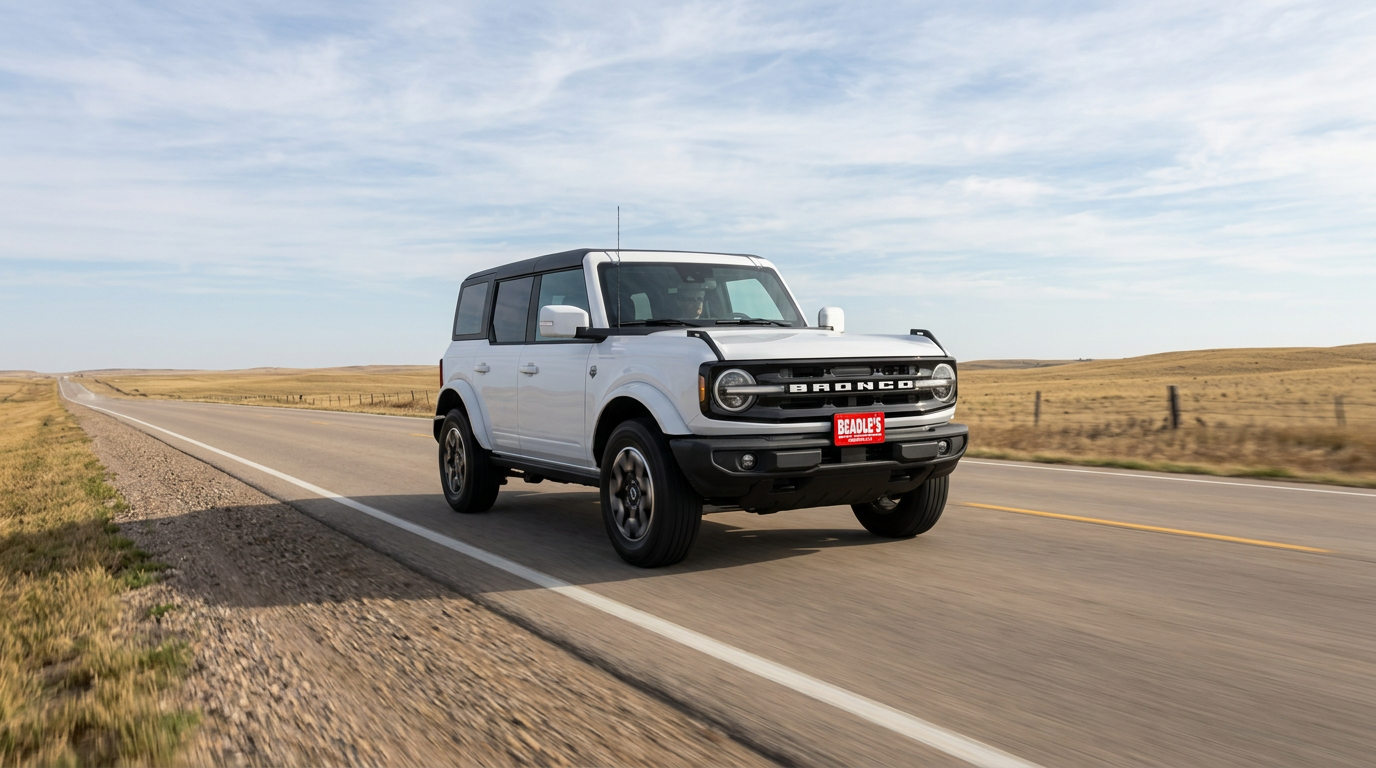
2026 Ford Ranger Lariat interior with 12 inch SYNC touchscreen and digital instrument cluster

Big Screen or Basic Setup? A Plain-English Breakdown of Every 2026 Ranger Tech Feature

Tech specs in truck brochures tend to blur together fast — every trim claims to be "well-equipped," every screen sounds massive, and it's hard to tell what's actually different between a base XL and a loaded Lariat until you're standing in the dealership trying to remember which truck had the 360-degree camera and which one didn't. This guide cuts through that. Here's a clear, trim-by-trim breakdown of every technology and safety feature on the 2026 Ford Ranger — what's standard, what you have to add, and what you simply can't get without stepping up a trim. What Every 2026 Ranger Gets — Regardless of Trim Ford's Co-Pilot360™ suite is standard equipment on all 2026 Ranger trims. That means safety technology isn't a luxury upgrade — it's built into the base price no matter which model you choose. Here's what every Ranger includes: Feature What It Does Pre-Collision Assist with Automatic Emergency Braking Detects vehicles and pedestrians ahead; warns driver and automatically applies brakes if needed Blind Spot Information System (BLIS®) Monitors blind spots and warns when a vehicle enters; Cross-Traffic Alert included Lane-Keeping System Alerts driver when drifting from lane and applies gentle steering input to keep the truck in lane Auto High-Beam Headlamps Automatically switches between high and low beams based on oncoming traffic Rear View Camera Standard rearview display when reversing Apple CarPlay® / Android Auto™ Wireless on XLT and above; wired on XL Pro Power Onboard™ — 400W In-bed 120V AC outlet for tools, chargers, and equipment — standard across all trims SYNC 4A Touchscreen: Size Varies by Trim All 2026 Rangers run SYNC 4A — Ford's connected infotainment platform. But screen size is not the same across all trims, and the difference matters in daily use. Trim SYNC 4A Screen Digital Cluster Wireless CarPlay XL 8 inches — Wired only XLT 12 inches 12-inch digital ✓ Wireless Lariat 12 inches 12-inch digital ✓ Wireless Raptor 12 inches 12-inch digital ✓ Wireless The jump from the XL's 8-inch screen to the XLT's 12-inch is significant. Beyond screen size, the XLT also gains a 12-inch digital instrument cluster in place of traditional analog gauges — the display is configurable and shows navigation, off-road data, and driver assist readouts. If you spend a lot of time interacting with navigation or media, the XLT and above deliver a noticeably better experience. What's New on Tech for 2026 Two tech-related additions stand out for 2026: Power Moonroof — New for 2026, now available as an option. Not available on every trim, but for buyers who've been waiting for a factory moonroof option on the Ranger, it's here. If outdoor visibility while parked or natural light while driving matters to you, this is worth checking at the trim level you're considering. SiriusXM 360L — The on-demand tier of SiriusXM is now included. 360L goes beyond traditional satellite radio — it adds on-demand content and personalized channel recommendations delivered over a connected data connection. Same hardware as before, better content access. The upgrade was to the tier, not the physical radio. Adaptive Cruise and Driver Assist: What's Available Where Basic cruise control is standard on all trims. Adaptive Cruise Control with Stop-and-Go — which maintains a set following distance and can bring the truck to a complete stop in traffic — is available on XLT and above, typically as part of a higher package level. If highway driving is a big part of your commute or your travel, it's a feature worth tracking when building your trim. The 360-degree camera system — which shows a bird's-eye view of the truck while maneuvering — is available on the Lariat and above. For backing into a tight space with a trailer or parallel parking on a Bowdle street with limited sight lines, the surround-view system is genuinely useful rather than a gimmick. FordPass, OTA Updates, and Connected Features The FordPass™ app connects your phone to the truck and lets you remotely start, lock, unlock, and check vehicle status — fuel level, tire pressure, and whether the doors are locked. It's a small but practical convenience when you're loading gear in the dark before a morning hunt or warming up the truck from inside the house in January. The 2026 Ranger also supports over-the-air software updates through the built-in modem. Ford can push SYNC system updates, recalibrations, and feature improvements to the truck without requiring a dealership visit — the same way a smartphone updates. Your truck can get better after you drive it off the lot. Pro Power Onboard™: The 400W In-Bed Outlet Every 2026 Ranger comes with a 400-watt 120V AC outlet in the bed as standard equipment. That's enough to run a power tool, charge a phone or laptop, power a small compressor, or run lighting at a worksite or campsite. It's not a generator replacement — 400W has limits — but for everyday use it's a useful feature that most buyers don't expect to find at this power level as a standard item. For heavier power needs, you'll want to look at F-150 with its higher Pro Power Onboard tiers, which go substantially higher. The Ranger's 400W is the right tool for typical job-site and outdoor use, not for powering large appliances. Audio Upgrades: B&O Available on Lariat The XL and XLT come with Ford's standard audio setup — functional, decent, nothing remarkable. The Lariat can be optioned with the Bang & Olufsen™ premium audio system, which is a meaningful step up in sound quality for buyers who care about audio. B&O is not available on the XL or XLT. Ambient interior lighting is also available on the Lariat, which adds configurable mood lighting along the interior panels. It's a comfort and style feature, not a function feature, but it contributes to the overall feel of the cabin in a way that photographs well and rides even better. Technology FAQ Does the base XL Ranger have Apple CarPlay? Yes, but wired only. The XL supports Apple CarPlay and Android Auto via a USB connection. Wireless CarPlay and Android Auto are available starting on the XLT and carry through to the Raptor. What is SYNC 4A and how is it different from SYNC 4? SYNC 4A is Ford's enhanced version of the SYNC 4 platform — it includes a faster processor, an improved voice command system, and support for over-the-air updates. The "A" designation reflects a hardware upgrade. All 2026 Rangers run SYNC 4A regardless of trim level. Is the Power Moonroof standard or optional on the 2026 Ranger? The Power Moonroof is a new addition for 2026 and is available as an option — it is not standard on any trim. Check the specific build configuration at your trim of interest, as availability can vary by package. It was not offered at all on the 2025 Ranger. Does the 2026 Ranger have a heads-up display? The 2026 Ranger does not offer a heads-up display. Navigation and driver information are displayed on the 12-inch digital instrument cluster (XLT and above) or the SYNC 4A touchscreen. Does the 360-degree camera come standard or is it an option? The 360-degree surround-view camera system is available on the Lariat and Raptor — it is not available on the XL or XLT. It is typically included or available as part of a higher-tier option package at the Lariat level. All trims include a standard rear view camera. Key Takeaways Ford Co-Pilot360™ safety suite is standard on all 2026 Ranger trims — no safety tech upgrades required at any level XL gets an 8-inch SYNC 4A screen; XLT, Lariat, and Raptor get a 12-inch screen and 12-inch digital cluster Wireless CarPlay and Android Auto start at the XLT — XL is wired only Power Moonroof is new for 2026 — available as an option where applicable SiriusXM 360L on-demand tier is now standard — upgraded from basic satellite for 2026 Pro Power Onboard 400W in-bed outlet is standard on all trims 360-degree camera available on Lariat and above; B&O audio available on Lariat FordPass connectivity and over-the-air SYNC updates supported across the lineup The technology story on the 2026 Ranger is straightforward once you know where the dividing lines are: XL gets the basics done well, XLT makes a real jump in screen size and cluster, and Lariat adds the camera system, audio upgrades, and comfort features that make it feel like a premium truck. The safety foundation is solid at every level. If you want to see how technology availability lines up with each trim's full feature set, the 2026 Ford Ranger overview has the full picture. And if you want a trim-by-trim comparison of which tech features appear at each price point, the trim levels guide breaks it down side by side. — Lexy Tabbert, Beadle Ford Continue Reading → Which 2026 Ranger trim includes each technology feature → Towing technology features and the Trailer Tow Package explained

2026 Ford Explorer ST on open highway

2026 Ford Explorer ST Performance Guide

The 2026 Ford Explorer ST is built for drivers who want their three-row SUV to feel fast, responsive, and confident — not just practical. While the Explorer lineup is family-focused at its core, the ST trim shifts the personality toward performance. This guide explains what makes the Explorer ST different from other trims, how it feels in real-world driving, and who it’s truly built for. For full lineup context, including how ST fits alongside Active, Platinum, and Tremor, start with the 2026 Ford Explorer overview. Shop Explorers in Stock Table of Contents What is the Explorer ST? What engine does the ST use? How does the ST feel different to drive? Does the ST handle differently? ST vs Tremor: Performance vs Adventure Who should buy the Explorer ST? Is the ST still practical for families? How to properly test drive an Explorer ST What is the 2026 Ford Explorer ST? The Explorer ST is the performance-focused trim of the Explorer lineup. It combines three-row seating with a stronger engine and sport-tuned driving characteristics. It’s not just about horsepower — it’s about how the SUV responds when you press the accelerator, change lanes at highway speed, or drive through curves. What engine does the Explorer ST use? The 2026 Explorer ST is powered by a 3.0L EcoBoost® V6 engine. In simple terms: it produces more power and torque than the standard 2.3L engine used in other trims. What that means in everyday life: Quicker acceleration when merging Stronger passing power at highway speeds Less “working hard” feeling when loaded with passengers More confident towing feel when properly equipped If you want a full comparison between the 2.3L and 3.0L engines, see our Explorer Engine Deep Dive. How does the ST feel different to drive? This is where the difference becomes noticeable. Compared to an Active or ST-Line trim: The accelerator feels more immediate. The SUV reaches highway speed more quickly. Passing slower vehicles requires less planning. The engine feels stronger under heavy load. For drivers who spend significant time on highways — especially in areas with strong wind or long-distance travel — the ST’s power can feel more relaxed and effortless. Does the Explorer ST handle differently? Yes. The ST features sport-oriented tuning designed to provide a more controlled feel through curves and during quick lane changes. It’s still a three-row SUV — but it feels tighter and more responsive compared to family-focused trims. This makes it appealing to drivers who want practicality without sacrificing driving enjoyment. Explorer ST vs Explorer Tremor: What’s the difference? This is one of the most common questions. Explorer ST: Performance-focused Strong acceleration Sport-tuned handling On-road emphasis Explorer Tremor: Adventure-focused Designed for gravel and uneven terrain Distinct styling and capability orientation Off-road confidence priority If your driving is primarily paved roads and highways, ST is the performance path. If you regularly travel beyond pavement, Tremor may be the better fit. The full trim breakdown is available in our Explorer Trim Levels Guide. Who should buy the 2026 Explorer ST? The Explorer ST is best for drivers who: Enjoy strong acceleration Drive long highway distances regularly Want their SUV to feel athletic Carry passengers but still want performance Prefer a sport-inspired driving experience It’s especially appealing to families where at least one driver values performance feel as much as practicality. Is the ST still practical for families? Yes. The Explorer ST retains three-row seating and family functionality. Seating configurations and interior layout may vary by equipment selection, so it’s important to confirm your preferred layout. Interior space details are covered in our Interior & Cargo Guide. How should you test drive an Explorer ST? Start with a normal city drive to feel throttle response. Merge onto a highway and notice acceleration difference. Perform a controlled highway pass. Drive through a few curves to feel steering control. Compare directly with a 2.3L-equipped trim if possible. The difference becomes most obvious during highway acceleration and passing. Quick ST Overview Category Explorer ST Engine 3.0L EcoBoost V6 Driving Feel Performance-focused Personality Sporty, responsive, confident Seating Three rows (configuration varies) Key Takeaways The ST is the performance-focused Explorer trim. It uses the 3.0L EcoBoost engine. Acceleration and passing feel stronger and more effortless. It remains practical for family use. Best suited for drivers who enjoy athletic driving feel. Frequently Asked Questions Is the Explorer ST fast? The Explorer ST offers significantly stronger acceleration compared to standard trims, especially during highway merging and passing. Does the ST tow more than other Explorers? Maximum towing capacity depends on configuration, but engine strength can influence how confident towing feels. Is the Explorer ST good in winter? With available AWD and proper tires, the ST can perform confidently in winter conditions. Is the ST worth the upgrade? For drivers who value performance feel and acceleration, many find the upgrade worthwhile. For purely practical use, other trims may meet daily needs just as well. Conclusion In my experience, the Explorer ST appeals most to drivers who want their SUV to feel powerful and responsive — not just functional. When buyers test drive it back-to-back with a standard trim, the difference in acceleration and highway confidence becomes clear very quickly. For families who want practicality without sacrificing driving enjoyment, the ST often feels like the perfect balance. About the Author Lexy Tabbert provides research-driven SUV configuration guidance and performance insights for drivers across South Dakota and beyond.

2026 Ford F-350 Super Duty towing on a rural South Dakota highway

2026 Ford F-350 Towing Guide

Quick Answer Properly equipped, the 2026 Ford F-350 Super Duty tows up to 40,000 lbs gooseneck with the 6.7L High-Output Power Stroke diesel and 40K Gooseneck Tow Package, up to about 35,000 lbs fifth-wheel, and up to 28,000 lbs conventional in dual-rear-wheel form. The 2026 Ford F-350 Super Duty is built for drivers who tow heavy on purpose — fifth-wheels, goosenecks, livestock, and equipment loads that don't leave much room for guesswork. If your towing days include long highway miles, wind, grades, or soft gravel lots, the right F-350 configuration feels noticeably more planted and in control. This guide focuses on the decisions that actually change towing confidence: the real numbers by hitch type and engine, the single-rear-wheel versus dual-rear-wheel choice, and the towing visibility features that matter once the trailer is hooked up. Because capability depends on how the truck is built, compare your options within the full lineup before you finalize a plan. Shop F-350s in Stock Get Pre-Approved On This Page What actually changes how much an F-350 can tow? How much can the 2026 F-350 tow by hitch type and engine? SRW vs. DRW: which one fits your trailer? Gooseneck vs. fifth-wheel vs. bumper pull: what's the difference? Which engine should you tow with? What towing tech is worth prioritizing? How do you choose an F-350 towing setup? What actually changes how much an F-350 can tow? Towing capacity isn't one number — on the F-350 it shifts with cab and bed choice, drivetrain, axle ratio, single- or dual-rear-wheel setup, hitch type, and packages. The headline 40,000-lb figure is a specific build, not every truck on the lot. The right way to shop is backward from your trailer: start with your real loaded weight and hitch type, then choose the configuration that gives you stability and margin instead of a close call. Around Bowdle and Aberdeen, that usually means matching the engine to how often you pull heavy and deciding honestly whether you need a dually — the two choices that move the numbers most. How much can the 2026 F-350 tow by hitch type and engine? Properly equipped, the 2026 F-350 tows up to 40,000 lbs gooseneck, up to about 35,000 lbs fifth-wheel, and up to 28,000 lbs on a conventional (bumper-pull) hitch in dual-rear-wheel form. A single-rear-wheel F-350 handles up to 25,000 lbs conventional — still well beyond any half-ton. Maximum gooseneck capability by engine breaks down like this: Engine Max Gooseneck Best For 6.8L gas V8 Up to 18,900 lbs Lighter goosenecks, occasional towing, top payload 7.3L gas V8 Up to 22,500 lbs Frequent gas towing without diesel upkeep 6.7L Power Stroke diesel Up to 38,600 lbs Regular heavy goosenecks, livestock, large fifth-wheels 6.7L High-Output Power Stroke Up to 40,000 lbs Maximum capability (DRW + 40K Gooseneck Tow Package) Maximums require proper equipment and vary with cab, bed, axle ratio, and configuration. The 40,000-lb gooseneck rating requires the dual-rear-wheel HO diesel with the 40K Gooseneck Tow Package (535). SRW vs. DRW: which one fits your trailer? Single-rear-wheel (SRW) is the better all-around choice for most heavy towing while staying easy to live with day to day; dual-rear-wheel (DRW, or dually) is for maximum stability and the heaviest goosenecks and fifth-wheels. This is the most important F-350 decision most buyers make. Single-rear-wheel (SRW) is right for you if you tow goosenecks and fifth-wheels well under the top of the range, run gravel and tight yards often, and want a truck that's easier to park and daily-drive. Dual-rear-wheel (DRW) is right for you if you regularly pull a large fifth-wheel or gooseneck near the F-350's ceiling, want the calmest feel in crosswinds and on long highway runs, or need the 40,000-lb maximum. From the Beadle Ford Lot The most common F-350 conversation we have in Bowdle is SRW vs. DRW — and plenty of buyers who assume they need a dually don't. A single-rear-wheel F-350 covers most goosenecks around here with margin to spare and is far easier to live with on gravel and in the yard. Gooseneck vs. fifth-wheel vs. bumper pull: what's the difference? The hitch type changes how the load behaves and how the truck should be equipped. Gooseneck and fifth-wheel hitches mount over the rear axle for a more stable, higher-capacity tow; a conventional bumper pull is simpler but tops out lower. Bumper pull (conventional): common for utility and many travel trailers; weight distribution and brake control matter more as loads climb. Up to 25,000 lbs SRW, 28,000 lbs DRW. Fifth-wheel: popular for larger RVs; the over-axle connection feels more stable on the highway. Up to about 35,000 lbs. Gooseneck: the livestock and equipment standard; controlled feel and tight maneuvering, and the highest ratings — up to 40,000 lbs. Which engine should you tow with? Match the engine to towing frequency and weight. Gas (6.8L or 7.3L) fits mixed driving and periodic towing; the 6.7L Power Stroke diesels are the choice when you tow heavy and often and want torque-forward control on long pulls. All four engines pair with the 10-speed TorqShift automatic. The standard diesel makes 1,050 lb-ft and pulls up to 38,600 lbs gooseneck; the High-Output diesel adds 150 lb-ft and unlocks the 40,000-lb maximum in DRW form. Our Recommendation For most ranch and farm buyers around Bowdle and Aberdeen running gooseneck stock and equipment trailers, we recommend the standard-output 6.7L Power Stroke. Its 1,050 lb-ft and up-to-38,600-lb gooseneck rating cover nearly every trailer in this part of South Dakota — the High-Output engine and a dually only pay off if you're routinely near the top of the range. The full breakdown is in our 2026 F-350 engine comparison guide. What towing tech is worth prioritizing? Prioritize the features you use every time you hook up: trailer brake control, camera visibility, trailer-aware monitoring, and proper tow mirrors. On a heavy gooseneck or a dually-and-long-trailer combo, visibility is a safety feature, not a convenience. Trailer brake control: increasingly important as trailer weight rises. Camera visibility: helps with hitch alignment, backing, and tight maneuvers. Trailer-aware monitoring: when equipped, eases lane changes and long highway runs. Tow mirrors and lighting: clear sightlines down a long trailer in a crosswind. How do you choose an F-350 towing setup? Work from the trailer to the truck, in five steps: Start with the trailer: type (bumper pull, fifth-wheel, gooseneck) and realistic loaded weight. Decide SRW vs. DRW: choose your stability margin based on how heavy and how often you tow. Pick an engine for your frequency: occasional gas vs. frequent heavy diesel pulling. Prioritize visibility and control: brake control, camera support, and tow mirrors. Confirm the exact build: ratings and equipment vary with configuration — verify before you order. Key Takeaways The 2026 F-350 tows up to 40,000 lbs gooseneck, ~35,000 lbs fifth-wheel, and up to 28,000 lbs conventional — properly equipped. SRW fits most heavy towing and daily use; DRW is the stability choice for the largest fifth-wheels and goosenecks. Hitch type changes both the rating and how the truck should be equipped. The standard 6.7L Power Stroke (38,600 lbs gooseneck) covers nearly every trailer in this region. Towing visibility tech can matter as much as horsepower in real conditions. Frequently Asked Questions How much can the 2026 Ford F-350 tow? Properly equipped, up to 40,000 lbs gooseneck with the 6.7L High-Output Power Stroke diesel in dual-rear-wheel form with the 40K Gooseneck Tow Package, up to about 35,000 lbs fifth-wheel, and up to 28,000 lbs conventional on the DRW. A single-rear-wheel F-350 tows up to 25,000 lbs conventional. Exact ratings depend on cab, bed, axle ratio, and configuration. When should I choose an F-350 instead of an F-250 for towing? Step up to an F-350 when you want more stability margin for heavy trailers, tow more frequently, or need a configuration built for large fifth-wheel or gooseneck use. The F-350's 40,000-lb gooseneck maximum is nearly double the F-250's 23,000 lbs, so if your loaded trailer is anywhere near an F-250's ceiling, the F-350 gives you headroom instead of a truck at its limit. Is DRW worth it for fifth-wheel or gooseneck towing? DRW is worth it for maximum stability and the heaviest loads — large fifth-wheels and goosenecks near the top of the range — and it's required for the 40,000-lb maximum. SRW still handles most trailers in this region with margin, so the dually pays off mainly when you're routinely running heavy or want the calmest feel in crosswinds. What is the 40K Gooseneck Tow Package? It's the factory option group (order code 535) required to reach the F-350's 40,000-lb gooseneck maximum, available with the 6.7L High-Output Power Stroke diesel in dual-rear-wheel form. Without it, gooseneck ratings are lower. We confirm the exact package and axle combination on any truck before you order. Does an F-350 ride differently when it's unloaded? Yes — a heavy-duty truck is designed around carrying and towing, so the unloaded ride is firmer, and a dually is firmer still than a single-rear-wheel. Many buyers accept that trade for a more controlled, planted feel once the trailer is connected. Quick Answers: F-350 Towing One-line answers to the follow-up questions buyers ask next. What's the max gooseneck rating? Up to 40,000 lbs with the HO diesel DRW and 40K Gooseneck Tow Package. What's the max fifth-wheel rating? Up to about 35,000 lbs, properly equipped. What's the max conventional rating? Up to 28,000 lbs DRW, 25,000 lbs SRW. How much can the gas 7.3L tow? Up to 22,500 lbs gooseneck. How much can the standard diesel tow? Up to 38,600 lbs gooseneck. Do I need a dually to tow heavy? No — SRW covers most trailers here; DRW is for the heaviest loads. What transmission handles the towing? A 10-speed TorqShift automatic, standard on all engines. Is a trailer brake controller included? Yes — an integrated trailer brake controller is available and recommended for heavy trailers. Can it tow a large livestock gooseneck? Yes — that's a core use case for the F-350 in our market. How do I confirm a specific truck's rating? We verify cab, axle, and package against the build before you order. Keep Researching The complete 2026 Ford F-350 Super Duty overview — trims, specs, towing, and inventory in one place. 2026 F-350 engine comparison — gas vs. diesel and the ownership-cost math behind the tow ratings. 2026 F-350 packages & trims — where DRW becomes available and which towing packages to order. 2026 F-350 technology — the trailer cameras and driver-assist features that matter when towing. My Take on Towing with the 2026 Ford F-350 In my experience, the best towing setups are the ones built with margin — where the truck feels composed, the trailer feels predictable, and you're not constantly managing the load. The F-350 shines when buyers choose SRW vs. DRW intentionally, match the hitch to the job, and pick the engine for how they actually tow rather than for the biggest number on the window sticker. If you bring me your trailer type and a realistic loaded weight, we can size the right F-350 in a few minutes. Stop in at Beadle Ford in Bowdle or reach out and we'll walk through it together. Shop F-350s in Stock Get Pre-Approved About the Author Lexy Tabbert — Beadle Ford, Bowdle, SD Lexy Tabbert is the Director of Sales and Marketing at Beadle Ford in Bowdle, South Dakota. She covers Ford vehicles, trim comparisons, and buyer guidance — helping families, ranchers, and ag operators across the region find the right truck and configuration for their needs. Learn more about Lexy.
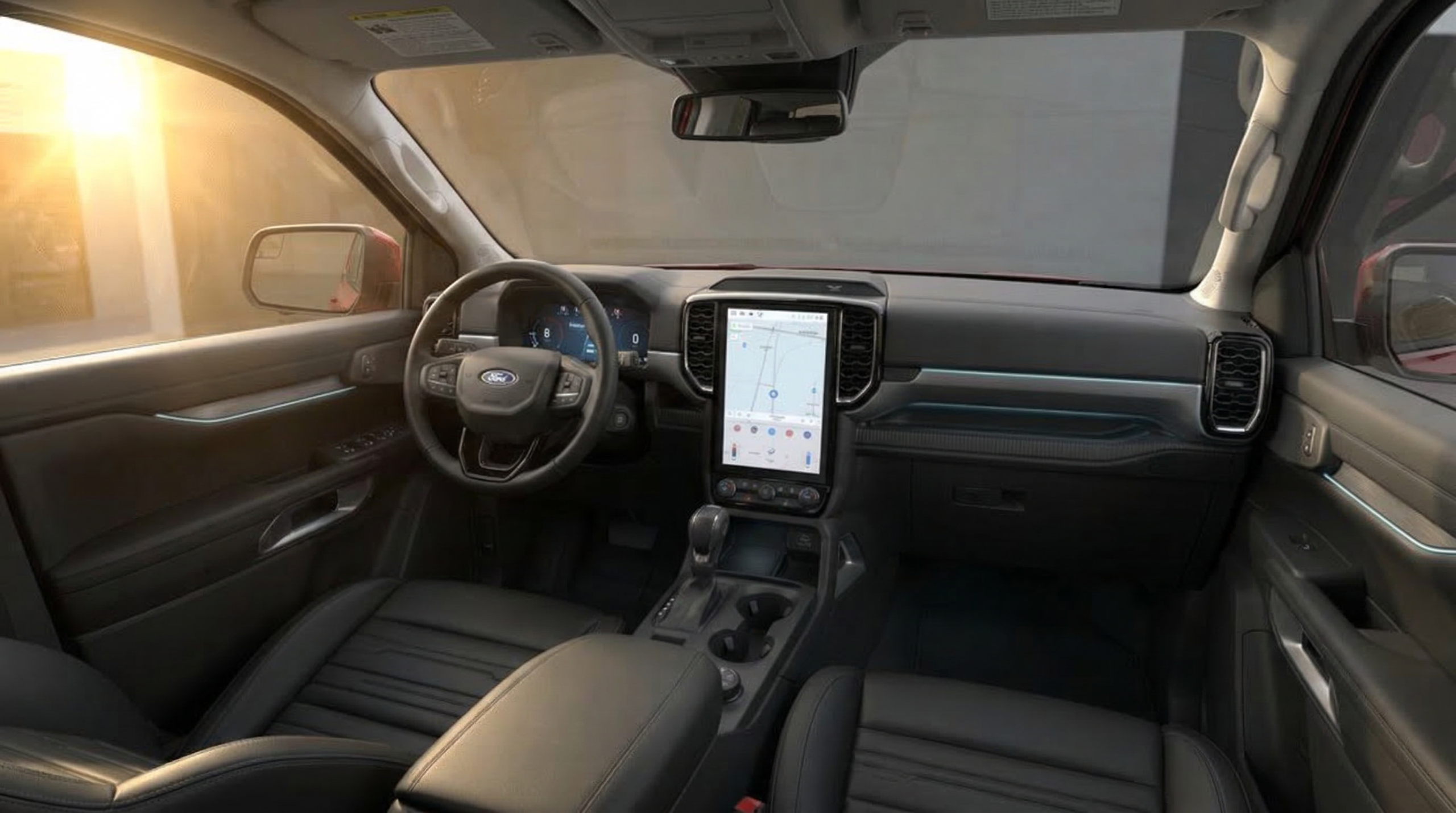
2026 Ford Ranger FX4 off-road in South Dakota

FX4 or Skip It? Here's What the 2026 Ranger's Off-Road Package Actually Does

Let's be direct: the FX4 Off-Road Package sounds impressive on a window sticker, but plenty of buyers aren't sure whether they actually need it or if it's just a checkbox that adds cost. If you spend time on gravel roads, muddy field edges, hunting access roads, or anywhere paved roads stop being a guarantee — the answer is probably yes. If you stay on pavement and well-maintained highways, you can save the money. Here's an honest breakdown of every component, what it does in the real world, and who it's actually built for. The Big 2026 Change: FX4 Now Available on the XL For 2026, Ford expanded FX4 availability down to the XL trim — that's new. Previously the package started at the XLT. Now you can spec the XL with FX4 content, which creates a lower-cost entry point for buyers who want the off-road capability without the added interior features of the XLT or Lariat. FX4 remains available on the XLT and Lariat as well. The Raptor is its own animal — it doesn't use the FX4 package name because it has more capable off-road hardware built in from the ground up. More on the Raptor vs. FX4 comparison below. What the FX4 Package Actually Includes The FX4 Off-Road Package is a collection of components that work together to improve capability in low-traction situations. Here's what's in it: Component What It Does Electronic Rear Locking Differential Locks both rear wheels to rotate at the same speed — prevents the truck from spinning the easy wheel and losing traction Trail Control™ Low-speed cruise control for off-road terrain — you steer, the truck manages throttle and braking independently at each wheel Rock Crawl Mode Activates low-range 4x4, engages e-locker, reduces throttle sensitivity for precise control on uneven terrain Off-Road-Tuned Shock Absorbers Recalibrated dampers for improved wheel articulation and stability on rough, uneven surfaces Steel Front Bash Plate Protects the front underbody from rocks, logs, and road debris when ground clearance runs out Off-Road Tires All-terrain tires on all FX4 configurations (OWL tires available on XLT models without the Black Appearance Package) FX4 Badging Box decals — the visual identifier that signals the package is equipped Trail Control: The Feature Most Buyers Underestimate Trail Control is essentially low-speed off-road cruise control. You set a target speed between 1 and 20 mph and it holds that speed — independently braking individual wheels and modulating throttle to keep you moving at a consistent pace through rough terrain. Your hands stay on the wheel for steering; the truck handles the rest. Why does this matter? On a steep rocky descent or a rutted two-track, managing throttle and brakes manually while also steering is a lot to coordinate — especially with passengers in the truck. Trail Control eliminates the brake-throttle-steer juggling act and lets you focus on your line. It's particularly useful for technical descents where too much speed leads to sliding. It's not a feature you'll use on every off-road trip. But the times you need it — loaded with gear, on a challenging grade, with a trailer behind you — it earns its place fast. The E-Locker: When It Matters and When It Doesn't The electronic rear locking differential is the most practically useful piece of the FX4 package for South Dakota driving conditions. Here's the core problem it solves: when one rear wheel is on a slippery surface and the other has grip, an open differential sends power to the wheel with less resistance — which means the slipping wheel spins freely while the good-traction wheel sits still. You go nowhere. The e-locker mechanically locks both rear wheels together so they both turn at the same speed regardless of traction. Both rear wheels become driving wheels. In soft spring mud, loose gravel, flooded field paths, or a wet boat ramp — the difference between locked and open is often the difference between moving and stuck. When to Use the E-Locker Use it: Muddy boat ramps, soft field edges, loose gravel climbs, spring thaw on two-tracks, wet grass, sand Don't use it on: Pavement or hard-packed roads — locking the rear differential on solid surfaces causes binding and handling issues You engage and disengage it with a dash button. Easy to forget you have it, easier to remember once you've needed it. FX4 vs. Raptor: Different Tools for Different Terrain The Raptor and the FX4 Ranger are not competing for the same buyer. The FX4 package improves a capable everyday truck — you're still on the same frame, same suspension travel, same ground clearance as the base Ranger. The Raptor is a purpose-built performance off-road platform with a completely different suspension architecture, significantly more wheel travel, and a 3.0L V6 tuned specifically for off-road use. XLT / Lariat w/ FX4 Raptor Engine 2.3L I4 or 2.7L V6 3.0L V6 — 405 hp Suspension Off-road tuned shocks Live-valve Fox Racing Shox, long-travel Max Towing up to 7,500 lbs up to 5,510 lbs Drive Modes Rock Crawl (FX4) Baja, Rock Crawl + more Best Use Daily driver + off-road capability Performance off-road truck Price Tier Package add-on cost Significant premium For most buyers in central South Dakota, the FX4 on an XLT or Lariat is the right call. It handles gravel roads, hunting access, boat launches, and field edges with confidence — and it still tows at the full 7,500 lb ceiling. The Raptor is for buyers who want high-speed desert running and extreme trail capability as a primary use case, not a secondary one. Worth It or Skip It: The Honest Framework Add FX4 if you regularly: Drive unpaved roads, gravel county roads, or seasonal two-tracks Back down boat ramps — especially in late fall or early spring when surfaces get soft Drive across pastures, field edges, or hunting grounds with soft or wet soil Deal with South Dakota spring mud or late-season snowpack on back roads Haul trailers off-pavement where departure traction is a concern Skip FX4 if you: Primarily drive paved highways, town streets, and well-maintained county roads Have no regular use for the e-locker, Trail Control, or rock crawl modes Are on a tight budget and the package cost matters — there's nothing wrong with a clean XLT or Lariat without it Why It Makes Sense for Bowdle-Area Drivers Living and working around Bowdle means unpaved roads aren't a novelty — they're routine. County gravel roads that turn to mud in April, field access tracks after rain, boat launches on the Missouri River system, stock dam access that gets torn up by cattle and equipment — this is exactly the environment the FX4 package is engineered for. The steel bash plate alone is worth something when you're driving roads where rocks and debris are a given. The e-locker is worth something every spring. Trail Control is worth something any time you're on a loaded descent in bad conditions. None of these are theoretical benefits in this part of the state — they're features you'll actually use. For a complete look at which trims offer FX4 and how the package fits into each build, or to understand how the e-locker improves traction at boat ramps and soft-surface towing situations, both guides have the detail. FX4 FAQ Is the FX4 package available on all 2026 Ranger trims? FX4 is available on the XL, XLT, and Lariat. The XL availability is new for 2026 — the package previously started at the XLT. The Raptor does not use the FX4 package name; it comes with a more capable off-road system as standard equipment. Does adding FX4 affect towing capacity? No — FX4 does not reduce or increase the Ranger's towing capacity. The 7,500 lb max (with Trailer Tow Package) remains the same whether or not FX4 is equipped. The e-locker can actually improve traction during soft-surface trailer departure situations, but the official tow rating is unchanged. Can I use the e-locker on pavement? No — the electronic rear locking differential is designed for low-traction, low-speed off-road use only. Using it on pavement causes drivetrain binding and handling instability. It's engaged and disengaged with a dash button, so it's easy to flip on and off as conditions change. What's the difference between Trail Control and regular cruise control? Standard cruise control maintains speed on pavement by managing throttle only. Trail Control is designed for off-road terrain and operates at very low speeds (1–20 mph) — it controls both throttle and braking independently at each wheel to maintain a consistent pace. The driver handles steering; Trail Control handles the throttle-brake balance on technical terrain. Did the FX4 package change at all for 2026? The package contents are essentially the same as 2025. The significant 2026 change is availability — FX4 is now offered on the XL trim for the first time. The components themselves (e-locker, Trail Control, off-road shocks, bash plate, FX4 tires and badging) carried over unchanged. Key Takeaways FX4 is now available on the XL for 2026 — that's new; it previously started at the XLT The package includes: e-locker, Trail Control, Rock Crawl mode, off-road shocks, steel bash plate, FX4 tires and badging The electronic rear locking differential is the most practically useful piece for South Dakota conditions Trail Control is low-speed off-road cruise control — handles throttle and braking while you steer FX4 does not reduce towing capacity — the 7,500 lb max still applies The Raptor is a different product entirely — purpose-built off-road with long-travel suspension and a 3.0L V6 If you drive unpaved roads, boat ramps, or field access regularly in central SD — FX4 is worth it The FX4 Off-Road Package isn't flashy marketing — it's a set of components that address real traction problems in real conditions. Around Bowdle, those conditions show up in April mud, gravel county roads, and every trip to a boat ramp or field edge. Whether it belongs on your build depends on how you actually use the truck. If you want to talk through trim and package combinations at Beadle Ford, I'm happy to help you land on the right build. The 2026 Ford Ranger overview is a good place to start if you want to compare the full lineup before narrowing down. — Lexy Tabbert, Beadle Ford Continue Reading → Which trims offer FX4 — and how each build stacks up on value → How the e-locker helps in soft-surface towing situations

How Much Can a Ford Edge Tow? Capacity, Cargo Space, and Real-World Capability

Ford Edge Capability Guide How Much Can a Ford Edge Tow? Capacity, Cargo Space, and Real-World Capability Definitive towing specs, Class II package details, and practical guidance for South Dakota buyers. The Ford Edge is a three-row crossover SUV built for families, outdoor enthusiasts, and SD ranchers who need a daily driver that can handle a boat, utility trailer, or camping setup. But what’s the real towing capacity? What cargo space do you actually get? And how do you know if an Edge you’re considering at a dealer lot is equipped to tow? We’ve pulled the OEM spec sheets and real-world owner feedback to give you the complete picture — exact towing limits by engine and package, GCWR numbers, tongue weight, and honest talk about what Edge owners pull across South Dakota’s lakes and back roads. Shop Edges in Stock Get Pre-Approved On This Page Ford Edge Towing Capacity: OEM Specs Class II Tow Package (53G) Explained Cargo Space & Interior Dimensions Real-World SD Use Cases What to Look for When Buying Used Frequently Asked Questions Key Takeaways Ford Edge Towing Capacity: OEM Specs The Ford Edge comes in three main powertrain configurations, and towing capacity differs significantly by engine choice and whether you add the optional Class II Tow Package (53G). Here’s the breakdown from Ford’s official 2023–2024 towing guides: Configuration Max Trailer Weight GCWR Tongue Load 2.0L EcoBoost I4 AWD (no tow package) 1,500 lbs 6,300 lbs N/A* 2.0L EcoBoost I4 AWD + Class II Package (53G) 3,500 lbs 8,300 lbs 350 lbs 2.7L EcoBoost V6 AWD ST (tow package standard) 3,500 lbs 8,500 lbs 350 lbs *The base 2.0L without tow package does NOT offer a factory Class II receiver; dealer accessory installation required. Max tongue load is 350 lbs on configurations with Class II package or factory tow prep. GCWR explained: Gross Combined Weight Rating is the total weight of your Edge plus the loaded trailer. Ford’s system stops you from overloading — if your Edge weighs 4,500 lbs, you can’t add more than 3,800 lbs of trailer and cargo in the 8,300 lbs GCWR configuration. Key takeaway: If you plan to tow more than 1,500 lbs, you need either the Class II Package on the 2.0L or the 2.7L V6 ST. The 2.7L offers a higher GCWR (8,500 vs. 8,300) and slightly more confidence for heavier loads, but both cap out at 3,500 lbs trailer weight. Expert Tip: All configurations are SAE J2807 certified, meaning they’ve been independently tested for towing safety. You can tow up to spec with confidence, but don’t exceed it. Class II Tow Package (53G): What You’re Really Getting The optional Class II Tow Package (Ford code 53G) is standard on the 2.7L V6 ST trim and optional on SE, SEL, ST-Line, and Titanium trims. Here’s exactly what Ford includes: Class II Tow Package (53G) Contents Trailer Wiring Harness (4-Pin): Powers brake lights and turn signals on your trailer. Essential for legal towing. Hitch Receiver (Class II): 1¼” square, rated for 3,500 lbs. Accepts standard hitch balls and adjustable ball mounts. Trailer Sway Control: Uses the Edge’s stability control to detect and dampen trailer oscillation at highway speeds. Activates automatically. SelectShift Automatic Transmission + Steering Wheel Paddle Shifters: Manual gear selection for engine braking on grades and towing. Better heat management than full auto. The SelectShift and paddle shifters are particularly valuable when towing. Lake Oahe and the Missouri River run through central South Dakota with plenty of hills — having the ability to lock the transmission in a lower gear means your transmission fluid stays cooler and you get better braking on the descent. That alone can add transmission lifespan by thousands of miles on a towing vehicle. Frontal area: Edges with the tow package have a larger frontal area (30 sq ft vs. 20 sq ft), which relates to air density and cooling calculations. More relevant for heat-heavy conditions like summer towing in the Black Hills. Class II hitch receiver detail: 1.25" square rated for 3,500 lbs WC (weight-carrying). Standard on ST, optional on other trims. Do You Need the Class II Package? Yes, if you plan to tow anything regularly. Even if your boat or utility trailer is only 2,500 lbs, the factory receiver, wiring, and SelectShift give you: Professional-grade towing harness (no aftermarket adapters to fail) Integrated sway control (proven to reduce accident risk by ~40% per NHTSA) Transmission management tools for safer braking on grades Better resale value (noted by used car buyers) Skip it if: You only tow every few years or plan to tow under 1,500 lbs. You can add a dealer-installed receiver later, but integrated factory towing always outperforms bolt-on kits. Cargo Space & Interior Dimensions Towing is part of the Edge story, but cargo space is equally important for SD buyers who haul feed, tools, camping gear, and equipment. Configuration Cargo Volume (Cu. Ft.) Behind 2nd row (typical) 39.2 cu. ft. 2nd row folded (max) 73.4 cu. ft. What fits in 39 cubic feet? Two large suitcases, a folded baby stroller, groceries for two weeks, camping gear for a family of four, or a side-by-side ATV frame. It’s the sweet spot for daily family hauling. What fits in 73 cubic feet? Everything above plus a second ATV, a small snowblower, pallets of feed sacks, or enough camping equipment for a week-long trip with toys and sports gear. Fold that second row and you’re in truck-like territory for volume. Second row folds flat for max cargo. Real-world: you can fit a pallet of 50-lb feed sacks in the cargo area with room to spare. Practical Cargo Scenarios for South Dakota Weekend at Lake Oahe: Beach towels, cooler, life jackets, snorkel gear, folding chairs, camping tent. Uses ~20 cu. ft. with 2nd row up. Plenty of room. Feed run to the co-op: 1,200 lbs of bagged feed (12 × 50-lb bags). Cargo area holds the volume easily; weight is within GVWR limits for all Edge configurations. Tool run + small equipment: Chainsaw, tool chest, extension ladder, tarps, fuel cans. Organize with cargo netting on the sides; 2nd row down gives you 6+ feet of length. ATV transport + camping: Fold 2nd row. Secure one ATV on a cargo dolly, load tent, sleeping bags, cooler in remaining space. This is a working Edge. Load Safety Note: Keep weight in the cargo area, not on the roof. High roof loads reduce stability at highway speeds and increase rollover risk, especially when cornering or crossing wind-exposed terrain. Real-World SD Use Cases: What Edge Owners Actually Tow Boat Trailers (Lake Oahe & Missouri River) Lake Oahe is the crown jewel of SD recreation, and Edge owners across the region use them to tow pontoon and fishing boat trailers. Here’s what works: Small fishing boat (17–19 ft): Typical dry weight 1,800–2,200 lbs, fuel + gear adds another 400–600 lbs. Total 2,200–2,800 lbs. Edge can handle with Class II package. Pontoon (20–22 ft): Dry weight 3,000–3,500 lbs, fully loaded 3,500–4,200 lbs. This exceeds Edge capacity. You need an Explorer or truck. Jet ski trailer (dual jet skis): Dry weight 800–1,200 lbs, loaded 1,500–1,800 lbs. Edge with Class II package is ideal. Tongue weight on boat trailers typically runs 10–12% of loaded trailer weight. On a 2,500 lb loaded boat, expect 250–300 lbs tongue load — right in the Edge’s 350 lbs sweet spot. Utility & Equipment Trailers Ranch work and hobby projects call for open utility trailers. Edge owners frequently tow: Single-axle enclosed trailer (6×10 ft): Empty weight 1,200 lbs. Loaded with fencing, posts, and tools: 2,500–3,000 lbs. Class II package handles this routinely. Tandem-axle utility trailer: Dry weight 2,000+ lbs before loading. Exceeds Edge capacity. Truck territory. ATV/quad trailer (single or dual): Empty 600–900 lbs, loaded with two ATVs 2,500–3,200 lbs. Edge with Class II package works. Camping & Recreational Trailers Travel trailers under 2,500 lbs: Lightweight teardrop and vintage Airstream models are increasingly popular with SD families. Edge with Class II package can tow these comfortably. Tongue load is typically 200–300 lbs. Horse trailers: A 2-horse steel trailer runs 1,500–1,800 lbs empty. With hay and equipment, 2,200–2,600 lbs. Edge can manage, but monitor fluid temps on longer hauls. Real Owner Feedback: “I tow a 2,200-lb fishing boat to Oahe on weekends with my Class II Edge. The sway control is rock-solid, and the paddle shifters let me brake downhill without riding the brakes. Transmission stays cool. Only regret is not getting the V6 for the extra GCWR headroom if we ever upgrade boats.” — James K., Pierre, SD What to Look for When Buying a Used Edge for Towing Not every used Edge you find at a dealer lot is equipped the same way. Here’s your checklist when shopping for a tow-capable Edge: 1. Confirm the Tow Package Look underneath the rear bumper: If there’s a Class II hitch receiver (1.25” square tube), the tow package is installed. If the bumper is smooth plastic, no package. Check the Monroney label (window sticker) or Carfax: Search for option code “53G” in the vehicle history. If the dealer says “we can add one,” verify the cost. Factory receivers run $600–$1,200; aftermarket adds another $300–$500. 2. Check Engine & GCWR History Ask the dealer: “Was this Edge used for towing?” Signs of heavy towing use: Transmission fluid darker than normal (should be bright red) Higher mileage on the odometer than expected for the year Wear marks on the hitch receiver Cooler hoses showing signs of stress If the Edge was towed a lot, it’s not a dealbreaker, but budget for earlier transmission service (fluid and filter every 50k miles instead of 150k). 3. Verify the Engine 2.0L EcoBoost I4: Adequate for most uses but requires the Class II package for 3,500 lbs. Single turbo, reliable engine. Check boost line clamps for leaks. 2.7L EcoBoost V6: Superior towing confidence. Dual turbo, more power, comes with tow package standard. Higher fuel consumption. Good choice if you plan heavy seasonal towing. 4. Test the Transmission (SelectShift) If the Edge has SelectShift, test the paddle shifters: Upshift and downshift using steering wheel paddles. Should respond instantly. No hesitation, grinding, or slipping. Manual mode disengages automatically above 6,500 rpm (safety feature). SelectShift adds confidence and longevity on towing-heavy vehicles. If the paddles are broken or unresponsive, factor in a transmission diagnostic (usually $100–$200). 5. Inspect Brake & Cooling Systems Brakes: Towing puts extra demand on brakes. Check pad thickness (should be >0.25”) and rotor condition. If pads are thin, budget $600–$1,000 for replacement. Transmission cooler: Open the hood and look for a secondary cooler mounted in front of the main radiator. On high-mileage Edges with heavy towing history, a failing cooler is common. Replacement runs $800–$1,500. 6. Ask the Right Questions Question What It Tells You “Was this towed, or used for towing?” Whether it endured heavy use. Transmission wear patterns differ. “Has the transmission fluid been serviced?” Maintenance history. Towed Edges need fluid changes sooner. “Any transmission issues or hesitations?” Early warning. Hesitation = internal wear. Costly repair. “Do the paddle shifters work?” Whether you have manual control for towing. Broken = electronics repair. Key Takeaways Max towing is 3,500 lbs (Class II package required on 2.0L; standard on 2.7L V6 ST). Any trailer exceeding this needs a different vehicle. Class II package is worth the cost if you tow regularly. Factory integration, sway control, and SelectShift add safety and resale value. Tongue weight maxes at 350 lbs across all Edge configurations. Most boat and utility trailers fall under this; verify before purchase. Cargo space is generous: 39.2 cu. ft. with the 2nd row up, 73.4 cu. ft. folded. Perfect for gear + weekend trips without a trailer. Real-world SD use: Fishing boats (under 2,800 lbs), jet skis, ATV trailers, light utility trailers, and small travel trailers are all safe bets. Pontoons and tandem-utility trailers exceed capacity. When buying used: Confirm the tow package, check brake and transmission cooler condition, and ask about towing history. Heavy use requires closer inspection. If your needs exceed 3,500 lbs, consider the Ford Explorer, which tows up to 5,600 lbs, or a truck like the F-150. Frequently Asked Questions Can I tow 3,500 lbs with a Ford Edge that doesn’t have the Class II package? No. Without the Class II Tow Package (53G), the 2.0L EcoBoost is rated for a maximum of 1,500 lbs. The 2.7L V6 ST comes with the package standard and can tow 3,500 lbs. If you have a 2.0L without the package and need higher capacity, you must either upgrade to the V6 or have a dealer install a Class II receiver (though Ford does not recommend towing the full 3,500 lbs without the integrated package components like trailer sway control and SelectShift). What does GCWR mean, and why does it matter? GCWR (Gross Combined Weight Rating) is the maximum total weight your Edge plus the loaded trailer can weigh. For example, a 2.0L with Class II has an 8,300 lbs GCWR. If your Edge weighs 4,500 lbs, you can add no more than 3,800 lbs of trailer and cargo. Exceeding GCWR overloads the chassis, transmission, and brakes, creating serious safety and reliability issues. You can check your Edge’s curb weight on the driver’s door jamb label. Is the Ford Edge better for towing than the Honda Pilot or Chevy Traverse? All three are competitive in the 3,500-lbs class. The Pilot maxes at 3,500 lbs, the Traverse at 5,600 lbs (with V8), and the Edge at 3,500 lbs. For towing capacity alone, the Traverse wins if you need a full-size three-row. For a mid-size vehicle, Edge, Pilot, and Traverse are equivalent. Choose based on features, interior layout, and local dealer support (we recommend Beadle Ford for Edge owners in South Dakota). Will towing an Edge void the warranty? No, as long as you stay within GCWR and tow weight limits, and follow Ford’s recommended maintenance schedule. Towing within spec is a normal use case. However, if you exceed GCWR or tow beyond the rated 3,500 lbs, Ford can deny warranty claims on related components (transmission, cooling system, brakes). Stick to the specs and service on schedule, and you’re covered. Do I need a separate brake controller for the trailer? The Class II package includes a 4-pin trailer wiring harness (12V connector). This powers trailer lights but not trailer brakes. For trailers under 3,000 lbs with surge or electric brakes, most states do not require a separate controller (South Dakota allows this). For heavier trailers or if you prefer integrated braking, a $150–$300 proportional brake controller can be added by a dealer or RV shop. Check your trailer’s manual and local regulations. Can I tow in the rain, snow, or high wind conditions common in South Dakota? Yes, with caution. The Edge’s Trailer Sway Control (included in the Class II package) helps stabilize the trailer in crosswinds and adverse conditions. However, reduce speed and increase following distance in rain, snow, and high-wind zones (common near Oahe and the Missouri River breaks). Avoid towing in whiteout conditions. The paddle shifters and SelectShift give you manual braking control on slippery descents — use it to prevent jackknifing. My Take on the Ford Edge as a Towing Vehicle From a marketing research perspective, the Edge occupies a genuinely useful position in the market: it’s a mid-size crossover that tows at the same ceiling as many buyers actually need. The 3,500-lb limit covers the most common South Dakota use cases — fishing boats at Lake Oahe, jet ski trailers, small utility trailers, and ATV setups. Buyers who regularly pull anything heavier should be looking at the Explorer or F-150 instead, and the Edge doesn’t pretend otherwise. The Class II package distinction is the most important purchasing detail in this guide. Without it, buyers on the 2.0L are limited to 1,500 lbs and don’t get trailer sway control — that’s a meaningful gap, not just a spec sheet difference. When evaluating a used Edge for towing, confirming the presence of that package should be the first question. For the complete model overview including trim and year comparisons, the Ford Edge buyer guide has the full context. Questions about a specific vehicle or tow package configuration? Beadle Ford in Bowdle can help. Shop Edges in Stock Get Pre-Approved Contact Beadle Ford Related Edge Resources Shop Edges in Stock Ford Edge Best Years & Model History Need More Towing Capacity? The Ford Explorer tows up to 5,600 lbs and offers three rows with more room. View Explorer inventory. About the Author Lexy Tabbert — Beadle Ford, Bowdle, SD Lexy Tabbert is the Director of Sales and Marketing at Beadle Ford in Bowdle, South Dakota. She covers Ford vehicles, trim comparisons, and buyer guidance — helping families, ranchers, and ag operators across the region find the right truck and configuration for their needs. Learn more about Lexy.
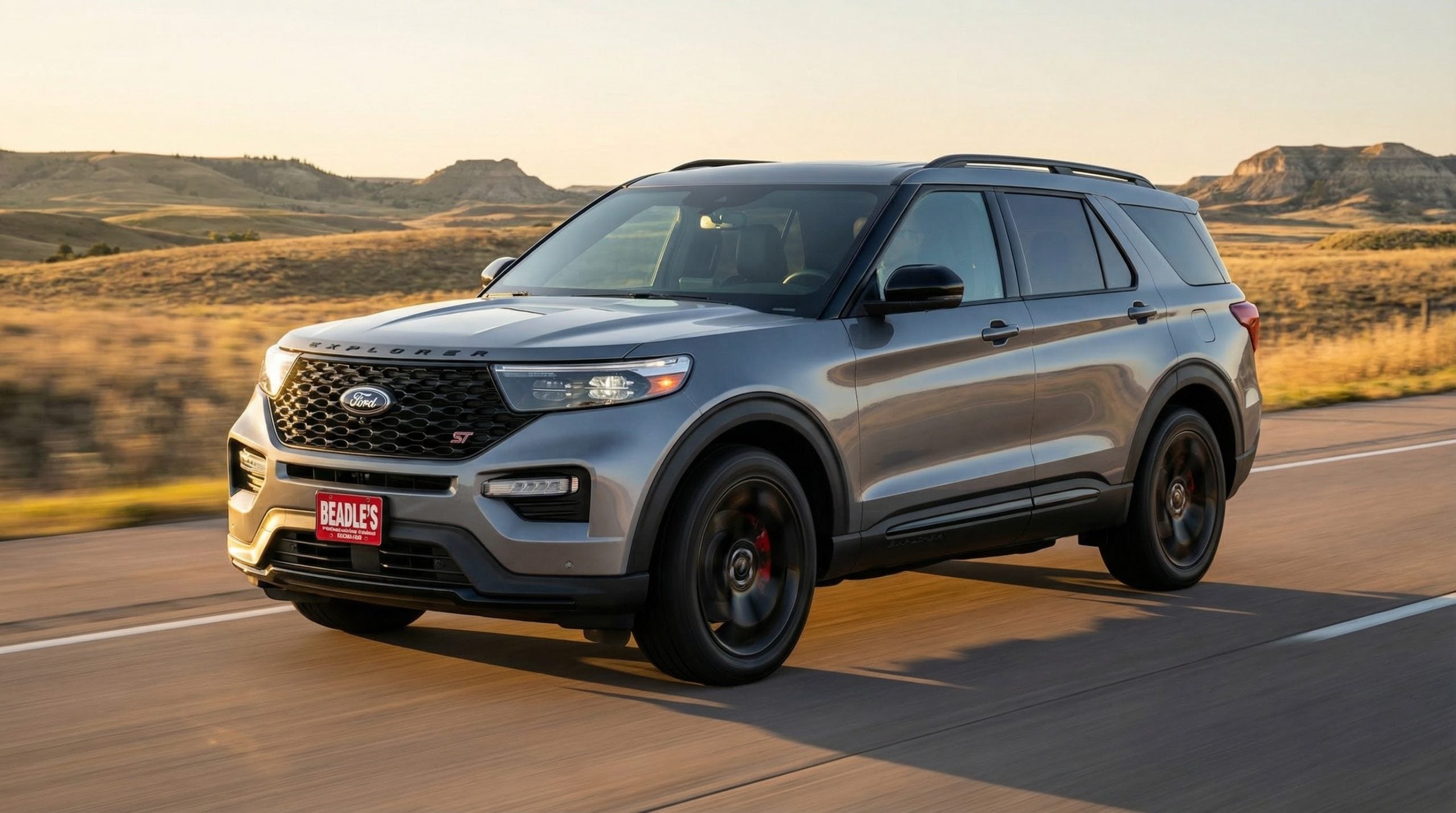
Contact Us

Fill out this form below and we'll contact you shortly
*Required Fields