
Blog

All New Vehicles Bowdle Ford Dealer Bowdle Ford Service
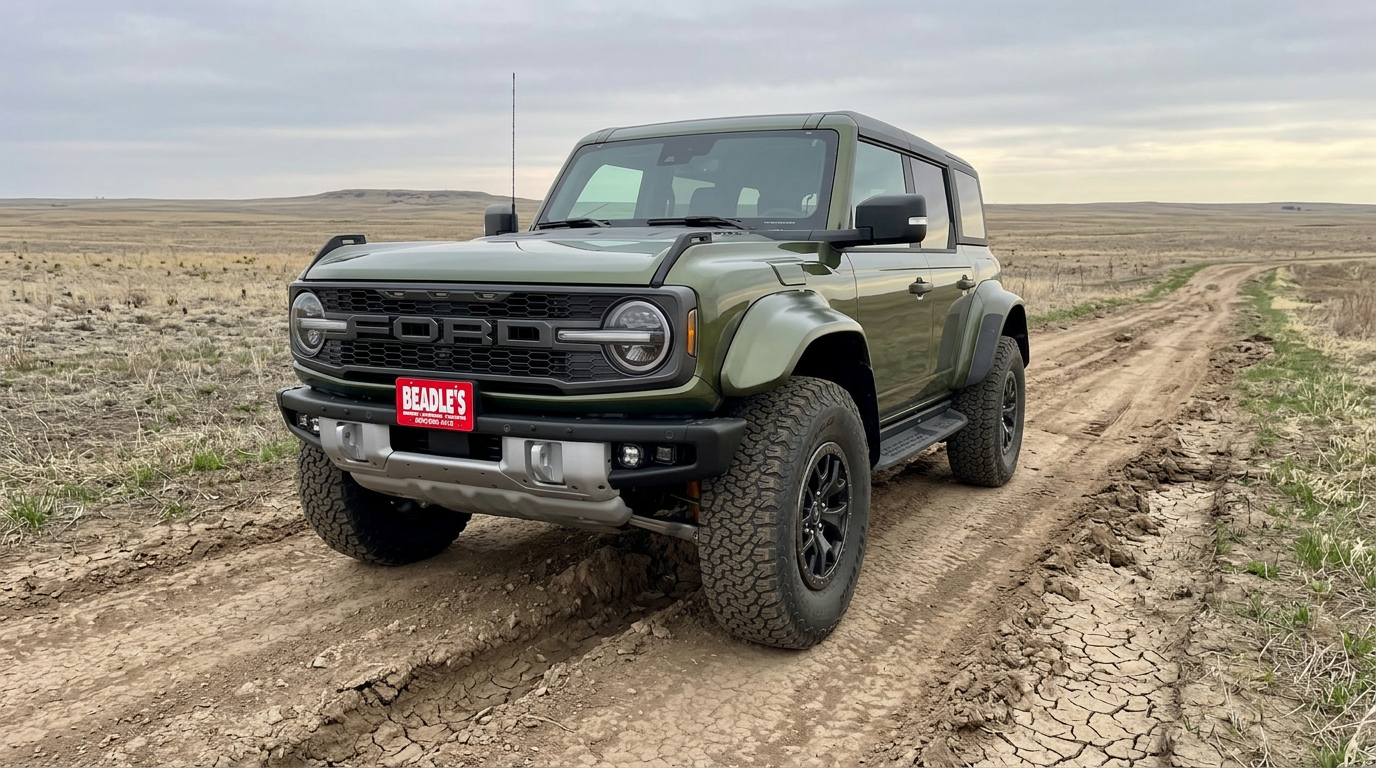
2026 Ford Bronco 4-Door Raptor in Shelter Green Metallic on a rutted section-line dirt road in central South Dakota

2026 Ford Bronco vs 2026 Jeep Wrangler: An Honest Comparison From a Ford Store

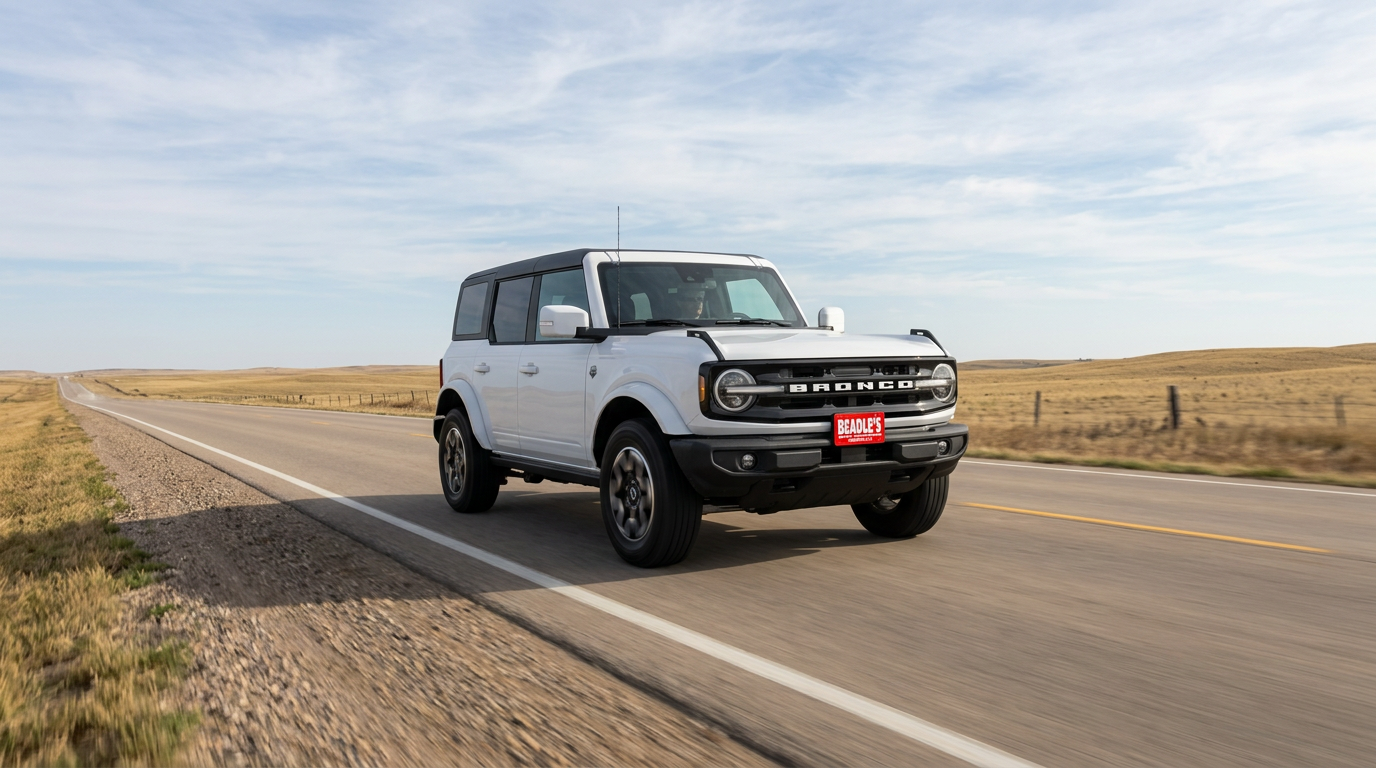
The 2026 Ford Bronco and the 2026 Jeep Wrangler are the two body-on-frame, four-wheel-drive, removable-top SUVs in the segment. They share a buyer profile and a use case — both are bought as second vehicles, weekend rigs, and lifestyle expressions as much as transportation. Cross-shopping is real, and most Bronco buyers in central South Dakota have driven a Wrangler at least once before signing. This is an honest comparison from a Ford store, played even-handedly. We'll cover engines and transmissions, off-road hardware, the doors-off and roof-off designs, on-road comfort, what the money actually buys, and where the Wrangler still wins versus where the Bronco is the right call for most Beadle-area buyers. There are real differences in both directions. Shop Broncos in Stock Get Pre-Approved On This Page How Do the 2026 Bronco and Wrangler Compare on Engines and Transmissions? How Does the Off-Road Hardware Stack Up? Removable Doors and Roof: How Do the Two Designs Differ? Which One Drives Better on Long Highway Hauls? What Do You Actually Get for the Money With Each One? Where Does the Wrangler Still Win — and Where Does the Bronco Win? How Do the 2026 Bronco and Wrangler Compare on Engines and Transmissions? The two lineups are organized differently. The Bronco offers three EcoBoost engines (2.3L I-4, 2.7L V6, 3.0L V6 Raptor) and the only manual transmission in the segment — a 7-speed paired with the 2.3L. The Wrangler runs a 2.0L turbo I-4 and a 3.6L Pentastar V6 across most of its lineup, with the 6.4L HEMI V8 reserved for the new-for-2026 Moab 392 and the limited-edition Willys 392. The Wrangler offers a 6-speed manual on the 3.6L V6, and an 8-speed automatic across the lineup. On peak horsepower, Wrangler wins at the top — the 6.4L HEMI V8 in the Moab 392 makes 470 horsepower and 470 lb-ft of torque versus the Bronco Raptor's 418 horsepower and 440 lb-ft from its 3.0L EcoBoost V6. The HEMI also makes a sound the Raptor doesn't try to make. For buyers cross-shopping at the very top of each lineup — Bronco Raptor versus Wrangler 392 — the Wrangler is the more powerful vehicle on paper. In the meaningful middle of the lineup, the Bronco's 2.7L EcoBoost V6 (330 hp / 415 lb-ft) outpunches the Wrangler 3.6L Pentastar (285 hp / 260 lb-ft) on torque by a wide margin — 415 versus 260 lb-ft is the difference between an engine that pulls effortlessly from low RPM and one that needs to rev to make work. The Bronco's base 2.3L (300 hp / 325 lb-ft) similarly outpunches the Wrangler 2.0L turbo (270 hp / 295 lb-ft). The transmission story is more even. Bronco's 10-speed automatic has more ratios than Wrangler's 8-speed, which gives the Bronco a smoother shift cadence at highway speed and more precise gearing for off-road crawl. But Wrangler still offers a manual with the V6 — Bronco's manual is 2.3L-only. For buyers who want a V6 with a stick shift, the Wrangler is the only option. For full Bronco engine context see our 2.3L vs 2.7L EcoBoost engine comparison. How Does the Off-Road Hardware Stack Up? Both vehicles are genuinely capable. The differences are in how each is engineered to be capable, not in whether they are. At the top spec, the numbers are within a half-degree of each other on most published metrics. On terrain management systems, the Bronco uses G.O.A.T. Modes (Goes Over Any Type of Terrain) — five modes on most trims, seven on Badlands and Raptor, including Off-Road, Rock-Crawl, and Baja. Wrangler uses Selec-Terrain with four primary modes (Auto, Snow, Sand/Mud, Rock) plus the brand's familiar 4WD systems (Command-Trac, Selec-Trac, or Rock-Trac depending on trim). Both work well; G.O.A.T. tends to be more discrete in mode count, while Selec-Terrain is broader by default. See our 2026 Bronco G.O.A.T. Modes guide for the full mode-by-mode breakdown. On locking differentials, both vehicles offer electronic-locking front and rear lockers at their off-road-focused trims. Bronco standardizes them on Badlands, Heritage Edition, Raptor, and any trim equipped with the Sasquatch Package. Wrangler standardizes them on Rubicon trims (and the new Moab 392 / Willys 392). Big Bend with the Black Diamond Package gets a rear locker only — Wrangler's Sport S and Sahara are similar. On front sway-bar disconnect, both vehicles offer it. Wrangler's electronic disconnect (on Rubicon and up) has been the segment benchmark for years. Bronco offers Front Stabilizer Bar Disconnect standard on Raptor and Stroppe, and new for 2026 Ford made it a standalone $1,305 option on Badlands (previously only via Sasquatch). Bronco Wildtrak with Sasquatch in the kind of cattail-slough mud that Wrangler buyers also cross-shop for — both vehicles handle it; the question is which one fits how you live with it the rest of the week. On geometry numbers at the most-capable spec: the Bronco Raptor (37" tires) lists approximately 13.1 inches of ground clearance, 47.2° approach, 30.8° breakover, and 40.5° departure. The Wrangler Moab 392 lists approximately 12.9 inches of ground clearance, 47.4° approach, and 40.4° departure (Jeep doesn't always publish breakover the same way). The Bronco Sasquatch (35" tires) lists approximately 11.6 inches of ground clearance with similar angle values. Wrangler Rubicon with the Xtreme 35 Package is in roughly the same neighborhood. These numbers are within rounding error of each other at the top spec — neither vehicle has a meaningful geometry advantage. For Sasquatch context specifically, see our 2026 Bronco Sasquatch Package guide. On 4WD systems, Wrangler's Rock-Trac (Rubicon-only) gets a 4:1 low-range gear that's sharper than what the Bronco uses, and the Bronco compensates with the GOAT Off-Road and Rock-Crawl modes plus Trail Control (low-speed off-road cruise control). Both are capable; Wrangler is slightly more analog, Bronco is slightly more electronic. Get Pre-Approved Contact Beadle Ford Removable Doors and Roof: How Do the Two Designs Differ? Both vehicles have removable doors and removable tops. The differences are in how the engineering is executed — and in how often you'd actually take advantage of it. 2026 Ford Bronco 4-Door Big Bend in doors-off configuration with front roof panels removed — what most buyers picture when they imagine the doors-off lifestyle. Bronco's frameless doors are designed to be removed without specialty tools — the Tool Kit is standard on Base and inherited up the trim ladder. The mirrors stay attached to the body (not the door), which means you keep your sideview mirrors when the doors are off. Wrangler's mirrors are mounted to the doors, so when those come off, the mirrors come with them — and Jeep sells aftermarket frame-mounted mirrors as an accessory if you want to drive doors-off legally on the highway. On the roof, Bronco offers a Modular Hardtop with separate front panels (driver and passenger T-tops) that can come off independently of the rear, plus a soft-top option. Wrangler offers either a one-piece hardtop, a two-piece hardtop (Freedom Top), or the soft top. Both designs work; Wrangler's Freedom Top is generally faster to take off than Bronco's modular setup, while Bronco's lets you go partial — front panels off, rear panels on — which is a useful in-between for a sunny day with cooler weather behind you. Honest take for central South Dakota: the doors-off and roof-off lifestyle is mostly a 4–6 month window. From mid-October through early April, the doors stay on and the hardtop earns its keep. Both vehicles handle the cold months equivalently — but if you're bought either of them for the doors-off feature, plan around the calendar. Our 2026 Bronco removable doors and roof guide covers this in more detail. Which One Drives Better on Long Highway Hauls? This is one of the clearer differences. The Bronco generally rides quieter, tracks straighter at highway speeds, and feels less truck-like over expansion joints than the Wrangler does — particularly on Outer Banks and on any non-Sasquatch configuration. The Wrangler's solid front axle (a feature for off-road purists) is also why it tends to wander more at 75 mph and follow road crowns more aggressively than the Bronco's independent front suspension does. For long-distance drivers — anyone making the four-hour Bowdle-to-Black-Hills run a few times a year — the Bronco's on-road manners are a real, daily-felt advantage. Wind noise is lower, steering feel is closer to a modern crossover, and the cabin doesn't ask the driver to actively manage the wheel the way a Wrangler can on a windy day. Both vehicles offer modern infotainment. Bronco runs SYNC 4 with a 12-inch standard touchscreen on every trim — including Base — and wireless Apple CarPlay and Android Auto. Wrangler runs Uconnect 5 with an 8.4-inch standard screen (12.3-inch optional). Both interfaces are good. Bronco's standard screen is bigger; Wrangler's tactile controls are arguably better for off-road glove use. Worth flagging: the 2026 Bronco does not offer Ford's BlueCruise hands-free highway driving. Wrangler doesn't offer a competing hands-free system either. So while BlueCruise is a Ford brand strength elsewhere in the lineup, it's not a differentiator here. What Do You Actually Get for the Money With Each One? At MSRP, the two lineups overlap heavily. The 2026 Bronco starts at $40,495 (Base, before destination) and tops out at $79,995 (Raptor). The 2026 Wrangler starts comparably (depending on trim and body style) and tops out near $90,000+ for the Moab 392 and the limited-edition Willys 392. For mainstream comparison, a Bronco Big Bend, Outer Banks, or Badlands sits roughly in line with a Wrangler Sport S, Sahara, or Rubicon respectively. Where the math diverges is in standard equipment per dollar. The Bronco runs SYNC 4 with the 12-inch screen, wireless CarPlay and Android Auto, and Co-Pilot360 driver-assist (BLIS, lane-keeping, AEB) standard from Big Bend up. Wrangler delivers similar tech but more of it lands in optional packages or higher trims. A Bronco Big Bend at MSRP usually has more standard tech than a Wrangler Sport S at the same price. For trim-by-trim Bronco context, see our 2026 Bronco trim levels guide. On towing, Wrangler wins on paper: the 4-door Wrangler Rubicon with the 4.10 axle (and the Moab 392 / Willys 392) is rated to tow up to 5,000 lbs. Every non-Raptor 2026 Bronco caps at 3,500 lbs; the Bronco Raptor caps at 4,500 lbs. If you're regularly towing a trailer that puts you above 3,500 lbs, that pushes you to a Bronco Raptor or to the Wrangler. For most buyers towing a fishing boat, an ATV trailer, or a small camper, both are well within capacity. Resale value is roughly comparable. Wrangler has historically held value extremely well — that hasn't completely changed — but the Bronco's resale has been strong since launch and continues to track close to Wrangler's at three- and five-year points. Both vehicles depreciate less than the average mainstream SUV. Where Does the Wrangler Still Win — and Where Does the Bronco Win? The Wrangler still wins if you want the highest-output engine in the segment (the 470-hp HEMI V8 Moab 392 / Willys 392 — the Bronco Raptor doesn't try to chase it), if you want a manual transmission paired with a V6 (Bronco's manual is 2.3L-only), if your tow load lives between 3,500 and 5,000 lbs (Bronco caps at 3,500 lb non-Raptor / 4,500 lb Raptor), or if you place a strong premium on the Wrangler's brand identity and aftermarket community — both are real and longstanding strengths. The Bronco wins if you do a lot of long-distance highway miles, if you want the segment's best standard-tech-per-dollar (SYNC 4, 12-inch screen, Co-Pilot360 from Big Bend up), if you want creature comforts in your off-road SUV without stepping all the way up to a top-trim Wrangler, if you appreciate that the Bronco's mirrors stay on when the doors come off, or if you want the GOAT mode terrain system rather than Selec-Terrain. The third factor — the one that doesn't show up on a spec sheet — is the dealer relationship. The nearest Jeep dealership to Bowdle is enough miles away that warranty service, recall work, and trade-in conversations all become a half-day commitment. Beadle Ford is twenty minutes from most of our buyers, and we've been here for decades. For a vehicle that's going to need an oil change four times in the first year and a service item or two over its life, that proximity matters more than most buyers think when they're shopping on paper. Either vehicle is a good choice. We recommend driving both — and we'll tell you straight up which one fits your specific use case, even if that answer isn't the Bronco. For the broader 2026 Bronco context, the full 2026 Ford Bronco overview covers engines, capability, and what's new for the year. Key Takeaways Top engines: Wrangler 6.4L HEMI V8 (470 hp / 470 lb-ft) outpowers Bronco Raptor 3.0L V6 (418 hp / 440 lb-ft). In the meaningful middle, Bronco's 2.7L EcoBoost V6 outpunches Wrangler's 3.6L V6 on torque (415 vs 260 lb-ft). Off-road geometry at top spec is within rounding error: Bronco Raptor ~13.1" GC, 47.2° approach, 40.5° departure; Wrangler Moab 392 ~12.9" GC, 47.4° approach, 40.4° departure. Towing: Wrangler tops out at 5,000 lbs (4-Dr Rubicon w/ 4.10 axle); Bronco caps at 3,500 lbs non-Raptor, 4,500 lbs Raptor. Doors-off design: Bronco's mirrors are body-mounted (stay on); Wrangler's mirrors come off with the doors and require aftermarket frame mirrors for legal road use. Bronco wins on long-highway comfort, standard tech per dollar (SYNC 4 + 12-inch screen + Co-Pilot360), and dealer proximity for central-SD buyers. Wrangler wins on top-spec horsepower, V6+manual availability, max towing, and aftermarket community. Frequently Asked Questions Is the 2026 Ford Bronco better off-road than the 2026 Jeep Wrangler? Neither has a meaningful geometry advantage at top spec — published approach, departure, and ground-clearance numbers are within a half-degree or half-inch of each other. Both have front and rear lockers and front sway-bar disconnect at their off-road trims. The vehicles are differently engineered to the same end: Bronco leans more electronic (GOAT modes, Trail Control), Wrangler more analog (Rock-Trac 4:1 low range, solid front axle). Does the 2026 Bronco tow more than the 2026 Wrangler? No. Wrangler wins on max towing. The 4-Door Wrangler Rubicon with the 4.10 axle and the Moab 392 / Willys 392 are rated up to 5,000 lbs. The 2026 Ford Bronco tops out at 4,500 lbs (Raptor only); every other Bronco trim caps at 3,500 lbs. Can you get a manual transmission on either the 2026 Bronco or Wrangler? Both vehicles offer a manual transmission. The Bronco's 7-speed manual is paired exclusively with the 2.3L EcoBoost. The Wrangler's 6-speed manual is offered with the 3.6L Pentastar V6. If you want a V6 with a stick shift, only the Wrangler offers that combination. Which is more comfortable on the highway: 2026 Bronco or Wrangler? The Bronco is generally quieter, tracks straighter, and handles wind and road crowns better at 70+ mph than the Wrangler does. The Wrangler's solid front axle is a feature for off-road purists but trades on-road manners for it. If long highway miles are a regular part of how you'll use the vehicle, the Bronco is the more comfortable highway companion. Do you keep the sideview mirrors when you take the doors off the 2026 Bronco? Yes. The Bronco's sideview mirrors are mounted to the body, not the doors, so they stay attached when the doors are removed. On the Wrangler, the mirrors are door-mounted — when the doors come off, the mirrors come off with them, and aftermarket frame-mounted mirrors are required for legal on-road use without doors. My Take on the 2026 Bronco vs Wrangler Decision I'll be honest — I've sold a few customers a Bronco who would have been better off with a Wrangler, and I've sent a couple of long-time Wrangler owners home in a Bronco who didn't expect to like it. The decision usually comes down to two questions: how many highway miles will you put on it, and how committed are you to the brand identity and the community that comes with each one. If long highway runs are a big part of your year and you don't have strong loyalty either way, the Bronco's on-road manners and standard-tech-per-dollar usually carry the day. If you've owned three Wranglers and you know what you love about them, no amount of EcoBoost torque is going to change that — and that's a perfectly valid reason to stay with what you know. The thing the spec sheet doesn't capture is the dealer side of the deal. We've been at Beadle Ford in Bowdle long enough to remember a lot of our customers' previous trucks — and the closest Jeep store is far enough away that the relationship is harder to build. If you're cross-shopping and the trucks land at a near-tie on paper, the dealer math is worth weighing. Either way, come drive both. We'll be square with you about which one fits. Shop Broncos in Stock Get Pre-Approved About the Author Lexy Tabbert — Beadle Ford, Bowdle, SD Lexy Tabbert is the Director of Sales and Marketing at Beadle Ford in Bowdle, South Dakota. She covers Ford vehicles, trim comparisons, and buyer guidance — helping families, ranchers, and ag operators across the region find the right truck and configuration for their needs. Learn more about Lexy.
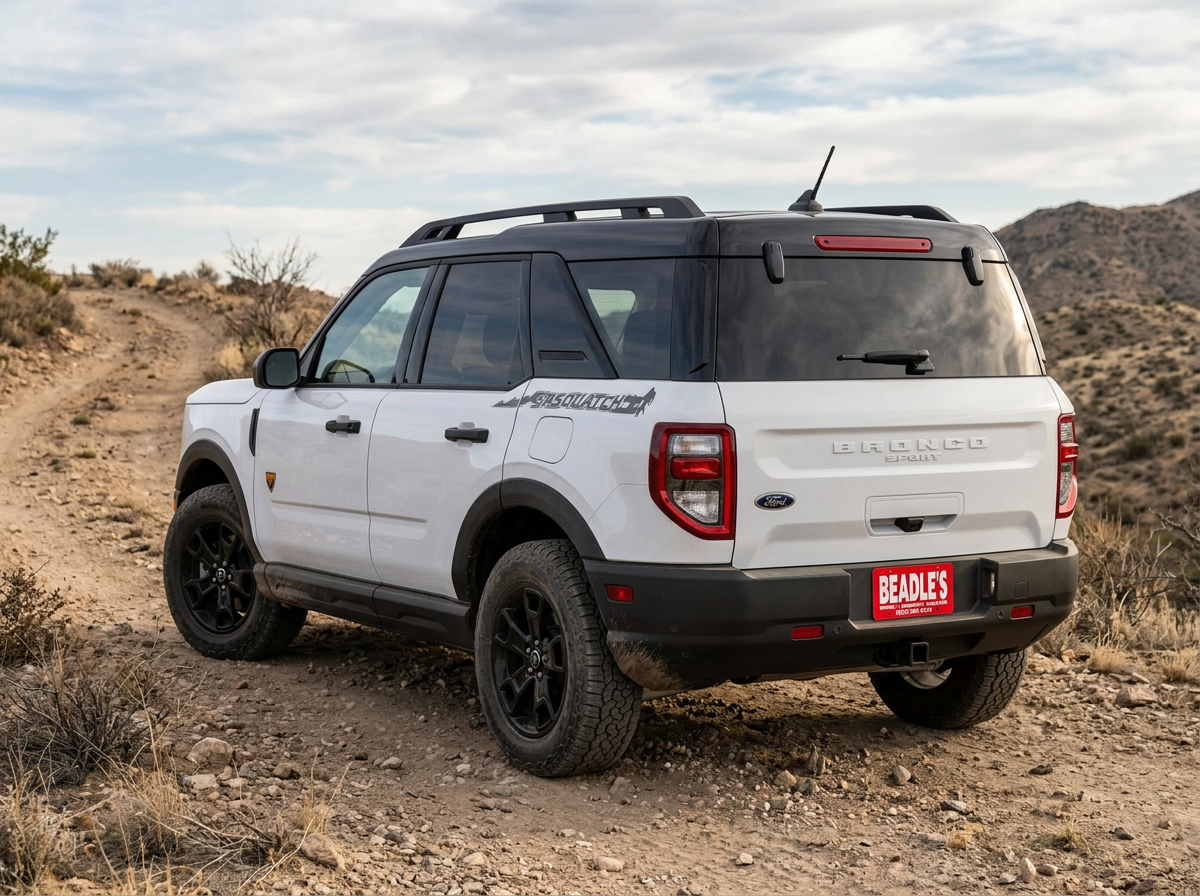
2026 Ford Bronco Sport Outer Banks with Sasquatch Package in South Dakota

Outer Banks Sasquatch vs Badlands: What the 2026 Bronco Sport Sasquatch Package Adds and Who It's Actually For

The 2026 Ford Bronco Sport Sasquatch Package turns the Outer Banks trim into a legitimate off-road machine — but it's not the same thing as buying a Badlands. If you're deciding between adding the Sasquatch Package to an Outer Banks or stepping up to the Badlands outright, the answer depends on what you're actually planning to do with the vehicle and how much the Outer Banks' interior upgrades matter to you. Here's what the Sasquatch Package adds, what it can't change, and which buyer each option is really built for. Shop Bronco Sports in Stock Get Pre-Approved In This Guide What Is the Sasquatch Package on the 2026 Bronco Sport? What Does the Sasquatch Package Actually Include? Outer Banks Sasquatch vs. Badlands: Full Comparison Does the Outer Banks Sasquatch Get Rock Crawl and Rally Modes? Is the Sasquatch Package Worth It on the Outer Banks? Who Should Buy the Outer Banks Sasquatch vs. the Badlands? What Is the Sasquatch Package on the 2026 Bronco Sport? The Sasquatch Package (option code 67A) is a factory off-road upgrade available exclusively on the 2026 Bronco Sport Outer Banks trim. It cannot be added to Big Bend, Heritage, or Heritage Limited — and it has no place on the Badlands, because the Badlands already includes most of its hardware as standard equipment. The package was built to give Outer Banks buyers access to Badlands-tier off-road hardware without giving up the Outer Banks' comfort and luxury features. You get the Advanced 4x4 system with twin-clutch rear axle, HOSS 2.0 off-road suspension, aggressive A/T tires, Trail Control, recovery hooks, and underbody protection — all on a trim that also offers available B&O audio, a panoramic fixed glass roof, and leather-trimmed seating. One important note: the Sasquatch Package requires the Outer Banks Tech Package (option code 96T) to be ordered first. For Bowdle buyers who want a capable trail rig that can also serve as a comfortable vehicle for longer South Dakota road trips, the Outer Banks Sasquatch is worth a serious look — as long as you understand exactly what it does and doesn't give you. What Does the Sasquatch Package Actually Include? The Sasquatch Package is one of the most content-rich factory option packages on the Bronco Sport lineup. Here's what's bundled in: Feature What It Means Advanced 4x4 with Twin-Clutch DRSC Active torque-vectoring rear axle — the same system standard on Badlands HOSS 2.0 Off-Road Suspension High-performance Off-Road Stabilization & Suspension with Bilstein position-sensitive dampers Trail Control Low-speed cruise control that manages throttle and braking over technical terrain Trail One-Pedal Drive Regenerative deceleration for precise throttle control at slow off-road speeds Pro Power Onboard 400W 110V outlet with up to 400 watts for power tools, camp gear, or electronics 17" Ebony Black Aluminum Wheels Larger-diameter wheels replacing Outer Banks' standard alloys P235/65R17 All-Terrain Tires All-terrain compound for improved grip on gravel, dirt, snow, and soft ground High Clearance Front Fender Flares Wider clearance to accommodate bigger tires and improve approach angles Front Brush Guard with Recovery Hooks Black MIC (Molded-In Color) construction; integrated front recovery points Black MIC Front & Rear Bumpers Replaces body-color bumpers with a more rugged, trail-ready look Rear Recovery Hooks — 2 D-rings Frame-mounted rear anchor points for recovery straps or tow lines Class II Trailer Tow Package Required for towing above 1,500 lbs; adds hitch receiver and wiring harness 12.3" Digital Instrument Cluster Full-color reconfigurable display replacing analog gauges Rubberized Floor Covering Easier cleanup after muddy or wet adventures Underbody Protection Front and rear skid plates to guard against rocks and trail debris That's a significant list. The Sasquatch Package essentially bolts Badlands-level off-road hardware onto the Outer Banks platform — giving you access to two capability sets that normally live on separate trim lines. The remaining question is what it leaves out, which is covered in the next section. Outer Banks Sasquatch vs. Badlands: Full Comparison On the surface, the Outer Banks Sasquatch and the Badlands look nearly identical once the package is installed. But there are meaningful differences — primarily in the engine room and the G.O.A.T. mode system — that matter to serious off-road buyers. Feature Outer Banks + Sasquatch Badlands Base Engine 1.5L EcoBoost (180 hp / 190 lb-ft) 2.0L EcoBoost (250 hp / 280 lb-ft) 2.0L Engine Available? Yes — optional add-on Standard, included Advanced 4x4 with Twin Clutch Yes (via Sasquatch Package) Standard HOSS 2.0 Suspension Yes (via Sasquatch Package) Standard Trail Control + Trail One-Pedal Yes (via Sasquatch Package) Standard P235/65R17 A/T Tires Yes (via Sasquatch Package) Standard Total G.O.A.T. Modes 5 modes 7 modes Rock Crawl Mode No Yes Rally Mode No Yes Leather-Trimmed Seating Available Available (heated) B&O Sound System Available Not available Panoramic Fixed Glass Roof Available Not available Pro Power Onboard 400W Yes (via Sasquatch Package) Standard The short version: the Outer Banks Sasquatch gives you Badlands hardware while keeping the Outer Banks' luxury features, but starts with the 1.5L engine and lacks Rock Crawl and Rally modes. The Badlands comes with the 2.0L, Rock Crawl, and Rally as standard — but trades away the panoramic roof and B&O audio options. Does the Outer Banks Sasquatch Get Rock Crawl and Rally Modes? No. Rock Crawl and Rally are exclusive to the Badlands trim and cannot be unlocked by any package or option on the Outer Banks. This is one of the most important differences between the two configurations — and the one buyers most often overlook when spec-shopping. The Outer Banks Sasquatch gets the five standard G.O.A.T. (Goes Over Any Type of Terrain) modes: Normal, Eco, Sport, Slippery, and Sand. These are genuinely capable across a wide range of conditions. But Rock Crawl and Rally require the Badlands' powertrain calibration and the 2.0L engine's specific torque curve — neither of which transfers to the Outer Banks through a package alone. G.O.A.T. Mode Availability by Configuration Mode Outer Banks Sasquatch Badlands Normal Yes Yes Eco Yes Yes Sport Yes Yes Slippery Yes Yes Sand Yes Yes Rock Crawl No Yes Rally No Yes If you're regularly running rocky terrain in the Badlands (the geographic region, not the trim) or want Rock Crawl's precise throttle management for technical obstacles, the Badlands trim is the right call. If your off-roading consists of trail riding, forest roads, pasture tracks, or winter traction across western South Dakota, the Outer Banks Sasquatch's five modes are fully up to the task. Is the Sasquatch Package Worth It on the Outer Banks? For the right buyer, yes. The Sasquatch Package bundles gear that would cost substantially more to source aftermarket — an upgraded 4x4 system, skid plates, recovery hooks front and rear, A/T tires, upgraded suspension, Pro Power Onboard, Trail Control, and the Class II tow package. Buying those components separately would run well past the package price, and they wouldn't be factory-integrated or covered under your Ford warranty. The value question is different depending on your use case: Worth It If You... Want the Outer Banks' interior upgrades and off-road hardware in a single build Plan to tow a jon boat, ATV trailer, or utility load (up to 2,200 lbs with the 2.0L) Drive gravel, pasture, or forest roads regularly but don't need Rock Crawl mode Want A/T tires and capable 4x4 for South Dakota winters without buying aftermarket Want the 400W outlet for worksites, hunting camp, or charging gear on the road Skip It If You... Primarily drive pavement and rarely go off-road Need Rock Crawl or Rally modes for technical terrain Want the 2.0L engine as standard without a separate upgrade Are comparing total cost to a Badlands without factoring in the required Tech Package One important consideration: the Sasquatch Package requires the Outer Banks Tech Package (96T) to be ordered first, which means the actual entry cost includes both packages stacked. Build your full configuration before comparing it to Badlands pricing — the sticker difference is often smaller than buyers expect. Who Should Buy the Outer Banks Sasquatch vs. the Badlands? This decision usually comes down to one core question: what matters more to you — the interior experience or the maximum off-road performance ceiling? Here's how to map your use case to the right build: Use Case Outer Banks Sasquatch Badlands Weekend trail riding + comfortable daily commute Better fit Also capable Serious rock crawling or technical off-road routes Limited — no Rock Crawl mode Better fit Long road trips, premium audio, comfort features Better fit Fewer luxury options Towing a boat to Lake Oahe or a small utility trailer Better fit (Class II included) Also capable Maximum horsepower and torque without upgrades Requires separate 2.0L add-on Better fit — 2.0L standard South Dakota winter driving and gravel roads year-round Strong Strong Our full 2026 Bronco Sport trim comparison guide breaks down all five trims side-by-side — including base prices, standard features, and which engine each gets — so you can see exactly where the Outer Banks Sasquatch and the Badlands land against each other before you make a decision. Key Takeaways The Sasquatch Package (67A) is available only on the Outer Banks trim and requires the Tech Package (96T) first — it cannot be added to other trims. It includes Advanced 4x4 with twin clutch, HOSS 2.0 suspension, A/T tires, Trail Control, Trail One-Pedal Drive, Pro Power 400W, front brush guard, front and rear recovery hooks, underbody protection, and the Class II Tow Package. The Outer Banks Sasquatch does NOT include Rock Crawl or Rally modes — those remain exclusive to the Badlands trim regardless of packages ordered. The Outer Banks base engine is the 1.5L EcoBoost (180 hp); the 2.0L is available as a separate upgrade but is not included with the Sasquatch Package. The Badlands includes the 2.0L EcoBoost, Rock Crawl, and Rally as standard — but the panoramic roof and B&O audio are not available on Badlands. Factor in both the Tech Package and Sasquatch Package when budgeting — the combined cost may put you close to Badlands pricing, so run both configurations before committing. Frequently Asked Questions Can I add the Sasquatch Package to any Bronco Sport trim? No. The Sasquatch Package (67A) is only available on the Outer Banks for the 2026 model year. It cannot be added to Big Bend, Heritage, Heritage Limited, or Badlands. It also requires the Outer Banks Tech Package (96T) as a prerequisite order. Does the Sasquatch Package include Rock Crawl mode? No. Rock Crawl is a Badlands-exclusive G.O.A.T. mode and is not available on the Outer Banks regardless of which packages are added. The Outer Banks Sasquatch receives five G.O.A.T. modes: Normal, Eco, Sport, Slippery, and Sand. Does the Outer Banks Sasquatch automatically come with the 2.0L engine? No. The Outer Banks base engine is the 1.5L EcoBoost three-cylinder (180 hp, 190 lb-ft). The 2.0L EcoBoost is available as a separate option on the Outer Banks but is not bundled with the Sasquatch Package. If you want the 2.0L, you need to add it separately when you configure your order. Is the Outer Banks Sasquatch more expensive than the Badlands? It depends on how you configure both. The Outer Banks requires the Tech Package before the Sasquatch Package can be added, meaning your real starting point is Outer Banks base + Tech Package + Sasquatch Package. When stacked, the total is often close to a similarly equipped Badlands. Compare both full builds before committing — the gap is usually smaller than buyers expect. Can the Outer Banks Sasquatch tow a boat to Lake Oahe? Yes. With the Class II Trailer Tow Package included in the Sasquatch bundle, the 2026 Bronco Sport Outer Banks Sasquatch is capable of towing up to 2,200 lbs when properly equipped with the 2.0L EcoBoost. A jon boat, small aluminum fishing boat, or personal watercraft trailer is well within that range. Confirm your loaded boat-and-trailer weight before you head to the ramp. Bottom Line for Bowdle Buyers I've walked a lot of buyers through the Outer Banks Sasquatch vs. Badlands decision, and it almost always comes down to one question: how often are you on technical rocky terrain versus gravel roads, dirt trails, and slick winter conditions? For most buyers in this area — running fence lines, heading out to hunting ground, pulling a boat to Lake Oahe, or managing winter roads between towns — the Outer Banks Sasquatch is genuinely well-equipped. The hardware is serious, and the Outer Banks interior makes those longer trips a lot more comfortable. But if Rock Crawl matters to you, or you want the 2.0L as a given rather than an add-on, the Badlands is the cleaner answer. Either way, you're looking at one of the most capable compact SUVs in this price class for the way South Dakotans actually use their vehicles. For a full side-by-side of all five trims — including standard features, engine options, and package breakdowns — our 2026 Ford Bronco Sport guide at Beadle Ford has everything you need to finalize your configuration. Shop Bronco Sports in Stock Get Pre-Approved Contact Us About the Author Lexy Tabbert Lexy Tabbert is an automotive content writer and researcher at Beadle Ford in Bowdle, SD. She covers Ford lineup updates, trim comparisons, package breakdowns, and regional buying guides to help South Dakota shoppers make confident vehicle decisions. When she's not comparing option codes, she's watching the roads between here and the Badlands — the geographic ones, not the trim.

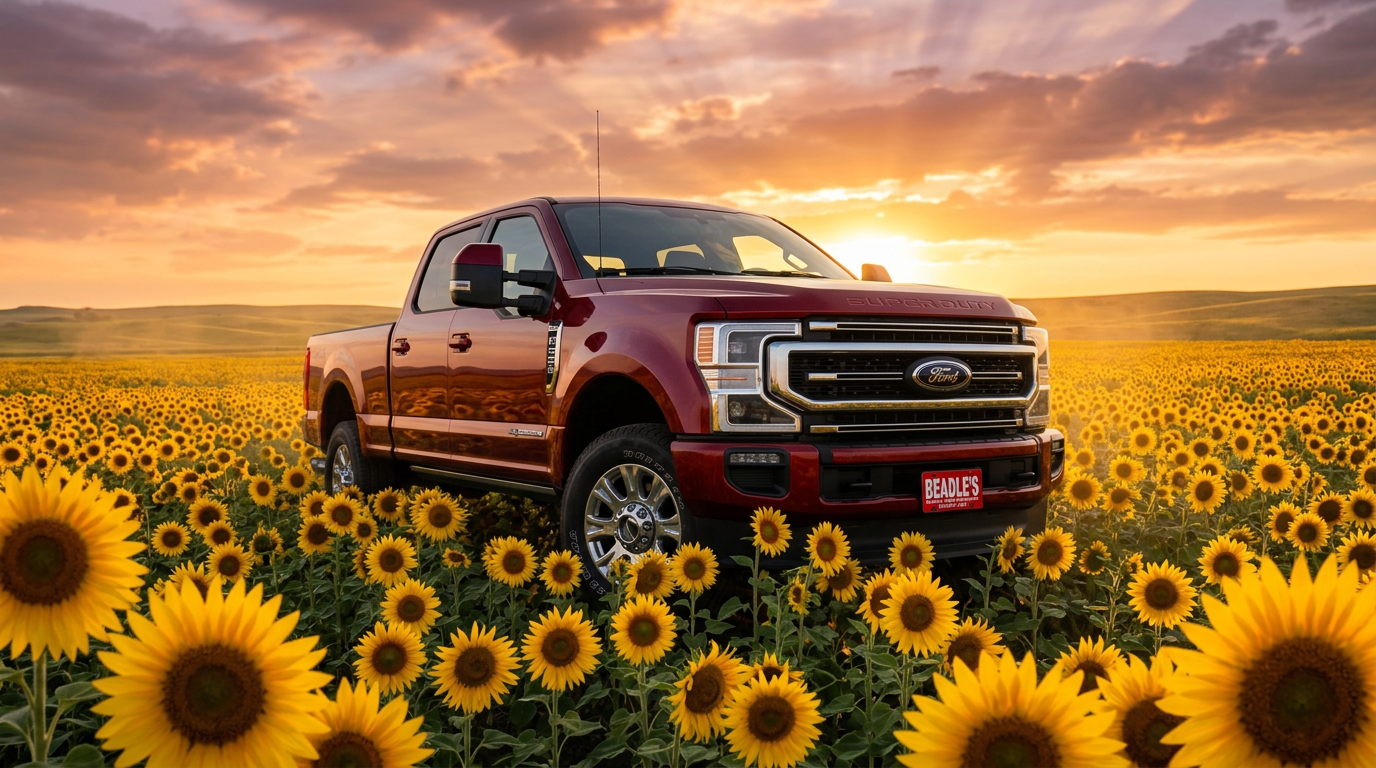
2027 Ford F-350 Lariat in Ruby Red Metallic in a South Dakota sunflower field

2027 Ford F-350 Colors & Appearance

Quick Answer The 2027 Ford F-350 palette runs from work-ready Oxford White, Agate Black, and Carbonized Gray to bold Ruby Red and Argon Blue, with premium tri-coat options available. New for 2027: Tremor Off-Road on the XL work trim and the Super Duty Carhartt Package, plus new colors added and a few 2026 shades retired. Availability varies by trim and build. Styling on a heavy-duty truck is rarely "just cosmetic." Color affects how the truck represents a business, how well it hides gravel dust and road salt, and how easy it is to match later if you add another truck to the fleet — and 2027 brings a few real appearance changes worth knowing. Here's the 2027 F-350's colors, what's new in appearance, and how to choose a look that fits the work for buyers around Bowdle and Aberdeen. Shop F-350s in Stock Get Pre-Approved On This Page What colors does the 2027 F-350 come in? Neutral vs. bold for a work truck What changed in appearance for 2027? Chrome vs. blacked-out, and wheels How do you choose styling for your use? What colors does the 2027 F-350 come in? The 2027 palette spans work-truck neutrals to bold and premium finishes. Confirmed colors include: Work-friendly neutrals: Oxford White, Agate Black Metallic, Carbonized Gray Metallic, Iconic Silver Metallic, Marsh Gray, and Avalanche. Bold: Ruby Red Metallic Tinted Clearcoat and Argon Blue Metallic. Premium: available tri-coat finishes (extra cost). 2027 adds new colors and retires a few 2026 shades, and availability varies by trim and build — confirm the exact 2027 palette and your color's availability when you order. Neutral vs. bold for a work truck For a truck that works and gets traded, neutrals are usually the safe long-term play: they hide dust and salt, match a fleet, and hold the broadest resale appeal. Bold colors look sharp but can narrow the buyer pool later and may be more limited by trim and package. From the Beadle Ford Lot The F-350s that move fastest at trade-in around here are white, black, and gray — they hide the gravel dust and winter salt that coat everything by February, and a fleet buyer can match them without a second thought. Bold colors look great in the yard; just go in knowing they can narrow your resale pool down the road. What changed in appearance for 2027? Two additions stand out. The Tremor Off-Road Package is now available on the XL work trim — bringing the rugged off-road look to the base truck for the first time — and the new Super Duty Carhartt Package adds work-grade styling on single-rear-wheel trucks. The color palette also shifted, with new shades in and a few 2026 colors out. If the Carhartt look is what you're after, it points your build toward single-rear-wheel — full detail in our 2027 F-350 Carhartt Edition guide. Chrome vs. blacked-out, and wheels Appearance packages change the truck's personality fast — grille, bumpers, and trim shift from bright chrome to blacked-out. Wheels vary by trim and configuration too, from 18-inch painted and machined aluminum on work trims to 20-inch finishes higher up, plus the 17-inch forged wheels on dual-rear-wheel trucks. Choose your finish direction and trim together so you don't back into a look after the fact. Our Recommendation For work, fleet, and resale buyers around Bowdle and Aberdeen, a neutral — Oxford White, Agate Black, or Carbonized Gray — hides dust and salt and trades easiest. Save a premium tri-coat or a bold Ruby Red for a personal truck you plan to keep, and pick chrome or blacked-out to match how you want it to read. Match the look to a trim in our what's-new for 2027 guide. How do you choose styling for your use? Work from how the truck will be used, in four steps: Decide if the truck represents a business or fleet, or is personal. Choose a finish direction — chrome, blacked-out, Tremor, or Carhartt — before locking the trim. Confirm your color is available on your preferred 2027 build (premium tri-coats are limited and extra-cost). Check wheel and tire practicality for winter, gravel, and towing. Key Takeaways The 2027 palette spans Oxford White, Agate Black, and Carbonized Gray to Ruby Red and Argon Blue, plus premium tri-coats. New for 2027: Tremor Off-Road now on XL, and the Super Duty Carhartt Package (SRW). New colors added and a few 2026 shades retired — confirm the final palette at order. Neutrals hide dust and salt, match fleets, and trade easiest in this region. Appearance packages and wheels vary by trim — choose finish and trim together. Frequently Asked Questions What colors does the 2027 Ford F-350 come in? Confirmed colors include Oxford White, Agate Black Metallic, Carbonized Gray Metallic, Iconic Silver Metallic, Marsh Gray, Avalanche, Argon Blue Metallic, and Ruby Red Metallic Tinted Clearcoat, plus available premium tri-coat finishes. 2027 adds new colors and retires a few 2026 shades; availability varies by trim and build. Which F-350 colors are best for resale? Neutrals — Oxford White, Agate Black, and Carbonized Gray — tend to hold the broadest resale appeal and are easiest to match in a fleet. They also hide gravel dust and winter road salt better, which matters in South Dakota. Bold colors look great but can narrow the resale pool. Is the Tremor Off-Road Package new for 2027? It's newly available on the XL work trim for 2027 — bringing the rugged off-road look and hardware to the base truck for the first time. The package adds traction and appearance elements that change the truck's stance and styling. Do appearance packages change the wheels and grille? Often, yes. Many appearance packages adjust exterior finishes — grille, bumpers, and wheel designs — shifting between bright chrome and blacked-out looks. Wheels also vary by trim and configuration, so confirm the exact content by build. Are premium tri-coat colors extra on the 2027 F-350? Yes — tri-coat finishes are premium, extra-cost paints and can be limited by trim. Standard and no-cost metallics cover most of the lineup. We'll confirm which colors are available on your build and at what cost when you order. Quick Answers: 2027 F-350 Colors & Appearance One-line answers to the follow-up questions buyers ask next. Most popular work colors? Oxford White, Agate Black, and Carbonized Gray. Boldest options? Ruby Red Tinted Clearcoat and Argon Blue Metallic. Premium paints? Available tri-coat finishes, extra cost. Best color for resale? Neutral white, black, or gray. New appearance for 2027? Tremor on XL and the Carhartt Package (SRW). Did colors change? Yes — new shades added, a few 2026 colors dropped. Blacked-out look? Yes — via appearance packages on equipped trims. Do wheels change by trim? Yes — 18" work wheels up to 20"; 17" forged on DRW. Best to hide dust and salt? White and gray shades. How do I confirm a color? We verify the 2027 palette and your color at order. Keep Researching The complete 2027 Ford F-350 Super Duty overview — specs, towing, trims, and how to order. 2027 F-350 Carhartt Edition — the new work-grade styling package. What's new for 2027 — Tremor-on-XL and the rest of the changes. 2027 F-350 SRW vs. DRW — wheels and stance by rear-wheel choice. My Take on F-350 Colors & Styling In my experience, styling feels right when it matches the job. The 2027 additions — Tremor on XL and the Carhartt look — give work-truck buyers more personality than ever, but for a truck that earns its keep and gets traded, a neutral color still wins on resale and on hiding the dust. Pick the look you'll be happy with for years, not just on the lot. Tell me how you'll use the truck and the look you're after, and I'll help you land a color and finish that holds up. Stop in at Beadle Ford in Bowdle or reach out anytime. Shop F-350s in Stock Get Pre-Approved About the Author Lexy Tabbert — Beadle Ford, Bowdle, SD Lexy Tabbert is the Director of Sales and Marketing at Beadle Ford in Bowdle, South Dakota. She covers Ford vehicles, trim comparisons, and buyer guidance — helping families, ranchers, and ag operators across the region find the right truck and configuration for their needs. Learn more about Lexy.
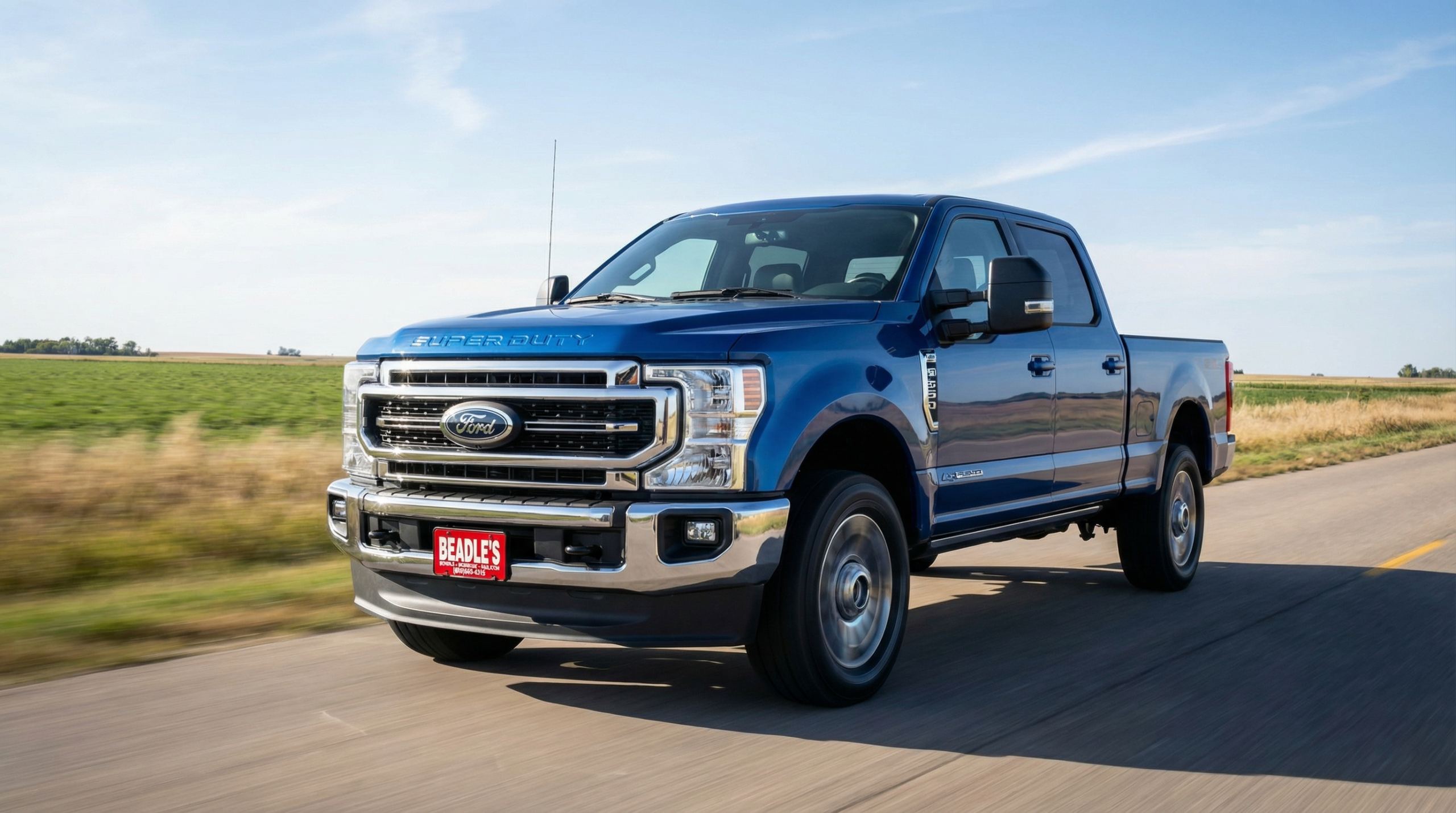
2026 Ford F-350 Super Duty driving on a rural South Dakota road

2026 Ford F-350 Engine Comparison

Quick Answer The 2026 Ford F-350 offers four engines: a 6.8L gas V8 (405 hp), a 7.3L gas V8 (430 hp), a 6.7L Power Stroke diesel (1,050 lb-ft), and a 6.7L High-Output Power Stroke (1,200 lb-ft, up to 40,000 lbs gooseneck). Gas suits mixed driving and top payload; diesel wins for frequent heavy towing. The "best" engine on a 2026 Ford F-350 Super Duty is the one that matches how you actually use the truck. If you tow heavy frequently, drive long distances, or want an effortless feel under load, your priorities look different than someone doing mixed driving with occasional towing. This guide lays out the four engines with their real numbers, how gas and diesel actually feel when towing, the ownership considerations beyond fuel, and how to match the engine to your workload here in South Dakota and North Dakota. Shop F-350s in Stock Get Pre-Approved On This Page What are the 2026 F-350 engine options and specs? Gas vs. diesel: what changes in real use? Which engine feels best for towing? Ownership considerations beyond fuel How do you match an engine to your workload? What are the 2026 F-350 engine options and specs? The 2026 F-350 offers four engines, all paired with a 10-speed TorqShift automatic: two gas V8s and two 6.7L Power Stroke diesels. The 6.8L gas is standard on XL, XLT, and Lariat; the 7.3L gas becomes standard on King Ranch and up; both diesels are optional across the line. Engine Output Max Tow / Payload 6.8L gas V8 405 hp / 445 lb-ft 18,900 lbs / up to 8,000 lbs payload 7.3L gas V8 430 hp / 485 lb-ft 22,500 lbs / 7,635 lbs payload 6.7L Power Stroke diesel 475 hp / 1,050 lb-ft 38,600 lbs / 6,952 lbs payload 6.7L High-Output Power Stroke 500 hp / 1,200 lb-ft 40,000 lbs / 6,935 lbs payload Tow figures are maximum gooseneck, properly equipped; the 40,000-lb rating requires the dual-rear-wheel HO diesel with the 40K Gooseneck Tow Package. Payload and towing vary with cab, bed, axle, and configuration. Gas vs. diesel: what changes in real use? Both can be strong choices — for different patterns. Gas is the simpler, lower-cost-of-entry option for mixed driving and occasional towing, and the 6.8L gas actually carries the highest payload of any F-350 at up to 8,000 lbs. Diesel earns its premium when towing is frequent and heavy, trading purchase price for torque and a composed feel under load. Engine availability ties to trim and packages, so it helps to compare powertrains alongside equipment. That framework is in our 2026 F-350 packages & trims guide. Which engine feels best for towing? For heavy, frequent towing, the diesels feel best — stable and unstrained on grades, in wind, and on long highway runs — which is why they're the common pick above roughly 20,000 lbs. The standard 6.7L Power Stroke (1,050 lb-ft, up to 38,600 lbs) covers nearly every gooseneck around here; the High-Output (1,200 lb-ft, up to 40,000 lbs) is for the heaviest loads. If your towing is occasional and mixed, the 7.3L gas is capable to 22,500 lbs without diesel upkeep. Our Recommendation For most ranch and farm buyers around Bowdle and Aberdeen who tow gooseneck trailers regularly, we recommend the standard 6.7L Power Stroke — its 1,050 lb-ft and 38,600-lb rating cover nearly every trailer here without paying for the High-Output engine. If you tow only occasionally and want maximum payload and the lowest cost of ownership, the 7.3L gas V8 is the smarter buy. Match it to a build with our 2026 F-350 towing guide. Ownership considerations beyond fuel The right engine is an ownership decision, not just a spec-sheet one. Weigh the purchase premium against how hard and how often you'll actually work the truck. Upfront cost: diesel configurations carry a higher purchase price than gas. Use pattern: frequent heavy towing justifies diesel; mixed driving favors gas. Payload need: if you haul heavy in the bed more than you tow, the 6.8L gas and its 8,000-lb payload may matter more than diesel torque. Long-term plans: how long you keep the truck changes the value equation. Work reality: in wind, winter, and long distances, "effortless under load" can matter more than mileage. How do you match an engine to your workload? Work from how you use the truck, in four steps: Identify your heaviest trailer and how often you tow it. Decide whether "effortless under load" on grades and in wind is a priority. Factor in payload needs, annual miles, and how long you keep trucks. Compare real builds — engine choice can affect available equipment, packages, and SRW vs. DRW. From the Beadle Ford Lot Most F-350 shoppers come in asking about the High-Output diesel, but once we walk through their real trailer weight, more leave with the standard 6.7L Power Stroke or the 7.3L gas — the High-Output engine and a dually mostly earn their premium once you're routinely past what those two cover. Key Takeaways Four engines, all 10-speed TorqShift: 6.8L gas (405 hp), 7.3L gas (430 hp), 6.7L diesel (1,050 lb-ft), 6.7L HO diesel (1,200 lb-ft). The 6.8L gas carries the highest payload of any F-350 — up to 8,000 lbs. Diesel tows farthest: 38,600 lbs standard, 40,000 lbs High-Output (DRW). Pick by workload pattern, not headline torque — gas for mixed/occasional, diesel for frequent heavy towing. Engine choice can affect equipment and packages, so confirm on a real build. Frequently Asked Questions What are the 2026 Ford F-350 engine specs? Four engines, all with a 10-speed TorqShift automatic: the 6.8L gas V8 (405 hp / 445 lb-ft), the 7.3L gas V8 (430 hp / 485 lb-ft), the 6.7L Power Stroke diesel (475 hp / 1,050 lb-ft), and the 6.7L High-Output Power Stroke (500 hp / 1,200 lb-ft). Is diesel always the best choice for an F-350? Not always. Diesel shines for frequent heavy towing — up to 38,600 lbs standard or 40,000 lbs High-Output — but gas can be a strong fit for mixed driving and occasional towing. The best choice depends on your trailer weight, towing frequency, payload needs, and ownership priorities. Which 2026 F-350 engine has the most payload? The 6.8L gas V8, at up to 8,000 lbs properly equipped — more than either diesel — because the lighter engine leaves more weight available for the bed. The 7.3L gas follows at 7,635 lbs, with the diesels near 6,950 lbs. Does engine choice affect towing features and packages? It can. Some towing equipment and packages vary by trim, engine, and configuration — the 40,000-lb gooseneck rating, for example, requires the High-Output diesel in dual-rear-wheel form with the 40K Gooseneck Tow Package. Confirm the equipment list on the exact truck you're considering. Which engine should I get if I tow heavy every week? For regular heavy gooseneck towing in this region, the standard 6.7L Power Stroke is the value pick — 1,050 lb-ft and up to 38,600 lbs covers nearly every trailer. Step up to the High-Output diesel only if you routinely run near 40,000 lbs, where the dually and 40K package pay off. Quick Answers: F-350 Engines One-line answers to the follow-up questions buyers ask next. How many engines does the 2026 F-350 offer? Four — two gas V8s and two 6.7L Power Stroke diesels. What transmission do they use? A 10-speed TorqShift automatic, standard on all four. Most powerful engine? The 6.7L High-Output Power Stroke — 500 hp and 1,200 lb-ft. Most payload? The 6.8L gas V8 — up to 8,000 lbs. Most towing? The High-Output diesel — up to 40,000 lbs gooseneck (DRW). Best value diesel? The standard 6.7L Power Stroke — 1,050 lb-ft, up to 38,600 lbs. Which gas engine is standard? The 6.8L on XL/XLT/Lariat; the 7.3L on King Ranch and up. Is gas good enough to tow? Yes — the 7.3L gas tows up to 22,500 lbs gooseneck. Does diesel cost more upfront? Yes, but frequent heavy towing can justify it. How do I confirm an engine on a build? We verify engine, axle, and packages before you order. Keep Researching The complete 2026 Ford F-350 Super Duty overview — trims, specs, towing, and inventory in one place. 2026 F-350 towing guide — the gooseneck, fifth-wheel, and conventional ratings behind each engine. 2026 F-350 packages & trims — which engine is standard on which trim, and where DRW becomes available. 2026 F-350 technology — the trailering tech that pairs with your powertrain choice. My Take on the 2026 F-350 Engines In my experience, engine decisions are easiest when you stop thinking in headlines and start thinking in workload. When the engine matches how often — and how heavy — you tow, the truck feels more confident to drive and simpler to live with over time. Around here, that lands more buyers on the standard diesel or the 7.3L gas than on the High-Output engine they came in asking about. Tell me your heaviest trailer and your typical week, and we'll match the engine to it. Stop in at Beadle Ford in Bowdle or reach out anytime. Shop F-350s in Stock Get Pre-Approved About the Author Lexy Tabbert — Beadle Ford, Bowdle, SD Lexy Tabbert is the Director of Sales and Marketing at Beadle Ford in Bowdle, South Dakota. She covers Ford vehicles, trim comparisons, and buyer guidance — helping families, ranchers, and ag operators across the region find the right truck and configuration for their needs. Learn more about Lexy.
2026 Ford Maverick Trims & Packages

Picking a 2026 Ford Maverick trim is only “step two.” The buyers who end up happiest usually decide drivetrain (AWD vs FWD), payload reality, and towing hardware first—then use trims and packages to fine-tune comfort, convenience, and appearance. If you haven’t locked in your must-haves yet, start with: 2026 Maverick Specs & Configurations. For inventory, model guidance, and local help in one place, visit the Ford Maverick model page. Shop Mavericks in Stock Contact Us Table of Contents Which 2026 Maverick trims are offered? What trims change (and what they don’t) Packages that actually change ownership Why AWD-first shopping changes the best trim choice How to choose a trim/package setup (step-by-step) FAQ Which 2026 Maverick trims are offered? The 2026 Maverick lineup is commonly shown with these model lines: XL, XLT, Lobo, Lariat, and Tremor. The biggest mistake buyers make is assuming the trim name automatically equals capability. On Maverick, capability is driven by drivetrain, payload, and towing equipment. What trims change (and what they don’t) Trims primarily change comfort, interior materials, feature access, and appearance. They can also influence which options are easier to add, because packages and required equipment can be tied to certain trims. What trims usually change: cabin feel, tech convenience, appearance details, and option availability. What trims do not automatically change: your real towing readiness if the truck doesn’t have the right towing hardware. What to do instead: verify the exact truck’s equipment list before assuming it’s “the towing one” or “the winter one.” If towing is part of your decision, pair this with: 2026 Maverick Towing Guide. Packages that actually change ownership Most packages fall into a few real-world categories. The “best” packages aren’t the fanciest—they’re the ones that solve problems you actually have. Towing-focused packages: aim at real towing hardware (brake controller, 7-pin, hitch class). Confirm on the window sticker. Winter/traction-minded equipment: AWD helps, but tires and visibility features often matter just as much. Comfort/commute packages: worthwhile if you drive long miles and want the truck to feel “easy” every day. Appearance packages: great when they don’t interfere with capability priorities or budget. Why AWD-first shopping changes the best trim choice In South Dakota, many Maverick buyers shop AWD first because winter traction is a non-negotiable. That changes how you should evaluate trims: you want the trim that lets you get the drivetrain you want without forcing unwanted extras. Quick Overview Best approach Choose drivetrain + towing needs first, then pick trim for comfort/features Most common mistake Buying a trim for the badge and missing the equipment you actually need Smart confirmation Verify the window sticker for towing hardware, AWD, and required option bundles How to choose a trim/package setup (step-by-step) Decide AWD vs FWD based on winter routes and confidence needs. Decide towing level (light hitch vs full towing hardware) based on your trailer’s loaded weight. Confirm payload reality (people + gear + bed cargo) so the build actually fits your routine. Pick your trim to match comfort/feature expectations without forcing extras you don’t want. Add packages intentionally —choose only what solves a real need. Shop Mavericks in Stock Ask About a Specific Trim FAQ Does a higher trim automatically tow more? Not automatically. Towing readiness depends on the towing hardware on that exact build (hitch class, wiring, brake controller), plus drivetrain and configuration. Always confirm the window sticker. What’s the best way to avoid overpaying for packages? Start with your non-negotiables (AWD, towing equipment, payload needs), then choose the lowest trim that supports those needs. Add only packages that solve real problems for your driving routine. Where can I compare trims and real inventory together? The fastest method is browsing the Ford Maverick model page, then checking each truck’s equipment list. If you want help comparing two specific builds, contact us. Conclusion In my experience, the best Maverick purchases happen when buyers choose capability first and trim second. When AWD, towing hardware, and payload reality are locked in up front, trims and packages become a simple “fit and finish” decision—not a gamble. About the Author: Lexy Tabbert helps South Dakota and North Dakota shoppers choose truck configurations that fit real driving—winter roads, weekend projects, towing needs, and long-term ownership. Her approach is straightforward: confirm the capability requirements first, then choose the trim and packages that support how you actually use the truck.

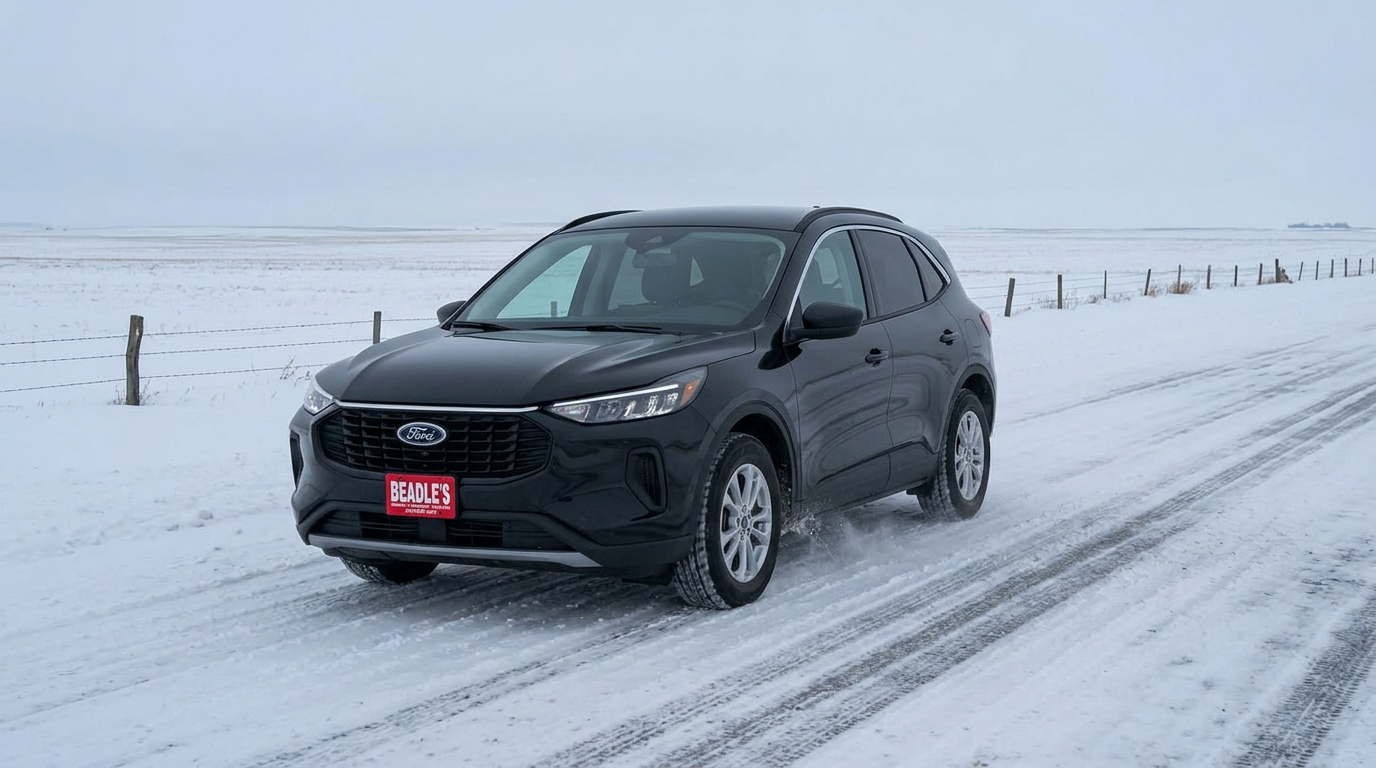
2026 Ford Escape AWD on snow-covered South Dakota highway in winter

2026 Ford Escape AWD in South Dakota Winters: What You Actually Need to Know

If you're shopping for a 2026 Ford Escape in South Dakota, AWD is probably on your checklist — and for good reason. But the answer to "does it come with AWD?" isn't a simple yes or no. Some trims include it standard. Some have it as an option you must add at the order stage. And one trim can't get it at all. Getting this wrong at purchase is costly — in most cases, drivetrain can't be changed after the vehicle is built. This guide covers what central South Dakota buyers specifically need to know: which 2026 Escape trims come with AWD, how the system performs on packed snow and gravel county roads, whether the optional AWD upgrade on entry trims is worth the cost, and why the PHEV has a limitation most buyers don't discover until it's too late. Shop Escapes in Stock Get Pre-Approved On This Page Which 2026 Ford Escape Trims Come with AWD? What Does Ford's Intelligent AWD Actually Do in Snow and Ice? Active and ST-Line AWD: Is the Optional Upgrade Worth It? Why PHEV Buyers Should Think Twice (It's FWD Only) How Does the Escape AWD Hold Up on Gravel Roads and Through South Dakota's Mud Season? Which 2026 Ford Escape Trims Come with AWD? AWD is standard — and the only drivetrain option — on the ST-Line Select, ST-Line Elite, and Platinum trims. On the Active and ST-Line, FWD comes standard and AWD is an option you must specifically select at order. The PHEV trim is front-wheel drive only with no AWD available at any configuration. Here's the full breakdown: Trim AWD Status Engine Active Optional (FWD standard — must add) 1.5L EcoBoost ST-Line Optional (FWD standard — must add) 1.5L EcoBoost ST-Line Select AWD Only — standard, no FWD 2.0L EcoBoost or 2.5L Hybrid ST-Line Elite AWD Only — standard, no FWD 2.0L EcoBoost or 2.5L Hybrid Platinum AWD Only — standard, no FWD 2.0L EcoBoost or 2.5L Hybrid PHEV FWD Only — no AWD available 2.5L Plug-In Hybrid The practical takeaway for buyers in this area: if you want AWD without having to think about it at the order stage, start at ST-Line Select. At that trim and above, every unit built is AWD — there is no FWD version to accidentally end up with. For buyers considering Active or ST-Line, AWD must be explicitly specified when the vehicle is ordered. You cannot add it to a finished vehicle later. What Does Ford's Intelligent AWD Actually Do in Snow and Ice? Ford's Intelligent All-Wheel Drive monitors wheel slip continuously and transfers torque between the front and rear axles as conditions change — without any driver input required. In normal driving, the system defaults toward front-wheel drive to preserve fuel economy. When it detects wheel slip on snow, ice, or slippery surfaces, it engages the rear axle and redistributes power to where traction is available. This is on-demand AWD, not a locked four-wheel-drive system. That distinction matters for South Dakota buyers. The Escape's Intelligent AWD is designed to handle the conditions most drivers in this area encounter most often: packed snow on county roads, ice-covered intersections, slippery highway on-ramps in January, and the slow grip loss that starts on a gravel road in early October. For those conditions, it performs well. Where it starts to show limits is in deeper unpacked snow, significant off-camber terrain, or situations where a driver wants to manually lock in four-wheel drive. That's where the Bronco Sport's standard 4x4 system with GOAT (Goes Over Any Type of Terrain) modes has a genuine edge. For most Escape buyers — highway commuters, school-run vehicles, buyers who see gravel roads but not serious off-road terrain — the Intelligent AWD is well-suited to what a central South Dakota winter actually looks like. The full 2026 Ford Escape overview at Beadle Ford covers the complete powertrain and AWD picture if you want to compare everything at once. Looking for Something in Stock? Check out these models at Beadle Ford. Ford Bronco Sport Standard 4x4, GOAT modes, staying in Ford's lineup. Built for South Dakota. Shop Escapes in Stock Ford Explorer More room, available 3-row seating, ready for the plains. Shop Escapes in Stock Ford Maverick Compact truck versatility at an Escape-comparable price. Shop Escapes in Stock Active and ST-Line AWD: Is the Optional Upgrade Worth It? For most South Dakota buyers, yes. Winter driving in Spink or Walworth County is not the same as winter driving in a warm-climate suburb, and the optional AWD on Active and ST-Line trims is one of those decisions where the cost of skipping it tends to show up in February. The critical point is that it's a factory-order decision — it must be selected when the vehicle is built. Once an FWD Escape leaves the assembly line, it stays FWD. Before committing to the AWD add on an Active or ST-Line, it's worth looking at the ST-Line Select as a comparison. The Select starts at AWD as its only configuration — no option needed, no risk of an FWD unit being delivered — and it also brings heated front seats, a heated steering wheel, remote start, a power liftgate, and body-color heated mirrors as standard equipment. At -15°F outside Bowdle on a January morning, those aren't comfort upgrades — they're practical ones. For many buyers, the total picture at ST-Line Select represents better value per dollar than adding only AWD to a base trim and still missing those features. That comparison gets clearer when you see all six trims laid out with specific feature detail. The 2026 Ford Escape trim levels guide walks through every trim with a South Dakota buyer's lens — including which features matter most in this climate and at this price point. Why PHEV Buyers Should Think Twice (It's FWD Only) The 2026 Escape PHEV is front-wheel drive only. There is no AWD option, no upgrade path, no workaround. That's confirmed in the 2026 order guide. If you purchase a 2026 Escape PHEV, it will be FWD — regardless of trim package or added options. The PHEV's approximately 37-mile EV-only range sounds appealing on paper, but that figure comes with a significant infrastructure assumption: regular access to Level 2 charging. In practice, the Level 2 charging network that makes plug-in hybrids most cost-effective is concentrated in larger cities. If you're primarily driving around Bowdle, Gettysburg, or Redfield, the realistic scenario involves Level 1 home charging — slower, and in many cases insufficient to keep the battery consistently topped for daily use. Many rural PHEV owners end up running in hybrid gas mode the majority of the time anyway, which means they've paid for plug-in capability they can't fully use, in a vehicle that can't get AWD. For central South Dakota buyers, the 2.5L Hybrid AWD — available on ST-Line Select, ST-Line Elite, and Platinum — is typically the more practical choice. It delivers strong fuel economy without requiring a charger, and AWD is standard on every unit. The PHEV has its place in the right situation; that situation is more easily found closer to a city with established charging infrastructure than it is in rural central South Dakota. How Does the Escape AWD Hold Up on Gravel Roads and Through South Dakota's Mud Season? AWD earns its value in central South Dakota well beyond December through February. The seasonal picture for a vehicle driven in this area breaks into four distinct challenges: deep-winter cold and packed snow from December through March, spring mud season on gravel roads through April and May, dry-season gravel and dust from June through September, and early freeze and frost conditions in October and November. Ford's Intelligent AWD handles the winter and fall scenarios well for a vehicle in the Escape's class — the on-demand torque transfer responds quickly to the kind of gradual slip that packed county roads and icy intersections produce. Spring mud adds a different kind of AWD value: gravel township roads that soften and rut through May are manageable with AWD in a way that FWD crossovers often aren't. The Escape isn't a dedicated mud vehicle — all-season tires and moderate ground clearance define its limits clearly — but it handles the general surface variability of rural South Dakota driving better than FWD alternatives in the same class. One honest caveat worth stating clearly: if your driving regularly involves unimproved ranch access roads, significant off-camber terrain, or anything approaching serious off-road conditions, the Escape AWD will reach its limits before the Bronco Sport does. The Bronco Sport's standard 4x4, higher ground clearance, and GOAT mode settings are built for more demanding use. For the majority of South Dakota Escape buyers — county road commuters, farm families using the vehicle as a daily driver, buyers who encounter gravel roads but not livestock trails — the Escape AWD handles the year-round reality of this area well. Key Takeaways AWD is standard on ST-Line Select, ST-Line Elite, and Platinum — on Active and ST-Line, it's an option that must be explicitly added at the order stage. The PHEV trim is front-wheel drive only — there is no AWD available on the 2026 Escape PHEV at any price point. Ford's Intelligent AWD handles packed snow, ice, and gravel roads well — it's well-matched to typical central South Dakota winter and spring driving conditions. ST-Line Select is where AWD becomes mandatory, and it also brings heated seats, heated steering wheel, and remote start — making it a single-decision answer to winter preparedness for most buyers. For buyers who need deeper off-road capability or want standard 4x4 engagement, the Bronco Sport is the stronger option in Ford's current lineup. Frequently Asked Questions Does the 2026 Ford Escape come with AWD standard? AWD is standard — and the only drivetrain option — on the ST-Line Select, ST-Line Elite, and Platinum trims. On the Active and ST-Line, FWD comes standard and AWD is an optional add that must be specified at order. The PHEV trim is front-wheel drive only with no AWD available at any configuration or price point. Is the 2026 Ford Escape hybrid AWD or FWD? It depends on which hybrid. The 2.5L Hybrid (gas-electric, non-plug-in) is AWD only — available on the ST-Line Select, ST-Line Elite, and Platinum trims. The 2.5L Plug-In Hybrid (PHEV trim) is front-wheel drive only, with no AWD option available on that trim. Can you get the 2026 Ford Escape PHEV with AWD? No. The 2026 Ford Escape PHEV is front-wheel drive only. There is no AWD configuration available for the PHEV trim at any price point. Buyers who want both plug-in hybrid capability and all-wheel drive will need to consider a different vehicle. Which 2026 Ford Escape trim is best for South Dakota winter driving? The ST-Line Select is the natural starting point for South Dakota buyers. AWD is standard on that trim with no FWD option, and it also includes heated front seats, a heated steering wheel, remote start, and a power liftgate — all of which matter in sub-zero temperatures. ST-Line Elite and Platinum add more comfort and technology upgrades. Active and ST-Line with the optional AWD add are viable, but require explicitly specifying AWD at order to avoid receiving an FWD unit. How does the Escape's AWD compare to the Bronco Sport's 4x4? The Escape uses Ford's Intelligent AWD, an on-demand system that monitors slip and engages the rear axle as conditions require. The Bronco Sport uses a standard 4x4 system with GOAT modes and higher ground clearance, designed for more demanding off-road and rough-terrain use. For typical South Dakota winter driving — packed snow, ice, gravel roads, spring mud — both are capable. The Bronco Sport has an advantage in deeper snow, off-camber terrain, and situations calling for engaged four-wheel drive. The Escape Hybrid AWD has an advantage in fuel economy on highway miles. My Take on AWD and the 2026 Ford Escape The AWD question comes up in almost every Escape conversation I have, and the answer that surprises most buyers is that it isn't guaranteed by the model — it depends on which trim they're actually ordering. My default starting point in those conversations is usually ST-Line Select, because AWD is already locked in, and so are the heated seats and remote start that make the first start of a February morning significantly less unpleasant. Getting all three in a single trim decision takes a lot of the complexity out of it. If you're trying to decide between adding AWD to an Active or ST-Line versus stepping up to Select, or if you're weighing the Escape against the Bronco Sport on traction grounds, I'm happy to walk through the specifics. Those are real trade-offs worth talking through before you commit. Stop by or give us a call. Shop Escapes in Stock Get Pre-Approved About the Author Lexy Tabbert — Beadle Ford, Bowdle, SD Lexy Tabbert is the Director of Sales and Marketing at Beadle Ford in Bowdle, South Dakota. She covers Ford vehicles, trim comparisons, and buyer guidance — helping families, ranchers, and ag operators across the region find the right truck and configuration for their needs. Learn more about Lexy.
2027 Ford Expedition in Star White Metallic on a snowy South Dakota highway near Bowdle

2027 Ford Expedition vs. 2026 Toyota Sequoia: EcoBoost V6 vs. i-FORCE MAX Hybrid — and the Service Question Most Reviews Skip

Home› Ford Expedition› 2027 Ford Expedition› Expedition vs. Toyota Sequoia If you’re cross-shopping a 2027 Ford Expedition against a 2026 Toyota Sequoia, you’re choosing between two very different takes on the full-size three-row SUV. Ford brings a 3.5L EcoBoost V6 — with a 440 hp / 510 lb-ft High Output variant available — paired with BlueCruise hands-free highway driving. Toyota counters with a single powertrain: the i-FORCE MAX hybrid, a 3.5L twin-turbo V6 paired with an electric motor producing a combined 437 hp and 583 lb-ft of torque. Both are legitimate; they’re just optimized differently. This guide covers the decisions that actually matter for a Dakota buyer: how each powertrain behaves in real winter conditions, cargo and third-row usability, towing in cold weather with a hybrid (a real consideration north of I-90), the hands-free driving comparison, and dealer network accessibility — an honest look at what happens when your Sequoia needs service and your closest Toyota dealer is 60-plus miles away. Browse Expedition Inventory Ask About a Custom Order On This Page EcoBoost V6 vs. i-FORCE MAX hybrid — which works better in Dakota winters? Which SUV gives you more usable space? Can the Sequoia’s hybrid handle heavy trailers in cold weather? BlueCruise vs. Toyota Safety Sense — which hands-free system wins? Dealer network, resale, and cost of ownership — does Toyota reliability win here? EcoBoost V6 vs. i-FORCE MAX hybrid — which works better in Dakota winters? Both trucks use twin-turbocharged V6 engines; the difference is what Toyota adds on top. The 2027 Ford Expedition runs the 3.5L EcoBoost V6 as the standard engine with a 3.5L EcoBoost V6 High Output at 440 hp / 510 lb-ft optional on Tremor, Platinum Stealth Performance, and Platinum Ultimate. Toyota’s 2026 Sequoia offers one powertrain only — the i-FORCE MAX hybrid, pairing a 3.5L twin-turbo V6 with an electric motor and a nickel-metal hydride battery pack for a combined 437 hp and 583 lb-ft of torque. Both use 10-speed automatic transmissions. For hot climates and stop-and-go driving, hybrids shine. For our climate, the calculus shifts. Nickel-metal hydride batteries — the chemistry Toyota uses in the Sequoia’s hybrid system — perform meaningfully worse in sustained cold. At -10°F or colder (which we see several weeks a winter), a hybrid’s regenerative braking is less effective, battery efficiency drops, and the electric motor contributes less. You’re running on the gas engine more and the hybrid advantage narrows. The EcoBoost V6, by contrast, behaves consistently regardless of temperature — it’s the same engine at 80°F as it is at -20°F. The practical takeaway: if most of your driving is interstate cruising in reasonable weather, the Sequoia’s hybrid gets stronger fuel economy, especially at lower speeds. If you drive through a Dakota winter every year, the EcoBoost V6’s consistency matters. And if you want the 440 hp High Output engine and the factory off-road Tremor trim, those simply aren’t options Toyota offers. The full 2027 Expedition trim and engine breakdown is in the complete 2027 Ford Expedition overview. Which SUV gives you more usable space? The Expedition wins most of the practical space comparisons, and independent reviews from Edmunds and others have consistently called this out. The Ford’s third row is genuinely adult-usable, with leg and headroom that supports taller passengers on longer trips — Bowdle to Fargo with three kids across the back row works without complaints. The Sequoia’s third row is narrower and has less legroom; it’s better described as kid-friendly rather than adult-friendly. Cargo behind the third row is where the Sequoia has a specific geometry quirk. Because of how Toyota packaged the hybrid battery pack, the Sequoia’s load floor is higher and the third-row seatbacks don’t fold flat — you end up with a raised, uneven surface when the third row is folded down. The Expedition’s third row folds flat and the cargo floor is at a consistent height, which matters when you’re loading a generator, a cooler, or long gear. Inside, the Expedition brings the 24" panoramic driver display and 13.2" center display as the Ford Digital Experience standard from Active and up, with Google Maps, Google Assistant, and Google Play Store embedded natively plus wireless Apple CarPlay and Android Auto. The Sequoia runs Toyota’s 14" multimedia touchscreen with wireless CarPlay/Android Auto on most trims — a capable system, but the visual experience is different. If you need the MAX-length body style for even more cargo and third-row space, the Expedition MAX is available on Active, Platinum, and King Ranch (the Tremor is standard-length only). The Expedition vs. Expedition MAX guide walks through that body-style decision. Toyota does not offer an extended-length Sequoia. Can the Sequoia’s hybrid handle heavy trailers in cold weather? On paper, the Sequoia tows well. Toyota publishes a maximum trailer rating of approximately 9,520 lbs when properly equipped — functionally in the same ballpark as the Expedition Tremor’s 9,300 lbs. For a bumper-pull livestock trailer or a 24-foot enclosed trailer with a side-by-side, either truck handles it. The question isn’t peak capacity; it’s how each truck delivers that capability in adverse conditions. Cold-weather towing is a real consideration with a hybrid. Hybrid batteries lose efficiency in sustained cold, and when you’re towing heavy — 7,000 or 8,000 lbs behind you — the electric motor is contributing less of the torque and the gas engine is working harder. On long cold-weather hauls, Sequoia owners have reported lower-than-advertised fuel economy and more frequent engine loading. A turbocharged V6 like the EcoBoost maintains consistent power delivery regardless of temperature, which is why long-range towing consistency is one place the Expedition has an advantage. Pro Trailer Hitch Assist and Pro Trailer Backup Assist are standard on every retail Expedition trim via Ford Co-Pilot360 Assist 2.0. The 360-degree camera includes a trailer view specifically designed for hitching and navigating narrow hauling situations. BLIS with Trailer Coverage extends the blind-spot monitoring around the length of whatever you’re pulling. Toyota offers comparable features on upper Sequoia trims, but they’re more package-dependent on the Toyota side than on the Ford side. Official 2027 Expedition tow ratings will be confirmed when Ford releases the 2027 Towing Guide. If you’re sizing an Expedition to a specific trailer, contact Beadle Ford and we’ll run the configuration against your actual load. Ready to explore the Ford side? Get Pre-Approved Browse Current Expedition Inventory BlueCruise vs. Toyota Safety Sense — which hands-free system wins? Ford has the more mature hands-free highway driving system. BlueCruise works on approximately 97% of controlled-access U.S. and Canada highways with driver-facing camera monitoring, Lane Change Assist, and In-Lane Repositioning. Active Touring includes a 90-Day BlueCruise trial on retail orders; Platinum Ultimate and King Ranch come with a 1-Year + 90-Day plan standard. Toyota’s 2026 Sequoia comes standard with Toyota Safety Sense 3.0 — Dynamic Radar Cruise Control, Lane Departure Alert with Steering Assist, Pre-Collision System with Pedestrian Detection, Road Sign Assist, and Blind Spot Monitor. It’s comparable to Ford Co-Pilot360 Assist 2.0 for the core driver-assist tier. What Toyota doesn’t offer at the Sequoia price point is a direct BlueCruise competitor — true hands-free highway driving with driver monitoring across a mapped road network. Nissan offers ProPilot 2.0 on its Ariya and some other models; GM offers Super Cruise on Tahoe and Suburban. Toyota’s hands-free capability on the Sequoia is narrower in scope. If hands-free highway driving matters to you — especially on the long I-90 or US-281 hauls most Dakota drivers know well — BlueCruise is the clearer answer on this cross-shop. The BlueCruise vs. Super Cruise vs. ProPilot 2.0 guide walks through which system covers which roads and which buyer fits which system. Dealer network, resale, and cost of ownership — does Toyota reliability win here? Toyota’s reputation for reliability is real. It shows up in resale data, in long-term ownership studies, and in the fact that you’ll see 15-year-old Tundras and Sequoias still in daily service. But reliability is only part of the cost-of-ownership equation, and in rural South Dakota, the dealer network side of that equation often matters more. If you live in Bowdle or anywhere in north-central South Dakota and you buy a Sequoia, your closest Toyota dealer for service, warranty work, or hybrid-system diagnostics is roughly 60-plus miles away. That’s a real consideration. Recall work, a 30,000-mile service interval, a brake job, a hybrid inverter warning on the dashboard — every one of those becomes a day trip. If something goes wrong under warranty that requires multiple visits, it’s multiple day trips. Beadle Ford is in Bowdle. Service is local. The techs working on your Expedition know the truck because they’ve been working on Expeditions for years. Ford parts are nationally available. Neither is a “Toyota is worse” argument — both brands build reliable trucks. But when you factor in the accessibility of routine service, warranty work, and emergency repairs over a five or seven-year ownership period, the dealer network question meaningfully narrows Toyota’s reliability advantage. Hybrid-specific maintenance is worth naming too. The i-FORCE MAX system is well-engineered, but it adds components — battery pack, inverter, electric motor — that a naturally aspirated V8 or a turbo V6 like the EcoBoost doesn’t have. Long-term battery replacement at 10+ years is a real out-of-warranty cost to plan for on any hybrid. The Expedition’s EcoBoost V6 is a conventional powertrain with well-understood long-term service costs. Key Takeaways Ford offers two engines (standard 3.5L EcoBoost V6 and the 440 hp / 510 lb-ft High Output); Toyota offers one (i-FORCE MAX hybrid at 437 hp / 583 lb-ft combined). Hybrid powertrains lose efficiency in sustained cold. EcoBoost V6 performance is consistent regardless of temperature. Expedition’s third row and cargo behind the third row are more usable than the Sequoia’s, largely because of hybrid battery packaging. BlueCruise offers more mature hands-free highway coverage than Toyota Safety Sense 3.0 provides on the Sequoia. Service network matters in rural SD. Beadle Ford is in Bowdle; the nearest Toyota dealer is 60-plus miles away. No factory off-road Sequoia trim comparable to the Expedition Tremor; no Sequoia MAX-length option. Frequently Asked Questions How does the 2027 Ford Expedition compare to the 2026 Toyota Sequoia? Ford uses the 3.5L EcoBoost V6 (with a 440 hp / 510 lb-ft High Output variant) and offers BlueCruise hands-free driving, five trims including the off-road Tremor, and a MAX body style. Toyota offers one i-FORCE MAX hybrid powertrain at a combined 437 hp / 583 lb-ft, no off-road trim, and no extended-length Sequoia. Expedition wins on third-row space and cargo-floor flatness; Sequoia wins on hybrid fuel economy in non-winter conditions. Is the Toyota Sequoia’s hybrid better in the cold than the Ford EcoBoost V6? No. Hybrid batteries lose efficiency in sustained cold, and the Sequoia’s i-FORCE MAX relies on its electric motor for part of its power delivery. In a Dakota winter, you’re running on the gas engine more and the hybrid advantage narrows. The EcoBoost V6 behaves consistently regardless of temperature. Which has more third-row room, the Expedition or the Sequoia? The Expedition has meaningfully more usable third-row space for adult passengers, as reviewed by Edmunds and other independent outlets. The Sequoia’s third row is narrower with less legroom due to hybrid battery packaging, and the cargo floor behind the third row is raised and uneven when folded. How much can the Expedition tow vs. the Sequoia? The 2026 Toyota Sequoia publishes a maximum trailer rating of approximately 9,520 lbs when properly equipped. The 2027 Expedition Tremor is rated to tow up to 9,300 lbs when properly equipped. Both are in the same functional range for most real trailers. Does the Sequoia have a hands-free driving system like BlueCruise? Not directly. The 2026 Toyota Sequoia includes Toyota Safety Sense 3.0 as standard — Dynamic Radar Cruise Control, Lane Departure Alert with Steering Assist, Pre-Collision System, and Blind Spot Monitor — but it doesn’t offer true hands-free highway driving at the Expedition’s BlueCruise tier. Ford’s BlueCruise works on approximately 97% of controlled-access U.S. and Canada highways. Where’s the nearest Toyota dealer to Bowdle? The nearest Toyota dealership to Bowdle is roughly 60-plus miles away. Routine service, hybrid-system diagnostics, recalls, and warranty work require a round trip. Beadle Ford is in Bowdle — service for an Expedition is local and same-day possible for most issues. Does the Expedition have a direct competitor to the Sequoia’s hybrid powertrain? No. The 2027 Ford Expedition is offered only with the 3.5L EcoBoost V6 family — standard, or the 440 hp / 510 lb-ft High Output variant on Tremor, Platinum Stealth Performance, and Platinum Ultimate. There is no hybrid or electric Expedition variant. If a hybrid powertrain is a non-negotiable, the Sequoia is the direct pick in this class. My Take on the Expedition vs. Sequoia Cross-Shop The Sequoia is a well-built truck, and if you’re committed to a hybrid powertrain, it’s the cleanest answer in this class. I won’t pretend otherwise. But for the buyers we see at Beadle Ford — families commuting between Bowdle and Sioux Falls, ranchers hauling stock trailers through Dakota winters, or anyone who’s thinking about hands-free highway driving on their regular routes — the Expedition typically wins on the practical details. Third-row usability, cargo-floor flatness, BlueCruise coverage, and local service accessibility all stack in Ford’s favor for how most of our customers actually drive. The real test is a side-by-side drive with a cold-weather trailer in mind. If you’re serious about this decision, come drive an Expedition and we’ll talk through your specific use case against the Sequoia honestly. The right answer depends on your week, not on a spec sheet. Shop 2027 Expeditions in Stock Contact Beadle Ford About the Author Lexy Tabbert — Beadle Ford, Bowdle, SD Lexy Tabbert is the Director of Sales and Marketing at Beadle Ford in Bowdle, South Dakota. She covers Ford vehicles, trim comparisons, and buyer guidance — helping families, ranchers, and ag operators across the region find the right truck and configuration for their needs. Learn more about Lexy.
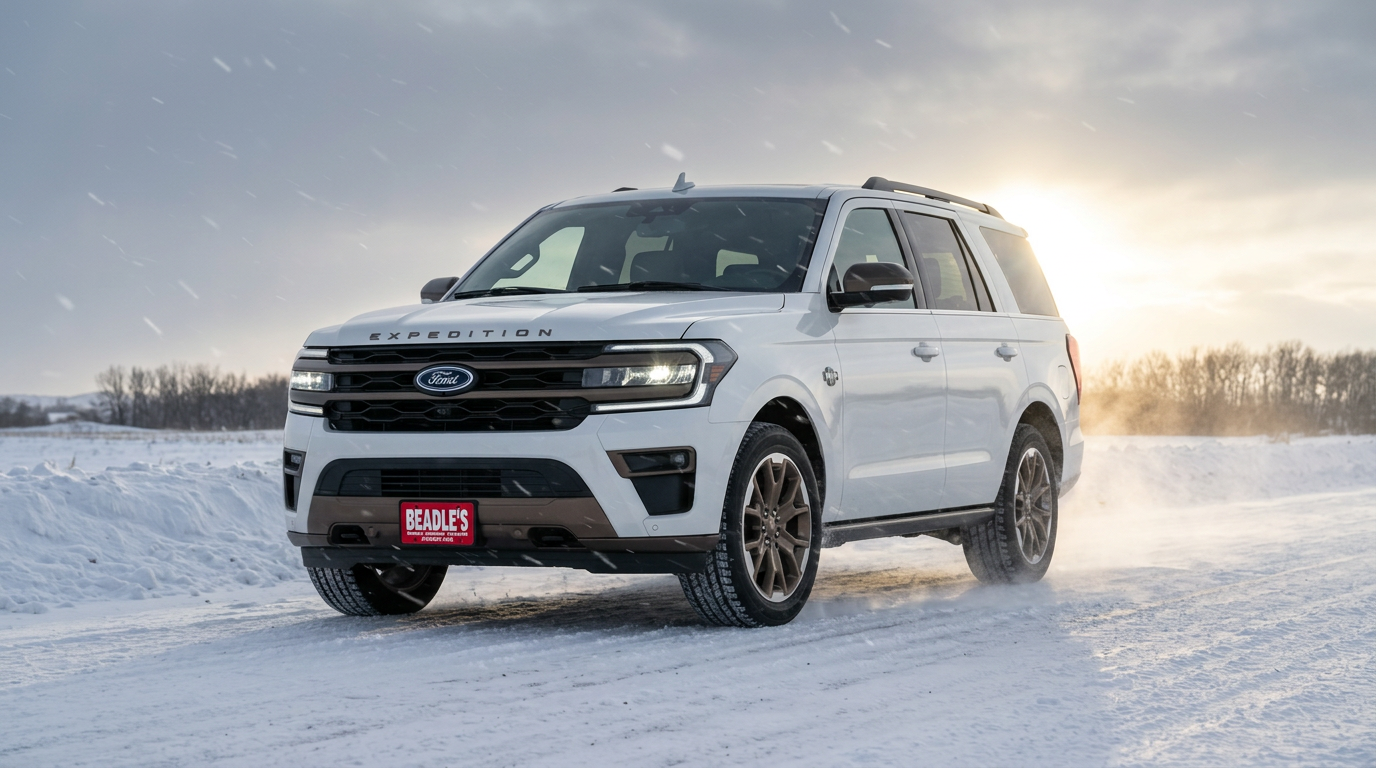
2026 Ford Bronco Big Bend with the doors removed and front roof panels off, parked on a South Dakota gravel road through CRP grassland on a summer afternoon

2026 Ford Bronco Removable Doors and Roof: A Practical Owner's Guide

The removable doors and roof are the single feature most buyers ask about — and the feature most owners use less than they expect. Done right, taking the doors off a Bronco for a summer evening drive across the central South Dakota plains is one of the real pleasures of ownership. Done wrong, it's a Saturday spent fighting with panels in your garage and a winter spent regretting the soft-top order you made in July. This is a practical owner's guide for a 2026 Bronco buyer in Bowdle and the central SD region. We'll cover what comes off and what doesn't, how the removal actually works, where to store doors and panels at home, soft top versus hardtop in a cold climate, theft and security when the doors are off, and when you'll really want the doors off in central SD. The honest take is in here, not just the sales sheet version. Shop Broncos in Stock Get Pre-Approved On This Page What Comes Off and What Stays On When You Remove the Bronco's Doors and Roof? How Does the Step-by-Step Doors and Roof Removal Actually Work? Where Should I Store the Doors and Roof Panels at Home? Soft Top or Hardtop: Which Is the Right Choice in a Cold Climate? Are the Doors Off a Theft or Security Concern Around Town? When Will I Actually Want the Doors Off in Central South Dakota? What Comes Off and What Stays On When You Remove the Bronco's Doors and Roof? All four doors come off — they're frameless, lift straight up off the hinges, and the wiring connector unplugs cleanly. The roof is modular: on a hardtop, the two front panels above the driver and front passenger lift off independently for a sunroof-style opening, and the rear section over the back seats and cargo area can come off as a third piece. On a soft top, the entire fabric assembly folds back and stays attached to the vehicle. What stays on regardless of the configuration: the windshield, the body-mounted sideview mirrors, the cowl, and the roll cage that's integrated into the body structure. The mirrors staying with the vehicle is the practical detail that separates the Bronco from a Wrangler — Wrangler mirrors are door-mounted, so when doors come off, mirrors come off too, and aftermarket frame-mounted mirrors are required for legal on-road driving without doors. On the Bronco you can take the doors off, hop in, and drive without thinking about the mirror situation. The Tool Kit for removable doors and tops is standard equipment on the Base trim, which means every Bronco above Base inherits it as well. Tube doors are an available accessory at $850 for 2-Door and $1,250 for 4-Door if you want a doors-off look with side-rail protection — useful for buyers who want the open-air feel without leaving doors at home. For the full Bronco vs Wrangler comparison see our 2026 Bronco vs Jeep Wrangler honest comparison. How Does the Step-by-Step Doors and Roof Removal Actually Work? For a single door: roll the window down, unplug the wiring connector inside the door jamb, pull the strap loose from the body, remove the two hinge bolts with the supplied Torx tool, and lift the door straight up off the hinge pins. The first time you do this, plan on twenty minutes per door because you'll be looking up the steps. After the third or fourth time, it's about five minutes per door. For the front roof panels on a hardtop: from inside the cabin, release the two over-center latches on each panel, lift the panel free, and store it. Each front panel takes well under a minute. The rear section is heavier and is a two-person job — bolts and clips along the rear pillar release the section, and you'll want a partner to handle weight and avoid scratching the body. Most owners pull the front panels far more often than the rear section, which is by design. Practical tip: the doors are heavier than they look. A 4-Door Bronco's rear doors are manageable solo if you have decent grip and back, but the larger 2-Door front doors are easier with two people. If you're working alone, a folding moving blanket on a workbench gives you a soft place to set the door without scuffing the paint or the wiring connector. Where Should I Store the Doors and Roof Panels at Home? Plan on roughly the floor area of a closet for four 4-Door doors set vertically against a wall, plus a flat space the size of a standard countertop for stacked roof panels. The Ford-supplied storage bags are worth using — they protect the painted body color, the wiring connectors, and the latches from dust and incidental contact in a working garage. Wall-mount door hangers are an aftermarket accessory worth the money if you're going to remove doors more than once a season. A summer evening on a ranch property is the use case the doors-off configuration was built for. The four-to-six month window in central SD is the realistic season. The most common mistake we see at trade-in is doors and panels stored on a concrete floor without protection — by year three, the bottom edges of the doors show wear that cosmetic detail won't hide. Store them off the ground, ideally on a wall hanger or a foam-padded shelf. Roof panels lay flat with the painted side up. If you don't have garage space — common for ranch-area owners whose garages are full of hay, equipment, or another vehicle — that's a strong signal to skip the soft-top configuration entirely and run the hardtop year-round. There's no shame in admitting a feature won't get used. Storage logistics derail the doors-off lifestyle for more owners than the doors-off lifestyle delivers value to. Soft Top or Hardtop: Which Is the Right Choice in a Cold Climate? For a year-round daily driver in central South Dakota, a hardtop is the right answer for almost every buyer. The soft top is functional through SD winters, but it loses cabin heat faster, lets in more highway noise at speed, and shows wear faster on a vehicle that lives outdoors through a Bowdle winter. Most experienced Bronco owners in the area run a hardtop year-round and use the front roof panels for occasional sunroof-style summer driving. Hardtop attached, year-round. The Heritage Edition's standard Oxford White-painted hardtop is one example; every other trim has its own hardtop options at various price points. The Dual Tops add-in (order code 66J) at $1,995 is the splurge option — it bundles a soft top with the hardtop so you can swap by season. We see this ordered most often by buyers who actually live the doors-off summer lifestyle and have garage space to store the second top. For most central SD buyers it's not worth the money; the front roof panels of the modular hardtop already deliver most of the open-air experience without the storage headache. Painted hardtops are a separate decision. Body-color and contrast painted hardtops are available at upcharges across most trims; the Heritage Edition gets its standard Oxford White-painted hardtop at no extra charge. The painted top is a styling decision more than a functional one — every hardtop seals and insulates the same way regardless of the paint. For the SD winter side of this equation see our South Dakota winter driving guide. Get Pre-Approved Contact Beadle Ford Are the Doors Off a Theft or Security Concern Around Town? In Bowdle and small-town central SD generally, doors-off vehicle theft is rare to the point of irrelevance. The bigger practical concern is theft from inside the cabin — anything visible in the interior is reachable in seconds when there are no doors. That means stowing a wallet, phone, firearm, or rifle case before you walk away from the vehicle, even for a quick stop at the post office or coffee shop. The center console locks on most Bronco trims, which gives you a small secure spot for keys, a wallet, or a phone. A hardtop with the rear section attached lets you lock items in the cargo area behind the rear seats. With the doors off and the front roof panels removed, treat the cabin like an open boat — no valuables visible, no firearms visible, period. Insurance generally treats doors-off driving the same as doors-on driving in terms of comprehensive coverage, but if you're storing doors at a property other than your residence (a cabin, a hunting camp, a parents' garage), check that they're covered there too. We've never had a customer report a theft of removed doors, but we've heard of damage from a falling shelf in a garage where the doors weren't properly stored. When Will I Actually Want the Doors Off in Central South Dakota? The realistic doors-off window in central SD is roughly May through early October — a four-to-six month season. Within that window, the use cases that earn the configuration are summer evening drives across the plains, slow scouting runs through CRP and harvested fields, ranch-property loop drives at golden hour, lake-access trips on warm afternoons, and the occasional Black Hills weekend where the temperature stays above sixty. By the time pheasant season opens in late October, almost every Bronco in the area has its doors and front panels back on. November through April is hardtop weather across central SD — and the front panels usually stay on too, since spring is unpredictable enough that "above sixty" days are exceptions before May. The doors-off lifestyle in central SD is real, but it's a summer privilege, not a year-round one. We get into the seasonal hunting-rig context in detail in our South Dakota hunting guide. What this means for the buying decision is simple. The removable doors and roof are real features that add real value during the summer months — they're not marketing fluff. They're also features most owners use a few dozen times a year, not a few hundred. Pricing the soft-top and dual-tops options against that realistic usage is part of getting the build right. The full lineup and configuration choices come together in the 2026 Ford Bronco overview, which lays out trims, top options, and pricing side by side. Key Takeaways All four doors and the front roof panels come off; the rear roof section is a heavier two-person job. Bronco mirrors are body-mounted, so they stay attached when doors come off — no aftermarket mirror required for legal on-road driving. For year-round SD use, spec a hardtop. The Dual Tops add-in (66J, $1,995) is for buyers with garage space who actually live the summer doors-off lifestyle. Plan on closet-floor space for stored doors and a countertop-sized flat area for roof panels. Wall-mount door hangers are worth the money if you remove doors more than once a season. The realistic doors-off window in central SD is May through early October — a four-to-six month season, not a year-round feature. Frequently Asked Questions How long does it take to remove the doors and roof on a 2026 Ford Bronco? First time, plan on roughly twenty minutes per door because you'll be referring to the manual. Once you've done it three or four times, it drops to about five minutes per door. The two front roof panels on a hardtop release in well under a minute each. The rear roof section is heavier and is a two-person job that takes longer. Do the sideview mirrors stay attached when the Bronco's doors come off? Yes. The Bronco's sideview mirrors are mounted to the body, not the doors, so they stay attached when the doors are removed. This is different from the Jeep Wrangler, where the mirrors are door-mounted and aftermarket frame-mounted mirrors are required for legal on-road driving without doors. Should I order a soft top or a hardtop on a 2026 Bronco for South Dakota? For a year-round daily driver in central South Dakota, a hardtop is the right call for almost every buyer. The soft top is functional through SD winters, but it loses cabin heat faster, lets in more highway noise at speed, and shows wear faster on a vehicle that lives outdoors. The Dual Tops add-in ($1,995) bundles both for buyers with garage space and a genuine summer doors-off use case. How much storage space do the doors and roof panels take in a garage? Roughly the floor area of a closet for four 4-Door doors set vertically against a wall, plus a countertop-sized flat space for stacked roof panels. The Ford-supplied storage bags are worth using to protect the paint and connectors. Aftermarket wall-mount door hangers are a worthwhile add if you remove doors more than once a season. Are tube doors a good substitute for the standard frameless doors? Tube doors are an available accessory at $850 for 2-Door and $1,250 for 4-Door, and they're a smart option for owners who want the doors-off open-air feel with side-rail protection. They don't replace the standard frameless doors for highway driving — there's no glass, no insulation, and no weather sealing — but for ranch-property summer use or short slow drives they work well. How many months a year will I actually drive doors-off in central South Dakota? A realistic central SD doors-off window is May through early October — four to six months, depending on spring and fall temperatures. By the late-October pheasant opener almost every Bronco in the area has its doors and front roof panels back on. For winter, the doors stay on every time. My Take on the Bronco's Removable Doors and Roof I've watched plenty of customers walk in convinced they need the soft-top configuration because they want the open-air feel — and most of them, after a few months of ownership, end up running the hardtop year-round and pulling the front panels for the warm Saturdays they actually want them. That's not a failure of the soft top; it's just the realistic central SD use case. The doors-off summer evening drive is one of the moments that earns the Bronco its reputation. It's also a moment that happens twenty or thirty times a year, not two hundred. If you're weighing the top configuration on a build, come in and let's talk through the actual storage you have at home and how you'll really use the vehicle. We'd rather steer a customer toward the right top up front than answer a regret call in February. The doors-off feature is real and worth talking about — it's also worth being honest about how it fits into a Bowdle-area life. Shop Broncos in Stock Get Pre-Approved About the Author Lexy Tabbert — Beadle Ford, Bowdle, SD Lexy Tabbert is the Director of Sales and Marketing at Beadle Ford in Bowdle, South Dakota. She covers Ford vehicles, trim comparisons, and buyer guidance — helping families, ranchers, and ag operators across the region find the right truck and configuration for their needs. Learn more about Lexy.
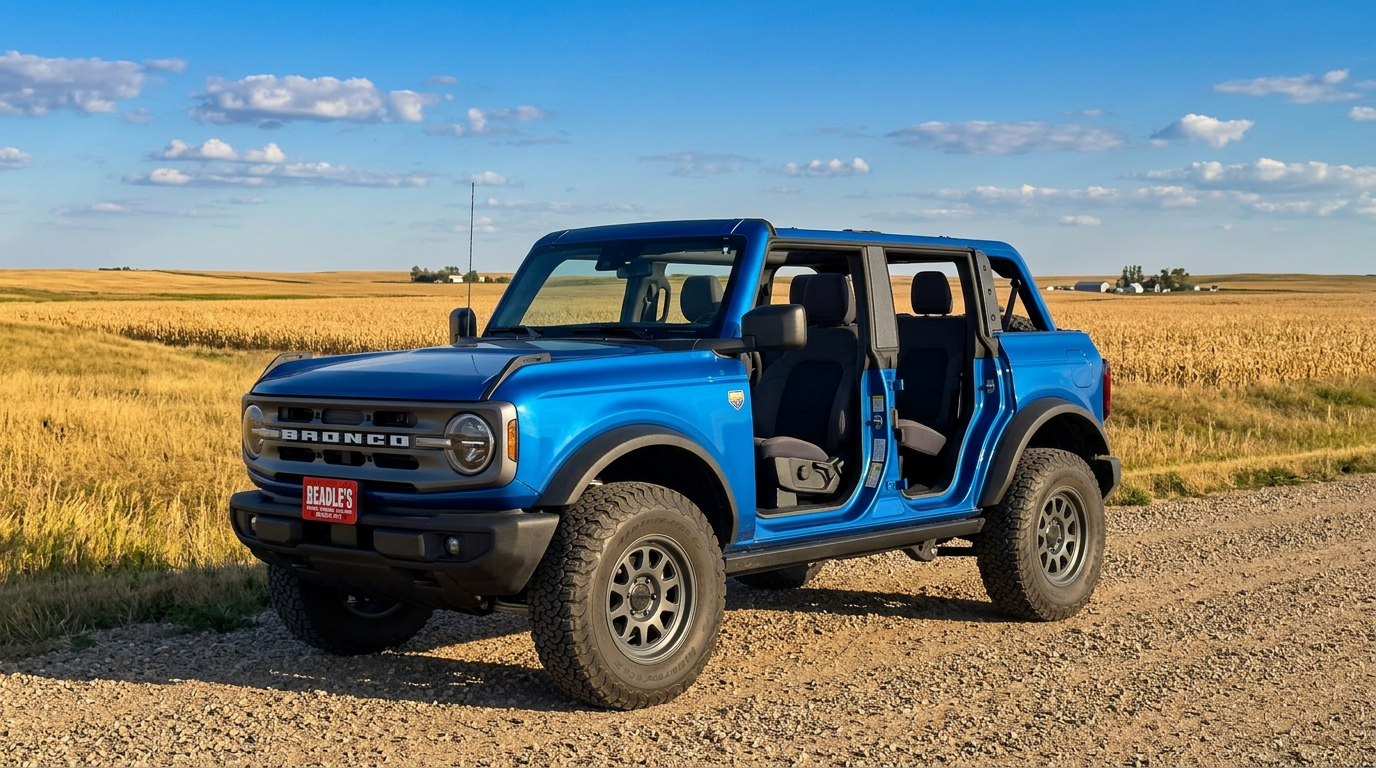
2027 Ford F-250 towing a travel trailer in South Dakota

2027 Ford F-250: 7.3L Gas vs. 6.7L HO Diesel

Quick Answer The 2027 F-250 offers a standard 7.3L gas V8 and an optional 6.7L High-Output Power Stroke diesel. The gas V8 tows up to about 19,500 lbs and suits daily driving and occasional towing; the diesel raises the maximum to 23,000 lbs gooseneck for heavy, frequent hauling. With the 2027 F-250 down to two engines, the choice is cleaner than it used to be: the now-standard 7.3L gas V8, or the available 6.7L High-Output Power Stroke diesel. For most buyers around here, the real question isn't which engine is "better" — it's how often and how heavy you actually tow. This guide breaks down what each engine tows, when the gas V8 is the smarter buy, when the diesel earns its premium, and what each costs to own over time — framed for the occasional-to-regular tower in central South Dakota. Shop F-250s in Stock Reserve a 2027 F-250 Get Pre-Approved On This Page What engines does the 2027 F-250 offer? How much can the gas V8 tow vs. the HO diesel? When is the 7.3L gas the smarter buy? When does the HO diesel pay off? What does each engine cost to own? What engines does the 2027 F-250 offer? Two. The 7.3L gas V8 is standard on every trim, and the 6.7L High-Output Power Stroke V8 turbo diesel is optional across the line. Both use a 10-speed TorqShift automatic. The 7.3L gas is a big, simple, naturally aspirated V8 — strong, easy to live with, and inexpensive to maintain. The High-Output diesel trades that simplicity for far more low-end torque and the highest tow ratings in the F-250 lineup. There's no longer a "middle" engine to overthink; you're choosing between a capable standard gas V8 and the heavy-haul diesel. How much can the gas V8 tow vs. the HO diesel? Properly equipped, the 7.3L gas tows up to about 19,500 lbs on a fifth-wheel or gooseneck and 18,200 lbs conventional. The 6.7L High-Output diesel raises that to up to 23,000 lbs gooseneck, 22,100 lbs fifth-wheel, and 22,000 lbs conventional with the F-250 High-Capacity Axle Upgrade. That gap matters only if your trailer lives in it. A loaded tandem-axle stock trailer or a typical fifth-wheel camper sits comfortably inside the gas truck's range. It's the heavy gooseneck — equipment, big livestock loads, the trailer that's near the top of the range every week — where the diesel's extra ceiling and torque pull ahead. Max towing (properly equipped) 7.3L Gas V8 6.7L HO Diesel Conventional Up to 18,200 lbs Up to 22,000 lbs Fifth-wheel About 19,500 lbs Up to 22,100 lbs Gooseneck About 19,500 lbs Up to 23,000 lbs Maximums require proper equipment and vary by cab, bed, axle, and configuration. The highest diesel ratings require the F-250 High-Capacity Axle Upgrade. When is the 7.3L gas the smarter buy? When you tow occasionally rather than constantly, and your loads stay under roughly 19,500 lbs. For a camper on weekends, a stock trailer to the sale barn, or an occasional gooseneck, the gas V8 has the room without the diesel's upfront cost or added upkeep. It also wins on the unglamorous stuff: a lower purchase price, cheaper oil changes, no diesel exhaust fluid to manage, and easier cold-weather starting in a Dakota January. For a truck that spends most of its life unloaded and tows on weekends, that adds up. Our Recommendation For most F-250 buyers around Bowdle and Aberdeen — daily drivers who tow a camper or a gooseneck occasionally — the standard 7.3L gas V8 is the smarter buy. It covers up to about 19,500 lbs of towing and saves you several thousand dollars up front plus the diesel's ongoing maintenance. When does the HO diesel pay off? When you tow heavy and often. The High-Output diesel's extra torque, higher tow ceiling, and better fuel economy under load make it worth the premium for buyers who run near the top of the range regularly — loaded goosenecks, equipment hauling, or long highway miles with a fifth-wheel. The diesel also tends to hold its value well and is built for high-mileage, hard-working duty cycles. If towing is your truck's main job rather than an occasional weekend, the diesel usually earns back its upfront cost in capability, comfort under load, and resale. Pair it with the High-Capacity Axle Upgrade to unlock the 23,000-lb gooseneck maximum. What does each engine cost to own? The gas V8 is cheaper to buy and cheaper to maintain; the diesel costs several thousand dollars more up front and more per service, but returns better towing fuel economy and stronger resale. Ford has not yet published final 2027 pricing, so the exact diesel premium is to be confirmed. The honest math comes down to use. If you tow occasionally, the gas truck's lower cost of ownership is hard to beat. If you tow heavy and rack up loaded miles, the diesel's efficiency and durability under load close the gap and often come out ahead over a long ownership period. Factor 7.3L Gas V8 6.7L HO Diesel Best for Daily driving, occasional towing Heavy, frequent towing Upfront cost Lower (standard) Several thousand more Maintenance Lower; no DEF Higher; DEF, larger oil capacity Towing fuel economy Good for the class Better under heavy load Resale Solid Strong, especially high-mileage From the Beadle Ford Lot The question we ask every gas-versus-diesel shopper is the same: what's your heaviest trailer, and how often do you pull it? When we weigh a buyer's actual loaded trailer against the now-standard 7.3L gas, most realize the gas truck covers it with room to spare — and the diesel decision turns out to be about frequency, not whether it'll handle the job. Key Takeaways The 7.3L gas V8 is standard and tows up to about 19,500 lbs on a fifth-wheel or gooseneck. The 6.7L High-Output diesel raises the max to 23,000 lbs gooseneck with the High-Capacity Axle Upgrade. Choose the gas V8 for daily driving and occasional towing; choose the diesel for heavy, frequent hauling. The gas V8 costs less to buy and maintain; the diesel returns better towing economy and stronger resale. The deciding factor is frequency and trailer weight, not whether the gas truck can do the job. Frequently Asked Questions Is the 7.3L gas enough for towing a fifth-wheel? For most fifth-wheel campers, yes. The 7.3L gas V8 tows up to about 19,500 lbs on a fifth-wheel or gooseneck, properly equipped, which covers the large majority of recreational fifth-wheels. Step up to the diesel if your loaded trailer runs higher or you tow heavy every week. How much more can the diesel tow than the gas V8? The 6.7L High-Output diesel tows up to 23,000 lbs gooseneck and 22,000 lbs conventional with the High-Capacity Axle Upgrade, versus about 19,500 lbs gooseneck and 18,200 lbs conventional for the 7.3L gas. That's roughly 3,500 to 4,000 lbs more capability at the top. Does the diesel cost more to own? Up front and per service, yes — the diesel is a several-thousand-dollar option and costs more to maintain, including diesel exhaust fluid and larger oil changes. It returns better fuel economy under heavy load and stronger resale, so over a long ownership period of frequent towing it can come out ahead. Which engine is better for South Dakota winters? The 7.3L gas V8 is the simpler cold-weather choice — easy starting in deep cold and no diesel-specific cold-start considerations. Diesels run fine in Dakota winters with proper fuel and plug-in use, but for a truck that mostly drives unloaded, the gas V8 is lower-hassle. Do I need the High-Capacity Axle Upgrade? Only if you want the diesel's maximum tow ratings. The F-250 High-Capacity Axle Upgrade is what unlocks the 23,000-lb gooseneck and 22,000-lb conventional figures on the High-Output diesel. If your loads sit well below those numbers, you may not need it — we can match the axle to your trailer. Quick Answers: 2027 F-250 Gas vs. Diesel One-line answers to the follow-up questions buyers ask next. Which engine is standard? The 7.3L gas V8. Gas towing max? About 19,500 lbs fifth-wheel/gooseneck, 18,200 lbs conventional. Diesel towing max? Up to 23,000 lbs gooseneck with the High-Capacity Axle Upgrade. Which is cheaper to buy? The gas V8 — it's standard. Which is cheaper to maintain? The gas V8 — no DEF, smaller oil changes. Which has better towing fuel economy? The diesel, under heavy load. Which holds value better? The diesel, especially at high mileage. Best for occasional towing? The 7.3L gas V8. Best for daily heavy hauling? The 6.7L High-Output diesel. Do both use the same transmission? Yes — a 10-speed TorqShift automatic. Keep Researching The complete 2027 Ford F-250 Super Duty overview — trims, towing, specs, and inventory 2027 F-250 for recreational towing — campers and fifth-wheels on the gas V8 What's new for the 2027 F-250 — the four-to-two engine change explained Is an F-250 enough truck? — when to consider stepping up to an F-350 My Take on Gas vs. Diesel in the 2027 F-250 I steer a lot of people toward the gas V8, and not because it's the cheaper sale — it's because most of the folks who ask me are towing a camper or a stock trailer a handful of times a year, not running a loaded gooseneck every week. For that buyer, the now-standard 7.3L is genuinely the right truck, and it keeps several thousand dollars in their pocket. When someone really does pull heavy and often, the diesel is the obvious call and I'll say so. The best way to settle it is to tell me your heaviest trailer and how often you pull it. Bring those numbers to Beadle Ford in Bowdle and we'll match the engine to how you actually use the truck. Shop F-250s in Stock Reserve a 2027 F-250 Get Pre-Approved About the Author Lexy Tabbert — Beadle Ford, Bowdle, SD Lexy Tabbert is the Director of Sales and Marketing at Beadle Ford in Bowdle, South Dakota. She covers Ford vehicles, trim comparisons, and buyer guidance — helping families, ranchers, and ag operators across the region find the right truck and configuration for their needs. Learn more about Lexy.
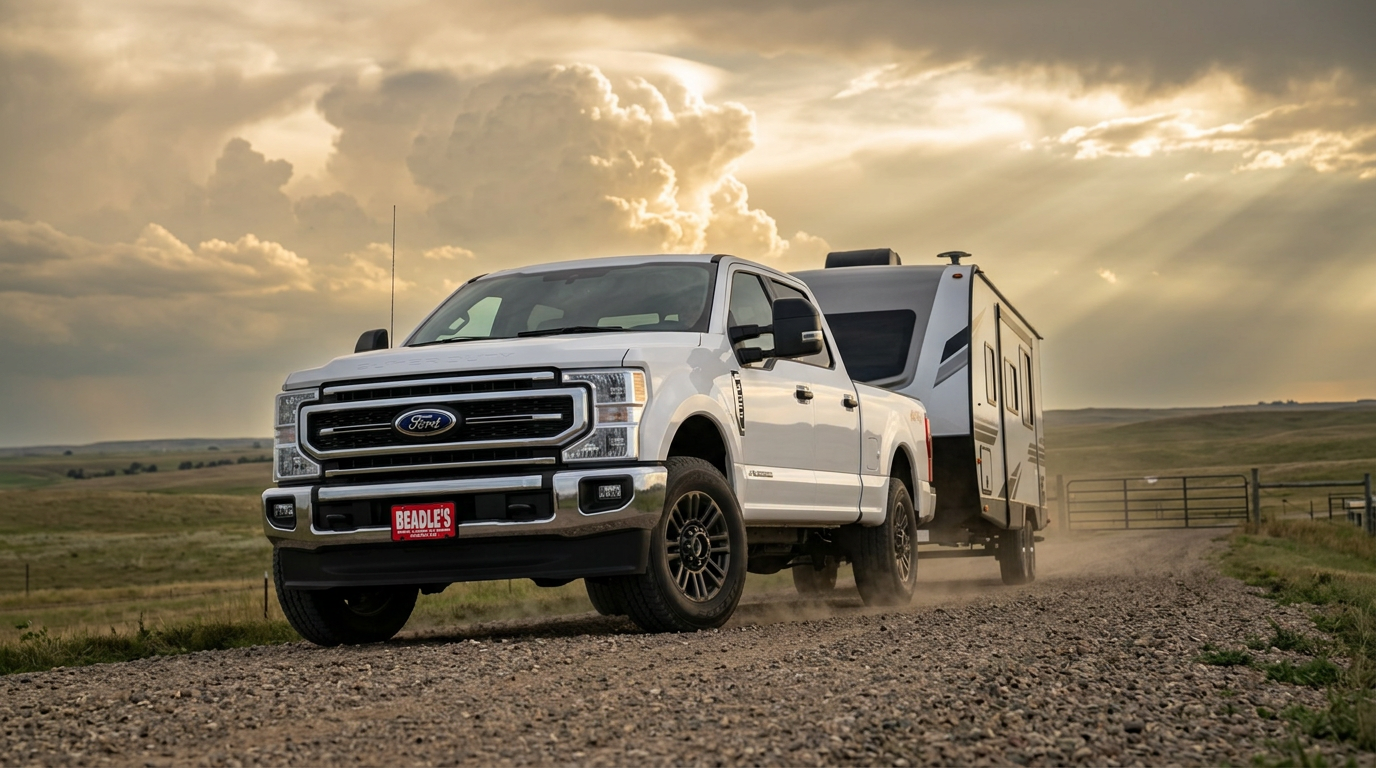
2027 Ford F-250 towing a fifth-wheel camper near Lake Oahe, SD

2027 Ford F-250 for Recreational Towing: Campers & Fifth-Wheels

Quick Answer Properly equipped, the 2027 Ford F-250 tows travel trailers and fifth-wheel campers up to about 19,500 lbs on the standard 7.3L gas V8 and up to 22,100 lbs fifth-wheel with the High-Output diesel. For most RV buyers, the gas V8 has the room without the diesel premium. If your idea of a good weekend is a camper behind the truck headed for Lake Oahe or the Black Hills, the 2027 F-250 is built for it. With the now-standard 7.3L gas V8 and the right tow setup, it pulls big travel trailers and most fifth-wheels comfortably — no diesel required for the majority of recreational towing. Here's what the F-250 tows for RVs, whether the gas V8 is enough for a big fifth-wheel, the tow equipment worth ordering, and how to match a trailer to your exact configuration. Shop F-250s in Stock Reserve a 2027 F-250 Get Pre-Approved On This Page How much can the 2027 F-250 tow for RVs? Can the 7.3L gas pull a big fifth-wheel? What tow package, hitch, and mirrors do you want? How to match a trailer to your F-250 config How much can the 2027 F-250 tow for RVs? Properly equipped, the 7.3L gas F-250 tows up to about 19,500 lbs on a fifth-wheel or gooseneck and 18,200 lbs conventional. The 6.7L High-Output diesel raises that to up to 22,100 lbs fifth-wheel and 22,000 lbs conventional. That covers the full range of travel trailers and the large majority of recreational fifth-wheels. For perspective, a typical family fifth-wheel runs roughly 12,000 to 16,000 lbs loaded, and most bumper-pull travel trailers come in well under that. Both sit comfortably inside the F-250's range with margin to spare for gear, water, and the climb out of a river valley. RV towing (properly equipped) 7.3L Gas V8 6.7L HO Diesel Travel trailer (conventional) Up to 18,200 lbs Up to 22,000 lbs Fifth-wheel camper About 19,500 lbs Up to 22,100 lbs Maximums require proper equipment and vary by cab, bed, axle, and configuration. Always tow to your specific truck's door-jamb ratings. Can the 7.3L gas pull a big fifth-wheel? Yes — the now-standard 7.3L gas V8 tows a fifth-wheel up to about 19,500 lbs, which covers the large majority of recreational fifth-wheel campers. Unless your rig is a heavy toy hauler or a full-time-living fifth-wheel near the top of the range, the gas truck has the capability. The number that trips people up isn't the tow rating — it's king pin weight. A fifth-wheel puts roughly 15% of its loaded weight down on the truck, so a 16,000-lb fifth-wheel adds around 2,400 lbs to the bed. That has to fit within the F-250's payload along with your passengers and gear, which is exactly why the payload number matters as much as the tow rating. Our Recommendation For most RV buyers around Bowdle and Aberdeen, the standard 7.3L gas V8 is the right engine — it pulls a fifth-wheel up to about 19,500 lbs and saves the diesel premium. Step up to the High-Output diesel if you run a heavy toy hauler, climb mountain grades often, or want the extra fuel economy on long hauls. What tow package, hitch, and mirrors do you want? For recreational towing, order the trailer tow equipment that makes the trip easy and safe: the factory trailer tow package with the 7-wire harness, the integrated trailer brake controller, PowerScope telescoping tow mirrors, and the fifth-wheel/gooseneck prep package if you're pulling either. The F-250's 2.5-inch receiver is rated to 22,000 lbs and 2,200 lbs of tongue weight. Trailer Tow Package — 7-wire harness and connector, the backbone of any RV setup. Integrated trailer brake controller — smooth, factory-tuned trailer braking. PowerScope telescoping trailer tow mirrors — the visibility you'll want behind a wide fifth-wheel. Fifth-wheel / gooseneck prep package — factory bed prep so the hitch installs clean. 360-degree camera and Pro Trailer features where available — a big help backing into a tight campsite. How to match a trailer to your F-250 config Match three numbers, not one: your trailer's loaded weight against the truck's tow rating, your trailer's tongue or king pin weight against the truck's payload, and your total combined weight against the GCWR on the door jamb. The tow rating alone doesn't tell you if the truck can carry the hitch weight. Cab, bed, axle ratio, and engine all shift those numbers, so the smartest move is to spec the truck around your actual trailer. Tell us your camper's loaded weight and we'll build an F-250 with the right axle and options to tow it with margin — or check it against a truck already on the lot before you buy. From the Beadle Ford Lot The mistake we catch most with camper buyers is shopping the tow rating and forgetting the payload. A big fifth-wheel's king pin weight eats into payload fast, and a beautifully spec'd truck can run out of payload before it runs out of tow rating. We always check both against the actual trailer before anyone signs. Key Takeaways The 7.3L gas F-250 tows fifth-wheels up to about 19,500 lbs and travel trailers up to 18,200 lbs. The High-Output diesel raises that to up to 22,100 lbs fifth-wheel and 22,000 lbs conventional. For most recreational towing, the standard gas V8 is plenty — no diesel premium needed. Watch king pin weight (about 15% of a fifth-wheel) against payload, not just the tow rating. Order the trailer tow package, brake controller, PowerScope mirrors, and fifth-wheel prep for an easy setup. Frequently Asked Questions Can a 2027 F-250 tow a fifth-wheel camper? Yes. The 7.3L gas F-250 tows a fifth-wheel up to about 19,500 lbs and the High-Output diesel up to 22,100 lbs, properly equipped — covering the large majority of recreational fifth-wheel campers. Just confirm the king pin weight fits within the truck's payload. Do I need the diesel to tow an RV? Not for most campers. The standard 7.3L gas V8 tows fifth-wheels up to about 19,500 lbs, which handles the majority of travel trailers and fifth-wheels. The diesel makes sense for heavy toy haulers, frequent mountain grades, or buyers who want better long-haul fuel economy. What tow equipment should I order for camping? The trailer tow package with the 7-wire harness, the integrated trailer brake controller, PowerScope telescoping tow mirrors, and the fifth-wheel/gooseneck prep package if you pull either. A 360-degree camera helps a lot when backing into a campsite. Why does payload matter for towing a camper? Because a fifth-wheel or gooseneck puts roughly 15% of its loaded weight on the truck as king pin weight. That hitch weight, plus passengers and cargo, has to fit within payload — so a truck can hit its payload limit before its tow rating. Always check both. Quick Answers: F-250 Recreational Towing One-line answers to the follow-up questions buyers ask next. Fifth-wheel max on gas? About 19,500 lbs, properly equipped. Fifth-wheel max on diesel? Up to 22,100 lbs. Travel trailer max on gas? Up to 18,200 lbs conventional. Do I need a diesel for a camper? Not for most — the gas V8 covers it. What's king pin weight? Roughly 15% of a fifth-wheel's loaded weight, carried by the truck. What hitch receiver does it have? A 2.5-inch receiver rated to 22,000 lbs. Best mirrors for towing? PowerScope telescoping trailer tow mirrors. Does it have a trailer brake controller? Yes — an integrated, factory-tuned controller. Will it back into a campsite easily? Yes, especially with the 360-degree camera. Where can I match my camper to a truck? Beadle Ford in Bowdle, SD. Keep Researching The complete 2027 Ford F-250 Super Duty overview — trims, towing, specs, and inventory 7.3L gas vs. HO diesel — which engine for how you tow 2027 F-150 vs. F-250 — do you need a Super Duty for your camper? 2027 F-250 winter & gravel capability — getting to the lake in any season My Take on Towing a Camper With the F-250 The thing I most want camper buyers to walk away knowing is to bring me the trailer's real loaded weight, not the brochure dry weight. People load a fifth-wheel up with water, gear, and a generator and suddenly the king pin weight is a different number than they planned for. When we spec the truck around the trailer you actually own, the F-250 tows it beautifully — and most folks are pleasantly surprised the standard gas V8 is all they need. Headed to Oahe or the Hills this summer? Bring me your camper's numbers and we'll build or find the right F-250 to pull it. Stop by Beadle Ford in Bowdle anytime. Shop F-250s in Stock Reserve a 2027 F-250 Get Pre-Approved About the Author Lexy Tabbert — Beadle Ford, Bowdle, SD Lexy Tabbert is the Director of Sales and Marketing at Beadle Ford in Bowdle, South Dakota. She covers Ford vehicles, trim comparisons, and buyer guidance — helping families, ranchers, and ag operators across the region find the right truck and configuration for their needs. Learn more about Lexy.
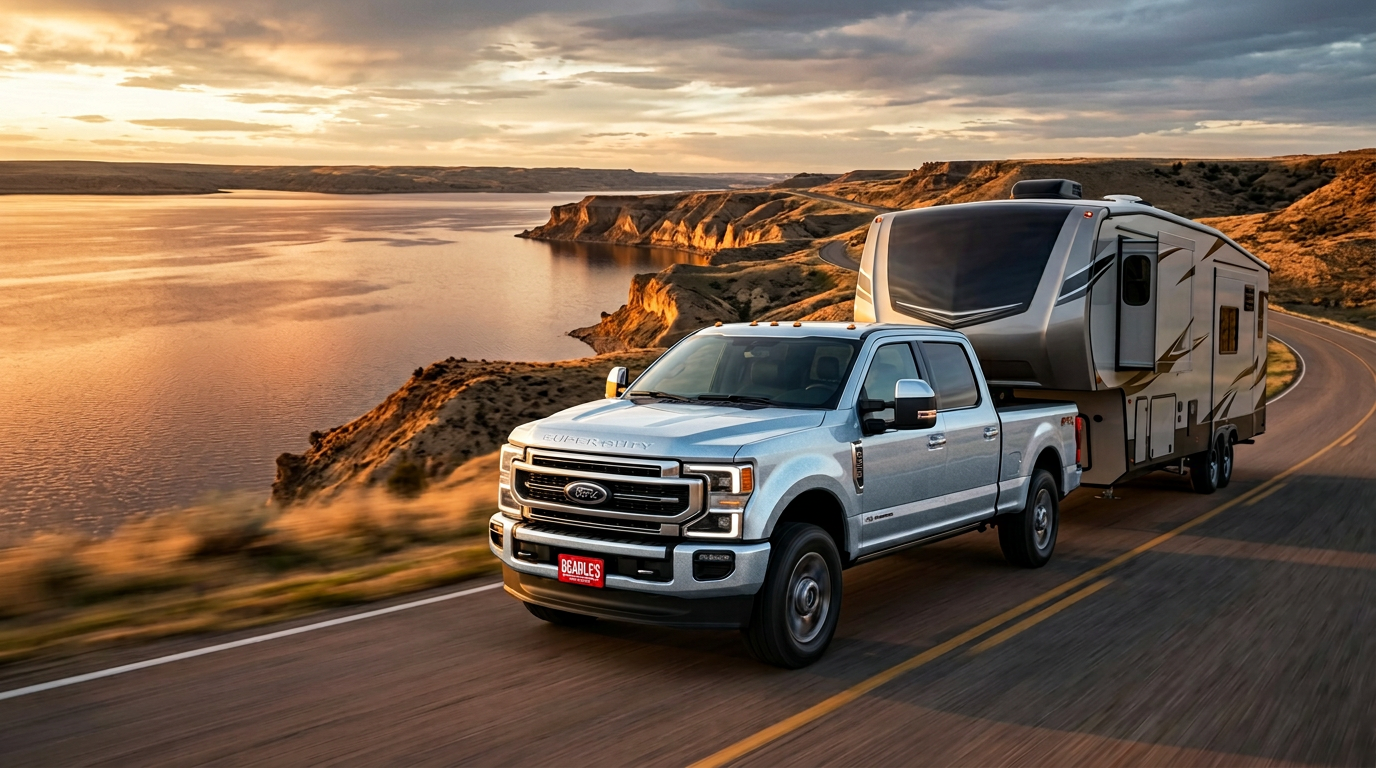
2026 Ford Explorer ST on open highway

2026 Ford Explorer Engine Options Deep Dive (2.3L vs 3.0L)

If you’re shopping for a 2026 Ford Explorer, the engine choice matters because it changes how the SUV feels every day — how easily it merges onto the highway, how confident it feels when loaded with people and gear, and how relaxed it is when towing or driving into headwinds. This guide explains the two main engine paths in plain language: what the 2.3L EcoBoost is best at, what the 3.0L EcoBoost does differently, and how to choose based on real life (not confusing specs). For the full lineup context (trims, seating layouts, towing structure, and how it all fits together), start with the 2026 Ford Explorer overview. Shop Explorers in Stock Table of Contents What engines are available on the 2026 Explorer? What does “turbocharged” actually mean? Who is the 2.3L EcoBoost best for? Who is the 3.0L EcoBoost best for? Real-world examples: when the engine choice matters ST vs Tremor: how engine choice changes the vibe Does the engine affect fuel and day-to-day costs? How to choose the right engine in 5 steps What engines are available on the 2026 Ford Explorer? The 2026 Ford Explorer is generally built around two EcoBoost options: 2.3L EcoBoost® I-4 (commonly found on Explorer Active and ST-Line, and used across much of the lineup depending on configuration) 3.0L EcoBoost® V6 (the performance-focused option, standard on Explorer ST and available on some Tremor configurations depending on equipment selection) Simple takeaway: The 2.3L is the “everyday balanced” engine. The 3.0L is the “effortless power” engine. Trim-level structure and availability changes are best understood inside the full lineup guide: 2026 Ford Explorer overview. What does “turbocharged” actually mean? A turbo is like a “power helper.” Instead of making the engine bigger, it pushes more air into the engine so it can make more power when you need it — like when you accelerate, merge, or climb a hill. What that means in real life: You can have a smaller engine that still feels strong when you press the gas. Power can come in quickly when you need it (great for merging and passing). How smooth it feels depends on the engine size and tuning (which is where 2.3 vs 3.0 starts to matter). Who is the 2.3L EcoBoost best for? The 2.3L EcoBoost is usually the best fit for drivers who want a three-row SUV that feels confident and modern without paying extra for performance they won’t use every day. Best match if your life looks like: School drop-offs, errands, commuting, and weekend travel Mostly highway driving at steady speeds Occasional towing (with the right tow equipment) You want capability, but you don’t need “sports SUV” acceleration How it feels: responsive, balanced, and easy to live with — especially in Active and ST-Line trims. If your priority is family layout and space, this pairs well with what we cover in the Interior & Cargo Guide. Who is the 3.0L EcoBoost V6 best for? The 3.0L EcoBoost is for drivers who want the Explorer to feel effortless — especially when the SUV is loaded with people, gear, and long-distance highway miles. Best match if: You routinely drive with 5–7 passengers plus cargo You live on the highway and want strong passing power You tow more often (or want towing to feel less strained) You simply enjoy the feeling of confident acceleration How it feels: smoother power delivery, less “working hard” sensation on hills and passing, and a more performance-oriented personality — especially in Explorer ST. If you’re considering ST specifically, the deeper performance angle is covered in the Explorer ST Performance Guide. Real-world examples: when the engine choice matters Most people don’t notice engine differences in a calm test drive. They notice it during the moments that actually matter in real life. Here are the most common situations where your engine choice will feel different: 1) Merging onto the highway with kids in the back 2.3L: capable and responsive, but you may press the gas more to get the same “go now” feeling. 3.0L: feels more immediate and relaxed — less effort, more confidence. 2) Passing a semi on a two-lane highway 2.3L: does the job, but you’ll plan your pass a little more. 3.0L: passing power feels easier and quicker, especially at speed. 3) Driving into strong South Dakota wind 2.3L: steady, but you may notice more downshifts or effort in gusty conditions. 3.0L: maintains speed more effortlessly with less “strain” sensation. 4) Towing a small camper or boat The 2026 Explorer can tow up to 5,000 pounds when properly equipped, but engine choice impacts how confident it feels while towing — especially on hills, in wind, or when the SUV is loaded. For the full towing breakdown (including tongue weight, trailer frontal area, and setup tips), see the 2026 Explorer Towing & AWD Guide. ST vs Tremor: how engine choice changes the vibe This is a very common question: “If I want something special, should I choose ST or Tremor?” ST: performance personality — the engine and tuning are meant to feel fast and responsive on pavement. Tremor: adventure personality — designed for confidence on rougher roads and travel routes beyond pavement, with engine availability depending on how it’s equipped. If you want a trim-level decision guide that compares these clearly, the best reference is the 2026 Explorer Trim Levels Guide (it frames the “who each trim is for” question). Does the engine affect fuel and day-to-day costs? In plain terms: the more performance you choose, the more you should expect the vehicle to use fuel when you drive it like a performance vehicle. But driving habits matter just as much as engine choice. If you drive calmly, fuel use may be closer than you’d expect. If you accelerate aggressively or drive at high speeds often, the difference becomes more noticeable. Simple way to think about it: 2.3L: optimized for everyday efficiency and balance 3.0L: optimized for effortless power and performance feel How to choose the right Explorer engine in 5 steps This is voice-search friendly on purpose — it’s the simplest way to decide without getting lost. List your “most common” week. Commute, school, errands, highway miles. Think about your “most demanding” day. Full family load + gear + winter driving + highway passing. Decide how you want it to feel. “Fine and capable” vs “effortless and confident.” If you tow, decide how often. Occasional towing vs frequent towing. Use the trim structure as your shortcut. ST = performance path, Active/ST-Line = balanced path, Tremor = adventure path depending on configuration. Quick Specs / Overview (Plain Language) Engine What it’s best at Who it fits best 2.3L EcoBoost I-4 Everyday balance and confident daily driving Most families, commuters, general travel 3.0L EcoBoost V6 Effortless power, highway passing, performance feel ST shoppers, frequent highway drivers, heavy loads Key Takeaways The 2.3L EcoBoost is the “balanced everyday” engine for most families. The 3.0L EcoBoost is the “effortless power” option that feels stronger under load. Engine choice matters most in merging, passing, wind, hills, and towing feel. Trim choice is often the easiest way to narrow engine options. For full lineup context, the pillar page ties everything together. FAQ Is the 2.3L engine enough for a family SUV? For most families, yes. It’s designed to provide confident everyday performance for commuting, errands, highway travel, and family trips. The difference is less about “enough” and more about whether you want power to feel effortless under heavy loads. When does the 3.0L engine make the biggest difference? Most drivers notice the difference during highway merging and passing, when the vehicle is fully loaded with passengers, when driving into strong wind, and when towing or climbing hills. Does the engine change towing capacity? The Explorer can tow up to 5,000 pounds when properly equipped, but engine choice can change how confident and relaxed towing feels. Equipment configuration also matters, which is why towing should be evaluated as a full setup. Do I need the ST to get the stronger engine? Explorer ST is the most direct performance path, and the 3.0L EcoBoost is standard there. Other trims may have different availability depending on configuration, so the trim guide is the best starting point. What should I test drive to compare engines? If possible, drive an Explorer Active (2.3L) and an Explorer ST (3.0L). Use the same roads: a highway merge, a passing situation, and a rougher road section. The “feel” difference becomes clear quickly. Conclusion In my experience, engine decisions get much easier when shoppers stop thinking in “car specs” and instead focus on real moments: merging with kids in the back, passing on a two-lane highway, driving into wind, or towing on a weekend trip. When you match the engine to the life you actually live, the right Explorer configuration usually becomes obvious. About the Author Lexy Tabbert provides research-driven SUV configuration guidance and ownership insights for drivers across South Dakota and beyond.

2026 Ford Bronco Outer Banks in Velocity Blue Metallic in motion on a two-lane South Dakota highway, prairie horizon

2.3L vs 2.7L EcoBoost: Which 2026 Ford Bronco Engine Is Right for You?

Two engines power most 2026 Ford Bronco orders: a 2.3L EcoBoost I-4 making 300 horsepower and 325 lb-ft of torque, and a 2.7L EcoBoost V6 making 330 horsepower and 415 lb-ft. The Raptor's 3.0L V6 sits in its own tier (418 hp / 440 lb-ft) and isn't part of this comparison. For everyone else, the choice is between the four-cylinder and the V6 — and it's a closer call than most buyers expect. This is an honest decision tool. We'll cover what each engine actually feels like behind the wheel, what towing looks like (spoiler: nearly identical), what to expect at the pump on a Bowdle-to-Black-Hills run, whether the 7-speed manual still earns its place, and which engine matches which buyer in central South Dakota. Shop Broncos in Stock Get Pre-Approved On This Page Why Is the 2.3L EcoBoost the Default Engine on the 2026 Bronco? What Does the 2.7L EcoBoost V6 Actually Buy You Over the 2.3L? How Different Is Towing Between the 2.3L and 2.7L? What's the EPA Fuel Economy for Each 2026 Bronco Engine? Should You Pick the 7-Speed Manual or the 10-Speed Automatic? Which 2026 Bronco Engine Is Right for You? Why Is the 2.3L EcoBoost the Default Engine on the 2026 Bronco? The 2.3L EcoBoost is the default because it's the broadest-fit engine in the lineup — the only one offered with the 7-speed manual transmission, standard on every trim from Base through Heritage Edition (other than Outer Banks, where it pairs with the auto only), and capable of the same 3,500-pound tow rating as the V6. For most buyers it's enough engine. Output is 300 horsepower at 5,700 RPM and 325 lb-ft of torque at 3,400 RPM on premium fuel (275 hp / 315 lb-ft on regular). It's a turbocharged inline-four with direct injection, and in a body-on-frame Bronco it pulls cleanly from low RPM and turns the four-cylinder displacement gap into a non-issue most of the time. On a county-road merge or a Black Hills two-track, the four cylinder doesn't feel undersized. Where the 2.3L gives ground is at sustained high-load output: a long uphill grade with a trailer, or the upper third of the rev range when you want immediate punch from 50 to 75. The four cylinder works harder there than the V6 does — you'll hear it through the firewall, and you'll feel the turbo spooling rather than the V6's broader torque shelf. For most central-SD use cases, that distinction doesn't show up in everyday driving. Trim availability: standard on Base, Big Bend, Outer Banks, Badlands, and Heritage Edition. New for 2026, the 10-speed automatic is now available with the 2.3L on Heritage (was 2.7L-only before). Stroppe and Raptor don't offer the 2.3L. For full trim-by-trim context, see our 2026 Ford Bronco trim levels guide. A 2.3L EcoBoost Badlands in its natural habitat — gravel county road, prairie horizon, the Bowdle-to-Hills run that 80% of central-SD Bronco miles look like. What Does the 2.7L EcoBoost V6 Actually Buy You Over the 2.3L? The 2.7L EcoBoost V6 buys you 30 more horsepower (330 vs 300) and — much more meaningfully — 90 more lb-ft of torque (415 vs 325) on premium fuel. The torque is what you actually feel: stronger pull from a stop, easier passing at highway speed, and a smoother delivery profile that doesn't ask the engine to work as hard. The upcharge is $2,995. The 2.7L is a turbocharged V6 with direct injection. It's automatic-only — there's no manual-transmission option with the V6. It's available on Outer Banks, Badlands 4-Door, and Heritage Edition, and it's the only engine offered on the Stroppe Edition (fleet/military only). It is not offered on Base, Big Bend, Badlands 2-Door, or Raptor. Day-to-day, the V6 is most noticeable at the moments the 2.3L works hardest — uphill grades with weight, on-ramp acceleration, sustained 70+ highway speeds with a headwind, and the kind of pull-from-2,500-RPM situations where a V6's torque shelf flattens out before a four cylinder's turbo fully spools. For drivers who do a lot of long highway miles or pull a small trailer regularly, the V6 reduces the engine's working effort. For drivers who mostly do town errands and gravel section roads, that effort difference is real but often not worth the upcharge. There's also a refinement gap. The V6 is quieter at cruise and smoother at idle — small things, but the kind of thing you notice on a four-hour run to the Hills. If long highway distance is a big part of your annual miles, that refinement adds up. Get Pre-Approved Contact Beadle Ford How Different Is Towing Between the 2.3L and 2.7L? On paper, almost not at all. Both the 2.3L and 2.7L EcoBoost are rated to tow 3,500 lbs on every non-Raptor 2026 Bronco — regardless of trim, axle ratio, body style, or transmission. The Raptor is the only 2026 Bronco rated higher, at 4,500 lbs. The standard hitch receiver on every non-Raptor caps at 3,500 / 350 lbs (trailer / tongue), so the engine choice doesn't change the ceiling. Outer Banks 2.7L EcoBoost towing a small bass-fishing rig to a Lake Oahe boat ramp — well within the Bronco's 3,500-pound non-Raptor cap. Where the engines actually differ is in how they pull that 3,500 lbs, not how much. The 2.7L V6's extra torque means the engine works less hard at the same load — fewer downshifts on grade, less turbo build-up before getting underway, lower thermal load on long pulls. If you're pulling a single-axle aluminum bass boat to Lake Oahe a few times a summer, the 2.3L handles it with no issue. If you're pulling a 3,400-pound enclosed trailer with sled or ATV to the Hills regularly, the V6 will feel measurably less stressed at the end of a long day. A 2026 footnote worth knowing: the Badlands 4-Door with the 2.7L V6 and 4.46 axle has a slightly lower published rating of 3,460 lbs (versus 3,500 on every other configuration). It's a 40-pound spread — not relevant to most buyers, but if you've got a trailer that's right at the line, that's the one config to flag. The Trailer Tow Prep Package is included on every non-Raptor Bronco, but the dealer-installed OEM trailer hitch receiver is required for any towing over 2,000 lbs. The frontal-area limit is 30 sq ft (non-Raptor), which rules out tall enclosed trailers regardless of weight rating. What's the EPA Fuel Economy for Each 2026 Bronco Engine? EPA-estimated fuel economy varies by door count, transmission, axle ratio, and tire size — there isn't one single number that applies. As a baseline, the 2.3L EcoBoost rates roughly 18 city / 20 highway / 19 combined on a 4-Door automatic, and the 2.7L EcoBoost V6 rates roughly 17 / 17 / 17 on the same body. The 2-Door 2.3L generally rates a touch higher (around 20 / 21 / 20). Verify your specific configuration on fueleconomy.gov before purchase — Sasquatch's 35-inch tires and 4.70 axle, in particular, drop EPA combined by a noticeable margin on either engine. For a Bowdle-to-Black-Hills round trip (about 720 miles total at mostly highway speeds), the math comes out roughly like this on each engine, before fuel-cost variations. A 2.3L 4-Door averaging 20 mpg highway burns about 36 gallons. A 2.7L V6 4-Door averaging 17 mpg burns about 42 gallons — a six-gallon difference per round trip, which adds up over a year of regular Hills runs but doesn't move the needle on a single weekend. What changes more than the engine choice is what's hung off the Bronco. Sasquatch's bigger tires and steeper axle ratio are the single biggest fuel-economy variable in the lineup — a non-Sasquatch 2.3L Badlands and a Sasquatch-equipped 2.3L Badlands aren't really the same vehicle for MPG purposes. If saving fuel on long highway hauls is a priority, lean toward the smaller-tire trim and the 4-Door 2.3L auto. If you're already at Sasquatch spec, the 2.7L's torque advantage often offsets the V6's combined-MPG penalty for the way most buyers actually use the truck. Both engines run on regular 87-octane fuel; premium is recommended for peak rated horsepower and torque but not required. Real-world MPG from owner forums tends to track within 1–2 mpg of EPA combined under mixed driving, with bigger gaps when towing or running deep snow. Should You Pick the 7-Speed Manual or the 10-Speed Automatic? For most buyers in central South Dakota, the 10-speed automatic is the practical pick. The 7-speed manual is a real driver's-engagement choice, and it earns its keep for buyers who want it — but the auto wins on towing, on long-distance highway comfort, and on every winter morning where the manual's clutch and Crank-in-Gear function become extra effort instead of fun. The 7-speed manual (Ford code 44Q) is offered with the 2.3L EcoBoost only — never with the V6. It's standard on Base, Big Bend, Badlands, and Heritage Edition. It includes a Granny Gear (an ultra-low first), Crank-in-Gear functionality (lets you start the engine while in gear with the clutch pressed), and Hill Descent Control. For genuine off-road work — slow, technical climbs in the Black Hills or precise low-speed crawl situations — the manual gives the driver more direct control than even a well-tuned automatic. The 10-speed automatic (Ford code 44T) is available with the 2.3L on most trims (NEW for 2026 on Heritage Edition with the 2.3L) and standard with the 2.7L V6 and 3.0L Raptor V6. With the auto you also get Trail Control (low-speed cruise control for off-road), Trail Turn Assist (tightens the turning radius by braking the inside rear wheel), and on Outer Banks and Badlands, Trail One-Pedal Driving. Those features pair tightly with the GOAT modes — see our 2026 Bronco G.O.A.T. Modes guide for how those interact in practice. The honest take: if you're choosing between a 2.3L manual and a 2.3L auto, and you're not specifically excited about driving a manual, take the auto. It's better for towing, better in stop-and-go, better for resale value, and better in winter clutch-leg fatigue. If you genuinely want the manual — and a meaningful number of Bronco buyers do — get it. It's one of the few capable off-road SUVs that still offers a true row-your-own option. Which 2026 Bronco Engine Is Right for You? The 2.3L EcoBoost fits the buyer who wants the broadest-fit engine and is doing mostly daily driving, gravel section roads, light recreational towing, and weekend trips to the Hills. It's the right call for the Plains Outdoorsman who already owns an F-150 for heavy work and uses the Bronco as a secondary vehicle, the buyer who wants the manual transmission, and anyone primarily driving in town or on county roads where the V6's extra torque doesn't get used. The 2.7L EcoBoost V6 fits the buyer who runs long highway miles regularly, regularly tows close to the 3,500-pound limit, wants the smoother and quieter cruise feel, and doesn't want the manual transmission anyway. The Ranch-Country Daily who's pulling a small trailer to and from a property weekly, or the buyer who makes the Hills run six or eight times a year, will appreciate the V6's torque shelf. The $2,995 upcharge is real money, but for the right use case, it's well-spent. For SD winter driving — a topic worth its own treatment — both engines handle cold starts and traction well. See our 2026 Bronco in South Dakota winter guide for the cold-weather details that matter at 30 below. For the broader 2026 Bronco context — engines, capability, what's new for the year — the full 2026 Ford Bronco overview walks through the lineup side by side. And if Sasquatch is on your build sheet, our honest take on whether Sasquatch is worth it in central South Dakota covers that decision in detail — Sasquatch is the single biggest variable on either engine's fuel economy. Key Takeaways 2.3L EcoBoost: 300 hp / 325 lb-ft, available with 7-speed manual, the broadest-fit engine for most buyers. 2.7L EcoBoost V6: 330 hp / 415 lb-ft, automatic-only, $2,995 upcharge — buys torque, refinement, and easier highway and towing duty. Both engines tow 3,500 lbs (non-Raptor cap). The Raptor's 3.0L V6 is in its own tier at 4,500 lbs. EPA estimates: 2.3L 4-Door auto ~18/20/19; 2.7L V6 4-Door ~17/17/17. Verify your specific configuration on fueleconomy.gov before purchase. The 7-speed manual is 2.3L-only and rewards engaged drivers; the 10-speed auto is the practical pick for most central-SD buyers. Frequently Asked Questions How much horsepower does each 2026 Bronco engine make? On premium fuel, the 2.3L EcoBoost makes 300 horsepower and 325 lb-ft of torque, the 2.7L EcoBoost V6 makes 330 horsepower and 415 lb-ft, and the Raptor's 3.0L EcoBoost V6 makes 418 horsepower and 440 lb-ft. Output drops slightly on regular 87-octane fuel. Can both engines tow the same amount? Yes. Every non-Raptor 2026 Bronco — 2.3L or 2.7L, manual or automatic, any trim — is rated to tow 3,500 lbs. The hitch receiver on non-Raptor models caps there. Only the Raptor (3.0L V6) is rated higher at 4,500 lbs. One small footnote: the Badlands 4-Door with the 2.7L V6 and 4.46 axle is rated at 3,460 lbs. Which trims offer the 2.7L EcoBoost V6? The 2.7L EcoBoost V6 is offered on Outer Banks, Badlands 4-Door, and Heritage Edition, and is the only engine on the Stroppe Edition (fleet/military only). The upcharge is $2,995. It is not offered on Base, Big Bend, Badlands 2-Door, or Raptor. Is the 7-speed manual transmission available with the 2.7L V6? No. The 7-speed manual is offered exclusively with the 2.3L EcoBoost. The 2.7L EcoBoost V6 and the Raptor's 3.0L EcoBoost V6 are 10-speed automatic only. New for 2026, the 10-speed automatic is now also available with the 2.3L on the Heritage Edition (was 2.7L-only before). Does the 2026 Ford Bronco require premium fuel? No. Both the 2.3L EcoBoost and 2.7L EcoBoost V6 run on regular 87-octane fuel. Premium is recommended for peak rated horsepower and torque (300 hp / 325 lb-ft on the 2.3L; 330 hp / 415 lb-ft on the 2.7L), but the engines are calibrated to run safely on regular with a small drop in output. My Take on the 2026 Bronco Engine Choice In my time at Beadle Ford, I've watched buyers wrestle with this decision more than any other on the Bronco. The honest answer for most of them: the 2.3L is enough engine. The buyers who actually use the V6's torque tend to know they need it before they walk in — they have a specific trailer, a specific commute, or a specific feel they're after. The buyers who pick the V6 because they're worried the four cylinder is "too small" usually find out a year later that the 2.3L would have done the job. If you're between the two, drive both back to back. Twenty minutes of seat time on the same county road outside Bowdle, with the same kind of load, settles the question for almost everyone — and saves you a $3,000 second-guess. Shop Broncos in Stock Get Pre-Approved About the Author Lexy Tabbert — Beadle Ford, Bowdle, SD Lexy Tabbert is the Director of Sales and Marketing at Beadle Ford in Bowdle, South Dakota. She covers Ford vehicles, trim comparisons, and buyer guidance — helping families, ranchers, and ag operators across the region find the right truck and configuration for their needs. Learn more about Lexy.
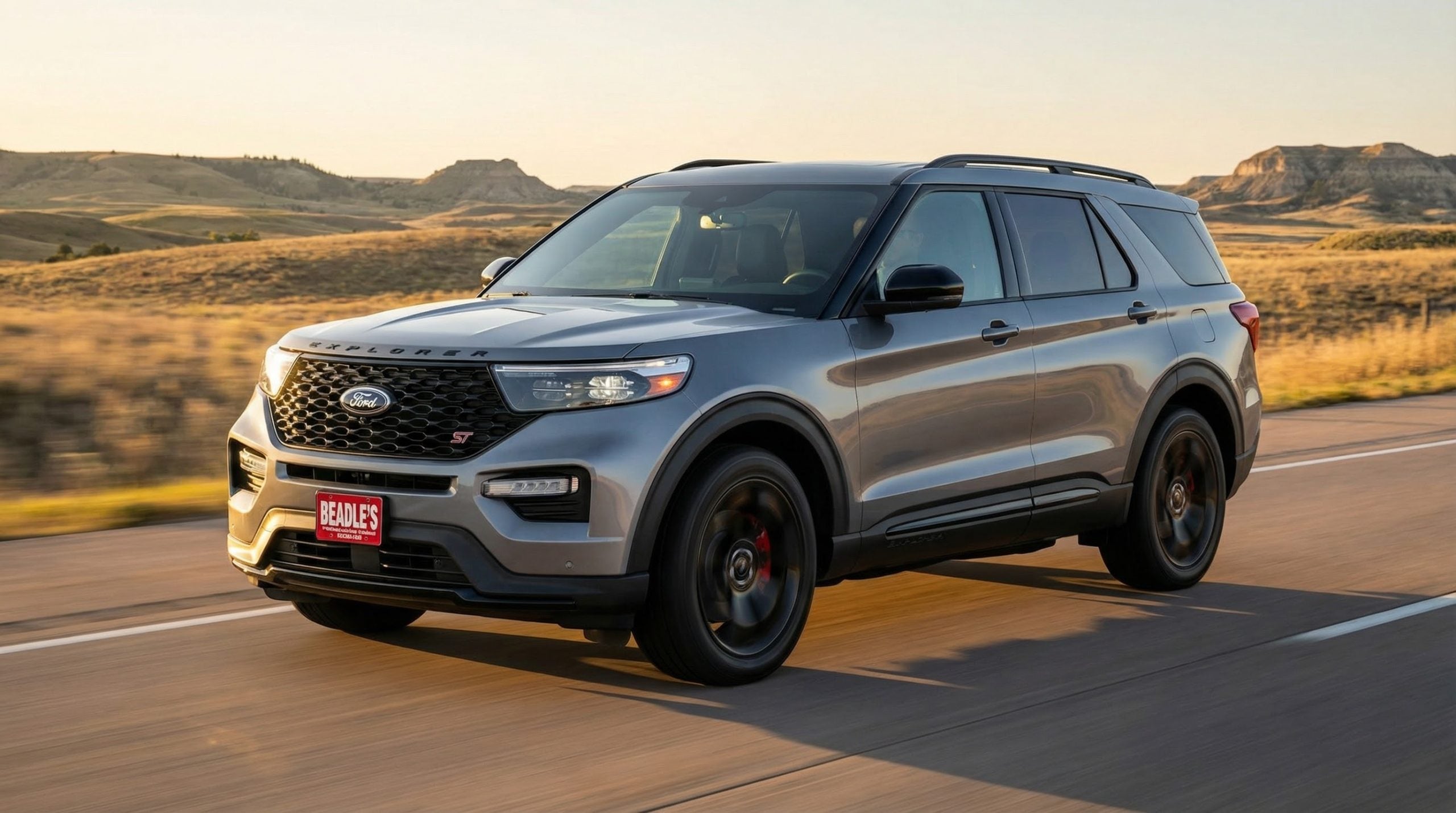
Contact Us

Fill out this form below and we'll contact you shortly
*Required Fields