
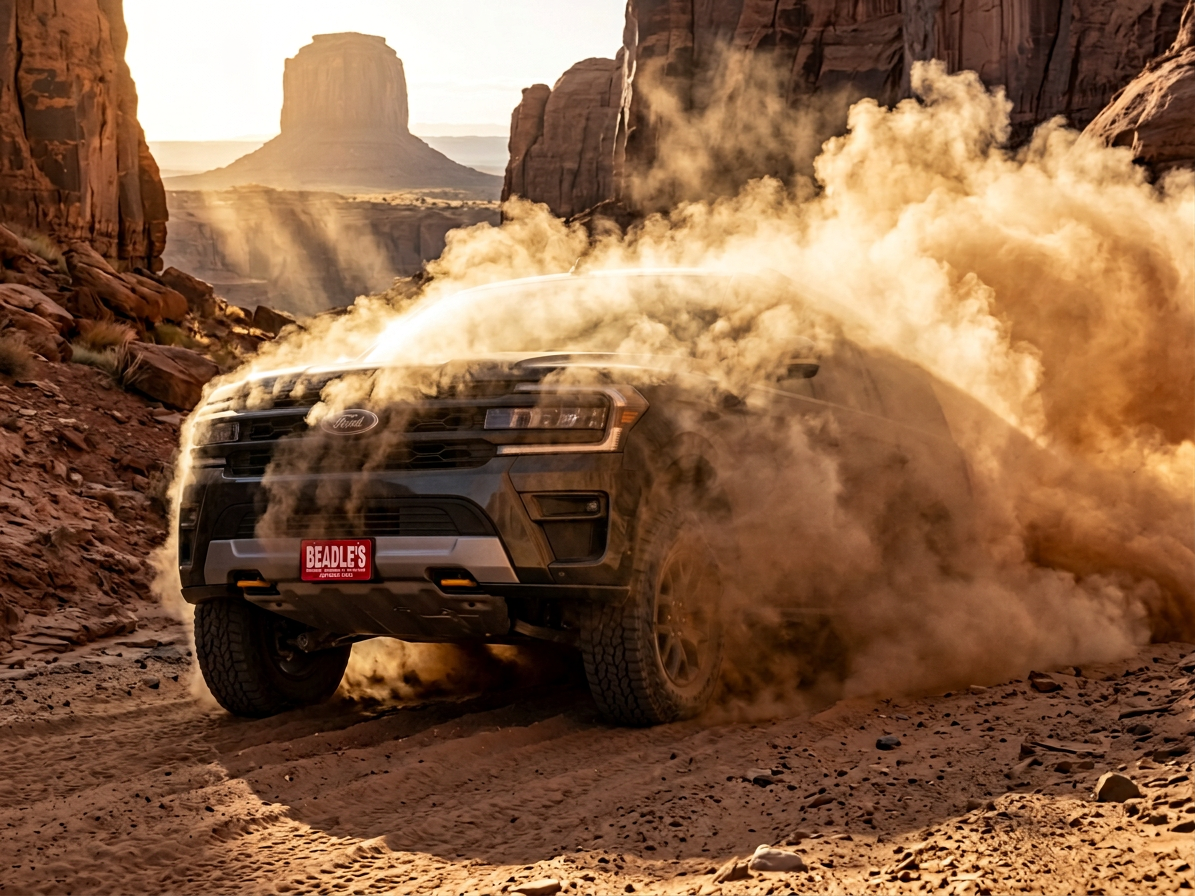
The 2027 Ford Expedition Tremor is the Expedition’s factory off-road trim — a 4×4-only, 440-horsepower, electronic-locking-differential configuration that sits between the Platinum and an aftermarket project. It’s the first factory off-road Expedition, and it continues in the 2027 lineup unchanged from its 2025 launch. If you’ve been hearing about the Tremor but weren’t sure whether it’s a legitimate capability trim or a Platinum with stickers and steel-look wheels, this guide answers it honestly.
We’ll walk through what the Tremor actually is mechanically, what the 440 hp and 510 lb-ft High Output EcoBoost really gets you, how it handles gravel and section-line roads in the kind of terrain we drive around Bowdle, why Ford only offers the Tremor in 4×4 and not in Expedition MAX, whether it’s worth the jump over a Platinum for a rural South Dakota buyer, and what you give up to get it. If you’re cross-shopping the Tremor against anything from a Wagoneer to a Tahoe Z71, the trade-offs section at the end matters as much as the specs at the top.
On This Page
What is the Expedition Tremor, really?
The Expedition Tremor is the factory off-road trim of the sixth-generation Expedition — a standalone retail trim, not a package. It’s not a Platinum with different wheels or a skid-plate cosmetic; it’s a different mechanical specification of the Expedition with its own engine, suspension, tires, differential, and drive-mode software.
What that mechanical difference includes: a 3.5L EcoBoost V6 High Output engine, a 3.73 Electronic Locking Rear Differential, a modified higher-ride suspension with premium passive shocks, modified Raptor-style front and transmission skid plates, an underbody fuel tank shield, P275/70R18 all-terrain tires on unique 18" Dark Carbonized Gray wheels, a unique off-road grille with Carbonized Gray bars and signature lighting, amber Active front tow hooks, a platform running board with angular step bars, a standard off-road underbody shield, and a drive-mode system that adds Rock Crawl on top of the standard six modes. None of that equipment is optional on another Expedition trim — it’s Tremor-specific.
The Platinum trim, by contrast, is the Expedition’s luxury spec — 22" Ebony Bright Machined wheels, painted body-color bumpers, a chrome-trimmed grille, and an interior that leans plush over purposeful. You can order a Platinum with the Stealth Performance Package (19B) or the Platinum Ultimate Package (17A) and get the same 440 hp / 510 lb-ft High Output V6 as the Tremor, but you won’t get the Tremor’s locking differential, its Rock Crawl drive mode, its all-terrain tire setup, or its off-road-specific skid plates. Those are structural choices the Tremor trim makes that a Platinum cannot match.
If you’re comparing the Tremor to the rest of the lineup, the complete 2027 Ford Expedition overview has the side-by-side trim framing.
What does 440 hp and 510 lb-ft actually get you?
The Tremor runs the 3.5L EcoBoost V6 High Output — a twin-turbocharged V6 that produces 440 horsepower and 510 lb-ft of torque, confirmed in the 2027 Ford Expedition Order Guide. It’s mated to a 10-speed automatic transmission with SelectShift capability and Ford’s intelligent 4WD system with Torque on Demand and a two-speed transfer case.
Practically, the 440 hp and 510 lb-ft figures matter in two scenarios. First, towing — the Tremor’s Heavy-Duty Trailer Tow Package is standard, and current-generation Tremor reporting cites a max tow capacity of approximately 9,600 lbs when properly equipped. Ford will confirm the official 2027 figure when the 2027 Ford Towing Guide is released. That’s enough tow for most livestock trailers, most flat-deck trailers in the 24- to 30-foot range, a two-place enclosed snowmobile trailer, and any boat that fits on a single-axle or tandem trailer for Lake Oahe. Second, altitude and load — turbocharged engines don’t lose power at elevation the way naturally aspirated engines do, which matters if you tow to the Black Hills or into Wyoming from Bowdle. The High Output engine gives you usable torque across the whole tach range, not just at the top.
The engine also includes a High Flow Exhaust System and an Engine Sound Enhancer with Active Noise Cancellation — which means the cabin stays conversational at highway speed while the exhaust has more presence when you’re on the throttle. It’s a deliberate calibration choice, not a defect.
How does the Tremor handle gravel and off-pavement?
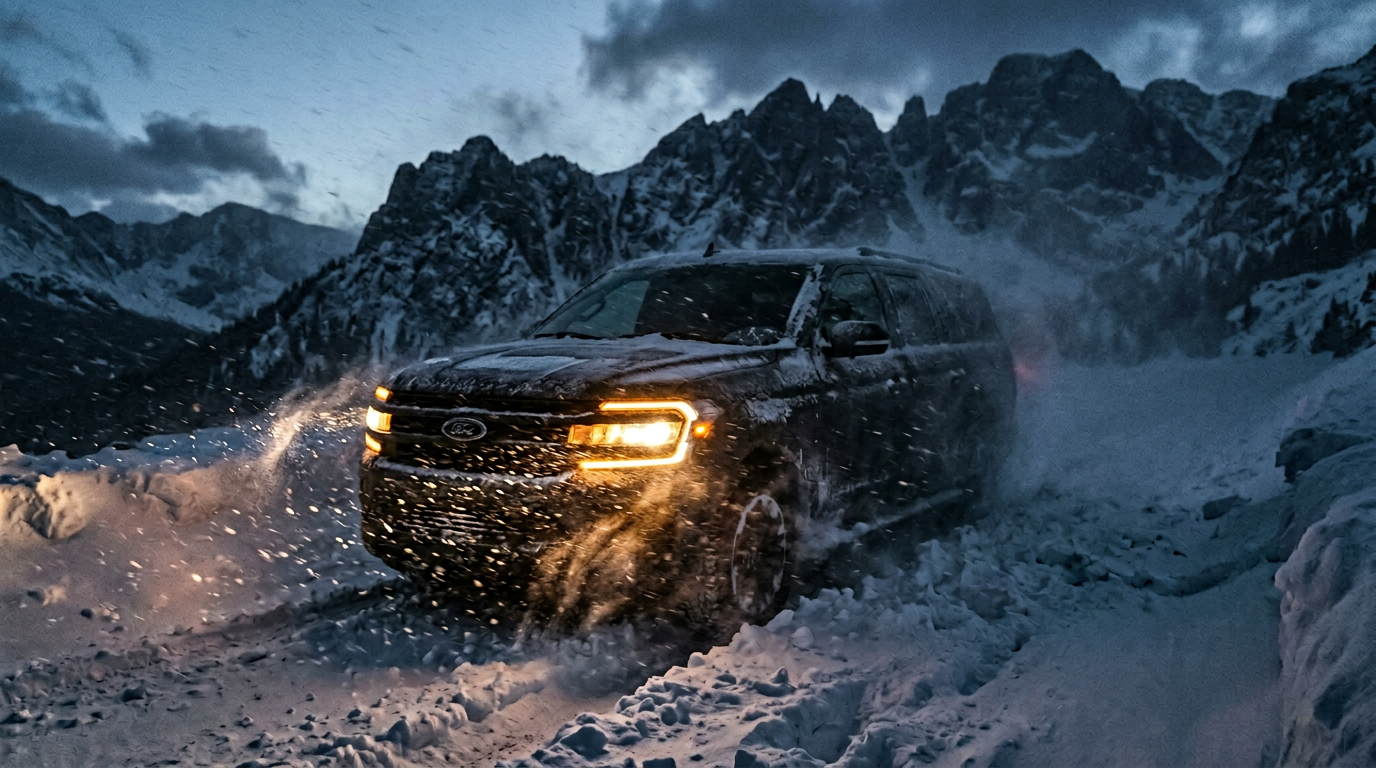
Better than any Expedition before it. The Tremor’s modified higher-ride suspension, P275/70R18 all-terrain tires, 3.73 Electronic Locking Rear Differential, and seven drive modes (Normal, Sport, Tow/Haul, Eco, Slippery, Off-Road, and Rock Crawl) are all aimed at the same use case: rural, unpaved, variable-grip driving. Independent reviews of the current-generation Tremor from outlets like Gear Patrol and JD Power cite approximately 10.6 inches of ground clearance; the 2027 figure should be verified against final Ford documentation but the hardware is unchanged.
The practical difference on gravel is twofold. The suspension and tires together let the Tremor absorb washboard gravel at reasonable speed without the harshness of a Platinum on 22" low-profile tires — which matters if your weekly commute involves 10 or 15 miles of county gravel before you hit US-12 or US-83. And Trail Control — which includes Trail One Pedal Drive for steep grade management and Trail Turn Assist for tight-radius maneuvering — plus the off-road underbody shield and modified Raptor skid plates, let you drive into places a Platinum shouldn’t go. Pasture two-tracks after a wet week, unmaintained CRP access roads, Lake Oahe shoreline when the grade gets soft — that’s the terrain the Tremor was engineered for.
Standard on the Tremor: off-road auxiliary grille lights, amber Active front tow hooks, front and rear parking sensors, a 360-degree camera with off-road overlays and a Rock Crawl view, and the BLIS trailer coverage that extends blind-spot monitoring around whatever you’re pulling. None of it is optional. None of it is a bundled package. It’s baseline Tremor equipment.
Why is the Tremor 4×4 only and not offered in MAX?
Both answers come back to the same idea: Ford engineered the Tremor for a specific use case, and they didn’t water it down for configurations that compromise that use case. A 4×2 Tremor would be contradictory — the whole point of the trim is off-pavement capability, and you can’t get that without four-wheel drive. So there’s only one Tremor configuration: 4×4, with the two-speed transfer case, Torque on Demand, and the 3.73 Electronic Locking Rear Differential standard.
The no-MAX decision is more about geometry. The Expedition MAX adds roughly a foot of wheelbase and overall length. That length, in an off-road context, hurts the rear departure angle, increases the risk of high-centering over ruts and crests, and makes tight-radius off-road maneuvering (which Trail Turn Assist is designed to help with) meaningfully harder. Ford chose not to offer a compromised off-road Expedition — if you want MAX length, the Expedition MAX is available in XL, Active, Platinum, and King Ranch for 2027.
That does create a buyer decision: if your use case is hauling three kids, dog crates, and a week of gear between Bowdle and Fargo, the Tremor’s standard length may feel short behind the third row. In that case the 2027 Expedition MAX Platinum (now offered in 4×2 as well as 4×4) is probably the better fit. The Expedition vs. Expedition MAX comparison walks through that decision in detail.
Thinking about reserving a Tremor?
Lock in your configuration, or ask us about ordering specifics before you commit.
Is the Tremor worth it over a Platinum for rural South Dakota?
For a lot of buyers in our service area — Bowdle, Selby, Ipswich, Eureka, and out across north-central South Dakota to the Missouri River — yes, but only if your actual weekly driving includes unpaved terrain. If your driving is 90% paved highway, a Platinum does the exact same job with a more refined ride on the 22" wheels and a plusher interior. If your driving is 60% paved and 40% county gravel, pasture, or shoreline access, the Tremor earns its spot.
Pick the Tremor if: you run gravel daily and want a suspension and tire setup built for it; you want a locking rear differential for mud, snow, or steep approach angles; you want Rock Crawl mode for lake access or trailer launches on unimproved ramps; you want Amber Active tow hooks rated for recovery, not decoration; or you want the standard 22-speaker B&O Play Unleashed audio and the Power Panoramic Vista Roof without stepping up to a Platinum Ultimate.
Pick a Platinum instead if: you live on pavement, you prefer the 22" Ebony Bright Machined wheel look over the 18" Dark Carbonized Gray Tremor wheel, you want the 30th Anniversary Appearance Package (which is Platinum-only and not compatible with the Tremor), or you’re leaning toward the Platinum Ultimate’s combination of High Output engine, Driver’s Package, and standard BlueCruise 1-Year + 90-Day plan.
For a broader framing of the whole lineup — Active, Tremor, Platinum with its four packages, and King Ranch — the 2027 Ford Expedition trim levels guide walks through who each trim is really built for.
What do you give up by choosing the Tremor?
Three real trade-offs. The first is fuel economy. EPA ratings for the 2027 Expedition will be confirmed closer to launch, but the current-generation Tremor — with all-terrain tires, the modified suspension, and the High Output V6 — uses more fuel than a standard Expedition with the base 3.5L EcoBoost V6 and highway-biased tires. If most of your miles are interstate commuting, the Tremor will cost you at the pump versus an Active Touring or a Platinum 4×2.
The second is the no-MAX constraint covered above. The Tremor’s third-row and cargo-behind-third-row space is the standard-length Expedition’s space. If you’re hauling big family gear regularly, that may not be enough.
The third is price. Official 2027 pricing will be confirmed by Ford closer to launch; public reporting cites a Tremor MSRP in the mid-$80,000s, which places it above a standard Expedition Platinum and roughly in range with a Platinum Stealth Performance. What you’re paying for is the Tremor-unique mechanical content, not cosmetic upgrades. That’s a different value proposition than most trim walks.
Parking and daily usability are not really trade-offs. The Tremor is the same overall length as a standard Expedition — you’re not navigating a longer truck. The 18" wheels with taller all-terrain sidewalls actually handle curbs and potholes more forgivingly than 22" low-profile wheels do. If daily-driver livability is a concern, the Tremor is not the trim that compromises it — MAX is.
Key Takeaways
- The Tremor is a standalone factory off-road trim — not a Platinum package. It carries over from its 2025 launch.
- 3.5L EcoBoost V6 High Output at 440 hp / 510 lb-ft, 10-speed automatic, 3.73 Electronic Locking Rear Differential standard.
- Seven drive modes including Rock Crawl, Trail Control with One Pedal Drive and Trail Turn Assist, P275/70R18 all-terrain tires.
- 4×4 only. No 4×2. No Expedition Tremor MAX — Ford didn’t compromise off-road geometry for extended length.
- Worth it over a Platinum if unpaved terrain is part of your weekly driving; Platinum is the better pick if you’re primarily on pavement.
Frequently Asked Questions
My Take on the 2027 Ford Expedition Tremor
I talk to a lot of Expedition buyers in north-central South Dakota, and the Tremor is the trim I’m happiest to explain honestly. For the ranch-and-hunt buyers who actually use the capability — gravel-road commutes, stock-trailer towing, pasture access, boat launches that go below the waterline at Lake Oahe — the Tremor earns every dollar. For the buyer who wants it because it looks rugged but drives exclusively on US-12 and US-83, a Platinum is honestly the better truck, and the Platinum Ultimate gets you the same engine and BlueCruise at a different emphasis.
If you’re trying to decide, let’s talk through your actual week — where you drive, what you tow, and what you need from the third row. I’ll point you at the right trim for you, even if it isn’t the one you walked in thinking about.
About the Author
Lexy Tabbert — Beadle Ford, Bowdle, SD
Lexy Tabbert is the Director of Sales and Marketing at Beadle Ford in Bowdle, South Dakota. She covers Ford vehicles, trim comparisons, and buyer guidance — helping families, ranchers, and ag operators across the region find the right truck and configuration for their needs. Learn more about Lexy.
If you drive an Expedition today, or you’re thinking about your first one, 2027 is the biggest model-year refresh since the sixth-generation Expedition arrived in 2025. Ford has published the 2027 Order Guide, reservations are open at Beadle Ford, and there are six real changes worth knowing about before you decide whether to wait for a 2027 or pick up a current 2026 Expedition.
This guide walks through every change that matters for retail buyers — the 30th Anniversary Appearance Package that debuts on Platinum, three new paint colors, the Ford Security Package that’s newly optional across every trim, a laminated windshield that’s now standard, the new Family Travel Package on Active Touring, and the expanded 4×2 availability for MAX Platinum. It also tackles the question most current Expedition owners are asking me: is the 2027 worth waiting for, or is the right 2026 the smarter move?
What’s actually new on the 2027 Expedition vs. the 2026?
Six meaningful changes. The 30th Anniversary Appearance Package debuts on Platinum, three new paints join the catalog, the Ford Security Package is newly optional across every trim, a laminated windshield is standard across the lineup, Active Touring adds a new Family Travel Package, and MAX-length Platinum is newly available in 4×2 configuration for the first time.
The sixth-generation platform, the Ford Digital Experience with the 24" panoramic display, Ford Co-Pilot360 Assist 2.0, and the Tremor trim all carry over from 2025–2026. So do the engine choices — the 3.5L EcoBoost V6 and the 3.5L EcoBoost V6 High Output. Official 2027 horsepower and torque figures for the standard engine will be confirmed by Ford at launch; the High Output engine remains at 440 hp and 510 lb-ft per the 2027 Order Guide.
What that means practically: this is a refresh year, not a redesign year. If you drive 15,000 miles a year on US-12 and US-83, none of the 2027 changes fundamentally alter the truck — but the 30th Anniversary Package gives Expedition buyers something visually distinct, the Ford Security Package addresses a real owner concern, and the 4×2 MAX Platinum availability opens a configuration that wasn’t possible in 2026.
The full change list — including trim-by-trim equipment shifts, package availability changes, and every bullet point from the Order Guide — lives in the complete 2027 Ford Expedition overview. This guide focuses on the changes most buyers ask about.
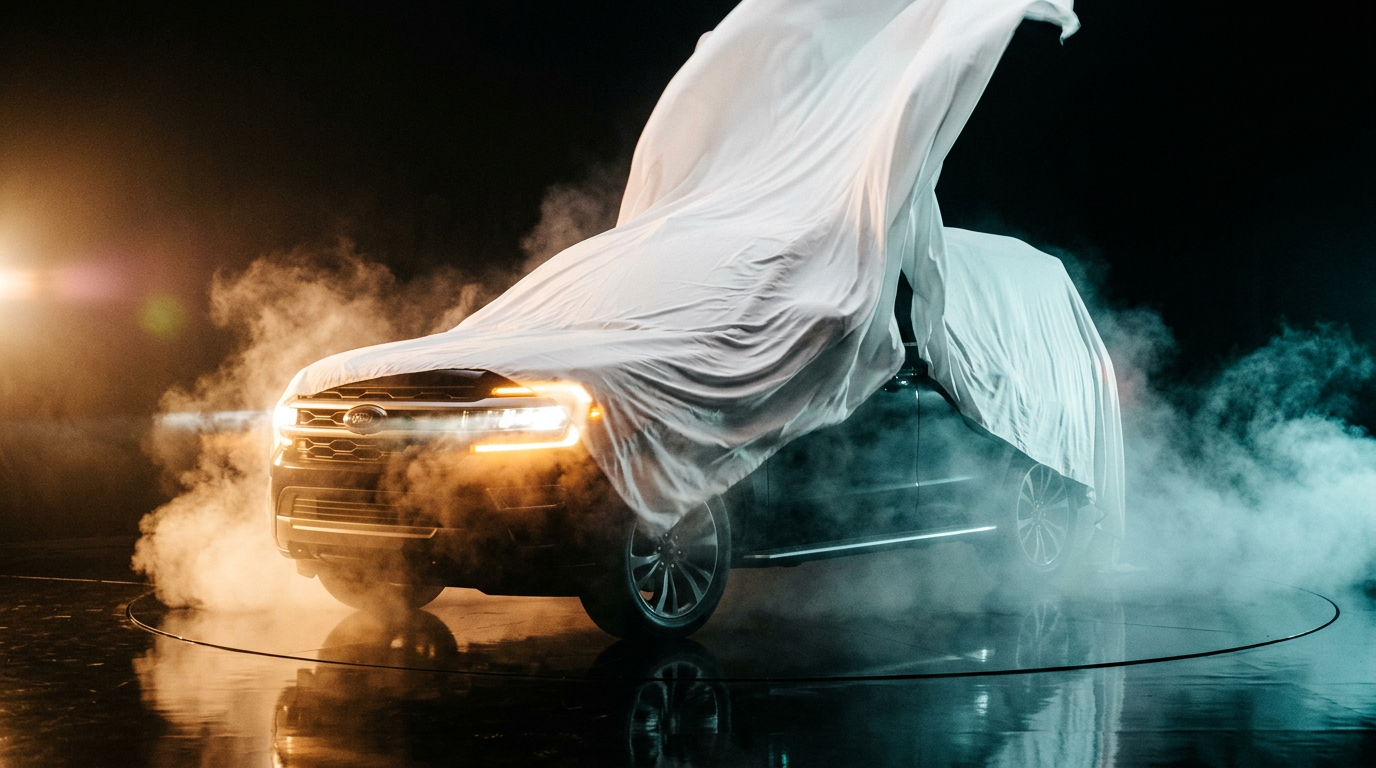
Is the Expedition Tremor new for 2027?
No. The Expedition Tremor launched with the sixth-generation platform for the 2025 model year, and it continues in the 2027 lineup essentially unchanged. It’s one of the most talked-about Expedition trims, which is probably why people assume it’s new — but the 2027 Order Guide does not mark the Tremor trim as new for this model year.
What the Tremor is, for anyone who hasn’t looked yet: the first factory off-road Expedition. It’s 4×4 only, it’s not offered in MAX, and it runs the 3.5L EcoBoost V6 High Output at 440 hp and 510 lb-ft of torque. A 3.73 Electronic Locking Rear Differential is standard, Trail Control with Trail One Pedal Drive handles steep descents, and the drive-mode system adds a Rock Crawl mode on top of the standard Normal, Sport, Tow/Haul, Eco, Slippery, and Off-Road modes. Modified Raptor-style front and transmission skid plates plus an underbody fuel tank shield protect the important hardware, and it rides on P275/70R18 all-terrain tires on 18" Dark Carbonized Gray wheels.
For buyers whose driving includes gravel roads, pasture two-tracks, or Lake Oahe shoreline terrain, the Tremor is the Expedition trim that handles it without compromise — and you don’t give up three-row family usability to get there.
If the Tremor is on your list, the full buyer’s guide is here: 2027 Ford Expedition Tremor: Everything You Need to Know.
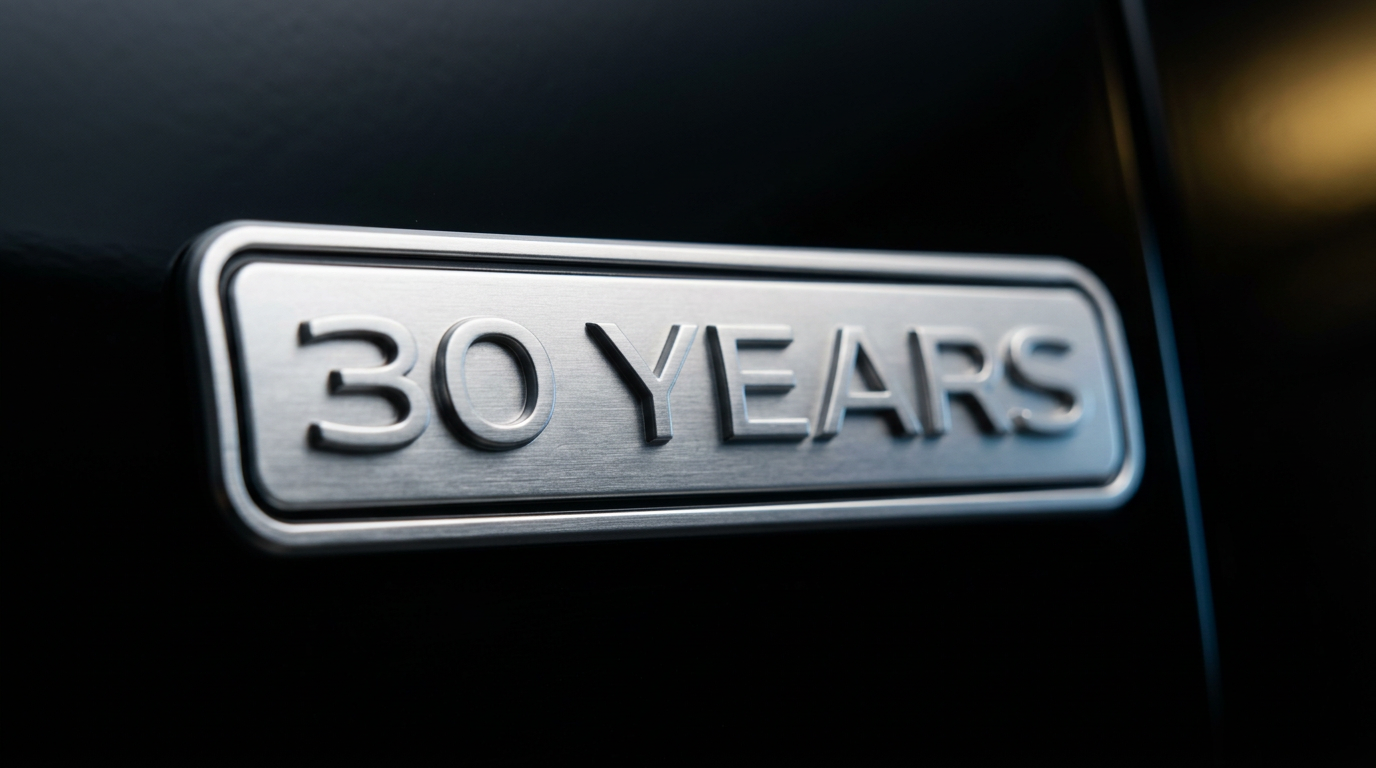
What is the 30th Anniversary Appearance Package?
The 30th Anniversary Appearance Package is a new-for-2027, Platinum-only option that commemorates three decades of the Ford Expedition nameplate. It layers a cohesive set of visual upgrades over the Platinum trim and introduces a paint color you can’t get anywhere else in the Expedition lineup.
On the outside, the package adds 22" × 9" Ebony Bright Machined aluminum wheels, a Carbon Black front bumper and fascia, an Ebony painted grille, Black Bezel headlamps with an Ebony trim applique, black beltline moldings, and liftgate badging that reads “30th ANNIVERSARY” in black. Inside, Salt Crystal Gray leather is required, and the package includes a Cargo Organizer, front and second-row tray-style floor liners, and scuff plates with satin-aluminum “30th” lettering in a racetrack motif.
The paint palette is where the package gets unique. It’s offered in Agate Black Metallic, Star White Metallic Tri-coat, or Blue Ember Metallic — and Blue Ember is only available on the 30th Anniversary Package. If that finish sounds familiar, it previously lived exclusively on the Mustang Dark Horse. This is its first appearance on an Expedition. The Anniversary Package can be ordered on either standard-length Platinum or Expedition MAX Platinum, but it is not compatible with the Platinum Ultimate, Stealth Appearance, or Stealth Performance packages.
The full walkthrough — every inclusion, every paint and interior combination, and whether to pick it over a standard Platinum — is here: 2027 Ford Expedition 30th Anniversary Appearance Package Explained.
Ready to lock in your 2027 Expedition configuration?
Reservations are open. Submit your build and we’ll confirm timing, pricing, and availability.
Reserve Your 2027 Ford ExpeditionWhat paints are new, deleted, or fleet-only for 2027?
Three new paints join the 2027 Expedition catalog, two are discontinued, and one is now restricted to fleet orders. The net effect is a slightly smaller retail palette, but with three genuinely distinctive additions.
New for 2027:
- Bronze Fire Metallic Tri-coat — an extra-cost tri-coat finish available on most retail trims
- Nocturnal Blue Metallic — an extra-cost finish available on most retail trims
- Blue Ember Metallic — only available on Platinum with the 30th Anniversary Appearance Package
Discontinued:
- Space Silver Metallic
- Stone Blue Metallic
Now fleet-only:
- Oxford White — retail buyers can no longer order the base white on a 2027 Expedition
Agate Black Metallic, Dark Matter Gray Metallic, Glacier Gray Metallic Tri-Coat, Marsh Gray (Tremor-focused availability), and Star White Metallic Tri-Coat continue from 2026. If a specific color is driving your decision, order guidance and availability per trim is worth confirming before reservation — contact Beadle Ford and we’ll pull the specifics against your trim choice.
Should you wait for the 2027 or buy a 2026 today?
It depends on which 2027 changes matter to you. The core platform, engines, technology, and safety suite are the same on both model years — so a 2026 Expedition isn’t a lesser truck, it’s last year’s version of this generation.
Wait for the 2027 if: you want the 30th Anniversary Appearance Package, you specifically want Blue Ember Metallic, Bronze Fire Metallic Tri-coat, or Nocturnal Blue Metallic paint, the new Family Travel Package on Active Touring is non-negotiable, you want the Ford Security Package included from day one, or you’re set on a 4×2 MAX Platinum (which wasn’t offered in 2026).
Consider a 2026 instead if: you’d rather have the truck sooner than wait out a reservation, you’re cross-shopping another brand and timing matters, the 2027 color additions aren’t deal-makers for you, or you find a 2026 configuration in our current inventory that matches what you’d order anyway. A 2026 Expedition is the same generation with the same Ford Digital Experience, same Co-Pilot360 Assist 2.0, and same core powertrain — it just doesn’t have the 2027 cosmetic and packaging updates.
If you’re trading an older Expedition: the 6th-gen platform itself is the bigger jump from a 2021–2024 Expedition than any year-to-year change within the 6th gen. If your current Expedition is a 2021, 2022, 2023, or 2024, the decision between a 2026 and a 2027 matters less than the decision to move into the new generation at all. That trade-in math, and how we time the deal around your reservation, is walked through here: Should You Trade Your Current Ford Expedition for a 2027?.
Whichever way you lean, the decision gets easier when you can see a current Expedition in person. Browse our current Ford Expedition inventory and compare against the full 2027 Ford Expedition overview.
Key Takeaways
- The 2027 Expedition is a refresh, not a redesign — same sixth-generation platform as 2025 and 2026.
- Six real changes for 2027: 30th Anniversary Package, three new paints, Ford Security Package, standard laminated windshield, Family Travel Package (Active Touring), and 4×2 MAX Platinum.
- The Expedition Tremor is NOT new for 2027 — it launched with the 2025 MY and carries over.
- Blue Ember Metallic paint is exclusive to the 30th Anniversary Appearance Package, which is Platinum-only.
- If you’re driving a 2021–2024 Expedition, moving into the 6th-gen platform is a bigger jump than choosing 2027 over 2026.
Frequently Asked Questions
My Take on the 2027 Ford Expedition
Most of the Expedition drivers I talk to in Bowdle and the surrounding ranch and farm country have had their current Expedition for five years or more. For that group, the 2026 vs. 2027 decision is smaller than people think — either truck is a generational step up from what’s in the driveway today. The 30th Anniversary Package is genuinely distinctive, and if Blue Ember Metallic is on your wish list you should reserve. But if you’re just looking for the 6th-gen Expedition, a current 2026 — inventory permitting — will do exactly that.
If you’d like to talk through which way makes sense for your situation — trade-in timing, configuration, and whether the 2027 changes are worth the wait — stop in, call us, or submit a reservation to hold your spot. I’m happy to walk through it.
About the Author
Lexy Tabbert — Beadle Ford, Bowdle, SD
Lexy Tabbert is the Director of Sales and Marketing at Beadle Ford in Bowdle, South Dakota. She covers Ford vehicles, trim comparisons, and buyer guidance — helping families, ranchers, and ag operators across the region find the right truck and configuration for their needs. Learn more about Lexy.
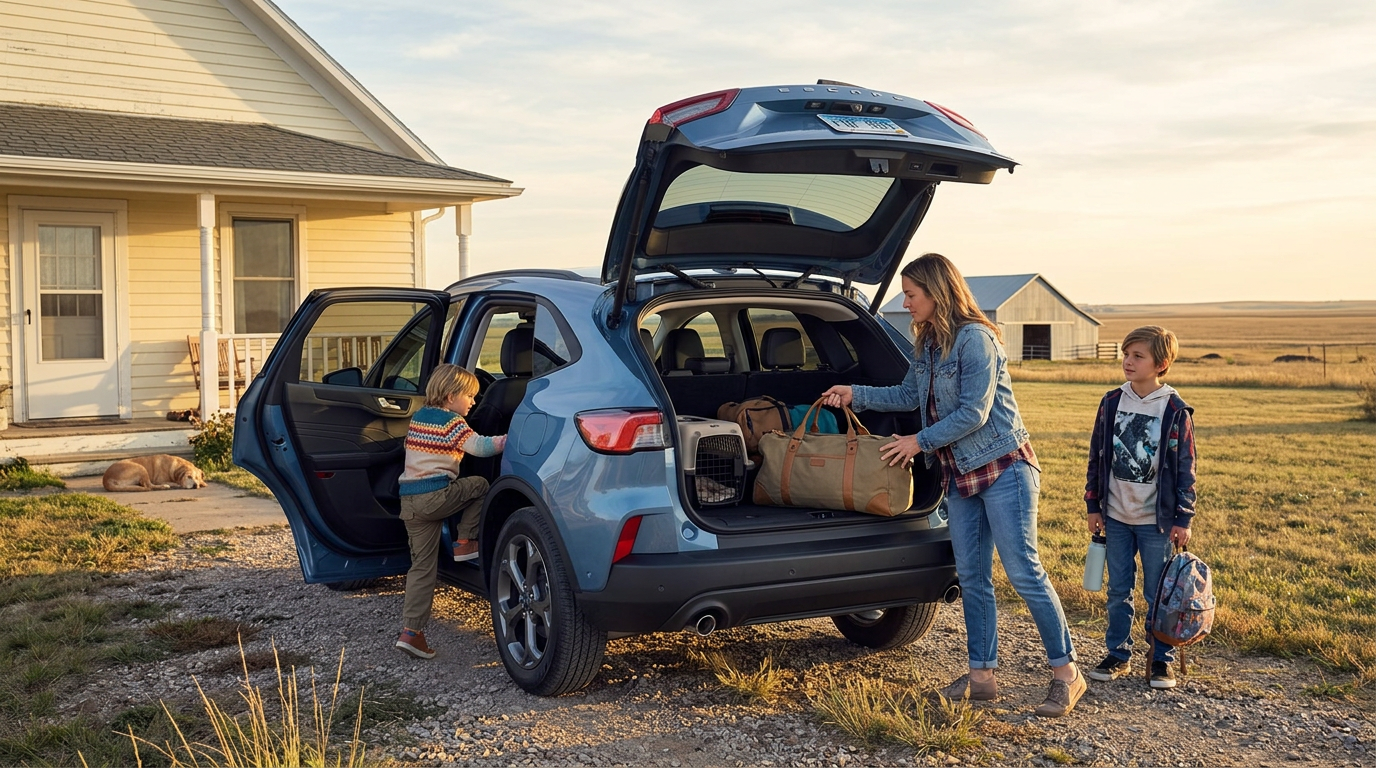
The 2026 Ford Escape seats five, offers available AWD, delivers among the better fuel economy in its class through the hybrid powertrain, and includes Ford’s full Co-Pilot360 safety suite as standard equipment across every trim. For South Dakota families — school runs in Bowdle, sports travel to Huron or Mitchell, longer highway trips to Aberdeen or Sioux Falls — it covers most of what a family vehicle needs to do without moving up to a larger SUV.
This guide breaks down the Escape’s family-specific specs and features honestly: interior room, safety systems, AWD availability for winter driving, and fuel economy for a family that logs real miles across central South Dakota. It also covers when the Escape genuinely isn’t enough and the Explorer makes more sense.
On This Page
- What Is the 2026 Ford Escape Like Inside for a Family of Five?
- What Kid-Friendly Features Does the 2026 Ford Escape Have?
- What Safety Features Come Standard on the 2026 Ford Escape?
- Does the 2026 Ford Escape Have AWD for Year-Round Family Driving in South Dakota?
- How Does the Escape’s Fuel Economy Affect a Family’s Monthly Driving Budget?
- When Should a South Dakota Family Consider the Explorer Instead of the Escape?
What Is the 2026 Ford Escape Like Inside for a Family of Five?
The Escape fits five passengers across two rows. It is a compact crossover, so the rear seat is sized for kids and average-build adults comfortably, but it is not a large SUV — tall adults sitting behind tall adults will feel the compact footprint on long trips.
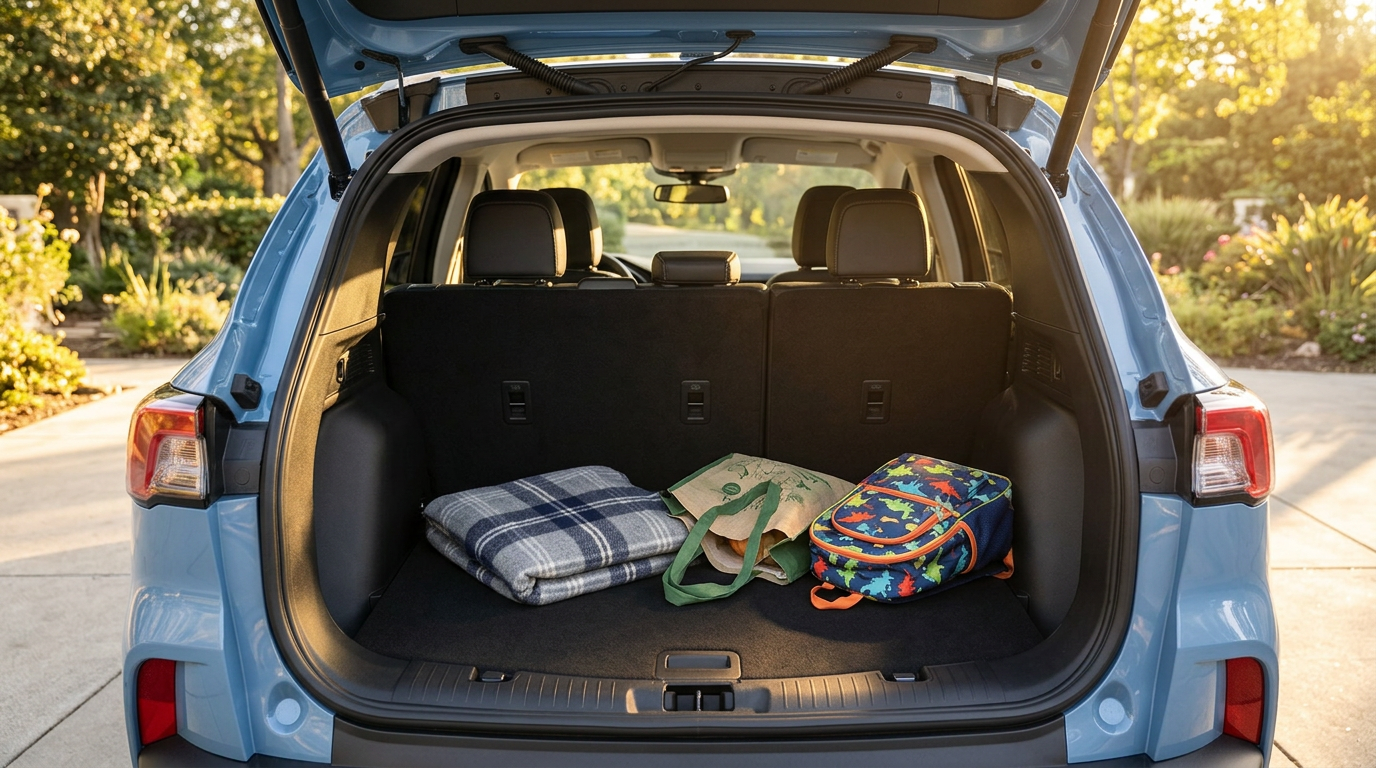
Cargo is the practical question for families. Behind the rear seats, the Escape offers approximately 37.5 cubic feet of cargo space — enough for a week of grocery runs or a weekend’s worth of luggage for four. With the rear seats folded flat (60/40 split configuration), cargo capacity expands to approximately 60.8 cubic feet. Verify current figures at Ford.com, as cargo numbers are not listed in the order guide. The 60/40 split-fold rear seats are sliding as well as folding — the sliding feature lets you push the rear seats back for more legroom when cargo isn’t the priority, or forward when you need the extra cargo depth.
Where the Escape works well for SD families: daily driving, school pickup, commutes, and trips where you’re packing light. Where it starts to feel tight: sports weekends with equipment, camping trips with gear, or anything that would fill a typical pickup bed. For most Bowdle-area families using the Escape as a daily driver and second vehicle, the cargo room is adequate. For families who routinely haul gear for multiple kids plus parents, the complete 2026 Ford Escape overview covers all configurations, and the Explorer section below covers when stepping up makes sense.
What Kid-Friendly Features Does the 2026 Ford Escape Have?
LATCH anchors are standard on the rear outboard seating positions across all 2026 Escape trims. For families with car seats, the sliding rear bench is genuinely useful — you can slide the second row forward to give the front passenger more room, or push it back to make car seat installation and kid loading easier. That flexibility is a practical difference from fixed-rear-seat competitors in this class.
Features that matter for SD family winters — and when they become standard: heated front seats, a heated steering wheel, and remote start are all standard on ST-Line Select and up. On Active and ST-Line, they are not standard — they require either an option package or moving to a higher trim. If you’re pre-warming a vehicle for school pickup in January at -10°F in Bowdle, that feature set matters, and the ST-Line Select is where it becomes baked in. A power liftgate (genuinely useful with your hands full of groceries or a kid) is also standard on ST-Line Select and up.
Dual-zone electronic automatic climate control is standard across all trims — both front and rear passengers can reach their preferred temperature. The 13.2″ SYNC 4 screen is standard on ST-Line Elite, PHEV, and Platinum; it’s optional via tech packages on Select and lower trims. Wireless Apple CarPlay and Android Auto are included on all trims with the 8″ standard screen and up. There is no factory-installed rear seat entertainment system on the 2026 Escape — families who want screen time for rear passengers will need a tablet or aftermarket solution. One honest note: the Escape trim levels guide covers which trims include the winter-ready feature set and which require option packages.
What Safety Features Come Standard on the 2026 Ford Escape?
Ford Co-Pilot360 is standard on every 2026 Ford Escape trim — from the entry-level Active through Platinum. This means automatic emergency braking (AEB) with pedestrian detection, forward collision warning, BLIS blind spot monitoring with rear cross-traffic braking, lane-keeping assist with driver alert, road departure warning, rear view camera, auto high-beam headlamps, and post-collision braking are included regardless of which configuration you purchase.
Also standard on all trims: AdvanceTrac with Roll Stability Control (RSC), Electronic Traction Control, SOS Post-Crash Alert System, SecuriLock passive anti-theft, and a full airbag system including a Safety Canopy with rollover sensor. For highway driving on SD’s open interstates where deer crossings and sudden weather changes are real risks, having AEB with pedestrian detection and road departure warning on every single trim matters.
For families who want the next level of driver assistance — adaptive cruise control with stop-and-go, lane centering assist, rear parking sensors, and intersection assist — that’s Co-Pilot360 Assist+. It comes standard on ST-Line Elite, PHEV, and Platinum. On Active, ST-Line, and ST-Line Select, Co-Pilot360 Assist+ requires a tech package upgrade. If highway-capable adaptive cruise is important for your family’s longer South Dakota drives, the ST-Line Elite is where it becomes standard without package math.
Other Ford Models to Consider
Need more room? These models are also available at Beadle Ford.
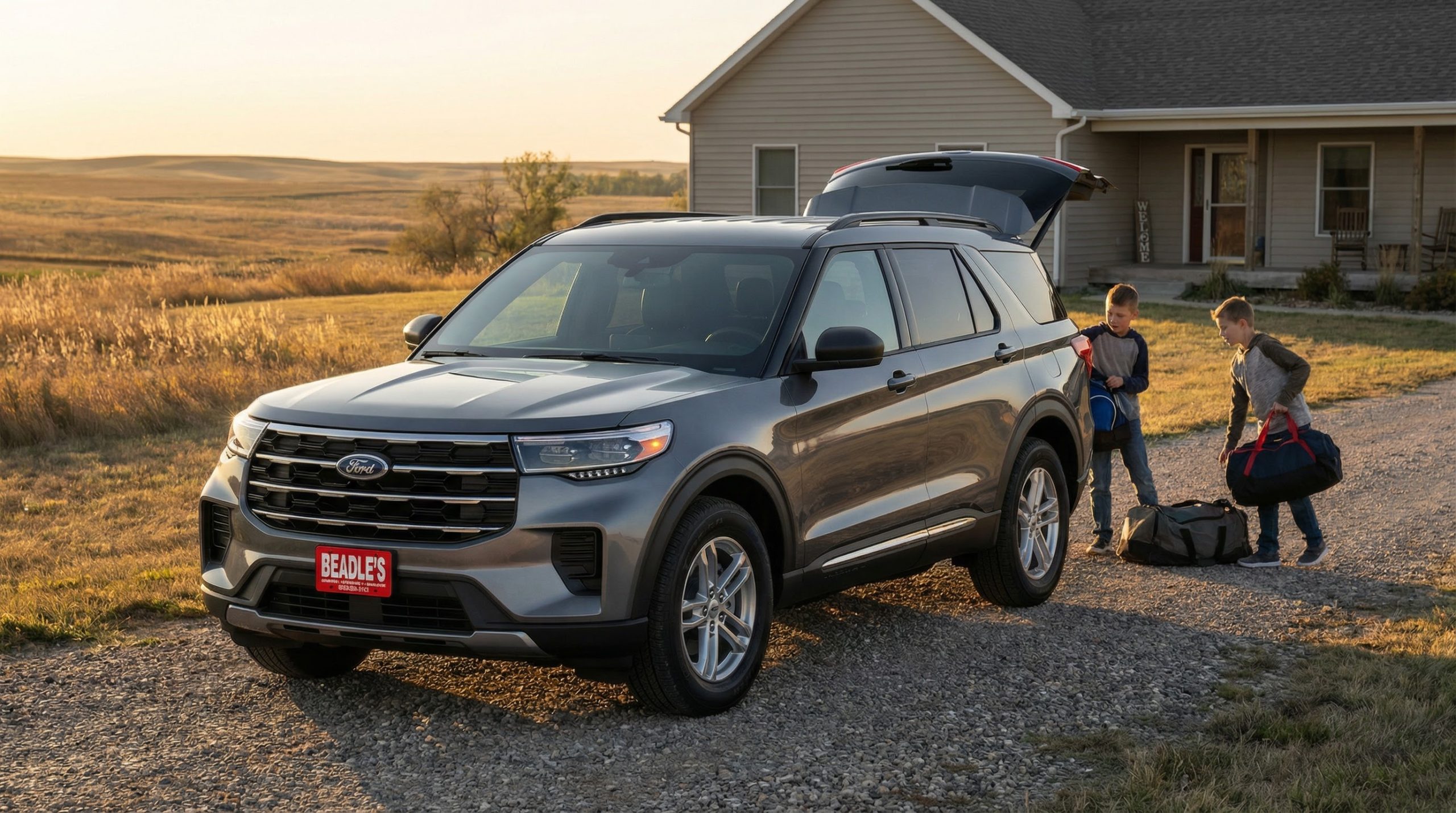
Ford Explorer
More cargo room, available 3-row seating, more towing capacity.
View Explorer Inventory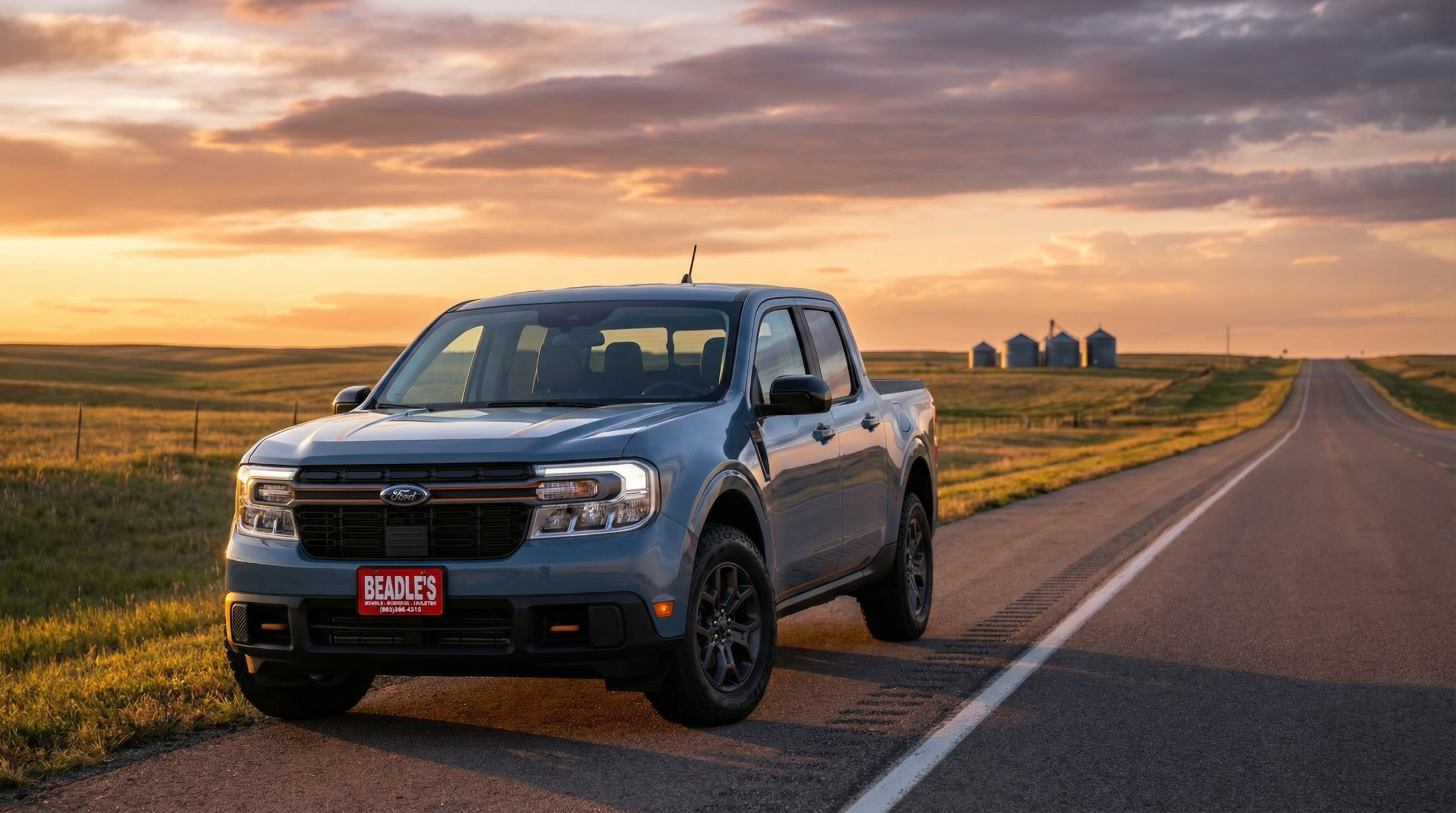
Ford Maverick
Compact truck with hybrid option, bed utility, and family-friendly price.
View Maverick InventoryDoes the 2026 Ford Escape Have AWD for Year-Round Family Driving in South Dakota?
Yes — and the answer matters more depending on which trim you order. AWD is standard and the only drivetrain option on ST-Line Select, ST-Line Elite, and Platinum. On Active and ST-Line, FWD comes standard and AWD must be added at order — it does not come on the vehicle automatically. The PHEV trim is front-wheel drive only with no AWD option.
For a family in Bowdle that’s doing school pickup on packed gravel in November and running kids to Saturday morning sports in Huron in February, the AWD configuration is the practical choice. The Escape’s AWD system distributes torque to the rear axle when slip is detected — it handles packed snow and gravel county roads competently. What it doesn’t have is a dedicated Snow/Slippery driving mode — it’s a reactive AWD system rather than a mode-switching one.
The ST-Line Select is the natural starting point for South Dakota family buyers: AWD becomes non-negotiable here (you can’t order FWD even if you wanted to), and it adds the full winter-ready package — heated front seats, heated steering wheel, and remote start — as standard equipment. That combination in a single trim is a clean deal for a central SD family vehicle. For more detail on how AWD availability lines up across all trims, the complete 2026 Ford Escape lineup overview covers all six configurations.
How Does the Escape’s Fuel Economy Affect a Family’s Monthly Driving Budget?
The 2026 Ford Escape’s fuel economy advantage is most meaningful in the Hybrid AWD configuration. The 2.5L Hybrid AWD (available on ST-Line Select, Elite, and Platinum) delivers approximately 39 mpg combined — verify current EPA figures at fueleconomy.gov. For a family logging 15,000 miles per year, that’s roughly 385 gallons of fuel annually. On the 1.5L EcoBoost FWD at approximately 30 mpg combined, the same 15,000 miles requires closer to 500 gallons. That difference — roughly 115 gallons per year — is real money on a farm family’s budget where every dollar matters.
The SD-specific efficiency argument is the highway leg. South Dakota families don’t just drive city blocks — they’re driving 30-mile county road hauls to get to a highway, then 60 to 80 miles into a larger city for errands or appointments. The Escape Hybrid’s EPA highway figure (approximately 36 mpg — verify at fueleconomy.gov) holds up well on those stretches. For a Bowdle family making regular trips to Aberdeen or Huron, the Hybrid AWD pays back in fuel savings in a way that suburban buyers who drive shorter loops don’t experience as directly.
The PHEV is worth mentioning for context: it delivers higher MPGe when running on electricity (~101 MPGe, verify at fueleconomy.gov) and good hybrid-mode efficiency once the battery depletes (~40 mpg, verify). The practical challenge for central SD families is that reliable Level 2 charging infrastructure near Bowdle is limited — the PHEV’s efficiency advantage is smaller if you’re charging on a standard Level 1 outlet or not charging consistently. And the PHEV is FWD-only, which is a significant trade-off for SD winter driving. For most SD families, the non-plug-in Hybrid AWD on ST-Line Select is the stronger combination of efficiency, AWD, and real-world practicality.
When Should a South Dakota Family Consider the Ford Explorer Instead of the Escape?
The Explorer is the right call when the Escape’s two-row, five-passenger limit is genuinely a constraint for your family’s actual use. The Explorer offers available three-row seating — a real third row for a family of six or seven, not a jump seat. It also offers more cargo volume behind the second row than the Escape, more towing capacity depending on configuration, and a longer wheelbase that translates to more rear-passenger legroom on multi-hour drives.
The trade-offs are straightforward: the Explorer is larger, costs more, and burns more fuel. For a family that genuinely needs three rows a few times a year (church trips, extended family hauling, carpool groups), paying the Explorer premium makes sense. For a family that’s primarily two parents and two kids — the Escape’s five-passenger cabin covers everyone, the cargo room handles the gear, and you’re spending and fueling less for the same trip.
One practical note on timing: the 2026 Escape is the final model year — Ford is not producing an Escape beyond 2026. The Explorer is continuing in Ford’s lineup. If long-term model continuity and parts availability over a 10+ year ownership horizon matters to your family’s decision, the Explorer’s ongoing production is a real difference. For a 5–7 year ownership window, that consideration is lower — the Escape carries full Ford warranty coverage and parts support for any recently discontinued model is strong for many years post-production. Both the Escape and Explorer are available at Beadle Ford in Bowdle.
Key Takeaways for South Dakota Families
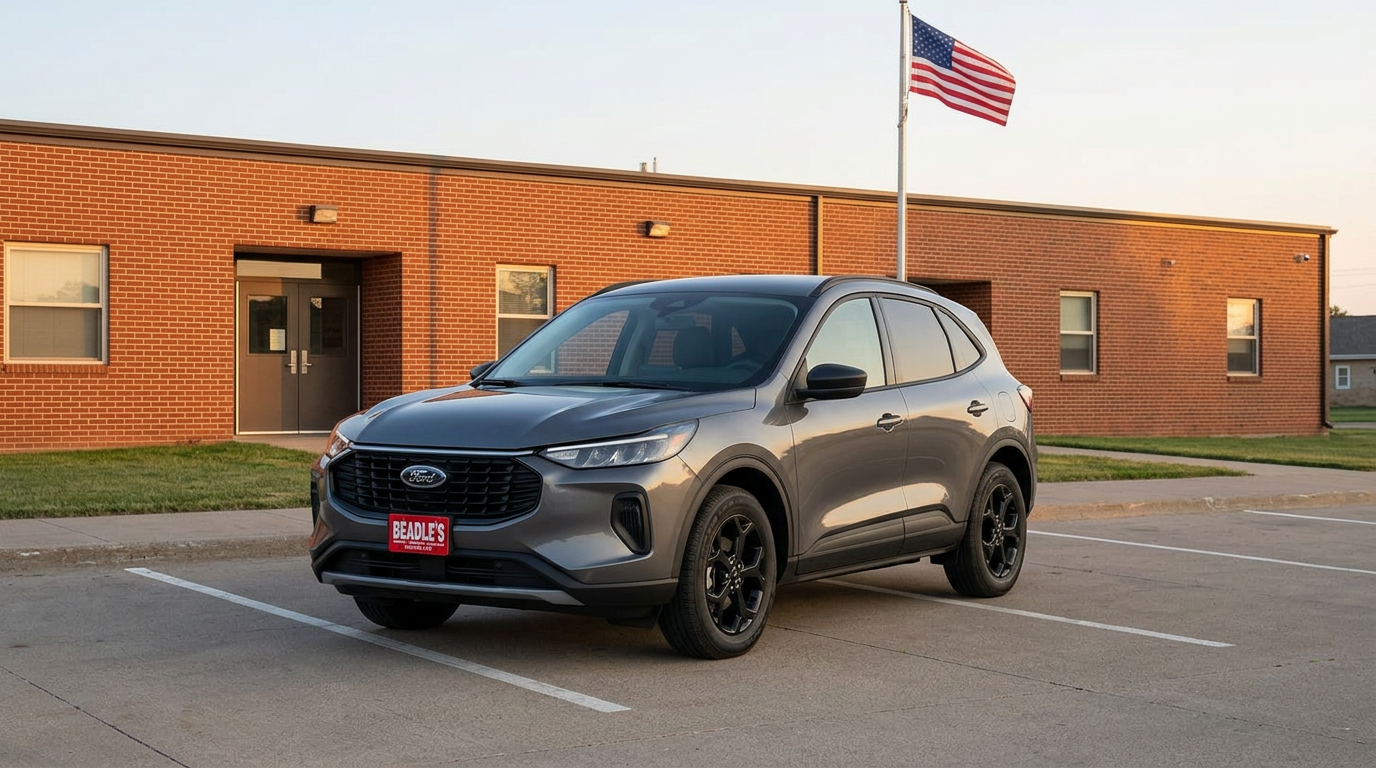
- The Escape seats five with a sliding, 60/40 split-fold rear seat; cargo room is approximately 37.5 cu ft behind the rear seats (verify at Ford.com). It is not a three-row SUV.
- Ford Co-Pilot360 with AEB, pedestrian detection, BLIS, lane-keeping, and road departure warning is standard on every trim — no trim is without it.
- LATCH anchors are standard on rear outboard positions; heated seats, heated steering wheel, remote start, and power liftgate become standard starting at ST-Line Select.
- For SD family winter driving, ST-Line Select is the practical starting point: AWD is standard (no FWD option), and the full cold-weather feature set is included.
- The 2.5L Hybrid AWD delivers approximately 39 mpg combined — roughly 115 gallons per year less than the 1.5L gas on 15,000 annual miles, a meaningful difference for a farm family’s budget.
- If your family regularly needs three rows or significantly more cargo capacity, step up to the Explorer — the Escape is a compact two-row vehicle and that limit is real on big gear days.
Frequently Asked Questions
My Take on the 2026 Ford Escape as a South Dakota Family Vehicle
The buyers I talk to who are considering the Escape for family use usually come in with one of two scenarios: they’re using it as a second vehicle on the farm — mom’s daily driver for town runs and kid hauling while the truck handles the heavier work — or they’re a smaller family that doesn’t need a full-size SUV and is trying to keep fuel costs reasonable on South Dakota highway miles. The Escape fits both of those use cases well. The ST-Line Select in Hybrid AWD hits a real sweet spot: AWD locked in, heated seats and remote start included, and approximately 39 mpg on the highway.
I do tell families honestly when the Escape is going to come up short. If you’ve got three kids who need their own row, or you’re the household that hauls ATV gear and sports equipment for multiple kids on the same trip — you’re going to load the Escape to its limit and probably wish you’d gone to the Explorer. The five-passenger, two-row limit is real. It’s not a knock on the vehicle; it’s just what it is. The Explorer is right down the lot.
If you want to walk through which trim makes the most sense for your family’s actual routine, stop by Beadle Ford in Bowdle. I’m happy to go through it with you.
About the Author
Lexy Tabbert — Beadle Ford, Bowdle, SD
Lexy Tabbert is the Director of Sales and Marketing at Beadle Ford in Bowdle, South Dakota. She covers Ford vehicles, trim comparisons, and buyer guidance — helping families, ranchers, and ag operators across the region find the right truck and configuration for their needs. Learn more about Lexy.
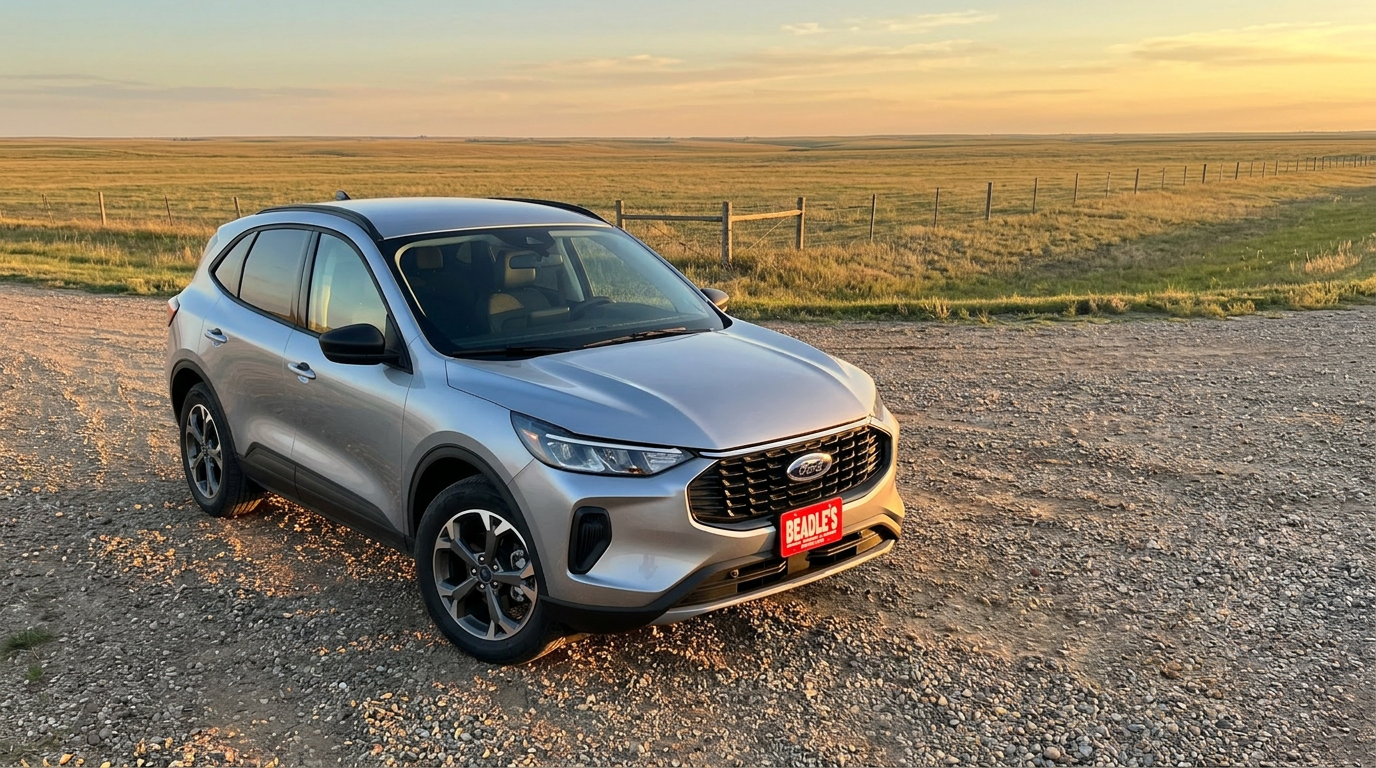
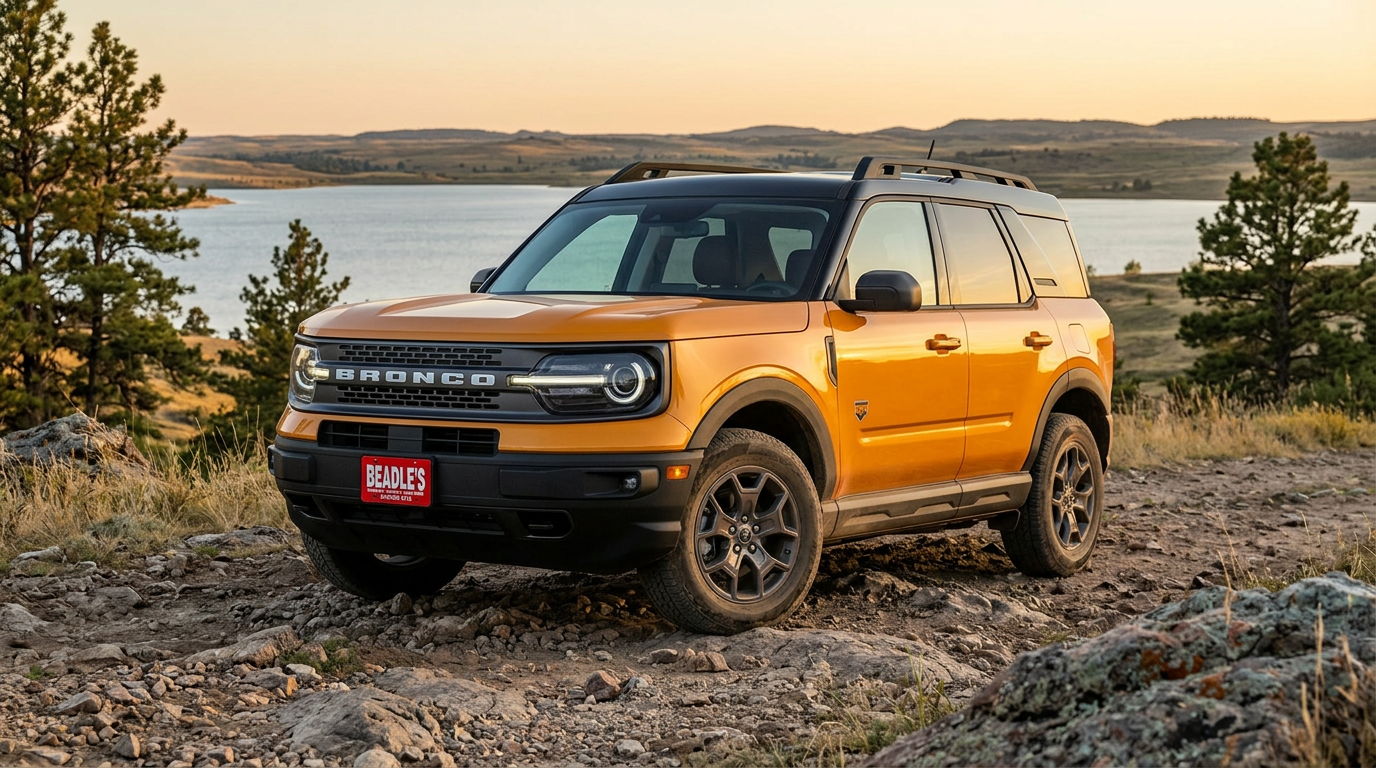
Two Ford crossovers, similar footprint, very different orientation. The 2026 Ford Escape is a highway-capable crossover with hybrid powertrain options and a refined ride — built for efficiency and daily comfort. The 2026 Ford Bronco Sport is built around standard AWD and GOAT modes (Goes Over Any Type of Terrain), with more ground clearance and trail-specific capability across its lineup. For South Dakota buyers, the comparison usually comes down to three things: fuel economy, AWD standard vs. optional, and what your roads actually look like.
This guide compares both vehicles directly across the factors that matter most for central South Dakota use: winter traction, daily practicality, long-distance efficiency, and real-world capability on gravel and county roads.
On This Page
- How Do the Escape and Bronco Sport Compare at a Glance?
- Which Has Better AWD and Winter Traction for South Dakota Roads?
- Is the Escape’s Hybrid Option Worth Choosing Over the Bronco Sport’s Gas Engine?
- How Do the Escape and Bronco Sport Compare for Day-to-Day South Dakota Use?
- Does It Matter That the 2026 Escape Is the Last Model Year?
- Which Vehicle Is the Right Choice for a South Dakota Buyer?
How Do the Escape and Bronco Sport Compare at a Glance?
Both are compact Ford crossovers, but they’re built for different use cases. The Escape prioritizes efficiency and road comfort; the Bronco Sport prioritizes go-anywhere capability and standard AWD across the lineup.
| Category | 2026 Ford Escape | 2026 Ford Bronco Sport |
|---|---|---|
| AWD | Optional (lower trims) / Standard (Select, Elite, Platinum) | Standard across lineup |
| Powertrains | Gas, Hybrid, PHEV | Gas only |
| Off-road modes | None | GOAT modes (5 modes) |
| Ground clearance | Lower (road-oriented profile) | Higher (trail-capable profile) |
| Fuel economy | Up to ~39 mpg (Hybrid AWD) | ~26–28 mpg combined (gas) (verify at fueleconomy.gov) |
| Lineup future | Discontinued after 2026 | Continuing in Ford lineup |
The Escape is the more highway-oriented, efficiency-focused option. The Bronco Sport is the more capable choice for buyers who want AWD guaranteed regardless of trim and some off-road margin for gravel roads and field access. Both are available now at Beadle Ford in Bowdle. The complete 2026 Ford Escape overview covers all six Escape trims and configurations in detail.
Which Has Better AWD and Winter Traction for South Dakota Roads?
The Bronco Sport has the structural advantage here: AWD is standard across the entire lineup, and the Bronco Sport is built around GOAT modes — including a dedicated Slippery mode for low-traction surfaces — across its configuration. You can’t accidentally take delivery of a Bronco Sport without AWD.
The Escape’s situation is more nuanced. On Active and ST-Line, AWD is optional — it has to be specified at the order stage or you’ll receive an FWD unit. On ST-Line Select, Elite, and Platinum, AWD is standard and mandatory. The 2026 Escape’s AWD system distributes torque to the rear axle when slip is detected, similar to how most modern crossover AWD systems work. What it doesn’t have is the GOAT mode framework — there’s no dedicated Slippery or Off-Road setting. For packed snow and gravel county roads, Escape AWD is competent. For soft shoulder work or field access, the Bronco Sport has more hardware working in its favor.
The Bronco Sport also carries more ground clearance than the Escape, which is relevant on unimproved rural approaches and during spring breakup when road surfaces are unpredictable. For winter highway and gravel driving — which is the majority of central South Dakota use — both vehicles handle it. The Bronco Sport has the edge if you routinely drive on marginal surfaces or need that off-road margin. The full Escape AWD winter guide covers how the Escape system performs in South Dakota conditions specifically.
Is the Escape’s Hybrid Option Worth Choosing Over the Bronco Sport’s Gas Engine?
For buyers who log significant highway miles between Bowdle and larger cities, the Escape’s 2.5L Hybrid AWD is a meaningful advantage. The Hybrid delivers approximately 39 mpg combined (verify at fueleconomy.gov), compared to approximately 26–28 mpg combined for the Bronco Sport’s gas engine depending on trim. Over 15,000 miles per year, that gap adds up in a tangible way at the pump.
The Bronco Sport doesn’t offer a hybrid option — it’s gas-only across the entire lineup in 2026. For buyers who want the Bronco Sport’s AWD standard and off-road capability but also want improved efficiency, there’s no hybrid path. The Escape offers that combination — 2.5L Hybrid AWD on Select, Elite, or Platinum gives you AWD standard, approximately 39 mpg combined, and the cold-weather feature set (heated seats, heated steering wheel, remote start) in one package.
The trade-off: the Escape’s eCVT transmission has a different feel from the Bronco Sport’s 8-speed automatic. Neither is objectively better — it’s a preference. The Bronco Sport’s powertrain is tuned for confident low-end torque delivery on challenging terrain. The Escape Hybrid’s eCVT is tuned for smooth, efficient highway operation. The right answer depends on which use case dominates your actual driving.
Other Ford Models to Consider
Not sure if Escape or Bronco Sport is right? These models are also available at Beadle Ford.
How Do the Escape and Bronco Sport Compare for Day-to-Day South Dakota Use?
For typical daily use — highway driving, trips to Pierre or Aberdeen, grocery runs, school pickups — the Escape is the smoother, quieter daily driver. Its lower hood line gives better forward sightlines on highways, and the refined suspension tuning makes long South Dakota interstate stretches more comfortable. On-road ride quality is noticeably better than the Bronco Sport’s more rugged setup.
The Bronco Sport’s more upright stance and rugged suspension tuning are an asset off pavement, but the stiffer ride is a real trade-off on long highway stretches. Cabin road noise is generally higher in the Bronco Sport compared to the Escape. The Bronco Sport’s taller body also catches more wind on open prairie highway driving, which can affect both feel and fuel consumption in windy SD conditions. Both offer comparable interior space and cargo room for most family use cases.
Technology features at comparable price points are similar — both offer SYNC 4, Co-Pilot360, and available heated seats at mid-trim levels. The Bronco Sport’s standard roof rails and available auxiliary switches cater to buyers who outfit their vehicle with outdoor gear. The Escape’s available 12.3″ SYNC 4 screen at Elite and Platinum trims and the B&O audio option offer a more premium interior experience at the top of its lineup. Interior cargo room is close enough between the two that neither vehicle will feel like a compromise for grocery runs, school pickups, or weekend trips — both are two-row crossovers with similar footprints and neither is cramped for daily South Dakota use.
Does It Matter That the 2026 Escape Is the Last Model Year?
It matters for some things and not others. The 2026 Ford Escape is the final model year — Ford is not producing an Escape in 2027 or beyond. The Bronco Sport is continuing in Ford’s lineup. If future parts availability or continued dealer familiarity with the model is important to your decision, that’s a legitimate reason to weight the Bronco Sport.
What doesn’t change: warranty coverage and service support. A new 2026 Escape purchased from Beadle Ford comes with Ford’s standard 3-year/36,000-mile bumper-to-bumper and 5-year/60,000-mile powertrain warranty exactly like any other new Ford vehicle. Parts supply for a recently discontinued model is typically strong for many years post-production — Ford produces large volumes of Escapes, and the parts ecosystem doesn’t disappear the day production ends.
Where it could matter practically: if you plan to keep the vehicle 10–15 years, the Bronco Sport’s continuing production means ongoing OEM parts availability that a discontinued model eventually loses. If you’re planning a 5–7 year ownership cycle and staying within the warranty and common parts window, the Escape’s discontinuation is a lower concern. For buyers who want to buy a Ford crossover at this price point and keep their options open for future service familiarity, the Bronco Sport has the cleaner long-term story.
Which Vehicle Is the Right Choice for a South Dakota Buyer?
Choose the Escape if: you want hybrid fuel efficiency, you’re doing primarily highway and gravel road driving, you’re comfortable specifying AWD at order (or starting at ST-Line Select where it’s standard), and you want the most comfortable long-distance ride. The 2.5L Hybrid AWD on ST-Line Select is one of the better combinations of AWD, efficiency, and cold-weather readiness available at this price point — and the 2026 is the last year you can buy it new.
Choose the Bronco Sport if: AWD guaranteed without having to think about it matters more than fuel economy, you occasionally need more ground clearance or off-road margin for field access and unimproved roads, you want a vehicle that stays in Ford’s active lineup, or the rugged exterior aesthetic fits your preference. The Bronco Sport’s standard AWD removes the order-time AWD question entirely — every unit off the lot is equipped for South Dakota conditions.
The decision usually comes down to how much you value fuel economy versus guaranteed off-road margin, and whether the Escape’s final model year status changes your calculus. The Escape trim levels guide covers which Escape configurations deliver AWD standard if that’s the direction you’re leaning.
Key Takeaways
- The Bronco Sport has AWD standard across its entire lineup; the Escape has AWD optional on lower trims and standard only on ST-Line Select, Elite, and Platinum.
- The Escape’s 2.5L Hybrid AWD delivers approximately 39 mpg combined — significantly better than the Bronco Sport’s gas-only powertrain at approximately 26–28 mpg combined.
- The Bronco Sport offers GOAT modes and more ground clearance, making it more capable on marginal surfaces, unimproved roads, and field approaches common in rural SD.
- The Escape is the smoother, quieter highway vehicle — the Bronco Sport’s rugged suspension is an asset off-road and a trade-off on long interstate stretches.
- The 2026 Escape is the final model year; the Bronco Sport is continuing in Ford’s lineup — relevant for buyers with long ownership horizons or concerns about long-term parts availability.
Frequently Asked Questions
My Take on the Escape vs. Bronco Sport Decision for South Dakota Buyers
I’ve had this conversation quite a bit lately, and it tends to split pretty clearly. Buyers who do most of their driving on paved highways and gravel roads and want the best fuel economy usually end up with the Escape Hybrid AWD — the efficiency advantage on long SD drives is real, and ST-Line Select packages the winter-ready features together cleanly. Buyers who want AWD without having to think about it, or who occasionally need that extra ground clearance for field access and rough approaches, usually land on the Bronco Sport.
The Escape being the final model year is worth taking seriously if you’re a long-term keeper. For a five-year ownership window, it matters less — the warranty coverage is identical and parts are widely available for recently discontinued models. But if you plan to drive it for 12 years, the Bronco Sport’s continuing lineup is a reasonable tie-breaker.
If you want to drive both back to back and see which one fits your actual use — that’s honestly the best way to make this call. Stop by Beadle Ford in Bowdle and we’ll pull both out for you.
About the Author
Lexy Tabbert — Beadle Ford, Bowdle, SD
Lexy Tabbert is the Director of Sales and Marketing at Beadle Ford in Bowdle, South Dakota. She covers Ford vehicles, trim comparisons, and buyer guidance — helping families, ranchers, and ag operators across the region find the right truck and configuration for their needs. Learn more about Lexy.
2026 Ford Escape Hybrid vs. Gas vs. Plug-In Hybrid: Which Powertrain Makes Sense for Rural South Dakota?
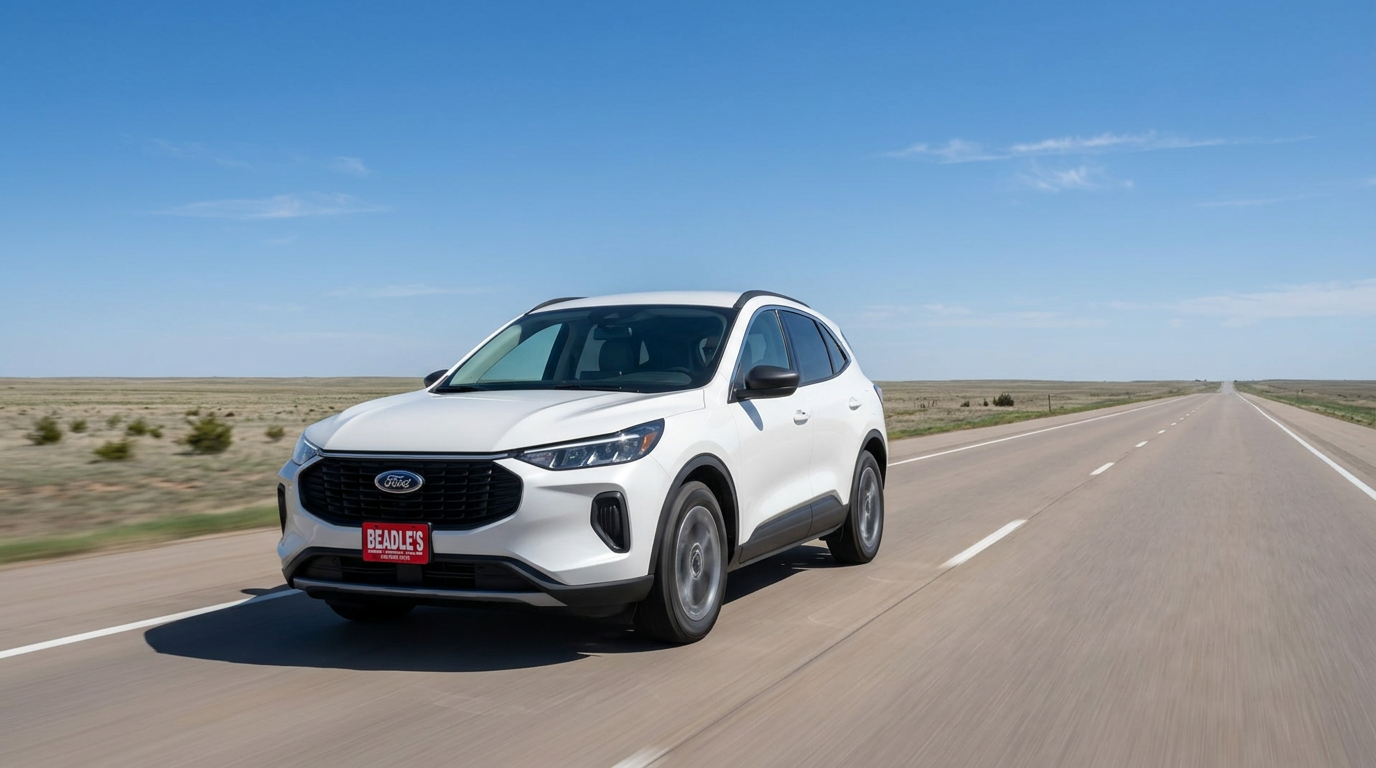
The 2026 Ford Escape comes with four distinct powertrain options: a 1.5L EcoBoost gas engine, a 2.0L EcoBoost gas engine, a 2.5L hybrid (non-plug-in), and a 2.5L plug-in hybrid (PHEV). The choice isn’t just about fuel economy — each powertrain comes with different AWD availability, different trim access, and different real-world implications for buyers driving central South Dakota roads year-round.
This guide breaks down what each powertrain actually delivers, who it makes sense for, and where the trade-offs land — specifically for the long-distance, all-season, rural driving conditions common to buyers in the Bowdle area.
On This Page
- What Powertrain Options Does the 2026 Ford Escape Offer?
- When Does the 1.5L EcoBoost Make Sense for South Dakota Buyers?
- What Does the 2.0L EcoBoost Bring Over the 1.5L — and Is It Worth It?
- Why Do Many South Dakota Buyers Choose the 2.5L Hybrid AWD?
- What’s the Honest Case for — and Against — the Escape PHEV Near Bowdle?
- Which Escape Powertrain Is the Right Choice for Rural South Dakota Driving?
What Powertrain Options Does the 2026 Ford Escape Offer?
The 2026 Escape offers four powertrain options across six trims. Which powertrains are available depends entirely on which trim you’re looking at — and AWD availability is not consistent across all of them.
| Powertrain | Drivetrain | Available Trims |
|---|---|---|
| 1.5L EcoBoost | FWD std / AWD optional | Active, ST-Line |
| 2.0L EcoBoost | AWD Only | ST-Line Select, ST-Line Elite, Platinum |
| 2.5L Hybrid | AWD Only | ST-Line Select, ST-Line Elite, Platinum |
| 2.5L PHEV | FWD Only — no AWD | PHEV trim only |
The central point: if AWD matters to you — and for most South Dakota buyers it should — the 2.5L PHEV is off the table immediately. The 1.5L EcoBoost is viable only if AWD is added at the order stage on Active or ST-Line. The 2.0L EcoBoost and 2.5L Hybrid are AWD by default on Select and above, with no FWD option available. The full 2026 Ford Escape overview at Beadle Ford covers how each powertrain fits within the broader trim lineup.
When Does the 1.5L EcoBoost Make Sense for South Dakota Buyers?
The 1.5L EcoBoost makes the most sense when price is the primary driver and AWD is explicitly selected at the order stage. It’s capable on pavement and gravel, and delivers reasonable efficiency — approximately 30 mpg combined in FWD configuration (verify at fueleconomy.gov for current EPA figures). AWD-equipped 1.5L fuel economy has not been officially published; check fueleconomy.gov for updated ratings.
The limitation for SD buyers is what comes with those trims. Active and ST-Line — the only trims offering the 1.5L — don’t include heated seats, a heated steering wheel, remote start, or a power liftgate as standard equipment. Adding AWD doesn’t change that. On a February morning in Spink County, those features aren’t luxuries.
The 1.5L is paired with an 8-speed conventional automatic — not an eCVT. Towing is capped at 2,000 lbs regardless of drivetrain, and the Class II factory tow package is not available on Active or ST-Line, only through a dealer accessory. If cost is the main consideration and cold-weather standard features are less important, the 1.5L with AWD added is workable. If the goal is winter readiness as a complete package, the comparison against ST-Line Select usually goes against the 1.5L once all-in cost is factored.
What Does the 2.0L EcoBoost Bring Over the 1.5L — and Is It Worth It?
The 2.0L EcoBoost delivers more power and a meaningful towing capacity advantage. It’s AWD only — available on ST-Line Select, ST-Line Elite, and Platinum — so AWD is always included at no additional option cost. The key practical upgrade over the 1.5L is towing: with the Class II factory tow package (code 536), the 2.0L EcoBoost AWD is rated at 3,500 lbs, compared to 2,000 lbs on the 1.5L with no factory package available.
For buyers who need to move a small boat to Lake Oahe, a utility trailer, or similar light-duty loads common in central South Dakota, 3,500 lbs is the right number. A small fishing boat and trailer, a loaded single-axle utility trailer — the 2.0L covers those tasks where the 1.5L falls short. The 1.5L tops out at 2,000 lbs without a factory package option — that gap matters for buyers with regular, even occasional, towing needs.
The trade-off against the 2.5L Hybrid is fuel economy. The Hybrid delivers approximately 39 mpg combined (verify at fueleconomy.gov), which compounds over significant highway miles between Bowdle and Aberdeen or Pierre. The 2.0L EcoBoost AWD fuel economy has not been officially published — check fueleconomy.gov for current EPA figures. The 2.0L also uses an 8-speed conventional automatic rather than an eCVT, which some buyers prefer for its familiar feel. If towing matters more than fuel savings, the 2.0L EcoBoost is the right call.
Looking for Something in Stock?
Check out these models available now at Beadle Ford.
Why Do Many South Dakota Buyers Choose the 2.5L Hybrid AWD?
Because it delivers AWD and significantly better fuel efficiency than either gas option, with no charging requirement. The 2.5L Hybrid AWD is available on ST-Line Select, ST-Line Elite, and Platinum — all trims that include heated seats, remote start, and a power liftgate as standard. The efficiency gain doesn’t come at the expense of cold-weather preparedness.
The hybrid system delivers approximately 39 mpg combined (verify at fueleconomy.gov for current EPA ratings). On a 200-mile round trip to Aberdeen or Sioux Falls, that’s a tangible fuel savings compared to either gas option. The eCVT transmission behaves differently from a conventional automatic — it maintains a steady engine rpm during acceleration rather than stepping through gears. Most buyers adapt quickly; many appreciate the smooth, consistent pull on long open-road stretches common in central South Dakota.
The trade-off is towing. With the Class II tow package, the 2.5L Hybrid AWD is rated for 1,500 lbs — significantly less than the 2.0L EcoBoost’s 3,500 lbs with the same package. For buyers who only need to move a small utility trailer or a jon boat, 1,500 lbs is workable. For anything heavier, the 2.0L EcoBoost is the right call. The AWD winter performance guide covers how the Hybrid AWD system handles South Dakota winter and gravel conditions in detail.
What’s the Honest Case for — and Against — the Escape PHEV Near Bowdle?
The PHEV is front-wheel drive only — that’s the immediate limitation for most central South Dakota buyers. But for buyers who have Level 2 charging at home and can accept FWD for their use case, the PHEV is the most feature-complete single Escape configuration available.
The plug-in hybrid system offers approximately 37 miles of EV-only range on a full charge (verify at fueleconomy.gov). Combined with a rated approximately 101 MPGe when operating on electricity and approximately 40 mpg fuel economy after the battery depletes, total range in hybrid mode extends to approximately 520 miles. The PHEV trim itself is well-equipped: Co-Pilot360 Assist+, 13.2″ SYNC 4, heated front seats, heated steering wheel, remote start, power liftgate, and roof-rack side rails are all standard. A Mobile Power Cord for Level 1 home charging comes included; Level 2 charging requires a separate 240V charger installation.
The realistic limitation for rural South Dakota buyers: Level 2 charging infrastructure is sparse around Bowdle and most of central SD. Without regular Level 2 access, the EV range advantage disappears — the PHEV effectively operates as a front-wheel-drive hybrid, and the non-plug-in 2.5L Hybrid AWD on Select, Elite, or Platinum delivers comparable gas-mode fuel economy without the charging dependency and without giving up all-wheel drive. The PHEV makes the most sense for a buyer who commutes to a larger town with Level 2 access, drives predictable daily distances within the EV range, and genuinely doesn’t need AWD.
Which Escape Powertrain Is the Right Choice for Rural South Dakota Driving?
For most central South Dakota buyers, the 2.5L Hybrid AWD on ST-Line Select is where the decision lands. AWD is standard, efficiency is strong, and the trim’s cold-weather features are included without adding packages. That combination — traction in winter, manageable fuel costs on long highway miles, and a vehicle that starts reliably in January — covers the majority of what SD buyers prioritize.
The 2.0L EcoBoost AWD is the right move if towing up to 3,500 lbs with the Class II package is part of your regular use case. It’s also AWD only at Select and above, so the cold-weather feature set stays intact. The trade-off is fuel economy — it won’t reach the Hybrid’s approximately 39 mpg combined. If you’re running Lake Oahe trips with a boat in tow regularly, the 2.0L makes that trade-off worthwhile.
The 1.5L EcoBoost is viable if budget is the driver and AWD is specified at order — but the buyer accepts the cold-weather feature gaps that come with Active and ST-Line. The PHEV is a niche fit for this market: strong configuration, but FWD-only and rural charging realities limit its relevance for most buyers in the area. The complete trim levels guide maps each powertrain option to the specific trim configurations available.
Key Takeaways
- The 2.5L PHEV is front-wheel drive only with no AWD option — a meaningful limitation for most central South Dakota buyers.
- The 2.5L Hybrid AWD on ST-Line Select delivers the best combination of AWD, efficiency (approximately 39 mpg combined), and cold-weather standard features for rural SD use.
- The 2.0L EcoBoost AWD is the right call when towing up to 3,500 lbs matters — the Class II factory tow package is available on Select, Elite, and Platinum only, not on 1.5L trims.
- The 1.5L EcoBoost with AWD is a viable lower-cost entry, but AWD must be explicitly specified at order on Active or ST-Line, and heated seats, remote start, and power liftgate are not included.
- PHEV buyers near Bowdle need reliable Level 2 charging access to realize the plug-in value proposition; without it, the non-plug-in Hybrid AWD delivers comparable efficiency with AWD included.
Frequently Asked Questions
My Take on the 2026 Escape Powertrain Decision for South Dakota Buyers
When I’m talking through powertrain options with a buyer, the conversation usually reaches the same two questions: do you need to tow anything, and do you have Level 2 charging access at home? Those two questions separate most of the field. If neither applies — no regular towing, no home charger — the 2.5L Hybrid AWD on Select is almost always where it lands. AWD is locked in, efficiency is real on the highway miles between towns, and the cold-weather features come with the trim. That combination is hard to argue with for central South Dakota use.
The PHEV comes up a fair amount, and I try to be direct about the charging situation near Bowdle. Without Level 2 access at home, the EV range advantage effectively disappears, and you end up with a front-wheel-drive hybrid. The non-plug-in Hybrid AWD covers that use case more practically for most buyers in this area. For buyers who do have that home charging setup and aren’t dependent on AWD — and there are some — the PHEV is genuinely strong.
If you want to work through the specifics for your situation — towing weight, typical drive distance, whether a Level 2 charger makes sense to add — I’m happy to run through that comparison with you directly. Stop by Beadle Ford in Bowdle or give us a call.
About the Author
Lexy Tabbert — Beadle Ford, Bowdle, SD
Lexy Tabbert is the Director of Sales and Marketing at Beadle Ford in Bowdle, South Dakota. She covers Ford vehicles, trim comparisons, and buyer guidance — helping families, ranchers, and ag operators across the region find the right truck and configuration for their needs. Learn more about Lexy.
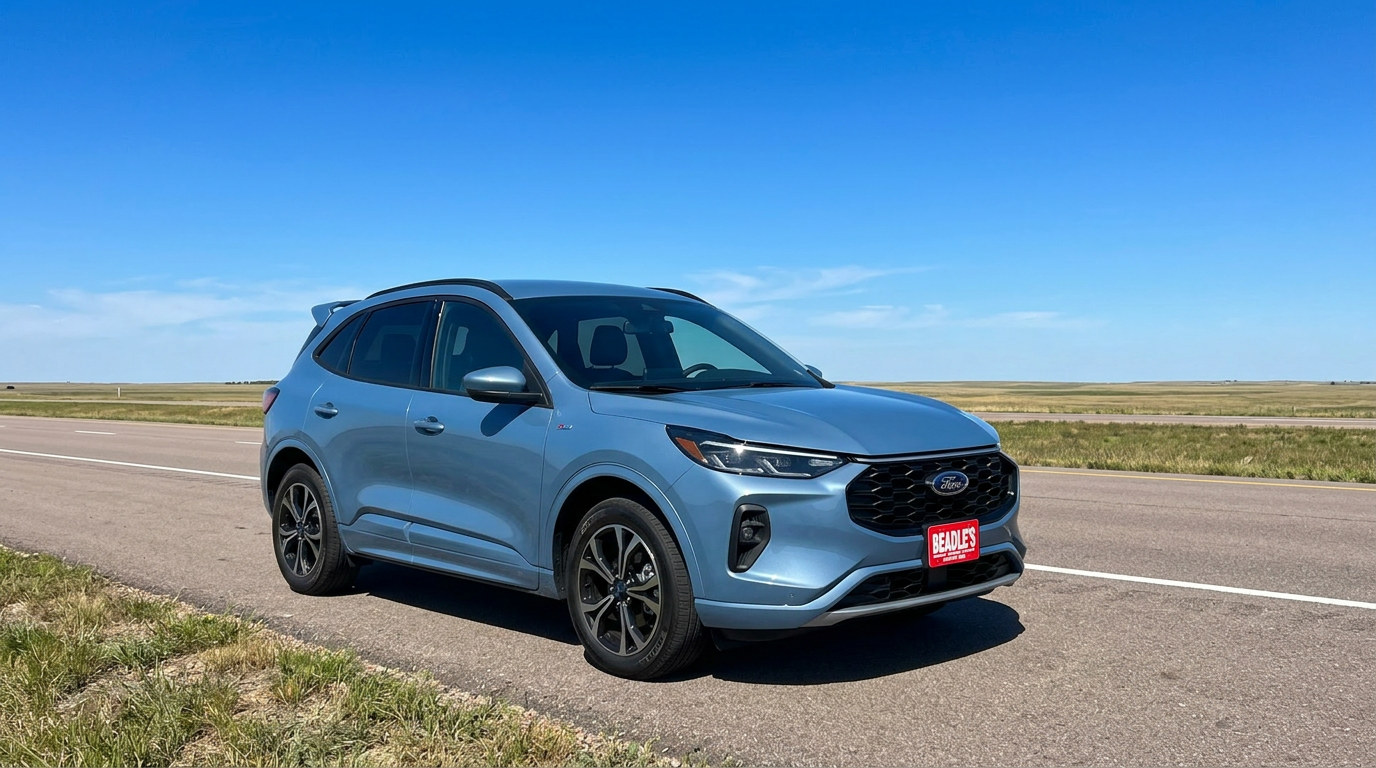
The 2026 Ford Escape comes in six trim levels: Active, PHEV, ST-Line, ST-Line Select, ST-Line Elite, and Platinum. For buyers in central South Dakota, one variable shapes that decision more than any other: AWD. The AWD picture changes dramatically depending on which trim you’re looking at — some include it standard, some require you to add it, and one trim can’t get it at all.
This guide breaks down what changes at each trim level, what you’re actually paying for, and which configuration makes the most practical sense for buyers driving county roads and South Dakota winters. The focus is on the decisions that matter here — AWD, cold-weather features, and real-world usability for rural SD driving.
On This Page
- Which Trims Include AWD — and Why Does It Shape Every Decision?
- Is the Escape Active the Right Starting Point for South Dakota Buyers?
- What Does the Escape ST-Line Add Over the Active?
- Why Is the ST-Line Select the Natural Starting Point for South Dakota Buyers?
- What Does the Escape ST-Line Elite Add Over the Select?
- Should South Dakota Buyers Consider the Escape PHEV?
- What Makes the Escape Platinum Worth the Step Up?
Which Trims Include AWD — and Why Does It Shape Every Decision?
AWD is optional on Active and ST-Line, standard (and mandatory) on ST-Line Select, ST-Line Elite, and Platinum, and unavailable on the PHEV. That single variable changes the practical suitability of each trim for central South Dakota winters more than any other spec on the sheet.
Here’s how the lineup splits on drivetrain:
| Trim | Drivetrain | Engine Options |
|---|---|---|
| Active | FWD standard / AWD optional | 1.5L EcoBoost |
| ST-Line | FWD standard / AWD optional | 1.5L EcoBoost |
| ST-Line Select | AWD Only | 2.5L Hybrid or 2.0L EcoBoost |
| ST-Line Elite | AWD Only | 2.5L Hybrid or 2.0L EcoBoost |
| Platinum | AWD Only | 2.5L Hybrid or 2.0L EcoBoost |
| PHEV | FWD Only — no AWD | 2.5L Plug-In Hybrid |
The dividing line is ST-Line Select. Below it, AWD must be added explicitly at the order stage and you’ll still be on the 1.5L EcoBoost. At Select and above, AWD is locked in and the engine steps up to a 2.0L EcoBoost or 2.5L Hybrid. The full AWD breakdown covers how Ford’s Intelligent AWD performs in South Dakota winter conditions. The complete 2026 Escape overview at Beadle Ford covers all six trims and powertrains in full.
Is the 2026 Escape Active the Right Starting Point for South Dakota Buyers?
The Active is the value entry point of the Escape lineup — capable vehicle, lower price point, and Co-Pilot360 standard. But in South Dakota, what matters is that AWD is optional, not included. Buyers who skip it end up with an FWD crossover on packed county roads in January.
What the Active includes standard: 1.5L EcoBoost with 8-speed automatic, 17″ Shadow Silver-painted aluminum wheels, cloth seating with 6-way manual driver and 4-way manual passenger adjustment, 8″ SYNC 4 touchscreen, dual-zone electronic automatic climate, and the full Ford Co-Pilot360 suite. What it does not include: heated seats, a heated steering wheel, remote start, or a power liftgate. On a -15°F morning outside Bowdle, those absences are noticeable.
The Active is a reasonable choice if AWD is added at order and you’re comparing total cost to what the ST-Line Select offers. If the all-in price with AWD added comes within range of ST-Line Select territory, the Select is usually the better use of that money — you’d be getting AWD standard plus heated seats, remote start, and a power liftgate without needing to option everything separately.
What Does the Escape ST-Line Add Over the Active?
The ST-Line adds sport exterior styling and a more supportive seat. The powertrain and AWD situation are identical to the Active — 1.5L EcoBoost, FWD standard, AWD optional — and the cold-weather feature gaps remain the same.
What changes over Active: 18″ Rock Metallic painted aluminum wheels (with a slightly lower-profile tire), a black mesh grille, large rear spoiler, rear skid plate, and ST-Line exterior badging that give the Escape a more aggressive profile. Inside, ST-Line replaces the standard cloth with Sport Contour bucket seats in partial vinyl and cloth with red accent stitching, and steps the driver’s seat up to an 8-way power adjustment versus the Active’s 6-way manual. That’s a meaningful seat upgrade for long highway drives.
What doesn’t change: still no heated seats, still no heated steering wheel, still no remote start, still no power liftgate. For South Dakota buyers, the ST-Line is worth considering if styling and seat comfort matter to you — but AWD still has to be added specifically if you want it, and the same cost comparison against ST-Line Select applies.
Looking for Something in Stock?
Check out these models available now at Beadle Ford.
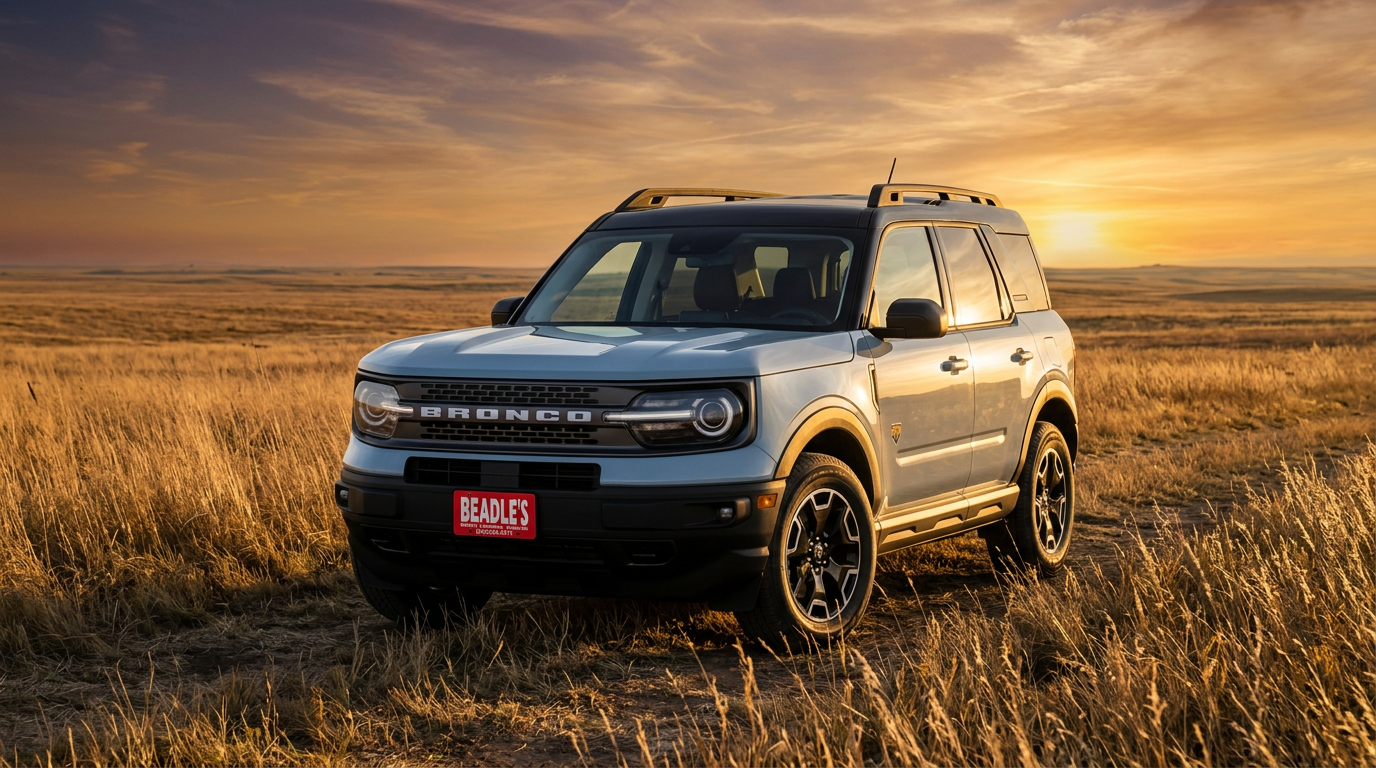
Ford Bronco Sport
Standard 4×4, GOAT modes, staying in Ford’s lineup. Built for South Dakota.
View Bronco Sport InventoryWhy Is the ST-Line Select the Natural Starting Point for South Dakota Buyers?
Because AWD is standard on every unit — there’s no FWD version to accidentally end up with — and it brings heated front seats, a heated steering wheel, remote start, and a power liftgate in the same configuration. The Select is the first trim that addresses a central South Dakota winter in a complete way, in one package.
The engine also steps up significantly at Select. Unlike Active and ST-Line which use the 1.5L EcoBoost, the Select runs either the 2.5L Hybrid AWD or the 2.0L EcoBoost AWD — both AWD only, no FWD version available. Additional standard equipment over ST-Line: body-color heated mirrors, LED fog lamps, illuminated vanity mirrors, and one-touch-up/down front and rear windows.
Optional packages on Select include Tech Pack 1 (adds Co-Pilot360 Assist+ with adaptive cruise and lane centering, plus the 13.2″ SYNC 4 screen) and Tech Pack 2 (adds 360° camera, B&O premium audio, 12.3″ digital cluster, power passenger seat, and wireless charging). For buyers who want a fully equipped Select without stepping up to Elite, Tech Pack 2 covers most of what changes between the two trims. Choosing between the 2.5L Hybrid and 2.0L EcoBoost at this trim level is its own decision — the powertrain comparison guide covers that in detail.
What Does the Escape ST-Line Elite Add Over the Select?
The Elite is a substantial comfort and technology step. The 12.3″ Digital Productivity Screen, Co-Pilot360 Assist+, and wireless charging all become standard equipment — no optional packages needed. Seating upgrades to a 10-way heated power driver seat and 6-way heated power passenger seat, and a memory package for driver seat and mirrors is added. AWD remains standard, same as Select.
Exterior: 19″ Machined-face Ebony-painted aluminum wheels (up from 18″ on Select). Interior: the 13.2″ SYNC 4 touchscreen is standard here without requiring Tech Pack 1, and the LED light bar headlamps, auto-dimming rearview mirror, and perimeter alarm all come built in.
For South Dakota buyers logging significant highway miles between towns, Co-Pilot360 Assist+’s adaptive cruise with stop-and-go and lane centering adds real-world value on long straight stretches. The memory package matters less in a personal vehicle but is useful if multiple drivers share the car regularly. The Elite makes the strongest case for buyers who want the full technology experience without moving to the top trim.
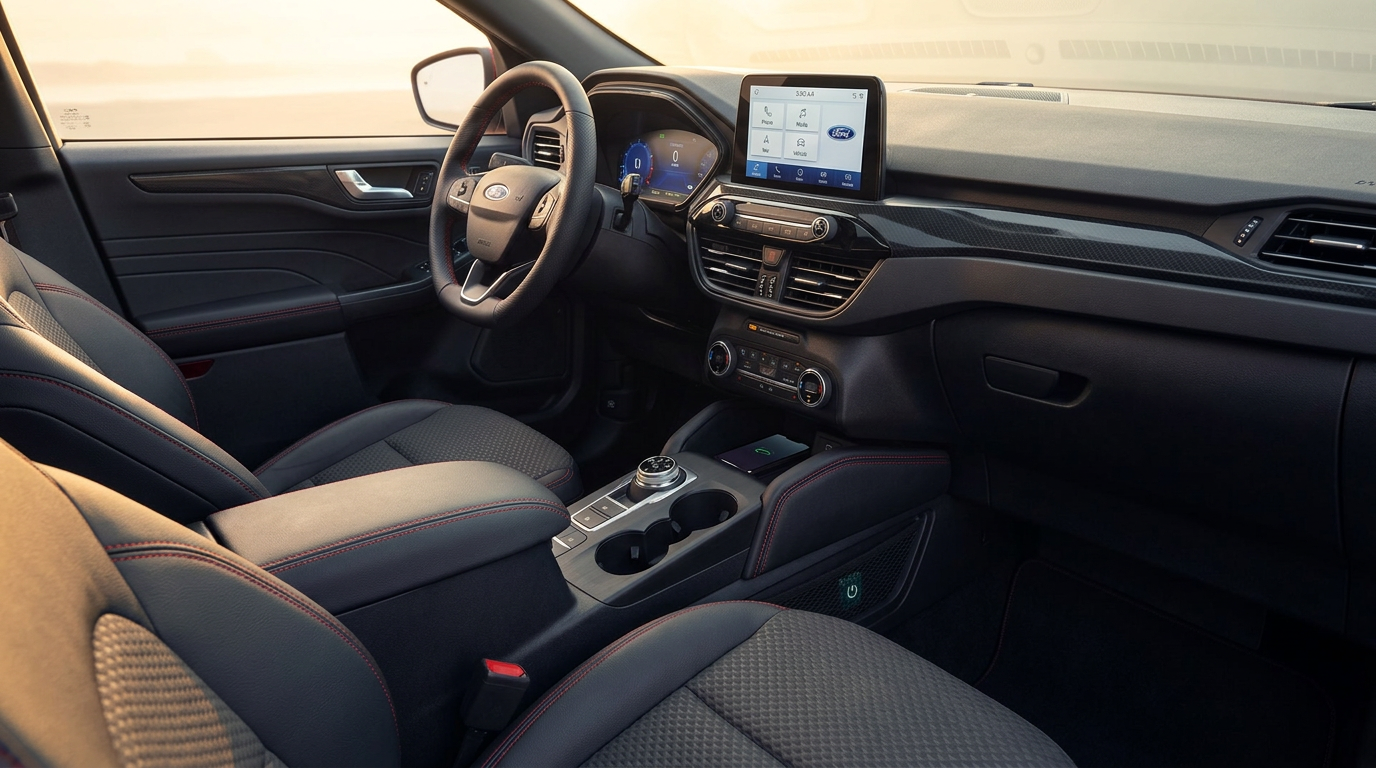
Should South Dakota Buyers Consider the Escape PHEV?
Probably not as their first choice. The PHEV is front-wheel drive only — no AWD option exists at any price point — which is a significant limitation for buyers in central South Dakota facing winter driving on county roads and gravel.
On paper, the PHEV is well-equipped: Co-Pilot360 Assist+ standard, 13.2″ SYNC 4 standard, heated front seats, heated steering wheel, remote start, power liftgate, and roof-rack side rails — all built in. The plug-in hybrid system offers approximately 37 miles of EV-only range (verify at fueleconomy.gov) on a full charge, with a Mobile Power Cord for Level 1 home charging included. Total range in hybrid mode extends well beyond that once the battery depletes.
The practical reality for rural South Dakota buyers: Level 2 charging infrastructure is limited around Bowdle and much of central SD, which means most PHEV owners in this area end up relying on the gas hybrid mode for the majority of their miles. That undercuts the primary value proposition of plug-in ownership. If fuel efficiency without a charging requirement is the goal, the 2.5L Hybrid AWD on Select, Elite, or Platinum delivers strong economy without the AWD trade-off. If charging access isn’t a concern, the PHEV’s feature content is strong. The powertrain comparison guide covers this decision in detail.
What Makes the Escape Platinum Worth the Step Up?
The Platinum is the top trim, and its primary differentiator over Elite is interior material quality and the Space Gray interior option. Seats step up to ActiveX trimmed material with mini-perforation — the only Escape trim available in the Space Gray interior environment. AWD is standard, same as Elite.
Standard equipment over Elite: Universal Garage Door Opener and roof-rack side rails join the list, and the 10-way heated power driver seat and 6-way heated power passenger seat carry forward with the premium ActiveX seating material. Memory package, wireless charging, power liftgate, and the full 13.2″ SYNC 4 with 12.3″ digital cluster — all standard, same as Elite. Engine options remain 2.5L Hybrid AWD or 2.0L EcoBoost AWD.
The Platinum is the right choice if the interior material and the Space Gray color combination matter to you, or if you want the full-feature vehicle without building it through optional packages. Buyers comparing Elite with Tech Pack 2 added to the Platinum should run the specific price difference — in some configurations the gap is narrower than expected.
Key Takeaways
- AWD is standard and mandatory on ST-Line Select, Elite, and Platinum — on Active and ST-Line it must be added specifically, and the PHEV has no AWD option at any price.
- The ST-Line Select is where most central South Dakota buyers should start — AWD is locked in and heated seats, heated steering wheel, and remote start all come with it.
- The 1.5L EcoBoost is only available on Active and ST-Line; Select and above use the 2.0L EcoBoost or 2.5L Hybrid, both AWD only.
- The PHEV’s FWD-only configuration is a real limitation for winter driving in SD — the 2.5L Hybrid AWD on Select, Elite, or Platinum is the better efficiency option for most buyers in this area.
- The Elite is the natural choice when technology and seat comfort on highway miles matter — Co-Pilot360 Assist+, the 12.3″ cluster, and wireless charging are all standard without option packages.
Frequently Asked Questions
My Take on the 2026 Escape Trim Lineup for South Dakota Buyers
When I’m working through trim options with a buyer, the conversation almost always lands on ST-Line Select as the starting point — not because it’s the cheapest or the most expensive, but because it’s where the math makes sense for someone who needs to drive in January. AWD is already in, heated seats and remote start are in, and you’re not piecing together options to get there. That combination at one trim level is hard to argue against for central South Dakota use.
From there it usually comes down to whether adaptive cruise and the larger technology suite matter enough to step to Elite, or whether the buyer is looking for the full-feature experience and the Platinum makes sense. The PHEV is worth a look if you have a charging setup at home and AWD isn’t a requirement — but for most buyers around here, the gas hybrid AWD is the configuration that holds up best year-round.
If you want to talk through which trim fits your situation, I’m happy to run the comparison with you directly. Stop by Beadle Ford in Bowdle or give us a call.
About the Author
Lexy Tabbert — Beadle Ford, Bowdle, SD
Lexy Tabbert is the Director of Sales and Marketing at Beadle Ford in Bowdle, South Dakota. She covers Ford vehicles, trim comparisons, and buyer guidance — helping families, ranchers, and ag operators across the region find the right truck and configuration for their needs. Learn more about Lexy.
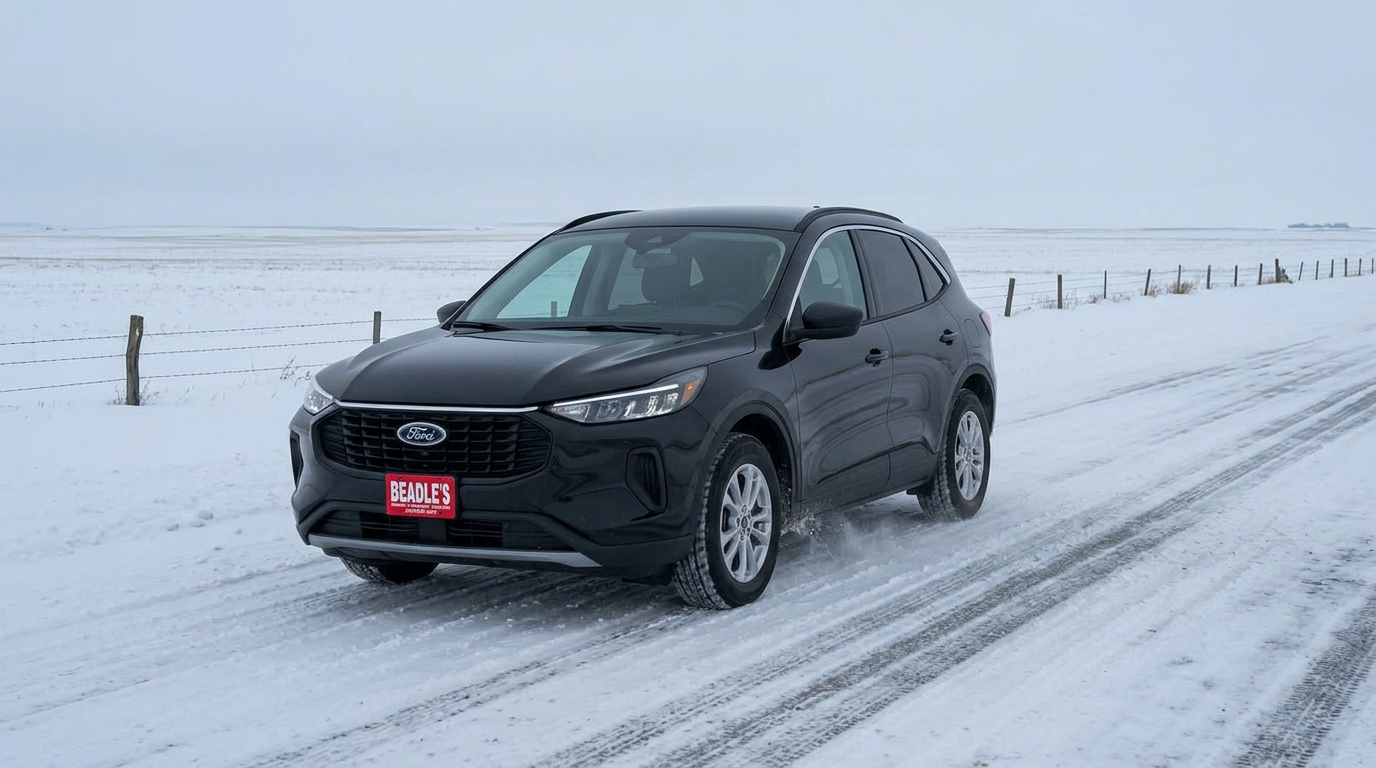
If you’re shopping for a 2026 Ford Escape in South Dakota, AWD is probably on your checklist — and for good reason. But the answer to “does it come with AWD?” isn’t a simple yes or no. Some trims include it standard. Some have it as an option you must add at the order stage. And one trim can’t get it at all. Getting this wrong at purchase is costly — in most cases, drivetrain can’t be changed after the vehicle is built.
This guide covers what central South Dakota buyers specifically need to know: which 2026 Escape trims come with AWD, how the system performs on packed snow and gravel county roads, whether the optional AWD upgrade on entry trims is worth the cost, and why the PHEV has a limitation most buyers don’t discover until it’s too late.
On This Page
- Which 2026 Ford Escape Trims Come with AWD?
- What Does Ford’s Intelligent AWD Actually Do in Snow and Ice?
- Active and ST-Line AWD: Is the Optional Upgrade Worth It?
- Why PHEV Buyers Should Think Twice (It’s FWD Only)
- How Does the Escape AWD Hold Up on Gravel Roads and Through South Dakota’s Mud Season?
Which 2026 Ford Escape Trims Come with AWD?
AWD is standard — and the only drivetrain option — on the ST-Line Select, ST-Line Elite, and Platinum trims. On the Active and ST-Line, FWD comes standard and AWD is an option you must specifically select at order. The PHEV trim is front-wheel drive only with no AWD available at any configuration.
Here’s the full breakdown:
| Trim | AWD Status | Engine |
|---|---|---|
| Active | Optional (FWD standard — must add) | 1.5L EcoBoost |
| ST-Line | Optional (FWD standard — must add) | 1.5L EcoBoost |
| ST-Line Select | AWD Only — standard, no FWD | 2.0L EcoBoost or 2.5L Hybrid |
| ST-Line Elite | AWD Only — standard, no FWD | 2.0L EcoBoost or 2.5L Hybrid |
| Platinum | AWD Only — standard, no FWD | 2.0L EcoBoost or 2.5L Hybrid |
| PHEV | FWD Only — no AWD available | 2.5L Plug-In Hybrid |
The practical takeaway for buyers in this area: if you want AWD without having to think about it at the order stage, start at ST-Line Select. At that trim and above, every unit built is AWD — there is no FWD version to accidentally end up with. For buyers considering Active or ST-Line, AWD must be explicitly specified when the vehicle is ordered. You cannot add it to a finished vehicle later.
What Does Ford’s Intelligent AWD Actually Do in Snow and Ice?
Ford’s Intelligent All-Wheel Drive monitors wheel slip continuously and transfers torque between the front and rear axles as conditions change — without any driver input required. In normal driving, the system defaults toward front-wheel drive to preserve fuel economy. When it detects wheel slip on snow, ice, or slippery surfaces, it engages the rear axle and redistributes power to where traction is available.
This is on-demand AWD, not a locked four-wheel-drive system. That distinction matters for South Dakota buyers. The Escape’s Intelligent AWD is designed to handle the conditions most drivers in this area encounter most often: packed snow on county roads, ice-covered intersections, slippery highway on-ramps in January, and the slow grip loss that starts on a gravel road in early October. For those conditions, it performs well.
Where it starts to show limits is in deeper unpacked snow, significant off-camber terrain, or situations where a driver wants to manually lock in four-wheel drive. That’s where the Bronco Sport’s standard 4×4 system with GOAT (Goes Over Any Type of Terrain) modes has a genuine edge. For most Escape buyers — highway commuters, school-run vehicles, buyers who see gravel roads but not serious off-road terrain — the Intelligent AWD is well-suited to what a central South Dakota winter actually looks like. The full 2026 Ford Escape overview at Beadle Ford covers the complete powertrain and AWD picture if you want to compare everything at once.
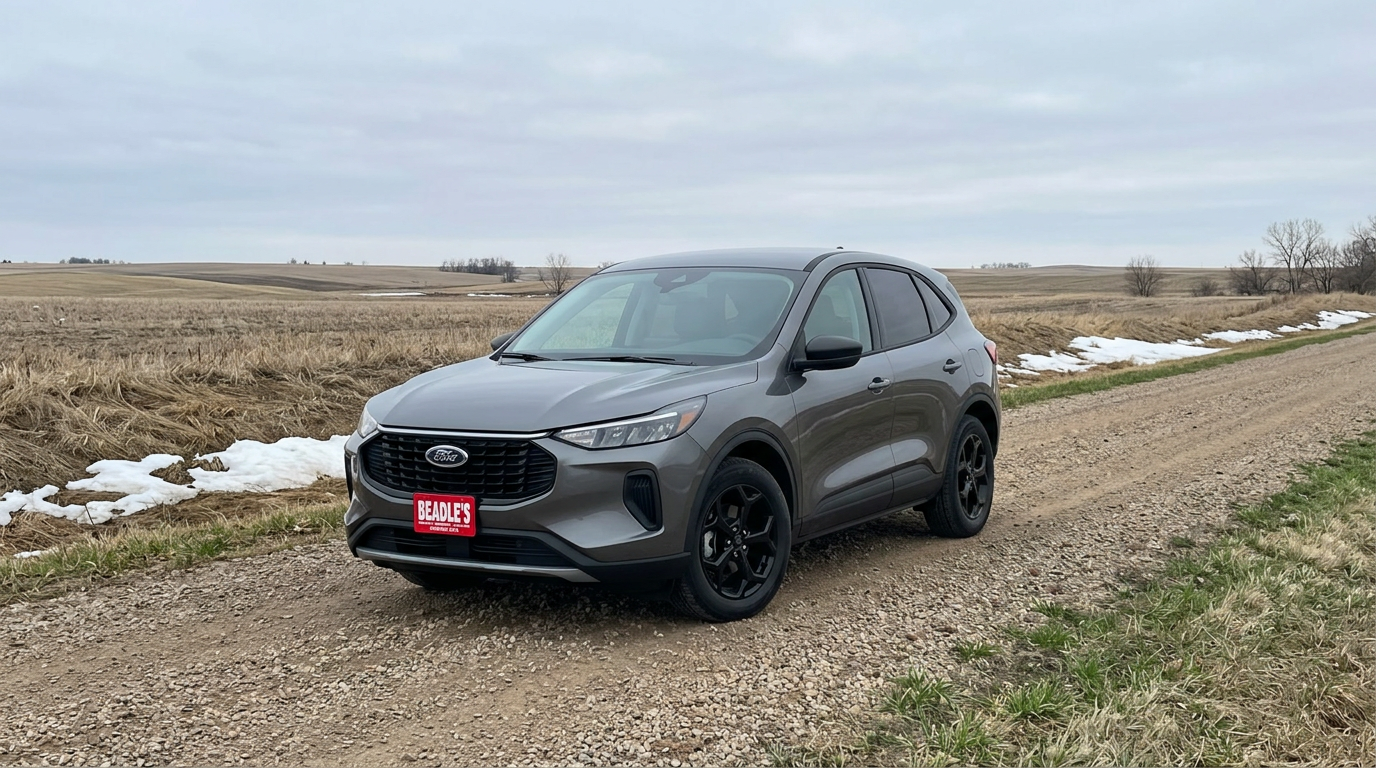
Looking for Something in Stock?
Check out these models available now at Beadle Ford.
Ford Bronco Sport
Standard 4×4, GOAT modes, staying in Ford’s lineup. Built for South Dakota.
View Bronco Sport InventoryActive and ST-Line AWD: Is the Optional Upgrade Worth It?
For most South Dakota buyers, yes. Winter driving in Spink or Walworth County is not the same as winter driving in a warm-climate suburb, and the optional AWD on Active and ST-Line trims is one of those decisions where the cost of skipping it tends to show up in February. The critical point is that it’s a factory-order decision — it must be selected when the vehicle is built. Once an FWD Escape leaves the assembly line, it stays FWD.
Before committing to the AWD add on an Active or ST-Line, it’s worth looking at the ST-Line Select as a comparison. The Select starts at AWD as its only configuration — no option needed, no risk of an FWD unit being delivered — and it also brings heated front seats, a heated steering wheel, remote start, a power liftgate, and body-color heated mirrors as standard equipment. At -15°F outside Bowdle on a January morning, those aren’t comfort upgrades — they’re practical ones. For many buyers, the total picture at ST-Line Select represents better value per dollar than adding only AWD to a base trim and still missing those features.
That comparison gets clearer when you see all six trims laid out with specific feature detail. The 2026 Ford Escape trim levels guide walks through every trim with a South Dakota buyer’s lens — including which features matter most in this climate and at this price point.
Why PHEV Buyers Should Think Twice (It’s FWD Only)
The 2026 Escape PHEV is front-wheel drive only. There is no AWD option, no upgrade path, no workaround. That’s confirmed in the 2026 order guide. If you purchase a 2026 Escape PHEV, it will be FWD — regardless of trim package or added options.
The PHEV’s approximately 37-mile EV-only range sounds appealing on paper, but that figure comes with a significant infrastructure assumption: regular access to Level 2 charging. In practice, the Level 2 charging network that makes plug-in hybrids most cost-effective is concentrated in larger cities. If you’re primarily driving around Bowdle, Gettysburg, or Redfield, the realistic scenario involves Level 1 home charging — slower, and in many cases insufficient to keep the battery consistently topped for daily use. Many rural PHEV owners end up running in hybrid gas mode the majority of the time anyway, which means they’ve paid for plug-in capability they can’t fully use, in a vehicle that can’t get AWD.
For central South Dakota buyers, the 2.5L Hybrid AWD — available on ST-Line Select, ST-Line Elite, and Platinum — is typically the more practical choice. It delivers strong fuel economy without requiring a charger, and AWD is standard on every unit. The PHEV has its place in the right situation; that situation is more easily found closer to a city with established charging infrastructure than it is in rural central South Dakota.
How Does the Escape AWD Hold Up on Gravel Roads and Through South Dakota’s Mud Season?
AWD earns its value in central South Dakota well beyond December through February. The seasonal picture for a vehicle driven in this area breaks into four distinct challenges: deep-winter cold and packed snow from December through March, spring mud season on gravel roads through April and May, dry-season gravel and dust from June through September, and early freeze and frost conditions in October and November.
Ford’s Intelligent AWD handles the winter and fall scenarios well for a vehicle in the Escape’s class — the on-demand torque transfer responds quickly to the kind of gradual slip that packed county roads and icy intersections produce. Spring mud adds a different kind of AWD value: gravel township roads that soften and rut through May are manageable with AWD in a way that FWD crossovers often aren’t. The Escape isn’t a dedicated mud vehicle — all-season tires and moderate ground clearance define its limits clearly — but it handles the general surface variability of rural South Dakota driving better than FWD alternatives in the same class.
One honest caveat worth stating clearly: if your driving regularly involves unimproved ranch access roads, significant off-camber terrain, or anything approaching serious off-road conditions, the Escape AWD will reach its limits before the Bronco Sport does. The Bronco Sport’s standard 4×4, higher ground clearance, and GOAT mode settings are built for more demanding use. For the majority of South Dakota Escape buyers — county road commuters, farm families using the vehicle as a daily driver, buyers who encounter gravel roads but not livestock trails — the Escape AWD handles the year-round reality of this area well.
Key Takeaways
- AWD is standard on ST-Line Select, ST-Line Elite, and Platinum — on Active and ST-Line, it’s an option that must be explicitly added at the order stage.
- The PHEV trim is front-wheel drive only — there is no AWD available on the 2026 Escape PHEV at any price point.
- Ford’s Intelligent AWD handles packed snow, ice, and gravel roads well — it’s well-matched to typical central South Dakota winter and spring driving conditions.
- ST-Line Select is where AWD becomes mandatory, and it also brings heated seats, heated steering wheel, and remote start — making it a single-decision answer to winter preparedness for most buyers.
- For buyers who need deeper off-road capability or want standard 4×4 engagement, the Bronco Sport is the stronger option in Ford’s current lineup.
Frequently Asked Questions
My Take on AWD and the 2026 Ford Escape
The AWD question comes up in almost every Escape conversation I have, and the answer that surprises most buyers is that it isn’t guaranteed by the model — it depends on which trim they’re actually ordering. My default starting point in those conversations is usually ST-Line Select, because AWD is already locked in, and so are the heated seats and remote start that make the first start of a February morning significantly less unpleasant. Getting all three in a single trim decision takes a lot of the complexity out of it.
If you’re trying to decide between adding AWD to an Active or ST-Line versus stepping up to Select, or if you’re weighing the Escape against the Bronco Sport on traction grounds, I’m happy to walk through the specifics. Those are real trade-offs worth talking through before you commit. Stop by or give us a call.
About the Author
Lexy Tabbert — Beadle Ford, Bowdle, SD
Lexy Tabbert is the Director of Sales and Marketing at Beadle Ford in Bowdle, South Dakota. She covers Ford vehicles, trim comparisons, and buyer guidance — helping families, ranchers, and ag operators across the region find the right truck and configuration for their needs. Learn more about Lexy.
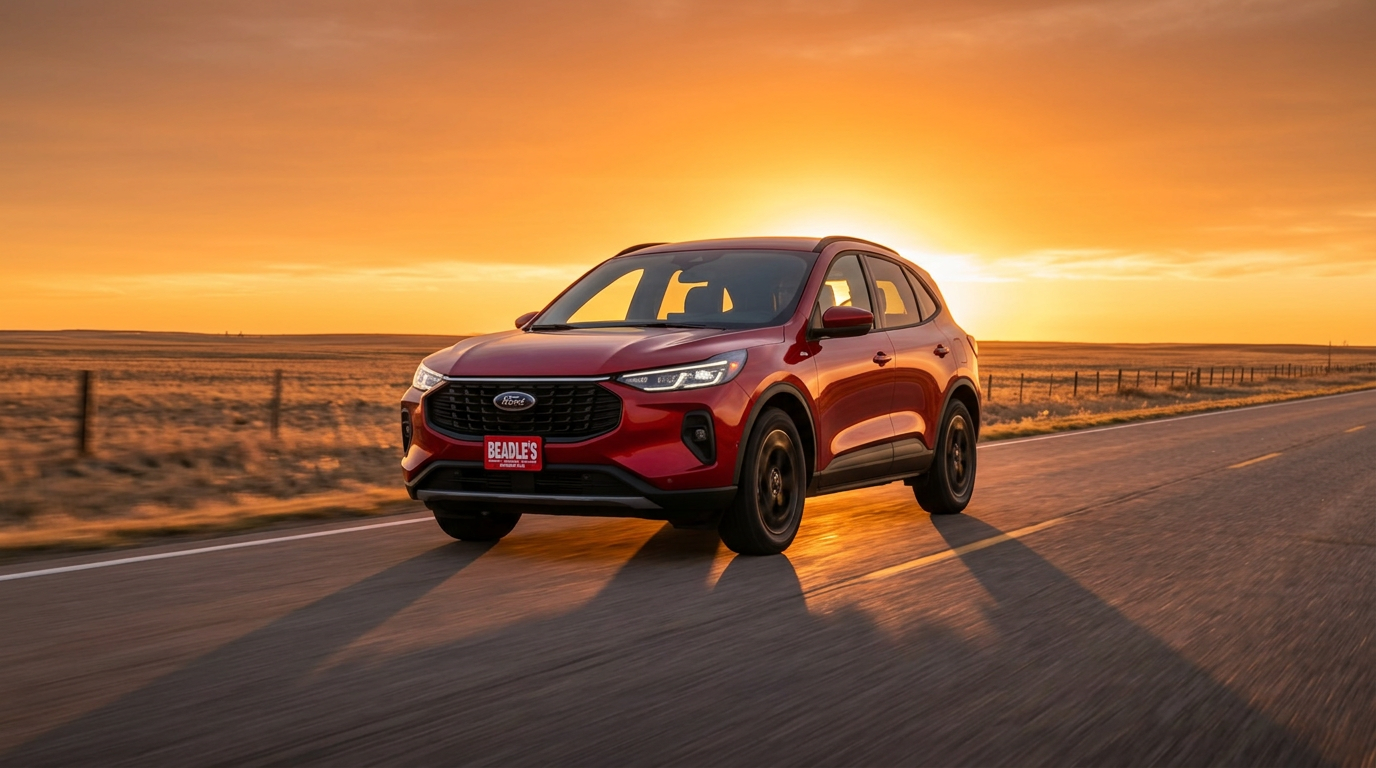
The 2026 Ford Escape is the last one Ford will ever build. If you’re researching an Escape right now, that matters — not because it makes the vehicle worse, but because it changes the conversation around availability, long-term support, and what comes next on our lot.
This guide covers what South Dakota buyers in and around Bowdle actually need to know: why Ford is ending Escape production, what that means for parts and service down the road, whether now is the right time to buy, and what options we have in stock if you decide a different direction makes more sense for you.
Why Is Ford Discontinuing the Escape After 2026?
Ford is ending Escape production after the 2026 model year as part of a deliberate shift in its SUV lineup — moving away from car-based crossovers and toward truck-based platforms and models with stronger long-term demand.
This isn’t a quality problem or a recall situation. The Escape has been a reliable, well-regarded vehicle through its run. But Ford has made a strategic decision that its compact crossover slot is better served by vehicles like the Bronco Sport, which shares a similar footprint but is built on a more capable platform and stays in the lineup going forward. The car-based Escape, by contrast, has been competing in a segment that’s gotten crowded, and Ford isn’t planning a successor.
For buyers in central South Dakota, the practical meaning is simple: the 2026 is the last new Escape you can buy. There’s no 2027 version coming to wait for. If you’re on the fence about an Escape, the clock on new-vehicle availability is running.
What Does the Final Model Year Mean for Pricing and Availability?
Final model year vehicles can go either direction on pricing — some carry incentives as the year winds down, others tighten up on allocation and become harder to find in specific trims or colors. The honest answer is that it depends on how the rest of the year plays out.
What we do know: production isn’t increasing. Ford isn’t building more 2026 Escapes to meet late-year demand. If you have a specific trim level, powertrain, or color in mind — the ST-Line Select in hybrid AWD, for example — the chance of finding exactly what you want decreases as inventory moves. Waiting for a better deal later in the year is a reasonable strategy if you’re flexible on configuration; it’s a riskier strategy if you’re particular about what you want.
For the full picture on what trim levels and powertrains are available and how they compare for South Dakota buyers, the 2026 Ford Escape overview breaks down every configuration in detail.
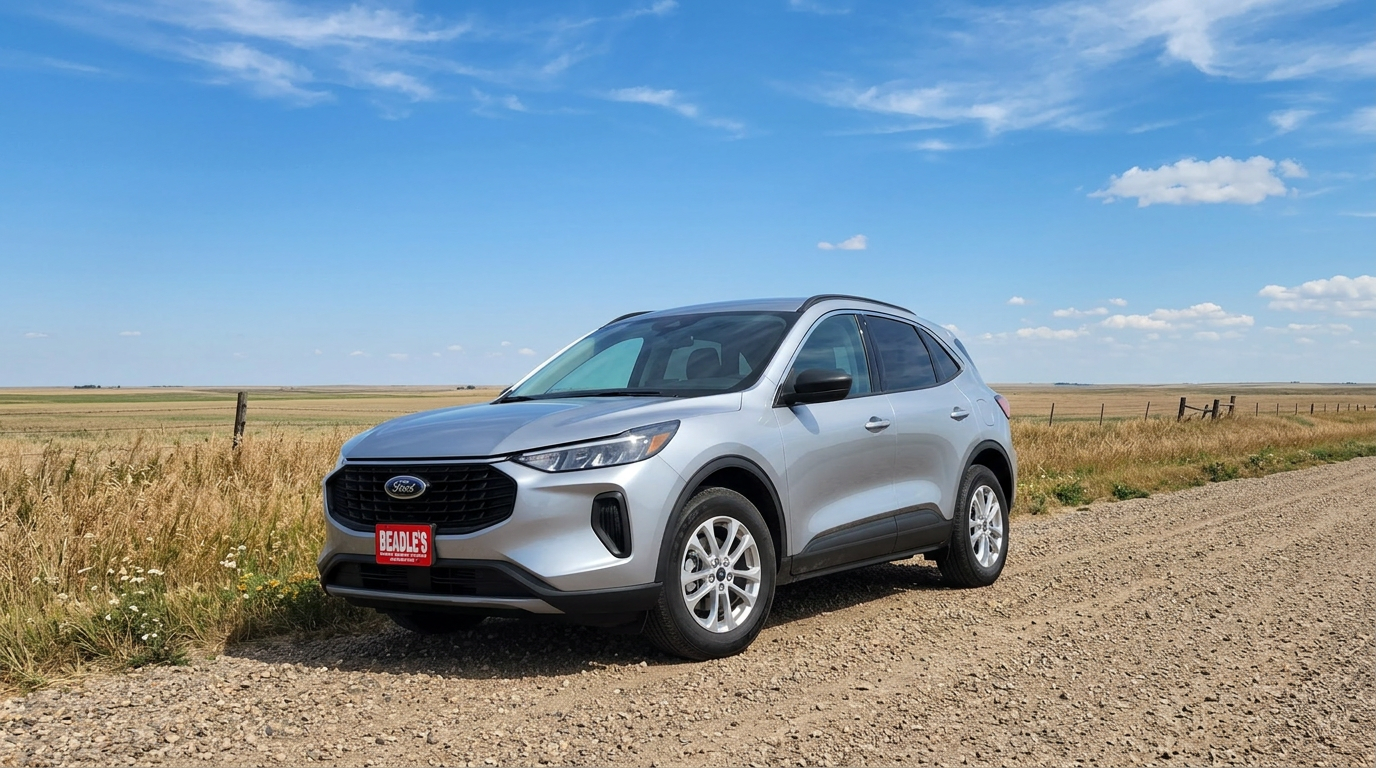
Will Ford Still Support the Escape After Production Ends?
Yes. Ford maintains parts availability well beyond production end, and your new-vehicle warranty applies fully regardless of whether the model continues. Buying a 2026 Escape doesn’t leave you stranded on parts.
This is a common and reasonable concern for rural buyers — if a model disappears, does support disappear with it? Not in any meaningful way for the first decade. The Escape shares a significant number of mechanical components with other Ford vehicles still in production, including powertrains used across multiple platforms. Common wear items like brakes, filters, belts, and sensors will remain stocked through Ford’s parts network and available through Beadle Ford’s service department.
Where you might eventually see impact — many years down the road — is on body panels and trim pieces specific to the Escape’s final generation. That’s a long-term consideration, not an immediate one, and not different from what happens with any discontinued vehicle over time.
Didn’t find what you were looking for?
The Escape is Ford’s final model year compact SUV — but we have three strong alternatives in the same size class and price range in stock now.
Should You Buy a 2026 Escape Now — or Wait?
If the Escape fits your needs today, the 2026 is the best version Ford built — and waiting doesn’t get you a newer one, because there isn’t one. The case for buying now is straightforward.
The 2026 Escape comes standard with Ford’s Co-Pilot360 suite on every trim — automatic emergency braking, blind-spot monitoring, lane-keeping assist, and more. The hybrid AWD option (available on ST-Line Select and above) makes it one of the more capable all-weather compact crossovers in its class. If you’ve been considering an Escape and already know it fits your life, the argument for acting now rather than later is real.
The case for waiting is narrower but valid: if you’re flexible on trim, color, and powertrain, watching how incentive programs develop over the rest of the model year is reasonable. Final model year vehicles sometimes see factory-to-dealer incentive programs in the back half of the year as Ford moves remaining units.
What we’d caution against is waiting with a specific configuration in mind. Central South Dakota isn’t a high-volume Escape market. The trims most suited to your climate — hybrid AWD on ST-Line Select or above — aren’t sitting in large numbers at regional dealers.
What’s Coming After the Escape at Beadle Ford?
Beadle Ford will continue carrying the Bronco Sport, Explorer, and Maverick — all three of which overlap meaningfully with what Escape buyers value, depending on what mattered most to you about the Escape.
The Bronco Sport is the most natural follow-on for buyers who wanted compact size and capable AWD. Where the Escape offered AWD as an optional upgrade on most trims, the Bronco Sport starts with standard 4×4 across its entire lineup — no upgrade required. For Bowdle-area buyers who know what a South Dakota winter looks like, that distinction matters. If you’re weighing the two, take a look at our Escape vs. Bronco Sport comparison for a direct breakdown.
The Explorer makes sense if you need more space than the Escape offered — more second-row legroom, available three-row seating, and a larger cargo area. It’s a step up in size and in tow rating.
The Maverick is the option to consider if part of the Escape’s appeal was its price point and efficiency. The Maverick’s standard hybrid (included at no charge, not an upgrade) delivers fuel economy in the same range as the Escape Hybrid, and it adds a small truck bed for buyers who occasionally need to haul something but don’t want a full-size pickup.
Key Takeaways
- The 2026 Ford Escape is the final model year — Ford is not building a 2027 Escape or any successor under that name.
- Parts and warranty support continue after production ends; Ford is required to supply parts for at least 10 years from the last model year.
- The 2026 Escape includes Ford Co-Pilot360 standard on every trim — automatic emergency braking, blind-spot monitoring, and lane-keeping assist with no upgrade required.
- If you need a specific trim or color — especially hybrid AWD — availability will only tighten as the year progresses.
- The Bronco Sport, Explorer, and Maverick are all in stock at Beadle Ford and cover most of what Escape buyers are looking for.
Frequently Asked Questions
My Take on the 2026 Ford Escape
I’ve talked to a lot of buyers around Bowdle who are genuinely torn on the Escape situation. They’ve driven Escapes, they like Escapes, and now they’re being told the model is going away — and they’re not sure if that means they should rush in or step back. My honest take: the 2026 is a well-built, well-equipped vehicle, and the hybrid AWD in particular is one of the better real-world winter setups I’ve seen in this class. If it fits your life, the final model year shouldn’t scare you off — it should make you more decisive, not less.
If you’re not sure whether the Escape is the right fit, I’m happy to walk you through the Bronco Sport, Explorer, or Maverick options we have on the lot and help you find what makes the most sense for how you actually drive out here. Stop by or give us a call.
About the Author
Lexy Tabbert — Beadle Ford, Bowdle, SD
Lexy Tabbert is the Director of Sales and Marketing at Beadle Ford in Bowdle, South Dakota. She covers Ford vehicles, trim comparisons, and buyer guidance — helping families, ranchers, and ag operators across the region find the right truck and configuration for their needs. Learn more about Lexy.
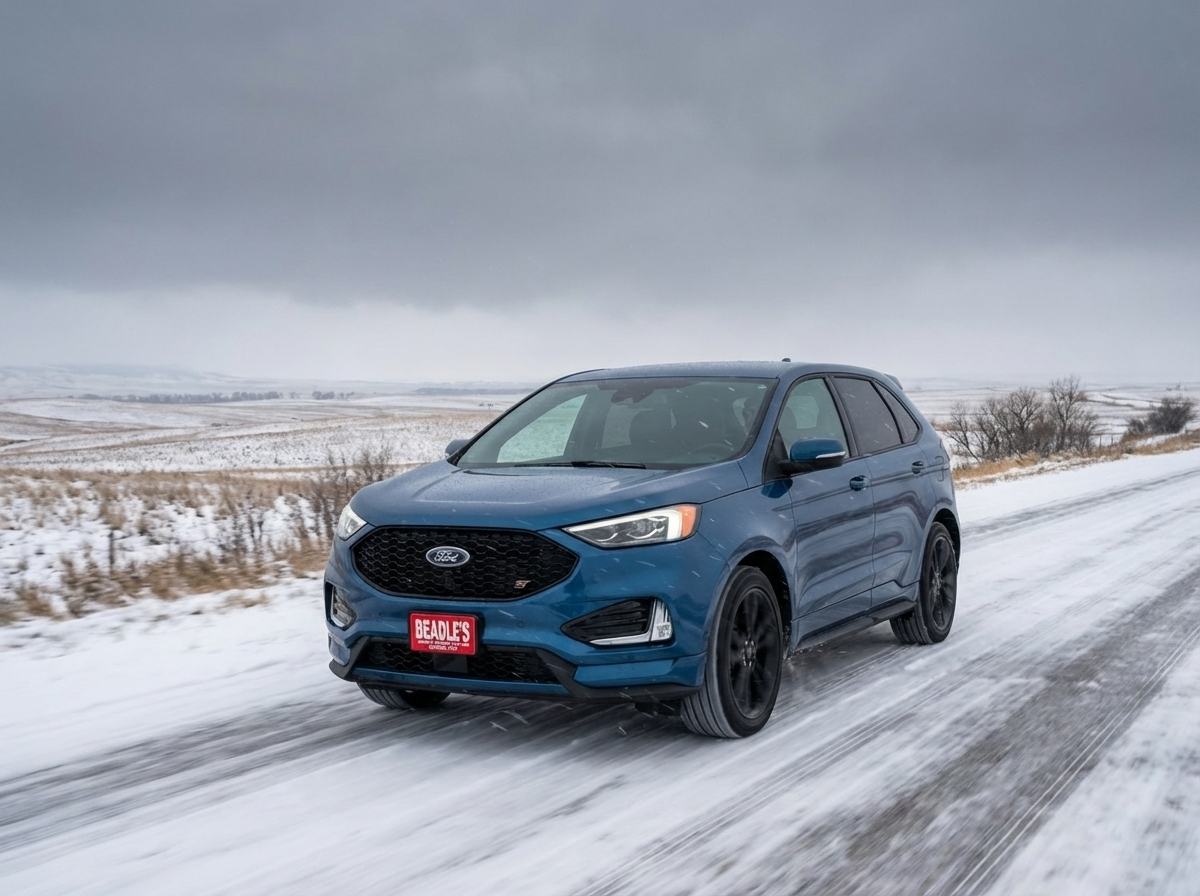
Best Ford SUV for South Dakota Families: Edge, Escape, Bronco Sport, or Explorer?
Choosing the right SUV for your South Dakota family means balancing winter driving, gravel roads, cargo needs, and budget. We’ve tested and researched all four of Ford’s best family SUVs to help you find your perfect fit.
South Dakota families face unique challenges: long highway drives between towns, winter snow and ice, gravel county roads, and the need to haul gear for camping, sports, and ranch work. Your SUV choice matters.
Ford offers four excellent family SUVs, each with a different profile. This guide compares them side by side so you can skip the confusion and find the one that matches your family’s lifestyle, budget, and adventures.
Whether you need a nimble compact for city runs, a versatile midsize for balanced duty, or a spacious three-row for road trips, we’ll walk you through the specs, real-world performance in SD conditions, and scenarios where each shines.
In This Guide
Ford Escape: The Compact, Budget-Smart Choice
The Escape is Ford’s most affordable SUV option and a favorite for couples, small families, and first-time SUV buyers in South Dakota. It offers surprising versatility in a tight footprint.
Escape Specs at a Glance
- Class: Compact crossover SUV
- Drivetrain: FWD standard, AWD optional on most trims
- Engines: 1.5L EcoBoost (180 hp), 2.0L EcoBoost (250 hp), 2.5L Hybrid (192 hp), 2.5L Plug-in Hybrid (210 hp)
- Cargo: 37.5 cu ft (behind rear seats), 65.4 cu ft (fully folded) — gas models
- Towing: 2,000 lbs (1.5L), 3,500 lbs (2.0L EcoBoost), 1,500 lbs (Hybrid/PHEV)
- Tech: 8”–13.2” touchscreen, Ford Co-Pilot360 (varies by trim)
- Fuel Economy: Hybrid: 42 city / 36 hwy. PHEV: 101 MPGe
Why Families Love the Escape
Easy to drive and park: Smaller than the Edge and Explorer, it feels confident on narrow county roads and in tight parking situations around Bowdle and surrounding towns.
Winter traction: Optional AWD handles South Dakota snow well, and the lower price means easier repairs if you need winter service.
Hybrid and plug-in options: If you spend a lot of time in town, the hybrid models save significantly on fuel. The 2.5L Hybrid gets an impressive 39 mpg combined in AWD.
Good for daily driving: School runs, errands, weekend getaways — the Escape handles everything South Dakota families throw at it.
Escape Challenges for SD Families
Limited towing: Max 3,500 lbs (with 2.0L EcoBoost), which means you can’t haul mid-size boats or trailers. Forget about towing a cabin trailer or horse trailer.
Tight cargo space: 65.4 cu ft isn’t much for a week-long camping trip or hauling sports equipment for multiple kids.
Short driving range on long highway trips: Between fuel stops from Bowdle to Rapid City or northeast to the lakes, you’ll stop often.
Ford Bronco Sport: The Off-Road Adventurer
The Bronco Sport is purpose-built for families who love gravel roads, camping, and exploring backcountry spots across South Dakota. It’s compact, tough, and equipped with Ford’s famous G.O.A.T. (Goes Over Any Terrain) modes.
Bronco Sport Specs at a Glance
- Class: Compact SUV, all-terrain focused
- Drivetrain: 4×4 standard (no FWD option)
- Engines: 1.5L EcoBoost (181 hp), 2.0L EcoBoost (250 hp)
- Cargo: 32.5 cu ft (behind rear seats), 65.2 cu ft (fully folded)
- Towing: 2,200 lbs (1.5L), 2,700 lbs (2.0L Badlands)
- G.O.A.T. Modes: Sand, Slippery, Sport, Eco, Normal; Badlands adds Mud/Ruts & Rock Crawl
- Tech: Ford Co-Pilot360, available 13.2” touchscreen
Why Adventurous Families Choose the Bronco Sport
All-terrain confidence: Standard 4×4 and G.O.A.T. modes mean you can handle gravel roads to remote camping spots, muddy ranch access roads, and sandy creek beds with confidence.
Badlands trim for serious off-road: The Badlands adds rock crawl, mud/ruts modes, and locking diffs, making it ready for extreme terrain adventures in the Black Hills and beyond.
Compact but capable: Small enough to be nimble, tough enough to handle backcountry roads that bigger SUVs avoid.
Fun factor: Kids love the adventure vibe, and parents appreciate the genuine 4×4 hardware rather than a pretend outdoor package.
Bronco Sport Trade-offs
Lower towing capacity: Max 2,700 lbs (Badlands only), so no large trailers or boats.
Compact cargo space: 65.2 cu ft is tight for week-long trips with a family of four or more.
Slightly higher fuel costs: 4×4 standard means less fuel economy than a comparable FWD vehicle. Plan for around 22–24 mpg highway.
Ford Edge: The Midsize Sweet Spot (Best Value)
The Ford Edge is the goldilocks SUV for South Dakota families: bigger than the Escape and Bronco Sport, more affordable than the Explorer, and loaded with premium features as standard. It’s purpose-built for families who want space, comfort, and value.
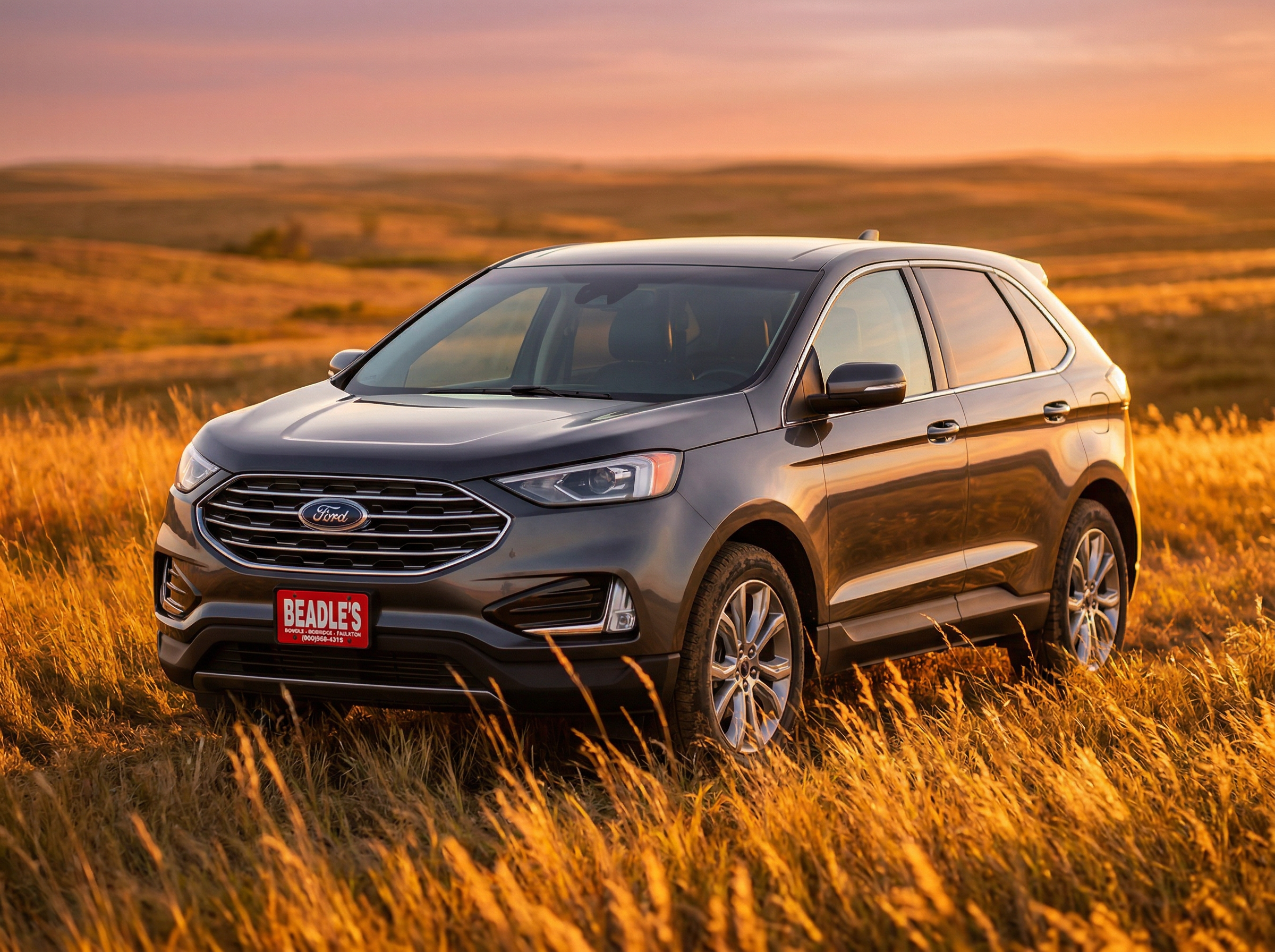
Edge Specs at a Glance
- Class: Midsize SUV, 2-row seating (5 passengers)
- Drivetrain: All-wheel drive (AWD) standard on all trims
- Engines: 2.0L EcoBoost (250 hp), 2.7L V6 EcoBoost (335 hp) on ST trim
- Cargo: 39.2 cu ft (behind rear seats), 73.4 cu ft (fully folded)
- Interior Roominess: Front legroom 42.6”, rear 40.6”; front shoulder room 60.3”, rear 60.5”
- Towing: 1,500 lbs (standard 2.0L), 3,500 lbs (2.7L V6 ST)
- Tech: SYNC 4A with 12” touchscreen, wireless Apple CarPlay & Android Auto, Co-Pilot360+ standard
- Note: Edge is discontinued (2024 was final year). Best Edge deals are used 2021–2024 models.
Why the Edge is South Dakota’s Best Midsize Value
All-wheel drive standard: No need to upgrade for winter traction. Every Edge comes with AWD, giving you confidence in South Dakota snow and ice.
Loaded with premium tech: SYNC 4A 12” screen, wireless CarPlay/Android Auto, and Co-Pilot360+ (adaptive cruise, lane centering, automatic parking) come on all trims. You’re not buying stripped-down versions.
Generous cargo: 73.4 cu ft fully folded beats the Escape and Bronco Sport, matches the base Explorer, and fits a week of camping gear plus sports equipment.
Comfortable seating for five: 40.6” of rear legroom means kids and passengers sit comfortably on long highway drives across SD.
Towing flexibility: Standard 2.0L handles 1,500 lbs (small trailers, jet skis). ST trim with 2.7L V6 hits 3,500 lbs, perfect for mid-size boats.
Exceptional used market: Because production ended, 2021–2024 used Edges are plentiful and priced 20–30% below comparable new competitors. You get nearly-new cars with dealer warranties at incredible value.
Edge Considerations
Used only: Ford discontinued the Edge in 2024, so new inventory is gone. But that’s actually good news — we have quality used examples with low miles at fantastic prices.
No third row: The Edge seats five max. If you need room for six or seven, the Explorer is your answer.
V6 power for heavier towing: If you want to tow 3,500 lbs, you need the ST trim with the 2.7L V6. The base 2.0L EcoBoost maxes out at 1,500 lbs.
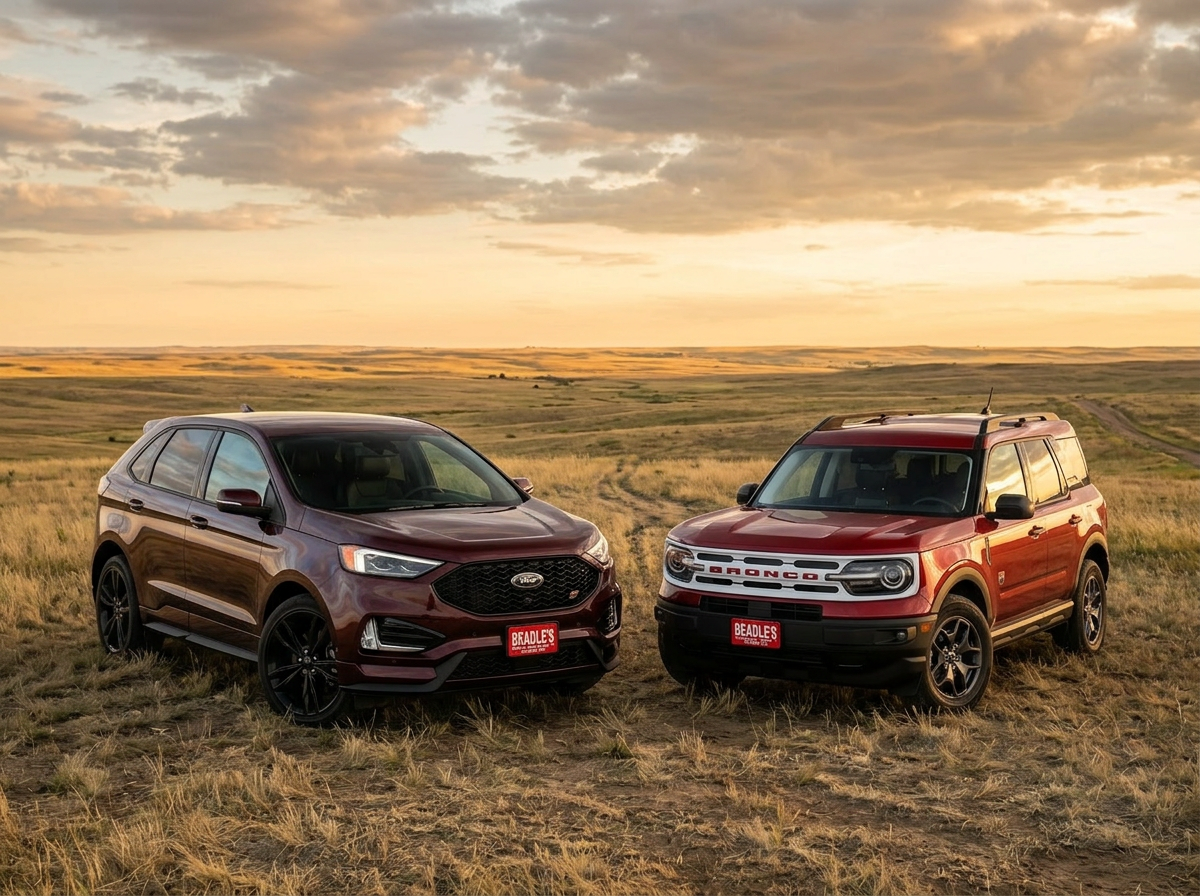
Ford Explorer: The Full-Size Family Power Player
The Explorer is Ford’s flagship three-row family SUV. If you need seven seats, serious towing power, and maximum cargo space, the Explorer is built for you. It’s the choice for large families and those who tow boats to Lake Oahe or haul horse trailers.
Explorer Specs at a Glance
- Class: Full-size SUV, three-row, up to seven passengers
- Drivetrain: RWD standard, AWD available
- Engines: 2.3L EcoBoost (300 hp), 3.0L Twin-Turbo V6 (400 hp)
- Cargo: 18.2 cu ft (all rows), 48 cu ft (3rd row folded), 87.8 cu ft (all rear folded)
- Towing: 5,000 lbs standard with Class III Tow Package; 2024 models up to 5,600 lbs
- Tech: 8”–13.2” touchscreen, Ford Co-Pilot360, available hands-free PowerFold third row
- Seating: Standard E-Z Entry second-row seats for easy third-row access
Why Larger SD Families Choose the Explorer
Genuine three-row seating: Seat five comfortably, or squeeze in seven. Perfect for big families, grandparent road trips, or active families with multiple kids and friends.
Massive cargo capacity: 87.8 cu ft with all seats folded is 14+ cu ft more than the Edge. Haul a week’s worth of camping gear, sports equipment, or ranch supplies.
Serious towing: 5,000 lbs base (5,600 lbs available) handles large fishing boats for Lake Oahe, horse trailers, and serious recreational equipment.
Powerful engines: Choose between the efficient 2.3L EcoBoost (300 hp) or the muscular 3.0L Twin-Turbo V6 (400 hp). The V6 is perfect if you tow large boats or drive heavily loaded.
Easy third-row access: Standard E-Z Entry second row slides and tilts forward, plus available PowerFold third-row seats make setup effortless with kids and car seats.
Explorer Trade-offs
Larger fuel consumption: Expect 24–28 mpg on highway with the 2.3L, less with the V6. Budget more for gas.
Bigger price tag: Base Explorer starts several thousand more than an Edge or Escape. But the space and capability justify the cost for growing families.
RWD standard means AWD is an upgrade: If you want AWD for South Dakota winter confidence, budget extra. Most buyers choose AWD in our climate.
Master Comparison: All Four Ford SUVs Side by Side
| Feature | Escape | Bronco Sport | Edge | Explorer |
|---|---|---|---|---|
| Class | Compact | Compact | Midsize | Full-size |
| Seating | 5 | 5 | 5 | 5–7 |
| Drivetrain | FWD std / AWD opt | 4×4 standard | AWD standard | RWD std / AWD opt |
| Cargo (max) | 65.4 cu ft | 65.2 cu ft | 73.4 cu ft | 87.8 cu ft |
| Towing Max | 3,500 lbs | 2,700 lbs | 3,500 lbs (ST) | 5,600 lbs |
| Tech Highlight | Hybrid / PHEV options | G.O.A.T. Modes | SYNC 4A, CarPlay std | PowerFold 3rd row |
| New or Used? | New available | New available | Used only (2021–24) | New & Used |
| Best For | Budget, fuel economy | Off-road, adventure | Value, balance | Large families, towing |
Which Ford SUV Fits Your South Dakota Family?
Scenario 1: “Just the Two of Us (Plus a Dog)”
Best choice: Ford Escape or Bronco Sport. Both seat five and offer excellent fuel economy. The Escape with FWD and a 1.5L or 2.0L EcoBoost is nimble, affordable, and easy on gas. The Bronco Sport with its standard 4×4 is perfect if you enjoy gravel-road adventures and camping in the Black Hills. Either hauls your camping gear, kayaks, or fishing equipment with ease.
Scenario 2: “Family of Four – School, Errands, Weekend Trips”
Best choice: Ford Escape or Ford Edge. The Escape gives you excellent value and fuel economy for daily driving. The Edge is the goldilocks option: more space than the Escape, better cargo (73.4 cu ft), standard AWD for South Dakota winter, and premium tech (SYNC 4A, wireless CarPlay) included. If you want the newest model and don’t mind a used purchase, a 2023–2024 Edge is an unbeatable value. Escape Hybrid models hit 39 mpg combined if you want maximum fuel economy.
Scenario 3: “Weekend Adventurers – Camping, Gravel Roads, Remote Spots”
Best choice: Ford Bronco Sport (especially Badlands trim). The Bronco Sport’s standard 4×4, G.O.A.T. modes, and Badlands rock crawl mean you can confidently explore remote camping areas, old mining roads, and rugged terrain across South Dakota and Wyoming. The compact size makes tight forest roads manageable. Pair it with a roof rack and you’ve got the perfect weekend adventure machine.
Scenario 4: “Family of Five or More – Sports Gear, Friends, Extended Trips”
Best choice: Ford Explorer (7-seater). Need to haul three kids, their sports equipment, a grandmother, and a friend? The Explorer seats seven and offers 87.8 cu ft of cargo with all seats folded. It’s comfortable for long highway drives from Bowdle to the Black Hills or beyond. The PowerFold third-row seats make setup painless with kids and car seats.
Scenario 5: “Towing a Boat to Lake Oahe (or Horse Trailer)”
Ford Edge ST (3,500 lbs) or Ford Explorer (5,000–5,600 lbs). Small to mid-size boats? The Edge ST with its 2.7L V6 handles 3,500 lbs. Larger boats or horse trailers? The Explorer’s 5,600 lbs capacity handles almost anything South Dakota families need to pull. Both offer the comfort and tech to enjoy the lake trip, not just survive it.
Scenario 6: “Budget-Conscious, Best Bang for the Buck”
Used Ford Edge (2021–2024). This is the hidden gem of the Ford SUV lineup. Because production ended, used Edges are abundant and priced 20–30% below new competitors. You get a midsize SUV with standard AWD, SYNC 4A, wireless CarPlay/Android Auto, and 73.4 cu ft of cargo at prices that beat a new Escape. If you’re smart, you buy a used Edge with low miles and a dealer warranty. It’s the best-value family SUV on the market right now.
Key Takeaways
- Escape: Most affordable, great fuel economy, best for couples and small families.
- Bronco Sport: Purpose-built for off-road adventure and gravel roads; standard 4×4 and G.O.A.T. modes.
- Edge: Best midsize value (especially used); standard AWD, premium tech, 73.4 cu ft cargo.
- Explorer: Three-row power player; seats up to seven, tows 5,600 lbs, maximum cargo space.
- South Dakota winters: All four offer AWD or 4×4 options; Bronco Sport and Edge lead in standard all-weather traction.
- Best overall value: Used Ford Edge — discontinued model means abundant inventory and strong pricing.
Frequently Asked Questions
Which Ford SUV is best for South Dakota winters?
The Ford Edge has the winter advantage: all-wheel drive is standard on every model, year, and trim. You don’t need to pay extra for winter traction. The Bronco Sport is a close second with standard 4×4 and G.O.A.T. modes. Both inspire confidence on snow and ice. The Escape and Explorer require AWD upgrades, which adds cost.
Can I tow a boat with any of these?
Yes, but capacity varies. Escape (2.0L): up to 3,500 lbs. Bronco Sport: up to 2,700 lbs (not ideal for heavy boats). Edge ST (2.7L V6): 3,500 lbs (good for mid-size boats). Explorer: 5,000–5,600 lbs (handles large boats and horse trailers). For a 20–24 ft boat at Lake Oahe, the Explorer is your safest bet.
Is the Ford Edge really discontinued?
Yes. Ford ended Edge production in 2024. This has created an excellent used-market opportunity: quality 2021–2024 examples are available at 20–30% below the cost of comparable new vehicles, and many still have remaining powertrain warranty coverage. For budget-conscious buyers, a low-mileage used Edge represents strong value in the current market.
How much cargo space do I really need?
A practical guide: 65 cu ft (Escape/Bronco Sport) fits a week of camping gear for a family of four, plus sports equipment. 73 cu ft (Edge) adds meaningful breathing room for gear-heavy trips. 87 cu ft (Explorer) handles extended family trips with everyone’s luggage plus extra cargo. If you take frequent road trips or haul ranch or farm equipment, 75+ cu ft is the better target.
What’s the real-world fuel economy for each model?
Escape (1.5L FWD): 28–30 mpg highway; (2.0L AWD): 26–28 mpg; (Hybrid): 39 mpg combined. Bronco Sport (4×4): 22–24 mpg highway. Edge (AWD): 28–30 mpg highway. Explorer (2.3L RWD): 26–28 mpg; (V6): 24–26 mpg. For long highway drives across South Dakota, the Escape Hybrid is the most fuel-efficient option. The Edge balances efficiency with cargo capacity.
Do I need the 2.0L EcoBoost or is the 1.5L enough?
For daily driving, school runs, and light towing, the 1.5L EcoBoost is adequate. The 2.0L delivers noticeably better power for highway merging, loaded driving, and towing up to 3,500 lbs. If towing is a regular part of your use case, or you frequently drive fully loaded, the 2.0L upgrade is worth the added cost for Escape and Bronco Sport buyers.
My Take on Finding the Right Ford SUV for a South Dakota Family
Researching all four of these vehicles, the clearest takeaway is that the decision depends almost entirely on use case—and that most South Dakota families I’ve analyzed the data for are better served by the Edge or Escape than they initially expect. The Edge in particular stands out as a value opportunity right now. Because production ended in 2024, used 2021–2024 inventory is available at prices that are genuinely hard to match in this segment: standard AWD across all trims, premium tech included, and 73+ cu ft of cargo space at used-vehicle pricing.
The Bronco Sport earns its place for families who actually use off-road capability—gravel roads, camping, backcountry access. The Explorer is the right answer when three rows are genuinely needed on a regular basis, or when towing capacity above 3,500 lbs is a real requirement. The Escape makes the most sense when fuel economy and a lower price point are the primary drivers.
The scenarios in this guide are designed to cut through the marketing and focus on how these vehicles actually perform in the conditions South Dakota families deal with every day. Match the vehicle to your real use, not the hypothetical one.
About the Author
Lexy Tabbert — Beadle Ford, Bowdle, SD
Lexy Tabbert is the Director of Sales and Marketing at Beadle Ford in Bowdle, South Dakota. She covers Ford vehicles, trim comparisons, and buyer guidance — helping families, ranchers, and ag operators across the region find the right truck and configuration for their needs. Learn more about Lexy.
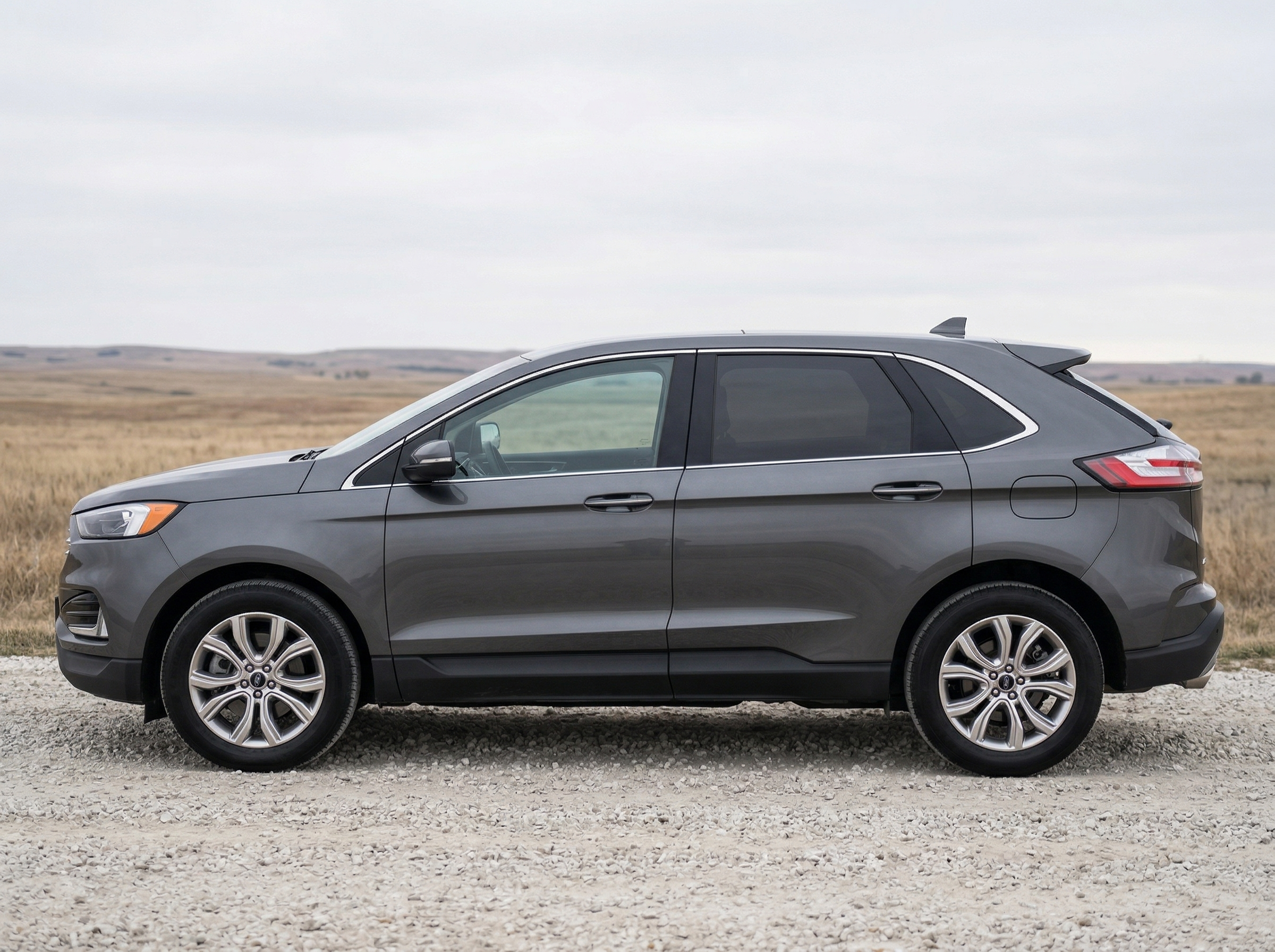
Ford Edge vs. Explorer: Do You Actually Need Three Rows?
You’re shopping for a midsize Ford SUV, and the decision feels straightforward: the Explorer has three rows, the Edge has two. More seats must mean more value, right? Not necessarily. For buyers across South Dakota’s ranches, rural routes, and small towns, the real choice comes down to how you actually use the vehicle, what you tow, and whether you’re paying for capacity you’ll never use.
At Beadle Ford in Bowdle, we help families and operators understand the honest difference. This guide cuts through the noise.
Interior Space & Legroom: The Surprise Winner
The most surprising discovery when you sit in both vehicles? The Edge’s second row is actually competitive with the Explorer’s. Many buyers assume the third row means more space everywhere, but that’s not how midsize SUVs work.
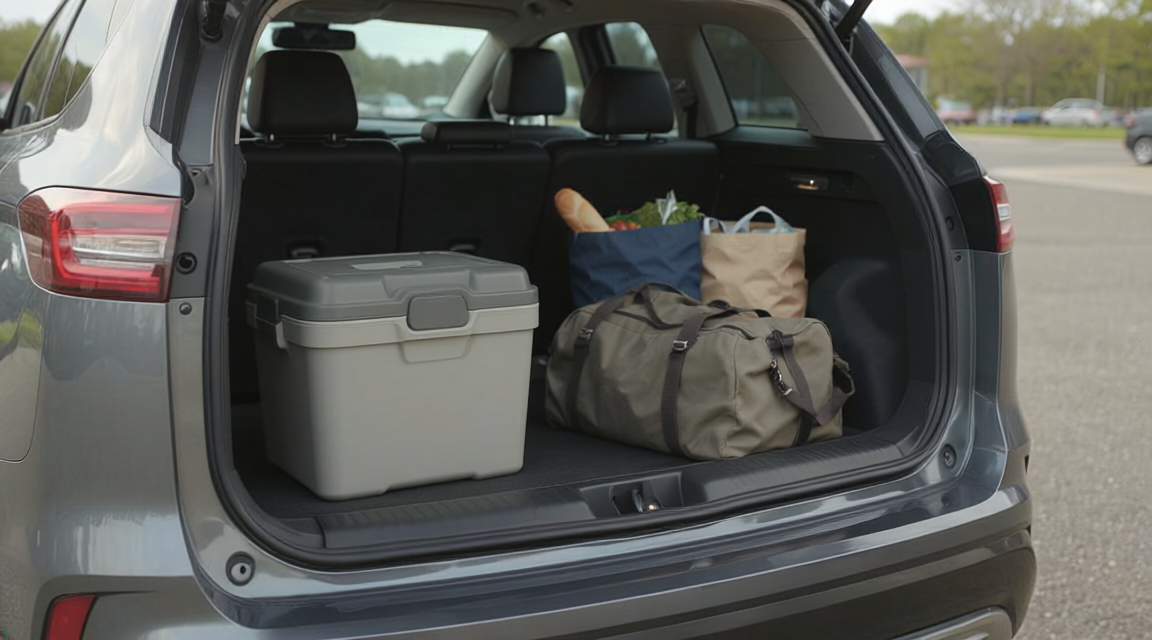
Edge Interior Dimensions:
- Front legroom: 42.6 inches
- Rear legroom: 40.6 inches
- Five-seat configuration (midsize 2-row)
- All trims standard with AWD
Explorer Interior Dimensions:
- Front legroom: competitive with Edge
- Second-row legroom: comparable
- Third row: tight, best for children or short-distance adult passengers
- Seven-seat standard; RWD base, AWD on higher trims
If you have a family of five or fewer, or if passengers don’t regularly sit in the third row, the Edge delivers the same comfort in the front and second rows with a cleaner, simpler driving experience. The Explorer’s third row exists, but many Bowdle-area families tell us it spends more time folded down than occupied.
Cargo Capacity: Different Jobs, Different Winners
Here’s where the comparison gets interesting. The Edge actually has a surprising cargo advantage for certain uses.
| Cargo Metric | Edge | Explorer |
|---|---|---|
| Behind 2nd/3rd row | 39.2 cu ft (both rows up) | 18.2 cu ft (all rows up) |
| 2nd row folded | 73.4 cu ft | 47.9 cu ft (3rd row up) |
| All rows folded | 73.4 cu ft (2-row, no 3rd) | 87.8 cu ft |
What this means: If you regularly haul lumber, farm equipment, gear, or full loads for work, the Edge gives you significantly more usable space with the second row up. You don’t have to fold seats flat to move a pallet or load of feed. The Explorer wins only if you need maximum volume and can fold all seats flat, which defeats the purpose of having seven seats.
For South Dakota ranchers and operators, this advantage matters. The Edge is built for the job; the Explorer is built for the idea of a job.
Towing & Power: Explorer Takes the Lead
If towing is non-negotiable, the Explorer has a clear advantage.
| Spec | Edge | Explorer |
|---|---|---|
| Base Towing | 1,500 lbs | 5,000 lbs standard |
| Max Towing | 3,500 lbs (ST with Class II) | 5,000 lbs (all engines) |
| Engine Options | 2.0L EcoBoost (250hp) or 2.7L V6 (335hp) | 2.3L EcoBoost (300hp) or 3.0L Twin-Turbo (400hp) |
| Class III Tow Package | ST trim only (Class II) | Standard on all models |
The Reality: If you’re hauling a small utility trailer, a motorcycle trailer, or light agricultural loads under 3,000 lbs, the Edge works. If you need to pull a larger boat, livestock trailer, or equipment regularly, the Explorer is the right choice. The towing gap is real and meaningful.
For ranches across South Dakota, the Explorer’s Class III standard tow package and higher capacity make it the practical choice when heavy pulling is part of the job.
Price & Value: Edge Offers Used-Market Strength
Ford discontinued the Edge in April 2024, which means one critical fact: the Edge is now available only on the used market. This creates a significant value difference.
Edge Pricing Reality:
- 2023–2024 models available used at major discounts from original MSRP
- Low mileage models still within factory warranty
- Buyers get a nearly-new midsize SUV for $25,000–$35,000 depending on condition and year
- Monthly payments typically $400–$550 financed
Explorer Pricing Reality:
- 2025–2026 new models start around $35,000–$40,000 for base trims
- Popular ST and Platinum trims run $45,000–$55,000+
- Monthly payments typically $600–$900+ financed
- Full manufacturer warranty on all new units
The Math for Bowdle-Area Buyers: If you’re budget-conscious and want a low-mileage, reliable midsize SUV that handles daily driving and light towing, a used Edge from 2023–2024 costs $200–$300 less per month than a new Explorer. That’s $2,400–$3,600 per year. Over five years, that’s $12,000–$18,000 in savings. For families stretched on a budget, that difference matters.
Real-World Use: What South Dakota Drivers Actually Do
After years of selling both vehicles across South Dakota’s ranching and rural communities, we’ve learned how buyers actually use these SUVs.
Choose the Edge if you:
- Are a couple or family of three to five
- Want competitive second-row legroom and comfort
- Need strong cargo space with seats up (farm supplies, feed, equipment)
- Tow light to moderate loads (under 3,000 lbs)
- Prioritize fuel efficiency and daily driving simplicity
- Are budget-conscious and want lower monthly payments
- Enjoy easy parking and maneuverability in town
Choose the Explorer if you:
- Have a family of six to seven who actually ride together regularly
- Need to haul larger trailers or equipment (3,000+ lbs)
- Want the maximum flexibility of three usable rows
- Prefer a new vehicle with full manufacturer warranty
- Are willing to accept slightly larger fuel consumption for capability
- Want the latest tech (2025–2026 infotainment and safety features)
The Honest Take: Most buyers we work with in Bowdle and the surrounding area fall into the Edge category. Couples, young families with young children, and business owners who need cargo space but don’t regularly tow heavy loads. The Explorer is the right choice only when those three rows are actually used, not just available. It’s about matching the vehicle to your real life, not paying for capacity you’ll never use.
Frequently Asked Questions
Can the Edge’s third row be added later?
No. The Edge is engineered as a two-row vehicle. Ford does not offer a third-row retrofit or accessory. The platform, wheelbase, and interior design do not accommodate a third row. If you think you’ll need a third row in the future, the Explorer is the only choice.
Is the Explorer’s third row comfortable for adults?
The Explorer’s third row is designed for children or adults on short trips. Legroom is tight, and headroom is limited. For a cross-state drive or full day of driving, adults will be uncomfortable. It’s truly an occasional-use feature. Many owners fold it down immediately and use the expanded cargo space instead.
Which SUV has better fuel economy?
The Edge generally achieves slightly better fuel economy due to its lighter weight and smaller engines. The 2.0L EcoBoost Edge on AWD averages around 23–25 MPG highway, while the 2025 Explorer 2.3L EcoBoost ranges around 20–23 MPG. The difference compounds over time. For frequent highway miles across South Dakota, the Edge saves fuel costs.
Why was the Ford Edge discontinued?
Ford discontinued the Edge to focus on the Explorer and expand their truck and performance-oriented SUV lines. The decision reflects market trends toward larger SUVs and electric vehicles, but it doesn’t mean the Edge is a bad vehicle. Many Bowdle-area owners keep their Edges well past 150,000 miles. The discontinuation just means used market prices and availability will gradually tighten.
Does Beadle Ford have used Edges in stock?
Yes. Beadle Ford maintains inventory of used Ford Edges from recent model years. Availability varies, but we work with regional and franchise resources to locate specific models and configurations. Check our current Edge inventory, or contact the team at (605) 285–6202 if you’re looking for a specific year or trim.
Can I test drive both to decide?
Yes. Back-to-back test drives of both vehicles reveal the differences in interior space, cargo layout, driving position, and steering feel immediately. It’s the most reliable way to determine which vehicle fits your lifestyle. Contact Beadle Ford to schedule a drive.
Key Takeaways
- Interior Space: The Edge’s second row is competitive with the Explorer’s. Five-seat comfort rivals seven-seat flexibility for most families.
- Cargo: The Edge wins for working loads (39.2 cu ft seats-up). The Explorer only wins when all rows fold flat.
- Towing: Explorer dominates with 5,000-lb standard towing vs. Edge’s 1,500–3,500-lb range. Non-negotiable for heavy haulers.
- Cost: Used Edge models cost $200–$300 per month less than new Explorers. A significant five-year savings for budget-aware buyers.
- Daily Use: Most Edge owners say they never missed the third row. Most Explorer owners fold the third row and wish they had the Edge’s cargo space.
- Best Question: Do you actually need three rows, or are you paying for what sounds good? That answer determines your choice.
My Take on the Edge vs. Explorer
Researching this comparison, the question that consistently separates the right answer from the wrong one is straightforward: how many people are actually riding together on a regular basis? For families of five or fewer, the data points clearly toward the Edge—more usable cargo space with seats up, a lower price point in the current used market, and a smaller footprint that’s easier to manage on rural routes and in town.
The Explorer makes sense when those third-row seats are genuinely needed—regular carpooling with six or seven passengers, or when towing heavier loads is a consistent requirement. The 5,000-lb standard tow rating is a real advantage for ag operators and families pulling larger trailers across South Dakota.
Both vehicles are well-built and well-supported. The decision comes down to matching the capability to the actual use case—not the hypothetical one.
About the Author
Lexy Tabbert — Beadle Ford, Bowdle, SD
Lexy Tabbert is the Director of Sales and Marketing at Beadle Ford in Bowdle, South Dakota. She covers Ford vehicles, trim comparisons, and buyer guidance — helping families, ranchers, and ag operators across the region find the right truck and configuration for their needs. Learn more about Lexy.
Connect with us

