
Blog / New Vehicles

Blog

All New Vehicles Bowdle Ford Dealer Bowdle Ford Service
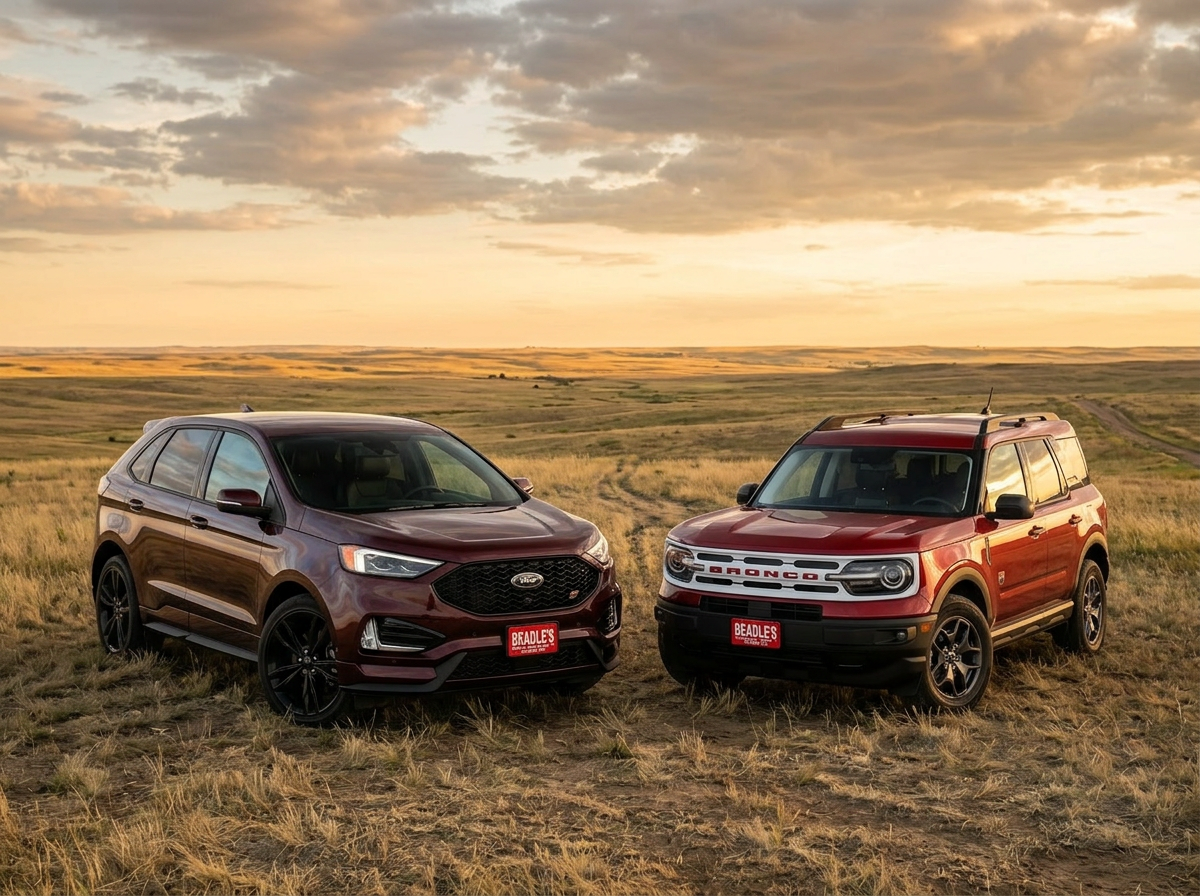
Ford Edge vs Bronco Sport vs Escape comparison Bowdle SD

Ford Edge vs. Bronco Sport vs. Escape: Which SUV Actually Fits Your Life?

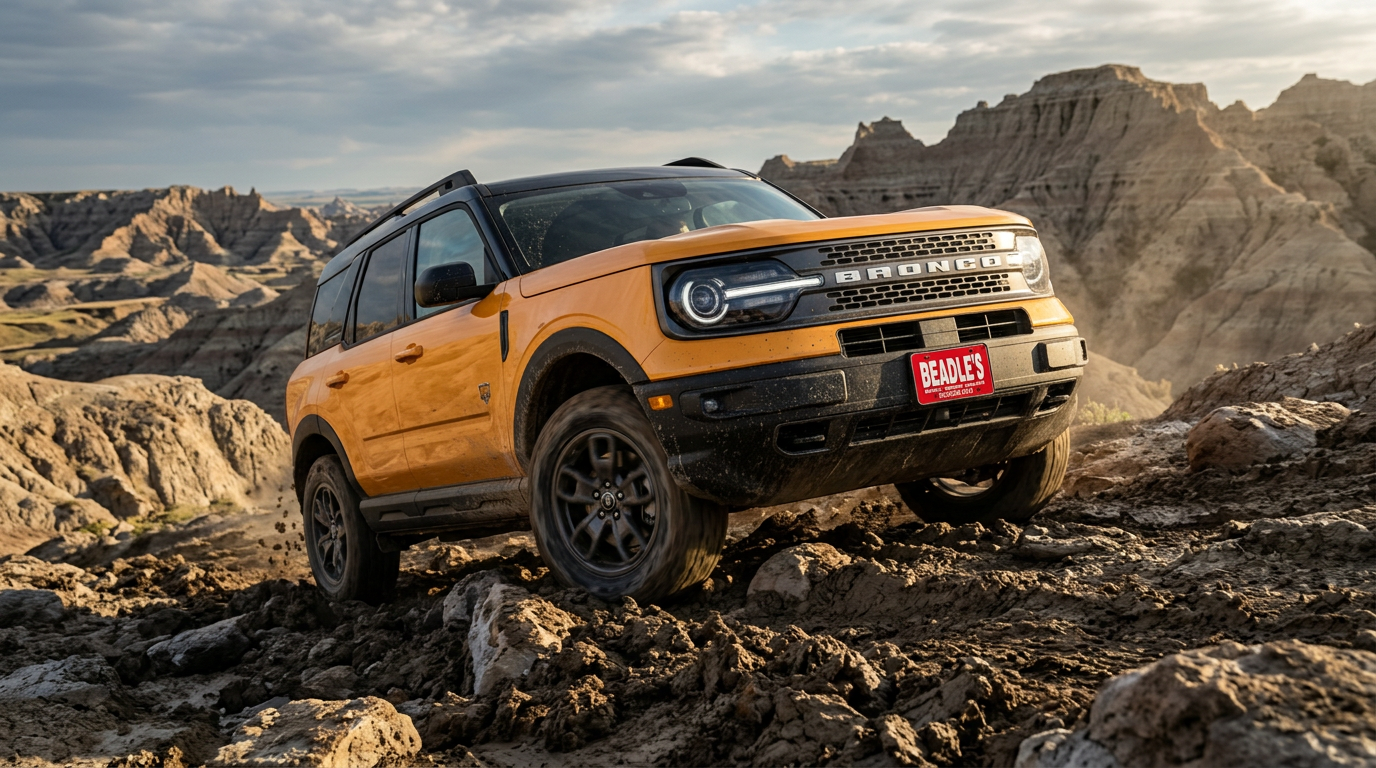
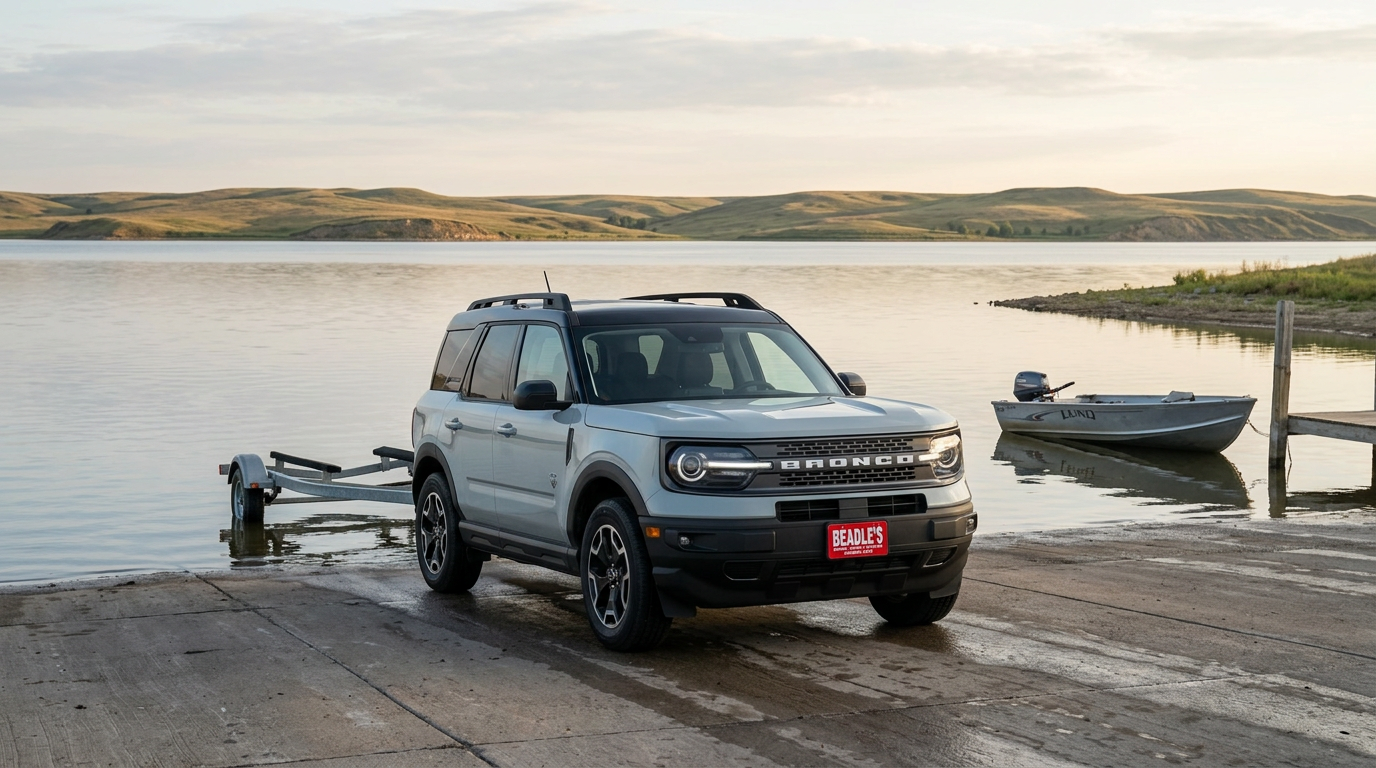
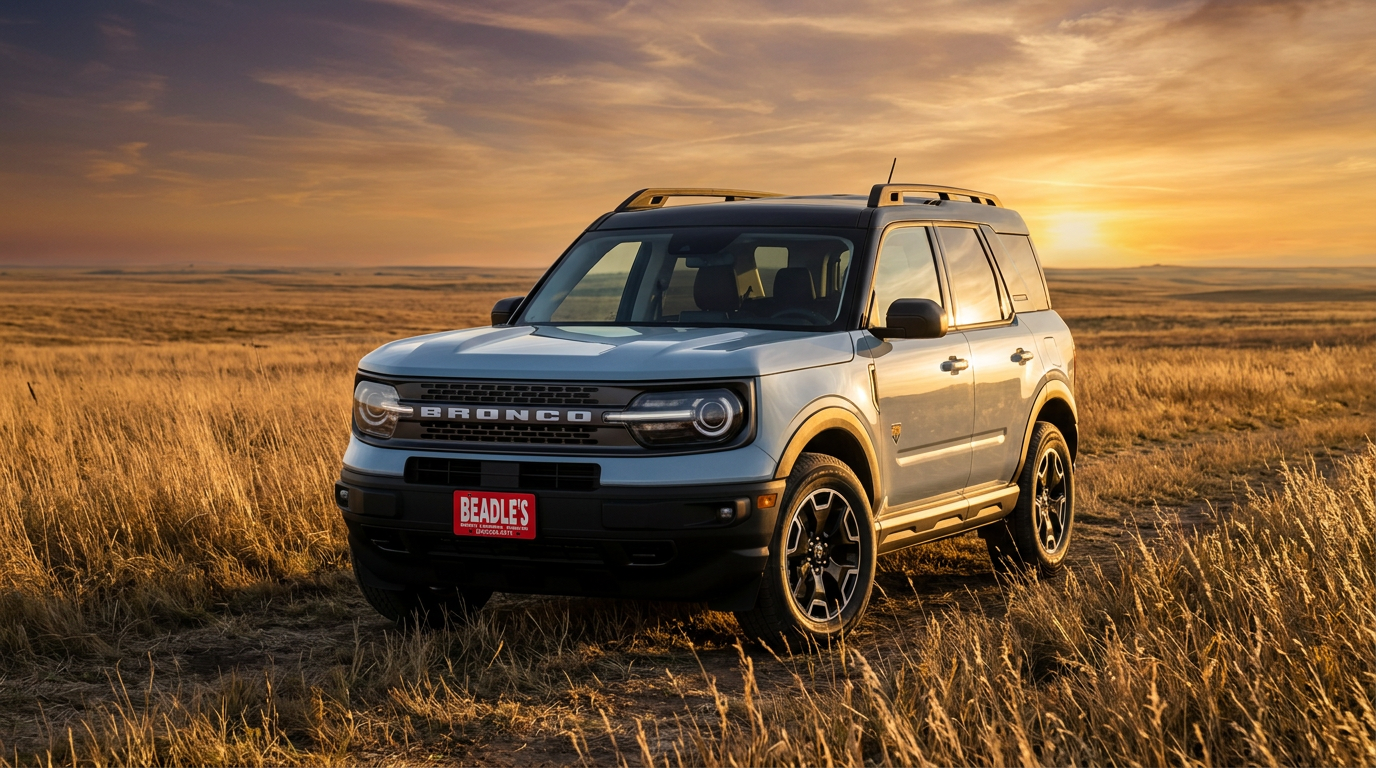
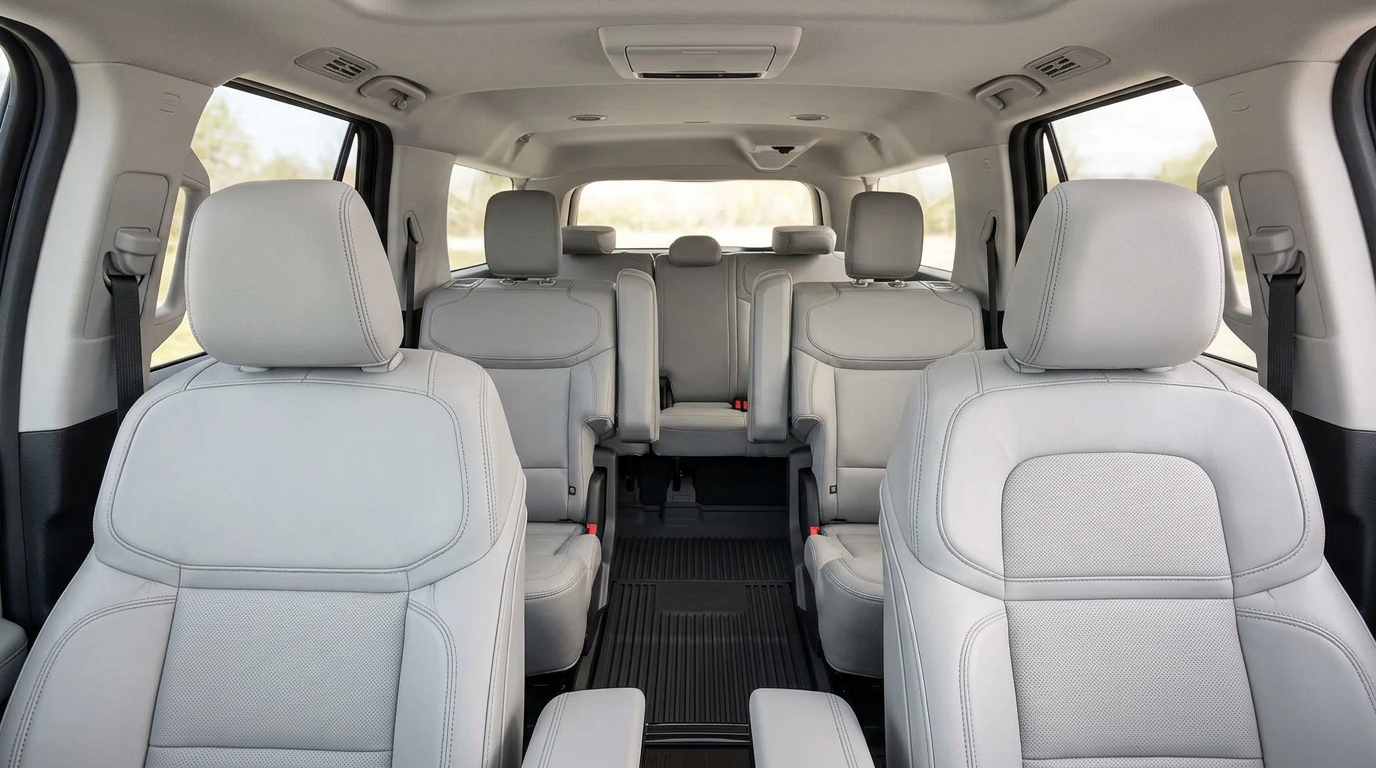
Ford Edge vs. Bronco Sport vs. Escape: Which SUV Actually Fits Your Life? Three Ford powerhouses. Three different answers. Here’s how to pick the right one for your Bowdle family, ranch, or weekend adventures. You’re standing at a crossroads. You want a Ford SUV—reliable, capable, built for South Dakota winters and gravel roads—but which one actually fits your life? The Edge promises space and luxury. The Bronco Sport delivers off-road attitude and new availability. The Escape brings efficiency and nimble handling. All three are solid choices. None is obviously “best.” At Beadle Ford in Bowdle, we live with these vehicles daily. We know what our customers tow (grain trailers, boats on Lake Oahe, ATV trailers), what they navigate (two-lane highways, frozen roads, rural ranch driveways), and what they need inside (family comfort, tech, cargo room). This guide cuts through the specs and gives you the truth: what each SUV wins at, who it’s actually for, and whether it makes sense for your wallet and your life. Shop Edges in Stock Get Pre-Approved In This Guide Quick Spec Comparison The Edge: Space Meets Refinement The Bronco Sport: Off-Road Attitude The Escape: Efficient & Nimble Master Comparison Table Key Takeaways for SD Buyers FAQ: Common Questions Answered Quick Spec Comparison At a glance, here’s where these three stand. (Full details in the master table below.) Ford Edge Size: 3-row full-size SUV Seating: 5 passengers Towing: 1,500–3,500 lbs Cargo: 39.2 cu ft Drivetrain: AWD standard Status: Used only Bronco Sport Size: Compact SUV Seating: 5 passengers Towing: 2,200–2,700 lbs Cargo: 32.5 cu ft Drivetrain: 4x4 standard Status: Available new Escape Size: Compact crossover Seating: 5 passengers Towing: 1,500–3,500 lbs Cargo: 33.5–65.4 cu ft Drivetrain: FWD/AWD/Hybrid Status: Available new The Ford Edge: Space Meets Refinement Who It’s For: The Edge is built for families who need genuine three-row seating, highway cruising comfort, and all the modern tech without the truck headaches. Think large families, grandparent hauling, long-distance road trips, and Lake Oahe vacations. The Edge trades raw off-road prowess for daily-driver refinement—heated leather seats, quiet cabins, and a premium feel. Engine & Power The Edge comes in two powerplants. The standard 2.0L EcoBoost I-4 delivers 250 horsepower and 280 lb-ft of torque with an 8-speed automatic. Prefer more muscle? The ST trim steps up to a 2.7L V6 with 335 horsepower and 380 lb-ft, pairing to a 7-speed unit. Both feel spirited on the highway and genuinely smooth in traffic. All models come standard with AWD. Towing & Cargo The Edge can tow 1,500 lbs base, or up to 3,500 lbs when equipped with a Class II hitch (ST trim also supports Class II). Max tongue weight is 350 lbs. Cargo space sits at 39.2 cubic feet behind the rear seats, or 73.4 cubic feet with rows folded—enough for serious hauling without needing a truck. For Bowdle farmers and ranchers, this towing capacity handles smaller grain trailers, boat towing (Lake Oahe is 30 minutes away), and ATV trailers. Not heavy-duty, but genuinely capable for family needs. Interior & Tech SYNC 4A 12” touchscreen is standard across all trims, with wireless Apple CarPlay and Android Auto built in. Co-Pilot360 suite (adaptive cruise, pre-collision assist, lane-centering) rounds out the tech package. Legroom is generous: front passengers get 42.6 inches, rear passengers 40.6 inches. Shoulder room measures 60.3” front, 60.5” rear—wide enough for four adults plus gear without feeling cramped. Cabin insulation keeps highway noise low. The Real Talk: Used Only Ford discontinued the Edge in April 2024. We carry certified pre-owned inventory at competitive prices—well-maintained vehicles with warranty backing. If you want the Edge, you’re buying pre-owned, but you’re buying a proven, refined SUV that still has years of reliable service ahead. The Ford Bronco Sport: Off-Road Attitude Who It’s For: The Bronco Sport is for adventurers and rural operators who want visible off-road credibility plus available modern tech. Farmers navigating muddy ranch roads, hunters heading into Black Hills terrain, weekend trail warriors, and young families wanting that “can-do” vibe. It’s not a hardcore off-roader, but it punches above its compact size. Engine & 4x4 Capability Four trims: Big Bend, Heritage, Outer Banks, and Badlands. Big Bend, Heritage, and Outer Banks pair the 1.5L EcoBoost 3-cylinder (180 hp, 200 lb-ft) with 4x4. The Badlands steps up to a 2.0L EcoBoost I-4 (250 hp, 280 lb-ft) with standard Advanced 4x4 featuring twin-clutch rear differential for single-wheel torque vectoring—seriously capable on rocks and dirt. All models include G.O.A.T. Modes (Go Over Any Terrain) for slippery, mud, sand, and rock environments. Badlands adds Trail Control for precise low-speed off-road navigation. Standard 4x4 across the board means no compromises for winter roads or gravel. Towing & Cargo Towing tops out at 2,700 lbs on Badlands (with Class II package) and 2,200 lbs on other trims. Cargo space is 32.5 cubic feet behind the rear seats, expanding to 65.2 cubic feet with second row folded. Smaller than the Edge, but honestly fine for most South Dakota use cases: ATV trailers, small boat towing, feed hauling, camping gear. The trade-off is clear: compact size makes it nimble on tight ranch roads and easier to park in Bowdle, but you won’t be towing a full grain trailer or living out of the cargo area on extended trips. Interior & Tech SYNC infotainment with touchscreen is standard. Outer Banks and Badlands add nicer upholstery and more tech. Cabin space is tight compared to the Edge—it’s a compact vehicle—but five adults fit comfortably for short trips. It’s designed for adventure, not long cross-country cruising. Available New The Bronco Sport is in active production and available new at Beadle Ford. Full warranty, latest features, and choice of trims and colors. If you want new with off-road credentials, this is the play. The Ford Escape: Efficient & Nimble Who It’s For: The Escape appeals to budget-conscious families, commuters, and hybrid-first buyers. If you’re driving a lot of highway miles (Sioux Falls to Bowdle commutes, extended family visits), want hybrid efficiency, or need a compact vehicle that’s easy to park and maneuverable, the Escape delivers. It’s the safe, practical choice. Engine & Drivetrain Options Four powertrains: 1.5L EcoBoost (180 hp, 199 lb-ft), 2.0L EcoBoost (250 hp), 2.5L Hybrid (192 hp net), and 2.5L Plug-in Hybrid (210 hp combined). The 1.5L and 2.0L come standard with FWD and optional AWD. The 2.5L Hybrid is AWD-only (new for 2026). The Plug-in Hybrid is FWD-only with 37 miles of all-electric range. For rural South Dakota, the gas options make the most sense (charging infrastructure is limited). The 2.0L EcoBoost with AWD provides genuine off-road-friendly traction for winter and gravel. The Hybrid is perfect for frequent highway driving with excellent fuel economy. Towing & Cargo The 1.5L EcoBoost can tow 2,000 lbs. The 2.0L EcoBoost tops out at 3,500 lbs with Class II package. Hybrids and Plug-in Hybrids are limited to 1,500 lbs. Cargo space is 33.5 cu ft behind the rear seats (EcoBoost) or 60.8 cu ft (Hybrid), expanding to 65.4 cu ft behind the first row when folded. Towing matches the Bronco Sport but feels less rugged. Cargo is adequate for family trips; daily driving comfort trumps maximum hauling. Interior & Tech SYNC connectivity is standard. The Escape feels more car-like than the Bronco Sport—quieter, more refined, easier to live with daily. Five passengers fit comfortably on shorter trips. Tech is solid but not cutting-edge. It’s the practical, reliable commuter choice. Available New The Escape is in full production, widely available, and competitively priced. Excellent warranty coverage and established resale value. If you want new with minimal fuss, the Escape is the straightforward answer. Master Comparison Table Side-by-side specs for the Edge, Bronco Sport, and Escape. Feature Ford Edge Bronco Sport Ford Escape Class Full-size 3-row SUV Compact SUV Compact Crossover Seating 5 passengers 5 passengers 5 passengers Engines 2.0L I-4 250hp / 2.7L V6 335hp 1.5L 3-cyl 180hp / 2.0L I-4 250hp 1.5L 180hp / 2.0L 250hp / 2.5L Hybrid / 2.5L PHEV Drivetrain AWD standard 4x4 standard FWD std / AWD optional (Hybrid AWD-only) Towing (Max) 3,500 lbs (with Class II) 2,700 lbs (Badlands w/ Class II) 3,500 lbs (2.0L w/ Class II) Cargo (Seats Up) 39.2 cu ft 32.5 cu ft 33.5–60.8 cu ft Cargo (Folded) 73.4 cu ft 65.2 cu ft 65.4 cu ft Front Legroom 42.6” ~38” ~39” Rear Legroom 40.6” ~36” ~37” Off-Road Cred None—highway SUV Strong—G.O.A.T. Modes, 4x4 Moderate—AWD helps, but car-based Availability Used only Available new Available new Best For Large families, highway comfort Off-road, rural, adventure Efficiency, daily commutes, budget Key Takeaways for South Dakota Buyers Choose the Edge if… You’re looking for maximum interior space and refinement. You tow regularly (grain trailers, larger boats, heavy loads under 3,500 lbs). You prioritize highway comfort and quiet cabins over adventurous styling. You don’t mind buying pre-owned (2023–2024 models available now). Choose the Bronco Sport if… You want visible off-road capability and 4x4 standard. You navigate gravel roads, muddy ranch terrain, or light trail work. You prefer a compact, easy-to-park vehicle for tight spaces and two-lane highways. You want the latest new-vehicle warranty and production flexibility. Choose the Escape if… You drive highway miles frequently and want hybrid efficiency. You value budget-friendly pricing and proven resale value. You prioritize daily-driver comfort, quiet operation, and tech. You tow modestly (under 2,000–3,500 lbs depending on engine) on occasion. Frequently Asked Questions Which SUV has the best towing capacity? The Ford Edge and Escape (2.0L EcoBoost) are tied at 3,500 lbs with a Class II hitch. The Bronco Sport tops out at 2,700 lbs (Badlands) or 2,200 lbs (other trims). For maximum towing confidence, go Edge or Escape with the larger EcoBoost. For daily ranch work under 2,500 lbs, the Bronco Sport is more than capable. Can I buy the Edge new? No. Ford discontinued the Edge in April 2024. Beadle Ford carries certified pre-owned 2023–2024 models backed by warranty and service history. If you need a new vehicle, the Bronco Sport or Escape are your options. Which is best for winter driving in South Dakota? All three come standard with AWD or 4x4. The Edge’s standard AWD is refined and capable for highway snow. The Bronco Sport’s 4x4 with G.O.A.T. Modes is solid for frozen gravel roads and ranch work. The Escape’s optional AWD (or standard on Hybrid) handles winter well but is less aggressive than the Bronco Sport. Choose based on your typical winter route: Bronco Sport for gravel, Edge or Escape for highway. Is the Bronco Sport good for towing a boat on Lake Oahe? Yes. Most recreational boats weigh 1,500–2,500 lbs, which fits squarely in the Bronco Sport’s wheelhouse. With a Class II package, the Badlands handles 2,700 lbs; other trims handle 2,200 lbs. The Edge and Escape (2.0L) handle slightly heavier boats at 3,500 lbs. All three are Lake Oahe-ready depending on your boat size. How does fuel economy compare? The Escape Hybrid leads with up to 42 mpg city. The gas Escapes and Bronco Sports deliver mid-20s mpg depending on engine and drive type. The Edge returns low-20s mpg given its larger size. If fuel economy is the priority, the Escape Hybrid wins. If you’re not a high-mileage driver, the difference is minimal. My Take on the Edge vs. Bronco Sport vs. Escape Researching these three side by side, the differences are more meaningful than they might appear in a spec sheet. The Edge stands out as the most complete package for buyers who need genuine cargo room and towing capacity in a refined, highway-capable vehicle. The Bronco Sport occupies a different niche entirely—smaller, more off-road-oriented, and priced as a new vehicle where the Edge is predominantly a used-market buy. The Escape slots in as the efficiency-focused commuter option, especially compelling in hybrid form. For South Dakota buyers weighing these options, the practical calculus often comes down to use case. Families hauling gear across long stretches of highway consistently find the Edge’s interior volume and 3,500 lb. tow rating hard to replace at its price point. Buyers who prioritize trail capability or want to avoid the used market may find the Bronco Sport more aligned with their needs. And if fuel economy is the top priority, the Escape Hybrid deserves serious consideration. All three have real strengths—the right answer depends entirely on what you’re actually asking the vehicle to do. Ready to Drive Home in Your Perfect SUV? Browse our Edge, Bronco Sport & Escape inventory, or schedule a test drive. Shop Edges in Stock Or call us: 605-285-6202 — Beadle Ford, Bowdle, SD About the Author Lexy Tabbert — Beadle Ford, Bowdle, SD Lexy Tabbert is the Director of Sales and Marketing at Beadle Ford in Bowdle, South Dakota. She covers Ford vehicles, trim comparisons, and buyer guidance — helping families, ranchers, and ag operators across the region find the right truck and configuration for their needs. Learn more about Lexy.
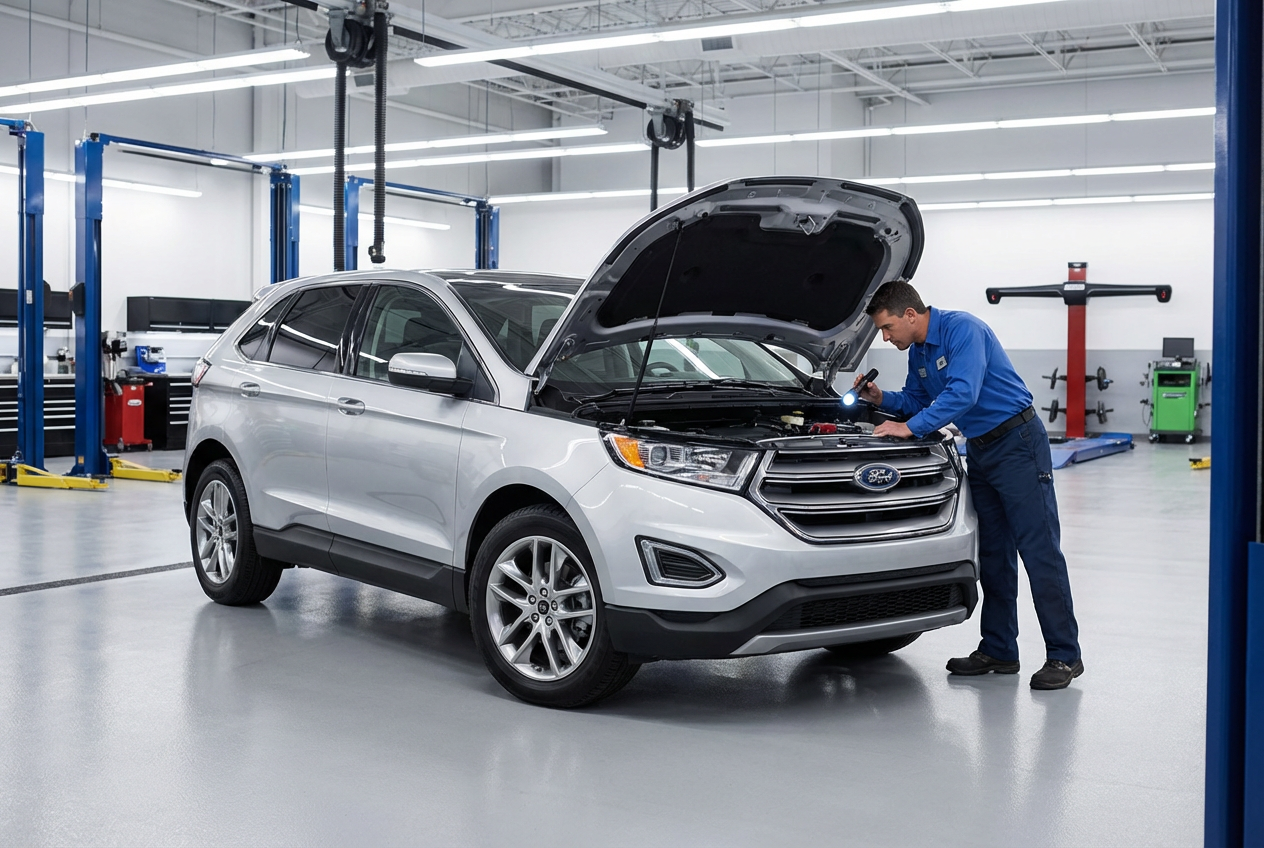
Used Ford Edge ready for inspection at Beadle Ford dealership Bowdle SD

What to Look for When Buying a Used Ford Edge — A Dealership Checklist

Buyer’s Guide What to Look for When Buying a Used Ford Edge — A Dealership Checklist A practical guide to finding the right used Edge. Inspection tips, what to test drive, and how to pick the right model year and package. Published March 31, 2026 — Beadle Ford, Bowdle, SD Shop Edges in Stock Get Pre-Approved The Ford Edge is a smart used buy. It’s spacious, capable on highways, packed with modern tech, and priced reasonably compared to newer competition. With all-wheel drive standard on every model, it handles South Dakota winters without complaint. And if you know what to look for — and what questions to ask — you can feel confident about your purchase. This checklist walks you through what to inspect before you buy, what to test on a real test drive, and which model years and packages offer the best value. Whether you’re shopping at a dealership or buying private-party, these steps will help you find a reliable Edge that fits your needs. In This Guide Why the Edge Is a Smart Used Buy What We Check Before a Used Edge Goes on Our Lot What to Look For on a Test Drive Which Model Years and Trims Offer the Best Value Packages Worth Looking For How to Confirm a Tow Package Is Installed Buying Private-Party? Bring It to Us First Frequently Asked Questions Why Is the Ford Edge a Smart Used Buy? The Edge checks real boxes. All-wheel drive comes standard on every trim, which matters if you live anywhere with winter weather. The 2.0L EcoBoost engine delivers smooth power without the thirst of a V6. The SYNC 4A infotainment system is responsive, supports wireless CarPlay and Android Auto, and feels modern even in older model years (2019+). And the interior is genuinely spacious — 39.2 cubic feet of cargo with the seats up, 73.4 folded down — enough for ranch supplies, sports gear, or a family road trip. Value-wise, a 2019–2024 used Edge sits 20–30% below a new comparable SUV. A well-maintained 2019 or 2020 model will feel nearly new in features and reliability, with thousands of miles left on the powertrain warranty if purchased through a dealership. And here’s the thing: when you buy through Beadle Ford, you’re buying confidence. Every used Edge we sell has passed our multi-point inspection. You get our backing, our service department, and the peace of mind that comes with knowing the vehicle was evaluated by experts. What Does Beadle Ford Check Before a Used Edge Goes on Our Lot? We run a multi-point inspection on every used vehicle. For the Edge, here’s what our service team verifies: Service History Review We pull the maintenance records. Regular oil changes, fluid services, and scheduled maintenance show an owner who cared for the vehicle. Gaps in service records raise questions we investigate further. Transmission Fluid and Shift Quality Our technician checks transmission fluid color and smell, then test-drives the vehicle through a range of speeds to confirm smooth shifting. Any harshness or hesitation gets flagged. For 2019+ models with the 8-speed, this is typically a formality — they shift beautifully. Engine Oil Condition and Coolant We check the dipstick for signs of coolant mixing with oil (milky residue) or metal particles. Clear oil means a healthy engine. Contaminated oil is a red flag we take seriously. SYNC System and Sensors We test the touchscreen, wireless CarPlay, Bluetooth connectivity, and all cameras and parking sensors. Any glitches get remedied by software update or component replacement before the vehicle is sold. AWD System and Suspension We test the AWD engagement, listen for unusual noises on a sharp turn (a sign of bearing wear), and inspect suspension components for wear. A healthy Edge handles turns smoothly. Undercarriage and Fluid Leaks We lift the vehicle and visually inspect for leaks, corrosion, and component integrity. A clean undercarriage tells us the vehicle has been maintained and not neglected. Tires, Brakes, and Exterior We measure tire tread, test brake feel, inspect the paint and body for damage or prior collision, and confirm all glass, lights, and trim are in good condition. What Should You Look and Listen for on a Test Drive? Here’s your real-world checklist. You don’t need a wrench in your hand — you just need to pay attention. Powertrain: Transmission and Engine Transmission shifts: From a stop, accelerate smoothly through all gears. You should feel gentle, progressive gear changes. No lurching, no hesitation, no clunks between gears. On the highway, accelerate from 45 to 65 mph and listen for smooth upshifting. Engine sound: The 2.0L EcoBoost should sound clean and responsive. A rough idle or knock during acceleration is a red flag. Acceleration: Merging should feel effortless. No lag, no stumble. If the engine hesitates, ask when the last tune-up was. Technology: SYNC, CarPlay, and Sensors Touchscreen response: Tap the home screen a few times. It should respond instantly. If there’s lag or freezing, note it. Wireless CarPlay or Android Auto: If you have a compatible phone, connect it. It should pair within 30 seconds and stay connected. Rear and front cameras: Shift into Reverse and watch the rear camera. Shift into Park and activate the front camera. Images should be clear, not grainy. Parking sensors: These beep as you back up. If sensors are silent or missing, that’s a repair cost down the road. All-Wheel-Drive System Engagement: Make a sharp left and right turn at modest speed. You shouldn’t hear clicking or feel a shudder. The AWD should engage seamlessly. Traction: If you pass over wet pavement or loose gravel, the vehicle should grip smoothly. No unexpected loss of traction. Interior: Seats, Climate, and Comfort Seat adjustments: The driver’s seat should slide fore and aft, recline, and adjust lumbar support. Power seats should move smoothly. Any grinding or stuck seat is a repair. Climate control: Turn on the air conditioning and heat. Both should blow cold and hot respectively within 30 seconds. Liftgate: Close it from the inside, then open it from the outside with the button. Should raise smoothly and not drop suddenly when closing. Exterior: Tires, Brakes, and Body Tire tread: Use a penny. Insert it into the tread with Lincoln’s head facing down. If you see the top of his head, tread is low (less than 2/32-inch). Budget for tires soon. Tread should be even across all four wheels. Uneven wear suggests an alignment issue. Brake feel: From a stop, gradually increase brake pressure. The pedal should feel firm and responsive. No sponginess, no long throw. Brake should be smooth, not grabby. Paint and body: Walk around the vehicle. Look for scratches, dents, or mismatched paint that suggests prior collision or poor repair. Check the gap between panels. Even gaps mean good alignment. Which Model Years and Trims Offer the Best Value? The Edge has two main generations in the used market today. Here’s what you need to know. First Generation (2007–2014): Affordable, But Older These are the cheapest Edges on the lot, often under $8,000. But they lack modern infotainment, have older safety features, and earlier model years (2007–2010) used a transmission that required extra attention. If you’re buying used in this range, get a pre-purchase inspection from a trusted mechanic. The 2011–2014 models are more reliable, but you’re still driving 10+ year old technology. Early Generation 2 (2015–2018): The Middle Ground These brought the modern platform and refreshed design. You get SYNC 3, wireless connectivity, and modern infotainment. The trade-off: the 6-speed transmission is competent but doesn’t shift as smoothly as the 8-speed that came later. These are priced $12,000–$18,000 depending on mileage and trim. They’re a solid choice if the price is right and you like the trim level. Late Generation 2 (2019–2024): The Sweet Spot — Recommended This is where we spend most of our time. The 2019 refresh brought the 8-speed transmission (smooth and efficient), SYNC 4A with wireless CarPlay, Co-Pilot360 driver assistance as standard, and the ST performance trim. You get modern safety tech, responsive infotainment, and bulletproof reliability. Prices range $22,000–$32,000 for low-mileage examples. For trim, the SEL and ST-Line are our best sellers — they balance features and cost. The base SE is spartan; the Titanium pushes toward luxury pricing. The ST is high-performance and pricier, but worth it if you want sport-tuned suspension and an aggressive look. For a complete breakdown of which years are best, see our Ford Edge Best Model Years guide. What Packages Are Worth Looking For? Here’s a quick breakdown of the most popular option packages you’ll see on used Edges: Class II Tow Package (53G) If you tow a small trailer, a boat, or an ATV, this is the package to seek out. It adds a removable hitch receiver, trailer wiring harness, trailer sway control, and integrated transmission cooler. The 2.0L EcoBoost can safely tow 2,000 lbs; the ST with 2.7L V6 can tow up to 3,500 lbs. It’s a $500–$700 value on the used market. We’ll show you how to spot it next. 301A Luxury Package Adds leather upholstery, a power panoramic sunroof, upgraded LED lighting, and enhanced climate controls. It’s a nice-to-have, not a need-to-have. If the price difference isn’t more than a few hundred dollars, it’s worth taking. 401A High Luxury Package Bundles the 301A items plus a power-adjustable steering column, dual-zone climate, and premium audio. Again, nice but not essential. If you enjoy premium comfort features and the pricing is reasonable, grab it. All other packages (weathertech floor mats, roof racks, etc.) are nice bonuses but don’t materially affect value. Focus on the tow package if you need to tow; everything else is gravy. How Do You Know If the Tow Package Is Actually Installed? Tow packages are one of the most frequently claimed but least verifiable option. Don’t just take the seller’s word for it. Here’s what to look for: Visual Confirmation Hitch receiver: Get down and look under the rear bumper. You should see a removable or integrated hitch tube protruding from the frame. If you don’t see it, the package isn’t installed. Wiring harness: On the driver’s side of the rear bumper, look for a 4 or 7-pin trailer wiring connector flush-mounted or taped behind the bumper. Transmission cooler: This is harder to spot without removal, but your mechanic can confirm it during an inspection. What to Ask Ask the dealer or seller, “Does the towing package come with documentation in the service records?” Ask to see the original window sticker or Monroney label. It will list “Class II Tow Package” as a line item if installed. If no documentation exists, verify visually yourself. Buying a Used Edge from a Private Seller? Bring It to Beadle Ford First. Private-party purchases are usually cheaper, but you’re on your own for inspection and warranty. That’s a risk. Here’s our suggestion: Schedule a pre-purchase inspection at Beadle Ford before you buy. Our service department will perform a comprehensive diagnostic on any vehicle you’re considering. We’ll check the engine, transmission, all sensors, undercarriage, suspension, brakes, and cooling system. We’ll run a complete OBDII scan to catch any hidden fault codes. The inspection takes about an hour and costs around $150–$200 — money well spent if it uncovers a $2,000 repair problem before you own the vehicle. You walk into the transaction with confidence. You know exactly what you’re buying. And if the inspection reveals issues, you can negotiate the price down or walk away knowing you dodged a bullet. Call Beadle Ford at 605–285–6202 to schedule a pre-purchase inspection. Ask for our service department. Bring the vehicle on a day that works for your schedule. Key Takeaways The Ford Edge is a capable, spacious midsize SUV with all-wheel drive standard, modern SYNC 4A infotainment (2019+), and strong value as a used purchase. Dealership purchases come with a multi-point inspection, verified service history, and the confidence of professional evaluation. On a test drive, listen for smooth transmission shifts, responsive engine, and seamless AWD engagement. Test the touchscreen, cameras, and climate control. A 2019+ Edge with the 8-speed transmission is the sweet spot for reliability and modern features. The SEL and ST-Line trims offer the best balance of equipment and price. The Class II Tow Package is worth seeking out if you tow. Verify its presence with a visual check and original documentation. Buying private-party? Invest $150–$200 in a pre-purchase inspection at Beadle Ford. It’s your insurance policy against hidden repairs. Frequently Asked Questions How does Beadle Ford inspect used vehicles? We perform a comprehensive multi-point inspection covering engine, transmission, all electrical systems, sensors, suspension, brakes, undercarriage, and body condition. Our service technicians review maintenance history, test-drive the vehicle through a range of speeds, and run a full OBDII diagnostic scan. Any issues are documented, and repairs are made before the vehicle is offered for sale. What’s the best Edge trim to buy used? The SEL and ST-Line are our best sellers. They offer a strong balance of comfort features, technology, and pricing. The SEL is more accessible; the ST-Line adds sport styling and handling tweaks. The Titanium is plush but pricier. The ST is for buyers who want performance. The base SE is spartan but reliable if budget is your priority. Is the 2019–2024 Edge significantly better than the 2015–2018? Yes. The 2019 refresh brought the 8-speed transmission, which shifts noticeably more smoothly than the 6-speed. It also added SYNC 4A with wireless CarPlay, Co-Pilot360 driver-assistance suite, and the ST trim. Reliability is measurably better. If you have the budget, a 2019+ is recommended over 2015–2018 models. How do I know if the tow package is installed? Look under the rear bumper for a hitch receiver tube. Check the driver’s side rear bumper area for a 4 or 7-pin trailer wiring connector. Ask to see the original window sticker or service records that document the package. If none of these are present or visible, the package wasn’t installed. What should I listen for during a test drive? Listen for smooth, progressive transmission shifts with no lurching or hesitation. The engine should sound clean and responsive, with no rough idle or knocking. There should be no unusual clicking or shuddering when turning (a sign of AWD bearing wear). The brakes should feel firm and responsive. Wind and road noise should be normal for a vehicle of that age and mileage. What does a pre-purchase inspection at Beadle Ford include? It includes a full diagnostic check of engine and transmission, all electrical systems, cooling system, suspension, brakes, undercarriage condition, body integrity, and any pending fault codes. Our technician will provide you with a written report detailing findings and any recommended repairs. The inspection takes about an hour and costs $150–$200. Does buying from a dealership come with any warranty? Yes. Every used vehicle we sell comes with our dealership backing and access to our service department. Ford vehicles also retain any remaining factory powertrain warranty based on mileage. Ask us about the specific warranty terms when you visit. My Take on Buying a Used Ford Edge The inspection checklist in this guide reflects what actually distinguishes a sound used Edge purchase from a risky one. Most of the common problem areas — PTU oil, transmission behavior, cooling system condition — are detectable before purchase if you know what to look for. A buyer who does this homework is in a much stronger position than one who relies on visual appearance alone. From a marketing research standpoint, the 2019+ Edges are genuinely more defensible buys than earlier models, and that’s not just positioning — the data on transmission complaints, recall history, and feature availability all point in the same direction. The 2020–2023 window is where the value-to-reliability ratio is strongest in the used market right now. For the broader model context, the Ford Edge buyer guide covers trim levels, model year comparisons, and what to prioritize by use case. Beadle Ford in Bowdle can also assist with pre-purchase inspections if you want a professional assessment before committing. Shop Edges in Stock Get Pre-Approved Contact Beadle Ford About the Author Lexy Tabbert — Beadle Ford, Bowdle, SD Lexy Tabbert is the Director of Sales and Marketing at Beadle Ford in Bowdle, South Dakota. She covers Ford vehicles, trim comparisons, and buyer guidance — helping families, ranchers, and ag operators across the region find the right truck and configuration for their needs. Learn more about Lexy.
The Best Ford Edge Model Years to Buy Used — And Which Ones to Skip

Ford Edge Buying Guide The Best Ford Edge Model Years to Buy Used — And Which Ones to Skip The Ford Edge has been a trusted three-row crossover for nearly two decades. But not all model years are created equal. Whether you’re looking for a second family vehicle in Bowdle or need cargo capacity for ranch work, this guide breaks down which Edge generations and years deliver the best reliability, features, and value — and which ones to avoid. Published by Lexy Tabbert | Beadle Ford, Bowdle, SD | March 31, 2026 Shop Edges in Stock Get Pre-Approved In This Guide Generation Overview: Gen 1 vs. Gen 2 Why 2019 Changed Everything The Best Model Years to Target Which Years Should You Avoid? Edge Ownership in South Dakota Frequently Asked Questions What’s the Difference Between Generation 1 and Generation 2 Edge Models? Gen 1 (2007–2014) and Gen 2 (2015–2024) represent fundamentally different platforms, powertrains, and technology approaches. Here’s what matters for your used purchase: Generation 1: 2007–2014 Older transmission technology (6-speed auto) No modern safety suite (no Co-Pilot360) Older infotainment systems; many without smartphone integration Lower fuel economy than Gen 2 Now 12–19 years old; higher mileage and maintenance costs Best for: Budget-conscious buyers who don’t need advanced safety tech, willing to maintain aging systems. Generation 2: 2015–2024 Modern architecture with 8-speed transmission (2019+) Co-Pilot360 standard (adaptive cruise, lane-keep assist) in 2019+ SYNC 4A infotainment with wireless CarPlay and Android Auto Better fuel economy and towing capacity Younger vehicle — lower maintenance, longer remaining lifespan Best for: Families, commercial buyers, and anyone who values modern safety and tech. Why Did the 2019 Ford Edge Mark a Major Turning Point? 2019 was the year Ford fully modernized the Edge generation. Three critical upgrades happened simultaneously, making it the obvious threshold to remember when shopping used. The Three Game-Changing Upgrades in 2019: 8-Speed Transmission Replaced the aging 6-speed auto. Better acceleration, smoother shifts, improved fuel economy. This single change makes pre-2019 Edges feel sluggish by comparison. Co-Pilot360 Safety Suite Standard Adaptive cruise control, lane-keeping assist, blind-spot monitoring, and collision warning became standard across all trims. Pre-2019 models either lack these entirely or had them as options. ST Performance Trim Introduced The high-output 2.7L EcoBoost (335 hp / 380 lb-ft) became available for the first time, delivering real performance if you need it for towing or highway merging. The 2023 and 2024 model years are virtually identical to 2019–2022. Ford didn’t perform another major refresh during this period, so you’re not missing anything by choosing a 2020 or 2021 instead of waiting for 2024. Which Ford Edge Model Years Should You Target for Best Value and Reliability? If you’re buying used right now in 2026, your sweet spot is 2020–2023. Here’s why: 2020–2023 Edge: The Goldilocks Zone Still covered by remaining factory warranty on most units Full access to modern safety suite and 8-speed transmission Mature generation with proven reliability track record Reasonable mileage for their age (typically 40,000–80,000 miles) Good pricing — no longer brand-new premiums, but not yet aging Recommended trims: SE, SEL, or ST-Line with AWD. All come standard with Co-Pilot360 and 8-speed transmission. 2019 Edge: Last-Chance Deal on Original Refresh Lowest prices on a post-refresh Edge (now 7 years old) All the core upgrades: 8-speed, Co-Pilot360, modern infotainment May carry higher mileage or require out-of-warranty repairs Warranty coverage likely expired; budget for potential repairs Best for: Budget buyers who are comfortable with out-of-warranty maintenance. 2015–2018 Edge: Proceed with Caution Early Gen 2 models with 6-speed transmission (dated, less efficient) No Co-Pilot360 standard (must verify option) Some transmission complaints reported on 2015–2016 models Now 8–11 years old with moderate-to-high mileage If considering: Get a full pre-purchase inspection and transmission history. The price savings may not be worth the added risk. Which Ford Edge Model Years Should You Avoid? Not all Edges are worth your money. Here’s what to skip and why: 2007–2014 (Gen 1) — Not Recommended These vehicles are now 12–19 years old. While some may still run, you’re likely to face: Aging electrical systems and potential infotainment failures Transmission issues on some units; no modern transmission tech Absence of modern safety features (no adaptive cruise, no lane-keeping assist) High maintenance costs relative to remaining lifespan Exception: If you find a Gen 1 with very low mileage (<100,000 miles) and perfect maintenance history, it might work as a budget commuter. Still get a pre-purchase inspection. 2015–2016 Edge with 6-Speed Transmission These early Gen 2 models reported transmission shudder and hesitation issues. Ford addressed the problem in later model years, but affected units may require costly repairs. If interested: Request full transmission service history. Avoid if the owner can’t provide maintenance records. What Should South Dakota Buyers Know About Edge Ownership? Living in Bowdle or across South Dakota means winter weather, gravel roads, and potential towing needs. The Edge handles all three—but your model year choice affects that capability. Winter Driving and AWD Good news: All modern Edge trims (2019+) come with standard AWD. This means better traction in snow and on icy roads from State Highway 45 to the Missouri River bottoms. You don’t need to hunt for an optional AWD system—it’s built in. Towing for Ranch and Farm Work The 2019–2024 Edge with the 2.0L EcoBoost offers up to 3,500 lbs. towing capacity. If you need more power, the ST trim with the 2.7L V6 EcoBoost delivers 5,600 lbs. —enough for trailers, equipment, or livestock haul jobs. Learn more: Check our complete Edge towing guide for payload specs and hitch recommendations. Gravel Road Durability The Edge is built on a sturdy unibody platform designed for North American drivers. Its ground clearance (8.9 inches) handles ranch roads and unmowed driveways without scraping. Co-Pilot360 (2019+) includes blind-spot monitoring, which is especially valuable when driving on rural roads where visibility can be limited. Cargo for the Countryside All Edges offer 39.2 cubic feet of cargo space with the rear seats up, and 73.4 cubic feet with them folded. That’s enough for feed sacks, ranch tools, hunting gear, and weekend supplies. The ST-Line and Titanium trims include a power liftgate, which is handy when your hands are full. Key Takeaways Best target: 2020–2023 Edge with SE, SEL, or ST-Line trim. All include 8-speed transmission, Co-Pilot360, and modern tech. Sweet spot for value: 2020–2021 models offer the best balance of remaining warranty, lower mileage, and competitive pricing. 2019 is the key threshold: This is when Ford introduced the 8-speed transmission, Co-Pilot360, and the ST performance trim. Earlier models lack one or all of these. Avoid 2015–2016: Early Gen 2 models had transmission issues. Skip these unless you find exceptional low-mileage examples with full service records. Pass on Gen 1 (2007–2014): These vehicles are 12–19 years old. Maintenance costs and safety gaps make newer Edges a better investment. South Dakota advantage: All modern Edges come with standard AWD—perfect for our winters. ST trim delivers 5,600 lbs. towing for ranch work. Frequently Asked Questions About Buying a Used Ford Edge How long do Ford Edges typically last? With regular maintenance, a Ford Edge can easily reach 200,000 miles. Gen 2 models (2015+) are particularly durable, especially if you keep up with oil changes, transmission fluid checks, and seasonal tire rotations. South Dakota’s cold winters mean you should also monitor battery health and use quality winter fluids. Is a 2020 Ford Edge better than a 2023? Practically no. Ford didn’t perform a major refresh between 2019 and 2024, so a 2020 and a 2023 Edge are nearly identical in design, features, and performance. The 2023 will have lower mileage and potentially more remaining warranty, but you’ll pay a premium. A 2020 with 50,000 miles is usually a smarter buy than a 2023 with 40,000 miles at a higher price. What’s the difference between SE, SEL, ST-Line, Titanium, and ST trims? SE: Base model with manual climate control and standard SYNC 4A. Best for budget buyers. SEL: Adds dual-zone climate, power liftgate, and enhanced trim. Solid value upgrade. ST-Line: Sport-tuned suspension, aggressive styling, upgraded interior. Great for drivers who want a sportier feel on gravel roads. Titanium: Premium comfort with leather, panoramic roof, power seats. Best for luxury buyers. ST: Performance trim with 2.7L V6 EcoBoost (335 hp), sport suspension, and unique styling. Only choice if you need maximum towing or want performance. For South Dakota use, we recommend SE or SEL with AWD as the sweet spot. The ST-Line is ideal if you want sportiness without the fuel penalty of the V6. Should I choose the 2.0L EcoBoost or 2.7L V6 engine? 2.0L EcoBoost (250 hp / 280 lb-ft): Available on SE, SEL, ST-Line, and Titanium trims. Delivers 28–29 mpg highway and ample power for everyday driving. Best for commuters and families. 2.7L V6 EcoBoost (335 hp / 380 lb-ft): ST trim only. Provides 5,600 lbs. towing capacity and aggressive acceleration. Best for ranch work and highway towing. For most Bowdle buyers, the 2.0L is the right choice. Choose the 2.7L only if you regularly tow trailers or need peak performance. Can I find a 2024 Ford Edge for sale? No. Ford discontinued the Edge after the 2024 model year. If you’re shopping in 2026, your newest option is 2024 (if any remain in dealer inventory), followed by 2023 and earlier. We recommend focusing on 2020–2023 models for the best balance of price and remaining lifespan. What is Co-Pilot360 and why does it matter? Co-Pilot360 is Ford’s standard safety bundle on 2019+ Edges. It includes adaptive cruise control, lane-keeping assist, blind-spot monitoring, and collision warning. For South Dakota drivers navigating winter conditions and rural highways, this suite significantly reduces accident risk. Pre-2019 Edges either lack these features or have them as expensive options. This is one major reason to target 2019+ models. My Take on Choosing a Used Ford Edge Based on the research I do to support Beadle Ford’s buyers, the 2019 model year is the clearest dividing line in this platform’s history. Everything before it is a different vehicle in terms of drivetrain and safety tech. Everything after it is a well-sorted SUV that holds up well in our climate. For buyers in and around Bowdle, the case for a 2020–2023 Edge is straightforward: AWD is standard, the EcoBoost engines are efficient for their size, and the safety suite works. If you’re hauling anything or driving rural roads in winter, those aren’t optional features—they matter. For a full picture of what the Edge offers across trims and years, the Ford Edge buyer guide covers the complete model lineup. If you have questions about a specific vehicle or want a pre-purchase inspection, Beadle Ford in Bowdle is here to help. Shop Edges in Stock Get Pre-Approved Contact Beadle Ford About the Author Lexy Tabbert — Beadle Ford, Bowdle, SD Lexy Tabbert is the Director of Sales and Marketing at Beadle Ford in Bowdle, South Dakota. She covers Ford vehicles, trim comparisons, and buyer guidance — helping families, ranchers, and ag operators across the region find the right truck and configuration for their needs. Learn more about Lexy.
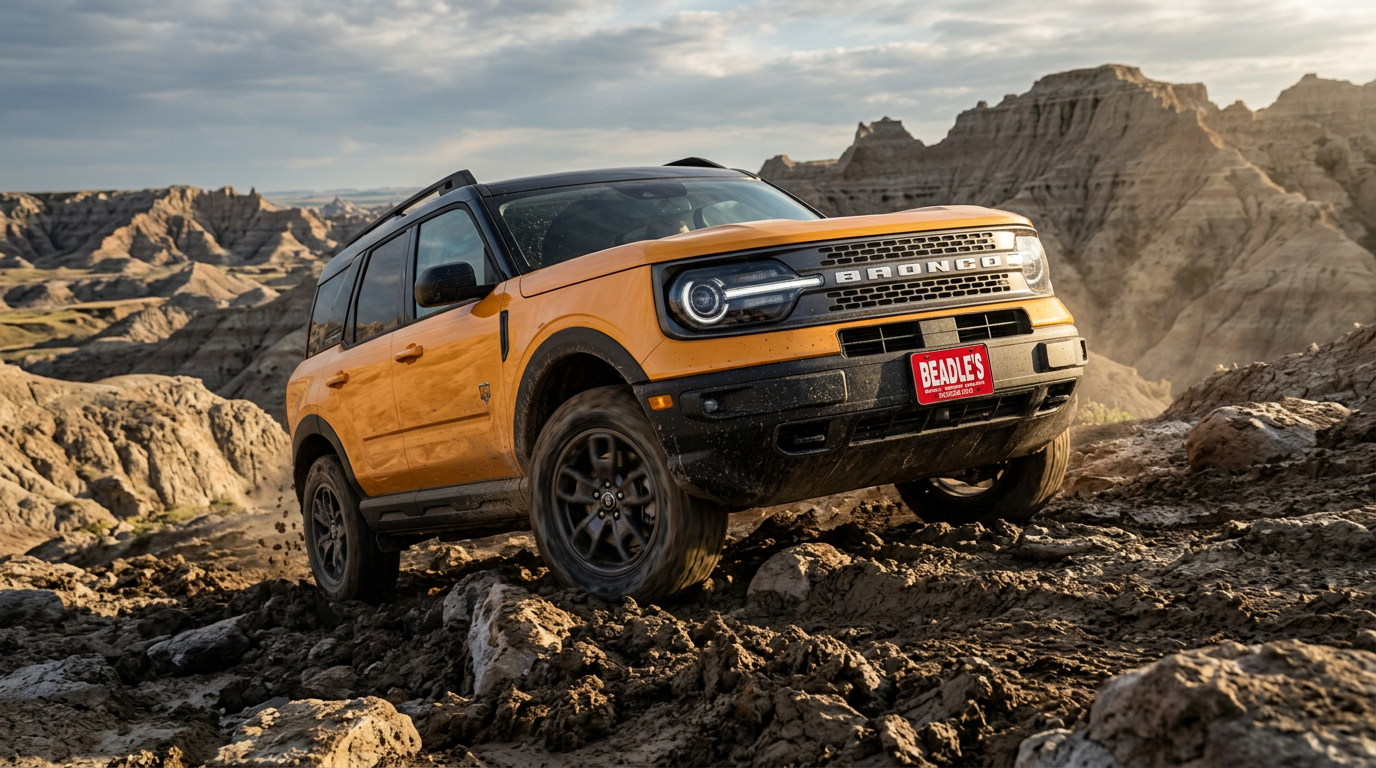
2026 Ford Bronco Sport on South Dakota terrain compared to Subaru Crosstrek and Jeep Compass

2026 Ford Bronco Sport vs Subaru Crosstrek vs Jeep Compass: Which Compact SUV Wins for South Dakota Buyers?

The 2026 Ford Bronco Sport, Subaru Crosstrek, and Jeep Compass are three of the most common compact SUV comparisons in this price class — and for buyers in South Dakota, the right answer looks different than it does for someone shopping in a suburb. Towing capacity, winter traction, off-pavement capability, and interior utility for active use all carry more weight here than they might in a city market. This is a full, honest comparison of how all three stack up across the categories that matter most to Bowdle-area buyers. Shop Bronco Sports in Stock Get Pre-Approved In This Guide How Do the Bronco Sport, Crosstrek, and Compass Compare on Paper? Which Has the Best Off-Road Capability for South Dakota? Which Compact SUV Can Tow a Boat or Utility Trailer? How Do All Three Handle South Dakota Winters? Which Has the Most Useful Interior for Active Use? Which Compact SUV Is the Best Value for South Dakota Buyers? How Do the Bronco Sport, Crosstrek, and Compass Compare on Paper? Before diving into the real-world use cases, here's how the three vehicles compare on the core specifications that drive buying decisions in this class: Spec 2026 Ford Bronco Sport 2026 Subaru Crosstrek 2026 Jeep Compass Base Engine 1.5L EcoBoost 3-cyl (180 hp) 2.0L Boxer 4-cyl (152 hp) 2.0L Turbo 4-cyl (200 hp) Top Engine 2.0L EcoBoost (250 hp) 2.5L Boxer 4-cyl (182 hp) 2.0L Turbo (200 hp) Max Towing 2,200 lbs 1,500 lbs 2,000 lbs AWD / 4x4 System Standard 4x4 or Advanced 4x4 with twin-clutch DRSC Symmetrical All-Wheel Drive FWD standard; optional AWD or Rock & Trail 4x4 Off-Road Terrain Modes 5–7 G.O.A.T. modes X-Mode (upper trims) Selec-Terrain (Trailhawk) A/T Tires Standard Yes (Heritage, OB Sasquatch, Badlands) No (all-season standard) Trailhawk only Trail Control Yes (Sasquatch / Badlands) No No Pro Power Onboard Outlet Yes (up to 400W) No No Cargo-Specific Features Slide-out table, MOLLE straps, carabiner hooks Standard cargo area Standard cargo area On paper, the Bronco Sport holds a meaningful edge on towing capacity, terrain modes, and adventure-specific utility features. The Crosstrek's strength is its well-proven Symmetrical AWD and strong reliability reputation. The Compass offers competitive power in its base engine but is somewhat inconsistent in what comes standard at each price point versus what requires an upgrade. Which Has the Best Off-Road Capability for South Dakota? For off-pavement use — gravel roads, two-tracks, pasture lanes, dirt forest roads — the Bronco Sport is the most capable of the three across every tier of the comparison. This is by design: the Bronco Sport was engineered as a purpose-built off-road crossover, while the Crosstrek and Compass are primarily road-oriented vehicles with varying degrees of trail capability added in. Off-Road Category Bronco Sport Crosstrek Compass Gravel road daily driving Excellent Very good Good (with AWD) Trail / forest road use Excellent Moderate Moderate (Trailhawk) Technical rock / obstacle terrain Capable (Badlands: Rock Crawl) Limited Limited Sand / loose terrain modes Sand mode (all trims) Not available Sand mode (Trailhawk) Standard A/T tires available Yes (Heritage, Badlands, Sasquatch) No Trailhawk only The Crosstrek's Symmetrical AWD is genuinely excellent for everyday conditions — it's always-on and very predictable — but it's not a trail-tuned system. Subaru's X-Mode (available on upper Crosstrek trims) adds descent control and torque management for slippery slopes, but it doesn't match the Bronco Sport's dedicated trail calibration or G.O.A.T. mode system. The Compass Trailhawk is the most capable off-road Compass, but the Trailhawk trim requires significant investment to reach that capability level. The base Compass with FWD or basic AWD is a pavement vehicle. The Bronco Sport starts from a position of off-road readiness across most of its lineup, which matters when you're choosing a single vehicle for mixed use in rural South Dakota. Which Compact SUV Can Tow a Boat or Utility Trailer? Towing capacity is where the Bronco Sport separates itself most clearly — and it's a meaningful differentiator for buyers in this part of South Dakota, where heading to Lake Oahe with a boat or running an ATV trailer to the Badlands isn't an occasional thing. Vehicle Max Tow Rating Class II Hitch What It Can Tow 2026 Ford Bronco Sport Up to 2,200 lbs Optional (standard on Badlands, included with Sasquatch Package) Jon boat, 14–16 ft aluminum fishing boat, personal watercraft, small livestock trailer, single ATV/UTV 2026 Subaru Crosstrek 1,500 lbs Optional (dealer-installed) Small kayak trailer, light utility trailer, personal watercraft (lightweight) 2026 Jeep Compass Up to 2,000 lbs Optional Small boat, utility trailer, single ATV (weight-dependent) The Crosstrek's 1,500 lb tow rating is the most limiting of the three — a loaded aluminum fishing boat with motor and gear is typically 1,200–1,600 lbs before adding a trailer, which puts many common setups at or above the Crosstrek's limit. The Compass gets closer to the Bronco Sport, but the Bronco Sport's Class II Tow Package is integrated into the most popular off-road configurations (Badlands standard, included in the Sasquatch Package). If towing a boat to Lake Oahe or running an ATV trailer is part of your regular use, the Bronco Sport is the clear choice in this comparison. The Crosstrek simply doesn't have the tow rating headroom that rural South Dakota use often requires. How Do All Three Handle South Dakota Winters? All three vehicles have AWD or 4x4 capability, which is the baseline requirement for South Dakota winters. But how they manage winter conditions — and how accessible that capability is — differs meaningfully between them. The Crosstrek's Symmetrical AWD is perhaps the most well-known winter system in its class. Subaru has built its entire brand identity around this drivetrain, and it's genuinely excellent on packed snow and ice. It's always engaged and requires no driver input to activate — you just drive. The Crosstrek also tends to have strong winter tire availability because of its loyal following. The Bronco Sport's winter advantage comes from its Slippery G.O.A.T. mode — a purpose-built winter calibration that adjusts throttle, braking, and traction management specifically for slick conditions. Combined with A/T tires standard on several trims, the Bronco Sport is genuinely well-prepared for South Dakota winters. The Badlands and Outer Banks Sasquatch configurations also benefit from the HOSS 2.0 suspension's ability to handle rutted, frozen surfaces better than standard suspension setups. The Compass with AWD handles winter roads adequately but without the same purpose-engineered winter mode. The Trailhawk adds Selec-Terrain with Snow mode, but the base Compass AWD is a more generic all-weather system. The Compass also starts with FWD as standard on lower trims — a meaningful disadvantage in this market that buyers often overlook when comparing sticker prices. South Dakota Winter Features Summary Winter Feature Bronco Sport Crosstrek Compass AWD / 4x4 standard on all trims Yes Yes No — FWD base Dedicated Slippery / Snow mode Yes (Slippery G.O.A.T.) X-Mode (upper trims) Snow mode (Trailhawk) A/T tires available standard Yes (multiple trims) No Trailhawk only Heated seats available Yes (multiple trims) Yes (upper trims) Yes (upper trims) The Crosstrek is a strong winter vehicle and deserves its reputation. But the Bronco Sport's combination of Slippery mode, standard A/T tires on several trims, and purpose-built 4x4 calibration makes it equally well-suited — and the fact that 4x4 is standard across the entire Bronco Sport lineup (the Compass offers FWD as a base option) gives it a reliability advantage for buyers who want winter capability without having to think about it. Which Has the Most Useful Interior for Active Use? Interior utility — how the vehicle is actually configured to support active and working use — is where the Bronco Sport creates the largest separation from both competitors. It's not just about cargo space on paper; it's about the specific features Ford engineered into the cargo area. The Bronco Sport includes a fold-out cargo table that slides out from the rear cargo area, MOLLE strap panels for securing gear, integrated carabiner hooks, a built-in bottle opener, available rubberized flooring for easy cleanup, and — on equipped trims — a 400W Pro Power Onboard outlet for running tools or charging gear. None of these features exist on the Crosstrek or Compass. The Crosstrek and Compass both offer solid, practical cargo areas — but they're designed for conventional use: fold the seat, load your gear, drive. The Bronco Sport's cargo area is designed for people who use their vehicle as a base camp, work vehicle, or gear transport system. That's a meaningful difference for a specific type of buyer. Interior and Cargo Features Comparison Feature Bronco Sport Crosstrek Compass Fold-out cargo table Yes No No MOLLE gear straps Yes No No Pro Power Onboard 400W outlet Yes (upper trims) No No Rubberized cargo flooring Available Not standard Not standard Roof rack / rails standard Standard (multiple trims) Available Available If you're using your compact SUV primarily as a commuter vehicle with occasional weekend use, all three are functional. If you're regularly packing for hunting trips, hauling gear to the range, setting up a trailhead basecamp, or running tools to a jobsite, the Bronco Sport's purpose-built cargo features are genuinely useful in ways the Crosstrek and Compass aren't designed to match. Which Compact SUV Is the Best Value for South Dakota Buyers? Value depends entirely on what you're optimizing for. Here's how each vehicle creates value for different buyer priorities: Buyer Priority Best Pick Why Towing a boat or trailer Bronco Sport 2,200 lbs max; Crosstrek caps at 1,500 lbs Off-road trail capability Bronco Sport G.O.A.T. modes, A/T tires, HOSS 2.0 (upper trims), Trail Control Long-term reliability reputation Crosstrek Subaru's AWD track record is industry-proven over decades Active cargo / gear hauling utility Bronco Sport Slide-out table, MOLLE, Pro Power — no equivalent on competitors Lowest entry price point Crosstrek or Compass Base pricing can be lower, though comparisons must account for feature differences South Dakota winter + off-pavement daily use Bronco Sport 4x4 standard on all trims, Slippery mode, A/T tires available throughout lineup For South Dakota buyers who need a vehicle that does more than just drive to town and back — towing, off-pavement work, gear hauling, winter confidence — the Bronco Sport delivers more capability per dollar at each competitive price point. The Crosstrek earns its reputation for reliability and is a legitimate alternative for buyers whose primary use is road-biased. The Compass requires more careful trim-level comparison to arrive at a competitive configuration, and its FWD base is a consideration in this climate. Key Takeaways The Bronco Sport leads on towing (2,200 lbs) vs. Crosstrek (1,500 lbs) and Compass (2,000 lbs) — a meaningful difference for Lake Oahe boat owners or ATV trailer users. 4x4 is standard on every Bronco Sport trim; the Compass starts with FWD on lower trims, which requires buyers to step up to get all-weather drivetrain capability. The Bronco Sport's G.O.A.T. mode system — including Slippery mode for winter — is the most purpose-built terrain management system in this comparison. The Crosstrek's Symmetrical AWD is excellent for everyday winter driving and has a strong long-term reliability reputation — it's the most credible alternative for road-primary buyers. The Bronco Sport's cargo features — slide-out table, MOLLE straps, Pro Power outlet — have no equivalent on either the Crosstrek or Compass at any trim level. For the way most South Dakota buyers actually use their vehicles — mixed on/off pavement, towing, winter driving, gear hauling — the Bronco Sport is the strongest all-around fit in this comparison. Frequently Asked Questions Is the Subaru Crosstrek more reliable than the Ford Bronco Sport? The Crosstrek has a well-established long-term reliability track record built over multiple generations of Subaru's Symmetrical AWD platform. The Bronco Sport is a newer nameplate (introduced 2021), so there's less historical data over the same time horizon. Subaru consistently scores well in owner satisfaction and reliability surveys, which is a real consideration for buyers who prioritize long-term ownership costs. That said, the Bronco Sport's Ford platform is not unproven — the underlying engineering is shared with the global Ford small SUV lineup. Can the Crosstrek tow enough for a jon boat to Lake Oahe? Possibly, but you'd be close to the limit. The Crosstrek's maximum tow rating is 1,500 lbs. A basic aluminum jon boat (14 ft, with motor) typically weighs 500–700 lbs, and a single-axle trailer adds another 300–500 lbs. A loaded setup with fuel, gear, and motor can easily reach 1,200–1,500 lbs — which puts you right at the Crosstrek's rated limit with no headroom. The Bronco Sport's 2,200 lb rating gives you substantially more margin for the same types of trailers. Does the Jeep Compass come with 4x4 as standard? No. The base Jeep Compass Sport starts with front-wheel drive. All-wheel drive is available on higher trim levels, and the more capable Rock & Trail 4x4 system is available on the Trailhawk. For South Dakota buyers who need all-weather capability as a given, compare Compass AWD or Trailhawk trim pricing — not the FWD base price — when doing an apples-to-apples comparison with the Bronco Sport or Crosstrek. Which has the better fuel economy — Bronco Sport, Crosstrek, or Compass? The Crosstrek generally leads in fuel economy in this comparison, particularly with its base 2.0L Boxer. The Bronco Sport's 1.5L EcoBoost is competitive in mixed driving, while the 2.0L EcoBoost (Badlands) trades some efficiency for performance. The Compass is comparable to the Bronco Sport in most configurations. For buyers doing long highway miles across South Dakota, the Crosstrek's fuel economy advantage may be worth factoring into the long-term cost comparison. Is the Bronco Sport actually worth more than the Crosstrek or Compass for South Dakota use? For buyers who tow, go off-pavement regularly, or need purpose-built cargo utility, yes — the Bronco Sport's capability advantages in those categories create genuine value that the Crosstrek and Compass don't match. If your use is primarily highway and city driving with light weather needs, the Crosstrek's reliability reputation and lower entry pricing may make more sense for your situation. The honest answer is: it depends on your use case, not just the sticker price. The Bottom Line for South Dakota Shoppers These three vehicles serve similar market positions but are built with different buyers in mind. The Crosstrek is a well-rounded, reliable AWD crossover that does everything adequately and nothing dramatically. The Compass is a capable daily driver that requires trim-level navigation to get to its best configurations. The Bronco Sport is built for people who need their compact SUV to do more: tow more, go further off-road, carry more gear, and handle South Dakota winters with purpose-engineered tools rather than just adequate all-weather programming. If you're shopping in a market where you rarely leave pavement and never tow, the Crosstrek deserves serious consideration. If your driving life looks like most of ours out here — mixed pavement and gravel, seasonal towing, actual winters — the Bronco Sport is the vehicle this comparison is built around. Ready to see how the Bronco Sport lineup breaks down from Big Bend through Badlands? Our 2026 Ford Bronco Sport guide at Beadle Ford covers every trim, every package, and every configuration in detail. Shop Bronco Sports in Stock Get Pre-Approved Contact Us About the Author Lexy Tabbert Lexy Tabbert is an automotive content writer and researcher at Beadle Ford in Bowdle, SD. She covers Ford lineup comparisons, regional buying guides, towing specs, and off-road capability breakdowns to help South Dakota shoppers cut through manufacturer marketing and find the vehicle that actually fits how they live and work. She's not neutral in this comparison and isn't pretending to be.

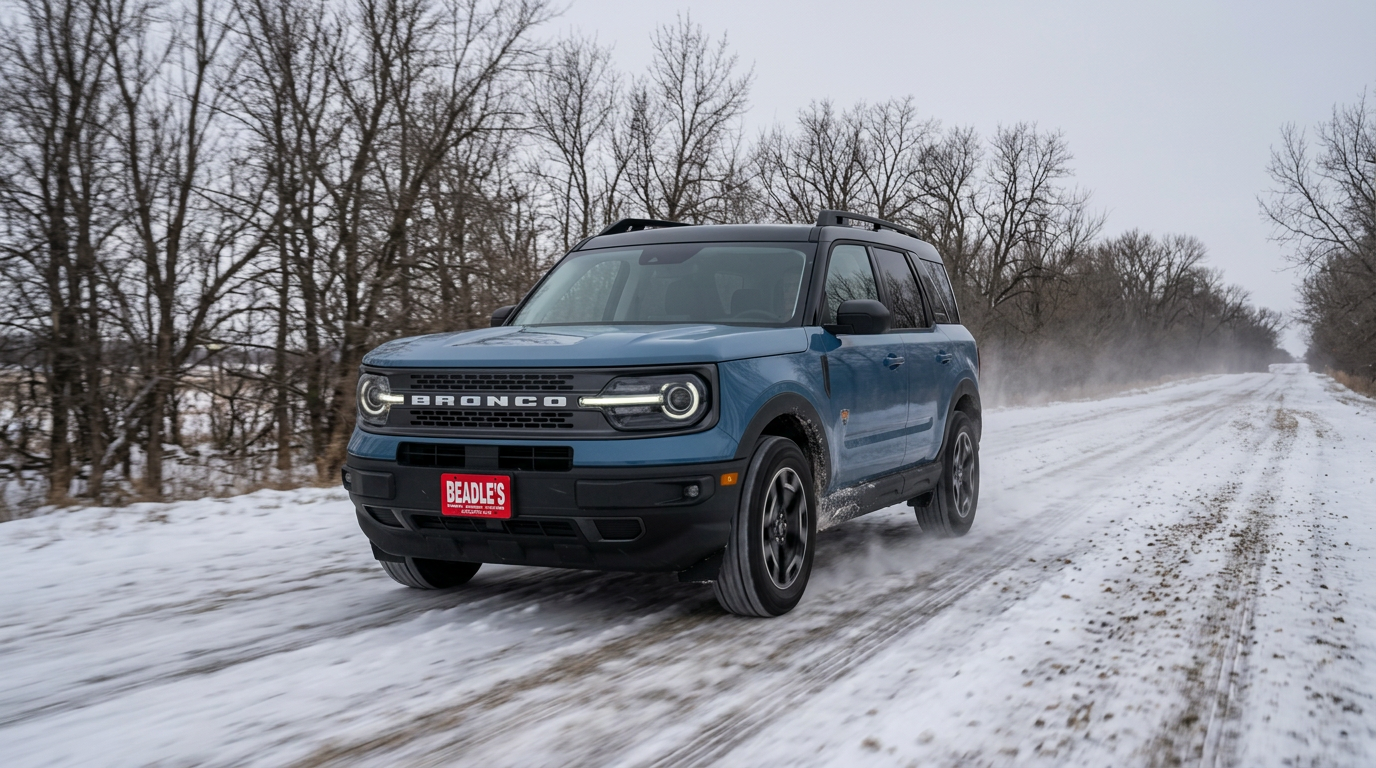
2026 Ford Bronco Sport on snow-covered gravel road South Dakota winter

How the 2026 Ford Bronco Sport Handles South Dakota Winters: Tires, Modes, and Real-World Cold-Weather Performance

A South Dakota winter puts real demands on a daily driver. Highway 12 in January, gravel county roads in a March freeze-thaw cycle, and remote distances from the nearest service bay mean your vehicle has to perform across a range of cold-weather conditions without cutting corners. The 2026 Bronco Sport's 4x4 standard across all trims, Slippery G.O.A.T. mode, and available winter features make it a genuinely capable winter vehicle — but some configurations handle it better than others. This guide breaks down what the Bronco Sport actually offers for winter driving, which trim configurations matter most for cold-weather capability, and what to realistically expect on the roads around Bowdle and north-central South Dakota from November through March. Shop Bronco Sports in Stock Get Pre-Approved On This Page How does the Bronco Sport's standard 4x4 handle winter conditions? What does Slippery mode do in snow and ice? Which trim has the best tires for winter driving? What cold-weather comfort features does the Bronco Sport have? Which trim is best for South Dakota winter daily driving? What are the Bronco Sport's winter limitations? How does the Bronco Sport's standard 4x4 handle winter conditions? Every 2026 Bronco Sport comes with 4x4 as standard equipment — not AWD, not a front-wheel-drive base with an optional upgrade. This matters for winter driving because 4x4 systems are engineered to handle torque distribution differently than most AWD systems, particularly on uneven or deeply compromised surfaces. On packed snow, ice-over gravel, or unprepared roads, the mechanical engagement provides real traction rather than relying solely on electronic bias. Big Bend, Heritage, and Outer Banks use the standard 4x4 system with HOSS 1.0 Off-Road Tuned Suspension. The Badlands uses Advanced 4x4 with a twin-clutch rear drive unit that allows individual wheel torque control — more precise in demanding conditions but not meaningfully different for typical winter highway and gravel road use. For the driving most buyers in north-central SD actually do in winter — highway runs, gravel county roads, town errands in cold and wind — the standard 4x4 system on Big Bend, Heritage, and Outer Banks handles all of it without issue. The Badlands' Advanced 4x4 advantage shows up more on technical off-road terrain than on winter pavement. What does Slippery mode do in snow and ice? Slippery is one of the five standard G.O.A.T. modes on every 2026 Bronco Sport trim. It's specifically designed for low-traction surfaces — snow, ice, wet packed gravel, and rain-slicked pavement. In Slippery mode, the throttle response is significantly reduced (pressing the accelerator delivers power more gradually, preventing sudden wheel spin), the transmission shifts up earlier to keep engine RPM lower, and the traction control system intervenes earlier before wheel spin develops into a slide. On Highway 12 between Bowdle and Aberdeen in January, Slippery mode is the right selection for most conditions. It removes the abrupt throttle response that can induce a slide when accelerating from a stop on a snow-covered intersection, and it keeps the AWD torque distribution optimized for surfaces where grip is unreliable. Don't leave Slippery mode on all winter. It reduces power response in a way that's appropriate for ice and packed snow but not necessary on dry cold pavement. Use Normal for clear roads and switch to Slippery when conditions warrant. Which trim has the best tires for winter driving? Tire choice is the single most important factor in winter traction, more than 4x4 system, more than electronic stability control. The Bronco Sport's trim-level tire differences are meaningful for winter performance. Trim Standard Tires Winter Performance Big Bend (base) All-season (A/S) Adequate for packed snow and light ice; not optimized for deep winter Big Bend + Bronze Package (60H) All-terrain (A/T) Better biting edges for loose snow and gravel, improved on unprepared roads Heritage 225/65R17 A/T standard Best standard winter grip in 1.5L lineup — A/T tread handles snow and gravel well Outer Banks (base) All-season on 18” wheels Comparable to Big Bend base; comfort-focused A/S tires Outer Banks + Sasquatch P235/65R17 A/T Strong winter grip, especially on loose snow Badlands A/T tires standard Full winter capability alongside the best mechanical 4x4 hardware in the lineup For dedicated winter use in deep snow or on unplowed gravel, a set of winter-specific tires on any of these trims will outperform the factory A/T or A/S tires. Dedicated winter tires use a softer rubber compound that stays pliable at low temperatures where all-season and all-terrain compounds stiffen and lose grip. This is the upgrade that makes the most difference if you're in genuinely harsh conditions for extended periods. What cold-weather comfort features does the Bronco Sport have? Cold-weather comfort features vary by trim. The key features — heated seats, heated steering wheel, and remote start — are not available on every trim. Feature Big Bend Heritage Outer Banks Badlands Heated front seats — — ✓ Standard ✓ Standard Heated steering wheel — — ✓ Standard ✓ Standard Remote start — — ✓ Standard ✓ Standard Dual-zone climate — — ✓ Standard ✓ Standard Standard 4x4 ✓ ✓ ✓ ✓ Slippery G.O.A.T. Mode ✓ ✓ ✓ ✓ Remote start is a genuine winter convenience — starting the Bronco Sport from inside to pre-warm the cabin before you walk out at −20° in January is a real quality-of-life feature. It's standard on Outer Banks and Badlands only. Big Bend and Heritage don't have it unless you add an aftermarket system. Which trim is best for South Dakota winter daily driving? The best trim depends on whether your priority is winter traction, winter comfort, or both. Best for Winter Traction (Budget-Conscious) Heritage — A/T tires standard, full 4x4, Slippery mode, and the lowest price point among trims with standard all-terrain rubber. No heated features, but the traction hardware is there without adding packages. Best for Winter Comfort + Traction Outer Banks — Heated seats, heated steering wheel, remote start, and dual-zone climate as standard. A/S tires on the base, but adding the Sasquatch Package upgrades to A/T tires. The combination of comfort features and available traction hardware makes this the best all-around winter daily driver. Best for Maximum Winter Capability Badlands — Advanced 4x4, HOSS 2.0 suspension, A/T tires, heated leather seats, heated steering wheel, remote start, and the highest tow rating if you're pulling anything in winter. More capability than most buyers need for daily driving, but no compromises. What are the Bronco Sport's winter limitations? The Bronco Sport handles South Dakota winters well within its class, but it has real limits that are worth understanding before depending on it in extreme conditions. Ground clearance: The Bronco Sport's clearance is adequate for packed snow but not designed for deep, unplowed drifts. In conditions where a truck would push through, the Bronco Sport will high-center. Heated seats are trim-limited: Buyers who want heated seats must be on Outer Banks or Badlands. Big Bend and Heritage don't offer them, even as an option. All-season tires on base trims: Big Bend and Outer Banks (without Sasquatch) ship with all-season tires. In extreme cold, dedicated winter tires provide significantly better stopping distances and lateral grip than A/S rubber. Not a plow vehicle: The Bronco Sport is not a worksite winter vehicle. It handles everyday winter driving conditions well — it is not built for heavy duty winter work use. For context on how these features fit the full 2026 Bronco Sport lineup, the 2026 Bronco Sport overview covers all trims and configurations in one place. Key Takeaways Every 2026 Bronco Sport trim includes 4x4 and Slippery G.O.A.T. mode as standard — no FWD models exist in this lineup. Slippery mode is specifically designed for snow, ice, and wet packed gravel — use it on Highway 12 in winter, not as your year-round default. The Heritage is the only 1.5L trim with A/T tires as standard equipment — without adding a package. Heated seats, heated steering wheel, and remote start are only standard on Outer Banks and Badlands. For the best combination of winter comfort and traction, the Outer Banks (especially with Sasquatch Package) or the Badlands are the strongest choices. Dedicated winter tires on any trim will outperform factory A/T and A/S tires in extreme cold conditions. Frequently Asked Questions Is the Bronco Sport better than an AWD crossover for South Dakota winter driving? For the conditions most common in north-central SD — packed snow on highways, gravel roads, occasional deeper snow — the Bronco Sport's standard 4x4 and Slippery mode provide more predictable and capable winter performance than a typical AWD crossover. AWD systems are designed primarily for on-road use. The Bronco Sport's 4x4 system combined with the HOSS suspension and G.O.A.T. modes is tuned for a wider range of surfaces. The tire choice still matters more than the drivetrain type on any platform. Can I add heated seats to a Big Bend or Heritage? Heated seats are not available as a factory option on Big Bend or Heritage. They are standard equipment only on Outer Banks and Badlands. Aftermarket heated seat installations are possible through dealer accessories or aftermarket shops, but the factory integration with the climate control system is not replicable after the fact. If heated seats are a priority, the Outer Banks is the minimum trim to consider. Do all-terrain tires actually help on ice? All-terrain tires improve performance in snow and loose-surface conditions over all-season tires, primarily because of their more aggressive tread pattern and siping. On ice specifically, A/T tires do not provide significantly better grip than A/S tires — both compounds stiffen in extreme cold. For ice, dedicated winter tires (which use a silica-enhanced compound that stays flexible below freezing) are meaningfully better than both A/T and A/S options. A/T tires shine in snow, slush, loose gravel, and dirt — not primarily on bare ice. How far in advance should I warm up the Bronco Sport at -20 degrees? Modern fuel-injected engines, including the Bronco Sport's EcoBoost turbocharged units, do not require extended warm-up times for engine protection purposes — they can be driven gently within a minute or two at any temperature. The reason to use remote start at very cold temperatures is primarily cabin comfort — getting the interior to a usable temperature before you get in — and windshield defrost. Five to ten minutes of remote start at −20°F will warm the cabin and defrost the glass. Drive gently until the engine temperature reaches normal operating range. My Take on the Bronco Sport as a South Dakota Winter Vehicle I hear this question a lot at Beadle Ford in Bowdle, usually starting in October: is the Bronco Sport actually going to be okay out here in January? The honest answer is yes — for the conditions most buyers around here actually face, it handles them well. Standard 4x4 on every trim, Slippery mode that works, and a cabin that holds heat are the three things that matter most for daily winter driving. What I'd tell any buyer focused on winter: the trim that gives you the most useful combination is the Outer Banks. The heated seats, heated steering wheel, and remote start are the difference between a cold-weather capable vehicle and a genuinely comfortable one for a South Dakota January. If budget is a factor, the Heritage gets you A/T tires standard without the comfort features. Both are solid options — it comes down to whether traction or comfort is the priority. The full picture of how the Bronco Sport handles all four seasons in SD — including the off-road and towing capability that make it a year-round vehicle — is in the 2026 Ford Bronco Sport overview. Come in and let's talk through the right build for your winter driving situation. Shop Bronco Sports in Stock Get Pre-Approved Contact Beadle Ford About the Author Lexy Tabbert — Beadle Ford, Bowdle, SD Lexy Tabbert covers Ford vehicles, trim comparisons, and buyer guidance for Beadle Ford in Bowdle, South Dakota. Her content is grounded in real buyer conversations with farmers, ranchers, and outdoor enthusiasts across north-central South Dakota and beyond. Learn more about Lexy.

2026 Ford Bronco Sport climbing rocky muddy off-road terrain South Dakota

Every G.O.A.T. Mode on the 2026 Ford Bronco Sport Explained — and When to Actually Use Each One

G.O.A.T. stands for Goes Over Any Type of Terrain — and it's not just a name. The system actively adjusts how the Bronco Sport's throttle, transmission, AWD torque split, and stability control all behave based on the surface you're on. Selecting the right mode changes how the vehicle responds in a meaningful way. This guide walks through every G.O.A.T. mode available on the 2026 Bronco Sport — what each one does mechanically, which trims have it, and when it makes sense to use it in South Dakota conditions. Shop Bronco Sports in Stock Get Pre-Approved On This Page What does the G.O.A.T. system actually do? What are the five standard G.O.A.T. modes? What do Rock Crawl and Rally add on the Badlands? Which modes are most useful for South Dakota conditions? Which trims have which G.O.A.T. modes? What does the G.O.A.T. system actually do? G.O.A.T. modes adjust multiple vehicle systems simultaneously when you select a mode. Depending on the mode, the system modifies throttle response mapping (how aggressively the engine responds to accelerator input), transmission shift points (when the gearbox shifts up or holds), AWD torque distribution between front and rear axles, and stability control thresholds (how much wheel slip is tolerated before intervention). Some modes also modify traction control aggressiveness. This is not just traction control with a different label. Changing modes changes fundamental vehicle behavior in each of those systems at once. The difference between Sport mode on a dry highway and Off-Road mode on a wet two-track is real and noticeable. What are the five standard G.O.A.T. modes? Every 2026 Bronco Sport trim — Big Bend, Heritage, Outer Banks, and Badlands — includes these five modes as standard: Mode What It Does Best For Normal Balanced throttle, standard AWD split, full stability control active Everyday driving, dry pavement, highway miles ECO Reduced throttle sensitivity, early upshifts, power limited to favor efficiency Long highway stretches, light daily commuting, maximizing fuel range Sport Sharpened throttle response, holds gears longer, more rear torque bias Dry pavement passing, spirited driving, highway on-ramps Slippery Reduced throttle sensitivity, earlier traction intervention, smooth power delivery Snow, ice, packed gravel, wet roads — South Dakota winter conditions Off-Road Raised stability control threshold (allows more wheel slip), adjusted torque split for uneven terrain Dirt two-tracks, loose gravel, rutted trails, mud These five modes cover the full range of conditions most Bronco Sport buyers will encounter. Normal and ECO handle the majority of time on pavement. Slippery is genuinely useful for Highway 12 in January. Off-Road handles trail and ranch access where the road surface gets unpredictable. What do Rock Crawl and Rally add on the Badlands? The Badlands is the only 2026 Bronco Sport trim with seven G.O.A.T. modes. Rock Crawl and Rally are exclusive to this trim and address two specific situations on opposite ends of the speed and terrain spectrum. Rock Crawl Designed for very slow, technical terrain — loose rock, steep ledges, deep ruts. Rock Crawl maximizes available traction by applying throttle very progressively (prevents sudden wheel spin on loose surfaces), locking the AWD system to distribute power as evenly as possible between all four wheels, and loosening stability control thresholds to allow each wheel to move somewhat independently. Trail Control (Badlands-exclusive) works with Rock Crawl to let the driver focus on steering while the system manages brake and throttle to maintain a selected crawl speed. This is where the Advanced 4x4 twin-clutch system on the Badlands separates from the standard 4x4 on other trims — individual rear wheel torque control enables true traction management on uneven surfaces. Rally Rally is the high-speed dirt counterpart. It's designed for fast gravel, loose dirt roads, and aggressive off-pavement driving where controlled oversteer is useful. It loosens stability control intervention further than Off-Road mode and sharpens throttle response, allowing the rear to step out in a controlled way when momentum and cornering demands it. For most buyers in north-central SD who run highway and gravel roads — not competitive rally stages — this mode is rarely needed in practice. Rock Crawl and Rally are real tools for specific scenarios. If your Bronco Sport use involves technical trail work at slow speed, Rock Crawl matters. If it's primarily gravel roads and light trails, the five standard modes cover everything you'll encounter. Which G.O.A.T. modes are most useful for South Dakota conditions? North-central South Dakota presents a specific mix of conditions across seasons. Here's how the modes map to what you'll actually encounter: Condition Recommended Mode Why Highway 12 in winter (snow/ice) Slippery Smoothest throttle delivery, earliest traction intervention — prevents abrupt wheel spin on ice Gravel county roads (dry) Normal or Off-Road Normal handles packed gravel fine; Off-Road if surface is loose or washboarded Spring mud, field access roads Off-Road Allows wheel slip needed to dig through soft surfaces without cutting power too quickly Lake Oahe boat ramp (wet concrete/gravel) Slippery or Off-Road Slippery if ramp is wet but solid; Off-Road if the base is loose gravel Long highway miles to Aberdeen or Pierre Normal or ECO ECO reduces fuel consumption on open highway stretches Trail access, two-track ranch roads Off-Road Raised slip threshold handles uneven terrain without cutting power mid-obstacle Technical rocky terrain (Badlands only) Rock Crawl Maximum traction control with Trail Control for hands-free speed management Most buyers will find that Slippery, Off-Road, and Normal cover 95% of their driving. ECO is worth using on long highway stretches between towns. Sport sees use on dry roads when you want more responsive throttle. Rock Crawl and Rally come into play for the specific scenarios they were designed for. Which trims have which G.O.A.T. modes? Mode availability is consistent across the three 1.5L trims. The Badlands is the only trim with the full seven-mode system. Mode Big Bend Heritage Outer Banks Badlands Normal ✓ ✓ ✓ ✓ ECO ✓ ✓ ✓ ✓ Sport ✓ ✓ ✓ ✓ Slippery ✓ ✓ ✓ ✓ Off-Road ✓ ✓ ✓ ✓ Rock Crawl — — — ✓ Badlands only Rally — — — ✓ Badlands only The trim-by-trim overview, including what else separates the Badlands from other trims, is part of the broader 2026 Bronco Sport overview. Key Takeaways G.O.A.T. modes adjust throttle, transmission, AWD torque split, and stability control simultaneously — not just traction control. All five base modes (Normal, ECO, Sport, Slippery, Off-Road) are standard on every 2026 Bronco Sport trim. Rock Crawl and Rally are exclusive to the Badlands — not available on Big Bend, Heritage, or Outer Banks. Slippery mode is the right choice for South Dakota winter conditions — snow, ice, and wet packed gravel. Off-Road mode handles spring mud, two-track ranch roads, and loose gravel. Rock Crawl requires the Badlands' Advanced 4x4 with twin-clutch rear drive unit to function as intended. Frequently Asked Questions Should I use Slippery mode or Off-Road mode on a snow-covered gravel road? Slippery mode is the better choice on snow-covered or icy gravel. It's tuned to deliver power as smoothly as possible to avoid wheelspin on low-traction surfaces, and it intervenes earlier when wheels start to slip. Off-Road mode allows more wheel slip — useful on dirt and loose rock, but more likely to cause instability on ice. If the road is cold, packed, and slick, use Slippery. If the surface is loose, soft, or rutted dirt or gravel without ice, use Off-Road. Can I switch G.O.A.T. modes while driving? Yes, most G.O.A.T. modes can be changed while the vehicle is moving. This is intentional — conditions change quickly on rural roads where you may transition from pavement to gravel to mud within a short stretch. Some modes have speed limitations for selection. Consult your owner's manual for the specific operating requirements for each mode. Does using ECO mode significantly reduce performance? ECO mode makes the throttle less sensitive and shifts up earlier, which reduces available power response. On the open highway between Bowdle and Aberdeen where you're at a steady cruise speed, this has minimal effect. At highway speeds, the engine is operating efficiently regardless. ECO mode has a more noticeable impact on acceleration from a stop or when climbing grades. For mixed driving or when you need quick throttle response (passing, merging), switch back to Normal. Does Rock Crawl work on all Badlands versions including with the Sasquatch Package? Rock Crawl is available on the Badlands trim in all configurations, including with the Badlands Sasquatch Package (67B). The Badlands Sasquatch adds HOSS 3.0 suspension with Bilstein position-sensitive dampers, which further improves the off-road hardware that Rock Crawl operates through. All seven G.O.A.T. modes are present on the Badlands regardless of package configuration. Will I actually use Rock Crawl in South Dakota? For most buyers in north-central SD, Rock Crawl is a rarely-used mode. The terrain around Bowdle, along the Missouri River, and on most ranch and farm access roads doesn't present the slow-speed technical obstacles Rock Crawl is designed for. It becomes more relevant on dedicated off-road trails, in the Badlands of western SD, or on routes that involve significant loose rock and steep approach angles. It's there when you need it — but Slippery, Off-Road, and Normal will cover the vast majority of your driving time. My Take on G.O.A.T. Modes for SD Buyers When I talk about G.O.A.T. modes with customers at Beadle Ford, the question I usually hear is: do I actually need to think about this, or is it just a marketing feature? It's a fair question. The honest answer is that two modes in particular are genuinely useful for everyday driving in this part of South Dakota: Slippery and Off-Road. If you're driving gravel roads to a farm or ranch, or running Highway 12 in January, those modes make a real difference in how the vehicle behaves. Rock Crawl and Rally are on the Badlands for a reason, but they're not modes most buyers will touch on a Tuesday morning. They're there for the people who actually get into that terrain. If you're heading west toward the Badlands or the Black Hills and want to run technical trails, they matter. For everyone else, the five standard modes cover everything. If you want to understand how the G.O.A.T. modes fit alongside the broader capability and trim picture, that's covered in the 2026 Ford Bronco Sport overview. Stop into Beadle Ford in Bowdle and we can walk you through the full system. Shop Bronco Sports in Stock Get Pre-Approved Contact Beadle Ford About the Author Lexy Tabbert — Beadle Ford, Bowdle, SD Lexy Tabbert covers Ford vehicles, trim comparisons, and buyer guidance for Beadle Ford in Bowdle, South Dakota. Her content is grounded in real buyer conversations with farmers, ranchers, and outdoor enthusiasts across north-central South Dakota and beyond. Learn more about Lexy.

2026 Ford Bronco Sport at Lake Oahe boat ramp trailer hitch visible SD

2026 Ford Bronco Sport Towing Capacity: What You Can Actually Pull and How to Set It Up Right

The 2026 Ford Bronco Sport can tow — but how much depends entirely on which trim you have and whether your vehicle is equipped with the right package. The difference between a properly equipped Bronco Sport and one without the required tow package isn't just a number on a spec sheet: exceeding the unpackaged limit can void your warranty. This guide breaks down the actual towing numbers by configuration, explains the Class II Trailer Tow Package requirement, and puts the ratings in real-world context for buyers around Bowdle hauling boats to Lake Oahe or pulling livestock trailers across north-central South Dakota. Shop Bronco Sports in Stock Get Pre-Approved On This Page What are the actual towing numbers by configuration? What is the Class II Trailer Tow Package and why does it matter? What is tongue weight and why does it matter? What does GCWR mean and how does it limit what you can tow? What can the Bronco Sport actually tow in South Dakota? Does elevation affect towing capacity in western South Dakota? What are the actual towing numbers by configuration? All 2026 Bronco Sport towing figures are SAE J2807 rated, which means they've been tested under a standardized methodology that accounts for vehicle weight, trailer geometry, and a driver plus 150 lbs of passenger weight. Not all towing claims in the industry use this standard — the J2807 rating is the credible benchmark. Configuration Max Tow (lbs) Tongue Weight (lbs) GCWR (lbs) Big Bend — Black Diamond Off-Road Package (67C) 2,200 220 6,100 Outer Banks — Sasquatch Package (67A) 2,200 220 6,320 Badlands (Class II tow package standard) 2,700 270 6,990 Class II Tow Package Is Required Above 1,500 lbs For trailers over 1,500 lbs, the Class II Trailer Tow Package is required. Towing without it when exceeding this threshold may void your vehicle's warranty. Confirm your vehicle's equipment before loading a trailer. Note that towing capacity is only available on specific configurations. A base Big Bend or base Outer Banks without the required package has a maximum tow rating of 1,500 lbs — adequate for a small utility trailer but not for most boats, campers, or livestock trailers common to this area. What is the Class II Trailer Tow Package and why does it matter? The Class II Trailer Tow Package is what allows the Bronco Sport to safely tow above 1,500 lbs. Without it, towing beyond that threshold risks exceeding the vehicle's engineering limits and can void warranty coverage. The package includes the hardware and wiring that supports the higher tow ratings listed above. Trim Class II Tow Package How to Get It Big Bend Included with Black Diamond Off-Road Package (67C) Must add package 67C Heritage Not available Tow rating limited to 1,500 lbs Outer Banks Included with Sasquatch Package (67A) Must add packages 96T + 67A Badlands Standard — included on every Badlands No additional package required The Heritage trim does not have a path to Class II towing. If towing above 1,500 lbs is a regular need — hauling a fishing boat to Lake Oahe, pulling a small livestock trailer — the Heritage is not the right trim for that use case regardless of its other merits. The Badlands is the simplest configuration for buyers with consistent towing needs since the package is standard and requires no separate ordering. What is tongue weight and why does it matter for trailer setup? Tongue weight is the downward force the trailer tongue applies to the hitch ball. For the Bronco Sport, tongue weight limits are 220 lbs for the 2,200 lb configurations and 270 lbs for the Badlands at 2,700 lbs. These limits are just as binding as the max tow rating — exceeding tongue weight causes rear-end sag, instability, and steering problems even when the total trailer weight is within limits. Tongue weight should be 10–15% of total trailer weight. For a 2,200 lb trailer, that's 220–330 lbs. The Bronco Sport's 220 lb limit sits at the lower end of that range, meaning proper trailer weight distribution matters more here than on a truck with a higher tongue weight allowance. Moving cargo forward or back on the trailer to balance the load before hitching makes a real difference. The Bronco Sport also has a frontal area limit: 20 sq ft without the tow package and 30 sq ft with it. For context, a typical boat trailer with a boat is usually under 20 sq ft frontal area. A wider enclosed trailer may approach the limit. What does GCWR mean and how does it limit what you can tow? GCWR stands for Gross Combined Weight Rating — the maximum total weight of the vehicle plus trailer, fully loaded. The Bronco Sport's GCWR is 6,100 lbs for the Big Bend configuration, 6,320 lbs for Outer Banks Sasquatch, and 6,990 lbs for the Badlands. This is a hard limit that governs the combined load the drivetrain, brakes, and chassis are rated to handle. Configuration GCWR (lbs) Max Trailer (approx, loaded vehicle) Big Bend + Black Diamond (67C) 6,100 ≈2,200 lbs (at estimated curb weight ~3,700 lbs + 200 lbs cargo) Outer Banks + Sasquatch (67A) 6,320 ≈2,200 lbs Badlands 6,990 ≈2,700 lbs GCWR matters most when your vehicle is loaded — carrying passengers, gear, or cargo in addition to towing a trailer. A fully loaded Bronco Sport with passengers and equipment will have less margin against the GCWR than an empty vehicle. Factor your expected vehicle load into the equation before assuming you can tow at the maximum trailer weight. What can the Bronco Sport actually tow in South Dakota real-world use? Put the ratings in practical terms for the kinds of towing common to this part of South Dakota: What You're Towing Typical Weight Range Compatible Configuration Jon boat or small fishing boat to Lake Oahe 800–1,400 lbs Any trim (within 1,500 lb unpackaged limit) Bass boat on single-axle trailer 1,500–2,200 lbs Big Bend + Black Diamond, OB + Sasquatch, or Badlands Small livestock trailer (2–3 calves) 1,800–2,400 lbs Badlands preferred; Class II required Small utility/equipment trailer 600–1,200 lbs Any trim Pop-up camper or small travel trailer 1,500–2,700 lbs Badlands at top range; lighter units on other equipped trims The Bronco Sport is a capable light-duty tower for the most common towing scenarios around the Missouri River corridor. It is not a heavy-duty towing platform — for trailers above 2,700 lbs, a truck or larger SUV is the appropriate vehicle. For more detail on cargo carrying and the gear storage system, the adventure gear guide covers that territory in full. Does elevation affect towing capacity on western South Dakota routes? Yes. The towing figures listed in Ford's towing guide assume sea-level conditions. At altitude, turbocharged engines produce less power because of reduced air density. The 1.5L and 2.0L EcoBoost engines compensate well compared to naturally aspirated engines, but there is still a reduction at elevation. Routes heading west from north-central SD toward the Black Hills climb from around 1,800 ft (Bowdle area) to 3,200 ft (Rapid City) and then to 4,000–7,200 ft in the Hills themselves. For local towing around Bowdle, Lake Oahe, and the Missouri River corridor, elevation is not a factor. For buyers who occasionally haul toward the Black Hills or Wyoming, build in extra margin below the rated maximum and expect the engine to work harder on extended grades. The Badlands' 2.0L has more reserve capacity for those scenarios than the 1.5L on the other trims. Key Takeaways All towing figures are SAE J2807 rated — the credible industry standard. The Badlands has the highest rating at 2,700 lbs with the Class II Tow Package included standard. Big Bend + Black Diamond (67C) and Outer Banks + Sasquatch (67A) each reach 2,200 lbs when properly equipped. The Heritage trim tops out at 1,500 lbs with no path to higher capacity. The Class II Tow Package is required for any trailer over 1,500 lbs — towing without it above that weight may void warranty. Tongue weight limits (220–270 lbs) and GCWR are just as binding as the max tow rating. For western SD towing at elevation, use the Badlands and keep a buffer below the rated max. Frequently Asked Questions Can a base Big Bend tow a boat without any packages? A base Big Bend without the Black Diamond Off-Road Package can tow up to 1,500 lbs. That covers small jon boats, light fishing boats, or a small utility trailer. For anything heavier — including most aluminum fishing boats with a full tank and gear — the Black Diamond Off-Road Package (67C) is required to reach the 2,200 lb rating. Can the Bronco Sport tow a livestock trailer? A small bumper-pull livestock trailer loaded with two to three calves typically falls in the 1,800–2,400 lb range. The Badlands rated at 2,700 lbs can handle the lighter end of that range. The Big Bend + Black Diamond and Outer Banks + Sasquatch at 2,200 lbs are workable for smaller loads. Heavier livestock trailers with multiple animals or full-grown cattle will exceed the Bronco Sport's capacity — a truck is the right tool for that application. Does the Heritage have a tow hitch? The Heritage can tow up to 1,500 lbs but does not have a path to the Class II Tow Package required for higher ratings. Confirm whether a trailer hitch is factory-installed or available as a dealer-installed option for your specific Heritage build. For any towing above 1,500 lbs on a regular basis, the Heritage is not the appropriate trim. What happens if I tow more than 1,500 lbs without the Class II package? Towing above 1,500 lbs without the Class II Trailer Tow Package can void your vehicle's powertrain warranty coverage. The package is not just about the hitch hardware — it includes the engineering validation that the drivetrain, transmission cooling, and electrical systems are rated to handle the additional load. Always confirm your vehicle's actual installed equipment before loading a trailer. How does the Bronco Sport compare to a truck for towing? The Bronco Sport maxes out at 2,700 lbs. A half-ton truck like the F-150 is rated to tow up to 13,000+ lbs depending on configuration. The Bronco Sport fills a real niche for buyers who need a capable 4x4 daily driver that can handle a boat, a small camper, or an occasional livestock run — but it is not a substitute for a truck when heavy towing is a regular requirement. My Take on Bronco Sport Towing for South Dakota Buyers The towing question comes up a lot at Beadle Ford. People around Bowdle use their vehicles for real work — whether that's pulling a fishing boat down to the Lake Oahe boat ramps in spring, hauling a small livestock trailer to move a few head, or dragging a utility trailer out to a field. The Bronco Sport can handle most of those jobs, but only with the right configuration. What I tell buyers is straightforward: if towing above 1,500 lbs is a consistent need, either get the Badlands — where the package is already included — or make sure the Big Bend or Outer Banks you're ordering has the required package in the build. Don't assume it's there. Check the window sticker. The package restriction is real and the warranty implications are real. Towing is one piece of the 2026 Bronco Sport picture. The full overview — trims, packages, what's new for 2026 — is covered in the 2026 Ford Bronco Sport overview. Come into Beadle Ford in Bowdle and we can walk through the exact build that works for what you're pulling. Shop Bronco Sports in Stock Get Pre-Approved Contact Beadle Ford About the Author Lexy Tabbert — Beadle Ford, Bowdle, SD Lexy Tabbert covers Ford vehicles, trim comparisons, and buyer guidance for Beadle Ford in Bowdle, South Dakota. Her content is grounded in real buyer conversations with farmers, ranchers, and outdoor enthusiasts across north-central South Dakota and beyond. Learn more about Lexy.

2026 Ford Bronco Sport on South Dakota plains at golden hour

2026 Ford Bronco Sport Trim Levels Explained: Big Bend, Heritage, Outer Banks, and Badlands Compared

The 2026 Ford Bronco Sport comes in four trims — Big Bend, Heritage, Outer Banks, and Badlands — and the differences between them go well beyond the price tag. Engine choice, suspension tuning, 4x4 system, seat material, and available packages all vary by trim in ways that matter for how you'll actually use the vehicle day to day. This guide breaks down every trim, compares what each one adds, and helps you figure out which configuration makes the most sense for buyers in Bowdle and across north-central South Dakota. Shop Bronco Sports in Stock Get Pre-Approved On This Page What are the four 2026 Bronco Sport trims? What does the Big Bend come with as standard? What does the Heritage add? What does the Outer Banks add? What makes the Badlands different from every other trim? How do the engines compare across trims? How does the 4x4 system differ on the Badlands? Which trim is right for your use case? What are the four 2026 Bronco Sport trims? The 2026 Bronco Sport lineup consists of Big Bend, Heritage, Outer Banks, and Badlands. The Free Wheeling trim was discontinued after 2025 and does not carry forward into 2026. Trim Engine 4x4 System Suspension Big Bend 1.5L EcoBoost Standard 4x4 HOSS 1.0 Heritage 1.5L EcoBoost Standard 4x4 HOSS 1.0 Outer Banks 1.5L EcoBoost Standard 4x4 HOSS 1.0 Badlands 2.0L EcoBoost Advanced 4x4 HOSS 2.0 Every 2026 Bronco Sport trim includes 4x4 as standard equipment — there is no front-wheel-drive option in this lineup. Every trim also comes with a 13.2-inch SYNC 4 touchscreen, wireless Apple CarPlay and Android Auto, and Ford Co-Pilot360 Assist+ as standard features. What does the Big Bend come with as standard? The Big Bend is the entry trim, but its standard equipment list is more complete than most entry-level compact SUVs. You get the full SYNC 4 suite, Ford Co-Pilot360 Assist+, 4x4, HOSS 1.0 suspension, and the full G.O.A.T. mode system. For 2026, the 8-inch digital cluster display is now standard on Big Bend — previously that was an add-on. Big Bend Standard Equipment Highlights 1.5L EcoBoost I3 with 8-speed automatic transmission Standard 4x4 with HOSS 1.0 Off-Road Tuned Suspension 5 G.O.A.T. Modes: Normal, ECO, Sport, Slippery, Off-Road 13.2” SYNC 4 center display, wireless Apple CarPlay and Android Auto 8” digital cluster display (new standard for 2026) Ford Co-Pilot360 Assist+ (adaptive cruise, lane centering, BLIS, auto emergency braking) MOLLE Straps System on the liftgate (standard on Big Bend) Roof-rack side rails Ford Connectivity Package — 1 year included Ford Security Package — 1 year included (new for 2026) For buyers who primarily want reliable 4x4 capability, modern tech, and the standard safety suite without paying for comfort upgrades they may not need, the Big Bend delivers strong value. The 2026 Bronze Package (60F) option is also exclusive to Big Bend — more on that below. What does the Heritage add over the Big Bend? The Heritage sits between the Big Bend and the Outer Banks in the lineup and is built around a distinct retro-inspired look. Its most practically useful addition over the Big Bend is the all-terrain tires that come standard — a meaningful upgrade for anyone running gravel county roads or accessing fields and trails regularly. Feature Big Bend Heritage Tires All-season All-terrain (225/65R17 A/T) — standard Roof color Body color Oxford White (unique to Heritage) Wheel color Standard Oxford White wheels Seat material Cloth Plaid cloth bucket seats Door ring Standard Oxford White door ring Armrest Standard Navy Pier micro suede, Race Red stitching Side decals None Heritage Bronco script decals The Heritage's A/T tires are the standout practical advantage. For buyers driving gravel roads between Bowdle and rural properties, or accessing lakeside boat ramps at Lake Oahe in spring mud season, having all-terrain tires standard removes the need to source and mount them separately. Everything else Heritage adds is cosmetic — the powertrain and 4x4 system are identical to the Big Bend. What does the Outer Banks add over the Big Bend and Heritage? The Outer Banks is where the comfort upgrades come in. It steps up to heated front seats, heated steering wheel, dual-zone climate control, power-adjustable seating with memory, remote start, and 18-inch machined-face wheels. The Outer Banks also opens access to the Sasquatch Package (67A), which adds the most significant off-road hardware short of the Badlands. Feature Added on Outer Banks Detail Climate Dual-zone automatic climate control Seating 8-way power driver seat, 6-way power passenger seat, memory function Heated features Heated front seats, heated steering wheel Convenience Remote start, auto-dimming rearview mirror Exterior 18” Machined-Face Ebony Black wheels, Shadow Black painted roof, LED fog lamps Available upgrade Sasquatch Package (67A) — requires Tech Package (96T) For buyers who spend long miles on the road — highway runs to Aberdeen or Pierre and back — the heated seat and steering wheel standard on Outer Banks are genuinely useful during a South Dakota winter. The Outer Banks with the Sasquatch Package is the closest the non-Badlands lineup gets to serious off-road hardware. What makes the Badlands different from every other trim? The Badlands is in a different category from the other three trims. It uses a larger engine, a more capable 4x4 system, upgraded suspension, a longer list of off-road features, and is the only trim with Rock Crawl and Rally G.O.A.T. modes. It also comes with the Class II Trailer Tow Package as standard equipment and carries the highest tow rating in the lineup at 2,700 lbs. Badlands-Only Features 2.0L EcoBoost I4 with SelectShift and paddle shifters Advanced 4x4 with twin-clutch rear drive unit (precise torque vectoring) HOSS 2.0 suspension with stiffer off-road tuning 7 G.O.A.T. Modes — adds Rock Crawl and Rally over the standard 5 Trail Control with Trail One-Pedal Drive Pro Power Onboard 400W 12.3” digital cluster display (vs 8” on other trims) Leather-trimmed heated front seats Rubberized cargo floor and cabin floor 360-degree camera with Trail View and front parking sensors Steel underbody protection (engine skid plate + fuel tank shields) Class II Trailer Tow Package — standard, not optional Max tow rating: 2,700 lbs (SAE J2807) If your primary use involves trails, rough terrain, livestock trailer towing, or any scenario where you want the most capability the Bronco Sport can offer, the Badlands is the only trim designed for that role. How do the engines compare across trims? Big Bend, Heritage, and Outer Banks all use the same proven 1.5L EcoBoost three-cylinder. The Badlands is the only trim that gets the larger 2.0L EcoBoost four-cylinder. Both use an 8-speed automatic transmission with a 3.80 final drive ratio. Ford has not yet published confirmed output figures for the 2026 model year — based on the 2025 lineup, the 1.5L produced 181 hp and 190 lb-ft of torque, and the 2.0L produced 250 hp and 277 lb-ft. Engine Available On Transmission Final Drive 1.5L EcoBoost I3 Big Bend, Heritage, Outer Banks 8-speed automatic 3.80 2.0L EcoBoost I4 Badlands only 8-speed automatic (SelectShift + paddles) 3.80 For most day-to-day driving across SD — highway miles, gravel roads, light trail access — the 1.5L is sufficient. The 2.0L's additional torque becomes relevant when towing near the Badlands' 2,700 lb limit, running steeper off-road terrain, or driving loaded at elevation on western SD routes toward the Black Hills. How does the 4x4 system differ on the Badlands? Big Bend, Heritage, and Outer Banks use a standard 4x4 system that distributes torque to all four wheels. The Badlands uses Advanced 4x4 with a twin-clutch rear drive unit, which allows independent torque control to the left and right rear wheels. This enables true torque vectoring — the system can send more power to an individual wheel when traction is uneven, rather than splitting torque equally across the rear axle. In practical terms, this is the difference between a 4x4 system that works well on gravel and light trails versus one designed to handle technical terrain where one wheel may be lifted or spinning. For buyers using the vehicle on structured roads and maintained trails, the standard 4x4 on Big Bend, Heritage, and Outer Banks is more than adequate. The Advanced 4x4 matters more in technical off-road scenarios or when adding the Sasquatch Package to Outer Banks — which also upgrades to Advanced 4x4 and the twin-clutch system. Which Bronco Sport trim is right for your use case? Here's how the trims stack up for different buyer profiles common to north-central South Dakota: Use Case Best Trim Why Daily driver, mostly pavement and highway Big Bend or Outer Banks Full tech suite at entry level; Outer Banks adds heated features for winter Gravel roads, light trail, farm access Heritage A/T tires standard, no extra cost to add off-road rubber Towing a boat to Lake Oahe, livestock trailer Badlands 2,700 lb tow rating, Class II package included standard Off-road trails, technical terrain Badlands or OB Sasquatch Advanced 4x4, HOSS 2.0, Rock Crawl and Rally modes Long SD winters, Highway 12 daily Outer Banks or Heritage Outer Banks: heated seat and wheel standard; Heritage: A/T tires standard Budget-conscious, want retro look Big Bend + Bronze Package Bronze Package exclusive to Big Bend; adds distinctive look at lower trim price point The full 2026 Bronco Sport model year overview — including how trims fit within the broader lineup, package options, and what's new for 2026 — is covered in detail in the 2026 Bronco Sport overview page. Key Takeaways The 2026 Bronco Sport comes in four trims: Big Bend, Heritage, Outer Banks, and Badlands. Free Wheeling is discontinued. Every trim includes 4x4 standard — there is no FWD Bronco Sport. Big Bend, Heritage, and Outer Banks use the 1.5L EcoBoost. The Badlands is the only trim with the 2.0L. The Heritage's most practical advantage is standard all-terrain tires — no other 1.5L trim includes them standard. The Outer Banks adds the comfort package — heated seats, heated steering wheel, dual-zone climate, remote start. The Badlands has a completely different 4x4 system (Advanced 4x4 with twin-clutch), HOSS 2.0 suspension, Rock Crawl and Rally modes, and the highest tow rating at 2,700 lbs. The Bronze Package (new for 2026) is exclusive to Big Bend and adds a distinctive appearance package with 17” Sinister Bronze wheels. Frequently Asked Questions Which 2026 Bronco Sport trim has the best value? It depends on your use. The Big Bend offers the strongest value if you want the full tech and safety suite without comfort upgrades. The Heritage edges ahead for buyers who drive gravel regularly and want A/T tires without paying to add them separately. If you want heated seats and steering wheel for South Dakota winters, the Outer Banks makes sense. The Badlands is the only valid choice if you need maximum tow capacity or serious off-road hardware. Can I get all-terrain tires on a Big Bend or Outer Banks? The Heritage is the only trim that comes with A/T tires as standard equipment. On the Big Bend, the Bronze + Black Diamond Package (60H) includes A/T tires as part of that package bundle. On the Outer Banks, the Sasquatch Package (67A) includes 17” Ebony Black wheels with P235/65R17 A/T tires. The Badlands comes with its own A/T tire setup as standard. The base Big Bend and base Outer Banks come with all-season tires only. What is the difference between HOSS 1.0 and HOSS 2.0 suspension? HOSS stands for High-Performance Off-Road Stability Suspension. HOSS 1.0 is the off-road tuned suspension on Big Bend, Heritage, and Outer Banks — it provides better articulation and stability than a standard passenger car suspension. HOSS 2.0 on the Badlands (and Outer Banks with Sasquatch) adds stiffer springs and more aggressive damper tuning for harder off-road use. The Badlands Sasquatch Package upgrades further to HOSS 3.0 with Bilstein position-sensitive dampers. Is the Badlands worth the extra cost over Outer Banks? The Badlands justifies its price premium when you need what only it offers: the 2.0L engine, Advanced 4x4 with twin-clutch, HOSS 2.0 suspension, Trail Control, Rock Crawl and Rally modes, and a standard tow rating of 2,700 lbs. If you're primarily on pavement and light gravel with occasional trail use, the Outer Banks (with optional Sasquatch Package for off-road hardware) often comes closer to the Badlands' capability at a lower total cost. Confirm current pricing and availability at Beadle Ford in Bowdle. Does the Heritage come with heated seats? No. Heated front seats are not standard on the Heritage trim. Heated seats become standard at the Outer Banks level. If winter comfort features are a priority alongside the Heritage's retro aesthetic, you would need to step up to the Outer Banks — which carries the heated seats, heated steering wheel, and dual-zone climate control as standard. My Take on the 2026 Bronco Sport Trim Lineup When I talk through trim choices with buyers at Beadle Ford, the conversation usually lands quickly on a few real questions: Do you need the tow capacity? Do you drive gravel regularly enough to want A/T tires? Do you spend enough time in the vehicle during a South Dakota winter to care about heated seats? Those three questions alone narrow the lineup down to one or two options in most cases. For the majority of buyers I talk to around Bowdle, the Heritage is underrated. The A/T tires standard — at a price point below the Outer Banks — is genuinely useful for the kind of driving most people in this area actually do. If you're regularly running a mix of pavement and gravel, you're going to want those tires, and getting them standard rather than adding them later saves money and hassle. The Badlands earns its place at the top of the lineup — if you're towing or running hard terrain, it's the one to have. The complete year-specific overview — including what changed for 2026, package breakdowns, and towing details — is covered in the 2026 Ford Bronco Sport overview. Stop by Beadle Ford in Bowdle if you want to talk through which trim makes sense for your situation. Shop Bronco Sports in Stock Get Pre-Approved Contact Beadle Ford About the Author Lexy Tabbert — Beadle Ford, Bowdle, SD Lexy Tabbert covers Ford vehicles, trim comparisons, and buyer guidance for Beadle Ford in Bowdle, South Dakota. Her content is grounded in real buyer conversations with farmers, ranchers, and outdoor enthusiasts across north-central South Dakota and beyond. Learn more about Lexy.

2026 Ford Expedition three-row interior with full seating

2026 Ford Expedition Interior, Seating & Cargo: What to Know Before You Buy

The 2026 Ford Expedition's interior is where the trim decisions really show up — seat material, second-row configuration, third-row fold behavior, cargo access, and power options all vary meaningfully across the lineup. Getting them wrong means living with the wrong vehicle for years. This guide walks through every confirmed interior spec from the 2026 Expedition Order Guide — seating configurations by trim, second-row and third-row options, the Ford Split Gate, and the cargo and storage details that matter most for real-life family and work use. Shop Expeditions in Stock Get Pre-Approved On This Page Seating configurations by trim — what's standard, what's optional? Bench vs. captain's chairs: which second row is right for your family? How does the third row work — and is it actually usable for adults? What is the Ford Split Gate and how does it help with cargo? Cargo space and interior storage — what does the Expedition actually hold? Seat materials and comfort features by trim FAQ Seating configurations by trim — what's standard and what's optional? The 2026 Expedition seats 7 or 8 depending on second-row choice. Not every trim offers both options — King Ranch® is captain's chairs only, with no bench available at any price. Here's the full picture from the order guide. Trim Standard 2nd Row Optional 2nd Row Seating Active Select (200A) 40/20/40 bench — cloth, manual fold No captain's chairs available 8-passenger Active Touring (202A) Power-fold captain's chairs — ActiveX® 40/20/40 power-fold bench (21F) 7 std / 8 opt Tremor® (501A) Power-fold captain's chairs — leather-trimmed, heated 40/20/40 power-fold bench (21F) 7 std / 8 opt Platinum (600A) Power-fold captain's chairs — heated leather-trimmed 40/20/40 power-fold bench (21F) — not with Stealth pkgs 7 std / 8 opt King Ranch® (400A) Power-fold captain's chairs — Del Rio leather, perforated inserts Bench NOT available 7-passenger only If you need 8 passengers — confirm before you order King Ranch® does not offer the 8-passenger bench — at any price, in any package. If 8-seat capacity is a requirement, the King Ranch® is not the right trim. Active Select (200A) is the only trim where 8-passenger is standard. Platinum bench requires the 21F option and is not available with the Stealth Appearance or Stealth Performance packages. Bench vs. captain's chairs in the second row — which is right for your family? This is the interior question most buyers wrestle with — and the answer depends entirely on how you use the vehicle. 40/20/40 Second-Row Bench Best for: Families needing 8 seats reliably Three kids across the second row (car seat friendly) Situations where center passenger is regular, not occasional Buckets-to-back-yard hauling with a wide flat floor when folded Tradeoffs: Less easy third-row access — no aisle between seats Center seat is narrow for adults on long trips On Active Select: cloth only, manual fold Second-Row Captain's Chairs Best for: Easier third-row access — walk-through aisle Families where rear adults want individual space Car seat installations where second-row independence matters Higher trim levels where the captain's chairs come heated Tradeoffs: 7 passengers vs. 8 — one fewer seat Tip-and-slide required for third-row access in some configs The 40/20/40 CenterSlide® bench on the Active Select uses a unique design — the center section slides side to side to allow access to the third row without folding the full bench. On the Touring 202A and above with captain's chairs, an aisle opens completely between the seats for straightforward third-row boarding. The practical difference matters most when you're helping kids buckle in or loading adults into row three regularly. How does the third row work — and is it actually usable for adults? The Expedition's third row folds flat on all trims and is power-operated on most. The fold mechanism, recline capability, and head restraint behavior all vary by trim. Here's what the order guide confirms for each. Trim 3rd Row Fold Recline Head Restraints Layout Active Select (200A) 60/40 PowerFold® — flat Power Recline Manual 60/40 Active Touring (202A) 60/40 PowerFold® — flat Power Recline Manual (vinyl) 60/40 std; 40/20/40 opt (21Y) Tremor® (501A) PowerFold® — flat Power Recline Remote power-folding 40/20/40 — Flexible Seating Platinum (600A) PowerFold® — flat Power Recline Power-folding head restraints 40/20/40 — Luxury Vinyl King Ranch® (400A) PowerFold® — flat Power Recline Remote power-folding 40/20/40 Del Rio leather Third Row Flexible Seating (21Y) — Active Touring only option The Active Touring (202A) offers Third Row Flexible Seating (option 21Y) which converts the standard 60/40 split into a 40/20/40 configuration. This adds a center pass-through position, allowing a third-row passenger to sit in the center section independently. Available as an add-on; standard on Tremor®, Platinum, and King Ranch®. Adult usability in the third row depends on the driver and passenger seat positions as much as the vehicle itself. The Expedition offers more third-row headroom and legroom than most three-row crossovers — it's a body-on-frame SUV with a larger interior envelope — but taller adults will feel the constraint on longer trips. Power-folding head restraints (Tremor® and King Ranch®) are a practical upgrade — they allow the third-row seat backs to fold flat without first manually folding down the head restraints from the cargo area. On the Active, manual head restraints require reaching over the seat to fold them before the seat will flatten. Small detail, big quality-of-life difference when you're reconfiguring the cargo area regularly. What is the Ford Split Gate — and how does it actually help? The Ford Split Gate replaces the traditional single liftgate with a two-piece system: the upper three-quarters lifts like a conventional hatch, and the lower quarter drops down like a tailgate. Both sections are power-operated on all trims. It's standard across the entire 2026 Expedition lineup. Upper power liftgate Opens the upper portion for full cargo access. Hands-free proximity open available on Touring (202A) and above — approach with the fob and it opens automatically. Active Select (200A) requires a button press. Lower power tailgate Drops down and functions as a loading platform or tailgate bench. Rated to hold up to 500 lbs — usable as a seat at a tailgate, loading dock for heavy gear, or step to reach items in the back of the cargo area. The optional Cargo Tailgate Manager accessory turns this lower section into a configurable organizer with dividers and bins. The practical difference from a traditional liftgate: in a tight parking spot or garage where you can't swing the full liftgate up, you can access the cargo area through the lower tailgate without opening the upper section at all. The upper section also opens without requiring the lower tailgate to be down — useful in weather where you don't want snow or rain blowing into the cargo area while loading. The "Open On Approach" feature — available on Active Touring (202A) through King Ranch® — reads proximity from your fob and opens the upper liftgate automatically when you approach from behind. Useful when your hands are full with gear. The lower tailgate must still be opened separately. Cargo space and interior storage — what does the 2026 Expedition actually hold? The Expedition's body-on-frame construction and full-size SUV architecture gives it substantially more interior volume than three-row crossovers. Second and third rows fold completely flat when not in use. Expedition (SWB) ~20 cu. ft. behind 3rd row ~65 cu. ft. 3rd row folded ~108 cu. ft. all rows folded flat Expedition MAX ~35 cu. ft. behind 3rd row ~80 cu. ft. 3rd row folded ~123 cu. ft. all rows folded flat Cargo volumes are manufacturer-published specifications. All rows fold flat on both wheelbases. Interior storage features — confirmed from order guide Flex Powered Console Standard on Active Touring (202A), Tremor®, Platinum, and King Ranch®. An adaptable center console that adjusts position and configuration for different use scenarios. Includes a console vault accessory option (61J) on trims where the Flex Powered Console is present — not available on Active Select (200A). Third-Row Storage Bins Standard on Active Select (200A). Deleted when the XL fleet third-row PowerFold® seat is installed. Provides small item storage accessible from the third row. 360-Degree Zone Lighting Standard on Active Touring (202A) and above. Illuminates the cargo area, running boards, and exterior zones around the vehicle — useful for loading and unloading in low-light conditions. Roof-Rail Perimeter Lighting adds to this on Platinum Ultimate Package (17A). Pro Power Onboard™ — 400W Standard on Active Touring (202A), Platinum (600A), and King Ranch® (400A). Provides two 120V outlets — one in the console and one in the cargo area — for powering tools, appliances, or charging gear without an inverter. Useful for tailgating, camp setups, or job sites. Cargo Tailgate Manager (DIO — dealer-installed) Available as a dealer-installed accessory on all trims. Converts the Split Gate lower tailgate into an organized surface with dividers, nets, and tie-downs for managing smaller items without them sliding in the cargo area. Pairs particularly well with the Split Gate's 500-lb load rating. Seat materials and comfort features by trim Seat material, heating, ventilation, and adjustment range all vary significantly by trim. Here's what's confirmed from the order guide for each package. Active Select (200A) Row 1: Cloth captain's chairs — 10-way power driver (tilt, lumbar, recline), 8-way power passenger Row 2: Cloth 40/20/40 CenterSlide® bench — manual recline Row 3: Cloth 60/40 PowerFold® — power recline, manual head restraints No seat heating standard; no ventilation Active Touring (202A) Row 1: ActiveX®-trimmed captain's chairs — 10-way power driver with memory, 8-way power passenger, heated Row 2: ActiveX®-trimmed power-fold captain's chairs with tip-and-slide Row 3: Vinyl 60/40 PowerFold® — power recline, manual head restraints Front row heated standard; no ventilation Tremor® (501A) Row 1: Leather-trimmed with perforated inserts (Tremor® logo on seatback) — 10-way power driver with memory, heated and ventilated Row 2: Leather-trimmed power-fold captain's chairs with armrests — heated Row 3: Vinyl 40/20/40 — power recline, remote power-folding head restraints Front row heated and ventilated; second row heated Platinum (600A) Row 1: Leather-trimmed with perforated inserts — 10-way power driver with memory, heated and ventilated Row 2: Heated leather-trimmed power-fold captain's chairs with armrests Row 3: Luxury Vinyl 40/20/40 with perforated inserts — power recline, power-folding head restraints Platinum Ultimate Package (17A) upgrades Row 1 to multi-contour luxury leather seats King Ranch® (400A) Row 1: Del Rio leather — 10-way power driver with memory, heated and ventilated, power lumbar and recline Row 2: Del Rio leather power-fold captain's chairs with perforated inserts, armrests, tip-and-slide Row 3: Del Rio leather 40/20/40 — power recline, remote power-folding head restraints All three rows leather. Front and second row heated. Front row ventilated. 22-speaker B&O® Unleashed audio standard Ambient Lighting — Platinum and King Ranch® only Platinum (600A) and King Ranch® (400A) include ambient interior lighting with seven color options — illuminating all door panels above the armrest and the instrument panel. Not available on Active or Tremor®. Frequently Asked Questions Does the 2026 Expedition have heated and ventilated seats? Front row heated seating is standard on Active Touring (202A) and above. Front row ventilation is standard on Tremor®, Platinum, and King Ranch®. Second-row seat heating is standard on Tremor®, Platinum, and King Ranch®. The Active Select (200A) does not include heated seats as standard — it is the entry-level cloth configuration. Can the 2026 Expedition seat 8 passengers on the King Ranch®? No. Per the 2026 Expedition Order Guide, the King Ranch® (400A) is captain's chairs only in the second row — there is no 8-passenger bench option available at any price on this trim. The bench seat option (21F) is available on Active Touring, Tremor®, and Platinum (with package restrictions). If 8-passenger seating is a requirement, you're looking at Active Select (8-passenger standard) or Active Touring / Tremor® / Platinum with the 21F option. Does the third row fold flat? Yes — on all trims. The third row is a power-fold operation (PowerFold®) on all 2026 Expedition configurations, folding completely flat to the floor. On Active Select, manual head restraints must be folded down first before the seat will flatten. On Tremor® and King Ranch®, remote power-folding head restraints handle this automatically, allowing the entire third row to fold with one action from the cargo area. What is the Ford Split Gate — is it standard? Yes — the Ford Split Gate is standard on all 2026 Expedition trims. It's a two-piece liftgate: the upper section opens like a conventional power hatch, and the lower section drops down like a tailgate rated to 500 lbs. Both sections are power-operated. The hands-free "Open On Approach" upper liftgate feature is available on Active Touring (202A) and above. Does the 2026 Expedition have a wireless charging pad? No. Per the 2026 Expedition Order Guide, the wireless charging pad was removed from the 2026 lineup. Charging is through USB-C ports distributed across all three rows. Trims with the Digital Device Holder (Tremor®, Platinum, King Ranch®) include 60W USB-C ports built into the front seat backs for second-row device charging. What is the 40/20/40 Third Row Flexible Seating option? The standard third-row layout on Active trims is a 60/40 split — two sections, no center pass-through. The Third Row Flexible Seating option (21Y) on Active Touring (202A) changes this to a 40/20/40 configuration, adding a narrow center section that can be used as an independent seat or a pass-through between the two outboard positions. This is standard on Tremor®, Platinum, and King Ranch®. My Take on the 2026 Expedition Interior The interior conversation that comes up most at Beadle Ford is the bench-vs-captain's-chairs decision — and honestly, I push back a little when buyers assume they want captain's chairs just because they're on the higher trims. If you have three kids, someone usually ends up in the center of the second row regardless, and the bench makes that more comfortable and keeps you at 8 passengers. Captain's chairs are the right call when third-row access is a daily event. The power-folding head restraints on Tremor® and King Ranch® are one of those features that sounds minor on paper and becomes something you appreciate every time you use it. Loading a truck bed or cargo area after every game or practice means that seat goes up and down more than you think. Not having to reach over and manually fiddle with head restraints before it'll flatten — that matters. For anything on current inventory, trim availability, or how to spec the right interior for your situation, reach out to us at Beadle Ford or browse the full 2026 Expedition overview. Shop Expeditions in Stock Get Pre-Approved Contact Beadle Ford About the Author Lexy Tabbert — Beadle Ford, Bowdle, SD Lexy Tabbert covers Ford vehicles, trim comparisons, and buyer guidance for Beadle Ford in Bowdle, South Dakota. Her content is grounded in real buyer conversations with families, ranchers, and ag operators across the region. Learn more about Lexy.

2026 Ford Expedition SYNC 4 dashboard with 24-inch panoramic display

2026 Ford Expedition Technology & Safety: Every Feature, Every Trim

The 2026 Ford Expedition arrives with one of the most complete technology packages in its class — a 24-inch panoramic display, Google built in, 5G connectivity, and a suite of driver-assist features that start on the base trim and expand significantly as you move up. But the feature that generates the most questions from buyers is BlueCruise: what it actually does, which trims include it, and what it costs after the trial ends. This guide breaks down every technology and safety feature on the 2026 Expedition — what's standard, what's trim-specific, and what matters most for families driving long stretches of South Dakota highway. Shop Expeditions in Stock Get Pre-Approved On This Page What is the Ford Digital Experience — and what does it actually include? What connectivity comes standard? How does BlueCruise work — and which trims include it? What does Ford Co-Pilot360® include as standard? Safety and ADAS features by trim What audio systems are available? FAQ What is the Ford Digital Experience — and what does it actually include? The Ford Digital Experience is the name for the 2026 Expedition's full cockpit and infotainment system. It pairs two displays — a 24-inch panoramic instrument cluster and a 13.2-inch center touchscreen — into one integrated interface. Both are standard across all 2026 Expedition trims, including the base Active. 24" Panoramic Display Driver-facing instrument cluster. Fully customizable — change layouts, gauge styles, and information shown. Steering wheel controls navigate menus without leaving the wheel. Haptic touchpads on either side of the steering wheel provide context-sensitive control for audio, cruise, BlueCruise, and menu navigation. 13.2" Center Stack Display Primary infotainment touchscreen. Runs Google software natively — Google Assistant, Google Maps, and Google Play Store are built in. Wireless Apple CarPlay® and Android Auto™ standard. Pinch-to-zoom capability, and the system supports video streaming and web browsing when parked. What the Ford Digital Experience includes on all trims: Feature Status 24" panoramic instrument display Standard — all trims 13.2" center stack touchscreen Standard — all trims Google Assistant, Google Maps, Google Play Store Standard — all trims Wireless Apple CarPlay® and Android Auto™ Standard — all trims 911 Assist® Standard — all trims SiriusXM with 360L (3-month prepaid) Standard — all trims Ford Connectivity Package (1-year included) Standard — all trims (1-yr trial) 5G Wi-Fi hotspot (unlimited, during connectivity plan) Included with connectivity plan Over-the-air (OTA) software updates Standard — all trims Connectivity Plan Note The Ford Connectivity Package (5G, hotspot, streaming, video conferencing) is included free for one year from the warranty start date and requires activation via the Ford app with credit card authorization. After one year, a paid plan or one-time 7-year purchase (65B) is required to continue. Google services require the 1-year complimentary plan to remain active; they function on the included trial period. See ford.com for current subscription pricing. What connectivity comes standard on the 2026 Expedition? 5G connectivity is standard across all trims through the included 1-year Ford Connectivity Package. For buyers who want it long-term without annual subscriptions, the 7-year one-time purchase (option 65B) is available at order time on all trims. USB ports are distributed across all three rows — the exact count varies by trim. Trim USB Ports (C+C) Notable Connectivity Active Select (200A) Row 1: 2 smart charging + 2 charging Google, wireless CarPlay/AA, SiriusXM 3-mo. Active Touring (202A) Row 1: as above + cargo area C+C port Pro Power Onboard™ 400W (console + cargo) Tremor® (501A) Row 1: media bin + main bin; Row 2: 2; Row 3: 2; Cargo: 1 Digital Device Holder w/ 60W USB in front seat backs Platinum (600A) Row 1: media bin + main bin; Row 2: 2; Row 3: 2; Cargo: 1 Digital Device Holder standard; UGDO; B&O 10-speaker King Ranch® (400A) Same as Platinum Digital Device Holder standard; B&O Unleashed 22-speaker The Digital Device Holder — included standard on Tremor®, Platinum, and King Ranch® — provides a dedicated mounting solution with 60W USB-C charging integrated into the front seat backs. Note: the Digital Device Holder and Rear Seat Entertainment (18E) are mutually exclusive on Tremor®, Platinum, and King Ranch® — you can have one or the other, not both. How does BlueCruise work — and which trims include it? BlueCruise is Ford's hands-free highway driving system. On qualified stretches of divided highway — called Blue Zones — the system handles steering, speed, and lane centering. The driver must remain attentive with eyes on the road; an interior camera monitors driver attention and will disengage the system if it detects inattention. What BlueCruise does on the 2026 Expedition Hands-free steering, braking, and acceleration in Blue Zones on divided highways Lane Change Assist — tap the turn signal to initiate a hands-free lane change In-Lane Repositioning — subtly shifts away from large vehicles in adjacent lanes Adaptive Cruise Control with Stop & Go — maintains following distance in traffic Lane Centering — keeps the vehicle centered within the lane Driver monitoring — interior camera required; will escalate alerts and disengage if driver is inattentive BlueCruise availability by trim — from the 2026 Expedition Order Guide Trim BlueCruise Status Critical Notes Active Select (200A) Not available No BlueCruise on base Select package Active Touring (202A) Optional — must order at purchase Hardware must be ordered at time of vehicle order (55B or 55C). Vehicle will never be BlueCruise capable if not ordered at purchase. Tremor® (501A) 90-Day Trial standard Hardware pre-installed. Trial included; subscription required after trial. Platinum (600A) — retail 90-Day Trial standard Included with retail orders; fleet orders require separate option. Platinum Ultimate Package (17A) 1-Year + 90-Day Trial included Longer initial period included with the 17A package. King Ranch® (400A) 1-Year + 90-Day Trial standard Hardware pre-installed; 1-year + 90-day included. Subscription after. Active Touring buyers — critical ordering note Per the 2026 Expedition Order Guide: on the Active Touring (202A), BlueCruise hardware must be ordered at time of vehicle purchase — option 55B (1-year + 90-day plan) or 55C (one-time purchase, 7-year minimum). If neither option is selected at order, the vehicle will never be capable of BlueCruise functionality. This cannot be added later. If BlueCruise matters to you, confirm it is on the window sticker before signing. For South Dakota buyers who regularly drive I-90, US-12, or US-83, BlueCruise delivers real-world value on those long straight highway stretches — particularly on family road trips or multi-hour hauls where driver fatigue is a genuine factor. The Tremor® and King Ranch® come with hardware pre-installed and trials included, making them the most straightforward entry points for BlueCruise. What does Ford Co-Pilot360® include as standard on every 2026 Expedition? Ford Co-Pilot360® Assist 2.0 is standard on every 2026 Expedition, starting with the base XL/Active. This is a comprehensive set of active safety and driver-assist features — not a basic bundle. The list below reflects what is confirmed standard from the order guide. ✓ 360-Degree Camera with Lane Change Preview ✓ Rear View Camera with Rear Camera Wash ✓ Adaptive Cruise Control (Stop & Go) ✓ Lane Centering ✓ Predictive Speed Assist ✓ Auto High Beams ✓ BLIS® (Blind Spot Information System) ✓ BLIS® with Cross-Traffic Alert ✓ BLIS® with Trailer Coverage (HDTT) ✓ Front and Rear Parking Sensors ✓ Lane-Keeping Alert ✓ Lane-Keeping Assist ✓ Driver Alert ✓ Road Edge Protection ✓ Pre-Collision Assist with Automatic Emergency Braking ✓ Pedestrian Detection ✓ Forward Collision Warning ✓ Dynamic Brake Support ✓ Post-Collision Braking ✓ Reverse Brake Assist ✓ Pro-Trailer Hitch Assist ✓ Pro-Trailer Backup Assist ✓ Hill Descent Control™ (4x4 only) ✓ Hill Start Assist ✓ Perimeter Alarm / Securilock PATS ✓ Rear Seat Occupant Alert ✓ SOS Post-Crash Alert System™ ✓ Personal Safety System™ (dual-stage airbags, belt pretensioners) Co-Pilot360® Active 2.0 — additional features on select trims The Active 2.0 package adds Intersection Assist and is included on Active Touring (202A) when BlueCruise is ordered, on Platinum (retail orders), and standard on King Ranch®. It also activates Power Tilt/Telescoping Steering Column with Memory when included. Active 2.0 is a driver-assist supplement — it is incremental to the standard Co-Pilot360® features listed above, not a replacement for them. Safety and ADAS features by trim — what upgrades as you move up? The full Co-Pilot360® Assist 2.0 suite is standard across all trims. Differences between trims relate primarily to BlueCruise access, suspension tuning, and the addition of rear seat entertainment vs. Digital Device Holder options. Feature Active Select Active Touring Tremor® Platinum King Ranch® Full Co-Pilot360® Assist 2.0 ✓ ✓ ✓ ✓ ✓ Co-Pilot360® Active 2.0 (Intersection Assist) — w/BlueCruise ✓ Retail std. ✓ 360-Degree Camera ✓ ✓ ✓ ✓ ✓ BlueCruise hands-free highway driving ✗ Opt (order time) 90-day trial 90-day trial 1yr + 90-day Adaptive suspension (CCD) — — — Pkg req'd ✓ Digital Device Holder (60W USB in seat backs) — — ✓ ✓ ✓ Rear Seat Entertainment (optional) — — Opt (not w/DDH) Opt (not w/DDH) Opt (not w/DDH) Rock Crawl mode / Trail Turn Assist — — ✓ — — 360-Degree Zone Lighting 202A only ✓ ✓ ✓ ✓ What audio systems are available? The Expedition's audio scales from a standard system on the Active up to the 22-speaker Bang & Olufsen® Unleashed system on King Ranch®. Both B&O systems include Beosonic™ — a customizable sound experience with four sound spaces and five pre-set modes. Active Select / Active Touring — Standard System AM/FM Stereo, six speakers, SiriusXM with 360L (3-month), speed-compensated volume. Functional for daily use; an upgrade path is available via SiriusXM 3-year plan (67B). Platinum (600A) — B&O® Sound System, 10 Speakers + Subwoofer B&O Sound System by Bang & Olufsen®. 10 speakers including subwoofer. Beosonic™ customizable sound experience: four sound spaces (Bright, Energetic, Relaxed, Warm), five pre-set modes (Custom, Lounge, Neutral, Party, Podcast). HD Radio included. King Ranch® (400A) — B&O® Unleashed Sound System, 22 Speakers + Subwoofer B&O Unleashed Sound System by Bang & Olufsen®. 22 speakers including subwoofer. Same Beosonic™ customization as Platinum but with significantly more speaker count and coverage across all three rows. HD Radio included. Note: The Tremor® uses the same standard audio platform as the Active — the off-road-oriented build trades the B&O upgrade for the high-output engine, lifted suspension, and off-road hardware. Frequently Asked Questions Does the 2026 Expedition have Apple CarPlay and Android Auto? Yes — wireless Apple CarPlay® and Android Auto™ are standard on all 2026 Expedition trims. They operate through the 13.2-inch center display and require no cable connection. Does the 2026 Expedition have BlueCruise? It depends on the trim. BlueCruise is not available on the Active Select (200A). On the Active Touring (202A), it must be ordered at the time of vehicle purchase — the hardware cannot be added after the fact. Tremor® and Platinum include a 90-day trial standard; King Ranch® includes a 1-year + 90-day trial. All trims require a paid subscription after the included trial period. For full details, see the BlueCruise section above. Does the 5G hotspot cost extra after the first year? Yes — the Ford Connectivity Package (which includes the 5G hotspot, Google services, streaming, and voice assistant) is included free for one year from the warranty start date. After that, a paid subscription is required. Buyers who want to avoid ongoing subscriptions can order the 7-year one-time purchase plan (option 65B) at the time of vehicle order. This is available on all trims except fleet orders. Can I add Rear Seat Entertainment if I also want the Digital Device Holder? No. Per the 2026 Expedition Order Guide, the Digital Device Holder and Rear Seat Entertainment (18E) are mutually exclusive on Tremor®, Platinum, and King Ranch®. You can choose one or the other — not both. On Active, neither option is available. Does the Expedition have over-the-air software updates? Yes. The 2026 Expedition receives over-the-air updates when connected to Wi-Fi. Ford recommends enabling automatic updates on a recurring overnight schedule. OTA updates can deliver new features, safety improvements, and system refinements without a dealer visit. Updates are delivered at Ford's discretion. Does the 2026 Expedition have a wireless charging pad? No — per the 2026 Expedition Order Guide, the wireless charging pad was deleted from the lineup for 2026. Charging is handled by USB-C ports distributed across all rows, with 60W USB-C ports available in the front seat backs on trims with the Digital Device Holder (Tremor®, Platinum, King Ranch®). My Take on the 2026 Expedition's Technology The display setup genuinely impresses buyers who sit in the vehicle for the first time. A 24-inch panoramic instrument cluster sounds like a spec-sheet number until you're actually behind the wheel — at that point it's obvious Ford made a real architectural commitment here, not just a screen upgrade. The BlueCruise ordering nuance on the Active Touring is the thing I walk every buyer through before they sign. It's easy to miss on a spec sheet, and it's the only technology decision on this vehicle that can't be corrected after purchase. If you're buying an Active Touring and you want BlueCruise — even someday — it has to be on the window sticker before the vehicle is ordered. For the full picture on what's available at each trim level, the 2026 Ford Expedition overview ties everything together. Come see us in Bowdle or reach out anytime. Shop Expeditions in Stock Get Pre-Approved Contact Beadle Ford About the Author Lexy Tabbert — Beadle Ford, Bowdle, SD Lexy Tabbert covers Ford vehicles, trim comparisons, and buyer guidance for Beadle Ford in Bowdle, South Dakota. Her content is grounded in real buyer conversations with families, ranchers, and ag operators across the region. Learn more about Lexy.

2026 Ford Expedition Platinum trim exterior near Bowdle SD

2026 Ford Expedition Trims & Packages

The 2026 Ford Expedition comes in four distinct trims — Active, Tremor®, King Ranch®, and Platinum — each designed around a different kind of buyer. Understanding what separates them, and which packages actually move the needle for South Dakota families and ranch buyers, is the difference between a vehicle that fits your life and one that falls short on a gravel road in February. This guide maps every trim, its drivetrain requirements, seating configuration, key standard features, and which packages are worth considering — so you can walk into Beadle Ford in Bowdle with a clear picture of what you want. Shop Expeditions in Stock Get Pre-Approved On This Page How do the four Expedition trims differ? What does the Active trim include? What makes the Tremor® different? Who is the King Ranch® for? What does Platinum add over King Ranch®? 7-passenger vs. 8-passenger: which trim gets which? Which trims include the Heavy-Duty Trailer Tow package? How to choose the right Expedition trim Key Takeaways FAQ How do the four 2026 Expedition trims differ from each other? The four trims follow a clear progression — value and capability on one end, luxury and heritage on the other — but drivetrain availability and standard features vary significantly between them. The biggest decisions aren't just about price; they're about whether you need 4x4, how many seats you need, and whether you'll be towing at the upper end of the rating. Trim Drivetrain Wheelbase Engine HDTT Active 4x2 or 4x4 SWB & MAX 400 HP Optional (4x4 only) Tremor® 4x4 only SWB only 440 HP / 510 lb-ft Standard King Ranch® 4x4 only SWB & MAX 400 HP Standard Platinum 4x4 only SWB & MAX 400 HP (HO available) Standard The Active is the only trim with 4x2 availability — all others are 4x4 only. The Tremor® is the only trim that cannot be ordered as a MAX. For South Dakota buyers dealing with winter roads, gravel approaches, and ranch use, the 4x4 configuration is worth examining closely across every trim. What does the 2026 Expedition Active trim include — and is it enough? The Active is the entry retail trim and, by most measures, the most flexible configuration in the lineup. It's the only trim available in 4x2, and the only one that offers both the standard and MAX wheelbase without requiring 4x4. Standard on Active: body-on-frame construction, trailer sway control, the Ford Digital Experience with 24-inch panoramic display and 13.2-inch SYNC® 4 touchscreen, LED headlights and taillights, tri-zone automatic climate control, 10-way power driver's seat, wireless Apple CarPlay and Android Auto, and the new Split Gate rear liftgate. Active — What to Know Available in 4x2 or 4x4 — the only trim with 4x2 as an option Available in standard wheelbase (SWB) and MAX Standard seating: 8-passenger bench (Select configuration) Touring configuration adds captain's chairs, SYNC® 4 upgrades, and additional driver assistance Heavy-Duty Trailer Tow package is optional — and requires 4x4 Without HDTT, towing is limited to the base rating; with HDTT on 4x4, the SWB reaches 9,200 lbs Ford Security Package (1-year) now standard across all 2026 Expedition trims Worth it if: You want the most affordable path to a full-size 3-row Ford SUV, plan to configure it in 4x4 with the HDTT package for towing, or need the MAX body for additional cargo room without stepping into a luxury trim price. Skip it if: You need the High Output engine or want standard 4x4 with the tow package included at no additional cost — in that case, the Tremor® or Platinum makes more sense. What makes the 2026 Expedition Tremor® different from every other trim? The Tremor® is all-new for this generation and built around a specific purpose: off-road capability without sacrificing family functionality. It's the only trim in the Expedition lineup that comes standard with the High Output engine and a locking rear differential. The Tremor® is 4x4 only and available in standard wheelbase only — it cannot be configured as a MAX. It comes standard with the 3.5L EcoBoost® High Output engine producing 440 HP and 510 lb-ft of torque, a 3.73 electronic locking rear differential, and a heavier-duty 28MM radiator (compared to 26MM on other trims). The Heavy-Duty Trailer Tow package is standard. Tremor® — What Sets It Apart 3.5L EcoBoost® High Output — 440 HP / 510 lb-ft torque — standard 3.73 electronic locking rear differential — standard 28MM heavy-duty radiator (upgraded vs. 26MM on other trims) Terrain management modes tuned for off-pavement surfaces 18" x 8.5" Dark Carbonized Gray Painted Aluminum wheels with 33" all-terrain tires Digital Device Holder — standard (not available when Rear Seat Entertainment is selected) Rear Seat Entertainment — available (not available when Digital Device Holder is selected) Standard captain's chairs (7-passenger); 8-passenger bench optional Not available as MAX HDTT standard — SWB 4x4 towing up to 9,600 lbs when properly equipped Worth it if: You need off-road capability, regularly drive gravel roads or mixed terrain around Bowdle or the Standing Rock region, want the High Output engine as standard equipment, and don't need the extended MAX body. Skip it if: You need more than 7 or 8 passengers regularly in MAX configuration, or if off-road capability isn't a priority and the Platinum's luxury features are more relevant to how you use the vehicle. Who is the King Ranch® Expedition built for? The King Ranch® draws from Ford's Western heritage and positions itself as the luxury trim for buyers who want distinctive styling, premium interior materials, and a strong connection to that Western ranch aesthetic — without the technology-forward focus of the Platinum. The King Ranch® is 4x4 only, available in both standard and MAX wheelbase. It comes standard with the 3.73 rear axle and the Heavy-Duty Trailer Tow package — so unlike the Active, you're not paying extra to reach the higher tow ratings. Standard seating is 7-passenger captain's chairs. King Ranch® — What to Know 4x4 only — available in SWB and MAX Standard engine: 3.5L EcoBoost® V6 at 400 HP HDTT standard — no additional cost to reach 4x4 tow ratings Premium two-tone exterior with King Ranch® badging throughout Distinctive heritage leather interior with King Ranch® stitching Standard 7-passenger captain's chairs — 8-passenger bench not available on King Ranch® Digital Device Holder — standard Rear Seat Entertainment — available Ford BlueCruise hands-free highway driving — available (one-time purchase option) Worth it if: You want a premium interior with Western heritage styling, need 4x4 with towing capability included as standard, and prefer captain's chairs over bench seating as a baseline. Skip it if: You need 8-passenger capacity (the bench is not available on King Ranch®), or if you want the High Output engine — that's only accessible through the Tremor® or select Platinum packages. What does the Platinum add — and is it worth the step up from King Ranch®? The Platinum is the top luxury configuration in the Expedition lineup. Where the King Ranch® leans into heritage styling, the Platinum leans into technology, comfort, and driver assistance features — including the clearest path to the High Output engine outside of the Tremor®. The Platinum is 4x4 only, available in both standard and MAX wheelbase. HDTT is standard. Standard seating is 7-passenger captain's chairs, with the 8-passenger bench available as an option. The High Output engine (440 HP) is accessible through select Platinum packages. Platinum — What's Included or Available 4x4 only — available in SWB and MAX Standard engine: 3.5L EcoBoost® V6 at 400 HP; High Output (440 HP) available via select packages HDTT standard Premium leather interior with advanced driver assistance technology Ford BlueCruise — 90-day trial included with retail orders; upgradeable to 1-year or one-time purchase Rear Seat Entertainment — available (not available when Digital Device Holder is selected) Digital Device Holder — standard (not available when Rear Seat Entertainment is selected) Standard 7-passenger captain's chairs; 8-passenger bench optional Adaptive Cruise Control with Stop-and-Go Worth it if: You want the maximum technology and driver assistance package, value the fact that BlueCruise is included as a 90-day trial on retail orders (upgradeable from there), want access to the High Output engine without the off-road trim, or need the option of 8-passenger seating with premium materials. Skip it if: The Western heritage styling of the King Ranch® is more appealing and BlueCruise isn't a priority for your driving patterns. 7-passenger or 8-passenger — which trims offer which seating configuration? Seating configuration in the 2026 Expedition is tied directly to which trim you choose and which second-row setup is standard or optional for that trim. This is one of the most commonly misunderstood parts of Expedition shopping. Trim Standard Seating 8-Passenger Available? Active (Select) 8-passenger bench Standard Active (Touring) 7-passenger captain's chairs Yes — optional Tremor® 7-passenger captain's chairs Yes — optional King Ranch® 7-passenger captain's chairs No — bench not available Platinum 7-passenger captain's chairs Yes — optional If 8-passenger capacity is a firm requirement at the premium trim level, the Platinum is your only path — the King Ranch® does not offer a bench option. On the Active, the bench is standard in the Select configuration and optional in the Touring configuration. Captain's chairs improve third-row access significantly but reduce total capacity by one seat. Which trims include the Heavy-Duty Trailer Tow package — and why does it matter? The Heavy-Duty Trailer Tow (HDTT) package is what unlocks the Expedition's highest tow ratings. Without it, towing capacity drops significantly — and on the Active trim, it costs extra and requires 4x4. On all other trims, it comes standard. Important for Towing Buyers The Active 4x2 cannot receive the HDTT package at all — it requires 4x4. If you're planning to tow a horse trailer, bumper-pull camper, or any load above 6,000 lbs, you need the Active in 4x4 with HDTT added, or a higher trim where HDTT is standard. What the Heavy-Duty Trailer Tow package includes on 2026 Expedition: 4-pin and 7-pin trailer connector Class IV hitch receiver Upgraded 3.73 rear axle ratio Upgraded 26MM radiator (28MM on Tremor®) Tow/Haul mode Integrated trailer brake controller Trailer sway control Pro Trailer Hitch Assist™ Pro Trailer Backup Assist™ 2.0 360-degree camera For buyers near Bowdle hauling livestock trailers, campers, or equipment along routes around Lake Oahe and the Standing Rock region, the HDTT package is not optional — it's the difference between a truck-rated tow and a light-duty setup. Confirm your specific configuration's tow rating with the window sticker before purchase. How to choose the right 2026 Expedition trim for your situation Work through these questions in order. The answer to each one narrows the field. Do you need to tow more than 6,000 lbs? If yes — you need the Active 4x4 with HDTT added, or any trim above Active where HDTT is standard. Eliminate the Active 4x2 entirely. Do you drive gravel roads, mixed terrain, or need proven winter traction in South Dakota? If yes — 4x4 is the right configuration. That eliminates the Active 4x2. The Tremor® adds dedicated off-road hardware if terrain is a priority. Do you need to seat 8 passengers? If yes — the Active (Select configuration) or Platinum are your options. The King Ranch® bench is not available; the Tremor® bench is optional. Do you need the High Output engine (440 HP)? If yes — the Tremor® has it as standard. The Platinum can be configured with it through select packages. The Active and King Ranch® do not offer it. Do you need the extended MAX body for cargo or third-row legroom? If yes — the Tremor® is off the table. The Active, King Ranch®, and Platinum all offer a MAX configuration. Is BlueCruise hands-free highway driving a priority for long highway miles? If yes — the Platinum is the best fit. It's available on the King Ranch® as well, but is most prominently featured in Platinum packages. Confirm availability on your specific build with Beadle Ford. Key Takeaways Four retail trims: Active, Tremor®, King Ranch®, Platinum — each with a distinct purpose Active is the only trim available in 4x2; all others are 4x4 only Tremor® is the only trim with the High Output engine as standard and the only SWB-only trim King Ranch® does not offer the 8-passenger bench — captain's chairs only HDTT is optional on Active (requires 4x4), standard on all other trims Without HDTT, towing capacity is significantly lower regardless of trim The High Output engine is accessible on Platinum through select packages only The new Split Gate liftgate is standard across all 2026 Expedition trims Ford Security Package (1-year) now standard across the lineup Frequently Asked Questions Which 2026 Expedition trim is available in 4x2? Only the Active trim is available in 4x2. Tremor®, King Ranch®, and Platinum are all 4x4 only. For South Dakota buyers dealing with winter conditions, gravel roads, and variable terrain around Bowdle and across north-central South Dakota, the 4x4 configuration is worth the consideration — but 4x2 is an option for buyers who primarily drive paved highway routes. Can you get the Expedition Tremor® as a MAX? No. The Tremor® is standard wheelbase only. If you need the extended MAX body for additional cargo room or third-row space, you'll need to look at the Active, King Ranch®, or Platinum — all of which are available in MAX configuration. Does the King Ranch® offer 8-passenger seating? No. The King Ranch® comes standard with 7-passenger captain's chairs and the 8-passenger bench is not available on this trim. If 8-passenger capacity is a requirement at the premium trim level, the Platinum is the correct choice — it offers the bench as an option. Is the Heavy-Duty Trailer Tow package standard on all trims? No — it's optional on the Active trim (and requires 4x4 to add). On the Tremor®, King Ranch®, and Platinum, the HDTT package is standard. Without HDTT, towing capacity is significantly lower. Buyers who plan to tow livestock trailers, campers, or boats should confirm their configuration includes the package before purchase — the window sticker will verify this. Which trim has the most powerful engine? The Tremor® comes standard with the 3.5L EcoBoost® High Output engine at 440 HP and 510 lb-ft of torque. The Platinum can also be configured with the High Output engine through select packages. The Active and King Ranch® use the standard 3.5L EcoBoost® V6 at 400 HP, which is not available in a High Output configuration on those trims. What is the new Split Gate on the 2026 Expedition? The Split Gate is a new rear liftgate design introduced for 2026. The upper three-quarters lifts like a traditional hatch, while the lower section drops down like a truck tailgate and is rated to support up to 500 lbs. It functions as a seat, loading platform, or tailgate surface. The Split Gate is standard across all 2026 Expedition trims. My Take on the 2026 Expedition Trim Lineup After working through a lot of Expedition builds with buyers here in Bowdle and the surrounding area, the trim question almost always comes down to two things: do you need to tow at the top of the rating, and do you need the MAX body? Everything else follows from there. For most South Dakota ranch and farm buyers I talk to, the Active 4x4 with HDTT is where the conversation starts — it gets you into the full towing package at the most accessible price point. From there, buyers who want the off-road capability for mixed terrain and gravel roads are almost always better served by the Tremor®, which brings the High Output engine and the locking diff as standard. I wouldn't talk anyone out of it for how we use vehicles around here. The King Ranch® is the right call for buyers who want the luxury feel with a heritage identity — but I always make sure buyers know the bench seat is off the table at that trim. That's a dealbreaker for some families, and the Platinum becomes the obvious answer when 8-passenger capacity matters alongside premium features. The full context for how these trims connect to towing capacity, seating configurations, and what the MAX adds for families is covered in the 2026 Ford Expedition overview — that's where the complete picture comes together. If you're ready to look at what's available or want to talk through a specific build, I'm here at Beadle Ford in Bowdle. Shop Expeditions in Stock Get Pre-Approved Contact Beadle Ford About the Author Lexy Tabbert — Beadle Ford, Bowdle, SD Lexy Tabbert covers Ford vehicles, trim comparisons, and buyer guidance for Beadle Ford in Bowdle, South Dakota. Her content is grounded in real buyer conversations with families, ranchers, and ag operators across the region. Learn more about Lexy.

2026 Ford Explorer towing small camper

2026 Ford Explorer Towing Capacity & AWD Guide

The 2026 Ford Explorer can tow up to 5,000 pounds when properly equipped. That makes it capable of handling small campers, fishing boats, and utility trailers — while still serving as a daily family SUV. This guide explains what “properly equipped” means, how towing varies by configuration, and what you should know about trailer setup, tongue weight, and all-wheel drive. For a full overview of trim and engine structure, see the 2026 Ford Explorer overview. Shop Explorers in Stock Table of Contents What is the maximum towing capacity? What does “properly equipped” mean? What can the Explorer realistically tow? What is the maximum tongue weight? What is trailer frontal area limitation? Does altitude affect towing? Does AWD improve towing confidence? Is Explorer good for winter towing? How to prepare your Explorer for towing What is the maximum towing capacity of the 2026 Explorer? When properly equipped, the 2026 Ford Explorer can tow up to 5,000 pounds. This rating applies across engine options when configured correctly with the appropriate trailer tow equipment. What does “properly equipped” mean? “Properly equipped” typically refers to vehicles configured with the available Trailer Tow Package, correct hitch receiver setup, and appropriate drivetrain configuration. Towing capability can depend on: Engine selection Drivetrain configuration Trailer Tow Package equipment Weight distribution and trailer setup What can the Explorer realistically tow? A 5,000-pound rating generally covers: Small travel trailers Single-axle campers Fishing boats Small enclosed utility trailers Trailer weight, loaded cargo weight, and frontal area all matter when determining real-world performance. What is the maximum tongue weight? The Explorer’s maximum tongue weight rating is typically 500 pounds when properly equipped. Proper tongue weight distribution is critical for stable towing. What is trailer frontal area limitation? The maximum recommended trailer frontal area is approximately 40 square feet. Larger frontal areas can increase aerodynamic drag and reduce towing performance. This factor is often overlooked but plays an important role in safe towing. Does altitude affect towing capacity? Yes. At higher elevations, towing capacity can be reduced. As a general guideline, gross combined weight ratings may be reduced by approximately 2% per 1,000 feet of elevation. This primarily matters when traveling through mountainous terrain. Does AWD improve towing confidence? Available all-wheel drive can improve traction when launching a trailer, especially on wet, snowy, or gravel surfaces. AWD does not increase maximum tow rating but can improve stability in certain conditions. Is the Explorer good for winter towing? When equipped with AWD and appropriate tires, the Explorer can provide confident winter towing for properly sized trailers. Trailer sway control and tow/haul modes also contribute to stability. How do you prepare your Explorer for towing? Confirm trailer weight is within limits. Verify tongue weight. Ensure proper hitch setup. Check tire pressure. Use Tow/Haul mode when appropriate. Key Takeaways Maximum towing is 5,000 pounds when properly equipped. Tongue weight rating is typically 500 pounds. Frontal area limits impact towing performance. Altitude can reduce effective towing capacity. AWD improves traction but not max rating. Frequently Asked Questions Can the 2026 Explorer tow a camper? Yes, small campers within the 5,000-pound limit can be towed when properly equipped. Is the Trailer Tow Package standard? Tow equipment availability depends on trim and configuration. Does AWD increase towing capacity? AWD improves traction but does not increase maximum rated towing capacity. Conclusion In my experience, most Explorer owners tow well within the 5,000-pound rating, and understanding trailer setup matters more than chasing the highest number. When configured correctly, the 2026 Explorer offers a balanced combination of family practicality and light-duty towing capability. About the Author Lexy Tabbert provides research-driven SUV configuration guidance and towing insights for drivers across South Dakota and beyond.

Contact Us

Fill out this form below and we'll contact you shortly
*Required Fields