
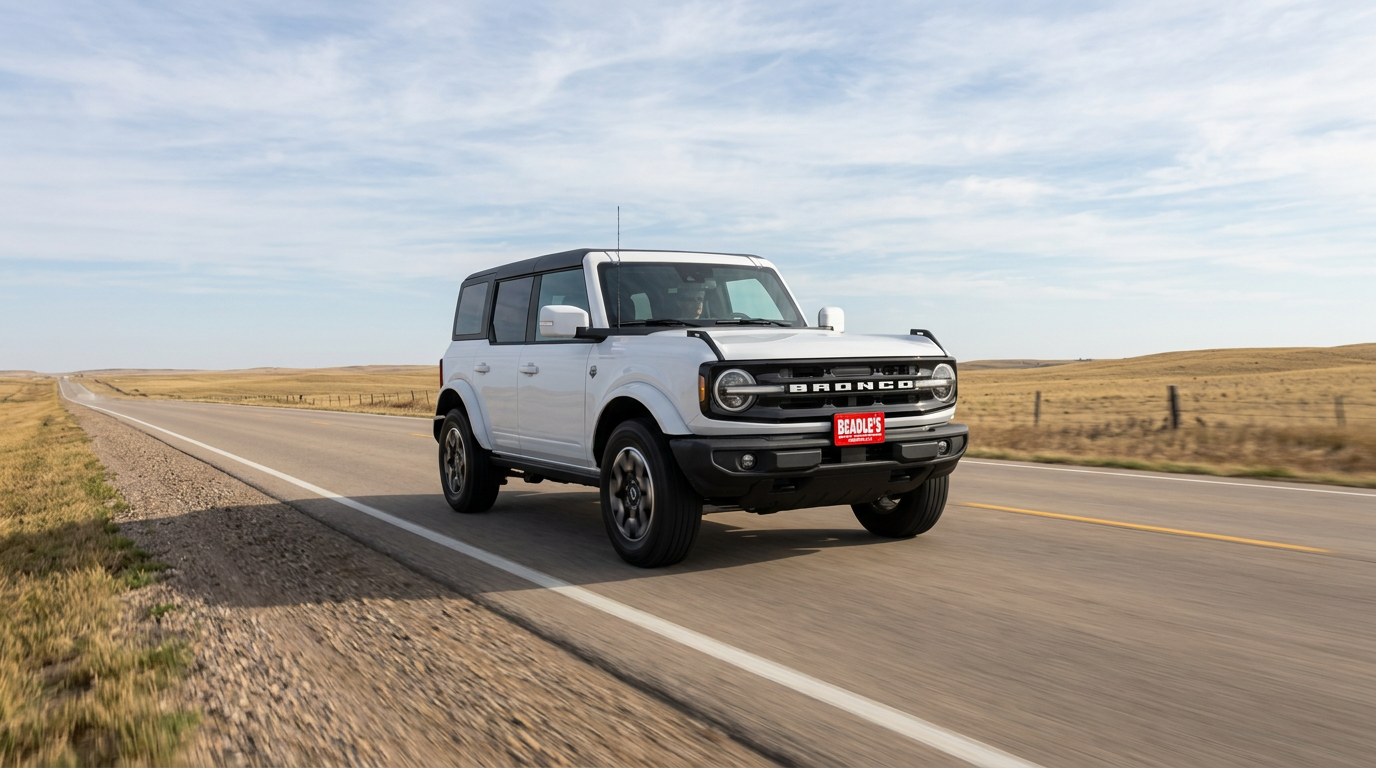
Two engines power most 2026 Ford Bronco orders: a 2.3L EcoBoost I-4 making 300 horsepower and 325 lb-ft of torque, and a 2.7L EcoBoost V6 making 330 horsepower and 415 lb-ft. The Raptor’s 3.0L V6 sits in its own tier (418 hp / 440 lb-ft) and isn’t part of this comparison. For everyone else, the choice is between the four-cylinder and the V6 — and it’s a closer call than most buyers expect.
This is an honest decision tool. We’ll cover what each engine actually feels like behind the wheel, what towing looks like (spoiler: nearly identical), what to expect at the pump on a Bowdle-to-Black-Hills run, whether the 7-speed manual still earns its place, and which engine matches which buyer in central South Dakota.
On This Page
- Why Is the 2.3L EcoBoost the Default Engine on the 2026 Bronco?
- What Does the 2.7L EcoBoost V6 Actually Buy You Over the 2.3L?
- How Different Is Towing Between the 2.3L and 2.7L?
- What’s the EPA Fuel Economy for Each 2026 Bronco Engine?
- Should You Pick the 7-Speed Manual or the 10-Speed Automatic?
- Which 2026 Bronco Engine Is Right for You?
Why Is the 2.3L EcoBoost the Default Engine on the 2026 Bronco?
The 2.3L EcoBoost is the default because it’s the broadest-fit engine in the lineup — the only one offered with the 7-speed manual transmission, standard on every trim from Base through Heritage Edition (other than Outer Banks, where it pairs with the auto only), and capable of the same 3,500-pound tow rating as the V6. For most buyers it’s enough engine.
Output is 300 horsepower at 5,700 RPM and 325 lb-ft of torque at 3,400 RPM on premium fuel (275 hp / 315 lb-ft on regular). It’s a turbocharged inline-four with direct injection, and in a body-on-frame Bronco it pulls cleanly from low RPM and turns the four-cylinder displacement gap into a non-issue most of the time. On a county-road merge or a Black Hills two-track, the four cylinder doesn’t feel undersized.
Where the 2.3L gives ground is at sustained high-load output: a long uphill grade with a trailer, or the upper third of the rev range when you want immediate punch from 50 to 75. The four cylinder works harder there than the V6 does — you’ll hear it through the firewall, and you’ll feel the turbo spooling rather than the V6’s broader torque shelf. For most central-SD use cases, that distinction doesn’t show up in everyday driving.
Trim availability: standard on Base, Big Bend, Outer Banks, Badlands, and Heritage Edition. New for 2026, the 10-speed automatic is now available with the 2.3L on Heritage (was 2.7L-only before). Stroppe and Raptor don’t offer the 2.3L. For full trim-by-trim context, see our 2026 Ford Bronco trim levels guide.
What Does the 2.7L EcoBoost V6 Actually Buy You Over the 2.3L?
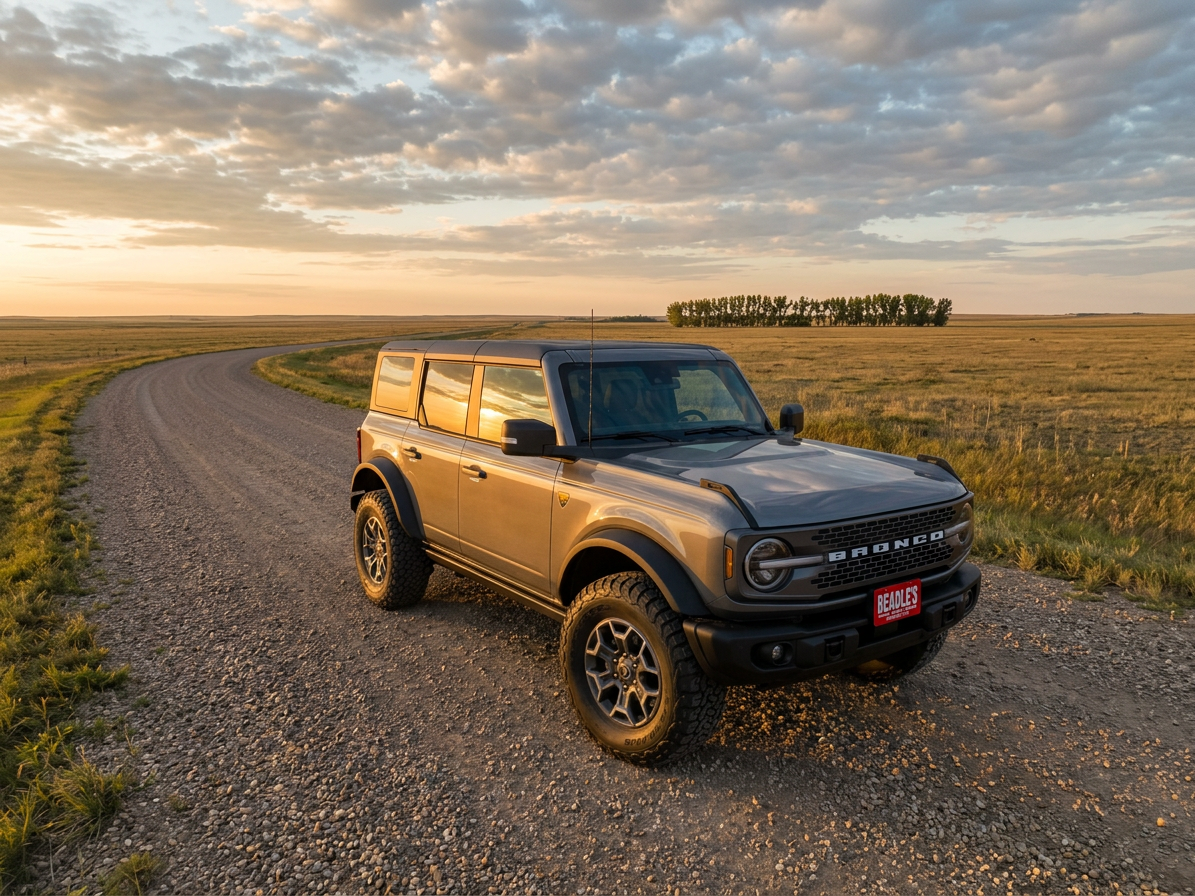
The 2.7L EcoBoost V6 buys you 30 more horsepower (330 vs 300) and — much more meaningfully — 90 more lb-ft of torque (415 vs 325) on premium fuel. The torque is what you actually feel: stronger pull from a stop, easier passing at highway speed, and a smoother delivery profile that doesn’t ask the engine to work as hard. The upcharge is $2,995.
The 2.7L is a turbocharged V6 with direct injection. It’s automatic-only — there’s no manual-transmission option with the V6. It’s available on Outer Banks, Badlands 4-Door, and Heritage Edition, and it’s the only engine offered on the Stroppe Edition (fleet/military only). It is not offered on Base, Big Bend, Badlands 2-Door, or Raptor.
Day-to-day, the V6 is most noticeable at the moments the 2.3L works hardest — uphill grades with weight, on-ramp acceleration, sustained 70+ highway speeds with a headwind, and the kind of pull-from-2,500-RPM situations where a V6’s torque shelf flattens out before a four cylinder’s turbo fully spools. For drivers who do a lot of long highway miles or pull a small trailer regularly, the V6 reduces the engine’s working effort. For drivers who mostly do town errands and gravel section roads, that effort difference is real but often not worth the upcharge.
There’s also a refinement gap. The V6 is quieter at cruise and smoother at idle — small things, but the kind of thing you notice on a four-hour run to the Hills. If long highway distance is a big part of your annual miles, that refinement adds up.
How Different Is Towing Between the 2.3L and 2.7L?
On paper, almost not at all. Both the 2.3L and 2.7L EcoBoost are rated to tow 3,500 lbs on every non-Raptor 2026 Bronco — regardless of trim, axle ratio, body style, or transmission. The Raptor is the only 2026 Bronco rated higher, at 4,500 lbs. The standard hitch receiver on every non-Raptor caps at 3,500 / 350 lbs (trailer / tongue), so the engine choice doesn’t change the ceiling.
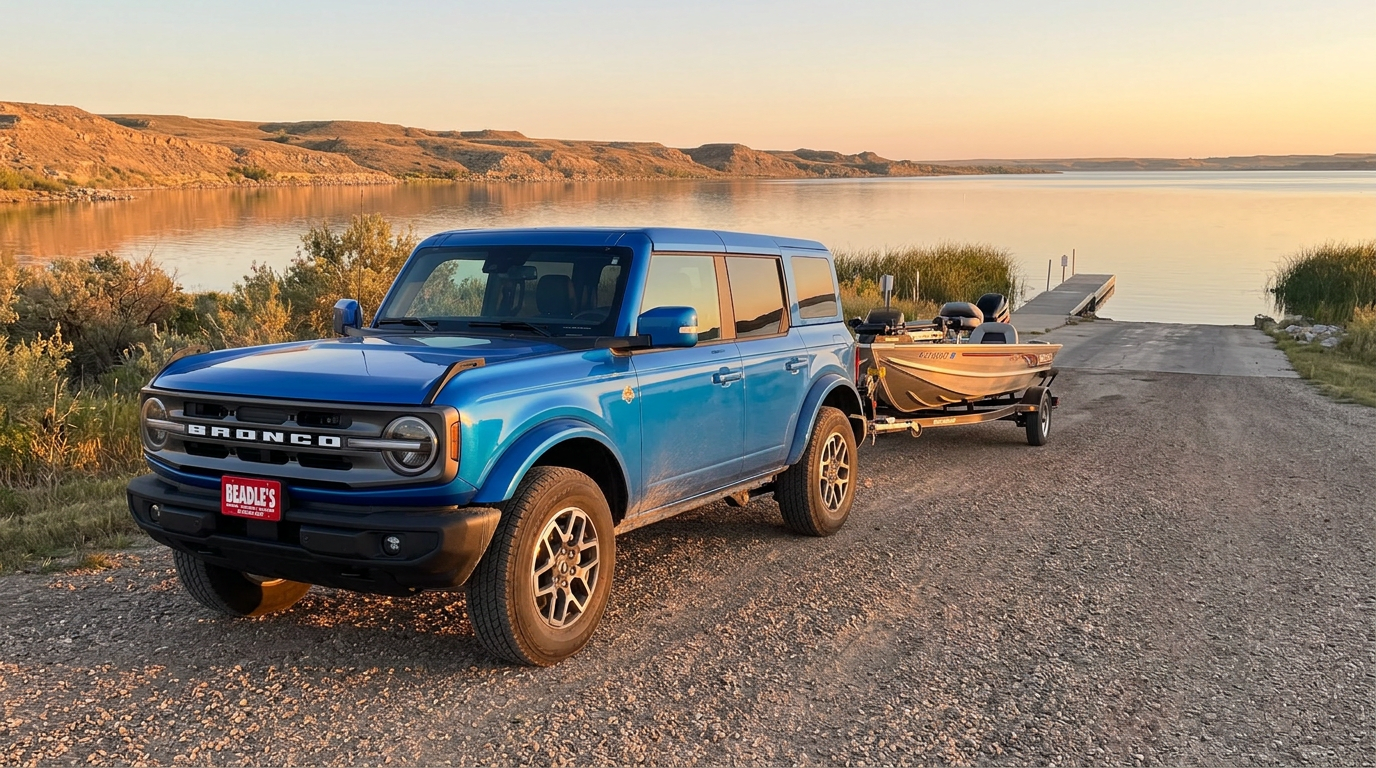
Where the engines actually differ is in how they pull that 3,500 lbs, not how much. The 2.7L V6’s extra torque means the engine works less hard at the same load — fewer downshifts on grade, less turbo build-up before getting underway, lower thermal load on long pulls. If you’re pulling a single-axle aluminum bass boat to Lake Oahe a few times a summer, the 2.3L handles it with no issue. If you’re pulling a 3,400-pound enclosed trailer with sled or ATV to the Hills regularly, the V6 will feel measurably less stressed at the end of a long day.
A 2026 footnote worth knowing: the Badlands 4-Door with the 2.7L V6 and 4.46 axle has a slightly lower published rating of 3,460 lbs (versus 3,500 on every other configuration). It’s a 40-pound spread — not relevant to most buyers, but if you’ve got a trailer that’s right at the line, that’s the one config to flag.
The Trailer Tow Prep Package is included on every non-Raptor Bronco, but the dealer-installed OEM trailer hitch receiver is required for any towing over 2,000 lbs. The frontal-area limit is 30 sq ft (non-Raptor), which rules out tall enclosed trailers regardless of weight rating.
What’s the EPA Fuel Economy for Each 2026 Bronco Engine?
EPA-estimated fuel economy varies by door count, transmission, axle ratio, and tire size — there isn’t one single number that applies. As a baseline, the 2.3L EcoBoost rates roughly 18 city / 20 highway / 19 combined on a 4-Door automatic, and the 2.7L EcoBoost V6 rates roughly 17 / 17 / 17 on the same body. The 2-Door 2.3L generally rates a touch higher (around 20 / 21 / 20). Verify your specific configuration on fueleconomy.gov before purchase — Sasquatch’s 35-inch tires and 4.70 axle, in particular, drop EPA combined by a noticeable margin on either engine.
For a Bowdle-to-Black-Hills round trip (about 720 miles total at mostly highway speeds), the math comes out roughly like this on each engine, before fuel-cost variations. A 2.3L 4-Door averaging 20 mpg highway burns about 36 gallons. A 2.7L V6 4-Door averaging 17 mpg burns about 42 gallons — a six-gallon difference per round trip, which adds up over a year of regular Hills runs but doesn’t move the needle on a single weekend.
What changes more than the engine choice is what’s hung off the Bronco. Sasquatch’s bigger tires and steeper axle ratio are the single biggest fuel-economy variable in the lineup — a non-Sasquatch 2.3L Badlands and a Sasquatch-equipped 2.3L Badlands aren’t really the same vehicle for MPG purposes. If saving fuel on long highway hauls is a priority, lean toward the smaller-tire trim and the 4-Door 2.3L auto. If you’re already at Sasquatch spec, the 2.7L’s torque advantage often offsets the V6’s combined-MPG penalty for the way most buyers actually use the truck.
Both engines run on regular 87-octane fuel; premium is recommended for peak rated horsepower and torque but not required. Real-world MPG from owner forums tends to track within 1–2 mpg of EPA combined under mixed driving, with bigger gaps when towing or running deep snow.
Should You Pick the 7-Speed Manual or the 10-Speed Automatic?
For most buyers in central South Dakota, the 10-speed automatic is the practical pick. The 7-speed manual is a real driver’s-engagement choice, and it earns its keep for buyers who want it — but the auto wins on towing, on long-distance highway comfort, and on every winter morning where the manual’s clutch and Crank-in-Gear function become extra effort instead of fun.
The 7-speed manual (Ford code 44Q) is offered with the 2.3L EcoBoost only — never with the V6. It’s standard on Base, Big Bend, Badlands, and Heritage Edition. It includes a Granny Gear (an ultra-low first), Crank-in-Gear functionality (lets you start the engine while in gear with the clutch pressed), and Hill Descent Control. For genuine off-road work — slow, technical climbs in the Black Hills or precise low-speed crawl situations — the manual gives the driver more direct control than even a well-tuned automatic.
The 10-speed automatic (Ford code 44T) is available with the 2.3L on most trims (NEW for 2026 on Heritage Edition with the 2.3L) and standard with the 2.7L V6 and 3.0L Raptor V6. With the auto you also get Trail Control (low-speed cruise control for off-road), Trail Turn Assist (tightens the turning radius by braking the inside rear wheel), and on Outer Banks and Badlands, Trail One-Pedal Driving. Those features pair tightly with the GOAT modes — see our 2026 Bronco G.O.A.T. Modes guide for how those interact in practice.
The honest take: if you’re choosing between a 2.3L manual and a 2.3L auto, and you’re not specifically excited about driving a manual, take the auto. It’s better for towing, better in stop-and-go, better for resale value, and better in winter clutch-leg fatigue. If you genuinely want the manual — and a meaningful number of Bronco buyers do — get it. It’s one of the few capable off-road SUVs that still offers a true row-your-own option.
Which 2026 Bronco Engine Is Right for You?
The 2.3L EcoBoost fits the buyer who wants the broadest-fit engine and is doing mostly daily driving, gravel section roads, light recreational towing, and weekend trips to the Hills. It’s the right call for the Plains Outdoorsman who already owns an F-150 for heavy work and uses the Bronco as a secondary vehicle, the buyer who wants the manual transmission, and anyone primarily driving in town or on county roads where the V6’s extra torque doesn’t get used.
The 2.7L EcoBoost V6 fits the buyer who runs long highway miles regularly, regularly tows close to the 3,500-pound limit, wants the smoother and quieter cruise feel, and doesn’t want the manual transmission anyway. The Ranch-Country Daily who’s pulling a small trailer to and from a property weekly, or the buyer who makes the Hills run six or eight times a year, will appreciate the V6’s torque shelf. The $2,995 upcharge is real money, but for the right use case, it’s well-spent.
For SD winter driving — a topic worth its own treatment — both engines handle cold starts and traction well. See our 2026 Bronco in South Dakota winter guide for the cold-weather details that matter at 30 below.
For the broader 2026 Bronco context — engines, capability, what’s new for the year — the full 2026 Ford Bronco overview walks through the lineup side by side. And if Sasquatch is on your build sheet, our honest take on whether Sasquatch is worth it in central South Dakota covers that decision in detail — Sasquatch is the single biggest variable on either engine’s fuel economy.
Key Takeaways
- 2.3L EcoBoost: 300 hp / 325 lb-ft, available with 7-speed manual, the broadest-fit engine for most buyers.
- 2.7L EcoBoost V6: 330 hp / 415 lb-ft, automatic-only, $2,995 upcharge — buys torque, refinement, and easier highway and towing duty.
- Both engines tow 3,500 lbs (non-Raptor cap). The Raptor’s 3.0L V6 is in its own tier at 4,500 lbs.
- EPA estimates: 2.3L 4-Door auto ~18/20/19; 2.7L V6 4-Door ~17/17/17. Verify your specific configuration on fueleconomy.gov before purchase.
- The 7-speed manual is 2.3L-only and rewards engaged drivers; the 10-speed auto is the practical pick for most central-SD buyers.
Frequently Asked Questions
My Take on the 2026 Bronco Engine Choice
In my time at Beadle Ford, I’ve watched buyers wrestle with this decision more than any other on the Bronco. The honest answer for most of them: the 2.3L is enough engine. The buyers who actually use the V6’s torque tend to know they need it before they walk in — they have a specific trailer, a specific commute, or a specific feel they’re after. The buyers who pick the V6 because they’re worried the four cylinder is “too small” usually find out a year later that the 2.3L would have done the job.
If you’re between the two, drive both back to back. Twenty minutes of seat time on the same county road outside Bowdle, with the same kind of load, settles the question for almost everyone — and saves you a $3,000 second-guess.
About the Author
Lexy Tabbert — Beadle Ford, Bowdle, SD
Lexy Tabbert is the Director of Sales and Marketing at Beadle Ford in Bowdle, South Dakota. She covers Ford vehicles, trim comparisons, and buyer guidance — helping families, ranchers, and ag operators across the region find the right truck and configuration for their needs. Learn more about Lexy.
Connect with us

