
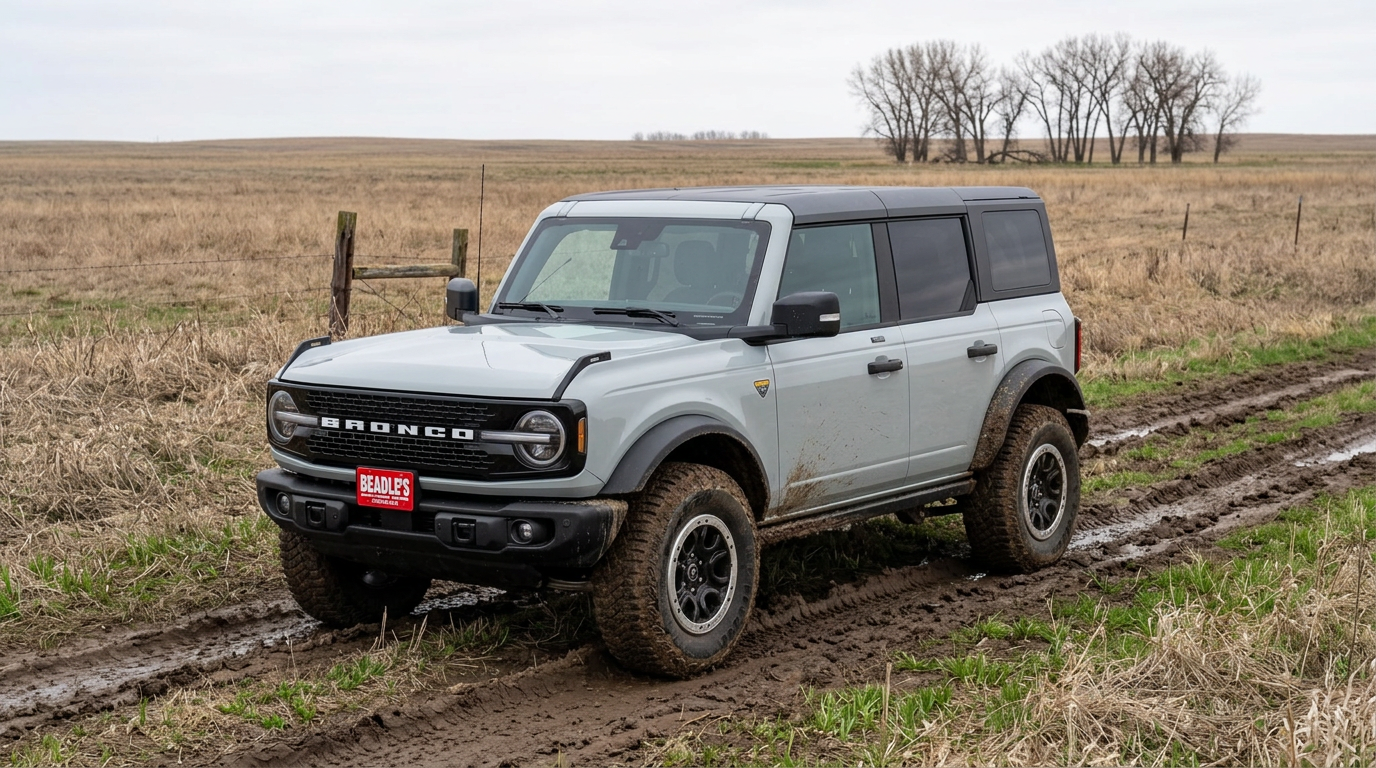
The Sasquatch Package is the single most-asked-about option on the 2026 Ford Bronco — and for most central-South Dakota buyers, it’s also the option that’s hardest to justify on paper. The 35-inch tires, the electronic-locking front and rear differentials, and the Bilstein high-clearance suspension are real upgrades, but they’re built for terrain most Bowdle-area drivers don’t actually run.
This is an honest decision guide. We’ll cover what’s actually in the package, what the 35-inch R/T tires cost you on highway and gravel, when the front locker matters and when it doesn’t, the price by trim, and the buyer who genuinely benefits from Sasquatch versus the one who’d be just as happy with a standard Badlands.
What Does the Sasquatch Package Include?
The Sasquatch Package (Ford order code 765) bundles seven hardware upgrades that move a Bronco from capable to seriously off-road ready. The standard contents are the same on every trim that can take it.
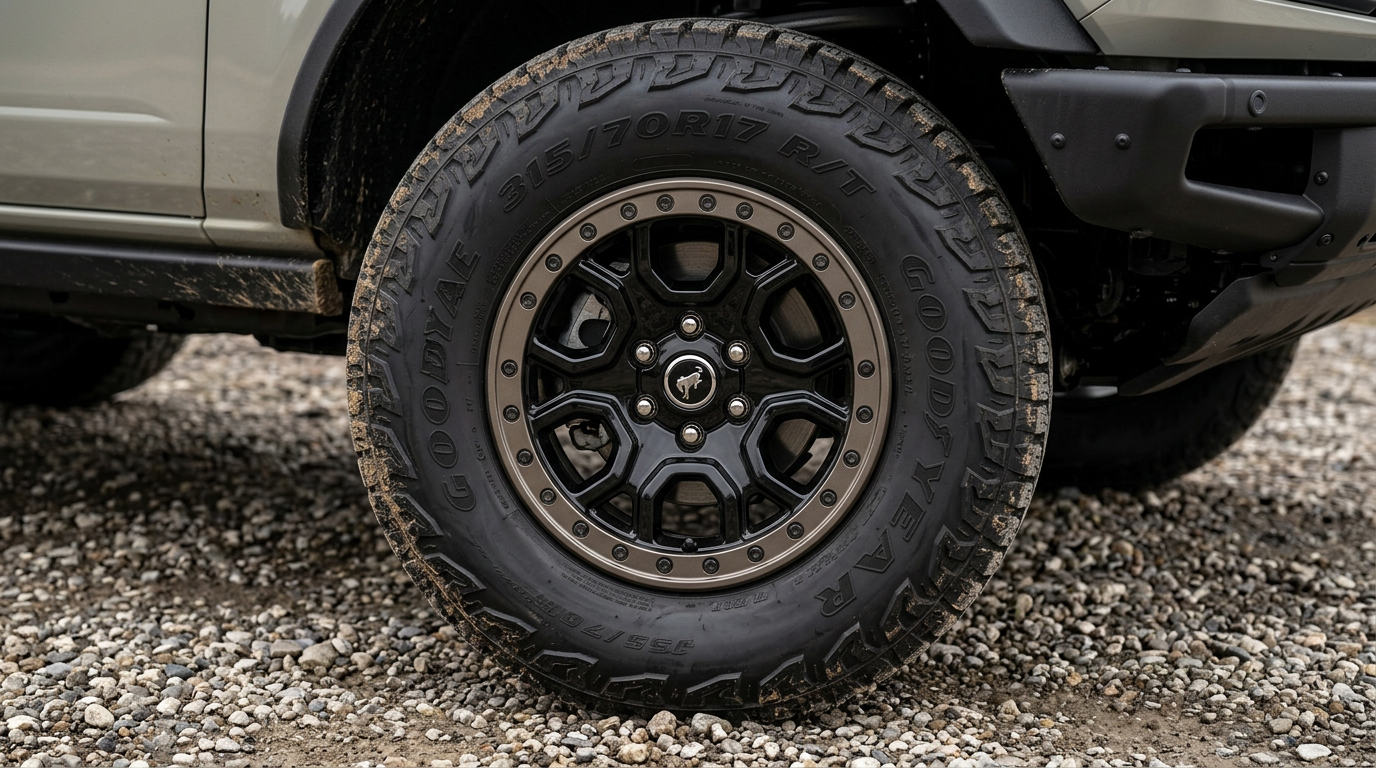
Standard Sasquatch contents include the Advanced 4×4 system with Automatic On-Demand Engagement (which adds 4-Auto mode), 17-inch matte-black alloy wheels, a 4.70 final-drive axle ratio with electronic-locking front and rear differentials, high-clearance suspension, high-clearance fender flares, LT315/70R17 Rugged-Terrain (R/T) tires (the 35s), and position-sensitive Bilstein shocks. That’s the package. Everything else listed in marketing — the 4-Auto, the lockers, the suspension — is a re-statement of those seven items.
Two trims add a little more on top of the base Sasquatch contents. Outer Banks with Sasquatch adds a passenger-side interior grab handle. Badlands with Sasquatch adds the Front Stabilizer Bar Disconnect — a feature that’s also available standalone for $1,305 on the 2026 Badlands. The Stroppe Edition (fleet/military only) also adds HOSS 3.0 with FOX Internal Bypass Dampers when Sasquatch is equipped.
For full context on which trim is the right starting point before adding Sasquatch, see our 2026 Ford Bronco trim levels guide. Heritage Edition is the one trim that includes Sasquatch in the base price — for everyone else, it’s an option.
Are the 35-Inch Tires Worth the Trade-Offs on Highway and Gravel?
For genuine off-road use the 35s are an upgrade you can feel. For long stretches of South Dakota highway and gravel section roads, the standard 33-inch R/T tire on a non-Sasquatch Badlands handles the same job with less compromise on ride, noise, and fuel economy.
The Sasquatch tire is an LT315/70R17 Rugged-Terrain — load-rated, aggressive tread, 35-inch overall diameter. On a moderate trail, in spring mud, on a steep loose-rock approach, or anywhere a sidewall might meet a rock face, that tire is exactly what you’d want. The trade-offs show up the rest of the time.
On Bowdle-to-Black-Hills runs, you’ll feel a small but real fuel-economy penalty from the heavier rotating mass and the more aggressive tread. Highway noise is more present at 70+ mph than the 33-inch R/T or the 32-inch all-terrain on lower trims. On washboard gravel, the longer sidewall actually rides slightly softer than a smaller-diameter tire — that’s a small win for Sasquatch. Tire replacement is more expensive at this size, and rotation intervals matter more because LT-rated tires don’t tolerate uneven wear well.
If you do go Sasquatch and want something better than the matte-black standard wheel, you have four upgrade options: 17-inch Black High Gloss-Painted Aluminum with a Warm Alloy Beauty Ring, beadlock capable (64X) at $995; 17-inch Dark Carbonized Gray Alloy Painted, beadlock-capable forged (64T) at $1,995 on Raptor and Lux trims; 17-inch Magnetic Gray Mid-Gloss-Painted Alloy with Machined Flange (DIO) at $1,960; or the 17-inch Gravity Gray-Painted Alloy that’s included with the 60th Anniversary Package on Outer Banks.
The honest summary: if you live on gravel and highway and your “off-roading” is gravel two-tracks and lake access, the 33s do the job. If you actually run rocks, drift mud, or want the lifted look enough to pay for it, the 35s earn their keep.
What Do Electronic-Locking Front and Rear Axles Actually Do?
A locking differential forces both wheels on an axle to spin at the same speed, regardless of which one has grip. Without it, a wheel hanging in the air or sitting on ice can spin freely while the wheel on solid ground gets nothing — that’s an open differential at work. With a locker engaged, both wheels turn together, so even one wheel with traction can pull the vehicle through.
Electronic-locking front and rear differentials are standard with every Sasquatch Package, on every Badlands and Heritage Edition trim, and on the Raptor. A standard Big Bend (without the Black Diamond Package) has open differentials front and rear. Big Bend with Black Diamond gets a rear locker only — no front locker — which still meaningfully improves traction on slippery, rutted, or off-camber surfaces but doesn’t match a full Sasquatch or Badlands setup.
When you actually use the lockers in central South Dakota: deep mud in spring thaw on a section line; loose, off-camber climbs in the Black Hills; rocky two-track approaches to a Lake Oahe boat ramp where one tire is up on a step and another is dropped into a rut. When you don’t need them: every gravel road, snow on a county road (4-Auto and the standard 4WD system handle that), pasture work, and most of what a Bronco does day-to-day. The lockers are insurance, not a daily driver.
The 4.70 axle ratio that Sasquatch brings — versus the standard 3.73 or 4.46 ratios — also gives the Bronco shorter overall gearing. That helps in low range when you actually need crawl-speed torque, but it slightly raises engine RPM at highway speeds. The 10-speed automatic compensates well; the 7-speed manual will feel busier on long highway runs than a non-Sasquatch 2.3L manual would. For more on what the 4-Auto and the full GOAT mode system do alongside the lockers, see our 2026 Bronco G.O.A.T. Modes guide.
How Much Does the Sasquatch Package Cost by Trim?
Sasquatch pricing ranges from $4,180 on a Big Bend with the 10-speed automatic (when Black Diamond is already added) up to $8,460 on a Base trim with the 7-speed manual. On the Heritage Edition the package is included in the base price at no upcharge.
Here’s how the math works out by trim, before destination:
| Trim | With 7-Spd Manual | With 10-Spd Auto |
|---|---|---|
| Base | $8,460 | $6,465 |
| Big Bend (requires Black Diamond +$4,495) | $6,175 | $4,180 |
| Outer Banks | n/a (auto only) | $6,465 |
| Badlands | $6,345 | $4,350 |
| Heritage Edition | included | included |
Two pricing realities are worth flagging. First, Big Bend’s lower Sasquatch sticker is misleading — Black Diamond is a prerequisite, so the true added cost over a standard Big Bend is Black Diamond ($4,495) plus Sasquatch ($4,180 with auto) for $8,675 total. That is more than ordering Sasquatch on a Badlands, where the off-road hardware that Black Diamond duplicates is already standard.
Second, Heritage Edition is the cleanest path to Sasquatch capability — it bundles the package with the trim’s distinct styling at $51,625, which works out very close to a Badlands 4-Door with Sasquatch added once you account for the auto transmission and standard equipment.
Outer Banks pricing is automatic-only because Outer Banks doesn’t offer the 7-speed manual. On Base, the cost is highest because there’s no overlap with hardware already on the trim — every Sasquatch piece is genuinely new.
Is the Sasquatch Package Worth It for Central South Dakota Drivers?
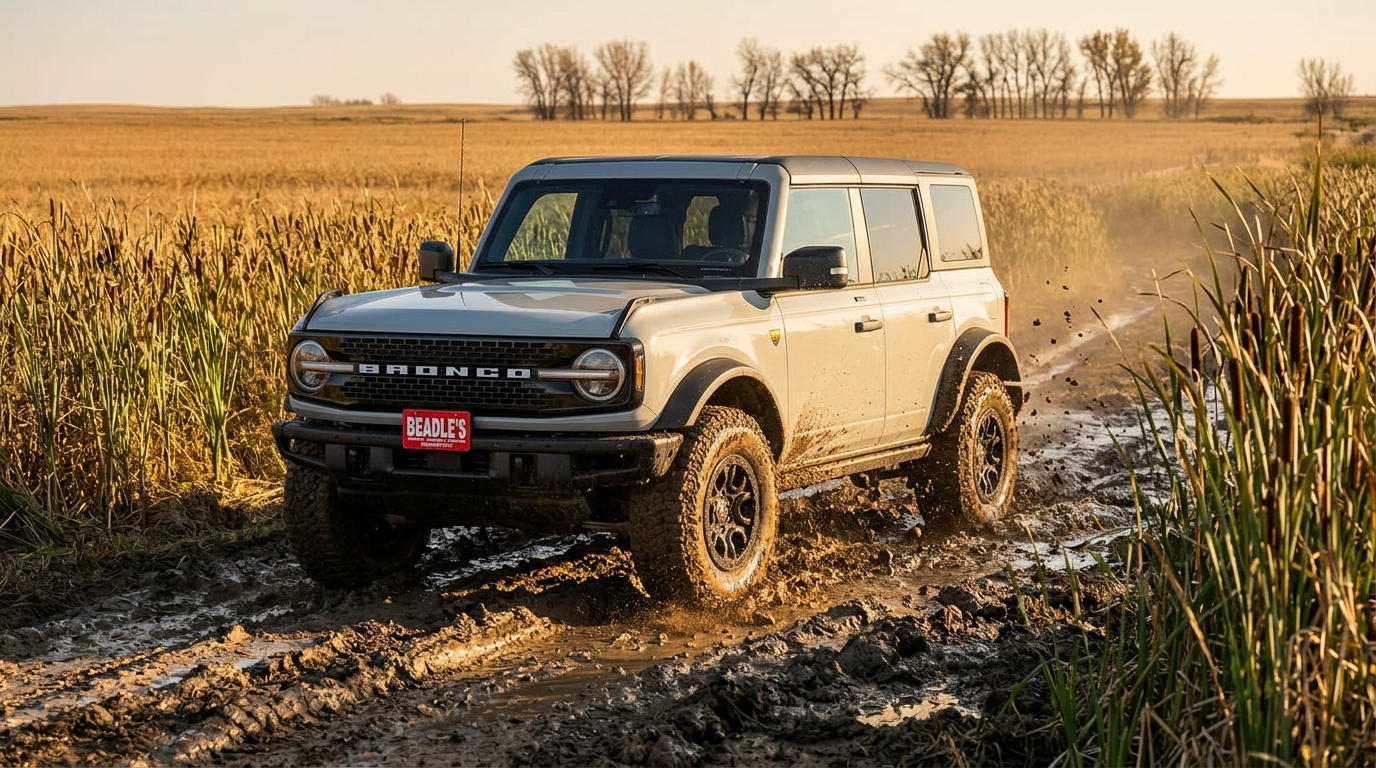
For most central-South Dakota drivers, the standard Badlands 33-inch R/T setup with electronic-locking front and rear differentials is enough. Sasquatch is worth it for the buyer who actually rock-crawls in the Black Hills, regularly runs deep mud or sand, or specifically wants the lifted look — which is a real and valid reason on its own.
The contrarian truth most national Bronco content won’t tell you: gravel section roads, harvested-cornfield two-tracks, Lake Oahe boat-ramp access, ranch pasture work, and a few weekend trips per year to the Hills are well within what a non-Sasquatch Badlands handles. The Badlands already comes with both lockers, HOSS 2.0 suspension, and the 33-inch R/T tires. The Sasquatch upgrade buys you taller tires, a numerically lower (deeper) axle ratio, Bilstein high-clearance shocks, and the high-clearance fender flares to clear the bigger tires. Useful upgrades — but not a leap from “couldn’t do it” to “now I can.” The Badlands could already do it.
Sasquatch is worth it if you actually rock-crawl two or more weekends a year in the Hills, run timber or river-bottom approaches that scrape rocker panels, regularly cross deep mud or sand the standard Badlands setup wouldn’t clear, want the look enough to pay for it (and there’s nothing wrong with that), or are buying Heritage Edition or Wildtrak Package — both of which include it bundled at a price that’s hard to argue with on its own.
Sasquatch is not worth it if your “off-roading” is gravel-road commutes, lake-access two-tracks, light snow, light pasture work, or one annual trip to a campground — the standard Badlands or even a Big Bend with Black Diamond will do all of that on the 32- or 33-inch tires they ship with, and you’ll keep the better ride, the better fuel economy, and several thousand dollars on a different option.
For the engine side of this decision — whether the 2.3L or the 2.7L makes more sense once you’re already at this spec level — see our 2.3L vs 2.7L EcoBoost engine comparison. And for the broader 2026 model-year context, the full 2026 Ford Bronco overview walks through everything new for the year.
Key Takeaways
- The Sasquatch Package adds 35-inch R/T tires, a 4.70 axle, electronic-locking front and rear differentials, high-clearance Bilstein suspension, and high-clearance fender flares.
- Sasquatch pricing ranges from $4,180 (Big Bend auto, after Black Diamond) to $8,460 (Base manual). Heritage Edition includes it standard.
- For most central-SD drivers — gravel, lake access, light Hills trips — a non-Sasquatch Badlands with 33-inch tires does the same work without the highway and fuel-economy trade-offs.
- Sasquatch earns its keep for buyers who actually rock-crawl, run deep mud or sand, or want the lifted look enough to pay for it.
- Big Bend’s Sasquatch sticker looks low, but Black Diamond is a prerequisite — true added cost is closer to a Badlands with Sasquatch when you tally both.
Frequently Asked Questions
My Take on the 2026 Bronco Sasquatch Package
I see two kinds of Sasquatch buyers walk through the door at Beadle Ford. One actually uses the hardware — they rock-crawl, they run deep mud in spring, they’re the buyer the package was engineered for. The other wants the look, knows it, and is paying for it on purpose — which is a perfectly valid reason if the truck is going to be parked in their driveway for the next eight years. The buyer I quietly steer away from Sasquatch is the one who’s halfway between, who has been told by a friend or a forum that they “need” it for South Dakota, and who would actually be happier with a standard Badlands.
If you’re not sure which of those buyers you are, come walk a Badlands and a Sasquatch-equipped trim back to back on the gravel just outside Bowdle. The difference is real, but it’s not the difference Ford’s marketing tells you to expect — and twenty minutes of side-by-side time will save you $4,000–$8,000 either direction.
About the Author
Lexy Tabbert — Beadle Ford, Bowdle, SD
Lexy Tabbert is the Director of Sales and Marketing at Beadle Ford in Bowdle, South Dakota. She covers Ford vehicles, trim comparisons, and buyer guidance — helping families, ranchers, and ag operators across the region find the right truck and configuration for their needs. Learn more about Lexy.
Connect with us

