
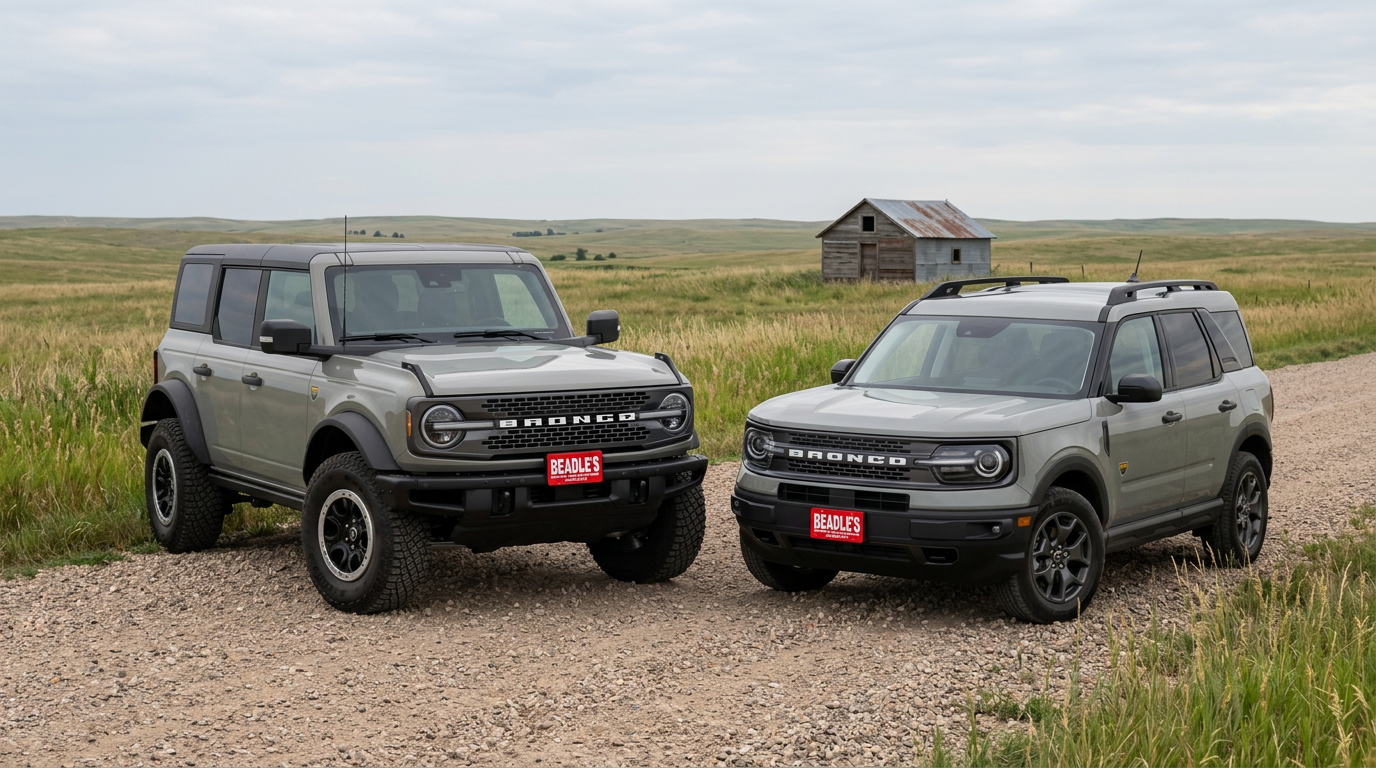
Half the customers who walk into Beadle Ford asking about a Bronco actually want a Bronco Sport. The other half think the Sport is the right call until they see what the full-size Bronco can do. Two vehicles, similar names, same off-road family — and very different jobs. Knowing which one fits your week before you walk onto the lot saves time, money, and a regret call six months later.
This guide is an honest comparison of the 2026 Ford Bronco and the 2026 Ford Bronco Sport for buyers in Bowdle and the central South Dakota region. We’ll cover what body-on-frame versus unibody really means for daily driving, interior and cargo room, off-road hardware, towing and capability, the pricing gap and what it buys, and which one we recommend for which kind of buyer. Both are good vehicles. Only one is right for any given customer.
On This Page
- What Does Body-on-Frame vs Unibody Actually Mean for Drivers?
- How Do Interior Space, Cargo Room, and Daily Practicality Compare?
- How Does the Off-Road Hardware Compare — Sasquatch vs Sport Badlands?
- Which One Tows More, and What Real-World Capability Does Each Offer?
- What’s the Pricing Gap, and What Does the Money Actually Buy You?
- Which One Should Beadle Ford Recommend for You?
What Does Body-on-Frame vs Unibody Actually Mean for Drivers?
The Bronco is body-on-frame: a separate ladder frame underneath the body, the same architecture as a full-size truck. The Bronco Sport is unibody: the body and structural frame are a single welded unit, the same architecture as a crossover SUV. That single design choice drives almost every meaningful difference between the two.
Body-on-frame gives you better hard off-road durability, easier flex when one wheel is up on a rock and another is in a hole, simpler frame repair after damage, and the ability to mount removable doors and a removable roof without compromising structure. It also makes the vehicle heavier, slightly louder at highway speed, and a little less refined on smooth pavement.
Unibody gives you a quieter cabin, better fuel economy, smoother ride quality on pavement, lower curb weight, and a tighter turning radius. The trade-off is reduced articulation in genuine off-road conditions and a lower towing ceiling. For a buyer who lives mostly on Bowdle’s blacktop and gravel and occasionally wants to access a CRP edge or a Lake Oahe boat ramp, unibody is plenty. For a buyer who needs to thread a section-line two-track in winter or pull a 3,500-lb boat trailer, body-on-frame is the right tool.
How Do Interior Space, Cargo Room, and Daily Practicality Compare?
Both vehicles seat five. The full-size Bronco’s 4-Door is wider and taller, with more shoulder room front and rear, more rear-seat legroom, and a noticeably bigger cargo bay behind the rear seats. The Bronco Sport is narrower and lower, easier to park in a small-town downtown space, and lighter on the eyes for shorter drivers who don’t want to climb up into the cabin.
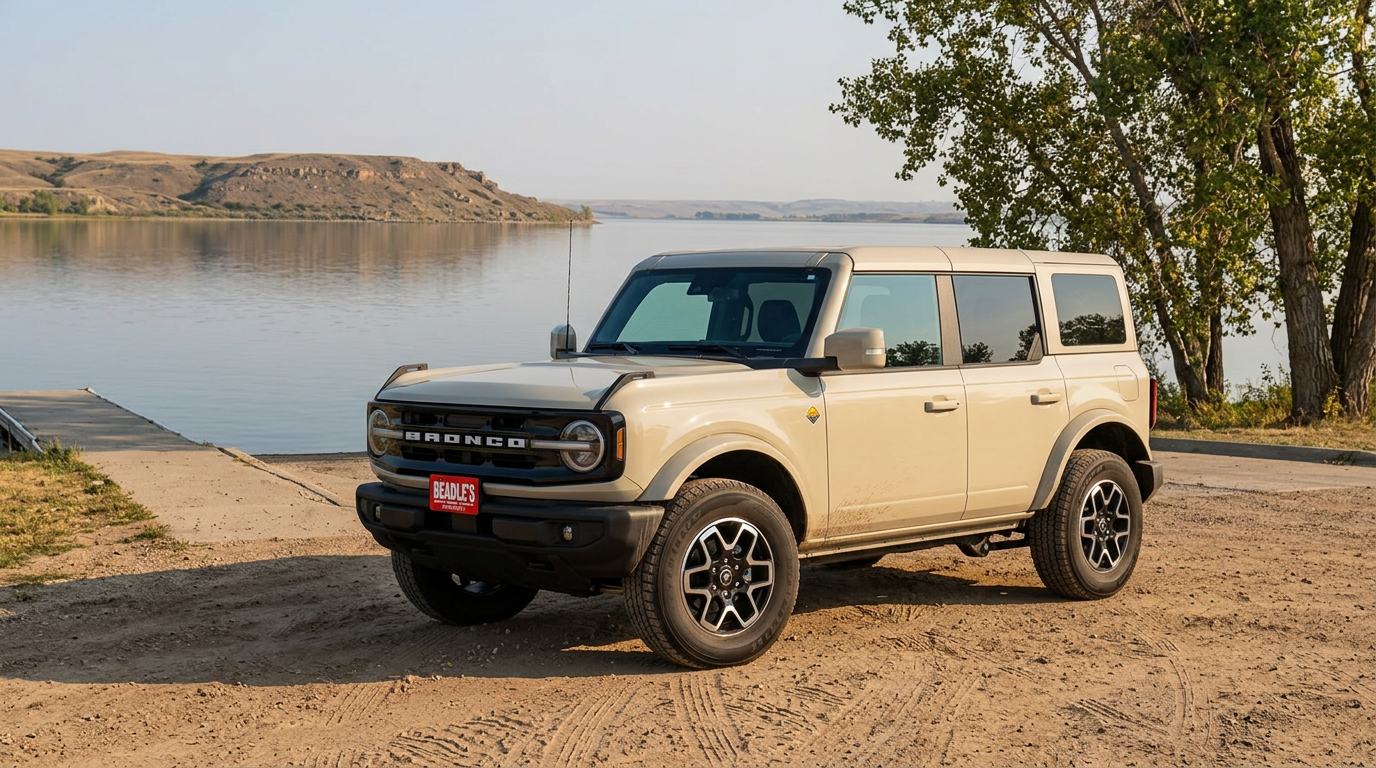
Cargo: a 4-Door Bronco swallows a Lab-sized kennel, a full decoy spread, and two coolers behind the rear seats with the seats up. The Bronco Sport’s cargo bay handles a kennel and a cooler with the seats up, but a full decoy spread or layout blind needs the rear seat folded. For grocery-and-school-pickup duty, both are plenty. For a hunting rig that hauls dogs and gear, the full-size Bronco is the right answer. For full hunting use cases see our South Dakota hunting guide.
Daily-driver feel is where the Bronco Sport pulls ahead. It rides quieter on US-12 at 70 mph, returns better fuel economy on the Bowdle-to-Hills run, and parks more easily in a narrow lot. The full-size Bronco’s removable doors and roof are unique to the platform — the Bronco Sport doesn’t offer them. If the doors-off summer lifestyle is part of why you’re shopping, that’s a Bronco-only feature.
How Does the Off-Road Hardware Compare — Sasquatch vs Sport Badlands?
Both vehicles can tackle a wet ranch two-track, a CRP access road, or a snow-packed section line in central SD. The line between them shows up in deep mud, real ruts, and rock crawling — situations where the full-size Bronco’s hardware advantage is the difference between getting through and getting stuck.
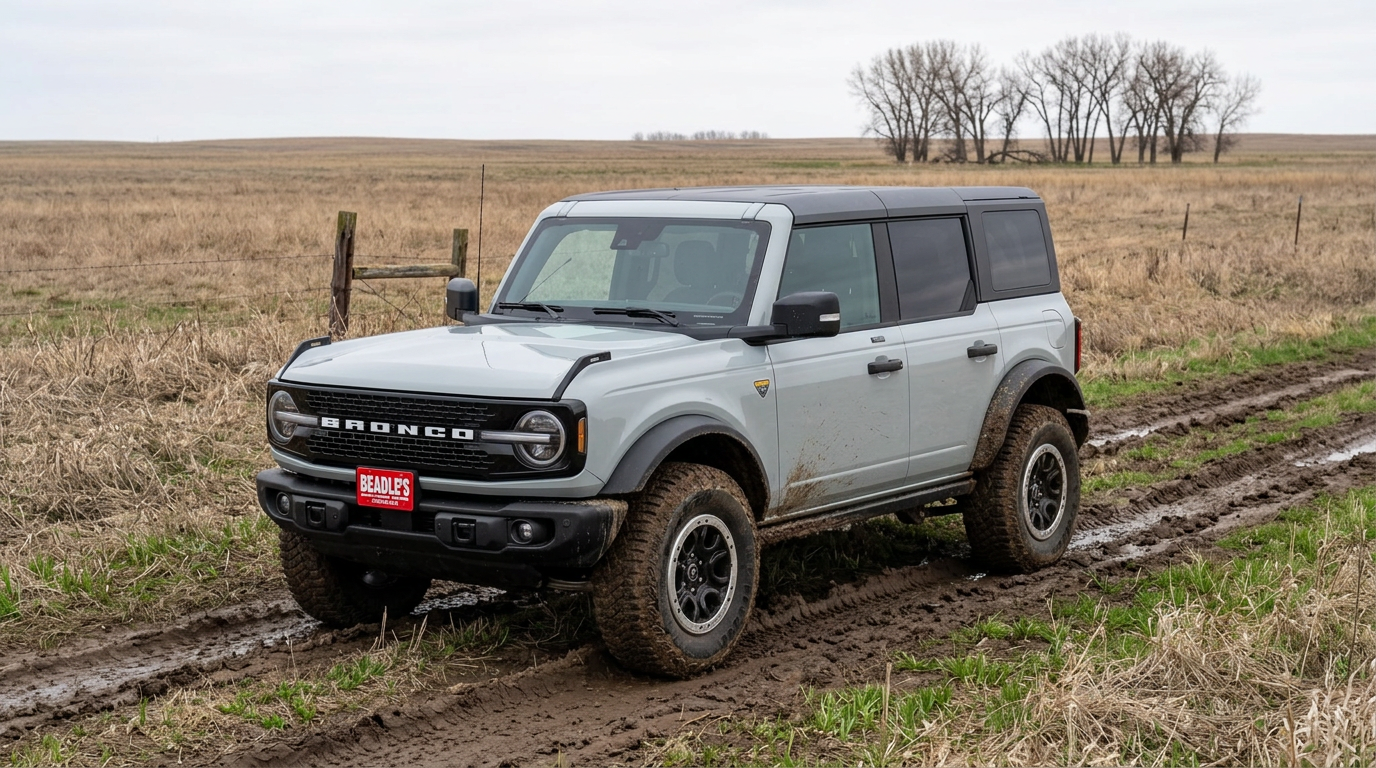
The full-size Bronco’s Badlands trim ships with electronic-locking front and rear differentials, 33-inch Rugged-Terrain tires, the seven-mode G.O.A.T. terrain system (Off-Road, Rock-Crawl, Baja added on top of the standard five), and the Advanced 4×4 system with 4-Auto. Add the Sasquatch Package and you get 35-inch tires and HOSS suspension upgrades. For the full breakdown see our 2026 Bronco trim levels guide.
The Bronco Sport’s Badlands trim is the most off-road-focused of the Sport lineup, with steel underbody skid plates, terrain modes, and twin-clutch rear axle technology. It’s a capable rig for what it is — a unibody crossover with off-road tuning — but it doesn’t offer beadlock-capable wheels, 35-inch tires, or the dual electronic locker setup. For everyday SD ranch and lake access, Sport Badlands handles it. For genuine off-road work, the full-size Bronco’s hardware ceiling is much higher.
Which One Tows More, and What Real-World Capability Does Each Offer?
The full-size Bronco wins on towing. Every non-Raptor 2026 Bronco is rated for a 3,500-lb maximum loaded trailer weight, and the Raptor is rated for 4,500 lbs. The Bronco Sport’s tow rating is significantly lower and is configuration-dependent — for a small utility trailer, a single-axle aluminum boat, or a lightweight pop-up camper it works; for the 3,500-lb fishing-rig-on-a-trailer use case, the full-size Bronco is the right vehicle.
Real-world capability beyond towing is where each vehicle’s intended use shows up. The full-size Bronco is built to handle deep snow on a section line, mud on a slough access road, and frozen ruts on a river-bottom whitetail trail. It walks through what the Bronco Sport would have to turn around at. The Bronco Sport, in turn, is built to handle the entire range of central SD daily driving with capability in reserve — gravel roads, light off-pavement, snowy commutes, dirt fairgrounds — in a more efficient and refined package.
A practical note for towing: a dealer-installed OEM trailer hitch receiver is required for any towing over 2,000 lbs on the full-size Bronco, regardless of trim. Same kind of dealer-install conversation applies to the Bronco Sport for any towing setup. Bring the trailer specs to the conversation and we’ll size the right tow package for either vehicle.
What’s the Pricing Gap, and What Does the Money Actually Buy You?
The 2026 Bronco starts at $40,495 (Base 2-Door or 4-Door), runs through Big Bend at $40,995, Outer Banks at $48,090, Badlands at $48,890, Heritage Edition at $51,625, and tops out at the Raptor at $79,995 — all before the $1,995 destination charge. The 2026 Bronco Sport’s lineup starts well below the full-size Bronco’s entry point and tops out below the Bronco Badlands’ starting price. There’s typically a five-to-fifteen-thousand-dollar gap between comparably equipped Sport and Bronco trims.
The money buys you four things on the full-size Bronco that the Sport can’t match: removable doors and roof, body-on-frame off-road durability, a tow rating up to 3,500 or 4,500 lbs, and the highest off-road hardware ceiling in the segment (lockers, 35-inch tires, HOSS suspension on Badlands and up). If those features matter to you, the upcharge is worth it. If they don’t, you’re paying for capability you won’t use.
Cost of ownership beyond purchase price tends to favor the Bronco Sport over time. Better fuel economy, lower insurance in most cases, and lower tire-replacement costs (32-inch tires versus 33-inch or 35-inch on the full-size Bronco) all add up over a five-year ownership window. We’d rather have the straight conversation than oversell either vehicle.
Which One Should Beadle Ford Recommend for You?
Pick the Bronco Sport if your daily driving is mostly pavement and gravel, you want better fuel economy, parking matters in your week, and you don’t tow more than light loads. Sport Badlands is plenty for ranch-property access, CRP edges, and Lake Oahe boat ramp duty in fair weather. The 2026 Bronco Sport lineup is detailed on our 2026 Ford Bronco Sport overview, and the model page with current inventory lives at the Ford Bronco Sport model page.
Pick the full-size Bronco if you tow a 3,500-lb boat or trailer, you hunt cattail sloughs and river-bottom timber, you want the doors-off summer lifestyle, you regularly drive unplowed section lines in winter, or the body-on-frame durability matters because you actually use the vehicle hard. Badlands 4-Door is the sweet spot for most central SD buyers; the Sasquatch Package is the upgrade if you cross deep mud or snow regularly.
Pick neither if you don’t actually want or need 4WD, off-road styling, or the Bronco identity. Ford has several strong crossover options that will be cheaper, more efficient, and better suited to a pure pavement life. Both Broncos are real off-road vehicles — the value is in using what they offer. The complete 2026 Ford Bronco overview lays out trims, packages, and capability side by side if you’re leaning full-size.
Key Takeaways
- Bronco is body-on-frame; Bronco Sport is unibody. That single design choice drives almost every meaningful difference between them.
- Full-size Bronco tows up to 3,500 lbs (non-Raptor) or 4,500 lbs (Raptor). Bronco Sport tow rating is significantly lower and configuration-dependent.
- Removable doors and roof are unique to the full-size Bronco — the Bronco Sport doesn’t offer them.
- Sport Badlands handles light off-road and gravel-road duty in central SD; full-size Bronco Badlands or Sasquatch handles cattail sloughs, river-bottom timber, and unplowed section lines.
- Bronco Sport wins on fuel economy, daily refinement, parking, and total cost of ownership. Full-size Bronco wins on capability ceiling, towing, and lifestyle features.
Frequently Asked Questions
My Take on the Bronco vs Bronco Sport Decision
The mistake I see most often is a customer ordering the full-size Bronco because it looks more capable, then driving it for two years on pavement and gravel and never once putting it in 4-Low. That’s a $15,000 capability premium for a vehicle that’s not being used to its purpose — and it’s a Bronco Sport in disguise. The reverse mistake also happens: a customer orders the Sport because it’s more affordable, then realizes a year in that they actually do tow a fishing boat and want the doors off in summer.
Honest advice: the right vehicle is the one that matches what you actually do, not what you imagine doing. We sell both at Beadle Ford, and we’d rather sell you the right one and have you back in five years than sell you the wrong one and lose you to a different brand. Bring your real use case — towing, terrain, weekly miles, summer plans — and we’ll walk through both. The conversation usually settles itself in fifteen minutes.
About the Author
Lexy Tabbert — Beadle Ford, Bowdle, SD
Lexy Tabbert is the Director of Sales and Marketing at Beadle Ford in Bowdle, South Dakota. She covers Ford vehicles, trim comparisons, and buyer guidance — helping families, ranchers, and ag operators across the region find the right truck and configuration for their needs. Learn more about Lexy.
Connect with us

