

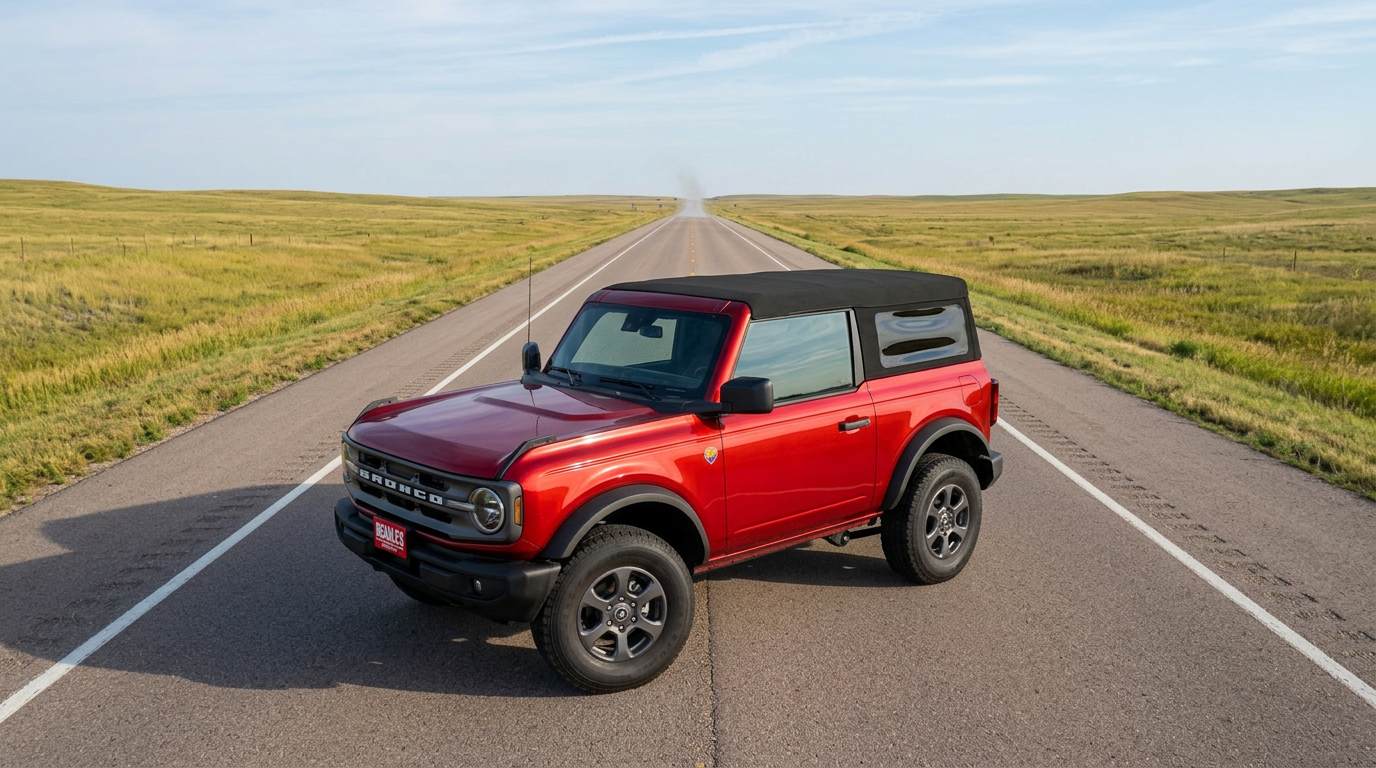
The 2-Door versus 4-Door decision on a 2026 Ford Bronco is one of the few choices in the build process where the spec-sheet differences and the everyday driving experience point in opposite directions. The 2-Door has a tighter wheelbase, slightly better off-road breakover geometry, and the original Bronco silhouette that turns heads in a Bowdle parking lot. The 4-Door has a back seat your kids and dogs can actually use, a cargo bay that holds gear, and the resale demand to back it up.
This guide is for buyers weighing the body-style choice on a 2026 Bronco at Beadle Ford. We’ll cover the off-road geometry trade-off, interior space and rear-seat reality, daily-driver fit for kids and dogs and long highway runs, resale demand, and who should actually pick the 2-Door. The straight answer: most central South Dakota buyers should pick 4-Door. There’s a specific 2-Door buyer, and we’ll name who that is.
On This Page
- How Do Wheelbase, Approach, and Departure Differ Between the 2-Door and 4-Door?
- What’s the Interior Cargo Room and Rear-Seat Reality on Each Body Style?
- Which Body Style Fits Better for Kids, Dogs, Gear, and Long Drives?
- Why Does the 4-Door Dominate the Market — and What Does That Mean for Resale?
- Who Is the Specific Buyer Who Should Pick the 2-Door?
- Which Body Style Does Beadle Ford Recommend for Most Buyers?
How Do Wheelbase, Approach, and Departure Differ Between the 2-Door and 4-Door?
The 2-Door’s shorter wheelbase gives it a slightly better breakover angle — the angle that determines whether the underbody clears a sharp ridge or a high mid-line obstacle. On the same trim and tire spec, expect the 2-Door’s breakover to read a few degrees better than the 4-Door’s, because there’s less length between the front and rear axles to bridge across the obstacle. Approach angle (front-bumper clearance) and departure angle (rear-bumper clearance) are largely the same between body styles since they’re set by the bumper, fender flare, and tire-size geometry rather than wheelbase.
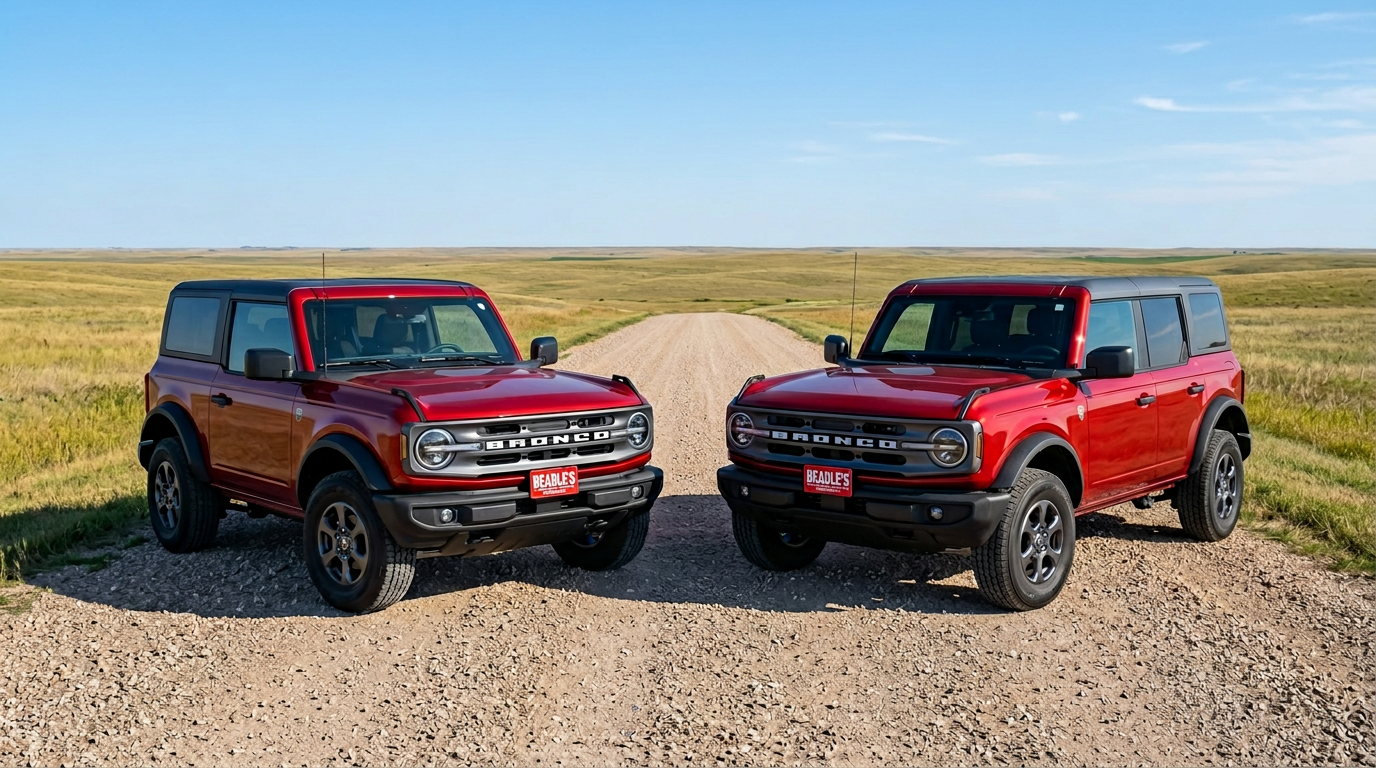
Across the lineup, ground clearance and tire-driven angles are tire-spec dependent: a Badlands on 33-inch Rugged-Terrain tires has approximately 8.8 to 9.0 inches of ground clearance with roughly 43° approach, 26° breakover, and 37° departure; a Sasquatch-equipped Bronco on 35-inch tires moves to about 11.6 inches of clearance, 43° approach, 29° breakover, and 37° departure; the Raptor on 37-inch tires sits at roughly 13.1 inches of clearance, 47° approach, 31° breakover, and 40.5° departure. The 2-Door’s wheelbase advantage stacks on top of those numbers, particularly improving breakover.
What this means in real terms for central SD: on the access roads, two-tracks, and CRP edges most owners actually drive, the geometry difference between 2-Door and 4-Door doesn’t show up. The 2-Door’s edge is real on Black Hills weekend trails or genuine rock-crawling terrain. For the rest of the lineup’s geometry numbers and trim breakdowns see our 2026 Bronco trim levels guide.
What’s the Interior Cargo Room and Rear-Seat Reality on Each Body Style?
The 4-Door’s longer wheelbase translates directly into more rear-seat legroom and a noticeably bigger cargo bay behind the rear seats. A 4-Door swallows a Lab-sized kennel, a cooler, two shotgun cases, and a duffel of blaze orange behind the rear seats with the seats up. A 2-Door’s cargo bay behind its small rear seats is much tighter — a kennel and a cooler fit, but a full hunting load means folding the rear seats and accepting that the rear bench isn’t usable.
The 2-Door’s rear bench is best understood as occasional-use seating: a couple of adults can fit for a short trip, kids fit fine for daily duty, but it’s not a configuration that anyone would choose for a long highway haul. Climbing into the back seat through the front-passenger door is fine for a parking lot but tedious if your day involves multiple stops. Two-Door buyers usually treat the rear seat as a folded-down cargo extension by default and use it for passengers occasionally.
For everyday hunting, family, and gear-hauling use cases, the 4-Door is the meaningful answer. For full hunting context see our South Dakota hunting guide, where the 4-Door body style is the recommendation across every persona we serve.
Which Body Style Fits Better for Kids, Dogs, Gear, and Long Drives?
The 4-Door wins on every daily-driver use case in central SD. For a family with kids, the 4-Door’s standard rear doors make car-seat installation, school pickup, and grocery loading manageable; the 2-Door’s tilt-and-fold front-seat access is a functional dealbreaker for most parents within a week. For a hunter with one or more dogs, the 4-Door’s rear cargo bay accepts a kennel without compromising passenger seating.
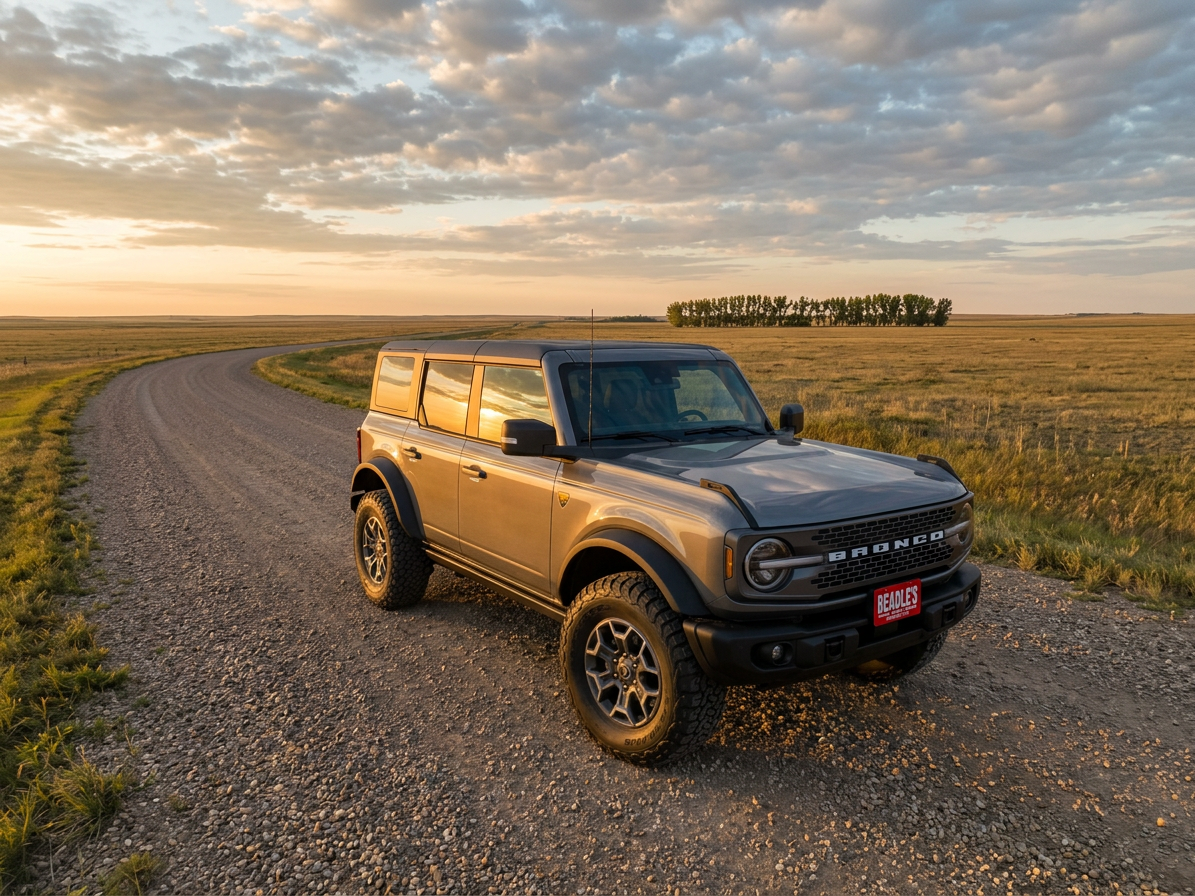
Long highway distances are where the 4-Door’s longer wheelbase quietly earns its money. The Bowdle-to-Black-Hills run is a four-hour drive each way, and the 4-Door tracks straighter at sustained 70-plus mph speeds, handles cross-winds with less correction, and rides quieter in the cabin. The 2-Door’s shorter wheelbase makes it a livelier vehicle on tight off-road courses and a slightly twitchier vehicle on a long highway haul. Neither is unsafe — but at 70 mph for four hours, the 4-Door is the more relaxed companion.
Fuel economy and cargo capacity also tilt to the 4-Door for the long-haul use case. The 2-Door is slightly lighter and gets a marginal fuel-economy edge in city driving, but the 4-Door’s larger cargo capacity means fewer trips and less roof-rack improvisation for a long weekend away. Across the central SD daily-driver use case, the 4-Door is the safer bet for almost every buyer profile.
Why Does the 4-Door Dominate the Market — and What Does That Mean for Resale?
Industry-wide, 4-Door body styles outsell 2-Door body styles in this segment by a wide margin. Ford’s lineup reflects this: most 2026 Bronco trims (Big Bend, Outer Banks, Heritage Edition, Stroppe, Raptor) are 4-Door only. Only the Base and Badlands trims offer both body styles, and the 2-Door is priced the same as the 4-Door at those trims — buyers don’t get a discount for choosing the more limited body.
Resale demand follows production volume. A used 4-Door Bronco draws a wider buyer pool — families, hunters, daily-driver shoppers, and lifestyle buyers all consider it. A used 2-Door draws a narrower pool of buyers who specifically want that body style, which means longer time on a lot when reselling and softer values relative to comparable 4-Door builds. This isn’t a Bronco-specific dynamic; it’s how the segment has worked for years across both Bronco and Wrangler.
For a buyer who plans to own the vehicle for ten-plus years and never sell, resale doesn’t matter — pick whichever body style fits your life. For a buyer who anticipates trading in within five years, the 4-Door’s broader resale demand is one more factor in its favor. A 2-Door that you love is worth keeping; a 2-Door you bought for the looks and want to flip in three years won’t reward you the way a 4-Door would.
Who Is the Specific Buyer Who Should Pick the 2-Door?
The 2-Door has a real, specific buyer. It’s usually a single person or a couple without children at home, who values nimble off-road handling and the original Bronco silhouette over rear-seat practicality. Often a second vehicle in the household — an F-150 or a family SUV handles the daily-driver work, and the 2-Door Bronco is the weekend rig, the off-road tool, the lifestyle expression. For that buyer, the 2-Door is the right call and we’d never talk them out of it.
The 2-Door also makes sense for an enthusiast who specifically values the breakover-angle advantage on serious off-road terrain — a Black Hills regular, a buyer who actually rock-crawls, someone who wants the most maneuverable Bronco for tight wooded trails. In central SD, that profile is rare; the terrain doesn’t demand it. But if you fit it, you fit it.
Where the 2-Door doesn’t make sense is when it’s bought for the looks alone by a buyer whose actual life involves kids in car seats, regular hunting trips with a dog and a kennel, or long highway hauls. Those buyers usually return within a year asking how to trade up to a 4-Door, and the swap is harder than getting it right the first time.
Which Body Style Does Beadle Ford Recommend for Most Buyers?
The 4-Door is the right call for most central SD Bronco buyers. It seats your family or your hunting partner with their dog, swallows the gear you actually carry, drives more comfortably on long highway runs, and holds resale value better. The 4-Door is available across every Bronco trim in the lineup — Base, Big Bend, Outer Banks, Badlands, Heritage Edition, and Raptor — which means you can build any spec you want without body-style limiting your trim options.
The 2-Door is the right call for a specific buyer profile: single owner or no-kids couple who values nimble off-road and the original silhouette over rear-seat use. For that buyer, the 2-Door is available in Base or Badlands trim at the same MSRP as the 4-Door — $40,495 for Base, $48,890 for Badlands, before the $1,995 destination charge. Big Bend, Outer Banks, Heritage Edition, and Raptor are 4-Door only.
The full lineup, every trim’s body-style availability, and the broader configuration options come together in the 2026 Ford Bronco overview. If you’re weighing the 2-Door versus 4-Door decision, come in and we’ll walk through both with the actual use case you have in mind. The right answer is usually obvious within the first few questions.
Key Takeaways
- The 2-Door’s shorter wheelbase improves breakover angle a few degrees over the 4-Door at the same trim and tire spec; approach and departure are similar.
- The 4-Door wins on rear-seat usability, cargo capacity, daily-driver fit, and long-highway comfort — the meaningful differences for most central SD buyers.
- Body-style availability: only the Base and Badlands trims offer the 2-Door. Big Bend, Outer Banks, Heritage Edition, and Raptor are 4-Door only.
- Pricing is identical between body styles at the trims that offer both — $40,495 for Base, $48,890 for Badlands, before destination.
- Resale demand favors the 4-Door across the segment, which is one more factor for a buyer who anticipates trading in within five years.
Frequently Asked Questions
My Take on the 2-Door vs 4-Door Decision
I’ll be direct: most of the customers who walk into Beadle Ford asking about a 2-Door Bronco are buying it for the looks. That’s a perfectly fine reason to buy a vehicle if you can also live with the rear-seat compromise — but a year in, plenty of those buyers wish they’d ordered the 4-Door. The styling that wins them over in the showroom doesn’t outweigh the daily-driver friction once kids, dogs, and gear are part of the routine.
The buyers who do well with the 2-Door are the ones who walked in already knowing why — single owner or empty-nester couple, second vehicle in the household, weekend rig, off-road tool. For that profile, the 2-Door is the right answer and we’d back the call. For everyone else, the 4-Door is the safer bet, and we’d rather you hear that up front than in a regret call six months later. Come in, bring your real use case, and we’ll walk through both.
About the Author
Lexy Tabbert — Beadle Ford, Bowdle, SD
Lexy Tabbert is the Director of Sales and Marketing at Beadle Ford in Bowdle, South Dakota. She covers Ford vehicles, trim comparisons, and buyer guidance — helping families, ranchers, and ag operators across the region find the right truck and configuration for their needs. Learn more about Lexy.
Connect with us

