
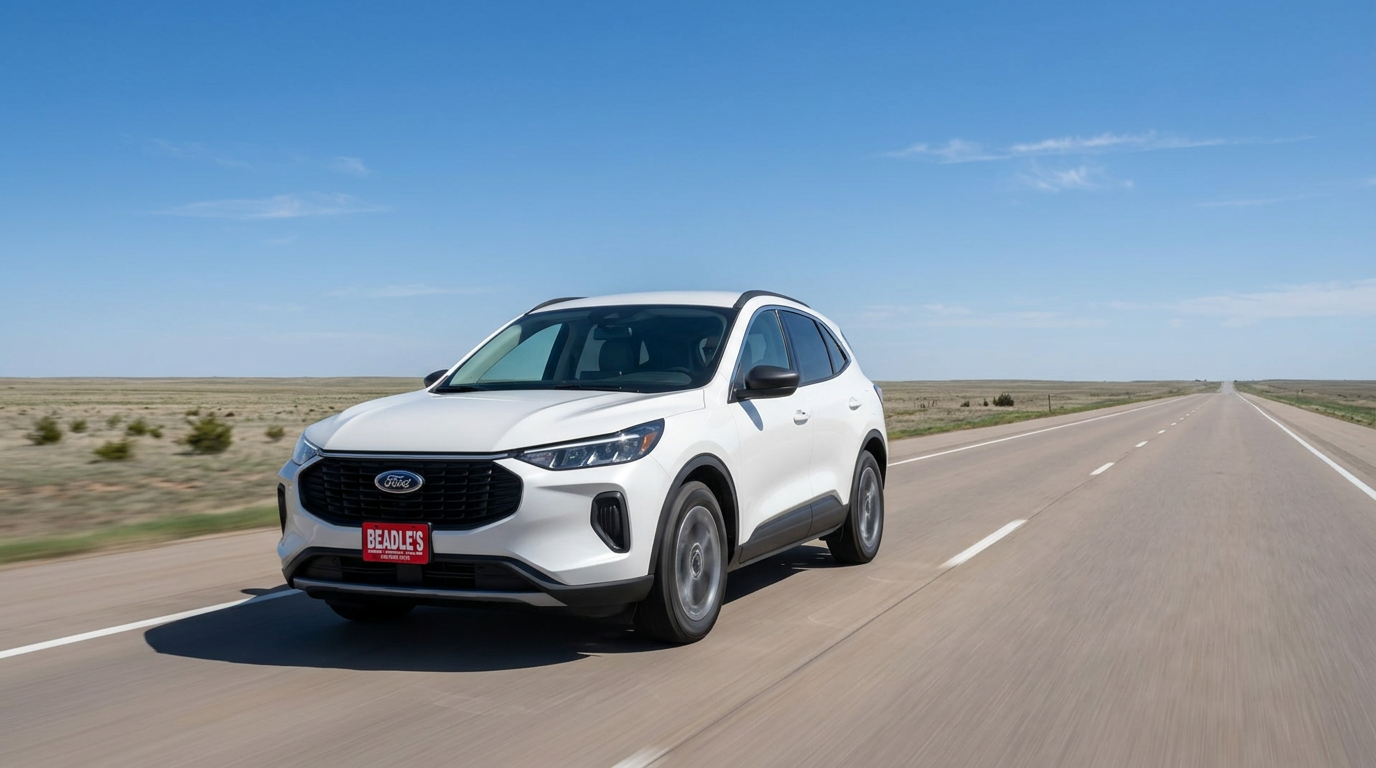
The 2026 Ford Escape comes with four distinct powertrain options: a 1.5L EcoBoost gas engine, a 2.0L EcoBoost gas engine, a 2.5L hybrid (non-plug-in), and a 2.5L plug-in hybrid (PHEV). The choice isn’t just about fuel economy — each powertrain comes with different AWD availability, different trim access, and different real-world implications for buyers driving central South Dakota roads year-round.
This guide breaks down what each powertrain actually delivers, who it makes sense for, and where the trade-offs land — specifically for the long-distance, all-season, rural driving conditions common to buyers in the Bowdle area.
On This Page
- What Powertrain Options Does the 2026 Ford Escape Offer?
- When Does the 1.5L EcoBoost Make Sense for South Dakota Buyers?
- What Does the 2.0L EcoBoost Bring Over the 1.5L — and Is It Worth It?
- Why Do Many South Dakota Buyers Choose the 2.5L Hybrid AWD?
- What’s the Honest Case for — and Against — the Escape PHEV Near Bowdle?
- Which Escape Powertrain Is the Right Choice for Rural South Dakota Driving?
What Powertrain Options Does the 2026 Ford Escape Offer?
The 2026 Escape offers four powertrain options across six trims. Which powertrains are available depends entirely on which trim you’re looking at — and AWD availability is not consistent across all of them.
| Powertrain | Drivetrain | Available Trims |
|---|---|---|
| 1.5L EcoBoost | FWD std / AWD optional | Active, ST-Line |
| 2.0L EcoBoost | AWD Only | ST-Line Select, ST-Line Elite, Platinum |
| 2.5L Hybrid | AWD Only | ST-Line Select, ST-Line Elite, Platinum |
| 2.5L PHEV | FWD Only — no AWD | PHEV trim only |
The central point: if AWD matters to you — and for most South Dakota buyers it should — the 2.5L PHEV is off the table immediately. The 1.5L EcoBoost is viable only if AWD is added at the order stage on Active or ST-Line. The 2.0L EcoBoost and 2.5L Hybrid are AWD by default on Select and above, with no FWD option available. The full 2026 Ford Escape overview at Beadle Ford covers how each powertrain fits within the broader trim lineup.
When Does the 1.5L EcoBoost Make Sense for South Dakota Buyers?
The 1.5L EcoBoost makes the most sense when price is the primary driver and AWD is explicitly selected at the order stage. It’s capable on pavement and gravel, and delivers reasonable efficiency — approximately 30 mpg combined in FWD configuration (verify at fueleconomy.gov for current EPA figures). AWD-equipped 1.5L fuel economy has not been officially published; check fueleconomy.gov for updated ratings.
The limitation for SD buyers is what comes with those trims. Active and ST-Line — the only trims offering the 1.5L — don’t include heated seats, a heated steering wheel, remote start, or a power liftgate as standard equipment. Adding AWD doesn’t change that. On a February morning in Spink County, those features aren’t luxuries.
The 1.5L is paired with an 8-speed conventional automatic — not an eCVT. Towing is capped at 2,000 lbs regardless of drivetrain, and the Class II factory tow package is not available on Active or ST-Line, only through a dealer accessory. If cost is the main consideration and cold-weather standard features are less important, the 1.5L with AWD added is workable. If the goal is winter readiness as a complete package, the comparison against ST-Line Select usually goes against the 1.5L once all-in cost is factored.
What Does the 2.0L EcoBoost Bring Over the 1.5L — and Is It Worth It?
The 2.0L EcoBoost delivers more power and a meaningful towing capacity advantage. It’s AWD only — available on ST-Line Select, ST-Line Elite, and Platinum — so AWD is always included at no additional option cost. The key practical upgrade over the 1.5L is towing: with the Class II factory tow package (code 536), the 2.0L EcoBoost AWD is rated at 3,500 lbs, compared to 2,000 lbs on the 1.5L with no factory package available.
For buyers who need to move a small boat to Lake Oahe, a utility trailer, or similar light-duty loads common in central South Dakota, 3,500 lbs is the right number. A small fishing boat and trailer, a loaded single-axle utility trailer — the 2.0L covers those tasks where the 1.5L falls short. The 1.5L tops out at 2,000 lbs without a factory package option — that gap matters for buyers with regular, even occasional, towing needs.
The trade-off against the 2.5L Hybrid is fuel economy. The Hybrid delivers approximately 39 mpg combined (verify at fueleconomy.gov), which compounds over significant highway miles between Bowdle and Aberdeen or Pierre. The 2.0L EcoBoost AWD fuel economy has not been officially published — check fueleconomy.gov for current EPA figures. The 2.0L also uses an 8-speed conventional automatic rather than an eCVT, which some buyers prefer for its familiar feel. If towing matters more than fuel savings, the 2.0L EcoBoost is the right call.
Looking for Something in Stock?
Check out these models available now at Beadle Ford.
Why Do Many South Dakota Buyers Choose the 2.5L Hybrid AWD?
Because it delivers AWD and significantly better fuel efficiency than either gas option, with no charging requirement. The 2.5L Hybrid AWD is available on ST-Line Select, ST-Line Elite, and Platinum — all trims that include heated seats, remote start, and a power liftgate as standard. The efficiency gain doesn’t come at the expense of cold-weather preparedness.
The hybrid system delivers approximately 39 mpg combined (verify at fueleconomy.gov for current EPA ratings). On a 200-mile round trip to Aberdeen or Sioux Falls, that’s a tangible fuel savings compared to either gas option. The eCVT transmission behaves differently from a conventional automatic — it maintains a steady engine rpm during acceleration rather than stepping through gears. Most buyers adapt quickly; many appreciate the smooth, consistent pull on long open-road stretches common in central South Dakota.
The trade-off is towing. With the Class II tow package, the 2.5L Hybrid AWD is rated for 1,500 lbs — significantly less than the 2.0L EcoBoost’s 3,500 lbs with the same package. For buyers who only need to move a small utility trailer or a jon boat, 1,500 lbs is workable. For anything heavier, the 2.0L EcoBoost is the right call. The AWD winter performance guide covers how the Hybrid AWD system handles South Dakota winter and gravel conditions in detail.
What’s the Honest Case for — and Against — the Escape PHEV Near Bowdle?
The PHEV is front-wheel drive only — that’s the immediate limitation for most central South Dakota buyers. But for buyers who have Level 2 charging at home and can accept FWD for their use case, the PHEV is the most feature-complete single Escape configuration available.
The plug-in hybrid system offers approximately 37 miles of EV-only range on a full charge (verify at fueleconomy.gov). Combined with a rated approximately 101 MPGe when operating on electricity and approximately 40 mpg fuel economy after the battery depletes, total range in hybrid mode extends to approximately 520 miles. The PHEV trim itself is well-equipped: Co-Pilot360 Assist+, 13.2″ SYNC 4, heated front seats, heated steering wheel, remote start, power liftgate, and roof-rack side rails are all standard. A Mobile Power Cord for Level 1 home charging comes included; Level 2 charging requires a separate 240V charger installation.
The realistic limitation for rural South Dakota buyers: Level 2 charging infrastructure is sparse around Bowdle and most of central SD. Without regular Level 2 access, the EV range advantage disappears — the PHEV effectively operates as a front-wheel-drive hybrid, and the non-plug-in 2.5L Hybrid AWD on Select, Elite, or Platinum delivers comparable gas-mode fuel economy without the charging dependency and without giving up all-wheel drive. The PHEV makes the most sense for a buyer who commutes to a larger town with Level 2 access, drives predictable daily distances within the EV range, and genuinely doesn’t need AWD.
Which Escape Powertrain Is the Right Choice for Rural South Dakota Driving?
For most central South Dakota buyers, the 2.5L Hybrid AWD on ST-Line Select is where the decision lands. AWD is standard, efficiency is strong, and the trim’s cold-weather features are included without adding packages. That combination — traction in winter, manageable fuel costs on long highway miles, and a vehicle that starts reliably in January — covers the majority of what SD buyers prioritize.
The 2.0L EcoBoost AWD is the right move if towing up to 3,500 lbs with the Class II package is part of your regular use case. It’s also AWD only at Select and above, so the cold-weather feature set stays intact. The trade-off is fuel economy — it won’t reach the Hybrid’s approximately 39 mpg combined. If you’re running Lake Oahe trips with a boat in tow regularly, the 2.0L makes that trade-off worthwhile.
The 1.5L EcoBoost is viable if budget is the driver and AWD is specified at order — but the buyer accepts the cold-weather feature gaps that come with Active and ST-Line. The PHEV is a niche fit for this market: strong configuration, but FWD-only and rural charging realities limit its relevance for most buyers in the area. The complete trim levels guide maps each powertrain option to the specific trim configurations available.
Key Takeaways
- The 2.5L PHEV is front-wheel drive only with no AWD option — a meaningful limitation for most central South Dakota buyers.
- The 2.5L Hybrid AWD on ST-Line Select delivers the best combination of AWD, efficiency (approximately 39 mpg combined), and cold-weather standard features for rural SD use.
- The 2.0L EcoBoost AWD is the right call when towing up to 3,500 lbs matters — the Class II factory tow package is available on Select, Elite, and Platinum only, not on 1.5L trims.
- The 1.5L EcoBoost with AWD is a viable lower-cost entry, but AWD must be explicitly specified at order on Active or ST-Line, and heated seats, remote start, and power liftgate are not included.
- PHEV buyers near Bowdle need reliable Level 2 charging access to realize the plug-in value proposition; without it, the non-plug-in Hybrid AWD delivers comparable efficiency with AWD included.
Frequently Asked Questions
My Take on the 2026 Escape Powertrain Decision for South Dakota Buyers
When I’m talking through powertrain options with a buyer, the conversation usually reaches the same two questions: do you need to tow anything, and do you have Level 2 charging access at home? Those two questions separate most of the field. If neither applies — no regular towing, no home charger — the 2.5L Hybrid AWD on Select is almost always where it lands. AWD is locked in, efficiency is real on the highway miles between towns, and the cold-weather features come with the trim. That combination is hard to argue with for central South Dakota use.
The PHEV comes up a fair amount, and I try to be direct about the charging situation near Bowdle. Without Level 2 access at home, the EV range advantage effectively disappears, and you end up with a front-wheel-drive hybrid. The non-plug-in Hybrid AWD covers that use case more practically for most buyers in this area. For buyers who do have that home charging setup and aren’t dependent on AWD — and there are some — the PHEV is genuinely strong.
If you want to work through the specifics for your situation — towing weight, typical drive distance, whether a Level 2 charger makes sense to add — I’m happy to run through that comparison with you directly. Stop by Beadle Ford in Bowdle or give us a call.
About the Author
Lexy Tabbert — Beadle Ford, Bowdle, SD
Lexy Tabbert is the Director of Sales and Marketing at Beadle Ford in Bowdle, South Dakota. She covers Ford vehicles, trim comparisons, and buyer guidance — helping families, ranchers, and ag operators across the region find the right truck and configuration for their needs. Learn more about Lexy.
Connect with us

