

G.O.A.T. stands for Goes Over Any Type of Terrain — it’s Ford’s terrain management system that adjusts throttle response, transmission shift points, traction control behavior, and torque distribution depending on what’s under the tires. The marketing version makes every mode sound essential. The honest version, after years of selling Broncos to ranchers, hunters, and lake-bound buyers in central South Dakota, is that you’ll use two or three of the modes regularly and the others maybe once a season.
This guide walks through every G.O.A.T. mode on the 2026 Ford Bronco, names which trims get which modes, and pairs each one with a real central SD use case. We’ll also cover Trail Control, Trail Turn Assist, and One-Pedal Trail Driving — three off-road tech features that don’t get marketed as G.O.A.T. modes but matter as much as some that do.
On This Page
- What’s the Full G.O.A.T. Mode List for the 2026 Bronco?
- What Are the Five Modes Every Bronco Has — Normal, ECO, Sport, Slippery, and Sand?
- Which Modes Do Badlands and Raptor Add — Off-Road, Rock-Crawl, and Baja?
- When Would I Actually Use Each Mode in Central South Dakota?
- How Do G.O.A.T. Modes Compare to Jeep’s Selec-Terrain System?
- What Do Trail Control, Trail Turn Assist, and One-Pedal Trail Driving Do?
What’s the Full G.O.A.T. Mode List for the 2026 Bronco?
Every 2026 Bronco gets five G.O.A.T. modes as standard equipment: Normal, ECO, Sport, Slippery, and Sand. Badlands and Raptor get a different seven-mode set: Normal, ECO, Slippery, Off-Road, Sport, Rock-Crawl, and Baja. The Badlands setup drops Sand from the standard list and adds three off-road-specific modes — it’s not just five-plus-two, it’s a different mix tuned for harder use.
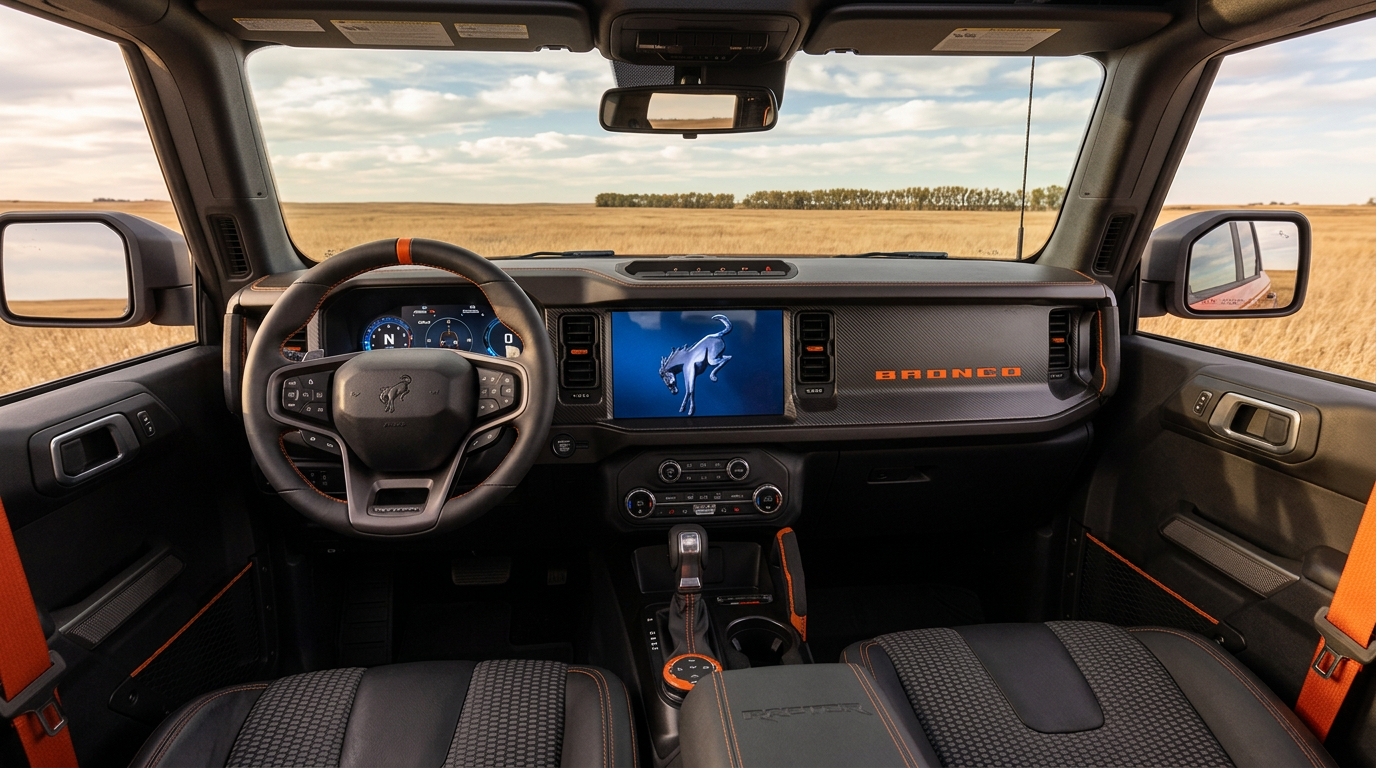
The mode dial sits on the center console where the standard transmission shifter would be on a non-G.O.A.T. vehicle, and you select modes by rotating the dial. The current mode is shown both on the dial itself and in the digital instrument cluster. The Heritage Edition and Stroppe Edition use the standard five-mode set; the Big Bend and Outer Banks also get five. If the seven-mode set matters to your use case, Badlands or Raptor is the trim. For full trim breakdowns see our 2026 Bronco trim levels guide.
What Are the Five Modes Every Bronco Has — Normal, ECO, Sport, Slippery, and Sand?
Normal is the default mode for everyday driving — paved roads, dry gravel, light loads. The system runs balanced throttle response, normal shift mapping, and standard traction control. It’s where the Bronco sits 80 percent of the time for most owners.
ECO mode dials throttle response back, holds gears longer, and biases shift points for fuel economy. It’s the mode for the Bowdle-to-Black-Hills highway run when you’d rather have an extra mile or two per gallon than instant pedal response. Highway only — there’s no off-road benefit to ECO.
Sport sharpens throttle response, holds gears longer for higher-RPM operation, and tightens steering feel slightly. It’s the mode for the rare moments you actually want to drive a Bronco hard on pavement — a fun back-road run, a quick highway pass. Most Bronco owners try Sport once and never return to it.
Slippery is the workhorse of the standard five-mode set in central South Dakota. It dials throttle response back so you don’t break traction at takeoff, smooths shift points, and recalibrates traction control for soft or slick surfaces. Slippery covers wet gravel, packed snow, glare ice on a section line, a soft CRP access road, and frozen ruts in early winter. If you live outside Bowdle on a gravel road, this mode earns its money every week of the cold months.
Sand is the mode for a Lake Oahe shoreline access lane, a soft beach approach to a boat ramp, and any deep dry-loose surface where you need wheel speed to maintain forward momentum. It defeats traction control more aggressively than Slippery does, on the principle that wheel slip is part of how you make progress through deep sand. Sand is missing from the Badlands and Raptor mode set, since those trims expect their drivers to use Off-Road or 4-Low for that work instead.
Which Modes Do Badlands and Raptor Add — Off-Road, Rock-Crawl, and Baja?
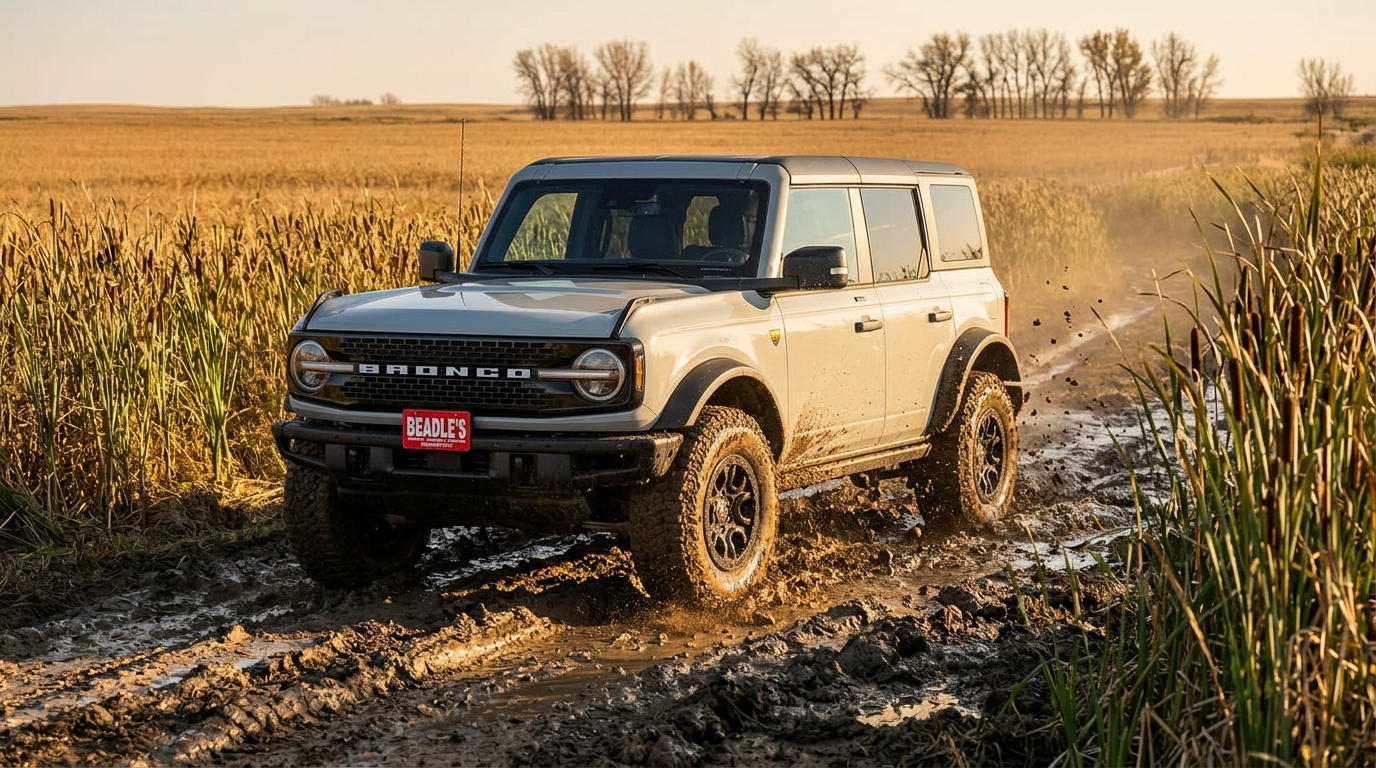
Off-Road is the everyday off-pavement mode for Badlands and Raptor. It engages the front axle, biases torque toward the wheels with grip, calibrates throttle for low-speed control, and prepares the system for use of the front and rear lockers if needed. This is the mode for a cattail-slough access road in late October, a river-bottom timber two-track in November, or a section line that hasn’t been graded since spring thaw.
Rock-Crawl is the slowest, most deliberate mode — designed for picking through rocky terrain with maximum control. It holds low gears, sharpens brake response, and integrates with Trail Control for hands-off-the-throttle crawling speed. In central SD, Rock-Crawl is overkill for almost everything. You’d reach for it on a Black Hills weekend or a serious hunting access trail with embedded rocks. It’s a Wyoming or Colorado feature more than a Bowdle one.
Baja is the high-speed off-road mode — sharp throttle, aggressive shift mapping, traction control retuned for desert-style driving. Like Rock-Crawl, it’s geographically misaligned with central SD. There aren’t many places within an hour of Bowdle where Baja mode is the right tool. Most Badlands owners around here never use it. It’s part of the package because the Badlands trim is sold nationwide, and there are buyers in the Southwest and West Coast who do use it.
Both lockers — front and rear, electronic — are standard on Badlands, Heritage Edition, Raptor, and any Bronco with the Sasquatch Package. The lockers are what get you out of a stuck situation when an open differential is just spinning one wheel; they’re a separate system from the mode dial, but Off-Road and Rock-Crawl prepare the vehicle to use them. Sasquatch deep-dive in our 2026 Bronco Sasquatch Package guide.
When Would I Actually Use Each Mode in Central South Dakota?
Here’s the honest central SD use map for each mode:
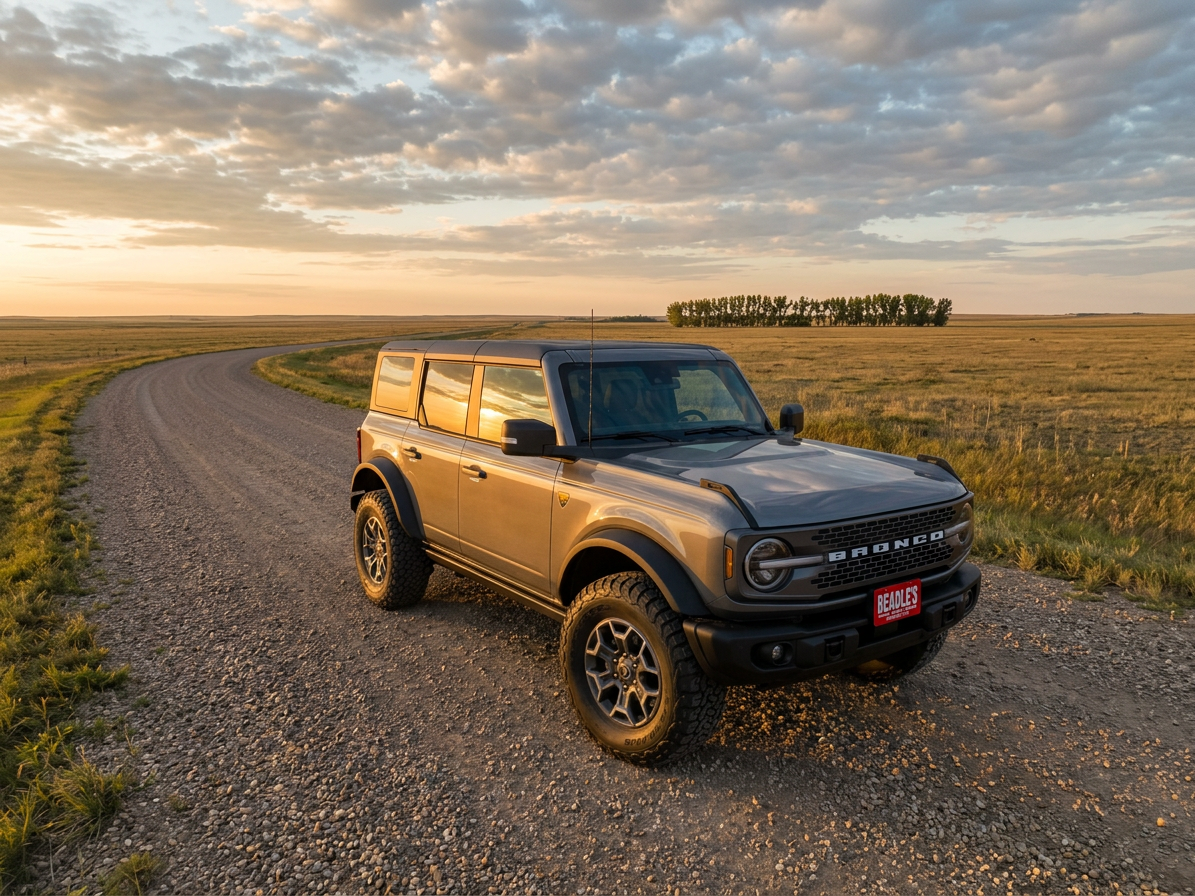
Normal: Paved roads anywhere — Bowdle in town, US-12, US-83, the trip to Aberdeen or Pierre. Dry gravel section roads in summer. Light errand-running on packed snow with no ice. This is where the Bronco lives most of the time.
ECO: Long highway runs, particularly to the Black Hills (~four hours) when you’d rather take the small fuel-economy improvement. Skip ECO in town or on gravel — there’s no benefit.
Sport: Almost never. The Bronco isn’t a sport-tuned vehicle, and the mode is more relevant for highway passing maneuvers than for daily driving.
Slippery: Wet gravel section roads, snow-covered county roads, glare ice, frozen ruts in early winter, soft CRP access roads after rain, the muddy approach to a Lake Oahe boat ramp in spring. This is the everyday cold-weather setting for a Bronco that lives outside Bowdle.
Sand: Lake Oahe shoreline access at unimproved boat ramps in summer. Some sandy two-tracks across CRP. Used a few times a season at most.
Off-Road (Badlands/Raptor): Cattail-slough access roads, river-bottom timber two-tracks, ranch-property loops with deep ruts, harvested-cornfield approaches in wet conditions. This is the SD-relevant mode that actually gets used in the field.
Rock-Crawl and Baja (Badlands/Raptor): Black Hills weekend trips for Rock-Crawl. Baja is mostly geographically misaligned with central SD — an interesting feature on the spec sheet that most local owners never use.
How Do G.O.A.T. Modes Compare to Jeep’s Selec-Terrain System?
Both systems do the same job — adjust traction control, throttle response, transmission behavior, and torque distribution for different surfaces. The differences are in mode count, mode names, and how the systems integrate with other off-road tech. Jeep’s Selec-Terrain typically runs four to five primary modes (Auto, Snow, Sand/Mud, Rock) depending on the trim, paired with the brand’s Command-Trac, Selec-Trac, or Rock-Trac 4WD systems.
G.O.A.T. tends to be more discrete in mode count — five on most Broncos, seven on Badlands and Raptor — and more electronic in feel. Selec-Terrain leans more analog, with a tighter integration with Rock-Trac’s mechanical 4:1 low-range gearing on Wrangler Rubicons. Neither system has a clear edge over the other; they’re tuned for the different brand philosophies. For the full Bronco vs Wrangler picture see our 2026 Bronco vs Jeep Wrangler honest comparison.
For a central SD buyer, the comparison usually doesn’t come down to mode count — it comes down to other factors (engine choice, towing, doors-off design, dealer relationship). The G.O.A.T. system covers everything a Bronco buyer needs in this region. The Selec-Terrain system covers everything a Wrangler buyer needs. Both work.
What Do Trail Control, Trail Turn Assist, and One-Pedal Trail Driving Do?
These three features get less attention than G.O.A.T. modes but matter as much in real off-road work. Trail Control is low-speed off-road cruise control — set a speed between roughly 1 and 20 mph, and the vehicle maintains it while you focus on steering. It’s available on Bronco trims with the 10-Speed Automatic and is the right tool for crawling through deep ruts, soft mud, or a cattail-slough access road where you’d rather not modulate the throttle by foot.
Trail Turn Assist uses individual brake application to tighten the turning radius dramatically when you’re navigating a tight off-road switchback or a narrow section-line corner. It’s a niche feature in central SD because most of our terrain doesn’t require it, but for a Black Hills trail or a wooded ranch-property loop with tight turns it does what no amount of steering-wheel input can match.
One-Pedal Trail Driving is available on Outer Banks and Badlands with the 10-Speed Automatic. It lets you control acceleration and braking with just the throttle pedal — lift off the throttle and the vehicle slows aggressively without you needing to swap to the brake pedal. For tricky off-road work where your right foot is doing more thinking than driving, it’s a useful feature. All three of these tools become clearer within the full 2026 Ford Bronco overview, where capability and tech features lay out by trim.
Key Takeaways
- Every 2026 Bronco has five G.O.A.T. modes: Normal, ECO, Sport, Slippery, and Sand.
- Badlands and Raptor get a different seven-mode set: Normal, ECO, Slippery, Off-Road, Sport, Rock-Crawl, and Baja (drops Sand, adds three off-road modes).
- For central SD buyers, Slippery is the everyday cold-weather mode — earns its money every week of the cold months on a gravel-road commute.
- Off-Road is the SD-relevant Badlands mode that gets real use; Rock-Crawl and Baja are tuned for terrain we don’t have around Bowdle.
- Trail Control (low-speed off-road cruise) is the sleeper feature — pair it with Off-Road mode and a Bronco walks through ruts you’d struggle through manually.
Frequently Asked Questions
My Take on G.O.A.T. Modes for Central SD Buyers
The marketing version of G.O.A.T. modes makes every setting sound essential. The reality, after years of selling Broncos to ranchers, hunters, and ag operators in this region, is that most owners use Normal and Slippery for ninety-five percent of their miles, reach for Sand a couple times a summer, and never touch Sport. On a Badlands, Off-Road gets actual use; Rock-Crawl and Baja stay on the dial as features the spec sheet wanted but the geography doesn’t ask for.
What I’d tell a customer is this: the seven-mode set on Badlands isn’t worth paying for if you’re not going to use Off-Road regularly. The five-mode set with a Big Bend’s Black Diamond Package or an Outer Banks gets you 95 percent of the central SD Bronco experience for less money. If you actually do hunt sloughs and river bottoms, the Badlands Off-Road mode plus the standard front and rear lockers earn the upcharge. Come in and we’ll figure out which math fits your week.
About the Author
Lexy Tabbert — Beadle Ford, Bowdle, SD
Lexy Tabbert is the Director of Sales and Marketing at Beadle Ford in Bowdle, South Dakota. She covers Ford vehicles, trim comparisons, and buyer guidance — helping families, ranchers, and ag operators across the region find the right truck and configuration for their needs. Learn more about Lexy.
Connect with us

