

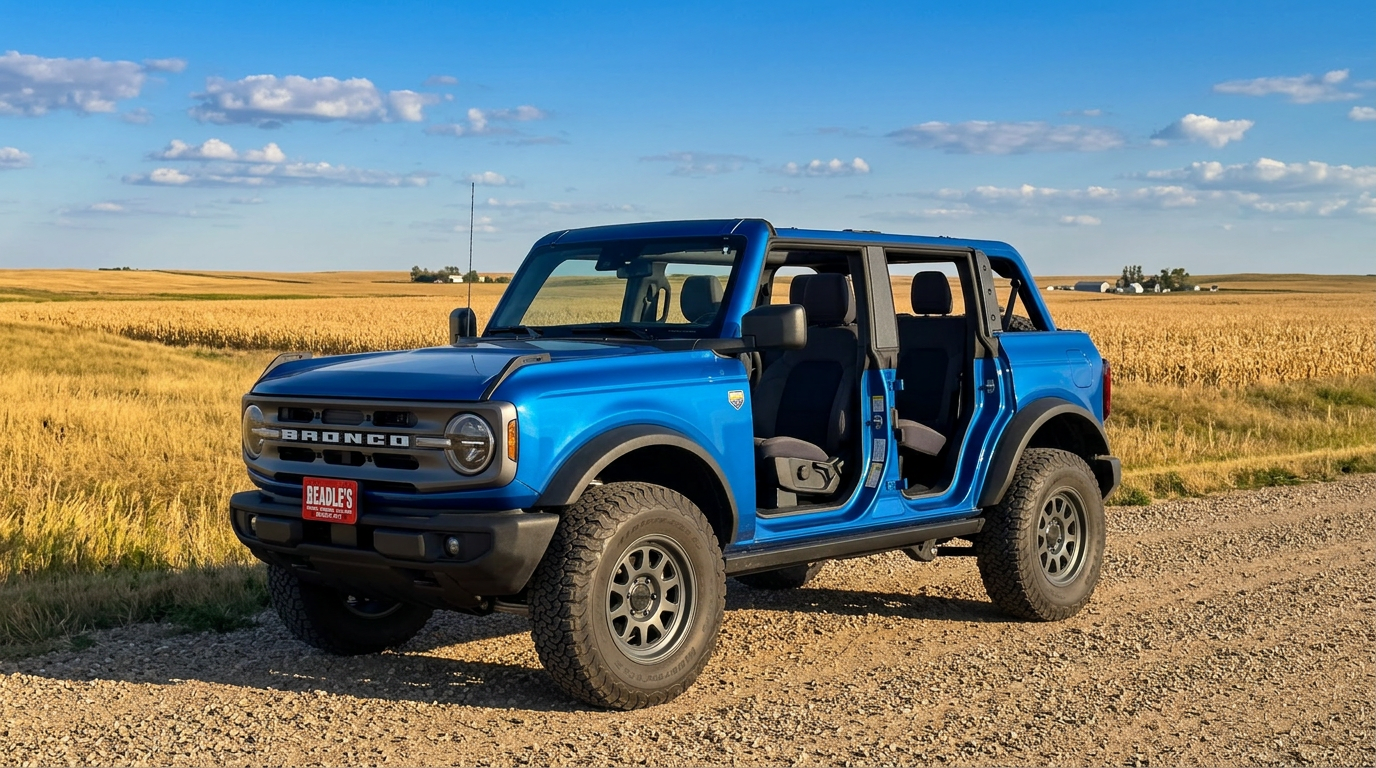
The removable doors and roof are the single feature most buyers ask about — and the feature most owners use less than they expect. Done right, taking the doors off a Bronco for a summer evening drive across the central South Dakota plains is one of the real pleasures of ownership. Done wrong, it’s a Saturday spent fighting with panels in your garage and a winter spent regretting the soft-top order you made in July.
This is a practical owner’s guide for a 2026 Bronco buyer in Bowdle and the central SD region. We’ll cover what comes off and what doesn’t, how the removal actually works, where to store doors and panels at home, soft top versus hardtop in a cold climate, theft and security when the doors are off, and when you’ll really want the doors off in central SD. The honest take is in here, not just the sales sheet version.
On This Page
- What Comes Off and What Stays On When You Remove the Bronco’s Doors and Roof?
- How Does the Step-by-Step Doors and Roof Removal Actually Work?
- Where Should I Store the Doors and Roof Panels at Home?
- Soft Top or Hardtop: Which Is the Right Choice in a Cold Climate?
- Are the Doors Off a Theft or Security Concern Around Town?
- When Will I Actually Want the Doors Off in Central South Dakota?
What Comes Off and What Stays On When You Remove the Bronco’s Doors and Roof?
All four doors come off — they’re frameless, lift straight up off the hinges, and the wiring connector unplugs cleanly. The roof is modular: on a hardtop, the two front panels above the driver and front passenger lift off independently for a sunroof-style opening, and the rear section over the back seats and cargo area can come off as a third piece. On a soft top, the entire fabric assembly folds back and stays attached to the vehicle.
What stays on regardless of the configuration: the windshield, the body-mounted sideview mirrors, the cowl, and the roll cage that’s integrated into the body structure. The mirrors staying with the vehicle is the practical detail that separates the Bronco from a Wrangler — Wrangler mirrors are door-mounted, so when doors come off, mirrors come off too, and aftermarket frame-mounted mirrors are required for legal on-road driving without doors. On the Bronco you can take the doors off, hop in, and drive without thinking about the mirror situation.
The Tool Kit for removable doors and tops is standard equipment on the Base trim, which means every Bronco above Base inherits it as well. Tube doors are an available accessory at $850 for 2-Door and $1,250 for 4-Door if you want a doors-off look with side-rail protection — useful for buyers who want the open-air feel without leaving doors at home. For the full Bronco vs Wrangler comparison see our 2026 Bronco vs Jeep Wrangler honest comparison.
How Does the Step-by-Step Doors and Roof Removal Actually Work?
For a single door: roll the window down, unplug the wiring connector inside the door jamb, pull the strap loose from the body, remove the two hinge bolts with the supplied Torx tool, and lift the door straight up off the hinge pins. The first time you do this, plan on twenty minutes per door because you’ll be looking up the steps. After the third or fourth time, it’s about five minutes per door.
For the front roof panels on a hardtop: from inside the cabin, release the two over-center latches on each panel, lift the panel free, and store it. Each front panel takes well under a minute. The rear section is heavier and is a two-person job — bolts and clips along the rear pillar release the section, and you’ll want a partner to handle weight and avoid scratching the body. Most owners pull the front panels far more often than the rear section, which is by design.
Practical tip: the doors are heavier than they look. A 4-Door Bronco’s rear doors are manageable solo if you have decent grip and back, but the larger 2-Door front doors are easier with two people. If you’re working alone, a folding moving blanket on a workbench gives you a soft place to set the door without scuffing the paint or the wiring connector.
Where Should I Store the Doors and Roof Panels at Home?
Plan on roughly the floor area of a closet for four 4-Door doors set vertically against a wall, plus a flat space the size of a standard countertop for stacked roof panels. The Ford-supplied storage bags are worth using — they protect the painted body color, the wiring connectors, and the latches from dust and incidental contact in a working garage. Wall-mount door hangers are an aftermarket accessory worth the money if you’re going to remove doors more than once a season.
The most common mistake we see at trade-in is doors and panels stored on a concrete floor without protection — by year three, the bottom edges of the doors show wear that cosmetic detail won’t hide. Store them off the ground, ideally on a wall hanger or a foam-padded shelf. Roof panels lay flat with the painted side up.
If you don’t have garage space — common for ranch-area owners whose garages are full of hay, equipment, or another vehicle — that’s a strong signal to skip the soft-top configuration entirely and run the hardtop year-round. There’s no shame in admitting a feature won’t get used. Storage logistics derail the doors-off lifestyle for more owners than the doors-off lifestyle delivers value to.
Soft Top or Hardtop: Which Is the Right Choice in a Cold Climate?
For a year-round daily driver in central South Dakota, a hardtop is the right answer for almost every buyer. The soft top is functional through SD winters, but it loses cabin heat faster, lets in more highway noise at speed, and shows wear faster on a vehicle that lives outdoors through a Bowdle winter. Most experienced Bronco owners in the area run a hardtop year-round and use the front roof panels for occasional sunroof-style summer driving.
The Dual Tops add-in (order code 66J) at $1,995 is the splurge option — it bundles a soft top with the hardtop so you can swap by season. We see this ordered most often by buyers who actually live the doors-off summer lifestyle and have garage space to store the second top. For most central SD buyers it’s not worth the money; the front roof panels of the modular hardtop already deliver most of the open-air experience without the storage headache.
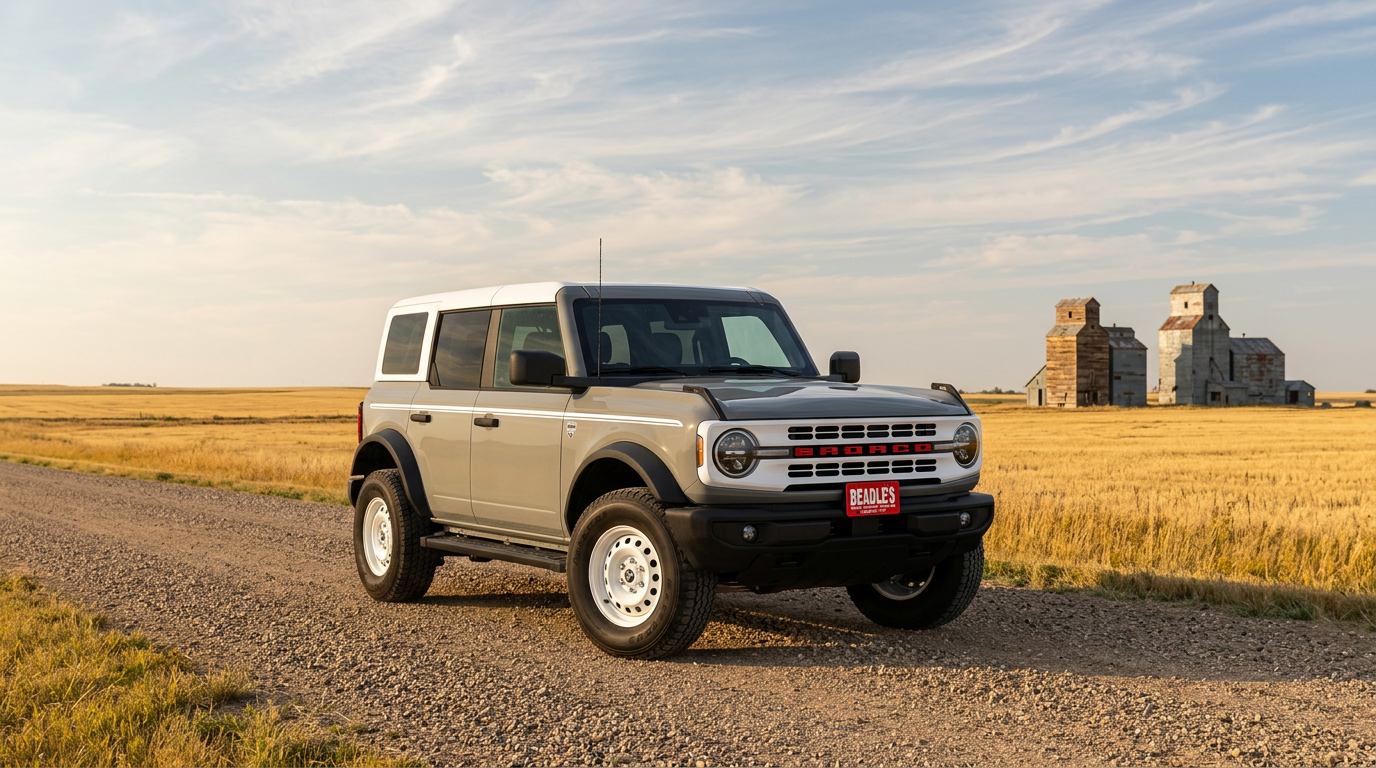
Painted hardtops are a separate decision. Body-color and contrast painted hardtops are available at upcharges across most trims; the Heritage Edition gets its standard Oxford White-painted hardtop at no extra charge. The painted top is a styling decision more than a functional one — every hardtop seals and insulates the same way regardless of the paint. For the SD winter side of this equation see our South Dakota winter driving guide.
Are the Doors Off a Theft or Security Concern Around Town?
In Bowdle and small-town central SD generally, doors-off vehicle theft is rare to the point of irrelevance. The bigger practical concern is theft from inside the cabin — anything visible in the interior is reachable in seconds when there are no doors. That means stowing a wallet, phone, firearm, or rifle case before you walk away from the vehicle, even for a quick stop at the post office or coffee shop.
The center console locks on most Bronco trims, which gives you a small secure spot for keys, a wallet, or a phone. A hardtop with the rear section attached lets you lock items in the cargo area behind the rear seats. With the doors off and the front roof panels removed, treat the cabin like an open boat — no valuables visible, no firearms visible, period.
Insurance generally treats doors-off driving the same as doors-on driving in terms of comprehensive coverage, but if you’re storing doors at a property other than your residence (a cabin, a hunting camp, a parents’ garage), check that they’re covered there too. We’ve never had a customer report a theft of removed doors, but we’ve heard of damage from a falling shelf in a garage where the doors weren’t properly stored.
When Will I Actually Want the Doors Off in Central South Dakota?
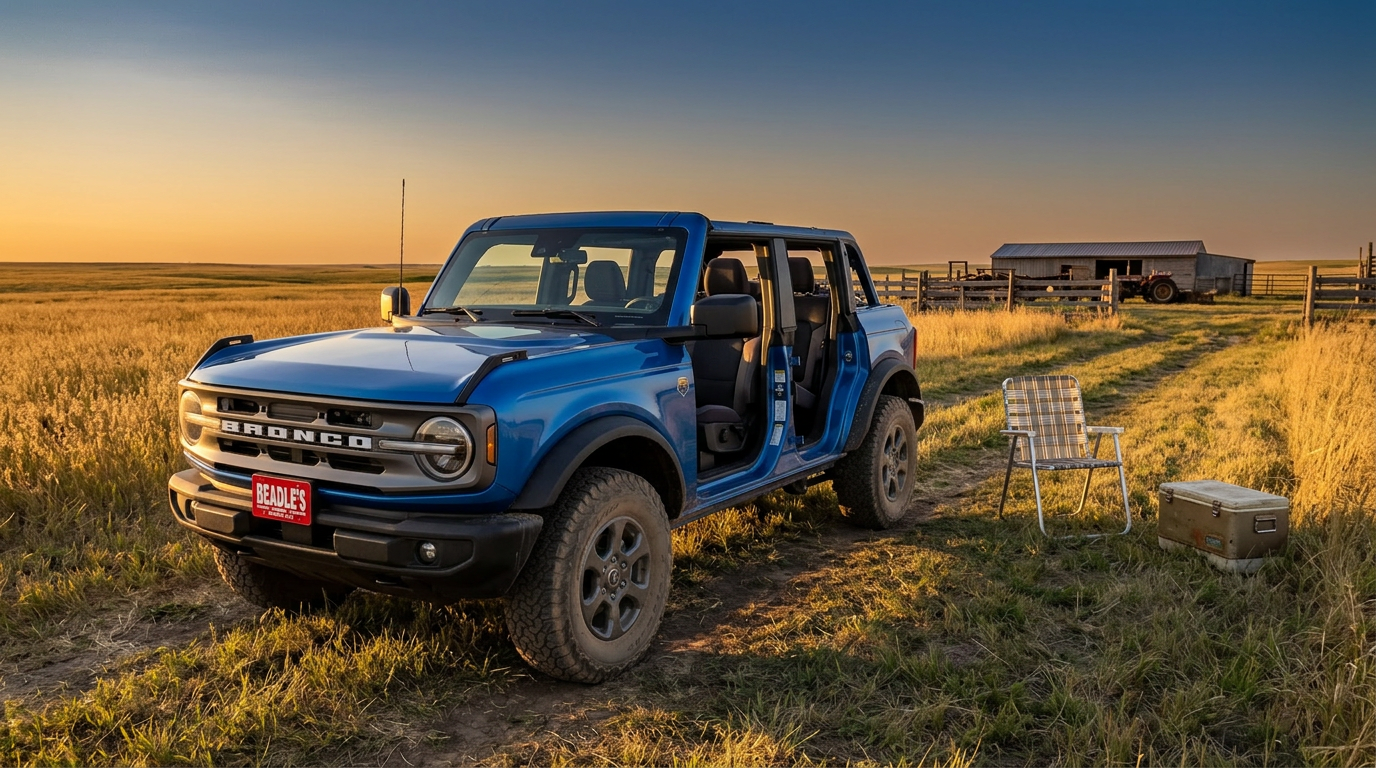
The realistic doors-off window in central SD is roughly May through early October — a four-to-six month season. Within that window, the use cases that earn the configuration are summer evening drives across the plains, slow scouting runs through CRP and harvested fields, ranch-property loop drives at golden hour, lake-access trips on warm afternoons, and the occasional Black Hills weekend where the temperature stays above sixty.
By the time pheasant season opens in late October, almost every Bronco in the area has its doors and front panels back on. November through April is hardtop weather across central SD — and the front panels usually stay on too, since spring is unpredictable enough that “above sixty” days are exceptions before May. The doors-off lifestyle in central SD is real, but it’s a summer privilege, not a year-round one. We get into the seasonal hunting-rig context in detail in our South Dakota hunting guide.
What this means for the buying decision is simple. The removable doors and roof are real features that add real value during the summer months — they’re not marketing fluff. They’re also features most owners use a few dozen times a year, not a few hundred. Pricing the soft-top and dual-tops options against that realistic usage is part of getting the build right. The full lineup and configuration choices come together in the 2026 Ford Bronco overview, which lays out trims, top options, and pricing side by side.
Key Takeaways
- All four doors and the front roof panels come off; the rear roof section is a heavier two-person job.
- Bronco mirrors are body-mounted, so they stay attached when doors come off — no aftermarket mirror required for legal on-road driving.
- For year-round SD use, spec a hardtop. The Dual Tops add-in (66J, $1,995) is for buyers with garage space who actually live the summer doors-off lifestyle.
- Plan on closet-floor space for stored doors and a countertop-sized flat area for roof panels. Wall-mount door hangers are worth the money if you remove doors more than once a season.
- The realistic doors-off window in central SD is May through early October — a four-to-six month season, not a year-round feature.
Frequently Asked Questions
My Take on the Bronco’s Removable Doors and Roof
I’ve watched plenty of customers walk in convinced they need the soft-top configuration because they want the open-air feel — and most of them, after a few months of ownership, end up running the hardtop year-round and pulling the front panels for the warm Saturdays they actually want them. That’s not a failure of the soft top; it’s just the realistic central SD use case. The doors-off summer evening drive is one of the moments that earns the Bronco its reputation. It’s also a moment that happens twenty or thirty times a year, not two hundred.
If you’re weighing the top configuration on a build, come in and let’s talk through the actual storage you have at home and how you’ll really use the vehicle. We’d rather steer a customer toward the right top up front than answer a regret call in February. The doors-off feature is real and worth talking about — it’s also worth being honest about how it fits into a Bowdle-area life.
About the Author
Lexy Tabbert — Beadle Ford, Bowdle, SD
Lexy Tabbert is the Director of Sales and Marketing at Beadle Ford in Bowdle, South Dakota. She covers Ford vehicles, trim comparisons, and buyer guidance — helping families, ranchers, and ag operators across the region find the right truck and configuration for their needs. Learn more about Lexy.
Connect with us

