

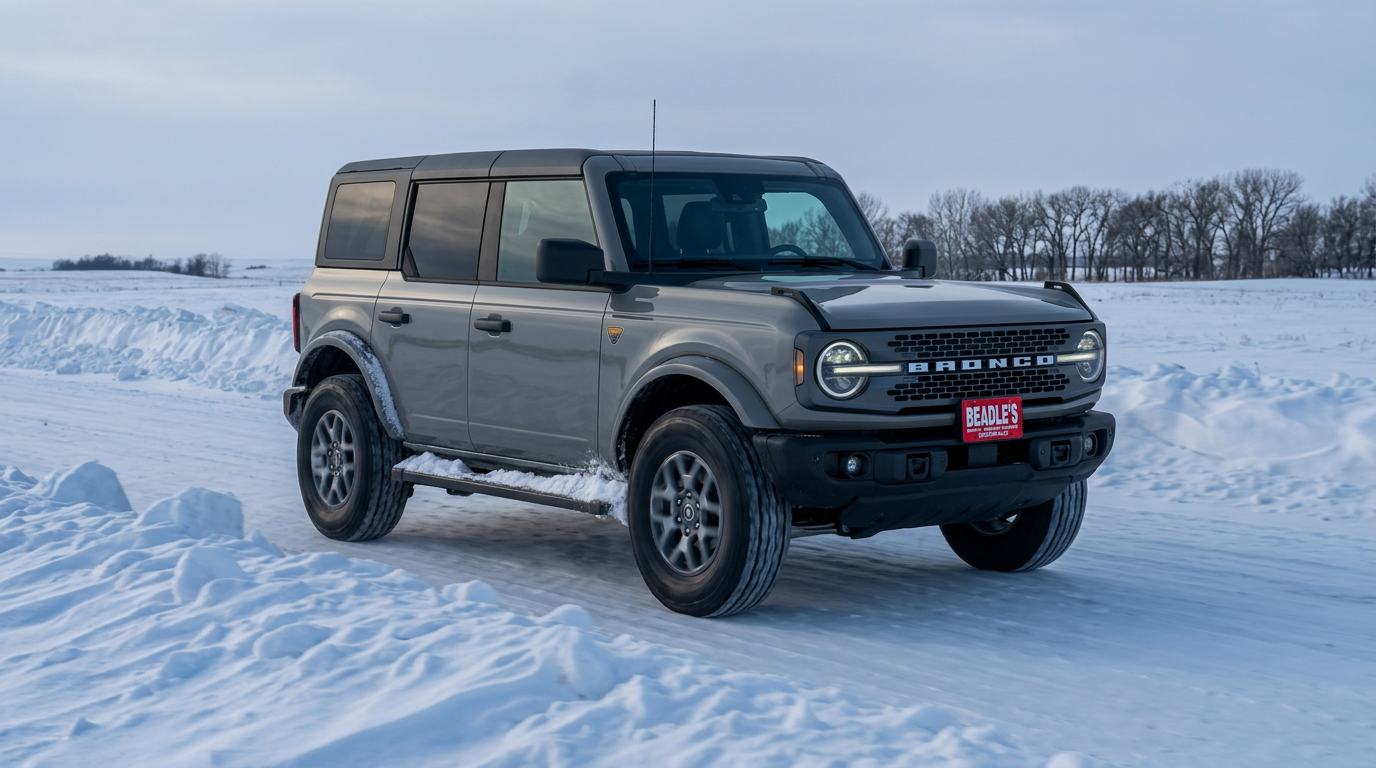
Most reviews of the 2026 Ford Bronco are written by people who tested it in California or on a closed Michigan track. That’s not the test that matters in central South Dakota. The real test is whether it starts at minus-twenty without a block heater, whether it tracks straight on a section line that drifts shut twice a week, and whether the soft top is anything other than a liability when the wind chill hits forty below. We sell Broncos to ranchers, hunters, and ag operators who hear the same questions every winter — so this is an honest take on how the 2026 Bronco actually performs through a real central SD winter.
This guide covers the 4WD systems and what each setting is for, the soft-top trade-off in deep cold, heated seats and steering by trim, ground clearance against drifted snow and plowed banks, cold-weather practicality (block heater, battery, storage), and what the Bronco actually handles versus what it doesn’t. There’s no glossing over the rough edges — and there are a few.
On This Page
- How Do 4-Auto, 4H, and 4L Work on Icy SD Section Roads?
- Can the Soft Top and Removable Doors Handle 30-Below Weather?
- Which Bronco Trims Get Heated Seats, Heated Steering, and Strong Defrost?
- Is the Bronco’s Ground Clearance Enough for Drifted Snow and Plowed Banks?
- What Cold-Weather Practicality Should I Plan For — Block Heater, Battery, Storage?
- What Does the Bronco Handle on Plowed County Roads vs Unplowed Section Lines?
How Do 4-Auto, 4H, and 4L Work on Icy SD Section Roads?
On Broncos with the Advanced 4×4 system — Badlands, Heritage Edition, Raptor, and any trim equipped with the Sasquatch Package — 4-Auto is the setting you want for almost every central SD winter drive. It engages the front axle automatically when the rears slip, then disengages when grip returns, so you can leave it on for a 90-mile run that mixes plowed pavement, drifted gravel, and ice patches without thinking about transfer-case position.
4H is the manual-engagement setting for sustained low-traction surfaces — a packed snow section line, a long stretch of glare ice, the drive into a CRP gate that hasn’t been plowed since November. It locks 50/50 torque split front to rear, which is exactly what you want when both axles need power but not what you want on dry pavement (parking-lot binding will let you know). The Base Bronco’s standard 4×4 is part-time selectable engagement only — no 4-Auto, manual transfer-case shifts only — so 4H is the everyday winter setting on that trim.
4L is the deep-stuck setting. Wheel speed slows dramatically while torque goes up — the right combination for crawling out of a drift, climbing a snow-packed approach to a tree stand, or breaking through a wind-piled section-line drift you couldn’t see coming. You won’t use it on the highway. You’ll use it three or four times a winter at most, but when you need it, nothing else does the job. For the full transmission and engine context see our 2.3L vs 2.7L EcoBoost engine comparison.
Can the Soft Top and Removable Doors Handle 30-Below Weather?
The honest answer most reviewers won’t give: the soft top is functional in central SD winter, but for most of our customers it isn’t the right call. A soft top loses cabin heat faster, lets road noise in at highway speed, and shows wear faster on a vehicle that lives outdoors through a Bowdle winter. If you’re buying a Bronco that will be a year-round daily driver in SD, spec a hardtop and don’t look back.
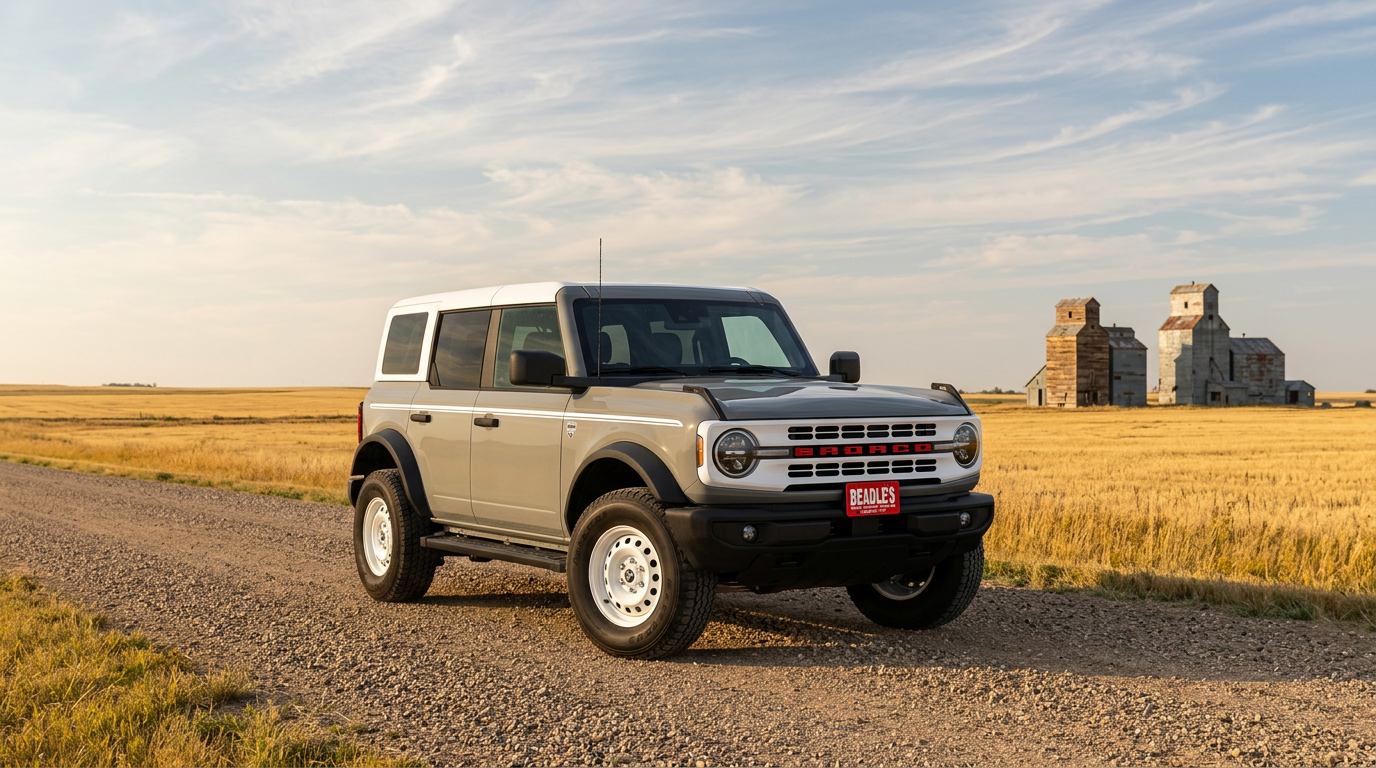
On the door side, the frameless removable doors do seal — there’s no daylight visible at the seam — and the door-frame heater channels behave well at sub-zero temperatures. Where the design shows up is in noise: at 70 mph in a cross-wind on US-12 west of Bowdle, you hear more wind than you would in a comparable hardtop SUV from a unibody platform. Most owners get used to it within a month. A few never do.
Door-removal in winter isn’t really an option to plan around — by the time you’d want the doors off again, it’s spring. The four to six months from May through early October is the realistic window for that, and we cover the full picture in our removable doors and roof guide. For winter, leave them on. Lock them on. Maybe forget you can take them off.
Which Bronco Trims Get Heated Seats, Heated Steering, and Strong Defrost?
Heated front seats and a heated steering wheel are available via the Mid Package on Big Bend (222A), Outer Banks (312A), and Badlands (332A), and they’re typically included on Heritage Edition, Stroppe, and Raptor. If you’re buying for SD winter use, the Mid Package is non-negotiable on Big Bend, Outer Banks, or Badlands — confirm it’s on the build sheet before you sign.
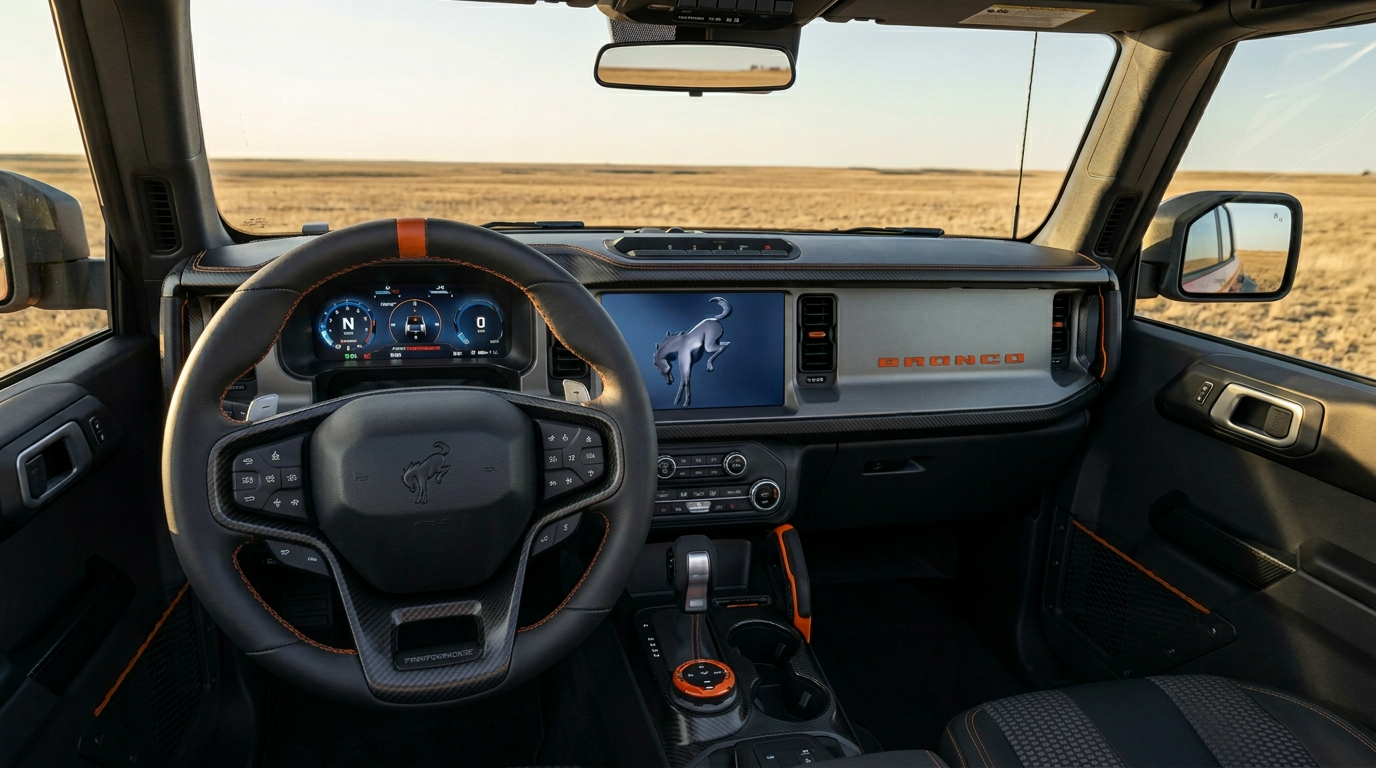
Defrost performance is where the Bronco surprises people. The HVAC system warms up faster than you’d expect from a body-on-frame SUV with a soft-top option in the lineup, and the windshield clears in a couple of minutes from a cold start. The rear defrost grid on the hardtop’s swing-gate window works well; it’s worth confirming you have it on whichever top you spec, since soft-top configurations have a different rear-glass setup.
The 12-inch SYNC 4 display is standard on every trim including Base, which means remote start and climate pre-conditioning through the FordPass app are available across the lineup. On a January morning when it’s minus-fifteen and the wind is picking up, walking out to a cabin that’s already warming is the kind of small advantage that earns its money back fast. Trim-by-trim breakdowns are in our 2026 Bronco trim levels guide.
Is the Bronco’s Ground Clearance Enough for Drifted Snow and Plowed Banks?
A Badlands with the standard 33-inch Rugged-Terrain tires has approximately 8.8 to 9.0 inches of ground clearance — enough for the every-week winter scenarios in central SD: county-road drifts, plow-bank crossings into a driveway, an inch or two of fresh on top of packed gravel. A Bronco with the Sasquatch Package and 35-inch tires moves up to about 11.6 inches. The Raptor sits at roughly 13.1 inches on its 37-inch all-terrains.
Where ground clearance starts to matter is the section-line scenario most central SD owners face: a road that hasn’t been plowed in three days, with cross-drifts that rise to running-board height. A standard Badlands handles those drifts; a Sasquatch handles them more easily; an Outer Banks on 18-inch street-biased tires struggles. If you live ten miles outside Bowdle on a road that gets plowed once a week, the math points toward Badlands as the floor and Sasquatch as the upgrade if you can swing it.
A practical note: plow banks at the end of a driveway are different from drifted snow on a section road. A plow bank is dense, often icy, and it’ll grab a bumper if you hit it at speed. A drifted section road is loose powder until it isn’t. Slippery mode handles both, but the actual ground clearance — not the tire size alone — is what carries you over.
What Cold-Weather Practicality Should I Plan For — Block Heater, Battery, Storage?
The 2.3L EcoBoost and 2.7L EcoBoost both start cold reliably without a block heater above zero, and most owners around Bowdle don’t bother with one. Below zero — and especially below minus-twenty, which we hit several times most winters — a block heater shortens the warm-up cycle and puts less stress on the battery. It’s a worthwhile add for a vehicle that lives outdoors all winter, and any service department can install one.
The OEM battery has been reliable in our experience, but a Bronco that sits unstarted for a week in deep cold — common for a hunting rig that’s parked between pheasant trips — benefits from a battery tender or a dual-battery setup if you run aftermarket lighting. The Bronco’s available auxiliary upfitter switches (where equipped) make wiring a tender or a winter-only accessory cleaner than splicing into the main harness.
Storage of the doors and panels is the other practical question if you’ve kept the soft-top option open for summer. Doors take up roughly the floor area of a closet; panels stack flat in a garage corner with the Ford-supplied storage bag. If you don’t have garage space, plan to leave the hardtop on year-round and skip the soft-top configuration entirely. We’ve watched plenty of customers regret a soft-top order they made in July when February rolls around.
What Does the Bronco Handle on Plowed County Roads vs Unplowed Section Lines?
On a plowed county road in 4-Auto with 33-inch tires, the Bronco tracks straight at 60 mph with no drama. The body-on-frame chassis is heavier than a unibody crossover, which works in its favor on packed snow — the weight helps the tires bite. Cross-wind handling on US-83 or US-12 is on par with an F-150 SuperCrew of similar height, which is to say it’s manageable but not invisible.
On an unplowed section line with 6 to 12 inches of fresh, the Badlands or any Sasquatch-equipped Bronco walks through it without complaint in 4H or 4-Auto. Slippery mode dials throttle response back so you don’t break traction on the gas pedal, and Trail Control (on automatic-transmission trims) is genuinely useful for a long deliberate crawl through deep stuff — set the speed, focus on steering. A standard Big Bend without the Black Diamond Package is more limited; it’ll do most of what you ask, but it’s not the right trim for an everyday section-line winter commute.
Where the Bronco honestly doesn’t shine: deep, heavy, wet snow at the end of a long driveway in a March melt. The vehicle is heavy enough that it can sink in slush rather than float over it the way a lifted side-by-side might. Approach speed and Slippery mode help; momentum is your friend. If you regularly cross 18-plus inches of heavy March slush, that’s the use case where Sasquatch’s 35-inch tires earn their upcharge — narrower contact patch, more bite, less flotation needed.
All of this is clearer within the full 2026 Ford Bronco overview, where every trim’s drivetrain, tire size, and package availability lays out side by side. Winter is the season that separates the right Bronco spec from the wrong one — looking at the lineup as a whole helps make the call.
Key Takeaways
- 4-Auto is the everyday winter setting on Badlands, Heritage, Raptor, and any Sasquatch-equipped trim — set it and leave it.
- For year-round SD use, spec a hardtop. The soft top is functional but loses heat and shows wear faster outdoors.
- Heated front seats and a heated steering wheel come via the Mid Package on Big Bend, Outer Banks, and Badlands — don’t skip it on a winter rig.
- 33-inch R/T tires (Badlands) clear the every-week winter scenarios in central SD; 35-inch tires (Sasquatch) earn their money on weekly unplowed section-line drifts.
- A block heater is worth installing on any Bronco that lives outdoors below zero. Battery tenders are smart for a vehicle that sits between hunting trips.
Frequently Asked Questions
My Take on the 2026 Bronco as a South Dakota Winter Vehicle
I’ll say what most reviews won’t: the Bronco is a real winter vehicle in central SD, but only if you spec it right. A Big Bend with the Mid Package and a hardtop will handle 95 percent of what a Bowdle-area owner faces in a winter. A Badlands with the Mid Package adds the front locker, the seven-mode terrain system, and 33-inch R/T tires that quietly do their job through a January cold snap. A Sasquatch-equipped build is for the buyer whose driveway is on the wrong side of a section line that doesn’t get plowed for days at a time. None of those are the wrong call — they’re three different answers to three different winter realities.
What I’d steer customers away from is an Outer Banks on 18-inch street-biased tires as a year-round SD vehicle. It’s a capable rig in three seasons; in February it asks for more than it should. If you’re shopping a Bronco for winter use, come in and let’s walk through trims, tops, and tire packages with the actual roads and driveway you drive in mind. That conversation usually saves a customer money and gets them the right rig the first time.
About the Author
Lexy Tabbert — Beadle Ford, Bowdle, SD
Lexy Tabbert is the Director of Sales and Marketing at Beadle Ford in Bowdle, South Dakota. She covers Ford vehicles, trim comparisons, and buyer guidance — helping families, ranchers, and ag operators across the region find the right truck and configuration for their needs. Learn more about Lexy.
Connect with us

