

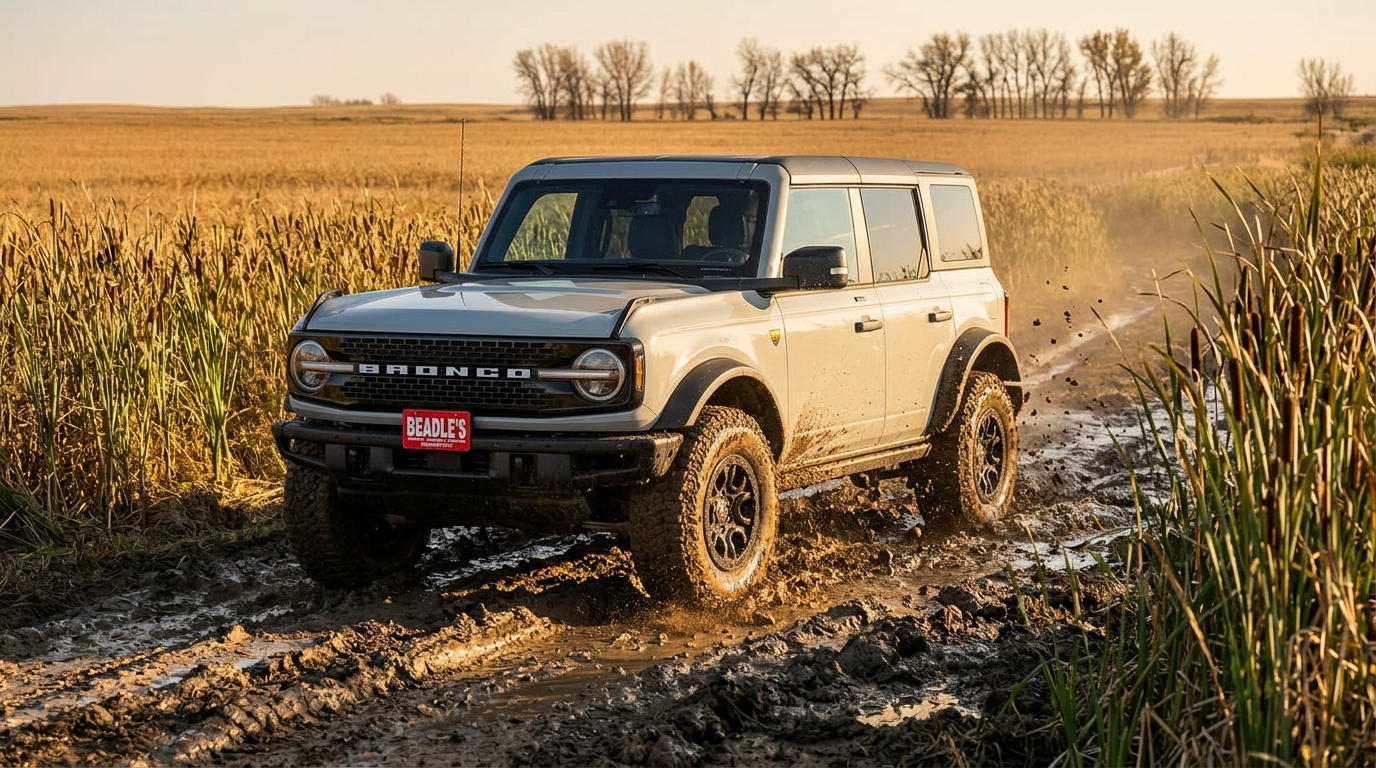
A hunting rig in central South Dakota is asked to do four different jobs in four different seasons. It hauls a Lab and a kennel out to a CRP field at dawn for the pheasant opener, picks its way down a muddy ranch two-track to a cattail slough for late-October waterfowl, parks at the edge of river-bottom timber for a November whitetail sit, and breaks through drifted snow on a section line in late January for the closing weekend of the season. Most trucks can do one or two of those well. The 2026 Ford Bronco is built to do all four.
This guide is for upland, big-game, and waterfowl hunters around Bowdle and the central South Dakota plains who are weighing whether the Bronco fits the way they actually hunt. We’ll cover cargo, the removable top, the G.O.A.T. modes that matter for SD terrain, how a Bronco compares to an F-150 or a side-by-side as a hunting rig, which trim suits the job best, and what each season really demands. There’s no marketing spin here — just what works.
On This Page
- What Cargo and Gear Can the 2026 Bronco Actually Haul for a Hunt?
- How Does the Removable Top Help With Upland Hunting?
- Which G.O.A.T. Modes Handle Muddy CRP, Cattail Sloughs, and River-Bottom Timber?
- Bronco vs F-150 vs Side-by-Side: Which Is the Right Hunting Rig?
- Which 2026 Bronco Trim Is Best for the South Dakota Hunter?
- What Are the Real SD Use Cases, From the October Pheasant Opener Through Late Whitetail?
What Cargo and Gear Can the 2026 Bronco Actually Haul for a Hunt?
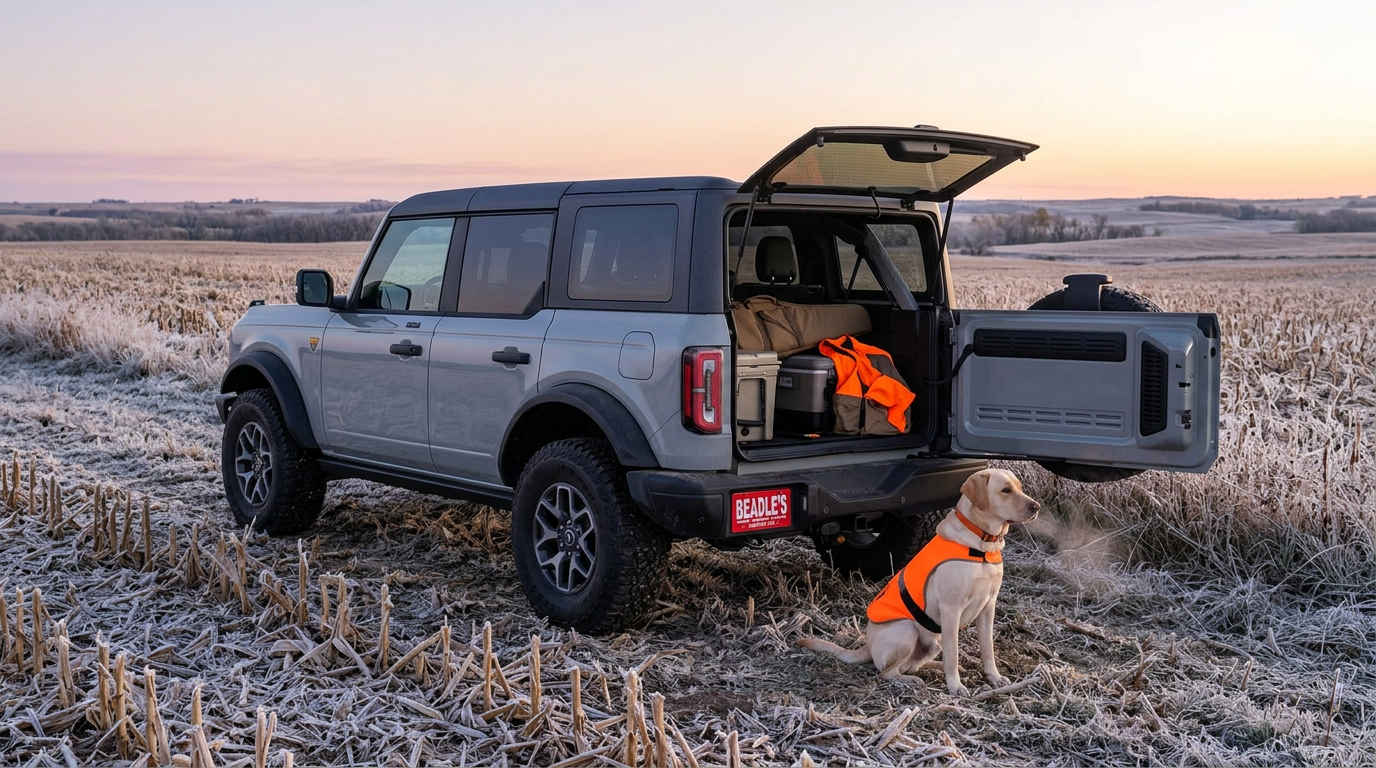
A 4-Door 2026 Bronco swallows a Lab-sized kennel, a full decoy spread for a small-water hunt, two coolers, a couple of shotgun cases, and a duffel of blaze orange — with the rear seats up — and still leaves room behind the seats for a wet bird dog and a muddy bird bag. Fold the rear seat down and it opens up enough room to lay down a 200-decoy mallard spread or a layout blind. This is the practical cargo case for the 4-Door, and it’s the body style we recommend for almost every hunter.
The 2-Door is a different conversation. It’s a smaller cargo box behind the rear seats, and the rear seat itself is tight enough that a kennel of any meaningful size has to ride up front or the rear seats fold down and you lose the seats entirely. For a single hunter with a single dog and a tight gear footprint, the 2-Door works. For most hunting parties — multiple dogs, a partner, decoys, blinds, and a cooler that can hold a day’s worth of birds — the 4-Door is the right call.
A few details that matter on the lot. The Badlands trim ships with marine-grade vinyl seats — the right material when wet dogs, mud, blood, and bird residue are part of the routine. They wipe down with a damp rag and don’t soak. Outer Banks gets leather-trimmed seats, which look sharp on the lot but require more care in a hunting context. The Bronco’s swing-gate tailgate (versus a drop gate) means you load from the side rather than tailgating off the back — a small adjustment if you’re used to an F-150 bed, but it works fine for cargo and for sitting on while you change boots.
On the trailer side, every non-Raptor 2026 Bronco is rated for a 3,500-lb maximum loaded trailer weight. The Raptor is rated to 4,500 lbs. That’s enough for a small aluminum boat for waterfowl on Lake Oahe, a single-axle utility trailer for layout blinds and a bigger decoy spread, or a small enclosed trailer for hauling dogs and gear long distance. It’s not enough to tow a heavy stock trailer or a tandem-axle camper — that’s an F-150 conversation, not a Bronco one. We cover the engine and towing details in our 2.3L vs 2.7L EcoBoost engine comparison.
How Does the Removable Top Help With Upland Hunting?
For early-season grouse, summer scouting, and warm October days when you’re driving slow along section lines glassing for sign, doors-off and front-roof-panels-off is genuinely useful — you can see, hear, and load dogs without ducking through a doorframe. For cold-weather hunting, which is most of the SD season, the doors and top stay on.
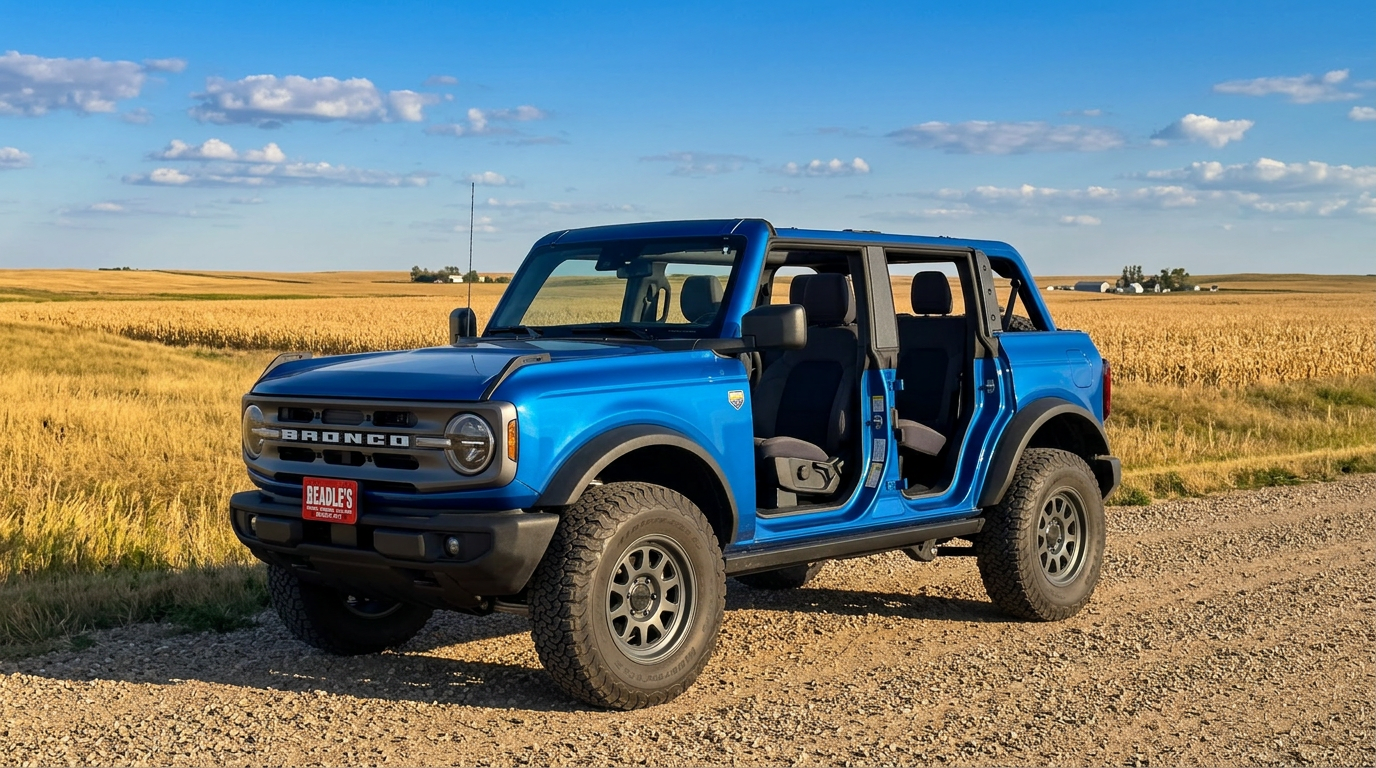
Two practical things to know. First, the Bronco’s sideview mirrors are mounted to the body, not the doors, so they stay attached when the doors come off — you don’t need aftermarket mirrors to drive legally without doors. That’s a real engineering edge if you take the doors off often. Second, the modular hardtop comes apart in panels: the front two panels lift off easily for a sunroof effect, and the rear section can come off as a separate piece. Most days when hunters say they want “doors-off” what they really want is the front roof panels off — easier to do, easier to put back, and you keep the cabin enclosed if weather changes.
The honest take: the doors-off lifestyle is a four- to six-month window in central SD, roughly May through early October. By the time the pheasant opener rolls around in mid-October, most hunters want the doors and roof on. Where the removable hardware actually helps a hunter is in the soft season — scouting trails, running dogs, checking food plots, summer grouse — not in the November cold. The full deep-dive on storage, removal time, and cold-weather trade-offs lives in our removable doors and roof guide.
Which G.O.A.T. Modes Handle Muddy CRP, Cattail Sloughs, and River-Bottom Timber?
Slippery mode handles most muddy CRP access roads on every Bronco trim. Off-Road and Rock-Crawl modes — available on Badlands, Heritage Edition, and Raptor — are what you reach for when a cattail slough or a river-bottom two-track gets serious. Sand mode is the one to use along Lake Oahe shorelines and at unimproved boat ramps.
Every 2026 Bronco has five G.O.A.T. modes standard: Normal, ECO, Sport, Slippery, and Sand. Slippery is the workhorse for SD hunters — it dials back throttle response, reins in shift points, and biases torque distribution for a slick or soft surface. That’s the right setting for a CRP access road after rain, a frozen ruts in a section line in early November, or a wet ranch two-track at first light.
Badlands and Raptor add Off-Road, Rock-Crawl, and Baja modes — seven total. Off-Road is what you want for a muddy two-track to a cattail slough or a river-bottom timber stand, where ruts are deep and you need slow, deliberate progress. Pair it with Trail Control (low-speed off-road cruise control, available on the 10-speed automatic) and the Bronco crawls through at a set speed while you focus on steering. Rock-Crawl is overkill for almost everything in the central SD region — you’d reach for it on a Black Hills weekend, not at home.
The lockers matter as much as the modes. Badlands, Heritage Edition, Raptor, and any Bronco equipped with the Sasquatch Package get electronic-locking front and rear differentials. When you’re sitting in mud or ice and the open differentials are spinning one wheel, the lockers are what get you out. For full mode-by-mode use cases see our 2026 Bronco G.O.A.T. Modes guide.
Bronco vs F-150 vs Side-by-Side: Which Is the Right Hunting Rig?
The Bronco isn’t trying to replace an F-150 or a side-by-side — it’s the rig that fills the gap between them. The F-150 is the long-haul truck and the towing king. The side-by-side is the back-pasture access tool. The Bronco is the road-legal, weather-sealed, dog-haulable middle ground that can do most of what each does without compromising on either highway manners or off-road capability.
Where the F-150 still wins: open-bed cargo for elk quarters or whole deer, towing big enclosed trailers, and seating five-plus full-size adults in comfort. If you’re hauling a tandem-axle stock trailer or a heavy gooseneck, that’s an F-150 question. Where the F-150 loses to the Bronco: tight CRP corners, narrow ranch gates, and back-pasture two-tracks where wheelbase and overhangs start to matter. A 4-Door Bronco’s wheelbase is roughly 116 inches; a 4-Door F-150 SuperCrew’s is 145+. That difference shows up the second you try to thread between cottonwoods on a section line.
Where a side-by-side wins: pure terrain access, low operating cost, the ability to leave it on the property full-time. Where it loses: it’s not road-legal in most of the state for the long drive to a Cow Creek WMA, it has no enclosed cargo for a kennel and gear in cold rain, and it has no real cabin for a January late-season hunt when the wind chill is below zero.
For most of our customers in the Bowdle area, the Bronco doesn’t displace either one. It joins the F-150 in the driveway as the second vehicle — the access vehicle for the 90-mile drive to public land where the F-150 is too big for the gates and the side-by-side can’t legally make the trip. That role is what the Bronco was built for.
Which 2026 Bronco Trim Is Best for the South Dakota Hunter?
The Badlands 4-Door is the sweet spot for most central SD hunters. It comes standard with marine-grade vinyl seats that wipe down clean, 33-inch Rugged-Terrain tires, the seven-mode G.O.A.T. system with Off-Road and Rock-Crawl, electronic-locking front and rear differentials, and the Advanced 4×4 system with 4-Auto. That’s the spec sheet of a serious hunting rig at a trim that doesn’t require a Sasquatch upcharge.
Big Bend with the Black Diamond Package is the budget option. Black Diamond adds an electronic-locking rear differential plus additional off-road hardware — enough capability for most hunters who don’t need the Badlands’ front locker or the seven-mode terrain system. It’s a real working trim at a lower entry price. Outer Banks is more comfort-oriented (leather-trimmed seats, painted hardtop, body-color flares); it’s a capable rig but not the one you want if dogs and decoys ride in the back every weekend.
Heritage Edition is Badlands hardware in a different aesthetic — Sasquatch is standard (35-inch tires, lockers, 4.7 axle), white wheels and Oxford White hardtop give it a distinctive look, and plaid cloth seats nod to the original 1960s Bronco. It works as a hunting rig, but you’re paying a premium for the styling. Raptor is overkill for SD hunting unless you’re also doing Black Hills high-clearance trails on weekends — its 37-inch tires, Live Valve dampers, and 4,500-lb tow rating are built for terrain you don’t have in central SD.
The new-for-2026 Wildtrak Package on Badlands 4-Door (a $11,945 option) bundles the 2.7L V6, the 10-speed automatic, the Sasquatch Package, HOSS 3.0 with FOX Internal Bypass dampers, and the Black Appearance Package. For a hunter who genuinely uses the rig in deep mud, river-bottom ruts, or cattail slough access — and who wants the V6’s torque for towing a small boat — Wildtrak earns its money. Full trim breakdowns are in our 2026 Bronco trim levels guide.
What Are the Real SD Use Cases, From the October Pheasant Opener Through Late Whitetail?
The third Saturday of October is opening day for pheasants. A Badlands 4-Door pulls up to the edge of a CRP field at dawn, swing gate opens, the Lab jumps out, the cooler and gun case come out behind. The drive in might have been a wet section road — Slippery mode for the gravel, 4-Auto for the change from pavement to dirt, no manual shifting needed. Available heated front seats and a heated steering wheel kill the cold while you wait for legal shooting time. That’s the everyday pheasant scenario, and the Bronco was built for it.
Late October through November shifts to waterfowl in the cattail sloughs north and west of Bowdle, and toward whitetail along the Whitlock and Cow Creek arms of Lake Oahe. The slough access roads are where Off-Road mode and electronic lockers earn their keep — soft mud, deep ruts, sometimes ice forming on the shaded side. A standard Badlands handles most of it; Wildtrak with Sasquatch handles all of it. The whitetail sit means parking at the edge of river-bottom timber and not getting stuck on the way out three hours after dark.
Late season — January for resident pheasant hunters and the closing weekend of waterfowl — is where the Bronco really separates from a side-by-side. The cabin is heated and weather-sealed. The 33-inch or 35-inch tires push through drifted snow on a county section line where a stock-suspension SUV would high-center on the running boards. Slippery mode plus 4-Auto lets the rig sort traction without you needing to think about it. We cover the full winter picture in our South Dakota winter driving guide.
All of this becomes clearer within the full 2026 Ford Bronco overview, which lays out trims, engines, capability, and what’s new for the year side by side. The hunting use case is one of the cleanest applications of the Bronco’s design — and seeing it next to the rest of the lineup helps make the trim choice obvious.
Key Takeaways
- 4-Door is the right body style for almost every hunter — the 2-Door is too tight for kennels, decoys, and a hunting partner.
- Badlands 4-Door is the sweet spot: marine-grade vinyl seats, 33″ R/T tires, front and rear lockers, seven G.O.A.T. modes, and Advanced 4×4 with 4-Auto.
- Slippery mode covers most muddy CRP access roads; Off-Road and Rock-Crawl on Badlands and up handle cattail-slough and river-bottom two-tracks.
- Maximum towing on every non-Raptor 2026 Bronco is 3,500 lbs — enough for a small boat or a single-axle utility trailer, not for heavy stock or gooseneck trailers.
- The Bronco doesn’t replace an F-150 or a side-by-side — it’s the road-legal, weather-sealed access vehicle that fits between them.
Frequently Asked Questions
My Take on the 2026 Bronco as a South Dakota Hunting Rig
I’ve watched plenty of customers come in thinking they need a Raptor or a fully loaded Sasquatch build, then walk out an hour later with a Badlands 4-Door because the spec list lined up exactly with how they actually hunt. The Badlands has been our recommendation for the central SD hunter for as long as we’ve been selling the new Bronco — marine vinyl seats that handle a wet Lab, 33-inch Rugged-Terrain tires that work in mud and snow, electronic lockers when you actually need them, and seven G.O.A.T. modes that cover everything from a CRP access road to a river-bottom two-track. It doesn’t try to be a Black Hills rock-crawler, because most of us aren’t asking it to be one.
If you’re weighing one as a second vehicle alongside an F-150 — which is how most of my hunting customers buy a Bronco — bring your kennel and your gear bag in for the test drive. We’ll fold the seats, load the cargo bay, and you can see for yourself whether the 4-Door’s footprint actually works for the way you hunt. That’s the kind of conversation we’d rather have face to face than over a spec sheet.
About the Author
Lexy Tabbert — Beadle Ford, Bowdle, SD
Lexy Tabbert is the Director of Sales and Marketing at Beadle Ford in Bowdle, South Dakota. She covers Ford vehicles, trim comparisons, and buyer guidance — helping families, ranchers, and ag operators across the region find the right truck and configuration for their needs. Learn more about Lexy.
Connect with us

