
The 2026 Ford Bronco and the 2026 Jeep Wrangler are the two body-on-frame, four-wheel-drive, removable-top SUVs in the segment. They share a buyer profile and a use case — both are bought as second vehicles, weekend rigs, and lifestyle expressions as much as transportation. Cross-shopping is real, and most Bronco buyers in central South Dakota have driven a Wrangler at least once before signing.
This is an honest comparison from a Ford store, played even-handedly. We’ll cover engines and transmissions, off-road hardware, the doors-off and roof-off designs, on-road comfort, what the money actually buys, and where the Wrangler still wins versus where the Bronco is the right call for most Beadle-area buyers. There are real differences in both directions.
On This Page
- How Do the 2026 Bronco and Wrangler Compare on Engines and Transmissions?
- How Does the Off-Road Hardware Stack Up?
- Removable Doors and Roof: How Do the Two Designs Differ?
- Which One Drives Better on Long Highway Hauls?
- What Do You Actually Get for the Money With Each One?
- Where Does the Wrangler Still Win — and Where Does the Bronco Win?
How Do the 2026 Bronco and Wrangler Compare on Engines and Transmissions?
The two lineups are organized differently. The Bronco offers three EcoBoost engines (2.3L I-4, 2.7L V6, 3.0L V6 Raptor) and the only manual transmission in the segment — a 7-speed paired with the 2.3L. The Wrangler runs a 2.0L turbo I-4 and a 3.6L Pentastar V6 across most of its lineup, with the 6.4L HEMI V8 reserved for the new-for-2026 Moab 392 and the limited-edition Willys 392. The Wrangler offers a 6-speed manual on the 3.6L V6, and an 8-speed automatic across the lineup.
On peak horsepower, Wrangler wins at the top — the 6.4L HEMI V8 in the Moab 392 makes 470 horsepower and 470 lb-ft of torque versus the Bronco Raptor’s 418 horsepower and 440 lb-ft from its 3.0L EcoBoost V6. The HEMI also makes a sound the Raptor doesn’t try to make. For buyers cross-shopping at the very top of each lineup — Bronco Raptor versus Wrangler 392 — the Wrangler is the more powerful vehicle on paper.
In the meaningful middle of the lineup, the Bronco’s 2.7L EcoBoost V6 (330 hp / 415 lb-ft) outpunches the Wrangler 3.6L Pentastar (285 hp / 260 lb-ft) on torque by a wide margin — 415 versus 260 lb-ft is the difference between an engine that pulls effortlessly from low RPM and one that needs to rev to make work. The Bronco’s base 2.3L (300 hp / 325 lb-ft) similarly outpunches the Wrangler 2.0L turbo (270 hp / 295 lb-ft).
The transmission story is more even. Bronco’s 10-speed automatic has more ratios than Wrangler’s 8-speed, which gives the Bronco a smoother shift cadence at highway speed and more precise gearing for off-road crawl. But Wrangler still offers a manual with the V6 — Bronco’s manual is 2.3L-only. For buyers who want a V6 with a stick shift, the Wrangler is the only option. For full Bronco engine context see our 2.3L vs 2.7L EcoBoost engine comparison.
How Does the Off-Road Hardware Stack Up?
Both vehicles are genuinely capable. The differences are in how each is engineered to be capable, not in whether they are. At the top spec, the numbers are within a half-degree of each other on most published metrics.
On terrain management systems, the Bronco uses G.O.A.T. Modes (Goes Over Any Type of Terrain) — five modes on most trims, seven on Badlands and Raptor, including Off-Road, Rock-Crawl, and Baja. Wrangler uses Selec-Terrain with four primary modes (Auto, Snow, Sand/Mud, Rock) plus the brand’s familiar 4WD systems (Command-Trac, Selec-Trac, or Rock-Trac depending on trim). Both work well; G.O.A.T. tends to be more discrete in mode count, while Selec-Terrain is broader by default. See our 2026 Bronco G.O.A.T. Modes guide for the full mode-by-mode breakdown.
On locking differentials, both vehicles offer electronic-locking front and rear lockers at their off-road-focused trims. Bronco standardizes them on Badlands, Heritage Edition, Raptor, and any trim equipped with the Sasquatch Package. Wrangler standardizes them on Rubicon trims (and the new Moab 392 / Willys 392). Big Bend with the Black Diamond Package gets a rear locker only — Wrangler’s Sport S and Sahara are similar.
On front sway-bar disconnect, both vehicles offer it. Wrangler’s electronic disconnect (on Rubicon and up) has been the segment benchmark for years. Bronco offers Front Stabilizer Bar Disconnect standard on Raptor and Stroppe, and new for 2026 Ford made it a standalone $1,305 option on Badlands (previously only via Sasquatch).
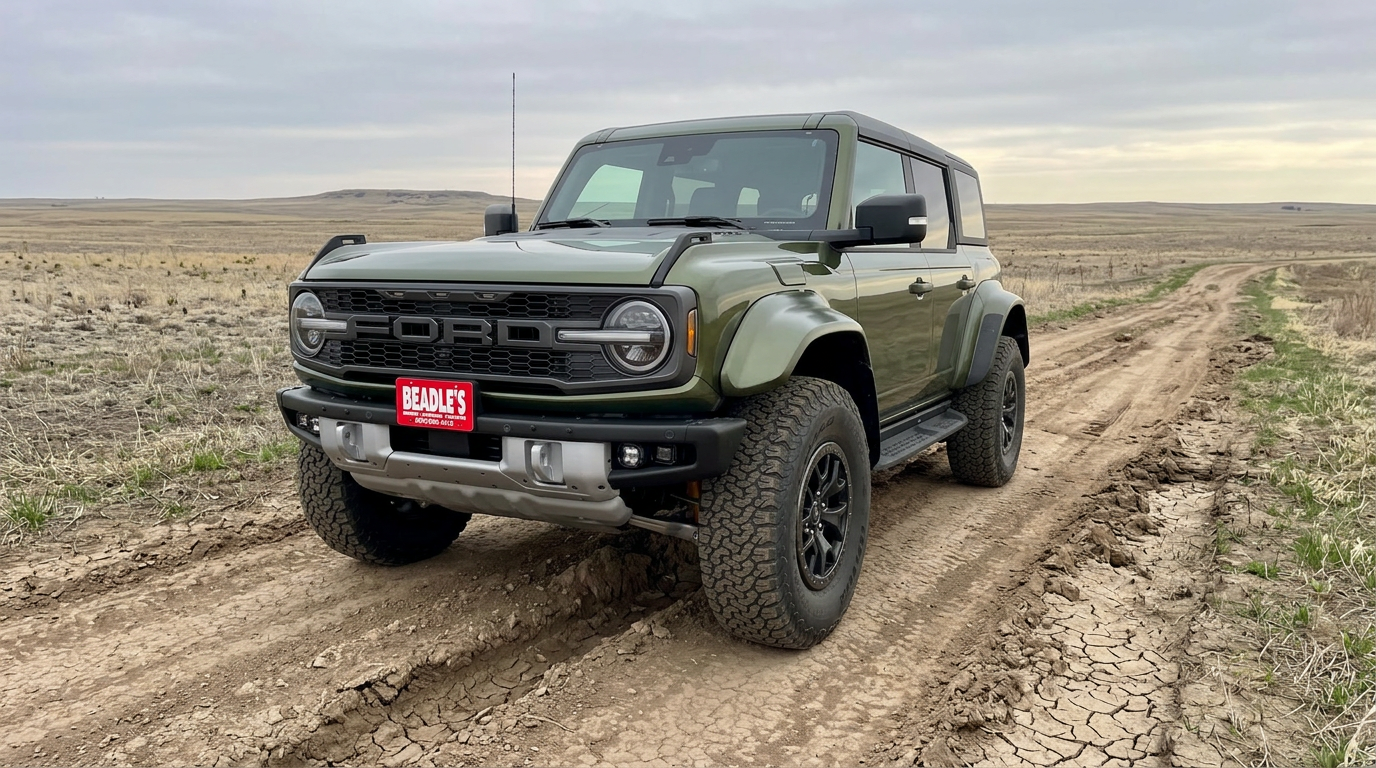
On geometry numbers at the most-capable spec: the Bronco Raptor (37″ tires) lists approximately 13.1 inches of ground clearance, 47.2° approach, 30.8° breakover, and 40.5° departure. The Wrangler Moab 392 lists approximately 12.9 inches of ground clearance, 47.4° approach, and 40.4° departure (Jeep doesn’t always publish breakover the same way). The Bronco Sasquatch (35″ tires) lists approximately 11.6 inches of ground clearance with similar angle values. Wrangler Rubicon with the Xtreme 35 Package is in roughly the same neighborhood. These numbers are within rounding error of each other at the top spec — neither vehicle has a meaningful geometry advantage. For Sasquatch context specifically, see our 2026 Bronco Sasquatch Package guide.
On 4WD systems, Wrangler’s Rock-Trac (Rubicon-only) gets a 4:1 low-range gear that’s sharper than what the Bronco uses, and the Bronco compensates with the GOAT Off-Road and Rock-Crawl modes plus Trail Control (low-speed off-road cruise control). Both are capable; Wrangler is slightly more analog, Bronco is slightly more electronic.
Removable Doors and Roof: How Do the Two Designs Differ?
Both vehicles have removable doors and removable tops. The differences are in how the engineering is executed — and in how often you’d actually take advantage of it.
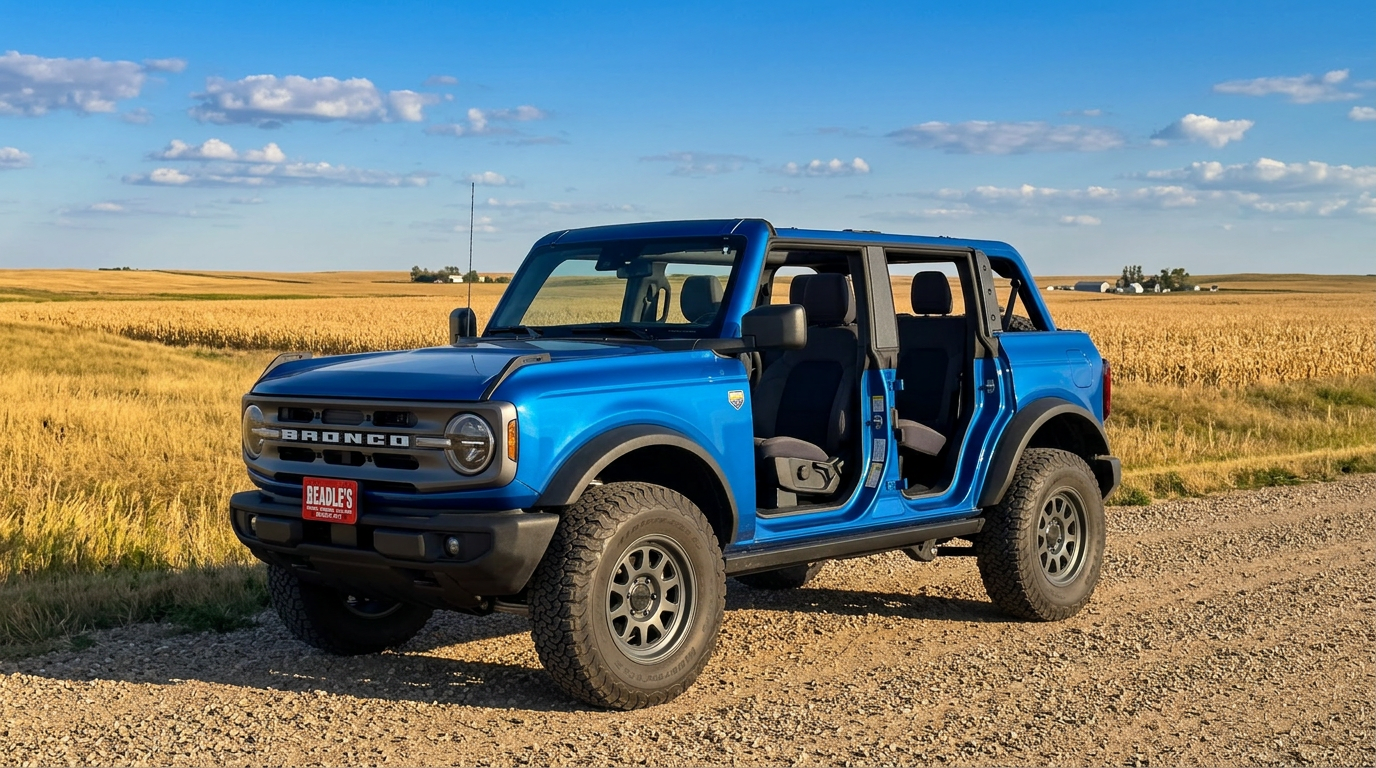
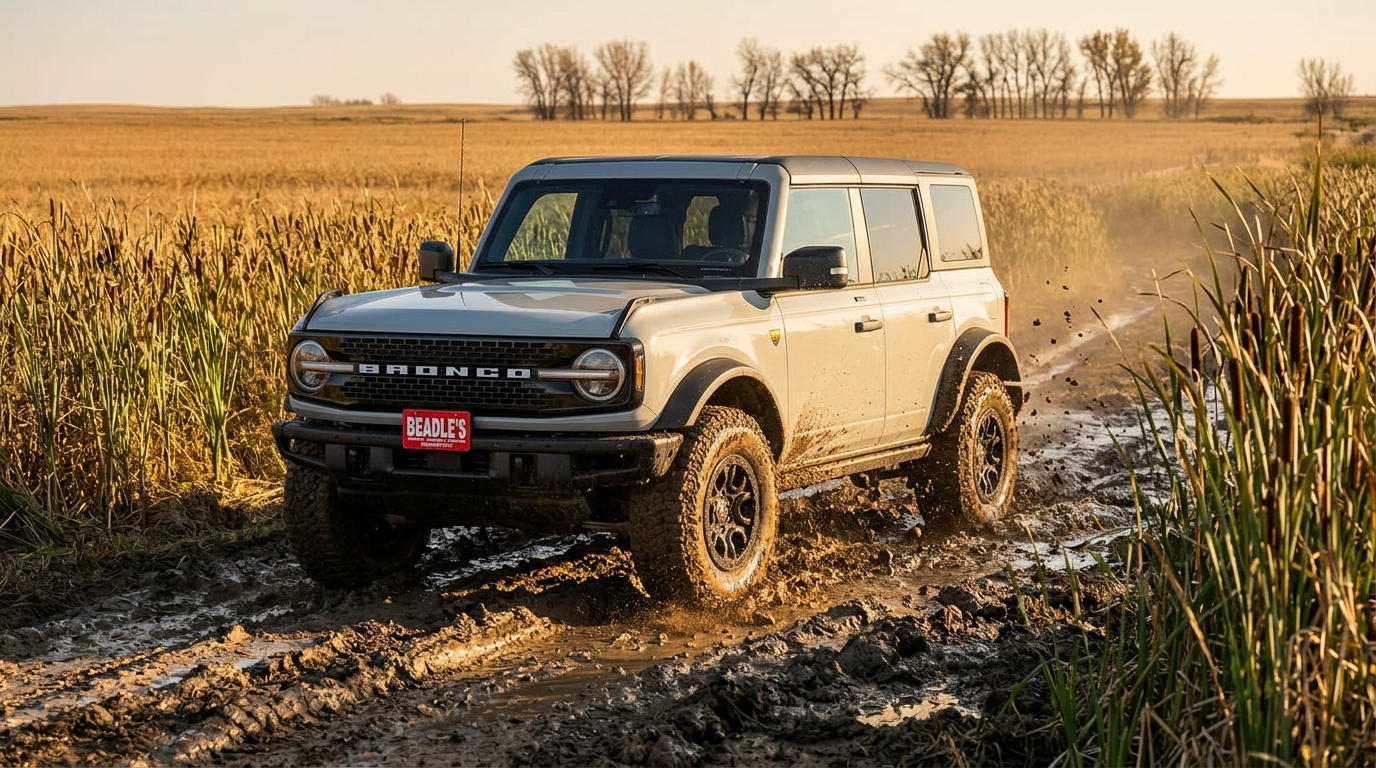
Bronco’s frameless doors are designed to be removed without specialty tools — the Tool Kit is standard on Base and inherited up the trim ladder. The mirrors stay attached to the body (not the door), which means you keep your sideview mirrors when the doors are off. Wrangler’s mirrors are mounted to the doors, so when those come off, the mirrors come with them — and Jeep sells aftermarket frame-mounted mirrors as an accessory if you want to drive doors-off legally on the highway.
On the roof, Bronco offers a Modular Hardtop with separate front panels (driver and passenger T-tops) that can come off independently of the rear, plus a soft-top option. Wrangler offers either a one-piece hardtop, a two-piece hardtop (Freedom Top), or the soft top. Both designs work; Wrangler’s Freedom Top is generally faster to take off than Bronco’s modular setup, while Bronco’s lets you go partial — front panels off, rear panels on — which is a useful in-between for a sunny day with cooler weather behind you.
Honest take for central South Dakota: the doors-off and roof-off lifestyle is mostly a 4–6 month window. From mid-October through early April, the doors stay on and the hardtop earns its keep. Both vehicles handle the cold months equivalently — but if you’re bought either of them for the doors-off feature, plan around the calendar. Our 2026 Bronco removable doors and roof guide covers this in more detail.
Which One Drives Better on Long Highway Hauls?
This is one of the clearer differences. The Bronco generally rides quieter, tracks straighter at highway speeds, and feels less truck-like over expansion joints than the Wrangler does — particularly on Outer Banks and on any non-Sasquatch configuration. The Wrangler’s solid front axle (a feature for off-road purists) is also why it tends to wander more at 75 mph and follow road crowns more aggressively than the Bronco’s independent front suspension does.
For long-distance drivers — anyone making the four-hour Bowdle-to-Black-Hills run a few times a year — the Bronco’s on-road manners are a real, daily-felt advantage. Wind noise is lower, steering feel is closer to a modern crossover, and the cabin doesn’t ask the driver to actively manage the wheel the way a Wrangler can on a windy day.
Both vehicles offer modern infotainment. Bronco runs SYNC 4 with a 12-inch standard touchscreen on every trim — including Base — and wireless Apple CarPlay and Android Auto. Wrangler runs Uconnect 5 with an 8.4-inch standard screen (12.3-inch optional). Both interfaces are good. Bronco’s standard screen is bigger; Wrangler’s tactile controls are arguably better for off-road glove use.
Worth flagging: the 2026 Bronco does not offer Ford’s BlueCruise hands-free highway driving. Wrangler doesn’t offer a competing hands-free system either. So while BlueCruise is a Ford brand strength elsewhere in the lineup, it’s not a differentiator here.
What Do You Actually Get for the Money With Each One?
At MSRP, the two lineups overlap heavily. The 2026 Bronco starts at $40,495 (Base, before destination) and tops out at $79,995 (Raptor). The 2026 Wrangler starts comparably (depending on trim and body style) and tops out near $90,000+ for the Moab 392 and the limited-edition Willys 392. For mainstream comparison, a Bronco Big Bend, Outer Banks, or Badlands sits roughly in line with a Wrangler Sport S, Sahara, or Rubicon respectively.
Where the math diverges is in standard equipment per dollar. The Bronco runs SYNC 4 with the 12-inch screen, wireless CarPlay and Android Auto, and Co-Pilot360 driver-assist (BLIS, lane-keeping, AEB) standard from Big Bend up. Wrangler delivers similar tech but more of it lands in optional packages or higher trims. A Bronco Big Bend at MSRP usually has more standard tech than a Wrangler Sport S at the same price. For trim-by-trim Bronco context, see our 2026 Bronco trim levels guide.
On towing, Wrangler wins on paper: the 4-door Wrangler Rubicon with the 4.10 axle (and the Moab 392 / Willys 392) is rated to tow up to 5,000 lbs. Every non-Raptor 2026 Bronco caps at 3,500 lbs; the Bronco Raptor caps at 4,500 lbs. If you’re regularly towing a trailer that puts you above 3,500 lbs, that pushes you to a Bronco Raptor or to the Wrangler. For most buyers towing a fishing boat, an ATV trailer, or a small camper, both are well within capacity.
Resale value is roughly comparable. Wrangler has historically held value extremely well — that hasn’t completely changed — but the Bronco’s resale has been strong since launch and continues to track close to Wrangler’s at three- and five-year points. Both vehicles depreciate less than the average mainstream SUV.
Where Does the Wrangler Still Win — and Where Does the Bronco Win?
The Wrangler still wins if you want the highest-output engine in the segment (the 470-hp HEMI V8 Moab 392 / Willys 392 — the Bronco Raptor doesn’t try to chase it), if you want a manual transmission paired with a V6 (Bronco’s manual is 2.3L-only), if your tow load lives between 3,500 and 5,000 lbs (Bronco caps at 3,500 lb non-Raptor / 4,500 lb Raptor), or if you place a strong premium on the Wrangler’s brand identity and aftermarket community — both are real and longstanding strengths.
The Bronco wins if you do a lot of long-distance highway miles, if you want the segment’s best standard-tech-per-dollar (SYNC 4, 12-inch screen, Co-Pilot360 from Big Bend up), if you want creature comforts in your off-road SUV without stepping all the way up to a top-trim Wrangler, if you appreciate that the Bronco’s mirrors stay on when the doors come off, or if you want the GOAT mode terrain system rather than Selec-Terrain.
The third factor — the one that doesn’t show up on a spec sheet — is the dealer relationship. The nearest Jeep dealership to Bowdle is enough miles away that warranty service, recall work, and trade-in conversations all become a half-day commitment. Beadle Ford is twenty minutes from most of our buyers, and we’ve been here for decades. For a vehicle that’s going to need an oil change four times in the first year and a service item or two over its life, that proximity matters more than most buyers think when they’re shopping on paper.
Either vehicle is a good choice. We recommend driving both — and we’ll tell you straight up which one fits your specific use case, even if that answer isn’t the Bronco. For the broader 2026 Bronco context, the full 2026 Ford Bronco overview covers engines, capability, and what’s new for the year.
Key Takeaways
- Top engines: Wrangler 6.4L HEMI V8 (470 hp / 470 lb-ft) outpowers Bronco Raptor 3.0L V6 (418 hp / 440 lb-ft). In the meaningful middle, Bronco’s 2.7L EcoBoost V6 outpunches Wrangler’s 3.6L V6 on torque (415 vs 260 lb-ft).
- Off-road geometry at top spec is within rounding error: Bronco Raptor ~13.1″ GC, 47.2° approach, 40.5° departure; Wrangler Moab 392 ~12.9″ GC, 47.4° approach, 40.4° departure.
- Towing: Wrangler tops out at 5,000 lbs (4-Dr Rubicon w/ 4.10 axle); Bronco caps at 3,500 lbs non-Raptor, 4,500 lbs Raptor.
- Doors-off design: Bronco’s mirrors are body-mounted (stay on); Wrangler’s mirrors come off with the doors and require aftermarket frame mirrors for legal road use.
- Bronco wins on long-highway comfort, standard tech per dollar (SYNC 4 + 12-inch screen + Co-Pilot360), and dealer proximity for central-SD buyers. Wrangler wins on top-spec horsepower, V6+manual availability, max towing, and aftermarket community.
Frequently Asked Questions
My Take on the 2026 Bronco vs Wrangler Decision
I’ll be honest — the decision between a Bronco and a Wrangler usually comes down to two questions: how many highway miles will you put on it, and how committed are you to the brand identity and the community that comes with each one. If long highway runs are a big part of your year and you don’t have strong loyalty either way, the Bronco’s on-road manners and standard-tech-per-dollar usually carry the day. If you’ve owned three Wranglers and you know what you love about them, no amount of EcoBoost torque is going to change that — and that’s a perfectly valid reason to stay with what you know.
The thing the spec sheet doesn’t capture is the dealer side of the deal. We’ve been at Beadle Ford in Bowdle long enough to remember a lot of our customers’ previous trucks — and the closest Jeep store is far enough away that the relationship is harder to build. If you’re cross-shopping and the trucks land at a near-tie on paper, the dealer math is worth weighing. Either way, come drive both. We’ll be square with you about which one fits.
About the Author
Lexy Tabbert — Beadle Ford, Bowdle, SD
Lexy Tabbert is the Director of Sales and Marketing at Beadle Ford in Bowdle, South Dakota. She covers Ford vehicles, trim comparisons, and buyer guidance — helping families, ranchers, and ag operators across the region find the right truck and configuration for their needs. Learn more about Lexy.
Connect with us

