

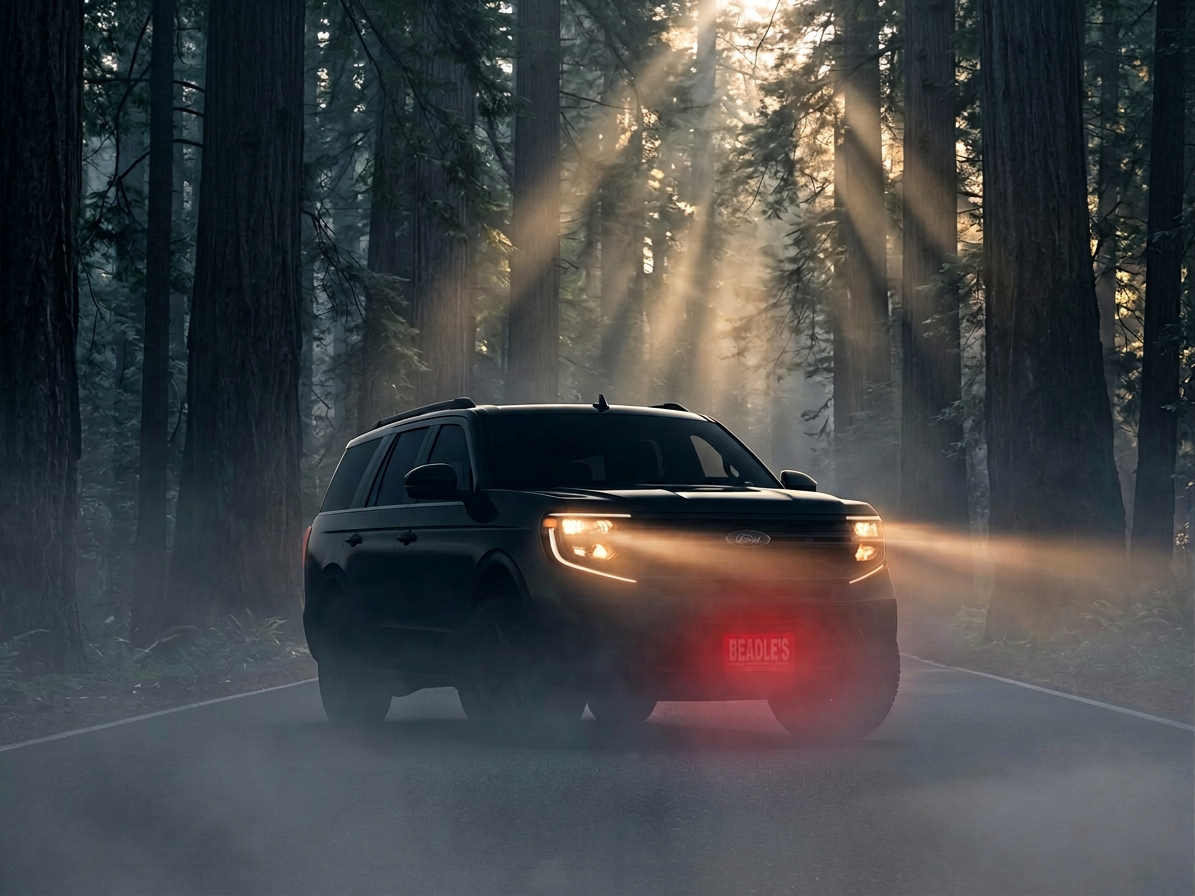
You’re in an F-150 SuperCrew or a Ford Explorer today, and the truck or SUV that worked for your family five years ago is starting to feel small. Maybe the oldest just started driving, and the second row is shared three-across. Maybe the F-150 bed handles the cargo but you keep wishing you had room inside for everyone AND the gear. Maybe the Explorer’s third row works for kids but not for teenagers. This guide is for buyers at exactly that moment — the upsizer who’s thinking about their first full-size SUV.
We’ll cover when upsizing genuinely makes sense, how the 2027 Expedition compares to the Ford Explorer (the intra-Ford decision most buyers in this spot are weighing), what actually changes when you move from a half-ton pickup or a midsize SUV to a full-size three-row — parking, fuel, tires, driveway footprint — whether the Expedition’s third row holds up for a growing family, and which trim is the right pick for a first-time full-size SUV buyer.
On This Page
- When is it time to upsize from an F-150 or Explorer?
- How does the 2027 Expedition compare to the Ford Explorer?
- What changes when you move from a half-ton pickup to a full-size SUV?
- Is the Expedition’s third row actually usable for a growing family?
- How do you pick the right trim on your first Expedition?
When is it time to upsize from an F-150 or Explorer?
Usually, the family tells you before the spec sheet does. Here are the moments we see most often at Beadle Ford.
The second-row-three-across moment. You’re in an F-150 SuperCrew or an Explorer and the three kids in the second row are getting bigger every year. Car seats become booster seats; booster seats become seatbelt passengers. Elbows start touching. Road trips that used to be easy become negotiations about who sits where. That’s usually the first signal.
The “everything doesn’t fit” moment. You’re packing for a weekend at Lake Oahe, a family trip to the Black Hills, or the long haul to Sioux Falls or Fargo for a tournament. In the F-150, the bed handles cargo but you can’t fit all the passengers and the dog comfortably. In the Explorer, everyone fits but the gear takes up the third-row space you’d planned to use for passengers. Either truck does part of the job but not both.
The “oldest starts driving” moment. When the oldest kid gets a driver’s license, your family effectively becomes a two-vehicle operation that used to be a one-vehicle operation. If the kid inherits your F-150, you still need something that carries the rest of the family plus gear. If the kid inherits something smaller, the family vehicle still needs to handle trips that now include a teenager who’s driving themselves some of the time. A full-size SUV absorbs both scenarios.
The towing-plus-passengers moment. You want to pull a boat, a camper, or a livestock trailer with the family along for the ride. An Explorer tows less than an Expedition; an F-150 tows more but loses passenger and cargo space. The Expedition does both jobs — up to approximately 9,600 lbs on the Tremor (reported, pending the 2027 Ford Towing Guide) with three rows of passengers and cargo still on board.
If any of those moments sound like your current situation, you’re probably not too early to consider upsizing.
How does the 2027 Expedition compare to the Ford Explorer?
Both are Ford three-row SUVs, but they’re different classes of vehicle with different purposes. The Explorer is Ford’s midsize three-row, built on a unibody platform with a focus on car-like ride quality, urban-friendly dimensions, and efficiency. The Expedition is Ford’s full-size three-row, built on a body-on-frame platform with full-size trucks’ capability — higher towing, larger third row, more interior volume, more presence.
The practical differences for an upsizing family: the Expedition’s third row is meaningfully larger and supports adult passengers on longer trips. The cargo area behind the third row is bigger — the Expedition MAX stretches that even further. Towing capability steps up substantially: where an Explorer handles a small boat or a light utility trailer, the Expedition Tremor’s reported 9,600 lb max (pending 2027 Ford Towing Guide) opens up gooseneck livestock trailers, tandem-axle camper setups, and multi-use haulers that exceed Explorer territory.
Where the Explorer still wins: tighter parking, a smaller turning radius, generally better fuel economy (final 2027 EPA ratings pending), and a lower purchase price. If you rarely carry more than four people and your trips stay on pavement, the Explorer might remain the right vehicle. The upsize case only gets stronger as your family and use case get bigger.
The Expedition also offers two body styles the Explorer doesn’t: standard-length Expedition and the extended Expedition MAX. If your family trips push the cargo-behind-the-third-row question hard, MAX adds roughly a foot of wheelbase and meaningful cargo volume. The Expedition vs. Expedition MAX guide walks through that body-style decision in detail.
What changes when you move from a half-ton pickup to a full-size SUV?
Less than most first-time Expedition buyers expect. An F-150 SuperCrew and an Expedition share a lot of engineering lineage — the same Ford Digital Experience on upper trims, the same Ford Co-Pilot360 Assist 2.0 driver-assist standard, similar dimensions in terms of width and height, and 3.5L EcoBoost V6 architecture available in both. The transition is more about how you use the vehicle than how it drives.
Parking and turning radius. The Expedition (standard length) is about the same overall length as an F-150 SuperCrew with a 6.5-foot bed. If you park an F-150 SuperCrew comfortably today, the standard Expedition fits the same spots. The MAX is longer — roughly equivalent to an F-150 SuperCrew with an 8-foot bed — and takes a little more room to maneuver. Turning radius is slightly tighter on the Expedition than on most pickups because the SUV body sits on a shorter effective wheelbase.
Fuel and running costs. Official 2027 EPA ratings will be released closer to launch. In general, a full-size three-row SUV uses comparable or slightly more fuel than a half-ton pickup because the SUV weighs similar and has a less aerodynamic shape under some conditions. Tire sizes on Platinum (P275/60R20) and King Ranch (P275/50R22) are larger than most F-150 SuperCrew sizes, which means tire replacement costs are higher. Tremor uses more conservative P275/70R18 all-terrains at lower replacement cost than the bigger Platinum or King Ranch rubber.
What improves. All-weather passenger comfort, cargo access from inside the vehicle (versus a pickup bed), interior storage for grocery-sized and gear-sized items, and third-row flexibility for family seating configurations. Those are the day-to-day changes that most buyers actually feel after their first month.
If you’re moving from an Explorer rather than an F-150, the changes are more noticeable — you’re moving up in overall footprint, ride quality shift toward truck-like dynamics, higher towing capacity, and larger interior volume. Fuel economy likely decreases, and the replacement tire and service costs step up. The Explorer-to-Expedition transition is a genuine upsize, not a lateral move.

Thinking about making the upsize?
Is the Expedition’s third row actually usable for a growing family?
Yes, and it holds up as kids get taller. The Expedition’s third row is full-size-SUV-class legroom and headroom, designed to support adult passengers on longer trips. That’s the practical difference buyers notice when they move from an Explorer’s more compact third row — the Expedition’s third row doesn’t become an emergency-only seat as your kids grow into it.
The seating configurations matter. Active Select (200A) comes standard as 8-passenger with a second-row 40/20/40 CenterSlide bench. Active Touring (202A) is 7-passenger with power-folding captain’s chairs, with an 8-passenger bench option. Tremor, Platinum, and King Ranch are all 7-passenger with leather captain’s chairs (Tremor and Platinum offer an 8-passenger option). MAX-body Expeditions add cargo space behind the third row rather than changing the seating count — still 7 or 8 passenger.
Access to the third row is tidier than most. The power-folding second-row captain’s chairs on Active Touring and above tilt and slide forward with a single button, making third-row entry easier than manually folding a second-row bench. For kids in booster seats or smaller passengers, third-row access through a captain’s chair aisle is meaningfully simpler than climbing over.
If the third-row question is central to your decision — particularly if you’re considering a MAX body style for more cargo volume behind the third row — the Expedition vs. Expedition MAX guide goes deeper on the body-style trade-off.
How do you pick the right trim on your first Expedition?
For first-time full-size SUV buyers coming from an F-150 SuperCrew or Explorer, the Active Touring (202A) equipment group is usually the value sweet spot. It adds the features that most family buyers end up wanting — BlueCruise 90-Day Trial, Pro Power Onboard 400W, heated front seats and steering wheel, memory driver seat, ActiveX trimmed seats, and power-folding second-row captain’s chairs — over Active Select (200A) without stepping up into Platinum luxury territory. For 2027, Active Touring also offers the new Family Travel Package option with 360-Degree Zone Lighting, a Digital Device Holder, Flex Powered Console, Power Panoramic Vista Roof, and third-row PowerFold seating.
If you’re moving from a Platinum-trim Explorer or an F-150 Lariat and you’re used to premium interior materials, Platinum base (600A) is worth considering — 22" Ebony Bright Machined wheels, 4-Wheel Independent Suspension, body-color bumpers with Silver Lining trim, and leather-trimmed heated/ventilated front seats with perforated inserts. Platinum Ultimate (17A) adds the 440 hp High Output engine, standard BlueCruise 1-Year + 90-Day plan, and premium appearance items that standard Platinum 600A no longer carries for 2027.
If off-pavement capability matters — gravel, pasture, or ranch access is part of your driving — the Tremor is the only factory off-road Expedition. It’s a genuinely different mechanical spec, not a cosmetic upgrade. But for pure on-pavement family use, Active Touring or Platinum makes more sense.
For the complete trim-by-trim decision framework with every Platinum package detailed, see the 2027 Ford Expedition Trim Levels guide. And for the full 2027 feature list and reservation details, see the complete 2027 Ford Expedition overview.
Key Takeaways
- Typical upsize triggers: the three-across-in-row-two moment, the “everything doesn’t fit” trip moment, the oldest starting to drive, or wanting to tow plus carry passengers.
- Expedition vs. Explorer is midsize vs. full-size, unibody vs. body-on-frame. The Expedition has a bigger third row, more cargo, and more towing.
- Moving from an F-150 SuperCrew to a standard-length Expedition is a lateral shift in footprint, not an upsize in parking terms. MAX adds real length.
- Tire and service costs step up with 22" wheels on Platinum and King Ranch; Tremor’s 18" all-terrains are more economical to replace.
- Active Touring (202A) is typically the value sweet spot for first-time full-size SUV buyers; Platinum for luxury; Tremor for off-pavement use cases.
Frequently Asked Questions
My Take on the First-Expedition Decision
Most of the upsizing buyers I see at Beadle Ford are one of two types. Either they’re in an Explorer and the family has outgrown the third row, or they’re in an F-150 SuperCrew and they want the passenger flexibility an SUV brings without giving up much of what the truck does. Either way, the Expedition answers the question. For the Explorer buyer, it’s a meaningful upsize. For the F-150 buyer, it’s a lateral shift in footprint with a big improvement in interior utility.
If you’re at that moment and you’d like to walk through the configuration against your actual week — school drop-offs, weekend trips, the trailer you already own — come see me. I’ll help you pick the trim and body style that genuinely fits, not just the one that looks good on the lot.
About the Author
Lexy Tabbert — Beadle Ford, Bowdle, SD
Lexy Tabbert is the Director of Sales and Marketing at Beadle Ford in Bowdle, South Dakota. She covers Ford vehicles, trim comparisons, and buyer guidance — helping families, ranchers, and ag operators across the region find the right truck and configuration for their needs. Learn more about Lexy.
Connect with us

