
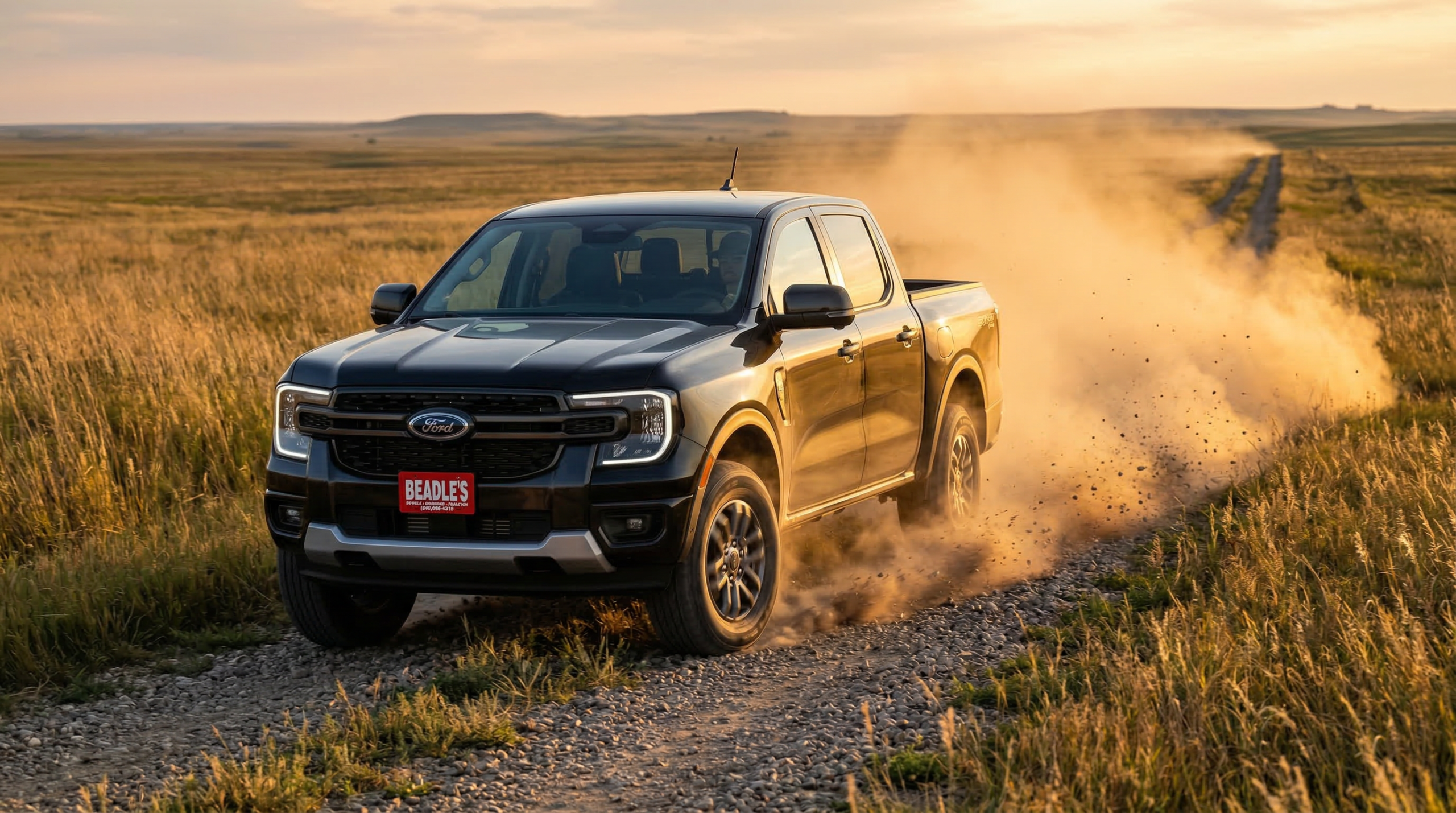
Let’s be direct: the FX4 Off-Road Package sounds impressive on a window sticker, but plenty of buyers aren’t sure whether they actually need it or if it’s just a checkbox that adds cost. If you spend time on gravel roads, muddy field edges, hunting access roads, or anywhere paved roads stop being a guarantee — the answer is probably yes. If you stay on pavement and well-maintained highways, you can save the money. Here’s an honest breakdown of every component, what it does in the real world, and who it’s actually built for.
The Big 2026 Change: FX4 Now Available on the XL
For 2026, Ford expanded FX4 availability down to the XL trim — that’s new. Previously the package started at the XLT. Now you can spec the XL with FX4 content, which creates a lower-cost entry point for buyers who want the off-road capability without the added interior features of the XLT or Lariat.
FX4 remains available on the XLT and Lariat as well. The Raptor is its own animal — it doesn’t use the FX4 package name because it has more capable off-road hardware built in from the ground up. More on the Raptor vs. FX4 comparison below.
What the FX4 Package Actually Includes
The FX4 Off-Road Package is a collection of components that work together to improve capability in low-traction situations. Here’s what’s in it:
| Component | What It Does |
|---|---|
| Electronic Rear Locking Differential | Locks both rear wheels to rotate at the same speed — prevents the truck from spinning the easy wheel and losing traction |
| Trail Control™ | Low-speed cruise control for off-road terrain — you steer, the truck manages throttle and braking independently at each wheel |
| Rock Crawl Mode | Activates low-range 4×4, engages e-locker, reduces throttle sensitivity for precise control on uneven terrain |
| Off-Road-Tuned Shock Absorbers | Recalibrated dampers for improved wheel articulation and stability on rough, uneven surfaces |
| Steel Front Bash Plate | Protects the front underbody from rocks, logs, and road debris when ground clearance runs out |
| Off-Road Tires | All-terrain tires on all FX4 configurations (OWL tires available on XLT models without the Black Appearance Package) |
| FX4 Badging | Box decals — the visual identifier that signals the package is equipped |
Trail Control: The Feature Most Buyers Underestimate
Trail Control is essentially low-speed off-road cruise control. You set a target speed between 1 and 20 mph and it holds that speed — independently braking individual wheels and modulating throttle to keep you moving at a consistent pace through rough terrain. Your hands stay on the wheel for steering; the truck handles the rest.
Why does this matter? On a steep rocky descent or a rutted two-track, managing throttle and brakes manually while also steering is a lot to coordinate — especially with passengers in the truck. Trail Control eliminates the brake-throttle-steer juggling act and lets you focus on your line. It’s particularly useful for technical descents where too much speed leads to sliding.
It’s not a feature you’ll use on every off-road trip. But the times you need it — loaded with gear, on a challenging grade, with a trailer behind you — it earns its place fast.
The E-Locker: When It Matters and When It Doesn’t
The electronic rear locking differential is the most practically useful piece of the FX4 package for South Dakota driving conditions. Here’s the core problem it solves: when one rear wheel is on a slippery surface and the other has grip, an open differential sends power to the wheel with less resistance — which means the slipping wheel spins freely while the good-traction wheel sits still. You go nowhere.
The e-locker mechanically locks both rear wheels together so they both turn at the same speed regardless of traction. Both rear wheels become driving wheels. In soft spring mud, loose gravel, flooded field paths, or a wet boat ramp — the difference between locked and open is often the difference between moving and stuck.
When to Use the E-Locker
Use it: Muddy boat ramps, soft field edges, loose gravel climbs, spring thaw on two-tracks, wet grass, sand
Don’t use it on: Pavement or hard-packed roads — locking the rear differential on solid surfaces causes binding and handling issues
You engage and disengage it with a dash button. Easy to forget you have it, easier to remember once you’ve needed it.
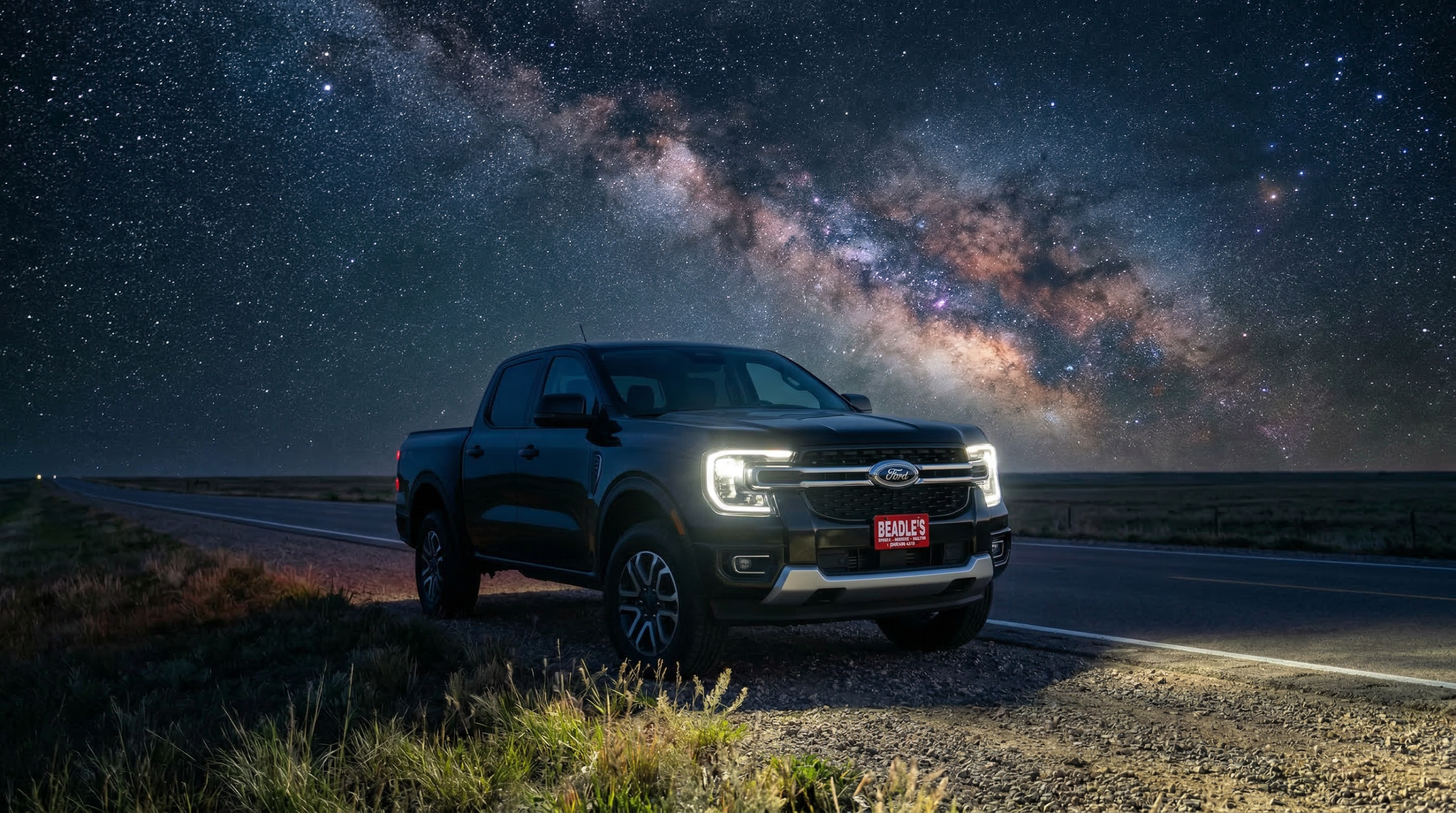
FX4 vs. Raptor: Different Tools for Different Terrain
The Raptor and the FX4 Ranger are not competing for the same buyer. The FX4 package improves a capable everyday truck — you’re still on the same frame, same suspension travel, same ground clearance as the base Ranger. The Raptor is a purpose-built performance off-road platform with a completely different suspension architecture, significantly more wheel travel, and a 3.0L V6 tuned specifically for off-road use.
| XLT / Lariat w/ FX4 | Raptor | |
|---|---|---|
| Engine | 2.3L I4 or 2.7L V6 | 3.0L V6 — 405 hp |
| Suspension | Off-road tuned shocks | Live-valve Fox Racing Shox, long-travel |
| Max Towing | up to 7,500 lbs | up to 5,510 lbs |
| Drive Modes | Rock Crawl (FX4) | Baja, Rock Crawl + more |
| Best Use | Daily driver + off-road capability | Performance off-road truck |
| Price Tier | Package add-on cost | Significant premium |
For most buyers in central South Dakota, the FX4 on an XLT or Lariat is the right call. It handles gravel roads, hunting access, boat launches, and field edges with confidence — and it still tows at the full 7,500 lb ceiling. The Raptor is for buyers who want high-speed desert running and extreme trail capability as a primary use case, not a secondary one.
Worth It or Skip It: The Honest Framework
Add FX4 if you regularly:
- Drive unpaved roads, gravel county roads, or seasonal two-tracks
- Back down boat ramps — especially in late fall or early spring when surfaces get soft
- Drive across pastures, field edges, or hunting grounds with soft or wet soil
- Deal with South Dakota spring mud or late-season snowpack on back roads
- Haul trailers off-pavement where departure traction is a concern
Skip FX4 if you:
- Primarily drive paved highways, town streets, and well-maintained county roads
- Have no regular use for the e-locker, Trail Control, or rock crawl modes
- Are on a tight budget and the package cost matters — there’s nothing wrong with a clean XLT or Lariat without it
Why It Makes Sense for Bowdle-Area Drivers
Living and working around Bowdle means unpaved roads aren’t a novelty — they’re routine. County gravel roads that turn to mud in April, field access tracks after rain, boat launches on the Missouri River system, stock dam access that gets torn up by cattle and equipment — this is exactly the environment the FX4 package is engineered for.
The steel bash plate alone is worth something when you’re driving roads where rocks and debris are a given. The e-locker is worth something every spring. Trail Control is worth something any time you’re on a loaded descent in bad conditions. None of these are theoretical benefits in this part of the state — they’re features you’ll actually use.
For a complete look at which trims offer FX4 and how the package fits into each build, or to understand how the e-locker improves traction at boat ramps and soft-surface towing situations, both guides have the detail.
FX4 FAQ
Key Takeaways
- FX4 is now available on the XL for 2026 — that’s new; it previously started at the XLT
- The package includes: e-locker, Trail Control, Rock Crawl mode, off-road shocks, steel bash plate, FX4 tires and badging
- The electronic rear locking differential is the most practically useful piece for South Dakota conditions
- Trail Control is low-speed off-road cruise control — handles throttle and braking while you steer
- FX4 does not reduce towing capacity — the 7,500 lb max still applies
- The Raptor is a different product entirely — purpose-built off-road with long-travel suspension and a 3.0L V6
- If you drive unpaved roads, boat ramps, or field access regularly in central SD — FX4 is worth it
The FX4 Off-Road Package isn’t flashy marketing — it’s a set of components that address real traction problems in real conditions. Around Bowdle, those conditions show up in April mud, gravel county roads, and every trip to a boat ramp or field edge. Whether it belongs on your build depends on how you actually use the truck.
If you want to talk through trim and package combinations at Beadle Ford, I’m happy to help you land on the right build. The complete 2026 Ranger overview is a good place to start if you want to compare the full lineup before narrowing down.
— Lexy Tabbert, Beadle Ford

