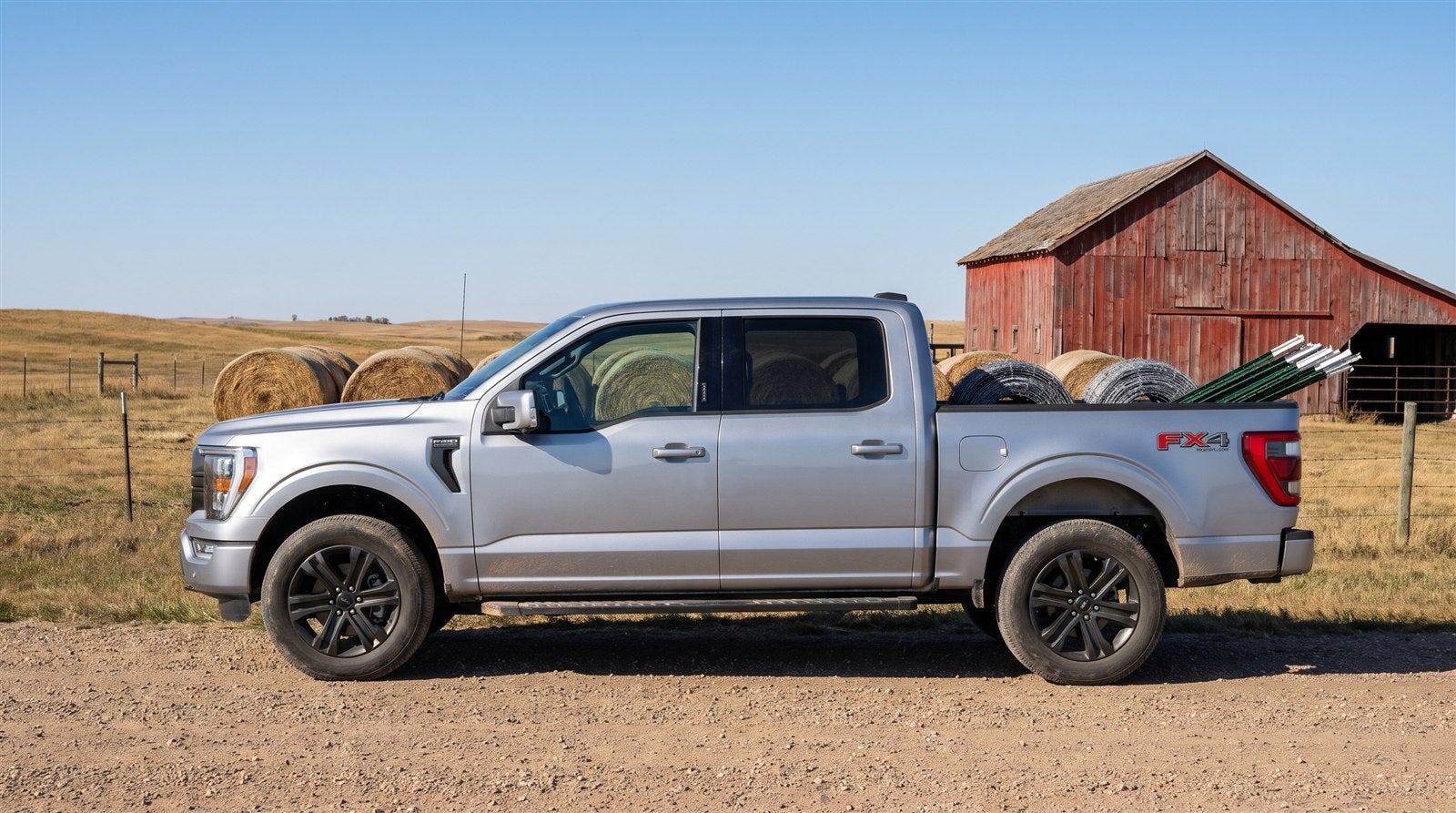
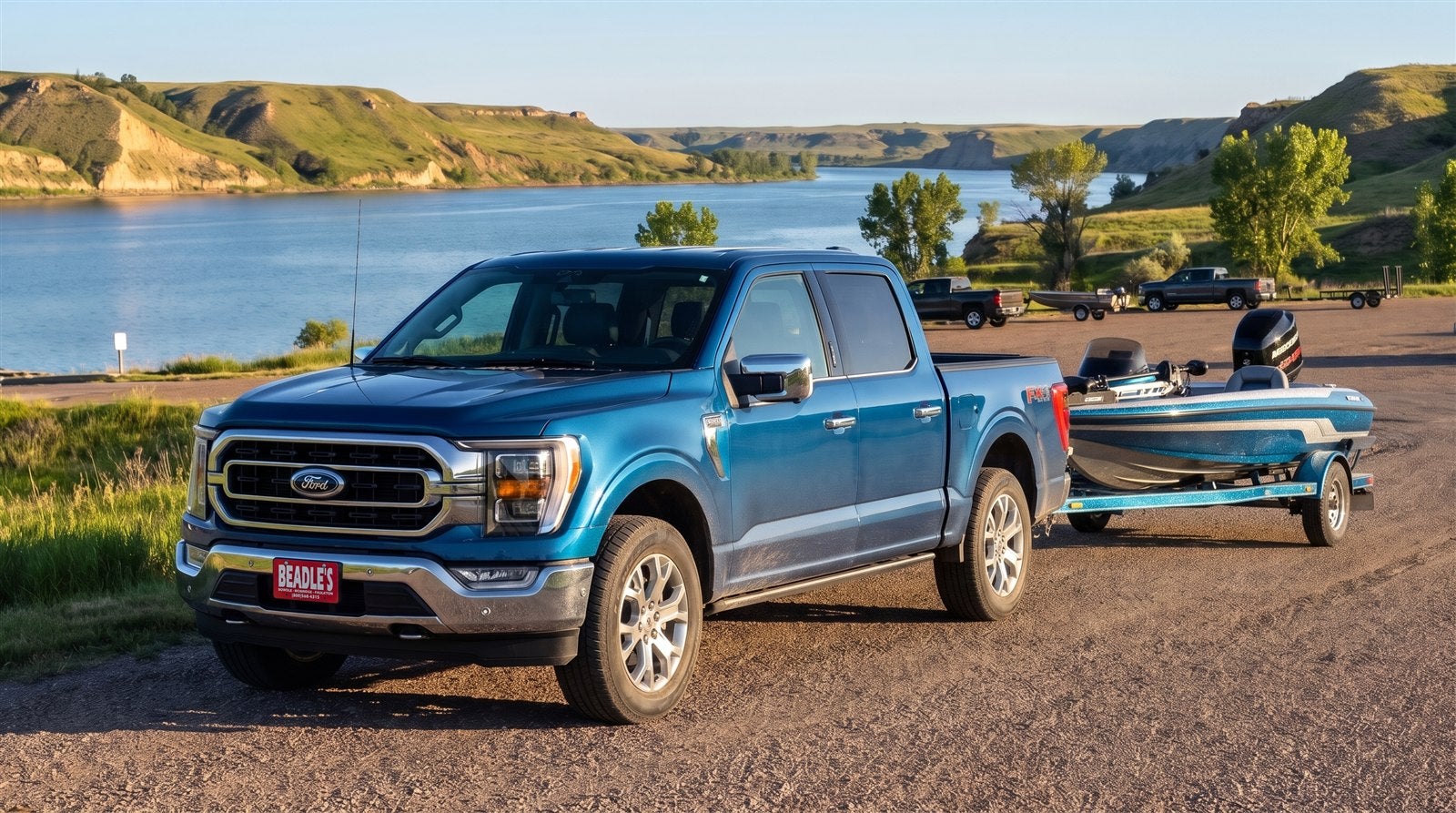
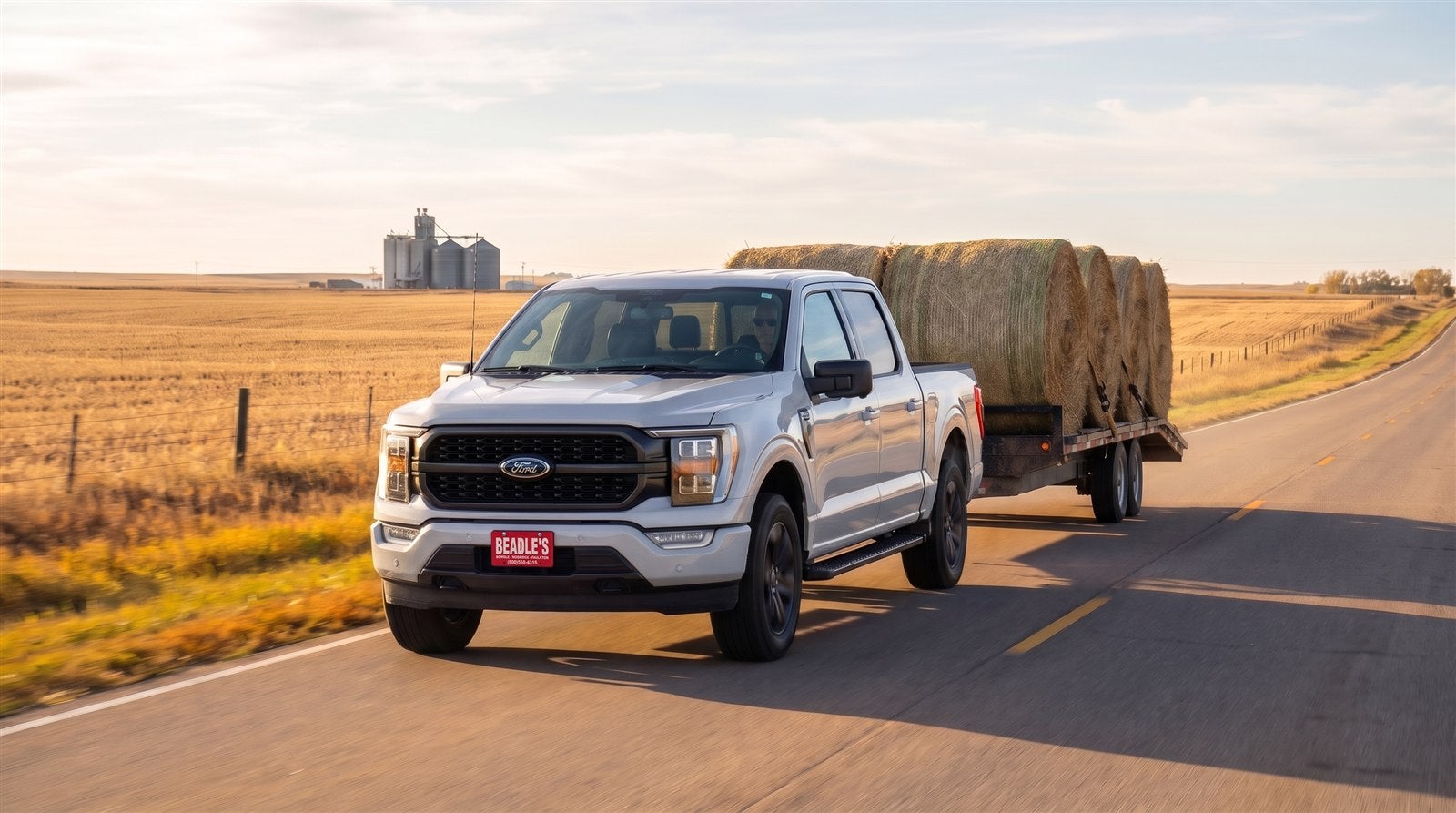
Quick Answer A 2026 Ford F-150's payload is printed on its driver's door-jamb sticker, and tongue weight, gooseneck pin weight, passengers and gear all count against it. Ford figures about 10% of a bumper-pull trailer and 15% of a fifth-wheel rides on the truck. Do that math before trusting any tow rating. Most people shop a half-ton by its tow rating. Then they hook up a loaded camper or a gooseneck full of calves, put the family in the cab, and find out the real limit was a smaller number on the door jamb all along. That number is payload, and with a camper or gooseneck it usually runs out before the tow rating does. This guide shows ranchers, families and lake-goers around Bowdle how to read the 2026 F-150 payload sticker, how tongue and pin weight work, and how to run the math on a bale trailer, a gooseneck and a camper. Ford hasn't published a full 2026 payload chart by configuration, so we teach the method that works on any truck: the sticker on the truck in front of you. Search F-150 Inventory Get Pre-Approved On This Page Why does payload matter more than the tow rating? Where is the payload number, and how do you read the sticker? What's the difference between tongue weight and gooseneck pin weight? How do you do the payload math with your own sticker? What size camper can a 2026 F-150 handle? How do cab, bed, engine and options change payload? How do you check your real numbers before a big haul? When does the payload math say you need an F-250? Why does payload matter more than the tow rating? Because part of every trailer rides on the truck. The tow rating measures what the truck can pull, but the tongue or gooseneck pin pushes straight down on the hitch, and that weight comes out of payload just like a passenger or a bag of mineral in the bed. Ford's fine print says payload and towing figures "may not be achieved simultaneously," and its tow ratings assume just a 150-lb driver and a 150-lb passenger. A real Saturday adds kids, a cooler, a dog and a toolbox, all of it payload. With a light boat or utility trailer, you'll usually hit the tow rating first. With a travel trailer or gooseneck, which put far more weight on the hitch, payload is almost always the real ceiling. Where is the payload number, and how do you read the sticker? Open the driver's door and look at the door jamb. The Tire and Loading Information label there carries the sentence that matters: "The combined weight of occupants and cargo should never exceed" a set number of pounds. That number is your payload for that exact truck, as it was built at the factory. The Safety Compliance Certification label sits right beside it. What the two labels tell you: What's on the label What it means for you "Occupants and cargo should never exceed ___ lbs" (Tire and Loading label) Your payload. People, gear, bed load and trailer tongue or pin weight all come out of it. GVWR (Gross Vehicle Weight Rating) The most the loaded truck may weigh in total, including everything above. GAWR Front / Rear (Gross Axle Weight Rating) The most each axle may carry. A heavy tongue or pin loads the rear axle hardest, so the rear number matters most when towing. Axle code Your rear axle ratio, which decides which of Ford's tow ratings applies to your truck (decoder below). Decoding the axle code. Ford's 2026 F-150 codes are 15 (3.15), 27 (3.31) and 19 (3.55) for a standard rear axle, and L3 (3.31), L9 (3.55), L6 (3.73) and L4 (4.10) for an electronic-locking rear axle. Match that ratio, plus your engine, cab and wheelbase, to Ford's tow ratings in our 2026 F-150 towing guide. One catch: the sticker reflects the truck as it left the factory. A toolbox, tonneau cover, headache rack, bed-mounted gooseneck hitch or heavier aftermarket tires added later all come off that number first. What's the difference between tongue weight and gooseneck pin weight? Tongue weight is a bumper-pull trailer pushing down on the receiver behind your bumper. Pin weight is a gooseneck or fifth-wheel pushing down on a hitch in the bed, near the rear axle. Ford plans on about 10% of trailer weight for a conventional tongue and about 15% for a fifth-wheel king-pin. Use at least 15% for a gooseneck. A 10,000-lb bumper-pull at 10% puts about 1,000 lbs on the truck; the same 10,000 lbs as a gooseneck at 15% puts about 1,500 lbs there. The 2026 F-150's receiver has its own limits: Hitch setup (2026 F-150) Max trailer Max tongue weight Weight-carrying (ball mount only) 5,000 lbs 500 lbs Weight-distributing hitch 13,500 lbs 1,400 lbs The standard receiver itself is rated to 11,600 lbs; the reinforced receiver that comes with the Max Tow Axle is rated to 14,000 lbs. Ford says not to tow more than 5,000 lbs without a weight-distribution system, so most loaded campers and bale trailers need one. It spreads the load, but it doesn't erase tongue weight from your payload, and the hitch's own weight counts too. How do you do the payload math with your own sticker? Add up everything the truck will carry and compare it to your door-jamb number. If the total is bigger, the load is too much for that truck, whatever the tow rating says. Payload you need = tongue or pin weight + hitch hardware + every person in the cab + everything in the bed and cab + anything added after the factory Three common South Dakota loads. Swap in your own weights. Example 1: Round bales on a bumper-pull flatbed Trailer plus bales, loaded: 7,500 lbs (weigh your own bales; they vary a lot by crop and moisture) Tongue weight at 10%: 750 lbs Driver and one passenger: 370 lbs Chains, binders, a fuel can and a toolbox: 120 lbs Payload needed: 1,240 lbs, plus the weight-distribution hitch This load is over both weight-carrying limits (5,000 lbs of trailer, 500 lbs of tongue), so it needs a weight-distributing hitch. If your sticker can't cover the total, drop a bale or two. Example 2: Gooseneck stock trailer to the sale barn Trailer plus cattle, loaded: 10,000 lbs Pin weight at 15%: 1,500 lbs Bed-mounted gooseneck hitch: check the maker's listed weight Driver and one passenger: 370 lbs Sorting sticks, a mineral tub and fencing tools: 100 lbs Payload needed: 1,970 lbs, plus the hitch This is where a half-ton runs out of room. Ford's highest 2026 F-150 fifth-wheel/gooseneck rating is 11,700 lbs, on a SuperCrew 4x2 properly equipped with the 5.0L V8, the Tow/Haul Package and the Max Tow Axle. At 15%, an 11,700-lb gooseneck puts 1,755 lbs on the pin before anyone climbs into the cab. Ford also notes the configuration with that rating has the 5.5-ft box, which most fifth-wheel trailer designs aren't compatible with. Example 3: The family camper to Lake Oahe Camper at its brochure "dry" weight: 5,800 lbs Add 30 gallons of fresh water (about 8.3 lbs a gallon): 250 lbs Add propane, a battery, food, bedding and camp gear: 700 lbs Loaded camper: 6,750 lbs, so tongue weight at 10% = 675 lbs Two adults and two kids: 490 lbs Firewood, a cooler and two bikes in the bed: 150 lbs Payload needed: 1,315 lbs, plus the weight-distribution hitch Loaded, with the family aboard, a "5,800-lb" camper asks the door sticker for about 1,315 lbs plus the hitch. What size camper can a 2026 F-150 handle? Whatever your leftover payload and Ford's frontal-area limits allow. At 10% tongue weight, every 100 lbs of leftover payload supports about 1,000 lbs of loaded camper. Start with the payload number on your door jamb. Subtract riders, cargo, the hitch and any accessories added after the factory. What's left is your tongue-weight budget. Multiply that budget by 10 for the heaviest loaded camper at a 10% tongue. Loaded campers often run heavier at the tongue, so weigh yours. Compare that weight with Ford's tow rating for your engine, cab, wheelbase and axle. The lower number wins. Check frontal area. Ford's conventional ratings assume a trailer face of no more than 55 sq ft (ratings up to 7,700 lbs) or 65 sq ft (7,701 lbs and up), and 75 sq ft for a fifth-wheel or gooseneck. A tall camper can hit this limit before any weight limit. Shop campers by loaded hitch weight, not length. Brochure "dry" hitch weight leaves out water, propane, batteries and gear. A slide-in truck camper is different: its whole loaded weight sits in the bed and counts against payload, so most belong on a heavier truck. How do cab, bed, engine and options change payload? Payload is roughly GVWR minus the truck's own weight, so two F-150s parked side by side can carry very different loads, and Ford's "maximum payload" applies to only one specific configuration. Cab: SuperCrew outweighs SuperCab, which outweighs Regular Cab. More cab usually means less payload. Bed and wheelbase: the 2026 F-150 offers a 5.5-ft, 6.5-ft or 8-ft box depending on cab and trim, and each combination is rated differently. 4x4 vs. 4x2: the front axle and transfer case add weight, but around Bowdle you'll want 4x4 anyway. Engine: the 3.5L PowerBoost Full Hybrid's battery and electric motor add weight the gas engines don't carry. Trim and options: power leather seats, a Twin Panel Moonroof, 22-inch wheels and power-deployable running boards all add weight, so a loaded upper trim usually shows a lower sticker number than a lighter XLT. Towing equipment: the Tow/Haul Package and Max Tow Axle unlock the top tow ratings but don't add payload. The 2.7L EcoBoost can't get the Tow/Haul Package. If you tow a heavy camper or gooseneck often, choose the lighter cab, engine and options that still fit your life. If you mostly haul people and tow now and then, the comfort options are worth their weight. Our 2026 F-150 trim levels guide lays out what each trim adds. Our Recommendation For South Dakota buyers towing a loaded camper or gooseneck, we recommend picking the 2026 F-150 whose door sticker covers your tongue or pin weight (10% or 15% of the loaded trailer) plus everyone and everything aboard, with at least 10% to spare. If no F-150 clears that bar, the answer is a Super Duty. From the Beadle Ford Lot A lot of our payload conversations start the same way: someone has already picked out a camper or stock trailer and wants to know which truck will pull it. We open the driver's door, read the sticker together and run the numbers right there. More often than not, the deciding number is on the door jamb, not in the tow rating. How do you check your real numbers before a big haul? Weigh it. A ticket from a certified truck scale, or the local elevator's scale if they'll weigh you, ends the guessing. Weigh the truck alone, loaded for the trip (people, gear, full tank). GVWR minus that weight is the payload you really have left. Weigh truck and trailer hooked up, each axle on its own pad if possible. The truck must stay under GVWR and its rear axle under the rear GAWR. Weigh the trailer unhooked to get its true loaded weight. Subtract the trailer-axle weight from step 2, and the difference is your real tongue or pin weight. Do it once for each setup you run regularly and write the numbers down, so you're not guessing on US-12 with a crosswind pushing on the trailer. When does the payload math say you need an F-250? When your regular load, not your occasional one, needs more payload than any F-150 sticker you can find, or runs the rear axle up to its GAWR every trip: a weekly loaded gooseneck, a heavy camper plus a full crew, or a slide-in camper. For the ride, fuel and cost trade-offs, read our F-250 vs. F-150 comparison. Load Weight on the truck Check first Best fit Fishing boat or small utility trailer About 10% tongue Tow rating, ramp traction Any properly equipped F-150 Bale or equipment flatbed About 10% tongue Weight-distributing hitch over 5,000 lbs; payload F-150 with WD hitch, if the sticker clears it Travel trailer camper 10% or more tongue, loaded Payload, frontal area F-150 for many mid-size campers; do the math Gooseneck stock trailer 15% or more pin Payload, rear GAWR, bed fit F-150 for light, occasional loads; F-250 for regular heavy hauls Slide-in truck camper 100% of its loaded weight Payload, rear GAWR Usually a Super Duty Key Takeaways Every 2026 F-150's real payload is on its driver's door jamb. Plan on about 10% of a loaded bumper-pull trailer and at least 15% of a gooseneck as weight on the truck. Passengers, bed gear, the hitch and anything added after the factory all come out of the same payload. Over 5,000 lbs of trailer or 500 lbs of tongue, the 2026 F-150 needs a weight-distributing hitch. If your regular load won't fit any F-150 sticker, it's F-250 work. Frequently Asked Questions How much payload does a 2026 Ford F-150 have? It depends on the exact truck. Ford hasn't published a full 2026 F-150 payload chart by configuration, and payload changes with cab, bed, engine, 4x2 or 4x4, and options. The number for any specific truck is printed on its driver's door-jamb label, and that's the number to use. Does trailer tongue weight count against payload? Yes. Tongue weight and gooseneck pin weight both press down on the truck, so they come out of payload just like passengers and cargo. Ford plans on about 10% of trailer weight for a conventional tongue and about 15% for a fifth-wheel king-pin. Does the driver count against F-150 payload? Yes. The door-jamb label covers the combined weight of all occupants and cargo, driver included. Ford's tow ratings assume only a 150-lb driver and a 150-lb passenger, so a heavier crew or more riders cut into what's left for the trailer. When do I need a weight-distributing hitch on a 2026 F-150? Ford says not to tow more than 5,000 lbs without a weight-distribution system. Weight-carrying alone, the receiver is rated for 5,000 lbs of trailer and 500 lbs of tongue weight. With a weight-distributing hitch, the ratings rise to 13,500 lbs and 1,400 lbs, when properly equipped. Can a 2026 F-150 pull a gooseneck stock trailer? Yes, within its ratings. Ford's highest 2026 F-150 fifth-wheel/gooseneck rating is 11,700 lbs, on a SuperCrew 4x2 properly equipped with the 5.0L V8, Tow/Haul Package and Max Tow Axle. At about 15% pin weight, payload is usually the real limit, so check the door-jamb sticker against your loaded trailer before you buy. Quick Answers: 2026 F-150 Payload One-line answers to the follow-up questions buyers ask next. Where's the payload number? On the Tire and Loading label in the driver's door jamb. How much tongue weight should I plan for? About 10% of the loaded trailer, per Ford. How much gooseneck pin weight? About 15% or more of the loaded trailer. What's the max tongue weight on the receiver? 500 lbs weight-carrying, or 1,400 lbs with a weight-distributing hitch. What's GAWR? The most each axle may carry; a heavy tongue or pin loads the rear axle most. Can a 2026 F-150 carry a slide-in camper? Its entire loaded weight counts as payload, so most need a Super Duty. Do aftermarket parts count? Yes, anything added after the factory comes off the sticker number. Best way to know for sure? Weigh your loaded setup on a certified scale. Keep Researching How payload fits with engines, trims and towing becomes clearer in the complete 2026 Ford F-150 overview. 2026 F-150 towing guide: Ford's tow ratings by engine and the equipment that unlocks them. Which 2026 F-150 is best for ranch and farm work? Putting this payload math to work on a ranch truck. F-250 vs. F-150: what you gain when the payload math says step up. My Take on 2026 F-150 Payload In my experience, the buyers happiest with their F-150 are the ones who checked the door jamb before the tow rating. Around Bowdle, the truck that pulls a camper to Lake Oahe in July often hauls bales in November and a stock trailer in the spring, and each job puts a different load on the hitch. The sticker is the one number that covers all of them, and it's on the truck, not in a brochure. If you know what you'll be towing, bring the trailer's weight with you or send it to us. We'll open a few doors on the Beadle Ford lot, do the math with you, and I'll tell you honestly whether it's an F-150 job or a Super Duty job. Search F-150 Inventory Get Pre-Approved About the Author Lexy Tabbert — Beadle Ford, Bowdle, SD Lexy Tabbert is the Director of Sales and Marketing at Beadle Ford in Bowdle, South Dakota. She covers Ford vehicles, trim comparisons, and buyer guidance — helping families, ranchers, and ag operators across the region find the right truck and configuration for their needs. Learn more about Lexy.