
Blog / New Vehicles

2026 F-150 Payload Explained: Tongue Weight, Gooseneck Pin Weight and Your Door Sticker

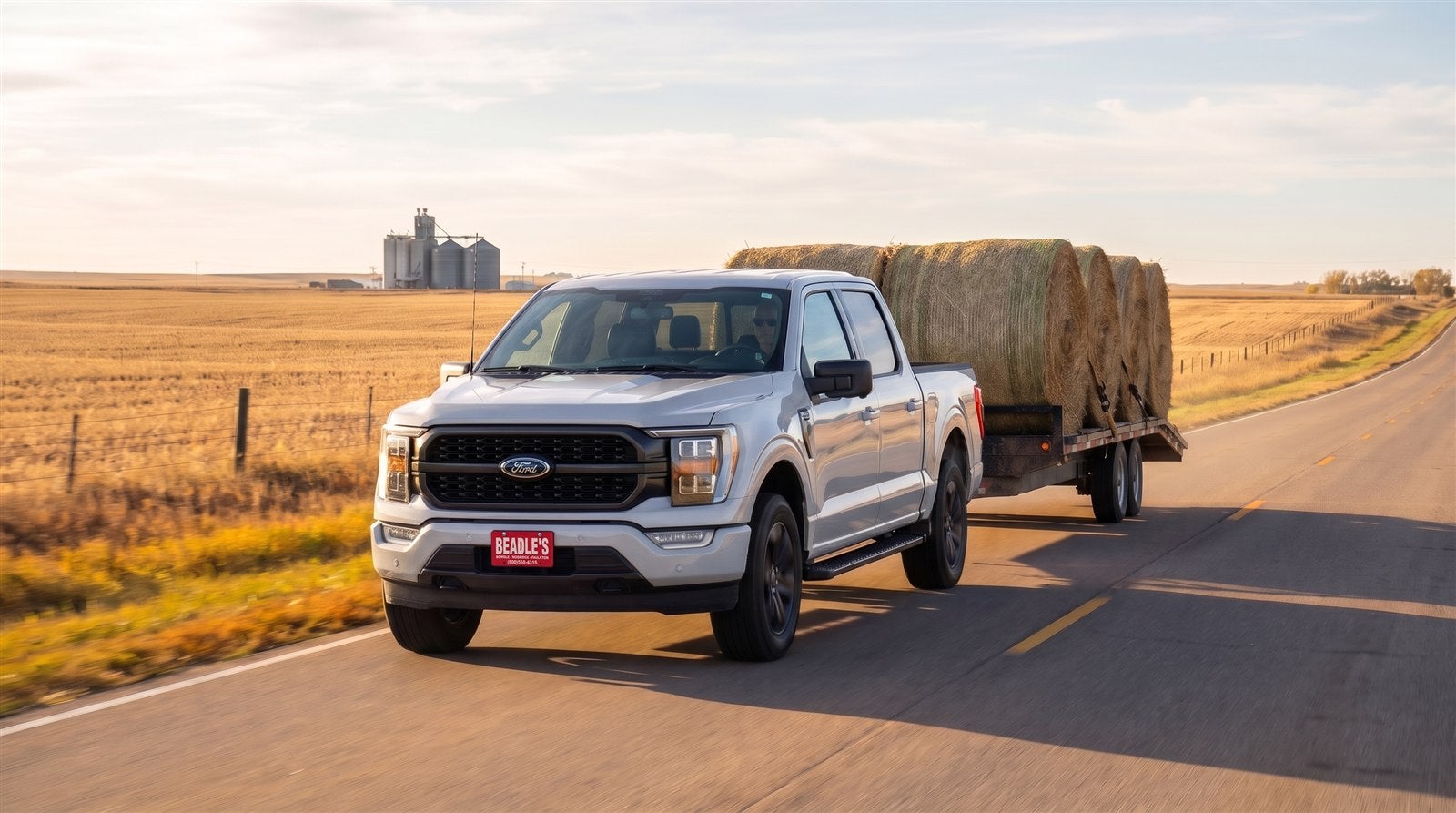
Avalanche 2026 Ford F-150 Lariat towing a flatbed of round hay bales on a two-lane South Dakota highway

Quick Answer

A 2026 Ford F-150's payload is printed on its driver's door-jamb sticker, and tongue weight, gooseneck pin weight, passengers and gear all count against it. Ford figures about 10% of a bumper-pull trailer and 15% of a fifth-wheel rides on the truck. Do that math before trusting any tow rating.

Most people shop a half-ton by its tow rating. Then they hook up a loaded camper or a gooseneck full of calves, put the family in the cab, and find out the real limit was a smaller number on the door jamb all along. That number is payload, and with a camper or gooseneck it usually runs out before the tow rating does.

This guide shows ranchers, families and lake-goers around Bowdle how to read the 2026 F-150 payload sticker, how tongue and pin weight work, and how to run the math on a bale trailer, a gooseneck and a camper. Ford hasn't published a full 2026 payload chart by configuration, so we teach the method that works on any truck: the sticker on the truck in front of you.

Why does payload matter more than the tow rating?

Because part of every trailer rides on the truck. The tow rating measures what the truck can pull, but the tongue or gooseneck pin pushes straight down on the hitch, and that weight comes out of payload just like a passenger or a bag of mineral in the bed.

Ford's fine print says payload and towing figures "may not be achieved simultaneously," and its tow ratings assume just a 150-lb driver and a 150-lb passenger. A real Saturday adds kids, a cooler, a dog and a toolbox, all of it payload.

With a light boat or utility trailer, you'll usually hit the tow rating first. With a travel trailer or gooseneck, which put far more weight on the hitch, payload is almost always the real ceiling.

Where is the payload number, and how do you read the sticker?

Open the driver's door and look at the door jamb. The Tire and Loading Information label there carries the sentence that matters: "The combined weight of occupants and cargo should never exceed" a set number of pounds. That number is your payload for that exact truck, as it was built at the factory.

The Safety Compliance Certification label sits right beside it. What the two labels tell you:

What's on the label What it means for you
"Occupants and cargo should never exceed ___ lbs" (Tire and Loading label) Your payload. People, gear, bed load and trailer tongue or pin weight all come out of it.
GVWR (Gross Vehicle Weight Rating) The most the loaded truck may weigh in total, including everything above.
GAWR Front / Rear (Gross Axle Weight Rating) The most each axle may carry. A heavy tongue or pin loads the rear axle hardest, so the rear number matters most when towing.
Axle code Your rear axle ratio, which decides which of Ford's tow ratings applies to your truck (decoder below).

Decoding the axle code. Ford's 2026 F-150 codes are 15 (3.15), 27 (3.31) and 19 (3.55) for a standard rear axle, and L3 (3.31), L9 (3.55), L6 (3.73) and L4 (4.10) for an electronic-locking rear axle. Match that ratio, plus your engine, cab and wheelbase, to Ford's tow ratings in our 2026 F-150 towing guide.

One catch: the sticker reflects the truck as it left the factory. A toolbox, tonneau cover, headache rack, bed-mounted gooseneck hitch or heavier aftermarket tires added later all come off that number first.

What's the difference between tongue weight and gooseneck pin weight?

Tongue weight is a bumper-pull trailer pushing down on the receiver behind your bumper. Pin weight is a gooseneck or fifth-wheel pushing down on a hitch in the bed, near the rear axle. Ford plans on about 10% of trailer weight for a conventional tongue and about 15% for a fifth-wheel king-pin. Use at least 15% for a gooseneck.

A 10,000-lb bumper-pull at 10% puts about 1,000 lbs on the truck; the same 10,000 lbs as a gooseneck at 15% puts about 1,500 lbs there. The 2026 F-150's receiver has its own limits:

Hitch setup (2026 F-150) Max trailer Max tongue weight
Weight-carrying (ball mount only) 5,000 lbs 500 lbs
Weight-distributing hitch 13,500 lbs 1,400 lbs

The standard receiver itself is rated to 11,600 lbs; the reinforced receiver that comes with the Max Tow Axle is rated to 14,000 lbs. Ford says not to tow more than 5,000 lbs without a weight-distribution system, so most loaded campers and bale trailers need one. It spreads the load, but it doesn't erase tongue weight from your payload, and the hitch's own weight counts too.

How do you do the payload math with your own sticker?

Add up everything the truck will carry and compare it to your door-jamb number. If the total is bigger, the load is too much for that truck, whatever the tow rating says.

Payload you need = tongue or pin weight + hitch hardware + every person in the cab + everything in the bed and cab + anything added after the factory

Three common South Dakota loads. Swap in your own weights.

Example 1: Round bales on a bumper-pull flatbed

  • Trailer plus bales, loaded: 7,500 lbs (weigh your own bales; they vary a lot by crop and moisture)
  • Tongue weight at 10%: 750 lbs
  • Driver and one passenger: 370 lbs
  • Chains, binders, a fuel can and a toolbox: 120 lbs
  • Payload needed: 1,240 lbs, plus the weight-distribution hitch

This load is over both weight-carrying limits (5,000 lbs of trailer, 500 lbs of tongue), so it needs a weight-distributing hitch. If your sticker can't cover the total, drop a bale or two.

Example 2: Gooseneck stock trailer to the sale barn

  • Trailer plus cattle, loaded: 10,000 lbs
  • Pin weight at 15%: 1,500 lbs
  • Bed-mounted gooseneck hitch: check the maker's listed weight
  • Driver and one passenger: 370 lbs
  • Sorting sticks, a mineral tub and fencing tools: 100 lbs
  • Payload needed: 1,970 lbs, plus the hitch

This is where a half-ton runs out of room. Ford's highest 2026 F-150 fifth-wheel/gooseneck rating is 11,700 lbs, on a SuperCrew 4x2 properly equipped with the 5.0L V8, the Tow/Haul Package and the Max Tow Axle. At 15%, an 11,700-lb gooseneck puts 1,755 lbs on the pin before anyone climbs into the cab. Ford also notes the configuration with that rating has the 5.5-ft box, which most fifth-wheel trailer designs aren't compatible with.

Example 3: The family camper to Lake Oahe

  • Camper at its brochure "dry" weight: 5,800 lbs
  • Add 30 gallons of fresh water (about 8.3 lbs a gallon): 250 lbs
  • Add propane, a battery, food, bedding and camp gear: 700 lbs
  • Loaded camper: 6,750 lbs, so tongue weight at 10% = 675 lbs
  • Two adults and two kids: 490 lbs
  • Firewood, a cooler and two bikes in the bed: 150 lbs
  • Payload needed: 1,315 lbs, plus the weight-distribution hitch

Loaded, with the family aboard, a "5,800-lb" camper asks the door sticker for about 1,315 lbs plus the hitch.

What size camper can a 2026 F-150 handle?

Whatever your leftover payload and Ford's frontal-area limits allow. At 10% tongue weight, every 100 lbs of leftover payload supports about 1,000 lbs of loaded camper.

  1. Start with the payload number on your door jamb.
  2. Subtract riders, cargo, the hitch and any accessories added after the factory. What's left is your tongue-weight budget.
  3. Multiply that budget by 10 for the heaviest loaded camper at a 10% tongue. Loaded campers often run heavier at the tongue, so weigh yours.
  4. Compare that weight with Ford's tow rating for your engine, cab, wheelbase and axle. The lower number wins.
  5. Check frontal area. Ford's conventional ratings assume a trailer face of no more than 55 sq ft (ratings up to 7,700 lbs) or 65 sq ft (7,701 lbs and up), and 75 sq ft for a fifth-wheel or gooseneck. A tall camper can hit this limit before any weight limit.

Shop campers by loaded hitch weight, not length. Brochure "dry" hitch weight leaves out water, propane, batteries and gear. A slide-in truck camper is different: its whole loaded weight sits in the bed and counts against payload, so most belong on a heavier truck.
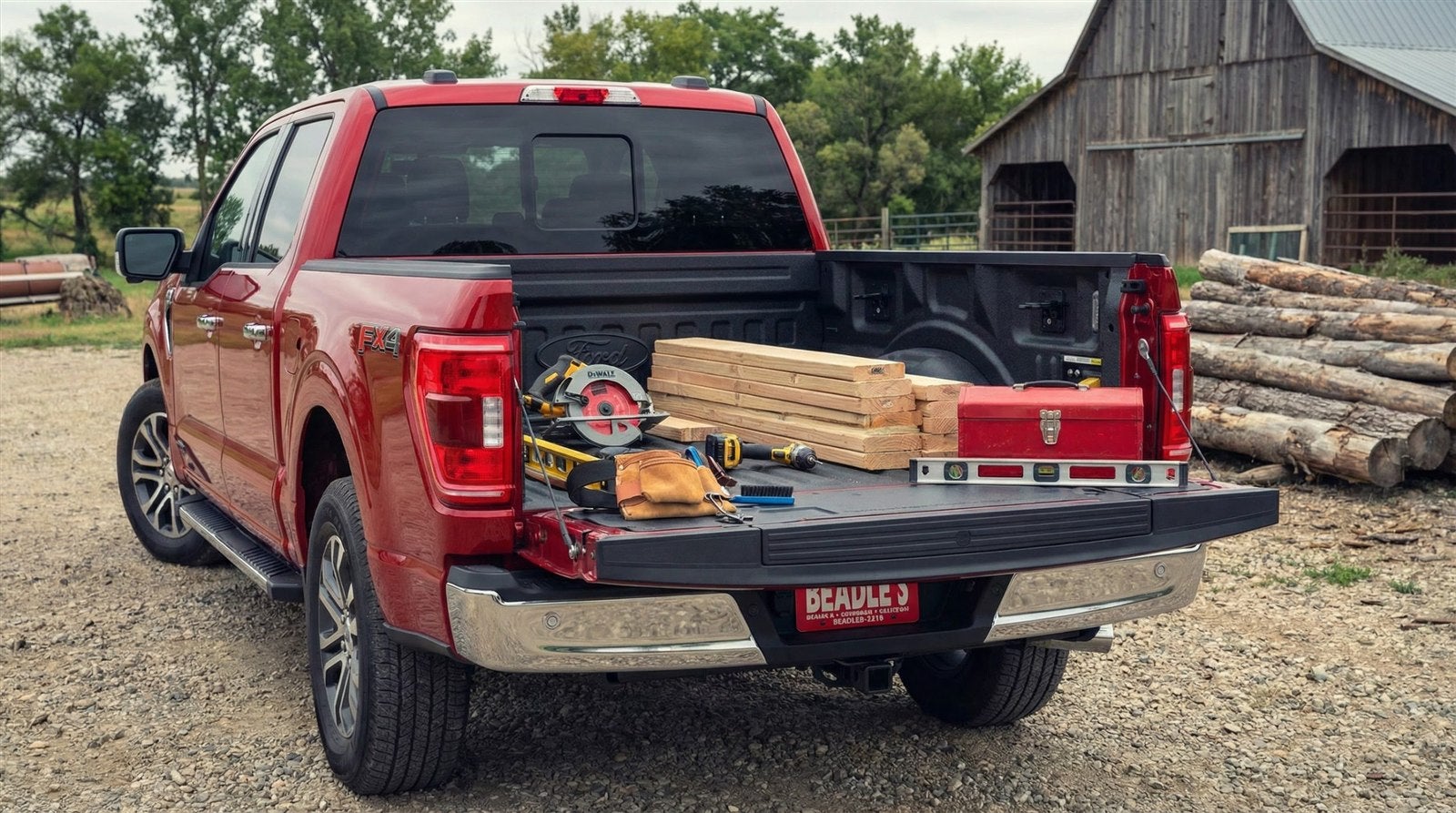
Red Ford F-150 with the tailgate down and the bed loaded with lumber and tools beside a South Dakota barn

How do cab, bed, engine and options change payload?

Payload is roughly GVWR minus the truck's own weight, so two F-150s parked side by side can carry very different loads, and Ford's "maximum payload" applies to only one specific configuration.

  • Cab: SuperCrew outweighs SuperCab, which outweighs Regular Cab. More cab usually means less payload.
  • Bed and wheelbase: the 2026 F-150 offers a 5.5-ft, 6.5-ft or 8-ft box depending on cab and trim, and each combination is rated differently.
  • 4x4 vs. 4x2: the front axle and transfer case add weight, but around Bowdle you'll want 4x4 anyway.
  • Engine: the 3.5L PowerBoost Full Hybrid's battery and electric motor add weight the gas engines don't carry.
  • Trim and options: power leather seats, a Twin Panel Moonroof, 22-inch wheels and power-deployable running boards all add weight, so a loaded upper trim usually shows a lower sticker number than a lighter XLT.
  • Towing equipment: the Tow/Haul Package and Max Tow Axle unlock the top tow ratings but don't add payload. The 2.7L EcoBoost can't get the Tow/Haul Package.

If you tow a heavy camper or gooseneck often, choose the lighter cab, engine and options that still fit your life. If you mostly haul people and tow now and then, the comfort options are worth their weight. Our 2026 F-150 trim levels guide lays out what each trim adds.

Our Recommendation

For South Dakota buyers towing a loaded camper or gooseneck, we recommend picking the 2026 F-150 whose door sticker covers your tongue or pin weight (10% or 15% of the loaded trailer) plus everyone and everything aboard, with at least 10% to spare. If no F-150 clears that bar, the answer is a Super Duty.

From the Beadle Ford Lot

A lot of our payload conversations start the same way: someone has already picked out a camper or stock trailer and wants to know which truck will pull it. We open the driver's door, read the sticker together and run the numbers right there. More often than not, the deciding number is on the door jamb, not in the tow rating.

How do you check your real numbers before a big haul?

Weigh it. A ticket from a certified truck scale, or the local elevator's scale if they'll weigh you, ends the guessing.

  1. Weigh the truck alone, loaded for the trip (people, gear, full tank). GVWR minus that weight is the payload you really have left.
  2. Weigh truck and trailer hooked up, each axle on its own pad if possible. The truck must stay under GVWR and its rear axle under the rear GAWR.
  3. Weigh the trailer unhooked to get its true loaded weight. Subtract the trailer-axle weight from step 2, and the difference is your real tongue or pin weight.

Do it once for each setup you run regularly and write the numbers down, so you're not guessing on US-12 with a crosswind pushing on the trailer.

When does the payload math say you need an F-250?

When your regular load, not your occasional one, needs more payload than any F-150 sticker you can find, or runs the rear axle up to its GAWR every trip: a weekly loaded gooseneck, a heavy camper plus a full crew, or a slide-in camper. For the ride, fuel and cost trade-offs, read our F-250 vs. F-150 comparison.

Load Weight on the truck Check first Best fit
Fishing boat or small utility trailer About 10% tongue Tow rating, ramp traction Any properly equipped F-150
Bale or equipment flatbed About 10% tongue Weight-distributing hitch over 5,000 lbs; payload F-150 with WD hitch, if the sticker clears it
Travel trailer camper 10% or more tongue, loaded Payload, frontal area F-150 for many mid-size campers; do the math
Gooseneck stock trailer 15% or more pin Payload, rear GAWR, bed fit F-150 for light, occasional loads; F-250 for regular heavy hauls
Slide-in truck camper 100% of its loaded weight Payload, rear GAWR Usually a Super Duty

Key Takeaways

  • Every 2026 F-150's real payload is on its driver's door jamb.
  • Plan on about 10% of a loaded bumper-pull trailer and at least 15% of a gooseneck as weight on the truck.
  • Passengers, bed gear, the hitch and anything added after the factory all come out of the same payload.
  • Over 5,000 lbs of trailer or 500 lbs of tongue, the 2026 F-150 needs a weight-distributing hitch.
  • If your regular load won't fit any F-150 sticker, it's F-250 work.

Frequently Asked Questions

How much payload does a 2026 Ford F-150 have?

It depends on the exact truck. Ford hasn't published a full 2026 F-150 payload chart by configuration, and payload changes with cab, bed, engine, 4x2 or 4x4, and options. The number for any specific truck is printed on its driver's door-jamb label, and that's the number to use.

Does trailer tongue weight count against payload?

Yes. Tongue weight and gooseneck pin weight both press down on the truck, so they come out of payload just like passengers and cargo. Ford plans on about 10% of trailer weight for a conventional tongue and about 15% for a fifth-wheel king-pin.

Does the driver count against F-150 payload?

Yes. The door-jamb label covers the combined weight of all occupants and cargo, driver included. Ford's tow ratings assume only a 150-lb driver and a 150-lb passenger, so a heavier crew or more riders cut into what's left for the trailer.

When do I need a weight-distributing hitch on a 2026 F-150?

Ford says not to tow more than 5,000 lbs without a weight-distribution system. Weight-carrying alone, the receiver is rated for 5,000 lbs of trailer and 500 lbs of tongue weight. With a weight-distributing hitch, the ratings rise to 13,500 lbs and 1,400 lbs, when properly equipped.

Can a 2026 F-150 pull a gooseneck stock trailer?

Yes, within its ratings. Ford's highest 2026 F-150 fifth-wheel/gooseneck rating is 11,700 lbs, on a SuperCrew 4x2 properly equipped with the 5.0L V8, Tow/Haul Package and Max Tow Axle. At about 15% pin weight, payload is usually the real limit, so check the door-jamb sticker against your loaded trailer before you buy.

Quick Answers: 2026 F-150 Payload

One-line answers to the follow-up questions buyers ask next.

Where's the payload number? On the Tire and Loading label in the driver's door jamb.
How much tongue weight should I plan for? About 10% of the loaded trailer, per Ford.
How much gooseneck pin weight? About 15% or more of the loaded trailer.
What's the max tongue weight on the receiver? 500 lbs weight-carrying, or 1,400 lbs with a weight-distributing hitch.
What's GAWR? The most each axle may carry; a heavy tongue or pin loads the rear axle most.
Can a 2026 F-150 carry a slide-in camper? Its entire loaded weight counts as payload, so most need a Super Duty.
Do aftermarket parts count? Yes, anything added after the factory comes off the sticker number.
Best way to know for sure? Weigh your loaded setup on a certified scale.

Keep Researching

How payload fits with engines, trims and towing becomes clearer in the complete 2026 Ford F-150 overview.
2026 F-150 towing guide: Ford's tow ratings by engine and the equipment that unlocks them.
Which 2026 F-150 is best for ranch and farm work? Putting this payload math to work on a ranch truck.
F-250 vs. F-150: what you gain when the payload math says step up.

My Take on 2026 F-150 Payload

In my experience, the buyers happiest with their F-150 are the ones who checked the door jamb before the tow rating. Around Bowdle, the truck that pulls a camper to Lake Oahe in July often hauls bales in November and a stock trailer in the spring, and each job puts a different load on the hitch. The sticker is the one number that covers all of them, and it's on the truck, not in a brochure.

If you know what you'll be towing, bring the trailer's weight with you or send it to us. We'll open a few doors on the Beadle Ford lot, do the math with you, and I'll tell you honestly whether it's an F-150 job or a Super Duty job.

About the Author

Lexy Tabbert — Beadle Ford, Bowdle, SD

Lexy Tabbert is the Director of Sales and Marketing at Beadle Ford in Bowdle, South Dakota. She covers Ford vehicles, trim comparisons, and buyer guidance — helping families, ranchers, and ag operators across the region find the right truck and configuration for their needs.

Posted in:

Related Posts

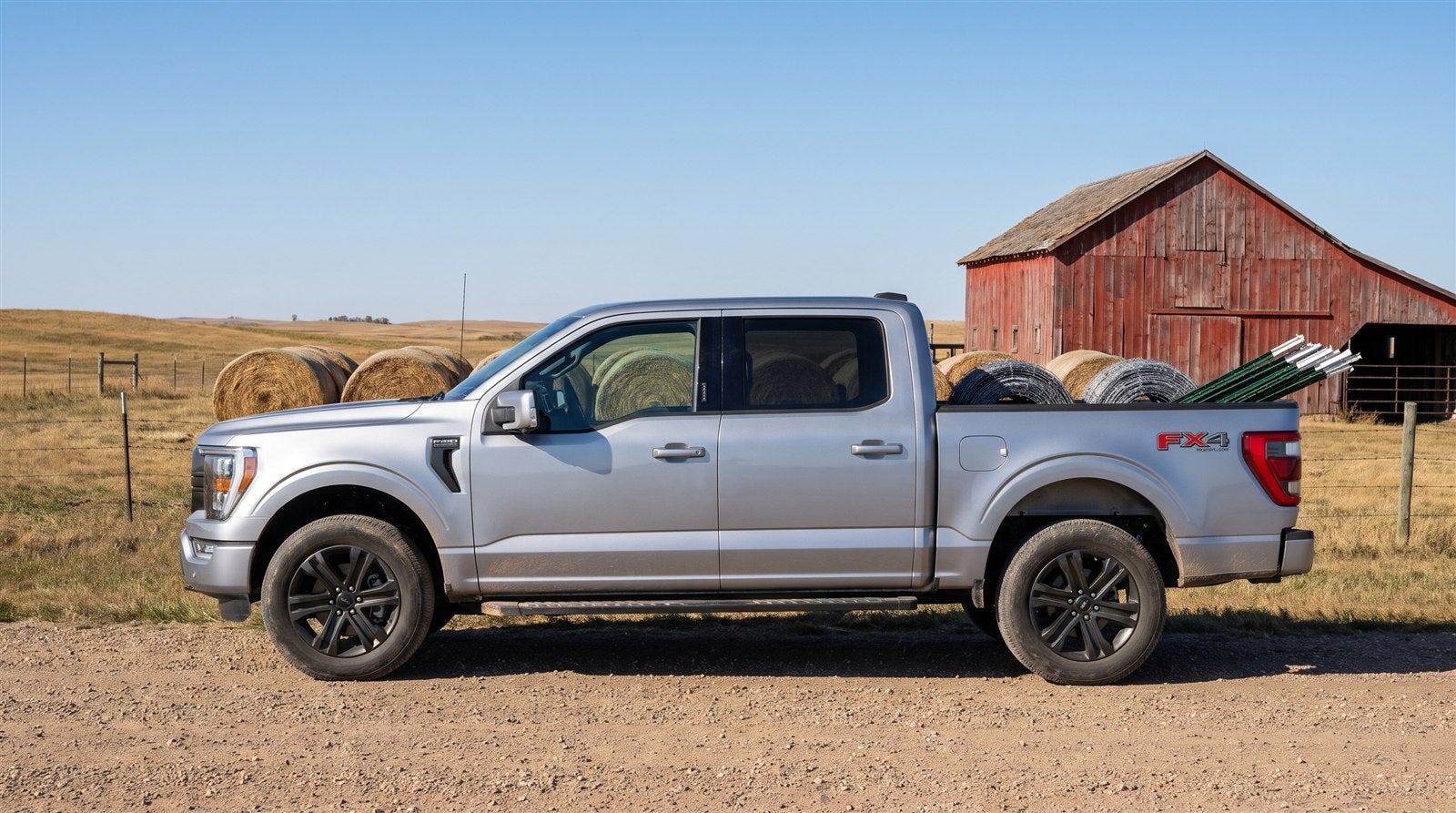
Iconic Silver 2026 Ford F-150 Lariat SuperCrew with the 6.5-foot box loaded with fence posts by a South Dakota red barn

2026 F-150 SuperCrew vs. SuperCab and Bed Lengths Explained

Quick Answer The 2026 Ford F-150 comes in three cabs and three box lengths. Regular Cab (6.5- or 8-foot box) is XL only. SuperCab pairs only with the 6.5-foot box. SuperCrew offers 5.5- or 6.5-foot boxes. For most Bowdle-area buyers, a SuperCrew 4x4 with the 6.5-foot box covers family and ranch work. Cab and bed are the two F-150 choices you live with every day, and the hardest to change later. Pick the wrong cab and the kids ride knees-to-seatback to every away game. Pick the wrong bed and the fence posts hang past the tailgate on every trip to the pasture. This guide covers every 2026 F-150 cab and box combination, which trims offer each one, and how each changes towing, payload, parking and ride for ranchers, families and highway drivers around Bowdle. Search Available F-150 Inventory Get Pre-Approved On This Page What cab and bed combinations does the 2026 F-150 come in? Which trims can you get with each cab and bed? SuperCrew or SuperCab: which cab fits your family and crew? 5.5, 6.5 or 8-foot bed: which box fits your work? How do cab and bed change towing and payload? How do cab and bed affect parking, ride and highway miles? Which cab and bed fit a rancher, a family or a highway driver? What does Beadle Ford stock, and can you get a different cab or bed? What cab and bed combinations does the 2026 F-150 come in? Ford builds the 2026 F-150 in five cab-and-box combinations: Regular Cab with a 6.5- or 8-foot box, SuperCab with a 6.5-foot box, and SuperCrew with a 5.5- or 6.5-foot box. There is no SuperCab or SuperCrew with an 8-foot box, and the 5.5-foot box only comes on a SuperCrew. A Regular Cab has two doors and one row of seats. A SuperCab adds a smaller second row behind smaller rear doors. A SuperCrew has four full-size doors and a full-size back seat. Wheelbase, the distance between the axles, drives most of the parking and ride differences. Cab Box Wheelbase Drive Trims Regular Cab 6.5 ft 122.5 in 4x2 or 4x4 XL Regular Cab 8 ft 141 in 4x2 or 4x4 XL SuperCab 6.5 ft 145 in 4x2 or 4x4 XL, STX, XLT SuperCrew 5.5 ft 145 in 4x2 or 4x4 Every trim, XL through Raptor SuperCrew 6.5 ft 157 in 4x4 XL, XLT, Lariat, King Ranch, Platinum Outside of fleet-only XL builds, the SuperCrew 6.5-foot box is 4x4-only. The SuperCab 6.5-foot box and SuperCrew 5.5-foot box share a 145-inch wheelbase, so trading back-seat room for bed length doesn't make the truck longer. Which trims can you get with each cab and bed? Lariat, King Ranch, Platinum, Tremor and Raptor are SuperCrew-only for 2026. Only the XL is offered in all three cabs, and the XL is the only way to get a Regular Cab or an 8-foot box. Trim Regular Cab 6.5 ft Regular Cab 8 ft SuperCab 6.5 ft SuperCrew 5.5 ft SuperCrew 6.5 ft XL Yes Yes Yes Yes Yes (4x4) STX No No Yes Yes No XLT No No Entry equipment groups only Yes Yes (4x4) Lariat No No No Yes Yes (4x4) King Ranch No No No Yes Yes (4x4) Platinum No No No Yes Yes (4x4, not the top group) Tremor No No No Yes (4x4 only) No Raptor No No No Yes (4x4 only) No The XLT SuperCab stops at the entry equipment groups. The better-equipped XLT groups, the ones that add the 360-degree camera, adaptive cruise and Pro Trailer Backup Assist™, are SuperCrew-only. The box can decide your engine. On the XL and XLT, the SuperCrew 6.5-foot box makes the 3.5L EcoBoost® V6 standard, and the 2.7L EcoBoost isn't offered on that truck in 4x4 form. The XL Regular Cab 6.5-foot box comes with the 5.0L V8. The PowerBoost™ hybrid is a SuperCrew-only engine. You won't find it on a Regular Cab or SuperCab. Tank size follows the cab. The Regular Cab 6.5-foot box carries a 23-gallon tank; every other gas configuration carries 36 gallons. For what each trim adds beyond the cab and box, see our 2026 F-150 trim levels guide. SuperCrew or SuperCab: which cab fits your family and crew? If anyone rides in the back seat more than once a week, get the SuperCrew. The SuperCab fits a work truck that only carries a second row now and then. The SuperCrew's full-size rear doors are the daily difference. Car seats, a teenager who grew six inches since spring, or two hired hands heading out to fix fence all fit without anyone folding up. The SuperCab's smaller second row suits a dog, a cooler, coats and tools, or a rider on a short trip to town, not an adult on a long highway run. SuperCrew is worth it if: kids, car seats or a regular crew ride in back; you want Lariat or higher; you want the PowerBoost hybrid; or this truck is the family's main vehicle. SuperCab is worth it if: the back seat is mostly cargo space, you want the 6.5-foot box at the shorter 145-inch wheelbase, and an STX or entry XLT has the equipment you need. Skip the SuperCab if: you want heated and ventilated seats, BlueCruise, or the upper XLT driver-assist and trailer features. Those live on SuperCrew trucks. 5.5, 6.5 or 8-foot bed: which box fits your work? The 6.5-foot box is the all-around ranch choice. The 5.5-foot box is the easier truck to live with in town and in a garage. The 8-foot box is for a dedicated work truck that hauls full-length material, and it only comes on the XL Regular Cab. 5.5-foot box (SuperCrew only, 145-inch wheelbase). Groceries, sports bags, mineral tubs and seed bags fit fine; fence posts and panels ride with the tailgate down. It's the only box on Tremor, Raptor and Platinum's top group. Towing catch: Ford notes the 5.5-foot box accepts a fifth-wheel hitch, but most fifth-wheel trailer designs aren't compatible with it. If a gooseneck or fifth-wheel trailer is in your future, plan on the longer box. 6.5-foot box (Regular Cab, SuperCab and SuperCrew). The box for a truck that fixes fence on Saturday and goes to church on Sunday. Posts, wire, panels and small square bales sit inside, and more of a four-wheeler stays in the box. On a SuperCrew it stretches the wheelbase to 157 inches, the longest of any F-150. 8-foot box (XL Regular Cab only, 141-inch wheelbase). The traditional long-box work truck for full-length material, with one row of seats. It earns its keep as a hired-hand or parts-run truck on a place that already has a family vehicle. Hauling an ATV or UTV? Measure the machine before you choose; many ride with the tailgate down in a 5.5-foot box. On any length, the available Bed Utility Package on XLT and Lariat adds bed storage boxes, a Tailgate Step, a Tailgate Work Surface, four tie-down plates and LED box lighting. How do cab and bed change towing and payload? With the 3.5L EcoBoost V6 in a 4x4, Ford's conventional tow ratings run from 10,700 lbs on a SuperCab to 13,500 lbs on a SuperCrew 6.5-foot box when properly equipped, and the top ratings require the Tow/Haul Package plus the Max Tow Axle. 3.5L EcoBoost 4x4 Best rating without Max Tow Axle With Tow/Haul Package + Max Tow Axle Regular Cab, 8-ft box 11,000 lbs No Max Tow rating listed SuperCab, 6.5-ft box 10,700 lbs No Max Tow rating listed SuperCrew, 5.5-ft box 10,500 lbs 13,100 lbs SuperCrew, 6.5-ft box 10,900 lbs 13,500 lbs Ford's 2026 conventional ratings, maximum loaded trailer weight, when properly equipped. Ratings vary by axle ratio and equipment. If you want a 3.5L EcoBoost rated over 13,000 lbs, you want a SuperCrew. Ford's 2026 Max Tow ratings for that engine are SuperCrew figures, and the 6.5-foot box gets the highest one. Without the Max Tow Axle, the SuperCrew 5.5-foot box rates lowest of the four, at 10,500 lbs. The bigger cab adds weight, and that weight comes out of what the truck can pull. The upgrade has limits. Gas F-150s towing over 11,600 lbs need both upgrades. The Max Tow Axle isn't offered on the XL or the entry XLT group, and the Tow/Haul Package isn't offered with the 2.7L EcoBoost. Payload works the same way in reverse: a bigger cab, longer box, 4x4 hardware and options all add weight the truck can't carry. We don't quote 2026 payload by configuration; the number that counts is on the specific truck's door-jamb label. A conventional trailer puts roughly 10% of its weight on the hitch and a gooseneck roughly 15% on the pin, and all of it counts against payload. Our 2026 F-150 payload guide walks through reading that label, and the towing guide has every rating. How do cab and bed affect parking, ride and highway miles? A longer wheelbase rides steadier on a windy two-lane highway and is harder to park or turn around in a tight yard. The SuperCrew 6.5-foot box has the longest F-150 wheelbase at 157 inches, a full foot more than the SuperCrew 5.5-foot box. Parking and garages. That extra foot shows up at the grocery store in Aberdeen, between the bins and the shop, and in a garage built for the last truck. Measure your garage depth and shop door, then bring the numbers in and we'll put a tape on a truck on our lot. Every 2026 F-150 has a rear camera, rear parking sensors and Reverse Brake Assist; the 360-degree camera and front sensors come with Ford Co-Pilot360™ Assist 2.0, in the upper XLT groups and standard on Lariat and above. Ride and highway miles. A longer wheelbase generally rides calmer over expansion joints, holds its line better in a crosswind on US-12, and is steadier with a trailer behind it. Both SuperCrew boxes carry the same 36-gallon tank on gas engines, so the shorter truck gives up no range. Gravel and pasture. A shorter wheelbase turns tighter at a gate or around a bale yard. If your days are more pasture than pavement, the 145-inch trucks are easier to work with. Which cab and bed fit a rancher, a family or a highway driver? The SuperCrew 4x4 with the 6.5-foot box does the most jobs well. The table covers the exceptions. Our Recommendation For families and ranchers in north-central South Dakota, we recommend the 2026 F-150 SuperCrew 4x4 with the 6.5-foot box. It seats a full back row, carries fence posts inside the box, and has Ford's highest 3.5L EcoBoost tow rating: 13,500 lbs when properly equipped with the Tow/Haul Package and Max Tow Axle. Best for Cab and box Why Watch for Rancher whose truck is also the family truck SuperCrew 6.5 ft, 4x4 Back seat, posts inside the box, top 3.5L tow rating Length in tight yards and garages Hired-hand or parts-run truck XL Regular Cab 8 ft, or SuperCab 6.5 ft Long box, simple equipment Little or no rear seat Family in town, school and activity runs SuperCrew 5.5 ft Easiest SuperCrew to park Long loads ride tailgate-down Highway miles, camper or boat SuperCrew 6.5 ft, 4x4 157-inch wheelbase rides and tows steadier Check door-jamb payload before buying a camper Hunter or angler hauling an ATV SuperCrew 6.5 ft (or 5.5 ft on a Tremor) More of the machine inside the box Tremor comes only with the 5.5-ft box Gooseneck or fifth-wheel stock trailer 6.5-ft box Most fifth-wheel designs don't fit the 5.5-ft box Pin weight eats payload If the gooseneck question is the deciding one, our 2026 F-150 ranch and farm guide covers when a half-ton is enough and when to step up to a Super Duty. What does Beadle Ford stock, and can you get a different cab or bed? Stock changes week to week, so check the live F-150 inventory for the cabs and boxes we have today. If you need a Regular Cab, a SuperCab or a different box length, talk to us and we'll help you order or find the truck you need. Box length varies by truck, so check the listing or call us. If an STX SuperCab for the hired man or an 8-foot XL Regular Cab is the right truck, say so. We'll lay out the options and timing plainly and won't talk you into a SuperCrew you don't need. You can see how each configuration fits the full lineup in the complete 2026 Ford F-150 overview. From the Beadle Ford Lot The cab-and-bed conversation we have most often starts with someone sure they want the shorter box so it fits the garage, and it ends with a tape measure. Once a family that hauls feed, fencing or a camper sees that the SuperCrew cab is the same either way, most of them choose the 6.5-foot box. Key Takeaways The 2026 F-150 comes in five cab-and-box combinations; the 8-foot box is XL Regular Cab only. Lariat, King Ranch, Platinum, Tremor and Raptor are SuperCrew-only, and Tremor and Raptor come only with the 5.5-foot box. The 3.5L EcoBoost's top 13,500-lb conventional rating is on the SuperCrew 4x4 with the 6.5-foot box, with the Tow/Haul Package and Max Tow Axle. The SuperCrew 6.5-foot box has the longest F-150 wheelbase, 157 inches. Measure your garage before you choose it. Frequently Asked Questions Can you get a 2026 F-150 SuperCrew with an 8-foot bed? No. The 8-foot box comes only on the XL Regular Cab. The longest box on a 2026 F-150 SuperCrew is 6.5 feet, on a 157-inch wheelbase. Is the SuperCab or SuperCrew better for car seats? The SuperCrew. It has four full-size doors and a full-size back seat, so installing and buckling car seats is far easier. The SuperCab's smaller second row works for occasional riders and cargo, not for daily car-seat duty. Does bed length change towing capacity on the 2026 F-150? Yes. With the 3.5L EcoBoost 4x4, Ford rates the SuperCrew 5.5-foot box at up to 13,100 lbs and the SuperCrew 6.5-foot box at up to 13,500 lbs, both when properly equipped with the Tow/Haul Package and Max Tow Axle. Most fifth-wheel designs also aren't compatible with the 5.5-foot box. Which 2026 F-150 trims are SuperCrew only? Lariat, King Ranch, Platinum, Tremor and Raptor. Lariat, King Ranch and Platinum offer the 5.5- or 6.5-foot box, while Tremor and Raptor come only as a SuperCrew 4x4 with the 5.5-foot box. The XL, STX and XLT also offer a SuperCab, and the XL adds the Regular Cab. Does Beadle Ford have SuperCab or Regular Cab F-150s in stock? It changes week to week, so check the live F-150 inventory. If you need a SuperCab, a Regular Cab or a specific box length, contact Beadle Ford and we'll help you order or locate the right truck. Quick Answers: 2026 F-150 Cabs and Beds One-line answers to the follow-up questions buyers ask next. How many cab styles does the 2026 F-150 offer? Three: Regular Cab, SuperCab and SuperCrew. What bed lengths are offered? 5.5 feet (SuperCrew), 6.5 feet (all three cabs) and 8 feet (XL Regular Cab only). Which F-150 has the longest wheelbase? The SuperCrew with the 6.5-foot box, at 157 inches. Can I get a Lariat as a SuperCab? No, the 2026 Lariat is SuperCrew-only. What box does the Tremor come with? Only the 5.5-foot box, on a SuperCrew 4x4. Which configuration tows the most with the 3.5L EcoBoost? The SuperCrew 4x4 with the 6.5-foot box, 13,500 lbs when properly equipped with the Tow/Haul Package and Max Tow Axle. Is the PowerBoost hybrid offered on a SuperCab? No, the 2026 PowerBoost hybrid is offered only on the SuperCrew. Where do I find my truck's payload? On the Tire and Loading Information label on the driver's door jamb. Keep Researching The complete 2026 Ford F-150 overview: engines, towing, trims, technology and winter driving in one place 2026 F-150 Payload Explained: how cab, box and options change what your truck can carry Which 2026 F-150 Is Best for Ranch and Farm Work?: the half-ton for feed, fencing and stock trailers 2026 F-150 Towing Guide: every rating by engine, axle and hitch type My Take on 2026 F-150 Cabs and Beds In my experience, people around Bowdle rarely regret buying too much box. They regret buying the short box for the garage and then hauling posts with the tailgate down for the next eight years. If the truck carries the family and does ranch work, I'd start with the SuperCrew 4x4 and the 6.5-foot box, then go measure the garage. That isn't everyone's answer. A town truck is easier to park with the 5.5-foot box and gives up nothing in the back seat. A second truck on the place can be an XL Regular Cab with the 8-foot box. Torn between two? Bring your measurements and tell us what you haul, and we'll walk the lot with you. Search Available F-150 Inventory Get Pre-Approved Contact Beadle Ford About the Author Lexy Tabbert — Beadle Ford, Bowdle, SD Lexy Tabbert is the Director of Sales and Marketing at Beadle Ford in Bowdle, South Dakota. She covers Ford vehicles, trim comparisons, and buyer guidance — helping families, ranchers, and ag operators across the region find the right truck and configuration for their needs. Learn more about Lexy.
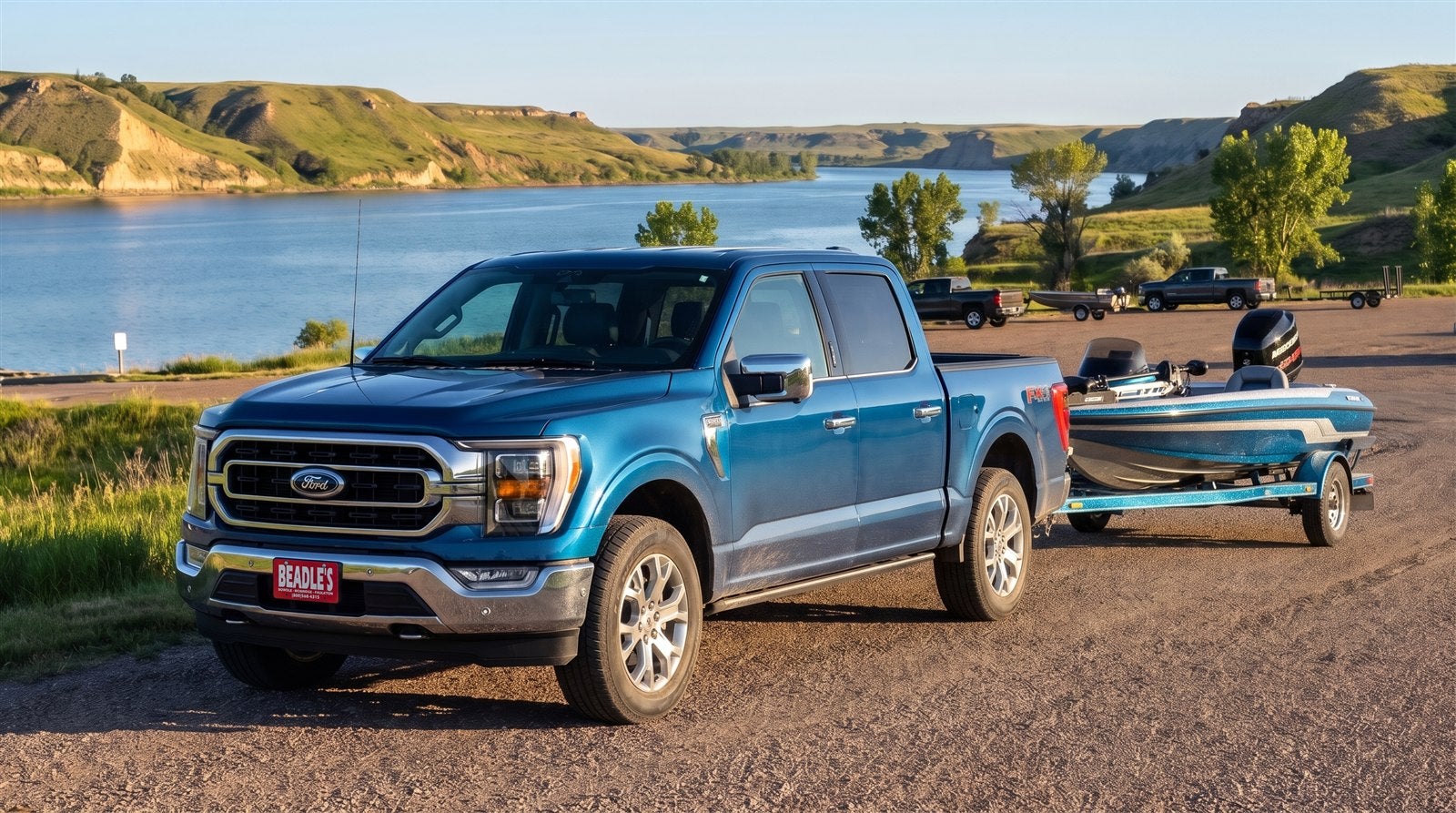
Argon Blue 2026 Ford F-150 Lariat towing a fiberglass bass boat at a Lake Oahe boat ramp lot in South Dakota

Towing Your Boat to Lake Oahe with a 2026 F-150

Quick Answer A 2026 Ford F-150 4x4 easily handles a typical 3,000- to 4,000-lb bass boat; Ford’s lowest 2026 F-150 conventional rating is 7,400 lbs. At Lake Oahe the ramp is the real test: use 4x4, keep the rear tires dry, and choose a trim with Pro Trailer Backup Assist. Nobody around Bowdle loses sleep over whether an F-150 can pull a bass boat down US-12. The worry is the last fifty feet: backing down a wet ramp at Lake Oahe with a line of trucks waiting behind you, then pulling a dripping boat back up concrete coated in algae and river silt. That part of towing never shows up in a tow-rating chart. This guide is for families and anglers who fish Oahe from ice-out to freeze-up: how a bass boat compares with the truck, 4x4 on a slick ramp, trailer features by trim, crosswinds on US-12 and US-83, and pre-trip checks. For the full rating tables, see our 2026 F-150 towing and payload guide. Search Available F-150 Inventory Get Pre-Approved On This Page Is a 2026 F-150 enough truck for a bass boat? How do you pull a boat up a wet, steep ramp with a 2026 F-150? Which trailer features help at the ramp, and which trims have them? How do you handle crosswinds on US-12 and US-83 with a boat in tow? What is the smoothest way to launch and retrieve? What should you check before you leave for the lake? Is a 2026 F-150 enough truck for a bass boat? Yes, with a lot of room to spare. A typical 18- to 20-foot fiberglass bass boat from the early 2000s, rigged with its outboard, a full tank, batteries, gear and its trailer, usually lands somewhere around 3,000 to 4,000 lbs. Even the lowest conventional towing rating Ford lists for any 2026 F-150, 7,400 lbs, is roughly double that. That estimate is a starting point. Boats pick up weight over twenty years (a kicker motor, a second battery, coolers and rods), so weigh the whole rig loaded the way you fish on a certified scale at a truck stop, co-op or elevator. For a boat, the hitch matters more than the tow rating. Ford rates the standard 2-inch receiver at 5,000 lbs of trailer and 500 lbs of tongue weight as a weight-carrying hitch, which is how almost every bass boat is towed, and calls for weight distribution above 5,000 lbs. Tongue weight should run about 10% of the trailer weight, so a 3,500-lb boat puts roughly 350 lbs on the ball, comfortably inside that 500-lb limit. Tongue weight counts against payload, along with the family, the dog and the cooler. Ford has not published 2026 F-150 payload by configuration, so read the label on your own door jamb. Our post on 2026 F-150 payload, tongue weight and your door sticker walks through the math. Stepping up later? A big pontoon can pass 5,000 lbs; then equipment matters, and the ratings by configuration in our 2026 F-150 towing and payload guide are the place to start. How do you pull a boat up a wet, steep ramp with a 2026 F-150? Shift into 4x4 before you back down, keep the truck’s rear tires out of the water, and pull out slow and steady instead of fast. On most Oahe ramps, 4x4 High is enough. Save 4x4 Low for the steepest, slickest pulls, like a late-fall morning when the waterline has a skin of ice. Two-wheel drive struggles because the only tires pulling are the rear ones, on the wettest part of the ramp, just as the boat’s weight lands on the hitch. Every 2026 F-150 4x4 has Electronic Shift-On-the-Fly, so with the front tires pulling on dry concrete, the truck walks up instead of spinning. Slippery mode. It is one of the standard drive modes on the 2026 F-150, built for low-traction surfaces like a ramp coated in algae. Electronic-locking rear axle. It comes with the Tow/Haul Package and the FX4 Off-Road Package, and is standard on Tremor. Hill Start Assist and the electric parking brake. Both are standard. Hill Start Assist briefly holds the rig as you move to the throttle. Don’t spin the tires. Spinning polishes the ramp. If the tires slip, ease off and roll on gently. Read the owner’s manual before using 4x4 Low the first time. Our 2026 F-150 4x4 and winter driving guide covers the drive modes and the FX4 package in more detail. Which trailer features help at the ramp, and which trims have them? Every 2026 F-150 has the basics: a Class IV hitch, the Smart Trailer Tow Connector with 4- and 7-pin plugs, Trailer Sway Control and a rear camera. Pro Trailer Backup Assist, Pro Trailer Hitch Assist and the 360-Degree Camera come with Ford Co-Pilot360 Assist 2.0, which is standard on Lariat and above and available on XLT in its upper equipment groups. Feature What it does at the lake Where it comes on a 2026 F-150 Best for Pro Trailer Backup Assist™ You turn a knob in the direction you want the trailer to go; the truck steers. Standard Lariat, King Ranch, Platinum, Tremor, Raptor. Available XLT (upper groups). Anyone who dreads backing down a busy ramp Pro Trailer Hitch Assist™ Lines the ball up under the coupler. Same as Pro Trailer Backup Assist. Hooking up alone at dawn 360-Degree Camera Shows the dock, the curb and the truck parked next to you. Same as Pro Trailer Backup Assist. Tight staging lots Smart Trailer Tow Connector, 4- and 7-pin Connects trailer lights and brakes through the standard 4- and 7-pin plugs. Standard, every trim. Everyone Trailer Sway Control Helps settle a trailer that starts to sway. Standard, every trim. Windy prairie highways Integrated Trailer Brake Controller Runs electric or electric-over-hydraulic trailer brakes from the dash. Comes with the Tow/Haul Package: standard on King Ranch and Platinum, optional on most other trims. Standard on Raptor. Stand-alone option with the 2.7L EcoBoost. Bigger boats with electric brakes Trailer tire pressure sensors, trailer camera Watch trailer tires and the view behind the boat. Dealer-installed options. Long highway runs to Pierre On brakes: many bass boat trailers use surge brakes, which need no controller in the truck. If yours has electric or electric-over-hydraulic brakes, you want the Integrated Trailer Brake Controller. The Tow/Haul Package is not available with the 2.7L EcoBoost, which gets the stand-alone controller instead. The 2026 F-150 technology guide covers the rest of Co-Pilot360. Our Recommendation For a Bowdle-area family towing a bass boat to Lake Oahe, we recommend a 2026 F-150 Lariat SuperCrew 4x4 with the 3.5L EcoBoost. Pro Trailer Backup Assist, the 360-Degree Camera and Pro Power Onboard 400 W are all standard on Lariat, the 3.5L EcoBoost is rated up to 13,500 lbs when properly equipped, and the SuperCrew cab carries the whole crew. Add the Tow/Haul Package if your trailer has electric brakes. How do you handle crosswinds on US-12 and US-83 with a boat in tow? Slow down, keep both hands on the wheel, and load the boat so the tongue carries its share. A bass boat sits low and catches far less wind than a camper, but a 30-mile-an-hour gust across open prairie still pushes the rig toward the shoulder. From Bowdle, most lake trips start west on US-12, where a south wind hits the boat broadside. Turn south on US-83 at Selby toward Gettysburg, West Whitlock or Pierre, and now it is an east or west wind that catches you from the side, often with no shelterbelt for miles. Speed is the biggest lever. Ten miles an hour under the limit on a gusty day costs a few minutes and buys a lot of control. Get the tongue weight right. A trailer light on the tongue wanders. Aim for about 10% of trailer weight on the ball and keep heavy gear forward of the trailer axle. Let Trailer Sway Control do its job. It is standard on every 2026 F-150. If the trailer starts to move, ease off the throttle and steer straight; don’t jerk the wheel or stab the brakes. Watch semis and grain trucks. The push of air from an oncoming truck hits the boat first. Hold steady toward the right edge of your lane. Use Tow/Haul mode. It is a standard drive mode on every 2026 F-150, set up for pulling a trailer. Select it before the grades down to the river. If a wind advisory is up, the lake will probably be rough too. Waiting a day is the smart call. From the Beadle Ford Lot When lake people shop for a truck, the tow rating almost never comes up first. What they ask about is the ramp: will it pull the boat out on a wet morning without spinning, and can it make backing down in front of a line of waiting trucks less stressful. That is why we walk boat owners through 4x4 and Pro Trailer Backup Assist on the lot, not just the numbers on the window sticker. What is the smoothest way to launch and retrieve? Do every bit of prep in the staging area, not on the ramp. A good launch takes a couple of minutes on the concrete. Launching In the staging area: drain plug in, rear transom straps off, gear loaded, bow line tied off, motor tilted up, and the key in the boat. If your trailer has older incandescent lights, unplug them before backing into the water so the hot bulbs don’t crack. Shift into 4x4, line up straight, and back down slowly. Use your mirrors, the 360-Degree Camera or Pro Trailer Backup Assist, whichever you trust most. Back in until the boat nearly floats, shift to Park and set the electric parking brake. Unhook the winch strap and safety chain once someone has the bow line or is at the helm. Pull straight up and out, and park so the next rig has room to stage. Retrieving While the boat waits at the dock, back the trailer in, in 4x4, deep enough that the bunks are wet but the truck’s rear tires stay out of the water. Drive or winch the boat onto the trailer, hook the winch strap and the safety chain, and tilt the motor up. Pull out slowly in 4x4, or 4x4 Low if the ramp is steep or icy. Back in the staging area: transom straps on, drain plug out, livewells and bilge drained, lights plugged back in and tested. A late-fall tip: in November the waterline can glaze over by evening. If you see ice, use 4x4 Low and stay gentle on the throttle until the front tires reach dry concrete. What should you check before you leave for the lake? Walk around the truck and trailer before you pull out. Ten minutes at home beats a burned-up bearing on the shoulder of US-83. Hitch: ball size matches the coupler, coupler latched with the pin in, safety chains crossed under the tongue, and the breakaway cable hooked up if the trailer has brakes. Lights: test brake lights, turn signals and running lights. Tires: truck to the door-jamb label, trailer to the trailer tire sidewall. Trailer tires age out before they wear out, so look for cracking. Wheel bearings: feel each hub at the first stop; one much hotter than the others needs attention. Boat: transom straps tight, motor supported, bow strap and chain on, nothing loose in the boat that can blow out on the highway. Drain plug and water: South Dakota’s aquatic invasive species rules require you to pull the drain plug and drain water when you leave the lake. Check South Dakota Game, Fish and Parks for the current rules before the season. Truck: Tow/Haul mode on, mirrors set for the trailer, and a full tank, since towing uses more fuel than you are used to. The same list works for the last run of the year to winter storage. If you are shopping for the truck to pull it, start with the complete 2026 Ford F-150 overview, which lays out every trim, engine and cab in one place. Key Takeaways A rigged bass boat of about 3,000 to 4,000 lbs is well under the lowest conventional towing rating Ford lists for any 2026 F-150, 7,400 lbs. Weigh yours to be sure. The standard receiver handles 5,000 lbs of trailer and 500 lbs of tongue weight as a weight-carrying hitch, which covers most bass boats. On a wet ramp, 4x4 matters more than engine size. Use 4x4 High for most ramps and 4x4 Low for steep or icy ones. Pro Trailer Backup Assist and the 360-Degree Camera are standard on the 2026 Lariat and available on XLT in its upper equipment groups. On US-83 in a crosswind, speed and tongue weight do more for stability than anything else. Frequently Asked Questions Can a 2026 Ford F-150 tow a bass boat? Yes. A typical rigged 18- to 20-foot bass boat and trailer weighs around 3,000 to 4,000 lbs, and the lowest conventional towing rating Ford lists for any 2026 F-150 is 7,400 lbs. Weigh your loaded rig and check your door-jamb label, because tongue weight counts against payload. Should I use 4x4 High or 4x4 Low on a boat ramp? 4x4 High handles most Lake Oahe ramps. Use 4x4 Low on a steep ramp, a slick one, or one with ice at the waterline, and follow the owner’s manual for shifting into it. Shift back to 2WD once you are on dry pavement. Which 2026 F-150 trims have Pro Trailer Backup Assist? Pro Trailer Backup Assist comes with Ford Co-Pilot360 Assist 2.0. It is standard on Lariat, King Ranch, Platinum, Tremor and Raptor, and available on XLT in its upper equipment groups. It is not part of the XL or STX equipment. Do I need the Integrated Trailer Brake Controller for a boat trailer? Only if the trailer has electric or electric-over-hydraulic brakes. Surge brakes, common on bass boat trailers, work without one. On the 2026 F-150, the controller comes in the Tow/Haul Package or as a stand-alone option with the 2.7L EcoBoost. Is the 2.7L EcoBoost enough for a fishing boat? For a typical bass boat, yes. The 2.7L EcoBoost is rated up to 8,400 lbs when properly equipped. It cannot get the Tow/Haul Package, so if you expect to step up to a much heavier boat, the 3.5L EcoBoost gives you more room to grow. Quick Answers: Towing a Boat with a 2026 F-150 One-line answers to the follow-up questions boat owners ask next. How much does a bass boat and trailer weigh? A rigged 18- to 20-foot fiberglass bass boat on its trailer usually runs about 3,000 to 4,000 lbs. What is the lowest 2026 F-150 conventional towing rating? 7,400 lbs, and most configurations are rated well above it. How much tongue weight should a boat trailer have? About 10% of the loaded trailer weight. What is the standard hitch limit without weight distribution? 5,000 lbs of trailer and 500 lbs of tongue weight. Is Pro Trailer Backup Assist standard on the 2026 Lariat? Yes, as part of Ford Co-Pilot360 Assist 2.0. Which drive mode helps on a slimy ramp? Slippery mode, with 4x4 engaged. Can I add a trailer camera or trailer tire sensors? Yes, both are dealer-installed options. Does the 2.7L EcoBoost get the Tow/Haul Package? No, but it can get a stand-alone Integrated Trailer Brake Controller. Keep Researching The complete 2026 Ford F-150 overview — every trim, engine and cab, explained in one place 2026 Ford F-150 Towing & Payload Guide — ratings by engine and the equipment each one needs 2026 F-150 Payload Explained — how tongue weight, passengers and gear add up against your door sticker 2026 Ford F-150 4x4 & Winter Driving Guide — drive modes, FX4 and when 4x4 earns its keep My Take on the 2026 Ford F-150 as a Lake Truck I don’t worry about whether a 2026 F-150 can tow a bass boat; it can, with plenty to spare. What matters to lake families around Bowdle is what the tow rating leaves out: 4x4 on a slick ramp, a way to back down without an audience making you sweat, and a truck that stays planted when the wind comes across US-83. That is why I point most boat owners toward a Lariat SuperCrew 4x4: the trailer tech is standard, the 3.5L EcoBoost covers this boat and the next one, and the back seat fits the kids and the cooler. If you would rather stay closer to an XLT budget, I will show you which equipment groups add the same trailer tech. If you have a boat and a question, bring both. We are happy to hook up your trailer on our lot and let you try Pro Trailer Backup Assist yourself before you decide anything. Search Available F-150 Inventory Get Pre-Approved Contact Beadle Ford About the Author Lexy Tabbert — Beadle Ford, Bowdle, SD Lexy Tabbert is the Director of Sales and Marketing at Beadle Ford in Bowdle, South Dakota. She covers Ford vehicles, trim comparisons, and buyer guidance — helping families, ranchers, and ag operators across the region find the right truck and configuration for their needs. Learn more about Lexy.
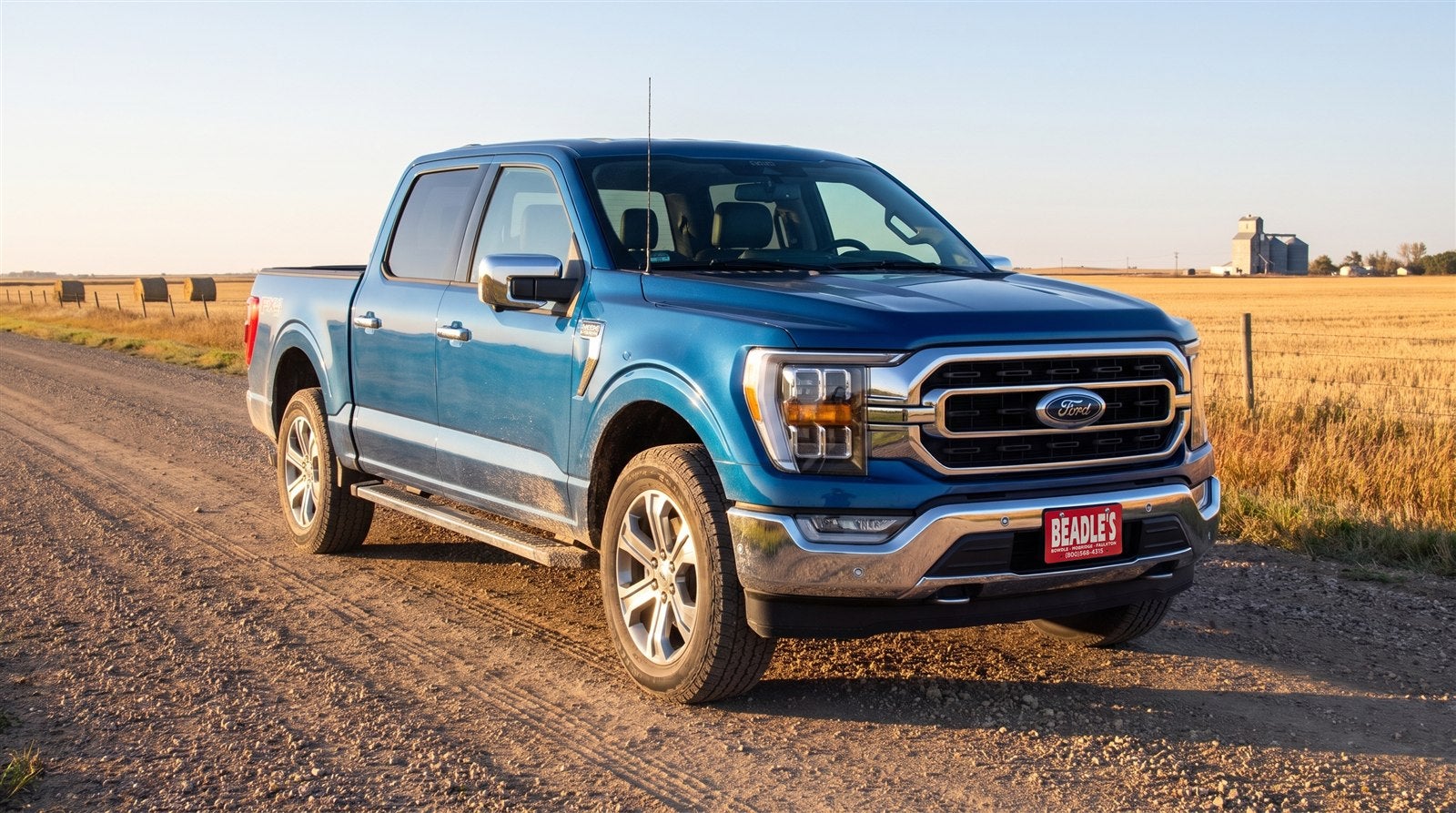
Argon Blue 2026 Ford F-150 on a gravel road beside a wheat field in South Dakota

Which 2026 F-150 Is Best for Ranch and Farm Work?

Quick Answer For South Dakota ranch work, the best 2026 F-150 is a SuperCrew 4x4 with the 3.5L EcoBoost and Tow/Haul Package. With the 6.5-ft box and Max Tow axle, it is rated to pull a gooseneck up to 9,000 lbs. Heavier weekly stock hauling belongs in a Super Duty. Most ranchers who ask us about a half-ton already have a Super Duty on the place. The real question is whether an F-150 can do everything else: checking cows on section-line roads, hauling mineral and fencing supplies, parts runs, and the stock trailer when the load is light enough. For a lot of operations around Bowdle, Ipswich and Roscoe, it can, if you buy the right configuration and respect its limits. This guide covers which 2026 F-150 fits ranch work, its gooseneck ratings by engine and bed length, the equipment that matters for livestock trailers, and when to step up to an F-250 or F-350. Every rating below is Ford's figure for a properly equipped truck. Search Available F-150 Inventory Get Pre-Approved Contact Beadle Ford On This Page Can a half-ton F-150 handle ranch and farm work? Which 2026 F-150 should a rancher start with? How much gooseneck stock trailer can a 2026 F-150 pull? What equipment matters most for pulling livestock? How does the F-150 handle feed, fencing and pasture work? When should you step up to an F-250 or F-350? Can a half-ton F-150 really handle ranch and farm work? Yes, for the daily work and for lighter trailer loads. A properly equipped 2026 F-150 SuperCrew 4x4 with the 3.5L EcoBoost and the 6.5-ft box is rated to pull up to 13,500 lbs on a conventional hitch and up to 9,000 lbs on a gooseneck, which covers a lot of what a cow-calf operation asks of a pickup. Where the F-150 earns its keep is the work that happens every day, not twice a year. It parks like a pickup you can take to a ball game, and it is comfortable on the two-lane miles between Bowdle, Aberdeen and the sale barn. Here is how ranch jobs line up against a half-ton: Checking cattle on pasture roads: a strong fit, with 4x4 and Deep Snow/Sand and Mud/Rut drive modes. Feed, mineral and fencing supplies: a good fit, if you load to the payload on your door sticker, not to how full the bed looks. A bumper-pull stock trailer or flatbed: a good fit within the rating. A gooseneck stock trailer: workable for lighter trailers and partial loads, inside the ratings below. A loaded triple-axle gooseneck every week: that is Super Duty work. The limit you hit first on a ranch is rarely the engine. It is payload: the gooseneck pin, the people in the cab and everything in the bed, all counted against one number on the driver's door-jamb label. Which 2026 F-150 configuration should a rancher start with? Start with a 2026 F-150 Lariat SuperCrew 4x4 with the 3.5L EcoBoost, which is what most of the F-150s on the Beadle Ford lot in Bowdle are built as. For 2026 the 3.5L EcoBoost is the Lariat's standard engine, and it is the F-150 engine with the highest conventional tow rating. The 3.5L EcoBoost pairs with the Tow/Haul Package, which adds the Integrated Trailer Brake Controller and an electronic-locking rear axle. The Lariat adds standard Ford Co-Pilot360 Assist 2.0 (Pro Trailer Backup Assist, Pro Trailer Hitch Assist and the 360-Degree Camera), Pro Power Onboard 400 W outlets in the cab and bed, and heated and ventilated front seats for January mornings. For ranch use, the engine matters more than the trim name. Here is how four F-150 engines compare on a gooseneck: Engine (SuperCrew 4x4) Tow/Haul Package Top gooseneck rating Best for 2.7L EcoBoost V6 Not available 7,000 lbs Parts runs and light bumper-pull trailers 3.5L EcoBoost V6 Optional (Lariat, XLT) 9,000 lbs The all-around ranch F-150 5.0L V8 Optional 10,000 lbs The heaviest gooseneck loads a half-ton is rated for 3.5L PowerBoost Full Hybrid V6 Optional 7,200 lbs Ranchers who want Pro Power Onboard 2.4 kW standard Ford's maximum loaded-trailer ratings for 5th-wheel and gooseneck towing, SuperCrew 4x4, properly equipped. The 3.5L EcoBoost and 5.0L V8 top figures require the Tow/Haul Package plus the Max Tow axle. Our Recommendation For a ranch or farm family around Bowdle that wants one pickup for chores, highway miles and a lighter stock trailer, we recommend a 2026 F-150 Lariat SuperCrew 4x4 with the 3.5L EcoBoost and the Tow/Haul Package. With the 6.5-ft box and Max Tow axle, it is rated for up to 13,500 lbs conventional and 9,000 lbs gooseneck, and the trailer tech comes standard on the Lariat. If you would rather stay in an XLT, get one with the 3.5L EcoBoost and one of the XLT's upper equipment groups so you still get Pro Trailer Backup Assist and the 360-Degree Camera. XLT stock moves week to week, so call ahead to check availability on a specific build. For the full trim-by-trim picture, the complete 2026 Ford F-150 overview walks through every trim and engine, and the 2026 F-150 engine options guide goes deeper on the 3.5L versus the V8. How much gooseneck stock trailer can a 2026 F-150 pull? A 2026 F-150 SuperCrew 4x4 with the 3.5L EcoBoost is rated to pull a gooseneck up to 8,200 lbs with the 6.5-ft box, or up to 9,000 lbs with the Tow/Haul Package and Max Tow axle. That is the loaded weight of the trailer, cattle included, not the empty weight on the trailer's tag. Bed length changes the number. Ford's gooseneck and 5th-wheel ratings for the 3.5L EcoBoost SuperCrew 4x4: 3.5L EcoBoost SuperCrew 4x4 Standard rear axle Tow/Haul + Max Tow axle 5.5-ft box 8,000 lbs 8,700 lbs 6.5-ft box 8,200 lbs 9,000 lbs Why the 6.5-ft box matters: besides the higher rating, the longer box gives the trailer's nose more room to clear the cab in a tight turn at the corrals. Ford notes that the 5.5-ft box will accept a 5th-wheel hitch but most 5th-wheel trailer designs are not compatible with it. Ford also limits frontal area to 75 sq ft for 5th-wheel and gooseneck towing and lists a maximum 4x4 tailgate height of 58.3 inches, so check how your trailer's neck sits over the bed rails. Do the pin-weight math before you load: Ford plans on roughly 15% of the trailer's weight resting on the hitch for a 5th-wheel, and a gooseneck puts its weight into the bed the same way. An 8,000-lb loaded stock trailer puts about 1,200 lbs on the ball in your bed, and that counts against payload before anyone climbs into the cab. Take the payload figure from the label inside the driver's door and subtract the pin weight, the people and the gear. If the answer is close to zero, that trailer is too much for that F-150, even under the tow rating. Plan for the hitch itself: a gooseneck needs an in-bed hitch, and that hitch has its own rating. Go by the lowest of the truck rating, the hitch rating and your payload math. From the Beadle Ford Lot The ranch question we hear most is not "how much will it tow?" It is "will it pull my stock trailer?" Our first questions back are what the trailer weighs loaded, how many head you haul on a typical trip, and whether it is a bumper-pull or a gooseneck. Once we have those numbers, we walk out to the truck and read the door-jamb label together, because that label usually settles the question faster than any brochure. What equipment matters most for pulling livestock with an F-150? The Tow/Haul Package is the one option a ranch F-150 should not go without. It adds the Integrated Trailer Brake Controller, which you need to run electric trailer brakes, and an electronic-locking rear axle that helps when the yard is muddy and the trailer is loaded. With the 3.5L EcoBoost, the Tow/Haul Package brings a 3.55 electronic-locking rear axle. It is optional on XLT and Lariat and standard on King Ranch and Platinum. The 2.7L EcoBoost cannot be ordered with it, which is why we steer ranch buyers toward the 3.5L. The rest of the list: Max Tow axle: required for the top ratings in this guide. It is not offered with every wheel package (it is not available with 17-inch, 18-inch painted aluminum or 22-inch wheels), so check the specific truck, not just the trim. Pro Trailer Hitch Assist and Pro Trailer Backup Assist: part of Co-Pilot360 Assist 2.0, standard on Lariat and included in the XLT's upper equipment groups. Hitch Assist helps line up a bumper-pull coupler, and Backup Assist steers the trailer with a knob while you back up to a loading chute. 360-Degree Camera: also part of Co-Pilot360 Assist 2.0, for watching gates, posts and calves around the truck. Smart Trailer Tow Connector, 4- and 7-pin wiring, and Trailer Sway Control: standard on every 2026 F-150, along with a Class IV hitch. Hitch receiver ratings: the standard 2-inch receiver is rated for 11,600 lbs, and the Max Tow axle adds a reinforced receiver rated for 14,000 lbs. Above 5,000 lbs on a bumper-pull, Ford requires a weight-distributing hitch. Checking a truck you already own? The rear axle code is printed on the same door-jamb label. On an electronic-locking axle, L9 means 3.55 and L6 means 3.73. For the complete conventional ratings by engine and cab, the 2026 F-150 towing guide has the full table. How does the F-150 handle feed, fencing and daily pasture work? This is where the F-150 is strongest. A SuperCrew 4x4 with a 6.5-ft box hauls posts, wire, mineral tubs and salt, and the cab carries a hired hand, a dog and the kids. A few things make daily ranch use easier: 4x4 with Electronic Shift-On-the-Fly: standard on every 4x4, with Deep Snow/Sand and Mud/Rut modes for drifted feed yards and calving-season mud. Bed Utility Package (optional on XLT and Lariat): on the Lariat it adds bed storage boxes, the Tailgate Step, a Tailgate Work Surface, four tie-down plates and LED box lighting. The upper Lariat equipment groups add the Pro Access Tailgate and a Power Tailgate. Pro Power Onboard 400 W: standard on the Lariat, with outlets in the cab and the bed for charging tool batteries and running small loads at a fence line. Bigger jobs need more output: the PowerBoost hybrid comes with 2.4 kW, and 7.2 kW is available with it. FX4 Off-Road Package (4x4, optional on XLT and Lariat): adds Hill Descent Control, off-road shocks, skid plates for the fuel tank, transfer case and front differential, and an electronic-locking rear axle. Worth it if your pasture trails are rough. Skip it if your miles are mostly gravel roads. Bed weight adds up faster than it looks. A 100-gallon transfer tank full of diesel carries roughly 700 lbs of fuel before you count the tank and pump. Add a pallet of mineral and two people in the cab, and you can reach payload with the tailgate still closed. For drive modes and winter traction, see the 2026 F-150 4x4 and winter driving guide. When should a rancher step up to an F-250 or F-350 instead? Step up when your loaded gooseneck regularly weighs more than the F-150 is rated to pull, or when the pin weight plus your crew and bed load won't fit inside the payload on the door sticker. For most ranchers that means a loaded multi-axle stock trailer hauled weekly. The highest gooseneck rating on any 2026 F-150 SuperCrew 4x4 is 10,000 lbs, with the 5.0L V8, Tow/Haul Package and Max Tow axle. If your loaded trailer routinely lands near or above that, a Super Duty is the right tool. A quick sort: Your typical work Best fit Checking cattle, feed and fencing, parts runs, family miles F-150 SuperCrew 4x4, 3.5L EcoBoost Bumper-pull stock or flatbed trailer within the rating F-150 3.5L EcoBoost with the Tow/Haul Package Light gooseneck or partial loads a few times a season F-150 with the 6.5-ft box, Tow/Haul Package and Max Tow axle Loaded gooseneck near 10,000 lbs or more, every week F-250 or F-350 Super Duty Many operations run both: a Super Duty that stays hooked to the gooseneck and an F-150 for everything else. Our F-150 vs. F-250 comparison lays out the differences in ride, capability and daily livability, and our F-350 for ag and ranch work guide covers how to build the heavy-duty half of a two-truck ranch. Key Takeaways The best 2026 F-150 for ranch work is a SuperCrew 4x4 with the 3.5L EcoBoost and the Tow/Haul Package. Properly equipped with the 6.5-ft box and Max Tow axle, that truck is rated for up to 9,000 lbs on a gooseneck. Payload, not the tow rating, is usually the first limit: figure about 15% of the loaded trailer weight on the gooseneck ball. Skip the 2.7L EcoBoost for stock trailers, since it cannot get the Tow/Haul Package. A loaded gooseneck near 10,000 lbs or more every week is Super Duty work. Frequently Asked Questions Can a 2026 Ford F-150 pull a gooseneck stock trailer? Yes, within its rating. A properly equipped 2026 F-150 SuperCrew 4x4 with the 3.5L EcoBoost is rated for up to 8,200 lbs on a gooseneck with the 6.5-ft box, or up to 9,000 lbs with the Tow/Haul Package and Max Tow axle. Check your payload too, since roughly 15% of the loaded trailer weight sits on the ball in the bed. Which F-150 engine is best for ranch work? For most ranches, the 3.5L EcoBoost. It is standard on the 2026 Lariat and works with the Tow/Haul Package. Choose the 5.0L V8 if gooseneck capacity comes first, since it carries the top SuperCrew 4x4 gooseneck rating of 10,000 lbs when properly equipped. Should a ranch F-150 have the 5.5-ft or 6.5-ft bed? Get the 6.5-ft box if you will pull a gooseneck or haul fencing and feed often. It carries a higher gooseneck rating with the 3.5L EcoBoost and gives the trailer more turning clearance. Ford notes that most 5th-wheel trailer designs are not compatible with the 5.5-ft box. Do I need the Tow/Haul Package for a stock trailer? We strongly recommend it. It adds the Integrated Trailer Brake Controller for electric trailer brakes and an electronic-locking rear axle, and the F-150's top tow ratings require it along with the Max Tow axle. It is not available with the 2.7L EcoBoost. When is an F-150 not enough truck for a ranch? When your loaded gooseneck regularly weighs near or above 10,000 lbs, the top gooseneck rating for a 2026 F-150 SuperCrew 4x4, or when pin weight plus crew and cargo exceed the payload on the door sticker. At that point an F-250 or F-350 Super Duty is the right truck for the trailer. Quick Answers: The 2026 F-150 on a Ranch One-line answers to the follow-up questions buyers ask next. Best ranch configuration? SuperCrew 4x4, 3.5L EcoBoost, Tow/Haul Package. Max gooseneck on the 3.5L EcoBoost? 9,000 lbs with the 6.5-ft box, Tow/Haul and Max Tow axle. Max gooseneck on any F-150 SuperCrew 4x4? 10,000 lbs with the 5.0L V8, Tow/Haul and Max Tow axle. How much pin weight should I plan on? About 15% of the loaded trailer weight. Where do I find my payload? On the label inside the driver's door jamb. Can the 2.7L EcoBoost get Tow/Haul? No, it is not available with the 2.7L. Is trailer backup tech standard on the Lariat? Yes, Pro Trailer Backup Assist and Hitch Assist are standard. When do I need a Super Duty? When a loaded gooseneck near 10,000 lbs or more is a weekly job. Keep Researching The complete 2026 Ford F-150 overview: every trim, engine and rating in one place 2026 Ford F-150 Towing & Payload Guide: conventional ratings by engine and the equipment each one needs F-150 vs. F-250: Do You Need a Super Duty?: the step-up decision in detail Ford F-350 for Ag & Ranch in South Dakota: building the heavy-hauling truck for the place My Take on the 2026 Ford F-150 for Ranch and Farm Work In my experience, ranch families around Bowdle get the most out of an F-150 when they stop asking it to be a Super Duty. Set up right, with the 3.5L EcoBoost, 4x4 and the Tow/Haul Package, it is the truck that checks cows before breakfast, hauls the fencing supplies, pulls the lighter trailer to the vet and still drives comfortably to Aberdeen on Saturday. What I don't want is for anyone to find out the hard way that their loaded gooseneck was past what the door sticker allows. Bring me the trailer's loaded weight and how often you pull it, and I'll give you a straight answer on whether an F-150 is enough or whether that trailer belongs behind an F-250 or F-350. Stop in at Beadle Ford in Bowdle anytime and we'll walk through it together. Search Available F-150 Inventory Get Pre-Approved Contact Beadle Ford About the Author Lexy Tabbert — Beadle Ford, Bowdle, SD Lexy Tabbert is the Director of Sales and Marketing at Beadle Ford in Bowdle, South Dakota. She covers Ford vehicles, trim comparisons, and buyer guidance — helping families, ranchers, and ag operators across the region find the right truck and configuration for their needs. Learn more about Lexy.