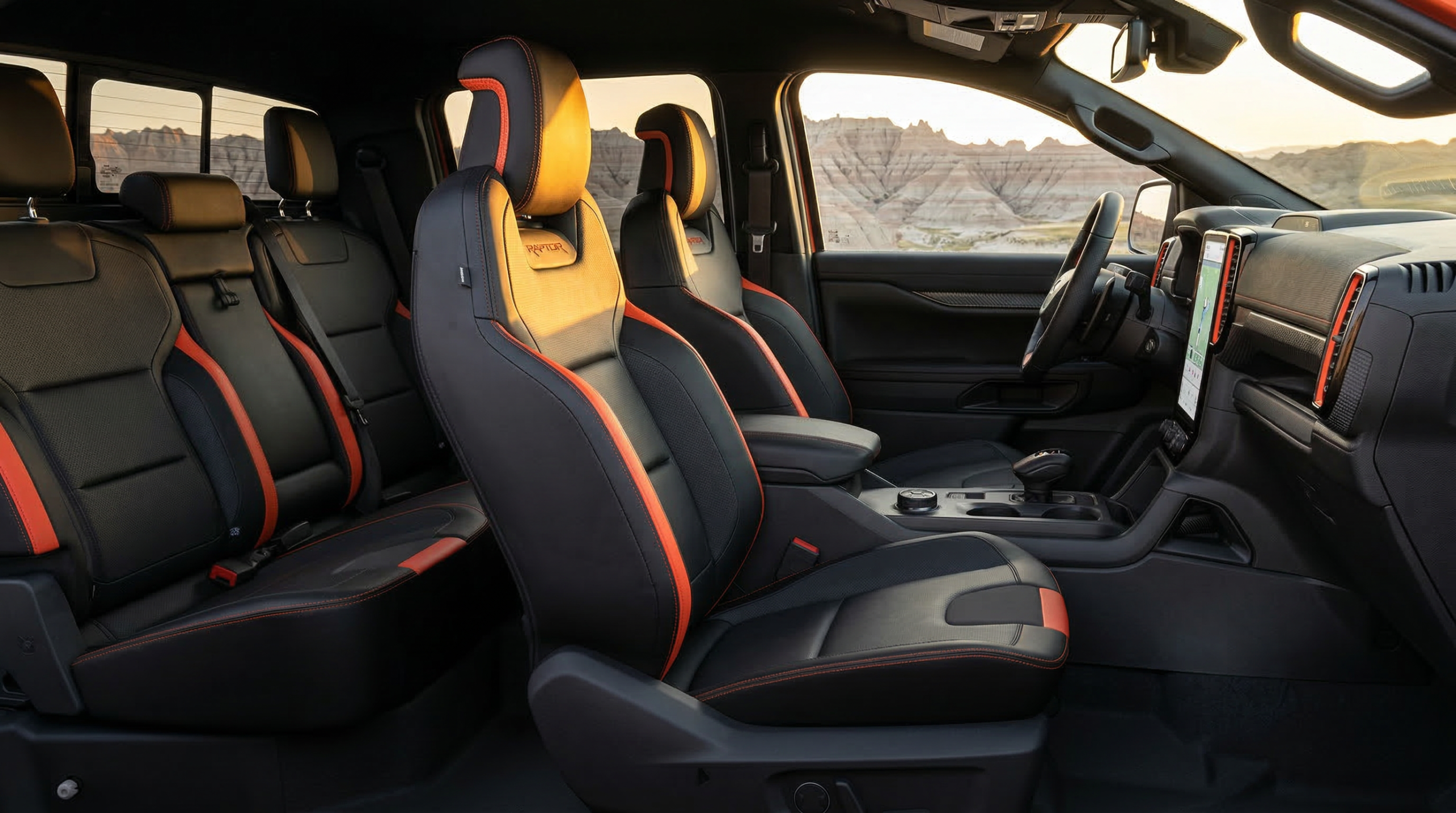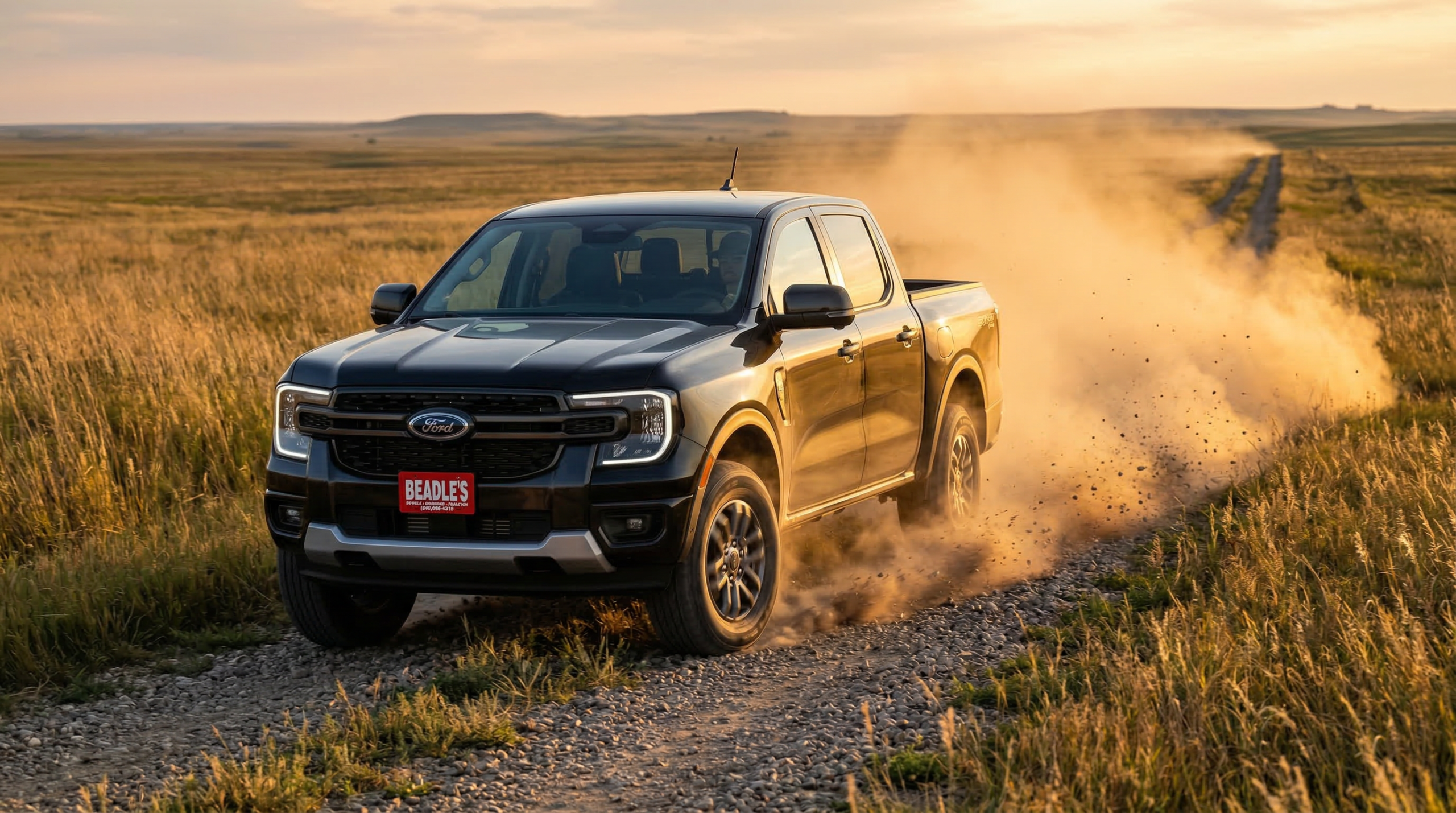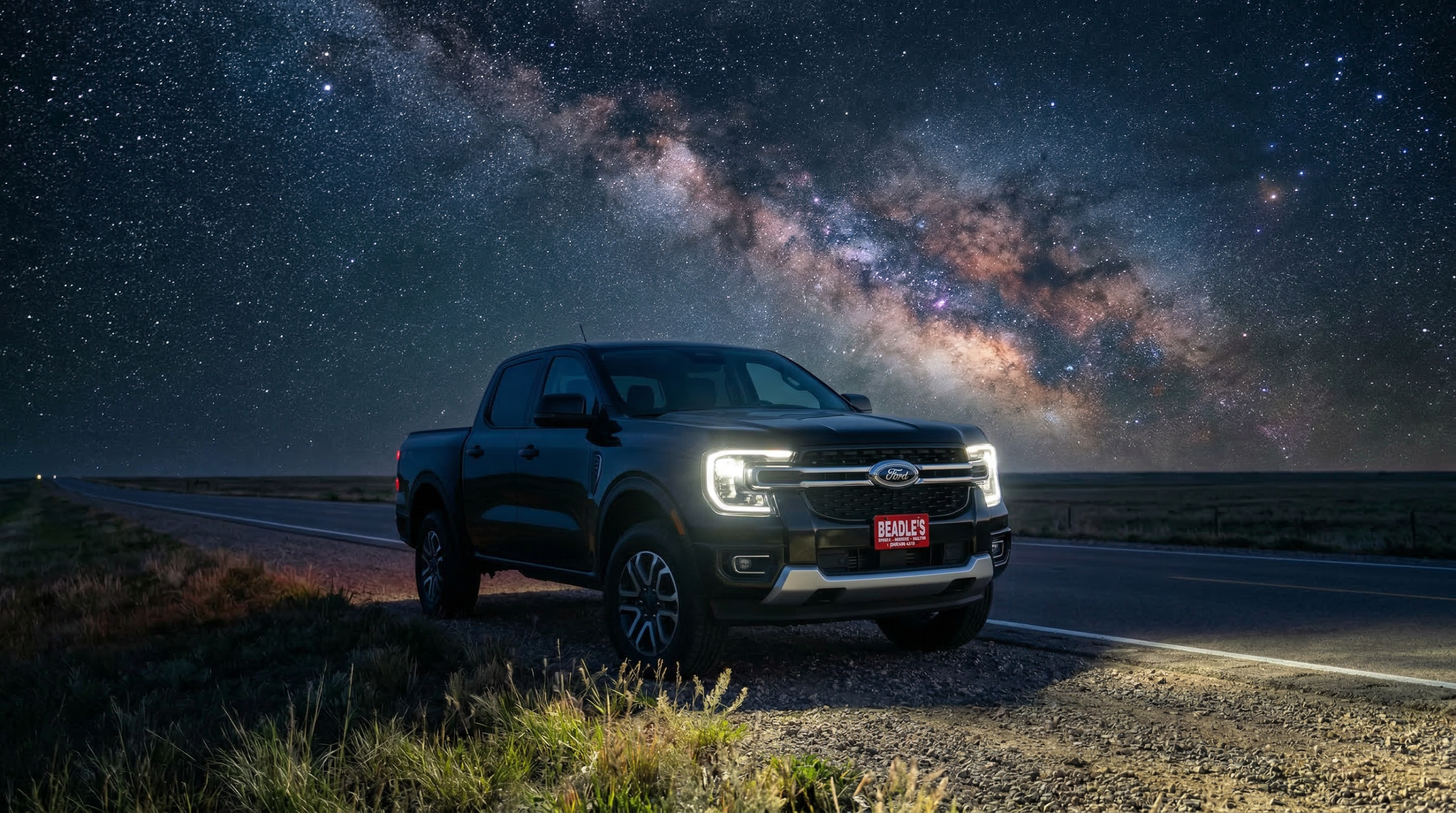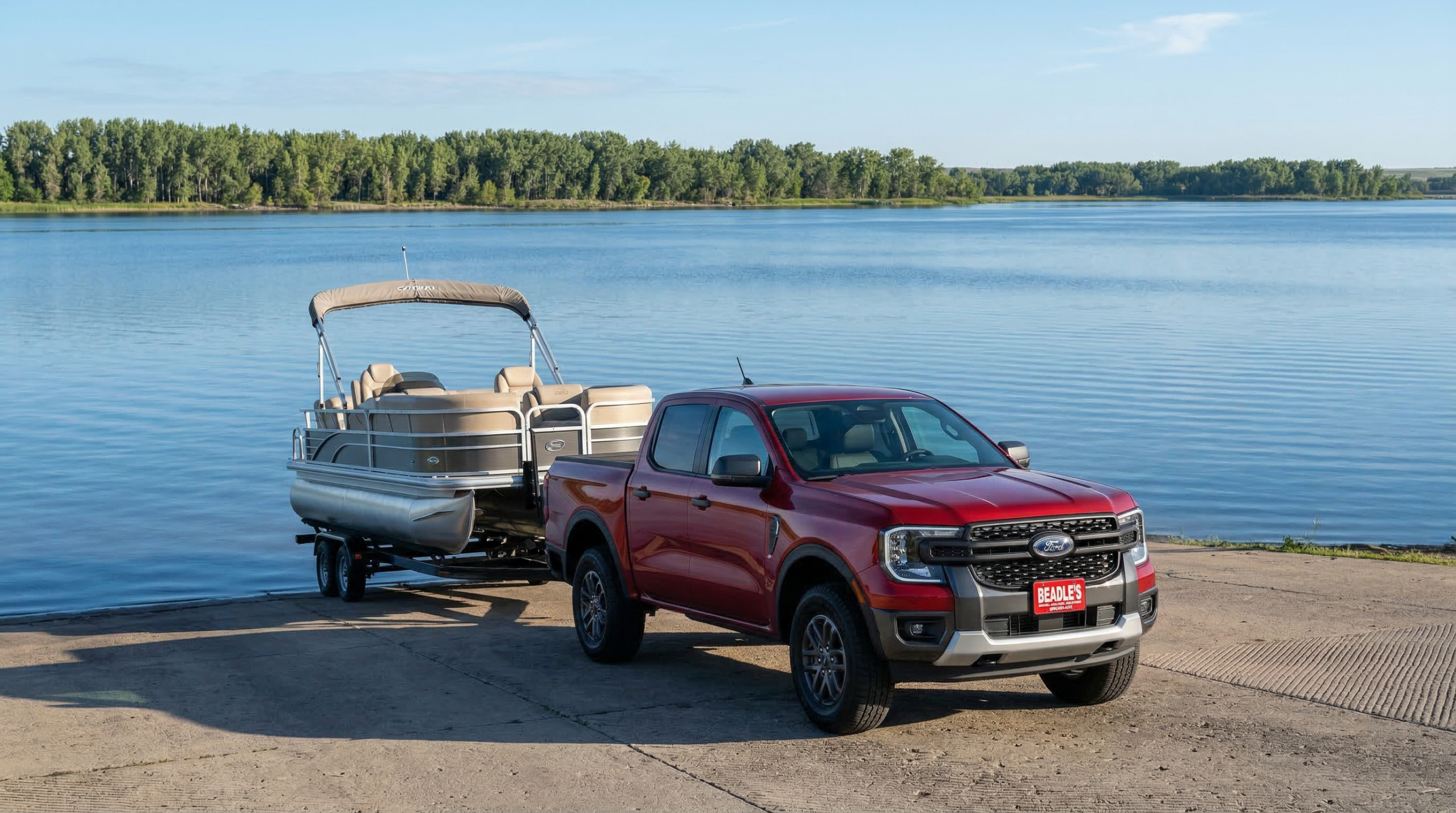

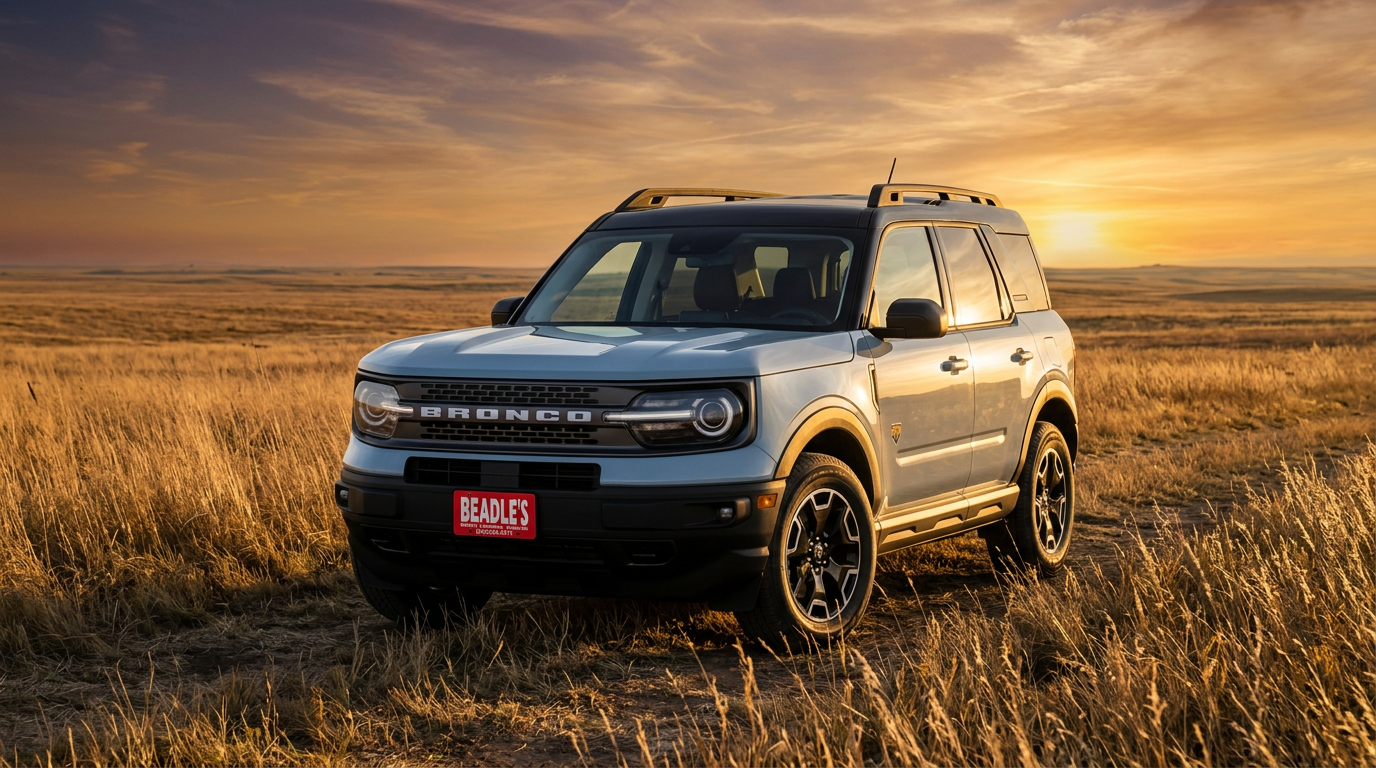
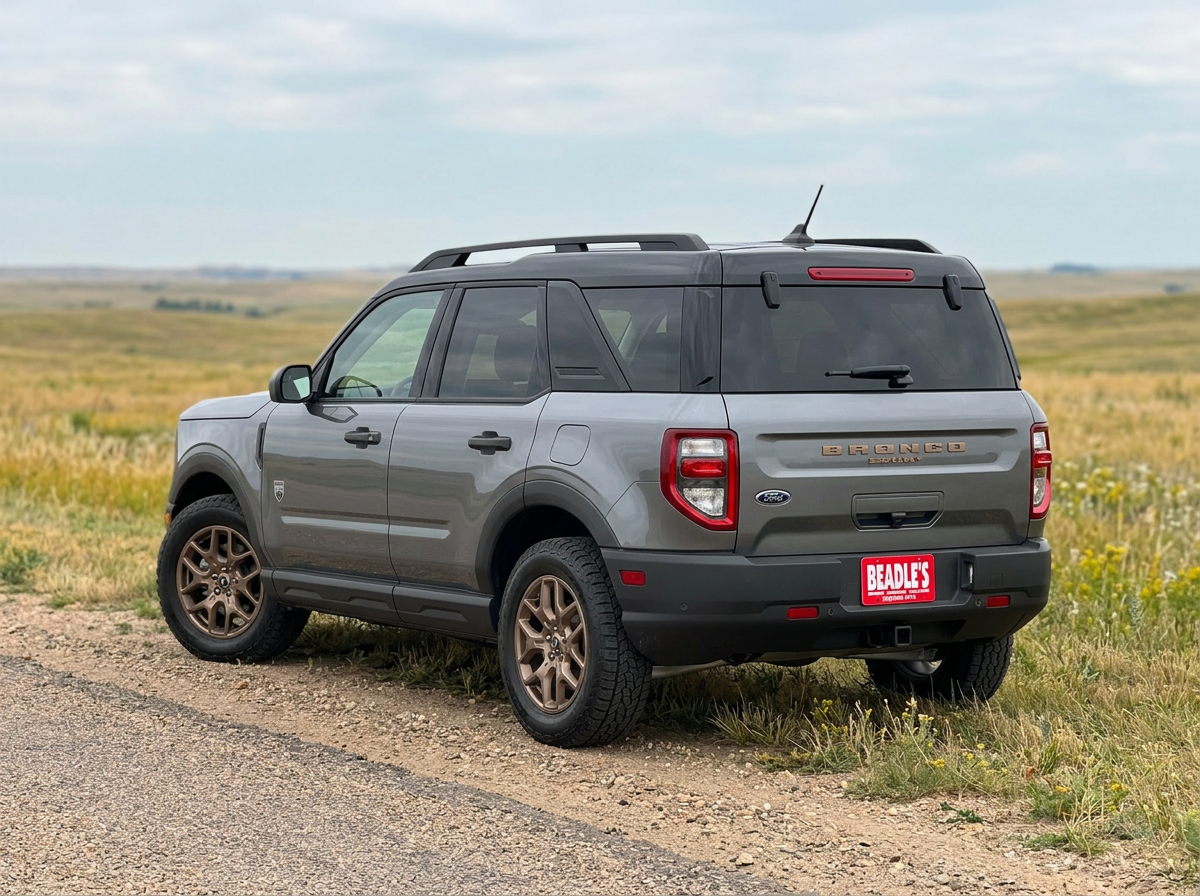
2026 Ford Bronco Sport on South Dakota plains at golden hour

The 2026 Ford Bronco Sport comes in four trims — Big Bend, Heritage, Outer Banks, and Badlands — and the differences between them go well beyond the price tag. Engine choice, suspension tuning, 4×4 system, seat material, and available packages all vary by trim in ways that matter for how you’ll actually use the vehicle day to day.

This guide breaks down every trim, compares what each one adds, and helps you figure out which configuration makes the most sense for buyers in Bowdle and across north-central South Dakota.

What are the four 2026 Bronco Sport trims?

The 2026 Bronco Sport lineup consists of Big Bend, Heritage, Outer Banks, and Badlands. The Free Wheeling trim was discontinued after 2025 and does not carry forward into 2026.

Trim Engine 4×4 System Suspension
Big Bend 1.5L EcoBoost Standard 4×4 HOSS 1.0
Heritage 1.5L EcoBoost Standard 4×4 HOSS 1.0
Outer Banks 1.5L EcoBoost Standard 4×4 HOSS 1.0
Badlands 2.0L EcoBoost Advanced 4×4 HOSS 2.0

Every 2026 Bronco Sport trim includes 4×4 as standard equipment — there is no front-wheel-drive option in this lineup. Every trim also comes with a 13.2-inch SYNC 4 touchscreen, wireless Apple CarPlay and Android Auto, and Ford Co-Pilot360 Assist+ as standard features.

What does the Big Bend come with as standard?

The Big Bend is the entry trim, but its standard equipment list is more complete than most entry-level compact SUVs. You get the full SYNC 4 suite, Ford Co-Pilot360 Assist+, 4×4, HOSS 1.0 suspension, and the full G.O.A.T. mode system. For 2026, the 8-inch digital cluster display is now standard on Big Bend — previously that was an add-on.

Big Bend Standard Equipment Highlights

  • 1.5L EcoBoost I3 with 8-speed automatic transmission
  • Standard 4×4 with HOSS 1.0 Off-Road Tuned Suspension
  • 5 G.O.A.T. Modes: Normal, ECO, Sport, Slippery, Off-Road
  • 13.2” SYNC 4 center display, wireless Apple CarPlay and Android Auto
  • 8” digital cluster display (new standard for 2026)
  • Ford Co-Pilot360 Assist+ (adaptive cruise, lane centering, BLIS, auto emergency braking)
  • MOLLE Straps System on the liftgate (standard on Big Bend)
  • Roof-rack side rails
  • Ford Connectivity Package — 1 year included
  • Ford Security Package — 1 year included (new for 2026)

For buyers who primarily want reliable 4×4 capability, modern tech, and the standard safety suite without paying for comfort upgrades they may not need, the Big Bend delivers strong value. The 2026 Bronze Package (60F) option is also exclusive to Big Bend — more on that below.

2026 Bronco Sport Bronze Package Big Bend Sinister Bronze wheels black roof

What does the Heritage add over the Big Bend?

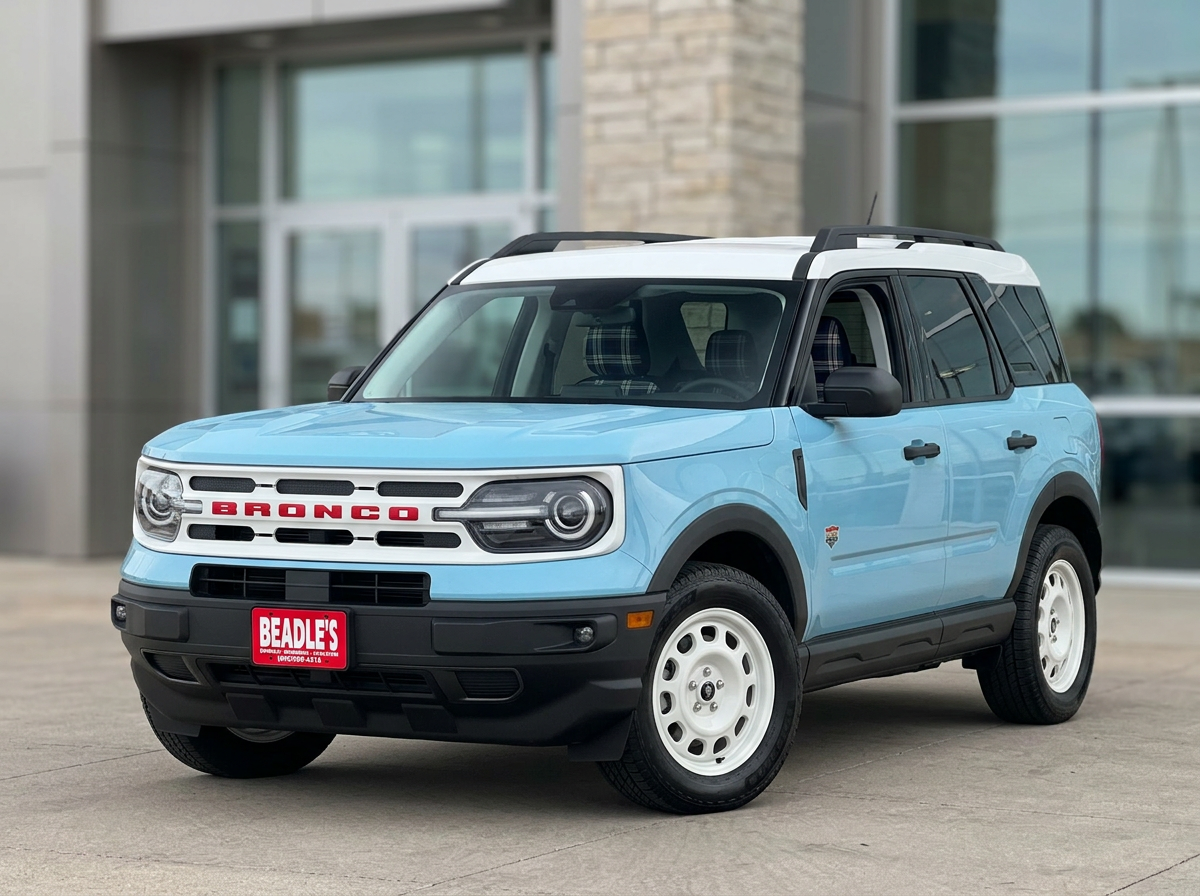
The Heritage sits between the Big Bend and the Outer Banks in the lineup and is built around a distinct retro-inspired look. Its most practically useful addition over the Big Bend is the all-terrain tires that come standard — a meaningful upgrade for anyone running gravel county roads or accessing fields and trails regularly.

Feature Big Bend Heritage
Tires All-season All-terrain (225/65R17 A/T) — standard
Roof color Body color Oxford White (unique to Heritage)
Wheel color Standard Oxford White wheels
Seat material Cloth Plaid cloth bucket seats
Door ring Standard Oxford White door ring
Armrest Standard Navy Pier micro suede, Race Red stitching
Side decals None Heritage Bronco script decals

The Heritage’s A/T tires are the standout practical advantage. For buyers driving gravel roads between Bowdle and rural properties, or accessing lakeside boat ramps at Lake Oahe in spring mud season, having all-terrain tires standard removes the need to source and mount them separately. Everything else Heritage adds is cosmetic — the powertrain and 4×4 system are identical to the Big Bend.

2026 Ford Bronco Sport Heritage white roof plaid seats South Dakota

What does the Outer Banks add over the Big Bend and Heritage?

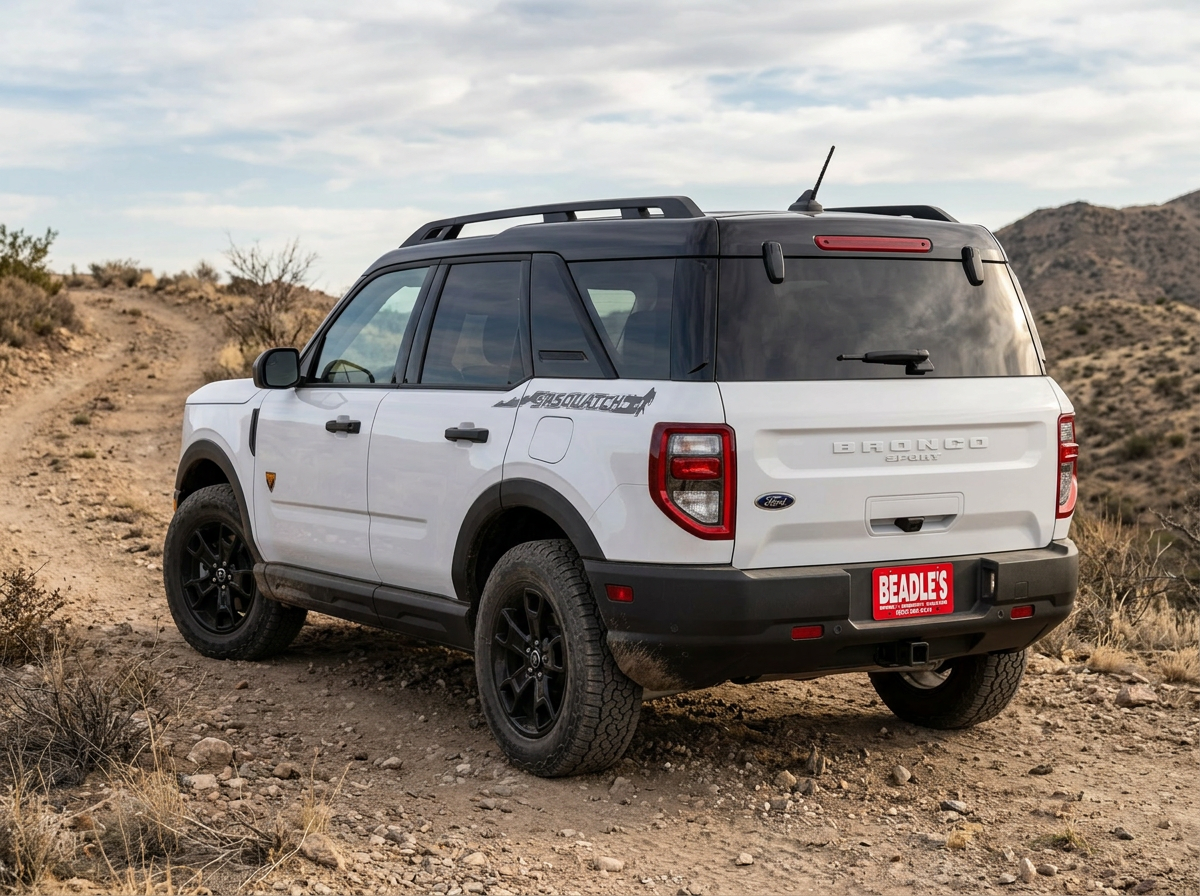
The Outer Banks is where the comfort upgrades come in. It steps up to heated front seats, heated steering wheel, dual-zone climate control, power-adjustable seating with memory, remote start, and 18-inch machined-face wheels. The Outer Banks also opens access to the Sasquatch Package (67A), which adds the most significant off-road hardware short of the Badlands.

Feature Added on Outer Banks Detail
Climate Dual-zone automatic climate control
Seating 8-way power driver seat, 6-way power passenger seat, memory function
Heated features Heated front seats, heated steering wheel
Convenience Remote start, auto-dimming rearview mirror
Exterior 18” Machined-Face Ebony Black wheels, Shadow Black painted roof, LED fog lamps
Available upgrade Sasquatch Package (67A) — requires Tech Package (96T)

For buyers who spend long miles on the road — highway runs to Aberdeen or Pierre and back — the heated seat and steering wheel standard on Outer Banks are genuinely useful during a South Dakota winter. The Outer Banks with the Sasquatch Package is the closest the non-Badlands lineup gets to serious off-road hardware.

2026 Ford Bronco Sport Outer Banks Sasquatch black bumpers fender flares A/T tires

What makes the Badlands different from every other trim?

The Badlands is in a different category from the other three trims. It uses a larger engine, a more capable 4×4 system, upgraded suspension, a longer list of off-road features, and is the only trim with Rock Crawl and Rally G.O.A.T. modes. It also comes with the Class II Trailer Tow Package as standard equipment and carries the highest tow rating in the lineup at 2,700 lbs.

Badlands-Only Features

  • 2.0L EcoBoost I4 with SelectShift and paddle shifters
  • Advanced 4×4 with twin-clutch rear drive unit (precise torque vectoring)
  • HOSS 2.0 suspension with stiffer off-road tuning
  • 7 G.O.A.T. Modes — adds Rock Crawl and Rally over the standard 5
  • Trail Control with Trail One-Pedal Drive
  • Pro Power Onboard 400W
  • 12.3” digital cluster display (vs 8” on other trims)
  • Leather-trimmed heated front seats
  • Rubberized cargo floor and cabin floor
  • 360-degree camera with Trail View and front parking sensors
  • Steel underbody protection (engine skid plate + fuel tank shields)
  • Class II Trailer Tow Package — standard, not optional
  • Max tow rating: 2,700 lbs (SAE J2807)

If your primary use involves trails, rough terrain, livestock trailer towing, or any scenario where you want the most capability the Bronco Sport can offer, the Badlands is the only trim designed for that role.

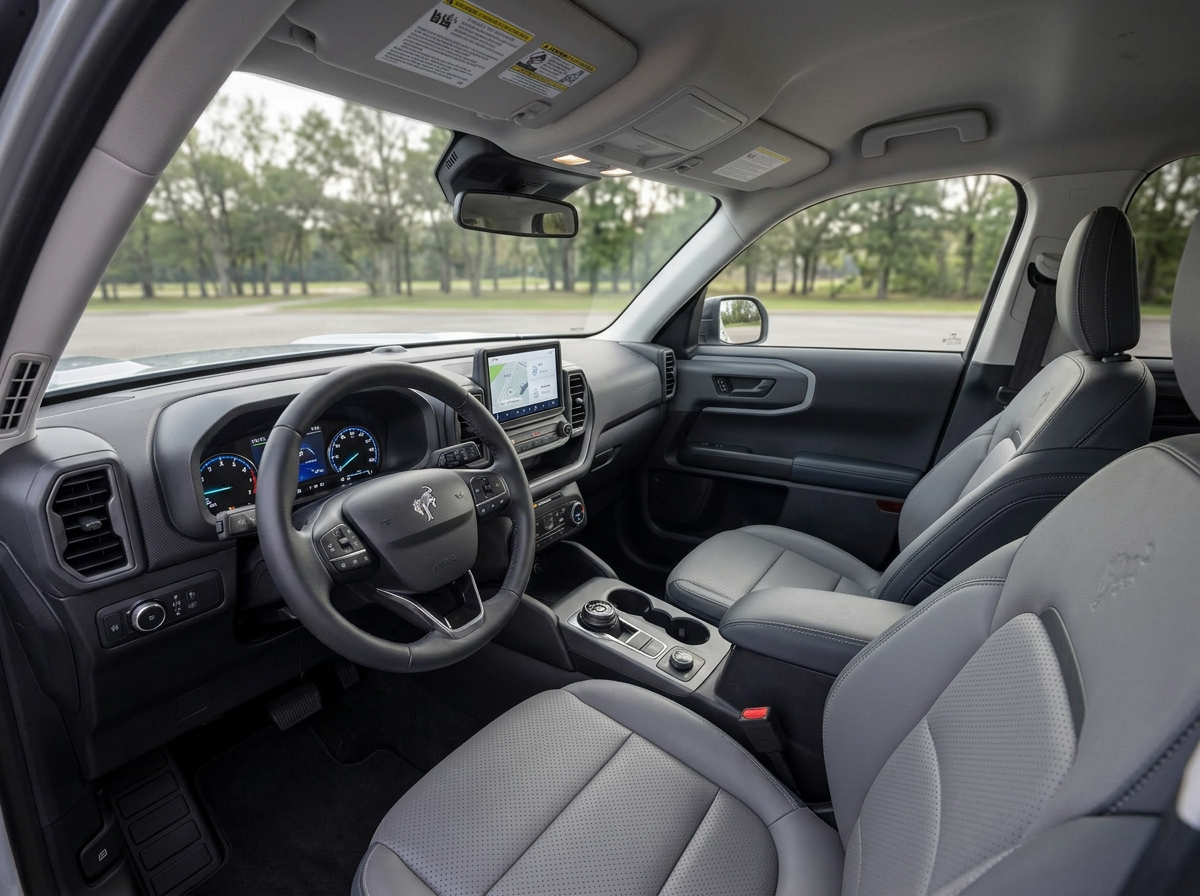
2026 Ford Bronco Sport Badlands interior leather seats 12.3 inch cluster

How do the engines compare across trims?

Big Bend, Heritage, and Outer Banks all use the same proven 1.5L EcoBoost three-cylinder. The Badlands is the only trim that gets the larger 2.0L EcoBoost four-cylinder. Both use an 8-speed automatic transmission with a 3.80 final drive ratio. Ford has not yet published confirmed output figures for the 2026 model year — based on the 2025 lineup, the 1.5L produced 181 hp and 190 lb-ft of torque, and the 2.0L produced 250 hp and 277 lb-ft.

Engine Available On Transmission Final Drive
1.5L EcoBoost I3 Big Bend, Heritage, Outer Banks 8-speed automatic 3.80
2.0L EcoBoost I4 Badlands only 8-speed automatic (SelectShift + paddles) 3.80

For most day-to-day driving across SD — highway miles, gravel roads, light trail access — the 1.5L is sufficient. The 2.0L’s additional torque becomes relevant when towing near the Badlands’ 2,700 lb limit, running steeper off-road terrain, or driving loaded at elevation on western SD routes toward the Black Hills.

How does the 4×4 system differ on the Badlands?

Big Bend, Heritage, and Outer Banks use a standard 4×4 system that distributes torque to all four wheels. The Badlands uses Advanced 4×4 with a twin-clutch rear drive unit, which allows independent torque control to the left and right rear wheels. This enables true torque vectoring — the system can send more power to an individual wheel when traction is uneven, rather than splitting torque equally across the rear axle.

In practical terms, this is the difference between a 4×4 system that works well on gravel and light trails versus one designed to handle technical terrain where one wheel may be lifted or spinning. For buyers using the vehicle on structured roads and maintained trails, the standard 4×4 on Big Bend, Heritage, and Outer Banks is more than adequate. The Advanced 4×4 matters more in technical off-road scenarios or when adding the Sasquatch Package to Outer Banks — which also upgrades to Advanced 4×4 and the twin-clutch system.

Which Bronco Sport trim is right for your use case?

Here’s how the trims stack up for different buyer profiles common to north-central South Dakota:

Use Case Best Trim Why
Daily driver, mostly pavement and highway Big Bend or Outer Banks Full tech suite at entry level; Outer Banks adds heated features for winter
Gravel roads, light trail, farm access Heritage A/T tires standard, no extra cost to add off-road rubber
Towing a boat to Lake Oahe, livestock trailer Badlands 2,700 lb tow rating, Class II package included standard
Off-road trails, technical terrain Badlands or OB Sasquatch Advanced 4×4, HOSS 2.0, Rock Crawl and Rally modes
Long SD winters, Highway 12 daily Outer Banks or Heritage Outer Banks: heated seat and wheel standard; Heritage: A/T tires standard
Budget-conscious, want retro look Big Bend + Bronze Package Bronze Package exclusive to Big Bend; adds distinctive look at lower trim price point

The full 2026 Bronco Sport model year overview — including how trims fit within the broader lineup, package options, and what’s new for 2026 — is covered in detail in the 2026 Bronco Sport overview page.

Key Takeaways

  • The 2026 Bronco Sport comes in four trims: Big Bend, Heritage, Outer Banks, and Badlands. Free Wheeling is discontinued.
  • Every trim includes 4×4 standard — there is no FWD Bronco Sport.
  • Big Bend, Heritage, and Outer Banks use the 1.5L EcoBoost. The Badlands is the only trim with the 2.0L.
  • The Heritage’s most practical advantage is standard all-terrain tires — no other 1.5L trim includes them standard.
  • The Outer Banks adds the comfort package — heated seats, heated steering wheel, dual-zone climate, remote start.
  • The Badlands has a completely different 4×4 system (Advanced 4×4 with twin-clutch), HOSS 2.0 suspension, Rock Crawl and Rally modes, and the highest tow rating at 2,700 lbs.
  • The Bronze Package (new for 2026) is exclusive to Big Bend and adds a distinctive appearance package with 17” Sinister Bronze wheels.

Frequently Asked Questions

Which 2026 Bronco Sport trim has the best value?

It depends on your use. The Big Bend offers the strongest value if you want the full tech and safety suite without comfort upgrades. The Heritage edges ahead for buyers who drive gravel regularly and want A/T tires without paying to add them separately. If you want heated seats and steering wheel for South Dakota winters, the Outer Banks makes sense. The Badlands is the only valid choice if you need maximum tow capacity or serious off-road hardware.

Can I get all-terrain tires on a Big Bend or Outer Banks?

The Heritage is the only trim that comes with A/T tires as standard equipment. On the Big Bend, the Bronze + Black Diamond Package (60H) includes A/T tires as part of that package bundle. On the Outer Banks, the Sasquatch Package (67A) includes 17” Ebony Black wheels with P235/65R17 A/T tires. The Badlands comes with its own A/T tire setup as standard. The base Big Bend and base Outer Banks come with all-season tires only.

What is the difference between HOSS 1.0 and HOSS 2.0 suspension?

HOSS stands for High-Performance Off-Road Stability Suspension. HOSS 1.0 is the off-road tuned suspension on Big Bend, Heritage, and Outer Banks — it provides better articulation and stability than a standard passenger car suspension. HOSS 2.0 on the Badlands (and Outer Banks with Sasquatch) adds stiffer springs and more aggressive damper tuning for harder off-road use. The Badlands Sasquatch Package upgrades further to HOSS 3.0 with Bilstein position-sensitive dampers.

Is the Badlands worth the extra cost over Outer Banks?

The Badlands justifies its price premium when you need what only it offers: the 2.0L engine, Advanced 4×4 with twin-clutch, HOSS 2.0 suspension, Trail Control, Rock Crawl and Rally modes, and a standard tow rating of 2,700 lbs. If you’re primarily on pavement and light gravel with occasional trail use, the Outer Banks (with optional Sasquatch Package for off-road hardware) often comes closer to the Badlands’ capability at a lower total cost. Confirm current pricing and availability at Beadle Ford in Bowdle.

Does the Heritage come with heated seats?

No. Heated front seats are not standard on the Heritage trim. Heated seats become standard at the Outer Banks level. If winter comfort features are a priority alongside the Heritage’s retro aesthetic, you would need to step up to the Outer Banks — which carries the heated seats, heated steering wheel, and dual-zone climate control as standard.

My Take on the 2026 Bronco Sport Trim Lineup

When I talk through trim choices with buyers at Beadle Ford, the conversation usually lands quickly on a few real questions: Do you need the tow capacity? Do you drive gravel regularly enough to want A/T tires? Do you spend enough time in the vehicle during a South Dakota winter to care about heated seats? Those three questions alone narrow the lineup down to one or two options in most cases.

For the majority of buyers I talk to around Bowdle, the Heritage is underrated. The A/T tires standard — at a price point below the Outer Banks — is genuinely useful for the kind of driving most people in this area actually do. If you’re regularly running a mix of pavement and gravel, you’re going to want those tires, and getting them standard rather than adding them later saves money and hassle. The Badlands earns its place at the top of the lineup — if you’re towing or running hard terrain, it’s the one to have.

The complete year-specific overview — including what changed for 2026, package breakdowns, and towing details — is covered in the 2026 Ford Bronco Sport overview. Stop by Beadle Ford in Bowdle if you want to talk through which trim makes sense for your situation.

About the Author

Lexy Tabbert — Beadle Ford, Bowdle, SD

Lexy Tabbert covers Ford vehicles, trim comparisons, and buyer guidance for Beadle Ford in Bowdle, South Dakota. Her content is grounded in real buyer conversations with farmers, ranchers, and outdoor enthusiasts across north-central South Dakota and beyond. Learn more about Lexy.

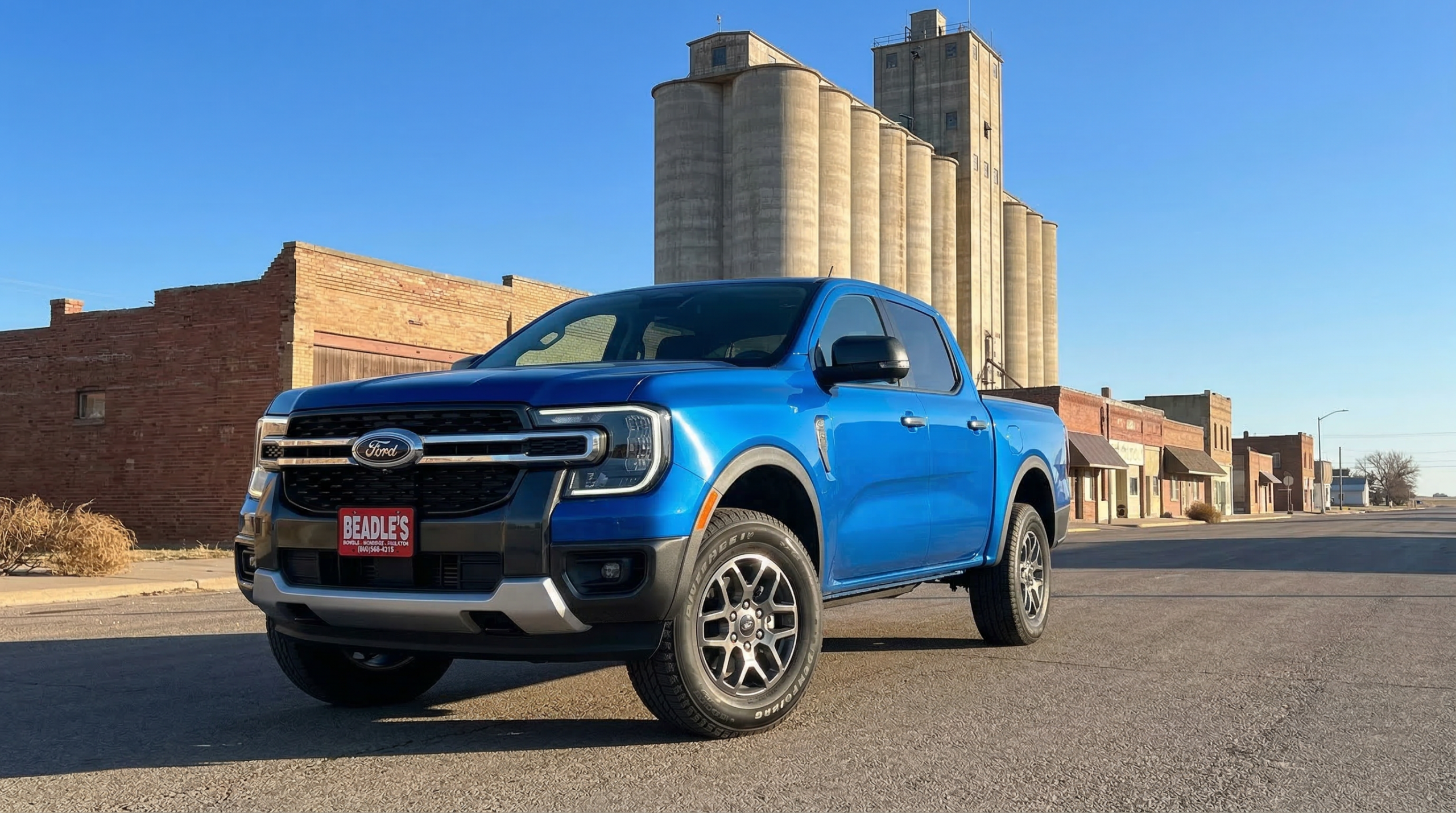
2026 Ford Ranger XLT parked on a small town South Dakota main street with grain elevator

The Ford Ranger and Toyota Tacoma are the two names that come up in nearly every midsize truck conversation — and for good reason. Both are capable, both are well-established, and both have genuine strengths. This comparison isn’t going to tell you one is universally better. It’s going to give you an honest side-by-side on the specs that actually affect daily use, towing, off-road capability, and long-term value — so you can make the call yourself.

One upfront note: Beadle Ford sells the Ranger, not the Tacoma. You should know that going in. What I’m giving you here is a factual comparison based on published specifications. If the Tacoma comes out ahead on something, you’ll see it.

Head-to-Head Specs: Where They Differ

Spec 2026 Ford Ranger 2024 Toyota Tacoma
Max Towing up to 7,500 lbs up to 6,500 lbs
Max Payload up to 1,788 lbs up to 1,755 lbs
Engines Available 2.3L I4 (270 hp), 2.7L V6 (315 hp), 3.0L V6 Raptor (405 hp) 2.4L I4 (228 hp), 2.4L I4 Hybrid (326 hp combined)
Transmission 10-speed automatic 8-speed auto or 6-speed manual
Frame High-strength steel ladder frame High-strength steel ladder frame
Infotainment Screen Up to 12 inches Up to 14 inches
Hybrid Option No Yes (i-FORCE MAX)
Performance Off-Road Variant Ranger Raptor (405 hp) TRD Pro
Cab Configuration (SuperCrew) SuperCrew only — 4 full doors Double Cab or CrewMax

Tacoma specs based on published 2024 model year figures. Verify current-year specifications with Toyota before purchase.

Where the Ranger Comes Out Ahead

Towing capacity. The Ranger’s 7,500 lb max towing rating is 1,000 lbs higher than the Tacoma’s 6,500 lb ceiling. That gap is meaningful when you’re near the top of the range — a loaded livestock trailer, a heavier pontoon boat, or a dual-axle utility trailer can cross from one side to the other. If towing is a regular part of your use case, the Ranger’s rated edge is real and confirmed against the same SAE J2807 standard.

Engine options at non-Raptor trims. The Ranger offers a 2.7L EcoBoost® V6 with 315 hp and 400 lb-ft of torque on XLT and Lariat builds — without requiring a performance variant. The Tacoma’s non-hybrid engine is a 2.4L I4 producing 228 hp. For buyers who want strong power in a workhorse trim rather than an off-road showpiece, the Ranger has a meaningful advantage here.

SuperCrew only. The Ranger comes exclusively in SuperCrew — four full-size doors, full rear seat. There’s no access cab or double cab compromise. If rear-seat space matters, the Ranger delivers it as the only option rather than making it a premium configuration choice.

Raptor vs. TRD Pro. The Ranger Raptor runs a 3.0L V6 producing 405 hp, live-valve Fox Racing Shox, and is built as a high-speed off-road performance truck. The TRD Pro is a serious off-road package but operates in a different performance tier. If maximum off-road performance matters and budget allows, the Raptor is the more capable option.

Where the Tacoma Has the Edge

Hybrid option. The Tacoma offers an i-FORCE MAX hybrid powertrain that Toyota claims produces 326 hp combined — Ford has no hybrid Ranger equivalent. For buyers focused on fuel efficiency alongside capability, the Tacoma hybrid is a genuine advantage the Ranger doesn’t match.

Larger screen at the top trim. The Tacoma’s top-end infotainment goes to 14 inches vs. the Ranger’s 12 inches. For buyers who prioritize the biggest possible display, the Tacoma screen is larger.

Manual transmission option. The Tacoma offers a 6-speed manual on certain configurations. The Ranger is automatic-only across all trims and engines. For buyers who prefer a manual, the Tacoma is the only option in this comparison.

Resale and reputation. Toyota’s resale value history on the Tacoma is strong — consistently among the best in the segment. Ford Ranger resale has improved significantly but hasn’t historically matched Toyota in this regard. If long-term resale is a financial priority, it’s worth researching current residual value data.
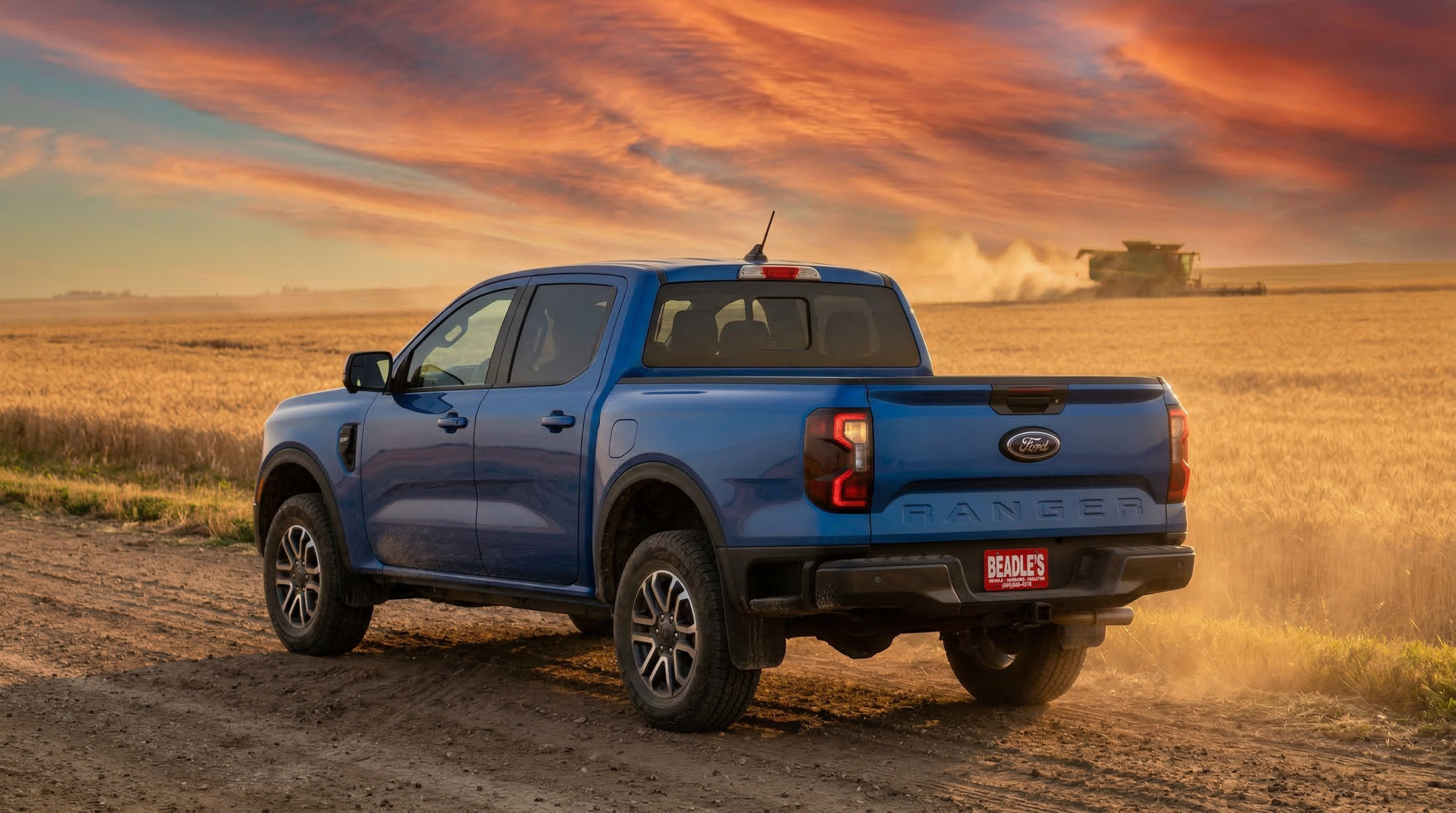
2026 Ford Ranger XLT parked beside South Dakota wheat fields during harvest sunset

How to Actually Make the Call

Quick Decision Guide

Choose the Ranger if you:

Regularly tow near or above 6,500 lbs — boats, livestock, loaded trailers. Want a V6 option in a non-performance trim. Value a full SuperCrew standard. Are considering the Raptor as your off-road variant. Want to buy locally from Beadle Ford in Bowdle.

Consider the Tacoma if you:

Prioritize a hybrid powertrain for fuel economy. Want a manual transmission. Value Toyota’s historical resale performance above other factors. Don’t tow near the top of the segment’s capacity range.

For most buyers in central South Dakota — where towing is a real use case and gravel roads are a given — the Ranger’s capacity edge and V6 availability matter. The 1,000 lb towing advantage alone can be the deciding factor when a pontoon boat or loaded horse trailer is in the picture.

One More Thing: Where You Buy Matters Too

The nearest Toyota dealership to Bowdle is a significant drive. Beadle Ford is right here — which means sales support, service, warranty work, and parts availability are local. For farm trucks, work trucks, or any vehicle that gets used hard and occasionally needs attention, dealership proximity is a practical consideration that doesn’t show up in a spec comparison but matters in daily ownership.

That’s not a pitch — it’s a real factor. Local service reduces downtime. If a sensor goes out during harvest or a tow job turns into a warranty issue, having the selling dealer 20 minutes away instead of an hour-plus changes the math on truck ownership.

Ranger vs. Tacoma FAQ

Does the Ford Ranger tow more than the Toyota Tacoma?
Yes. The 2026 Ford Ranger tows up to 7,500 lbs when properly equipped, compared to the Tacoma’s 6,500 lb max. That’s a 1,000 lb advantage for the Ranger — meaningful when you’re pulling boats, livestock trailers, or loaded utility trailers.
Does the Ford Ranger come in a hybrid version?
No — the 2026 Ford Ranger does not offer a hybrid powertrain. The Tacoma does offer an i-FORCE MAX hybrid option. If hybrid capability is important to your buying decision, the Tacoma has an advantage here that the Ranger cannot match at this time.
Is the Ranger Raptor better than the Tacoma TRD Pro off-road?
In terms of outright off-road performance, the Ranger Raptor’s 3.0L V6 with 405 hp and live-valve Fox Racing Shox long-travel suspension is a more extreme setup than the TRD Pro. The TRD Pro is a serious off-road package, but the Raptor is designed for high-speed off-road driving in a way the TRD Pro is not. For buyers who want a factory performance off-road truck, the Raptor is the stronger specification.
Which has better resale value, the Ranger or the Tacoma?
The Toyota Tacoma has historically had stronger resale values than the Ford Ranger. Toyota’s Tacoma resale consistently ranks near the top of the segment. Ranger resale has improved but has not historically matched Toyota in this metric. If resale value is a top priority, current residual value data from a source like Kelley Blue Book or ALG should factor into your decision.
Can I compare the Ranger to the F-150 instead?
The Ranger and F-150 are different truck categories — the Ranger is a midsize truck, the F-150 is full-size. If your towing or payload needs consistently push near or above the Ranger’s limits, the F-150 might be the better fit. Beadle Ford carries both. The key question is whether you need the additional capacity a full-size truck provides, or whether the Ranger’s midsize footprint and lower cost fits your use case better.

Key Takeaways

  • The Ranger tows up to 7,500 lbs — 1,000 lbs more than the Tacoma’s 6,500 lb max
  • The Ranger offers a 315 hp V6 engine on XLT and Lariat without needing a performance trim; Tacoma non-hybrid tops at 228 hp
  • The Tacoma offers a hybrid powertrain (i-FORCE MAX) that the Ranger does not
  • Tacoma resale value has historically been stronger than the Ranger’s
  • The Ranger comes exclusively in SuperCrew (4 full doors) — no compromise cab configurations
  • The Ranger Raptor (405 hp, live-valve Fox shocks) is a more extreme off-road specification than the TRD Pro
  • For Bowdle-area buyers, Ranger availability and local Beadle Ford service are a practical ownership advantage

Both trucks are genuinely good. If the Tacoma’s hybrid system or manual transmission is a deciding factor for you, that’s a legitimate reason to go that direction. But if you’re towing regularly, want a V6 without stepping into Raptor territory, or just want to buy local and service local — the Ranger earns the comparison.

Before you decide, it’s worth reading the complete 2026 Ranger overview before deciding — or stopping in at Beadle Ford in Bowdle to see one in person. That tends to settle the conversation faster than any spec sheet.

— Lexy Tabbert, Beadle Ford
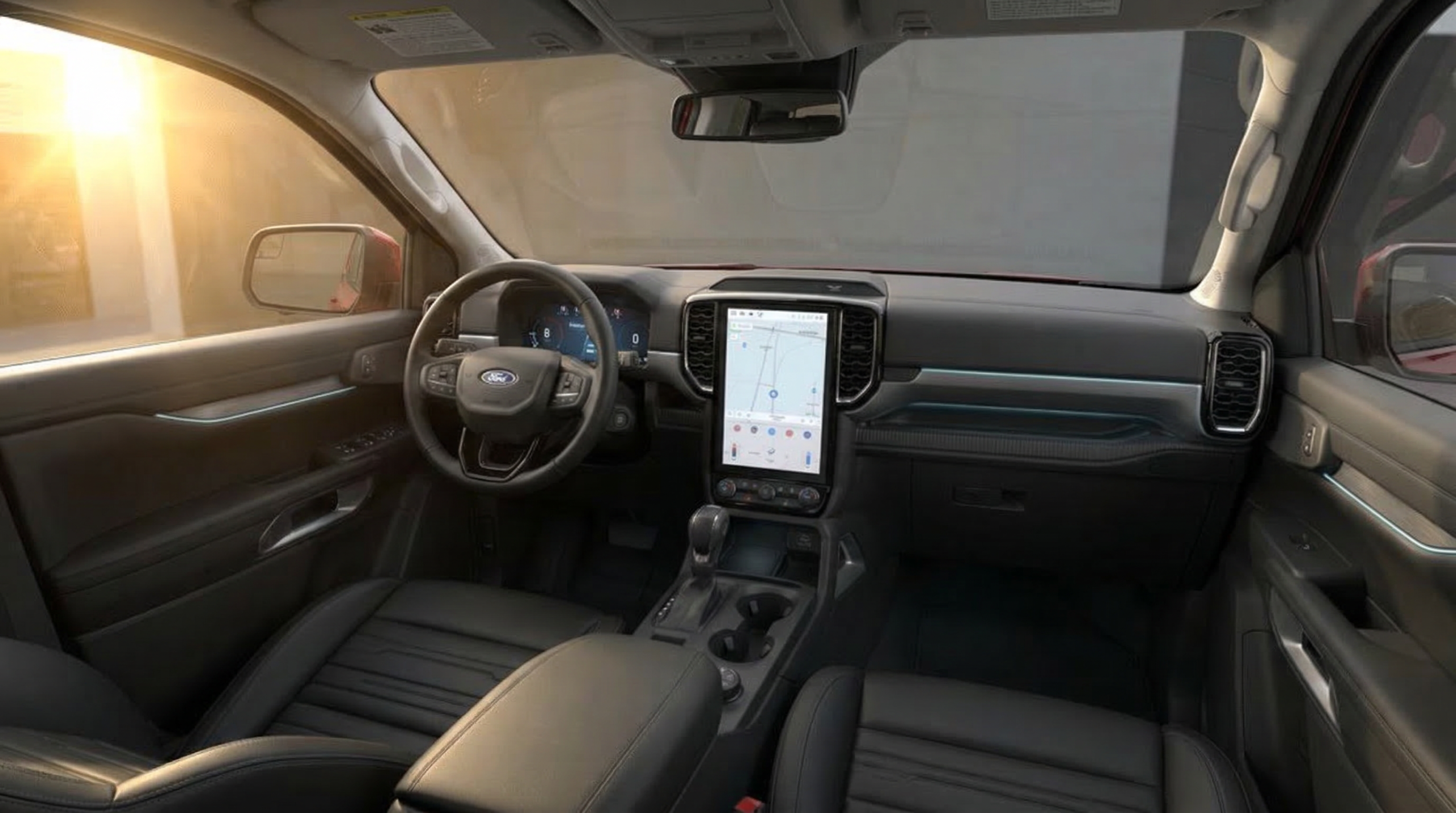
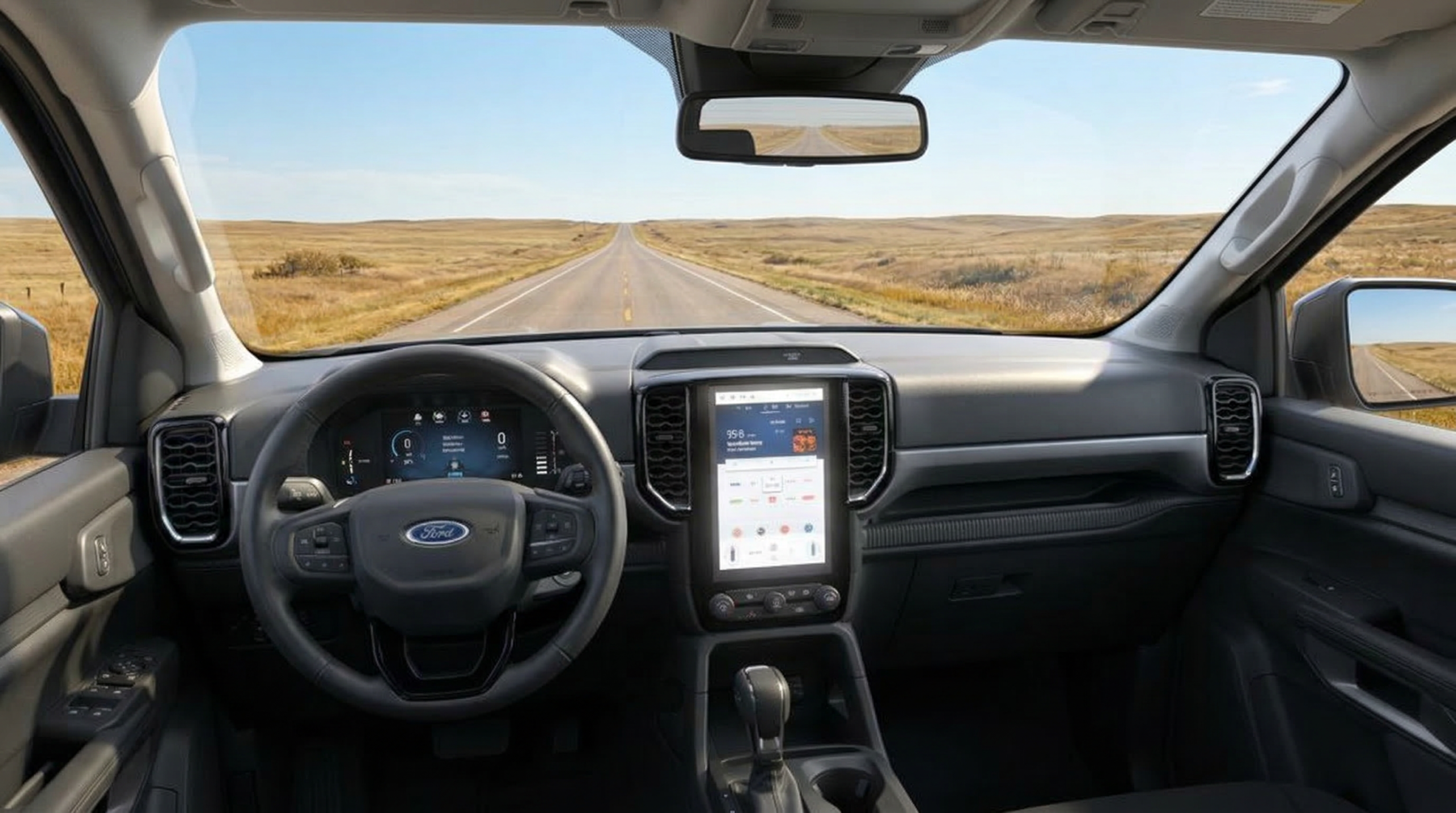
2026 Ford Ranger Lariat interior with 12 inch SYNC touchscreen and digital instrument cluster

Tech specs in truck brochures tend to blur together fast — every trim claims to be “well-equipped,” every screen sounds massive, and it’s hard to tell what’s actually different between a base XL and a loaded Lariat until you’re standing in the dealership trying to remember which truck had the 360-degree camera and which one didn’t. This guide cuts through that. Here’s a clear, trim-by-trim breakdown of every technology and safety feature on the 2026 Ford Ranger — what’s standard, what you have to add, and what you simply can’t get without stepping up a trim.

What Every 2026 Ranger Gets — Regardless of Trim

Ford’s Co-Pilot360™ suite is standard equipment on all 2026 Ranger trims. That means safety technology isn’t a luxury upgrade — it’s built into the base price no matter which model you choose. Here’s what every Ranger includes:

Feature What It Does
Pre-Collision Assist with Automatic Emergency Braking Detects vehicles and pedestrians ahead; warns driver and automatically applies brakes if needed
Blind Spot Information System (BLIS®) Monitors blind spots and warns when a vehicle enters; Cross-Traffic Alert included
Lane-Keeping System Alerts driver when drifting from lane and applies gentle steering input to keep the truck in lane
Auto High-Beam Headlamps Automatically switches between high and low beams based on oncoming traffic
Rear View Camera Standard rearview display when reversing
Apple CarPlay® / Android Auto™ Wireless on XLT and above; wired on XL
Pro Power Onboard™ — 400W In-bed 120V AC outlet for tools, chargers, and equipment — standard across all trims

SYNC 4A Touchscreen: Size Varies by Trim

All 2026 Rangers run SYNC 4A — Ford’s connected infotainment platform. But screen size is not the same across all trims, and the difference matters in daily use.

Trim SYNC 4A Screen Digital Cluster Wireless CarPlay
XL 8 inches Wired only
XLT 12 inches 12-inch digital ✓ Wireless
Lariat 12 inches 12-inch digital ✓ Wireless
Raptor 12 inches 12-inch digital ✓ Wireless

The jump from the XL’s 8-inch screen to the XLT’s 12-inch is significant. Beyond screen size, the XLT also gains a 12-inch digital instrument cluster in place of traditional analog gauges — the display is configurable and shows navigation, off-road data, and driver assist readouts. If you spend a lot of time interacting with navigation or media, the XLT and above deliver a noticeably better experience.

What’s New on Tech for 2026

Two tech-related additions stand out for 2026:

Power Moonroof — New for 2026, now available as an option. Not available on every trim, but for buyers who’ve been waiting for a factory moonroof option on the Ranger, it’s here. If outdoor visibility while parked or natural light while driving matters to you, this is worth checking at the trim level you’re considering.

SiriusXM 360L — The on-demand tier of SiriusXM is now included. 360L goes beyond traditional satellite radio — it adds on-demand content and personalized channel recommendations delivered over a connected data connection. Same hardware as before, better content access. The upgrade was to the tier, not the physical radio.

2026 Ford Ranger Raptor interior with performance seats and large center touchscreen

Adaptive Cruise and Driver Assist: What’s Available Where

Basic cruise control is standard on all trims. Adaptive Cruise Control with Stop-and-Go — which maintains a set following distance and can bring the truck to a complete stop in traffic — is available on XLT and above, typically as part of a higher package level. If highway driving is a big part of your commute or your travel, it’s a feature worth tracking when building your trim.

The 360-degree camera system — which shows a bird’s-eye view of the truck while maneuvering — is available on the Lariat and above. For backing into a tight space with a trailer or parallel parking on a Bowdle street with limited sight lines, the surround-view system is genuinely useful rather than a gimmick.

FordPass, OTA Updates, and Connected Features

The FordPass™ app connects your phone to the truck and lets you remotely start, lock, unlock, and check vehicle status — fuel level, tire pressure, and whether the doors are locked. It’s a small but practical convenience when you’re loading gear in the dark before a morning hunt or warming up the truck from inside the house in January.

The 2026 Ranger also supports over-the-air software updates through the built-in modem. Ford can push SYNC system updates, recalibrations, and feature improvements to the truck without requiring a dealership visit — the same way a smartphone updates. Your truck can get better after you drive it off the lot.

Pro Power Onboard™: The 400W In-Bed Outlet

Every 2026 Ranger comes with a 400-watt 120V AC outlet in the bed as standard equipment. That’s enough to run a power tool, charge a phone or laptop, power a small compressor, or run lighting at a worksite or campsite. It’s not a generator replacement — 400W has limits — but for everyday use it’s a useful feature that most buyers don’t expect to find at this power level as a standard item.

For heavier power needs, you’ll want to look at F-150 with its higher Pro Power Onboard tiers, which go substantially higher. The Ranger’s 400W is the right tool for typical job-site and outdoor use, not for powering large appliances.

Audio Upgrades: B&O Available on Lariat

The XL and XLT come with Ford’s standard audio setup — functional, decent, nothing remarkable. The Lariat can be optioned with the Bang & Olufsen™ premium audio system, which is a meaningful step up in sound quality for buyers who care about audio. B&O is not available on the XL or XLT.

Ambient interior lighting is also available on the Lariat, which adds configurable mood lighting along the interior panels. It’s a comfort and style feature, not a function feature, but it contributes to the overall feel of the cabin in a way that photographs well and rides even better.

Technology FAQ

Does the base XL Ranger have Apple CarPlay?
Yes, but wired only. The XL supports Apple CarPlay and Android Auto via a USB connection. Wireless CarPlay and Android Auto are available starting on the XLT and carry through to the Raptor.
What is SYNC 4A and how is it different from SYNC 4?
SYNC 4A is Ford’s enhanced version of the SYNC 4 platform — it includes a faster processor, an improved voice command system, and support for over-the-air updates. The “A” designation reflects a hardware upgrade. All 2026 Rangers run SYNC 4A regardless of trim level.
Is the Power Moonroof standard or optional on the 2026 Ranger?
The Power Moonroof is a new addition for 2026 and is available as an option — it is not standard on any trim. Check the specific build configuration at your trim of interest, as availability can vary by package. It was not offered at all on the 2025 Ranger.
Does the 2026 Ranger have a heads-up display?
The 2026 Ranger does not offer a heads-up display. Navigation and driver information are displayed on the 12-inch digital instrument cluster (XLT and above) or the SYNC 4A touchscreen.
Does the 360-degree camera come standard or is it an option?
The 360-degree surround-view camera system is available on the Lariat and Raptor — it is not available on the XL or XLT. It is typically included or available as part of a higher-tier option package at the Lariat level. All trims include a standard rear view camera.

Key Takeaways

  • Ford Co-Pilot360™ safety suite is standard on all 2026 Ranger trims — no safety tech upgrades required at any level
  • XL gets an 8-inch SYNC 4A screen; XLT, Lariat, and Raptor get a 12-inch screen and 12-inch digital cluster
  • Wireless CarPlay and Android Auto start at the XLT — XL is wired only
  • Power Moonroof is new for 2026 — available as an option where applicable
  • SiriusXM 360L on-demand tier is now standard — upgraded from basic satellite for 2026
  • Pro Power Onboard 400W in-bed outlet is standard on all trims
  • 360-degree camera available on Lariat and above; B&O audio available on Lariat
  • FordPass connectivity and over-the-air SYNC updates supported across the lineup

The technology story on the 2026 Ranger is straightforward once you know where the dividing lines are: XL gets the basics done well, XLT makes a real jump in screen size and cluster, and Lariat adds the camera system, audio upgrades, and comfort features that make it feel like a premium truck. The safety foundation is solid at every level.

If you want to see how technology availability lines up with each trim’s full feature set, the complete 2026 Ranger overview has the full picture. And if you want a trim-by-trim comparison of which tech features appear at each price point, the trim levels guide breaks it down side by side.

— Lexy Tabbert, Beadle Ford
2026 Ford Ranger XLT FX4 driving a gravel road through South Dakota prairie grassland

Let’s be direct: the FX4 Off-Road Package sounds impressive on a window sticker, but plenty of buyers aren’t sure whether they actually need it or if it’s just a checkbox that adds cost. If you spend time on gravel roads, muddy field edges, hunting access roads, or anywhere paved roads stop being a guarantee — the answer is probably yes. If you stay on pavement and well-maintained highways, you can save the money. Here’s an honest breakdown of every component, what it does in the real world, and who it’s actually built for.

The Big 2026 Change: FX4 Now Available on the XL

For 2026, Ford expanded FX4 availability down to the XL trim — that’s new. Previously the package started at the XLT. Now you can spec the XL with FX4 content, which creates a lower-cost entry point for buyers who want the off-road capability without the added interior features of the XLT or Lariat.

FX4 remains available on the XLT and Lariat as well. The Raptor is its own animal — it doesn’t use the FX4 package name because it has more capable off-road hardware built in from the ground up. More on the Raptor vs. FX4 comparison below.

What the FX4 Package Actually Includes

The FX4 Off-Road Package is a collection of components that work together to improve capability in low-traction situations. Here’s what’s in it:

Component What It Does
Electronic Rear Locking Differential Locks both rear wheels to rotate at the same speed — prevents the truck from spinning the easy wheel and losing traction
Trail Control™ Low-speed cruise control for off-road terrain — you steer, the truck manages throttle and braking independently at each wheel
Rock Crawl Mode Activates low-range 4×4, engages e-locker, reduces throttle sensitivity for precise control on uneven terrain
Off-Road-Tuned Shock Absorbers Recalibrated dampers for improved wheel articulation and stability on rough, uneven surfaces
Steel Front Bash Plate Protects the front underbody from rocks, logs, and road debris when ground clearance runs out
Off-Road Tires All-terrain tires on all FX4 configurations (OWL tires available on XLT models without the Black Appearance Package)
FX4 Badging Box decals — the visual identifier that signals the package is equipped

Trail Control: The Feature Most Buyers Underestimate

Trail Control is essentially low-speed off-road cruise control. You set a target speed between 1 and 20 mph and it holds that speed — independently braking individual wheels and modulating throttle to keep you moving at a consistent pace through rough terrain. Your hands stay on the wheel for steering; the truck handles the rest.

Why does this matter? On a steep rocky descent or a rutted two-track, managing throttle and brakes manually while also steering is a lot to coordinate — especially with passengers in the truck. Trail Control eliminates the brake-throttle-steer juggling act and lets you focus on your line. It’s particularly useful for technical descents where too much speed leads to sliding.

It’s not a feature you’ll use on every off-road trip. But the times you need it — loaded with gear, on a challenging grade, with a trailer behind you — it earns its place fast.

The E-Locker: When It Matters and When It Doesn’t

The electronic rear locking differential is the most practically useful piece of the FX4 package for South Dakota driving conditions. Here’s the core problem it solves: when one rear wheel is on a slippery surface and the other has grip, an open differential sends power to the wheel with less resistance — which means the slipping wheel spins freely while the good-traction wheel sits still. You go nowhere.

The e-locker mechanically locks both rear wheels together so they both turn at the same speed regardless of traction. Both rear wheels become driving wheels. In soft spring mud, loose gravel, flooded field paths, or a wet boat ramp — the difference between locked and open is often the difference between moving and stuck.

When to Use the E-Locker

Use it: Muddy boat ramps, soft field edges, loose gravel climbs, spring thaw on two-tracks, wet grass, sand

Don’t use it on: Pavement or hard-packed roads — locking the rear differential on solid surfaces causes binding and handling issues

You engage and disengage it with a dash button. Easy to forget you have it, easier to remember once you’ve needed it.

2026 Ford Ranger FX4 parked on a South Dakota prairie highway under the Milky Way

FX4 vs. Raptor: Different Tools for Different Terrain

The Raptor and the FX4 Ranger are not competing for the same buyer. The FX4 package improves a capable everyday truck — you’re still on the same frame, same suspension travel, same ground clearance as the base Ranger. The Raptor is a purpose-built performance off-road platform with a completely different suspension architecture, significantly more wheel travel, and a 3.0L V6 tuned specifically for off-road use.

XLT / Lariat w/ FX4 Raptor
Engine 2.3L I4 or 2.7L V6 3.0L V6 — 405 hp
Suspension Off-road tuned shocks Live-valve Fox Racing Shox, long-travel
Max Towing up to 7,500 lbs up to 5,510 lbs
Drive Modes Rock Crawl (FX4) Baja, Rock Crawl + more
Best Use Daily driver + off-road capability Performance off-road truck
Price Tier Package add-on cost Significant premium

For most buyers in central South Dakota, the FX4 on an XLT or Lariat is the right call. It handles gravel roads, hunting access, boat launches, and field edges with confidence — and it still tows at the full 7,500 lb ceiling. The Raptor is for buyers who want high-speed desert running and extreme trail capability as a primary use case, not a secondary one.

Worth It or Skip It: The Honest Framework

Add FX4 if you regularly:

  • Drive unpaved roads, gravel county roads, or seasonal two-tracks
  • Back down boat ramps — especially in late fall or early spring when surfaces get soft
  • Drive across pastures, field edges, or hunting grounds with soft or wet soil
  • Deal with South Dakota spring mud or late-season snowpack on back roads
  • Haul trailers off-pavement where departure traction is a concern

Skip FX4 if you:

  • Primarily drive paved highways, town streets, and well-maintained county roads
  • Have no regular use for the e-locker, Trail Control, or rock crawl modes
  • Are on a tight budget and the package cost matters — there’s nothing wrong with a clean XLT or Lariat without it

Why It Makes Sense for Bowdle-Area Drivers

Living and working around Bowdle means unpaved roads aren’t a novelty — they’re routine. County gravel roads that turn to mud in April, field access tracks after rain, boat launches on the Missouri River system, stock dam access that gets torn up by cattle and equipment — this is exactly the environment the FX4 package is engineered for.

The steel bash plate alone is worth something when you’re driving roads where rocks and debris are a given. The e-locker is worth something every spring. Trail Control is worth something any time you’re on a loaded descent in bad conditions. None of these are theoretical benefits in this part of the state — they’re features you’ll actually use.

For a complete look at which trims offer FX4 and how the package fits into each build, or to understand how the e-locker improves traction at boat ramps and soft-surface towing situations, both guides have the detail.

FX4 FAQ

Is the FX4 package available on all 2026 Ranger trims?
FX4 is available on the XL, XLT, and Lariat. The XL availability is new for 2026 — the package previously started at the XLT. The Raptor does not use the FX4 package name; it comes with a more capable off-road system as standard equipment.
Does adding FX4 affect towing capacity?
No — FX4 does not reduce or increase the Ranger’s towing capacity. The 7,500 lb max (with Trailer Tow Package) remains the same whether or not FX4 is equipped. The e-locker can actually improve traction during soft-surface trailer departure situations, but the official tow rating is unchanged.
Can I use the e-locker on pavement?
No — the electronic rear locking differential is designed for low-traction, low-speed off-road use only. Using it on pavement causes drivetrain binding and handling instability. It’s engaged and disengaged with a dash button, so it’s easy to flip on and off as conditions change.
What’s the difference between Trail Control and regular cruise control?
Standard cruise control maintains speed on pavement by managing throttle only. Trail Control is designed for off-road terrain and operates at very low speeds (1–20 mph) — it controls both throttle and braking independently at each wheel to maintain a consistent pace. The driver handles steering; Trail Control handles the throttle-brake balance on technical terrain.
Did the FX4 package change at all for 2026?
The package contents are essentially the same as 2025. The significant 2026 change is availability — FX4 is now offered on the XL trim for the first time. The components themselves (e-locker, Trail Control, off-road shocks, bash plate, FX4 tires and badging) carried over unchanged.

Key Takeaways

  • FX4 is now available on the XL for 2026 — that’s new; it previously started at the XLT
  • The package includes: e-locker, Trail Control, Rock Crawl mode, off-road shocks, steel bash plate, FX4 tires and badging
  • The electronic rear locking differential is the most practically useful piece for South Dakota conditions
  • Trail Control is low-speed off-road cruise control — handles throttle and braking while you steer
  • FX4 does not reduce towing capacity — the 7,500 lb max still applies
  • The Raptor is a different product entirely — purpose-built off-road with long-travel suspension and a 3.0L V6
  • If you drive unpaved roads, boat ramps, or field access regularly in central SD — FX4 is worth it

The FX4 Off-Road Package isn’t flashy marketing — it’s a set of components that address real traction problems in real conditions. Around Bowdle, those conditions show up in April mud, gravel county roads, and every trip to a boat ramp or field edge. Whether it belongs on your build depends on how you actually use the truck.

If you want to talk through trim and package combinations at Beadle Ford, I’m happy to help you land on the right build. The complete 2026 Ranger overview is a good place to start if you want to compare the full lineup before narrowing down.

— Lexy Tabbert, Beadle Ford
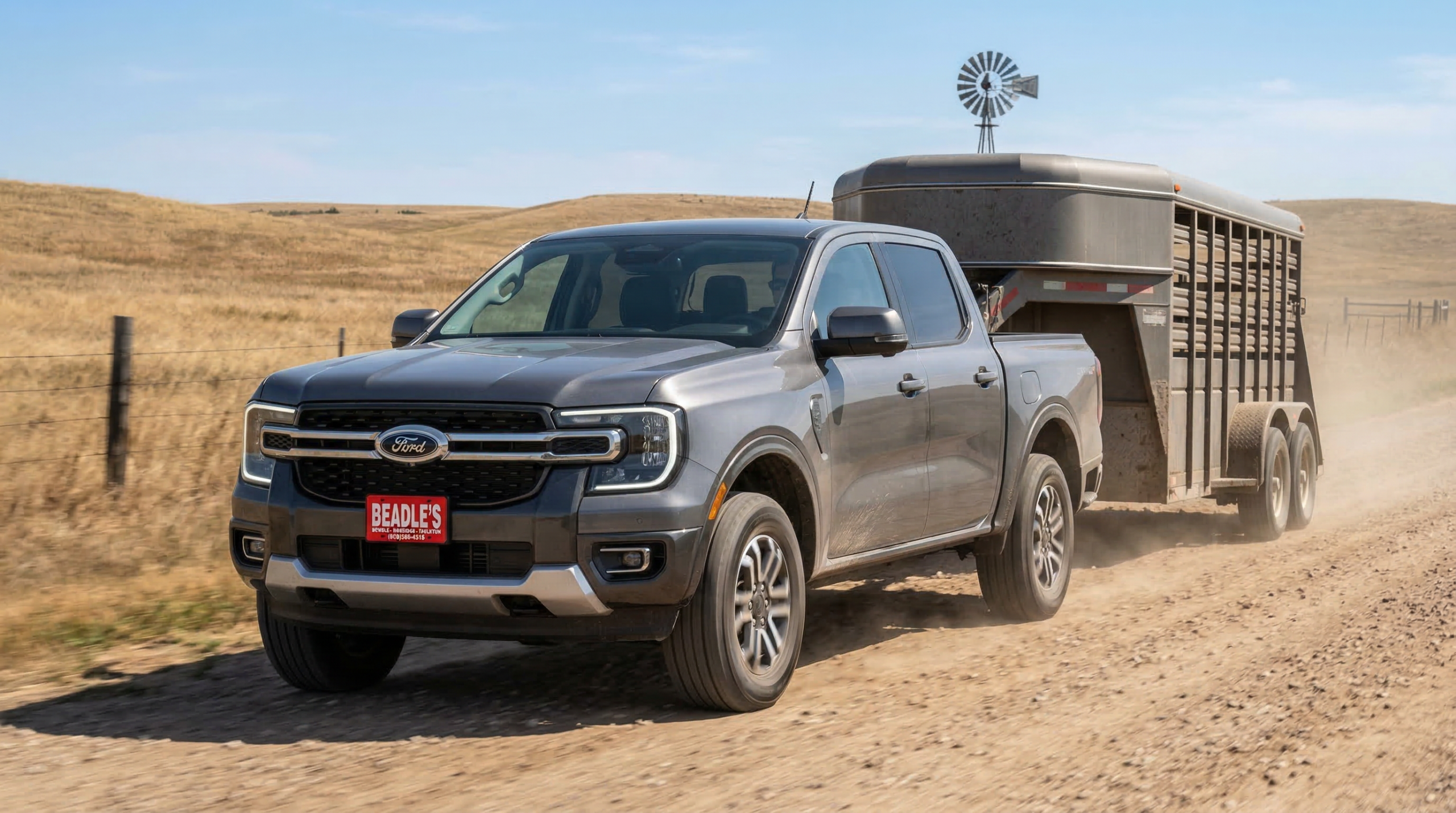
2026 Ford Ranger XLT towing a pontoon boat at the Lake Oahe boat ramp in South Dakota

If you’re hauling a boat to Lake Oahe, pulling a livestock trailer across gravel roads, or packing a travel trailer for a Black Hills trip, the number that matters most is towing capacity — and the 2026 Ford Ranger has a story worth knowing. Not just one number. A few of them, depending on which engine you pick, whether you tow with a hitch or the bumper, and whether the Raptor is even on your radar. This guide breaks all of it down in plain terms so you can answer the real question: can the Ranger tow what you need to tow?

Quick note before we get into it: towing is one area where nothing changed for 2026 — same figures as 2025, same packages, same ratings. So if you’ve been researching the Ranger for a while, this data is current and confirmed.

The Numbers: Towing Capacity by Engine and Drivetrain

The 2026 Ford Ranger offers three engine options across its trim lineup. Two of them — the 2.3L EcoBoost® I4 and the 2.7L EcoBoost® V6 — deliver the same maximum towing rating. The third is the Raptor-exclusive 3.0L, which is tuned for off-road performance and tows a different number entirely. All figures are SAE J2807 certified and require proper equipment.

Configuration Max Towing GCWR
2.3L EcoBoost® I4 — 4×2 up to 7,500 lbs 12,370 lbs
2.3L EcoBoost® I4 — 4×4 up to 7,500 lbs 12,590 lbs
2.7L EcoBoost® V6 — 4×4 up to 7,500 lbs 12,745 lbs
3.0L EcoBoost® V6 — Raptor 4×4 up to 5,510 lbs 11,465 lbs

All max towing figures require the Trailer Tow Package and proper setup per Ford’s towing guidelines. Figures rated to SAE J2807.

What Is GCWR — and Why Does It Matter?

GCWR stands for Gross Combined Weight Rating — the maximum allowable weight of your fully loaded truck plus your fully loaded trailer combined. It’s the number that protects your drivetrain, brakes, and frame from being overloaded even when your trailer alone is within the max towing limit.

Here’s a practical example: say you’re towing a 6,800 lb loaded horse trailer with a 2.3L 4×4 Ranger. That’s within the 7,500 lb tow limit. But if your truck is fully loaded with gear, fuel, passengers, and payload, you’ll want to add those weights together and confirm the total stays under 12,590 lbs. Most drivers never get close — but on a long haul with a packed cab and a loaded trailer, it’s worth checking.

The Raptor’s GCWR of 11,465 lbs is lower than the other configurations, which is one reason its max trailer rating sits at 5,510 lbs rather than 7,500 lbs. More on that below.

The Trailer Tow Package: You Need It to Reach 7,500 lbs

Without the Trailer Tow Package, the Ranger’s maximum towing capacity drops to 3,500 lbs — bumper-pull only. That’s enough for a small utility trailer, a personal watercraft, or a light single-horse trailer, but it won’t get you to the 7,500 lb figure most people are asking about.

The Trailer Tow Package adds a Class IV trailer hitch receiver and wiring harness, which enables the full 7,500 lb rating and increases the allowed frontal trailer area from 30 sq ft to 55 sq ft. Frontal area matters because a tall, wide trailer creates more aerodynamic drag — the package accounts for that additional load on the powertrain and cooling system.

Tongue Load Limits — Know These Before You Hitch Up

Tongue load is the downward force the trailer puts on your hitch ball. Too little and the trailer sways. Too much and you stress the rear suspension.

Hitch receiver (with Trailer Tow Package): up to 750 lbs

The rule of thumb is to keep tongue weight between 10–15% of total trailer weight. On a 6,000 lb trailer, that’s 600–900 lbs — so you’d want to load toward the lighter end for the Ranger.

2026 Ford Ranger Lariat towing a livestock trailer on a South Dakota ranch road

Real Trailers, Real Numbers: What Can You Actually Pull?

Spec sheets are one thing. Knowing whether your actual trailer fits those specs is another. Here’s a look at common trailers around Bowdle and the surrounding area and where they land against the Ranger’s ratings.

Trailer Type Typical Loaded Weight Ranger (w/ Tow Pkg)
16–18 ft pontoon boat + trailer 3,500–5,500 lbs ✓ Handles it
Single-horse or 2-horse bumper-pull trailer 3,000–5,000 lbs loaded ✓ Handles it
Livestock trailer (2–3 head cattle) 4,500–6,500 lbs loaded ✓ Within range
Mid-size travel trailer 4,000–6,500 lbs ✓ Within range
Larger travel trailer / toy hauler 7,000–10,000+ lbs ⚠ Exceeds rating
Enclosed car/equipment trailer varies widely Confirm loaded weight

For the trip from Bowdle down to the Badlands or out to the Black Hills with a loaded travel trailer, the Ranger’s 7,500 lb ceiling comfortably handles most smaller-to-mid travel trailers. Once you’re looking at larger trailers in the 8,000–10,000 lb range, you’ll want to be looking at a full-size truck like the F-150 instead.

What About the Raptor? Why It Tows Less

The Raptor’s towing capacity of up to 5,510 lbs when properly equipped is lower than the other Ranger configurations — and that’s by design, not a weakness. The Raptor is built around a different mission: high-speed off-road capability. It runs on a long-travel suspension setup with live-valve Fox Racing Shox that’s tuned for absorbing rough terrain at speed, not for maximum towing geometry.

The 3.0L EcoBoost® V6 in the Raptor makes 405 hp and 430 lb-ft of torque — more output than the other two engines — but that power is optimized for rock crawling and Baja-style driving, not fifth-wheel pulling. The shorter GCWR (11,465 lbs) reflects the overall system’s tow-optimized limits relative to its suspension and frame tuning.

Bottom line: if towing is your primary use case, the XLT or Lariat with the Trailer Tow Package is the smarter configuration. The Raptor’s 5,510 lb limit handles a pontoon boat or a horse trailer just fine — it’s just not the right tool if you’re regularly running at or near the 7,500 lb ceiling.

2026 vs. 2025: Towing Didn’t Change

If you’ve been cross-referencing 2025 and 2026 Ranger specs trying to find a difference in towing — there isn’t one. The 7,500 lb max, the GCWR figures, the bumper-pull limit, the tongue load specs — all identical to 2025. Ford updated a number of other things for 2026 (new color, FX4 availability changes, SiriusXM tier upgrade, Power Moonroof added), but towing capacity was not touched.

That’s actually a good thing — 7,500 lbs is near the top of the midsize truck segment, and there’s no structural reason Ford would need to change it. The platform has plenty of capability left for most real-world towing jobs.

Towing on Soft Ground: Where the FX4 Package Helps

Getting a trailer out of a muddy boat ramp or pulling up a loose gravel access road to a hunting spot is a different kind of challenge than highway towing. That’s where the FX4 Off-Road Package earns its place in a towing conversation.

The FX4 Package adds an electronic rear locking differential, which locks both rear wheels to the same rotational speed when you need maximum traction. At a boat ramp where one rear tire is in loose sand and the other is on wet concrete, the e-locker prevents the truck from spinning the easy wheel and losing momentum. It makes a meaningful difference in low-traction departure situations — the kind that happen all the time around Lake Oahe.

For a deeper look at everything the FX4 adds, the FX4 Off-Road Package guide covers every component and who actually needs it.

Towing FAQ

Does the 2026 Ford Ranger need the Trailer Tow Package to tow 7,500 lbs?
Yes. Without the Trailer Tow Package, the Ranger’s maximum towing capacity is 3,500 lbs — bumper-pull only. The Trailer Tow Package adds the Class IV hitch receiver and wiring needed to reach the 7,500 lb rating.
Is the 2.7L V6 significantly better for towing than the 2.3L four-cylinder?
Both engines cap at the same 7,500 lb max towing rating, so on paper they’re equal. The 2.7L makes 315 hp and 400 lb-ft of torque vs. 270 hp and 310 lb-ft for the 2.3L — so you’ll feel more effortless power at highway speeds and on grades with the V6. If you’re regularly towing near the top of the range, the 2.7L is the more comfortable choice.
What is the payload capacity of the 2026 Ranger?
The 2026 Ford Ranger has a payload capacity of up to 1,788 lbs on 4×2 models and up to 1,711 lbs on 4×4 models. Payload includes passengers, cargo in the bed, and gear in the cab — everything the truck carries, not what it pulls. Your specific truck’s payload limit is on the sticker inside the driver’s door.
Can the Raptor tow a boat or horse trailer?
Yes — the Raptor can tow up to 5,510 lbs when properly equipped, which covers a pontoon boat, a 2-horse trailer, or a mid-size travel trailer. It won’t reach the 7,500 lb figure of the other configurations due to its off-road-tuned suspension and frame setup, but it’s not a no-tow vehicle by any stretch.
Did towing capacity change from 2025 to 2026?
No. Towing capacity is identical between the 2025 and 2026 Ford Ranger across all configurations. The 7,500 lb max for non-Raptor models with the Trailer Tow Package, the 5,510 lb Raptor rating, the GCWR figures, and the tongue load limits are all unchanged.

Key Takeaways

  • The 2026 Ford Ranger tows up to 7,500 lbs when properly equipped — same on the 2.3L I4 and 2.7L V6
  • The Raptor tows up to 5,510 lbs — intentionally lower due to its off-road suspension tuning
  • Without the Trailer Tow Package, maximum towing drops to 3,500 lbs bumper-pull only
  • GCWR accounts for the combined weight of truck and trailer — always check it, not just the tow limit
  • Max tongue load is 750 lbs (hitch) — stay in the 10–15% range of your total trailer weight
  • The FX4 e-locker improves traction on boat ramps, muddy fields, and loose-surface departure situations
  • Towing figures are identical to 2025 — no change for 2026
  • All figures rated to SAE J2807 — the industry standard for consistent towing measurement

For most of what people around Bowdle are actually pulling — boats, horse trailers, livestock loads, a travel trailer to Custer or Wall Drug — the 2026 Ranger with the Trailer Tow Package sits comfortably in range. The 7,500 lb ceiling is one of the highest ratings in the midsize segment, and the 2.7L V6 makes that capacity feel effortless rather than strained.

At Beadle Ford in Bowdle, I can walk you through the trim and package combination that makes the most sense for what you’re hauling. If you want to see how trim choice affects your towing setup options, the full 2026 Ranger overview breaks down the complete lineup.

— Lexy Tabbert, Beadle Ford
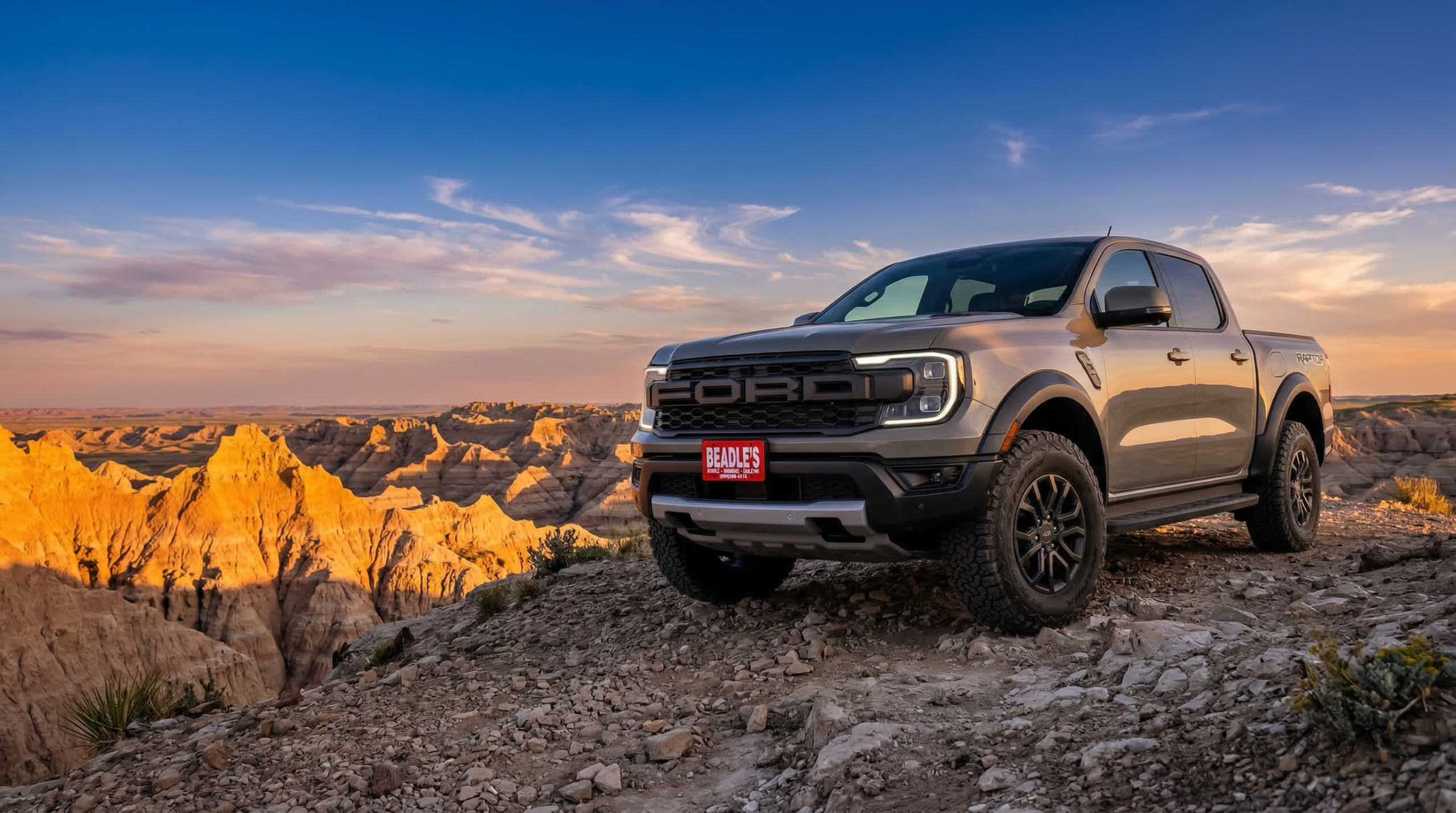
2026 Ford Ranger Raptor parked on a Badlands overlook in South Dakota at sunset

Four trim levels. Three engines. Multiple drivetrain configurations. Choosing the right 2026 Ford Ranger isn’t complicated once you know what each level actually includes — but the overlap between XLT and Lariat trips up a lot of buyers, and the Raptor is its own category entirely.

This guide breaks down every trim from XL through Raptor: what’s standard, what’s available, how the drivetrain options compare, and which configuration makes the most sense for buyers in central South Dakota.

What are the 2026 Ford Ranger trim levels?

The 2026 Ranger comes in four trim levels: XL, XLT, Lariat, and Ranger Raptor. They are not equally spaced in what they offer. XL is the work-truck baseline. XLT is where most buyers land and where the biggest value jump happens. Lariat adds comfort, technology, and the V6 option. The Ranger Raptor is a purpose-built off-road variant that doesn’t compete with the other three — it’s a different vehicle for a different buyer.

Every Ranger is a SuperCrew: four full-size doors, a 128-inch wheelbase, and a 5-foot bed. There is no SuperCab option for this generation.

What does the 2026 Ranger XL include?

The XL is the work-first configuration. It comes with the 2.3L EcoBoost® I4 (270 hp, 310 lb-ft torque), cloth seating, a 10-inch SYNC 4A touchscreen, an 8-inch digital instrument cluster, steel wheels with hub covers, and a reverse camera. It is available in both 4×2 and 4×4.

What the XL doesn’t include at the base level: Ford Co-Pilot360™ driver assist (available as an option), heated seats, power-adjustable driver’s seat, or a 12-inch touchscreen. It gets the job done without extras — which is exactly what a lot of ranch and work-truck buyers want.

New for 2026: FX4 Off-Road Package is now available on the XL. That means buyers can get a base-trim Ranger with an electronic-locking rear differential, skid plates, and Trail Control™ without paying for XLT features they don’t need. The 2.3L is the only engine on XL — no V6 option at this trim.

What does the 2026 Ranger XLT include?

XLT is the high-volume trim for good reason. The high-series XLT build (301A) adds a significant amount over XL at a reasonable price step: Ford Co-Pilot360™ driver assist as standard equipment, heated front seats, a power-adjustable driver’s seat, a 12-inch SYNC 4A touchscreen, and dual-zone electronic automatic temperature control (DEATC). It also adds a power-sliding rear window.

The 2.7L EcoBoost® V6 (315 hp, 400 lb-ft torque) becomes available on XLT — but only in 4×4 configuration. If you want the V6, you’re going 4×4. That’s not a downside in South Dakota, but it’s worth knowing before you spec the truck.

FX4 Off-Road Package is available on XLT in both 2.3L and 2.7L configurations. The optional new power moonroof is also available on XLT for 2026 — the first time it’s been offered on this Ranger generation. For a deeper look at what the FX4 package actually includes, the FX4 Off-Road Package guide covers every component.

2026 Ford Ranger XLT driver view looking down an open South Dakota highway

What does the 2026 Ranger Lariat include?

The Lariat is the comfort-and-capability tier. It adds ActiveX upholstered seating (Ford’s leather-alternative — new for 2026, replacing leather), a 12-inch digital instrument cluster, zone lighting, ambient interior lighting, a Bang & Olufsen Premium Sound System, and standard Adaptive Cruise Control with Speed Sign Recognition. Technology features that are packaged options on XLT — including the 360-degree camera — are standard on Lariat.

The Lariat carries both the 2.3L EcoBoost® I4 and the 2.7L EcoBoost® V6 as options. The V6 is available in 4×4 only at this trim. FX4 and the optional power moonroof are both available on Lariat.

If you’re comparing XLT and Lariat, the Lariat is primarily an interior upgrade — better sound, better instrumentation, leather-alternative seating, and standard technology features. If those comfort and tech differences matter to you in daily use, Lariat is worth the step up. If you’re mostly using this as a work or tow truck, XLT gets you almost everything that matters at a lower price.

What makes the 2026 Ranger Raptor different from every other trim?

The Ranger Raptor is not a trim upgrade — it’s a different truck. It uses a purpose-built 3.0L EcoBoost® V6 producing 405 horsepower and 430 lb-ft of torque. It rides on Fox Live Valve position-sensitive shock absorbers with a Watts-link rear suspension. It has Baja and Rock Crawl drive modes that don’t exist on any other Ranger trim. It comes standard with everything the FX4 package adds to other trims — and then well beyond.

It is also 4×4 only, and it tows less than a standard Ranger — up to 5,510 lbs when properly equipped, compared to 7,500 lbs on non-Raptor trims. That lower tow rating reflects its off-road-optimized axle ratio (4.27 vs. 3.73 on other trims) and heavier suspension hardware. It is not a tow truck. It is not a daily hauler. It is a performance off-road vehicle that happens to have a 5-foot bed.

The Raptor also gets Raptor-specific interior features: performance seats, Raptor badging, unique instrument cluster graphics, and the 3.0L-exclusive powertrain display. If dedicated off-road performance is the priority and towing isn’t, this is the trim. For everyone else, the right comparison is XL, XLT, or Lariat.

Which Ranger trims come in 4×2 vs. 4×4?

The 2026 Ranger’s drivetrain availability depends on trim and engine. Here’s the full picture:

Trim Engine 4×2 4×4
XL 2.3L I4 only Yes Yes
XLT 2.3L I4 Yes Yes
XLT 2.7L V6 No Yes (only)
Lariat 2.3L I4 Yes Yes
Lariat 2.7L V6 No Yes (only)
Raptor 3.0L V6 only No Yes (only)

If getting the 2.7L V6 is a priority, you are committing to 4×4 — it is not available any other way. For most South Dakota buyers, that’s not a concern. For the handful who want the V6 purely for towing on flat terrain and would prefer to save the 4×4 premium, the 2.3L in 4×2 is the only path. For the full breakdown of towing capacity by engine and configuration, see the 2026 Ranger towing guide.

Which 2026 Ranger trim is the best value for South Dakota buyers?

For buyers in the Bowdle area — where the truck sees a mix of gravel roads, highway miles, ranch work, and seasonal weather — the XLT with the 2.7L V6 and FX4 Off-Road Package is the configuration that keeps coming up as the right answer. You get the safety and comfort step-up from Co-Pilot360 and heated seats, the torque advantage of the V6 for towing, and the e-locker and skid plates for the county section roads and spring mud conditions that are part of regular driving here.

Quick Buyer Guide

XL — Best for: work trucks, fleet buyers, buyers who want FX4 at entry-level pricing. No V6, no Co-Pilot360 standard.

XLT — Best for: most buyers. Big comfort and safety step-up from XL; V6 available; FX4 available; new moonroof option available.

Lariat — Best for: buyers who want a more premium interior, better audio, and standard tech without stepping into the Raptor tier. V6 and FX4 available.

Raptor — Best for: buyers whose primary use case is off-road performance. Not for towing-first buyers — tow rating is lower than all other trims.

Key Takeaways

  • Four trim levels: XL (work-first), XLT (best all-rounder), Lariat (comfort + tech), Raptor (off-road performance)
  • The 2.7L V6 is available on XLT and Lariat in 4×4 only — choosing the V6 means choosing 4×4
  • The 3.0L V6 is exclusive to the Ranger Raptor and is not available on any other trim
  • FX4 is available on XL, XLT, and Lariat for 2026 — new on XL this year
  • The Raptor tows less (up to 5,510 lbs when properly equipped) than all other trims (up to 7,500 lbs when properly equipped)
  • The power moonroof is a new 2026 option available on XLT and Lariat only
  • Lariat switches from leather to ActiveX seating for 2026
  • For most Bowdle-area buyers, XLT with the 2.7L V6 and FX4 is the practical sweet spot

Frequently Asked Questions

What’s the difference between XLT Standard and XLT High?

XLT is offered in two build packages. The standard XLT (300A) is the lower build, which includes the base XLT content. The high-series XLT (301A) adds Ford Co-Pilot360™, heated front seats, a power-adjustable driver’s seat, a 12-inch SYNC 4A touchscreen, dual-zone climate control, and a power-sliding rear window. Most buyers shopping XLT are comparing against the high-series build — that’s where the significant comfort and safety upgrades live.

Can I get the 2.7L V6 on the XL trim?

No. The 2.7L EcoBoost® V6 is available on XLT and Lariat only. The XL is 2.3L I4 exclusively. If the V6 is a priority, the starting point is XLT.

Is Ford Co-Pilot360 standard on all Ranger trims?

Ford Co-Pilot360™ is standard on XLT (high-series build) and above. On the base XL, it is available as an optional package. It is not standard on the base XL. Co-Pilot360 includes Pre-Collision Assist with Automatic Emergency Braking, BLIS with Cross-Traffic Alert and Trailer Coverage, Lane-Keeping System, Auto High-Beam Headlamps, Rear Parking Sensors, and Reverse Brake Assist.

Does the Lariat come with the 360-degree camera standard?

Yes. The 360-degree camera is standard on the Lariat. On XLT, it is available through an advanced tow or technology package. On XL, it is not available. If a 360-degree camera is important for trailer positioning or tight-space maneuvering, that’s one reason to consider Lariat over XLT.

What wheels does each Ranger trim come with?

XL comes standard with steel wheels. XLT with the Sport Package gets 17-inch gray-painted aluminum wheels; the optional 18-inch Chrome PVD aluminum wheel is now available standalone on XLT for 2026. Lariat comes with 18-inch machined aluminum wheels with dark-painted pockets. The Raptor uses 17-inch gray-painted aluminum Raptor-specific wheels with LT285/70R17 all-terrain tires.

My Take on the 2026 Ranger Trim Lineup

When buyers come into Beadle Ford in Bowdle and ask where to start with the Ranger, I usually ask two questions: do you need to tow regularly, and how much of your driving is on gravel or off-pavement? Those two answers narrow it down fast. If the answer to both is yes — and for most folks in this region, it is — the XLT with the 2.7L V6 and FX4 is where the conversation ends up. It covers the towing, it covers the terrain, and it does it without paying Lariat prices for interior upgrades you might not need on a work truck.

The Lariat makes a lot of sense for buyers who split time between hauling and highway driving — the B&O sound, ambient lighting, and ActiveX seating matter more if this is also your daily driver. The XL with FX4 is the right spec for anyone who wants a capable ranch truck without the price of the XLT feature set. And the Raptor is for a specific buyer who prioritizes off-road performance above everything else, including towing capacity.

The complete picture of what each trim includes — including engine and drivetrain availability — is on the 2026 Ford Ranger overview page. If you want to talk through which trim fits your situation before you drive, give us a call or stop by Beadle Ford in Bowdle.

About the Author

Lexy Tabbert — Beadle Ford, Bowdle, SD

Lexy Tabbert covers Ford vehicles, trim comparisons, and buyer guidance for Beadle Ford in Bowdle, South Dakota. Her content is grounded in real buyer conversations with families, ranchers, and ag operators across the Bowdle region and central South Dakota. Learn more about Lexy.

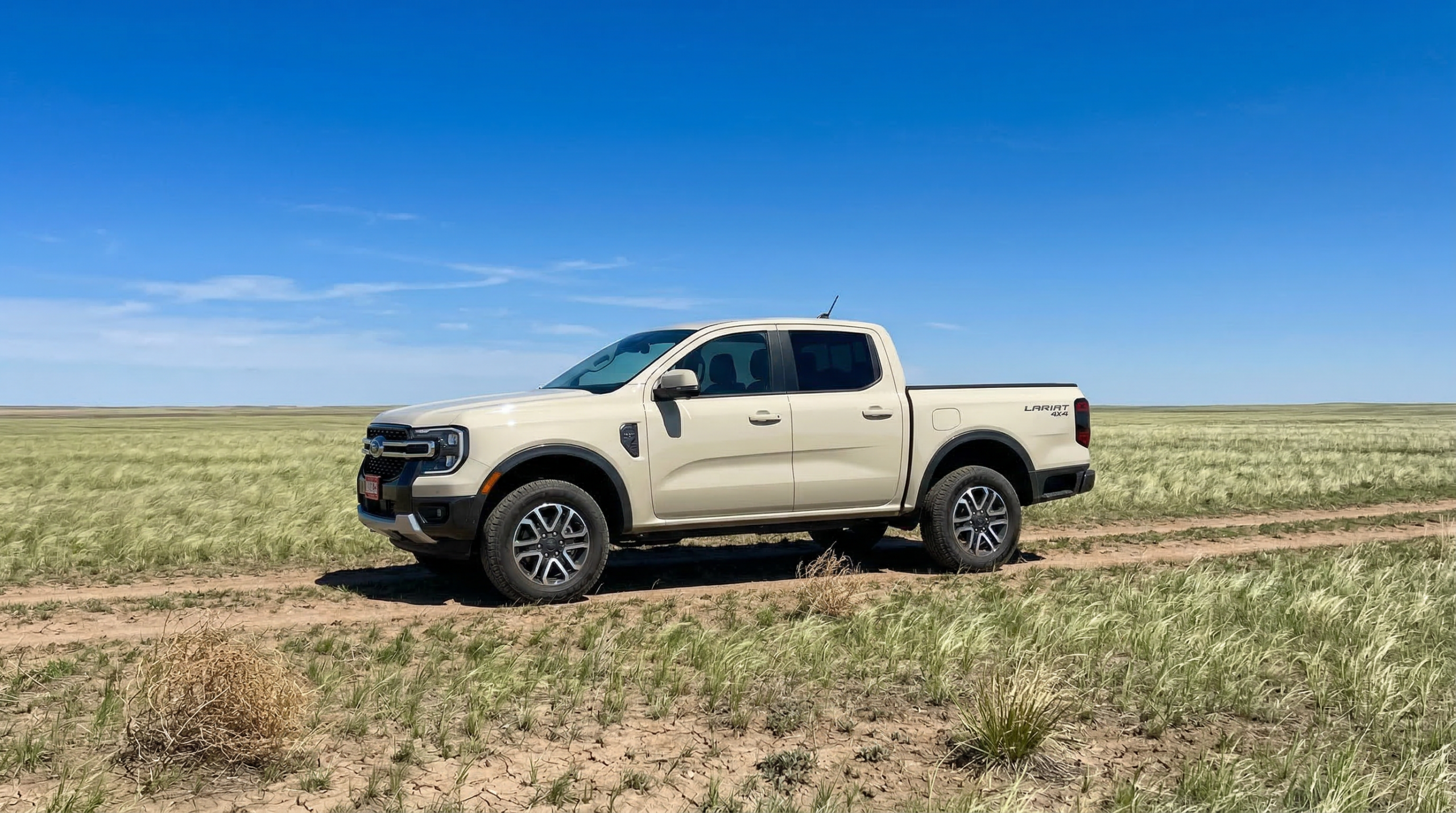
2026 Ford Ranger Lariat in Avalanche color on open South Dakota prairie landscape

Every year when a new model rolls out, the first question is the same: did anything actually change? For the 2026 Ford Ranger, the honest answer is yes — and a couple of those changes are more significant than the typical annual refresh. There’s a new exterior color, a first-ever option for this Ranger generation, an expanded off-road package, and a handful of refinements across packages, technology, and interior materials.

This guide covers every confirmed change from 2025 to 2026 — new color, new options, package updates, seating changes, and tech upgrades. It also covers the one big topic that didn’t change: towing.

What actually changed on the 2026 Ford Ranger?

The 2026 Ranger updates fall into four categories: color, options, packages, and interior. No powertrain changes, no towing changes, no new body style. Here’s the full picture at a glance.

What Changed 2025 2026
Exterior color Azure Gray available Avalanche added; Azure Gray removed
Moonroof Not available Optional on XLT and Lariat
FX4 availability XLT and Lariat only XL, XLT, and Lariat
Lariat seating Leather ActiveX (leather-alternative)
SiriusXM tier Standard satellite 360L on-demand + satellite
Chrome Accent Package Available on XLT Lariat only
18″ Chrome PVD wheels (XLT) Part of a package Available standalone
Black Appearance Graphics Not available New package option
Towing capacity Up to 7,500 lbs when properly equipped Unchanged

Everything in the table above is confirmed for 2026. These changes apply across the lineup as noted — some are trim-specific, some are package-level. Full details on each are in the sections below.

Did the 2026 Ranger get a new exterior color?

Yes. Avalanche is a new color for 2026, and Azure Gray has been removed from the palette. If you were considering the Ranger in Azure Gray, that option is no longer available — Avalanche is the new addition in its place.

The rest of the color lineup carries over from 2025. Confirm current color availability on the window sticker or with Beadle Ford directly, as dealer allocation can vary by model year and region.

Is there finally a moonroof option on the Ranger?

Yes — and this is a legitimate first. An optional power moonroof is available on XLT and Lariat trims for 2026. This is the first time Ford has offered a moonroof option on this generation of the Ranger. It is not available on the base XL or the Ranger Raptor.

For buyers who’ve been waiting on a Ranger with a sunroof, 2026 is the year it arrived. Out here in central South Dakota where the sky is the best thing about the drive, it’s an option that actually makes sense.

Is the FX4 Off-Road Package available on more trims for 2026?

Yes — FX4 is now available on the XL trim for 2026. In 2025, the FX4 Off-Road Package was limited to XLT and Lariat. That changes with 2026, making FX4 accessible across all three non-Raptor trim levels: XL, XLT, and Lariat.

This matters for buyers who want the FX4 hardware — electronic-locking rear differential, skid plates, Trail Control™, and off-road-tuned shocks — without moving up to XLT pricing. The FX4 package itself is unchanged; it’s just now available one rung lower. To see how these changes play out across each trim level, the 2026 Ranger trim breakdown has the full picture.

2026 Ford Ranger XLT parked beside South Dakota wheat fields during harvest sunset

What changed on the 2026 Ranger Lariat?

Two changes are specific to the Lariat for 2026. First, seating material switches from leather to ActiveX upholstery. ActiveX is Ford’s leather-alternative material — it offers a similar appearance and is designed to be easier to clean and more consistent in temperature extremes, which matters in South Dakota winters and summers alike. This is a direct material substitution, not a feature addition or removal.

Second, the Chrome Accent Package is no longer available on XLT for 2026 — it’s now a Lariat-only option. If you were planning to add chrome accent trim to an XLT, that configuration is not available on the 2026 model year.

What other updates came with the 2026 model year?

A few additional changes round out the 2026 update:

SiriusXM upgraded to 360L. The 2026 Ranger upgrades SiriusXM from the standard satellite tier to the 360L on-demand service, which combines traditional satellite broadcasting with on-demand streaming. A 3-year 360L subscription plan is now an optionable add-on.

18″ Chrome PVD wheels available standalone on XLT. The 18-inch Chrome PVD aluminum wheel is now available as a standalone option on XLT, rather than requiring it as part of a larger package. This gives XLT buyers more flexibility when configuring the truck.

New Black Appearance Graphics package. A Black Appearance Graphics add-on is a new option for 2026, providing a blacked-out exterior accent treatment for buyers who prefer that look.

New dealer-installed options are also available for 2026, including an Illuminated Ford Oval, Jump Starter, Tool Kit, Windshield Sunscreen, and roll-up tonneau cover options — practical add-ons that can be configured before delivery.

Did the 2026 Ranger’s towing capacity change?

No. Towing capacity on the 2026 Ford Ranger is identical to 2025. Non-Raptor trims with the Trailer Tow Package are rated at up to 7,500 lbs when properly equipped. The Ranger Raptor is rated at up to 5,510 lbs when properly equipped. Bumper-only towing without the Tow Package remains 3,500 lbs. Package requirements are unchanged.

This is worth stating clearly because it’s a common assumption that spec sheets change annually. For towing, the 2026 Ranger is spec-for-spec identical to 2025. If you’re making a towing decision, the full breakdown of capacity by engine configuration, package requirements, and GCWR is covered in the 2026 Ranger towing guide.

Key Takeaways

  • Avalanche is a new exterior color for 2026; Azure Gray has been removed
  • A power moonroof is available for the first time on this Ranger generation — XLT and Lariat only
  • FX4 Off-Road Package is now available on the XL trim, expanding availability to XL, XLT, and Lariat
  • Lariat switches from leather to ActiveX seating for 2026 — same category, different material
  • SiriusXM upgraded to the 360L on-demand tier; 3-year subscription plan now optionable
  • Chrome Accent Package moved from XLT to Lariat-only for 2026
  • 18″ Chrome PVD wheels are now available as a standalone option on XLT
  • Black Appearance Graphics is a new 2026 package option
  • Towing capacity is completely unchanged from 2025 — up to 7,500 lbs when properly equipped on non-Raptor trims

Frequently Asked Questions

Did Ford change the Ranger’s engines for 2026?

No. All three engine options carry over unchanged from 2025: the 2.3L EcoBoost® I4 (270 hp, 310 lb-ft), the available 2.7L EcoBoost® V6 (315 hp, 400 lb-ft), and the Raptor-exclusive 3.0L EcoBoost® V6 (405 hp, 430 lb-ft). All pair with a 10-speed automatic transmission. Drivetrain availability by trim is also unchanged.

Is Azure Gray still available on the 2026 Ranger?

No. Azure Gray has been removed from the 2026 Ranger color lineup and replaced by Avalanche. If Azure Gray was your planned color, you would need to find a remaining 2025 model or choose a different 2026 color.

What exactly is ActiveX upholstery on the 2026 Lariat?

ActiveX is Ford’s leather-alternative seating material. It is designed to approximate the appearance and feel of leather while offering easier cleaning and more consistent performance across temperature extremes — a practical consideration in a climate like South Dakota’s. It replaces genuine leather on the 2026 Lariat but retains the same heated and ventilated seat functionality.

Can I get the moonroof on the 2026 Ranger Raptor?

No. The optional power moonroof is available on XLT and Lariat trims only. It is not available on the base XL or the Ranger Raptor.

Did any of the 2026 changes affect towing or payload ratings?

No. Towing ratings, payload ratings, GCWR values, and package requirements are all identical to the 2025 Ranger. None of the 2026 updates — color, moonroof, FX4 availability, seating material, or SiriusXM tier — affect the truck’s rated capabilities.

My Take on the 2026 Ranger Updates

The question I hear at Beadle Ford in Bowdle more than almost any other is: “Is the new model year worth waiting for, or should I just buy the one on the lot?” For the 2026 Ranger, my honest answer is: it depends on what matters to you. If you’ve been holding out for a moonroof on a Ranger — that’s a real upgrade, and it’s the first time it’s been available on this generation. If you’ve been eyeing an XL and wanted FX4 capability without jumping to XLT pricing, that’s also a meaningful change.

For buyers focused primarily on towing — pulling a camper out to the Badlands for a long weekend, or hauling livestock equipment — there’s no functional reason to wait. The 2026 Ranger tows the same as 2025. The package setup is the same. The numbers haven’t moved.

These updates are best understood alongside the full picture of what this truck offers year-round — the complete 2026 Ford Ranger overview covers trims, engines, towing, and features in one place. If you want to talk through which configuration fits your situation, stop by or give Beadle Ford a call — we’re here to help you find the right truck, not just sell you the newest one.

About the Author

Lexy Tabbert — Beadle Ford, Bowdle, SD

Lexy Tabbert covers Ford vehicles, trim comparisons, and buyer guidance for Beadle Ford in Bowdle, South Dakota. Her content is grounded in real buyer conversations with families, ranchers, and ag operators across the Bowdle region and central South Dakota. Learn more about Lexy.

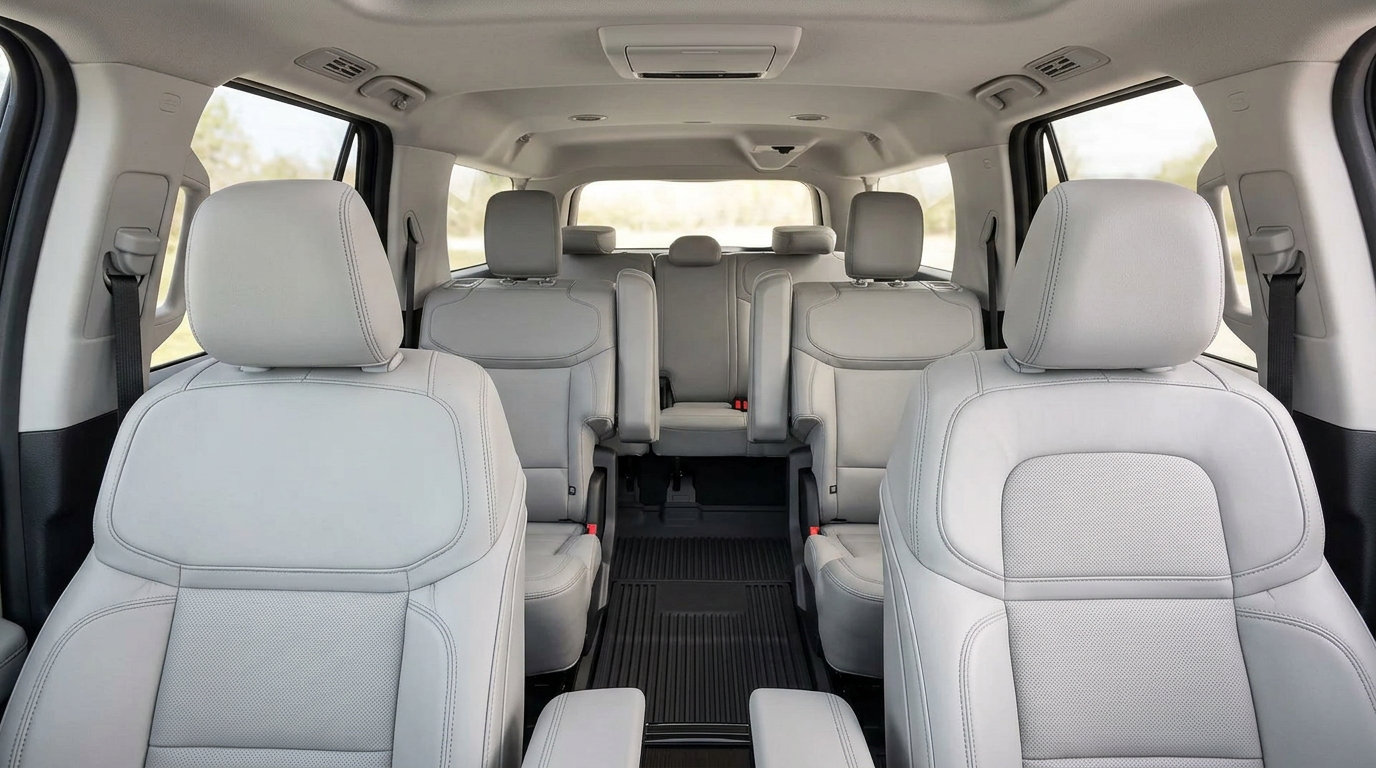
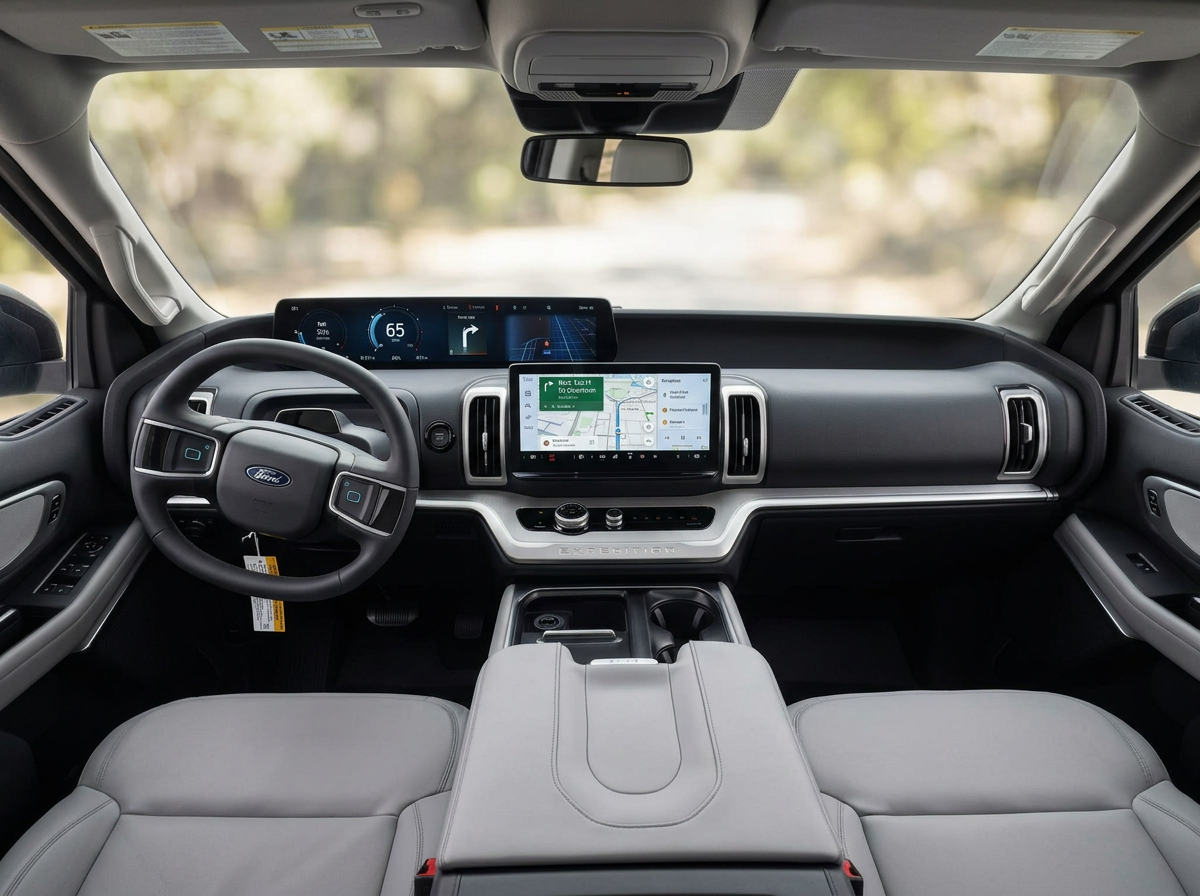
2026 Ford Expedition three-row interior with full seating

The 2026 Ford Expedition’s interior is where the trim decisions really show up — seat material, second-row configuration, third-row fold behavior, cargo access, and power options all vary meaningfully across the lineup. Getting them wrong means living with the wrong vehicle for years.

This guide walks through every confirmed interior spec from the 2026 Expedition Order Guide — seating configurations by trim, second-row and third-row options, the Ford Split Gate, and the cargo and storage details that matter most for real-life family and work use.

Seating configurations by trim — what’s standard and what’s optional?

The 2026 Expedition seats 7 or 8 depending on second-row choice. Not every trim offers both options — King Ranch® is captain’s chairs only, with no bench available at any price. Here’s the full picture from the order guide.

Trim Standard 2nd Row Optional 2nd Row Seating
Active Select (200A) 40/20/40 bench — cloth, manual fold No captain’s chairs available 8-passenger
Active Touring (202A) Power-fold captain’s chairs — ActiveX® 40/20/40 power-fold bench (21F) 7 std / 8 opt
Tremor® (501A) Power-fold captain’s chairs — leather-trimmed, heated 40/20/40 power-fold bench (21F) 7 std / 8 opt
Platinum (600A) Power-fold captain’s chairs — heated leather-trimmed 40/20/40 power-fold bench (21F) — not with Stealth pkgs 7 std / 8 opt
King Ranch® (400A) Power-fold captain’s chairs — Del Rio leather, perforated inserts Bench NOT available 7-passenger only

If you need 8 passengers — confirm before you order

King Ranch® does not offer the 8-passenger bench — at any price, in any package. If 8-seat capacity is a requirement, the King Ranch® is not the right trim. Active Select (200A) is the only trim where 8-passenger is standard. Platinum bench requires the 21F option and is not available with the Stealth Appearance or Stealth Performance packages.

Bench vs. captain’s chairs in the second row — which is right for your family?

This is the interior question most buyers wrestle with — and the answer depends entirely on how you use the vehicle.

40/20/40 Second-Row Bench

Best for:

  • Families needing 8 seats reliably
  • Three kids across the second row (car seat friendly)
  • Situations where center passenger is regular, not occasional
  • Buckets-to-back-yard hauling with a wide flat floor when folded

Tradeoffs:

  • Less easy third-row access — no aisle between seats
  • Center seat is narrow for adults on long trips
  • On Active Select: cloth only, manual fold

Second-Row Captain’s Chairs

Best for:

  • Easier third-row access — walk-through aisle
  • Families where rear adults want individual space
  • Car seat installations where second-row independence matters
  • Higher trim levels where the captain’s chairs come heated

Tradeoffs:

  • 7 passengers vs. 8 — one fewer seat
  • Tip-and-slide required for third-row access in some configs

The 40/20/40 CenterSlide® bench on the Active Select uses a unique design — the center section slides side to side to allow access to the third row without folding the full bench. On the Touring 202A and above with captain’s chairs, an aisle opens completely between the seats for straightforward third-row boarding. The practical difference matters most when you’re helping kids buckle in or loading adults into row three regularly.

2026 Ford Expedition dashboard and front row interior

How does the third row work — and is it actually usable for adults?

The Expedition’s third row folds flat on all trims and is power-operated on most. The fold mechanism, recline capability, and head restraint behavior all vary by trim. Here’s what the order guide confirms for each.

Trim 3rd Row Fold Recline Head Restraints Layout
Active Select (200A) 60/40 PowerFold® — flat Power Recline Manual 60/40
Active Touring (202A) 60/40 PowerFold® — flat Power Recline Manual (vinyl) 60/40 std; 40/20/40 opt (21Y)
Tremor® (501A) PowerFold® — flat Power Recline Remote power-folding 40/20/40 — Flexible Seating
Platinum (600A) PowerFold® — flat Power Recline Power-folding head restraints 40/20/40 — Luxury Vinyl
King Ranch® (400A) PowerFold® — flat Power Recline Remote power-folding 40/20/40 Del Rio leather

Third Row Flexible Seating (21Y) — Active Touring only option

The Active Touring (202A) offers Third Row Flexible Seating (option 21Y) which converts the standard 60/40 split into a 40/20/40 configuration. This adds a center pass-through position, allowing a third-row passenger to sit in the center section independently. Available as an add-on; standard on Tremor®, Platinum, and King Ranch®.

Adult usability in the third row depends on the driver and passenger seat positions as much as the vehicle itself. The Expedition offers more third-row headroom and legroom than most three-row crossovers — it’s a body-on-frame SUV with a larger interior envelope — but taller adults will feel the constraint on longer trips.

Power-folding head restraints (Tremor® and King Ranch®) are a practical upgrade — they allow the third-row seat backs to fold flat without first manually folding down the head restraints from the cargo area. On the Active, manual head restraints require reaching over the seat to fold them before the seat will flatten. Small detail, big quality-of-life difference when you’re reconfiguring the cargo area regularly.

What is the Ford Split Gate — and how does it actually help?

The Ford Split Gate replaces the traditional single liftgate with a two-piece system: the upper three-quarters lifts like a conventional hatch, and the lower quarter drops down like a tailgate. Both sections are power-operated on all trims. It’s standard across the entire 2026 Expedition lineup.

Upper power liftgate

Opens the upper portion for full cargo access. Hands-free proximity open available on Touring (202A) and above — approach with the fob and it opens automatically. Active Select (200A) requires a button press.

Lower power tailgate

Drops down and functions as a loading platform or tailgate bench. Rated to hold up to 500 lbs — usable as a seat at a tailgate, loading dock for heavy gear, or step to reach items in the back of the cargo area. The optional Cargo Tailgate Manager accessory turns this lower section into a configurable organizer with dividers and bins.

The practical difference from a traditional liftgate: in a tight parking spot or garage where you can’t swing the full liftgate up, you can access the cargo area through the lower tailgate without opening the upper section at all. The upper section also opens without requiring the lower tailgate to be down — useful in weather where you don’t want snow or rain blowing into the cargo area while loading.

The “Open On Approach” feature — available on Active Touring (202A) through King Ranch® — reads proximity from your fob and opens the upper liftgate automatically when you approach from behind. Useful when your hands are full with gear. The lower tailgate must still be opened separately.

Cargo space and interior storage — what does the 2026 Expedition actually hold?

The Expedition’s body-on-frame construction and full-size SUV architecture gives it substantially more interior volume than three-row crossovers. Second and third rows fold completely flat when not in use.

Expedition (SWB)

~20 cu. ft.

behind 3rd row

~65 cu. ft.

3rd row folded

~108 cu. ft.

all rows folded flat

Expedition MAX

~35 cu. ft.

behind 3rd row

~80 cu. ft.

3rd row folded

~123 cu. ft.

all rows folded flat

Cargo volumes are manufacturer-published specifications. All rows fold flat on both wheelbases.

Interior storage features — confirmed from order guide

Flex Powered Console

Standard on Active Touring (202A), Tremor®, Platinum, and King Ranch®. An adaptable center console that adjusts position and configuration for different use scenarios. Includes a console vault accessory option (61J) on trims where the Flex Powered Console is present — not available on Active Select (200A).

Third-Row Storage Bins

Standard on Active Select (200A). Deleted when the XL fleet third-row PowerFold® seat is installed. Provides small item storage accessible from the third row.

360-Degree Zone Lighting

Standard on Active Touring (202A) and above. Illuminates the cargo area, running boards, and exterior zones around the vehicle — useful for loading and unloading in low-light conditions. Roof-Rail Perimeter Lighting adds to this on Platinum Ultimate Package (17A).

Pro Power Onboard™ — 400W

Standard on Active Touring (202A), Platinum (600A), and King Ranch® (400A). Provides two 120V outlets — one in the console and one in the cargo area — for powering tools, appliances, or charging gear without an inverter. Useful for tailgating, camp setups, or job sites.

Cargo Tailgate Manager (DIO — dealer-installed)

Available as a dealer-installed accessory on all trims. Converts the Split Gate lower tailgate into an organized surface with dividers, nets, and tie-downs for managing smaller items without them sliding in the cargo area. Pairs particularly well with the Split Gate’s 500-lb load rating.

Seat materials and comfort features by trim

Seat material, heating, ventilation, and adjustment range all vary significantly by trim. Here’s what’s confirmed from the order guide for each package.

Active Select (200A)

  • Row 1: Cloth captain’s chairs — 10-way power driver (tilt, lumbar, recline), 8-way power passenger
  • Row 2: Cloth 40/20/40 CenterSlide® bench — manual recline
  • Row 3: Cloth 60/40 PowerFold® — power recline, manual head restraints
  • No seat heating standard; no ventilation

Active Touring (202A)

  • Row 1: ActiveX®-trimmed captain’s chairs — 10-way power driver with memory, 8-way power passenger, heated
  • Row 2: ActiveX®-trimmed power-fold captain’s chairs with tip-and-slide
  • Row 3: Vinyl 60/40 PowerFold® — power recline, manual head restraints
  • Front row heated standard; no ventilation

Tremor® (501A)

  • Row 1: Leather-trimmed with perforated inserts (Tremor® logo on seatback) — 10-way power driver with memory, heated and ventilated
  • Row 2: Leather-trimmed power-fold captain’s chairs with armrests — heated
  • Row 3: Vinyl 40/20/40 — power recline, remote power-folding head restraints
  • Front row heated and ventilated; second row heated

Platinum (600A)

  • Row 1: Leather-trimmed with perforated inserts — 10-way power driver with memory, heated and ventilated
  • Row 2: Heated leather-trimmed power-fold captain’s chairs with armrests
  • Row 3: Luxury Vinyl 40/20/40 with perforated inserts — power recline, power-folding head restraints
  • Platinum Ultimate Package (17A) upgrades Row 1 to multi-contour luxury leather seats

King Ranch® (400A)

  • Row 1: Del Rio leather — 10-way power driver with memory, heated and ventilated, power lumbar and recline
  • Row 2: Del Rio leather power-fold captain’s chairs with perforated inserts, armrests, tip-and-slide
  • Row 3: Del Rio leather 40/20/40 — power recline, remote power-folding head restraints
  • All three rows leather. Front and second row heated. Front row ventilated.
  • 22-speaker B&O® Unleashed audio standard

Ambient Lighting — Platinum and King Ranch® only

Platinum (600A) and King Ranch® (400A) include ambient interior lighting with seven color options — illuminating all door panels above the armrest and the instrument panel. Not available on Active or Tremor®.

Frequently Asked Questions

Does the 2026 Expedition have heated and ventilated seats?

Front row heated seating is standard on Active Touring (202A) and above. Front row ventilation is standard on Tremor®, Platinum, and King Ranch®. Second-row seat heating is standard on Tremor®, Platinum, and King Ranch®. The Active Select (200A) does not include heated seats as standard — it is the entry-level cloth configuration.

Can the 2026 Expedition seat 8 passengers on the King Ranch®?

No. Per the 2026 Expedition Order Guide, the King Ranch® (400A) is captain’s chairs only in the second row — there is no 8-passenger bench option available at any price on this trim. The bench seat option (21F) is available on Active Touring, Tremor®, and Platinum (with package restrictions). If 8-passenger seating is a requirement, you’re looking at Active Select (8-passenger standard) or Active Touring / Tremor® / Platinum with the 21F option.

Does the third row fold flat?

Yes — on all trims. The third row is a power-fold operation (PowerFold®) on all 2026 Expedition configurations, folding completely flat to the floor. On Active Select, manual head restraints must be folded down first before the seat will flatten. On Tremor® and King Ranch®, remote power-folding head restraints handle this automatically, allowing the entire third row to fold with one action from the cargo area.

What is the Ford Split Gate — is it standard?

Yes — the Ford Split Gate is standard on all 2026 Expedition trims. It’s a two-piece liftgate: the upper section opens like a conventional power hatch, and the lower section drops down like a tailgate rated to 500 lbs. Both sections are power-operated. The hands-free “Open On Approach” upper liftgate feature is available on Active Touring (202A) and above.

Does the 2026 Expedition have a wireless charging pad?

No. Per the 2026 Expedition Order Guide, the wireless charging pad was removed from the 2026 lineup. Charging is through USB-C ports distributed across all three rows. Trims with the Digital Device Holder (Tremor®, Platinum, King Ranch®) include 60W USB-C ports built into the front seat backs for second-row device charging.

What is the 40/20/40 Third Row Flexible Seating option?

The standard third-row layout on Active trims is a 60/40 split — two sections, no center pass-through. The Third Row Flexible Seating option (21Y) on Active Touring (202A) changes this to a 40/20/40 configuration, adding a narrow center section that can be used as an independent seat or a pass-through between the two outboard positions. This is standard on Tremor®, Platinum, and King Ranch®.

My Take on the 2026 Expedition Interior

The interior conversation that comes up most at Beadle Ford is the bench-vs-captain’s-chairs decision — and honestly, I push back a little when buyers assume they want captain’s chairs just because they’re on the higher trims. If you have three kids, someone usually ends up in the center of the second row regardless, and the bench makes that more comfortable and keeps you at 8 passengers. Captain’s chairs are the right call when third-row access is a daily event.

The power-folding head restraints on Tremor® and King Ranch® are one of those features that sounds minor on paper and becomes something you appreciate every time you use it. Loading a truck bed or cargo area after every game or practice means that seat goes up and down more than you think. Not having to reach over and manually fiddle with head restraints before it’ll flatten — that matters.

For anything on current inventory, trim availability, or how to spec the right interior for your situation, reach out to us at Beadle Ford or browse the full 2026 Expedition overview.

About the Author

Lexy Tabbert — Beadle Ford, Bowdle, SD

Lexy Tabbert covers Ford vehicles, trim comparisons, and buyer guidance for Beadle Ford in Bowdle, South Dakota. Her content is grounded in real buyer conversations with families, ranchers, and ag operators across the region.

2026 Ford Expedition SYNC 4 dashboard with 24-inch panoramic display

The 2026 Ford Expedition arrives with one of the most complete technology packages in its class — a 24-inch panoramic display, Google built in, 5G connectivity, and a suite of driver-assist features that start on the base trim and expand significantly as you move up. But the feature that generates the most questions from buyers is BlueCruise: what it actually does, which trims include it, and what it costs after the trial ends.

This guide breaks down every technology and safety feature on the 2026 Expedition — what’s standard, what’s trim-specific, and what matters most for families driving long stretches of South Dakota highway.

What is the Ford Digital Experience — and what does it actually include?

The Ford Digital Experience is the name for the 2026 Expedition’s full cockpit and infotainment system. It pairs two displays — a 24-inch panoramic instrument cluster and a 13.2-inch center touchscreen — into one integrated interface. Both are standard across all 2026 Expedition trims, including the base Active.

24″ Panoramic Display

Driver-facing instrument cluster. Fully customizable — change layouts, gauge styles, and information shown. Steering wheel controls navigate menus without leaving the wheel. Haptic touchpads on either side of the steering wheel provide context-sensitive control for audio, cruise, BlueCruise, and menu navigation.

13.2″ Center Stack Display

Primary infotainment touchscreen. Runs Google software natively — Google Assistant, Google Maps, and Google Play Store are built in. Wireless Apple CarPlay® and Android Auto™ standard. Pinch-to-zoom capability, and the system supports video streaming and web browsing when parked.

What the Ford Digital Experience includes on all trims:

Feature Status
24″ panoramic instrument displayStandard — all trims
13.2″ center stack touchscreenStandard — all trims
Google Assistant, Google Maps, Google Play StoreStandard — all trims
Wireless Apple CarPlay® and Android Auto™Standard — all trims
911 Assist®Standard — all trims
SiriusXM with 360L (3-month prepaid)Standard — all trims
Ford Connectivity Package (1-year included)Standard — all trims (1-yr trial)
5G Wi-Fi hotspot (unlimited, during connectivity plan)Included with connectivity plan
Over-the-air (OTA) software updatesStandard — all trims

Connectivity Plan Note

The Ford Connectivity Package (5G, hotspot, streaming, video conferencing) is included free for one year from the warranty start date and requires activation via the Ford app with credit card authorization. After one year, a paid plan or one-time 7-year purchase (65B) is required to continue. Google services require the 1-year complimentary plan to remain active; they function on the included trial period. See ford.com for current subscription pricing.

What connectivity comes standard on the 2026 Expedition?

5G connectivity is standard across all trims through the included 1-year Ford Connectivity Package. For buyers who want it long-term without annual subscriptions, the 7-year one-time purchase (option 65B) is available at order time on all trims. USB ports are distributed across all three rows — the exact count varies by trim.

Trim USB Ports (C+C) Notable Connectivity
Active Select (200A) Row 1: 2 smart charging + 2 charging Google, wireless CarPlay/AA, SiriusXM 3-mo.
Active Touring (202A) Row 1: as above + cargo area C+C port Pro Power Onboard™ 400W (console + cargo)
Tremor® (501A) Row 1: media bin + main bin; Row 2: 2; Row 3: 2; Cargo: 1 Digital Device Holder w/ 60W USB in front seat backs
Platinum (600A) Row 1: media bin + main bin; Row 2: 2; Row 3: 2; Cargo: 1 Digital Device Holder standard; UGDO; B&O 10-speaker
King Ranch® (400A) Same as Platinum Digital Device Holder standard; B&O Unleashed 22-speaker

The Digital Device Holder — included standard on Tremor®, Platinum, and King Ranch® — provides a dedicated mounting solution with 60W USB-C charging integrated into the front seat backs. Note: the Digital Device Holder and Rear Seat Entertainment (18E) are mutually exclusive on Tremor®, Platinum, and King Ranch® — you can have one or the other, not both.

2026 Ford Expedition at sunset near Lake Oahe South Dakota

How does BlueCruise work — and which trims include it?

BlueCruise is Ford’s hands-free highway driving system. On qualified stretches of divided highway — called Blue Zones — the system handles steering, speed, and lane centering. The driver must remain attentive with eyes on the road; an interior camera monitors driver attention and will disengage the system if it detects inattention.

What BlueCruise does on the 2026 Expedition

  • Hands-free steering, braking, and acceleration in Blue Zones on divided highways
  • Lane Change Assist — tap the turn signal to initiate a hands-free lane change
  • In-Lane Repositioning — subtly shifts away from large vehicles in adjacent lanes
  • Adaptive Cruise Control with Stop & Go — maintains following distance in traffic
  • Lane Centering — keeps the vehicle centered within the lane
  • Driver monitoring — interior camera required; will escalate alerts and disengage if driver is inattentive

BlueCruise availability by trim — from the 2026 Expedition Order Guide

Trim BlueCruise Status Critical Notes
Active Select (200A) Not available No BlueCruise on base Select package
Active Touring (202A) Optional — must order at purchase Hardware must be ordered at time of vehicle order (55B or 55C). Vehicle will never be BlueCruise capable if not ordered at purchase.
Tremor® (501A) 90-Day Trial standard Hardware pre-installed. Trial included; subscription required after trial.
Platinum (600A) — retail 90-Day Trial standard Included with retail orders; fleet orders require separate option.
Platinum Ultimate Package (17A) 1-Year + 90-Day Trial included Longer initial period included with the 17A package.
King Ranch® (400A) 1-Year + 90-Day Trial standard Hardware pre-installed; 1-year + 90-day included. Subscription after.

Active Touring buyers — critical ordering note

Per the 2026 Expedition Order Guide: on the Active Touring (202A), BlueCruise hardware must be ordered at time of vehicle purchase — option 55B (1-year + 90-day plan) or 55C (one-time purchase, 7-year minimum). If neither option is selected at order, the vehicle will never be capable of BlueCruise functionality. This cannot be added later. If BlueCruise matters to you, confirm it is on the window sticker before signing.

For South Dakota buyers who regularly drive I-90, US-12, or US-83, BlueCruise delivers real-world value on those long straight highway stretches — particularly on family road trips or multi-hour hauls where driver fatigue is a genuine factor. The Tremor® and King Ranch® come with hardware pre-installed and trials included, making them the most straightforward entry points for BlueCruise.

What does Ford Co-Pilot360® include as standard on every 2026 Expedition?

Ford Co-Pilot360® Assist 2.0 is standard on every 2026 Expedition, starting with the base XL/Active. This is a comprehensive set of active safety and driver-assist features — not a basic bundle. The list below reflects what is confirmed standard from the order guide.

✓ 360-Degree Camera with Lane Change Preview
✓ Rear View Camera with Rear Camera Wash
✓ Adaptive Cruise Control (Stop & Go)
✓ Lane Centering
✓ Predictive Speed Assist
✓ Auto High Beams
✓ BLIS® (Blind Spot Information System)
✓ BLIS® with Cross-Traffic Alert
✓ BLIS® with Trailer Coverage (HDTT)
✓ Front and Rear Parking Sensors
✓ Lane-Keeping Alert
✓ Lane-Keeping Assist
✓ Driver Alert
✓ Road Edge Protection
✓ Pre-Collision Assist with Automatic Emergency Braking
✓ Pedestrian Detection
✓ Forward Collision Warning
✓ Dynamic Brake Support
✓ Post-Collision Braking
✓ Reverse Brake Assist
✓ Pro-Trailer Hitch Assist
✓ Pro-Trailer Backup Assist
✓ Hill Descent Control™ (4×4 only)
✓ Hill Start Assist
✓ Perimeter Alarm / Securilock PATS
✓ Rear Seat Occupant Alert
✓ SOS Post-Crash Alert System™
✓ Personal Safety System™ (dual-stage airbags, belt pretensioners)

Co-Pilot360® Active 2.0 — additional features on select trims

The Active 2.0 package adds Intersection Assist and is included on Active Touring (202A) when BlueCruise is ordered, on Platinum (retail orders), and standard on King Ranch®. It also activates Power Tilt/Telescoping Steering Column with Memory when included.

Active 2.0 is a driver-assist supplement — it is incremental to the standard Co-Pilot360® features listed above, not a replacement for them.

Safety and ADAS features by trim — what upgrades as you move up?

The full Co-Pilot360® Assist 2.0 suite is standard across all trims. Differences between trims relate primarily to BlueCruise access, suspension tuning, and the addition of rear seat entertainment vs. Digital Device Holder options.

Feature Active Select Active Touring Tremor® Platinum King Ranch®
Full Co-Pilot360® Assist 2.0
Co-Pilot360® Active 2.0 (Intersection Assist) w/BlueCruise Retail std.
360-Degree Camera
BlueCruise hands-free highway driving Opt (order time) 90-day trial 90-day trial 1yr + 90-day
Adaptive suspension (CCD) Pkg req’d
Digital Device Holder (60W USB in seat backs)
Rear Seat Entertainment (optional) Opt (not w/DDH) Opt (not w/DDH) Opt (not w/DDH)
Rock Crawl mode / Trail Turn Assist
360-Degree Zone Lighting 202A only

What audio systems are available?

The Expedition’s audio scales from a standard system on the Active up to the 22-speaker Bang & Olufsen® Unleashed system on King Ranch®. Both B&O systems include Beosonic™ — a customizable sound experience with four sound spaces and five pre-set modes.

Active Select / Active Touring — Standard System

AM/FM Stereo, six speakers, SiriusXM with 360L (3-month), speed-compensated volume. Functional for daily use; an upgrade path is available via SiriusXM 3-year plan (67B).

Platinum (600A) — B&O® Sound System, 10 Speakers + Subwoofer

B&O Sound System by Bang & Olufsen®. 10 speakers including subwoofer. Beosonic™ customizable sound experience: four sound spaces (Bright, Energetic, Relaxed, Warm), five pre-set modes (Custom, Lounge, Neutral, Party, Podcast). HD Radio included.

King Ranch® (400A) — B&O® Unleashed Sound System, 22 Speakers + Subwoofer

B&O Unleashed Sound System by Bang & Olufsen®. 22 speakers including subwoofer. Same Beosonic™ customization as Platinum but with significantly more speaker count and coverage across all three rows. HD Radio included.

Note: The Tremor® uses the same standard audio platform as the Active — the off-road-oriented build trades the B&O upgrade for the high-output engine, lifted suspension, and off-road hardware.

Frequently Asked Questions

Does the 2026 Expedition have Apple CarPlay and Android Auto?

Yes — wireless Apple CarPlay® and Android Auto™ are standard on all 2026 Expedition trims. They operate through the 13.2-inch center display and require no cable connection.

Does the 2026 Expedition have BlueCruise?

It depends on the trim. BlueCruise is not available on the Active Select (200A). On the Active Touring (202A), it must be ordered at the time of vehicle purchase — the hardware cannot be added after the fact. Tremor® and Platinum include a 90-day trial standard; King Ranch® includes a 1-year + 90-day trial. All trims require a paid subscription after the included trial period. For full details, see the BlueCruise section above.

Does the 5G hotspot cost extra after the first year?

Yes — the Ford Connectivity Package (which includes the 5G hotspot, Google services, streaming, and voice assistant) is included free for one year from the warranty start date. After that, a paid subscription is required. Buyers who want to avoid ongoing subscriptions can order the 7-year one-time purchase plan (option 65B) at the time of vehicle order. This is available on all trims except fleet orders.

Can I add Rear Seat Entertainment if I also want the Digital Device Holder?

No. Per the 2026 Expedition Order Guide, the Digital Device Holder and Rear Seat Entertainment (18E) are mutually exclusive on Tremor®, Platinum, and King Ranch®. You can choose one or the other — not both. On Active, neither option is available.

Does the Expedition have over-the-air software updates?

Yes. The 2026 Expedition receives over-the-air updates when connected to Wi-Fi. Ford recommends enabling automatic updates on a recurring overnight schedule. OTA updates can deliver new features, safety improvements, and system refinements without a dealer visit. Updates are delivered at Ford’s discretion.

Does the 2026 Expedition have a wireless charging pad?

No — per the 2026 Expedition Order Guide, the wireless charging pad was deleted from the lineup for 2026. Charging is handled by USB-C ports distributed across all rows, with 60W USB-C ports available in the front seat backs on trims with the Digital Device Holder (Tremor®, Platinum, King Ranch®).

My Take on the 2026 Expedition’s Technology

The display setup genuinely impresses buyers who sit in the vehicle for the first time. A 24-inch panoramic instrument cluster sounds like a spec-sheet number until you’re actually behind the wheel — at that point it’s obvious Ford made a real architectural commitment here, not just a screen upgrade.

The BlueCruise ordering nuance on the Active Touring is the thing I walk every buyer through before they sign. It’s easy to miss on a spec sheet, and it’s the only technology decision on this vehicle that can’t be corrected after purchase. If you’re buying an Active Touring and you want BlueCruise — even someday — it has to be on the window sticker before the vehicle is ordered.

For the full picture on what’s available at each trim level, the 2026 Ford Expedition overview ties everything together. Come see us in Bowdle or reach out anytime.

About the Author

Lexy Tabbert — Beadle Ford, Bowdle, SD

Lexy Tabbert covers Ford vehicles, trim comparisons, and buyer guidance for Beadle Ford in Bowdle, South Dakota. Her content is grounded in real buyer conversations with families, ranchers, and ag operators across the region.

2026 Ford Expedition MAX extended wheelbase side profile

The 2026 Ford Expedition and Expedition MAX share the same engine, the same trim lineup, and the same core technology. The difference between them comes down to one thing: the MAX is about a foot longer, and that extra length changes what the vehicle can do for you day to day.

This guide walks through every meaningful difference — cargo space, towing, trim availability, seating, garage fit, and the one thing buyers often overlook — so you can decide which configuration actually fits your life.

Side-by-side specs: what actually changes between Expedition and Expedition MAX?

Most specs are identical — same engine, same horsepower, same axle options, same technology. The differences are limited to body dimensions, towing capacity, and one trim exclusion. Here’s everything in one table.

Expedition (SWB) Expedition MAX
Overall length ~210 in. ~221.9 in.
Engine 3.5L EcoBoost® V6 — identical on both
Standard horsepower 400 HP (standard) / 440 HP (High Output — Tremor® or optional Platinum packages)
Transmission 10-speed automatic with SelectShift® — identical on both
Max tow — 4×4 w/HDTT 9,600 lbs 9,000 lbs
Max tow — 4×2, no HDTT 6,000 lbs 6,300 lbs
Cargo — behind 3rd row 22.9 cu. ft. 37.4 cu. ft.
Cargo — all rows folded 108.5 cu. ft. 123.1 cu. ft.
Passenger seating 7 or 8 passengers — same on both
Tremor® available Yes — SWB only No
Active, Platinum, King Ranch® SWB and MAX SWB and MAX
Drivetrain options 4×2 or 4×4 (Active); 4×4 only (Tremor®, Platinum, King Ranch®)

Source note: Towing figures from Ford’s official 2026 Expedition Towing Guide (SAE J2807® method). Trim availability confirmed from the 2026 Expedition Order Guide. Exterior dimensions and cargo volumes are manufacturer-published specifications; fuel economy figures are TBD per the order guide and will be updated when EPA ratings are released.

How much more cargo space does the MAX actually add?

The ~12-inch longer body translates to approximately 15 additional cubic feet behind the third row — the space that matters most when all three rows are occupied and you still need to carry gear. With rows folded, the MAX adds roughly 15 cubic feet over the standard Expedition.

Expedition (SWB)

22.9 cu. ft.

behind 3rd row (all seats up)

108.5 cu. ft.

all rows folded flat

Expedition MAX

37.4 cu. ft.

behind 3rd row (all seats up)

123.1 cu. ft.

all rows folded flat

The difference behind the third row is significant. The standard Expedition offers around 23 cubic feet with all seats up — enough for a few bags and a cooler. The MAX jumps to 37.4 cubic feet, which means a full row of luggage, a large stroller, sporting equipment, or a week’s worth of gear without folding any seats.

What ~15 extra cubic feet behind row 3 actually holds

  • A full-size double stroller without folding
  • 3–4 large checked-bag-size rolling suitcases upright
  • Two large sporting equipment bags (hockey, lacrosse, wrestling)
  • A loaded dog crate (large breed) without encroaching on the third row
  • A week of groceries for a family of 7 — without Tetris

If your third row is occupied most of the time and you regularly carry cargo behind it — sports gear, strollers, hunting equipment, travel luggage — the MAX pays for itself in daily convenience. If your third row is folded more often than not, the additional cargo space is largely redundant because both vehicles provide an enormous flat floor when the seats are down.

2026 Ford Expedition on open South Dakota plains near Bowdle

Does the Expedition MAX tow less — and does it matter?

Yes — the MAX tows 600 lbs less than the SWB on the 4×4 configuration. Per Ford’s official 2026 Expedition Towing Guide, the SWB 4×4 with HDTT is rated at 9,600 lbs and the MAX 4×4 with HDTT is rated at 9,000 lbs. Both require the 3.73 rear axle and HDTT package to reach their respective maximums.

Configuration Max Tow GCWR
SWB 4×4 — 3.73 axle w/HDTT 9,600 lbs 15,900 lbs
MAX 4×4 — 3.73 axle w/HDTT 9,000 lbs 15,900 lbs
SWB 4×2 — 3.31 axle, no HDTT 6,000 lbs 12,000 lbs
MAX 4×2 — 3.31 axle, no HDTT 6,300 lbs 12,500 lbs

For most buyers in this region pulling a two-horse trailer, a bumper-pull camper, or a boat in the 5,000–8,500 lb range, both configurations are comfortably within their rated limits. The 600 lb difference only matters if you’re regularly towing near the absolute ceiling — say, a fully loaded four-horse LQ trailer pushing 9,000+ lbs.

For a full breakdown of all towing configurations, requirements, and real-world trailer scenarios, see the 2026 Expedition Towing Guide.

Which trims are available on each wheelbase?

The most important trim-availability difference: the Tremor® is only available on the standard wheelbase (SWB). If you want the Tremor®, you’re getting the standard Expedition — the MAX body is not available on that trim. All other trims offer both wheelbases.

Trim SWB Available MAX Available Notes
Active ✓ Yes ✓ Yes 4×2 or 4×4
Tremor® ✓ Yes ✗ Not available 4×4 only
Platinum ✓ Yes ✓ Yes 4×4 only
King Ranch® ✓ Yes ✓ Yes 4×4 only

The Tremor® exclusivity to the SWB is a meaningful constraint for buyers who want both off-road capability and maximum cargo space. That combination isn’t available in a single vehicle — a Tremor® buyer is getting the standard wheelbase, period. For full trim details, see the 2026 Expedition Trims & Packages guide.

2026 Ford Expedition three-row interior with all seats occupied

Is the passenger experience different in the MAX?

Passenger seating capacity is identical — both wheelbases seat 7 or 8 depending on second-row configuration. The extra length in the MAX goes to cargo space behind the third row, not to the passenger cabin itself. Third-row legroom and second-row space are the same in both.

Seating configurations — identical on SWB and MAX

  • Active Select (200A): 8-passenger bench standard, captain’s chairs optional
  • Active Touring (202A): 7-passenger captain’s chairs standard, 8-passenger bench optional
  • Tremor® (501A): 7-passenger captain’s chairs standard, 8-passenger bench optional — SWB only
  • Platinum (600A): 7-passenger captain’s chairs standard, 8-passenger bench optional (not available with Stealth packages)
  • King Ranch® (400A): 7-passenger captain’s chairs only — bench not available on either wheelbase

The key distinction: if you frequently carry 7 passengers and need cargo space behind the third row at the same time, the MAX is the vehicle for that use case. If you have 7 passengers occasionally and fold the third row most of the time, the standard Expedition’s 108 cubic feet of flat floor is more than adequate.

For car-seat families: both wheelbases offer the same LATCH anchor and tether coverage. The Expedition leads its class in lower anchor and top tether availability across all three rows — and that’s not changed by wheelbase selection.

Will the Expedition MAX fit in my garage?

This is the question that decides it for more buyers than they’d expect. The MAX at approximately 221.9 inches long is just over 18.5 feet. Many standard two-car garages are 20–22 feet deep, but clearance matters — you need room to walk around the vehicle and open the Split Gate liftgate fully.

Vehicle Length Min. Recommended Garage Depth
Expedition SWB ~210 in. (17.5 ft.) ~20 ft. with clearance
Expedition MAX ~221.9 in. (18.5 ft.) ~21–22 ft. recommended

Before you order a MAX

Measure your garage depth from the closed door to the back wall. Standard garage doors open overhead and reclaim 12–18 inches of that depth. If your actual usable depth is under 21 feet, the MAX may not give you comfortable clearance to fully open the liftgate. Measure first — don’t assume.

Parking lot and drive-through clearance is the same consideration. The MAX is noticeably longer in tight turns, multi-level parking structures, and ranch or farm lane situations. Most buyers adapt quickly, but if you regularly park in constrained environments, the SWB is the easier daily driver.

Which one should you choose?

The decision usually comes down to how you use the third row. Here’s a straightforward decision framework based on the real differences between these two vehicles.

Choose the Expedition MAX if:

  • Your third row is occupied regularly and you still need to carry cargo behind it
  • You have a large family (4+ kids) and routinely pack sports gear, strollers, or luggage
  • You take long road trips with all seats full and need space for a week of bags
  • You want Platinum or King Ranch® and the extra cargo is valuable to you
  • Your garage comfortably accommodates 22 feet or longer

Choose the standard Expedition (SWB) if:

  • You want the Tremor® — it’s only available on the SWB
  • Your third row is folded more often than occupied
  • You want maximum towing capacity (9,600 lbs vs. 9,000 lbs)
  • Your garage, parking, or daily route rewards a shorter footprint
  • You’re towing near the upper limit and need every pound of rated capacity

The honest summary

For most families in this part of South Dakota, the standard Expedition handles the daily load — including towing and cargo — without the added length. The MAX earns its premium when your third row is regularly occupied and cargo behind it matters. If you’re ever torn, come to Beadle Ford and spend 15 minutes actually loading your real gear into both. The right answer usually becomes obvious fast.

Frequently Asked Questions

What is the difference between the Expedition and Expedition MAX?

The Expedition MAX is the extended-wheelbase version of the standard Expedition — approximately 12 inches longer overall. That extra length adds roughly 15 cubic feet of cargo space behind the third row. Everything else — engine, transmission, seating capacity, trim options, and most dimensions — is shared between the two. The Tremor® off-road trim is the one exception: it’s available on the SWB only, not the MAX.

Does the Expedition MAX seat more passengers than the standard?

No — both wheelbases seat 7 or 8 passengers depending on second-row configuration. The extra length in the MAX goes to cargo space behind the third row, not to passenger room. Third-row and second-row space are the same in both vehicles.

Can I get the Tremor® in an Expedition MAX?

No. Per the 2026 Expedition Order Guide, the Tremor® is only offered on the standard wheelbase (SWB). There is no Expedition MAX Tremor®. Active, Platinum, and King Ranch® are all available on both wheelbases.

Is the MAX harder to drive and park than the standard Expedition?

The MAX is 12 inches longer, which is noticeable in tight turns, parking structures, and narrow lanes. Both vehicles come with a 360-degree camera and Pro Trailer Hitch Assist™ (with HDTT), which help significantly. Most buyers adapt to the size quickly. The practical concern is garage fit — if your garage is under about 21 feet deep, the MAX may be tight for liftgate clearance.

Which gets better fuel economy — the Expedition or Expedition MAX?

The 2026 Expedition’s official EPA fuel economy figures are listed as TBD in the Ford order guide at the time of this writing and will be updated when EPA ratings are released. Historically the standard SWB has rated slightly higher in city driving due to the lighter body; highway numbers have been essentially equivalent between the two. Check the window sticker for final EPA estimates on any specific vehicle.

How much more does the Expedition MAX cost than the standard?

Pricing varies by trim, configuration, and market. Contact Beadle Ford directly for current MSRP on specific configurations — we’ll pull the exact numbers on any build you’re considering. You can also browse current inventory at the link below.

My Take: SWB vs. MAX

When buyers ask me which one they should get, my first question is always: do you use that third row as actual seating, or as a shelf? If the answer is “mostly a shelf,” the standard Expedition is a cleaner choice — easier to park, rated for 600 more pounds of towing, and available in the Tremor® if off-road matters to you.

If you have four kids and at least two of them regularly ride in the third row, the MAX starts making real sense. Not because the third row is bigger — it isn’t — but because the cargo you need to carry with everyone aboard actually fits without a game of Tetris every time you leave the house.

Garage fit is the thing I remind buyers to check before they leave. I’ve had more than a few people order the MAX, fall in love with it, and then spend a weekend reorganizing their garage. Measure your depth, account for the door track overhead, and make sure you can open the liftgate all the way without hitting the back wall.

For the full picture on trim options, available packages, and what comes standard at each level, the 2026 Ford Expedition overview at Beadle Ford covers it all. Come see us in Bowdle or reach out — we’re happy to spec out both wheelbases side by side for you.

About the Author

Lexy Tabbert — Beadle Ford, Bowdle, SD

Lexy Tabbert covers Ford vehicles, trim comparisons, and buyer guidance for Beadle Ford in Bowdle, South Dakota. Her content is grounded in real buyer conversations with families, ranchers, and ag operators across the region.

Cookie Consent: By continuing to use this site you agree to our use of cookies.

Accept Learn More