

If you’re cross-shopping a 2027 Ford Expedition against a 2026 Jeep Wagoneer or Grand Wagoneer, you’re weighing two genuinely different takes on the full-size three-row SUV. The Wagoneer has real advantages — a 10,000-lb maximum tow rating on paper, available Quadra-Lift air suspension, and Jeep brand heritage. The Expedition counters with a factory off-road trim (the Tremor), a 440 hp High Output engine option, BlueCruise hands-free highway driving, and Ford’s more stable long-term dealer network across the Dakotas.
This guide covers the decisions that matter: whether the Wagoneer’s 10,000-lb tow figure translates to real-world advantage, how the cabins actually compare, what Stellantis’s recent reliability record means for a 5-to-7-year ownership horizon, how dealer networks and long-term service accessibility shake out in rural South Dakota, and which buyer should pick which truck.
On This Page
- Does the Wagoneer’s 10,000-lb tow rating actually matter in real use?
- Wagoneer vs. Expedition — which cabin feels more luxurious?
- Is Jeep reliability and resale catching up to Ford?
- What does dealer network stability look like across the Dakotas?
- Which buyers should pick the Expedition and who should try the Wagoneer?
Does the Wagoneer’s 10,000-lb tow rating actually matter in real use?
On a spec sheet, yes. In most real scenarios, it probably doesn’t. Jeep publishes a maximum trailer rating for the 2026 Wagoneer of approximately 10,000 lbs when properly equipped — the highest peak figure in this class. Public reporting on the current-generation Expedition Tremor cites approximately 9,600 lbs when properly equipped, pending the 2027 Ford Towing Guide release. That’s a 400-lb difference, which is meaningful if your trailer is right at the ragged edge of an Expedition’s rating, and immaterial otherwise.
Here’s the practical question. A 24-foot gooseneck loaded with two horses, a tandem-axle enclosed trailer for a side-by-side, or a standard tri-axle boat trailer for Lake Oahe all come in well under either truck’s rating. The trailers that need a 10,000-lb rating — and actually hit close to it — are a narrow set: long gooseneck livestock trailers loaded heavy, big dual-axle RVs, and some heavy utility trailers. If your actual trailer is one of those, the Wagoneer’s peak rating matters. If it isn’t, you’re buying a spec that doesn’t change your ownership.
Both trucks run twin-turbocharged engines: the Expedition’s 3.5L EcoBoost V6 (with a 440 hp / 510 lb-ft High Output variant available) and the Wagoneer’s 3.0L Hurricane twin-turbo inline-six (rated by Jeep at approximately 420 hp / 468 lb-ft, with a High-Output version on the Grand Wagoneer at approximately 510 hp / 500 lb-ft). The Expedition uses a 10-speed automatic; the Wagoneer uses an 8-speed. For typical South Dakota trailer work, either truck pulls confidently.
Where the Expedition adds practical value: Pro Trailer Hitch Assist and Pro Trailer Backup Assist are standard on every retail Expedition trim via Ford Co-Pilot360 Assist 2.0. BLIS with Trailer Coverage extends blind-spot monitoring around whatever you’re pulling. If you pull different trailers regularly, those assists matter more than a 400-lb peak rating difference. For more on Expedition towing, see the complete 2027 Ford Expedition overview.
Wagoneer vs. Expedition — which cabin feels more luxurious?
This one depends on the trim you’re comparing. A Grand Wagoneer Series III interior is genuinely premium — Palermo leather, real wood and aluminum trim, a 10-screen Uconnect-based multimedia setup with up to three displays on the front alone, and available Quadra-Lift air suspension that changes ride height for different driving modes. On material count and visual complexity, the Grand Wagoneer goes further than any Expedition trim.
The 2027 Expedition counters with a different philosophy. The Ford Digital Experience pairs a 24" panoramic driver display with a 13.2" center display — fewer total screens than the Grand Wagoneer, but better integrated. Google Maps, Google Assistant, and Google Play Store are embedded natively. Wireless Apple CarPlay and Android Auto work on every retail Expedition. The King Ranch interior uses Del Rio Premium leather with Mesa Antique armrests, Del Rio steering wheel with Norias stitching, and heritage badging that the Wagoneer’s more corporate-luxury approach doesn’t try to match. The Platinum with the 30th Anniversary Appearance Package has a more distinct visual identity than any Wagoneer trim, anchored by Blue Ember Metallic paint that’s exclusive to that package.
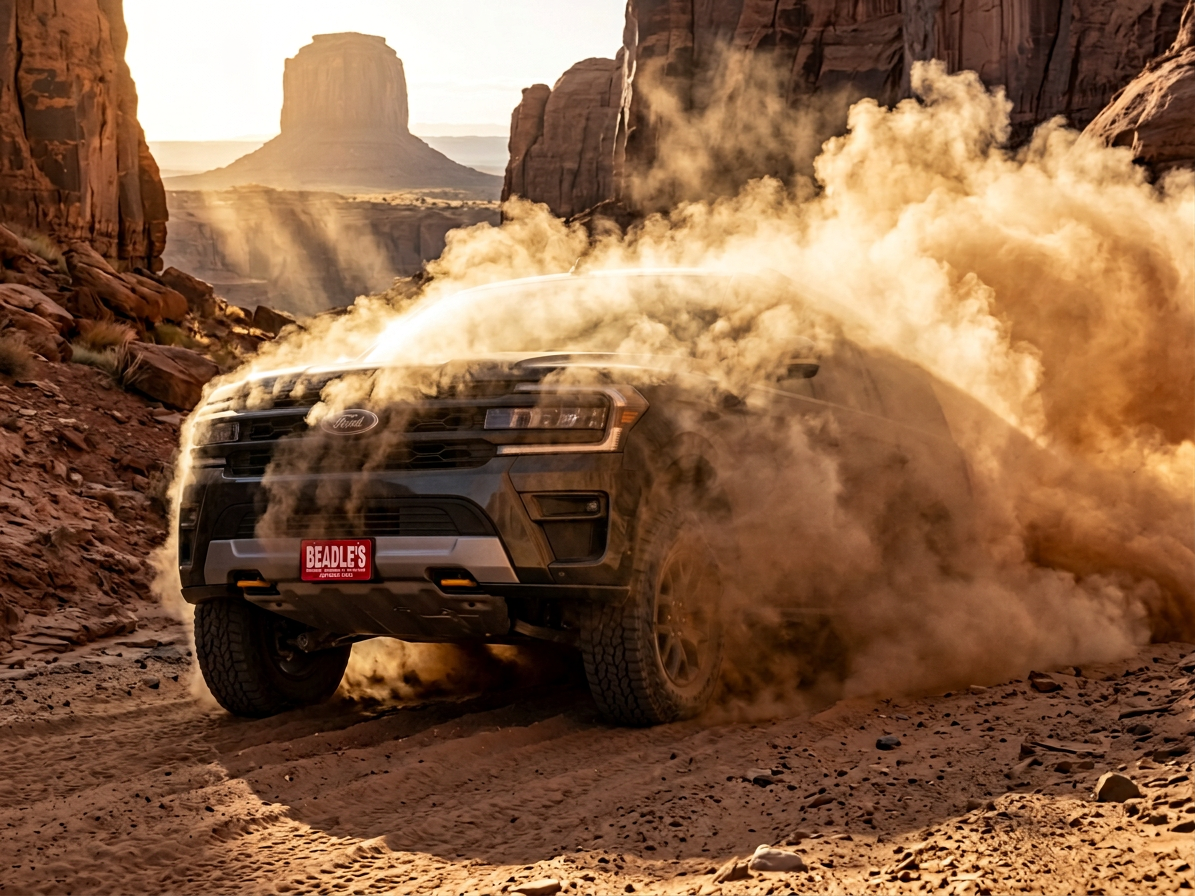
Where the Wagoneer genuinely wins on ride quality: the available Quadra-Lift air suspension delivers a smoother highway ride and better cornering behavior than the Expedition’s 4-wheel independent suspension on 22" wheels. For pure pavement comfort on long highway stretches, the air suspension is a real advantage. Where the Expedition wins: the Tremor’s off-road capability is a standalone trim with its own suspension, tires, locking differential, and drive modes — the Wagoneer doesn’t offer a direct factory off-road trim.
For the full Expedition trim lineup and which one matches which use case, see the 2027 Ford Expedition trim levels guide.
Ready to explore the Ford side?
Is Jeep reliability and resale catching up to Ford?
Both are narrowing, but the Wagoneer is still working from a harder starting point. The Wagoneer launched as a 2022 model year and the first two model years had documented quality issues — electronics problems, software glitches, fit-and-finish inconsistencies, and multiple recalls. Stellantis has worked to address these in 2024 and 2025 production, and more recent Wagoneer and Grand Wagoneer model years have shown improvement in third-party dependability data. The 2026 Wagoneer is a better-built vehicle than the 2022 was.
That said, the company-wide picture still matters. Stellantis-brand vehicles — which includes Jeep, Chrysler, Dodge, and Ram — have ranked below industry average on multiple recent J.D. Power and Consumer Reports dependability and reliability studies. Ford’s ranking has trended upward in those same studies over the past several years. Neither brand is immune to problems, but the trajectory lines for a 2022–2025 Stellantis vehicle versus a 2022–2025 Ford vehicle have gone in different directions.
Resale reflects the same story. Early-production Wagoneers (2022-2023) have seen meaningfully steeper depreciation curves than segment averages, partly because of the quality concerns and partly because Jeep over-produced initial inventory relative to demand. Expedition resale has been more stable, with the 6th-generation platform launched for 2025 still holding its value well into the used market. If you plan to trade or sell within 5 years, the resale gap compounds the initial-price comparison.
If you’re planning a longer ownership horizon — 7 to 10 years — the question shifts to service accessibility and long-term parts availability, which ties into the next section.
What does dealer network stability look like across the Dakotas?
For practical ownership in rural South Dakota, the dealer network question matters as much as the truck itself. Ford’s retail dealer network in the Dakotas has been stable for decades. Stellantis’s CDJR (Chrysler-Dodge-Jeep-Ram) network has contracted somewhat in recent years, with dealer consolidation and restructuring affecting service access in some rural markets. Not every small-town Jeep buyer has the same dealer they did five years ago.
Beadle Ford has been serving the Bowdle area for a long time. When you own a Ford, routine maintenance, recall work, warranty service, and emergency repairs happen locally. Techs who’ve been working on F-150s and Expeditions for years know the platforms. Ford parts availability through Ford’s national distribution is reliable. Over a 7-year ownership period, that consistency matters more than a 400-lb tow spec or a slightly different infotainment setup.
Stellantis has also navigated more software and electronics updates than Ford over the past several years. Wagoneer owners have reported more frequent dealer trips for software updates, infotainment diagnostics, and sensor-related recalls than is typical for the class. When those trips require driving farther than your daily commute, they accumulate into real hours of lost time.
If long-term service accessibility is a decision factor for you, that’s worth weighing honestly against the Wagoneer’s on-paper advantages.
Which buyers should pick the Expedition and who should try the Wagoneer?
Both trucks have defensible pitches. Here’s how I frame the decision for buyers walking into Beadle Ford.
Pick the 2027 Ford Expedition if:
- You want a factory off-road trim — the Tremor has no direct Wagoneer equivalent at the Expedition price point
- You want BlueCruise hands-free highway driving covering approximately 97% of controlled-access U.S. highways
- You want Pro Trailer Hitch Assist and Pro Trailer Backup Assist standard on every retail trim (not a trim-locked feature)
- You want the 24" panoramic driver display and Ford Digital Experience
- You want the 30th Anniversary Appearance Package with Blue Ember Metallic — Ford’s distinctive visual identity option
- You’re planning to own for 5-plus years and want resale stability and reliable service access
Try the 2026 Jeep Wagoneer or Grand Wagoneer if:
- You specifically need the 10,000-lb peak tow rating for a trailer that actually hits it
- You want Quadra-Lift air suspension for smoother highway ride quality
- You want the Grand Wagoneer’s multi-screen interior aesthetic and material complexity
- You’re committed to the Jeep brand and the Wagoneer’s heritage story matters to you
- You have an established Stellantis service relationship that works for you
If you’re genuinely undecided, come drive an Expedition. Drive a Wagoneer too if you’re considering it. The right answer on a 5-year ownership question usually shows up in the details of a real test drive, not a spec comparison.
Key Takeaways
- Wagoneer tops the class on peak tow rating at approximately 10,000 lbs vs. Expedition Tremor’s reported 9,600 lbs. The difference matters for a narrow set of trailers.
- Ford runs the 3.5L EcoBoost V6 with a 440 hp / 510 lb-ft High Output option and a 10-speed auto; Wagoneer runs the 3.0L Hurricane twin-turbo I6 with an 8-speed.
- Grand Wagoneer interior is more visually complex (multi-screen layout, available air suspension). Expedition interiors (King Ranch Del Rio leather, Platinum with 30th Anniversary) have more heritage character.
- Stellantis-brand dependability has ranked below industry average in recent years; Ford has trended upward. Early Wagoneer production (2022-2023) had documented quality issues.
- Wagoneer resale has depreciated faster than segment average; Expedition resale has been more stable.
- Expedition offers the factory off-road Tremor trim; Wagoneer does not offer a direct factory off-road competitor.
Frequently Asked Questions
My Take on the Expedition vs. Wagoneer Cross-Shop
The Wagoneer has real upsides — the air suspension ride, the peak tow number, and the Grand Wagoneer’s interior ambition. I respect what Jeep built. But for the buyers we see at Beadle Ford, the practical equation usually favors the Expedition. The Tremor has no Wagoneer equivalent if capability matters to you. BlueCruise is more mature than anything Stellantis currently offers on the Wagoneer. Ford’s resale stability and Stellantis’s quality-rebuild trajectory are pointed in different directions, and that matters over a 7-year ownership window.
If the Wagoneer’s air suspension or the 10,000-lb tow rating genuinely fit your use case, it’s a legitimate truck. If you’re drawn by the Grand Wagoneer’s multi-screen interior but the rest of the pitch is a wash, the Expedition is probably the smarter long-term pick. Come drive both if you’re unsure — I’ll walk you through the details against your week and your wallet honestly.
About the Author
Lexy Tabbert — Beadle Ford, Bowdle, SD
Lexy Tabbert is the Director of Sales and Marketing at Beadle Ford in Bowdle, South Dakota. She covers Ford vehicles, trim comparisons, and buyer guidance — helping families, ranchers, and ag operators across the region find the right truck and configuration for their needs. Learn more about Lexy.
Connect with us

