
The 2026 Ford Bronco Sport, Subaru Crosstrek, and Jeep Compass are three of the most common compact SUV comparisons in this price class — and for buyers in South Dakota, the right answer looks different than it does for someone shopping in a suburb. Towing capacity, winter traction, off-pavement capability, and interior utility for active use all carry more weight here than they might in a city market. This is a full, honest comparison of how all three stack up across the categories that matter most to Bowdle-area buyers.
How Do the Bronco Sport, Crosstrek, and Compass Compare on Paper?
Before diving into the real-world use cases, here’s how the three vehicles compare on the core specifications that drive buying decisions in this class:
| Spec | 2026 Ford Bronco Sport | 2026 Subaru Crosstrek | 2026 Jeep Compass |
|---|---|---|---|
| Base Engine | 1.5L EcoBoost 3-cyl (180 hp) | 2.0L Boxer 4-cyl (152 hp) | 2.0L Turbo 4-cyl (200 hp) |
| Top Engine | 2.0L EcoBoost (250 hp) | 2.5L Boxer 4-cyl (182 hp) | 2.0L Turbo (200 hp) |
| Max Towing | 2,200 lbs | 1,500 lbs | 2,000 lbs |
| AWD / 4×4 System | Standard 4×4 or Advanced 4×4 with twin-clutch DRSC | Symmetrical All-Wheel Drive | FWD standard; optional AWD or Rock & Trail 4×4 |
| Off-Road Terrain Modes | 5–7 G.O.A.T. modes | X-Mode (upper trims) | Selec-Terrain (Trailhawk) |
| A/T Tires Standard | Yes (Heritage, OB Sasquatch, Badlands) | No (all-season standard) | Trailhawk only |
| Trail Control | Yes (Sasquatch / Badlands) | No | No |
| Pro Power Onboard Outlet | Yes (up to 400W) | No | No |
| Cargo-Specific Features | Slide-out table, MOLLE straps, carabiner hooks | Standard cargo area | Standard cargo area |
On paper, the Bronco Sport holds a meaningful edge on towing capacity, terrain modes, and adventure-specific utility features. The Crosstrek’s strength is its well-proven Symmetrical AWD and strong reliability reputation. The Compass offers competitive power in its base engine but is somewhat inconsistent in what comes standard at each price point versus what requires an upgrade.
Which Has the Best Off-Road Capability for South Dakota?
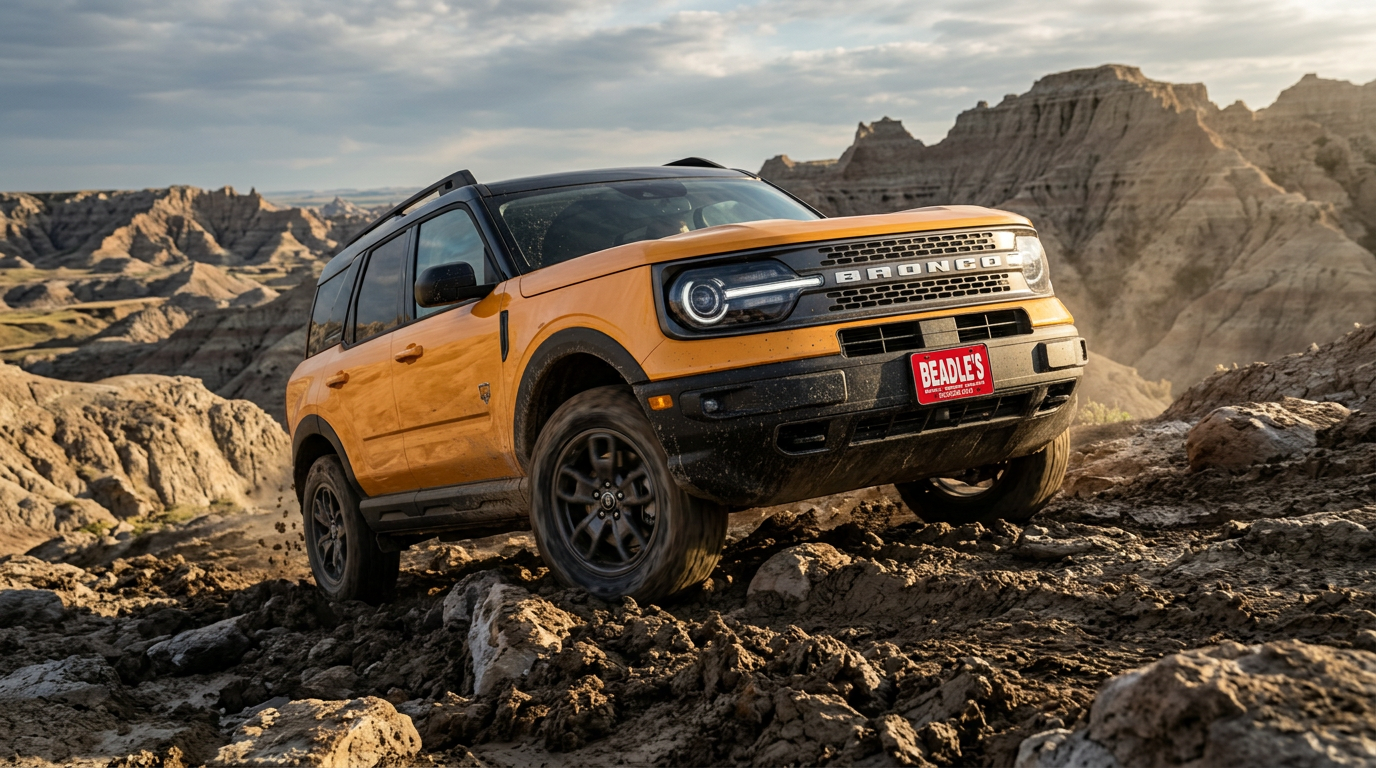
For off-pavement use — gravel roads, two-tracks, pasture lanes, dirt forest roads — the Bronco Sport is the most capable of the three across every tier of the comparison. This is by design: the Bronco Sport was engineered as a purpose-built off-road crossover, while the Crosstrek and Compass are primarily road-oriented vehicles with varying degrees of trail capability added in.
| Off-Road Category | Bronco Sport | Crosstrek | Compass |
|---|---|---|---|
| Gravel road daily driving | Excellent | Very good | Good (with AWD) |
| Trail / forest road use | Excellent | Moderate | Moderate (Trailhawk) |
| Technical rock / obstacle terrain | Capable (Badlands: Rock Crawl) | Limited | Limited |
| Sand / loose terrain modes | Sand mode (all trims) | Not available | Sand mode (Trailhawk) |
| Standard A/T tires available | Yes (Heritage, Badlands, Sasquatch) | No | Trailhawk only |
The Crosstrek’s Symmetrical AWD is genuinely excellent for everyday conditions — it’s always-on and very predictable — but it’s not a trail-tuned system. Subaru’s X-Mode (available on upper Crosstrek trims) adds descent control and torque management for slippery slopes, but it doesn’t match the Bronco Sport’s dedicated trail calibration or G.O.A.T. mode system.
The Compass Trailhawk is the most capable off-road Compass, but the Trailhawk trim requires significant investment to reach that capability level. The base Compass with FWD or basic AWD is a pavement vehicle. The Bronco Sport starts from a position of off-road readiness across most of its lineup, which matters when you’re choosing a single vehicle for mixed use in rural South Dakota.
Which Compact SUV Can Tow a Boat or Utility Trailer?
Towing capacity is where the Bronco Sport separates itself most clearly — and it’s a meaningful differentiator for buyers in this part of South Dakota, where heading to Lake Oahe with a boat or running an ATV trailer to the Badlands isn’t an occasional thing.
| Vehicle | Max Tow Rating | Class II Hitch | What It Can Tow |
|---|---|---|---|
| 2026 Ford Bronco Sport | Up to 2,200 lbs | Optional (standard on Badlands, included with Sasquatch Package) | Jon boat, 14–16 ft aluminum fishing boat, personal watercraft, small livestock trailer, single ATV/UTV |
| 2026 Subaru Crosstrek | 1,500 lbs | Optional (dealer-installed) | Small kayak trailer, light utility trailer, personal watercraft (lightweight) |
| 2026 Jeep Compass | Up to 2,000 lbs | Optional | Small boat, utility trailer, single ATV (weight-dependent) |
The Crosstrek’s 1,500 lb tow rating is the most limiting of the three — a loaded aluminum fishing boat with motor and gear is typically 1,200–1,600 lbs before adding a trailer, which puts many common setups at or above the Crosstrek’s limit. The Compass gets closer to the Bronco Sport, but the Bronco Sport’s Class II Tow Package is integrated into the most popular off-road configurations (Badlands standard, included in the Sasquatch Package).
If towing a boat to Lake Oahe or running an ATV trailer is part of your regular use, the Bronco Sport is the clear choice in this comparison. The Crosstrek simply doesn’t have the tow rating headroom that rural South Dakota use often requires.
How Do All Three Handle South Dakota Winters?
All three vehicles have AWD or 4×4 capability, which is the baseline requirement for South Dakota winters. But how they manage winter conditions — and how accessible that capability is — differs meaningfully between them.
The Crosstrek’s Symmetrical AWD is perhaps the most well-known winter system in its class. Subaru has built its entire brand identity around this drivetrain, and it’s genuinely excellent on packed snow and ice. It’s always engaged and requires no driver input to activate — you just drive. The Crosstrek also tends to have strong winter tire availability because of its loyal following.
The Bronco Sport’s winter advantage comes from its Slippery G.O.A.T. mode — a purpose-built winter calibration that adjusts throttle, braking, and traction management specifically for slick conditions. Combined with A/T tires standard on several trims, the Bronco Sport is genuinely well-prepared for South Dakota winters. The Badlands and Outer Banks Sasquatch configurations also benefit from the HOSS 2.0 suspension’s ability to handle rutted, frozen surfaces better than standard suspension setups.
The Compass with AWD handles winter roads adequately but without the same purpose-engineered winter mode. The Trailhawk adds Selec-Terrain with Snow mode, but the base Compass AWD is a more generic all-weather system. The Compass also starts with FWD as standard on lower trims — a meaningful disadvantage in this market that buyers often overlook when comparing sticker prices.
South Dakota Winter Features Summary
| Winter Feature | Bronco Sport | Crosstrek | Compass |
|---|---|---|---|
| AWD / 4×4 standard on all trims | Yes | Yes | No — FWD base |
| Dedicated Slippery / Snow mode | Yes (Slippery G.O.A.T.) | X-Mode (upper trims) | Snow mode (Trailhawk) |
| A/T tires available standard | Yes (multiple trims) | No | Trailhawk only |
| Heated seats available | Yes (multiple trims) | Yes (upper trims) | Yes (upper trims) |
The Crosstrek is a strong winter vehicle and deserves its reputation. But the Bronco Sport’s combination of Slippery mode, standard A/T tires on several trims, and purpose-built 4×4 calibration makes it equally well-suited — and the fact that 4×4 is standard across the entire Bronco Sport lineup (the Compass offers FWD as a base option) gives it a reliability advantage for buyers who want winter capability without having to think about it.
Which Has the Most Useful Interior for Active Use?
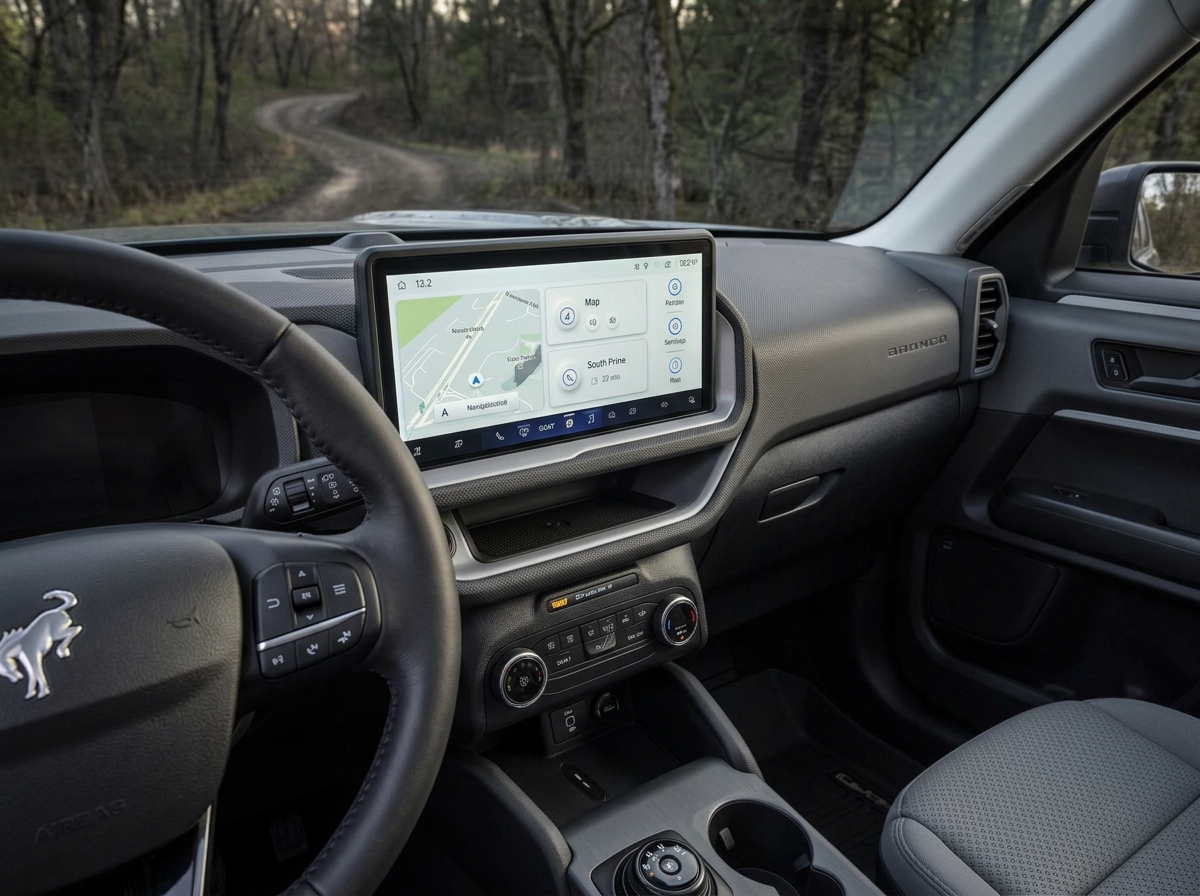
Interior utility — how the vehicle is actually configured to support active and working use — is where the Bronco Sport creates the largest separation from both competitors. It’s not just about cargo space on paper; it’s about the specific features Ford engineered into the cargo area.
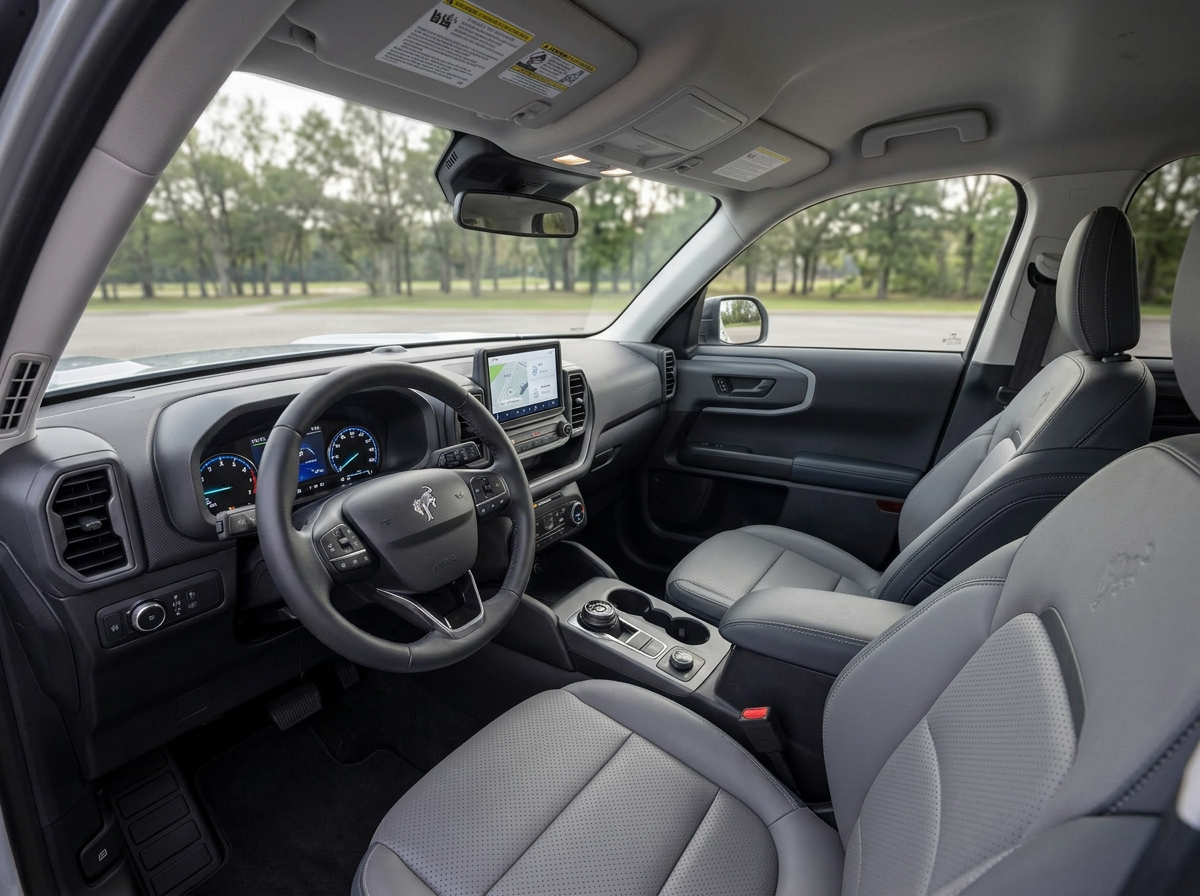
The Bronco Sport includes a fold-out cargo table that slides out from the rear cargo area, MOLLE strap panels for securing gear, integrated carabiner hooks, a built-in bottle opener, available rubberized flooring for easy cleanup, and — on equipped trims — a 400W Pro Power Onboard outlet for running tools or charging gear. None of these features exist on the Crosstrek or Compass.
The Crosstrek and Compass both offer solid, practical cargo areas — but they’re designed for conventional use: fold the seat, load your gear, drive. The Bronco Sport’s cargo area is designed for people who use their vehicle as a base camp, work vehicle, or gear transport system. That’s a meaningful difference for a specific type of buyer.
Interior and Cargo Features Comparison
| Feature | Bronco Sport | Crosstrek | Compass |
|---|---|---|---|
| Fold-out cargo table | Yes | No | No |
| MOLLE gear straps | Yes | No | No |
| Pro Power Onboard 400W outlet | Yes (upper trims) | No | No |
| Rubberized cargo flooring | Available | Not standard | Not standard |
| Roof rack / rails standard | Standard (multiple trims) | Available | Available |
If you’re using your compact SUV primarily as a commuter vehicle with occasional weekend use, all three are functional. If you’re regularly packing for hunting trips, hauling gear to the range, setting up a trailhead basecamp, or running tools to a jobsite, the Bronco Sport’s purpose-built cargo features are genuinely useful in ways the Crosstrek and Compass aren’t designed to match.
Which Compact SUV Is the Best Value for South Dakota Buyers?
Value depends entirely on what you’re optimizing for. Here’s how each vehicle creates value for different buyer priorities:
| Buyer Priority | Best Pick | Why |
|---|---|---|
| Towing a boat or trailer | Bronco Sport | 2,200 lbs max; Crosstrek caps at 1,500 lbs |
| Off-road trail capability | Bronco Sport | G.O.A.T. modes, A/T tires, HOSS 2.0 (upper trims), Trail Control |
| Long-term reliability reputation | Crosstrek | Subaru’s AWD track record is industry-proven over decades |
| Active cargo / gear hauling utility | Bronco Sport | Slide-out table, MOLLE, Pro Power — no equivalent on competitors |
| Lowest entry price point | Crosstrek or Compass | Base pricing can be lower, though comparisons must account for feature differences |
| South Dakota winter + off-pavement daily use | Bronco Sport | 4×4 standard on all trims, Slippery mode, A/T tires available throughout lineup |
For South Dakota buyers who need a vehicle that does more than just drive to town and back — towing, off-pavement work, gear hauling, winter confidence — the Bronco Sport delivers more capability per dollar at each competitive price point. The Crosstrek earns its reputation for reliability and is a legitimate alternative for buyers whose primary use is road-biased. The Compass requires more careful trim-level comparison to arrive at a competitive configuration, and its FWD base is a consideration in this climate.
Key Takeaways
- The Bronco Sport leads on towing (2,200 lbs) vs. Crosstrek (1,500 lbs) and Compass (2,000 lbs) — a meaningful difference for Lake Oahe boat owners or ATV trailer users.
- 4×4 is standard on every Bronco Sport trim; the Compass starts with FWD on lower trims, which requires buyers to step up to get all-weather drivetrain capability.
- The Bronco Sport’s G.O.A.T. mode system — including Slippery mode for winter — is the most purpose-built terrain management system in this comparison.
- The Crosstrek’s Symmetrical AWD is excellent for everyday winter driving and has a strong long-term reliability reputation — it’s the most credible alternative for road-primary buyers.
- The Bronco Sport’s cargo features — slide-out table, MOLLE straps, Pro Power outlet — have no equivalent on either the Crosstrek or Compass at any trim level.
- For the way most South Dakota buyers actually use their vehicles — mixed on/off pavement, towing, winter driving, gear hauling — the Bronco Sport is the strongest all-around fit in this comparison.
Frequently Asked Questions
Is the Subaru Crosstrek more reliable than the Ford Bronco Sport?
The Crosstrek has a well-established long-term reliability track record built over multiple generations of Subaru’s Symmetrical AWD platform. The Bronco Sport is a newer nameplate (introduced 2021), so there’s less historical data over the same time horizon. Subaru consistently scores well in owner satisfaction and reliability surveys, which is a real consideration for buyers who prioritize long-term ownership costs. That said, the Bronco Sport’s Ford platform is not unproven — the underlying engineering is shared with the global Ford small SUV lineup.
Can the Crosstrek tow enough for a jon boat to Lake Oahe?
Possibly, but you’d be close to the limit. The Crosstrek’s maximum tow rating is 1,500 lbs. A basic aluminum jon boat (14 ft, with motor) typically weighs 500–700 lbs, and a single-axle trailer adds another 300–500 lbs. A loaded setup with fuel, gear, and motor can easily reach 1,200–1,500 lbs — which puts you right at the Crosstrek’s rated limit with no headroom. The Bronco Sport’s 2,200 lb rating gives you substantially more margin for the same types of trailers.
Does the Jeep Compass come with 4×4 as standard?
No. The base Jeep Compass Sport starts with front-wheel drive. All-wheel drive is available on higher trim levels, and the more capable Rock & Trail 4×4 system is available on the Trailhawk. For South Dakota buyers who need all-weather capability as a given, compare Compass AWD or Trailhawk trim pricing — not the FWD base price — when doing an apples-to-apples comparison with the Bronco Sport or Crosstrek.
Which has the better fuel economy — Bronco Sport, Crosstrek, or Compass?
The Crosstrek generally leads in fuel economy in this comparison, particularly with its base 2.0L Boxer. The Bronco Sport’s 1.5L EcoBoost is competitive in mixed driving, while the 2.0L EcoBoost (Badlands) trades some efficiency for performance. The Compass is comparable to the Bronco Sport in most configurations. For buyers doing long highway miles across South Dakota, the Crosstrek’s fuel economy advantage may be worth factoring into the long-term cost comparison.
Is the Bronco Sport actually worth more than the Crosstrek or Compass for South Dakota use?
For buyers who tow, go off-pavement regularly, or need purpose-built cargo utility, yes — the Bronco Sport’s capability advantages in those categories create genuine value that the Crosstrek and Compass don’t match. If your use is primarily highway and city driving with light weather needs, the Crosstrek’s reliability reputation and lower entry pricing may make more sense for your situation. The honest answer is: it depends on your use case, not just the sticker price.
The Bottom Line for South Dakota Shoppers
These three vehicles serve similar market positions but are built with different buyers in mind. The Crosstrek is a well-rounded, reliable AWD crossover that does everything adequately and nothing dramatically. The Compass is a capable daily driver that requires trim-level navigation to get to its best configurations. The Bronco Sport is built for people who need their compact SUV to do more: tow more, go further off-road, carry more gear, and handle South Dakota winters with purpose-engineered tools rather than just adequate all-weather programming.
If you’re shopping in a market where you rarely leave pavement and never tow, the Crosstrek deserves serious consideration. If your driving life looks like most of ours out here — mixed pavement and gravel, seasonal towing, actual winters — the Bronco Sport is the vehicle this comparison is built around.
Ready to see how the Bronco Sport lineup breaks down from Big Bend through Badlands? Our 2026 Ford Bronco Sport guide at Beadle Ford covers every trim, every package, and every configuration in detail.
About the Author
Lexy Tabbert is an automotive content writer and researcher at Beadle Ford in Bowdle, SD. She covers Ford lineup comparisons, regional buying guides, towing specs, and off-road capability breakdowns to help South Dakota shoppers cut through manufacturer marketing and find the vehicle that actually fits how they live and work. She’s not neutral in this comparison and isn’t pretending to be.
Connect with us

