
If you’re cross-shopping a 2027 Ford Expedition against a 2026 Toyota Sequoia, you’re choosing between two very different takes on the full-size three-row SUV. Ford brings a 3.5L EcoBoost V6 — with a 440 hp / 510 lb-ft High Output variant available — paired with BlueCruise hands-free highway driving. Toyota counters with a single powertrain: the i-FORCE MAX hybrid, a 3.5L twin-turbo V6 paired with an electric motor producing a combined 437 hp and 583 lb-ft of torque. Both are legitimate; they’re just optimized differently.
This guide covers the decisions that actually matter for a Dakota buyer: how each powertrain behaves in real winter conditions, cargo and third-row usability, towing in cold weather with a hybrid (a real consideration north of I-90), the hands-free driving comparison, and dealer network accessibility — an honest look at what happens when your Sequoia needs service and your closest Toyota dealer is 60-plus miles away.
On This Page
- EcoBoost V6 vs. i-FORCE MAX hybrid — which works better in Dakota winters?
- Which SUV gives you more usable space?
- Can the Sequoia’s hybrid handle heavy trailers in cold weather?
- BlueCruise vs. Toyota Safety Sense — which hands-free system wins?
- Dealer network, resale, and cost of ownership — does Toyota reliability win here?
EcoBoost V6 vs. i-FORCE MAX hybrid — which works better in Dakota winters?
Both trucks use twin-turbocharged V6 engines; the difference is what Toyota adds on top. The 2027 Ford Expedition runs the 3.5L EcoBoost V6 as the standard engine with a 3.5L EcoBoost V6 High Output at 440 hp / 510 lb-ft optional on Tremor, Platinum Stealth Performance, and Platinum Ultimate. Toyota’s 2026 Sequoia offers one powertrain only — the i-FORCE MAX hybrid, pairing a 3.5L twin-turbo V6 with an electric motor and a nickel-metal hydride battery pack for a combined 437 hp and 583 lb-ft of torque. Both use 10-speed automatic transmissions.
For hot climates and stop-and-go driving, hybrids shine. For our climate, the calculus shifts. Nickel-metal hydride batteries — the chemistry Toyota uses in the Sequoia’s hybrid system — perform meaningfully worse in sustained cold. At -10°F or colder (which we see several weeks a winter), a hybrid’s regenerative braking is less effective, battery efficiency drops, and the electric motor contributes less. You’re running on the gas engine more and the hybrid advantage narrows. The EcoBoost V6, by contrast, behaves consistently regardless of temperature — it’s the same engine at 80°F as it is at -20°F.
The practical takeaway: if most of your driving is interstate cruising in reasonable weather, the Sequoia’s hybrid gets stronger fuel economy, especially at lower speeds. If you drive through a Dakota winter every year, the EcoBoost V6’s consistency matters. And if you want the 440 hp High Output engine and the factory off-road Tremor trim, those simply aren’t options Toyota offers.
The full 2027 Expedition trim and engine breakdown is in the complete 2027 Ford Expedition overview.
Which SUV gives you more usable space?
The Expedition wins most of the practical space comparisons, and independent reviews from Edmunds and others have consistently called this out. The Ford’s third row is genuinely adult-usable, with leg and headroom that supports taller passengers on longer trips — Bowdle to Fargo with three kids across the back row works without complaints. The Sequoia’s third row is narrower and has less legroom; it’s better described as kid-friendly rather than adult-friendly.
Cargo behind the third row is where the Sequoia has a specific geometry quirk. Because of how Toyota packaged the hybrid battery pack, the Sequoia’s load floor is higher and the third-row seatbacks don’t fold flat — you end up with a raised, uneven surface when the third row is folded down. The Expedition’s third row folds flat and the cargo floor is at a consistent height, which matters when you’re loading a generator, a cooler, or long gear.
Inside, the Expedition brings the 24" panoramic driver display and 13.2" center display as the Ford Digital Experience standard from Active (200A) and up, with Google Maps, Google Assistant, and Google Play Store embedded natively plus wireless Apple CarPlay and Android Auto. The Sequoia runs Toyota’s 14" multimedia touchscreen with wireless CarPlay/Android Auto on most trims — a capable system, but the visual experience is different.
If you need the MAX-length body style for even more cargo and third-row space, the Expedition MAX is available on Active, Platinum, and King Ranch (the Tremor is standard-length only). The Expedition vs. Expedition MAX guide walks through that body-style decision. Toyota does not offer an extended-length Sequoia.
Can the Sequoia’s hybrid handle heavy trailers in cold weather?
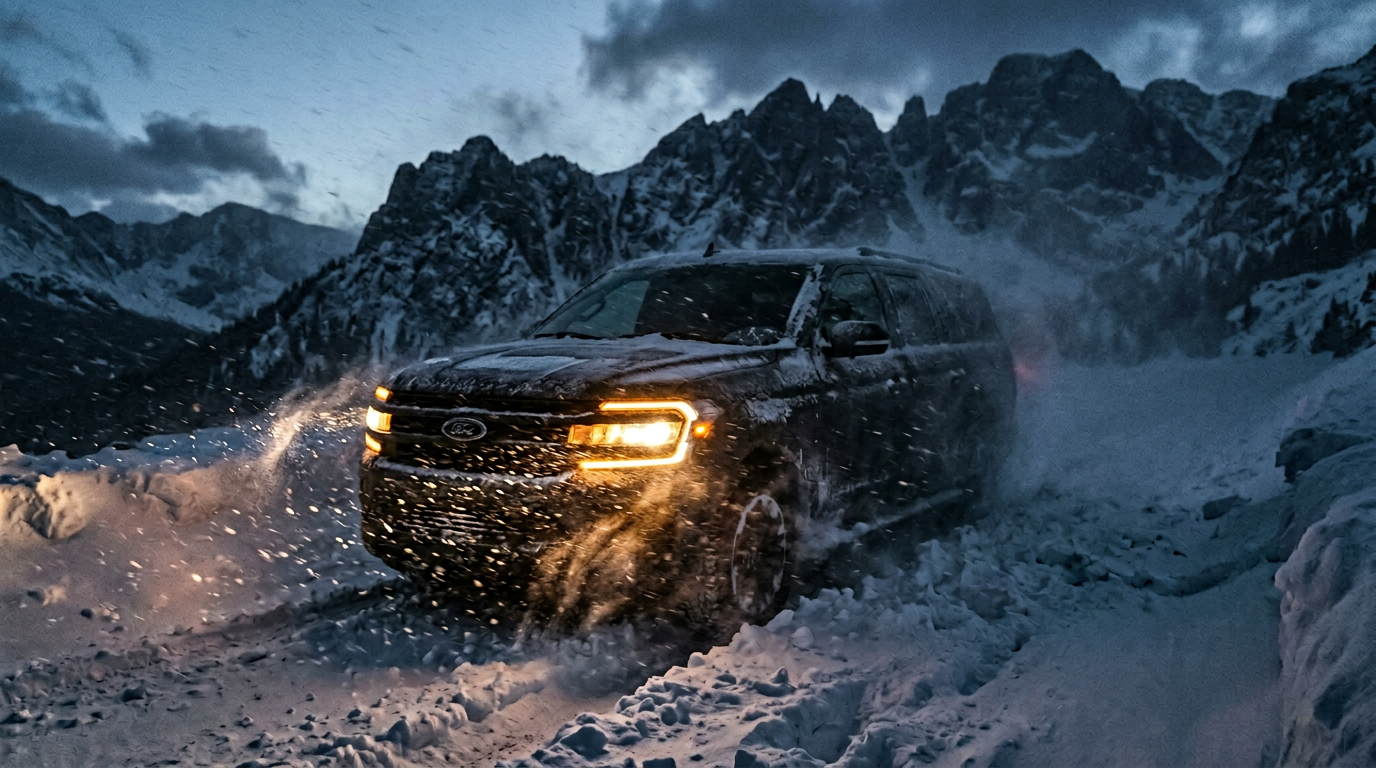
On paper, the Sequoia tows well. Toyota publishes a maximum trailer rating of approximately 9,520 lbs when properly equipped — functionally in the same ballpark as the Expedition Tremor’s reported 9,600 lbs. For a standard gooseneck loaded with livestock or a 24-foot enclosed trailer with a side-by-side, either truck handles it. The question isn’t peak capacity; it’s how each truck delivers that capability in adverse conditions.
Cold-weather towing is a real consideration with a hybrid. Hybrid batteries lose efficiency in sustained cold, and when you’re towing heavy — 7,000 or 8,000 lbs behind you — the electric motor is contributing less of the torque and the gas engine is working harder. On long cold-weather hauls, Sequoia owners have reported lower-than-advertised fuel economy and more frequent engine loading. A turbocharged V6 like the EcoBoost maintains consistent power delivery regardless of temperature, which is why long-range towing consistency is one place the Expedition has an advantage.
Pro Trailer Hitch Assist and Pro Trailer Backup Assist are standard on every retail Expedition trim via Ford Co-Pilot360 Assist 2.0. The 360-degree camera includes a trailer view specifically designed for hitching and navigating narrow hauling situations. BLIS with Trailer Coverage extends the blind-spot monitoring around the length of whatever you’re pulling. Toyota offers comparable features on upper Sequoia trims, but they’re more package-dependent on the Toyota side than on the Ford side.
Official 2027 Expedition tow ratings will be confirmed when Ford releases the 2027 Towing Guide. If you’re sizing an Expedition to a specific trailer, contact Beadle Ford and we’ll run the configuration against your actual load.
Ready to explore the Ford side?
BlueCruise vs. Toyota Safety Sense — which hands-free system wins?
Ford has the more mature hands-free highway driving system. BlueCruise works on approximately 97% of controlled-access U.S. and Canada highways with driver-facing camera monitoring, Lane Change Assist, and In-Lane Repositioning. Active Touring (202A) includes a 90-Day BlueCruise trial on retail orders; Platinum Ultimate (17A) and King Ranch (400A) come with a 1-Year + 90-Day plan standard.
Toyota’s 2026 Sequoia comes standard with Toyota Safety Sense 3.0 — Dynamic Radar Cruise Control, Lane Departure Alert with Steering Assist, Pre-Collision System with Pedestrian Detection, Road Sign Assist, and Blind Spot Monitor. It’s comparable to Ford Co-Pilot360 Assist 2.0 for the core driver-assist tier. What Toyota doesn’t offer at the Sequoia price point is a direct BlueCruise competitor — true hands-free highway driving with driver monitoring across a mapped road network. Nissan offers ProPilot 2.0 on its Ariya and some other models; GM offers Super Cruise on Tahoe and Suburban. Toyota’s hands-free capability on the Sequoia is narrower in scope.
If hands-free highway driving matters to you — especially on the long I-90 or US-281 hauls most Dakota drivers know well — BlueCruise is the clearer answer on this cross-shop. The BlueCruise vs. Super Cruise vs. ProPilot 2.0 guide walks through which system covers which roads and which buyer fits which system.
Dealer network, resale, and cost of ownership — does Toyota reliability win here?
Toyota’s reputation for reliability is real. It shows up in resale data, in long-term ownership studies, and in the fact that you’ll see 15-year-old Tundras and Sequoias still in daily service. But reliability is only part of the cost-of-ownership equation, and in rural South Dakota, the dealer network side of that equation often matters more.
If you live in Bowdle or anywhere in north-central South Dakota and you buy a Sequoia, your closest Toyota dealer for service, warranty work, or hybrid-system diagnostics is roughly 60-plus miles away. That’s a real consideration. Recall work, a 30,000-mile service interval, a brake job, a hybrid inverter warning on the dashboard — every one of those becomes a day trip. If something goes wrong under warranty that requires multiple visits, it’s multiple day trips.
Beadle Ford is in Bowdle. Service is local. The techs working on your Expedition know the truck because they’ve been working on Expeditions for years. Ford parts are nationally available. Neither is a “Toyota is worse” argument — both brands build reliable trucks. But when you factor in the accessibility of routine service, warranty work, and emergency repairs over a five or seven-year ownership period, the dealer network question meaningfully narrows Toyota’s reliability advantage.
Hybrid-specific maintenance is worth naming too. The i-FORCE MAX system is well-engineered, but it adds components — battery pack, inverter, electric motor — that a naturally aspirated V8 or a turbo V6 like the EcoBoost doesn’t have. Long-term battery replacement at 10+ years is a real out-of-warranty cost to plan for on any hybrid. The Expedition’s EcoBoost V6 is a conventional powertrain with well-understood long-term service costs.
Key Takeaways
- Ford offers two engines (standard 3.5L EcoBoost V6 and the 440 hp / 510 lb-ft High Output); Toyota offers one (i-FORCE MAX hybrid at 437 hp / 583 lb-ft combined).
- Hybrid powertrains lose efficiency in sustained cold. EcoBoost V6 performance is consistent regardless of temperature.
- Expedition’s third row and cargo behind the third row are more usable than the Sequoia’s, largely because of hybrid battery packaging.
- BlueCruise offers more mature hands-free highway coverage than Toyota Safety Sense 3.0 provides on the Sequoia.
- Service network matters in rural SD. Beadle Ford is in Bowdle; the nearest Toyota dealer is 60-plus miles away.
- No factory off-road Sequoia trim comparable to the Expedition Tremor; no Sequoia MAX-length option.
Frequently Asked Questions
My Take on the Expedition vs. Sequoia Cross-Shop
The Sequoia is a well-built truck, and if you’re committed to a hybrid powertrain, it’s the cleanest answer in this class. I won’t pretend otherwise. But for the buyers we see at Beadle Ford — families commuting between Bowdle and Sioux Falls, ranchers hauling stock trailers through Dakota winters, or anyone who’s thinking about hands-free highway driving on their regular routes — the Expedition typically wins on the practical details. Third-row usability, cargo-floor flatness, BlueCruise coverage, and local service accessibility all stack in Ford’s favor for how most of our customers actually drive.
The real test is a side-by-side drive with a cold-weather trailer in mind. If you’re serious about this decision, come drive an Expedition and we’ll talk through your specific use case against the Sequoia honestly. The right answer depends on your week, not on a spec sheet.
About the Author
Lexy Tabbert — Beadle Ford, Bowdle, SD
Lexy Tabbert is the Director of Sales and Marketing at Beadle Ford in Bowdle, South Dakota. She covers Ford vehicles, trim comparisons, and buyer guidance — helping families, ranchers, and ag operators across the region find the right truck and configuration for their needs. Learn more about Lexy.
Connect with us

