
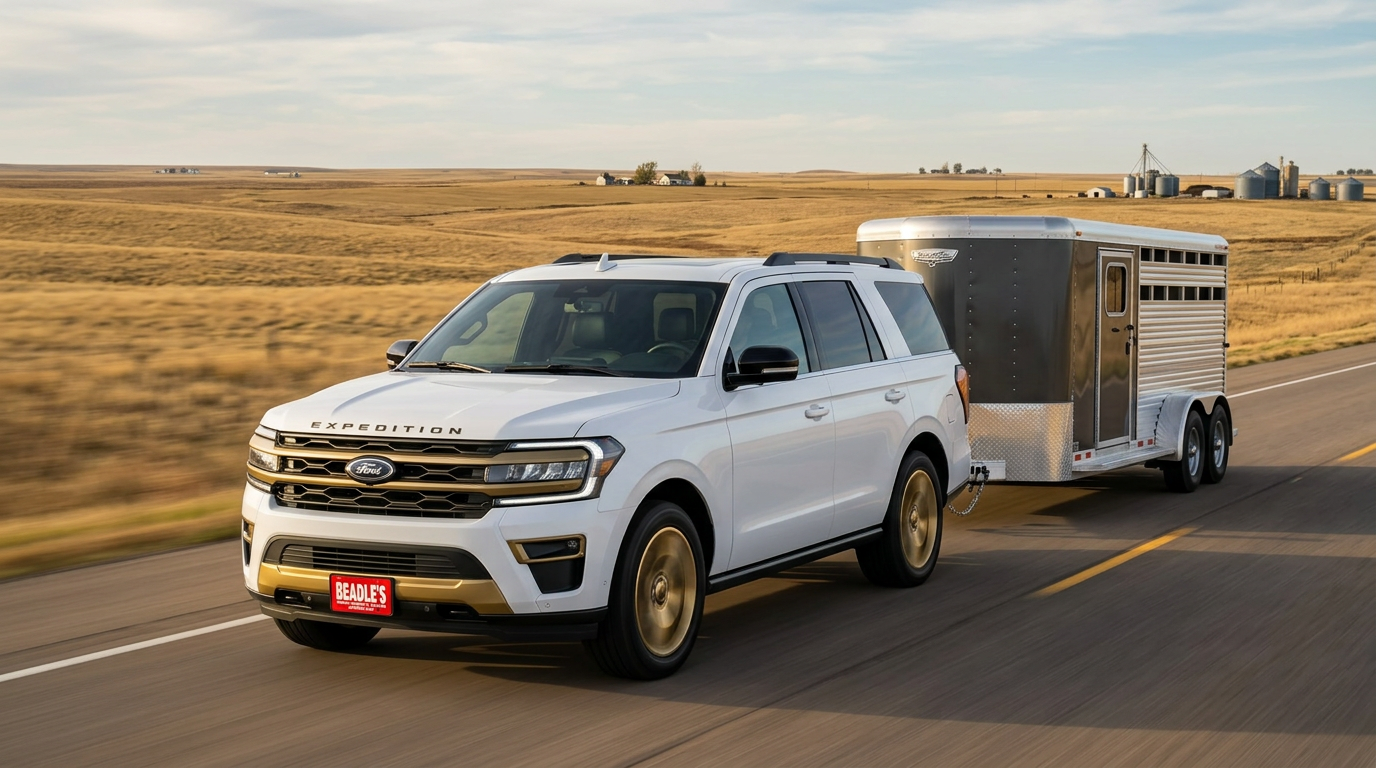
The 2026 Ford Expedition can tow up to 9,600 lbs — but that number only applies to one specific configuration. The actual rating for your build depends on drivetrain, axle ratio, wheelbase, and whether the Heavy-Duty Trailer Tow package is installed. Get one of those wrong and you may be operating beyond your rated limit without knowing it.
This guide breaks down every towing figure from Ford’s official 2026 Expedition Towing Guide, explains the equipment required to reach the higher ratings, and connects those numbers to the trailers South Dakota buyers actually pull — horse trailers, bumper-pull campers, hay equipment, and boats on the Missouri River system.
On This Page
- What are the actual 2026 Expedition tow ratings by configuration?
- What does the Heavy-Duty Trailer Tow package include?
- Why does the axle ratio matter so much?
- When is a weight-distributing hitch required?
- Real-world towing scenarios: what can the Expedition actually pull?
- Does elevation affect towing capacity in South Dakota?
- Does the Expedition MAX tow less than the standard Expedition?
- What towing technology comes with the Expedition?
- Key Takeaways
- FAQ
What are the actual 2026 Expedition tow ratings — by configuration?
The 9,600 lb headline figure applies to the Expedition SWB 4×4 with the 3.73 axle ratio and the Heavy-Duty Trailer Tow package installed. Every other configuration is rated lower. The table below reflects Ford’s official 2026 Expedition Towing Guide, calculated using the SAE J2807® method.
| Configuration | Axle | GCWR (lbs.) | Max Tow (lbs.) |
|---|---|---|---|
| Expedition SWB 4×4 | 3.73 | 15,900 | 9,600 |
| Expedition SWB 4×2 — Tremor® High Output | 3.73 | 15,600 | 9,300 |
| Expedition SWB 4×2 — standard (24″ wheels) | 3.73 | 15,600 | 9,200 |
| Expedition MAX 4×4 | 3.73 | 15,900 | 9,000 |
| Expedition SWB 4×2 — standard | 3.31 | 12,000 | 6,000 |
| Expedition MAX 4×2 — standard | 3.31 | 12,500 | 6,300 |
Source
All figures from Ford’s official 2026 Expedition Towing Guide, calculated using the SAE J2807® method. Maximum towing varies based on cargo, vehicle configuration, accessories, and number of passengers. Ratings assume a 150-lb. driver and passenger.
The difference between the 6,000 lb and 9,600 lb rating comes down to two things: the 3.73 rear axle ratio and the Heavy-Duty Trailer Tow package. Without both, you’re operating at the lower end of the range. On the Active 4×2, neither is included as standard — both are required additions.
What does the Heavy-Duty Trailer Tow package include — and which trims get it standard?
The HDTT package is the single most important option for any Expedition buyer who plans to tow above 6,000 lbs. It bundles the upgraded axle, integrated brake controller, trailer camera, and Pro Trailer Backup Assist™ 2.0 in one package — and it’s standard on every trim except the Active.
| Trim | HDTT Status | Note |
|---|---|---|
| Active | Optional | Requires 4×4. Not available on 4×2. |
| Tremor® | Standard | 28MM radiator (vs. 26MM on other trims) |
| King Ranch® | Standard | 26MM radiator |
| Platinum | Standard | 26MM radiator |
What the Heavy-Duty Trailer Tow package includes on all 2026 Expedition configurations:
Warranty Note
Per Ford’s 2026 Expedition Towing Guide: your New Vehicle Limited Warranty may be voided if you tow above the rating for your configuration without the required equipment. Confirm your specific build’s tow rating on the window sticker before purchase.
Why does the axle ratio matter so much for towing?
The axle ratio is one of the two biggest factors separating the 6,000 lb rating from the 9,600 lb rating. The 3.31 axle ratio is standard on Active 4×2 configurations — and with it, towing is capped at 6,000 lbs (SWB) or 6,300 lbs (MAX). Moving to the 3.73 ratio — which comes with the HDTT package — unlocks the full rating for your drivetrain.
What the axle ratio codes mean on your window sticker
Check the Safety Compliance Certification Label on the left front door lock facing. Below the bar code, you’ll see “AXLE” followed by a two-digit code:
- Code 15 = 3.31 ratio (Non-Limited Slip) — base towing rating
- Code 2L = 3.73 ratio (Non-Limited Slip) — required for maximum tow ratings
A numerically higher axle ratio multiplies torque at the wheels more aggressively, which is what allows the Expedition to pull heavier loads from a stop and maintain controlled speed on grades. For buyers towing loaded livestock trailers or heavy campers on the grades around the Missouri River breaks, the 3.73 isn’t just a preference — it’s required for the job.
When is a weight-distributing hitch required — and what does that mean in practice?
Per Ford’s official towing guide: any trailer over 7,000 lbs requires a weight-distributing hitch on both the Expedition SWB and the Expedition MAX. This is not optional — it’s a requirement to tow safely within the rated limit, and Ford’s warranty language references it directly.
Hitch Receiver Weight Capacity — Per Ford’s Official Towing Guide
| Vehicle | Weight-Carrying Max | Max Tongue (WC) | Weight-Distributing Max | Max Tongue (WD) |
|---|---|---|---|---|
| Expedition SWB 4×4 | 7,000 lbs | 700 lbs | 9,600 lbs | 960 lbs |
| Expedition MAX 4×4 | 7,000 lbs | 700 lbs | 9,000 lbs | 900 lbs |
What this means practically: if you’re pulling a bumper-pull horse trailer or loaded camper above 7,000 lbs, you need a weight-distributing hitch setup — not just the ball mount that comes with the receiver. The hitch receiver is standard on the vehicle; the ball mount, hitch ball, and weight-distributing head are the buyer’s responsibility.
Tongue weight should be approximately 10% of the total loaded trailer weight. A 9,000 lb trailer requires roughly 900 lbs of tongue weight — which must be within your vehicle’s available payload after accounting for passengers and cargo.
What can the 2026 Expedition actually tow — real-world scenarios for South Dakota buyers?
The numbers on the tow chart only matter when matched to the trailers buyers here actually pull. Here’s how the Expedition’s ratings map to common loads in this part of South Dakota and the upper plains.
Two-horse bumper-pull trailer (loaded)
A two-horse straight-load bumper-pull trailer with horses typically weighs 5,000–7,000 lbs loaded depending on trailer weight and horse size. This falls within the Expedition’s rating on any 4×4 configuration with HDTT — including the Active 4×4. A weight-distributing hitch is required at the upper end of this range (above 7,000 lbs).
✓ Within rating on: Active 4×4 w/HDTT, Tremor®, King Ranch®, Platinum (SWB or MAX)
Four-horse slant-load with living quarters
A four-horse LQ trailer can weigh 8,000–9,500 lbs loaded. An Expedition SWB 4×4 properly equipped is rated at 9,600 lbs — which covers most configurations at the lower end. At 9,000+ lbs, you’re near or above maximum. A weight-distributing hitch is mandatory, and tongue weight must be carefully managed. At this weight, many buyers consider a truck instead — but the Expedition SWB 4×4 is in the conversation up to 9,600 lbs when properly equipped.
⚠ Approaching limit: SWB 4×4 only, weight-distributing hitch required, verify loaded weight before towing
Bumper-pull travel trailer or fifth-wheel camper
Most bumper-pull travel trailers in the 24–30 ft range weigh 5,000–8,500 lbs loaded. The Expedition handles this range comfortably on any 4×4 configuration with HDTT. Fifth-wheel trailers require a different hitch setup and are generally better suited for a pickup — the Expedition is not recommended for fifth-wheel use given hitch type and bed requirements.
✓ Within rating on: Active 4×4 w/HDTT, Tremor®, King Ranch®, Platinum — bumper-pull only
Boat and trailer (Lake Oahe, Sharpe, or Francis Case)
A 20–24 ft fiberglass fishing or pontoon boat with a loaded trailer typically runs 4,500–7,500 lbs. The Expedition handles this range on 4×4 with HDTT without issue. Tongue weight management matters on boat trailers — ensure the trailer is loaded with roughly 60% of weight in the front half.
✓ Comfortably within rating on all 4×4 configurations with HDTT
Utility / hay / livestock trailer
Gooseneck livestock trailers with hay or cattle typically exceed 10,000–15,000 lbs loaded — well beyond the Expedition’s 9,600 lb maximum. For regular heavy livestock or gooseneck use, a pickup truck is the correct tool. The Expedition is not rated for gooseneck or fifth-wheel hitch configurations.
✗ Exceeds Expedition’s max rating — a truck is the right tool for gooseneck/heavy livestock loads
Does elevation affect towing capacity in South Dakota and the western plains?
Yes — and this matters for buyers in western South Dakota more than most people realize. Ford’s official towing guide states: reduce Gross Vehicle Weight (GVW) and Gross Combination Weight (GCW) by 2% per 1,000 ft. of elevation when towing at altitude.
Elevation context — western South Dakota
- Bowdle, SD: approximately 1,800 ft — about a 3.6% reduction (~346 lbs off 9,600 lb max)
- Rapid City, SD: approximately 3,200 ft — about a 6.4% reduction (~614 lbs off 9,600 lb max)
- Black Hills region: 4,000–7,200 ft — 8–14% reduction in effective GCW
- Western routes into Wyoming/Montana: 4,500–7,000 ft — significant reduction applies
If you’re hauling a loaded trailer from Bowdle to Rapid City and up into the Hills, the effective towing capacity at elevation is meaningfully lower than what the sticker says at sea level. Build in a margin — don’t tow at the absolute maximum if your route includes significant elevation gain.
Does the Expedition MAX tow less than the standard Expedition?
Yes — by 600 lbs on the 4×4 configuration. The Expedition MAX 4×4 is rated at 9,000 lbs vs. 9,600 lbs for the SWB 4×4, both properly equipped. The difference comes from the additional body weight of the extended wheelbase. The engine, axle, and HDTT package are identical — the body is heavier.
| Expedition SWB | Expedition MAX | |
|---|---|---|
| Max tow — 4×4 w/HDTT | 9,600 lbs | 9,000 lbs |
| Max tow — 4×2, no HDTT | 6,000 lbs | 6,300 lbs |
| GCWR — 4×4 w/HDTT | 15,900 lbs | 15,900 lbs |
| Tremor® available | Yes | No |
For most buyers pulling trailers in the 5,000–8,500 lb range, the 600 lb difference between SWB and MAX is irrelevant — both configurations are within rating. The decision between them is really about cargo space and third-row legroom, not towing. The full comparison is covered in the 2026 Expedition vs. Expedition MAX guide.
What towing technology comes with the 2026 Expedition?
The HDTT package bundles a set of active and passive towing technologies that make a real difference for buyers who tow regularly. These aren’t marketing features — they’re the systems that prevent trailer sway incidents and take the stress out of backing a trailer in a crowded boat launch.
Pro Trailer Backup Assist™ 2.0
Steer the trailer using a knob on the dash — the system translates your input into counter-intuitive steering corrections automatically. Particularly useful on narrow boat ramps, tight ranch lanes, and unfamiliar campsites.
Pro Trailer Hitch Assist™
Uses the 360-degree camera system to guide the hitch ball directly under the trailer coupler. Eliminates the guesswork of lining up solo — a practical tool when you’re hooking up alone in the dark or in tight quarters.
Integrated Trailer Brake Controller
Provides proportional braking output to the trailer’s electric brakes based on the Expedition’s brake pressure. Built into the vehicle — no external controller to purchase or calibrate. Required for trailers with electric brakes.
Trailer Sway Control
Detects trailer sway and automatically applies selective braking or reduces engine torque to bring the combination back under control. Standard on all 2026 Expedition configurations — not just HDTT-equipped vehicles.
Tow/Haul Mode
Adjusts the 10-speed automatic’s shift points for towing — holds gears longer on grades, uses engine braking on descents, and reduces hunting between gears on hilly terrain. Engage it anytime you’re pulling a loaded trailer.
360-Degree Camera with BLIS® Trailer Coverage
The camera system gives a top-down view during hitching and maneuvering. BLIS® with Trailer Coverage extends blind spot monitoring to account for the trailer’s length — useful on highway passes when the trailer obscures your rear sightlines.
Key Takeaways
- 9,600 lbs = SWB 4×4 only, with 3.73 axle and HDTT — not every Expedition configuration
- Without HDTT, the Active 4×2 is limited to 6,000 lbs (SWB) or 6,300 lbs (MAX)
- HDTT is optional on Active (requires 4×4), standard on Tremor®, King Ranch®, and Platinum
- Any trailer over 7,000 lbs requires a weight-distributing hitch — per Ford’s official towing guide
- The Expedition MAX tows up to 9,000 lbs (4×4 w/HDTT) — 600 lbs less than SWB
- Tongue weight should be approximately 10% of total loaded trailer weight
- Reduce GVW and GCW by 2% per 1,000 ft. of elevation — relevant for western SD routes
- The Expedition is not rated for gooseneck or fifth-wheel hitch configurations
- Tow ratings are calculated with a 150-lb driver and passenger — real-world payload reduces effective capacity
- Confirm your build’s specific tow rating on the window sticker before purchase
Frequently Asked Questions
What is the maximum towing capacity of the 2026 Ford Expedition?
9,600 lbs — but only on the Expedition SWB 4×4, properly equipped with the 3.73 rear axle and Heavy-Duty Trailer Tow package. Trailers above 7,000 lbs also require a weight-distributing hitch. The Active 4×2 without HDTT is limited to 6,000 lbs (SWB) or 6,300 lbs (MAX). All figures are from Ford’s official 2026 Expedition Towing Guide, calculated using the SAE J2807® method.
Can the 2026 Expedition tow a horse trailer?
Yes — a two-horse bumper-pull loaded at 5,000–7,000 lbs is well within rating on any Expedition 4×4 with HDTT. A four-horse LQ trailer at 8,000–9,500 lbs loaded approaches or exceeds the SWB 4×4 maximum of 9,600 lbs and requires careful weight management, a weight-distributing hitch, and verified loaded weights before towing. Heavy gooseneck livestock trailers exceeding 10,000 lbs require a pickup truck — the Expedition is not rated for gooseneck hitch use.
Does the Expedition MAX tow less than the standard Expedition?
Yes — by 600 lbs. The MAX 4×4 with HDTT is rated at 9,000 lbs vs. 9,600 lbs for the SWB 4×4. The longer wheelbase adds body weight, which reduces available tow capacity. For most trailer loads in the 5,000–8,500 lb range, both configurations are comfortably within rating — the difference only matters if you’re regularly near the upper limit.
Do I need the Heavy-Duty Trailer Tow package to tow with the Expedition?
Not for loads under 6,000 lbs on the Active 4×2 — but you cannot add it to a 4×2 configuration. For any load above 6,000 lbs, the HDTT package is required to reach the higher ratings, and it requires 4×4 on the Active trim. On Tremor®, King Ranch®, and Platinum, HDTT is standard. The package also includes the integrated trailer brake controller, Pro Trailer Backup Assist™ 2.0, and 360-degree camera — features most towing buyers want regardless of trailer weight.
Is a weight-distributing hitch included with the Expedition?
No. The hitch receiver is factory-installed and standard on the Expedition. The ball mount, hitch ball, and weight-distributing head are the buyer’s responsibility. Per Ford’s towing guide, a weight-distributing hitch is required for any trailer over 7,000 lbs on both SWB and MAX configurations.
Does elevation affect how much the Expedition can tow?
Yes. Ford’s official guidance calls for reducing Gross Vehicle Weight and Gross Combination Weight by 2% per 1,000 ft. of elevation. Buyers in western South Dakota or those routing through the Black Hills should account for this when loading near maximum — especially on routes that climb from 1,800 ft near Bowdle to 4,000+ ft in the Hills region.
My Take on Towing with the 2026 Expedition
The towing conversation I have most often at Beadle Ford goes like this: a buyer comes in saying they need to tow a horse trailer or a camper, they’ve seen the 9,600 lb headline, and they assume any Expedition will get them there. The first thing I do is ask what configuration they’re looking at — because that number only belongs to one specific build.
For most buyers around here pulling a two- or three-horse trailer or a mid-size camper in the 6,000–8,500 lb range, the Active 4×4 with HDTT gets the job done and is the most affordable path to the full tow package. If you’re pushing above 8,500 lbs regularly, you’re looking at the Tremor® or Platinum — where HDTT is already standard — or you’re having a different conversation about whether a truck is a better fit for your use case.
The elevation piece matters more than most buyers realize. If your route takes you through Rapid City or up into the Hills, you’re losing real effective capacity at altitude. Build in a margin — don’t configure at the absolute maximum if your route climbs.
For the full picture on how trim and configuration choices interact with towing, the 2026 Ford Expedition overview covers it all in one place. If you want to talk through a specific trailer and build, come see us at Beadle Ford in Bowdle or reach out anytime.
About the Author
Lexy Tabbert — Beadle Ford, Bowdle, SD
Lexy Tabbert covers Ford vehicles, trim comparisons, and buyer guidance for Beadle Ford in Bowdle, South Dakota. Her content is grounded in real buyer conversations with families, ranchers, and ag operators across the region. Learn more about Lexy.
Connect with us

