
Quick Answer
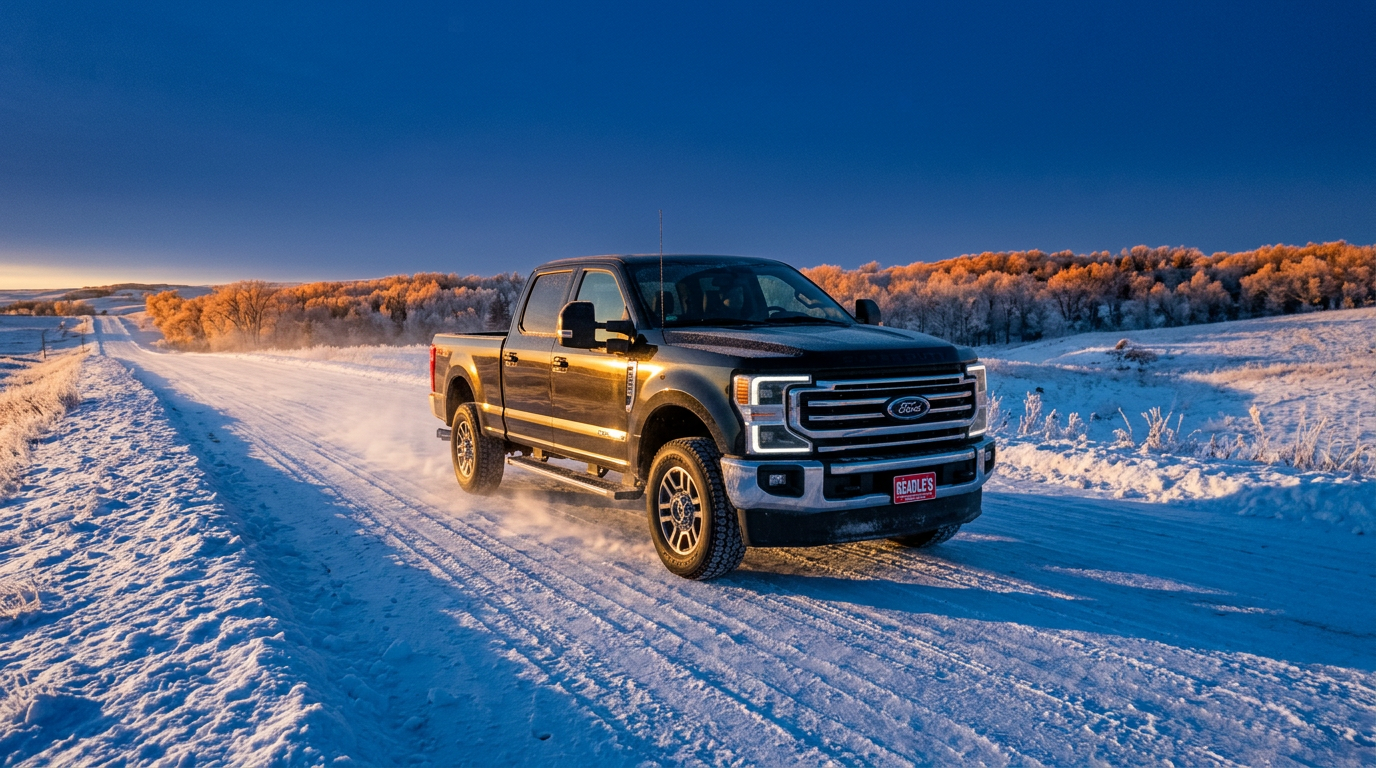
The 2027 Ford F-250 is excellent in South Dakota winters and on gravel with 4×4, selectable drive modes including Slippery Roads, real ground clearance, and the right tires. Add the Snow Plow Prep Package for plowing, or the XL Off-Road 35-inch Tire Package for serious traction.
Around here, a truck has to earn its keep in February and on washboard gravel just as much as it does towing in July. The good news is that the same heavy-duty build that makes the F-250 a strong tow truck also makes it one of the most confident winter and gravel daily drivers you can buy — as long as you spec it right.
Here’s how the 2027 F-250 handles a Dakota winter, what 4×4, drive modes, and snow-plow prep actually do for you, the tires that matter most, and the off-road traction tech worth ordering.
How does the 2027 F-250 handle SD winters?
Very well, and for the same reasons it’s a good tow truck: 4×4 traction, real ground clearance to clear drifts, weight to stay planted, and traction tech tuned for slick roads. On a snow-packed county road or a drifted-in driveway, the F-250 with 4×4 and good tires is hard to stop.
The ground clearance is the underrated part. Where a low car high-centers on a plow ridge, the Super Duty drives over it. Combine that with the Electronic Shift-on-the-Fly 4×4 and the Slippery Roads drive mode, and getting to work in a Dakota February stops being a question.
4×4, drive modes, and snow-plow prep
The F-250’s Electronic Shift-on-the-Fly 4×4 lets you move between two-wheel and four-wheel drive on the move, and the selectable drive modes — including Slippery Roads — retune throttle response and traction control for snow and ice. 4×4 is standard beginning on the King Ranch and available on the XL, XLT, and Lariat; for South Dakota, most buyers add it on any trim.
If you plow, order the Snow Plow Prep Package. It readies the truck to mount a plow within Ford’s front-axle weight limits, with the upgraded components a plow setup needs. Spec it from the factory rather than adding it later — it’s a cleaner, better-integrated setup.
Best tires for snow and gravel
Tires matter more than almost anything else for winter and gravel traction. A good set of all-terrain tires is the practical all-rounder for South Dakota — they handle gravel, mud, and packed snow well and last. If you drive a lot of ice and deep snow, a dedicated winter tire is the safest choice for those months.
The point is to match the tire to your roads. A truck that’s perfect on the highway can feel sketchy on glare ice with the wrong rubber, and the right tire transforms how a heavy 4×4 puts power down. We’ll help you pick a tire that fits how and where you actually drive.
Off-road and traction tech worth having
For buyers who run rough gravel, mud, and trails, the new XL Off-Road 35-inch Tire Package is the standout for 2027. It adds 35-inch tires, a taller ride height, an electronic locking rear differential, a limited-slip front differential, Rock Crawl mode, Trail Control, Trail Turn Assist, and heavy-duty skid plates — serious capability on an affordable trim.
Stepping up, the Tremor Off-Road Package — now available on the XL for 2027 — brings a lifted suspension and the full off-road treatment. For most winter-and-gravel daily drivers, though, plain 4×4 with the right tires does the job; the off-road packages are for buyers who genuinely leave the maintained roads.
Our Recommendation
For a South Dakota winter-and-gravel daily driver, we recommend a 4×4 F-250 with a good set of all-terrain tires and the Snow Plow Prep Package if you push snow. That combination handles our roads in any season. Add the XL Off-Road 35-inch Tire Package only if you regularly run rough trails and mud beyond the gravel.
From the Beadle Ford Lot
The single biggest winter upgrade I steer people toward isn’t a package — it’s tires. A 4×4 F-250 on worn highway tires will still struggle on glare ice, and the same truck on a good all-terrain set is a different machine. We sort out the tire before we talk about anything else for a winter driver.
Key Takeaways
- With 4×4, drive modes, ground clearance, and the right tires, the 2027 F-250 is excellent in winter and on gravel.
- Electronic Shift-on-the-Fly 4×4 and the Slippery Roads drive mode tune the truck for snow and ice.
- 4×4 is standard from the King Ranch and available on XL, XLT, and Lariat — most SD buyers add it.
- Order the Snow Plow Prep Package from the factory if you plow.
- Tires are the biggest winter upgrade; the XL Off-Road 35-inch Tire Package adds serious off-road traction.
Frequently Asked Questions
Quick Answers: F-250 Winter & Gravel
One-line answers to the follow-up questions buyers ask next.
Good in snow? Yes — excellent with 4×4 and good tires.
Does it have a winter drive mode? Yes — the Slippery Roads mode.
What kind of 4×4? Electronic Shift-on-the-Fly.
Is 4×4 standard? Standard from the King Ranch; available on XL, XLT, Lariat.
Can it plow? Yes — order the Snow Plow Prep Package.
Best tires? All-terrain for the all-around, winter tires for heavy ice and snow.
Biggest winter upgrade? Tires, before any package.
Off-road package for trails? The XL Off-Road 35-inch Tire Package or Tremor.
Does ground clearance help in snow? Yes — it clears drifts and plow ridges.
Where can I spec one for winter? Beadle Ford in Bowdle, SD.
Keep Researching
The complete 2027 Ford F-250 Super Duty overview — trims, towing, specs, and inventory
2027 F-250 as a daily driver in South Dakota — winter, fuel, and livability
2027 F-250 for recreational towing — getting to the lake in any season
2027 F-150 vs. F-250 — how much truck you need
My Take on Winter and Gravel With the F-250
Living and working out here, I’m a believer that the F-250 is one of the most weather-proof daily drivers a person can own — but only if it’s set up right. I’d take a properly spec’d 4×4 with good all-terrain tires over almost anything when the roads turn to glass. What I steer people away from is buying the truck and skimping on the tire, because that’s where a capable machine gets let down.
Tell me how rough your roads get and whether you push snow, and we’ll build an F-250 that gets you through a Dakota winter without drama. We’re at Beadle Ford in Bowdle whenever you’re ready to spec one.
About the Author
Lexy Tabbert — Beadle Ford, Bowdle, SD
Lexy Tabbert is the Director of Sales and Marketing at Beadle Ford in Bowdle, South Dakota. She covers Ford vehicles, trim comparisons, and buyer guidance — helping families, ranchers, and ag operators across the region find the right truck and configuration for their needs. Learn more about Lexy.
Quick Answer
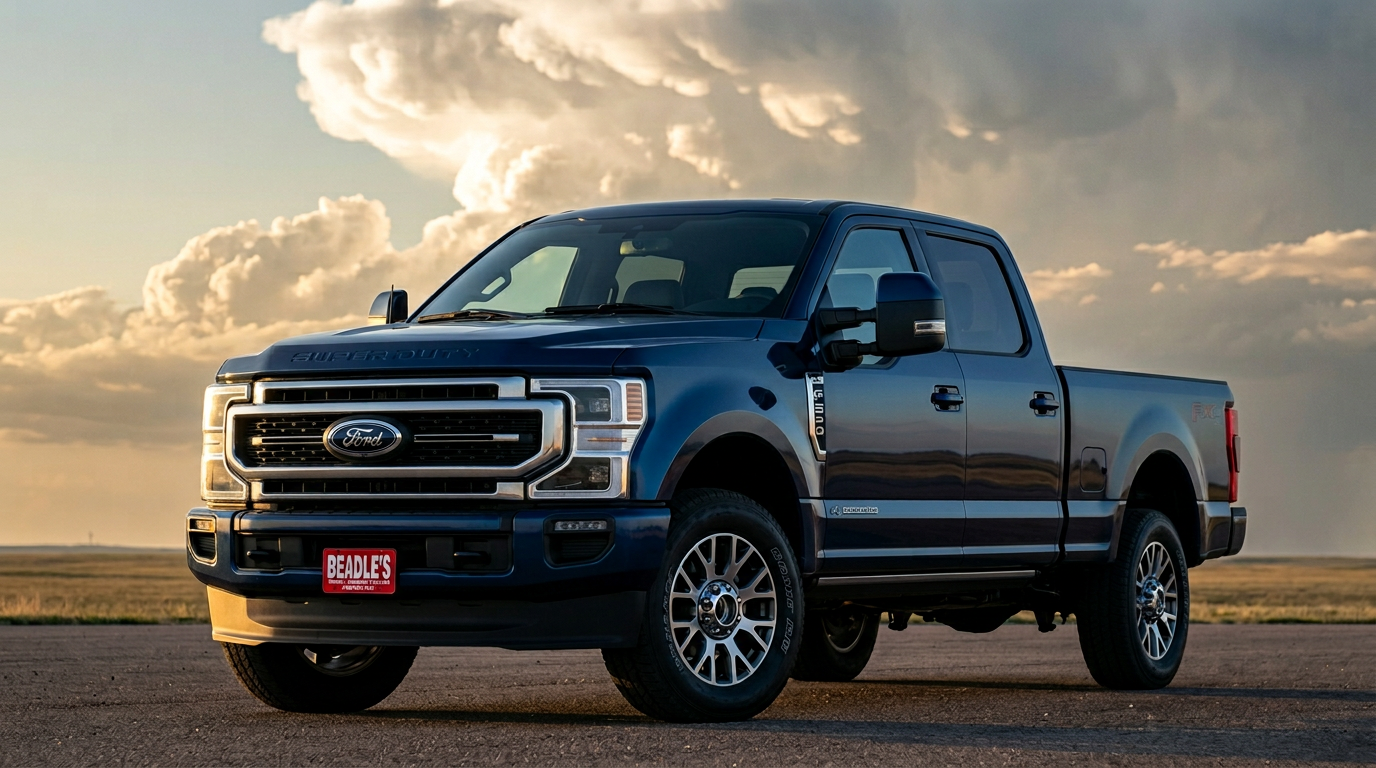
For 2027, the Ford F-250 adds two new colors — Neptune Blue and Iconic Silver Metallic — while dropping Argon Blue Metallic and Avalanche. The big appearance news is Tremor Off-Road now available on the XL, a new XL Off-Road 35-inch Tire Package, and the new Super Duty Carhartt Package.
Color is the headline most buyers want, but 2027 also opens up real styling and off-road appearance options that weren’t on the F-250 before. If you want your Super Duty to look a certain way — clean and chrome, blacked-out, off-road rugged, or work-ready — there’s now a package for it.
Here’s what’s new and dropped in the palette, the off-road and appearance packages worth knowing, and how wheels and styling break down by trim. To see every color on the same truck, use our interactive 2027 Super Duty color picker.
What new colors did the 2027 F-250 add?
Two: Neptune Blue, a deep marine blue, and Iconic Silver Metallic, a bright silver. Both are available across the trims (Iconic Silver on every trim except King Ranch), giving the 2027 F-250 a fresh blue and a clean, low-maintenance silver in the lineup.
They join carryover favorites like Oxford White, Agate Black Metallic, Carbonized Gray Metallic, and the premium tri-coats. For the full retail palette — ten colors shown on the same truck in the same light, with trim-exclusive ones labeled — the interactive Super Duty color picker is the fastest way to compare.
Which 2026 colors were dropped?
Argon Blue Metallic and Avalanche are discontinued for 2027. If either was on your shortlist, a 2026 F-250 still on the lot is the last way to get it — once that inventory sells down, those colors are gone.
For blue buyers, the new Neptune Blue is the natural successor and is available across every trim. If you were set on Avalanche specifically, talk to us before our remaining 2026 inventory moves.
Tremor on XL and the 35-inch tire package
The biggest appearance change for 2027 is off-road. The Tremor Off-Road Package is now available on the XL (with the STX Appearance Package), bringing the lifted, aggressive Tremor look and capability to the work trim for the first time. There’s also a new XL Off-Road 35-inch Tire Package for buyers who want the rugged stance without the full Tremor.
The XL Off-Road 35-inch Tire Package adds 35-inch tires, a taller ride height, an electronic locking rear differential, a limited-slip front differential, upgraded suspension dampers, Rock Crawl mode, Trail Control, Trail Turn Assist, and heavy-duty skid plates — serious gravel-and-trail hardware on an affordable trim.
Also new: the Super Duty Carhartt Package brings work-grade, Carhartt-branded styling inside and out to single-rear-wheel trucks — a distinctive work-truck look for 2027.
Wheels and appearance options by trim
Styling scales with trim. XL and XLT start with 18-inch wheels and add appearance flavor through packages — the STX Appearance Package for a sportier look or the Black Appearance Package to black out the chrome. The XLT and Lariat can step up to 20-inch wheels, including a 20-inch Dark Carbonized Gray High-Gloss option and a 20-inch Chrome PVD wheel on the Lariat.
Up top, the King Ranch wears its signature Western styling with two-tone Marsh Gray lower cladding (and an available Chrome Package), while the Platinum gets the most modern, monochromatic premium look. So whether you want blacked-out, chromed-out, off-road, or refined, there’s a 2027 F-250 configuration for it.
Our Recommendation
For a sharp, value-minded look around Bowdle and Aberdeen, we like an XLT in one of the new colors with the STX Appearance Package — or, if you want real gravel-and-trail capability on a budget, the new XL Off-Road 35-inch Tire Package. Both deliver standout style without stepping into King Ranch or Platinum money.
From the Beadle Ford Lot
The appearance change people are most excited about is Tremor finally landing on the XL. Buyers who wanted that lifted, 35-inch-tire look used to have to climb into a higher trim to get it — now they can build a work-priced XL that looks the part. We expect to order a lot of those.
Key Takeaways
- New 2027 colors: Neptune Blue and Iconic Silver Metallic; dropped: Argon Blue Metallic and Avalanche.
- Tremor Off-Road is now available on the F-250 XL (with the STX Appearance Package).
- The new XL Off-Road 35-inch Tire Package adds 35-inch tires, a locking rear diff, Rock Crawl, and skid plates.
- The new Super Duty Carhartt Package brings work-grade styling to single-rear-wheel trucks.
- Appearance options scale by trim: STX and Black Appearance on the work trims, chrome and Western styling up top.
Frequently Asked Questions
Quick Answers: 2027 F-250 Colors & Appearance
One-line answers to the follow-up questions buyers ask next.
New colors? Neptune Blue and Iconic Silver Metallic.
Dropped colors? Argon Blue Metallic and Avalanche.
How many retail colors total? Ten.
Where can I see them all? The interactive Super Duty color picker.
Tremor on the XL? Yes — new for 2027, with the STX Appearance Package.
What’s the 35-inch tire package? 35-inch tires, locking rear diff, Rock Crawl, skid plates on the XL.
Is there a Carhartt edition? Yes — the Super Duty Carhartt Package, single-rear-wheel.
Blacked-out look? The Black Appearance Package.
Chrome look? Standard chrome on mid trims; a Chrome Package on King Ranch.
Where can I build one? Beadle Ford in Bowdle, SD.
Keep Researching
The complete 2027 Ford F-250 Super Duty overview — trims, towing, specs, and inventory
See every 2027 Super Duty color — the interactive color picker
2027 F-250 trims for the everyday buyer — how styling scales by trim
What’s new for the 2027 F-250 — every change for the model year
My Take on the 2027 F-250 Look
The color choices are great, but the change I’m most excited to show people is Tremor on the XL. For years, the buyers who wanted that lifted, aggressive look had to spend up for it — now we can build a work-priced XL that turns heads on the gravel. Pair it with Neptune Blue or Iconic Silver and it’s a genuinely good-looking truck for the money.
Use the color picker to settle on your paint, then come tell me how you want the truck to look — we’ll spec the packages and wheels to match. We’re at Beadle Ford in Bowdle whenever you’re ready.
About the Author
Lexy Tabbert — Beadle Ford, Bowdle, SD
Lexy Tabbert is the Director of Sales and Marketing at Beadle Ford in Bowdle, South Dakota. She covers Ford vehicles, trim comparisons, and buyer guidance — helping families, ranchers, and ag operators across the region find the right truck and configuration for their needs. Learn more about Lexy.
Buy a 2026 Ford F-250 Now or Order a 2027?
Quick Answer
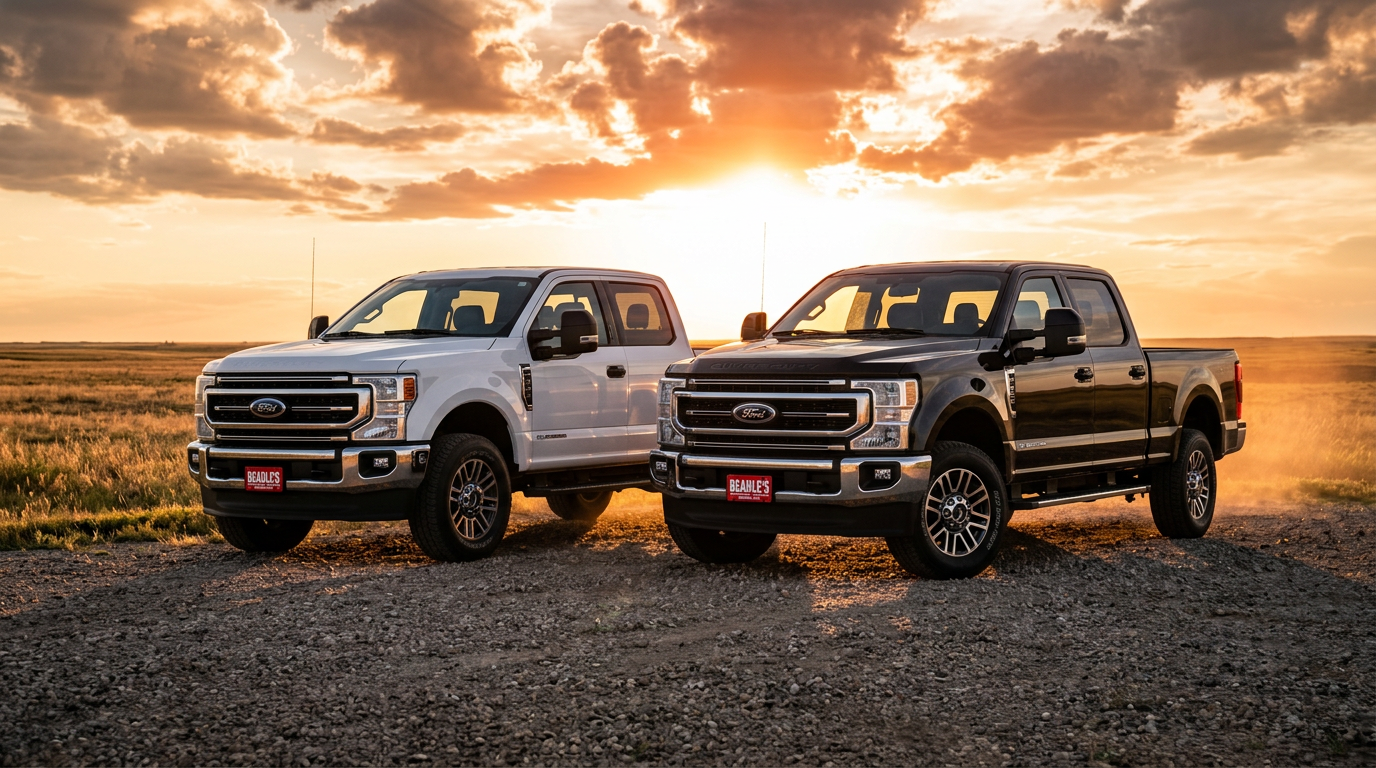
Buy a 2026 F-250 now if you want an engine the 2027 drops — the 6.8L gas V8 or the standard-output 6.7L diesel — or you need a truck on the lot today. Order a 2027 if you want the simplified lineup with the standard 7.3L gas, Tremor on the XL, and the new Carhartt Package.
With the 2027 F-250 now in production and 2026s still on the lot, a lot of shoppers are asking the same thing: buy now or wait and order? Because 2027 is a real change year for the Super Duty — not just a calendar flip — the answer actually depends on what you want under the hood and how soon you need the truck.
Here’s what changed between the two model years, why a 2026 is your last shot at certain engines, what to expect on price, and how to decide between buying off the lot and ordering to spec.
What’s different between the 2026 and 2027 F-250?
The big change is engines. The 2026 F-250 offers four engines; the 2027 simplifies to two. For 2027 the 7.3L gas V8 is standard on every trim and the 6.7L High-Output Power Stroke diesel is the only diesel — the 6.8L gas V8 and the standard-output 6.7L diesel are discontinued.
The 2027 also adds Tremor Off-Road availability on the XL, a new XL Off-Road 35-inch Tire Package, the Super Duty Carhartt Package, and two new colors (Neptune Blue and Iconic Silver Metallic) while dropping Argon Blue Metallic and Avalanche. Towing and payload capability carries over — the simplified lineup didn’t cost the F-250 any capability.
| Feature | 2026 F-250 | 2027 F-250 |
| Engines | Four (incl. 6.8L gas, std-output diesel) | Two (7.3L gas standard, HO diesel) |
| Tremor on XL | No | Yes (with STX) |
| Carhartt Package | No | New for 2027 |
| Availability | On the lot now | Build to order, arriving late 2026 |
Is the standard-output diesel really gone?
Yes. For 2027, the 6.7L High-Output Power Stroke is the only diesel — the standard-output 6.7L diesel is discontinued. So a 2026 still on the lot is the last chance to buy the standard-output diesel, and likewise the only way to still get the 6.8L gas V8.
For most buyers this doesn’t change much, because the now-standard 7.3L gas covers the towing the standard-output diesel was often chosen for. But if you specifically wanted that engine — for a particular price point or duty cycle — the 2026 is your window, and once our 2026 inventory sells down, it’s gone.
Will the 2027 cost more?
Probably a modest amount. The 7.3L gas V8 was roughly a $1,500 option in 2026 and is standard equipment for 2027, so the entry price likely reflects that. Ford has not yet published final 2027 F-250 pricing, so the exact difference is still to be confirmed.
If avoiding a price increase matters and you don’t need a specific 2027 feature, buying a 2026 now can be the value play — especially on remaining inventory. If you want the new packages or simply prefer ordering exactly the truck you want, the 2027 is worth the wait and likely the small premium.
Buy off the lot or order to spec?
Buy off the lot if you need a truck now, want to avoid a likely price bump, or you’ve found a 2026 configured close to what you want. Order to spec if you want the exact cab, bed, axle, trim, color, and packages — including the 2027-only options — and you can wait for the build.
Our Recommendation
If you want the 6.8L gas or the standard-output diesel, need a truck today, or want to avoid a likely price increase, buy a 2026 now — while they’re on the lot. If you want the simplified 2027 lineup, Tremor on the XL, the Carhartt Package, or a build done exactly to your spec, order a 2027. For the largest group of buyers, the now-standard 7.3L gas makes the 2027 an easy, future-proof choice.
Buy a 2026 now if you want the 6.8L gas or standard-output diesel, need a truck today, or want to dodge a price increase.
Order a 2027 if you want the standard 7.3L gas, Tremor on the XL, the Carhartt Package, the new colors, or a precise build.
From the Beadle Ford Lot
The honest version of this conversation usually takes two minutes: if you wanted a dropped engine or you need a truck this month, we look at the 2026s on the lot. If you’re flexible on timing and want it built your way, we order a 2027. The only buyers who feel rushed are the ones who had their heart set on the standard-output diesel — for them, the clock really is running on our remaining 2026s.
Key Takeaways
- The 2026 F-250 offers four engines; the 2027 simplifies to the standard 7.3L gas and the HO diesel.
- A 2026 on the lot is the last chance to get the 6.8L gas V8 or the standard-output 6.7L diesel.
- Expect a modest 2027 price increase since the 7.3L gas (a ~$1,500 option in 2026) is now standard; final pricing is not yet announced.
- Buy a 2026 now to get a dropped engine, buy today, or dodge a price bump; order a 2027 for the new lineup and a precise build.
- Towing and payload carry over — the 2027’s simpler lineup didn’t reduce capability.
Frequently Asked Questions
Quick Answers: 2026 vs. 2027 F-250
One-line answers to the follow-up questions buyers ask next.
Engines on the 2026? Four, including the 6.8L gas and standard-output diesel.
Engines on the 2027? Two — 7.3L gas standard, 6.7L HO diesel.
What’s the last-call engine? The standard-output 6.7L diesel (and the 6.8L gas).
Will the 2027 cost more? Likely a modest increase; final pricing not announced.
When do 2027s arrive? Deliveries ramp late 2026.
Can I order a 2027 now? Yes — order banks are open.
Did capability change? No — towing and payload carry over.
What’s new on the 2027? Tremor on XL, Carhartt Package, new colors.
Best reason to buy a 2026? A dropped engine, a truck today, or dodging a price bump.
Best reason to order a 2027? The new lineup and a build done your way.
Keep Researching
The complete 2027 Ford F-250 Super Duty overview — the new lineup, trims, and ordering
The 2026 Ford F-250 Super Duty overview — what’s on the lot now, including the dropped engines
What’s new for the 2027 F-250 — every change explained
7.3L gas vs. HO diesel — which engine fits how you tow
My Take on Buying Now vs. Ordering a 2027
I don’t think there’s a wrong answer here, and I won’t push someone to wait if a 2026 on our lot is the right truck at the right price today. The only time I get a little urgent is with the standard-output diesel — once our 2026 inventory is gone, that engine is genuinely off the table, so if that’s what you want, I’d rather you know the window is closing. For everyone else, the now-standard 7.3L gas makes the 2027 a confident, future-proof order.
Tell me which engine you’re after and your timeline, and I’ll show you whether the smart move is a 2026 on the lot or a 2027 built to your spec. Either way, we’ll sort it out at Beadle Ford in Bowdle.
About the Author
Lexy Tabbert — Beadle Ford, Bowdle, SD
Lexy Tabbert is the Director of Sales and Marketing at Beadle Ford in Bowdle, South Dakota. She covers Ford vehicles, trim comparisons, and buyer guidance — helping families, ranchers, and ag operators across the region find the right truck and configuration for their needs. Learn more about Lexy.
2027 Ford F-250 Trims for the Everyday Buyer
Quick Answer
The 2027 Ford F-250 comes in five trims: XL, XLT, Lariat, King Ranch, and Platinum. For most everyday buyers, the XLT is the value sweet spot and the Lariat is the comfort sweet spot — both with the standard 7.3L gas V8 and available 4×4. King Ranch and Platinum add Western and modern luxury.
Every 2027 F-250 has the same Super Duty capability under it, so picking a trim is really about how much comfort and tech you want for the money. The good news for 2027 is that the 7.3L gas V8 is standard across the board, so you’re not trading capability for a lower trim.
Here’s what each trim gets you, where the everyday-buyer value lands, and when the King Ranch or Platinum is worth the step up — framed for how people actually use a Super Duty around Bowdle and Aberdeen.
What trims does the 2027 F-250 come in?
Five, from work truck to luxury: XL, XLT, Lariat, King Ranch, and Platinum. The 7.3L gas V8 is standard on all of them, and the 6.7L High-Output diesel is optional across the line, so capability doesn’t change with trim — only comfort, tech, and styling do.
A couple of equipment notes worth knowing: Pro Power Onboard is standard from the XLT up, and 4×4 is standard beginning on the King Ranch (it’s available on XL, XLT, and Lariat). The new Super Duty Carhartt Package brings work-grade style to single-rear-wheel trucks.
| Trim | Character | Right for you if |
| XL | Straightforward work truck | You want the best price and a no-frills tool |
| XLT | Work plus everyday comfort | You want value — capability without luxury cost |
| Lariat | Leather and the big screen | You live in the truck on long drives |
| King Ranch | Western-styled luxury (4×4 standard) | You want premium that still works for a living |
| Platinum | Top tech-forward luxury | You want the most modern, loaded F-250 |
What do you get on XL and XLT?
The XL is the tool: durable, hose-out-friendly, and built to work, now with the 7.3L gas V8 standard and Tremor Off-Road newly available with the STX Appearance Package. It’s the lowest price of entry and exactly enough truck for a jobsite or a fleet.
The XLT is where most everyday buyers land. It keeps the work capability but adds the comfort and convenience that make a truck pleasant to live with — chrome exterior trim, more interior features, available LED lighting, and standard Pro Power Onboard for running tools and gear off the truck. For value, the XLT is hard to beat.
Why Lariat is the comfort sweet spot
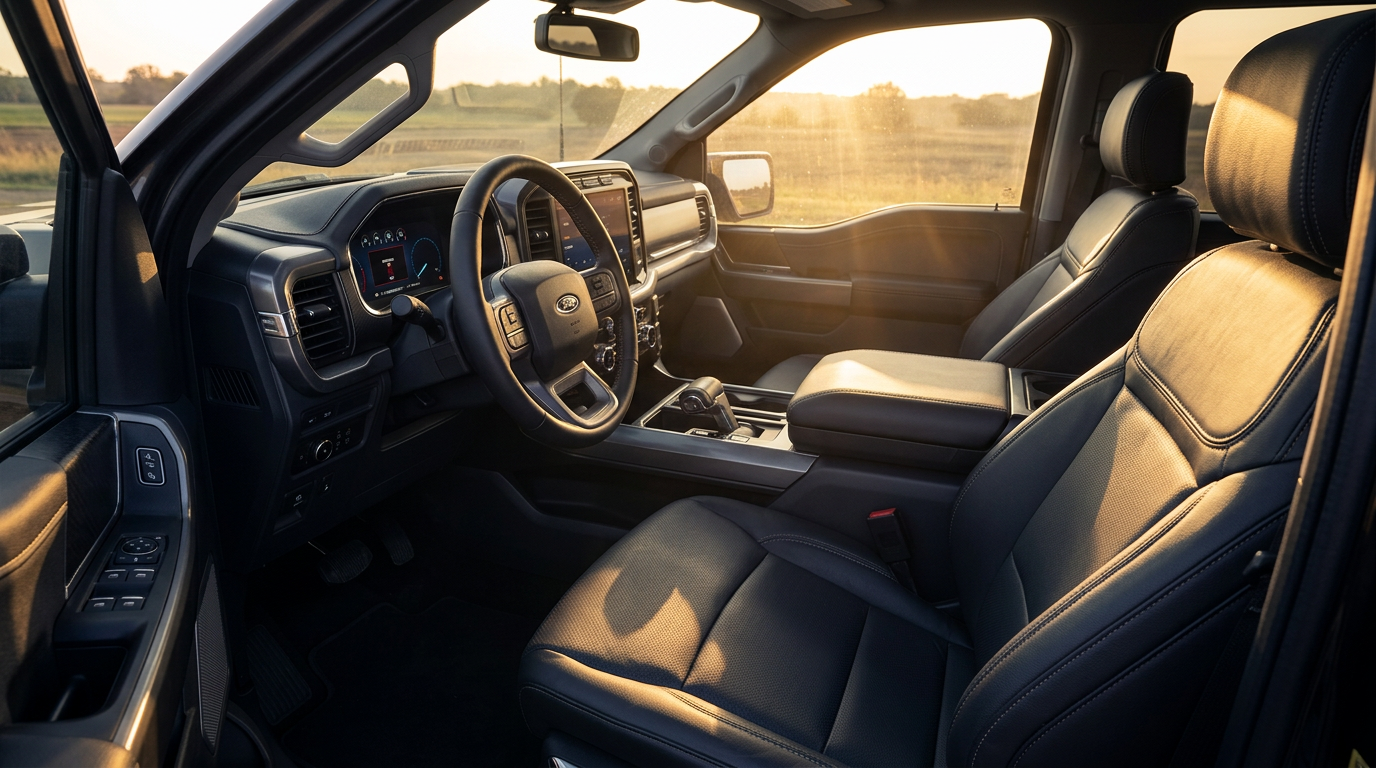
The Lariat is the trim we point most long-haul and daily-driver buyers toward. It adds leather seating, the 12-inch SYNC 4 touchscreen and 12-inch digital cluster, dual-zone automatic climate control, heated and ventilated front seats, and standard LED lighting — the features that make long Dakota highway miles genuinely comfortable.
It’s the step where an F-250 stops feeling like a work truck and starts feeling like a nice truck you’d happily drive every day, without climbing into King Ranch or Platinum money. If you want one truck that tows, works, and serves as the family highway vehicle, the Lariat is the sweet spot.
King Ranch and Platinum: worth the step up?
They’re worth it if you want a luxury truck that still has full Super Duty capability. The King Ranch brings Western-themed Kingsville leather, distinctive styling, two-tone Marsh Gray lower cladding, and standard 4×4. The Platinum goes the modern-luxury route with Multicontour leather seats and the most tech-forward cabin in the lineup.
Neither gives up any towing or hauling to the work trims — you’re paying purely for comfort, materials, and style. If you spend serious time in the truck and want it to feel special, the step up makes sense; if you mainly want capability and value, the XLT or Lariat already covers it.
Our Recommendation
For most everyday F-250 buyers around Bowdle and Aberdeen, the XLT is the value pick and the Lariat is the comfort pick — both with the standard 7.3L gas V8 and 4×4. Step up to King Ranch or Platinum only if you want luxury materials and styling, since none of it changes what the truck can tow or haul.
From the Beadle Ford Lot
The trim conversation usually settles itself once people sit in a Lariat. They came in pricing an XLT to save money, then they feel the leather and the big screen on a test drive and realize the Lariat is the truck they’ll actually want to spend time in. Both are great buys — it just comes down to how many highway miles you’re putting on it.
Key Takeaways
- The 2027 F-250 offers five trims: XL, XLT, Lariat, King Ranch, and Platinum.
- The 7.3L gas V8 is standard on every trim — capability doesn’t change, only comfort and tech.
- Pro Power Onboard is standard from the XLT; 4×4 is standard beginning on the King Ranch.
- The XLT is the value sweet spot; the Lariat adds leather and the 12-inch SYNC 4 screen for daily comfort.
- King Ranch and Platinum add luxury and styling without changing what the truck can tow or haul.
Frequently Asked Questions
Quick Answers: 2027 F-250 Trims
One-line answers to the follow-up questions buyers ask next.
How many trims? Five — XL, XLT, Lariat, King Ranch, Platinum.
Best value? The XLT.
Comfort sweet spot? The Lariat.
Which has the most luxury? The Platinum.
Standard engine on all trims? The 7.3L gas V8.
Where does Pro Power Onboard start? Standard on the XLT and up.
Where is 4×4 standard? Beginning on the King Ranch.
Which trim gets the 12-inch screen? The Lariat and up.
Is there a work-style package? Yes — the new Super Duty Carhartt Package (single-rear-wheel).
Where can I compare trims in person? Beadle Ford in Bowdle, SD.
Keep Researching
The complete 2027 Ford F-250 Super Duty overview — trims, towing, specs, and inventory
2027 F-250 colors & appearance — packages, wheels, and styling by trim
Is an F-250 enough truck? — capability across the lineup
Buy a 2026 now or order a 2027? — timing your purchase
My Take on Picking a 2027 F-250 Trim
Because the 7.3L gas is standard everywhere now, I tell people not to overthink capability and just buy the comfort level they’ll appreciate. For a work-first truck, the XLT is all most folks need and a genuinely good value. For someone putting on real highway miles, the Lariat is the one I’d own — it’s the point where the truck feels as nice as it is capable. The King Ranch and Platinum are wonderful, but they’re about wanting them, not needing them.
Come sit in an XLT and a Lariat back to back at Beadle Ford in Bowdle — that comparison usually makes the decision for you.
About the Author
Lexy Tabbert — Beadle Ford, Bowdle, SD
Lexy Tabbert is the Director of Sales and Marketing at Beadle Ford in Bowdle, South Dakota. She covers Ford vehicles, trim comparisons, and buyer guidance — helping families, ranchers, and ag operators across the region find the right truck and configuration for their needs. Learn more about Lexy.
Quick Answer
Yes, the 2027 Ford F-250 works well as a daily driver in South Dakota. A single-rear-wheel F-250 drives and parks like a normal full-size truck, upper trims are highway-comfortable, and 4×4 makes it excellent in snow and gravel. The trade-off is a firmer unloaded ride and a thirsty gas V8.
Plenty of people around here drive an F-250 every day, not just on tow days. The question isn’t whether a three-quarter-ton can be a daily driver — it’s whether the comfort, fuel, and winter manners line up with how you live. For most rural South Dakota owners, they do.
Here’s an honest look at the F-250 as an everyday vehicle: practicality, highway comfort and tech, what to really expect at the pump, and how it handles a Dakota winter and a season of gravel roads.
Is an F-250 practical as an everyday vehicle?
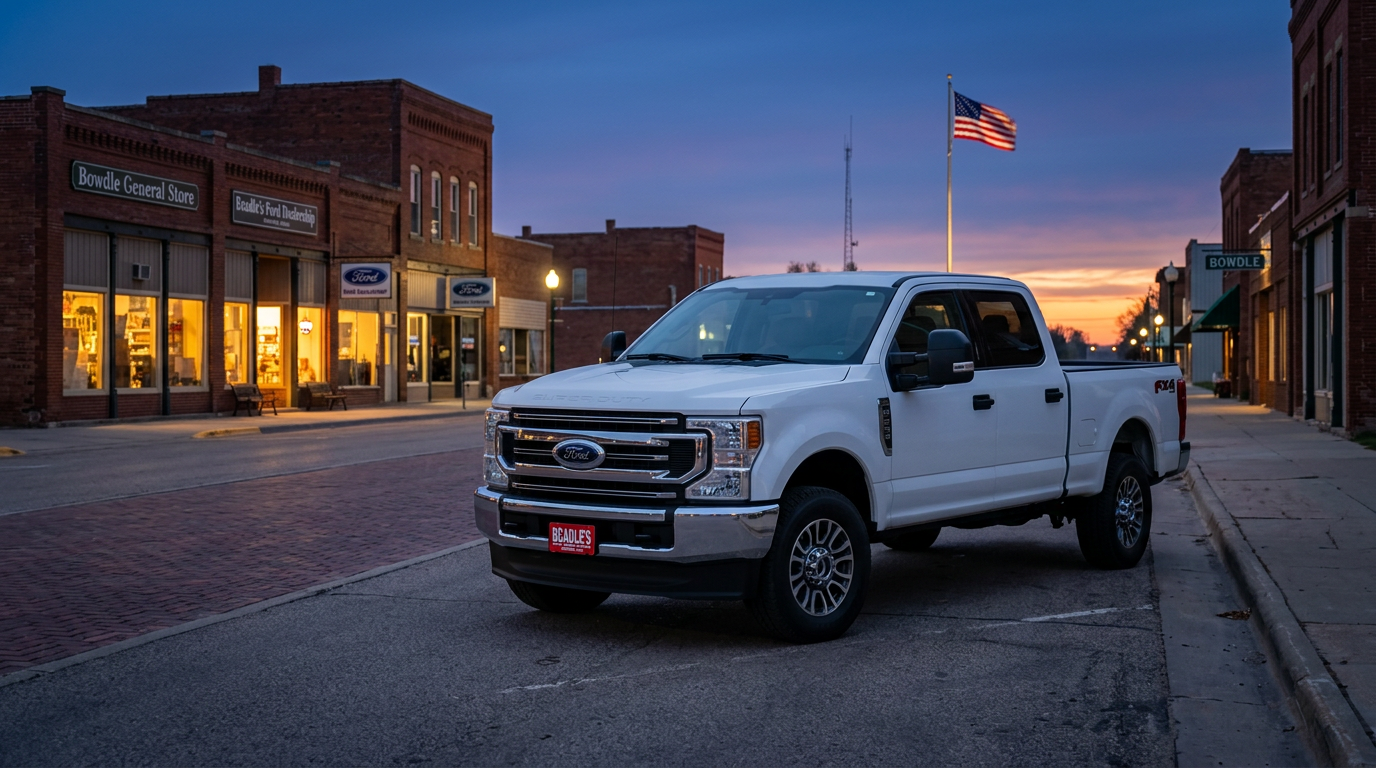
Yes. A single-rear-wheel F-250 drives, parks, and lives like a normal full-size truck — it’s the dually F-350 that gets awkward in a parking lot. For school runs, the co-op, the lumber yard, and the highway between towns, the F-250 is entirely livable as a daily.
The honest trade-offs versus a half-ton are size and ride: it’s a taller, heavier truck, and the heavy-duty suspension rides firmer when the bed is empty. Around here, where driveways are long, distances are real, and a truck earns its keep, those trade-offs are easy ones for most buyers to make.
Comfort and tech for long highway miles
On the long, straight highway miles between Dakota towns, the F-250 is a comfortable place to spend time — especially in Lariat trim and up, which add leather, the 12-inch SYNC 4 touchscreen, heated and ventilated seats, and a quieter, more settled cabin. Even the work-focused XLT is a pleasant long-haul truck.
The upper trims also bring the driver-assist and connectivity tech that makes a daily truck easier: a big digital cluster, wireless phone integration, and available 360-degree cameras. If your F-250 is going to double as the family highway vehicle, the Lariat is the comfort sweet spot.
Best daily-driver pick: an XLT for value or a Lariat for comfort, with the standard 7.3L gas V8 and 4×4 — capable enough for any chore, comfortable enough to live in.
Real-world fuel expectations on the 7.3L
Set expectations honestly: Super Duty trucks are above the 8,500-lb weight class the EPA rates, so there’s no window-sticker MPG figure. In real-world driving, the 7.3L gas V8 generally returns low-to-mid teens unloaded, and less when you’re towing.
The 6.7L High-Output diesel does noticeably better on the highway and especially under load, which is part of why heavy, high-mileage tow buyers lean diesel. But for a daily driver that mostly runs empty, the gas V8’s lower purchase and maintenance cost usually outweighs the diesel’s fuel savings. A big V8 in a heavy-duty truck is never going to sip — that’s the deal you make for the capability.
Winter and gravel-road livability
This is where the F-250 shines as a Dakota daily. With 4×4, selectable drive modes, real ground clearance, and the weight to stay planted, it handles snow-packed roads and washboard gravel about as well as anything on the lot. Add a good set of all-terrain or winter tires and it’s hard to stop.
The same toughness that makes it a capable tow truck makes it a confident winter commuter: heavy-duty everything, ground clearance to clear drifts, and the traction tech to put the power down. For getting to work in February or down a muddy spring two-track, it’s exactly the truck you want. The full breakdown lives in our 2027 F-250 winter & gravel capability guide.
Our Recommendation
For an F-250 that pulls daily-driver duty around Bowdle and Aberdeen, we recommend an XLT or Lariat with the standard 7.3L gas V8 and 4×4. You get genuine heavy-duty capability, a comfortable highway cabin, excellent winter and gravel manners, and a lower cost of ownership than the diesel for a truck that mostly drives unloaded.
From the Beadle Ford Lot
A fair number of our F-250 buyers barely tow at all — they want one truck that handles the gravel, the winter, and the occasional heavy chore, and doubles as the everyday driver. When someone tells me they want capability they can live in daily, I point them at a Lariat with the gas V8 and 4×4, and they rarely look back.
Key Takeaways
- A single-rear-wheel F-250 drives and parks like a normal full-size truck — livable as a daily driver.
- Lariat and up add leather, the 12-inch SYNC 4 touchscreen, and heated/ventilated seats for long highway miles.
- Super Duty trucks aren’t EPA-rated; expect low-to-mid teens unloaded from the 7.3L gas, less when towing.
- With 4×4 and good tires, the F-250 is excellent on Dakota snow and gravel.
- For a daily driver, an XLT or Lariat with the 7.3L gas and 4×4 is the value-and-comfort sweet spot.
Frequently Asked Questions
Quick Answers: F-250 as a Daily Driver
One-line answers to the follow-up questions buyers ask next.
Is it too big for daily use? No — the SRW F-250 drives like a normal full-size truck.
Fuel economy on the gas V8? Low-to-mid teens unloaded; not EPA-rated.
Is there an MPG window sticker? No — Super Duty is above the EPA-rated weight class.
Best daily trim? XLT for value, Lariat for comfort.
Best daily engine? The standard 7.3L gas V8.
Good in winter? Yes — excellent with 4×4 and good tires.
Comfortable on the highway? Yes, especially Lariat and up.
Does it have wireless phone connectivity? Yes, on upper trims with SYNC 4.
Gas or diesel for a daily? Gas, unless you tow heavy and often.
Where can I test drive one? Beadle Ford in Bowdle, SD.
Keep Researching
The complete 2027 Ford F-250 Super Duty overview — trims, towing, specs, and inventory
2027 F-250 winter & gravel capability — 4×4, drive modes, and the right tires
2027 F-250 trims for the everyday buyer — where the value lands
Is an F-250 enough truck? — capability for daily and weekend use
My Take on Daily-Driving an F-250
I’m upfront with daily-driver buyers about the fuel — a big gas V8 in a heavy-duty truck is going to drink more than a half-ton, and I’d rather someone know that going in than be surprised at the first fill-up. What I find, though, is that the people who want one truck to do everything around here almost never regret the F-250. It’s comfortable on the highway, unstoppable in the winter, and ready the day they finally do need to tow something heavy.
If you’re thinking about an F-250 as your everyday truck, come drive a Lariat and see how it feels on our roads. We’re at Beadle Ford in Bowdle whenever you’re ready.
About the Author
Lexy Tabbert — Beadle Ford, Bowdle, SD
Lexy Tabbert is the Director of Sales and Marketing at Beadle Ford in Bowdle, South Dakota. She covers Ford vehicles, trim comparisons, and buyer guidance — helping families, ranchers, and ag operators across the region find the right truck and configuration for their needs. Learn more about Lexy.
Quick Answer
Properly equipped, the 2027 Ford F-250 tows travel trailers and fifth-wheel campers up to about 19,500 lbs on the standard 7.3L gas V8 and up to 22,100 lbs fifth-wheel with the High-Output diesel. For most RV buyers, the gas V8 has the room without the diesel premium.
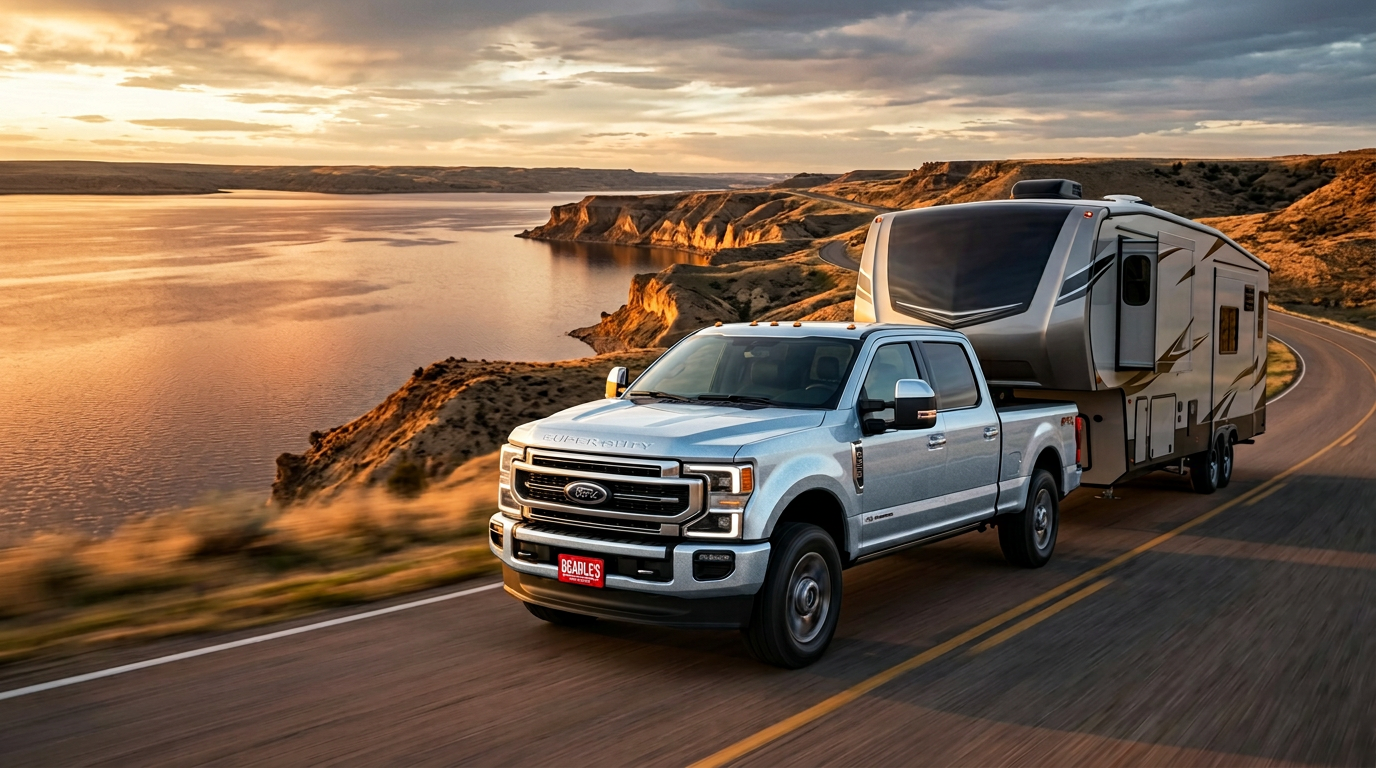
If your idea of a good weekend is a camper behind the truck headed for Lake Oahe or the Black Hills, the 2027 F-250 is built for it. With the now-standard 7.3L gas V8 and the right tow setup, it pulls big travel trailers and most fifth-wheels comfortably — no diesel required for the majority of recreational towing.
Here’s what the F-250 tows for RVs, whether the gas V8 is enough for a big fifth-wheel, the tow equipment worth ordering, and how to match a trailer to your exact configuration.
How much can the 2027 F-250 tow for RVs?
Properly equipped, the 7.3L gas F-250 tows up to about 19,500 lbs on a fifth-wheel or gooseneck and 18,200 lbs conventional. The 6.7L High-Output diesel raises that to up to 22,100 lbs fifth-wheel and 22,000 lbs conventional. That covers the full range of travel trailers and the large majority of recreational fifth-wheels.
For perspective, a typical family fifth-wheel runs roughly 12,000 to 16,000 lbs loaded, and most bumper-pull travel trailers come in well under that. Both sit comfortably inside the F-250’s range with margin to spare for gear, water, and the climb out of a river valley.
| RV towing (properly equipped) | 7.3L Gas V8 | 6.7L HO Diesel |
| Travel trailer (conventional) | Up to 18,200 lbs | Up to 22,000 lbs |
| Fifth-wheel camper | About 19,500 lbs | Up to 22,100 lbs |
Maximums require proper equipment and vary by cab, bed, axle, and configuration. Always tow to your specific truck’s door-jamb ratings.
Can the 7.3L gas pull a big fifth-wheel?
Yes — the now-standard 7.3L gas V8 tows a fifth-wheel up to about 19,500 lbs, which covers the large majority of recreational fifth-wheel campers. Unless your rig is a heavy toy hauler or a full-time-living fifth-wheel near the top of the range, the gas truck has the capability.
The number that trips people up isn’t the tow rating — it’s king pin weight. A fifth-wheel puts roughly 15% of its loaded weight down on the truck, so a 16,000-lb fifth-wheel adds around 2,400 lbs to the bed. That has to fit within the F-250’s payload along with your passengers and gear, which is exactly why the payload number matters as much as the tow rating.
Our Recommendation
For most RV buyers around Bowdle and Aberdeen, the standard 7.3L gas V8 is the right engine — it pulls a fifth-wheel up to about 19,500 lbs and saves the diesel premium. Step up to the High-Output diesel if you run a heavy toy hauler, climb mountain grades often, or want the extra fuel economy on long hauls.
What tow package, hitch, and mirrors do you want?
For recreational towing, order the trailer tow equipment that makes the trip easy and safe: the factory trailer tow package with the 7-wire harness, the integrated trailer brake controller, PowerScope telescoping tow mirrors, and the fifth-wheel/gooseneck prep package if you’re pulling either. The F-250’s 2.5-inch receiver is rated to 22,000 lbs and 2,200 lbs of tongue weight.
- Trailer Tow Package — 7-wire harness and connector, the backbone of any RV setup.
- Integrated trailer brake controller — smooth, factory-tuned trailer braking.
- PowerScope telescoping trailer tow mirrors — the visibility you’ll want behind a wide fifth-wheel.
- Fifth-wheel / gooseneck prep package — factory bed prep so the hitch installs clean.
- 360-degree camera and Pro Trailer features where available — a big help backing into a tight campsite.
How to match a trailer to your F-250 config
Match three numbers, not one: your trailer’s loaded weight against the truck’s tow rating, your trailer’s tongue or king pin weight against the truck’s payload, and your total combined weight against the GCWR on the door jamb. The tow rating alone doesn’t tell you if the truck can carry the hitch weight.
Cab, bed, axle ratio, and engine all shift those numbers, so the smartest move is to spec the truck around your actual trailer. Tell us your camper’s loaded weight and we’ll build an F-250 with the right axle and options to tow it with margin — or check it against a truck already on the lot before you buy.
From the Beadle Ford Lot
The mistake we catch most with camper buyers is shopping the tow rating and forgetting the payload. A big fifth-wheel’s king pin weight eats into payload fast, and a beautifully spec’d truck can run out of payload before it runs out of tow rating. We always check both against the actual trailer before anyone signs.
Key Takeaways
- The 7.3L gas F-250 tows fifth-wheels up to about 19,500 lbs and travel trailers up to 18,200 lbs.
- The High-Output diesel raises that to up to 22,100 lbs fifth-wheel and 22,000 lbs conventional.
- For most recreational towing, the standard gas V8 is plenty — no diesel premium needed.
- Watch king pin weight (about 15% of a fifth-wheel) against payload, not just the tow rating.
- Order the trailer tow package, brake controller, PowerScope mirrors, and fifth-wheel prep for an easy setup.
Frequently Asked Questions
Quick Answers: F-250 Recreational Towing
One-line answers to the follow-up questions buyers ask next.
Fifth-wheel max on gas? About 19,500 lbs, properly equipped.
Fifth-wheel max on diesel? Up to 22,100 lbs.
Travel trailer max on gas? Up to 18,200 lbs conventional.
Do I need a diesel for a camper? Not for most — the gas V8 covers it.
What’s king pin weight? Roughly 15% of a fifth-wheel’s loaded weight, carried by the truck.
What hitch receiver does it have? A 2.5-inch receiver rated to 22,000 lbs.
Best mirrors for towing? PowerScope telescoping trailer tow mirrors.
Does it have a trailer brake controller? Yes — an integrated, factory-tuned controller.
Will it back into a campsite easily? Yes, especially with the 360-degree camera.
Where can I match my camper to a truck? Beadle Ford in Bowdle, SD.
Keep Researching
The complete 2027 Ford F-250 Super Duty overview — trims, towing, specs, and inventory
7.3L gas vs. HO diesel — which engine for how you tow
2027 F-150 vs. F-250 — do you need a Super Duty for your camper?
2027 F-250 winter & gravel capability — getting to the lake in any season
My Take on Towing a Camper With the F-250
The thing I most want camper buyers to walk away knowing is to bring me the trailer’s real loaded weight, not the brochure dry weight. People load a fifth-wheel up with water, gear, and a generator and suddenly the king pin weight is a different number than they planned for. When we spec the truck around the trailer you actually own, the F-250 tows it beautifully — and most folks are pleasantly surprised the standard gas V8 is all they need.
Headed to Oahe or the Hills this summer? Bring me your camper’s numbers and we’ll build or find the right F-250 to pull it. Stop by Beadle Ford in Bowdle anytime.
About the Author
Lexy Tabbert — Beadle Ford, Bowdle, SD
Lexy Tabbert is the Director of Sales and Marketing at Beadle Ford in Bowdle, South Dakota. She covers Ford vehicles, trim comparisons, and buyer guidance — helping families, ranchers, and ag operators across the region find the right truck and configuration for their needs. Learn more about Lexy.
Quick Answer
Choose the 2027 Ford F-150 for light, occasional towing and the best daily ride and fuel economy. Step up to the F-250 Super Duty when you tow a fifth-wheel or gooseneck, haul heavy regularly, or want capability well beyond the F-150’s roughly 13,500-lb maximum.
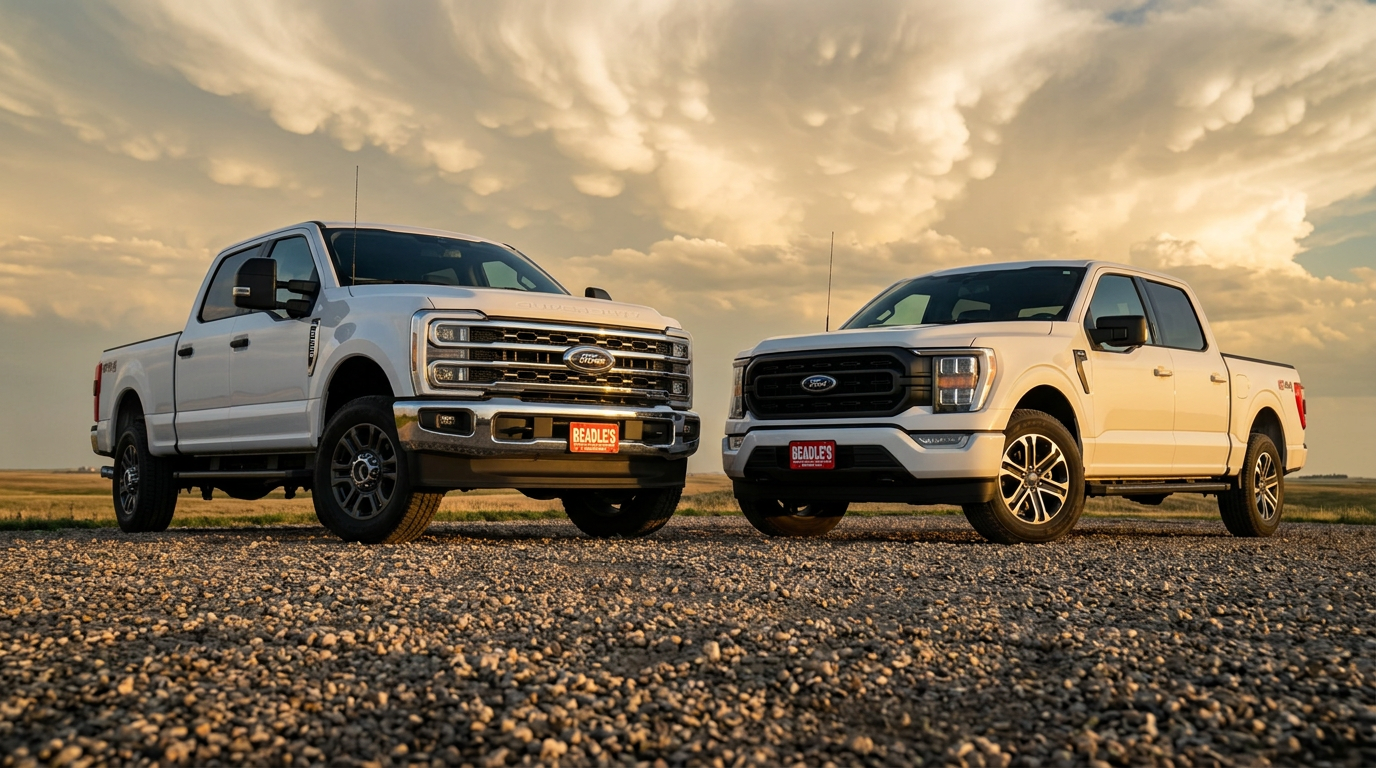
The 2027 Ford F-150 and F-250 look like cousins, but they’re built for different jobs. The F-150 is a half-ton tuned for everyday driving and lighter loads; the F-250 Super Duty is a three-quarter-ton built to tow and haul heavy. The real question isn’t which is “better” — it’s whether you actually need Super Duty capability.
This guide compares the two on towing and payload, ride and fuel, and daily livability, then helps you match the truck to how often and how heavy you tow around central South Dakota.
How do the 2027 F-150 and F-250 differ?
The F-150 is a half-ton; the F-250 is a three-quarter-ton Super Duty. That means heavier frames and axles, beefier brakes and suspension, and a fifth-wheel/gooseneck-ready bed on the F-250 — built for towing and hauling at weights a half-ton isn’t rated for.
The F-150 counters with a lighter, more refined platform: a smoother unloaded ride, better fuel economy, more engine and trim variety, and easier maneuvering. Think of the F-150 as the do-everything daily truck and the F-250 as the dedicated tow-and-haul truck that’s still comfortable to live with.
Towing and payload: where’s the real gap?
On conventional towing, the F-150 tops out around 13,500 lbs, while the 2027 F-250 reaches up to 18,200 lbs with the gas V8 and up to 22,000 lbs with the High-Output diesel. The bigger difference is fifth-wheel and gooseneck capability: the F-250 adds up to 23,000 lbs gooseneck, a job the F-150 isn’t built for.
Payload tells the same story — the F-250 carries up to about 3,700 lbs versus the F-150’s lighter-duty rating. If you’re hauling a fifth-wheel camper, a loaded gooseneck, or heavy material in the bed, that’s Super Duty territory. If your trailer is a boat, a small utility trailer, or a bumper-pull under the F-150’s limit, the half-ton has it covered.
| Capability (properly equipped) | 2027 F-150 | 2027 F-250 |
| Max conventional towing | Around 13,500 lbs | Up to 22,000 lbs |
| Fifth-wheel / gooseneck | Not its strength | Up to 23,000 lbs gooseneck |
| Class | Half-ton | Three-quarter-ton (Super Duty) |
| Best at | Daily driving, light towing | Heavy and frequent towing |
F-250 figures verified for 2027; F-150 maximum is its top conventional rating with the appropriate engine and tow package and varies by configuration.
Ride, fuel, and daily livability compared
Unloaded, the F-150 rides smoother and uses less fuel — its lighter-duty suspension and lineup of efficient engines make it the easier everyday truck. The F-250’s heavy-duty suspension is firmer when the bed is empty, and a big gas V8 or diesel isn’t sipping fuel.
Flip a heavy trailer onto the back, though, and the picture changes: the F-250 stays planted and composed where a half-ton starts to feel the load. So the “better daily driver” depends entirely on whether you’re usually empty or usually towing. For a truck that mostly runs errands and tows light, the F-150 wins comfort and fuel; for a truck that earns its keep with a trailer, the F-250’s manners under load matter more.
Which truck fits your towing frequency?
Match the truck to how often and how heavy you tow. If you tow light loads occasionally and want the best ride and fuel economy, the F-150 is the smarter half-ton. If you tow a fifth-wheel or gooseneck, haul heavy in the bed, or tow with any regularity, the F-250 is built for it.
Our Recommendation
For buyers towing under about 13,000 lbs occasionally — a boat, a small camper, a utility trailer — the 2027 F-150 is the better daily truck. The moment a fifth-wheel, a gooseneck, or regular heavy towing enters the picture, the 2027 F-250 is the right call — it tows up to 22,000 lbs conventional and 23,000 lbs gooseneck, well past anything a half-ton should attempt.
Choose the F-150 if you tow light and occasionally and want the best ride, fuel economy, and price.
Choose the F-250 if you tow a fifth-wheel or gooseneck, haul heavy, or tow regularly enough to want the capability.
From the Beadle Ford Lot
The cleanest way we help people decide is the trailer question: if it’s a gooseneck or a fifth-wheel, the conversation is over — that’s a Super Duty. If it’s a bumper-pull under the F-150’s rating and the truck mostly runs empty, the half-ton usually makes them happier day to day. The trailer almost always answers it.
Key Takeaways
- The F-150 is a half-ton; the F-250 is a three-quarter-ton Super Duty built for heavier towing and hauling.
- The F-150 tops out around 13,500 lbs conventional; the 2027 F-250 reaches up to 22,000 lbs conventional and 23,000 lbs gooseneck.
- Fifth-wheel and gooseneck towing is Super Duty territory — not a half-ton job.
- The F-150 rides smoother and uses less fuel unloaded; the F-250 is more composed under a heavy trailer.
- Let the trailer decide: light bumper-pull and mostly empty means F-150; gooseneck, fifth-wheel, or frequent heavy towing means F-250.
Frequently Asked Questions
Quick Answers: F-150 vs. F-250
One-line answers to the follow-up questions buyers ask next.
Which is the half-ton? The F-150; the F-250 is a three-quarter-ton.
F-150 max towing? Around 13,500 lbs conventional, properly equipped.
F-250 max towing? Up to 22,000 lbs conventional, 23,000 lbs gooseneck.
Which rides better empty? The F-150.
Which uses less fuel? The F-150.
Which tows a fifth-wheel? The F-250 — that’s Super Duty territory.
Which is the better daily driver? The F-150 if you’re mostly empty; the F-250 if you tow heavy.
Which has more payload? The F-250, up to about 3,700 lbs.
Gas or diesel in the F-250? Gas for occasional towing; diesel for heavy, frequent hauling.
Where can I compare them? Beadle Ford in Bowdle, SD.
Keep Researching
The complete 2027 Ford F-250 Super Duty overview — trims, towing, specs, and inventory
Is an F-250 enough truck? — or do you need to step up to an F-350
2027 F-250 for recreational towing — campers and fifth-wheels on the F-250
2027 F-250 trims for the everyday buyer — where the value lands
My Take on F-150 vs. F-250
I don’t push people up to a Super Duty they don’t need — if a buyer tows a boat or a small camper a few times a summer and the truck is otherwise empty, the F-150 is the one I’d put my own family in. But I also don’t want anyone underbuying. The minute someone mentions a gooseneck or a fifth-wheel, the F-250 is the honest answer, and trying to make a half-ton do that job is how people end up unhappy and unsafe.
Tell me your heaviest trailer and how often you pull it and I’ll tell you straight which truck you need. We’ve got both at Beadle Ford in Bowdle and you’re welcome to drive them back to back.
About the Author
Lexy Tabbert — Beadle Ford, Bowdle, SD
Lexy Tabbert is the Director of Sales and Marketing at Beadle Ford in Bowdle, South Dakota. She covers Ford vehicles, trim comparisons, and buyer guidance — helping families, ranchers, and ag operators across the region find the right truck and configuration for their needs. Learn more about Lexy.
Is an F-250 Enough Truck? (2027 Ford F-250)
Quick Answer
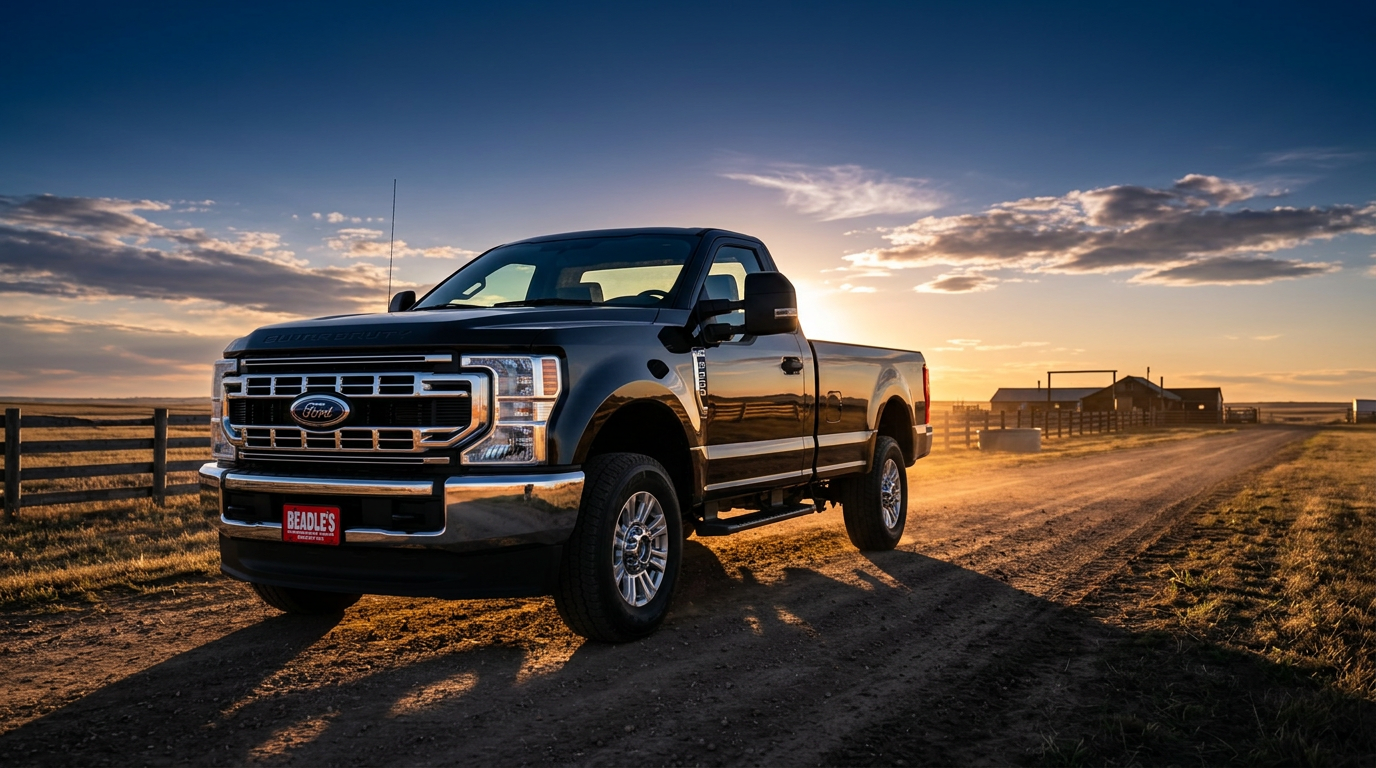
For most buyers, the 2027 Ford F-250 is enough truck. As a single-rear-wheel three-quarter-ton it tows up to 23,000 lbs gooseneck (diesel) and carries up to about 3,700 lbs of payload, properly equipped — plenty for daily driving, recreational towing, and ranch work. Step up to the F-350 mainly for a dually or maximum payload.
“Do I need an F-350, or is the F-250 enough?” is the question we hear most from heavy-duty shoppers. The honest answer for the large majority of buyers around here is that the F-250 is plenty — and stepping up to a one-ton usually solves a problem you don’t actually have.
This guide lays out what a 2027 F-250 handles day to day, exactly how much it tows and hauls, the specific cases where an F-350 earns the upgrade, and whether a three-quarter-ton is too much truck for a daily driver.
What can a 2027 F-250 handle day to day?
Just about everything a non-commercial owner throws at a truck: hauling in the bed, plowing snow, running gravel roads, and towing campers, boats, stock trailers, and the occasional gooseneck. With the now-standard 7.3L gas V8 and available 4×4, it’s a genuine heavy-duty truck without the bulk of a one-ton dually.
Around Bowdle and Aberdeen, that covers the way most people actually use a Super Duty: a capable work-and-family truck during the week, a tow vehicle on the weekend, and a snow-and-gravel machine all winter. The single-rear-wheel setup keeps it easy to drive and park while still carrying serious payload.
How much can it tow and haul?
Properly equipped, a 2027 F-250 tows up to about 19,500 lbs on a fifth-wheel or gooseneck with the 7.3L gas, and up to 23,000 lbs gooseneck with the 6.7L High-Output diesel and the High-Capacity Axle Upgrade. Payload reaches up to about 3,700 lbs.
Put that in real terms: a typical fifth-wheel camper, a loaded tandem stock trailer, or a skid steer on a deckover all sit comfortably within an F-250’s range. You’d have to be pulling a genuinely heavy gooseneck — the kind that’s near the top of the rating every trip — before the F-250 runs out of truck.
| 2027 F-250 capability | Properly equipped |
| Max gooseneck towing | Up to 23,000 lbs (HO diesel) |
| Max fifth-wheel towing | Up to 22,100 lbs (HO diesel); ~19,500 lbs (gas) |
| Max conventional towing | Up to 22,000 lbs (HO diesel); 18,200 lbs (gas) |
| Max payload | Up to about 3,700 lbs |
Maximums require proper equipment and vary by cab, bed, axle, engine, and configuration.
When would you actually need an F-350?
Step up to the F-350 when you need a dual-rear-wheel (dually) setup, the highest payload, or you routinely run heavy gooseneck and fifth-wheel loads near the top of the range. The F-350 adds DRW stability, more payload headroom, and a higher tow ceiling — up to 40,000 lbs gooseneck when properly equipped.
If that’s not you, the extra capability is capability you’ll pay for and rarely use. The dually is wider, harder to park, and less convenient as a daily driver. Most buyers who think they need a one-ton are buying for the heaviest day they can imagine rather than the load they actually pull.
Stay with the F-250 if you tow campers, boats, stock trailers, or an occasional gooseneck, and you want an easy daily driver.
Step up to the F-350 if you need a dually, run heavy goosenecks weekly, carry maximum payload, or want the 40,000-lb tow ceiling.
Is the F-250 too much truck for a daily driver?
No. A single-rear-wheel F-250 drives, parks, and lives like a normal full-size truck — it’s the dually F-350 that gets cumbersome as a daily. With the comfort of a Lariat or Platinum cab and the 7.3L gas, plenty of owners run an F-250 as their everyday vehicle.
The trade-off versus a half-ton F-150 is ride and fuel: the heavier-duty suspension rides a little firmer unloaded, and a big gas V8 isn’t sipping fuel. For buyers who tow with any regularity, that’s a fair trade for the capability and the smoother manners when there’s a trailer behind you.
Our Recommendation
For the large majority of buyers around Bowdle and Aberdeen, the 2027 F-250 is the right truck — it tows up to 23,000 lbs gooseneck and carries up to about 3,700 lbs, which covers daily driving, recreational towing, and ranch work. Only move up to the F-350 if you genuinely need a dually, maximum payload, or routinely tow heavy goosenecks.
From the Beadle Ford Lot
A lot of folks come in convinced they need a one-ton, and once we walk through what they actually pull, most of them land on an F-250 and are happier for it — easier to drive every day, less money out the door, and still more capability than they use. The buyers we send to the F-350 are the ones who already know they need a dually.
Key Takeaways
- The 2027 F-250 tows up to 23,000 lbs gooseneck (diesel) and carries up to about 3,700 lbs of payload.
- That covers daily driving, recreational towing, and ranch work for the large majority of buyers.
- Step up to the F-350 only for a dually, maximum payload, or routine heavy gooseneck towing.
- A single-rear-wheel F-250 drives and parks like a normal full-size truck — not too much for a daily driver.
Frequently Asked Questions
Quick Answers: Is an F-250 Enough?
One-line answers to the follow-up questions buyers ask next.
Max gooseneck tow? Up to 23,000 lbs with the High-Output diesel.
Max payload? Up to about 3,700 lbs.
Does the F-250 come as a dually? No — for a dually, step up to the F-350.
Can it pull a fifth-wheel camper? Yes — up to about 19,500 lbs on the gas V8.
Is it good for ranch work? Yes — stock trailers, hay, feed, and equipment.
When do I need an F-350? Dually, max payload, or routine heavy goosenecks.
Is it too big for daily driving? No — the SRW F-250 drives like a normal full-size truck.
Gas or diesel for an F-250? Gas for occasional towing; diesel for heavy, frequent hauling.
How does it compare to an F-150? More capability and a smoother tow, with a firmer unloaded ride.
Where can I see one? Beadle Ford in Bowdle, SD.
Keep Researching
The complete 2027 Ford F-250 Super Duty overview — trims, towing, specs, and inventory
2027 F-150 vs. F-250 — do you even need a Super Duty?
7.3L gas vs. HO diesel — which engine fits how you tow
2027 F-250 trims for the everyday buyer — where the value lands
My Take on Whether the F-250 Is Enough
I’d rather sell someone the truck they’ll actually use than the biggest one on the lot. When a buyer walks me through their real loads, the F-250 is the answer far more often than not — it does the work, it’s easier to live with every day, and it leaves money on the table that a one-ton would have taken. The people I point to an F-350 already know they need a dually before they walk in.
If you’re not sure which side of that line you’re on, tell me your heaviest trailer and how often you pull it. We’ll figure it out together at Beadle Ford in Bowdle.
About the Author
Lexy Tabbert — Beadle Ford, Bowdle, SD
Lexy Tabbert is the Director of Sales and Marketing at Beadle Ford in Bowdle, South Dakota. She covers Ford vehicles, trim comparisons, and buyer guidance — helping families, ranchers, and ag operators across the region find the right truck and configuration for their needs. Learn more about Lexy.
2027 Ford F-250: 7.3L Gas vs. 6.7L HO Diesel
Quick Answer
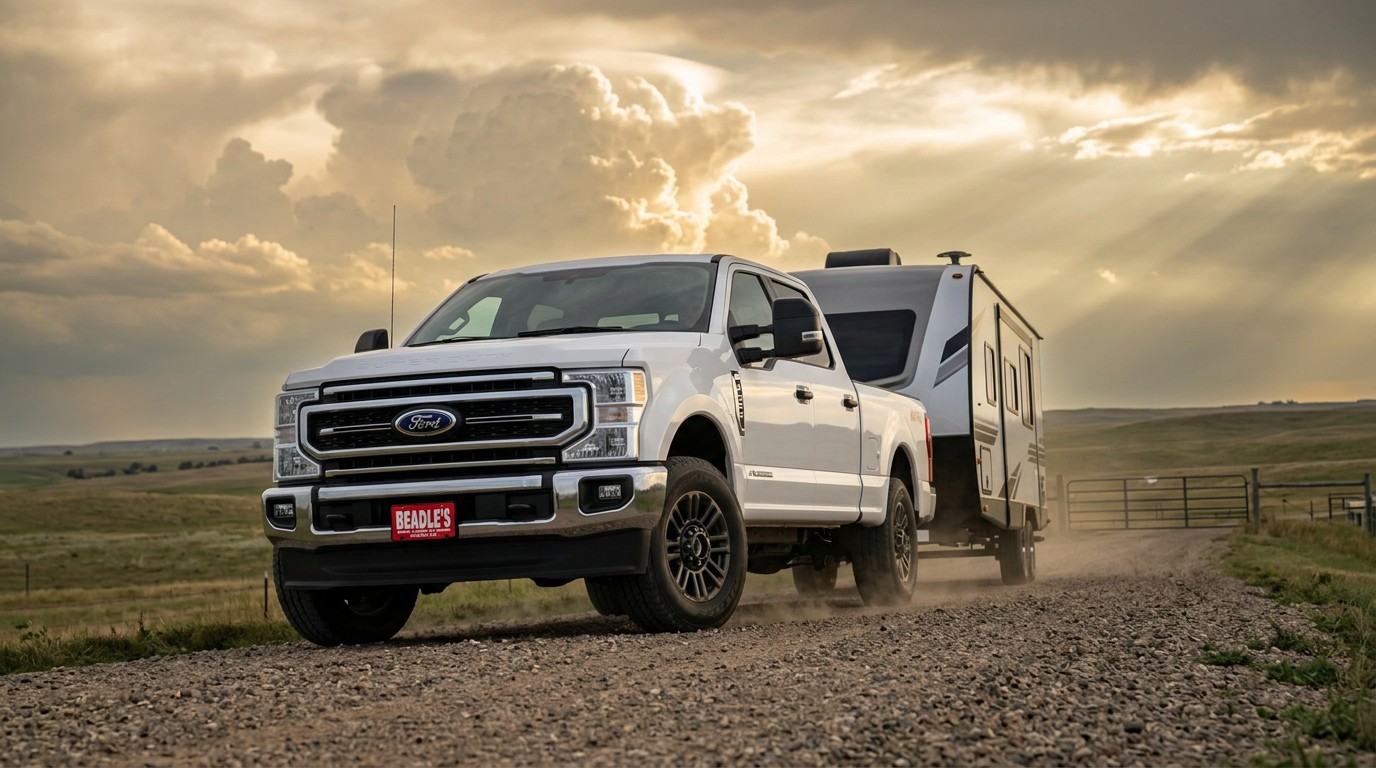
The 2027 F-250 offers a standard 7.3L gas V8 and an optional 6.7L High-Output Power Stroke diesel. The gas V8 tows up to about 19,500 lbs and suits daily driving and occasional towing; the diesel raises the maximum to 23,000 lbs gooseneck for heavy, frequent hauling.
With the 2027 F-250 down to two engines, the choice is cleaner than it used to be: the now-standard 7.3L gas V8, or the available 6.7L High-Output Power Stroke diesel. For most buyers around here, the real question isn’t which engine is “better” — it’s how often and how heavy you actually tow.
This guide breaks down what each engine tows, when the gas V8 is the smarter buy, when the diesel earns its premium, and what each costs to own over time — framed for the occasional-to-regular tower in central South Dakota.
What engines does the 2027 F-250 offer?
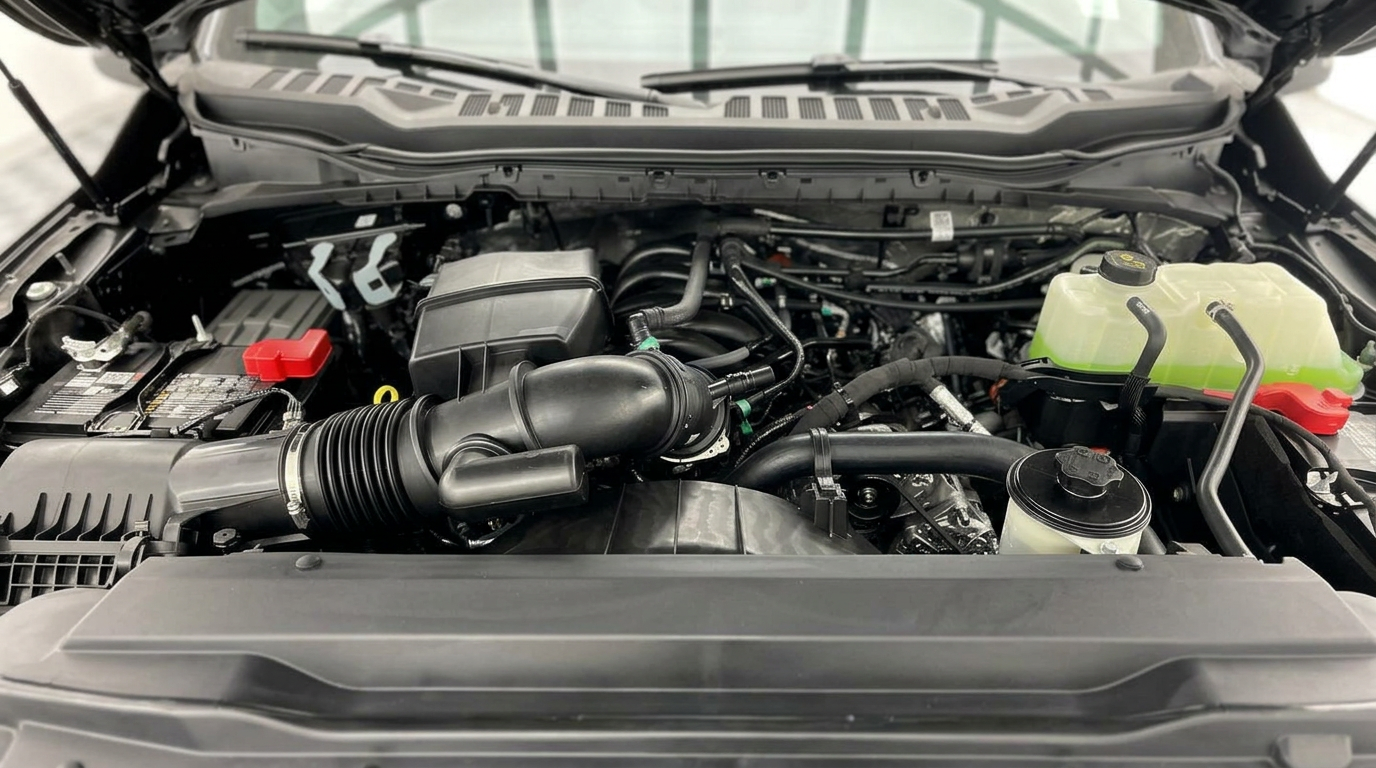
Two. The 7.3L gas V8 is standard on every trim, and the 6.7L High-Output Power Stroke V8 turbo diesel is optional across the line. Both use a 10-speed TorqShift automatic.
The 7.3L gas is a big, simple, naturally aspirated V8 — strong, easy to live with, and inexpensive to maintain. The High-Output diesel trades that simplicity for far more low-end torque and the highest tow ratings in the F-250 lineup. There’s no longer a “middle” engine to overthink; you’re choosing between a capable standard gas V8 and the heavy-haul diesel.
How much can the gas V8 tow vs. the HO diesel?
Properly equipped, the 7.3L gas tows up to about 19,500 lbs on a fifth-wheel or gooseneck and 18,200 lbs conventional. The 6.7L High-Output diesel raises that to up to 23,000 lbs gooseneck, 22,100 lbs fifth-wheel, and 22,000 lbs conventional with the F-250 High-Capacity Axle Upgrade.
That gap matters only if your trailer lives in it. A loaded tandem-axle stock trailer or a typical fifth-wheel camper sits comfortably inside the gas truck’s range. It’s the heavy gooseneck — equipment, big livestock loads, the trailer that’s near the top of the range every week — where the diesel’s extra ceiling and torque pull ahead.
| Max towing (properly equipped) | 7.3L Gas V8 | 6.7L HO Diesel |
| Conventional | Up to 18,200 lbs | Up to 22,000 lbs |
| Fifth-wheel | About 19,500 lbs | Up to 22,100 lbs |
| Gooseneck | About 19,500 lbs | Up to 23,000 lbs |
Maximums require proper equipment and vary by cab, bed, axle, and configuration. The highest diesel ratings require the F-250 High-Capacity Axle Upgrade.
When is the 7.3L gas the smarter buy?
When you tow occasionally rather than constantly, and your loads stay under roughly 19,500 lbs. For a camper on weekends, a stock trailer to the sale barn, or an occasional gooseneck, the gas V8 has the room without the diesel’s upfront cost or added upkeep.
It also wins on the unglamorous stuff: a lower purchase price, cheaper oil changes, no diesel exhaust fluid to manage, and easier cold-weather starting in a Dakota January. For a truck that spends most of its life unloaded and tows on weekends, that adds up.
Our Recommendation
For most F-250 buyers around Bowdle and Aberdeen — daily drivers who tow a camper or a gooseneck occasionally — the standard 7.3L gas V8 is the smarter buy. It covers up to about 19,500 lbs of towing and saves you several thousand dollars up front plus the diesel’s ongoing maintenance.
When does the HO diesel pay off?
When you tow heavy and often. The High-Output diesel’s extra torque, higher tow ceiling, and better fuel economy under load make it worth the premium for buyers who run near the top of the range regularly — loaded goosenecks, equipment hauling, or long highway miles with a fifth-wheel.
The diesel also tends to hold its value well and is built for high-mileage, hard-working duty cycles. If towing is your truck’s main job rather than an occasional weekend, the diesel usually earns back its upfront cost in capability, comfort under load, and resale. Pair it with the High-Capacity Axle Upgrade to unlock the 23,000-lb gooseneck maximum.
What does each engine cost to own?
The gas V8 is cheaper to buy and cheaper to maintain; the diesel costs several thousand dollars more up front and more per service, but returns better towing fuel economy and stronger resale. Ford has not yet published final 2027 pricing, so the exact diesel premium is to be confirmed.
The honest math comes down to use. If you tow occasionally, the gas truck’s lower cost of ownership is hard to beat. If you tow heavy and rack up loaded miles, the diesel’s efficiency and durability under load close the gap and often come out ahead over a long ownership period.
| Factor | 7.3L Gas V8 | 6.7L HO Diesel |
| Best for | Daily driving, occasional towing | Heavy, frequent towing |
| Upfront cost | Lower (standard) | Several thousand more |
| Maintenance | Lower; no DEF | Higher; DEF, larger oil capacity |
| Towing fuel economy | Good for the class | Better under heavy load |
| Resale | Solid | Strong, especially high-mileage |
From the Beadle Ford Lot
The question we ask every gas-versus-diesel shopper is the same: what’s your heaviest trailer, and how often do you pull it? When we weigh a buyer’s actual loaded trailer against the now-standard 7.3L gas, most realize the gas truck covers it with room to spare — and the diesel decision turns out to be about frequency, not whether it’ll handle the job.
Key Takeaways
- The 7.3L gas V8 is standard and tows up to about 19,500 lbs on a fifth-wheel or gooseneck.
- The 6.7L High-Output diesel raises the max to 23,000 lbs gooseneck with the High-Capacity Axle Upgrade.
- Choose the gas V8 for daily driving and occasional towing; choose the diesel for heavy, frequent hauling.
- The gas V8 costs less to buy and maintain; the diesel returns better towing economy and stronger resale.
- The deciding factor is frequency and trailer weight, not whether the gas truck can do the job.
Frequently Asked Questions
Quick Answers: 2027 F-250 Gas vs. Diesel
One-line answers to the follow-up questions buyers ask next.
Which engine is standard? The 7.3L gas V8.
Gas towing max? About 19,500 lbs fifth-wheel/gooseneck, 18,200 lbs conventional.
Diesel towing max? Up to 23,000 lbs gooseneck with the High-Capacity Axle Upgrade.
Which is cheaper to buy? The gas V8 — it’s standard.
Which is cheaper to maintain? The gas V8 — no DEF, smaller oil changes.
Which has better towing fuel economy? The diesel, under heavy load.
Which holds value better? The diesel, especially at high mileage.
Best for occasional towing? The 7.3L gas V8.
Best for daily heavy hauling? The 6.7L High-Output diesel.
Do both use the same transmission? Yes — a 10-speed TorqShift automatic.
Keep Researching
The complete 2027 Ford F-250 Super Duty overview — trims, towing, specs, and inventory
2027 F-250 for recreational towing — campers and fifth-wheels on the gas V8
What’s new for the 2027 F-250 — the four-to-two engine change explained
Is an F-250 enough truck? — when to consider stepping up to an F-350
My Take on Gas vs. Diesel in the 2027 F-250
I steer a lot of people toward the gas V8, and not because it’s the cheaper sale — it’s because most of the folks who ask me are towing a camper or a stock trailer a handful of times a year, not running a loaded gooseneck every week. For that buyer, the now-standard 7.3L is genuinely the right truck, and it keeps several thousand dollars in their pocket. When someone really does pull heavy and often, the diesel is the obvious call and I’ll say so.
The best way to settle it is to tell me your heaviest trailer and how often you pull it. Bring those numbers to Beadle Ford in Bowdle and we’ll match the engine to how you actually use the truck.
About the Author
Lexy Tabbert — Beadle Ford, Bowdle, SD
Lexy Tabbert is the Director of Sales and Marketing at Beadle Ford in Bowdle, South Dakota. She covers Ford vehicles, trim comparisons, and buyer guidance — helping families, ranchers, and ag operators across the region find the right truck and configuration for their needs. Learn more about Lexy.
What’s New for the 2027 Ford F-250 Super Duty
Quick Answer
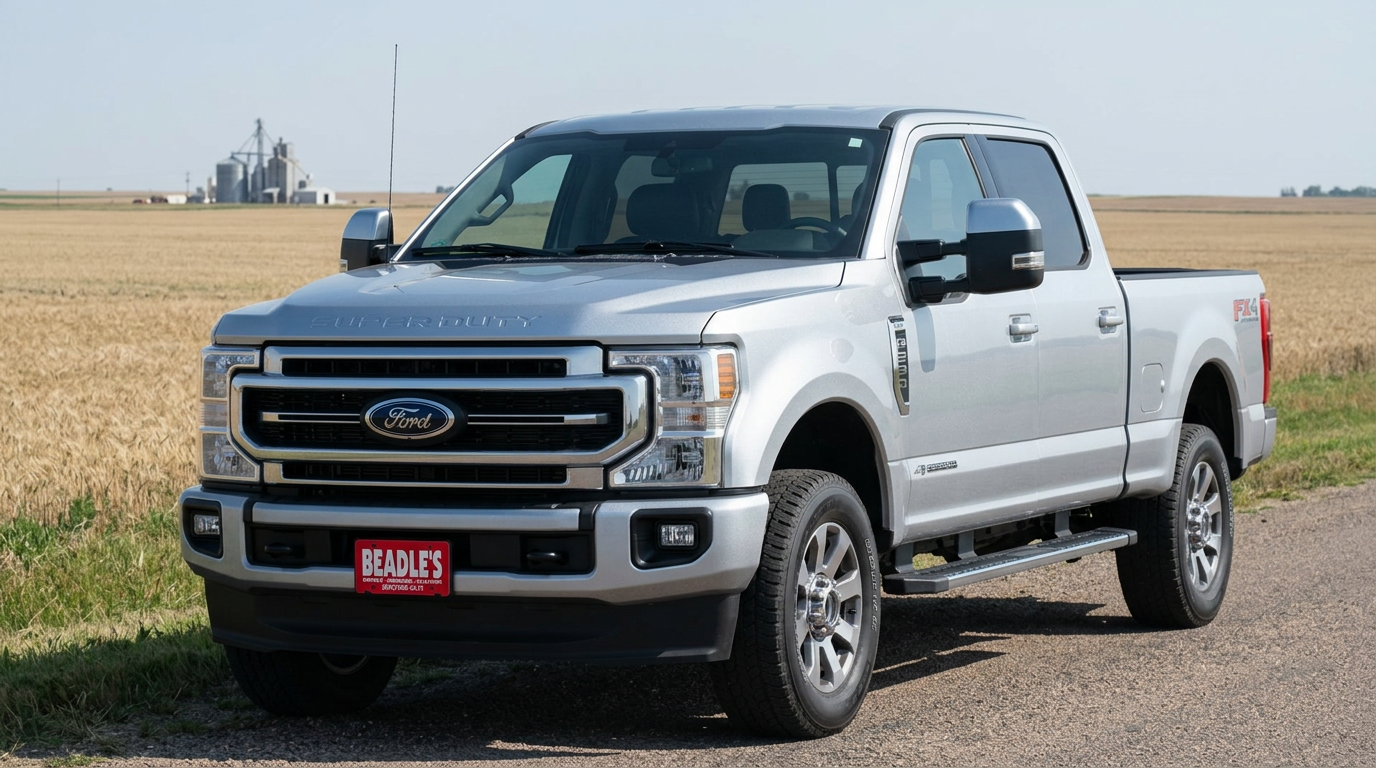
For 2027, the Ford F-250 Super Duty drops from four engines to two: the 7.3L gas V8 is now standard on every trim, and the 6.7L High-Output Power Stroke diesel is the only diesel. New for 2027 are Tremor on the XL, the Carhartt Package, and two new colors.
If you’re shopping the 2027 Ford F-250, the headline is the engine lineup. Ford cut it from four engines to two, and making the 7.3L gas V8 standard changes the math for most buyers — in a good way if you tow occasionally rather than every day.
Here’s every meaningful change for 2027 — engines, packages, colors, and what to expect on price — and what it all means for a daily-capable three-quarter-ton around Bowdle and Aberdeen.
What are the biggest changes for the 2027 F-250?
The biggest change is the engine lineup dropping from four engines to two: the 7.3L gas V8 is now standard on every trim, and the 6.7L High-Output Power Stroke diesel is the only diesel. Everything else builds on that.
Here’s the full list of what’s new for 2027:
- Two engines, not four — 7.3L gas V8 standard on all trims; 6.7L High-Output Power Stroke diesel optional across the line.
- Tremor Off-Road now available on the XL (with the STX Appearance Package), opening the off-road package to the work trim.
- New XL Off-Road 35-inch Tire Package — 35-inch tires, a locking rear differential, a taller ride height, Rock Crawl mode, Trail Control, and heavy-duty skid plates.
- New Super Duty Carhartt Package — work-grade styling on single-rear-wheel trucks.
- Two new colors — Neptune Blue and Iconic Silver Metallic, replacing Argon Blue Metallic and Avalanche.
For a North Dakota and South Dakota buyer, the takeaway is simple: the 2027 F-250 keeps all of its capability while making the decision easier and the standard truck more capable.
Why did Ford drop two engines for 2027?
Ford simplified the lineup. The 6.8L gas V8 and the standard-output 6.7L Power Stroke diesel are both discontinued for 2027, leaving the 7.3L gas V8 and the 6.7L High-Output Power Stroke diesel.
In practice, the two remaining engines cover the full range of how F-250 owners actually use the truck. The 7.3L gas handles daily driving and the large majority of recreational and ranch towing; the High-Output diesel is there for the buyer who tows heavy and often. Cutting the two middle engines mostly removes decision paralysis — you’re choosing between a capable standard gas V8 and the heavy-haul diesel, not sorting through four overlapping options.
Is the 7.3L gas V8 really standard now?
Yes. The 7.3L gas V8 is standard on every 2027 F-250 trim, from XL to Platinum. In 2026 it was roughly a $1,500 option over the base engine — so for 2027 you get more standard engine for your money.
Properly equipped, the 7.3L gas pulls up to about 19,500 lbs on a fifth-wheel or gooseneck and 18,200 lbs conventional. For most people towing a camper, a stock trailer, or an occasional gooseneck, that’s plenty of margin without the upfront cost or added maintenance of a diesel.
Our Recommendation
For most daily drivers and weekend haulers around Bowdle and Aberdeen, the now-standard 7.3L gas V8 is the right call — it covers daily miles and up to about 19,500 lbs of towing without diesel cost. Step up to the High-Output diesel only if you tow heavy and often or want the truck’s maximum ratings.
Want the full gas-versus-diesel breakdown? That decision gets its own deep dive within the complete 2027 F-250 overview.
What new packages and colors arrived for 2027?
Three package additions and two new colors. Tremor Off-Road is now available on the XL (with the STX Appearance Package), there’s a new XL Off-Road 35-inch Tire Package, and the Super Duty Carhartt Package debuts on single-rear-wheel trucks.
On color, Neptune Blue (a deep marine blue) and Iconic Silver Metallic (a bright silver) are new for 2027, while Argon Blue Metallic and Avalanche are discontinued. If you had your eye on either dropped color, a 2026 F-250 still on the lot is your last chance to get it.
You can see all ten 2027 colors on the same truck with our interactive Super Duty color picker, or dig into appearance packages and wheels in the 2027 F-250 colors & appearance guide.
Will the 2027 F-250 cost more than the 2026?
Expect a modest increase. The 7.3L gas V8 was about a $1,500 option in 2026 and is now standard equipment, so the entry price likely reflects that. Ford has not yet published final 2027 pricing.
That makes the timing question real: order a 2027 to get the simplified lineup and the new packages, or buy a 2026 on the lot to lock in an engine the 2027 drops. There’s no wrong answer — it comes down to what you want under the hood and how soon you need the truck.
Order a 2027 if you want the standard 7.3L gas, Tremor on the XL, the new Carhartt Package, or one of the new colors — and you can wait for a build.
Buy a 2026 now if you want the 6.8L gas or the standard-output diesel (both dropped for 2027), or you need a truck on the lot today.
From the Beadle Ford Lot
Most F-250 shoppers who hear about the engine changes walk in worried they’ve lost an option they wanted. Once we show them the 7.3L gas is now standard on every trim — and walk through what it actually tows — the simpler lineup usually fits them better than the engine they came in asking about.
Key Takeaways
- The 2027 F-250 cuts its engine lineup from four to two: 7.3L gas V8 standard, 6.7L High-Output diesel optional.
- The 6.8L gas V8 and the standard-output 6.7L diesel are discontinued for 2027.
- Tremor is now available on the XL, plus a new XL Off-Road 35-inch Tire Package and the Super Duty Carhartt Package.
- Neptune Blue and Iconic Silver Metallic are new colors; Argon Blue Metallic and Avalanche are gone.
- Expect a modest price increase since the 7.3L gas (a ~$1,500 option in 2026) is now standard; final pricing is not yet announced.
Frequently Asked Questions
Quick Answers: 2027 F-250 Changes
One-line answers to the follow-up questions buyers ask next.
How many engines for 2027? Two — 7.3L gas standard, 6.7L High-Output diesel optional.
Which engines were dropped? The 6.8L gas V8 and the standard-output 6.7L diesel.
Is the 7.3L gas standard now? Yes, on every trim.
What does the 7.3L gas tow? Up to about 19,500 lbs fifth-wheel/gooseneck, properly equipped.
Is Tremor on the XL now? Yes — new for 2027, with the STX Appearance Package.
New colors? Neptune Blue and Iconic Silver Metallic.
Dropped colors? Argon Blue Metallic and Avalanche.
Is there a Carhartt edition? Yes — the new Super Duty Carhartt Package, single-rear-wheel.
Will it cost more? Likely a modest increase; final pricing not yet announced.
Can I order one now? Yes — 2027 order banks are open; build yours to spec.
Keep Researching
The complete 2027 Ford F-250 Super Duty overview — trims, towing, specs, and inventory
2027 F-250: 7.3L gas vs. HO diesel — which engine fits how you tow
Buy a 2026 F-250 now or order a 2027? — the timing and engine trade-off
2027 F-250 colors & appearance — the new colors, packages, and wheels
My Take on the 2027 F-250 Changes
I think the simplified lineup is a win for the kind of F-250 buyer we see most around here. A lot of folks came in over the years talking themselves into a diesel they didn’t really need for a camper and the occasional gooseneck. Making the 7.3L gas standard takes the pressure off that decision — you get a genuinely capable truck without paying the diesel premium, and the diesel is still right there when you actually run heavy.
If you’re weighing a 2026 on our lot against ordering a 2027, I’m happy to walk through both with you and figure out which one matches how you’ll actually use the truck. Stop by Beadle Ford in Bowdle or give us a call.
About the Author
Lexy Tabbert — Beadle Ford, Bowdle, SD
Lexy Tabbert is the Director of Sales and Marketing at Beadle Ford in Bowdle, South Dakota. She covers Ford vehicles, trim comparisons, and buyer guidance — helping families, ranchers, and ag operators across the region find the right truck and configuration for their needs. Learn more about Lexy.
Connect with us

