

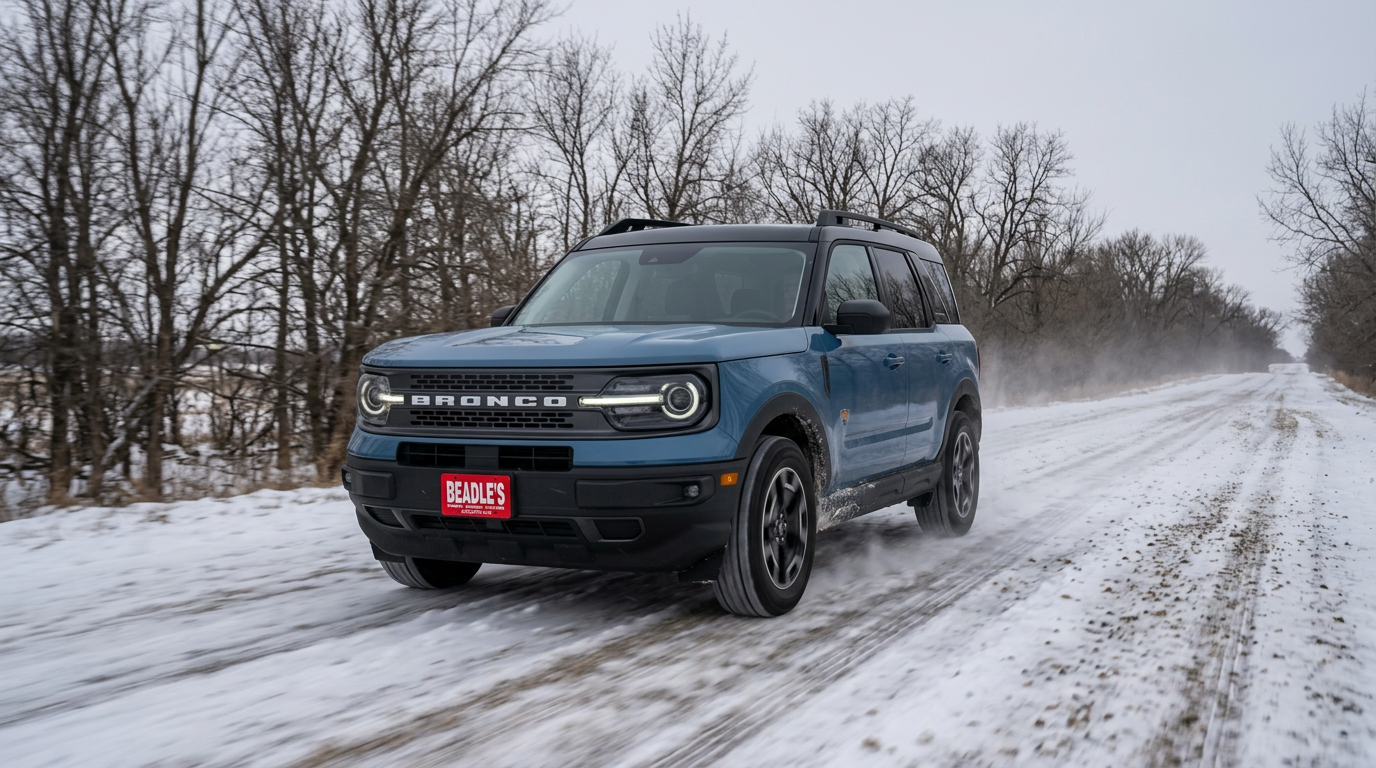
A South Dakota winter puts real demands on a daily driver. Highway 12 in January, gravel county roads in a March freeze-thaw cycle, and remote distances from the nearest service bay mean your vehicle has to perform across a range of cold-weather conditions without cutting corners. The 2026 Bronco Sport’s 4×4 standard across all trims, Slippery G.O.A.T. mode, and available winter features make it a genuinely capable winter vehicle — but some configurations handle it better than others.
This guide breaks down what the Bronco Sport actually offers for winter driving, which trim configurations matter most for cold-weather capability, and what to realistically expect on the roads around Bowdle and north-central South Dakota from November through March.
On This Page
- How does the Bronco Sport’s standard 4×4 handle winter conditions?
- What does Slippery mode do in snow and ice?
- Which trim has the best tires for winter driving?
- What cold-weather comfort features does the Bronco Sport have?
- Which trim is best for South Dakota winter daily driving?
- What are the Bronco Sport's winter limitations?
How does the Bronco Sport’s standard 4×4 handle winter conditions?
Every 2026 Bronco Sport comes with 4×4 as standard equipment — not AWD, not a front-wheel-drive base with an optional upgrade. This matters for winter driving because 4×4 systems are engineered to handle torque distribution differently than most AWD systems, particularly on uneven or deeply compromised surfaces. On packed snow, ice-over gravel, or unprepared roads, the mechanical engagement provides real traction rather than relying solely on electronic bias.
Big Bend, Heritage, and Outer Banks use the standard 4×4 system with HOSS 1.0 Off-Road Tuned Suspension. The Badlands uses Advanced 4×4 with a twin-clutch rear drive unit that allows individual wheel torque control — more precise in demanding conditions but not meaningfully different for typical winter highway and gravel road use.
For the driving most buyers in north-central SD actually do in winter — highway runs, gravel county roads, town errands in cold and wind — the standard 4×4 system on Big Bend, Heritage, and Outer Banks handles all of it without issue. The Badlands’ Advanced 4×4 advantage shows up more on technical off-road terrain than on winter pavement.
What does Slippery mode do in snow and ice?
Slippery is one of the five standard G.O.A.T. modes on every 2026 Bronco Sport trim. It’s specifically designed for low-traction surfaces — snow, ice, wet packed gravel, and rain-slicked pavement. In Slippery mode, the throttle response is significantly reduced (pressing the accelerator delivers power more gradually, preventing sudden wheel spin), the transmission shifts up earlier to keep engine RPM lower, and the traction control system intervenes earlier before wheel spin develops into a slide.
On Highway 12 between Bowdle and Aberdeen in January, Slippery mode is the right selection for most conditions. It removes the abrupt throttle response that can induce a slide when accelerating from a stop on a snow-covered intersection, and it keeps the AWD torque distribution optimized for surfaces where grip is unreliable.
Don’t leave Slippery mode on all winter. It reduces power response in a way that’s appropriate for ice and packed snow but not necessary on dry cold pavement. Use Normal for clear roads and switch to Slippery when conditions warrant.
Which trim has the best tires for winter driving?
Tire choice is the single most important factor in winter traction, more than 4×4 system, more than electronic stability control. The Bronco Sport’s trim-level tire differences are meaningful for winter performance.
| Trim | Standard Tires | Winter Performance |
|---|---|---|
| Big Bend (base) | All-season (A/S) | Adequate for packed snow and light ice; not optimized for deep winter |
| Big Bend + Bronze Package (60H) | All-terrain (A/T) | Better biting edges for loose snow and gravel, improved on unprepared roads |
| Heritage | 225/65R17 A/T standard | Best standard winter grip in 1.5L lineup — A/T tread handles snow and gravel well |
| Outer Banks (base) | All-season on 18” wheels | Comparable to Big Bend base; comfort-focused A/S tires |
| Outer Banks + Sasquatch | P235/65R17 A/T | Strong winter grip, especially on loose snow |
| Badlands | A/T tires standard | Full winter capability alongside the best mechanical 4×4 hardware in the lineup |
For dedicated winter use in deep snow or on unplowed gravel, a set of winter-specific tires on any of these trims will outperform the factory A/T or A/S tires. Dedicated winter tires use a softer rubber compound that stays pliable at low temperatures where all-season and all-terrain compounds stiffen and lose grip. This is the upgrade that makes the most difference if you’re in genuinely harsh conditions for extended periods.
What cold-weather comfort features does the Bronco Sport have?
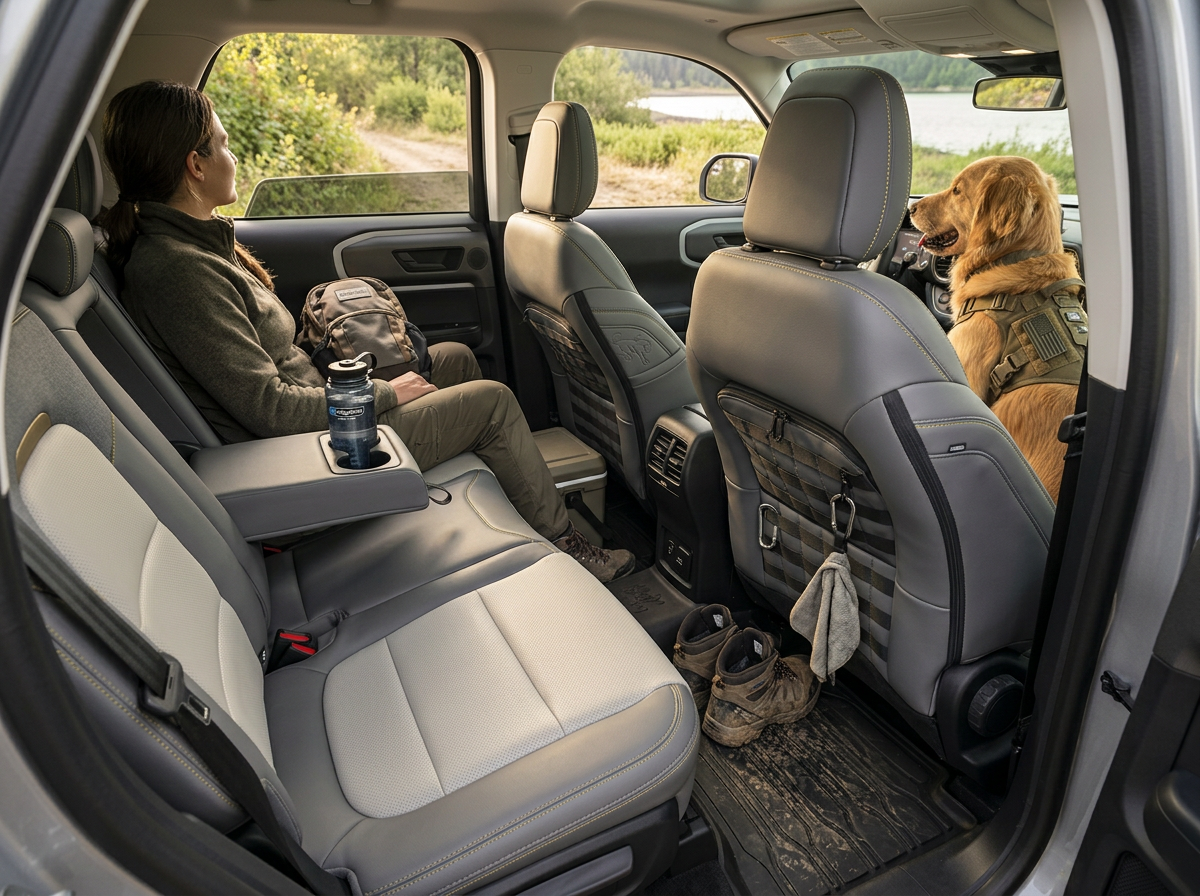
Cold-weather comfort features vary by trim. The key features — heated seats, heated steering wheel, and remote start — are not available on every trim.
| Feature | Big Bend | Heritage | Outer Banks | Badlands |
|---|---|---|---|---|
| Heated front seats | — | — | ✓ Standard | ✓ Standard |
| Heated steering wheel | — | — | ✓ Standard | ✓ Standard |
| Remote start | — | — | ✓ Standard | ✓ Standard |
| Dual-zone climate | — | — | ✓ Standard | ✓ Standard |
| Standard 4×4 | ✓ | ✓ | ✓ | ✓ |
| Slippery G.O.A.T. Mode | ✓ | ✓ | ✓ | ✓ |
Remote start is a genuine winter convenience — starting the Bronco Sport from inside to pre-warm the cabin before you walk out at −20° in January is a real quality-of-life feature. It’s standard on Outer Banks and Badlands only. Big Bend and Heritage don’t have it unless you add an aftermarket system.
Which trim is best for South Dakota winter daily driving?
The best trim depends on whether your priority is winter traction, winter comfort, or both.
Best for Winter Traction (Budget-Conscious)
Heritage — A/T tires standard, full 4×4, Slippery mode, and the lowest price point among trims with standard all-terrain rubber. No heated features, but the traction hardware is there without adding packages.
Best for Winter Comfort + Traction
Outer Banks — Heated seats, heated steering wheel, remote start, and dual-zone climate as standard. A/S tires on the base, but adding the Sasquatch Package upgrades to A/T tires. The combination of comfort features and available traction hardware makes this the best all-around winter daily driver.
Best for Maximum Winter Capability
Badlands — Advanced 4×4, HOSS 2.0 suspension, A/T tires, heated leather seats, heated steering wheel, remote start, and the highest tow rating if you’re pulling anything in winter. More capability than most buyers need for daily driving, but no compromises.
What are the Bronco Sport’s winter limitations?
The Bronco Sport handles South Dakota winters well within its class, but it has real limits that are worth understanding before depending on it in extreme conditions.
- Ground clearance: The Bronco Sport’s clearance is adequate for packed snow but not designed for deep, unplowed drifts. In conditions where a truck would push through, the Bronco Sport will high-center.
- Heated seats are trim-limited: Buyers who want heated seats must be on Outer Banks or Badlands. Big Bend and Heritage don’t offer them, even as an option.
- All-season tires on base trims: Big Bend and Outer Banks (without Sasquatch) ship with all-season tires. In extreme cold, dedicated winter tires provide significantly better stopping distances and lateral grip than A/S rubber.
- Not a plow vehicle: The Bronco Sport is not a worksite winter vehicle. It handles everyday winter driving conditions well — it is not built for heavy duty winter work use.
For context on how these features fit the full 2026 Bronco Sport lineup, the 2026 Bronco Sport overview covers all trims and configurations in one place.
Key Takeaways
- Every 2026 Bronco Sport trim includes 4×4 and Slippery G.O.A.T. mode as standard — no FWD models exist in this lineup.
- Slippery mode is specifically designed for snow, ice, and wet packed gravel — use it on Highway 12 in winter, not as your year-round default.
- The Heritage is the only 1.5L trim with A/T tires as standard equipment — without adding a package.
- Heated seats, heated steering wheel, and remote start are only standard on Outer Banks and Badlands.
- For the best combination of winter comfort and traction, the Outer Banks (especially with Sasquatch Package) or the Badlands are the strongest choices.
- Dedicated winter tires on any trim will outperform factory A/T and A/S tires in extreme cold conditions.
Frequently Asked Questions
Is the Bronco Sport better than an AWD crossover for South Dakota winter driving?
For the conditions most common in north-central SD — packed snow on highways, gravel roads, occasional deeper snow — the Bronco Sport’s standard 4×4 and Slippery mode provide more predictable and capable winter performance than a typical AWD crossover. AWD systems are designed primarily for on-road use. The Bronco Sport’s 4×4 system combined with the HOSS suspension and G.O.A.T. modes is tuned for a wider range of surfaces. The tire choice still matters more than the drivetrain type on any platform.
Can I add heated seats to a Big Bend or Heritage?
Heated seats are not available as a factory option on Big Bend or Heritage. They are standard equipment only on Outer Banks and Badlands. Aftermarket heated seat installations are possible through dealer accessories or aftermarket shops, but the factory integration with the climate control system is not replicable after the fact. If heated seats are a priority, the Outer Banks is the minimum trim to consider.
Do all-terrain tires actually help on ice?
All-terrain tires improve performance in snow and loose-surface conditions over all-season tires, primarily because of their more aggressive tread pattern and siping. On ice specifically, A/T tires do not provide significantly better grip than A/S tires — both compounds stiffen in extreme cold. For ice, dedicated winter tires (which use a silica-enhanced compound that stays flexible below freezing) are meaningfully better than both A/T and A/S options. A/T tires shine in snow, slush, loose gravel, and dirt — not primarily on bare ice.
How far in advance should I warm up the Bronco Sport at -20 degrees?
Modern fuel-injected engines, including the Bronco Sport’s EcoBoost turbocharged units, do not require extended warm-up times for engine protection purposes — they can be driven gently within a minute or two at any temperature. The reason to use remote start at very cold temperatures is primarily cabin comfort — getting the interior to a usable temperature before you get in — and windshield defrost. Five to ten minutes of remote start at −20°F will warm the cabin and defrost the glass. Drive gently until the engine temperature reaches normal operating range.
My Take on the Bronco Sport as a South Dakota Winter Vehicle
I hear this question a lot at Beadle Ford in Bowdle, usually starting in October: is the Bronco Sport actually going to be okay out here in January? The honest answer is yes — for the conditions most buyers around here actually face, it handles them well. Standard 4×4 on every trim, Slippery mode that works, and a cabin that holds heat are the three things that matter most for daily winter driving.
What I’d tell any buyer focused on winter: the trim that gives you the most useful combination is the Outer Banks. The heated seats, heated steering wheel, and remote start are the difference between a cold-weather capable vehicle and a genuinely comfortable one for a South Dakota January. If budget is a factor, the Heritage gets you A/T tires standard without the comfort features. Both are solid options — it comes down to whether traction or comfort is the priority.
The full picture of how the Bronco Sport handles all four seasons in SD — including the off-road and towing capability that make it a year-round vehicle — is in the 2026 Ford Bronco Sport overview. Come in and let’s talk through the right build for your winter driving situation.
About the Author
Lexy Tabbert — Beadle Ford, Bowdle, SD
Lexy Tabbert covers Ford vehicles, trim comparisons, and buyer guidance for Beadle Ford in Bowdle, South Dakota. Her content is grounded in real buyer conversations with farmers, ranchers, and outdoor enthusiasts across north-central South Dakota and beyond. Learn more about Lexy.
Connect with us

