
Quick Answer
Choose the 2027 Ford F-150 for light, occasional towing and the best daily ride and fuel economy. Step up to the F-250 Super Duty when you tow a fifth-wheel or gooseneck, haul heavy regularly, or want capability well beyond the F-150's roughly 13,500-lb maximum.
The 2027 Ford F-150 and F-250 look like cousins, but they're built for different jobs. The F-150 is a half-ton tuned for everyday driving and lighter loads; the F-250 Super Duty is a three-quarter-ton built to tow and haul heavy. The real question isn't which is "better" — it's whether you actually need Super Duty capability.
This guide compares the two on towing and payload, ride and fuel, and daily livability, then helps you match the truck to how often and how heavy you tow around central South Dakota.
How do the 2027 F-150 and F-250 differ?
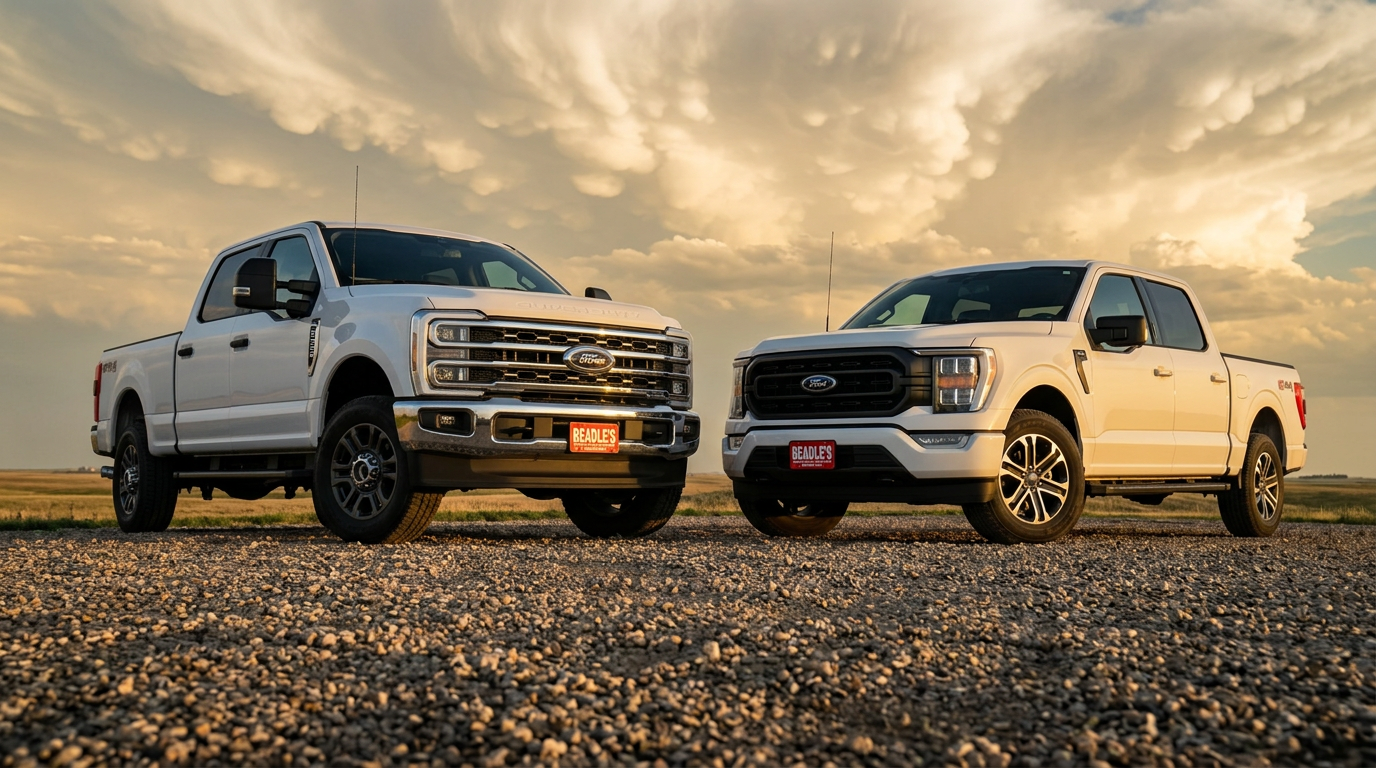
The F-150 is a half-ton; the F-250 is a three-quarter-ton Super Duty. That means heavier frames and axles, beefier brakes and suspension, and a fifth-wheel/gooseneck-ready bed on the F-250 — built for towing and hauling at weights a half-ton isn't rated for.
The F-150 counters with a lighter, more refined platform: a smoother unloaded ride, better fuel economy, more engine and trim variety, and easier maneuvering. Think of the F-150 as the do-everything daily truck and the F-250 as the dedicated tow-and-haul truck that's still comfortable to live with.
Towing and payload: where's the real gap?
On conventional towing, the F-150 tops out around 13,500 lbs, while the 2027 F-250 reaches up to 18,200 lbs with the gas V8 and up to 22,000 lbs with the High-Output diesel. The bigger difference is fifth-wheel and gooseneck capability: the F-250 adds up to 23,000 lbs gooseneck, a job the F-150 isn't built for.
Payload tells the same story — the F-250 carries up to about 3,700 lbs versus the F-150's lighter-duty rating. If you're hauling a fifth-wheel camper, a loaded gooseneck, or heavy material in the bed, that's Super Duty territory. If your trailer is a boat, a small utility trailer, or a bumper-pull under the F-150's limit, the half-ton has it covered.
| Capability (properly equipped) | 2027 F-150 | 2027 F-250 |
| Max conventional towing | Around 13,500 lbs | Up to 22,000 lbs |
| Fifth-wheel / gooseneck | Not its strength | Up to 23,000 lbs gooseneck |
| Class | Half-ton | Three-quarter-ton (Super Duty) |
| Best at | Daily driving, light towing | Heavy and frequent towing |
F-250 figures verified for 2027; F-150 maximum is its top conventional rating with the appropriate engine and tow package and varies by configuration.
Ride, fuel, and daily livability compared
Unloaded, the F-150 rides smoother and uses less fuel — its lighter-duty suspension and lineup of efficient engines make it the easier everyday truck. The F-250's heavy-duty suspension is firmer when the bed is empty, and a big gas V8 or diesel isn't sipping fuel.
Flip a heavy trailer onto the back, though, and the picture changes: the F-250 stays planted and composed where a half-ton starts to feel the load. So the "better daily driver" depends entirely on whether you're usually empty or usually towing. For a truck that mostly runs errands and tows light, the F-150 wins comfort and fuel; for a truck that earns its keep with a trailer, the F-250's manners under load matter more.
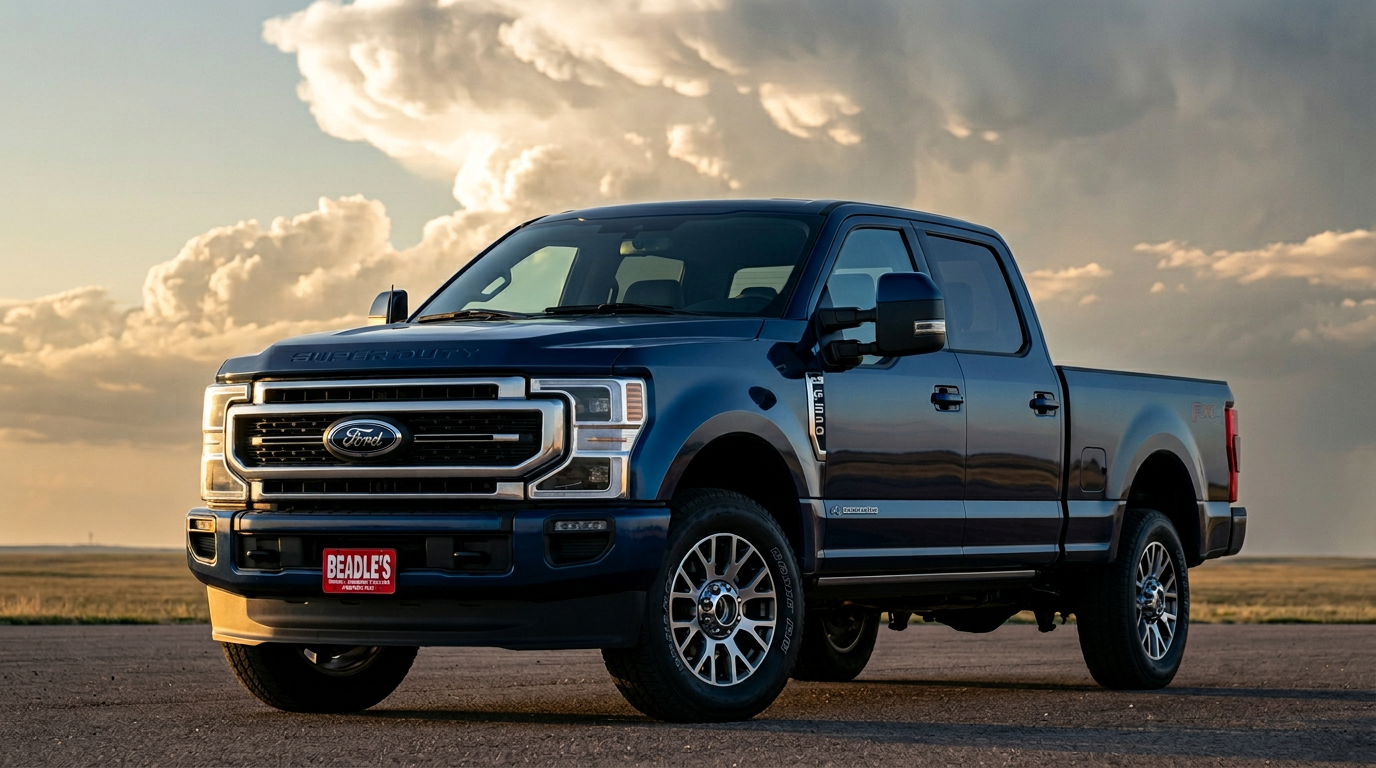
Which truck fits your towing frequency?
Match the truck to how often and how heavy you tow. If you tow light loads occasionally and want the best ride and fuel economy, the F-150 is the smarter half-ton. If you tow a fifth-wheel or gooseneck, haul heavy in the bed, or tow with any regularity, the F-250 is built for it.
Our Recommendation
For buyers towing under about 13,000 lbs occasionally — a boat, a small camper, a utility trailer — the 2027 F-150 is the better daily truck. The moment a fifth-wheel, a gooseneck, or regular heavy towing enters the picture, the 2027 F-250 is the right call — it tows up to 22,000 lbs conventional and 23,000 lbs gooseneck, well past anything a half-ton should attempt.
Choose the F-150 if you tow light and occasionally and want the best ride, fuel economy, and price.
Choose the F-250 if you tow a fifth-wheel or gooseneck, haul heavy, or tow regularly enough to want the capability.
From the Beadle Ford Lot
The cleanest way we help people decide is the trailer question: if it's a gooseneck or a fifth-wheel, the conversation is over — that's a Super Duty. If it's a bumper-pull under the F-150's rating and the truck mostly runs empty, the half-ton usually makes them happier day to day. The trailer almost always answers it.
Key Takeaways
- The F-150 is a half-ton; the F-250 is a three-quarter-ton Super Duty built for heavier towing and hauling.
- The F-150 tops out around 13,500 lbs conventional; the 2027 F-250 reaches up to 22,000 lbs conventional and 23,000 lbs gooseneck.
- Fifth-wheel and gooseneck towing is Super Duty territory — not a half-ton job.
- The F-150 rides smoother and uses less fuel unloaded; the F-250 is more composed under a heavy trailer.
- Let the trailer decide: light bumper-pull and mostly empty means F-150; gooseneck, fifth-wheel, or frequent heavy towing means F-250.
Frequently Asked Questions
Quick Answers: F-150 vs. F-250
One-line answers to the follow-up questions buyers ask next.
Which is the half-ton? The F-150; the F-250 is a three-quarter-ton.
F-150 max towing? Around 13,500 lbs conventional, properly equipped.
F-250 max towing? Up to 22,000 lbs conventional, 23,000 lbs gooseneck.
Which rides better empty? The F-150.
Which uses less fuel? The F-150.
Which tows a fifth-wheel? The F-250 — that's Super Duty territory.
Which is the better daily driver? The F-150 if you're mostly empty; the F-250 if you tow heavy.
Which has more payload? The F-250, up to about 3,700 lbs.
Gas or diesel in the F-250? Gas for occasional towing; diesel for heavy, frequent hauling.
Where can I compare them? Beadle Ford in Bowdle, SD.
Keep Researching
The complete 2027 Ford F-250 Super Duty overview — trims, towing, specs, and inventory
Is an F-250 enough truck? — or do you need to step up to an F-350
2027 F-250 for recreational towing — campers and fifth-wheels on the F-250
2027 F-250 trims for the everyday buyer — where the value lands
My Take on F-150 vs. F-250
I don't push people up to a Super Duty they don't need — if a buyer tows a boat or a small camper a few times a summer and the truck is otherwise empty, the F-150 is the one I'd put my own family in. But I also don't want anyone underbuying. The minute someone mentions a gooseneck or a fifth-wheel, the F-250 is the honest answer, and trying to make a half-ton do that job is how people end up unhappy and unsafe.
Tell me your heaviest trailer and how often you pull it and I'll tell you straight which truck you need. We've got both at Beadle Ford in Bowdle and you're welcome to drive them back to back.
About the Author
Lexy Tabbert — Beadle Ford, Bowdle, SD
Lexy Tabbert is the Director of Sales and Marketing at Beadle Ford in Bowdle, South Dakota. She covers Ford vehicles, trim comparisons, and buyer guidance — helping families, ranchers, and ag operators across the region find the right truck and configuration for their needs. Learn more about Lexy.